Licensing for knife sales: government response (accessible)
Updated 25 November 2026

© Crown copyright 2026
This publication is licensed under the terms of the Open Government Licence v3.0 except where otherwise stated. To view this licence, visit nationalarchives.gov.uk/doc/open-government-licence/version/3 or write to the Information Policy Team, The National Archives, Kew, London TW9 4DU, or email: psi@nationalarchives.gov.uk.
Where we have identified any third party copyright information you will need to obtain permission from the copyright holders concerned.
This publication is available at https://www.gov.uk/government/consultations/licensing-for-knife-sales/outcome/licensing-for-knife-sales-government-response-accessible
Published on: 25 November 2026
Introduction and contact details
This is the government response to the consultation paper, ‘Licensing for the Sale of Knives’.
It will cover:
-
the background to the consultation
-
the proposed government approach
-
a summary of the consultation responses
-
a detailed response to the specific questions raised in the report
-
the next steps following this consultation.
Further copies of this response and the consultation paper can be obtained by contacting the Firearms and Weapons Policy Unit at the address below:
Crime Directorate
Home Office
2 Marsham Street
London SW1P 4DF
Email: knifelicensingconsultation@homeoffice.gov.uk
This report is also available at https://www.gov.uk/government/consultations/licensing-for-knife-sales
Alternative format versions of this publication can be requested from knifelicensingconsultation@homeoffice.gov.uk
Complaints or comments
If you have any complaints or comments about the consultation process you should contact the Home Office at the above address.
Executive summary
1. The consultation was open to the public. Awareness of the consultation was raised through the media, Parliament, and various stakeholder meetings. We also discussed the policy with the National Police Chiefs’ Council lead on knife crime.
2. The consultation received a total of 3413 completed online responses, and 138 responses by email: a total of 3551 responses.
3. Of these, approximately 17% identified themselves as sellers of knives, and 82% said that they did not sell knives. The vast majority of the sellers were small businesses or private sellers. Trade associations, retail consortiums and unions responded on behalf of their members.
4. Responses were also received from police representatives, local authorities, museums and heritage collectors, practitioners of sword-based arts, and other interested members of the public.
5. Some respondents indicated they wanted their response to be confidential. Not all respondents answered every question; therefore, figures provided are based on the responses received for each question via both the online survey and email. All responses have been analysed and given full consideration in the preparation of this Government response.
Background
6. The consultation paper ‘Licensing for the Sale of Knives’ was published on 16 December 2025. It invited comments on government proposals to introduce a licensing system for sellers and importers of knives and bladed articles.
7. There have been legislative controls with age restrictions on the sales of knives since 1996 when it became an offence to sell knives to under 16s. This was amended in 2006 when the law in England and Wales was changed to make it an offence to sell a knife to a person under 18. The law applies to both sales of knives face to face in shops and remote sales and is enforced by the police and trading standards officers. Measures around age verification and delivery of bladed articles to domestic premises were strengthened in the Offensive Weapons Act 2019.
8. There is already a licensing scheme in operation in Scotland, the Scottish Knife Dealers Licensing scheme[footnote 1], which applies to businesses and regulates the sales of non-domestic knives. However, elsewhere in the UK, anyone can sell or import a knife, be it a business or a private seller without having to obtain a licence. This means that both Trading Standards and the police do not know exactly who is selling or importing knives. It means law enforcement has to rely on proactive searches or intelligence to identify sellers and where knives have come from in investigations.
9. The Independent end-to-end review of online knife sales[footnote 2] outlined concerns about the online system for selling and delivering knives, particularly with age verification at the point of sale and delivery.
10. Two categories of online sellers were identified in the Independent Review: retailers and peer-to-peer sellers. Retailers usually host online shops[footnote 3] with the ability to buy knives through their own platform, offering the chance to view and purchase knives using their own implemented systems and processes. Peer-to-peer includes what is described in the report as ‘grey market’ sellers, whose activity may be legal or illegal, but often involves the reselling of knives via social media and sales platforms. This leads to the opportunity for children to obtain knives without any form of age verification or screening at all.
11. The Independent Review found that knives used in violent offences could be traced back to both retailers and peer-to-peer sellers, but the ‘grey market’ by its very nature, often fails to offer the accountability required of retailers operating as registered businesses. The social media platforms used by ‘grey market’ sellers also provide a level of anonymity and the possibility of inadvertent advertising to children.
12. The review recommended that conditions applied through registration or licensing should be:
-
Mandatory reporting of suspicious or bulk purchases.
-
Details of buyer to be recorded, retained and made available to UK law enforcement upon request.
-
All marketing material to display clear age verification delivery.
-
Registrants will agree to Police and Trading Standards inspection and test purchasing.
-
New criminal offences of selling, offering to sell and marketing knives without registration (triable either way).
-
Unregistered selling of knives is treated more seriously than possession offences.
-
Retailers will be prohibited from the sale of ‘mystery boxes’ ‘mystery knives’ and ‘reduced priced add-ons’.
-
Registered retailer must not be a prohibited person (to be defined).
-
People and premises will be subject to checks for appropriateness to store and sell knives.
-
Extends to any business selling relevant bladed items.
13. The review also recommended introducing an ‘import licensing scheme to prohibit unlicensed importation of knives and prohibited weapons’.
The proposal
14. We proposed introducing registration through a licensing scheme for sales of knives and bladed articles. We sought views on whether businesses which sell knives and bladed articles should be required to hold a licence and whether this should also apply to private sellers.
15. Alongside the licensing for sellers of knives, we also proposed introducing licences for the importation of knives and bladed articles. It is recognised that stronger regulation of the UK market could encourage people to look to buy from sellers based abroad, and therefore import licensing will be important in preventing circumvention of sellers’ licensing.
16. We proposed for consideration:
a. A licensing scheme for business and private sellers that would be run by the police and subject to fees payable and suitability checks on applicants, as well as conditions placed on the licence holder. These conditions may include regulated storage and display of blades, and the implementation of robust age verification sales measures.
b. The licence would last for three years and be renewable with a renewal fee.
c. The licence could be revoked by the police under certain circumstances.
d. For large, multi-store businesses, each store would need to hold a licence, and each individual licence could be revoked by the police.
e. It would be a criminal offence to sell a knife or bladed article without the relevant licence to do so.
f. A licensing scheme for importers, with four options being considered:
-
Imports only possible through the use of an authorised UK-based importer;
-
A UK-based retailer importer licence, and private individuals would not be able to import;
-
An importer licence available to anyone interested, including private individuals;
-
A combined import and sales licence for retailers that both import and sell.
g. It would be a criminal offence to import any knife or bladed article without an import licence.
Summary of responses
17. A total of 3551 responses to the consultation paper were received: 3413 online and 138 by email. These were analysed to see what category of respondent they were. 76% of online respondents and 30% of email respondents were members of the public or respondents who had not identified themselves as having a particular interest (such as police, retailer or collector).
18. Approximately 17% of online respondents identified themselves as sellers of knives, while 82% said that they did not sell knives. The remainder did not answer the question. The vast majority (94%) of the sellers were small businesses or private sellers. However, it should be noted that where trade associations and retail consortiums responded, while their response would be ‘counted’ as one, they represented a number of individual retailers.
19. As part of the consultation, meetings were also held with retailers, manufacturers and trade associations to discuss the proposals.
20. All responses were analysed to identify where support or opposition to the proposals lie, and to identify any possible negative impact implementing them could have on individuals, groups of people or businesses.
21. The responses showed a wide range of opinion on licensing for the sale of knives, with responses largely collected within specific groups of respondents.
22. All emailed responses from police respondents indicated general support of licensing of knives.
23. Of those responding online, police and local authorities were overwhelmingly in favour of a license for businesses selling knives, (82% of police and 90% of Local Authority/Trading Standards).
24. 79% of small and medium-sized businesses and manufacturers who responded indicated that they did not support licensing for businesses selling knives, while 89% were against private sellers needing a license.
25. 76% of collectors or hobbyists who responded online were against the proposal to license business sellers. Members of the public who responded online and had not declared a specific interest were largely split in their opinion at approximately 51% for and 48% against (the rest did not give an opinion).
26. The majority (95%) of collectors and hobbyists who responded online were also against licensing private sellers. On this matter members of the public were also split in opinion, with 55% against the proposal. 88% of online respondents from the police, the Crown Prosecution Service (CPS) and local authorities supported this proposal.
27. When asked opinions on the length of time a licence should be valid, 880 respondents (26%) said they did not think a licence was needed. Of the 2045 who responded with a specified time length of 1, 2, 3, 5 or 10 years, or said the licence should be permanent or indefinite, the majority opinion (43% of these responses) was in favour of 3 years as the appropriate length. 65% of the police, 77% of CPS and 58% of Local Authority respondents favoured the 3-year option.
28. On the question of licensing for the import of knives and bladed articles, 40% of members of the public who answered online were in favour of ‘anyone’ needing a licence, including private individuals. This was also the majority view of police, Local Authority and CPS respondents, at 69%. Collectors and museums, along with small/medium businesses, favoured ‘No one’ needing a licence, at 47% of their responses.
Question-by-question analysis
29. Note: All online responses were included in the data below. Email responses were analysed and incorporated wherever applicable. However, in most cases, the questions were not answered explicitly in email responses, so the responses were analysed qualitatively and are included in the narrative analysis below.
30. Q1. Do you sell knives or other bladed articles?
Respondents were offered the response options:
- Yes
- No
Do you sell knives or other bladed articles?
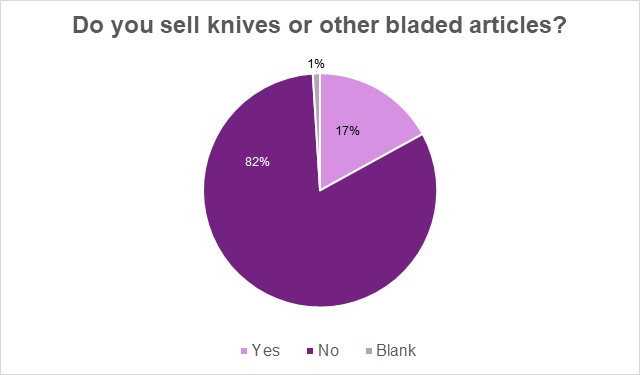
The pie chart above shows that 82% of respondents replied Yes to this question; while 17% replied No and 1% left the answer blank.
31. Q2. If you answered yes above, do you consider yourself to be (tick all that apply)
Respondents were offered the response options:
-
Online Seller
-
Face-to-face seller
-
Private/second-hand seller
-
Importer
-
Other (please explain)
What type of knife seller do you consider yourself to be?
| Online sellers | 199 |
| Face to face sellers | 265 |
| Private or second-hand sellers | 317 |
| Importers | 74 |
The bar graph above shows that 199 respondents said they were online sellers; 265 said they were face to face sellers; 317 said they were private or second-hand sellers; and 74 said they were importers.
Note: Respondents were able to indicate more than one field.
32. Q3. If you sell knives or bladed articles how large is your business?
Respondents were offered the response options:
-
Small (1-10 employees)
-
Medium (11-50 employees)
-
Large (over 51 employees)
If you sell knives or bladed articles how large is your business?
| Small (1-10 employees) | 499 |
| Medium (11-50 employees) | 18 |
| Large (over 51 employees) | 16 |
The bar graph above shows that 499 respondents indicated that they have a small business, with between 1 and 10 employees; while 18 said they have a medium business with 11 to 50 employees; and 16 said they have a large business with over 51 employees.
33. Q4. Should businesses which sell knives and bladed articles be required to hold a license?
Respondents were offered the response options:
-
Yes
-
No
| Should businesses which sell knives and bladed articles be required to hold a licence? | Count (online) | Percentage |
|---|---|---|
| Yes | 1,591 | 47% |
| No | 1,793 | 52% |
| Blank | 29 | 1% |
| Total | 3,413 |
The table above shows response numbers and percentages.
Should businesses which sell knives and bladed articles be required to hold a licence?
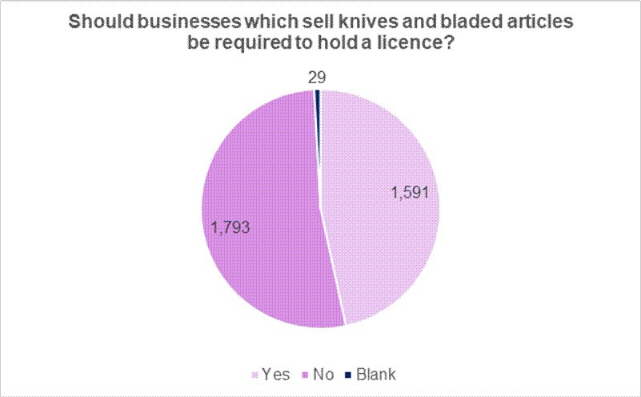
The pie chart above shows that 1591 online respondents answered Yes; 1793 answered No; and 29 left the response blank.
| Respondent type | Yes | No | Blank | Total |
|---|---|---|---|---|
| Police | 28 | 6 | 0 | 34 |
| Local authorities/trading standards/licensing/community safety | 43 | 5 | 0 | 48 |
| CPS | 26 | 0 | 0 | 26 |
| Charities | 16 | 2 | 0 | 18 |
| Collectors/reenactors/Historical European Martial Arts/museums | 60 | 195 | 0 | 255 |
| Retailers | 4 | 7 | 0 | 11 |
| Auction houses | 1 | 2 | 0 | 3 |
| Manufacturers | 2 | 5 | 0 | 7 |
| Member of the public | 1325 | 1231 | 27 | 2583 |
| Small and Medium Enterprises (SME) | 86 | 340 | 2 | 428 |
| Total | 1591 | 1793 | 29 | 3413 |
The table above shows response by respondent type.
34. Q5. Should private sellers who sell knives and bladed articles be required to hold a license?
Respondents were offered the response options:
-
Yes
-
No
| Should private sellers who sell knives and bladed articles be required to hold a licence? | Count (online) | Percentage |
|---|---|---|
| Yes | 1,305 | 38% |
| No | 2,077 | 61% |
| Blank | 31 | 1% |
| Total | 3,413 |
The table above shows response numbers and percentages.
Should private sellers who sell knives and bladed articles be required to hold a licence?
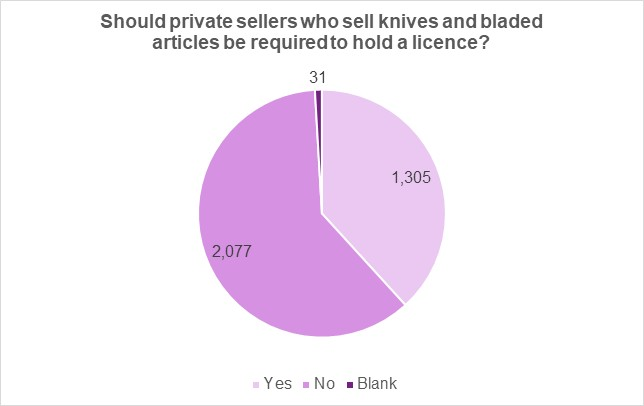
The pie chart above shows that 2,077 online respondents answered No; 1305 answered Yes; and 31 left the response blank.
| Respondent type | Yes | No | Blank | Total |
|---|---|---|---|---|
| Police | 26 | 8 | 0 | 34 |
| Local authorities/ trading standards/ licensing/community safety | 43 | 5 | 0 | 48 |
| CPS | 26 | 0 | 0 | 26 |
| Charities | 15 | 3 | 0 | 18 |
| Collectors/ reenactors/ Historical European Martial Arts/ museums | 13 | 241 | 1 | 255 |
| Auction houses | 1 | 2 | 0 | 3 |
| Retailers | 9 | 1 | 1 | 11 |
| Manufacturers | 4 | 3 | 0 | 7 |
| Member of the public | 1127 | 1428 | 28 | 2583 |
| Small and Medium Enterprises (SME) | 41 | 386 | 1 | 428 |
| Grand Total | 1305 | 2077 | 31 | 3413 |
The table above shows response by respondent type.
Email responses (combining support for both businesses and private sellers licences, because these were not separated in most responses):
| Response | Count (online) | Percentage |
|---|---|---|
| Support (including support with caveats indicated) | 48 | 35% |
| Oppose | 76 | 55% |
| Other (blank/no response) | 14 | 10% |
| Total | 138 | 100% |
Email responses indicating support or opposition to a knife sellers’ licence (business or private sellers)
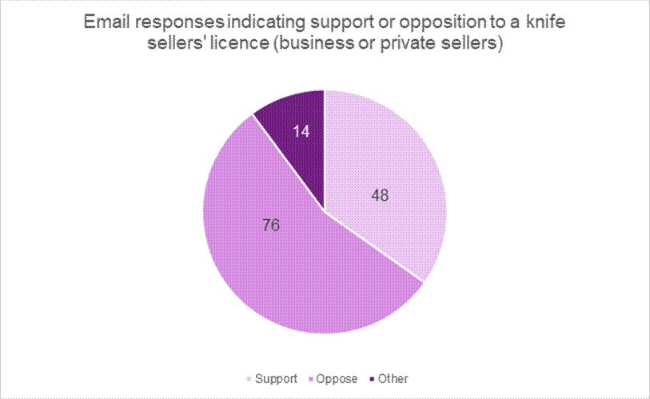
The pie chart above shows that 76 emailed responses indicated they opposed licences; 48 supported them; and 14 did not give a response to this question.
35. Q6. How long do you think a seller’s or importer’s licence should be valid for before it needs to be renewed?
Respondents were offered the response options:
-
3 years
-
5 years
-
10 years
-
Other
How long do you think a seller or importer licence should be valid for before it needs to be renewed?
| Blank | 286 |
| No licence needed | 880 |
| 1 year | 228 |
| 2 years | 57 |
| 3 years | 886 |
| 5 years | 412 |
| 10 years | 352 |
| Permanent or indefinite | 110 |
| Other | 202 |
The bar graph above shows that 286 responses were blank; 880 thought no licence is needed; 228 thought a licence should last 1 year; 57 that it should last 2 years; 886 that it should last 3 years; 412 that it should last 5 years; 352 that it should last 10 years; 110 that it should be indefinite; and 202 gave an unclear or other answer.
| Row Labels | Grand Total | 1 year | 2 years | 3 years | 5 years | 10 years | Permanent / Indefinite | No licence needed | Other |
|---|---|---|---|---|---|---|---|---|---|
| Police | 34 | 1 | 22 | 3 | 1 | 0 | 3 | 1 | |
| Local authorities/ trading standards/licensing/ community safety | 48 | 4 | 1 | 28 | 7 | 2 | 1 | 2 | 2 |
| CPS | 26 | 2 | 2 | 20 | 1 | 1 | 0 | 0 | 0 |
| Charities | 18 | 1 | 1 | 11 | 1 | 2 | 0 | 0 | 1 |
| Collectors/reenactors/ Historical European Martial Arts/museums | 255 | 0 | 2 | 17 | 41 | 39 | 14 | 96 | 14 |
| Auction houses | 3 | 0 | 0 | 0 | 1 | 0 | 0 | 2 | 0 |
| Retailers | 11 | 0 | 0 | 4 | 2 | 1 | 1 | 1 | 2 |
| Manufacturers | 7 | 0 | 0 | 0 | 2 | 2 | 1 | 2 | 0 |
| Member of the public | 2583 | 218 | 50 | 756 | 291 | 232 | 70 | 590 | 140 |
| Small and Medium Enterprises (SME) | 428 | 3 | 0 | 28 | 63 | 72 | 23 | 184 | 42 |
| Grand Total | 3413 | 228 | 57 | 886 | 412 | 352 | 110 | 880 | 202 |
The table above shows the number of responses by respondent type (blank answers excluded).
36. Q7. Who should be required to hold a licence to import knives and bladed articles?
Respondents were offered the response options:
-
UK-based authorised importer
-
Retailers, not including private individuals
-
Anyone – including private sellers and individuals importing items for personal use
-
Other
Who should be required to hold a licence to import knives and bladed articles?
| Anyone (including private or personal) | 1207 |
| UK-based authorised importer | 433 |
| Retailers (not private) | 398 |
| No one (including none or nobody) | 1084 |
| Other | 151 |
| Blank | 140 |
The bar graph above shows that 1207 responses indicated that anyone should need a licence to import; 433 said a UK based authorised importer should be used; 398 that retailer and not private sellers should need a licence to import; 1084 said that no one should need a licence to import; 151 gave another or unclear answer; and 140 left the response blank.
| Row labels | Grand Total | Other | Anyone (incl. private/ personal) | Retailers (not private) | UK-based authorised importer | No one (incl. none/ nobody) |
|---|---|---|---|---|---|---|
| Police | 34 | 2 | 19 | 4 | 5 | 2 |
| Local authorities/ trading standards / licensing/ community safety | 48 | 1 | 36 | 2 | 6 | 3 |
| CPS | 26 | 20 | 3 | 3 | 0 | |
| Charities | 18 | 0 | 10 | 3 | 4 | 1 |
| Collectors/ reenactors/ Historical European Martial Arts/ museums | 255 | 17 | 27 | 47 | 35 | 114 |
| Auction houses | 3 | 0 | 0 | 1 | 0 | 2 |
| Retailers | 11 | 1 | 7 | 1 | 1 | 1 |
| Manufacturers | 7 | 0 | 2 | 0 | 2 | 3 |
| Member of the public | 2583 | 103 | 1029 | 277 | 307 | 749 |
| Small and Medium Enterprises (SME) | 428 | 27 | 57 | 60 | 70 | 209 |
| Grand Total | 3413 | 151 | 1207 | 398 | 433 | 1084 |
The table above shows the number of responses by respondent type (blank answers excluded).
37. Q8. Do you anticipate that this measure will impact your business/business operations?
Respondents were offered the response options:
-
Yes
-
No
Comments were invited.
and Q9. Have you got any other comments?
Respondents were offered the response options:
-
Yes
-
No
Comments were invited.
The narrative responses to questions 8 and 9 have been analysed, where comments were included, and the key themes noted by respondent type. These are presented below under ‘Narrative analysis’.
Narrative analysis
Support for licensing
38. 15 emailed responses and 108 online responses came from representatives of police forces, Trading Standards, the CPS, and Local Authorities. These were mainly indicative of support for the proposals either outright or with a request for some degree of clarification, if and when, these proposals were taken forward.
39. The respondents asked for the Government to involve them closely in how the scheme would be implemented in practice, noting the administrative and cost burden this would place on those responsible. They raised the need for consideration of exemptions for certain knife types and uses. Furthermore, they acknowledged that while licensing will help, it should be only one of a range of measures that address the root causes of knife-related offending.
40. Retailers who were supportive generally emphasised that any licensing scheme should be proportionate to the goal the government is trying to achieve and should not be too onerous on businesses:
41. Where broad support was indicated, it was also subject to concerns and that the government considers that legitimate arts, sports or heritage groups were not adversely impacted unintentionally by catch-all legislation, and to include specific exemptions to avoid this.
42. Government response: We expect that introducing a licensing scheme for the sale and importation of knives would lead to better compliance with the relevant legislation. We are aware of the potential impact that a licensing scheme would have on sellers and importers and will take into careful consideration the need for the scheme to be proportionate.
43. We will also take into consideration the need for specific exemptions to minimise the adverse impact on legitimate arts and heritage collections.
44. We will work alongside the police, Border Force, Trading Standards and Local Authorities to ensure that any licensing scheme that is taken forward is practicable, enforceable and has reasonable implications on the implementing agencies.
45. An issue raised frequently by retailers, manufacturers and other respondents during consultation was whether it would be appropriate to exclude cutlery knives and other lower-risk knives from any licensing scheme.
46. Government response: We understand the rationale behind calls for exempting certain bladed articles from licensing and believe that this is a sensible and risk-balanced approach. We are looking at whether we should lift age restrictions from certain rounded tipped cutlery knives
Concerns raised by respondents about the government proposals
47. Of the emailed responses that expressed concerns, 36 responses (47%) were from antiques collectors, arts and sports practitioners, craftspeople and reenactors. 12 responses (16%) were from retailers, trade associations, manufacturers and staff unions.
48. The vast majority (76%) of online respondents were members of the public, or respondents who had not identified themselves as having a particular interest other than as such.
49. Issue raised: Designated weapons used for a sword-based art, historical reenactment, or forming part of an antique collection should be exempted from generic licensing regulation, or there would be a disproportionately negative impact on heritage, the arts and sports.
50. 255 of the online responses and 45 of emailed responses were from collectors, hobbyists and those with a sports and antiquities interest. More than half of these raised specific concerns over the licensing proposals having some kind of negative impact on these areas of knife use or ownership.
51. Government response: We acknowledge the concerns over legitimate ownership and use of bladed articles for sports, heritage, historical and public-interest collections, and there is the possibility of them being negatively impacted by a licensing scheme. We will take into careful consideration the need for specific exemptions to minimise any adverse impact and will work with stakeholders as we develop the scheme.
52. Issue raised: Licensing will be ineffective or not stop knife crime, as it does not tackle the root causes. It will disproportionately impact people and businesses who obey the law.
53. Respondents frequently raised concerns about whether a licensing scheme will tackle knife crime. They said knives were widely available (in particular, domestic kitchen knives) and that licensing does not address the root causes of knife crime. There was also concern that a licensing scheme will not deter criminals and illegitimate businesses.
54. Government response: We acknowledge that knife crime is a complex and multi-faceted issue, which cannot be solved by one solution alone. The licensing of knife sales and imports would aid the police in identifying and prosecuting illegal sales and sellers and enable more effective enforcement of the law - in particular in the area of ‘grey market’ sales, but not exclusively. It is just one of a raft of measures being considered and already being implemented by the Government to tackle knife crime.
55. Issue raised: The cost and practical feasibility of licensing for the police.
56. 44% of police and 17% of local authorities and trading standards responding online indicated that they had concerns about how the licensing scheme would be implemented by police and/or Local Authorities with current resources. They stressed that the cost of administering the scheme should be able to be recovered from fees.
57. Other concerns were over practical challenges that might be encountered as a result of the extent of the scheme.
58. Government response: We will work closely with the police to ensure any scheme is designed in a practical, enforceable, and sustainable way.
59. Issue raised: Enforceability of any licensing scheme.
60. Respondents from a range of categories, including small/medium businesses to charities and re-enactors, indicated that they have concerns over the enforceability of the proposals.
61. Government response: We acknowledge concerns about the practicalities of enforcing any licensing scheme and will work with the relevant authorities to ensure any proposed scheme is practicable. We will also engage with stakeholders such as small businesses to ensure that any scheme imposes reasonable demands that are achievable, balancing business impact with public safety concerns.
62. Issue raised: Lack of clarity in the proposals.
63. Where respondents requested further clarity over proposals, this predominantly fell into the following categories:
a. Clarity on what constitutes a ‘knife or bladed article’ and what exemptions would be included (whether these would be in line with current legislation such as religious or heritage exemptions)
b. Reassurance that a particular type of activity, role or institution would be exempted from a licensing scheme (for example Museum collections, antiquities dealers, horticulturalists and sword-based arts practitioners);
c. Clarity on how a scheme would work, including what suitability checks would be run, how monitoring and checks would be done, and when and how revocation of licences would be enacted.
64. Government response: We will ensure any legislation is as clear as possible, and in due course it will be supported by guidance, to ensure clarity on key issues. We will carefully consider the case for exemptions for heritage collections, crafts and trades. We will work closely with the relevant enforcement bodies to design a clear and practical process.
Impact on business and trade
Sales licensing
65. 463 businesses (including retailers, manufacturers and small/medium enterprises) and trade/retail associations responded to the consultation.
66. These respondents raised concerns over a reduced market supply, a disproportionate impact on small/medium businesses and/or reduced profits and higher business costs. Administrative burden was also cited as a concern, especially for small businesses for whom this could be disproportionately impactful. Small sellers were concerned about a potential reduction in their ability to sell and trade.
67. Government response: We will take the impact of cost and administration into account as and when designing a licensing scheme. We will work to ensure it does not have a disproportionate impact on smaller sellers.
Import licensing
68. Strong support for import licensing was indicated by respondents concerned with the impact on UK businesses if this is not implemented alongside a UK-based sales licensing scheme.
69. Respondents in support of import licensing indicated that it would be the most effective and efficient system to combine sales and import licenses, avoiding a double administration or cost burden on both the business and authorities.
70. Some respondents flagged the risk that importers willing to get around an importation scheme may not declare or declare knives incorrectly.
71. Government response: We will ensure that any importing licensing scheme is workable and manageable. Our intention is that all knives imported into the UK and subject to licence are handed to a licensed UK-based intermediary that will ensure that the sale complies with our domestic legislation. Sellers based abroad will have to nominate a UK intermediary which will be responsible for the knives when they arrive into the UK. The intermediary company will then be responsible for ensuring that the articles are delivered to the buyer in compliance with domestic legislation on the sale of knives.
Conclusion and next steps
72. We are grateful to everyone who took the time to respond to this consultation and share relevant experience and insights for consideration.
73. The Government intends to legislate to introduce a licensing scheme for sales and imports of knives.
74. Licensing for sellers of knives will include:
a. A requirement on both private and business sellers to be licensed to sell knives,
b. A requirement for both remote and bricks and mortar sellers to hold a licence;
c. A fee will be charged for the licence, which is to be determined, but it will be set at full-cost recovery;
d. The licence will be valid for a period likely to be of three years;
e. Enforcement agencies will be able to revoke licences if the licensing conditions are not met;
f. We will consider the case for exemptions in relation to heritage collections, crafts and trades.
75. We will develop a hybrid model for importation of knives. Businesses based in UK will be able to obtain an import licence on application and we are exploring whether to provide a combined sellers/import licence to those who wish to apply for both.
76. Businesses based outside the UK would be required to appoint an intermediary company based in the UK in order to import knives in the UK. This is a version of the third party authorised importer model proposed in the consultation. We believe that this is the most effective way to enable UK-based sellers to safely import knives and avoid penalising companies based in the UK compared to overseas. This model will also enable anyone who wishes to purchase knives from sellers based outside the UK doing so without having to apply for a licence, as the intermediary company would be responsible for applying for a licence and complying with all the licensing conditions. Private individuals will not be able to apply for an importation licence.
Consultation analysis methodology
77. Responses to this consultation were invited both via an online response form and via email. In all cases, these were considered both for their answers to the specified questions and any free text added. In some cases, additional information was supplied by email attachments. All information submitted was considered.
78. Responses submitted through the online form, which had two open-ended free text comments where this was invited, were coded for response type using a broad spectrum of codes. The coding framework was initially designed by social researchers then revised by a broader group of analysts based on the responses.
79. An AI tool adapted from one used by other Government Departments was used to analyse apply the coding framework to the responses and the outputs were analytically quality assured.
Consultation principles
80. The principles that Government departments and other public bodies should adopt for engaging stakeholders when developing policy and legislation are set out in the Cabinet Office Consultation Principles 2018.
-
Knife dealers licence (Scotland) - GOV.UK - https://www.gov.uk/find-licences/knife-dealers-licence-scotland ↩
-
Independent end-to-end review of online knife sales - GOV.UK ↩
-
Some may have both an online and shopfront presence ↩