Late payment consultation: time to pay up – government response (web version)
Updated 24 July 2026

© Crown copyright 2026
This publication is licensed under the terms of the Open Government Licence v3.0 except where otherwise stated. To view this licence, visit nationalarchives.gov.uk/doc/open-government-licence/version/3 or write to the Information Policy Team, The National Archives, Kew, London TW9 4DU, or email: psi@nationalarchives.gov.uk.
Where we have identified any third party copyright information you will need to obtain permission from the copyright holders concerned.
This publication is available at https://www.gov.uk/government/consultations/late-payments-tackling-poor-payment-practices/outcome/late-payment-consultation-time-to-pay-up-government-response-web-version
Ministerial foreword
This government is determined to tackle the scourge of late payments which costs the UK economy £11 billion each year and leads to the closure of 38 UK businesses every day.
On average, business owners affected by late payments waste 86 hours per year chasing invoices. That is a staggering total of 133 million staff hours across all UK businesses. This is money for which the work is already done, resources have already been spent, and payment is overdue.
In addition to time wasted, late payment impacts on the cash flow of small businesses. As a result, small businesses struggle to pay their hard-working employees on time, to pay for rent and to pay their own suppliers. They struggle to invest in technology, innovation and training, stifling their own growth, productivity and ultimately endangering their survival.
This is not right. It is not morally right for small businesses and the self-employed to be forced to expend time and resource which they do not have to chase payment that they are legally owed. And it is not good business. The status quo is wasteful, unproductive, drives small businesses to the wall, and holds back the potential of small businesses as an engine of economic growth.
Make no mistake – we are going to fix this problem. It’s time for the UK’s small businesses to be paid on time. It’s time to pay up.
I am grateful for the incredible levels of engagement with our public consultation that ran from 31 July 2025 to 23 October 2025. We had over 850 formal responses, more than ever before from consultations on this topic, with responses from businesses of every size, sector, region and nation in the UK.
Thank you for your time, effort and expertise in making sure that we are getting this right, and for working with us to tackle the problem of late payments once and for all.
You will see in this response the scale of our ambition. We will take forward the most ambitious legislation to tackle late payments in over 25 years, since the last time a Labour Government came to power. We will build upon and strengthen the reforms of the previous government while going significantly further and faster – putting in place the strongest legal framework on late payments in the G7.
We are putting tackling late payments at the centre of our efforts to make the UK the best place in the world to start, run and grow a business.
We want businesses to come with us on this journey. Every business that we spoke to as part of our consultation agreed with the importance of paying small businesses quickly and on time. Many of you are already making great efforts to do so, and there is excellent practice out there across the UK for others to follow.
I am grateful every day for the passion and dedication of UK business owners and will work with you to make sure our small businesses are paid on time, every time.
Peter Kyle
Secretary of State for Business and Trade and President of the Board of Trade
Executive summary
Introduction
The 2024 Labour Manifesto committed to tackling late payments to ensure small businesses and the self-employed are paid on time.[footnote 1]
On 31 July 2025 the Prime Minister launched Backing your business: our plan for small and medium-sized businesses with the commitment to tackle late payments front and centre:
We will legislate to end the scourge of late payments which costs the UK economy £11 billion per year and closes down 38 UK businesses every day. This will be the most significant legislation to tackle late payments in over 25 years and will give the UK the strongest legal framework on late payments in the G7.
The late payments consultation ran from 31 of July 2025 to 23 of October 2025. We are grateful to the hundreds of businesses across the UK, of all sizes, sectors, regions and nations, who made time to engage with our proposals.
Figure 1: impact of late payments
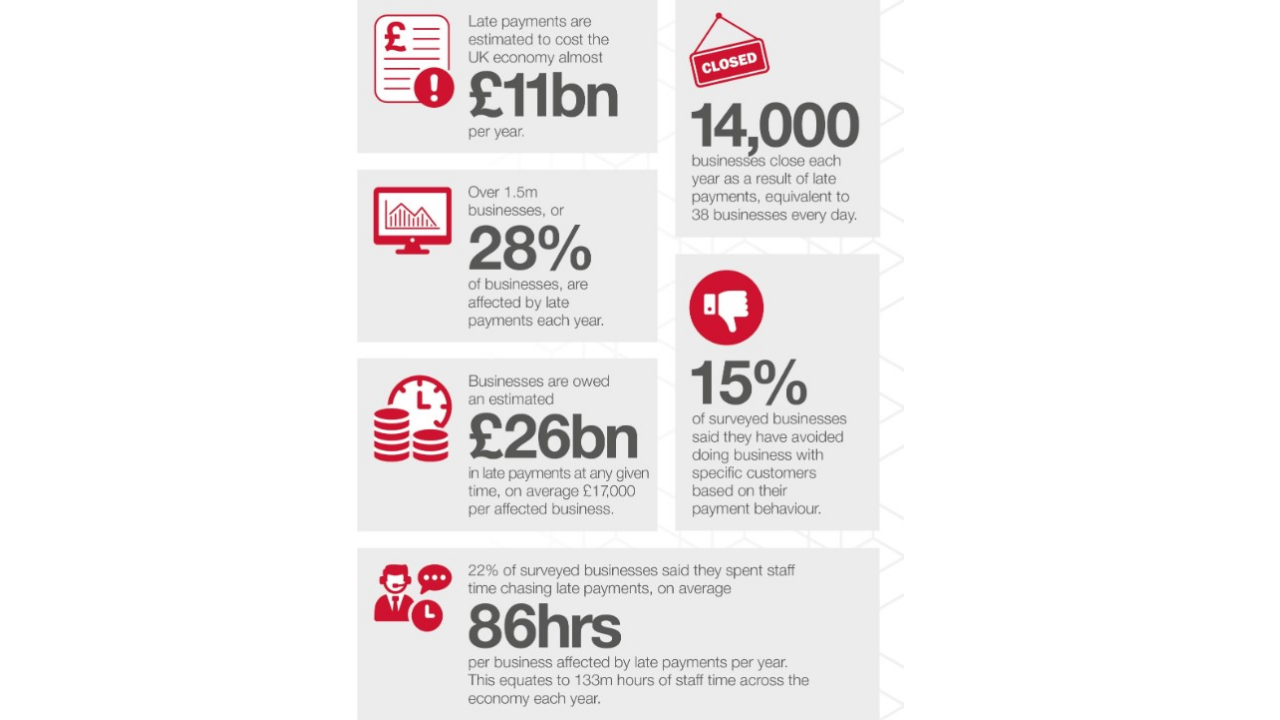
Late payments are estimated to cost the UK economy almost £11 billion per year. 14,000 businesses close each year as a result of late payments, equivalent to 38 businesses every day. Over 1.5 million businesses, or 28% of businesses, are affected by late payments each year. 15% of surveyed businesses said they have avoided doing business with specific customers based on their payment behaviour. Businesses are owed an estimated £26 billion in late payments at any given time, on average £17,000 per affected business. 22% of surveyed businesses said they spent staff time chasing late payments, on average 86 hours per business affected by late payments per year. This equates to 133 million hours of staff time across the economy each year.
Source: Late payments research: impact on the UK economy
Measures intended to be taken forward
The responses to the consultation confirmed the urgent need to tackle late payments. We will introduce new legislation as soon as Parliamentary time allows. We intend to take forward the following measures:
Small Business Commissioner (SBC) powers
Power to investigate: we intend to provide the SBC with the power to investigate businesses suspected of poor payment practices or inaccurately reporting payment performance.
Power to adjudicate: we intend to provide the SBC with the power to settle payment disputes outside of the court process.
Power to fine: we intend to provide the SBC with the power to fine businesses, including significant potential fines for large companies that persistently pay their suppliers late or fail to comply with late payment legislation.
Wider later payment measures
Board-level scrutiny of payment practices: we intend to introduce a requirement for the boards or audit committees of any persistently late-paying large company to publish commentary on why payment performance is poor and what actions they are taking to fix this.
Maximum payment terms: we intend to impose maximum payment terms of 60 days, with strictly limited exemptions, to ensure that smaller businesses are paid in a maximum of 60 days.
Deadline for disputing invoices: we intend to introduce a statutory time limit for raising disputes. Businesses that do not raise disputes within the time limit will need to pay compensation to their supplier.
Mandatory interest on late payments: we intend to make it a requirement that all commercial contracts will contain a right to statutory interest at 8% above the Bank of England base rate
Retention payments under construction contracts
Prohibition of retention payments: we propose to ban the practice of deducting and withholding of retention payments under the terms of a construction contract, consulting on its implementation.
We intend for these measures to be enacted and enforced together as a powerful set of legal and commercial incentives against late payment. In parallel, this government and the SBC will continue to drive cultural change and encourage best practice among businesses, already exemplified by hundreds of companies that are awardees of the Fair Payment Code.
The government has listened to feedback from respondents about ensuring the SBC is resourced sufficiently to discharge the new powers. We intend to provide further grant funding to the SBC, through the Department for Business and Trade. We also intend for the SBC to be given the ability to recover the costs of adjudications and investigations.
Together, this legal and cultural change will drive down late payments, provide crucial support to small businesses, and support UK economic growth.
Territorial Scope
The government intends to introduce these measures across the UK and will seek to introduce legislation to this effect. Late payments is a devolved matter for Scotland, Wales and transferred in Northern Ireland. We will work closely with governments in Scotland, Wales and Northern Ireland under the Late Payment Common Framework to ensure regulatory alignment on late payments.
Next steps
More detail on each of the measures we intend to take forward is provided later in this document, alongside a detailed summary of our consultation process and responses.
These measures will require a combination of primary legislation (an act of Parliament) and secondary legislation to enact. We will legislate as soon as Parliamentary time allows.
We will stay closely engaged with businesses throughout the legislative process, and during the period of implementation once new powers are ready to come into force and will work closely with both the SBC and the Construction Leadership Council to produce guidance.
Consultation
Summary of measures taken forward
SBC powers
Power to investigate: we intend to give the SBC powers to investigate businesses suspected of conducting poor payment practices, particularly in relation to breaches of late payments legislation, making the SBC more effective in tackling late payments. The proposed powers include:
- the power to launch investigations based on a wider range of evidence, including from anonymous sources
- the power to compel companies to provide information to support investigations
- the power to undertake compliance checks on The Reporting on Payment Practices and Performance Regulations 2017 data, backed up by financial penalties for non-compliance
Power to adjudicate: we intend to give the SBC powers to settle disputes between businesses outside of the court process, making the SBC more impactful and ensuring the impact on the judicial system from our reforms is limited. The proposed powers include:
- the power to allow small businesses to refer a payment dispute with a larger business to the SBC for adjudication
- the power to make adjudication awards
Power to fine or impose penalties: we intend to give the SBC powers to fine businesses, giving the SBC the tools it needs to ensure businesses that do not adhere to payment rules are sanctioned. The proposed powers include:
- the power to identify and fine persistent late payers based on the data published under The Reporting on Payment Practices and Performance Regulations 2017, with the levels of fines based on businesses’ unpaid statutory interest liability
- the power to impose financial penalties on businesses for breaching payments legislation as well as failing to comply with its investigations and arbitration
Wider late payments measures
Board-level scrutiny of payment practices: we intend to make it a legal requirement for the boards or audit committees of large UK businesses who have made a significant proportion of their payments late within the reporting period to publish commentary on GOV.UK explaining how the company intends to improve its payment performance, including:
- why the payment performance is poor
- the company’s intended actions to improve their payment performance
- which actions from previous commentary have not been implemented and why
Maximum payment terms: we intend to introduce a maximum payment term of 60 days between businesses, with limited exemptions.
Stricter maximum terms received strong overall support in our consultation. Some respondents expressed concern regarding the impact on legitimate business practices in specific sectors. We intend for the policy to be subject to a limited set of exemptions, combined with existing flexibility on ‘when the clock starts’, to address the need for business flexibility without watering down the late payments package. We intend to allow exemptions for contracts where:
- both parties are large companies
- the purchaser is the smaller party
- the goods or services are either being imported or exported
As part of the consultation, we proposed that the maximum payment terms may be reduced to 45 days over time. We do not intend to take this forward now but may revisit it in the future. We would consult again on any further reduction to maximum payment terms.
Deadline for disputing invoices: we intend to introduce a statutory time limit for raising disputes. Businesses that do not raise disputes within the time limit will need to pay compensation to their supplier.
Mandatory interest on late payments: we intend to make it a requirement that all commercial contracts will contain a right to statutory interest at 8% above the Bank of England base rate, and to remove the ability for parties to agree an alternative remedy to statutory interest.
Tightening this law should be a powerful disincentive against late payments and correct the dynamic where larger companies can opt out of paying interest to their smaller suppliers. If interest is unpaid, small businesses will be able to escalate to the SBC and resolve through adjudication.
Additional reporting on mandatory interest: we intend to make it a requirement for large companies to report upon interest payments, including the value of interest that a company is liable to pay and the value of interest that has actually been paid. This can be used to identify persistent poor behaviour from a large company and trigger an SBC investigation into their practices, with potential fines linked to the scale of unpaid interest.
Retention payments under construction contracts
Prohibition of retention payments: we propose to ban the practice of deducting and withholding retention payments under the terms of a construction contract, consulting on its implementation. This will prevent loss through insolvency and late and non-payment.
Consultation process
From 31 July 2025 to 23 October 2025, we consulted on a set of proposed legislative measures. For each measure we asked whether respondents agreed with the principle of introducing these measures, whether they would have a positive impact on payment behaviours, and whether there could any unintended consequences.
In total the late payments consultation received 867 responses from a wide range of stakeholders from across the UK, including all business sizes and a variety of sectors including retail, finance and manufacturing. Of the 867 respondents, there were 238 responses from businesses, trade associations, and individuals within the construction sector, representing large and small businesses within the contracting supply chain, as well as construction clients and professionals.
Chart 1: overall response demographics
| Answer | Number of responses |
|---|---|
| A business (including sole traders, partnerships and companies with or without employees) | 586 |
| A representative body | 84 |
| An individual | 80 |
| An organisation | 31 |
| Other (please specify) | 28 |
Chart 2: business response demographics
| Answer | Number of responses |
|---|---|
| Sole trader, partnership or other businesses without employees (0 employees) | 113 |
| Micro business (1 to 9 employees) | 158 |
| Small business (10 to 49 employees) | 179 |
| Medium business (50 to 249 employees) | 69 |
| Large business (250 or more employees) | 66 |
Demographic breakdowns do not always sum to consultation response totals. This is because some respondents did not provide additional demographic details and are not always counted.
Detailed response
For each of the proposed measures we set out a series of specific questions in our consultation. We set out each proposal and asked for feedback from respondents on whether they agreed with the proposal and whether it was likely to achieve the proposed aim. We also asked if there were any unintended consequences of each proposal which could impact on the polices effectiveness.
Measure 1: board-level scrutiny of payment practices (audit committees and board-level scrutiny of large company payment practices)
Our proposal
In the consultation we set out proposals to try to encourage greater board level scrutiny of businesses’ payment performance and practices.
Part A: ensuring audit committees or company boards, where companies have them, provide commentary and make recommendations regarding payment performance to company directors before the data is submitted to government and included in the director’s report. This would include data provided as part of The Reporting on Payment Practices and Performance Regulations 2017, and any interest on late payment liabilities.
Part B: ensuring the SBC writes to audit committees and company boards, where companies have them, when both assuring payment performance reporting and when investigating any other matter relating to a companies’ payment practices.
What you told us
Part A
Overall, 71% of respondents agreed that increasing the role of audit committees where companies through having them make recommendations to directors should be taken forward by the government. [footnote 2]Respondents were particularly supportive of encouraging board level conversations about their company’s payment practices and performance and believe that this mechanism will encourage them to improve payment times to their suppliers
However, there were some concerns, particularly from experts who raised concerns that while the objective to facilitate board level conversations could improve payment performance is positive, this would not be best achieved through mandatory involvement of audit committees. Concerns were raised about the proportionality of involving audit committees in every case as there are currently no legal functions set out in law that audit committees must complete. Respondents also expressed concern that this measure could lead to further mandatory requirements for audit committees in future further increasing regulatory burden.
Part B
Respondents were also extremely supportive of having the SBC write to board and audit committees about their payment performance as part of the SBC increased role with 76% of respondents agreeing that this measure should be taken forward. Although concerns were raised about the resourcing required for the SBC.
Respondents felt that these measures would further increase and improve transparency and accountability around the payment behaviours of large businesses, but there were some concerns around the increased burden and resource required of businesses and the SBC to action these measures.
Next steps
The government’s intention is to take these measures forward with some limited changes following feedback from businesses.
We intend to make it a legal requirement for the boards or audit committees of large UK businesses who have made a significant proportion of their payments late within the reporting period to publish commentary on GOV.UK explaining how the company intends to improve its payment performance, including:
- why the payment performance is poor
- the company’s intended actions to improve their payment performance
- which actions from previous commentary have not been implemented and why
We will also take forward Part B of the measure and ask the SBC to write to company boards and audit committees, where companies have them, to provide assurance on payment performance reporting.
Measure 2: maximum payment terms
Our proposal
We proposed strengthening maximum payment terms to better protect smaller businesses who often face unfair payment terms.
Within the consultation, we outlined a measure that would remove the current exemption that allows businesses to agree longer terms provided they are not considered ‘grossly unfair’. These changes would effectively introduce a ‘hard limit’ on payment terms at 60 days, reducing to 45 days after 5 years and subject to further consultation.
What you told us
Responses to the maximum payment terms proposal were more mixed than other measures within the consultation. 66% of respondents agreed with the proposal, while 27% disagreed.[footnote 3] Businesses of all sizes highlighted potential issues.
Responses from smaller businesses that disagreed with the proposal tended to focus on the proposed 60-day limit itself, arguing this was still too long for businesses to be waiting for payment. They explained their own payment cycles were often monthly, paying staff, expenses, and other businesses, with some suggesting a 30-day limit would be more appropriate. These responses therefore agreed with the spirit of the proposal, but with a preference for going further.
We recognise the importance of timely payment, and strengthening the existing 60-day limit terms supports this by preventing the most unfair payment terms. However, we also want to minimise potential disruption to business by introducing changes gradually. We will continue to consider further reductions in maximum payment terms after these first changes have taken effect, subject to further consultation.
Responses also highlighted concerns that 60 days may become the default, rather than the limit. They explained that some businesses may actually increase their current payment terms to reduce the risk of paying late and incurring penalties introduced by other parts of the policy package.
We recognise this is a risk under the proposal, with the possibility of ‘bunching’ behaviour common across regulatory limits or thresholds. However, this maximum limit will work alongside other policies – like the Fair Payment Code, The Reporting on Payment Practices and Performance Regulations 2017, and rules around bidding on central government contracts – which are designed to encourage best practice, including payment terms well below legal maximum.
We will continue to ensure an appropriate mix of incentives across government policy, outlawing the worst practices and encouraging the best.
Responses from some larger businesses and representative groups highlighted other potential challenges, including potential working capital impacts, international competitiveness, and other potential adverse outcomes resulting from the introduction of rules regarding how businesses contract with each other. These responses suggest that shorter payment times may:
- require large businesses to replace ‘lost cashflow’ currently supported by extended trade credit
- disadvantage businesses competing internationally
- remove an important ‘bargaining chip’ in contract negotiations.
- rule out existing arrangements in certain sectors that benefit both purchasing businesses and their suppliers
These are important concerns.
While major disruption to businesses’ working capital is unacceptable, some impacts are unavoidable, reflecting policy design rather than unintended consequences. The proposal is intended to speed up payments between businesses – particularly between large and small businesses, which necessarily means that larger businesses will transfer some of their working capital to their smaller suppliers, where current payment terms are higher than the 60-day maximum.
Importantly, we recognise overall disruption needs to be minimised, which is why we are proposing a gradual change with an appropriate transition period, starting with 60 days, no earlier than 2027.
Maintaining the UK’s international competitiveness is critical. While these changes are focused on addressing poor business payment behaviour, it is important not to diminish UK competitiveness or to impact on mutually beneficial arrangements, agreed by businesses on an ‘even footing’. We have therefore further developed our proposal to mitigate these risks.
Specific construction payment and dispute resolution legislation has been in place for nearly 30 years through the Housing Grants, Construction and Regeneration Act 1996 – Part 2 Construction Contracts. Respondents from the construction sector highlighted the importance of alignment of the existing and well-established legislation for parties to a construction contract with this policy for stricter maximum payment terms. This will be taken forward as part of the next steps.
Next steps
It is our intention to take forward stricter maximum payment terms, limited to 60 days. Responding to consultation feedback, however, we will allow for some limited exemptions and flexibility to address the most significant concerns raised.
We intend to allow exemptions for contracts where:
- both parties are large companies
- the purchaser is the smaller party
- the goods or service are either being imported or exported
Importantly, these exemptions balance protections for smaller businesses, who are often the most disadvantaged when negotiating payment terms, while allowing larger businesses to continue making arrangements that help them remain competitive both in the UK and abroad.
Maximum payment term restrictions will be focused on payment terms between businesses of different sizes. Elsewhere, the exemptions preserve freedom to contract, allowing businesses to negotiate and make arrangements that work best for them.
Measure 3: a deadline for disputing invoices
Our proposal
We proposed introducing a window for disputing invoices to encourage businesses to raise potential disputes early so they could be resolved before becoming late.
The consultation included a measure which would introduce a deadline of 30 days for businesses to raise a dispute over a good or service with their supplier. Businesses that raise a dispute after 30 days would be required to pay invoices in full within agreed payment terms, with late payments accruing statutory interest.
What you told us
Overall, businesses agreed that the government should introduce a window for raising disputes, with 72% of businesses agreeing with our initial proposal. Small and medium-sized businesses in particular agree that this measure will have a positive impact on payment practices, reducing the likelihood of businesses raising frivolous disputes in order to delay payment.
Respondents raised concerns about the time limit, with some saying that 30 days was still too long a window and that businesses should be able to identify issues and raise a dispute sooner than this, while other businesses considered than genuine disputes might take longer than 30 days to identify and resolve.
Respondents also asked for clarity if these measures were introduced, particularly around how interest would be treated and if disputes were raised outside of the window. Businesses also asked the government to consider what might be reasonable grounds for a dispute and how a dispute might be evidenced or perceived as legitimate if raised.
Respondents from the construction sector outlined the existing payment notice mechanisms for establishing the sum due under a construction contract. This statutory process under the Housing Grants, Construction and Regeneration Act 1996 – Part 2 Construction Contracts aimed to establish greater certainty and clarity in the payment process and improve cash flow through the construction supply chain.
In reviewing the existing process for construction contracts and the proposed policy mechanisms, a number of complexities were identified in the practical implementation through a construction contract. including the potential re-set of the payment due date. Alignment of the existing and well-established payment notice mechanisms with this policy will be taken forward as part of the next steps.
Next steps
We intend to introduce a time limit for raising disputes. Following feedback, we want to ensure that any new dispute policy does not cut across existing ones and make it clear how a dispute window will work in detail. A separate measure, aligned with the existing payment notice mechanisms will be taken forward for construction contracts.
Measure 4: mandatory statutory interest
In the consultation we set out a proposal to introduce legislation to ensure that businesses are paid interest on late payments in order to incentivise paying on time. The Late Payment of Commercial Debts (Interest) Act 1998 currently entitled businesses to claim interest when they are paid late.
In the consultation, we proposed legislation that will make it mandatory to pay interest on late payment without exception and that the interest rate must be at the statutory rate (8% above the Bank of England base rate). Businesses will no longer be able to negotiate alternative remedies or different interest rates for late payments.
What you told us
Overall, 80% of respondents agree with introducing mandatory interest for late payments. Small businesses, in particular, believed that this measure would shift the burden from small businesses having to ask for interest to be paid, with the risk of potentially damaging relationships with the business they supply. Respondents also made it clear that the government would have to make businesses aware of their rights to the statutory interest to ensure that businesses pay what they owe.
There were some concerns raised about additional administrative burden as new processes would have to be created to ensure interest is paid when owed. However, businesses that pay on time should not face an increased burden. Businesses also flagged the need for effective enforcement to make sure the interest is paid.
Next steps
We intend to take this measure forward as set out in the consultation and propose making including the statutory interest for late payments of 8% above the Bank of England base rate mandatory. If this measure is introduced, we will ensure there is sufficient guidance to support businesses. Importantly, as part of the enforcement of this policy, we are also introducing an additional reporting requirement for large businesses.
Measure 5: additional reporting on statutory interest
Our proposal
We proposed amending The Reporting on Payment Practices and Performance Regulations 2017 to require qualifying large businesses to report information relating to the payment of statutory interest. This would include a requirement to report the total statutory interest the qualifying company owed to its suppliers and the total statutory interest the company has paid out to suppliers in any given reporting period.
The aim of this measure is to further increase transparency around large companies’ payment behaviour. It will highlight the level of interest large companies owe and the extent to which large companies are adhering to proposed changes to rules regarding statutory interest.
What you told us
77% of respondents agreed with the intention to introduce the proposed measure and are interested in seeing increased transparency around how much interest large businesses pay on late payments introduced. Respondents believe that this measure will work well in conjunction with the proposed requirement to introduce mandatory interest for late payment and that it will force businesses to pay attention to the level of interest they will have to pay.
Businesses did raise concerns about the increased level of administrative burden for large companies. However, we believe the burden will be small relative to the benefits particularly considered against the potential benefit for smaller businesses.
Next steps
We intend to take forward a measure to require businesses to report on the interest payments on late payments under The Reporting on Payment Practices and Performance Regulations 2017. We also recognise the need for clear guidance and will seek to publish alongside the introduction of any new regulations.
Measure 6: financial penalties for persistent late payers
Our proposal
We also considered how to deal with large businesses who persistently pay their suppliers late. As part of this, we proposed granting the SBC greater powers to undertake enforcement action, applying financial penalties on persistent late payers.
The measure proposed that the data submitted by large businesses under The Reporting on Payment Practices and Performance Regulations 2017 would be used to identify those companies that persistently pay late.
The government proposes establishing a ‘trigger point’ (for example, companies that report that they have paid 25% or more of their suppliers late) at which point the SBC can investigate the circumstances of the company in question and, where appropriate, enforce a financial penalty. The investigation would consider any mitigating circumstances, past performance, and any evidence that the company will be changing their future payment practices.
The scale of the financial penalty would be based on businesses’ unpaid statutory interest liability. For example, twice the amount of statutory interest owed in the last reporting period.
What you told us
89% of respondents agreed that a measure intending to fine businesses that persistently pay late should be introduced with only 5% disagreeing. Small businesses were particularly in favour of this proposal highlighting their belief that introducing penalty fines would incentivise businesses to pay on time. 78% of large businesses also agreed.
Some respondents raised concerns about the potential effectiveness of the proposal telling us that it will be dependent on the size and nature of the fine and that large businesses may just absorb fines if they are too small. Respondents also highlighted that there are risks that some large businesses may seek to avoid these fines via loopholes such as disputing penalties or manipulating and reclassifying metrics.
Next steps
We intend to introduce a measure to fine businesses that persistently pay late. The government also recognises some of the concerns raised regarding businesses either simply absorbing fines or avoiding them via loopholes. Our intention is to ensure that any fines are significant while remaining proportionate.
Measure 7: expanded powers for the Small Business Commissioner
Our proposal
We proposed giving the SBC a range of new powers to the help them better support small businesses when facing issues with late payments. The proposed new powers included the power to arbitrate in payment disputes, investigate suspected wrongdoing in relation to late payments as well compel the disclosure of evidence that supports investigations.
We also proposed giving the SBC the power to ensure the accuracy of data large businesses submit under The Reporting on Payment Practices and Performance Regulations 2017 and to undertake spot checks on companies that report, and in cases where information and intelligence suggest assurance of payment performance data may be warranted.
What you told us
76% of respondents to the consultation told us they agreed with proposals to provide the SBC with additional powers to further support small businesses facing issues with payment when dealing with large businesses. Respondents broadly agreed the proposed measures will better support small businesses.
Respondents believed that if the SBC is well resourced and the powers are properly used then they will be effective in improving the payment practices of large businesses. However, respondents were concerned that the SBC should have the resources and profile for the powers to be effective.
Next steps
We intend to provide the SBC with the power to investigate, compel disclosure of information, to undertake compliance checks on data submitted under The Reporting on Payment Practices and Performance Regulations 2017 and to issue financial penalties.
The government has reviewed approaches to alternative dispute resolution, including arbitration and adjudication, and assessed that adjudication would be the most effective system to meet the policy objectives. We intend to provide the SBC with the power to adjudicate payment disputes between small and larger businesses, subject to the existing exemptions.
We have listened to consultation feedback around the resource required to ensure the SBC is effective. We intend to provide further grant funding to the SBC, through the Department for Business and Trade. We also intend for the SBC to be given the ability to recover the costs of adjudications and investigations.
Other reporting changes: annual reporting and streamlining
Our proposal
In the consultation we set out a proposal to change the frequency of reporting for large businesses under The Reporting on Payment Practices and Performance Regulations 2017 from twice yearly to annually. The intention was to reduce the administrative burden placed on large businesses when reporting, streamlining the reporting requirements to make it easier for large businesses to report.
What you told us
Overall, 40% of respondents disagreed with the proposal to reduce reporting frequency compared to only 30% agreeing, with the rest undecided. While businesses agreed that the measure may reduce administrative burden it was felt that this proposal would reduce transparency around the payment behaviour of large businesses and make it easier for them to hide any poor payment practices and reduces focus on addressing payment times.
Next steps
Following feedback, and concerns raised about the negative impact on transparency and accuracy of data, it is not our intention to take this measure forward.
Measure 8: retention payments under construction contracts
Our proposal
We consulted on 2 options on how the legislation would amend the Housing Grants, Construction and Regeneration Act 1996 – Part 2 Construction Contracts.
Option A: To prohibit the use of retention clauses in construction contracts, making it unlawful for payers to deduct and withhold retention sums from payments to payees. Payers could choose to seek alternative forms of insurance or surety, but this would not be mandated.
Option B: To allow the use of retention clauses in construction contracts and require any retention sums deducted and withheld to be protected. The protection of retention sums would be for the benefit of the payee, and payers would have a choice of either segregating the retained sums in a separate bank account or protecting the sums through an instrument of guarantee (insurance or surety bond).
What you told us
A significant majority (87% of responses) favoured reform and, of those, 53% of respondents indicated they could support either option.
Respondents were asked about the effectiveness of the options in preventing the abuse of retentions. A majority of respondents felt either measure would be effective, with 62% of respondents agreeing this would be the case for a ban, and 65% for a protection measure.
The consultation responses demonstrated broad agreement on the problems caused by retentions, and that the withheld money is often subject to unjustified late, partial, and non-payment. This leads to a negative impact on cash flow for small and medium businesses in the construction industry, through reducing working capital, and funds for investment.
Many respondents also stated that the underlying driver for retentions is an economic benefit for the payer. In addition, respondents indicated that there were alternative contractual mechanisms to secure performance, and in the event of defects or insolvency as per the intended purpose of retention, the amount withheld rarely, if ever, covered the costs.
Those who expressed concern about any changes to the current legislative framework believed retentions are a cost-effective mechanism, which provides an incentive for firms to fulfil their contractual obligations and to rectify defects.
Through both the responses and stakeholder engagement during the consultation period, there was often the view that a ban was the less complex legislative proposal of the 2 options, simpler for the industry to implement and easier to enforce under construction contracts.
Economic analysis also demonstrates that this is the lower cost option for the industry and its clients. Concerns cited about a ban included ensuring the scope of the legislation is broad enough to prevent circumvention, and the cost and availability of alternative forms of surety.
Respondents in support of a retention protection measure cited that retentions would be protected from upstream insolvency, but remain available for quality assurance, and that protection balances the needs of clients and contractors. Some respondents mentioned concerns about the administrative or cost implications of protecting retentions and remaining impact on cash flow.
For both options, respondents mainly supported a 12 to 24-month transitional period for contractual adjustments, financial planning, stakeholder engagement, and the development of alternative assurance mechanisms.
Many respondents also cited the challenges of ensuring quality of delivery in construction projects, and that the rate of errors and defects in the industry remains too high, generating significant costs and undermining the confidence of construction clients.
Responses included frequent references to the requirements of the Building Safety Act 2022, and the principles of the new regime driving safer, higher quality buildings, and the importance of the industry to meet these by improving competence and performance. There is also a need to create a larger and more sophisticated surety market to support the construction sector and its clients if retentions are no longer a means of mitigating risk. This is likely to require the development of a range of solutions in order to meet the needs of both construction clients and the supply chain.
Next steps
We propose to take forward a legislative measure to prohibit the deduction and withholding of retention payments under the terms of a construction contract. However, given the ambition of the policy, we will consult further with interested parties on the impact of this measure before taking a final decision on implementation.
To address concerns about build quality and surety alternatives, we will work with the Construction Leadership Council and construction clients to develop practical approaches to minimising defects, as well as working with the financial services sector to identify ways of developing the surety market for the construction sector.
Next steps
We intend to take forward legislation as soon as Parliamentary time allows.
-
Labour Party (2024) – Change: Labour Party Manifesto 2024 – Change Labour Party Manifesto 2024, p36 ↩
-
Agreed refers to responses which stated either ‘strongly agree’ or ‘somewhat agree’, unless stated otherwise. ↩
-
Disagreed refers to responses which stated either ‘strongly disagree’ or ‘somewhat disagree’, unless stated otherwise. ↩