Introducing mandatory eyesight testing for older drivers
Updated 16 February 2026

© Crown copyright 2026
This publication is licensed under the terms of the Open Government Licence v3.0 except where otherwise stated. To view this licence, visit nationalarchives.gov.uk/doc/open-government-licence/version/3 or write to the Information Policy Team, The National Archives, Kew, London TW9 4DU, or email: psi@nationalarchives.gov.uk.
Where we have identified any third party copyright information you will need to obtain permission from the copyright holders concerned.
This publication is available at https://www.gov.uk/government/consultations/introducing-mandatory-eyesight-testing-for-older-drivers/introducing-mandatory-eyesight-testing-for-older-drivers
The Department for Transport (DfT) is seeking views on the proposals for introducing mandatory eyesight testing for older drivers.
This consultation does not present a preferred option, allowing stakeholders to provide views on a variety of potential approaches.
Ministerial foreword
Road safety is fundamental to everything this government stands for. Safer roads underpin our national missions — driving economic growth, enabling greener journeys through active travel, easing pressure on the NHS and ensuring that everyone can travel safely.
Every fatality and serious collision is a tragedy. Having met with the families and friends of some of those who have been killed or seriously injured, I have some sense of the devastation road harm has on their lives. As Minister for Local Transport, the safety of all road users is a key priority. Our roads are some of the safest in the world, but any death on the roads is a tragedy. In 2024, there were 1,224 killed or seriously injured (KSI) older car driver casualties, a decrease of 3% compared to 2023, but an increase of 7% compared to 2014.
I have listened to the calls to consider the current process of self-declaration at the point of licence renewal for older drivers, including recommendations from coroners following fatal road collisions. I am also aware of the challenges posed by an ageing population, where certain conditions, including vision conditions, may become more prevalent. We need to find the right balance between ensuring that older people can actively participate in society and retain their independence, whilst at the same time maintaining safe driving on the roads.
This consultation is seeking views on introducing mandatory eyesight testing for older drivers. Eyesight deterioration is a common part of ageing due to natural changes in the eye’s structure and function, with eye conditions like glaucoma and macular degeneration becoming more common in later years.
While this consultation is focused on the mandatory eyesight testing of drivers aged 70 and over, we also recognise that more will need to be done to address wider health conditions associated with an ageing population and the increase in older drivers predicted. Consideration will be given in the future to other fitness to drive measures, such as cognitive assessments.
I want to support drivers as they become older. I recognise that having a driving licence is a lifeline for many and provides independence and freedom. However, we need to ensure older drivers can continue to drive safely as long as they are fit and healthy to do so.
Lilian Greenwood MP
Minister for Local Transport
Introduction
As the population in Great Britain (GB) ages, the proportion of older drivers on the road continues to increase. While driving provides older people with independence and mobility, it also presents challenges to road safety when faced with issues that form part of the natural ageing process, such as cognitive decline, deteriorating vision and increased frailty.
Road collisions place a significant burden on the NHS. In 2024, it is estimated that collisions resulted in £3 billion in medical and ambulance costs to the NHS. There will also be ongoing care costs for those with life-changing injuries. Road collisions also have a huge impact on the economy.
In 2024, the lost output due to collisions was an estimated £6.9 billion – that’s people who would have been able to work and contribute to society but cannot due to the impact of a road traffic collision.
In GB, entitlement to drive expires at the age of 70. Once drivers reach 70 years of age, they must renew their driving licence and, at most, every 3 years after that. To renew their entitlement, they must make a legal declaration that they can meet the eyesight standards required to drive and confirm whether they have any listed medical conditions.
High-profile cases, including a Fatal Accident Inquiry (FAI) in Scotland and coroner’s inquest hearings in England where older drivers were involved in fatal road traffic collisions, have led to understandable public concerns about the potential risks posed by older drivers, including those with vision conditions and raised concerns about the adequacy of the current system of self-declaration.
In 2023, the Driver and Vehicle Licensing Agency (DVLA) carried out a call for evidence about driver licensing for people with medical conditions. The call for evidence sought views on the current legislative basis for establishing whether an individual is medically fit to drive and what may be improved and changed.
As part of this work, consideration is being given to the recommendations made as part of the FAI and the coroner’s inquests and the challenges posed by an ageing population, where certain conditions, including vision conditions, may become more prevalent.
Several options could potentially improve the road safety outcomes for older drivers and other road users who could be involved in collisions with older drivers. These include mandatory eyesight tests or cognitive assessments at licence renewal, medical assessments, increasing the involvement of healthcare professionals in the process, or making it a legal obligation for healthcare professionals to report their patients to the DVLA when they are no longer fit to drive.
Vision is a critical component of safe driving and ensuring that older drivers can meet the minimum standards required for driving directly addresses a key factor in road safety. Therefore, this consultation is seeking views on potentially moving away from the current system of self-declaration for eyesight standards for drivers aged 70 and over and introducing mandatory eyesight tests for older drivers as part of the driving licence renewal process.
This proposal targets a specific and measurable aspect of driving competency and aims to achieve the objective of ensuring older drivers can continue to meet the eyesight standards required for safe driving.
While this consultation is focused on the mandatory eyesight testing of drivers aged 70 and over, we also recognise that as the population ages, more will need to be done to address the challenges this poses and consideration will also be given in the future to other fitness to drive measures, such as cognitive assessments.
Driver licensing is a reserved matter in respect of Wales and Scotland (but not Northern Ireland), so any licensing changes that are brought forward would apply to England, Scotland and Wales.
Cost of insurance
The government wants to support drivers and is committed in its manifesto to tackle the high costs of motor insurance. To deliver on this commitment, we formed a cross-government taskforce on motor insurance, co-chaired by the Department for Transport (DfT) and His Majesty’s Treasury.
However, it is important to explain that motor insurers are responsible for setting the terms and conditions of the policies that they offer, and it is for them to decide the level of risk that they take in issuing any policy to a given applicant. Motor insurance premiums are set according to the risks associated with a given applicant.
As part of that assessment, insurers consider the age and experience of the applicant, the applicant’s record of claims and the type of vehicle that will be driven. If the number of collisions involving older drivers decreases overall, this may contribute to a reduction in insurance premiums for older drivers.
Policy background
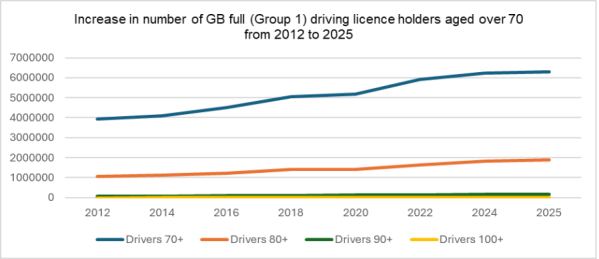
GB has an ageing population with more people likely to drive for longer. From November 2012 to May 2025, the number of people aged 70 and over holding a full driving licence (referred to throughout as ‘older drivers’) increased by 60% (from 3.9 million to 6.3 million).
The number of drivers aged over 70 in the UK has been rising sharply over the past decade, reflecting both demographic changes, increased life expectancy and driving longevity.
Figure 1 illustrates a sharp increase in the number of licensed drivers in GB aged 70 and above from 2012 to 2025. The data includes subgroups for drivers aged 80 or over, 90 or over, and 100 or over.
As of 2025, there were just over 6.3 million full car and motorcycle (group 1) driving licence holders aged 70 and over in GB, with roughly 2 million over-70 drivers renewing their licence each year. From the trend from 2012 to 2025, it looks as if the number of licensed drivers aged 70 or over will continue to increase.
Figure 1: Increase in number of GB full driving licence holders aged over 70, 2012 to 2025
Advances in medicine and health awareness mean people are living and working longer and many reasonably expect to continue to drive well into later life to maintain independence, especially in rural areas. However, it must be recognised that ageing naturally increases the risk of medical conditions that may affect the cognitive, physical or visual abilities needed for safe driving.
While drivers aged 17 to 24 represent a high proportion of collisions in GB, older car drivers are more likely to be killed or seriously injured per licence held, at least in part due to their frailty.
Overall, in 2024, around 24% of all car drivers killed were drivers aged 70 or older, with 11% of all casualties in car collisions being in collisions involving older drivers. In 2024, there were 1,224 KSI older car driver casualties, a decrease of 3% compared to 2023, and an increase of 7% compared to 2014.
The rates of KSI car driver casualties per billion miles driven are higher for male and female drivers aged 76 and over than the rates for all other driver age groups, except for drivers aged 29 and below.
Projected number of older drivers
We expect that, as the population ages, we are likely to see more drivers over the age of 70. Currently, approximately 77% of full driving licence holders go on to renew their driving licence at age 70 (see table 1 below). This figure is based on GB driving licence data and the volume of drivers aged 69 in the years 2019 to 2024, who renewed their driving licence at age 70.
Table 1: Projected number of older drivers
| Year | Age 69 | Renewed at age 70 | Renewal percentage |
|---|---|---|---|
| 2019 to 2020 | 633,039 | 496,826 | 78% |
| 2020 to 2021 | 615,426 | 444,614 | 72% |
| 2021 to 2022 | 609,672 | 469,493 | 77% |
| 2022 to 2023 | 622,970 | 483,368 | 77% |
| 2023 to 2024 | 621,791 | 481,727 | 77% |
Figure 2 provides the number of licence holders aged 70 and over in August 2025 and forecast volumes for the next 5 years. The forecast numbers are based on the growth seen in the number of licence holders aged 70 and over from August 2023 to August 2025 (an average increase of 1.94% per year) and on the number of licences held by people aged 70 and over in August 2025.
For wider context, data from the ONS suggests that there will be a 16% increase in the number of people aged 70 and over in the UK from 2024 to 2032, a compounding annual growth rate of 1.86% in the population per year.
Figure 2: Actual and forecast number of driving licence holders aged over 70, 2025 to 2030
| Actual or forecast numbers of driving licence holders aged over 70 | Number of licence holders aged 70 or over |
|---|---|
| Actual number of licence holders aged 70 or over in Aug 2025 | 6,347,364 |
| Forecast number of licences held by people aged 70 or over 2026 | 6,470,503 |
| Forecast number of licences held by people aged 70 or over 2027 | 6,596,031 |
| Forecast number of licences held by people aged 70 or over 2028 | 6,723,994 |
| Forecast number of licences held by people aged 70 or over 2029 | 6,854,439 |
| Forecast number of licences held by people aged 70 or over 2030 | 6,987,415 |
Source: This data was sourced from the GB driving licence data, August 2025. Forecast numbers are based on a 1.94% year-on-year increase as seen August 2023 to August 2025.
We aim to reduce the death and injury of older drivers (and other road users who could be involved in collisions with older drivers) without restricting the mobility and connectivity of older drivers within society.
Current licensing requirements
Group 1: drivers of cars and motorcycles
Drivers of cars and motorcycles (group 1) who hold a photocard licence are legally required to renew it every 10 years until they reach the age of 70. The 10-year renewal period is referred to as the administrative validity period (AVP) of the driving licence and the purpose is to ensure the photograph identification is up to date. At the age of 70, and at most every 3 years thereafter, drivers must renew their entitlement by making a legal declaration that they can meet the eyesight standards and confirm whether they have any listed medical conditions.
To renew driving entitlement at age 70, group 1 drivers must make a legal declaration that they can meet the eyesight standards required to drive and confirm whether they have any listed medical conditions. There is no requirement for sign off by a healthcare professional (GP, optometrist, etc), but it is a criminal offence to make a false declaration, and it may also invalidate motor insurance. The DVLA will investigate those drivers who notify them of a medical condition and will only issue a driving licence if the applicant can meet the appropriate medical standards of fitness to drive.
While the legal obligation to notify DVLA of a relevant medical condition is on the driver, the DVLA can and does accept notifications about drivers from third parties. Most commonly, this is the police, healthcare professionals, friends, relatives or neighbours. Such notifications may be made on behalf of the driver or without their knowledge.
Upon notification, DVLA will carry out a medical investigation. This usually includes gathering information from the driver, making enquiries with their doctor, as well as considering the results of any medical examination.
Group 2: bus and lorry drivers
Bus and lorry drivers (group 2) must hold a full group 1 driving licence and they must also meet stricter health standards in the interests of road safety. A D4 medical examination (completed by a General Medical Council-registered doctor who is licensed to practise in the United Kingdom or registered within the EU) is required when an individual applies for their first Group 2 licence and at renewal at age 45 and every 5 years thereafter until the age of 65, from which time drivers are subject to annual renewal.
The purpose of the D4 medical report is to check that the applicant/driver meets the standards of fitness to drive for group 2 vehicles. A D4 form must be signed and dated not more than 4 months before the licence is to take effect.
Eyesight and driving
All drivers have an ongoing legal responsibility to make sure they meet the legal eyesight standards for driving. These require that someone has a visual acuity (sharpness of vision) of at least 6 out of 12 on the Snellen scale (letter chart) and that they can read a number plate from 20 metres away (with glasses or contacts if needed).
They must also have a normal field of vision. Visual field refers to the total area a person can see while focusing straight ahead, including peripheral (side) vision. It is measured using tests like the Esterman binocular field test or Goldmann perimetry, which map the extent and quality of vision across the field.
However, as people age, eyesight often deteriorates in visual acuity or sharpness, medical conditions that affect the field of vision are more likely to develop and the ability to recover from glare also reduces. This deterioration can occur gradually, sometimes without a person noticing. Without eyesight correction or treatment, it can increase the risk of collisions for older drivers and other road users.
Regular eyesight tests not only help ensure drivers meet the vision standards but also play a vital role in helping to detect various other medical conditions and eye diseases at an early stage. Early detection allows for timely treatment, which can lead to better health outcomes and help older drivers stay on the road safely, for longer, than if left undetected and untreated.
This has potential long-term benefits for health and social care by reducing future costs, which is why the government supports the NHS recommendation that adults should have their eyes tested at least every 2 years.
Free NHS sight tests are available across GB for adults aged 60 and over, as well as individuals with certain medical conditions such as diabetes, glaucoma or aged 40 and over with a close family history of glaucoma. Other people are eligible for free NHS sight tests where they meet certain requirements.
These tests include:
- a visual acuity check
- an eye health assessment
- a prescription review, with referrals for further tests provided if clinically necessary
Although visual field testing is not routinely included, they are carried out if it is clinically necessary. Individuals not entitled to free NHS sight tests can pay for their own private eyesight test, which costs around £25 to £35, with enhanced eyesight tests costing around £10 extra.
Unlike driver licensing, health and NHS services are devolved in Scotland and Wales and each nation manages its own healthcare system. While the core principles of the NHS remain consistent in that it’s free at the point of use and publicly funded, there are differences in how free NHS sight tests are delivered.
In Scotland, all residents are entitled to a free NHS eye examination every one or 2 years, depending on age and clinical need, regardless of income or medical history.
In Wales, free NHS sight tests are available to those aged 60 and over, those with certain medical conditions, and individuals in specific at-risk groups, with additional eligibility for urgent eye care through the Eye Health Examination Wales service.
In England, eligibility is more restricted and based on age, medical conditions and income-related benefits.
DVLA medical investigations
Currently, there is no requirement for all drivers to have an eyesight test for driver licensing purposes. However, where drivers notify the DVLA of a medical or vision condition that may affect safe driving, the DVLA will investigate and may commission a test, examination or driving assessment.
Drivers who notify certain eye conditions, for example, glaucoma in both eyes, will be required to have a formal test of their visual field. The law provides that DVLA pays any fees associated with medical investigations.
Those who reapply for a driving licence, having previously failed to read a number plate from 20 metres either during a police roadside eyesight test or at their driving test, are required to undertake a number plate test conducted by the Driver and Vehicle Standards Agency (DVSA) before a licence will be issued.
Mandatory eyesight testing implemented internationally
Most European countries require driving licence applicants to undergo a vision assessment either at the time of first application or at renewal. These assessments are typically carried out by optometrists, ophthalmologists or general practitioners, depending on national regulations.
At first application, countries require proof of visual acuity and/or visual field testing, including:
- Austria
- Ireland
- Portugal
- Spain
- Denmark
- Finland
- Latvia
- Poland
In addition, several countries have implemented mandatory eyesight testing at licence renewal, including:
- Spain
- Italy
- Denmark
- Finland
- Norway
- Iceland
- the Netherlands
The age at which proof of an eyesight test is required varies between countries.
For example, in Spain, drivers are required to provide proof of vision testing at first application and at 10-yearly licence renewals. Once a driver reaches the age of 65, they are required to renew their licence for 5 years and are expected to undergo a medical examination, which includes a vision test.
At age 70 and over, the frequency of driving licence renewal increases and drivers are expected to:
- have a medical examination and vision test every 2 years
- in Italy, drivers over 70 must renew their licences every 3 years and a medical certificate is required that includes a vision test
- in Denmark, drivers must provide a medical certificate that includes an eye test at ages 70, 75 and then every 2 years
All costs associated with standalone eyesight tests are borne by the driver and range from around 6 to 35 Euros, with the exception of Sweden, where this expense is incorporated into the general driving licence fee.
Safety impacts of mandatory eyesight testing
In 2019, DfT published the road safety statement: a lifetime of road safety, which included an action to ‘assess the recommendations from the older driver’s taskforce’ (ODTF).
DfT funded a review of ODTF’s 2016 report and an updated version of that report, which was produced in November 2021, ‘supporting safe driving into old age’. The 2021 report makes recommendations on changes that could be made to improve the safety of older drivers, including:
- introducing mandatory eyesight testing
- fitness to drive assessment (alternative to prosecution scheme for careless driving offences to be rolled out nationally)
- voluntary driving appraisals/assessments (core content for driving appraisals and the training course for approved driving instructors (ADIs) should be extended to create a large pool of certified and trained instructors
The ODTF found considerable evidence that vision changes with age and that there are significant changes to both visual and cognitive function, and to driving performance. At the time of updating the 2016 report, the ODTF reviewed evidence alongside the most recent data from Hampshire Constabulary, which showed 51% of drivers aged 70 and above in Hampshire, who were offered an assessment as an alternative to prosecution after being stopped for driving without due care and attention, required eyesight correction.
They also refer to a study of police data by the College of Optometrists, which found that 77% of a large sample of collision reports involving the over 60s had ‘uncorrected, defective eyesight’ as a contributory factor (PDF).
In December 2019, DfT commissioned ScotCen Social Research (a subsidiary of NatCen) to carry out a rapid evidence assessment, the core objective of which was to understand the extent to which driver eyesight problems or vision issues pose a road safety risk in the UK. The evidence is being used to inform decisions related to the eyesight testing regime, eyesight testing requirements and fitness to drive standards relating to visual disorders, including informing what further research is required before decisions can be made.
As a rapid evidence assessment, the assessment prioritised studies based on relevance and was not a systematic review. This was appropriate to identify key evidence in this context, and the approach is clearly explained in the report.
The authors’ overall conclusion was that there was evidence, backed by both evidence reviews and primary research studies, of an association between cataract and a higher rate of motor vehicle collisions. There was mixed evidence on the relationship between contrast sensitivity, visual field, glaucoma, macular degeneration and the rate of motor vehicle collisions.
For all other visual impairments discussed in the prioritised literature, there was either mixed or no evidence to support an association. No evidence regarding cerebral tumour, arteriovenous malformation or diplopia (‘double vision’) was found in the included studies. The authors of the report concluded that the lack of evidence could be down to a combination of lack of research carried out and drivers compensating for their visual impairments by adjusting their driving behaviour (not driving in the dark) and/or employing different patterns of eye movement and increased scanning behaviour.
The College of Optometrists produced a report in September 2022 (PDF) that concluded that drivers may not fully understand their legal responsibility to ensure they meet the vision standards for driving and their personal risks related to eyesight and driving.
Optometrists who were interviewed as part of the research suggested that it should be mandatory for people who hold a licence to have regular sight checks. This would normalise the conversation about driving and vision, as well as making the roads safer for everyone.
The report concluded that optometrists could play a very effective role in supporting their patients to make more informed choices about their driving behaviour. However, this requires individuals to have regular eyesight tests in the first instance, and when they do, for optometrists to proactively discuss and give advice on vision and driving.
In November 2024, the report is your vision roadworthy was produced, which summarises the results of a UK roadside vision screening survey.
Police forces across England and Wales conducted number plate tests on 3,010 drivers and riders. Of the 3,010 tested:
- 83% were car drivers
- 1% were motorcycle riders
- the remaining 17% were drivers of other vehicles, such as vans and light goods vehicles
Police officers were asked to undertake a 20 metre number plate test at every opportunity, either specifically for the operation dark night and is your vision roadworthy (ODNIYVR) campaigns or when a driver was suspected of having defective vision, after committing a traffic offence, or following a road traffic collision.
1.7% of drivers who stopped failed the test and 3.2% of drivers who stopped received police warnings or had their licence revoked. 1.4% of drivers stopped had their driving licence revoked, including 38 immediate revocations. The survey also highlighted an increased failure rate among older drivers, with 10.2% of motorists aged 81 to 90 failing the test.
Options for change
Our primary objective is to reduce road deaths and injuries of older drivers (and other road users who could be involved in collisions with older drivers) while preserving their independence, mobility and social connectivity. We believe that by ensuring older drivers continue to meet the required vision standards for safe driving, there could be a positive impact on road safety.
To achieve this, there are a range of factors that need to be considered in how vision testing can be incorporated into the driving licence renewal process.
Age of commencement
Current considerations include introducing mandatory eyesight testing for drivers aged 70 and above and every renewal thereafter. Consideration could also be given to starting at a younger age (to be determined).
A proportionate approach is needed to balance road safety with individual autonomy. Visual capacity is fundamental to safe driving and age-related eye conditions often develop gradually and can go unnoticed by drivers.
Testing frequency
Areas being explored include conducting eyesight tests every 3 years for drivers over 70 in line with current licence renewal, or increasing the frequency as drivers reach higher age thresholds, for example, 75, 80, 85, etc.
The prevalence of eye conditions and the rate of visual decline can accelerate as people get older. Consideration will be given to the timing alignment of the eyesight test and the licence renewal period.
Type of test
Considerations include utilising the existing NHS eyesight test (although this only contains one element of the vision standards for driving (acuity, not field)) or developing a bespoke test to assess if a driver meets the vision standards for driving.
Consideration is being given to a licence holder providing proof that they have attended an eye test, which would include confirming the outcome from whoever conducted the test.
Test administration
Considerations include having tests administered by opticians, the NHS or through bespoke test centres for driving eyesight tests. We would require evidence of the outcome of the test within a set timeframe at each licence renewal. This could be provided by the licence holder, the person who conducts the test or both. Such a test could be administered by private eye care providers or, to improve scalability, delivered by trained personnel outside clinical settings (non-healthcare professionals), which could reduce costs and dependency on specialist availability.
Alongside this, we could look to introduce a legal obligation on the person conducting the test to report test results directly to the DVLA. Introducing a mandatory reporting requirement would give assurance that a licence holder meets the required vision standards and supports proactive intervention where vision may pose a road safety risk.
Funding arrangements
We could potentially use the existing free NHS eyesight test, which will have a cost for government (likely a smaller increase in costs for Scotland, where the NHS eyesight test is already available for all ages) or require drivers to pay for an eyesight test.
Consideration could also be given to the cost being split between government and the licence holder. This is something that will be scoped following the consultation.
How to respond
See the Ways to respond section of the consultation page on GOV.UK to find out how you can respond to this consultation.
The consultation period began on 7 January 2026 and will run until 11 May 2026. Ensure that your response reaches us before the closing date.
What will happen next
We will publish a summary of responses and the government response on the homepage for this consultation / call for evidence. Paper copies will be available on request.
If you have questions about this consultation, contact:
Road safety division
Department for Transport
33 Horseferry Road
London, SW1P 4DR
Alternatively, you can email: mandatoryeyesighttestingconsultation@dft.gov.uk.
Full list of questions
These questions are listed here to give you an overview of what we are asking. The consultation response form may include more questions, for example, questions about who you are.
See the Ways to respond section of the GOV.UK home page for this consultation to read a full list of questions and find out how you can respond to them.
Question 1: Who do you think should be responsible for notifying the DVLA when a licence holder is diagnosed with a medical condition that may affect their ability to meet the vision standards for driving?
Question 2: Do you agree or disagree that mandatory eyesight testing should be introduced for older drivers?
Question 3: Do you agree or disagree that 70 years is the appropriate age for mandatory eyesight testing to start?
Question 4: In your view, how often should older drivers be required to have a mandatory eyesight test?
Question 5: Why do you think this frequency is correct?
Question 6: In your view, should the frequency of mandatory eyesight tests increase as drivers get older?
Question 7: At what age, in your view, should the frequency of mandatory eyesight testing be increased?
Question 8: Why do you think the frequency of mandatory eyesight testing should be increased at this age?
Question 9: What, in your view, should the mandatory eyesight test cover?
-
visual acuity (a measure of the eyes’ ability to see sharpness of vision. This is usually measured by reading letters on a chart from a set distance, with glasses or contacts if needed)
- visual field (this is measured using machinery which tests your central and side vision and identifies if you have vision problems)
- identification of a visual condition
- confirmation that drivers meet the legal eyesight standards for driving
- another test
Question 10: Who, in your view, should be responsible for conducting the mandatory eyesight test?
Question 11: Who, in your view, should be responsible for notifying the DVLA of the outcome of the mandatory eyesight test?
Question 12: Outside of any potential mandatory eyesight testing requirements, who do you think should be responsible for notifying the DVLA when a licence holder may no longer meet the vision standards for driving?
Question 13: Do you have any further comments?
Further information
Freedom of information
Information provided in response to this consultation, including personal information, may be subject to publication or disclosure in accordance with the Freedom of Information Act 2000 (FOIA) or the Environmental Information Regulations 2004.
If you want information that you provide to be treated as confidential, please be aware that, under the FOIA, there is a statutory code of practice with which public authorities must comply and which deals, amongst other things, with obligations of confidence.
In view of this, it would be helpful if you could explain to us why you regard the information you have provided as confidential. If we receive a request for disclosure of the information, we will take full account of your explanation, but we cannot give an assurance that confidentiality can be maintained in all circumstances. An automatic confidentiality disclaimer generated by your IT system will not, of itself, be regarded as binding on the department.
Data protection
Your consultation response and the processing of personal data that it entails are necessary for the exercise of our functions as a government department. DfT will, under data protection law, be the controller for this information.
Your personal data collected through this consultation is processed in line with our online forms, surveys and consultations privacy notice
DfT’s privacy policy has more information about your rights in relation to your personal data, how to complain and how to contact the Data Protection Officer.