Growing up in the online world: progress statement (June 2026)
Updated 19 August 2026

© Crown copyright 2026
This publication is licensed under the terms of the Open Government Licence v3.0 except where otherwise stated. To view this licence, visit nationalarchives.gov.uk/doc/open-government-licence/version/3 or write to the Information Policy Team, The National Archives, Kew, London TW9 4DU, or email: psi@nationalarchives.gov.uk.
Where we have identified any third party copyright information you will need to obtain permission from the copyright holders concerned.
This publication is available at https://www.gov.uk/government/consultations/growing-up-in-the-online-world-a-national-consultation/outcome/growing-up-in-the-online-world-progress-statement
Presented to Parliament pursuant to section 71(1) of the Children’s Wellbeing and Schools Act 2026
June 2026
© Crown copyright 2026
ISBN 978-1-5286-6602-2
E03626741
Secretary of State Foreword
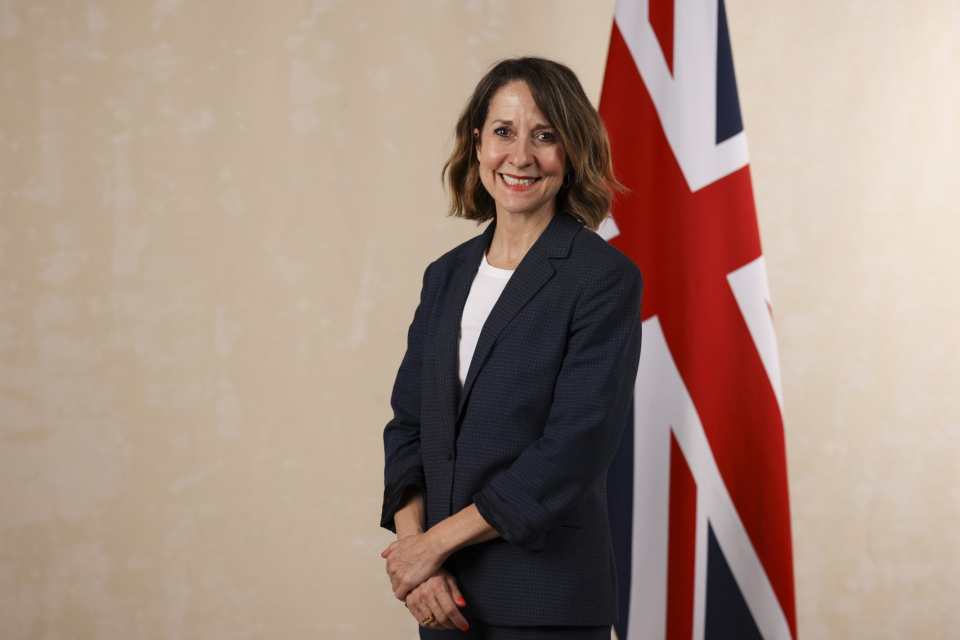
The Rt Hon Liz Kendall MP, Secretary of State for Science, Innovation and Technology
Every child deserves a childhood shaped by friendships, curiosity, play and love. A childhood where they feel safe, supported and free to explore who they are. Where they can try new things, build confidence, make friends face to face and feel they belong. That is the childhood every parent wants for their child. It is the childhood every child deserves.
Technology can be part of that. But for too long, the balance has been wrong. I have seen the evidence. I have heard from parents, teachers, doctors, police officers, children’s charities - and from children themselves. Social media is causing real harm and up and down the country parents are struggling with how to cope. It is affecting children’s mental health, their sleep, their concentration and their self-esteem. In the worst cases, it is exposing them to self-harm, grooming, exploitation and child sexual abuse.
That is why we launched the biggest national conversation on childhood in a generation. More than 116,000 people responded - 54,000 parents, 14,000 children, charities, teachers’ organisations, medical professionals, the police, industry, academia and parliamentarians. The message was overwhelming: most - including 9 out of 10 parents - want social media banned for under-16s.
We have listened. And we are acting.
We will ban social media companies offering their services to under-16s. And we will go further. We will restrict some harmful functionalities - including livestreaming and stranger communication - across a wider range of services, including gaming platforms. We will require AI chatbots to prevent children under 18 from accessing features that are specifically designed to enable sexually explicit interaction. And we will require effective age assurance so that these rules are enforced.
We know that this will be hard for children who are already used to having social media as part of their lives. But we think that drawing a clear line – that social media is harmful for under-16s – will help put power back in parents’ hands, keep today’s children safe, and set a new normal for future generations of children.
We want childhood to be about what matters offline as much as what happens online. That is why, alongside these protections, we are working across government to expand access to educational and positive experiences - sport, music, arts, volunteering, clubs and activities that help children explore their interests, build friendships and strengthen their sense of belonging.
My message is simple. We are telling an industry that has failed to keep children safe that the rules have changed. We are giving parents the support they have been asking for. And we are setting a new social norm for our children and future generations, so we can give children their childhood back.
This is not the end of the conversation. We plan to come forward with more measures in July. And as technology inevitably changes, we remain prepared to take further action if required. Today we are taking a bold and significant step towards creating a safer, healthier life online for our children and future generations.
Chapter 1: Introduction
Our aim is for every child to have the best possible start in life.
- This government is committed to doing whatever it takes to keep children safe online and give them the best start in life.
- We asked people across the UK how to make children’s experience of the online world better, and 116,211 people shared their views, including more than 54,000 parents and 14,000 children.
- Now we are preparing changes so children can use technology safely and parents can be confident that children are safe.
- These changes are just the start. This document sets out the government’s plan on the central questions in the consultation; we will provide an update on the remaining questions in July. We will also continue our wider work on online safety.
We are setting out our plan now to:
- Ban social media companies from providing their services to under 16s.
- Prevent under 16s from accessing harmful functions on other online services, including gaming services.
- Require default restrictions for 16- and 17-year-olds from harmful functions.
- Apply rigorous age checks to enforce these requirements.
- Prevent under 18s from accessing AI chatbot services that primarily offer sexualised content. Other AI chatbot services will not be able to offer children features that enable sexually explicit or sexual role-playing content.
- Give children access to more educational and positive content and experiences, both online and offline.
On 2nd March we published the consultation “Growing up in the online world: a national consultation” and began a national conversation about whether social media and other online services are shaping children’s lives in safe and healthy ways – and what needs to change.
We set out our aim for every child to enjoy a childhood shaped by friendships, curiosity, play and love - the chance to grow up happy, healthy, and supported. Our focus is on giving all children, no matter their background, the skills and opportunities they need to thrive and shape their own future. A future where they can try new things, build confidence, make friends face to face and feel they belong. We want to help parents and teenagers feel confident, connected, and ready for what’s ahead.
Technology is a big part of everyday lives for children now and in the world that they will enter as adults. The UK public and our shared values should shape technology and how we use it, rather than letting technology shape us. The government has already introduced some of the strongest laws in the world to protect children online, but we know more needs to be done on top of this to make sure children are ready for the future, and to keep pace as technology changes. Countries around the world are facing the same challenge. We will learn from the experiences of other international partners but also build on them. The changes outlined in this document, together with other actions that the government is taking – for example guidance on screen time, new restrictions on devices and more support for children to have enriching experiences offline – will lead the way in ensuring children have the best start in life.
1.1 The consultation and conversation
Going into this consultation there was consensus that further action was needed but there was a range of deeply held, often conflicting, views on what should be done next, especially on the question of whether we should ban social media companies from providing their services to under-16s. Decisions of this nature – when we are talking about the safety, wellbeing and futures of our children – need to be taken with the seriousness that they deserve. This consultation has allowed us to properly examine the range of options and their impacts. Allowing voices on all sides to be heard is an important part of the democratic process. That is why, alongside the consultation, we ran the national conversation.
The scale of participation has been huge, and we are grateful to all those who took part. Across our full consultation, parents’ and children’s consultations, and nationally representative polls, we heard from 116,211 people in just over 12 weeks. In total, responses included the views of more than 54,000 parents, 14,000 children, and 600 organisations.
As part of our national conversation, we invited parents, carers and children from all over the UK to join in events and share their views. Ministers, departments, devolved governments, MPs and organisations including charities and children’s groups have helped spread the word and made sure the survey reached children and families in different communities, helping to shape what happens next. We put hearing the voices of children themselves front and centre, recognising that it is their experiences and futures most directly affected.
“It was an incredible opportunity to attend this event which saw young people being included within conversations about themselves” Young person, National Conversation event
“I can really say what I want to say and I can be honest about my feelings about certain topics” Young person, National Conversation event
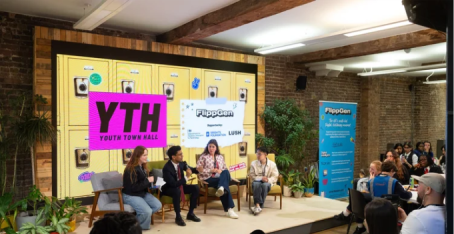
Minister Narayan engaging with young people at a Youth Town Hall.
We also took steps to ensure that voices which can sometimes get lost were listened to and surveyed through a nationally representative panel, in parallel to the wider consultation. We have published a range of evidence gathered through all of these processes alongside this statement, as well as the full methodology.
We have heard the calls for change, and we are ready to act quickly.
We know parents and carers want us to act at pace to address the issues they are most concerned about. So, we are setting out here the most significant changes we intend to make.
The consultation also looked at other areas including additional steps to prevent circumvention of any restrictions online, and how we can give parents and carers the right tools and advice to support children as they explore the online world. Some concerns raised during the consultation will also need further attention and we will be coming back to these questions. We will share a fuller update next month.
1.2 Meaningful culture change
Clear, simple action must be a game changer. This is about changing behaviour, and changing, as a society, the way we think about what is safe and suitable for children in an online world. Our objective is not just to prevent access to certain services or features, but to reset norms – just as we have done in other areas of life, like recognising that alcohol isn’t appropriate for children – and to give young people the childhood they deserve.
We want to help parents and carers feel confident to have open, everyday conversations with children about their online activity and to support parents in setting appropriate boundaries. We know it might not be easy, but we do not accept unsafe products for children offline, and we cannot accept them online.
We are laying the foundations for a new settlement for the online world: to ensure children have the best possible start in life and to put the power back into parents’ hands.
Our principles
As we move forward with these changes, it is important to be clear about our principles.
These principles reflect our commitment to swift and meaningful action for families and children:
-
We believe it is the responsibility of companies to make their products safe for children.
-
We want to help support and back parents and carers with clear guidance.
-
We will use the best available evidence, along with what we hear from children and families around the world, to guide our decisions. If something looks like it could cause real harm, we will act. And we will stay flexible and ready to adjust as new information comes in.
-
We want to help children get ready for the future by thinking about their whole lives – both online and offline.
-
We will build on the Online Safety Act, layering up protections for children, not replacing them.
-
We welcome and support websites and online services that put children first and treat them responsibly. We want the UK to lead the way in protecting young people online and offering them enriching experiences.
Chapter 2: What we heard: perspectives on growing up in the online world
What we heard:
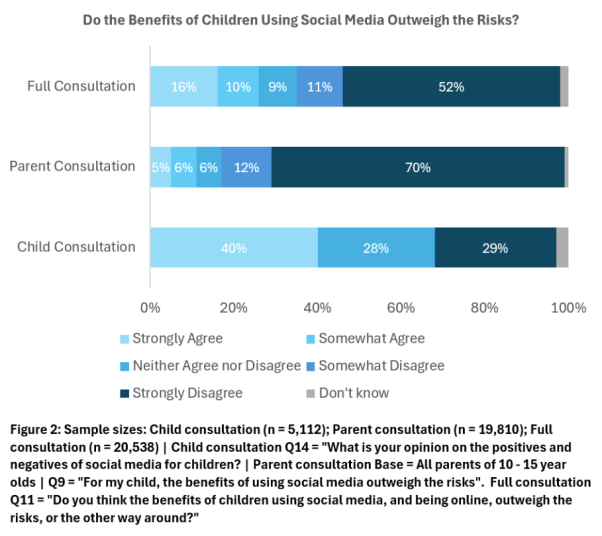
- Only 11% of respondents to the parent’s consultation agreed that the benefits of being on social media outweighed the risks.
- This compares with 40% of children who thought the benefits outweighed the risks.
Being online can open up a whole world – children can make friends, feel less alone, learn new skills, access information and connect with people they wouldn’t meet otherwise.
But it can also bring real risks – some content can be unsafe, children don’t always know the people they are talking to, apps can pull children in for too long, and it can take away time from sleep, school, and real life.
2.1 The positives of social media use and being online
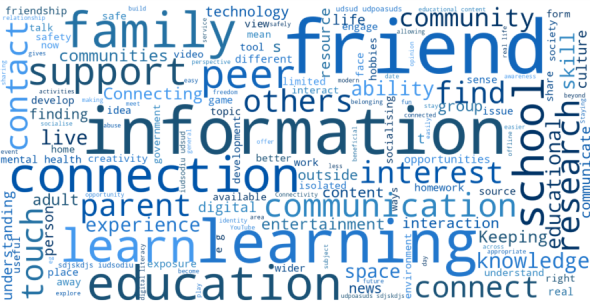
Figure 3 What are the benefits of social media use, and being online, for children?
Note: Full consultation, n=24,534>
In response to our consultation, many companies, charities and groups that represent children highlighted benefits that being online and using social media can provide children and young people. They set out how these services can help children connect with friends and family, find like-minded communities and access information. Some companies also described how their services can provide opportunities for children to be creative and develop digital skills.
During our discussions with families and young people, we heard lots of positive stories about using social media and other online services. Many children have told us that being online gives them the chance to learn new skills from experts all over the world, which they might not be able to do otherwise, because of things like cost or where they live. Young people have shared how chatting online, playing games or using helpful AI tools have supported them through tough times and helped them feel more connected, especially for those in more marginalised groups.
“For children in LGBTQ+ communities like me, it helps them feel safe, especially when they can’t come out to anyone in real life. It also helps children with depression or anxiety to get the help that they need” Young person, Children’s Consultation
Many of the people who responded to our consultation thought that being online can help children stay in touch with friends, feel less alone and boost their wellbeing. It can also open learning opportunities, give them access to different ideas and cultures, and help them build communication and media literacy skills. For some children, including those with special educational needs and disabilities (SEND), or those who may have more limited access to trusted and engaged adults, online tools and communities can provide valuable support and connection.
“I will usually look for something to improve my game. For me it’s basketball, but [it] can be arts and crafts, reading books, running, anything” Young person, National Conversation event
“Social media can also help us learn more and stay aware with what’s going on in the world. Personally, I like to stay on top of the news and find out what’s happening in the world, as it’s interesting and I find it good to learn about different cultures, global events” Young person, Children’s Consultation
All these online experiences show just how integral the internet has become in everyday life for children and families. Children and young people have told us they are worried about missing out on positive online experiences.
By understanding these benefits, we can understand what is most important for children’s positive online experiences and make sure that this is built into our approach.
“Listening to some positive stories about what social media can do or AI can do for young people is just as useful as hearing about some of the dangers” Parent, National Conversation event
Companies have told us of the beneficial experiences their services provide for users too, including the positive impact that many safety features have had and the reassurance these can give parents.
2.2 The concerns
Figure 4: What are the harms or risks of social media use, and being online, for children?
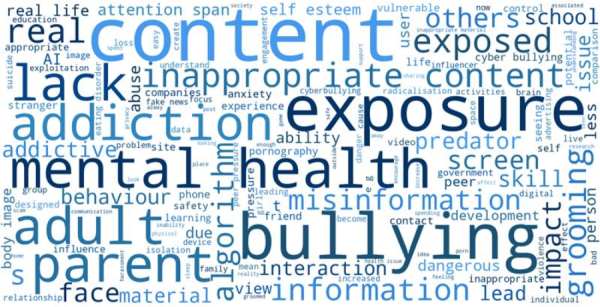
Note: Full consultation, n=24,534>
However, any positives have to be considered alongside the concerns of parents and the evidence of risk.
Overwhelmingly, our consultation showed that people are concerned about what children can be exposed to online, including harmful and age-inappropriate content, bullying, abuse and exploitation. Many were also worried about children spending too much time online, and the displacement of healthy activities and the impact this can have on sleep, exercise, physical health and school. We also heard concerns about the negative effects on emotional wellbeing and mental health, including anxiety, depression, low self-esteem, loneliness, as well as self-harm and suicidal thoughts.
Children have said they are worried too – including about seeing things that are not right for them and bullying online, but also about spending so much time online that it takes away from sleep, school and other important parts of life.
“It’s [social media] becoming something that everyone relies on. I do admit myself, there is a lot of time that I spend on it, instead of allocating it to schoolwork or sleep for example” Young person, National Conversation Event
“The main one from my experience has got to be anxiety – social media makes you constantly aware of what everyone else is thinking” Young person, Children’s Consultation
We also heard that vulnerable groups can be disproportionately impacted by some of the risks associated with online spaces. The children and young people that responded to our survey told us that not all children experience social media in the same way. Research by Internet Matters finds that girls and children with additional needs are more likely to have negative experiences online, which shows that some groups, such as those with SEND, face greater risks than others.[footnote 1],[footnote 2]
2.3 Evidence and lived experience
Academic responses have highlighted the lack of evidence on the impact of social media use and have recommended a combination of interventions to tackle what is a complex issue. There is a correlation between excessive social media use and poor mental health, but we don’t definitely know at the moment if one causes the other. There is also some evidence around the indirect effects of social media on children’s development, particularly where it displaces or disrupts sleep.[footnote 3] [footnote 4] Research is ongoing, and we expect more evidence to emerge in the coming months. The Science, Innovation and Technology Parliamentary Committee is looking at the impact of digital devices on brain development and physical impacts for children of different ages and backgrounds.
We also established an independent academic expert panel, and while their work is ongoing, their preliminary position confirms that the impact of social media is nuanced.[footnote 5] There are known harms, particularly among high-risk individuals, but young people can also experience benefits. Negative impacts are small when averaged across the population, but features that enable or promote excessive use are a credible concern. Ofcom research also suggests that features inherent in the platforms may make it harder for many children to consume social media in moderation.[footnote 6]
We want our policy to continue to be evidence-based. But to do this, researchers need better access to information from tech companies, including social media platforms, so they can properly understand how these services work and how they affect people of all ages. To support this, we will be consulting later this year on ways to make it easier for independent researchers to access data from platforms. This will help inform future decisions, leading to safer online experiences for all.
The Online Safety Act requires services to put in place measures like age checks and changes to their algorithms to protect children from harmful content.
However, the most recent evidence from Ofcom does show that children are still being exposed to harmful content, and all the major services have so far failed to commit to the scale of changes needed to reduce children’s exposure to harmful content.[footnote 7] [footnote 8] We know that Ofcom needs to go further and faster on enforcement, and we have set out in chapter 3 more detail on action we are taking.
Certain online features, especially those that work in real time like livestreaming, can put children at risk very quickly. The National Police Chiefs’ Council and the National Crime Agency have told us they are worried that the online world isn’t safe enough for children right now, and that young people are facing too many dangers. They feel things aren’t improving fast enough to protect children from risks found on social media, gaming services, devices and new risks like AI.
“The online environment is now one of the primary operating spaces for some forms of child sexual abuse (CSA) and a growing range of other serious harms affecting children” Letter from National Crime Agency and National Police Chief’s Council
Clinicians have also spoken out about their concerns around platform design features, and their impact on things that are important for children, like sleep.
“As paediatricians, we are increasingly concerned that the digital environment many children are growing up in is not designed with their safety, development and wellbeing in mind” Professor Steve Turner, President, Royal College of Paediatrics and Child Health, Academy of Medical Royal Colleges’ consultation submission
The National Education Union has shared teachers’ concerns, including over sleep deprivation and behavioural issues - a member poll showed 90% of members support a minimum age of 16 for children to access social media.
“Social media is not in any way suitable for children under 16. As a pastoral leader, social media incidents take up at least 80% of my workload. ….” National Education Union’s 2025 State of Education report
We also heard from parents who have suffered devastating and unimaginable losses because of their children’s online experiences. Their accounts paint a powerful and deeply distressing picture of how social media can expose children to harmful content and habits, as well as making it difficult for parents to intervene. We remain profoundly grateful to those parents who have shared their stories with us and their continued and unwavering commitment to child online safety. Their determination has been instrumental in driving forward meaningful change.
2.4 The need for change
We have heard from charities and child representative groups about the need for platforms to be much safer for children, to meet better, clearer safety rules before children can use them. Many have called for a broader package of reform which combines stronger rules, better age checks and more education to help families.
We have listened to families and experts, and it is clear things need to change. We also want to make sure we consider the difference of opinion between parents and children. To do this, we will take a careful and balanced approach, focusing on the biggest risks while protecting many of the positive things children have told us matter to them. This includes connecting with friends, being creative and having fun, and keeping space for safer online services.
Chapter 3: Social media
What we heard:
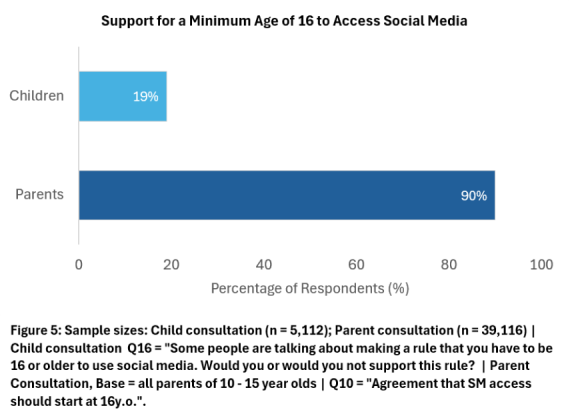
- Most (90%) parents who responded to the consultation support a minimum age of at least 16 for children to access social media.
- Only a small number (19%) of children supported a minimum age of 16 across all social media platforms, but 65% of young people (16-21) would like under-16s restricted from at least some features designed to keep users online longer, with over half (53%) wanting to restrict infinite scrolling.
What will change
- Social media companies will be banned from offering their services to under 16s.
- There will also be additional default restrictions for certain functions for 16- and 17-year-olds.
- We are considering further default overnight and “addictive” feature restrictions for 16- and 17-year-olds and will provide an update on this in July.
We know that children’s experiences vary depending on which websites or apps they use. We believe that the major social media services, as they are currently designed, create unique risks for children. The combination of rapid content uploading, algorithm-driven content recommendations, and other design features have created specifically harmful environments. 9 out of 10 of parents who responded to the consultation support a minimum age of at least 16 for children to access social media. This is significant.
We have given these companies many chances to make their platforms safer, and though many have introduced welcome changes, they haven’t gone far or fast enough. We therefore consider the responsible thing to do is to ban social media companies from offering their services to under 16s.
This isn’t about stopping children from going online altogether. It’s about making sure the services they use are safe and suitable. In practice, that means not allowing companies to offer social media services to children unless they are designed with their wellbeing at the centre.
3.1 What social media services will this apply to?
It is our intention that these measures will apply to social media services whose combination of design features have created specifically risky environments.
We will aim to use the same model as Australia. This means capturing user to user platforms, whose purpose is to enable social interaction, which allow users to post material alongside algorithms. This will include platforms like Snapchat, TikTok, YouTube, Instagram, Facebook and X.
We will take a UK approach to how we implement these measures, in particular by putting stronger requirements on companies to verify age.
Our approach will be targeted and proportionate. Nearly a third of people who responded to our full consultation thought that educational and cultural sites, such as libraries and museums should be exempt from age restrictions. There will be a narrowly defined list of exemptions, including, for example, educational services, e-commerce platforms and music streaming. We will keep this definition under review.
If services do not meet the criteria then they will not be in scope and children of all ages will still be able to use them. We want to see more services designed specifically for under 16s.
Australian approach:
The Australian eSafety Commissioner considers that to be an age-restricted social media platform, services must meet the following criteria:
- The sole purpose or significant purpose of the service is to enable online social interaction between two or more end-users;
- The service allows end-users to link to (e.g. send a friend/follow request), or interact with, some or all of the other end-users;
- The service allows end-users to post material on the service;
- The service has a ‘recommender feature’ (e.g., an algorithmic content feed) and/or a ‘logged-in feature’ (an endless-feed feature, a feedback feature or a time-limited feature) as defined in the legislation;
- Material on the service is accessible to, or delivered to, end-users in Australia.
It is for services to assess whether they meet the conditions to be considered an age-restricted social media platform and to notify the eSafety Commissioner. Services are required to do this on an ongoing basis as they evolve.
Services caught by the Australian model:
Under these criteria, the eSafety Commissioner considered that Facebook, Instagram, Snapchat, Threads, TikTok, Twitch, X, YouTube, Kick and Reddit were age restricted.
This list broadly aligns with many of the services that Ofcom identifies as most used by UK children and most associated with harm. In the UK, the list of most used by UK children also includes Roblox and WhatsApp, which as a gaming and a messaging service respectively, are exempted from the Australian approach (more on exemptions below).
Australian exemptions:
The Australian model includes specific exemptions for services that are not age restricted.
These include dedicated communication and messaging services; online gaming services, information and review platforms; professional networking and development services; educational platforms; health services and provider-patient communication services, as well as communication services specifically for educational institutions and students or students and families.
Australia was the first country in the world to delay children’s access to social media services. We have worked closely with them to understand their experience. We have heard some concerns, particularly from civil society, that industry compliance with Australia’s ban remains low. Research indicates that many children who were already using these platforms still have accounts, and some are getting around the restrictions.[footnote 9] This is why we are carefully considering our approach in terms of which companies the restrictions will apply to and how they meet these new rules. An important part of this will be making sure there are strong and effective ways to check users’ age, and there is more about this in chapter 6 below.
3.2 Children’s views?
Children have told us about the worries they have when they are online, and they want to see social media change. But they don’t all agree on the best way to approach this. Overall, children tend to favour a more selective approach to restricting different functionalities of services, rather than banning them altogether. Only a small number of children and young people consulted (19%) support a minimum age of 16 for access to all social media, but 66% support age restrictions on at least some social media sites.
That is why we are taking a mixed approach. We will ban social media companies from providing their services to under 16s because we think the risk outweighs the benefits. For other services, we will focus on restricting specific functions, rather than removing access completely. There is more detail on this in chapter 4.
Importantly, through our consultation, children have told what they value most about being online – such as connecting with friends, being creative and having fun. As we make changes, we will make sure they can still enjoy these positive experiences safely, whether online or in other ways.
3.3 How will children be able to access support and positive content?
Children should still be able to use the internet to learn, read news, connect with friends, and find help when they need it. We have heard how the internet can provide vital resources and safe spaces for children, and we know it can be particularly important for certain groups, such as those who are part of the LGBTQ+ community.
Our work across government to ensure the continued and improved access to positive, informative and supportive spaces will be important to ensure that no children are unfairly disadvantaged by these changes. We will ensure that children’s rights are carefully considered as we deliver our next steps.
Access to high-quality and educational content remains essential. While many children may currently access content like the news through social media and video sharing platforms, these are not the only – nor always the most reliable – sources of high-quality, educational and news content.[footnote 10] We want to see more high-quality services designed specifically for young people.
The Department for Culture, Media and Sport (DCMS) is helping to make it easier for young people to find and engage with trusted news as part of the Local Media Action Plan. This aims to help young people engage with high‑quality local and national journalism online. State funded schools throughout the UK already have digital access to around 150 newspapers through the Newspapers for Schools News Library, supporting teaching and helping children build skills to understand what they read and see online. More schools will be encouraged to make the most of this.
The BBC continues to play an important role as a source of trusted news for young audiences, with programmes like Newsround reaching millions each week; DCMS is working to help secure the BBC’s long-term sustainability and ensure its content continues to reach younger audiences.[footnote 11]
3.4 What happens at 16?
As children get older, it is right that they have more independence and responsibility online, just as we support them to make more of their own choices in other parts of their lives.
Some children and families, as well as charities, civil society groups and industry, have told us that introducing a minimum age of 16 might mean that when young people reach that age, they are suddenly exposed to harms they are not ready for. Different children mature at different ages and so we also need a system that supports this. In our consultation, both parents and children and young people strongly supported restricting persuasive design features on social media and introducing time-based limits on use.
So, for 16- and 17-year-olds we are introducing extra measures to help them adjust more gradually. This means some of the higher-risk functions will be limited by default. We explain this more in the next chapter.
We are also looking at optional restrictions on persuasive design features, like infinite scroll, and overnight limits for older children, to help them switch off and get a good night’s sleep. We are currently piloting how well this approach works and will share what we’ve learnt next month.
3.5 How will we help children be ready?
As children get older, it is also important they have the skills and confidence to use online services safely. That is why we are committed to helping children understand the risks, how to make safer choices, and helping parents and carers to support them. In March 2026, we published a cross-government Media Literacy Action Plan, setting clear priorities for the next three years, including preparing children and young people for a digital future.
Alongside this, we are providing practical support for families. The ‘You Won’t Know Until You Ask’ campaign and Kids Online Safety website give parents and carers simple, accessible advice to help children build critical thinking and resilience online.
In England, the Department for Education is strengthening children’s skills and confidence through education, recognising media literacy as an essential part of learning. These skills are already built into subjects like citizenship, Relationships, Sex and Health Education (RSHE), computing and English, giving pupils a strong foundation to navigate digital content safely and responsibly.
The government has updated the statutory RSHE guidance which schools can already follow and which all schools in England will be teaching from September 2026. In secondary schools, RSHE will include critical thinking about new types of technology including artificial intelligence and AI chatbots. Children will learn about the prevalence and harms of deep fakes, and about misinformation and disinformation. Children will be supported to identify misogynistic or violent online content, and to understand that what they see online may not reflect real life and can sometimes normalise or glamorise behaviours which are unhealthy and wrong.
The government is going further through the updated National Curriculum, strengthening critical thinking and helping pupils identify and challenge mis- and disinformation. A new curriculum in England will be introduced from 2027, with teaching beginning in September 2028. Media literacy will be properly and clearly covered in citizenship, alongside strengthened English lessons to help pupils analyse sources and spot bias, and an enhanced computing curriculum covering AI, data science and technological bias.
In addition to this, Ofcom has a role in helping people better understand the online world. This includes explaining how harmful content and online behaviour can affect different groups, for example women and girls. Ofcom’s three-year media literacy strategy sets out a plan to strengthen people’s ability to navigate media safely and confidently by building the evidence base, working with platforms and expanding partnerships to deliver skills and support across the UK.[footnote 12] This helps equip children, young people, parents and carers to make informed choices about how to live their online lives.
Our aim is to help families make choices that feel right for them, so teenagers can explore the online world in a way that supports their safety and wellbeing.
3.6 What about risks of other online spaces?
Civil society and industry groups have rightly raised the risk that a ban might incentivise children to move to other, less safe parts of the internet. We know this has been raised as an issue in Australia, with many charities and children’s groups expressing concerns.
In the UK, there is already a strong foundation of protections in place to help keep children safe across thousands of online services under the Online Safety Act, including focusing on smaller services that pose risks. Ofcom has clear powers to hold companies to account and is supported by the government to use these. They have already launched over 100 investigations and issued over £4 million in fines for breaching current online safety laws.[footnote 13]
Services should be in no doubt that where they break UK law, they will face the consequences. We know there is more that can be done to make companies change their behaviour at the pace needed. That is why we will make sure Ofcom has the funding it needs to enforce these new restrictions and to take strong enforcement action to protect all users more widely. We have also written to Ofcom’s new Chair asking him to ensure that robust enforcement is a priority.
We will also make sure this work is transparent and accountable, so Parliament and the public can see how companies are being held to account. We have asked Ofcom to produce a report outlining its progress on enforcing online safety laws. Within the first year of the new rules coming into force, we will ask Ofcom to include in this report the extent to which children are circumventing the ban and that Ofcom consider how these findings can be used to improve their wider enforcement strategy.
Alongside this, we are bringing in extra protections for a wider range of services to address specific harmful and risky functionalities, as set out in the sections below. Together, we believe this approach helps to reduce risks wherever children are online – not just on the biggest platforms – while limiting the chances that they move towards less safe spaces.
Chapter 4: Risky functions on other online services
What we heard:
- 93% of respondents to the parents’ consultation are concerned about their children being contacted by strangers and 90% are worried about the ability to send nude images and videos.
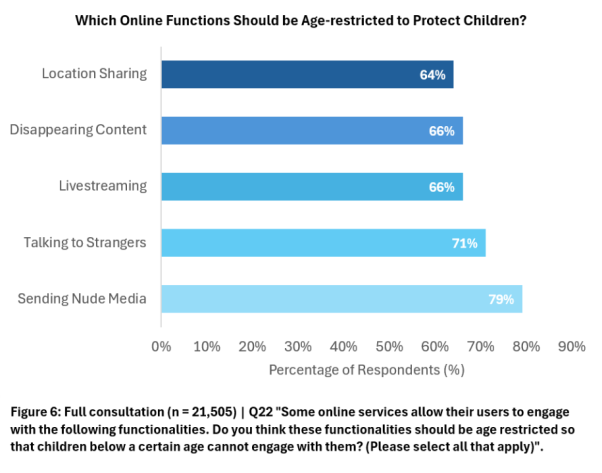
- Most respondents to the full consultation called for sending nude media (79%) and talking to strangers (71%) to be age restricted.
- 62% of children and young people who responded said they would feel safer if the riskiest features were restricted.
What will change
- Children under 16 will not have access to risky functions on services like gaming services, including communicating with strangers and creating livestreams.
- Children aged 16 and 17 will have access to these features restricted by default.
Many children and families have said that harm can be found across a range of online services children use. While social media services pose a unique risk due to the combination of their design features, there are also other services that children access that have many of the same harmful functions.
More than half of children surveyed said that restricting high-risk features, like sending nude images or videos, location sharing and talking with strangers, would make them feel safer online. These experiences are also impacted by factors such as age, vulnerability and personal circumstances. The creation, possession and sharing of indecent images of children is illegal under UK law.
“[Platform] doesn’t care whether or not that’s someone your age, or a 50 year old man” Rachel, 17, National Youth Agency response
We have taken action to prevent children from taking, sharing or viewing nude images. On 8 June, the Prime Minister announced that companies will need to put stronger safety protections on children’s phones. This includes using technology that can detect and block nude images before they are shared or viewed. This is a big step in helping to keep children safe from people who might try to harm or exploit them online. It also builds on the Online Safety Act’s measures which prevent children from being able to access pornography. If companies do not take meaningful steps within three months, the government will not hesitate to bring forward legislation.
We will be going further by introducing new age restrictions for under-16s on some of those functions that pose the greatest risk.
Charities and groups that speak up for children strongly support these kinds of safeguards, especially for functionalities that can be used to target or exploit children, like creating livestreams and communicating with strangers.
Some platforms have already taken measures to support age-appropriate experiences on their sites. For example, some already set an age of 16 or 18 to use functions like creating livestreams and direct messaging. We welcome the steps these companies have taken, and we want to go further to ensure these apply across the board.
4.1 Which functions?
We are introducing additional restrictions for under-16s to prevent them from communicating with strangers and creating livestreams. The evidence shows these functions can expose children to harm, and our consultation has clearly shown that both parents and children are overwhelmingly worried about children’s access to these.[footnote 14]
- By “communicating with strangers” we mean methods for unknown users to contact and talk with children. This includes on gaming services. This will not affect the ability for children to participate in multiplayer games online.
- By “creating livestreams” we mean children simultaneously creating and broadcasting video content to one or more people in, or very close to, real time (this is about one-way streaming).
We also looked at location sharing and disappearing messages. Location sharing can be a helpful tool for parents and carers who want to keep track of their children and help keep them safe. However, we also heard that location sharing poses risks to children’s privacy and safety. Disappearing messages are currently widely used on many popular messaging services which allow children to keep in touch with family and friends. But they also pose risks of exposing children to bullying and explicit content.
We think that by keeping under-16s off social media, preventing children from communicating with strangers and requiring more device level protections for children which prevent the taking, sharing or viewing of nude images, we will address these main risks. We think this approach will ensure children are protected in a way that is proportionate and risk-based and will not require adults to complete age checks where it may not be necessary. But we will keep this under review.
In our consultation, we also asked about whether to restrict addictive design features, like infinite scroll, which we know can keep children on social media longer than they intend. We think banning social media companies from offering their services to under-16s will address the risks of these features for this age group. We plan to say more in July about how to address these features for 16- and 17-year-olds.
It is also important that as children grow and enter adulthood, they are afforded safer online experiences. We are therefore putting in place additional protections for 16- and 17-year-olds, which keep livestreaming and stranger communication switched off by default. Young people could then choose for themselves what they are comfortable with and when, having been educated about the risks and how to keep themselves safe. Companies have told us that when given the choice, many children opt to keep safety restrictions turned on. These default settings will also apply on social media services for 16- and 17-year-olds, as explained in the previous chapter.
Some services are already protecting children from these functions. For instance, some services offer specially designed accounts which provide a set of default protections for young people. Gaming services have given us positive examples of the measures they have taken to disable functions that make it easy for strangers to make unfiltered contact with children, or to provide parental tools that support age-appropriate experiences. Some gaming services have similarly introduced age-based accounts on their platforms. We are taking the next step, by making restrictions mandatory for children under 16.
We also know that these functions are not always harmful. In some cases, they can be used in safer ways. For example, children may be matched with other players in games without being able to chat directly. This may be the case in lower-risk games, or those designed especially for children.
Many of the services which have these functions are also places where children talk to friends and family, learn new things and have fun. Online games can help children build skills and feel part of a wider community.
We will take care to make these rules focused and fair. We want to protect the helpful and fun parts of these services so children can still have important and positive experiences online. This means looking closely at the specific features that cause the most risk and leaving out types of services where those risks do not apply.
4.2 Which services?
We think it is right to raise the age of access to harmful functionalities on services where children are most likely to face these risks. This is likely to include popular services that children use, particularly gaming services, but may also include other online services where it is proportionate to do so.
Ofcom’s research finds many children use online gaming services: 72% of children aged 8-17 play games online, including 55% who say they at least sometimes play with people they have only met online. Nearly all children who play online games (96%) play at least sometimes with friends and family.[footnote 15]
Evidence suggests gaming services also pose risks of grooming: Protect Children research with CSAM offenders found that 41% of respondents who had sought contact with a child online first did so via an online game; and NSPCC research on online grooming also highlights “voice or text chat services built into online multiplayer games” as methods used by perpetrators to approach children.[footnote 16], [footnote 17]
Chapter 5: Harmful AI chatbots
What we heard:
- The consultation responses highlight that AI chatbots offer real benefits to children. Parents, children and young people ranked “help to find information” and “to support learning” as the two highest benefits offered by chatbots.
- Responses also discussed the education, digital literacy, creativity and play benefits chatbots can offer children.
- There were however concerns raised about chatbots exposing children to harmful content and functionalities.
- Parents agree chatbots creating mature content and simulating romantic relationships were some of the riskiest functionalities, including more than 8 in 10 parents who responded to the full consultation.
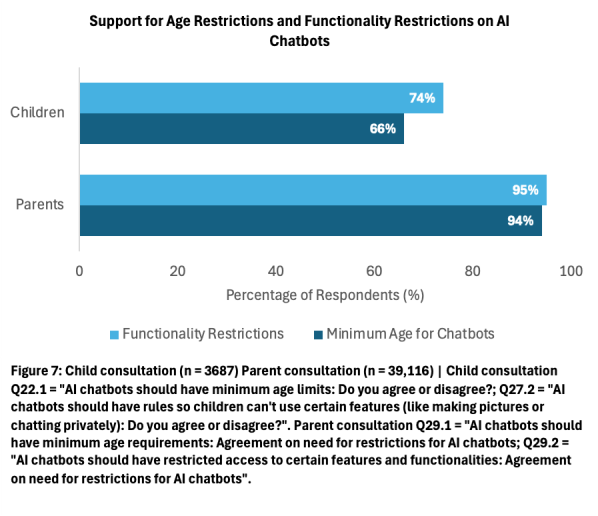
- 95% of responses to the parents’ consultation thought AI chatbots should have functionality restrictions, and 74% of young people (16-21) thought the same.
What will change:
- AI chatbot services whose primary purpose is to provide sexual relationships to their users will not be available to children under 18.
- Access to general purpose chatbots will not be age gated but to access features that enable sexually explicit interaction, a user would need to prove they are over 18.
AI chatbots are a new technology that many children can easily access online and are increasingly turning to for every day uses. This year Ofcom research found that 53% of 8–15-year-olds in the UK have used AI.[footnote 18] Learning how to use this technology, including chatbots, safely, critically and responsibly will be an increasingly important digital skill for young people.
Children use many types of chatbots, whether in an education setting or in everyday, personal use. These include general purpose chatbots that have been designed to respond to a wide range of topics, including research, translation, drafting and creativity – these are the chatbots most used by children.
There are also chatbots designed for specific functions such as supporting education or learning a language. Children may use these in an education setting, or may be accessing them for specific tasks, either supported by a professional, or in some cases, without any oversight.
“[AI chatbots] can help young people, particularly those with special educational needs and disabilities (SEND) reach their full potential” National Youth Agency consultation response
Within schools, there is huge potential for the use of carefully designed AI-tutoring tools to support all children. The Department for Education is taking steps to support the safe and effective use of AI and setting safeguards for pupils’ cognitive development, wellbeing and safety.
“If I didn’t have it [AI chatbot], I’d probably struggle quite a lot, and probably, like knock myself down a bit… Probably put down my self-esteem quite a bit, because obviously I’m not able to do some things that most people can” Amelia, 15, National Youth Agency, speaking about her experience with dyslexia
“I use it for example, if my maths teacher isn’t explaining something properly, I ask AI to explain how to do the question for me” Young person, 15, Highland Council – Scottish Youth Parliament submission
However, these benefits sit alongside real concern from parents, children and young people about the harms these services present to children’s wellbeing and safety. This view is shared by a wide range of organisations and consultation respondents – with over 90% of parents supporting setting a minimum age and restrictions on functionality. For children, 66% supported setting a minimum age and 74% supported restrictions on functionality.
We found there was a strong concern from parents, children and young people, and charities and organisations about chatbots exposing children to explicit content and engaging children in sexual discussions. These were amongst the most raised issues, mentioned by more than 80% of full consultation respondents.
“When children interact with companion chatbots that steer them towards sexual conversations, the relational dynamics can become reminiscent of established grooming patterns” Internet Watch Foundation consultation submission
There is a growing body of research from organisations such as the Center for Countering Digital Hate, Internet Watch Foundation and Common Sense Media that provides evidence of grooming-like behaviour happening on both “romantic companion” chatbots designed specifically for an adult experience, and general-purpose services, which may not be principally designed to provide explicit content as a feature. Both pose serious risks to children that require action to address.[footnote 19], [footnote 20], [footnote 21]
“I started to use this AI app [..] sometimes the characters become quite sexual. Even though I’ve seen way more explicit stuff online, roleplaying about it feels more real, I guess” Girl, 13, Childline, NSPCC consultation submission[footnote 22]
We also heard concerns over children’s use of chatbots for mental health support, including the use of “therapy apps” and general purpose chatbots. Some respondents felt AI chatbots could play a beneficial role in providing wellbeing support for children, with children valuing a non-judgemental and easily accessible way to discuss their feelings. However, we also heard strong concerns about how these services can provide children with harmful, misleading or inaccurate advice and potentially dissuade them from talking to friends, family and trained professionals.
“[Unlicensed] chatbots are commercial tools that unlike therapy can be designed to foster dependency and keep you coming back for more. They will not always have a user’s best interests at heart.” Mental Health Foundation consultation submission
Responses also highlighted the growing concern over the role of common chatbot features in exposing children to serious harms. Chatbot personas that mimic empathy and friendship were highlighted as presenting emotional and psychological risks to children, potentially encouraging children to develop an unhealthy emotional connection to a service or developing misplaced trust in its advice. Many chatbots also use features designed to encourage children to spend longer online and keep coming back. People raised concerns about the possible effects on children’s development and critical thinking, although the evidence is currently inconclusive.
5.1 Restricting sexualised AI chatbots
Despite the benefits presented, some types of AI chatbots can be especially unsafe for children. For example, so-called “romantic companion apps” are designed for adult use and can generate sexual or other age-inappropriate content in text, images, audio or video. These are not safe or appropriate for children.
Although some larger general-purpose services have put in place safety measures, there is evidence children are still being exposed to harmful features on some of these types of chatbots as well, including sexually explicit content and engaging in sexual roleplay.[footnote 23]
The government shares the concerns raised in the consultation and believes that children should not be having sexual discussions or relationships with chatbots. We therefore intend to ensure that chatbots whose primary purpose is to provide sexual relationships to their users cannot be accessed by children. Access to general purpose AI models will not be age gated. However, to access features on general purpose models that enable sexually explicit interaction, a user would need to prove that they are over 18.
5.2 Tackling harmful features on AI chatbots
There is growing evidence from organisations such as Parents Together Action and Heat Initiative, that persuasive and emotionally manipulative design features put children at risk of serious harms and may be contributing to them forming an unhealthy reliance or attachment to a service.[footnote 24] We also heard these concerns through our consultation.
The use of these features is prevalent across the sector. We are continuing to look carefully at which parts of services create the greatest risks for children, so we can put the right protections in the right places.
5.3 Mental health support
It is important AI chatbots do not replace advice and support from trained medical professionals. For individuals who are struggling with their mental health, it is imperative that they seek support from a trained professional or speak to a friend or relative. At the same time, we know that AI tools, when used in the right way, can complement mental health services rather than replace them.
For example, the NHS is using AI tools to supplement clinical care. However, these tools should only be used once they have been carefully checked to make sure they are safe, effective, ethical and protect people’s personal data. The new cross-government mental health strategy, due later this year, will set out plans to support access to safe, high-quality digital tools, including how AI chatbots can improve outcomes for adults and children. The call for evidence is open until Friday 10 July 2026.[footnote 25]
In response to the consultation, we are actively looking at how to protect children from harmful mental health advice on unlicensed chatbot services, including both dedicated “therapy” apps and general purpose chatbots, while making sure children can still access and benefit from trusted support for their mental health where it is safe to do so. We will be working with NHS England and other experts on this.
Chapter 6: Assessing age
What we heard:
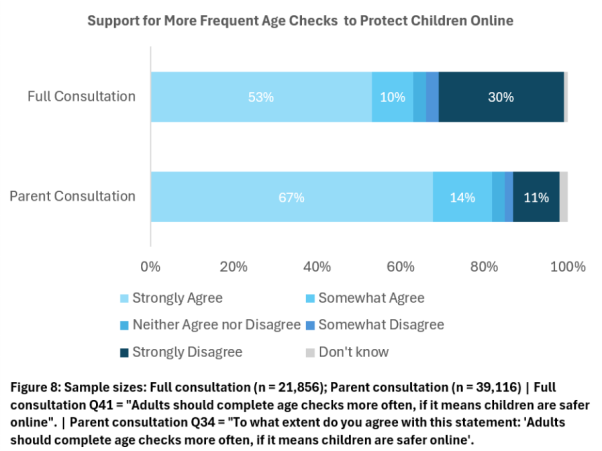
- 81% of respondents to the parents’ consultation and 63% respondents to the full consultation agreed that “adults should complete age checks more often, if it means children are safer online”.
- Additionally, respondents noted that age assurance should be robust and accessible for all users.
What will change:
- Companies will need to use stronger age checks to identify when someone is under 16.
- Age checks should become easier and more accurate, with better options and less need to repeat checks.
- In order to protect children, more adults will be asked to prove their age, but privacy will remain a key part of how checks are designed.
6.1 Age Assurance
To make these changes work, companies will need to introduce stronger “highly effective age assurance” to establish who is a child. Many people expressed concerns about how effective age checks can be and we know that in Australia some platforms’ approaches have been easy to bypass. We have also heard concerns about the impacts of age assurance on privacy and civil liberties.
“Age assurance” refers to several different approaches to assess a user’s age, such as using something like a passport (age verification), using machine-learning technologies like facial recognition (age estimation) or age inference, which analyses your behaviour or data to guess your age.
We have worked with our counterparts in Australia to understand what has gone well and what we can learn from. It is clear we will need to put in place strong, robust age checks to make these changes work. We will be applying the most effective forms of age assurance and looking at ways to improve those.
We will improve this by:
- Improving how accurate it is. We know there are challenges in accuracy for determining specific ages of children. We will work with industry to help age assurance technologies continue to progress and improve how accurately they can determine the age of users while protecting personal data.
- Improving the availability. We plan to improve the availability of age assurance for 16-17 year-olds. This includes by exploring easier access to secure, privacy-preserving ways for people to prove their age online – such as reusable checks that confirm someone meets an age threshold without requiring full ID every time. We will support the development of standards, to make it clear to industry and the public what best practice looks like for trustworthy age assurance technologies.
- Prioritising clear expectations. Ofcom will have a role in assessing what highly effective age assurance would look like in the context of a 16+ age limit. We have asked them to begin this work right away, and to publish their views on this by October. Ofcom must already consider key principles when giving advice on age checks, including making sure they are simple to use for children of different ages and needs. We have been clear that we expect Ofcom to continue to have regard to these principles, so the changes are fair, practical and work for everyone.
Many adults may not need to take extra steps, for example if a platform can reliably work out a user’s age from things like how long they have had an account, any previous age checks, or other ways of estimating age. These changes may mean more adults will need to prove they are an adult – however, nearly three quarters of adults (parents and non-parents) who responded to the consultation agreed adults should have to complete age checks more often if it helps keep children safe online.
The UK has one of the strongest data protection regimes in the world, and this applies to age assurance providers, ensuring that personal data is processed lawfully, fairly and securely. We know some people have concerns about privacy; protecting people’s personal information has always been, and will continue to be, a key part of our approach to age assurance. The Secretary of State has therefore written to Ofcom to ensure that their assessment of highly effective age assurance prioritises data security and privacy.
Chapter 7: Wider support
- These changes will be backed by guidance for parents on screentime and wider support for children offline too, including opportunities for sport, arts, youth activities and other real-world experiences.
7.1 Screentime guidance
Our aim is to reset norms around what is safe and appropriate online at different ages, while giving parents more support to guide their children with confidence.
In March 2026, the Department for Education (DfE) published screentime guidance for parents of children under 5 and in the autumn will publish new guidance for parents of children aged 5 to 16. This will help families strike a healthy balance with real-word experiences, relationships and activities that underpin children’s wellbeing and development. The guidance will be designed to support informed decision making, reflecting the evidence that the impact of screen use depends not only on duration but also on content, context and the individual child. This recognises that technology can enhance learning, creativity and access to opportunities, particularly for children with additional needs, while also acknowledging that excessive or poorly managed use can displace sleep, physical activity and face‑to‑face interaction.
The guidance is being supported through a call for evidence and will be shaped by an independent expert group drawing on research, professional expertise and lived experience. It will address key questions parents face, including how to balance screen use with other activities, what constitutes age-appropriate use, and how to establish healthy habits as children grow.
Importantly, it looks at children’s lives as a whole – across both home and school – recognising their online and offline experiences are closely linked. The aim is not to reduce technology use for its own sake, but to help families feel confident that children are using it in a way that supports their wellbeing, development and learning, helping families strike a healthy, sustainable balance between online and offline experiences.
7.2 Increasing children’s enrichment activities
We are working closely with the Department for Culture, Media and Sport (DCMS), the Department for Education (DfE), the Department for Health and Social Care (DHSC) and other parts of government to deliver a shared ambition to ensure children are given the best start in life, and to support access to real-world activities. That means helping to create more things to participate in, as well as helping young people build the skills, knowledge, independence and confidence they need for the online world once they do reach 16. We know that children are more ambitious than ever and are determined to succeed and make the world a better place.
The Government’s National Youth Strategy (“Youth Matters”) is helping improve young people in England’s access to enriching activities such as sport, arts and youth provision, improving pathways into education, training and employment, and ensuring young people can build essential skills both in and outside of school.
The programme also supports existing trusted adults and helps connect trusted adults with young people who have none, including funding mentoring through The King’s Trust, with the backing of its Goodwill Ambassador Sir Gareth Southgate.
We are already taking steps to ensure every child in England has access to high-quality enrichment opportunities, from the Department for Education’s new Enrichment Framework to the Holiday Activity and Food Programme, which provides healthy food and enriching activities for disadvantaged children during the school holidays, so that no child is excluded from experiences that broaden horizons and build confidence.[footnote 26]
We are fostering a love of reading, brought to life through this National Year of Reading’s core message: ‘If you’re into it, read into it’. We are also helping children feel more connected to the world around them through the introduction of a new natural history GCSE in England alongside the National Education Nature Park – delivered in partnership with the Natural History Museum and the Royal Horticultural Society – to foster a deeper relationship with nature and the environment.
We are committed to raising the healthiest generation ever – and are encouraging active, healthy lifestyles with free school meals, expanded free breakfast clubs, and programmes such as PE and school sport partnerships, while also supporting creativity and self-expression through the music hubs network and wider cultural opportunities, in and out of school. We aim to help children discover what inspires them and to nurture their individual talents, through a broad and balanced curriculum, which builds young people’s love of learning and engagement with new experiences and opportunities throughout their life.
An extra £22.5m of funding through DCMS will help hundreds of schools in England expand their enrichment offer, with pupils helping shape what is available. DCMS has also enabled £132.5m of Dormant Assets to fund programmes in activities in areas including culture, sport, adventure and life skills – both through after school clubs and communities at weekends and in the holidays. The government is keen to invite other funders with the same goals as us to collaborate on programmes across these categories, to help us enable as many young people as possible to participate in fun, enriching activities.
Together, this work is about giving young people more opportunities to connect offline, feel part of their communities and grow up safe, independent, happy and confident.
7.3 Children and young people’s mental health
We know there is widespread concern about the impact of social media on children and young people’s mental health and wellbeing, and while the measures announced today are an important step, they are not a singular solution to the challenges facing children and young people’s mental health. The government is therefore continuing to strengthen wider support for children, including a major independent review and cross-government mental health strategy led by the DHSC.
This includes:
- expanding mental health support teams to all schools and colleges in England by 2029
- reducing waiting times for those that require specialist care
- developing a new mental health strategy to be published later this year, to help children and young people participate fully in education and community life
The new mental health strategy will be informed by the independent review into prevalence and support for mental health conditions, attention-deficit hyperactivity disorder (ADHD) and autism. This includes looking at how the online world, alongside other factors such as school, family life and health, may contribute to children’s emotional wellbeing and mental health challenges, as well as factors like diagnosis and access to support.
Chapter 8: What happens next
8.1 Other issues
We wanted to provide an early update on the issues of greatest concern for parents and children. The consultation also asked about other important issues not discussed here. A further update will be published on the full range of questions asked by 16 July 2026, including:
- possible further default protections for 16- and 17-year-olds such as restrictions overnight and on other design features, like infinite scroll
- whether the age of digital consent should be raised
- risks of circumvention through use of virtual private networks
- media literacy support for parents
8.2 Ongoing commitment
The choices we are making mean the UK will be world leading in our protections for children.
We know that this is not the whole story. Keeping children safe online is a priority for this government, and we will need to continue to build on this as technology and harms evolve. We want parents and carers to know that we are committed to making ongoing improvements, working closely with them and experts to hold companies accountable and build trust in how online safety is enforced.
Groups who care about children and families have shared their thoughts, and we are listening. Some concerns raised during the consultation will need further attention, and we will be coming back to these in the future. For example, some groups suggested changes are needed to strengthen the Online Safety Act. These included further embedding safety-by-design principles, introducing risk-based duties on AI chatbots and more independent online safety leadership to coordinate action.
We are working closely with Ofcom to make sure companies follow the law and that parents and carers can trust the rules are being enforced. We will share more updates later in the year, so everyone stays informed and protected.
We have also set out below a full timeline, on when you will expect updates and action.
8.3 Progress statement and timeline
This policy update is a Statement of Progress made pursuant to section 71(1) of the Children’s Wellbeing and Schools Act 2026, which requires the Secretary of State to lay before Parliament a statement setting out (a) what progress has been made towards making the first regulations under section 214A(1) of the Online Safety Act 2023 (inserted by section 70 of the Children’s Wellbeing and Schools Act 2026) and (b) a timeline for making the first regulations.
The policy update describes the work undertaken by the Department for Science, Innovation and Technology towards making the first regulations. Further policy development and the drafting of the first regulations will continue.
We intend to lay the first regulations related to service level age restrictions on social media services before Parliament by the end of 2026. We intend to lay further regulations before Parliament within 12 months of this statement. These regulations are subject to the affirmative procedure under section 225(1)(ea) of the Online Safety Act 2023 and must be approved by both Houses of Parliament. The regulations will be made by the Secretary of State if so approved.
We expect the first set of social media restrictions to be in effect in Spring 2027. We recognise this will be a really material transition for many who currently are on these services. The government will provide regular updates and put out clear information answering the questions we know many young people will have before this regime comes into effect.
Chapter 9: Supplementary information
Supplementary information relevant to this consultation can be found via the GOV.UK page “Growing up in the online world: a national consultation”:[footnote 27]
- June progress statement: consultation summary of evidence, methodology, and list of organisations who responded to the consultation.
- Savanta: Children’s Wellbeing Online: Social Media Quantitative Report.
- Summary of Ministerial and official engagement in the National Conversation.
- Children’s version of the government’s June progress statement on the consultation.
- June progress statement: letter from DSIT Secretary of State to Ofcom.
Minutes from the meetings of the consultation expert advisory panel can be found on the GOV.UK page “Expert Panel for Growing up in the Online World”.[footnote 28]
-
Internet Matters (2024), “So standard it’s not noteworthy” Teenage girls’ experiences of harm online. ↩
-
Internet Matters (2026), Every Child Safe Online: Supporting children with additional needs. ↩
-
Kelly Y, Zilanawala A, Booker C, Sacker A (2019), Social Media Use and Adolescent Mental Health: Findings From the UK Millennium Cohort Study. ↩
-
Shen C, Girela-Serrano BM, Di Simplicio M, Spiers A, Dumontheil I, Thomas MSC, Röösli M, Elliott P, Smith RB, Toledano MB (2026), Social networking site use, depressive and anxiety symptoms in adolescents: evidence from a longitudinal cohort study (SCAMP). ↩
-
Minutes from the meetings of the consultation expert advisory panel can be found on the GOV.UK page “Expert Panel for Growing up in an Online World”. ↩
-
Ofcom (2026), Exploring the relationship between persuasive design on online platforms, and the time that children spend on them. ↩
-
Ofcom (2026), Children’s Online Experiences: Including a comparative analysis of the periods before and after the children’s safety duties came into force. ↩
-
Ofcom (2026), Update: tech firms’ responses to our call for action to protect children. ↩
-
eSafety (2026), Social Media Minimum Age: Compliance Update. ↩
-
Ofcom (2026), Children and Parents: Media Use and Attitudes Report 2025–6. ↩
-
Ofcom (2025), Ofcom’s Annual Report on the BBC 2024-25. ↩
-
Ofcom (2024), Ofcom’s Final Three-Year Media Literacy Strategy. ↩
-
Ofcom sets out fines issued under the Online Safety Act on their website: Illegal and harmful content. ↩
-
NSPCC and LGfL Digisafe (2018), Children sending and receiving sexual messages. ↩
-
Ofcom (2026), Children and Parents: Media Use and Attitudes Report 2025–6. ↩
-
Protect Children (2024), Tech Platforms Used by Online Child Sexual Abuse Offenders. ↩
-
NSPCC (2020), The impact of the coronavirus pandemic on child welfare: online abuse. ↩
-
Ofcom (2026), Children and Parents Media Literacy Tracker 2025–26: Data tables – main set. ↩
-
Center for Countering Digital Hate (2025), Fake Friend: How ChatGPT betrays vulnerable teens by encouraging dangerous behaviour. ↩
-
Internet Watch Foundation (2026), How AI is being abused to create child sexual abuse imagery. ↩
-
Common Sense Media (2025), AI Risk Assessment: Social AI Companions. ↩
-
Please note that Childline snapshots are based on real Childline service users but are not necessarily direct quotes. All potentially identifying details have been changed to protect the identity of the child or young person involved. ↩
-
Internet Matters (2025), Me, myself and AI: Understanding and safeguarding children’s use of AI chatbots. ↩
-
Parents Together Action (2025), “Darling, Please Come Back Soon”: Sexual Exploitation, Manipulation, and Violence on Character AI Kids’ Accounts. ↩
-
HMG (2026), Informing the mental health strategy for England: call for evidence document. ↩
-
HMG (2026), Holiday activities and food programme 2026 to 2027 financial year. ↩
-
HMG (2026), Growing up in the online world: a national consultation. ↩
-
HMG (2026), Expert Panel for Growing up in an Online World. ↩