Proposals to devolve certain Transport Works Act order functions to MSAs
Published 20 November 2026
Applies to England

© Crown copyright 2026
This publication is licensed under the terms of the Open Government Licence v3.0 except where otherwise stated. To view this licence, visit nationalarchives.gov.uk/doc/open-government-licence/version/3 or write to the Information Policy Team, The National Archives, Kew, London TW9 4DU, or email: psi@nationalarchives.gov.uk.
Where we have identified any third party copyright information you will need to obtain permission from the copyright holders concerned.
This publication is available at https://www.gov.uk/government/consultations/devolving-transport-and-works-act-order-powers/proposals-to-devolve-certain-transport-works-act-order-functions-to-msas
Executive summary
Transport and Works Act orders (TWAOs) are used to grant the legal powers to construct, operate and maintain guided transport systems, such as:
- railways (below the threshold of a nationally significant infrastructure project)
- tramways
- monorails
- guided busways
They can also be used to authorise the construction of inland waterways, bridges, piers and tunnels. The process for handling and deciding applications for TWAOs is set out within a statutory framework under the Transport and Works Act 1992.
Government has made amendments to modernise, simplify and speed up the process for obtaining a decision on an application for a TWAO. A number of these changes have recently been provided through the Planning and Infrastructure Act 2025.
Government has committed to devolving applications for TWAOs to mayoral strategic authorities (MSAs) to allow decision-making on local schemes to be brought closer to the areas affected by them. MSAs are authorities with a directly elected mayor, as provided for under the English Devolution and Community Empowerment Act 2026.
Rewiring the State sets out the government’s ambition to ensure every area in England has, or is in the process of establishing, a strategic authority by the end of 2027, with strategic authorities in place everywhere by the end of 2028.
We have developed initial proposals for devolving TWAO applications in England, which have been informed by a stakeholder engagement workshop. Our initial proposals are that TWAO powers should be devolved to MSAs by default for schemes that sit wholly within their MSA boundary area and do not relate to the national rail network.
We would like to test these proposals to help shape the final position. We are also looking for views on:
- what safeguards should be put in place
- how the final decision on TWAO applications should be presented
- how fees should operate
- what support should be provided to MSAs in taking on these responsibilities
This consultation applies in England only.
Consultation purpose
We are seeking views from potential applicants, statutory bodies, local and strategic authorities, industry representatives, legal practitioners and other interested stakeholders on:
- what should be devolved
- developing the framework for devolving these powers
Our proposals have been informed by a stakeholder engagement workshop held earlier in 2026. These proposals do not:
- impact the measures brought forward through the Planning and Infrastructure Act
- propose additional changes to the process for applying for or deciding an application for a TWAO
This means all applications will continue to be managed and decided in line with the statutory framework set out by the Transport and Works Act 1992, including the Transport and Works (Applications and Objections Procedure) (England and Wales) Rules 2006 and The Transport and Works (Inquiries Procedure) Rules 2004.
It is likely that a legislative change will be required to support the devolution of TWAOs.
Next steps will depend on what legislative changes need to be made to implement devolution.
Geographic extent
A range of organisations apply for TWAOs. They include local and strategic authorities, Network Rail, heritage railways, canal and navigation authorities, harbour authorities and private companies, among others.
Transport schemes
The Secretary of State for Transport decides applications for transport-related TWAO application.
Inland waterway schemes
The Secretary of State for Environment, Food and Rural Affairs normally decides applications for inland waterway schemes.
Wales schemes
Welsh ministers decides TWAO applications in Wales.
England and Wales cross-border schemes
Where schemes cross the boarder between England and Wales, applications for TWAOs are decided by the relevant Secretary of State.
This consultation applies in England only.
Policy background
The Transport and Works Act (TWA) 1992 provides a framework for granting legal powers to construct, operate and maintain guided transport systems, such as:
- railways (below the threshold of a nationally significant infrastructure project)
- tramways
- monorails
- guided busways
It can also be used to authorise construction of inland waterways, bridges, piers and tunnels. It should be noted that the TWAO regime does not cover road schemes.
Powers can include:
- compulsory purchase of land
- temporary possession
- stopping up streets
- creating byelaws
- statutory undertaker diversions
The TWAO process looks to provide most powers required to both construct and operate a project through a single route, avoiding the need for multiple applications.
Powers granted through a TWAO can, therefore, be wide-ranging and include the amendment or disapplication of other legislation.
The process for handling and deciding applications for TWAOs is set out within a statutory framework under the Transport and Works Act 1992, including requirements on:
- applications
- objections
- consultation
- where necessary, public inquiries
See the TWAO application process for more information.
If approved, a TWAO is made as a statutory instrument (SI). Associated consents can also be granted through the TWAO process for deemed planning permission, a deemed marine licence or a deemed listed building consent. These sit alongside the SI.
Decisions on TWAO applications are quasi-judicial in nature, meaning decision makers must ensure cases are decided fairly and impartially to avoid bias. Decision makers should also ensure they do not have a conflict of interest with the application they are deciding.
All decisions should be based on the evidence presented as part of the application process only. All decisions can potentially be the subject of a legal challenge.
Over the last 10 years, DfT has received an average of 5 TWAO applications per year, with just over half for schemes on the national rail network. The Secretary of State for Environment, Food and Rural Affairs has received around 3 applications in the last 10 years. This could be different in the future with changes to funding models and the ability for nationally significant infrastructure projects to be directed out of the regime set out in the Planning Act 2008 and use the TWAO process as an alternative.
Any devolution model should seek to avoid additional complexity, cost or delay. It would also need to maintain certainty for applicants and ensure that decisions continue to be made fairly, transparently and in accordance with the statutory framework.
Proposals for devolution
Proposal 1: Who should receive devolved TWAO powers?
The government proposes that all MSAs should automatically receive devolved TWAO powers for eligible schemes.
A strategic authority (SA) is the new name for all mayoral and non-mayoral combined authorities and combined county authorities in England, the Greater London authority and any local authorities designated as a strategic authority under the English Devolution and Community Empowerment Act 2026.
MSAs are strategic authorities with a directly elected mayor. The Rewiring the State Cabinet statement sets out the government’s ambition to ensure every area in England has, or is in the process of establishing, a strategic authority by the end of 2027, with strategic authorities in place everywhere by the end of 2028.
See the list of strategic authorities for more information.
The alternative approach would be to devolve powers only to those MSAs that actively request them, which could result in a less consistent framework across England.
Proposal 1 questions
Question: Do you agree that all MSAs should receive devolved TWAO powers automatically?
- yes
- no
- don’t know
Question: Do you have any feedback to support your answer?
Proposal 2: What should be devolved?
The government proposes that, where powers are devolved, MSAs should be responsible for the end-to-end TWAO process. This would include:
- managing applications
- handling objections
- overseeing any required inquiry process
- making the final decision
This provides the greatest degree of devolution, giving authorities responsibility for managing the entire process. It also enables MSAs to identify efficiencies while continuing to comply with the statutory framework.
An alternative option considered was to devolve decision-making only, with central government continuing to manage applications up to the point a decision is required. While this could help ensure consistency in how applications are processed, it would add complexity by requiring applications to be transferred between central government and MSAs. It would also limit MSAs’ ability to improve and streamline the process, as they would be responsible for the final decision rather than the wider application process.
Proposal 2 questions
Question: Do you think that MSAs should manage end-to-end TWAO processes for devolved schemes?
- yes
- no
- don’t know
Question: Do you have any feedback to support your answer?
Question: Do MSAs consider that they have or could put in place appropriate governance arrangements to manage actual or perceived conflicts of interest (particularly where an MSA is also promoting or funding a scheme)?
- yes
- no
- don’t know
Question: Do you have any feedback to support your answer?
Proposal 3: Which schemes should be devolved?
The government proposes that devolved TWAO powers should apply only to schemes that:
- sit wholly within an MSA area, and
- do not relate to the national rail network
The railway needs to be planned and managed as a single integrated system. The UK has one of the most congested rail networks in Europe, with local, regional and intercity services sharing infrastructure and competing for capacity. Decisions taken in one area can, therefore, have wider impacts across the network.
Given these interdependencies and the fact that rail scheme applications are currently progressed through a single, consistent process, there is a strong case for retaining a single body to manage and determine TWAO for rail schemes. This could ensure a coordinated and network-wide approach to decision-making.
For schemes that cross the boundaries of more than one MSA, the initial proposals are that responsibility should remain with central government. This would:
- avoid delaying schemes while arrangements are developed for how applications involving multiple MSAs should be managed and decided
- provide a clear route for decision-making where participating MSAs have different views
Overall, the proposal would mean that applications that cross MSA boundaries, cross the England-Wales border, relate to the national rail network, or where the safeguard is used (proposal 4), would continue to be managed centrally.
Another option considered was to allow applicants to choose whether to submit their application to an MSA or central government, on the basis that applicants are often best placed to decide which authority is the most appropriate to manage and determine their scheme.
However, this approach carries a risk that applicants would continue to submit applications to central government only, resulting in little change from the current system and limiting the benefits of devolution.
Proposal 3 questions
Question: Do you think devolved TWAO powers should apply only to schemes within an MSA area or should schemes that cross one or more MSA boundary be included noting the duty on mayors of neighbouring strategic authorities to collaborate with one another?
- devolved TWAO powers should only apply to schemes within an MSA area
- devolved TWAO powers should apply to schemes within an MSA area and crossing MSA boundaries
- don’t know
Question: Do you have any feedback to support your answer?
Question: Do you agree that national rail network applications should continue to be managed and decided by central government?
- yes
- no
- don’t know
Question: If not, under what circumstances should MSAs have a role in determining or contributing to decisions on these applications?
Question: Should any scheme type be included or excluded from the proposed scope?
- yes
- no
- don’t know
Question: What type(s) of scheme do you think should be included or excluded from the proposed scope?
Proposal 4: Safeguards
It is recognised that MSAs may be required to determine applications for schemes that they are also promoting. MSAs will, therefore, need to have appropriate arrangements in place to manage any actual or perceived conflicts of interest and minimise the risk of successful legal challenge.
Consideration has been given to what safeguards could be introduced on a case-by-case basis to support decision-making, including where there may be resource constraints or other factors that could otherwise delay the application process.
Government proposes that MSAs should be able to refer individual applications to central government where they consider this necessary or expedient. This could include cases involving:
- capacity constraints
- capability concerns
- resource pressures
- conflicts of interest
- other propriety concerns
Other safeguards were considered, including a Secretary of State call-in power and introducing an appeal mechanism. These options were discounted for the following reasons.
Secretary of State call-in power
This safeguard would allow central government to take over applications where there were concerns about delays, capacity, conflicts of interest or wider policy implications.
At the workshop, stakeholders said there would need to be clear guidance on the grounds for a call-in and a cut-off point for when an application could be called in. This is so all parties had certainty as to which body was managing a decision.
Overall, this option could itself create delays, add complexity and undermine local decision-making. We are not proposing to take this option forward.
Introducing an appeal mechanism
This would allow applicants to challenge MSA decisions to the Secretary of State for Transport. However, this is inconsistent with the current TWAO regime and devolution principles and likely to increase uncertainty and extend timescales.
We are also not proposing to take this option forward.
Proposal 4 questions
Question: Do you think that MSAs should refer TWAO applications to central government on a case-by-case basis?
- yes
- no
- don’t know
Question: Do you have any feedback to support your answer?
Question: Would any additional safeguards be needed to ensure applications are assessed fairly, efficiently and within relevant deadlines?
- yes
- no
- don’t know
Question: If yes, outline these safeguards.
Proposal 5: making TWAOs
TWAOs are currently made as local SIs. As part of the proposed devolution of TWAO powers, the government is considering the most appropriate legal mechanism for giving effect to orders determined by an MSA.
In some cases, it may be possible for orders to be made administratively where no provision is required to amend, repeal or create legislation. However, most TWAOs contain powers or provisions that interact with existing legislation and are likely to continue to require a legislative vehicle.
There are a number of options for giving effect to these orders, all of which will require further consideration. These include potentially providing MSAs with limited powers to make local SIs for TWAO purposes only or establishing arrangements under which central government would make the necessary SI following an MSA decision.
The precise approach would need to ensure that orders are made efficiently, provide appropriate legal certainty and maintain consistency in the drafting and operation of TWAOs.
Although rare, decisions on TWAO applications can be subject to legal challenge. As the decision-maker, central government meets its own costs of defending these challenges.
Where it successfully defends a claim, government may recover a proportion of those costs from the claimant. Although any recovery is subject to the costs caps that apply under the Aarhus Convention regime.
Regardless of which option is taken forward, it is proposed that any costs associated with legal challenges to the decision made by an MSA on a TWAO would be covered by the MSA. This would include any costs to the government where it is required to be an interested party in legal proceedings or is challenged directly on a decision made by an MSA.
With regard to the deeming of planning permission under section 90 of the Town and Country Planning Act 1990, the deeming of a marine licence to have been issued under part 4 of the Marine and Coastal Access Act 2009 and the deeming of a listed building consent under part I of the Planning (Listed Buildings and Conservation Areas) Act 1990, it is proposed that the ability to deem these would transfer to MSAs to issue the relevant consents in the same manner as government currently does.
Proposal 5 questions
Question: Do you have any views or preferences on the form and mechanism for granting a TWAO?
- yes
- no
- don’t know
Question: Do you have any feedback to support your answer?
Question: Are there existing legal or administrative mechanisms that could be used to enable strategic authorities to exercise functions related to making the final TWAOs?
- yes
- no
- don’t know
Question: Provide feedback to support your answer, including evidence on the relative merits, risks and practical implications of different approaches.
Question: Do you have any concerns about cost liabilities associated with challenges to decisions on TWAOs sitting with the MSA?
- yes
- no
- don’t know
Question: Do you have any feedback to support your answer?
Proposal 6: capability and resourcing
In central government, the following expertise and resources are used to manage and decide applications under the TWA.
Planners and administrative support
This is to check applications, analyse and manage objections and draft robust decision documents.
Environmental
This is to check compliance with all relevant environmental policy and legislation, including drafting habitat regulation assessments where necessary.
Legal resource
This is to check and approve the drafting of the TWAO and ensure all the decision documents are legally robust and all necessary legislation and policy have been followed.
Legal resource is also required to defend any legal challenges to decisions.
Proposals
Government recognises that TWAO applications are infrequent and that some MSAs may need support to develop and maintain the necessary expertise.
Options include:
- training
- workshops
- temporary support from central government, exploring whether central government could provide support on a cost recovery basis to ensure MSAs would not be financially disincentivised from developing skills in this area
Proposal 6 questions
Question: What support would MSAs need to manage developed TWAO functions effectively?
Question: Do MSAs have sufficient legal capacity to meet the proposed approach to devolving TWAOs?
- yes
- no
- don’t know
Question: If not, what measures could be put in place to address this?
Question: Should central government or the planning inspectorate provide temporary support or expertise on a cost recovery basis?
- planning inspectorate
- central government
- other
Question: Do you have any feedback to support your answer?
Question: How should expertise be maintained in MSAs, considering TWAO applications are low?
Proposal 7: fees
The Planning and Infrastructure Act 2025 enables a few specified bodies to recover the costs they incur when providing input to TWAO applications.
Application fees for TWAOs are currently prescribed in the Transport and Works (Applications and Objections Procedure) (England and Wales) Rules 2006. These fees are paid by the applicant to the relevant decision-maker at the point an application is submitted.
As part of the proposed devolution of TWAO powers, consideration has been given to whether there should continue to be a single national fee structure for all TWAO applications, or whether individual MSAs should be able to set their own fees, subject to cost-recovery principles.
Feedback from the stakeholder engagement workshop indicated a preference for retaining a single national fee structure, as this would provide greater clarity and consistency for applicants and decision-makers. Under this approach, fees would be paid to whichever body is responsible for managing the application, whether an MSA or central government.
Where an application is referred from an MSA to central government, the associated fee could transfer with the application.
Proposal 7 questions
Question: Do you think there should be a single national fee structure or should individual MSAs set their own fees, recognising that fees should be set on a cost-recovery basis?
- there should be a single national fee
- individual MSAs should set their own fee
- don’t know
- other
Question: Why do you think this? Provide evidence or other considerations that support your answer, including the potential benefits and drawbacks.
Impacts of the proposals
Government is interested in evidence on the likely impacts of these proposals, including impacts on:
- applicants
- MSAs
- local authorities
- statutory consultees
- affected communities
- central government
Respondents are invited to provide evidence on:
- costs
- benefits
- risks
- administrative burdens
- equality considerations
- any unintended consequences
Impacts of the proposals questions
Question: What costs and/or savings could arise from devolving TWAO functions to MSAs?
Question: Do you think the proposals affect the speed and quality of decision making?
- yes
- no
- don’t know
Question: Do you have any feedback to support your answer?
Question: Outline any impacts you consider this proposal could have. For example, any equality, accessibility, regional impacts, among others?
How to respond
We will only accept responses received before the closing date: 11:59pm on 18 December 2026.
The easiest way to respond is to use the online response form. It includes the option to save and continue your response if you are unable to complete it in one go.
If you cannot use the online form, email or post your response to us:
Email to: transportinfrastructure@dft.gov.uk
Write to:
Transport Infrastructure Planning and Casework Unit
Department for Transport
Floor 4, Great Minster House
33 Horseferry Road
London, SW1P 4DR
If you send your response by email or post:
- answer the questions asked in the consultation and, if required, provide further comments and evidence
- tell us if you are responding as an individual or on behalf of an organisation
If responding on behalf of an organisation, you need to:
- make it clear who the organisation represents
- outline how the views of members were assembled (where applicable)
You will receive an acknowledgement of receipt if you submit your response by email. Check your junk/spam folder if you do not receive this within 15 minutes of sending your email. If you do not find a receipt, email transportinfrastructure@dft.gov.uk with ‘missing receipt’ in the subject line.
What will happen next
Following the consultation, the government will consider responses before deciding whether and how to proceed with devolving TWAO powers.
Full list of questions
This list of questions provides an overview of what we are asking.
About you
Question: What is your name?
Question: What is your email address?
Question: Are you responding on behalf of an organisation?
Question: What is the name of your organisation?
Question: What best describes your organisation?
- infrastructure promoter
- local authority
- MSA
- statutory consultant
- transport body
- other
Question: How many people does your response represent?
- 1 to 5 people
- 6 to 10 people
- 11 to 20 people
- 21 people or more
Proposal 1
Question: Do you agree that all MSAs should receive devolved TWAO powers automatically?
- yes
- no
- don’t know
Question: Do you have any feedback to support your answer?
Proposal 2
Question: Do you think that MSAs should manage end-to-end TWAO processes for devolved schemes?
- yes
- no
- don’t know
Question: Do you have any feedback to support your answer?
Question: Do MSAs consider that they have or could put in place appropriate governance arrangements to manage actual or perceived conflicts of interest (particularly where an MSA is also promoting or funding a scheme)?
- yes
- no
- don’t know
Question: Do you have any feedback to support your answer?
Proposal 3
Question: Do you think devolved TWAO powers should apply only to schemes within an MSA area or should schemes that cross one or more MSA boundary be included noting the duty on mayors of neighbouring strategic authorities to collaborate with one another?
- devolved TWAO powers should only apply to schemes within an MSA area
- devolved TWAO powers should apply to schemes within an MSA area and crossing MSA boundaries
- don’t know
Question: Do you have any feedback to support your answer?
Question: Do you agree that national rail network applications should continue to be managed and decided by central government?
- yes
- no
- don’t know
Question: If not, under what circumstances should MSAs have a role in determining or contributing to decisions on these applications?
Question: Should any scheme type be included or excluded from the proposed scope?
- yes
- no
- don’t know
Question: What type(s) of scheme do you think should be included or excluded from the proposed scope?
Proposal 4
Question: Do you think that MSAs should refer TWAO applications to central government on a case-by-case basis?
- yes
- no
- don’t know
Question: Do you have any feedback to support your answer?
Question: Would any additional safeguards be needed to ensure applications are assessed fairly, efficiently and within relevant deadlines?
- yes
- no
- don’t know
Question: If yes, outline these safeguards.
Proposal 5
Question: Do you have any views or preferences on the form and mechanism for granting a TWAO?
- yes
- no
- don’t know
Question: Do you have any feedback to support your answer?
Question: Are there existing legal or administrative mechanisms that could be used to enable strategic authorities to exercise functions related to making the final TWAOs?
- yes
- no
- don’t know
Question: Provide feedback to support your answer, including evidence on the relative merits, risks and practical implications of different approaches.
Question: Do you have any concerns about cost liabilities associated with challenges to decisions on TWAOs sitting with the MSA?
- yes
- no
- don’t know
Question: Do you have any feedback to support your answer?
Proposal 6
Question: What support would MSAs need to manage developed TWAO functions effectively?
Question: Do MSAs have sufficient legal capacity to meet the proposed approach to devolving TWAOs?
- yes
- no
- don’t know
Question: If not, what measures could be put in place to address this?
Question: Should central government or the planning inspectorate provide temporary support or expertise on a cost recovery basis?
- central government
- planning inspectorate
- other
Question: Do you have any feedback to support your answer?
Question: How should expertise be maintained in MSAs, considering TWAO applications are low?
Proposal 7
Question: Do you think there should be a single national fee structure or should individual MSAs set their own fees, recognising that fees should be set on a cost-recovery basis?
- there should be a single national fee
- individual MSAs should set their own fee
- don’t know
- other
Question: Why do you think this? Provide evidence or other considerations that support your answer, including the potential benefits and drawbacks.
Impacts of the proposals
Question: What costs and/or savings could arise from devolving TWAO functions to MSAs?
Question: Do you think the proposals affect the speed, quality of decision making?
- yes
- no
- don’t know
Question: Do you have any feedback to support your answer?
Question: Outline any impacts you consider this proposal could have. For example, any equality, accessibility, regional impacts, among others?
Final comments
Question: Are there any comments you would like to make on the proposals of this consultation?
The easiest way to submit your answers is to use the online response form. For other ways to submit your answers, see how to respond.
TWAO application process
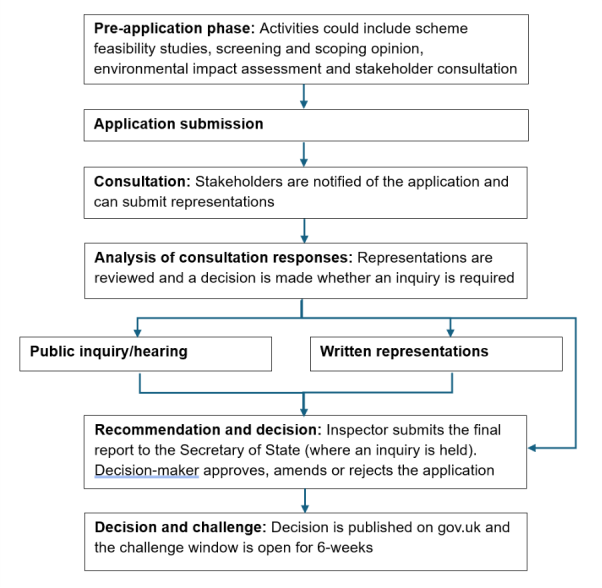
The above image shows the TWAO application process.
It starts with the pre-application phase where activities include scheme feasibility studies, screening and scoping opinion, environmental impact assessment and stakeholder consultation.
The next stage is for the applicant to submit the application.
Consultation is then carried out on the application. This includes notification of the application to stakeholders who can then submit representations.
The consultation responses are then analysed and a decision is made whether an inquiry if required.
The case can then be managed by public inquiry, written representations or it can go straight to a decision.
During the recommendation and decision stage, the inspector submits the final report to the Secretary of State where an inquiry is held. The decision-maker then approves, amends or rejects the application.
The final stage is post-decision and challenge. In this stage, the decision is published on GOV.UK and the challenge period opens for 6 weeks.
List of strategic authorities
Below is the list of strategic authorities by devolution. At Budget on 28 October 2026, government confirmed it is in the final stages of agreeing 10 new strategic authorities.
Note: (*) Announced but not yet created.
Established mayoral strategic authorities
- Cambridge and Peterborough
- East Midlands
- Greater London
- Greater Manchester
- Liverpool City Region
- North East
- South Yorkshire
- West Midlands
- West of England
- West Yorkshire
- York and North Yorkshire
Mayoral strategic authorities
- Cheshire and Warrington
- Cumbria
- Devon, Torbay and Plymouth (Devon and Torbay are foundation strategic authorities)(*)
- Greater Essex(*)
- Greater Lincolnshire
- Hampshire & Solent
- Hertfordshire(*)
- Hull and East Yorkshire
- Lancashire (currently a foundation strategic authority)(*)
- Leicester, Leicestershire and Rutland(*)
- Norfolk and Suffolk(*)
- Staffordshire and Stoke-on-Trent(*)
- Surrey(*)
- Sussex and Brighton
- Tees Valley
- Thames Valley(*)
- Wessex(*)
Foundation strategic authority
Cornwall(*)
Strategic authority type to be decided
Kent and Medway(*)
Further information
Freedom of information
Information provided in response to this consultation, including personal information, may be subject to publication or disclosure in accordance with the Freedom of Information Act 2000 (FOIA) or the Environmental Information Regulations 2004.
If you want information that you provide to be treated as confidential, please be aware that, under the FOIA, there is a statutory code of practice with which public authorities must comply and which deals, amongst other things, with obligations of confidence.
In view of this, it would be helpful if you could explain to us why you regard the information you have provided as confidential. If we receive a request for disclosure of the information, we will take full account of your explanation, but we cannot give an assurance that confidentiality can be maintained in all circumstances. An automatic confidentiality disclaimer generated by your IT system will not, of itself, be regarded as binding on the department.
Data protection
Your consultation response and the processing of personal data that it entails are necessary for the exercise of our functions as a government department. DfT will, under data protection law, be the controller for this information.
Personal data collected through this consultation is processed in line with our online forms, surveys and consultations privacy notice.
DfT’s privacy policy has more information about your rights in relation to your personal data, how to complain and how to contact the data protection officer.
Artificial intelligence
Artificial intelligence (AI) may be used to analyse responses to this consultation. Where the consultation asks for directly identifiable information, such as your name or contact details, these will be removed before processing with AI tools.