Corporate Civil Enforcement Reforms Consultation
Updated 15 June 2026
Applies to England, Scotland and Wales

© Crown copyright 2026
This publication is licensed under the terms of the Open Government Licence v3.0 except where otherwise stated. To view this licence, visit nationalarchives.gov.uk/doc/open-government-licence/version/3 or write to the Information Policy Team, The National Archives, Kew, London TW9 4DU, or email: psi@nationalarchives.gov.uk.
Where we have identified any third party copyright information you will need to obtain permission from the copyright holders concerned.
This publication is available at https://www.gov.uk/government/consultations/corporate-civil-enforcement-reforms/corporate-civil-enforcement-reforms-consultation
Foreword

Minister McDougall
Economic Growth is this government’s number one mission. Focussing on strengthening our economy will secure strong, long-term prosperity for the British people. Central to our ambition is rebuilding economic stability, encouraging businesses to invest, and removing the barriers that hold back new industries and the development of vital infrastructure. Sustained economic growth helps raise living standards, supports good jobs, and provides the revenue needed to fund essential public services.
Giving businesses the confidence to invest helps us stay competitive globally and improves our ability to respond to future challenges.
Essential to achieving this vision we need to uphold the highest corporate standards, so that business has a fair and level playing field. Laws introduced in 2023 improve corporate transparency and provide new tools to tackle economic crime, strengthening our business environment. Alongside that, to help create the conditions for economic growth we need to be able to tackle all forms of corporate abuse which, whilst not always criminal, serves to undermine the business environment and eat away at business confidence. That is why a robust, modern corporate civil enforcement regime, with its core purpose to protect the public, is important. Tackling the full spectrum of corporate abuse encourages others to uphold high corporate standards, helping to build the trust and confidence needed to do business.
Our corporate civil enforcement regime has not been wholly reviewed in four decades. It remains important in addressing corporate wrongdoing, but the tools it provides do not deliver the flexibility needed to deal with today’s fastmoving and complex business landscape.
I am therefore pleased to publish this consultation, which seeks views about options to reform tackling corporate misconduct. We want a clearer, more responsive system for identifying and addressing misconduct, which is proportionate, reduces risks for creditors and further strengthens institutional trust.
Modernising the civil enforcement toolbox will ensure that those that do business here have the confidence that they can grow and be globally competitive. I would strongly encourage those interested to respond to this consultation and to use this opportunity to provide their views.
General Information
Why we are consulting
This document sets out proposals for changes to the corporate civil enforcement regime, administered by the Insolvency Service, an executive agency of the Department for Business and Trade.
A robust corporate enforcement regime capable of tackling all forms of corporate abuse is essential for providing a level playing field for legitimate businesses to thrive and grow. It encourages businesses to maintain good corporate governance standards, provide confidence to do business and helps attract investment for businesses based in the UK. The current regime has been in place for nearly 40 years and whilst additions have been made since its introduction, the Government is of the view that now is the right time to consider changes to strengthen and modernise the regime, ensuring effective and efficient tools are available to tackle corporate wrongdoing today and into the future.
Through this consultation, the government is seeking views on a range of proposals to improve the regime, while ensuring it remains fair. The proposals build on and enhance existing tools and do not add new corporate governance requirements, meaning they create no additional new administrative burdens for businesses.
Consultation Details
Issued: 25 March 2026
Respond by: 11:59 PM - 22 June 2026
Enquiries to:
Civil Enforcement Consultation Team
Insolvency Service
Floor 16
1 Westfield Avenue
Stratford
London
E20 1HZ
Email: enforcement.reform@insolvency.gov.uk
Audiences:
- Insolvency Practitioners
- Recognised Professional Bodies
- Insolvency trade bodies
- Related professionals (lawyers, accountants)
- Creditor organisations
- Business representative organisations
- Government departments
- Directors of companies
- Other interested parties
- Members of the public
Territorial extent:
Eleven proposals in this consultation apply in England and Wales and some apply in Scotland. Insolvency and company law in Scotland are partly reserved and partly devolved. Where a proposal applies only to England and Wales as functions are devolved to the Scottish Government, this is stated explicitly.
For HMRC’s proposal on securities related director disqualification, the measure concerns UK wide tax matters and therefore applies across the UK. The power to legislate on UK-wide taxes is not devolved to Northern Ireland, Scotland or Wales.
How to respond
Responses can be provided via Smart Survey by accessing the following link Smart survey: Corporate Civil Enforcement Reforms Consultation, or emailed to the Policy Team at the Insolvency Service at enforcement.reform@insolvency.gov.uk
You can also send written response to:
Civil Enforcement Consultation Team
Insolvency Service
Floor 16
1 Westfield Avenue
Stratford
London
E20 1HZ
When responding, please state whether you are responding as an individual or representing the views of an organisation.
Your response will be most useful if it is framed in direct response to the questions posed, though further comments and evidence are also welcome.
Confidentiality and data protection
Information you provide in response to this consultation, including personal information, may be disclosed in accordance with UK legislation (UK GDPR, the Data Protection Act 2018 the Freedom of Information Act 2000, the Data Protection Act 2018 and the Environmental Information Regulations 2004).
If you want the information that you provide to be treated as confidential please tell us but please be aware that we cannot guarantee confidentiality in all circumstances. An automatic confidentiality disclaimer generated by your IT system will not be regarded by us as a confidentiality request.
We will process your personal data in accordance with all applicable data protection laws. See our privacy policy.
Responses provided during this consultation will be analysed to inform policy development. To support this process, we may use artificial intelligence (AI) tools to assist with summarising feedback.
AI will only be used as an aid to human analysis; all final interpretations will be made by officials.
We will summarise responses and publish this summary on GOV.UK. The summary will include a list of names or organisations that responded, but not people’s personal names, addresses or other contact details.
Quality assurance
This consultation has been carried out in accordance with the governments consultation principles.
If you have any complaints about the way this consultation has been conducted, please email: enquiries@businessandtrade.gov.uk
Executive Summary
The United Kingdom is one of the most attractive countries for business investment in the world, reflecting investor confidence in the UK’s institutional stability, market openness, and long-term growth potential. The strong foundations of our corporate framework- encouraging entrepreneurship and responsible risk taking are underpinned by a flexible and transparent insolvency regime, which seeks to rescue struggling businesses and ensures a fair distribution of their assets should they fail.
The Government expects all companies to trade responsibly and their directors to act with honesty and integrity. The vast majority of company directors take their duties seriously, however, the consequences of failing to do so can have a devastating impact on the public and the wider economy. An effective enforcement framework to tackle miscreant companies, and reverse harmful transactions which undermine the fairness of the insolvency regime is therefore essential.
The Insolvency Service has a strong record of tackling poor corporate conduct. Operating as an integral part of a wider network of regulators tasked with maintaining good corporate standards and tackling economic crime, the agency carries out a range of civil and criminal enforcement activities to uphold company and insolvency law in the UK. This plays a vital role in protecting both the public and the wider business environment, creating a level playing field in which legitimate enterprise can thrive.
The current civil enforcement regime provides the Insolvency Service with the tools to remove bad actors through director disqualification and shutting down live companies where it is in the public interest to do so. This system has been in place for nearly 40 years and is one of the world’s best, governed by the legal framework contained in the Company Directors Disqualification Act 1986, the Insolvent Companies (Disqualification of Unfit Directors) Proceedings Rules 1987, the Insolvency Act 1986, the Companies Act 1985, and an extensive body of case law.
This enforcement framework, which includes activity to disrupt organised crime facilitated through companies, tackling consumer frauds, investment scams, rogue builders and abusive phoenixing (where individuals use companies repeatedly to evade debts or for fraudulent purposes) continues to provide crucial protections for individuals and markets. However, the way businesses operate have changed significantly since the 1980s, for example due to advances in technology. This, alongside the development of ever more complex forms of corporate abuse and economic crime, has created challenges.
The existing enforcement regime has been improved incrementally over the years. Since 2001 the Secretary of State has been able to accept a disqualification undertaking, a voluntary agreement by a director to be disqualified without court proceedings, enabling earlier public protection. Also of note is the introduction of compensation orders in 2015 to claw back money lost to creditors as a result of director misconduct. The tools available to tackle financial wrongdoing more broadly have also been updated, for example through the Proceeds of Crime Act 2002, the Fraud Act 2006, and most recently the Economic Crime and Corporate Transparency Act 2023.
Enabled by Economic Crime and Corporate Transparency Act 2023, the Insolvency Service has set out a new Investigations and enforcement strategy 2026 to 2031 through which it will adopt a broader role tackling corporate abuse, reaching beyond its traditional insolvency-focused remit to help uphold the Companies Act and related legislation, and tackle economic crime facilitated through companies. Companies House states that prior to the introduction of the Economic Crime and Corporate Transparency Act, between 5% and 20% of UK registered companies were fraudulent. Furthermore, the National Crime Agency estimates that over £100 billion is laundered through and within the UK each year, a significant proportion of which is facilitated by UK registered corporate structures. Within this context, the Government believes that the existing civil enforcement tools of director disqualification and winding up companies in the public interest no longer provide enough flexibility to take swift and proportionate action against all forms of corporate abuse in the modern era. The enforcement regime needs strengthening and modernising so that it reflects the challenges of today and into the future, in turn making the system more effective and efficient, whilst remaining fair.
Supporting the Government’s plan to deliver economic stability by building strong foundations and through its mission to kickstart economic growth, this consultation seeks views to shape and influence potential measures to modernise the civil enforcement framework. These measures seek to provide the civil enforcement framework the flexibility needed to disrupt all forms of corporate abuse in the modern business environment and keep pace with international best practice. This will further break the business models of those who take advantage of limited liability for fraudulent or improper purposes whilst preserving the UK’s position as one of the safest places in the world to do business.
Summary of options
This consultation outlines and seeks views on the following:
Business as usual
This would maintain the current civil enforcement regime without introducing any changes. The Government believes that the current civil enforcement regime has not fully kept pace with modern business practices and the challenges that corporate abuse presents. Whilst there is scope for non-legislative improvements within the current regime to help address this, the scale of potential improvement is likely to be limited. Therefore, the Government does not believe that this would sufficiently modernise the regime or improve its effectiveness or efficiency.
Proposals for change
The Government believes that the civil enforcement framework requires reform in order to continue to meet its objective of protecting the integrity of our markets within the modern business environment, in turn making the regime more effective and efficient, whilst remaining fair. The nature and scale of such reform will be informed by responses to this consultation. The consultation seeks views on 11 targeted measures to address limitations identified in the current framework. These proposals have been categorised into:
- significant structural changes to the civil enforcement regime
- improvements to information-gathering powers
- procedural changes
Significant structural changes to the civil enforcement regime
- Requiring directors to be disqualified as a result of a company being wound up in the public interest by the court.
- Introducing a new restrictions regime allowing those responsible for less serious corporate misconduct to continue to act as a director, subject to conditions intended to mitigate the risks they pose.
- Replacing the court with the Secretary of State as decision maker for director disqualification, with appeals to an independent tribunal.
- Strengthening the powers to recover funds paid out by companies which undermine the fairness of the insolvency regime.
- Providing the court with the power to disqualify individuals from acting as company directors after a single summary conviction for failure to comply with HMRC securities legislation.
Improvements to information-gathering powers
- Providing legal clarity on the scope of existing powers to obtain documents and explanations regarding live companies.
- Modernising of disclosure gateways.
- Extending existing information gathering powers relating to director disqualification so that they apply in a wider range of circumstances.
Procedural changes
- Technical procedural rules changes.
- Introducing flexibility to the court procedure which may be used in director disqualification proceedings.
- Extending the limitation date for issuing disqualification proceedings in certain cases.
Background
Corporate enforcement landscape
UK registered companies and their directors have certain legal responsibilities to protect the interests of various stakeholders, including shareholders, employees, and creditors. Most of these responsibilities are set out in the Companies Act 2006 and Insolvency Act 1986. Where these responsibilities are not adhered to there is a range of enforcement tools, both criminal and civil, to deal with corporate misconduct and safeguard the public from future harm.
There is a comprehensive and multi-agency system to combat fraud, economic crime and the abuse of corporate structures. This system involves collaboration between law enforcement bodies, regulatory agencies, government departments, and private sector partners.
The Economic Crime Plan 2023–2026 forms the UK government’s strategic framework for tackling financial crime, including fraud, money laundering, and corruption. It builds on the 2019–2022 plan and adopts a whole-system approach. The plan is structured around three core outcomes: reducing money laundering and increasing asset recovery, combatting kleptocracy and sanctions evasion, and cutting fraud across society and business.
Companies House reforms under the Economic Crime and Corporate Transparency Act 2023 represent the most significant changes to the UK’s company registration system since the 19th century. These reforms aim to improve the accuracy and transparency of the UK’s corporate register and prevent the misuse of corporate structures for criminal purposes. The Economic Crime Plan and Companies House reforms mark a significant step forward in the UK’s efforts to combat financial crime and enhance corporate accountability.
The Economic Crime and Corporate Transparency Act 2023 has granted the Registrar of Companies enhanced powers which include stronger enforcement capabilities, allowing them to share data with law enforcement and investigate suspicious activity more effectively. Having shared responsibilities with Companies House for enforcing the requirements of the companies acts, the Insolvency Service is broadening its main focus from insolvency situations to encompass all corporate misconduct whether in live (company status described as ‘active’ or ‘dormant’ on the Companies Register), insolvent or dissolved companies, underpinned by funding from Companies House fees since 2024. This shift is captured in the Insolvency Service Investigation and Enforcement Strategy 2026–2031, which outlines its broadened remit and new capabilities.
The corporate civil enforcement tools contribute significantly to the work of the wider corporate enforcement landscape. Tools available to Companies House and the Insolvency Service are being used in collaboration to shut down companies who undermine the integrity of the company register. An investigation late last year resulted in five companies being shut down for filing false and forged accounts. To date, over 2,000 directors responsible for Covid Bounce Back Loan abuse have been banned from running a company and civil enforcement powers are also being used in other priority areas such as, sanctioning employers of illegal workers. The Government recognises the impact these tools have, announcing in Budget 2025 additional funding to the Insolvency Service for the next 5 years to tackle the abuse of insolvency processes to evade tax, write off debts and disqualify more rogue directors.
Civil enforcement framework
The corporate civil enforcement framework administered by the Insolvency Service is centred around two key pillars: the disqualification of individuals from acting as company directors, and the winding up of companies which trade against the public interest. The purpose of this framework is to:
- protect the public from harmful practices
- maintain the integrity of the marketplace by preventing and deterring poor conduct, in turn ensuring a level playing field in which legitimate enterprise can thrive
- promote confidence and trust in the UK economy, in turn supporting economic growth
Director disqualification
The framework governing the disqualification of individuals from acting as company directors is contained within the Company Directors Disqualification Act 1986, the Insolvent Companies (Disqualification of Unfit Directors) Proceedings Rules 1987, and a wide body of case law developed over the past 40 years.
The law permits the disqualification of individuals from being involved in the formation, promotion or management of companies in a range of specific circumstances, set out in the table below:
| Circumstances | Section of Company Director Disqualification Act 1986 |
|---|---|
| Courts’ powers to disqualify on criminal conviction, at the discretion of the court. Includes convictions of an offence, domestic or foreign, connected with the promotion, formation or management of a company Maximum period of disqualification: 15 years Or: Summary convictions of an offence, domestic or foreign, connected with the promotion, formation or management of a company or 3 summary convictions in 5 years for breaches of company or insolvency law. Maximum period of disqualification: 5 years |
2, 5, 5A |
| Powers exercised by the Insolvency Service to bring disqualification proceedings where a director (including shadow directors and persons controlling unfit directors) of either a solvent or insolvent company has acted in a way which makes them unfit to be involved in the management of companies. Maximum period of disqualification: 15 years |
7, 8, 8ZB, 8ZD |
| Powers available to specific regulators to bring disqualification proceedings where there is evidence of the promotion of tax avoidance schemes or breaches in competition law Maximum period of disqualification 15 years |
8ZF, 8ZG, 9A |
| Courts’ power to disqualify for persistent failure to deliver required documents to the Registrar of Companies Maximum period of disqualification: 5 years |
3 |
| Courts’ power to disqualify a director in connection with fraudulent or wrongful trading or found guilty of fraud in relation to a company or a breach of duty in the course of winding up. Maximum period of disqualification 15 years |
4, 10 |
| An offence for an individual to act as a director if they are undischarged from bankruptcy or subject to a Bankruptcy Restrictions Order/Undertaking or subject to director disqualification sanctions under regulations made under section 1 of the Sanctions and Anti-Money Laundering Act 2018 Remain disqualified as long as they remain undischarged from bankruptcy or subject to director disqualification sanctions |
11, 11A |
In all of these instances, except in relation to individuals subject to bankruptcy or director disqualification sanctions, it is a matter for the court to determine whether the case for disqualification is made out and to make a disqualification order where appropriate. The court also determines the period of the disqualification order. In doing so the court will consider a wide body of case law that has been established over the past 40 years, and which establishes a broad interpretation of what constitutes unfit conduct. One of the most significant pieces of case law was established by the case of Re Sevenoaks Stationers (Retail) Ltd [1991] which set guidelines for determining the appropriate period of disqualification by separating the 15-year maximum period into three brackets:
- top bracket (over 10 years): Reserved for particularly serious cases, for example where a director who had previously had one period of disqualification falls to be disqualified yet again
- middle bracket (5-10 years): Serious cases which do not merit the top bracket
- lower bracket (2-5 years): Cases where disqualification is appropriate, but the case is, relatively, not particularly serious
Since 2001, the Insolvency Service (on behalf of the Secretary of State) has also been able to accept a disqualification undertaking from an individual in cases falling under sections 7 or 8 of the Company Director Disqualification Act 1986. A disqualification undertaking can be offered by a director, which allows them to voluntarily agree to be disqualified without the need for court proceedings. Once accepted by the Secretary of State, it has the same effect as a disqualification order. The disqualification lasts for a specified period agreed between the director and the Secretary of State. The length of the disqualification period is often reduced when a director voluntarily offers an undertaking, in acknowledgement of their cooperation and early resolution providing protection to the public earlier. Disqualification undertakings represent around 80% of all disqualifications. Following further legislative changes in 2003, 2015, and 2024, it is now possible for the relevant regulator to accept a disqualification undertaking in relation to the grounds set out at sections 5A, 8ZA, 8ZD, 8ZF, 8ZG, 9A and 9B of the Company Director Disqualification Act 1986 (see table above).
It is a criminal offence (section 13 Company Director Disqualification Act 1986) for an individual to act in breach of their disqualification, with penalties on conviction including imprisonment for up to 2 years and/or an unlimited fine. Additionally, the individual will be personally liable for the debts incurred by the company whilst they were acting in breach of their disqualification. A disqualified individual may only act in the promotion, formation, or management of a specified company if they have obtained the prior leave of the court.
The Insolvency Service has powers to investigate the conduct of the directors of insolvent and dissolved companies, with a view to taking disqualification action under section 6 Company Director Disqualification Act 1986. These investigations into potential director misconduct are identified and targeted through an objective process, briefly described as:
- For insolvent companies, the appointed insolvency office holder must report (section 7A Company Director Disqualification Act 1986) to the Insolvency Service on the directors’ conduct. This report considers how the directors managed the company and whether their actions contributed to its financial difficulties or disadvantaged particular creditors. The report is reviewed by the Insolvency Service, along with all other known information to determine whether to investigate the directors’ conduct. Investigations into targeted cases are prioritised based on public interest factors.
- For dissolved companies, cases are primarily identified and targeted following complaints received from the public, or through information obtained by the Insolvency Service’s intelligence team. Such information is manually reviewed by the Insolvency Service to determine which cases to target using a set framework.
Section 8 Company Directors Disqualification Act 1986 provides the Secretary of State with the power to seek the disqualification of directors of companies that are not insolvent where it is found that their conduct is unfit to manage a company. This can involve directors of live companies that are potentially still trading and causing an ongoing risk to the public.
As originally enacted, an application for disqualification under section 8 Company Directors Disqualification Act 1986 could only be made on the basis of information or documents obtained as a result of the Secretary of State exercising certain powers, which included the power to make enquiries into the affairs of live companies (see section: Winding up companies in the public interest below).
However, in 2015 the legislation was updated so the Secretary of State could rely on any information that demonstrated that a director was unfit, enabling the Insolvency Service (on behalf of the Secretary of State) to use information and evidence provided by other regulatory bodies following their own investigations. Examples include referrals from Home Office, following investigations into the employment of illegal workers, which result in directors being disqualified for breaching immigration rules. They also include referrals from HMRC for national minimum wage breaches and from the Information Commissioner, following investigations into unlawful communications.
Winding up companies in the public interest
Under the Companies Act 1985, the Secretary of State may appoint investigators to conduct confidential fact-finding enquiries into UK-registered companies and overseas companies which carry on business in the UK. In practice, these enquiries are conducted by investigators at the Insolvency Service, most commonly in relation to live, trading companies where there is suspicion of serious misconduct or where there is risk to, impact on or harm caused to the public.
Similar to the targeting of director conduct investigations, there is an objective process for identifying and targeting appropriate investigations into the affairs of live companies. Evidence of companies acting fraudulently, running scams, or otherwise causing harm to the public is reported to the Insolvency Service in a number of ways. This includes referrals from other regulators, sources such as Report Fraud (previously Action Fraud) and complaints from the public via an online complaints’ portal operated by the agency. The Insolvency Service manually reviews all such evidence, alongside information held by the Insolvency Service’s intelligence team, to determine whether an investigation is appropriate. These investigations are discretionary and prioritised based on public interest factors. Once an investigation commences, the key powers available to investigators include:
- requiring the company or any other person to produce documents or provide explanations (section 447)
- since 2005, the ability to enter and remain on premises used by the company (section 453A)
There is a legal requirement to comply with requests for documents or explanations under section 447, and under section 453A(5) it is an offence to obstruct an inspector or their team while entering and remaining on the premises. The investigator may certify any non-compliance to the court, which could lead to contempt of court proceedings if there was no reasonable excuse for the non-compliance.
Where a fact-finding enquiry under section 447 identifies that enforcement action may be necessary, the Insolvency Service on behalf of the Secretary of State may:
- disclose the information obtained, within a strict statutory framework, to an appropriate prosecuting or regulatory authority
- apply to the court for the company to be wound up on public interest grounds under section 124A Insolvency Act 1986
The ability for the Secretary of State to petition the court to wind up a company on public interest grounds is a powerful regulatory tool used to protect consumers. It helps to uphold market integrity and stop the misuse of corporate structures.
Upon the making of a winding up order on public interest grounds, the court will appoint a liquidator.
Fact-finding enquiries under the Companies Act 1985 relate to the affairs of the company, and Insolvency Service investigators have no powers to specifically investigate the conduct of the individual directors unless the company becomes insolvent or is dissolved. It is often the case that the directors responsible for running the company are guilty of misconduct, but a winding up order made on public interest grounds does not prohibit them from taking part in the management of a new or different company and continuing to conduct themselves in a way that causes harm. At present, in order to prevent the directors from continuing egregious activity, it is necessary to undertake a further investigation and separate enforcement action to disqualify.
The case for reforming the civil enforcement regime
A world-leading civil enforcement framework must be fair, effective, and efficient, and underpinned by international best practice.
The Government’s view is that the UK’s civil enforcement regime is effective as it removes companies and directors who are at risk of causing future harm. Based on methodology approved by the Public Sector Fraud Authority, in the 2024/25 financial year the economic benefit of disqualifications was estimated to be around £36m, with the benefits of winding up companies in the public interest estimated at around £14m. In 2023/24 these benefits were higher, around £90m and £9m respectively. These differences reflect the varying case and creditor profile year on year. The enforcement regime seeks to balance the need to take action in appropriate cases, whilst promoting entrepreneurship and responsible risk-taking, in line with World Bank Principles and the UNCITRAL Legislative Guide on Insolvency Law. However, changes in business practices over the past 40 years and the expanded remit of the Insolvency Service to tackle economic crime means that the current tools alone are no longer sufficient to fairly, effectively, and efficiently tackle corporate misconduct at the required scale within the modern business environment.
The Insolvency Service’s 5-year Investigations and enforcement strategy 2026 to 2031, published in July 2025, sets out a bold vision for the Insolvency Service to play a more active role in upholding high corporate standards. This includes deploying its enforcement powers across a broader and more diverse set of scenarios than ever before, reaching beyond their traditional remit of focusing only on insolvency-related misconduct. This shift in approach reflects the expanded remit of the Insolvency Service to use its civil enforcement powers more broadly to help tackle economic crime and support Companies House’s efforts to improve trust in the companies register, most significantly following the recent Economic Crime Acts.
Prior to the introduction of the Economic Crime and Corporate Transparency Act 2023, Companies House estimated that between 5% and 20% of UK registered companies were fraudulent. At that time there were over 5 million companies registered in the UK, meaning the number that could be fraudulent was potentially as high as 1 million companies. This exposes businesses and consumers to a range of harms, chiefly through corporate structures being used to facilitate fraud, and to obscure and launder the proceeds of wider criminal activity. It also opens the UK to a range of national security threats, with hostile actors setting up UK companies to obscure activity. Economic Crime and Corporate Transparency Act 2023 has provided a welcome addition to the toolkit for tackling corporate fraud. With the total number of company insolvencies increasing year on year for the past 10 years, and with the proportion of company insolvencies where potential misconduct was identified rising in recent years (between 2019 and 2023 the proportion of company insolvencies where potential director misconduct was identified increased from 10%-17%), there have been significant increases in instances of potential director misconduct to investigate. However, the constraints of working within the existing framework mean that not all potential misconduct can be investigated. With the number of companies based in the UK continuing to grow, and the nature of corporate misconduct and economic crime constantly becoming more complex, there is an ever-growing demand on the Insolvency Service’s investigative resources.
There continue to be calls from Parliament and other stakeholders for the Insolvency Service to conduct more enforcement activity. Such views were raised during both the passage of the Rating (Coronavirus) and Directors Disqualification (Dissolved Companies) Act 2021 and the Economic Crime and Corporate Transparency Act 2023. The insolvency practitioner community has expressed the view that the effectiveness of the regime is limited and also questions the value of the director conduct reports they are required to submit, arguing that their findings are often not taken forward by the Insolvency Service.
Unsurprisingly, overall perceptions of the civil enforcement regime are heavily influenced by individuals’ personal experiences and outcomes. However, qualitative research conducted by the Insolvency Service (Confidence in the Regime 2021 to 2022 and Confidence in the Regime 2022 to 2023) has found that there has been a consistent perception across stakeholder groups that high profile individuals from large companies are able to avoid disqualification whilst SME directors are the most commonly disqualified, and this is seen to be inherently unfair.
Whilst no enforcement regime can investigate every instance of potential misconduct, the scale of possible wrongdoing demands consideration of how more can be done to protect the public. The Government believes that the current enforcement tools can be improved to make them fairer, more effective, and more efficient, for example by improving information gathering powers and modernising the process for taking enforcement action. The Government also believes that now is the time to introduce new enforcement tools to ensure that proportionate action can be taken against all forms of corporate abuse, strengthening the deterrence against misconduct and maintaining the UK’s world-leading position as a place where legitimate enterprise can thrive.
Non-monetised benefits significantly contribute to the regime’s effectiveness, tackling corporate wrongdoing to deter others from engaging in misconduct. This helps to improve the standards of company stewardship to the overall benefit of creditors and bolsters confidence in the marketplace. Qualitative research conducted by the Insolvency Service (Stakeholder Confidence Survey 2012 and Confidence in the Regime 2022 to 2023) found that awareness of the civil enforcement regime was low amongst company directors, confirming that more must be done to establish an effective deterrence against wrongful conduct in order to keep pace with international best practice. As the Insolvency Service focuses its investigative resources on the most egregious misconduct where the greatest harm is caused, it is also important for lower-level misconduct to be identified and addressed in order maintain an effective deterrent against all forms of corporate abuse.
This heightens the need to modernise and improve the civil enforcement regime, to ensure that the enforcement tools are fit for purpose in taking proportionate action against any form of economic crime and corporate misconduct, wherever it is found. This recognises that, whilst director disqualification and winding up companies in the public interest are effective tools for protecting the public, they are serious matters and taking this action can be costly for all parties. It is therefore right that these remedies should be reserved for the most serious cases, with other potential tools being created to fairly, effectively, and efficiently deal with lower-level misconduct in a way which deters corporate abuse and rehabilitates directors.
Objectives for change
As a result, the Government believes that there is a need to reform the civil enforcement regime with the following objectives:
Objective 1: To provide sufficient flexible civil enforcement tools to enable efficient and effective action to be taken to tackle corporate abuse and protect the public.
Objective 2: To improve the deterrent effect of the civil enforcement regime, by raising awareness, amongst company directors, of the consequences of failing to meet the required standards.
Objective 3: To address perceptions that the civil enforcement regime is not fair, balancing the needs of stakeholders, with the aim to increase confidence in the regime.
Objective 4: To ensure proposals for change align with the World Bank principles and UNCITRAL Legislative Guide on Insolvency Law to maintain our international standing.
To fulfil these objectives, a suite of proposals has been developed for consultation, outlined below, which fall within three categories: structural changes to the civil enforcement framework, updating information gathering powers, and making procedural changes. Whilst the Government believes that reform is needed, the nature and scale of that reform will be informed by consultation responses, and the Government therefore does not have a preferred package of measures at this stage.
Government Options
Business As Usual
Without reforms to the civil enforcement framework, the existing tools of director disqualification and winding up companies which trade against the public interest will remain in their current form.
Taking action to disqualify an individual as a director or wind up a company on public interest grounds is resource intensive and costly for all parties. The Insolvency Service is positioned at the centre of upholding good corporate standards but as corporate insolvencies rise and resources are focused on the most egregious cases of corporate abuse, there is a risk that lower-level misconduct could be left unchecked. An effective civil enforcement regime must tackle the full spectrum of unfit directors, including those who act dishonestly, recklessly, or incompetently.
The Insolvency Service has introduced significant operational efficiencies since the civil enforcement regime was introduced, including the use of technology to support investigations and there could be scope for further such efficiencies through non-legislative means. However, the Government does not believe that such non-legislative improvements alone can allow the Insolvency Service to balance the need to adequately address of corporate misconduct wherever it appears, without reforming the framework itself.
Question 1: Would reforming civil powers help the Insolvency Service tackle a wider range of misconduct? Please explain your answer.
As noted in the case for reforming the civil enforcement regime, there is limited evidence that the current regime deters poor conduct, due to a lack of awareness of the regime amongst directors. It is necessary to take further steps to prevent poor conduct before it occurs, both through a deterrent effect and providing proactive educational support for directors. There is scope to do this through non-legislative interventions, for example, the Insolvency Service has an evolving communication strategy aimed at increasing its communications activities and expanding and further promoting the content on its Directors Information Hub. Whilst these are important steps, the Government believes these measures alone will not sufficiently raise awareness of the civil enforcement regime or contribute substantially to deterring future misconduct.
Question 2: How could the Government raise directors’ awareness of the civil enforcement regime to prevent misconduct, without legislative change?
Proposals for change
The proposed options for change broadly fall into 3 categories; structural reforms to modernise and add to the existing regime, improvements to information gathering powers, and procedural changes. These include the introduction of a new Director Restrictions Regime to address low-level infractions more proportionately and swiftly, and a mandatory disqualification requirement following a public interest winding up order to ensure accountability. Additional powers under the Company Directors Disqualification Act 1986 will allow investigators to gather more information before initiating disqualification proceedings. Clarifications to section 447 of the Companies Act 1985 will streamline interview requirements. Finally, allowing flexibility in court procedures for disqualification cases is expected to improve efficiency and save resources across a case, for the courts, directors and their advisers, and the Insolvency Service. Collectively, these reforms and the intended efficiencies, will enable more corporate abuse to be tackled, with an aim to deter director misconduct, bolster public protection, increase confidence in the enforcement regime, and align with international best practices.
Structural Reforms
These proposals aim to modernise the existing enforcement framework by introducing additional tools that enhance flexibility and improve efficiency. They would enable government to address a broader range of corporate abuse, while supporting a more proportionate and targeted response to lower-level misconduct. The proposals also seek to accelerate enforcement processes, speeding up the removal of individuals responsible for corporate abuse, and strengthening protections for the public and the wider marketplace.
Proposal 1: The requirement to disqualify as a result of a company being wound up on public interest grounds
Summary of proposal
A change to the law so that the court must disqualify the directors of a company that has been wound up on public interest grounds via section 124A (1)(a) Insolvency Act 1986. Each disqualification order would take effect 21 days after the date of the winding up order and would last for a period of 5 years.
The Court would be required to make an order to disqualify all directors brought to its attention at the time of making the order, with there being appropriate safeguards in place to ensure only those accountable for the harmful activities are disqualified, and a facility to later seek a longer disqualification where it is merited.
Individuals who are disqualified will retain the right to appeal.
By winding up live companies where there is evidence they are being used to facilitate harmful activity, the Government protects both the public and the integrity of the companies register, providing confidence in the marketplace to do business and encouraging economic growth. While the winding up of a company on public interest grounds effectively terminates its activity, it is equally important to ensure that the individuals responsible for harmful or unlawful conduct are swiftly removed from the market. This prevents them from establishing a new company and continuing harmful activity, undermining the integrity of the corporate framework and exposing the public and other businesses to ongoing risk.
Currently, to disqualify a director of a company wound up on public interest grounds action must be taken under section 7 or section 8 of the Company Directors Disqualification Act 1986. Following the decision of the court to wind up a company on public interest grounds, the Insolvency Service on behalf of Secretary of State will review the conduct of the directors. A full investigation is required to establish each director’s culpability and determine whether there are any mitigating factors (which should be taken into account when determining the length of any disqualification). If, as a result of an investigation there is sufficient evidence that an individual is unfit to manage a company, a director may provide a disqualification undertaking or the court may issue a disqualification order.
At present, the average time taken to secure a director disqualification after an investigation initiated following a public interest winding up order is approximately two years. The directors concerned are free to continue to act as such during the time required to investigate and secure any disqualification, posing ongoing risk and potentially causing further harm to the public. The Government recognises this problem and the need to remove culpable individuals from the marketplace swiftly.
Proposal
On the making of a public interest winding up order, the Government is proposing that the court should at the same time disqualify all directors who were acting during the period the company caused the harm that resulted in its winding up. The court will be required to make orders against all those directors identified and brought to its attention by the Secretary of State (see section: Identifying Directors), at the time a winding up order is made as a result of a petition presented under section 124A(1)(a) of the Insolvency Act 1986. This will include all individuals who were acting as a director, whether or not formally appointed at Companies House along with those instructing acting directors, including shadow directors (director and shadow director are defined in section 22 Company Directors Disqualification Act 1986). Safeguards will be put in place for individuals who should not be disqualified (see section: Managing limited exceptions). Disqualification will be for 5 years and would take effect 21 days after the public interest winding up order is made. As is the case with existing disqualification proceedings, a director would have a right to appeal but this would not prevent a disqualification from commencing. Furthermore, if the Secretary of State determines that a director’s conduct warrants disqualification for longer than 5 years the Government proposes that there be a facility to later seek a longer disqualification (see section: Managing varying levels of misconduct).
Where a company has been wound up on public interest grounds there will be no requirement to assess each director’s conduct individually, the evidence contained in the petition will be sufficient to justify disqualification. The basis for this is that a company is controlled by its directors. If winding up a company is deemed to be in the public interest, it follows that its directors are responsible. In such cases, all directors should be subject to disqualification for a fixed period (government is proposing 5 years), eliminating the need to undertake time consuming and resource intensive additional investigatory work to demonstrate the extent of each individual’s culpability. The Government considers that 5 years is an appropriate minimum period of disqualification for an individual who acted in the management of a company during the period it caused harm (see section: Managing varying levels of misconduct).
Identifying Directors
For formally appointed directors, registered at Companies House, their formal appointment would be sufficient to identify them for disqualification. For directors not formally listed in company records, the Secretary of State will be required to provide evidence to the court that they were acting as directors at the time harm was caused. Recognising the importance of stopping a company that is causing harm as quickly as possible, it may not always be possible to collect evidence that an individual not formally appointed was acting as a director before a petition to wind up is presented. In these circumstances, the Secretary of State will be able to issue proceedings at a later date to disqualify an individual acting as a director on the same grounds as if it were presented at the time of the winding up petition.
Managing limited exceptions
There may be limited circumstances where a director should not be disqualified, this could, for example, include those unknowingly appointed as directors due to identity fraud. Therefore, provisions will provide the Secretary of State discretion over whom to bring to the court’s attention for the purpose of disqualification. In addition, disqualified individuals would have the right to appeal, but only under narrow circumstances, to include where an individual claims they were not involved with running the company.
Question 3: In what circumstances should a director be able to appeal their disqualification? Please explain your answer.
Managing varying levels of misconduct
The Government considers five years to be an appropriate minimum period of disqualification for an individual who acted as a director of a company during the period harm was being caused. This minimum period reflects the potential varying levels of responsibility between directors for the harmful activity.
However, the average period of disqualification for directors of companies wound up on public interest grounds is 9 years (average length of disqualification of a director following a company being wound up on public interest grounds for the period 1/4/2019 – 31/3/2025), demonstrating that there may well be circumstances where a director’s conduct warrants disqualification for a period exceeding five years. This could be due to a number of reasons, including the seriousness of the misconduct and where an individual director is identified as more directly responsible for the harm caused than other directors. The Government proposes that in appropriate cases the Insolvency Service on behalf of the Secretary of State should be able to conduct a disqualification investigation to determine whether a period of disqualification beyond 5 years is warranted.
This proposal aims to ensure an effective and efficient regime where directors are held accountable and swiftly removed from the market at the point a company is wound up in the public interest rather than sometime later.
Question 4: Does this proposal balance the need to act quickly to protect the public, whilst treating directors fairly? Please explain your answer.
Question 5: The proposed length of disqualification would be a set period of 5 years. Is this appropriate? If not, what do you think it should be? Please set out your reasoning.
Proposal 2: Director Restrictions
Summary of proposal
A new administrative process to place restrictions on directors who have neglected their corporate responsibilities.
The scheme will allow directors who have acted negligently or incompetently rather than wilfully committed wrongdoing, to continue to run a company but in a more controlled environment, providing safeguards for the public.
A restriction would be for three years and for any director subject to a restriction would require them to:
- have a joint bank signatory and at least one further director appointed to any company where they are a director
- ensure a company of which they are director has paid up capital of a certain amount
- ensure company filings are kept up to date along with tax return filings and that tax owed by the company is paid up to date
- comply with any industry-specific regulations, both those that apply to them in their role as director and ensure the company complies with company wide regulations
An individual who breaches the terms of a restriction or their director duties may be disqualified.
The Insolvency Service on behalf of the Secretary of State will be responsible for deciding whether a director’s conduct warrants restrictions and directors will be able to appeal these decisions.
Over recent years there has been a rise in the number of corporate insolvencies, which has led to an increase in instances of potential director misconduct to investigate. In 2014 there were 16,253 total company insolvencies, which has steadily risen to 23,872 in 2024. More widely, there is growing evidence of large-scale problems of people being appointed directors without fully understanding or engaging with the legal duties that follow – including people employed as nominee or ‘front’ directors for organised crime groups.
The Insolvency Service’s Investigation and Enforcement Strategy 2026–2031 includes a commitment to prioritising high-profile and nationally significant insolvency cases, with a focus on complex corporate structures and serious criminal activity. It continues to remain important to hold directors of companies of all sizes to account for their actions in the run up to insolvency, including tackling the full spectrum of misconduct and corporate abuse.
Unchecked lower-level misconduct poses a risk to the integrity of the corporate enforcement regime by undermining its deterrent effect. If such behaviour is perceived as inconsequential, it may contribute to a culture of tolerance towards this misconduct, leading to more serious behaviour and misconduct over time. Tackling such misconduct deters other directors from neglecting their duties and who might otherwise have been tempted to engage in poor corporate conduct.
The Insolvency Service’s resources are finite, and it is not possible to investigate all instances of reported misconduct. Therefore, it is important to explore how to maximise our capacity to tackle the full spectrum of misconduct.
Proposal
The proposed measure would introduce an administrative process, conducted by the Insolvency Service on behalf of the Secretary of State. It would represent an alternative to director disqualification for directors who neglect their duties, leading to misconduct that would currently warrant a period of disqualification at the lower end of the scale (for examples see section: Areas of misconduct in scope). Director restrictions will provide a proportionate response to less serious misconduct and provide efficiencies when compared to director disqualification process, enabling the Insolvency Service to tackle more poor behaviour.
A director’s restriction would allow those subject to it to continue to act as a director and therefore contribute positively to the economy but with appropriate safeguards in place to protect the public (see section: Restrictions placed on a director). This measure would help promote confidence in the marketplace and encourage growth. It is intended to address lower-level misconduct, focusing on directors who have failed to meet their statutory duties through neglect or ignorance, rather than those involved in deliberate or wilful wrongdoing. This type of misconduct is common, and in such cases, at the moment, the only options are either to pursue a total ban disqualifying the director, often a time-consuming and costly process for all parties, or take no action, leaving an incompetent individual free to continue running companies without oversight.
A substantial proportion of successful startups are created by entrepreneurs on their second or third attempt. Providing an alternative to disqualification gives individuals an opportunity to try again, with the protection and reassurance of limited liability enabling them to take calculated risks to build their next venture, but with guardrails to protect the public.
Restrictions placed on a director are designed to reduce the risk of repeated or escalating misconduct in any future directorship. Restrictions can also serve an educational purpose encouraging directors to improve their standards and adopt better governance practices in the future (see section: Restrictions placed on a director).
Details of directors subject to a restriction would be published on a register of restricted directors.
Question 6: Do you support the introduction of a director restrictions regime to address low-level misconduct? Please explain your answer.
Restrictions Process
Identifying and targeting potential director misconduct for restrictions will commence via the same objective process used to identify and target for disqualification purposes. Following an initial review, an investigation into director misconduct will be directed to the appropriate route for dealing with the misconduct identified, either restrictions or disqualification. This will not be a rigid process, allowing flexibility during investigations for cases to be moved if new information becomes available that suggests another action would be more appropriate in the circumstances. This ensures that where evidence of more serious misconduct is identified, stronger proportionate protections for the public, such as disqualification can be considered.
The criteria of what constitutes grounds for a restriction would be published providing clarity and transparency for both directors and the public. Investigations would be less resource-intensive (compared to a ‘traditional’ disqualification investigation), requiring only evidence that one of the published criteria has been breached.
Once information is obtained that a director’s conduct warrants a restriction (rather than disqualification) this information will be presented to a separate team within the Insolvency Service to consider the evidence and decide, on behalf of the Secretary of State, whether the director should be restricted. Where the decision is made to restrict the director, they will be informed of this decision, and the restriction will come into force 21 days from the date they are informed. This is to provide the individual time to make arrangements to meet the requirements of the restriction for any existing director appointments and if the director disagrees, challenge the decision (see section: Appeals).
The decision to apply restrictions would be made on the basis of information available at that time. If further information about unfit conduct were received post investigation, the decision may be reviewed.
Restrictions would be for a set time period of 3 years. This aims to be a fair period for misconduct that could currently attract a disqualification of between 2 to 5 years.
The Government considers this to be a proportionate way to deal with less serious misconduct and would provide efficiencies when compared to pursuing full disqualification. It would represent an effective use of public monies to address lower-level misconduct.
Question 7: Is 3 years a suitable timeframe for a restriction? If not, what should it be?
Areas of misconduct in scope
Based on known types of negligent behaviour that might be considered “lower-level” misconduct, the following behaviours could be in scope of a restriction;
- failure to adhere to company filing requirements on two or more occasions
- failure to file returns with HMRC
- failure to pay Crown debts (within set parameters, over a certain % of overall debt owed by an insolvent company to HMRC)
- inadequate accounting records (within set parameters, total debt owed by the insolvent company is less that a certain amount)
- multiple corporate failures within a set period of time without additional evidence of corporate abuse such as abusive phoenixing (e.g. 3 corporate insolvencies within 5 years)
The Government recognises that when these types of misconduct are present more serious misconduct may also exist. For example, failure to pay Crown debts may be an indicator of abusive phoenixing, where an individual is using companies to avoid tax liabilities, providing them with an unfair advantage over their competitors. This is why the process for identifying and applying restrictions is intended to be flexible and only pursued in preference to disqualification where appropriate.
Details of the types of misconduct that would constitute grounds for a restriction would be published, providing clarity and transparency for both directors and the public. The criteria would be amendable by the Secretary of State so they can flex and adapt to any emerging themes in the corporate landscape.
Question 8: What other types of misconduct should be considered for inclusion in the restrictions regime?
Restrictions placed on a director
The Government considers that the following would be appropriate restrictions to place on an individual who has acted negligently in their role as a director. These are intended to provide guardrails for an individual’s subsequent director appointments.
- they must not be the sole director of a company
- they must not be sole signatory for a company’s bank account
- any company of which they are director must have paid up capital of a certain amount (to be determined)
These restrictions aim to prevent the recurrence of the same or similar misconduct in any future directorships. Requiring at least one other director provides oversight and accountability, reducing the risk of decisions being taken without challenge, which can lead to governance failures or financial harm. Similarly, restricting an individual from being the sole signatory on a company bank account introduces an additional safeguard against misuse of funds. Setting a minimum capital requirement helps to ensure that the company has a basic level of financial stability, reducing the likelihood of insolvency and protecting suppliers and customers from undue risk.
In addition, a director who is subject to a restriction would be in breach if a company of which they were director of failed to adhere to statutory requirements, including:
- filing annual confirmation statement and accounts on time
- submitting and paying tax returns on time
- complying with sector specific regulatory requirements (for example Health and Safety regulations)
These are requirements that all directors are expected to uphold. However, for restricted individuals there will be specific consequences if those duties are breached. If a director does not adhere to the requirements of a restriction, they would risk being disqualified, with breaching a restriction being a specific standalone ground for disqualification.
Question 9: Do you think that restrictions provide sufficient weight to deter negligent behaviour? Please explain your answer.
Question 10: Are there additional restrictions you think should be considered to protect the public and prevent repeat misconduct? Please explain your answer.
Question 11: Should there be consequences for any co-director if an individual breaches their restrictions? Please explain your answer.
Appeals
Where a director disagrees with a decision to impose restrictions their rights would be protected though a mechanism to challenge that decision. In the first instance they may request a review by the Insolvency Service. This may result in the decision being confirmed, or the cessation of the restrictions process. The review would be undertaken independently by someone not involved in original decision. If the decision is reaffirmed, there would be a right of appeal to the court. Grounds for appeal would be defined and require the individual to demonstrate, to the satisfaction of the court, why the restriction should not apply.
Question 12: Does this proposal provide sufficient opportunity for directors to challenge the decision to apply restrictions? If not, what else should be done?
Director Education
Many stakeholders have asked the Government to consider providing post insolvency education for directors. Whilst failure alone does not automatically lead to learning outcomes, a rehabilitative educational approach recognises business failure as a powerful learning moment, providing an opportunity to improve directors’ understanding of duties, risk, and governance, supporting directors to ‘try again’ more competently. This could provide an alternative option for directors identified as suitable for a restriction. They could undertake, for example, an educational course to avoid restriction. Such a course could provide information to enable those directors who wish to start again to do so with the right tools to make informed decisions in accordance with their duties. Appropriate safeguards would be put in place to avoid directors abusing this option such as limiting its use to one time only. If the Government were to consider this further as a proposal, the objectives and content of any education and its delivery would require careful consideration. At this stage, and prior to further development, the Government is seeking views on whether this option could be an appropriate response where directors have been negligent of their duties, but who are keen to try again.
Question 13: What are your views on offering a post insolvency educational course as an alternative to placing restrictions on a director? Please explain your answer.
Question 14: Please provide any thoughts you may have on the following:
a. What should the aims of post insolvency director education be?
b. What types of content should included?
c. How should education be delivered?
d. Who should deliver the education?
e. How should it be funded?
f. How should outcomes be measured?
Proposal 3: Secretary of State to replace court as decision maker for disqualifications
Summary of proposal
The transfer of decision-making authority for director disqualifications from the courts to the Secretary of State, with appropriate safeguards through a statutory right of appeal to a tribunal in HM Courts & Tribunals Service. This would shift defended cases from the courts to a tribunal model.
The Insolvency Service, on behalf of the Secretary of State, would be tasked with deciding whether director disqualification is appropriate. To ensure fairness, the decision-making function would be exercised by a separate department to that carrying out the disqualification investigation.
Where disqualification is deemed necessary a director would be given notice of the Secretary of State’s decision. The disqualification would come into effect when either:
- the time for an appeal to the tribunal has elapsed, at the end of 42 days (including weekends and bank holidays) from the date the notice of disqualification is served on the individual; or
- the appeal is withdrawn, or the tribunal affirms the decision to disqualify
At present, the decision to disqualify directors is made by the courts. Under section 16 of the Company Directors Disqualification Act 1986, where the Insolvency Service, acting on behalf of the Secretary of State determines, following investigation, that it is in the public interest to seek disqualification, a written notice of intention to commence proceedings is issued to each director where misconduct has been identified. The notice sets out a summary of the allegations of director misconduct, as well as the period of disqualification sought by the Secretary of State and invites representations in response to the alleged misconduct.
Upon receiving this notice, a director may choose to offer a disqualification undertaking (which allows them to voluntarily accept a disqualification without the need for court proceedings) or they can contest the allegations through formal court proceedings.
Where a director offers a disqualification undertaking before formal proceedings are issued, the Secretary of State will not normally seek to recover costs. An undertaking may still be accepted after proceedings have commenced; however, in such cases, the Secretary of State would typically seek to recover costs incurred. The length of the disqualification period is often reduced when a director voluntarily offers an undertaking, in acknowledgement of their cooperation and early resolution (removing them from the marketplace more swiftly). In 2024/25, 81% of all disqualifications were pre-issue undertakings and the average time from date of insolvency to secure an undertaking was 22 months from the date of insolvency.
Currently, directors subject to disqualification court proceedings have the opportunity to respond to the allegations against them by submitting evidence to the court. Evidence may also be provided by third parties, such as the company’s banking facility providers, accountants, or creditors, to support or challenge the case. These individuals may be called as witnesses at any trial. The court will then determine whether the conduct in question renders the directors unfit to manage a company, and, if so, the appropriate period of disqualification. In 2024/25 the average time to secure a disqualification through the court was 37 months from the date of insolvency.
A disqualification order typically includes an order for the directors to pay the costs and expenses incurred by the Secretary of State.
The risk of incurring costs including adverse costs once disqualification proceedings are issued is likely to be a determining factor for directors in deciding whether to offer an undertaking to the Secretary of State. This is also influenced by whether a director has directors’ and officers’ insurance, with those who do (typically directors of large companies being less concerned by the risk of adverse costs due to their insurance cover.
Proposal
The Government is considering reforming the current approach for disqualifying directors by shifting defended cases from the courts to a tribunal model. This would be achieved by transferring decision-making authority from the courts to the Secretary of State supported by a right of appeal to a tribunal in HM Courts & Tribunals Service. To preserve the integrity of the decision-making function, it will be exercised by a separate department to that carrying out the disqualification investigation.
The Government considers that such a reform would bring the disqualification process in line with enforcement procedures adopted in other professional and regulatory frameworks. It has the potential to offer improved efficiency and reduced costs, reflecting a more streamlined and timely response to misconduct. In turn, providing additional capacity to deal with a wider range of misconduct.
An example of a similar regulatory framework is the enforcement procedure administered by the Charity Commission to disqualify trustees of charities. After a formal investigation into the conduct of trustees of a charity, the Commission may decide to issue a disqualification order if statutory criteria are met, the individual(s) are deemed unfit, and disqualification is in the public interest. Before issuing a disqualification order, the individual(s) are notified and given a one-month period to respond or make representations. Once representations have been considered, if the decision is made to issue a disqualification order the individual has a right to appeal to the First-tier Tribunal (Charity).
Shifting defended cases from the courts to a tribunal model will require directors who wish to challenge a decision to disqualify, to take positive action to dispute the grounds for disqualification and challenge the Secretary of State’s decision. Under the current process a director’s inaction leads to proceedings being issued at court, even if the director does not dispute the facts. Once disqualification proceedings are issued at court, costs start to build significantly and there are considerable delays in obtaining protection for the public. In 2024/25 post-issue disqualification undertakings took on average 36 months from date of insolvency to obtain and disqualification orders by the court 37 months, compared to pre-issue undertakings that took on average 22 months. For those directors who consider there are grounds to challenge the Secretary of State’s decision, providing a route via a tribunal in HM Courts & Tribunals Service is intended to provide a more accessible and cost-efficient mechanism for challenging decisions, offering a proportionate alternative to litigation through the courts.
Proposed Disqualification Process
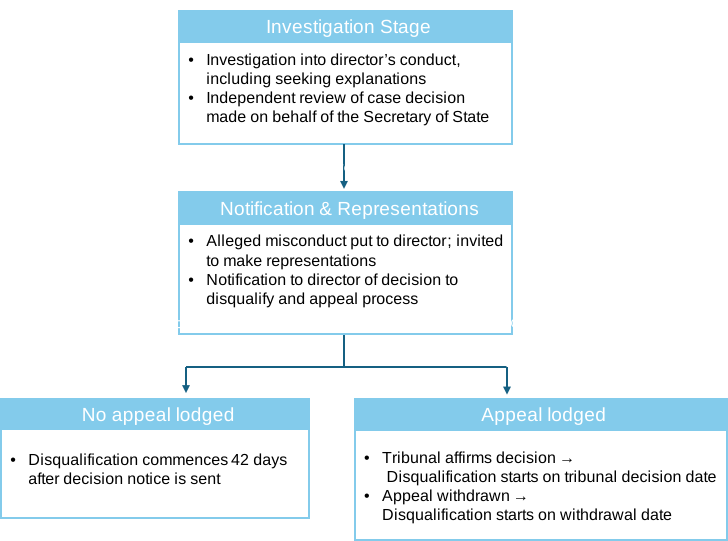
Investigation Stage:
- An investigation into directors’ conduct is carried out, including seeking explanations.
- An independent review of case decision is made on behalf of the Sectary of State
Notification & Representations:
- The alleged misconduct is put to director; invited to make representations
- Notification to director for decision to disqualify and appeal process
No appeal lodged:
- Disqualification commences 42 days after decision notice is sent
Appeal lodged:
- The tribunal affirms the decision, the disqualification then starts on tribunal decision date
- Appeal withdrawn, disqualification starts on withdrawal date
As currently, efforts would be made to contact the director and seek their views and explanations at an early stage in the investigation. Once the investigation is complete the investigator would give the director notice of the Secretary of State’s intention to exercise the power to disqualify them. The notice will set out the reasons disqualification is being considered and will give the person the opportunity to make representations within a period set out in the notice. Any representations made would be taken into account following this. If it was still considered appropriate to disqualify, the matter would be referred for review and a decision, by a separate department from that carrying out the investigation.
Should a disqualification be determined the right course of action, a further notice would be issued to the person setting out the decision, together with the date the disqualification comes into effect and the process for lodging an appeal.
The disqualification order would come into effect:
- on the date that the time to lodge an appeal to the tribunal has elapsed, which would be 42 days (including weekends and bank holidays) from the date the disqualification order is served on the person being disqualified
- the date the appeal is withdrawn
- the date the tribunal affirms the Secretary of State’s decision
If the tribunal’s decision is to uphold the individual’s appeal the disqualification does not commence. If the tribunal affirms the Secretary of State’s decision, a director may be able to seek a further review of the decision, however this will not stop the disqualification from commencing.
Question 15: Would the proposed system effectively improve the current court-based system? Please explain your answer.
Appeals
It is proposed that appeals against a decision to disqualify would be heard by the First-tier Tribunal. The First-tier Tribunal deals with appeals against decisions made by government departments and agencies. It is the first level in the tribunal system and is split into different chambers, each handling specific types of cases, such as immigration, tax, social security, property disputes, and health or education issues. If someone disagrees with an official decision (for example, about benefits or a visa), they can appeal to the relevant chamber of the First-tier Tribunal. If they’re still unhappy after that, they can usually take the case to the Upper Tribunal for further review.
HM Courts & Tribunals Service is responsible for recruiting panel members to sit on a tribunal and different panels have different compositions, depending on the areas of regulation they cover. The panel that hears appeals must have appropriate skills and be sufficiently qualified to decide the cases before them and can include judges. An individual will be able to appeal the First-tier Tribunal decision to the Upper Tribunal and from there to the Court of Appeal. So overall, although the courts would be removed as decision maker in disqualification matters there would be independent oversight of Secretary of State decisions.
The Government believes that providing a route to challenge the Secretary of State’s decision via a tribunal would be a more user-friendly and cost-effective forum for challenging decisions than bringing a claim through the courts. It would be easier and potentially cheaper for directors to challenge a decision to disqualify when compared to the current process. There is no cost to a director to lodge an appeal and as both parties are ordinarily expected to bear their own costs there is little risk of adverse costs. The Government believes this would create a fairer process, which doesn’t discriminate based on affordability.
Question 16: Should appeals against a decision to disqualify be heard in the First-tier Tribunal? If no, please provide reasons and alternatives.
Compensation orders
Compensation orders hold directors financially accountable for losses resulting from their unfit conduct. Under section 15A of the Company Directors Disqualification Act 1986, the Secretary of State may apply to the court for a compensation order at any time within 2 years of the date the disqualification order or undertaking commenced. Alternatively, during this period a disqualified individual can offer a compensation undertaking, accepting to pay compensation calculated by the Secretary of State as due.
The proposed new process for disqualification would also extend to section 15A of the Company Director Disqualification Act 1986, transferring decision-making authority to the Secretary of State for determining whether a compensation order is appropriate.
Question 17: Are there circumstances where you believe a tribunal-based approach would not be appropriate? Please provide details.
Question 18: Does the proposed system give a fair way for directors to appeal/challenge disqualification? Please explain your answer.
Proposal 4: Ensuring a fair distribution of a company’s assets upon insolvency
Summary of proposal
This is a small package of measures to improve distributions to creditors and improve governance of firms approaching insolvency. Insolvency legislation includes provisions that allow an insolvency office-holder to reclaim money wrongfully paid to third parties prior to an insolvency, or to reverse the impact of other transactions that are harmful to creditors. The measures in this package will make it easier for an insolvency office-holder to successfully bring such actions by, for example, reversing the burden of proof or lowering the threshold at which the provision applies.
Insolvency can be a challenging process for everyone involved, and particularly tough on a company’s creditors and stakeholders. Employees might lose their jobs, landlords can lose their tenants, and tax debts - which fund vital public services - go unpaid. For this reason, it is essential that all available assets are made available to those who have lost out.
Creditors are entitled to fair and equitable treatment in the distribution of the debtor’s assets. A company’s secured creditors, unsecured creditors, and other stakeholders receive their entitlements in accordance with a well-established legal framework. This structured and transparent approach is a crucial part of the insolvency process; it attempts to balance the interests of all parties involved and gives certainty to creditors that whatever money is available will be distributed fairly.
Unfortunately, as they approach a formal insolvency, some companies choose to damage or subvert the process by entering into transactions that are not in the interests of creditors as a whole. These transactions may be with unrelated parties, but they are often with those connected to a company, for example, with a connected company, a director, or a director’s family member. This may be done to try to avoid the fair distribution of assets that will take place following formal insolvency, and to unfairly benefit the connected party. Directors may cause the company to enter transactions that benefit them, or someone connected to them, instead of transactions that are fair to all creditors.
Alternatively, a distressed company may take out additional borrowing at an extortionate rate of interest, further dissipating the available funds for creditors through unfairly high interest payments or complex investment schemes.
If such transactions were allowed to stand unchallenged, it would diminish the pot of money available for all creditors by unfairly favouring others in the run up to formal insolvency. For this reason, legal powers exist that allow a liquidator or administrator to apply to court to reverse transactions that seek to undermine the fair distribution of assets upon insolvency. Such provisions, often known as “antecedent recoveries”, have been a part of the law of England and Wales for over 400 years and are in keeping with World Bank best practice for effective insolvency regimes.
Responses to a previous consultation Insolvency and Corporate Governance 2018 agreed that the Government should tackle unfair transactions in the lead up to insolvency and advocated for making improvements to these existing recovery powers. At the time, respondents were not in favour of more radical reform, on the basis that it might cause damage to the business turnaround market, particularly to those lending in this area. Respondents provided valuable insight and evidence about how the framework’s existing antecedent recovery powers could be expanded or improved to ensure inappropriate transactions can be reversed.
Additionally, and in response to the stakeholder feedback provided in 2018, the Government is also proposing a fourth measure to make clear that all delinquent directors can be pursued when they have caused a company financial loss, even where they are not formally appointed as a director of the company on its record at Companies House.
Since 2018, the business landscape and civil enforcement regime has continued to evolve, with renewed and additional focus on combatting economic crime, tackling abusive phoenixism, and enforcing the greater transparency requirements for company registration and reporting. As such, the Government is now revisiting these proposals with a view to assessing whether these suggested changes to antecedent recovery procedures are still relevant to today and would strengthen public trust in our insolvency regime.
This package of measures will help to maintain the UK’s world-class insolvency framework.
Transactions at an undervalue
A ‘transaction at an undervalue’ happens when a company either gives something away for free or sells something for much less than its actually worth. A simple example would be the sale of the freehold of a factory owned by the company for much less than that property’s market value.
Where a company that undertakes such a transaction subsequently enters administration or liquidation, the administrator or liquidator can make an application to court to recover the loss suffered by the body of creditors. On a successful court application, a court can order that the position be restored to what it would have been if the transaction had not taken place. The Government believes that most actions of this type are settled consensually before reaching court.
The Government’s current proposal will impact connected party transactions at an undervalue only – where those connected to the company take advantage of their connected status to attempt to dishonestly put assets out of the reach of creditors. To be in scope of review, the transaction must have taken place in the two years before the start of the insolvency for both connected and unconnected parties.
For a transaction to be challengeable, it must have taken place at a time when the company was insolvent, or if the transaction itself caused the company’s insolvency. ‘Insolvent’ for these purposes is defined by reference to section 123 of the Insolvency Act 1986, which determines when a company is unable to pay its debts. Section 123 encompasses both the ‘cash flow’ and ‘balance sheet’ tests for insolvency. The ‘cashflow test’ means the company is unable to pay its debts as and when they fall due, and the ‘balance sheet test’, is where the total value of its assets is less than its total liabilities. Where the recipient is connected to the company, it is presumed that the company was insolvent, although the recipient of the transaction can challenge this assumption.
Currently, it is for the liquidator or administrator to prove that the transaction was at an undervalue (or was a gift). In simple examples – like the sale of the property mentioned above, where market data of similar sales may be available – this may be relatively straightforward. But where transactions are complex, or where documentary evidence is lacking, this may be difficult to prove.
There is also a defence available to these claims: that the court cannot reverse a transaction if the company entered it in good faith and for the purpose of carrying on its business, and there were reasonable grounds for believing that it would benefit the company. The Government does not intend to change this defence, which will still be available for those that enter such transactions honestly.
The Government proposes to reverse the burden of proof where the transaction is between the insolvent company, and someone connected to it. If the liquidator or administrator believes a company made a deal with a connected party that was undervalue in the two years before the insolvency, it will be up to the connected party to prove the deal was fair. The good faith defence noted above would remain in place.
By allowing the transactions to be more easily pursued and remedied, creditors will receive a more equitable distribution of an insolvent company’s assets, in line with the World Bank’s principles. If the transactions are easier to pursue, the Government also aims for this to create a deterrent effect, which will improve corporate governance by reducing the number of these transactions in the first place.
This change would cover England and Wales.
Question 19: Will reversing the burden of proof by making the recipient demonstrate to the liquidator or administrator that the transaction was for value increase the effectiveness of these powers for the benefit of creditors? Please explain your answer.
Question 20: How might reversing the burden of proof improve corporate governance and company conduct overall? Please explain your answer.
Preferences
In insolvency law, a preference is where a company does anything with the intention of putting another party, for example a creditor, surety, or guarantor, in a better position than they otherwise would have been should the company enter an insolvent liquidation. Preferences made to a connected party are treated differently than those to unconnected parties. The lookback period is two years (rather than six months for an unconnected party), and the law presumes that the transaction was intended to prefer the connected party. This reflects that connected parties may have greater influence on a company’s activity than unconnected ones and may have a greater knowledge of the state of its finances.
Another necessary element of a successful preference claim is that the company is unable to pay its debts within the meaning given in the Insolvency Act 1986 (section 123 Insolvency Act 1986) at the point the preference is made, or as a result of it. The existing provision requires the insolvency office-holder to prove this insolvent state in their case. This can prove difficult where documentation is poor.
However, unlike in respect of transactions at undervalue to connected persons, the existing legal position is that there is no presumption of insolvency at the time of the preference, even where the preference is given to a connected person. The Government proposes that preferences will mirror the existing position in transactions at an undervalue in that there will be a presumption that, at the time the preference is made to a connected party or as a result of it, the company was insolvent. This assumption will be capable of rebuttal by the recipient, ensuring that payments made to a connected party at a time when the company was solvent are unaffected. This would require an amendment to section 240 of the Insolvency Act 1986.
The lookback period of two years for connected party preferences will not be amended.
This change would cover England and Wales.
Question 21: Should there be a presumption that a company is insolvent when a preference is made to a connected party? If possible and appropriate, please share examples or evidence of how the market is currently acting, or to demonstrate how this will work in practice.
Extortionate credit transactions
The insolvency framework (section 244 Insolvency Act 1986) contains a provision intended to ensure that extortionate credit transactions entered into by a company can be challenged in court. Such transactions must be entered into within three years of a company’s failure and require that ‘grossly exorbitant payments’ be made, or that the transaction has otherwise ‘grossly contravened ordinary principles of fair dealing’. The Government does not believe that this provision, first enacted in the Insolvency Act 1986, has ever been used. This is possibly because the test – ‘grossly exorbitant’ – is set too high, making a successful claim unlikely. This high bar then acts as a deterrent to a liquidator or administrator making such claims. Respondents to a previous consultation Insolvency and Corporate Governance 2018 stated that bringing claims under this provision was extremely difficult and requires an unreasonable amount of evidence.
The Government does not wish to deter rescue finance. Lenders to distressed companies take on greater risk than when lending to a financially healthy company, and this will be reflected in the price the borrower must pay. It is an important option available to distressed companies and can allow the company to avoid liquidation or administration.
The Government proposes to update the provision by replacing the ‘grossly exorbitant’ test with a less stringent test to assess whether the lending was ‘commercially disproportionate’, or similar wording. This reflects that, if the lending is charged at a rate appropriate to the particular circumstances of the borrower – even if that is a nominally large percentage rate when taken out of context – the transaction could not be successfully challenged.
By updating the test, this provision will become a more effective tool for modern-day liquidators and administrators and enact Parliament’s original intention for this measure. As with the other measures in this section, this will enable a fairer distribution of an insolvency company’s value to creditors.
This change would apply to Great Britain.
Question 22: Have you used, or tried to use, the extortionate credit provisions? If possible and appropriate, please share examples.
Question 23: What, if any, are the unintended consequences on businesses of the above proposal?
Question 24: Should section 244 Insolvency Act 1986 be revised to allow ‘commercially disproportionate’ (or similar wording) transactions to be challenged in court? Please explain your answer.
Question 25: How might ‘legitimate’ rescue finance be affected by this change? Please explain your answer.
Misfeasance and shadow directors
Misfeasance is the name given to the improper carrying out of a legal act or duty. In a company, an example of misfeasance would be a director not acting in the company’s interests in a way that causes the company financial loss. The ability to pursue a director for misfeasance reinforces the directors’ duties that are contained within the Companies Act 2006.
A company does not need to be insolvent for a misfeasance action to be taken. Where the company is in liquidation though, section 212 Insolvency Act 1986 provides a framework for a misfeasance action to be taken by the liquidator, official receiver, a creditor, or a contributory. The section goes on to state that misfeasance action may be taken against an officer (e.g. a director) or one who has acted as a liquidator, or administrative receiver (a separate provision allows action to be taken against administrators). However, the courts have found that the current drafting of this measure does not provide for a misfeasance action to be taken against shadow directors (see Revenue and Customs Commissioners v Holland and another; In re Paycheck Services 3 Ltd and others [2010] UKSC 51).
A shadow director is an individual who is not listed as a director on a company’s register at Companies House, but who instructs or directs the formally appointed directors, who usually act on those instructions or directions. Respondents to the 2018 consultation highlighted this discrepancy as something that should be addressed. The Government believes that all those who act improperly as directors, whether formally appointed or not, should be held accountable for their misfeasance. Accordingly, the Government proposes that section 212 Insolvency Act 1986 be amended to refer expressly to shadow directors, as defined by section 251 Insolvency Act 1986.
This change would cover Great Britain.
Question 26: Should the legislation be amended to make it clear that misfeasance actions against shadow directors of companies in liquidation are possible?
Question 27: Is there any doubt about the application of other sections of Chapter X Insolvency Act 1986 to shadow directors? Please explain your answer.
Proposal 5: Company directors disqualification for failure to comply with HMRC securities legislation
Summary of proposal
A change to the law is proposed to introduce a new power into the Company Directors Disqualification Act 1986, enabling a court to disqualify individuals from acting as company directors after a single summary conviction for failure to comply with HMRC securities legislation.
HMRC securities legislation refers to any statutory provision which allows HMRC to require a person or business to give security (effectively a deposit) in respect of a tax liability where there is a risk that taxes will not be paid.
A non-exhaustive summary of the statutory provisions that make up HMRC securities legislation is provided at Annex A to support consultees in understanding the scope of this proposal.
Currently, HMRC may require a business to give a security where there is a risk that taxes will not be paid, often due to previous arrears, late payments, or evidence of phoenix activity. A business required to give security is served with a Notice of Requirement, which obliges them to give the specified security by a set deadline. If the business does not give the security when required, the company and/or its directors can be prosecuted. The precise liability depends on the relevant tax regime - for example, in some cases both the company and directors may be prosecuted, while in others only one party may be liable.
Failure to give a security when required is a criminal offence under various tax regimes, including Pay As You Earn, Value Added Tax, National Insurance, the Construction Industry Scheme and Corporation Tax. The precise offence and liability depend on the relevant statutory provisions for each regime, as summarised in Annex A. Prosecutions for these offences are brought before a magistrates’ court and are summary in nature.
The obligation to provide a security is a fundamental HMRC compliance requirement. Breaching it demonstrates a disregard for legal duties and exposes public funds and legitimate businesses to significant financial risk, undermining the tax system and market integrity. While all offences relevant to director disqualification are serious, breaches of securities legislation can result in immediate and substantial loss to the Exchequer and may facilitate patterns of repeated non-compliance. Addressing these breaches effectively is essential to safeguarding public funds.
In 2024/25, HMRC secured 69 convictions, for failing to comply with HMRC securities legislation. Only convictions against individuals are relevant for the proposed director disqualification power. The inclusion of company convictions provides a complete picture of enforcement activity, but these would not themselves trigger disqualification under the proposed legislative change. These convictions were distributed as follows:
- 25 against companies
- 44 against individuals (directors, sole proprietors, partnerships)
The average corporate tax liability in cases involving securities breaches is estimated at around £285,000 per company and £195,000 per individual based on regional enforcement data (national figures may vary). This highlights the significant financial risk to the public when businesses fail to comply. The conviction and financial impact figures are based on the best available operational data from HMRC enforcement teams. Where direct data was unavailable, regional proportions were applied nationally. The numbers may be subject to refinement as more information becomes available.
While HMRC can pursue these offences, prosecution alone does not prevent a company from continuing to trade and accruing further debt. Although HMRC can petition for the company to be wound up, this process takes time, during which directors can continue to cause harm and further losses may occur.
Section 5 of the Company Directors Disqualification Act 1986 gives the court the power to disqualify individuals from being a director for up to five years where they have been convicted of certain summary offences. However, this power only arises if there have been at least three ‘relevant findings of guilt’ within the previous five years. The offences are strictly defined in law and only relate to contravention of, or failure to comply with, any of the relevant provisions of the companies legislation, including default orders and certain financial penalties imposed under specific regulations - namely, regulations made under section 1132A Companies Act 2006 and section 39 Economic Crime Transparency and Enforcement Act 2022.
Convictions for offences connected to breaches of HMRC securities legislation are not within the scope of section 5 Company Directors Disqualification Act 1986, so the court cannot disqualify a director for convictions of these offences.
Proposal
The Government proposes to introduce a new power which would enable the court to disqualify a director following a single summary conviction for failing to comply with HMRC securities legislation. This new power would operate alongside the existing regime.
For this proposal, ‘HMRC securities legislation’ refers to the regimes listed in Annex A. These provisions apply UK-wide unless stated otherwise.
Although director disqualification is transferred in Northern Ireland, the trigger for this proposal relates to UK-wide tax enforcement. Any Northern Ireland legislative changes would be taken forward separately through the appropriate mechanism.
The proposal seeks to address this by allowing courts to disqualify directors for up to five years after a single summary conviction for any HMRC securities related offence, properly addressing the seriousness of securities breaches, which often involve deliberate and egregious non-compliance with tax obligations and can pose a significant risk to public funds and fair competition.
Given the egregious nature of the non-compliance and the risk to public funds, the Government considers it proportionate and necessary to enable the courts to disqualify a director after a single summary conviction for a breach of HMRC securities legislation, rather than requiring three relevant findings of guilt within the previous five years, as is the case for companies legislation convictions, under section 5 Company Directors Disqualification Act 1986. Waiting for multiple convictions would intensify ongoing risk and potential harm to the Exchequer and the wider economy, particularly as such breaches can facilitate phoenix activity and repeated non-compliance across multiple companies.
Strengthening accountability through a proportionate disqualification power promotes confidence in corporate governance, deters misconduct and supports a level playing field and economic growth. Aligning the disqualification threshold with the seriousness and impact of the offence ensures that the measure is both effective and fair.
The intention is that the new power will automatically apply to all current and future HMRC security regimes, unless excluded by legislation or guidance. This future proofing reflects that securities legislation may evolve and ensures the disqualification trigger remains aligned with HMRC’s operational needs.
Individuals would have the right to appeal a disqualification order. As is the case for orders issued under the existing powers in section 5 Company Directors Disqualification Act 1986, appeal rights would be governed by general criminal procedure and court rules. This means the individual may appeal to the Crown Court under the Magistrates’ Courts Act 1980 to challenge either:
- the conviction for breach of HMRC securities legislation, or
- the length or appropriateness of the disqualification order.
The following case study illustrates how a single breach can result in significant losses and why timely intervention is essential.
Case Study: Why Stronger Powers to Disqualify Directors Matter
Note: This case study is based on a real enforcement scenario but has been anonymised to remove any identifying details. It is provided for illustrative purposes only.
Company A is liable to account for VAT and PAYE to HMRC; however, it has failed to provide all its VAT Returns, whilst running up large tax debts. Following a review, HMRC warned Company A that it needed to pay its overdue VAT and PAYE and file its outstanding tax returns. When these warnings were ignored, HMRC issued a Notice of Requirement, asking Company A to provide a sum of money, known as a security, against its VAT and PAYE obligations.
Company A failed to provide the required security, and its three directors were warned that this was a criminal offence. Following an investigation and prosecution, Company A and its directors were successfully convicted for breaches of securities legislation. Despite those convictions, Company A is still trading. It has not met its filing obligations and currently owes HMRC over £200,000 in unpaid VAT and PAYE.
Shortly after the criminal investigation began, two of the directors set up a new business (Company B) with a name very similar to Company A. Company B is also trading, owes HMRC £40,000 in unpaid VAT, and is not up to date with its tax filing obligations.
Across these two companies, the directors continue to cause tax losses (currently £240,000). Although the directors were prosecuted and convicted for failing to comply with HMRC securities legislation, under the current legal framework the court cannot disqualify them from acting as a director of any current or future companies. This means that these individuals can continue running companies at the risk that taxes will not be paid.
If the court did have the power to disqualify the director’s following conviction of a securities breach, it would have stopped them from running their companies – or setting up any further companies – and prevented them from accruing further tax debts. This change would not only protect public funds but also help ensure a fairer marketplace for businesses that play by the rules and reassure taxpayers that those who deliberately avoid their obligations cannot continue to do so unchecked. By strengthening deterrence, the proposed power would encourage better compliance and help safeguard the integrity of the UK marketplace and economy.
This case demonstrates that a single breach of HMRC securities legislation can be both deliberate and highly damaging.
Question 28: Should the courts have the power to disqualify a director for failing to comply with HMRC securities legislation? If not, please explain, considering the need to protect public funds and maintain market integrity.
Question 29: Do you think a single summary conviction is an appropriate threshold for director disqualification or should a higher threshold apply? Please share your views on how best to balance effective deterrence with fairness in setting the threshold for director disqualification.
Question 30: What do you consider to be the main risks or unintended consequences of introducing this power and how might these be mitigated to protect both the Exchequer and legitimate businesses?
Information gathering powers
The aim of these proposals is to improve and clarify current enforcement powers and legislation, ensuring they are fit for purpose in light of the new powers introduced by the Economic Crime and Corporate Transparency Act 2023. They would strengthen the Government’s powers to seek and gather the information necessary to support effective and efficient investigations into corporate abuse.
Proposal 6: Expansion and legal clarification of examination powers for live companies
Summary of proposal
The proposal recommends clarifying the wording in section 447 of the Companies Act 1985 to ensure investigators can effectively and directly obtain information from live trading companies and their directors, by explicitly requiring directors to answer questions about the activities of the company and removing legal ambiguities that can hinder investigations.
Section 447 of the Companies Act 1985 grants the Secretary of State powers to require a company or any other person to produce documents or provide information as specified. These powers are primarily used to investigate the activities of live companies and are designed to be non-public and fact-finding in nature.
The powers are a vital component of the Insolvency Service’s enforcement toolkit enabling a confidential fact-finding investigation to be conducted into the activities of a live company during which information is gathered to enable the Secretary of State to determine what action, if any, is required in the public interest. Possible outcomes include winding the company up in the public interest under section 124A Insolvency Act 1986, director disqualification proceedings, or referral to another regulator.
The early provision of information in an investigation conducted under section 447 significantly improves the speed and effectiveness of that investigation and hence any subsequent enforcement action that may be taken to limit ongoing harm. Similarly, where no public harm is identified the proactive provision of information supports a prompt completion of the investigation with no further action taken against the company.
However, investigations can sometimes be frustrated and delayed by directors or their advisors who deploy a narrow interpretation of the wording of section 447 in order to attempt to avoid answering questions about the activities of the company. This can create a distraction from the investigation, delaying the provision of information, and hindering the commencement of enforcement action that would disrupt ongoing harmful activities.
This proposal seeks to improve the clarity of the wording of section 447 by introducing an explicit requirement for directors to answer questions about the activities of the company.
This change would limit the scope for unnecessary challenge and delay by removing ambiguity surrounding the current wording of section 447 and providing legal certainty (that the powers extend to a requirement to answer questions in addition to the production of documents and provision of information).
The scope of section 447 was recently tested in the High Court (R v Artwork Holdings Ltd, formerly Yield Gallery Limited [2025] EWHC 1021 (Ch)) which confirmed that the current wording of section 447 does empower the Secretary of State to require company directors to attend for interview and answer questions. This case, which is a first instance decision demonstrates the need for greater clarity in the legislation.
This proposal would remove ambiguity surrounding the wording and purpose of section 447 and allow the Insolvency Service to gather information within a shorter timeframe, enabling it to intervene earlier and more decisively in cases of suspected unlawful or harmful activity.
Question 31: Should the Secretary of State’s powers under section 447 Companies Act 1985 be clarified to explicitly require any person to respond to investigators’ questions? Please explain your answer.
Proposal 7: Modernisation of disclosure gateways
Summary of proposal
This proposal seeks to explore whether the powers contained in section 447 and the disclosure gateways set out in Schedules 15C and 15D of the Companies Act 1985 should be modernised. Expanding the circumstances in which information gathered during the course of a section 447 investigation into a live company can subsequently be shared will support the broader remit of the Insolvency Service to tackle economic crime.
A fundamental principle of section 447 Companies Act 1985 is that where the powers are used to undertake an investigation into the activities of a live company the commercial value of the live company must be preserved. As such, all section 447 investigations are carried out in confidence and the disclosure of information gathered during those investigations is tightly via the gateways contained in section 449 Companies Act 1985 and detailed in Schedules 15C and 15D, with criminal sanctions for unauthorised disclosure. Schedule 15C outlines the specified persons to whom information may be disclosed and Schedule 15D defines the specific purposes for which information may be disclosed.
The disclosure gateway framework has not been reviewed for many years and the rigid controls surrounding how information gathered under section 447 can be shared creates a risk that the framework doesn’t keep pace with developments across the business, regulatory and economic crime landscapes. This limits the way information gathered under section 447 can be used to best effect in the fight against economic crime.
Limitations of the current framework system include:
- wholesale amendments to the framework can be made only through primary legislation reducing flexibility and rendering it slow to adapt to emerging issues
- limited revisions may be undertaken through secondary legislation, but only where they relate to public authorities and public functions, further reducing the agility of the framework
- restrictions prevent asset-related information gathered using section 447 powers being shared with an appointed office holder post-insolvency, limiting the effectiveness of asset tracing activities in insolvent companies where there is no ongoing commercial value to protect
- machinery of government changes can remove disclosure gateways which risks creating gaps in disclosure provisions, potentially limiting effective sharing of information and reducing public protections until the gateways can be replaced via secondary legislation
- any disclosure made in contravention of Schedules 15C and 15D attracts personal criminal liability adding to the rigidity of the framework.
We propose exploring how the gateway system could be modernised to create a more streamlined process that would increase flexibility subject to safeguards. These reforms would form part of a wider strategy to align civil enforcement tools with the objectives of the Economic Crime and Corporate Transparency Act 2023, which aims to modernise enforcement mechanisms and improve inter-agency collaboration.
Benefits would include improved efficiency by enabling faster and more effective collaboration with other enforcement bodies, enhanced public protection through timely and lawful information sharing, and modernisation of the legal framework to reflect current enforcement needs. Additionally, a modernised gateway system would support asset recovery efforts by allowing investigators to share critical information post-liquidation and hitting criminals where it hurts.
However, the reforms also raise important considerations. Any expansion of disclosure powers should be proportionate and necessary. Stakeholder concerns about fairness and oversight must be considered, particularly regarding the scope of information sharing, the potential for misuse, and the protection of whistleblowers.
Question 32: Should the Insolvency Service review the section 447 Companies Act 1985 disclosure framework? Please explain your answer setting out the positives and negatives of the current framework.
Question 33: How can the Insolvency Service best balance the need for confidentiality with the requirement for transparency and accountability in investigations under section 447 Companies Act 1985? Please explain your answer.
Proposal 8: Information gathering powers for investigating the conduct of directors of live and solvent companies
Summary of proposal
This proposal provides investigators with information gathering powers for the purpose of a disqualification under section 8 of the Company Director Disqualification Act 1986, which could include directors of solvent and live trading companies.
The information gathering powers would replicate those available when investigating the conduct of a director of an insolvent company.
The Insolvency Service, on behalf of the Secretary of State has consistently used director disqualification powers to protect the public from individuals who misuse corporate structures and abuse their duties.
Although many disqualifications are obtained following a company insolvency, section 8 Company Directors Disqualification Act 1986 provides the Secretary of State with a power to seek the disqualification of directors of companies that are not insolvent, where it is found that their conduct is unfit to manage a company. This covers a broad range of wrongdoing, including cases of dishonesty, fraud, and regulatory breaches. It can involve directors of live companies that are still trading and causing an ongoing risk to the public.
One of the primary reasons director disqualification is pursued under section 8 Company Director Disqualification Act 1986 is as a result of regulatory breaches, referred from other enforcement bodies. These cases arise when a live company is suspected of breaching regulatory obligations and details are referred to the Insolvency Service. These include referrals from the Home Office, following investigations into the employment of illegal workers, which result in directors being disqualified for breaching immigration rules. Companies where such regulatory breaches have occurred are typically not subject to insolvency proceedings. However, misuse of corporate structures and breaches of regulatory requirements can still pose significant risks to the public and undermine market integrity.
Unlike in cases of insolvency, the Company Directors Disqualification Act 1986 does not currently provide investigators with any specific powers to request information directly from directors of solvent companies or other parties before initiating disqualification proceedings. This can create challenges when cases are referred by other enforcement bodies. If those referrals and earlier investigations do not contain sufficient evidence for disqualification (such as attributing responsibility), then the potential for disqualification action is limited. Insolvency Service investigators do not have the power to independently gather further information from directors of solvent companies. This restricts the ability to build a complete picture of potential misconduct. This can be an issue due to the differing purposes and focus of other government departments’ investigations. For example, an immigration enforcement investigation seeks to establish whether the employer (the company), adhered to immigration rules. To complete regulatory action the investigation may only require notice to one named director. However, where a company has more than one director, fairness requires that a decision to disqualify should not be made unless all directors’ culpabilities are established. Otherwise, potentially culpable directors may be excluded from action simply due to a lack of available information.
Proposal
This proposal would provide investigators, on behalf of the Secretary of State, with powers to request information (see section: information gathering powers to be provided) for the purpose of investigating the conduct of a director where a disqualification under section 8 Company Director Disqualification Act 1986 is being considered. These additional powers would enable information to be requested when investigating the conduct of directors of solvent companies, including when the evidence provided by other enforcement bodies may not be sufficient for disqualification action. This ensures that, in appropriate cases, disqualification can be sought against directors where it is appropriate to do so. Such instances include where the company is live and trading and the director poses an ongoing risk to the public. Bridging the gap between the powers and evidence collected by other enforcement bodies so that, where appropriate, action can be taken to disqualify directors supports the Government’s whole-system approach for tackling economic crime and abuse of corporate structures. Removing from the market those responsible for the harm caused.
Question 34: Should the Secretary of State have the power to request additional information from directors of solvent companies before initiating disqualification proceedings under Section 8 Company Director Disqualification Act 1986? If no, please explain your answer.
Information powers to be provided
It is proposed that any new powers would be similar to those set out in section 7(4) Company Director Disqualification Act 1986 (information gathering powers for the investigation of misconduct in insolvent companies):
‘7(4) The Secretary of State may require any person -
(a) to furnish him with such information with respect to that person’s or another person’s conduct as a director of a company which has at any time become insolvent or been dissolved without becoming insolvent (whether while the person was a director or subsequently), and
(b) to produce and permit inspection of such books, papers and other records as are considered by the Secretary of State or (as the case may be) the official receiver to be relevant to that person’s or another person’s conduct as such a director,
as the Secretary of State or the official receiver may reasonably require for the purpose of determining whether to exercise, or of exercising, any function of his under this section.’
Non-compliance
If the requested information is not provided by the director, it is proposed, as with the current provisions for insolvent investigations, that the Secretary of State
should be able to apply to the court for an order requiring the information to be provided. At that point, the Secretary of State may also ask the court to require the respondent to cover the legal costs of the application. Failure to comply with a court order could result in proceedings for contempt of court.
Question 35: Should, as proposed the powers mirror those in Section 7(4) Company Director Disqualification Act 1986? If no, please explain your answer.
Question 36: Are there any limitations or safeguards you think should be included? If yes, please explain your answer and, if possible, provide suggestions.
Question 37: Do you believe the proposed powers would improve the effectiveness of director disqualification investigations? Please explain your answer.
Examination Powers
For consistency, if the proposed changes to section 447 Companies Act 1985 set out in proposal 6 go ahead, similar requirements should be added for the purpose of director disqualification. This would ensure consistency for information gathering powers across civil enforcement tools.
This proposal would create an explicit requirement for directors to respond to investigators’ questions. This alignment will ensure clarity across related powers and provide stakeholders with a clear understanding of the scope and application of information gathering powers.
Question 38: Should the proposed clarification in proposal 6 be replicated in section 7(4) Company Directors Disqualification Act 1986 and for section 8 Company Director Disqualification Act 1986 disqualifications? Please explain your answer.
Procedural Changes
The aims of these proposals are to improve and modernise the current director disqualification procedure and make the process more efficient. Whilst this consultation includes a proposal to structurally change the disqualification process (Proposal 3: Secretary of State to replace court as decision maker for disqualifications), we have also considered the existing process for director disqualification. The proposals contained in this section aim to improve and modernise the current procedure and make the process more efficient.
Proposal 9: Technical procedural rules changes
Summary of proposal
Amendments to the Insolvent Companies (Disqualification of Unfit Directors) Proceedings Rules 1987.
These amendments seek to modernise the current rules and ensure an efficient approach in director disqualification consistent with other civil court procedures.
To strengthen civil enforcement capabilities and ensure timely and effective action against directors where action is needed, we are considering amendments to the Insolvent Companies (Disqualification of Unfit Directors) Proceedings Rules 1987, which apply in England and Wales.
Currently the rules (3(2) and 3(3) along with rule 6(1)) require that evidence in support of a disqualification application be in the form of an affidavit. An affidavit is a written statement of facts that is sworn or affirmed under oath to be true by the person making it before a person authorised to administer oaths.
The Government is proposing to amend this requirement by replacing the need for an affidavit with a witness statement. A witness statement is a written account of a person’s evidence. It is not required to be sworn under oath and instead includes a written statement of truth signed by the person, confirming the contents are accurate. We believe this would be a more efficient, modern approach that would ensure consistency with other civil court processes, set out in the Civil Procedure Rules (CPR).
The Government also proposes amending the service rules by changing rule 5(1). In addition to the current Royal Mail procedure where a claim form should be sent by first-class post to the person’s last known address, the rules would be changed to bring them into line with other CPR provisions including enabling service of a claim form by electronic means.
We welcome responses to the following questions.
Question 39: Do you think these are the right changes to make to the procedural rules to ensure timely and effective action can be taken? Please explain your answer.
Question 40: How else might the Insolvent Companies (Disqualification of Unfit Directors) Proceedings Rules 1987 be changed to improve the disqualification procedure? Please explain your answer.
Proposal 10: Introduce flexibility for the court procedure used for disqualification proceedings
Summary of proposal
A change to the Insolvent Companies (Disqualification of Unfit Directors) Proceedings Rules 1987 to remove the requirement for all disqualification applications to follow the Part 8 procedure under the Civil Procedure Rules 1998 and allow the use of the Part 7 procedure where appropriate.
This change would provide greater flexibility in how cases are brought before the court, particularly in more complex or contested matters where the Part 7 route may be more suitable.
It is important to have an effective enforcement regime to uphold the UK’s corporate framework and promote confidence in the marketplace. This is recognised in the Insolvency Service’s enforcement strategy, which includes a continued focus on insolvency cases that are high profile or of national significance. These cases are often complex and typically involve substantial volumes of evidence.
When a civil claim is brought to court, it usually follows one of two legal routes set out in the Civil Procedure Rules 1998:
- Part 7. Used for disputes involving evidence and is the standard process for most civil claims, especially where there is disagreement about the facts. It allows the court to examine documents, hear from witnesses, and consider detailed evidence. Evidence is developed and disclosed as the case progresses. This route can take longer due to the need for thorough fact-finding.
- Part 8. Used when the facts are not in dispute, and the court is being asked to decide a legal issue. The early submission of evidence can reduce the need for lengthy written arguments but may, particularly in complex cases, involve large amounts of evidence being required to be submitted at the start of a case.
Most civil claims in England and Wales are brought under Part 7 Civil Procedure Rules. However, under the current rules (The Insolvent Companies (Disqualification of Unfit Directors) Proceedings Rules 1987), all disqualification proceedings must follow the Part 8 procedure. This means the Secretary of State must submit all evidence of misconduct at the start of the court process.
Due to the large body of case law associated with disqualification proceedings and the requirement under the Part 8 procedure to submit all relevant evidence upfront, over time there has been an increase in the volume of evidence being submitted to court. In complex cases, affidavits can be substantial in length, sometimes extending to several hundred pages, accompanied by thousands of pages of supporting evidence. Due to their size and detail, it can be challenging for directors to fully understand the allegations being made against them, which may impact their ability to respond effectively.
Proposal
The Government is proposing a change to allow greater flexibility and bring the disqualification process in line with the majority of civil claims. This would remove the requirement for all disqualification applications to follow the Part 8 route and instead allow the use of Part 7 where appropriate.
For instance, in complex cases involving disputed facts or substantial volumes of evidence, the Part 7 procedure does not require all supporting material to be submitted at the outset. Pleadings followed by disclosure and witness evidence would make it easier for defendants to understand the case against them.
Under Part 7 the Insolvency Service, acting on behalf of the Secretary of State, would be required to set out a statement of the case as part of the claim. The director would be required to respond indicating which parts (if any) of the statement they dispute. It is only disputed facts that are progressed to trial with the accompanying requirement for supporting evidence. In these circumstances the Part 7 procedure could reduce the amount of evidence required to be filed at court and therefore create resource savings across the case, for the courts, directors and their advisers, and the Insolvency Service.
Question 41: Should disqualification proceedings have the flexibility to follow either Part 7 or Part 8 of the Civil Procedure Rules, depending on the nature of the case? If no, please explain why.
Question 42: If answering yes to above question - in your view, what types of disqualification cases would be appropriate for using the Part 7 procedure (e.g. cases involving complex or disputed evidence)? Please provide examples or reasoning.
Proposal 11: Extension of the limitation date for certain cases
Summary of proposal
This proposal would provide the Secretary of State power to extend time limitation for bringing civil disqualification proceedings (under section 6 Company Directors Disqualification Act 1986) against directors of an insolvent or dissolved company in complex cases to enable investigations to continue for up to 5 years.
The current legislation sets a time limit for an application to be made for disqualification proceedings against a director of an insolvent or dissolved company. This is set out in section 7(2) Company Directors Disqualification Act 1986. The time limit is 3 years, and the relevant starting point depends on the situation:
- if the person was a director of a company that became insolvent (defined as entering insolvent liquidation, administration or an administrative receiver is appointed), the 3-year period starts from the date the company became insolvent
- if the person was a director of a company that was dissolved without becoming insolvent, the 3-year period starts from the date of dissolution
This period was extended from 2 to 3 years in 2015, following consultation that considered an extension of the period to 5 years. For the majority of investigations 3 years is sufficient, in fact following the extension of the time limit the average time to investigate a case remains under 2 years (currently 21 months).
It is possible for the Secretary of State to bring disqualification proceedings after this period, however, to do this they must apply to the court for permission. The criteria for an application are:
- the application must be made before the original three-year period expires
- the court will only grant an extension if there is a good reason - for example, if new evidence emerges late or there were delays outside the applicant’s control
When deciding whether to grant leave, the court will consider several factors. These include the reason for the delay in bringing the application, the strength of the evidence supporting the allegation of unfit conduct, and any prejudice that may be caused to the respondent due to the delay. Additionally, the court will take into account the public interest, particularly the importance of protecting the public from individuals who may be unfit to serve as directors.
While the current legislative framework allows for applications for an extension of time, this is granted at the discretion of the court and permission may only be sought on the basis that the case is ready and not that it will be ready at some future point in time.
This has led in some complex cases to the Secretary of State being compelled to issue disqualification proceedings protectively, that is, before the 3 year time limit expires but before all aspects of the case have been finalised. Once proceedings are issued at court, costs can increase significantly. Where the Secretary of State issues protectively, potentially not all matters have been finalised leading to a protracted period of litigation and increased costs for all parties involved.
As demonstrated by the experience of other government and quasi government regulators, such as the Financial Reporting Council (FRC), Financial Conduct Authority and Serious Fraud Office investigations into complex corporate arrangements frequently extend beyond 3 years due to their scale and intricacy.
Proposal
The Government proposes that when an investigation is deemed to be complex (see below) the Secretary of State should have the discretion to extend the time limit for issuing disqualification proceedings, without the need for court approval. The majority of cases are still expected to be completed within the existing 3-year timeframe.
The proposed approach introduces a dual track process where most cases would follow and adhere to the usual maximum three-year limitation. Complex cases, identified early, would follow a separate track allowing a longer period (the Government is proposing up to five years) for investigation. The Government considers a maximum of 5 years would ensure sufficient time to investigate whatever misconduct may exist in a complex case. During a previous consultation Transparency & Trust: Enhancing the Transparency of UK Company Ownership and Increasing Trust in UK Business an extension generally to 5 years was considered and there was some support for this.
The Secretary of State would have the power to decide whether the case is allocated to the standard track or the complex track.
This change supports the Government’s commitment to tackling high-profile and nationally significant insolvency cases, particularly those involving complex corporate structures. Providing the Secretary of State discretion to extend the time limit would ensure sufficient time is available to identify and investigate director misconduct in complex cases. This is important as in such cases, substantial public resources can be invested, and extending the investigation period helps ensure appropriate cases are pursued and appropriate outcomes obtained in the public interest. This would also ensure fairness for directors by identifying the appropriate limitation date early in an investigation and for complex cases providing a limitation date that still safeguards their ability to defend their actions.
Criteria for identifying complex case
Clear criteria for designating a case as ‘complex’ would be published, and decisions would be made on a case-by-case basis as early as possible in the investigation. Directors would be informed if the case is considered to be complex, the reasons why and what this means in relation to the timescale for the investigation. This early identification benefits all parties, including directors, by providing greater certainty about timeframes and a shared understanding of the process.
Whether a case is considered complex is likely to be based on a number of factors, these would include:
- the number of directors
- whether the company was a part of a group and the complexity of its structure
- size of the company
- volume and complexity of accounting and other records
- complexity of the alleged misconduct
Appropriate guardrails would be in place to ensure the process was being used fairly. Any decision about whether an investigation is complex would be made independently from the team investigating a case.
A decision made about designating a case as complex could be challenged by judicial review.
Question 43: Are these the right factors for determining if a case is complex? If not, please explain why and provide alternatives/additions.
Question 44: Is 5 years the appropriate timeframe for this measure? If not, what should it be?
For directors, the proposed change offers early clarity on whether their case is considered complex, helping them understand the likely duration of the investigation from the outset. Published criteria would reduce uncertainty and support a more constructive and informed experience for those involved.
Question 45: Is it appropriate for the Secretary of State to make the decision of what constitutes a complex case? If no, please explain why and if possible, suggest an alternative decision maker.
Considered Impacts of the Government’s Proposals for Change
In line with the better regulation framework guidance proportionate analysis has been conducted for this consultation, with qualitative description of the impacts of the proposals set out below. Following consultation, as part of determining the Government’s preferred approach there will be a full options assessment.
The exception to this is the proposal ‘Proposal 4: Ensuring a fair distribution of a company’s assets upon insolvency’. Proposal 4 is not included in the cost benefit analysis below as it follows on from a previous consultation on Insolvency and Corporate Governance in 2018. The consultation response was published in August 2018 confirming the Government would not proceed with the measure originally proposed. Instead, in response to feedback from stakeholders, existing powers to challenge antecedent transactions would be improved. Following the consultation, there was a commitment to bring forward legislation as soon as parliamentary time permits. This measure will therefore continue to be developed under the old better regulation framework. Should the proposal be carried forward into legislation, a full impact assessment will accompany any changes at that point.
Economic Rationale for Intervention
The proposed reforms are expected to mitigate against market failures.
Negative externalities: The purpose of the civil enforcement regime is to protect the public. It does this by preventing unfit directors being involved in the management of limited liability companies. It also prevents active companies continuing to trade to the detriment of the public and committing additional harm. Unfit directors include not only those who are fraudulent or dishonest, but also those who are negligent or incompetent.
The harm caused can have negative impacts directly on those they engage with, such as their creditors, but also upon the wider economy. For example, a financial loss to creditors, such as through unpaid invoices, can extend impacts beyond the creditor, to their employees in the form of lower job security, reduced benefits and higher workload, and to other firms in the supply chain who might be impacted via the domino effect.. A subset of misconduct is driven by criminal intent, for example fraudulent trading. In instances where behaviour is considered criminal, the Home Office highlights the impact this can have on wider society via costs in relation not just to the direct consequences of the criminal behaviour but also the anticipation and response to crime.
If unfit entities continued once wrongdoing had been identified, confidence in the regime would be undermined. Disqualifying directors and winding up companies that commit misconduct helps to reduce these negative externalities as well as promote confidence and risk-taking in the marketplace. Having a framework where misconduct can be, and is, tackled reduces the risk for creditors, which the World Bank highlights promote investment and the availability of credit. This improves institutional trust which is linked to positive economic outcomes and growth.
Imperfect information: The relationship between a creditor and the director/s of a firm is a principal-agent problem. The creditor (principal) faces the risk of not being repaid by the director’s company, but the extent of that risk is determined by the director (agent). A problem arises in a difference in information, where the creditor cannot be certain the director will conform with their director duties. The creditor may need to protect themselves against this risk, by methods such as increasing the cost of credit or taking out insurance to cover the risk of debt non-repayment. If this problem became extensive then it may negatively impact the market, such as higher costs for credit preventing innovation by acting as a high barrier to entry. Therefore, directors need to be incentivised to conform with their duties to lower this risk. If there isn’t a threat of civil enforcement, or the threat is too low, then there is a risk of moral hazard on behalf of the directors, who may not bear the consequences of their actions. A high performing enforcement regime mitigates against this risk of moral hazard and provides a deterrent to unfit behaviour. This promotes confidence in the regime that in turn encourages investment and lending.
Government intervention won’t fully remove these market failures; however, it will reduce them and improve social objectives around efficiency. There is a limit to what efficiency gains can be made under the current legislative framework, which means it might not be as effective as it could be in protecting the public from unfit directors. If the Government doesn’t intervene then it would mean:
- some misconduct that could be tackled by reforming the framework isn’t, which causes harm to wider economy
- increased risk of misconduct due to less effective deterrence effect
- lower value-for-money for the taxpayer from lower efficiency
- less confidence in the regime, and stakeholder perceptions that not enough is being done will remain
- the UK insolvency framework may fall behind other nations if it doesn’t keep pace with international principles best practice
Government objectives
These proposals are expected to support several government initiatives:
The Government’s number one mission, economic growth - The proposals will strengthen signals to the market that dishonest behaviour has consequences, improving trust and protecting legitimate businesses from being undercut by fraudulent actors. The Organisation for Economic Co-operation and Development highlights that institutional trust is linked to positive economic outcomes including higher GDP and lower unemployment. Furthermore, having a framework where misconduct can be, and is, tackled reduces the risk for creditors, which the World Bank highlights as promoting investment and the availability of credit.
The Government efficiency framework - This states output should be maximised for the minimum input, spending money on the things that most effectively achieve our intended outcomes. This will ensure better value for money in government.
The UK Counter Fraud Function Strategy - The Counter Fraud Function Strategy is for the whole of government and aims to ‘increase, apply and more effectively coordinate the range of criminal, civil and other counter fraud tools. By doing so the effectiveness of overall counter fraud activity will be enhanced.
The enactment of the Economic Crime and Corporate Transparency Act 2023 has substantially broadened the remit of the Insolvency Service. Currently, fraud and economic crime are the most prevalent types of crime emerging within the UK. Consequently, the Insolvency Service must adapt to effectively support the enforcement of the UK’s insolvency and overall corporate governance frameworks in alignment with the UK’s Economic Crime Plan 2 (2023-2026).
These proposals will support ongoing work by the Insolvency Service by increasing capacity to contribute to the Government’s priorities. This work includes:
- tackling those who abuse insolvency processes to evade tax, contributing to closing the tax gap
- sanctioning those who employ illegal workers, helping to reduce incentives to come to Britain illegally
- tackling Covid-19 support scheme abuse, contributing to recouping public money lost as a result of fraud
- enforcing director disqualification sanctions to deter and disrupt threats as part of the Government’s wider foreign policy
Cost Benefit Analysis
The measures listed do not change what counts as misconduct or compliance requirements on directors but propose ways in which to improve how enforcement action is taken. Where enforcement action is taken against companies and their directors it is because financial or other corporate wrongdoing has been identified, and therefore there is a need to protect the public, provide a level playing field and enable confidence in the marketplace. In line with the better regulation framework, an exemption applies around fines and penalties. Therefore, only costs that place a burden on compliant businesses and their directors are considered in scope of cost and benefit analysis (such as familiarisation costs or when enforcement action is overturned by an appeal).
Costs and benefits of each proposal in isolation have been qualitatively assessed for this consultation. These costs and benefits can either be one off or ongoing, as highlighted in the table below.
Proposals:
- Requiring directors to be disqualified as a result of a company being wound up in the public interest by the court.
- Introducing a new restrictions regime allowing those responsible for less serious corporate misconduct to continue to act as a director, subject to conditions intended to mitigate the risks they pose.
- Replacing the court with the Secretary of State as decision maker for director disqualification, with appeals to an independent tribunal.
- Strengthening the powers to recover funds paid out by companies which undermine the fairness of the insolvency regime.
- Providing the court with the power to disqualify individuals from acting as company directors after a single summary conviction for failure to comply with HMRC securities legislation.
- Providing legal clarity on the scope of existing powers to obtain documents and explanations regarding live companies.
- Modernisation of disclosure gateways.
- Extending existing information gathering powers relating to director disqualification so that they apply in a wider range of circumstances
- Technical procedural rules changes.
- Introducing flexibility for the court procedure which may be used in director disqualification proceedings.
- Extending the limitation date for bringing director disqualification proceedings in certain circumstances.
| Impacts - Costs | 1 | 2 | 3 | 4 | 5 | 6 | 7 | 8 | 9 | 10 | 11 |
|---|---|---|---|---|---|---|---|---|---|---|---|
| One-off; Familiarisation cost to directors who could spend this time on other business-related activities | x | x | x | NA | x | x | x | x | x | ||
| One-off; Familiarisation cost to shadow directors who could spend this time on other business-related activities | x | x | x | NA | x | x | x | x | x | ||
| One-off; Familiarisation cost to insolvency practitioners who could spend this time on other business-related activities | x | x | x | NA | x | ||||||
| One-off; Familiarisation cost to government staff who could spend this time on other activities | x | x | x | NA | x | x | x | x | x | x | x |
| One-off; Cost to government to adapt technology systems with the changes | x | NA | x | ||||||||
| One-off; Cost to Companies House to adapt technology systems with the changes | x | NA | |||||||||
| One-off; Cost to banks to adapt technology systems with the changes | x | NA | |||||||||
| One-off; Cost to set up a tribunal | x | NA | |||||||||
| Ongoing; Legal costs to government from additional cases that successfully appeal | x | x | NA | x | |||||||
| Ongoing; Legal costs to directors from additional cases that successfully appeal | x | x | x | NA | x |
| Impacts - Benefits | 1 | 2 | 3 | 4 | 5 | 6 | 7 | 8 | 9 | 10 | 11 |
|---|---|---|---|---|---|---|---|---|---|---|---|
| Ongoing; Enables more director disqualifications which prevents future harm to creditors | x | x | NA | x | |||||||
| Ongoing; Reduced costs to the Insolvency Service as the tribunal process should be less burdensome than that of court, therefore resulting in a more efficient system | x | NA | |||||||||
| Ongoing; Increased deterrence effect by increasing the number, or type, of cases action is taken against | x | x | x | NA | x | x | x | x | |||
| Ongoing; Positive standards effect by promoting positive corporate behaviour (rather than just deterring negative behaviour) | x | x | x | NA | x | x | x | x | |||
| Ongoing; Acting as a blocker to the domino effect by preventing directors from causing financial harm and triggering other company failures | x | x | x | NA | x | x | x | x | |||
| Ongoing; Increased trust among businesses and promoting confidence in the market by ensuring fair competition and a level playing field for businesses | x | x | x | NA | x | x | x | x | |||
| Ongoing; Efficiency savings by reducing the amount, or processes for, filing evidence at court | x | NA | x | ||||||||
| Ongoing; Providing new tools to enable action against certain types of cases improves perceptions that misconduct can be tackled | NA | x | x | x | |||||||
| Ongoing; Enabling cases to be processed faster, preventing further financial harm being caused. | x | NA | |||||||||
| Ongoing; Improved perceptions of fairness from stakeholders as the tribunal process will be cheaper and easier to engage with than the current court process. This has the potential to particularly benefit small businesses. | x | NA | |||||||||
| Ongoing; Improved transparency of process for directors at outset of case – helping perceptions of fairness of process | NA | x |
For the restrictions regime measure, we believe banks may need to make some minor technological adjustments to capture if a director subject to a restriction is a sole signatory or not. This is expected to be a minor change and is not expected to be overly burdensome. However, estimating the costs of this are uncertain. The consultation therefore asks:
Question 46: What evidence is available to suggest what the technological costs would be to banks to accommodate the restrictions measure? Please explain your answer.
For the proposal to replace the court with the Secretary of State as decision maker for director disqualification, with appeals to an independent tribunal, as the tribunal process is less burdensome than the court process there may be a change in behaviour. The change has the potential to alter the current proportion of cases that are successfully appealed but decrease legal costs due to the process being less burdensome. To better understand the potential impact, the consultation asks:
Question 47: What evidence is available to suggest what proportion of directors would successfully appeal against proceedings under the new process? Please explain your answer.
Question 48: What evidence is available to suggest what would be the legal cost, on average, under the new system for directors who successfully appeal? Please explain your answer.
Public Sector Equality Duty
The Government has considered the public sector equality duty under section 149 Equality Act 2010 in developing the proposals in this consultation. This requires due regard to equality considerations when making decisions and carrying out its’ functions.
For all the proposals contained in the consultation there will be impacts on directors. An initial assessment indicates that as the proposed changes would apply to all directors, they are not expected to raise any equality related concerns.
Question 49: If you have any equality related concerns for any proposals in this consultation:
a. Which proposals raise concerns? and
b. What are your concerns?
Annex A: HMRC Securities Legislation (Non‑Exhaustive Summary)
HMRC may require a business or an individual to provide a security where there is a risk that taxes will not be paid. These powers exist across several tax regimes, and the underlying statutory provisions differ between them. A failure to provide a security when required is a criminal offence.
For VAT, an offence is committed only where a business continues to trade after a Notice of Requirement has been issued. For all other regimes — PAYE, National Insurance contributions, the Construction Industry Scheme, and Corporation Tax — the offence is one of strict liability and arises simply from failure to give the required security by the date specified.
All such offences are summary in nature and may be prosecuted against either the company or the directors, depending on the regime.
General information on HMRC’s approach to securities is available in existing public guidance on GOV.UK (“Tax deposits and bonds”). The guidance provides further background and links to statutory materials, although it is not exhaustive. For the purpose of this consultation, a non‑exhaustive list of the principal statutory provisions is set out in Annex A.
Across PAYE, NIC, Construction Industry Scheme and Corporation Tax, the offence is a strict liability failure to pay the required security by the deadline. Additionally, VAT requires trading after a Notice of Requirement for the offence to be made out – it is the only regime with this requirement. A conviction under any regime may trigger the new Company Directors Disqualification Act 1986 power proposed in this consultation.
VAT
- Section 72(11), Value Added Tax Act 1994
- Paragraph 4 of Schedule 11, Value Added Tax Act 1994
- Section 171(4), Customs and Excise Management Act 1979
PAYE
- Part 4A, Income Tax (Pay As You Earn) Regulations 2003
NICs
- Part 3B of Schedule 4, Social Security (Contributions) Regulations 2001
- Section 684(4A), Income Tax (Earnings and Pensions) Act 2003
Construction Industry Scheme
- Part 3A, Income Tax (Construction Industry Scheme) Regulations 2005 (as amended by Part 2, Income Tax (Construction Industry Scheme) (Amendment) and the Corporation Tax (Security for Payments) Regulations 2019)
- Section 70A, Finance Act 2004
Corporation Tax
- Part 3, Income Tax (Construction Industry Scheme) (Amendment) and the Corporation Tax (Security for Payments) Regulations 2019
- Paragraph 88A(4) of Schedule 18, Finance Act 1998 (as amended by section 82, Finance Act 2019)
Annex B Consultation Questions
Business As Usual
Question 1: Would reforming civil powers help the Insolvency Service tackle a wider range of misconduct? Please explain your answer.
Question 2: How could the Government raise directors’ awareness of the civil enforcement regime to prevent misconduct, without legislative change?
Proposal 1: Requirement to disqualify as a result of a company being wound up on public interest grounds
Question 3: In what circumstances should a director be able to appeal their disqualification? Please explain your answer.
Question 4: Does this proposal balance the need to act quickly to protect the public, whilst treating directors fairly? Please explain your answer.
Question 5: The proposed length of disqualification would be a set period of 5 years. Is this appropriate? If not, what do you think it should be? Please set out your reasoning.
Proposal 2: Directors Restrictions
Question 6: Do you support the introduction of a director restrictions regime to address low-level misconduct? Please explain your answer.
Question 7: Is 3 years a suitable timeframe for a restriction? If not, what should it be?
Question 8: What other types of misconduct should be considered for inclusion in the restrictions regime?
Question 9: Do you think that restrictions provide sufficient weight to deter negligent behaviour? Please explain your answer.
Question 10: Are there additional restrictions you think should be considered to protect the public and prevent repeat misconduct? Please explain your answer.
Question 11: Should there be consequences for any co-director if an individual breaches their restrictions? Please explain your answer.
Question 12: Does this proposal provide sufficient opportunity for directors to challenge the decision to apply restrictions? If not, what else should be done?
Question 13: What are your views on offering a post insolvency educational course as an alternative to placing restrictions on a director? Please explain your answer.
Question 14: Please provide any thoughts you may have on the following:
a. What should the aims of post insolvency director education be?
b. What types of content should included?
c. How should education be delivered?
d. Who should deliver the education?
e. How should it be funded?
f. How should outcomes be measured?
Proposal 3: Secretary of State to replace court as decision maker for disqualification
Question 15: Would the proposed system effectively improve the current court-based system? Please explain your answer.
Question 16: Should appeals against a decision to disqualify be heard in the First-tier tribunal? If no, please provide reasons and alternatives.
Question 17: Are there circumstances where you believe a tribunal-based approach would not be appropriate? Please provide details.
Question 18: Does the proposed system give a fair way for directors to appeal/challenge disqualification? Please explain your answer.
Proposal 4: Ensuring fair distribution of a company’s assets upon insolvency
Question 19: Will reversing the burden of proof by making the recipient demonstrate to the liquidator or administrator that the transaction was for value increase the effectiveness of these powers for the benefit of creditors? Please explain your answer.
Question 20: How might reversing the burden of proof improve corporate governance and company conduct overall? Please explain your answer.
Question 21: Should there be a presumption that a company is insolvent when a preference is made to a connected party? If possible and appropriate, please share examples or evidence of how the market is currently acting, or to demonstrate how this will work in practice
Question 22: Have you used, or tried to use, the extortionate credit provisions? If possible and appropriate, please share examples
Question 23: What, if any, are the unintended consequences on businesses of the above proposal?
Question 24: Should section 244 Insolvency Act 1986 be revised to allow ‘commercially disproportionate’ (or similar wording) transactions to be challenged in the court? Please explain your answer.
Question 25: How might ‘legitimate’ rescue finance be affected by this change? Please explain your answer.
Question 26: Should the legislation be amended to make it clear that misfeasance actions against shadow directors of companies in liquidation are possible? Please explain your answer.
Question 27: Is there any doubt about the application of other sections of Chapter X Insolvency Act 1986 to shadow directors? Please explain your answer.
Proposal 5: Company directors disqualification for failure to comply with HMRC securities legislation
Question 28: Should the courts have the power to disqualify a director for failing to comply with HMRC securities legislation? If not, please explain, considering the need to protect public funds and maintain market integrity.
Question 29: Do you think a single summary conviction is an appropriate threshold for director disqualification, or should a higher threshold apply? Please share your views on how best to balance effective deterrence with fairness in setting the threshold for director disqualification.
Question 30: What do you consider to be the main risks or unintended consequences of introducing this power and how might these be mitigated to protect both the Exchequer and legitimate businesses?
Proposal 6: Expansion and legal clarification of examination powers for live companies
Question 31: Should the Secretary of State’s powers under section 447 Companies Act 1985 be clarified to explicitly require any person to respond to investigators’ questions? Please explain your answer.
Proposal 7: Modernisation of disclosure gateways
Question 32: Should the Insolvency Service review the section 447 Companies Act 1985 disclosure framework? Please explain your answer setting out the positives and negatives of the current framework.
Question 33: How can the Insolvency Service best balance the need for confidentiality with the requirement for transparency and accountability in investigations under section 447 Companies Act 1985? Please explain your answer.
Proposal 8: Expand powers to allow investigators to seek additional information before bringing disqualification action under section 8 Company Directors Disqualification Act 1986
Question 34: Should the Secretary of State have the power to request additional information from directors of solvent companies before initiating disqualification proceedings under Section 8 Company Director Disqualification Act 1986? If no, please explain your answer.
Question 35: Should, as proposed, the powers mirror those in section 7(4) Company Directors Disqualification Act 1986? If no, please explain your answer.
Question 36: Are there any limitations or safeguards you think should be included? If yes, please explain your answer and, if possible, provide suggestions.
Question 37: Do you believe the proposed powers would improve the effectiveness of director disqualification investigations? Please explain your answer.
Question 38: Should the proposed clarification in proposal 6 be replicated in section 7(4) Company Directors Disqualification Act 1986 and for section 8 Company Directors Disqualification Act 1986 disqualifications? Please explain your answer.
Proposal 9: Procedural changes
Question 39: Do you think these are the right changes to make to the procedural rules to ensure timely and effective action can be taken? Please explain your answer.
Question 40: How else might the Insolvent Companies (Disqualification of Unfit Directors) Proceedings Rules 1987 be changed to improve the disqualification procedure? Please explain your answer.
Proposal 10: Introducing flexibility for the court procedure used for disqualification proceedings
Question 41: Should disqualification proceedings have the flexibility to follow either Part 7 or Part 8 of the Civil Procedure Rules, depending on the nature of the case? If no, please explain why.
Question 42: If answering yes to above question - in your view, what types of disqualification cases would be appropriate for using the Part 7 procedure (e.g. cases involving complex or disputed evidence)? Please provide examples or reasoning.
Proposal 11: Extension of the limitation date for certain cases
Question 43: Are these the right factors for determining if a case is complex? If not, please explain why and provide alternatives/additions.
Question 44: Is 5 years the appropriate timeframe for this measure? If not, what should it be?
Question 45: Is it appropriate for the Secretary of State to make the decision of what constitutes a complex case? If no, please explain why and if possible, suggest an alternative decision maker.
Considered Impacts
Question 46: What evidence is available to suggest what the technological costs would be to banks to accommodate the restrictions measure? Please explain your answer.
Question 47: What evidence is available to suggest what proportion of directors would successfully appeal against proceedings under the new process? Please explain your answer.
Question 48: What evidence is available to suggest what would be the legal cost, on average, under the new system for directors who successfully appeal? Please explain your answer.
Question 49: If you have any equality related concerns for any proposals in this consultation:
a. Which proposals raise concerns? and
b. What are your concerns?