Continuing the Warm Home Discount Scheme: government response (accessible webpage)
Updated 30 January 2026

© Crown copyright 2026
This publication is licensed under the terms of the Open Government Licence v3.0 except where otherwise stated. To view this licence, visit nationalarchives.gov.uk/doc/open-government-licence/version/3 or write to the Information Policy Team, The National Archives, Kew, London TW9 4DU, or email: psi@nationalarchives.gov.uk.
Where we have identified any third party copyright information you will need to obtain permission from the copyright holders concerned.
This publication is available at https://www.gov.uk/government/consultations/continuing-the-warm-home-discount-scheme/outcome/continuing-the-warm-home-discount-scheme-government-response-accessible-webpage
Executive Summary
The Warm Home Discount has been a key policy in the Government’s approach to tackle fuel poverty and reduce the energy costs of low-income and vulnerable households across Great Britain, primarily through the provision of £150 energy bill rebates, funded through a levy on all domestic gas and electricity customers.
Since its inception in 2011, the Warm Home Discount has provided £4.53bn of support to low-income and vulnerable households through energy bill rebates and Industry Initiatives, primarily for the benefit of those in, or at risk of, fuel poverty. In winter 2023/24 alone, 3.35 million households were supported through a £150 rebate taken directly off their electricity or gas bill.[footnote 1]
This winter 2025/26, with the removal of the high-cost-to-heat threshold for recipients of qualifying benefits in England and Wales, around 6 million households (an increase of around 2.7 million on the previous year) are estimated to receive the rebate via the scheme across Great Britain. In addition, eligible households are supported through the Industry Initiatives element of the scheme, which obligates energy suppliers to provide additional energy-related and financial measures directly to eligible households or through third-party partners, such as charities.
The current scheme period for Warm Home Discount, as provided for in regulations (Warm Home Discount (England and Wales) Regulations 2022, and Warm Home Discount (Scotland) Regulations 2022), ends on 31 March 2026. New regulations are required to continue the scheme.
The consultation
The Continuing the Warm Home Discount Scheme consultation set out the Government’s proposals for a new 5-year scheme period to 2030/31, seeking views on the design and administration of the scheme in England, Wales and Scotland and seeking suggestions for innovations and improvements to be implemented during the scheme period.
We have sought feedback particularly from energy suppliers, the energy sector, and charities with an interest in fuel poverty, to inform the design of the new scheme period from winter 2026/27. All responses have been considered in developing this Government response.
England, Wales, and Scotland each have their own statutory definition of fuel poverty. In Scotland, fuel poverty is a devolved matter and consultation responses related to the scheme in Scotland have been shared with the Scottish Government. Scottish Government ministers have determined eligibility for Warm Home Discount in Scotland for the next scheme period within the funding limit.
Consultation responses
The consultation, published on GOV.UK, ran from 25 September 2025 to 20 November 2025[footnote 2] and received a total of 93 responses. As table 1 illustrates, the vast majority of respondents were organisations, with 84 responses (90%), while individual members of the public accounted for just 9 responses (10%). Among organisations, advocacy groups, consumer groups, and charities were the most common, followed by local authorities/public bodies and energy suppliers (see figure 1).
Table 1: Respondents by type
| Types of respondents | Number of responses | Proportion of total |
|---|---|---|
| Individuals | 9 | 10% |
| Organisations | 84 | 90% |
| Total | 93 | 100% |
Figure 1: Number of responses by organisation type (rounded to the nearest whole number)
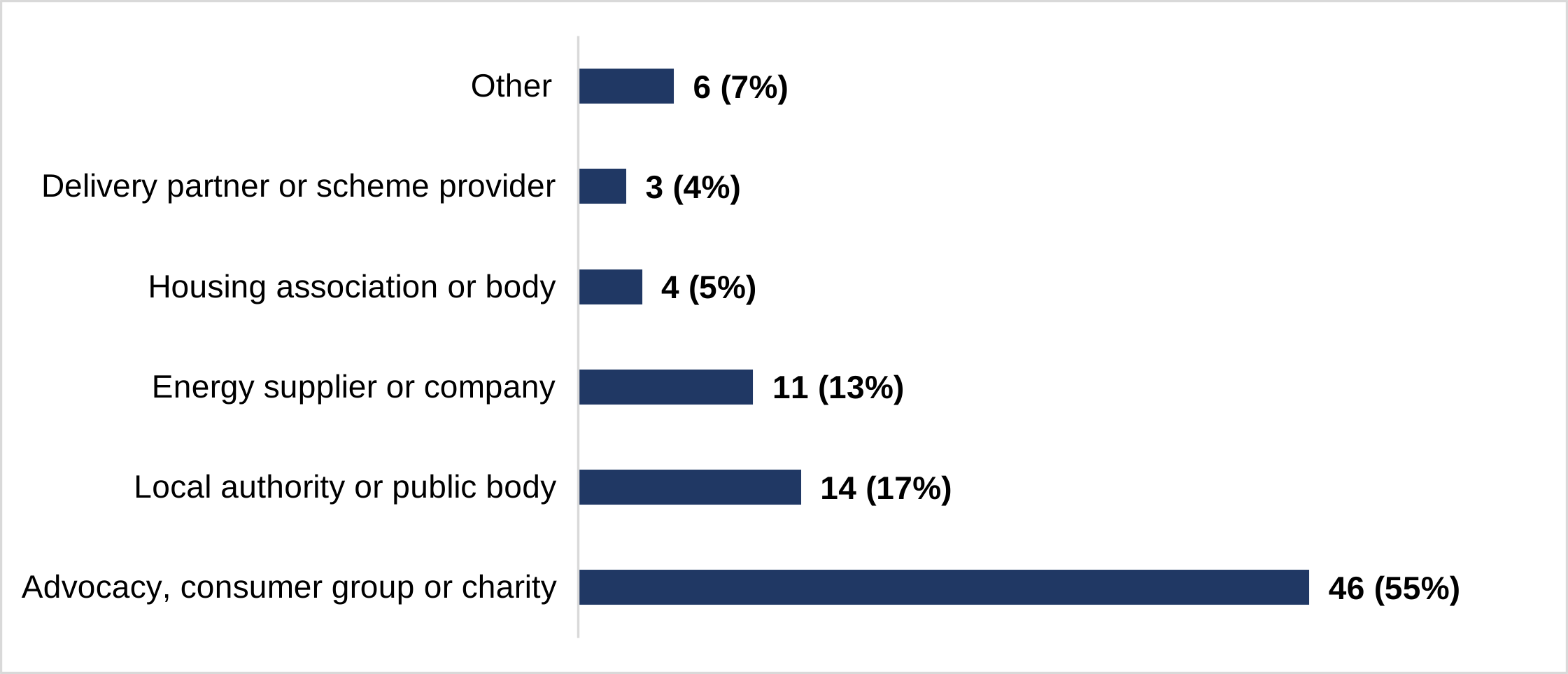
*Other includes industry trade bodies, private companies, and research organisations.
Overall, responses across all stakeholder groups revealed strong support for the Government’s proposal to continue the Warm Home Discount Scheme for a new five-year period from winter 2026/27-2030/31. Respondents widely recognised the Warm Home Discount as a vital intervention for households in, and at risk of, fuel poverty, especially given ongoing pressures on household budgets and the broader affordability challenges.
There was strong endorsement for retaining the scheme’s core structure, including the creation of one single Core Group for the scheme in England and Wales and the continuation of Industry Initiatives, which are widely perceived as essential for supporting vulnerable groups or those excluded from the main rebate element across Great Britain. In Scotland, respondents supported greater alignment with England and Wales through increased data-matching but also highlighted the need for flexibility to address Scotland’s specific circumstances, including high fuel poverty rates and rural challenges.
While the scheme’s continuation was widely welcomed, many respondents emphasised that support through the Warm Home Discount alone cannot solve fuel poverty. Recurring themes included calls to increase the rebate amount, to expand eligibility (especially for vulnerable groups not on means-tested benefits and those with higher energy needs), to improve targeting of those most in need, and to integrate the scheme into a broader long-term strategy to tackle fuel poverty. There was also widespread support for making Industry Initiatives more consistent and for exploring a more progressive funding model, as concerns were raised about the fairness of funding the scheme through energy bills.
Government response
The Government has reviewed the consultation responses, and based on the feedback received, decided to proceed with the Government’s proposals to:
- Continue the Warm Home Discount Scheme for a new 5-year scheme period from 2026/27 to 2030/31, recognising overwhelming support for its crucial role in tackling fuel poverty. While this decision reflects the strong consensus among stakeholders to maintain the scheme, the Government acknowledges the calls for the scheme to be part of a broader long-term strategy to tackle fuel poverty and will continue exploring improvements to the reach and targeting of the scheme during the next scheme period.
- In England and Wales, merge the current ‘Core Group 1’ and ‘Core Group 2’ into a single ‘Core Group’, retaining the expanded eligibility criteria from 2025/26 for the next scheme period. This decision was taken after careful consideration of stakeholder feedback which recognised the value of stability and simplicity of this approach, but also called for eligibility to be expanded further to reach vulnerable households, particularly those with protected characteristics, currently excluded from the scheme. The Government’s decision ensures that eligibility remains clear and that the vast majority of qualifying households (around 96%) will continue to receive their rebate automatically through robust data matching against DWP records. The eligibility criteria will remain under review, and the Government is committed to considering further adjustments in response to emerging needs of low-income and vulnerable households. The non-core obligation will remain part of a supplier’s requirement that covers all spending outside the automatic Core Group rebate. This obligation includes funding for Industry Initiatives across Great Britain, and, in Scotland, rebates for the Broader Group.
- In Scotland, expand the number of households qualifying via the data matched Core Group, reflecting the decisions made on eligibility by the Scottish Government. The Core Group in Scotland will be retained but expanded to increase the number of rebates provided under automatic data matching. Eligibility will be aligned to the match the same qualifying benefits as for the Scottish Winter Heating Payment as of December 2025. Additional rebates will be provided by energy suppliers in the Broader Group on an application basis through their non-core obligation. The Broader Group will be targeted at households in receipt of the Pension Age Disability Payment, the Adult Disability Payment and other households in receipt of means-tested benefits. Energy suppliers will continue to have discretion to set the requirements around being named on the energy bill, and the qualification date will be retained.
- Retain and strengthen support through Industry Initiatives in England, Wales and Scotland, recognising their vital role in supporting households currently not eligible for the core rebate, and with activities continued to be designed by individual energy suppliers and third-party partners. The Government acknowledges the widespread support for Industry Initiatives but takes note of concerns raised around consistency, transparency, and oversight, and remains committed to work with Ofgem to improve governance, administration and reporting related to the scheme during the next scheme period.
- Retain the inclusion of specified activities in the new regulations for the next scheme period, providing flexibility to target support for particular groups or pilot new approaches. Participation in specified activities will continue to be optional for scheme energy suppliers in the next scheme period. The Government will work with Ofgem to provide clear operational guidance and accountability while retaining supplier discretion in designing activities.
- Explore expanding the role of suppliers in the communications around Warm Home Discount with eligible consumers, working closely with Ofgem and energy suppliers to consider practical implementation, governance arrangements, and feasibility, ensuring the approach, if implemented, maintains clarity and accessibility in communications and broader consumer trust in the scheme.
- Change the method for estimating scheme costs from a fixed annual spending target set out in regulations to annual estimates reflecting the number of eligible households, with funding for Industry Initiatives increased in line with inflation. This approach was shaped by broad support for greater flexibility and predictability, but also by respondents’ concerns about fairness and funding stability. The Government will implement annual estimates while recognising the need for transparency, early guidance for suppliers, regular review, and further stakeholder engagement to ensure the approach remains fair, stable, and responsive to consumer needs.
- Allow the Secretary of State to issue rebate notices after the end of the scheme year in cases of errors in administration or data matching, with clear criteria and robust governance to ensure fairness and avoid confusion. This safeguard will be introduced in response to strong stakeholder support for protecting eligible households from missing out due to no fault of their own. The Government will work closely with Ofgem to ensure the process is well governed, transparent and communicated clearly with suppliers and consumers.
- Continue to explore improvements and innovations to the scheme during the next scheme period, recognising the strong support for expanding the reach of the scheme and the value of the rebate. This may include tiered or increased rebates, broader eligibility, application routes for excluded groups, better data-sharing, and integration with wider energy efficiency and affordability strategies. The Government remains committed and will work closely with stakeholders to further improve the scheme during the next period, ensuring it remains responsive to evolving needs.
Conclusion and next steps
The Government would like to thank all those who have contributed to and responded to this consultation, many of them with a particular interest in fuel poverty, including energy suppliers, the wider energy sector, and charities and consumer groups. The Government appreciates the time and effort dedicated to crafting detailed responses, attending stakeholder events and otherwise providing input to support our work to improve the scheme.
The Government will lay regulations for the next scheme period to ensure the regulations are in force ahead of winter 2026/27. This will enable the continuation of the scheme without interruption, securing continued support for around 6 million low-income and vulnerable households next winter and providing certainty for suppliers and delivery partners. The reforms set out in the Government response will take effect from the date the new regulations come into force, allowing us to move swiftly to implement the planned reforms and operational changes.
The Government will continue to work closely with Ofgem, Scottish Government, and stakeholders to finalise operational details, update guidance, and communicate changes in advance of implementation, ensuring a smooth transition and robust delivery of targeted support for the next scheme period. We will ensure to monitor delivery and remain open to further improvement as the scheme progresses.
The remainder of this document summarises the responses for each question, grouped where relevant, and outlines the Government’s response.
Continuing the Warm Home Discount Scheme to 2030/31
The consultation sought views on the Government’s proposal to continue the Warm Home Discount Scheme supporting households at risk of fuel poverty for an additional 5 years to 2030/31 after current regulations end on 31 March 2026.
Q1: Do you agree with our proposal to continue the Warm Home Discount scheme supporting households at risk of fuel poverty for the next scheme period from 2026/27? Please provide any reasoning/comments/evidence to support your view.
Summary of responses Q1
| Q1: Respondents’ views | ||||
|---|---|---|---|---|
| Supportive | Opposed | Neutral/mixed views | ||
| Of 87 respondents | 84 | 3 | 0 | |
| % | 97% | 3% | 0% |
Of the 93 total respondents, 87 (94%) answered this question. An overwhelming majority (97%) of those who responded to Q1 supported the proposals to continue the Warm Home Discount scheme into the next scheme period, for five-years to 2030/31. Respondents representing a breadth of organisations including local authorities, charities, energy suppliers, consumer groups, as well as individuals emphasised that the Warm Home Discount provides vital financial relief to households in fuel poverty or at risk of fuel poverty, helping to reduce the effects of cold and underheated homes, ill health, and financial hardship, particularly in the context of the affordability crisis.
Benefits noted by respondents
The consensus from respondents was clear that discontinuing the scheme or reducing support would exacerbate fuel poverty and its associated health and financial impacts. In addition, there was strong recognition in responses to Q1 of the importance of Industry Initiatives in reaching households in, or at risk of, fuel poverty yet not eligible for a rebate. Whilst not a specific proposal for consideration, most respondents supported an extension of the next scheme period from four to five years, out to 2030/31 to provide more certainty to consumers and industry. Many stakeholders noted the Government’s intention to return during the next scheme period for further improvements, calling for additional enhancements to ensure the scheme remains effective and equitable including calls to establish formal review points mid-scheme period to evaluate effectiveness and introduce scheme adjustments as required.
Concerns noted by respondents
Warm Home Discount is levy funded. A small number of respondents, particularly individuals rather than organisations raised concerns about the fairness of the current funding mechanism, which places the cost of the scheme on all bill payers, including those who may not benefit from it. There was broad support for shifting funding to general taxation or a mixed model to ensure fairness.
Recommendations made by respondents
While the scheme is widely recognised as essential, many respondents stressed that it is not sufficient on its own to address fuel poverty. There were strong calls for the Government to enhance the scheme by:
- increasing the rebate amount
- broadening eligibility to include more at-risk groups (particularly disabled people not in receipt of qualifying means-tested benefits and those with high energy needs), and
- integrating Warm Home Discount into a broader, long-term strategy to tackle fuel poverty, such as through energy efficiency improvements or the development of a social tariff.
There were also recommendations to improve data sharing between government departments and suppliers, and to improve targeting to ensure support reaches those most in need, with some calls to explore tiered support models based on household need. Further detail on suggestions for improvement and future innovations made by respondents can be found in the response to Q25 and Q26.
Government response Q1
The consultation responses showed overwhelming support for the continuation of the Warm Home Discount Scheme in England, Wales and Scotland to support households in, or at risk of, fuel poverty. The Government will therefore continue with the proposed five-year extension to the scheme through to winter 2030/31 and will lay new regulations coming into force ahead of winter 2026/27.
The Government is working closely across Government to unlock the data that will enable us to more effectively target future support to those who need help with their energy bills. Improved use of data and better targeting will allow the most effective use of the limited resources available.
Most respondents who provided written feedback to this question were keen to see improvements to the reach and targeting of the scheme in future to both reduce and tackle fuel poverty. Whilst future interactions were not the focus of Q1, the Government notes its intention to iterate and improve the scheme further, with more detail on this point set out in the Government response to Q25 and Q26.
Warm Home Discount in England and Wales from 2026/27
In England and Wales, currently the two eligible groups eligible for receipt of the Warm Home Discount rebate are referred to as Core Group 1 and Core Group 2:
Core Group 1 for 2025/26: households are eligible for the rebate on their energy bill if the person named on the energy bill (or their partner, or legal representative) was in receipt of the Guarantee Credit element of Pension Credit on the qualifying date for that scheme year.
Core Group 2 for 2025/26: households are eligible for the rebate on their energy bill if the person named on the energy bill (or their partner, or legal representative) was in receipt of a qualifying means-tested benefit on the qualifying date for that scheme year.
The Core Group 2 qualifying benefits for winter 2025/26 are:
- Housing Benefit
- Income-related Employment and Support Allowance (ESA)
- Income-based Jobseeker’s Allowance (JSA)
- Income Support
- The ‘Savings Credit’ element of Pension Credit
- Universal Credit
The expansion of Warm Home Discount this winter 2025/26 through the Warm Home Discount (Amendment) Regulations 2025, removed the high-cost-to-heat element of eligibility that had previously only been in place as an additional requirement for Core Group 2 eligibility. This change has in effect meant that both Core Groups are now largely the same, with eligibility linked to being named on the bill and receipt of a qualifying benefit. Both groups are now subject to the same automatic data match and most eligible households receiving a rebate without needing to take any action. Any unmatched households in both groups are supported to provide the information they need to receive the rebate by the Warm Home Discount helpline.
This consultation therefore sought views on the proposal to replace the existing automatically data matched Core Groups 1 and 2 with a single ‘Core Group’ in England and Wales from 2026/27, for the sake of simplicity for the administration of the scheme and communicating with eligible households. This proposal would be an administrative and technical change only and would not alter eligibility for the rebate in England and Wales in any way.
The consultation also sought views on the proposal that the eligibility criteria established for 2025/26 under the expansion (as set out above) would be continued for the next scheme period in England and Wales. We were particularly keen to hear any concerns about the impact of this proposal, with particular regard to potential impacts on households with protected characteristics, and how any concerns could be mitigated through Industry Initiatives.
Consultation questions
Q2: Do you agree with our proposal to rename the current ‘Core Group 1’ and ‘Core Group 2’ in England and Wales, bringing the existing groups together under one ‘Core Group’? Do you have any views on whether this approach could bring any potential advantages or disadvantages, including practical considerations in delivering the scheme?
Q3: Under these proposals the eligibility criteria established for 2025/26 would be continued for the next scheme period in England and Wales. Do you have any concerns about the impact of this proposal on households, in particular on those with protected characteristics?[footnote 3] What concerns do you have? Do you have any suggestions for mitigating your concerns, including through use of Industry Initiatives? Please provide any evidence you may have to support your answer.
Summary of responses Q2-Q3
Proposal to merge Core Group 1 and Core Group 2 in England and Wales
| Q2: Respondents’ views | |||
|---|---|---|---|
| Supportive | Opposed | Neutral/mixed views | |
| Of 70 respondents | 55 | 4 | 11 |
| % | 78% | 6% | 16% |
Of the 93 total respondents, 70 (75%) responded to Q2. Most of those who responded to this question (78%) expressed support for the proposal to merge the automatically data matched ‘Core Group 1’ and ‘Core Group 2’ in England and Wales into a single ‘Core Group’, citing improved clarity, simplicity, and administrative efficiency. This consolidation was widely seen as making the scheme easier for households to understand and for organisations to administer, with no impact on eligibility for current recipients. Respondents from across all stakeholder groups generally supported the proposal, believing a single Core Group will reduce confusion, streamline communications from Government, Ofgem and advisory organisations, and lower the scheme’s complexity for consumers and suppliers alike.
Several energy suppliers raised the potential of implementation challenges, stressing that it is essential that the transition is carefully managed and supported by clear guidance and robust data-sharing mechanisms, and sufficient lead time to update supplier systems.
Several respondents raised concerns that the proposed merging of the existing Core Groups would somehow alter eligibility for the scheme, and urged caution to ensure that this administrative simplification does not dilute the scheme’s ability to target those most in need including nuanced support for different vulnerable groups including households.
Overall, the proposal was positively received, provided that the transition will be carefully managed and does not compromise the scheme’s ability to reach those most in need. Many respondents emphasised the importance of clear, accessible communication and guidance during a transition to a single group, so all eligible households understand they remain eligible under the new single Core Group in England and Wales.
Eligibility criteria for the Warm Home Discount rebate in England and Wales
Most of the 59 respondents who responded to Q3 welcomed the proposal to retain the current eligibility criteria from this winter’s expansion (2025/26) of the Warm Home Discount in England and Wales into the next scheme period, noting the benefits of stability and simplicity of continuing the existing eligibility criteria.
However, respondents advocated for Warm Home Discount eligibility to expand further highlighting concerns that certain vulnerable households, particularly those with protected characteristics, may continue to be ineligible under a criteria requiring receipt of a qualifying means-tested benefit, and a direct relationship with an energy supplier. Calls were made to extend the Warm Home Discount Park Homes Scheme, as proposed in the ‘Expanding the Warm Home Discount Scheme’ consultation published in February 2025[footnote 4].
Concerns were raised by respondents for the following groups:
- Disabled people not in receipt of means-tested benefits, particularly noting that disabled people often incur higher energy costs due to medical needs.
- Low-income pensioners, eligible for but not in receipt of Pension Credit, a qualifying benefit for Warm Home Discount. Respondents noted that pensioners are in addition often living in communal living arrangements and may not have a direct relationship with their energy supplier.
- Households without a direct relationship with an energy supplier, including residents of care homes, alms-houses, continuous travellers, continuous cruisers, off-grid households and those using communal energy where there is no direct relationship between the customer and an energy supplier and they are ineligible.
- Single parents and families with young children not in receipt of qualifying benefits despite high vulnerability, noting cold homes pose health risks to infants and pregnant women.
- Low-income households in fuel poverty, with household income just above the threshold for means-tested benefit support.
- Some ethnic minority groups who face barriers to benefit uptake due to mistrust, language barriers, or cultural factors, with older Black Caribbean households being highlighted by respondents as particularly affected.
- Digital exclusion and low literacy were also raised as issues that can hinder access to Warm Home Discount, for example, because they are not classed as ‘most vulnerable’, or where households are not claiming the benefits they are eligible for because of lack of awareness, complexity or poor digital access.
- Households already in receipt of the rebate: despite favouring further expansion respondents also raised concerns that the relative value of the £150 rebate has reduced this winter as more households are supported. This increased the cost of the scheme which is funded through a levy on all energy billpayers.
There was strong support to mitigate some of these concerns through both existing and new proposals for Industry Initiatives to support excluded groups, including:
- The continuation of existing Industry Initiatives activities including energy efficiency measures, energy advice, boiler and central heating replacements, financial assistance payments, debt write-off, and benefit entitlement checks.
- Continuation of fuel vouchers and energy advice for disabled and elderly households.
- Outreach in rural and off-grid areas.
- Support for digitally excluded and linguistically isolated households.
Respondents also called for mitigations beyond Industry Initiatives, including suggestions to:
- Expand rebate eligibility to include non-means tested disability benefits,
- Create discretionary application routes and improve data-sharing across government departments to identify low-income households not on benefits,
- Increase Pension Credit uptake through targeted campaigns,
- Improve communication and accessibility of the Warm Home Discount helpline and materials,
- Consider increasing the rebate amount or indexing it to inflation, and
- Explore alternative funding mechanisms to reduce the burden on bill-payers.
Government response Q2-Q3
Proposal to merge Core Group 1 and Core Group 2 in England and Wales
We have considered responses to this proposal. The Government notes that the majority of respondents agreed with the proposal to merge Core Group 1 and Core Group 2 into a single ‘Core Group’. Stakeholders welcomed this simplification to make the Warm Home Discount scheme more user-friendly and easier to administer. The Government agrees that moving to a single Core Group will reduce confusion for eligible households. This change will allow us to communicate the scheme more clearly and ensure that all messaging is clear, accessible, and in plain language.
Importantly, this change is purely administrative: no currently eligible person will lose their discount as a result. Eligibility criteria and the value of the rebate remain unchanged. We also recognise the concerns raised about ensuring the scheme continues to support those most in need. The Government will maintain the ability to monitor and prioritise support for different vulnerable groups within the single Core Group. We will undertake a comprehensive communications campaign around this change, including updated guidance, training for delivery partners, and outreach through trusted channels.
The Government will work closely with Ofgem and energy suppliers and ensure that the move to a single Core Group does not impede future improvements to the scheme. The scheme will retain flexibility to introduce new elements or targeted assistance, as required.
Eligibility criteria for the Warm Home Discount rebate in England and Wales
We have considered all responses to this issue. The Government notes that most respondents supported the continuation of existing criteria, which this winter has expanded to all households in receipt of qualifying benefits with a direct relationship to an energy supplier. The Government recognises that respondents also want to see eligibility broaden further to support otherwise eligible households without a direct relationship with an energy supplier and to support households in fuel poverty, or at risk of fuel poverty, who are not in receipt of qualifying benefits including disabled people, people with high energy needs, families with young children and pensioners.
The Government considered responses to the March 2025 consultation on ‘Expanding the Warm Home Discount Scheme’ in its response in June 2025, where the decision was taken not to proceed with the expansion of the existing Park Homes Warm Home Discount Scheme. While there was clearly strong support in the responses to the March 2025 consultation to provide support for households without a direct relationship with an energy supplier, we had to consider the concerns raised during the consultation period about the potential impact of expansion on the support provided through other Industry Initiatives if such a change went ahead without increased budget. Based on the responses received, it was considered that any extension of support to people without a direct relationship with an energy supplier cannot be achieved within the existing Industry Initiatives budget. The Government must continue to balance the needs of those at risk of fuel poverty with the impact on bills for other consumers and therefore could not increase the budget for the Park Homes Scheme at that time. Following this winter’s expansion of the rebate to around 6 million households, budgetary constraints remain the primary reason for not proceeding with the expansion of Park Homes Scheme at this time.
The Government has made the decision to continue with the proposal to maintain this eligibility criteria in England and Wales from winter 2026/27 presented as a single Core Group. This will ensure that eligibility remains clear and that the vast majority of qualifying households (around 96%) will continue to receive their rebate automatically through robust data matching against DWP records. While Government acknowledges the case for broader eligibility, it must balance this against the scheme’s affordability and the impact on bills for other consumers. The eligibility criteria will remain under review and Government is committed to considering further adjustments in response to emerging needs of low-income and vulnerable households.
Households will be eligible for the rebate on their energy bill from winter 2026/27 if the person named on the energy bill (or their partner, or legal representative) is in receipt of a qualifying benefit on the qualifying date for that scheme year.
Qualifying benefits from winter 2026/27 for Core Group:
- The ‘Savings Credit’ element of Pension Credit
- The ‘Guarantee Credit’ element of Pension Credit
- Housing Benefit
- Income-related Employment and Support Allowance (ESA)
- Income-based Jobseeker’s Allowance (JSA)
- Income Support
- Universal Credit
Industry Initiatives will continue in England and Wales, offering further support for households in fuel poverty and fuel poverty risk groups, retaining flexibility for suppliers and third parties to tailor initiatives (with Ofgem approval) to best support these cohorts including disabled people, older people, and off-grid households. In the latest published annual report from SY13, Industry Initiatives in England and Wales supported over 1.7 million consumers, with 42% of the £27.5m funding spend on providing Industry Initiatives to households with at least one person with a significant health problem or disability.[footnote 5] The Government Response related to Industry Initiatives sets out further details on Industry Initiatives design during the next scheme period.
Whilst this consultation focused on securing the continuation of the scheme to 2030/31, the consultation also noted in Q25 and Q26 our intention to continue to explore improvements, both in terms of the level of support available and the reach of the scheme during the next scheme period. We will continue to ensure the quality of communications and helpline accessibility. We will continue to monitor the scheme’s impact and consider future adjustments based on evidence. Eligibility will continue to be set out in an eligibility statement published by the Secretary of State for each scheme year to offer additional flexibility to make amendments during the scheme period. Where proposed changes are significant, impact certain households or have a material impact on the customer levy required, they will be subject to further public consultation. We continue to work to unlock the household data needed to enable us to target support more effectively in the future.
Warm Home Discount for Scotland from 2026/27
The consultation sought views on how the scheme works in Scotland, particularly around eligibility and the potential for more customers to receive the £150 rebate automatically. Decisions on how the Scottish scheme operates in this regard, within the funding available for the next scheme period, have been determined by the Scottish Government.
The consultation noted that this winter’s expansion of Warm Home Discount - removing the high-cost-to-heat threshold in England and Wales for 2025/26 - creates an opportunity to introduce more data matching and automatic payments in Scotland from 2026/27. Currently only recipients of the ‘Guaranteed Credit’ element of Pension Credit are automatically data matched in Scotland (the Core Group), whereas all applicants to the Broader Group in Scotland must apply each year for the rebate directly to their energy supplier.
On eligibility for the Warm Home Discount rebate, the consultation set out three broad proposals for consideration:
- Option 1: Retain eligibility criteria and arrangements as for 2025/26; or
- Option 2: Replace the Broader Group, introducing automatic data matching and eligibility based on existing mandatory benefits and additional vulnerability criteria; or
- Option 3: Replace the Broader Group, introducing automatic data matching and eligibility based on qualifying benefits.
The consultation included proposals to extend the Warm Home Discount helpline to support to support automatically data matched Scottish consumers in an expanded Core Group.
The consultation tested stakeholder views on the approach to setting out eligibility for the rebate in Scotland, with a proposal to provide additional flexibility by introducing a published eligibility statement for each scheme year rather than setting eligibility in regulations.
The Government also consulted on the proposal to continue to include Industry Initiatives in Scotland, where it is part of the scheme, but energy suppliers are not obligated to participate as part of their non-core obligation. We, in addition, welcomed stakeholder responses to a call for evidence on the design and delivery of Industry Initiatives. Responses related to Industry Initiatives are therefore also noted in response to Questions 11-14.
We note that the Scottish Government has decided that for the next scheme period UK Government should lay regulations to enable the continuation of Warm Home Discount in Scotland after current regulations end on 31 March 2026.
Under devolution arrangements (set out in amendments to the Energy Act 2010 made by the Scotland Act 2016), Scottish Government Ministers could choose in future to develop their own regulations, subject to consultation in the Scottish Parliament, related to the devolved elements of the scheme within the funding limit available, and subject to the other reservations set out in the Energy Act 2010.
Consultation questions
Q4: Which of the three options listed above is your preferred option for the next scheme period in Scotland?
Q5: Do you have any views on the advantages, disadvantages or concerns of any of the options presented?
Q6: Do you have any views about the use of a centralised Warm Home Discount helpline for auto matched Scottish consumers in options 2 and 3? Currently only the Core Group receives helpline support.
Q7: Do you foresee any practical challenges or have any delivery concerns with replacing the Broader Group and its application process in options 2 and 3 with a data matched broader Core Group?
Q8: Do you have a preferred option for the next scheme period in Scotland that is not presented above? If so, please provide details.
Q9: Do you have any concerns about the impact of these proposals, including the three options as presented, on households, in particular on those with protected characteristics in Scotland?[footnote 6] What concerns do you have? Do you have any suggestions for mitigating your concerns, including through use of Industry Initiatives? Please provide any evidence you may have to support your answer.
Q10: Do you think there are advantages or disadvantages in setting out eligibility separately in Scotland?
Summary of responses Q4-Q10
| Q4: Respondents’ views | ||||||
|---|---|---|---|---|---|---|
| Option 1 | Option 2 | Option 3 | Option 2 or 3 | Other | ||
| Of 46 respondents | 1 | 4 | 33 | 4 | 4 | |
| % | 2% | 8.7% | 72% | 8.7% | 8.7% |
46 stakeholders, all of whom were organisations responded to questions relating to eligibility for the Scottish scheme.
Concerns noted by respondents with Option 1
There was very limited support amongst respondents for retaining the current arrangements as set out in Option 1 with stakeholders raising the following concerns:
- For the Broader Group eligible households must typically reapply to their energy supplier each scheme year. Each supplier has their own application process, and window within which applications can be made. This window set by suppliers varies between suppliers, and between scheme years. Stakeholders view this lack of consistency as a concern, noting that some eligible households are not aware of Warm Home Discount or the need to apply. Respondents noted that some eligible households miss the application window every year.
- Households with limited digital access and low confidence in navigating application processes can struggle to apply, and some applicants rely on support from friends, family, and advice services to complete their Broader Group application. This was viewed as a particular issue for households with disabilities, and vulnerabilities, along with some households where English is not their first language.
- The Broader Group does not guarantee that eligible households named on the bill will receive the rebate. Each application is determined by their energy supplier within their funding envelope, the overall size of which is based on their GB customer market share. This means that some suppliers report challenges in identifying eligible customers to fulfil their obligation, whereas other suppliers are typically oversubscribed.
- Eligibility for the Broader Group is therefore set by individual energy suppliers (with approval from Ofgem). Respondents often viewed inconsistent eligibility between suppliers as a concern, noting it reduces the sense of fairness around the scheme and leads to confusion amongst consumers. Some organisations noted that the complex eligibility made it more challenging for advice charities to support potentially eligible households.
- Energy suppliers frequently noted that the Broader Group model increases the administrative burden and is more expensive to deliver in comparison with the automatically data matched Core Group, where data matching is provided by DWP.
- Respondents noted concerns around the requirement to have a direct relationship with your energy supplier to be eligible for support. Groups of concern highlighted include those living off moorings, and households who pay their energy bill through a landlord or their charitable housing association.
Support from respondents for Options 2 and 3
There was significant support amongst respondents for a move towards greater data matching under Options 2 and 3 in the next scheme period. Respondents highlighted the following benefits under these proposals:
- Greater data matching would guarantee the rebate each year to matched eligible households with a direct relationship with their energy supplier, without the eligible householder needing to take any action. Stakeholders stated this approach is more equitable, more inclusive and more accessible.
- Unmatched households in the automatic data matching process could contact the Warm Home Discount helpline to provide additional evidence required to receive the rebate. Respondents noted this would provide a clear and consistent approach for all households in an expanded Core Group.
- A reduction in the number of households who would be required to contact their energy supplier for a rebate.
- Utilisation of Government data reducing the administrative burden on consumers, and energy suppliers, with potentially greater benefits to smaller energy suppliers with more limited resources.
- Strong support, particularly amongst industry, for the benefits of Warm Home Discount uniformity across England, Wales, and Scotland due to simplicity, a reduction in administration, and enabling universal communications and messaging by Government, advisory support groups and energy suppliers.
Concerns noted by respondents with Options 2 and 3
Whilst many respondents were in favour of a move towards greater matching, not all respondents agreed, particularly noting the benefits of supplier discretion at present to issue a rebate.
Many respondents, whilst supportive of data matching, also raised concerns about the impact of any changes on households who are currently eligible to apply under the Broader Group:
- Concerns over the possible removal of supplier discretion under data matched options, including opportunities for charities and advisory groups to make specific referrals on behalf of individuals for support.
- Concern for fuel poor households not in receipt of means-tested benefits, who are currently possibly eligible depending on their energy supplier’s eligibility criteria in a given scheme year. Groups of concern include low-income working households, private renters and disabled people in receipt of disability benefits e.g. Personal Independence Payment (PIP) but not a means-tested benefit.
- Fuel poor households, who are eligible for means-tested benefits but are less likely to have applied for them, citing Pension Credit as an example of a low take up group.
- A concern particularly from disability advocacy groups that none of the options, including the status quo, adequately support disabled households, with at present only low-income disabled households eligible for support via the Broader Group.
- Concerns that means-tested benefits are only a proxy for fuel poverty, and that a more targeted and nuanced definition should be introduced, more aligned to the Scottish Government’s statutory definition of fuel poverty.
Mitigations proposed by respondents
- Respondents, particularly advocacy groups and local councils responding in Scotland, noted that Industry Initiatives should be obligated in Scotland, as they are in England and Wales, and should be used to mitigate against those households at risk of fuel poverty who could become ineligible for a rebate under data matching.
- Industry Initiatives should be well-funded and targeted where possible to maximise the impact of support.
- Respondents are almost unanimous that Industry Initiatives funding should be maintained at least at current levels and increase with inflation (as it has during the current scheme period) noting that it would otherwise result in real terms cut in support to suppliers and third-party partners delivering practical support.
- Expand the automatic eligibility for a rebate under a data matched approach to include those not named on the bill and additional automatically qualifying benefits including Personal Independence Payment, Adult Disability Payment, Child Disability Payment, Pension Age Disability Payment, Disability Living Allowance, Scottish Child Payment, and Best Start Payments.
- Introduce additional flexibility for suppliers to determine eligibility related to the Scottish definition of fuel poverty or through referrals from support charities and NHS.
- Use Government data and supplier energy consumption data to identify edge cases and further households to support. This was often linked to proposals for a social tariff.
Clear messaging and signposting involving advocacy and support groups to communicate any change to eligibility to Scottish households.
Government response Q4-Q10
Eligibility for the Warm Home Discount scheme in Scotland is a matter to be determined by the Scottish Government. Following consideration of consultation responses to Q4-Q10, the Scottish Government have decided their approach to eligibility for the scheme in Scotland for the next scheme period which has been reflected in this document. Eligibility for the scheme in Scotland will be set out, as now, in regulations.
The Scottish Government have determined that the structure of the scheme in Scotland will be as follows:
- The Core Group
- The Broader Group
- Industry Initiatives
The Core Group from 2026/27:
Eligibility for the Core Group will be expanded to align with the same qualifying benefits list as for the Scottish Winter Heating Payment as of December 2025. The qualifying benefits for the Core Group will be set out in regulations as per the table below.
The Core Group does not involve an application. The Core Group is instead subject to automatic data matching using DWP data. The majority of households within the Core Group will be successfully data matched and will not need to take any action to receive the rebate in each scheme year that they qualify. A small number of households known as ‘unmatched’ households in the data matching process will be notified by Government of the need to contact the Warm Home Discount helpline to provide information to check their eligibility and receive the rebate.
Eligibility criteria for the Core Group in Scotland from 2026/27:
Households are eligible for an annual £150 rebate on their energy bill if the person named on the energy bill (or their partner, or legal representative) was in receipt of a qualifying benefit on the qualifying date for that scheme year.
The relevant qualifying benefits for the next scheme period are:
Pension Credit
No requirements other than qualifying for Pension Credit
Universal Credit
To be eligible, a consumer must be:
Employed or self-employed and get a child or young person disability element; or,
Not employed or self-employed and have either:
- A limited capability for work element
- A limited capability for work element with a work related activity element
- A child or young person disability element
- A child under 5
Income Support or Income based Jobseeker’s Allowance
Consumer must have a child under 5 or be in receipt of:
- A disability premium
- A severe disability premium
- A pensioner premium
- The child disability premium
Income Related Employment Support Allowance and
Consumer must have a child under 5
Or be in a support group or a work-related activity group
Or be in receipt of:
- A severe or enhanced disability premium
- A pensioner premium
Support for Mortgage Interest and
Consumer must have a child under 5 or be in receipt of:
- A disability premium
- A pensioner premium
- A child disability premium
The Broader Group
Suppliers will be required to allocate the remaining balance of the overall spending target for the Scottish scheme through non-core Broader Group rebates or Industry Initiatives. There will continue to be a minimum spending target as now, and the process of transferring non-core obligation from Broader Group to Industry Initiatives subject to Ofgem approval will continue. Regulations will continue to set out a mandatory list of eligibility criteria which energy suppliers must include in their eligibility criteria for the Broader Group. It will continue to be the case that suppliers retain the flexibility to consider criteria beyond the mandatory in setting their eligibility criteria for each scheme year. Eligibility criteria established by energy suppliers will continue to require approval by Ofgem. The Broader Group will continue to be application based, with individual applications determined by an applicant’s energy supplier. It will continue to be the case that the number of rebates available will be limited by the size of their supplier’s non-core obligation.
The Scottish Government has indicated its priorities for support under the Broader Group to include households where the bill payer or their partner is in receipt of the Pension Age Disability Payment, the Adult Disability Payment or receipt of a qualifying means-tested benefit without additional vulnerability requirements. Eligibility for these benefits will make up the mandatory eligibility criteria for inclusion in energy supplier’s eligibility criteria and will be set out within regulations.
Mandatory eligibility criteria for the Broader Group
Households are eligible to apply to their energy supplier for an annual £150 rebate on their energy bill if the person named on the energy bill (or their partner, or legal representative) was in receipt of a qualifying benefit on the qualifying date for that scheme year.
- Pension Age Disability Payment
- Adult Disability Payment
- Housing Benefit
- Income-related Employment and Support Allowance
- Income-based Jobseeker’s Allowance
- Income Support
- Universal Credit
The framework for delivering both core and non-core rebates and Industry Initiatives will remain largely as under the existing scheme.
Industry Initiatives across England, Wales, and Scotland
This section of the consultation asked for stakeholder views on the continuation, design and delivery of Industry Initiatives. Industry Initiatives are mandatory for obligated suppliers to fund through their non-core obligation in England and Wales and optional in Scotland (to ensure that non-core funding is available for Broader Group rebates). Suppliers can apply to Ofgem for approval by 15 November each winter to deliver additional Industry Initiatives to partially offset their obligation to deliver Broader Group rebates. They can also fund Industry Initiatives with a portion of their non-core obligation that is above their Broader Group minimum target. Measures currently permitted under Industry Initiatives include payments to organisations which refer customers in, or at risk of, fuel poverty or eligible for assistance to energy suppliers, energy efficiency measures, energy advice, training of energy advisors, boiler and central heating replacements, financial assistance payments, payments to eligible customers in mobile homes, debt write-off, and benefit entitlement checks. At present, an Industry Initiative must be an activity permitted under schedule 2 of the regulations in England and Wales and schedule 3 of the regulations in Scotland. The outcomes of Industry Initiatives must be delivered, as far as reasonably practicable, wholly or mainly to people in, or at risk of, fuel poverty.
Industry Initiatives have been a feature of the Warm Home Discount scheme since its inception providing suppliers with flexibility to provide different types of support to vulnerable customers. Industry Initiatives are proposed by suppliers and assessed and approved by Ofgem before delivery in line with regulatory requirements. This assessment evaluates whether the activities are eligible under the scheme rules and deliver value for money. Ofgem then monitors the supplier’s delivery of Industry Initiatives through reporting from the supplier, and a summary of the support delivered across all suppliers is published by Ofgem in their Warm Home Discount Annual Report.
In the most recent Annual Report (Scheme Year 13 2023/24), £76.4 million was spent on Industry Initiatives across Great Britain (£65.5 million in England and Wales and £10.9 million in Scotland).
Consultation questions
Q11: Do you agree that Industry Initiatives should be continued into the next scheme period?
Q12: Do you agree that Industry Initiatives should continue to be designed by individual energy suppliers and third-party partners? What are the benefits and drawbacks of this approach?
Q13: Do you have any proposals to improve the design and/or delivery of Industry Initiatives in the future? Do you have any proposals for additional activities that would be of benefit to include as permissible Industry Initiatives in the future?
Q14: Do you have any views on eligibility for Industry Initiatives, or the extent to which energy suppliers should have discretion and flexibility to who they are awarded to within fuel poverty risk groups?
Summary of responses Q11-Q14
| Q11: Respondents’ views | ||||
|---|---|---|---|---|
| Supportive | Opposed | Neutral/mixed views | ||
| Of 82 respondents | 76 | 3 | 3 | |
| % | 93% | 4% | 4% |
Out of all respondents to the consultation, 82 (88%) responded to Q11. 93% of those respondents were in favour of retaining Industry Initiatives as part of Warm Home Discount scheme design into the next scheme period.
Supportive respondents frequently highlighted that Industry Initiatives provide assistance to households in fuel poverty, or at risk of fuel poverty who are not eligible for the Warm Home Discount rebate. Industry Initiatives were viewed as a way for suppliers and third parties to tailor support and respond flexibly to the needs of those in, or at risk of, fuel poverty. Supportive respondents noted that existing permitted activities through Industry Initiatives such as benefits checks, energy advice and energy efficiency measures have the potential to remove a household from fuel poverty permanently and are a cost-effective way of providing support. In this sense, respondents felt these measures have the potential for longer term and deeper impact than the rebate.
Some respondents supported making Industry Initiatives mandatory as part of the non-core obligation for all suppliers in Scotland. Respondents often proposed, following a note in the consultation document, that Industry Initiatives could be used to support any households who were no longer eligible for the rebate if there was a move to data matching in Scotland.
The small minority of respondents who opposed the continuation of Industry Initiatives cited the impact on the levy applied to energy bills to fund the scheme, and the potential drawbacks of supplier involvement in the scheme.
| Q12: Respondents’ views | |||||
|---|---|---|---|---|---|
| Supportive | Opposed | Neutral/mixed views | Off-topic | ||
| Of 74 respondents | 53 | 5 | 15 | 1 | |
| % | 72% | 7% | 20% | 1% |
The majority of respondents to Q12 were in favour of individual energy suppliers and third-party partners continuing to design Industry Initiatives. Of 74 respondents, 72% were supportive, 7% were opposed, and 20% had mixed views, with 1% addressing other issues.
Benefits noted by respondents
- The flexibility and responsiveness under the current approach, with suppliers and third parties able to tailor the design of initiatives to specific regions or vulnerable groups, subject to Ofgem approval.
- The strong position of suppliers to identify specific cohorts within their customer base in the fuel poverty and fuel poverty risk group who may require additional support.
- The value of the expertise of third-party partners to help successfully design a scheme to reach and assist particular groups of people in and at risk of fuel poverty.
- The benefits of having both suppliers and third-party partners working together to encourage the design of innovative pilots, based on emerging need or new technologies.
- Existing opportunities within the design for larger initiatives run by a single third party but funded by multiple suppliers, promoting greater consistency in offerings to customers, whoever their supplier.
Concerns noted by respondents
- A lack of consistency for customers depending on their supplier and region, with the potential for some fuel poverty risk groups to be underserved in comparison to others.
- Related concerns about the level of oversight, with some respondents advocating for clearer guidance from DESNZ and Ofgem to promote consistency in standards across all suppliers. Some respondents were unclear that Warm Home Discount guidance on Industry Initiatives is the responsibility of Ofgem, rather than DESNZ.
- The role of suppliers with suggestions that there was a risk suppliers could be incentivised to design initiatives for commercial benefit or could be unwilling partners in the design of schemes, reducing the impact on fuel poverty risk groups.
Question 13 asked for views on how to improve the design and delivery of Industry Initiatives. 68% of respondents to the consultation responded to Q13, with 63 respondents in total. Stakeholders had a wide range of views on ways to improve the design and delivery of Industry Initiatives, as well as possible activities to be included as permissible in the next scheme period.
The most frequently cited were:
- Calls, from energy suppliers in particular, to improve the administration of the scheme. Respondents proposed shortening the standard response time for Ofgem to reply to queries on Industry Initiatives being proposed, separating qualitative and quantitative reporting requirements, and providing greater clarity on reporting requirements.
- A call for introducing greater budgetary certainty for multi-year activities by enabling approval for an Industry Initiative to run over multiple years during a scheme period. Respondents noted this would allow for better planning and reduce administration.
- Demand for a move from a perceived focus on outputs to outcomes. There were concerns the Industry Initiatives element of the scheme does not currently sufficiently discern between the value provided by different outcomes within permitted activities.
- To create a new initiative or expand the Park Homes Warm Home Discount scheme to enable eligibility for households otherwise eligible for a rebate but who do not have a direct relationship with an energy supplier.
- There were a variety of views on caps on financial spend applied to certain permitted activities, including financial assistance payments, debt write-off in England and Wales, and boiler replacement in England, Wales and Scotland. Most respondents who discussed this topic were in favour of increasing or removing the caps on total spend on financial assistance payments, on total spend and spend per customer on debt relief and maintaining or increasing the caps on boiler repairs. However, there were some concerns with increasing debt write-off caps given potential commercial benefits to suppliers and retaining or increasing the current boiler replacement cap given the conflict with decarbonisation priorities.
- There was also support to offer more holistic advice through Industry Initiatives, including, for example, on debt, housing and wellbeing/health as well as energy, and to support fuel poor customers who may be digitally excluded.
Question 14 asked for views on eligibility for Industry Initiatives. 57% of respondents to the consultation responded to Q14, with 53 responses in total. The majority of respondents were supportive of maintaining flexibility for suppliers to determine eligibility for Industry Initiatives. Respondents noted that this allowed for targeted support by energy suppliers to a wide variety of their customers in fuel poverty or at risk of fuel poverty who might not qualify for assistance under more prescriptive criteria. Respondents also highlighted the ongoing importance of balancing this flexibility with sufficient accountability and oversight from Ofgem.
Some respondents advocated extending eligibility to those without a direct relationship with an energy supplier. There were also suggestions that there could be prioritisation within the eligibility criteria for specific groups in, or at risk of, fuel poverty, including:
- Those living in houses with poor EPC ratings.
- Those who had been referred into the scheme from health and care professionals.
- Those with disabilities, health conditions or multiple vulnerabilities.
A small number of respondents (9% respondents to the question), wanted to reduce the current level of flexibility for a variety of reasons, including views that initiatives should be more targeted, or should be reserved for a particular cohort of households in fuel poverty or at risk of fuel poverty, such as those with severe illnesses.
Government response Q11-Q14
Continuation of Industry Initiatives
The Government has considered all responses, including information provided by stakeholders as part of the call for evidence and has decided, as proposed in the consultation, to retain Industry Initiatives into the next scheme period.
Evidence provided to this consultation demonstrates that Industry Initiatives are viewed by respondents as vital in supporting households in, or at risk of, fuel poverty, including those who are not eligible for the rebate under the schemes in England, Wales and Scotland. We note that many respondents highlight their flexibility and responsive delivery of support, encouraging partnerships between suppliers and third parties as beneficial to consumers.
Differences in design between England and Wales, and Scotland
Some respondents raised as an issue the difference in scheme design between Industry Initiatives in England and Wales compared to Scotland where Industry Initiatives are not currently mandated. Scottish Government Ministers have decided to proceed with Option 2 as outlined in the consultation for the Scottish scheme, introducing greater data matching under an expanded Core Group, whilst retaining the application-based Broader Group. It is therefore not feasible to obligate suppliers to deliver Industry Initiatives in Scotland as this would overly restrict the funding available to deliver Broader Group rebates (the same funding pot exists in relation to both groups).
Flexible approach within permitted activities
Feedback from the consultation shows broad support for the continued design of Industry Initiatives by suppliers and third-party partners. Responses outlined the significant advantages of this model, including flexibility and innovation, and the value of the expertise different partners can bring to the design of initiatives. Government will therefore retain the current system whereby Industry Initiatives are designed by suppliers and third parties in the next scheme period, within the framework of permitted activities, and subject to Ofgem approval.
Respondents provided a wide variety of suggestions for potential permissible Industry Initiative activities during the next scheme period, including more holistic energy advice services covering health, housing and debt as well as energy and income maximisation advice. While we appreciate that fuel poverty often exists in the context of other vulnerabilities, we believe that funding for advice services from Warm Home Discount Industry Initiatives should be directed towards energy and income maximisation advice, to ensure as many customers as possible can receive help with their energy bills. We note that some respondents discussed the links between Industry Initiatives and other interventions and would encourage suppliers and third parties to maximise the potential impact of these connections to support vulnerable customers. Flexibility within Industry Initiatives can ensure that energy suppliers can offer support to households in fuel poverty in groups relevant to the Public Sector Equality Duty.
Eligibility
We recognise the strong support in favour of maintaining supplier discretion over eligibility for Industry Initiatives. The Government therefore plans to retain the current flexibility around supplier determination of eligibility into the next scheme period whereby Industry Initiatives should support those wholly or mainly in fuel poverty, or a fuel poverty risk group. This will enable support to be tailored to evolving needs and provide help to those who may fall outside of the rebate eligibility criteria but are in, or at risk of, fuel poverty. While we acknowledge the desire from some stakeholders for the prioritisation of different groups, we believe the current system allows suppliers and third parties to make decisions on prioritisation based on direct knowledge of customer needs. We believe that retaining supplier discretion over eligibility, while working with Ofgem to improve administration, reporting, and governance will provide an appropriate balance of flexibility and accountability going into the next scheme period, as well as supporting groups including elderly and disabled people as required by the Public Sector Equality Duty.
The Government acknowledges the support among respondents to provide Industry Initiative funding for financial assistance payments to those without a direct relationship with an energy supplier. Increasing eligibility for rebates in this way could compromise existing and planned initiatives by diverting spend or would require a substantial increase in funding which would increase all consumer bills. The Government must balance the needs of those at risk of fuel poverty with the impact on bills for other consumers and therefore cannot increase the budget for the Park Homes Warm Home Discount Scheme at this time. However, as noted in the consultation, the Government is keen to consider ongoing improvements to the scheme, and will revisit this proposal again during the 2026/27-2030/31 scheme period. Where proposed changes are significant, impact certain households or have a material impact on the customer levy required, they will be subject to further public consultation.
Funding
Separately to the response above on eligibility for Industry Initiatives, organisations particularly stressed the importance of well-funded Industry Initiatives.
We recognise the potential benefits raised by respondents regarding multi-year funding and approval cycles and will look further at the potential for this to be implemented in future years. The Government also plans to retain the current adjustments to non-core obligations for overspend in the previous scheme year up to 5% into the next scheme period. This will apply to any overspend from winter 2025-26.
Limits on spending for Financial Assistance Payments, debt write off, and gas boiler replacements
We note the interest in the controls placed on those activities which have caps set, particularly from energy suppliers. The three activities currently capped are total financial assistance payments in England and Wales, and individual financial assistance payments, total and individual debt write-off payments, and total gas boiler replacement costs in England and Wales, and Scotland. Any financial assistance payments are individually capped at £150, to match the value of the rebate in England and Wales, and Scotland. Total debt write off is capped at £6 million total across England and Wales, and £600,000 total in Scotland, with a maximum spend per customer of £2000 across all nations. The total cap on gas boiler replacements is set at £8 million in England and Wales, and £800,000 in Scotland. The Government acknowledges the complexity and variety of views around retaining or removing these caps. It is our belief that having limits in place has allowed initiatives to provide crisis support to fuel poor households, while encouraging suppliers to diversify the initiatives they offer. We have therefore decided to retain the existing caps.
Guidance
Whilst we acknowledge the benefits of a flexible approach, we also recognise the issues raised in the consultation responses around a lack of consistency in offerings and standards. We will ensure that regulations set out the approach to enable Ofgem to draft their guidance. We will work with Ofgem to promote greater consistency in guidelines whilst retaining the same types of permitted activities delivered by different suppliers. We will also review how the minimum administrative requirements and expectations for Industry Initiatives are set out, to ensure the balance between flexibility and consistency.
Governance and reporting
We note the range of possible improvements to the scheme suggested by respondents. Alongside concerns raised about current oversight arrangements, and the wider role of suppliers in the scheme, respondents noted issues with reporting processes and timelines. DESNZ will work with Ofgem to identify opportunities to improve the governance, administration and reporting related to the scheme during the next scheme period. This will include consideration of the time requirements for the approval of proposals, associated reporting requests and requirements and relevant deadlines. As part of this we will also look at how approvals and reporting could be used to encourage a greater focus on the outcomes while maintaining robust scrutiny of delivery. We believe this has the potential to encourage improved offerings for vulnerable households, and greater confidence in the value of Industry Initiatives among stakeholders.
Impact on the levy
We note the concern from some respondents about the impact of Industry Initiatives on billpayers. The proposals in this consultation were aimed at securing the continuation of Warm Home Discount for a further five years to support households in fuel poverty. The Government is committed to reducing energy costs, whilst also supporting households in fuel poverty with their energy bills.
Specified activities
The consultation sought views on the continued inclusion of ‘specified activities’ in the new regulations for the next scheme period from 2026/27. Under current regulations, the Secretary of State has flexibility to issue a notice to enable obligated energy suppliers in England and Wales to optionally contribute non-core funding to fund a ‘specified activity’. Scottish Government Ministers have the same powers to issue a notice for the Scottish scheme.
These activities are defined by the same framework as Industry Initiatives: they must be a permitted type of activity within Industry Initiatives as in the regulations and must benefit households wholly or mainly in fuel poverty, or a fuel poverty risk group.
In practice, a specified activity is therefore simply a type of Industry Initiative, which the Secretary of State (or Scottish Ministers in Scotland) has formally designated by notice, that is open to contributions from all energy suppliers. A specified activity, as with any Industry Initiative, must provide those supported with advice on smart meters and energy advice in addition to the activity and must provide value for money.
The specified activities provision exists in the 2022 regulations, but it has not been used during the current scheme period. This consultation sought views on whether to continue the provision for specified activities within the regulations for the next scheme period.
Consultation question
Q15: Do you have any views on whether specified activities should be included in the new regulations for the next scheme period from 2026/27? Are there any advantages or drawbacks to their inclusion in your view?
Summary of responses Q15
| Q15: Respondents’ views | ||||
|---|---|---|---|---|
| Supportive | Opposed | Neutral/mixed views | Off-topic | |
| Of 38 respondents | 22 | 5 | 6 | 5 |
| % | 58% | 13% | 16% | 13% |
Of the 93 total respondents, 38 (41%) answered this question. Of these, 45% responses came from advocacy, consumer groups and charities, 21% from suppliers, 21% from local authorities or public bodies and the remaining 13% largely from delivery partners.
Supportive responses make up 58% and were most common among advocacy groups, consumer groups, and charities (50% of supportive responses), followed by local authorities and public bodies (32%), with mixed views from energy suppliers and delivery partners. While most acknowledged that specified activities have not been used to date in the current scheme, supportive respondents generally thought they could add value in future if implemented and managed effectively.
Benefits noted by respondents
Supportive respondents emphasised serval benefits of specified activities. For example, that they could enhance inclusion, ensuring targeted support for fuel-poor households or excluded groups not covered by standard eligibility criteria. The flexibility to respond to emerging needs and changing circumstances, such as energy price shocks or rural fuel poverty, was seen as a key advantage. Respondents also noted that specified activities could provide clarity and consistency, encourage innovation, allow for piloting new approaches, and complement existing initiatives without increasing costs for billpayers.
Concerns noted by respondents
The main concerns, raised primarily by energy suppliers and delivery partners, were that the provision for specified activities could reduce flexibility, making it harder to adapt policy, respond to emerging challenges, or tailor initiatives to specific needs. Some questioned the necessity of the provision, given its lack of use in the current scheme period and argued that it might add unnecessary complexity or administrative burden. Others warned that overly prescriptive lists of activities could stifle innovation, limit the ability to design effective initiatives, or risk reducing spending on other critical initiatives. Respondents also mentioned the ambiguity around responsibilities and accountability between Government, Ofgem and energy suppliers, highlighting the need for clear guidance and oversight to avoid confusion and ensure effective implementation.
Several respondents cautioned that the distinction between specified activities and Industry Initiatives is currently unclear, and that the overlap with Industry Initiatives limited the potential benefits of including specified activities. Some respondents stressed that specified activities should complement, not replace, existing support through the core rebate and Industry Initiatives.
Recommendations made by respondents
Overall, respondents across all stakeholder groups made several recommendations to improve the effectiveness of specified activities, including:
- Clear definitions, guidance, and proportionate oversight to ensure consistency, accountability, and transparency.
- Regular review and reporting and open publication of impact evaluations.
- New activities proposed for future consideration including fuel debt resolution and financial mentoring, home energy upgrades (including small-scale retrofit), energy literacy and digital enablement, targeted outreach, support for off-grid and rural households, and activities addressing access barriers.
- Ensuring specified activities do not reduce funding for other critical initiatives.
- Explicit measures to support digitally excluded or otherwise vulnerable groups.
Government response Q15
The Government has carefully considered the feedback received to this question and, in view of the broad support for our proposal, has decided to maintain the inclusion of specified activities in regulations for the next scheme period. Participation in specified activities will continue to be optional for scheme energy suppliers in the next scheme period.
The regulations will be clear that the Secretary of State for England and Wales, or the Scottish Government may notify suppliers of the opportunity to contribute non-core funding to an activity as set out within the notice. Any activity must be a permitted activity and support those wholly or mainly in fuel poverty, or fuel poverty risk groups as for Industry Initiatives. This notice may be used to target specific groups or communities within the fuel poverty group, and/or fuel poverty risk group. A specified activity must also provide to those supported with energy advice and smart meter advice, in addition to the activity and must provide value for money. Specified activities are therefore not intended to duplicate Industry Initiatives but provide UK Government and Scottish Government with a mechanism to propose specific support where we have evidence that it would helpful during the scheme period.
Respondents broadly recognised the potential for specified activities to improve the scheme’s flexibility and allow for more targeted support to fuel-poor households within the next scheme period. Many respondents emphasised the value of providing opportunity for adaptability, innovation, and the ability to respond to emerging needs and changing circumstances. The Government is of the view that the retention of specified activities will offer additional flexibility to support households in fuel poverty, or in fuel poverty risk groups without obligating energy suppliers to contribute.
We note that currently regulations are silent on the approach to governance on specified activities. It is our intention that specified activities, and any contributions to them as part of the non-core funding obligation should be monitored by Ofgem. We will ensure the framework is set out in guidance, for Ofgem to consider in its own guidance for the next scheme period. Specified activities, if used, would be reported in Ofgem’s Annual Report, and included in the Government’s ongoing evaluation of the scheme.
Communication with eligible customers
Currently, the Government sends over 7 million Warm Home Discount letters related to the rebate each year across Great Britain to eligible or potentially eligible customers in the automatically data matched Core Group 1 and Core Group 2 in England and Wales, and the Core Group in Scotland.
- Of these letters, approximately 5 million letters are sent to customers who are correctly matched under automatic data matching (known as matched households) and will receive the rebate automatically from their energy supplier, without needing to take any action.
- Around 2 million letters target those requiring further eligibility checks (known as unmatched households) and encourage them to contact the Government’s Warm Home Discount helpline to provide the information required to receive the rebate.
The consultation sought views on proposals to broaden the role of energy suppliers in communicating key information about the Warm Home Discount scheme to matched households only.
Unmatched households would continue to be notified by Government and be asked to contact the Warm Home Discount helpline for further support. Broader Group applicants in Scotland would continue to contact their energy supplier for application and Warm Home Discount support.
Recognising that suppliers often have more effective and efficient communication channels available to reach their customers, the consultation sought views on whether suppliers should assume a greater role in delivering key messages to matched households in the Core Group in England and Wales, and Scotland. Proposed responsibilities for suppliers include:
- Informing matched customers that they have been successfully data matched and they will receive a rebate in that scheme year, as now without needing to take any action. Energy suppliers are already under a similar duty to inform customers when they have the rebate applied;
- Informing matched customers of their inclusion in automated decision-making and informing them of their rights to a review of their eligibility;
- Directing customers to the Warm Home Discount webpage on GOV.UK for details on data use and to raise concerns about their inclusion in automated decision making; and
- Referring customers to the Government funded Warm Home Discount helpline for further assistance where necessary.
Consultation questions
Q16: Do you agree with the proposals to expand the role of suppliers in the communications around Warm Home Discount? Does this approach raise any advantages, or concerns in your view?
Q17: Do you have any views on appropriate governance arrangements or oversight to monitor the effectiveness of this approach?
Summary of responses Q16-Q17
| Q16: Respondents’ views | |||
|---|---|---|---|
| Supportive | Opposed | Neutral/mixed views | |
| Of 54 respondents | 27 | 16 | 11 |
| % | 50% | 30% | 20% |
A total of 54 respondents (representing 58% of the 93 consultation participants) answered this question. There was a split amongst respondents with support drawn from local authorities, consumers, consumer groups and charities, whereas energy suppliers were opposed to this additional duty.
Responses to Q16 and Q17 highlighted challenges in communication, governance, and with the implementation of the proposals. Some responses called for further research and piloting before full rollout. A hybrid model, combining government-led messaging with supplier and third-sector support, was a preferred approach by some respondents.
Benefits noted by respondents
- Suppliers are seen as well-placed to communicate directly with customers, leveraging existing relationships to build trust and improve awareness of both the rebate and wider support initiatives.
- Suppliers have the ability to use multiple channels, such as letters, SMS, email, and phone, which ensures broad and inclusive reach, particularly for vulnerable or digitally excluded households.
- Proactive engagement, including informing customers about automatic eligibility and expected payment timelines can enhance uptake and reduce confusion.
- By complementing government communications and collaborating with trusted advice partners, suppliers can deliver clear, consistent, and accessible messaging that strengthens consumer confidence and promotes long-term benefits beyond the £150 rebate.
Concerns noted by respondents
- Some respondents noted that communications should remain with Government and Ofgem in order to ensure consistency.
- Shifting communication responsibility to suppliers could lead to customer confusion, reduced engagement, and missed support, particularly among vulnerable households.
- Additional burden on suppliers, including operational strain on call centres which might lead to higher costs for consumers.
- Additional legal and GDPR compliance risks, data privacy issues and risks of weak governance.
- Suppliers may lack the capability to provide accessible formats for all customers. Respondents highlighted the importance of inclusivity and ensuring accessible formats and meeting health-related and disability needs.
- A decentralised approach risks inconsistent messaging and duplication of effort, which could undermine confidence in the scheme and increase the fraud risk.
Maintaining standards
The responses highlight a strong consensus on the need for robust governance and oversight to ensure fairness, transparency, and accountability, and maintain standards in communication and data sharing. Many respondents noted the importance of clear accountability led by Ofgem with DESNZ maintaining centralised control over the content of communications.
Respondents emphasised the importance of standardised accessible communication, covering multi-lingual and non-digital formats, supported by readability checks and compliance with Welsh Language Standards. Accessibility for vulnerable groups was considered important, with calls for minimum standards, experience panels, and co-designed templates. Monitoring and evaluation through audits, consumer feedback, and transparent reporting are considered essential. Such considerations are important for meeting the Public Sector Equality Duty related to disability, long-term ill health and other protected characteristics.
Recommendations made by respondents
- A coordinated government-led communications approach supported by suppliers and third-party partners, with DESNZ retaining control over eligibility and core messaging.
- Piloting of the proposed approach and additional research to address operational challenges.
- Standardised templates produced which are accessible, and inclusive - covering multi-lingual and non-digital formats, compliance with Welsh Language Standards, and co-designed templates for vulnerable groups.
- Clear guidance and shared resources to mitigate supplier burden and prevent cost pass-through to consumers, while maintaining consistency and trust in the scheme.
- Robust safeguards for fraud prevention, data security, and GDPR compliance should be embedded, alongside secure data-sharing practices.
- Monitoring and evaluation of compliance and effectiveness through audits, consumer feedback, and transparent reporting.
Government response Q16-Q17
The Government has carefully considered all responses regarding proposals to broaden the role of energy suppliers in communicating key information to successfully data matched customers who should receive the rebate without needing to take any action.
We recognise some clear advantages to suppliers taking on a greater role in communications to matched households including leveraging their existing customer relationships, harnessing existing data, using multiple channels to improve engagement, and providing timely updates on eligibility and rebates. These benefits could enhance awareness of the Warm Home Discount Scheme and reduce confusion for customers.
However, the Government has noted issues raised by respondents relating to the implementation and delivery of this proposal, including concerns around a potential for inconsistent messaging and impacts to accessibility, the additional burdens on suppliers, potential cost impacts for consumers, and ensuring GDPR compliance. We believe there is value in continuing to engage with stakeholders on these proposals, with a final decision to be made before the regulations are laid. We will work closely with Ofgem and energy suppliers to consider practical implementation, governance arrangements, and feasibility, ensuring the approach if implemented maintains clarity and accessibility in communications and broader consumer trust in the scheme, and takes account of those with protected characteristics of age and disability as required by the Public Sector Equality Duty.
The Government confirms that the process for unmatched households in the data matched Core Group 1 and Core Group 2 in England and Wales and Core Group in Scotland will be unaffected by these proposals. They will continue to be notified by Government of the need to contact the Warm Home Discount helpline to provide information to receive the rebate. In addition, households receiving the rebate through the application based Broader Group in Scotland will continue to be informed and contacted by their energy supplier, as now.
Changes to the levy - Removal of the spending target
In 2025/2026, the Government has reformed the eligibility criteria by removing the high-cost-to-heat threshold, thereby extending the scheme to all households on means-tested benefits. This has effectively removed the key lever used to adjust Warm Home Discount spending between scheme years, limiting the amount of under or overspend that can be adjusted for between scheme years. On the basis that the number of rebates delivered each year will be determined outside of the scheme (by the number of eligible households in receipt of qualifying benefits), it is less appropriate to set an annual overall spending target.
The consultation sought views on an alternative approach to managing the consumer levy, which funds the scheme. Ahead of each scheme year, DESNZ will provide Ofgem with an estimate of the number of eligible households expected to benefit from a rebate under Warm Home Discount in the coming winter. This will be updated, closer to the scheme delivery period, when better information is available and, in scheme years beyond the first, updated to reflect any differences between estimates and the actual number of rebates delivered in the previous scheme year. The consultation also sought views on determining Industry Initiatives spending in England and Wales, and on the Broader Group and Industry Initiatives in Scotland, under the different eligibility options being considered. It further sought views on the reconciliation process, which aligns participating energy suppliers’ expenditure with the amount of consumer levy collected through bills.
Please note the Government has recently consulted[footnote 7] on the Warm Home Discount Cost Recovery mechanisms. We will be publishing a government response to this consultation in due course.
Consultation questions
Q18: Do you have any views on the proposed change to how the Warm Home Discount cost is estimated for reflecting in retail gas and electricity prices, moving from an annual spending target set out in regulations to the introduction of estimates of total spend for that coming winter? Do you have any views on how this may work on a practical level for suppliers? If your response is specifically relevant to England and Wales, or Scotland only please make this clear in your reply.
Q19: Do you have any views on how to determine spending for Industry Initiatives in Scotland if data matching is adopted in place of the Broader Group?
Q20: Do you agree, in the absence of data matching, Scottish spending should continue to be determined as a proportion of expected spending in the England and Wales?
Q21: Do you agree that Industry Initiatives should be funded to a similar level as currently? Do you have any views on whether their value should be adjusted for inflation during the scheme period?
Q22: Do suppliers have any views on whether the reconciliation process works as currently organised? Do you consider whether any changes could improve the process?
Q23: Do you have any other comments, views or evidence on the proposals for the changes to the levy?
Summary of responses Q18
| Q18: Respondents’ views | |||
|---|---|---|---|
| Supportive | Opposed | Neutral/mixed views | |
| Of 39 respondents | 26 | 3 | 10 |
| % | 72% | 8% | 20% |
Consultation respondents generally supported our proposal to move from an annual spending target to estimates, seeing it as an improvement to the scheme. However, they stressed the importance of DESNZ producing an accurate estimate, as well as the need for early guidance and transparency.
Separately, there was broad backing for a fixed or baseline Industry Initiatives budget, often accompanied by a recommendation for a contingency allowance (commonly 10%). There were many calls to increase the current budget for Industry initiatives, and to set it for a longer period in advance, as this would make it easier to deliver this part of the scheme.
Concerns revolved around cash-flow risks, price cap volatility, and funding fairness, with multiple respondents arguing that the scheme should be funded by HM Treasury rather than a levy. Several respondents also chose to highlight problems with the Scottish targeting model and the broader fitness of the Warm Home Discount for tackling fuel poverty, particularly for disabled people.
Government response Q18
Taking note of concerns around fairness, transparency and the need for guidance, we will proceed with publishing a rolling estimate for Ofgem, for calculation of the England & Wales Warm Home Discount component of the price cap, and for suppliers, for consideration in any fixed price tariffs offered. This estimate will be based on the best understanding of the likely demand for the scheme, during the coming scheme year. After the first year, estimates will be adjusted for actual delivery in the previous scheme year, when that data is available. This will enable rapid resolution of any aggregate under or over collection of the consumer levy.
Summary of responses Q19-20
Responding to Q19, stakeholders strongly favoured a proportionate, fair, and needs-based approach to allocating funding for Scottish rebates and Industry Initiatives. There was broad support for aligning Scotland more closely with England & Wales through data-matching, a GB-wide funding pot, while ensuring that Scotland’s higher fuel-poverty rate and rural challenges are fully recognised and targeted with additional funding. Across responses, stakeholders emphasised that allocations must be transparent, regularly reviewed and proportionate, but the responses are split between calculating this allocation on the basis of GB market share and overall need.
There were repeated calls to ensure no reduction in average Industry Initiatives spending, for revision of existing activity caps, and for stronger government oversight of Industry Initiatives delivery and the balance between immediate support and long-term energy-efficiency outcomes.
| Q20: Respondents’ views | |||
|---|---|---|---|
| Supportive | Opposed | Neutral/mixed views | |
| Of 35 respondents | 16 | 9 | 10 |
| % | 45% | 26% | 29% |
Regarding Question 20, respondents broadly agreed that, in the absence of data matching, spending can continue to be set as a proportion of expected spending in England & Wales, but stressed this should only be an interim approach until data matching is introduced. Many argued (as on Question 19) that proportional allocation risks underestimating Scottish need, given Scotland’s colder climate, less efficient housing, and higher fuel poverty rates.
Some respondents advocated for need-based allocation, arguing that meter-point shares are an artificial and inaccurate basis for funding. Several respondents recommended periodic reviews and flexibility for suppliers supporting disproportionately vulnerable Scottish customer bases.
There was also strong support for having a GB scheme, enabled by data matching, which would allow more accurate, fair, and efficient distribution of support across regions.
Government response Q19-20
While the Scottish Government has chosen to increase the proportion of the Scottish scheme delivered through data matching, a large proportion of the scheme will still be delivered through non-core spending under the Broader Group and Industry Initiatives. Therefore, the levy funding required for Scottish scheme will continue to be determined by an overall spending target, set out in regulations. The non-core funding limit will be calculated by reference to the initial estimate of expected Core Group spending and set out in regulations. This will be adjusted for any under or overspend in previous scheme years, as is the case now.
In terms of allocations at the supplier level, it is noted that a ‘needs based’ allocation of non-core funding would enable more fuel poor households to be supported. However, there is not sufficient data available to make a detailed assessment of each supplier’s customers on which to base such an approach on. We will continue to apportion suppliers’ non-core obligations under the Scottish scheme on the basis of GB customer share as is the current approach. If Scottish Government Ministers choose to develop their own regulations for the Warm Home Discount scheme in Scotland, as referenced above, we will support this by setting out the corresponding reserved matters in a UK Government instrument.
Summary of responses Q21
| Q21: Respondents’ views | |||
|---|---|---|---|
| Supportive | Opposed | Neutral/mixed views | |
| Of 46 respondents | 42 | 1 | 3 |
| % | 91% | 2% | 7% |
Respondents were almost unanimous that Industry Initiatives funding should be maintained at least at current levels and increased with inflation, with many calling for a clear increase in the overall Industry Initiatives budget. Otherwise, it would result in a real-terms cut in support at a time when fuel poverty, energy debt, and demand for advice and energy-efficiency measures are rising. A number of respondents pointed out that Warm Home Discount rebates now buy about half the energy it did when it was introduced.
Stakeholders emphasised that Industry Initiatives are vital for reaching households who do not receive the main £150 rebate, and for delivering long-term solutions such as energy-efficiency upgrades, debt relief and advice. There were strong calls for multi-year, predictable funding, better alignment with the price cap allowance, and, in some cases, rural uplifts or extra support for high-cost regions.
Government response Q21
We recognise the value that the Industry Initiatives element of the Warm Home Discount scheme delivers. Activities under Industry Initiatives allow suppliers to innovate in how they support fuel poor and vulnerable customers and can provide support to households that are ineligible for the £150 rebate including disabled households and pensioners not in receipt of a means-tested benefit. As part of this consultation, Government carried out a call for evidence seeking additional views on Industry Initiatives and will continue to review their impact across the next scheme period, including looking at the possibility of implementing multi-year funding cycles, improved administration and reporting processes, consumer protection, and clearer guidelines for suppliers and third-party partners. Government must remain mindful of the costs that the Warm Home Discount places on all energy bill payers. Therefore, there are no plans to substantially increase the funding available to Industry Initiatives. Industry Initiatives will, however, increase in line with inflation, during the scheme period. The aggregate budget for Industry Initiatives in England and Wales and the non-core obligation in Scotland, will be set out in regulations for each year of the next scheme period.
Summary of responses Q22
Most respondents called for earlier, clearer, and more predictable reconciliation processes. Key concerns related to cashflow pressures, fixed tariff risk if obligations change after Price Cap was set, late or shifting reconciliation timelines.
Respondents emphasised the need for transparency, timely data, and fixed annual reconciliation windows, noting that unpredictability can impact both suppliers’ financial planning and the timely delivery of support to households. Several stressed that cashflow delays caused by late reconciliation can negatively affect vulnerable customers if suppliers postpone Warm Home Discount payments until reimbursement is received.
Stakeholders also highlighted administrative burdens and inconsistencies (such as differing UK bank holidays, partner delays, and demographic effects), and encouraged the Government and Ofgem to simplify processes, improve coordination, provide clearer guidance, and design future Warm Home Discount schemes with greater long-term stability.
Government response Q22
We recognise that delivery of the Warm Home Discount scheme places different burdens on different suppliers, depending on the size of their obligations and the number of eligible customers they have. DESNZ will work with Ofgem to identify improvements that can be made to the reconciliation process, including a review of the impact of the changes implemented this year.
Summary of responses Q23
Respondents consistently highlighted concerns about fairness, regressivity, and volatility in the Warm Home Discount levy system. Many argued that the levy is regressive and disproportionately burdens low-income households, including those who receive no Warm Home Discount support. Several organisations strongly advocated for HMT funding, tiered or progressive funding models, or hybrid approaches to reduce this inequity.
There was caution about proposed changes to estimating Warm Home Discount spend: while some welcomed flexibility, they warned that removing fixed spending targets could create uncertainty, complicate supplier planning, and destabilise Industry Initiatives that depend on predictable funding. Some called for at least the budget for Industry Initiatives to be fixed.
Suppliers and industry bodies stressed the need for transparent, timely data, clear governance, and early cost estimates to support price cap calculations. Many argued that levy changes must not delay Warm Home Discount payments, increase administrative burdens, or create risks for suppliers already facing tight cashflow conditions.
A recurring message was the importance of stability, predictability, and fairness both for suppliers and vulnerable households.
Government response Q23
We are grateful for the additional thoughts and suggestions of respondents. In addition to the modifications and improvements set out above, we will monitor the performance of levy and reconciliation processes during the scheme period and consider adjustments that improve delivery of the scheme and value for money for consumers.
Issuing rebate notices after the end of the scheme year
The deadline for consumers to contact the Warm Home Discount helpline and provide information to receive a rebate is the last working day before 1 March, with suppliers having 30 days to issue rebates before the end of the scheme year on 31 March. With the 2025 amendment regulations, the period to issue rebate notices to suppliers was extended from 1 March to 31 March 2026, with suppliers then having 30 days to pay those rebates. This allows suppliers additional time to pay rebates that have been missed or delayed, reflecting the significant changes in eligibility for the scheme expected in winter 2025/26.
For the next scheme period, the consultation proposed for the consumer deadline to contact the helpline and provide information to receive a rebate to remain set before 1 March each scheme year, ensuring suppliers have 30 days to issue rebates before scheme year ends.
While this period should in most cases be sufficient for consumers to contact the scheme, some may miss out on receiving the rebate through no fault of their own. The consultation therefore further proposed that, in limited circumstances, the Secretary of State should be able to issue a rebate notice after the end of the scheme year (e.g. for Scheme Year 15 after 31 March 2026), as long as they are satisfied that there is evidence that an error has occurred in data matching or administration either directly by government or the energy supplier that prevented the consumer from receiving the rebate.
Consultation question
Q24: Do you have any comments on the proposal for allowing rebates notices to be issued after 1 March (31 March for 2025/26) where the Secretary of State is satisfied that an error has occurred?
Summary of responses Q24
Of the 93 total respondents, 38 (41%) answered the question. Of those, a strong majority of 36 respondents (95%) endorsed the proposal, while 2 respondents (5%) opposed it.
Responses to this question showed overwhelming support across all stakeholder groups for the proposal to allow rebate notices to be issued after 1 March (31 March for 2025/26) in cases where errors in data matching or administration, either directly by government or the energy supplier, prevented eligible consumers from receiving the rebate. Stakeholders consistently emphasised the importance of ensuring that no household is unfairly disadvantaged due to circumstances beyond their control, with particular focus on vulnerable groups.
Benefits noted by respondents
Respondents identified several key benefits to the proposal. Most notably, it was seen as a crucial safeguard for fairness and inclusion, ensuring that eligible households affected by government administrative errors, data mismatches, or delays, are not excluded from support. The flexibility to issue late rebates was strongly welcomed and recognised as particularly important for those at greater risk of delays, including those living in rural or hard-to-reach areas, vulnerable groups and those facing barriers such as poor mental health or limited digital access. Respondents also felt the proposal offers a practical approach that would promote confidence in the scheme and provide a necessary safety net.
Concerns noted by respondents
While largely supportive, some respondents raised concerns about the potential for systemic delays and the risk of confusion or misuse if the process is not tightly controlled. There was a strong emphasis across stakeholder groups on the need for robust safeguards and governance, clear definitions of what constitutes an “error,” transparent reporting, and standardised processes to ensure consistency and prevent abuse. Several respondents also highlighted the importance of timely resolution of issues to avoid prolonged financial hardship for affected households, and called for clear, timely communication with both suppliers and affected households. The two respondents who opposed the proposal argued that late rebates undermine the purpose of timely support during the winter when needed the most and risk causing unnecessary delays, stating that assistance to those in fuel poverty should be provided promptly within the scheme year rather than retrospectively.
Recommendations made by respondents
Additionally, respondents put forward a range of practical suggestions to strengthen the implementation of the proposal:
- Clear definitions and criteria, as well as transparent, standardised processes, and strict timelines for approving and processing late rebates,
- Maintaining data integrity,
- Timely and clear instructions for suppliers on handling late notices, clarifying the rules for reconciliation purposes and financial reporting,
- Simple, well-communicated and accessible processes for consumers to raise concerns and request reviews,
- Annual public reporting on late rebates,
- Extending helpline support until the scheme formally closes on 31 March,
- Considering an extension of the grace period for vulnerable households,
- Exploring recompense or debt write-offs for households who accrue energy debt due to missed rebates.
Government response Q24
The Government has considered the responses and notes the overwhelming support for this proposal, particularly the strong feedback on the importance of fairness, inclusion and flexibility in the scheme. The Government has decided to proceed with the proposed approach for the next scheme period. Protecting fuel-poor households remains a central priority for this Government, and respondents widely recognised that enabling the Secretary of State to issue rebate notices after the end of the scheme year, in limited circumstances where the Secretary of State is of the view that an error in data matching or administration by government has prevented a consumer from receiving the rebate, is a vital safeguard.
The Government has decided that the consumer deadline to contact the Warm Home Discount helpline and provide information to receive the rebate will remain set before 1 March, but we are hoping that additional flexibility in limited circumstances where an error has occurred ensures that no eligible household is unfairly disadvantaged due to circumstances beyond their control, reinforcing the Government’s commitment to supporting those most at risk of fuel poverty. We will work with Ofgem to ensure that further detail around the operation of this policy is provided to Ofgem for their guidance ahead of regulations being laid.
As set out in the consultation document, rebate notices issued after 31 March, for the previous scheme year, will, for financial reporting and reconciliation purposes, be considered in the scheme year they were paid. For instance, any rebates paid after 31 March 2026 would be included in Scheme Year 16 (2026/27), rather than being retrospectively applied to the previous year. This approach aligns with supplier feedback, which emphasised the need for clarity and consistency in how late payments are accounted for, helping suppliers manage their financial planning, reporting, and compliance obligations more effectively.
Innovation and improvement during the scheme period
The Government understands that, while the Warm Home Discount scheme continues to provide valuable support to eligible low-income households, it has its limitations. We must continue to balance the level of support we can provide against the cost of providing it. The different impacts of the energy transition, towards clean heat and clean power, could adversely affect many households of different characteristics, including those subject to protected characteristics of disability and age (children and the elderly). The Warm Homes Plan sets out our future approach to upgrade homes, and bring down energy bills for good. We are determined to address the distribution of costs, and make that fairer - including for those with traditional forms of electric heating - supporting households in adopting clean energy solutions.
During the next scheme period, we will continue to explore improvements, both in terms of ensuring bill support is targeted and designed to support those who need it most. The aim of any such developments would be to enable bill support to respond in a targeted fashion in future to the impacts of other policies and events.
This consultation asked requested suggestions for further improvements or additions to the scheme that the Government could explore during the next scheme period, as well as views on how changes to the energy sector and how costs feature in bills could have a specific impact on households with particular characteristics.
Consultation questions
Q25: During the scheme period between 2026/27 and 2030/31, do you have any suggestions on what further improvements or additions to the scheme we could be exploring?
Q26: Are there in your view households with particular characteristics that are or will be particularly impacted by changes to the energy sector and how costs feature in bills?
Summary of responses Q25-Q26
Respondents to the consultation broadly supported strengthening and expanding the Warm Home Discount scheme to better reach vulnerable households and mitigate rising energy costs. Most stakeholders called for a more inclusive eligibility (especially to cover disabled people and others not on means-tested benefits) and for increasing the level of support (some suggesting a higher rebate amount, e.g. £300-£400, to match growing fuel bills). There was widespread concern that certain groups, particularly disabled and seriously ill individuals, older adults, off-gas rural residents, and others in high-cost situations, are acutely affected by energy price changes and risk being overlooked under current scheme rules.
Suggestions made by respondents
Broaden eligibility criteria – including support for including recipients of disability benefits (such as PIP, DLA, AA) and support for low-income households not on means-tested benefits.
Introduce an application route – including proposals for a digital or discretionary application process for those not automatically eligible and the importance of non-digital options for digitally excluded households.
Increase the rebate amount – there were suggestions that £150 is insufficient and this should be increased to £300-£400, as well as proposals for tiered support based on need (e.g. health, housing type, geography).
Consider a social tariff – including medium- to long-term support for a regulated energy social tariff, which was suggested as being a more sustainable solution to fuel poverty.
Address gaps in coverage – including support for households with small suppliers, communal heating, or atypical billing arrangements and the inclusion of park home residents, houseboat dwellers, and others on communal supplies.
Strengthen Industry Initiatives – including maintaining or expanding funding for Industry Initiatives, encouraging innovation and collaboration among suppliers.
Link Warm Home Discount to energy efficiency – including the integration of the Warm Home Discount with retrofit and insulation schemes and to use Warm Home Discount as a gateway to longer-term energy efficiency improvements.
Improve data sharing and delivery – including enhancing DWP-supplier data matching and the use of additional datasets (e.g. health, housing) to improve targeting.
Households with particular characteristics impacted by energy sector changes:
Disabled people and those with health conditions – including those with higher energy needs due to medical equipment and heating requirements, currently often excluded from Warm Home Discount due to benefit eligibility criteria.
Older adults – including those on fixed incomes and higher vulnerability to cold, and many who are not claiming Pension Credit and therefore missing out on Warm Home Discount.
Families with young children – including those with higher energy usage and financial vulnerability.
Rural and off-gas households – including those with higher energy costs and limited access to cheaper fuels.
Households in inefficient or hard-to-heat homes – including those with poor insulation and heating systems increase energy costs, and renters who lack control over property improvements.
Prepayment meter users – who can often face higher tariffs and risk of self-disconnection, and so the Warm Home Discount rebate can often be eroded by standing charges.
Digitally excluded and language-barrier groups – including those who have difficulty accessing support due to digital or language barriers.
Other groups – including travelling communities, boat dwellers, and those in communal living arrangements, as well as households transitioning to new technologies (e.g. heat pumps) facing new cost structures.
Government response Q25-Q26
The Government acknowledges the strong support from respondents for expanding the reach of the scheme and value of the rebate during the next scheme period beyond this winter’s expansion. This winter it is estimated that an additional 2.7 million households will benefit from receipt of the £150 rebate compared with last winter.
The Government has decided that the value of the rebate will be kept under review. For the next scheme period (2026/27), this will remain set at £150. As the Warm Home Discount is levy funded we have to balance the needs of those most at risk of fuel poverty with the impacts on the bills of all consumers including the bills of households in receipt of the rebate.
As noted in the consultation, we also intend to explore improvements in terms of the reach of the scheme during the next scheme period. We welcome the range of suggestions for improvements and innovations from respondents which we will actively continue to explore during the next scheme period. Any proposed changes that are significant, impact certain households or have a material impact on the customer levy required will be subject to stakeholder engagement and further statutory consultation.
-
Continuing the Warm Home Discount Scheme: consultation document - GOV.UK ↩
-
Protected characteristics are set out under the Public Sector Equality Duty: age; disability; gender reassignment; marriage or civil partnership; pregnancy and maternity; race; religion or belief; sex; sexual orientation. ↩
-
Expanding the Warm Home Discount Scheme, 2025 to 2026: consultation document - GOV.UK ↩
-
Protected characteristics are set out under the Public Sector Equality Duty: age; disability; gender reassignment; marriage or civil partnership; pregnancy and maternity; race; religion or belief; sex; sexual orientation. ↩