Reforming the Senior Managers & Certification Regime: Consultation Response
Updated 22 April 2026

© Crown copyright 2026
This publication is licensed under the terms of the Open Government Licence v3.0 except where otherwise stated. To view this licence, visit nationalarchives.gov.uk/doc/open-government-licence/version/3 or write to the Information Policy Team, The National Archives, Kew, London TW9 4DU, or email: psi@nationalarchives.gov.uk.
Where we have identified any third party copyright information you will need to obtain permission from the copyright holders concerned.
This publication is available at https://www.gov.uk/government/consultations/consultation-reforming-the-senior-managers-certification-regime/outcome/reforming-the-senior-managers-certification-regime-consultation-response
1. Introduction
The Senior Managers and Certification Regime (SM&CR) was introduced in 2016 to reduce harm to consumers, strengthen market integrity, and improve the safety and soundness of the financial services sector by upholding individual accountability.
Placing detailed statutory requirements in legislation was deemed necessary to embed accountability at a time when confidence in regulatory oversight of the Financial Services industry was considered low following the financial crisis. However, the evidence gathered through a decade of operational experience with the regime – including insights from the previous government’s 2023 Call for Evidence on the SM&CR – now shows that several statutory requirements don’t deliver additional improvements in governance or conduct. Instead, these requirements impose administrative burdens on firms and restrict the regulators’ ability to apply proportionate, risk-based oversight.
The Financial Services Growth & Competitiveness Strategy[footnote 1] published on 15 July 2025 set out the government’s commitment to reducing unnecessary regulatory burdens for financial services to help drive growth. The government agreed to consult on reforms to the SM&CR legislation to streamline the regime, while maintaining its strong and effective framework of individual accountability. These reforms aim to provide regulators with greater flexibility to deliver more proportionate and risk-sensitive SM&CR rules.
The government published its consultation into reforming the SM&CR on 15 July 2025. [footnote 2] The consultation closed on 8 October 2025 and sought views on:
- removing the Certification Regime from the Financial Services and Markets Act 2000 (FSMA 2000);
- better enabling regulators to reduce the number of senior management functions that require regulatory pre-approval under the Senior Managers Regime; and
- further easing the burden of the SM&CR and examining broader barriers that legislation may impose on a proportionate regulatory approach.
The consultation received 58 responses from a wide range of stakeholders, including banks, insurers, investment firms, intermediaries, building societies, trade associations, professional bodies, consumer representatives, and members of the public. Respondent firms varied in size from large global companies to smaller UK focused entities. Across the consultation questions, respondents provided detailed feedback on the effectiveness of the current regime and areas where burden can be reduced. This consultation response summarises the responses received and sets out the government’s final reform package.
In parallel with the government’s consultation in July 2025, the Financial Conduct Authority (FCA)[footnote 3] and the Prudential Regulation Authority (PRA)[footnote 4] launched their own consultations on near‑term rule changes to the SM&CR. These regulatory consultations address matters that can be amended under the regulators’ existing rule‑making powers. The policy statements for the FCA[footnote 5] and the PRA[footnote 6] setting out their final rules were published on 22 April 2026.
As part of work to further improve regulator operations, the government has proposed to shorten the regulators’ statutory deadlines for determining senior manager applications from three months to two months. The FCA and PRA are already reporting against this two-month timeframe on a voluntary basis, and this proposed legislative change would align the statutory approach with emerging regulatory practice.
As set out in last year’s Financial Services Growth and Competitiveness strategy, there is a shared ambition between the government, the FCA and the PRA to reduce the regulatory burden of the SM&CR by 50% whilst ensuring that individual accountability remains robust. These reforms aim to enable firms to manage risks more proportionately and operate with greater flexibility, while maintaining strong accountability standards that underpin the regime.
1.1 Reform package
The government has considered the feedback from the responses received to the consultation, wider industry engagement, and discussions with the FCA and the PRA. Responses showed broad support for addressing those areas of legislation that drive unnecessary burdens, and providing regulators with greater flexibility to deliver a more proportionate and risk sensitive SM&CR framework.
The government intends to make legislative changes to:
- Remove the Certification Regime from primary legislation, including the annual recertification requirement, and enable the regulators to consider a more proportionate and flexible framework in their rulebooks.
- Reduce the number of senior management functions that require regulator pre-approval. Regulators will be given a new power to specify circumstances where it would be suitable for a firm to notify the regulators of the appointment of a senior manager following the firm’s assessment of fitness and propriety.
- Repeal the prescriptive legislative provisions relating to Statements of Responsibilities, enabling regulators to consider appropriate requirements in their rulebooks.
- Streamline Conduct Rules by repealing the prescriptive legislative requirements on firms to notify regulators of breaches and to conduct mandatory training, while retaining the regulators’ power to make Conduct Rules and set out appropriate requirements in their rulebooks.
- Give regulators the power to specify in rules and guidance the circumstances in which they may accept senior manager applications subject to time-limits or conditions, approval of which would not trigger statutory notice requirements.
- Amend the Financial Markets Infrastructure SM&CR regime legislated for in FSMA 2023 in relation to central counterparties, central securities depositories and recognised investment exchanges to ensure it is consistent with the wider SM&CR changes detailed in this consultation response as and when it is brought into force.
Several consultation respondents raised points relating to supervisory practice, collaboration between the two regulators and the operational processes that sit alongside the statutory framework. While these matters fall outside the scope of legislative reform, the government has shared this feedback with the PRA and FCA to inform their consideration of future rulebook development and supervisory approaches.
The government has separately published a consultation on proposals to change the legislative framework for Appointed Representatives,[footnote 7] including bringing them into scope of the SM&CR. The consultation closed on 9 April 2026.
1.2 Next steps
Delivering these reforms will require primary legislation. The government intends to introduce this as soon as parliamentary time allows. Delivering the Government’s and regulators’ targeted 50% reduction in regulatory burden is a joint commitment, and we remain confident it can be achieved without undermining the core objectives of the SM&CR.
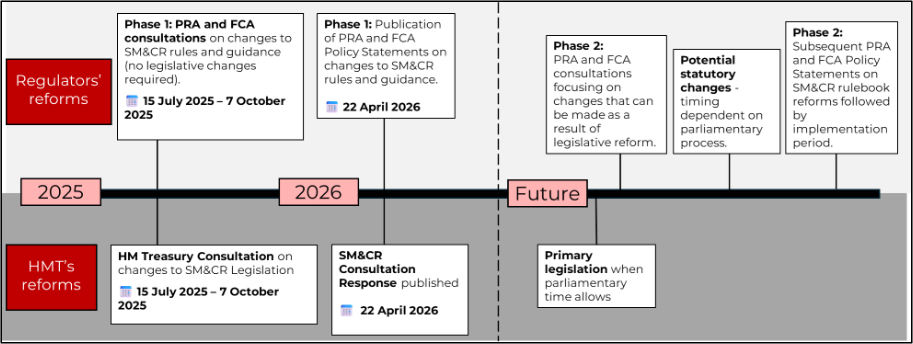
Once legislation is introduced, and subject to parliamentary passage, the regulators plan to consult on further proposed rule changes as part of a ‘Phase 2’ of SM&CR reform. The regulators will consider how best to use the additional flexibilities created by the legislative changes, such as bringing forward proposals for a more proportionate and risk-sensitive approach following removal of the Certification Regime from FSMA.
The regulators may also consider additional reforms to the regime, including those not dependent on legislative amendments, to further improve efficiency and reduce regulatory burden. The details of the regulators’ proposed approaches will be set out separately in their consultations.
Figure 1 illustrates these interactions:
Figure 1: Timeline of SM&CR reforms
2. Certification Regime
The Certification Regime is based on legislative requirements in FSMA 2000 and applies to staff that are not senior managers, but whose role could cause significant harm to the firm or its customers. Financial services firms must assess and certify these individuals as fit and proper to undertake their role, issue a certificate and conduct annual re-certification.
Q1. Do you agree that the Certification Regime should be removed from FSMA 2000?
A significant majority of respondents favoured removing the Certification Regime from FSMA 2000. They see the legislation as overly prescriptive, driving administrative burden without clear evidence that it improves individual accountability or consumer protection. Firms with large, certified populations reported that the annual re-certification requirements result in thousands of individual assessments, pulling HR, compliance, and line managers into repeated exercises without clear added value. Several respondents noted that the certificate itself had become a formality, offering little assurance beyond what firms already document internally.
Whilst in agreement with the removal, some respondents cautioned the uncertainty of what the regulators would replace it with. Responses noted concerns that it would be replaced with something similarly onerous and that early engagement with industry as they develop their approach would help provide confidence to market participants.
A small minority of respondents argued that the regime reinforces a culture of individual accountability beneath Senior Managers and provides important regulatory protections. One theme among these respondents was a concern that removing statutory duties could lead to inconsistent standards across the market, particularly in smaller firms.
Q2. Do you agree that the regulators should consider developing a more proportionate approach, that would replace the existing Certification Regime
Broadly, respondents encouraged regulators to consider risk-based and proportionate rules targeted at high-risk roles with genuine potential to cause consumer or market harm such as those in client facing roles or material risk takers. Firms highlighted the inefficiency of capturing junior staff, managers of certified staff, and individuals in functions that duplicate other regulatory or professional requirements – such as the remuneration regime for material risk takers and other FCA requirements such as Training & Competence.
There was a strong emphasis on the need for clarity and stability, noting the risk of recreating administrative burdens through detailed regulatory rules or frequent updates. While a few opposed the removal of the regime from legislation due to concerns about diminished individual accountability, some did emphasise that any replacement should still preserve the core intent of the regime.
Q3. Do you believe there are risks or unintended consequences if the Certification Regime is removed from FSMA 2000, and replaced with regulator rules? For example, how would it impact consumer protection, market integrity, safety and soundness, and policyholder protection?
Respondents expressed mixed views on whether removing the Certification Regime from FSMA 2000 would introduce new risks. A number of firms indicated they did not foresee material risks, provided replacement rules are well designed with clear guidance noting that the core protections, such as fitness and propriety obligations and senior managers’ accountability, would remain in place through other frameworks. These respondents argued that the certificate itself adds little regulatory value and that oversight of higher-risk functions could continue effectively through regulator rules.
A few respondents highlighted possible risks. A minority argued removal could weaken individual accountability or signal that the fitness and propriety of certified staff is less important. Other risks included reduced consistency in how firms interpret expectations, greater divergence in how fitness and propriety standards are applied, and potential weakening of consumer protection, especially if firms scale back oversight in roles that interact with customers. A small number of respondents warned the transition to regulator-led rules could lead to frequent rule changes, generating uncertainty and higher compliance costs if expectations are not stabilised early.
Q4. Are there alternative approaches that will still deliver the desired benefits, but may not involve removing the regime from legislation entirely?
There were relatively few alternative approaches proposed to full removal of the Certification Regime. While some respondents suggested that certain statutory elements such as the requirement to issue certificates or the rigid annual review cycle could be removed or amended, most respondents who supported reform emphasised that minor changes would not meaningfully reduce burden, given that the underlying rigidity stems from the legislative framework itself. Some respondents noted that narrowing the statutory definition of certification functions or adjusting the frequency of assessments could help alleviate administrative pressures.
By contrast, respondents who opposed legislative removal generally did not propose detailed alternatives. These respondents considered that reform should focus on improving implementation rather than altering the legislative basis.
Overall, the message from respondents was that alternative legislative approaches would likely introduce complexity without achieving the same level of simplification as full removal.
Q5. What are the critical elements for any replacement regime to achieve the government objectives of a lower cost, more proportionate and competitive regime?
Respondents emphasised that any replacement regime must be proportionate, risk-based, and clearly scoped. Many stressed the need for clear expectations, consistent standards between the regulators, and a smooth transition plan, noting that firms have already invested significantly in systems to support the current regime. Several warned that uncertainty or frequent rule changes could lead to unnecessary costs and operational inefficiency.
A number of respondents called for the replacement framework to avoid duplication of or to consider integration with existing HR and governance processes. For a small number of respondents, they noted the importance of improving the clarity and process around inter-firm regulatory references. Some highlighted the ongoing importance of ethical standards, Continuing Professional Development frameworks, and competence assurance in maintaining professionalism and public trust, even within a more proportionate regime.
Q6. Do the regulators currently have the necessary powers to deliver a replacement regime or are further powers required?
Most respondents agreed that the regulators already have the powers needed to design a replacement regime through their rulebooks. A minority cautioned that without clear legislative guardrails, there is a risk the regulators may recreate existing burdens in rules.
Q7: Do you have any comments on the likely costs and benefits of removing the Certification Regime from legislation and replacing it with a more proportionate regime, at this stage?
Respondents generally expected significant long-term administrative savings from removing the Certification Regime, including fewer system updates, simpler HR compliance processes, and greater operational flexibility. Many considered that these long-term efficiencies would outweigh short-term transition costs.
However, respondents identified a range of transitional impacts depending on how the regulators approach removal of the Certification Regime from legislation, including the need to retrain staff, update internal systems, and adjust internal control frameworks to reflect new requirements. Some also noted that, because the regulators’ detailed requirements will only become clear once their planned Phase 2 consultations and final rules are published, firms will face a period of transitional uncertainty that makes planning more difficult and may increase implementation costs.
Government Response
The government intends to proceed with the removal of the Certification Regime from FSMA 2000.
This change will enable the regulators to consider a more proportionate, flexible and risk-sensitive approach. They will be able to use their existing rule-making powers to put in place the requirements necessary to ensure the suitability of individuals performing functions below the senior manager level.
The government recognises the concern raised by some respondents that removing legislation could result in a weakening of firms’ internal controls on the risks of misconduct and operational failures. Regulators will retain their existing rulemaking powers and supervisory tools to take action if emerging risks develop. It will be important for regulators to continue to work closely with industry as they design and implement any replacement framework, including through consultation on draft rules and transitional arrangements. This will help to ensure that any replacement rules are clear, risk‑based and coherent, as well as helping to mitigate concerns raised about the potential for regulatory rules to replicate existing burdens.
The government will ensure that any commencement of the legislative changes to remove the Certification Regime is aligned with the regulators’ development of any replacement rules, in order to smooth the transition and avoid leaving regulatory gaps.
3. Senior Managers Regime
The Senior Managers Regime requires firms to seek regulatory pre-approval based on an assessment of fitness and propriety, before they appoint an individual into a senior management function. The regime is designed to ensure fitness and propriety of senior managers, clear allocation of responsibilities, individual accountability for key risks, and robust regulatory oversight of senior decision makers.
3.1 Reducing the number of senior management functions
Q8. Do you agree with the proposal to give the regulators more flexibility to reduce the overall number of senior manager roles?
Most respondents supported giving the regulators more flexibility to reduce the number of senior management functions, provided that individual accountability is preserved. Many noted that the current list of functions can be complex, with some perceived as duplicative or adding limited value to supervisory oversight. Respondents highlighted opportunities to streamline the regime by focusing on the most critical functions and ensuring requirements are proportionate across different types of firms.
Some respondents cautioned that reducing the number of senior management functions too much could create accountability gaps, particularly in complex or cross‑border structures, or place disproportionate responsibility on persons undertaking the remaining functions. These respondents emphasised the importance of maintaining sufficient granularity to ensure that key risks remain clearly owned.
Government Response
In its work leading up to the 2025 SM&CR reforms consultation, the government identified the risk that the primary legislation required regulators to take a particularly expansive approach to designating senior management functions. Following further legal analysis, including jointly with regulators, the government has concluded that this is not the case and the regulators do have the ability to amend the number of senior management functions in scope of the regime if needed. For that reason, the government is not planning to take forward any legislative changes to primary legislation around designation of roles, but is making other changes to allow for fewer senior management function applications.
3.2 Removing requirement for regulatory pre-approval for some senior management functions
Q9. In addition, do you agree with the proposal to give the regulators flexibility to reduce the number of roles within the regime for which pre-approval is required?
Respondents broadly supported giving regulators flexibility to decide whether authorised persons should always be required to seek regulatory pre-approval when a person carries out a senior management function. Many highlighted this would support internal mobility and succession planning by removing administrative barriers to routine senior appointments.
However, a minority raised concerns about unintended consequences, including inconsistent standards across firms and the loss of regulator objectivity in pre-approval decisions. Some stressed risks around enforcement and liability, the potential for unsuitable appointments under internal pressure (e.g. from group headquarters), and the loss of supervisory insight from reduced visibility of senior management function turnover.
Q10. Do you have any comments on the likely costs and benefits of making such changes to the Senior Managers Regime?
Respondents identified several benefits from reducing the number of senior management functions that require regulatory pre-approval, including faster hiring, reduced documentation, and a sharper regulatory focus on the highest impact functions. Many also stressed that improvements to regulatory systems and forms, including greater digitalisation, would be essential to realise these gains.
Some respondents noted that short-term costs may arise, such as updating systems, revising governance documentation, and retraining staff.
Q11. Are there any alternative approaches that government should consider to reform the approach to regulator pre-approval, which would still deliver the desired benefits?
Many respondents supported moving towards notification-based or registration style approaches for lower-risk senior management functions, with regulators only assessing a smaller set of the most senior or critical positions.
Others proposed streamlined or fast-track processes, particularly where individuals had previously been pre-approved, were moving internally, or were taking on amended responsibilities, to avoid duplicative assessment. Several respondents also highlighted the potential for greater recognition of prior approvals, including more proportionate treatment where individuals had already been approved in the UK or in comparable jurisdictions.
Q12. Do you have any other comments or suggestions regarding these proposed changes?
Many respondents emphasised the importance of clear guidance and supervisory consistency, particularly where functions shift between pre-approval and notification. Some respondents highlighted the need for regulators to ensure that new processes are not overly document-heavy, and that updates to systems and forms should be streamlined.
A small number raised concerns about potential divergence between the regulators, stressing the need for a harmonised approach to avoid introducing new inefficiencies. Others noted that firms will require adequate lead-in time to adjust governance structures and documentation. Many expressed a preference for a single, coordinated implementation rather than phased changes, and asked for clearer guidance on Prescribed Responsibilities, especially during interim arrangements in time to adjust governance structures and documentation.
Government Response
The government intends to legislate so that it is no longer always a requirement for firms to seek regulatory pre-approval when appointing an individual into a senior manager role. Regulators will be given a new power to specify in rules where it is suitable for a firm to notify the regulators of their intention to appoint a senior manager following an internal assessment by the firm of fitness and propriety. Such individuals who are notified to the regulators, will still be senior managers under the SM&CR and therefore subject to the same requirements as those who require pre-approval.
This will reduce both administrative burdens and delays associated with senior manager recruitment and appointments, while preserving the regulators’ ability to intervene where fitness and propriety concerns arise post-appointment.
For those senior management functions specified through regulator rules as suitable to move to a notification-based approach, there may be circumstances in which regulators do not consider it appropriate for specific firms to be able to appoint those senior managers without regulatory pre-approval. The government intends to ensure that the regulators have appropriate powers to be able to require firms to seek pre-approval for functions which are otherwise designated as suitable for notification to the regulators.
3.3 Statement of Responsibilities
Q13. Do you agree with the proposal to remove prescriptive legislative requirements relating to provision, maintenance and updating of Statement of Responsibilities, with the aim of allowing regulators to adopt a more proportionate approach?
Most respondents supported removing prescriptive legislative requirements for Statements of Responsibilities and allowing the regulators to set more proportionate expectations through their rulebooks. Supportive respondents argued that the current statutory requirements drive frequent updates for minor or temporary changes, increasing administrative effort without improving individual accountability.
Some respondents stressed that statements remain an important tool for clarity and individual accountability, and that statutory requirements help ensure responsibilities are not diluted through inconsistent internal governance.
Q14. What are the types of change for which an update to the Statement of Responsibilities is currently required, that you consider to be disproportionate?
Respondents highlighted that updates for minor internal adjustments, such as temporary delegation of responsibilities, changes in reporting lines, or interim cover arrangements are disproportionate and create unnecessary burdens. Several respondents recommended limiting updates to material or permanent changes, with the option for firms to maintain internal records for less significant adjustments.
Respondents emphasised that a more proportionate approach would reduce administrative burden while maintaining robust individual accountability, particularly if accompanied by clear guidance on materiality thresholds. Respondents also noted that frequent updates are compounded by duplication across multiple entities, a lack of alignment between regulators, and difficulties using existing regulatory systems. A small number suggested developing a joint template for dual-regulated functions to reduce duplication and improve consistency.
Government Response
The government will repeal the prescriptive provisions relating to Statements of Responsibilities from FSMA 2000. Removing these legislative obligations will give the regulators greater flexibility to determine, through their rules, how best to ensure clarity of individual accountability, while reducing unnecessary burdens and improving operational efficiency for firms.
4. Conduct Rules
The Conduct Rules form part of the statutory framework in FSMA 2000 and apply to most employees (other than ancillary staff) within authorised firms. They set baseline standards of behaviour designed to support a culture of integrity, good conduct and accountability, and currently include requirements for firms to train staff and notify regulators of breaches.
Q15. Are there requirements in the legislation for the Conduct Rules which you consider create a disproportionate burden? What are these elements?
Some respondents signalled the importance of the Conduct Rules and did not consider them disproportionate or burdensome.
However, many identified certain legislative requirements as disproportionately burdensome. The most frequently cited issue was the statutory duty to notify regulators of disciplinary action in relation to a Conduct Rule breach. Firms felt this captured immaterial issues where informing the regulator adds little regulatory value, particularly as respondents were not clear how the information is used. Many requested clearer definitions of what constitutes a breach and more proportionate thresholds to focus reporting on serious misconduct, which is difficult to achieve within the existing legislative framework.
Some firms also highlighted the inflexibility of statutory training requirements and that it could be made more proportionate to allow expectations to vary by role and risk.
Government Response
The government will retain the powers in legislation for regulators to make Conduct Rules but repeal the prescriptive legislative requirements on firms to notify regulators of breaches and to conduct mandatory training.
Removing these detailed obligations from FSMA 2000 will allow the regulators to consider appropriate rules in relation to Conduct Rule breaches and training requirements, ensuring the Conduct Rules remain effective while reducing unnecessary administrative burdens for firms.
5. Further proposals to ease the burden of the Senior Managers and Certification Regime
The government’s consultation invited views on whether further legislative changes were necessary to further reduce unnecessary burdens without affecting the core objectives of the SM&CR.
5.1 Other potential legislative changes
Q16. Are there any further elements of the SM&CR legislation that create unnecessary regulatory burdens on firms, the removal of which would not impact on the primary objectives of the regime?
A minority of respondents raised specific FSMA 2000 provisions they see as disproportionate. Some suggested removing section 347 FSMA 2000 (the record of authorised persons) as they argued the statutory requirement to submit staff details for a directory is burdensome, and removing it would allow simplification of the financial services register to focus more on customer-facing roles.
Separately, several respondents raised points about how the regime operates in practice rather than about the legislative framework. These included duplication between internal governance documents and Statements of Responsibilities across entities, the volume and format of documentation required for Senior Management applications, and overlaps with the remuneration and Material Risk Taker frameworks. Respondents suggested these matters would be better addressed through changes to FCA and PRA rules.
Government Response
The government has taken into account the consultation feedback and recognises that many of the burdens firms experience under the SM&CR stem from both operational practices, systems and processes and from statutory requirements. In relation to section 347 FSMA, the government notes respondents’ views and recognises that while the legislation requires the regulators to maintain a Directory, decisions on scope and publication fall within the regulators’ rules. The non-legislative issues raised fall within the regulators’ rule‑making remit. The government will continue to work with the FCA and PRA to support proportionate changes where non-legislative barriers exist.
5.2 International Talent
Q17. Do you face, or have you faced, any specific obstacles in trying to recruit internationally for senior manager roles?
Respondents highlighted several obstacles when recruiting internationally for individuals to fulfil senior manager roles, including lengthy approval timelines, difficulties obtaining regulatory references from other jurisdictions, delays in criminal records checks, and the UK’s remuneration deferral rules, which were seen as globally uncompetitive. Several firms noted that international candidates, particularly from the US, are deterred by the UK’s individual accountability framework.
Q18. If so, which are the key obstacles that would not be addressed by the reforms proposed in either this consultation or by the consultations the regulators have published in parallel?
Respondents said that some obstacles to international recruitment would remain even after the proposed reforms. These include how the SM&CR applies within global group structures, the UK being perceived as less competitive due to individual accountability, slow cross-border references and checks, and remuneration rules that deter internationally mobile candidates. Respondents suggested introducing mutual recognition or equivalence for senior managers who have already been approved in comparable jurisdictions, as well as fast-track pathways for individuals previously approved in the UK.
Government Response
The government has taken the consultation feedback into account and recognises the importance of reducing barriers to international recruitment. In recent years, the regulators have taken steps to enhance further the UK’s standing in a highly competitive international market for financial services skills and talent, such as through reforms to remuneration requirements. The government anticipates that many of the proposed SM&CR reforms will positively impact existing practical barriers, however, the government remains open to industry feedback should specific issues persist.
The government will continue working with the regulators to ensure the reformed SM&CR operates proportionately for international firms and globally mobile senior leaders. The regulators’ ongoing system and process improvements, alongside the government’s SM&CR reforms will help support a more efficient and internationally competitive framework.
To further support competitiveness, the government has proposed to legislate to shorten the regulators’ statutory deadlines for senior manager applications from three months to two months.
5.3 Further proposals
Since the publication of the consultation, the government has identified a small number of additional proposals that it believes will assist in reducing regulatory burdens associated with the SM&CR.
Regulatory pre-approval of senior manager applications subject to time-limits or conditions
Although regulators currently have powers to impose conditions or time-limits on senior manager approvals, firms are not able to apply for them directly and so they cannot be imposed without triggering statutory notice requirements under section 62 FSMA. This requires the regulators to issue a warning and decision notice and parties have the right to refer such a decision to the tribunal. In turn, such warning and statutory notices can carry a stigma effect for the individual or firm, which means they are infrequently used. This can limit flexibility for firms and regulators in cases where a conditional or time-limited approval would otherwise be a more proportionate solution.
There may be circumstances in which if a firm could voluntarily apply for a senior management function to be subject to a time-limit or conditions, this would provide additional flexibilities for firms in managing interim appointments and other situations where conditions or time-limitations may be appropriate. Where such applications are approved by the regulators, this would obviate the need for statutory notices to be issued, thereby streamlining the process.
Government Response
The government will legislate to give regulators the power to decide - in their rules and guidance – whether and to what extent to accept applications subject to a time-limit or condition. The government’s expectation is that the approach to such applications may vary depending on the particular senior management function, candidate or firm. Where such applications are made, the statutory notice requirements will not be triggered unless the regulators refuse the application, vary or impose other time-limits or conditions.
This could help reduce regulatory burdens and costs for firms and regulators in some instances where time-limited or conditional appointments are appropriate, and provide a more efficient way of managing interim appointments.
Financial Market Infrastructure (FMI)
The Financial Services and Markets Act 2023 (FSMA 2023) provided for the SM&CR to be applied to central counterparties, central securities depositories and recognised investment exchanges. However, these provisions are yet to be fully commenced in legislation. The precise extent to which the regime would apply (once commenced) must also be specified by HM Treasury in regulations. FSMA 2023 also provided the government with the power to extend the regime to credit rating agencies, subject to consultation with industry. We will collectively refer to these firms here as FMIs.
A small number of respondents offered mixed views on switching on the SM&CR for FMIs. Some supported switching on the SM&CR specifically to recognised investment exchanges noting that these entities undertake functions that, in their view, raise similar risks to other regulated firms and therefore should be subject to equivalent accountability standards or on a ‘same risk, same reward’ basis. Others generally supported its application, although noted the need to ensure that the requirements were aligned with any wider changes being made for FCA and PRA regulated firms. Those who disagreed with applying the SM&CR to recognised investment exchanges and central counterparties, raised concerns about UK competitiveness compared to other jurisdictions who do not apply similar standards to FMIs. They also highlighted potential impacts on recruitment if the regime were to be applied, and argued that the business models of these firms provide very little scope or incentive for individuals to take risks in the same way as may happen at banks and insurers.
Government Response
The government is not planning to commence the SM&CR for FMIs at this stage and a decision to do so would be subject to further consultation. However, as part of these reforms, the government intends to make the equivalent legislative changes to the SM&CR for FMIs to those that will apply to FCA and PRA-authorised firms, to ensure consistency and so that the regime could be applied in a coherent and aligned way in the future.
5.4 List of organisations who responded to the 2025 Consultation
Some responses were submitted by individuals. For data protection reasons, individual respondents have not been named. Some firms also requested that they not be named.
- Association of British Credit Unions Limited (ABCUL)
- Association of British Insurers (ABI)
- Association of Financial Mutuals (AFM)
- Association for Financial Markets in Europe (AFME) and UK Finance
- AFS Compliance Ltd
- Alternative Investment Management Association (AIMA)
- Allianz
- Association of Foreign Banks (AFB)
- Association of Mortgage Intermediaries (AMI)
- Aviva
- Baillie Gifford
- BlackRock
- British Insurance Brokers’ Association (BIBA)
- British Private Equity and Venture Capital Association (BVCA)
- CFA UK (Chartered Financial Analyst Society UK)
- Chartered Banker Institute (CBI)
- Chartered Insurance Institute (CII)
- CityHR
- Euroclear UK & International
- European Principal Traders Association (EPTA)
- European Venues & Intermediaries Association (EVIA)
- FCA Practitioner Panel
- Financial Services Consumer Panel
- Foresters Financial UK
- Hargreaves Lansdown
- Hiscox plc
- Howden
- Institute of Chartered Accountants in England and Wales (ICAEW)
- Investment & Life Assurance Group (ILAG)
- Intercontinental Exchange (ICE)
- International Underwriting Association (IUA)
- Investment Association (IA)
- Investment Company Institute (ICI)
- Japanese Bankers Association (JBA)
- Legal & General (L&G)
- London & International Insurance Brokers’ Association (LIIBA)
- Lloyd’s
- Lloyd’s Market Association (LMA)
- Lloyds Banking Group (LBG)
- London Market Group (LMG)
- London Stock Exchange Group (LSEG)
- Lowell Group
- Monzo Bank
- NatWest Group
- NewDay
- Northern Trust
- Phoenix Group Holdings plc
- Personal Investment Management & Financial Advice Association (PIMFA)
- Royal Bank of Canada (RBC)
- Standard Chartered Bank
- TheCityUK
- The Investing and Saving Alliance (TISA)
- TP ICAP
- Vanquis Bank
-
Financial Services Growth and Competitiveness Strategy, HM Treasury, July 2025 ↩
-
Consultation: Reforming the Senior Managers & Certification Regime, HM Treasury, July 2025 ↩
-
CP25/21: Senior Managers and Certification Regime review, Financial Conduct Authority, July 2025 ↩
-
CP18/25: Review of the Senior Managers and Certification Regime (SM&CR), Prudential Regulation Authority, July 2025 ↩
-
PS26/6: Senior Managers & Certification Regime Review, Financial Conduct Authority, April 2026 ↩
-
- PS12/26: Review of the Senior Managers and Certification Regime (SM&CR) − Phase 1, Prudential Regulation Authority, April 2026 ↩
-
The Appointed Representatives Regime: Consultation, HM Treasury, February 2026 ↩