Seeing through the fog of war
Dstl is working on future thermal cameras that will be better at seeing through smoke and dust.
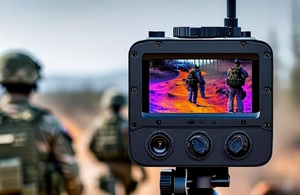
Thermal cameras detect heat rather than light, making them invaluable in difficult battlefield conditions, like smoke and dust. They can spot targets at long distances and operate when traditional cameras fail.
Current high-performance systems have a major drawback: they need to be cooled to extremely low temperatures, around -193°C (80 K), using bulky cooling engines. This limits where and how they can be deployed.
Working with Amethyst Research and Lancaster University, Dstl tackled this problem by designing a novel detector architecture that dramatically boosts efficiency by combining three clever innovations:
- A thin absorber layer to reduce unwanted thermal noise.
- A semiconductor layer which acts like a mirror to reflect and confine infrared light.
- Sub-wavelength structuring to enhance infrared light absorption.
Together, these features increased the detector’s efficiency by more than 10 times while reducing ‘thermal noise’. This work promises a route to thermal cameras that see through obscurants and operate at much higher temperatures, closer to -123°C (150 K), making them smaller, lighter, and less power-hungry.
The next phase will mature the technology and develop an imaging demonstrator. This could pave the way for wider applications for thermal imaging cameras such as mounted on small platforms, drones or even carried by soldiers.