Automatic enrolment alternative quality requirements: Triennial review 2026 - government response to the call for evidence and analysis
Updated 3 November 2026

© Crown copyright 2026
This publication is licensed under the terms of the Open Government Licence v3.0 except where otherwise stated. To view this licence, visit nationalarchives.gov.uk/doc/open-government-licence/version/3 or write to the Information Policy Team, The National Archives, Kew, London TW9 4DU, or email: psi@nationalarchives.gov.uk.
Where we have identified any third party copyright information you will need to obtain permission from the copyright holders concerned.
This publication is available at https://www.gov.uk/government/calls-for-evidence/automatic-enrolment-alternative-quality-requirements-for-workplace-schemes-db-hybrid-and-cdc/outcome/automatic-enrolment-alternative-quality-requirements-triennial-review-2026-government-response-to-the-call-for-evidence-and-analysis
Introduction
1. This document contains the findings of the 2026 review of the alternative quality requirements for pension schemes being used for automatic enrolment. Part of the review process included a call for evidence which ran from 16 June 2026 to 27 July 2026.
The aim of this call for evidence was:
- to ascertain whether the government’s policy intentions in this area continue to be achieved
- to look at how the simplifications and flexibilities of the alternative quality tests work in practice
- to identify if any new issues have arisen since the last triennial review in 2023
Why have we carried out these reviews?
2. The Secretary of State is required to review the regulations made under powers in the Pensions Act 2008 which introduced the alternative quality requirements for pension schemes being used for automatic enrolment into workplace pensions. There are 2 statutory reviews set out in the Pensions Act 2008 which must be carried out no more than 3-years after the completion of the previous review.[footnote 1] The last reviews were carried out in 2023.
3. Regulations [footnote 2] made under section 23A of the Pensions Act 2008 cover the alternative quality requirement for defined benefit pension schemes and defined benefit sections of hybrid schemes (section 24(1)(b)). The Regulations provide an alternative test that schemes and employers sponsoring defined benefit schemes can use to demonstrate that such a scheme is suitable to be used for automatic enrolment by meeting the relevant minimum quality requirements.
4. The findings of this review are set out in the section ‘Review of Alternative Quality Requirements for defined benefit and hybrid schemes (Pensions Act 2008, Section 23A)’.
5. Section 28(2C) of the Pensions Act 2008 requires triennial reviews to be carried out into whether the test in subsection (2A) continues to be satisfied. The provisions of section 28 apply to schemes set out in subsections (3)(a to c), (3A) and (3B). The schemes listed in subsection 3, include money purchase schemes, Collective Defined Contribution schemes, personal pension schemes, hybrid schemes, and defined benefit schemes where section 23A(1)(a) applies.
6. The findings of this review are set out in the section ‘The 2026 Reviews - Analysis of the Alternative Quality Requirements for Section 28 schemes’.
Background to the reviews
7. Automatic enrolment into workplace pensions was introduced in 2012 to enable more people to save for their retirement and to make retirement saving the norm for most people in work. The Pensions Act 2008 requires employers to enrol all their eligible[footnote 3] workers into a qualifying workplace pension scheme and pay pension contributions.
8. Employers who choose to use a defined benefit or hybrid pension scheme to meet their automatic enrolment duties must ensure their scheme meets the minimum quality requirements[footnote 4] set out in the Pensions Act 2008 and the accompanying secondary[footnote 5] legislation.
9. Up until 6 April 2016 a defined benefit scheme with its main administration in the UK could meet the quality requirements for a workplace pension scheme by either:
- being contracted out of the State Second Pension (also known as the Additional State Pension)
- meeting the Test Scheme Standard (TSS) provided for in legislation and statutory guidance[footnote 6] which allow defined benefit schemes to demonstrate they meet the minimum necessary standard
10. The ‘test scheme’ is a hypothetical defined benefit scheme and, in simple terms, a scheme satisfies the TSS if it provides pension benefits at least broadly equivalent to those of the ‘test scheme’. Following the abolition of contracting-out (on 6 April 2016), only those defined benefit schemes that satisfy the TSS in relation to all relevant jobholders[footnote 7] could be used as a qualifying workplace pension scheme. The TSS remains an option for all employers.
11. In straightforward cases, government guidance sets out how employers can certify that their scheme meets the TSS. In more complex cases, the scheme actuary will need to certify the scheme.
12. In 2 public consultations in 2013 and 2014, the government invited views on whether there was a less onerous way for defined benefit schemes to demonstrate the quality requirement for the purposes of automatic enrolment. The majority of respondents expressed the view that the TSS was unnecessarily complex, and employers would benefit from the flexibility to use an alternative, simpler test.
13. Consequently, the framework for alternative quality requirement tests for defined benefit or hybrid schemes was introduced through the Pensions Act 2014 (which inserted section 23A into the Pensions Act 2008). Details of the operation of the alternative quality requirement tests are set out in regulations (made under section 23A(1)).
14. The policy objective behind both alternative quality tests is to provide a simpler mechanism for employers and their advisers to determine if defined benefit or hybrid schemes meet the quality requirements for automatic enrolment.
The alternative quality requirements for defined benefit (DB) and hybrid schemes
15. Since 1 April 2015, there have been 2 alternative tests of scheme quality available to employers offering defined benefit schemes or hybrid schemes to meet their automatic enrolment duties:
16. Test 1: A test enabling schemes, which meet prescribed requirements, to use the money purchase quality requirements – based on meeting the existing quality requirements for defined contribution schemes, meaning, a minimum contribution equivalent to 8% of qualifying earnings (Section 20 of the Pensions Act 2008).
17. Test 2: A ‘cost of accruals’ test – based on the cost to the scheme of the future accrual of active member benefits.
The alternative tests
Test 1
18. This is a test enabling schemes which meet prescribed requirements to use the money purchase quality requirements.
19. In response to feedback from a public consultation in 2014, a test was introduced whereby a defined benefit scheme will be able to use the money purchase quality requirement for defined contribution schemes (Section 20 of the Pensions Act 2008).
20. To determine whether the scheme may apply this test, a number of conditions need to be satisfied:
(a) members’ benefits are calculated by reference to factors which include the contributions made to the scheme by, or on behalf of, the member
(b) the contributions in sub-paragraph (a) are converted, in accordance with scheme rules, as soon as reasonably practicable and no later than a month after receipt, into a right to an income for life
(c) the benefits payable to the member under the scheme become payable no later than the member’s State Pension Age
(d) following the conversion of the benefits in sub-paragraph (b), the amount of the members’ benefits cannot be reduced unless this is at the member’s request
(e) following any actuarial valuation, the trustees or managers have absolute discretion to use any excess funds to increase members’ benefits
(f) where benefits have been increased using the excess assets referred to in (e), they cannot be reduced except at the member’s request
Test 2
21. This is the cost of accruals test. The cost of accruals test is based on the cost to the scheme of the future accrual of active member benefits. The test is normally applied at scheme-level and, broadly speaking, a defined benefit scheme (or defined benefit elements of a hybrid scheme) meets the quality requirement for automatic enrolment if the cost of providing the benefits accruing for, or in respect of, the relevant members over a relevant period would require contributions to be made of a total amount equal to at least a prescribed percentage of the members’ total relevant earnings over that period.[footnote 8] In other words, the cost of providing benefits would at least require the minimum levels of contribution rates prescribed in legislation.
22. Prescribed percentages in relation to members’ earnings are set at a level that broadly represents the cost of providing the benefits under the TSS. To maintain the existing quality standards for schemes, section 23A of the Pensions Act 2008 provides that the percentage prescribed in regulations cannot be below the 8% total contribution rate required for a qualifying defined contribution scheme.
23. The cost of accruals test generally applies at a scheme-level. However, where there is material difference in the cost of providing benefits for different groups, the test is applied at a benefit scale level.
Defined Contribution (DC) test
24. Section 20 of the Pensions Act 2008 sets out the general requirement for money purchase schemes to meet the quality standard for Automatic Enrolment (AE) and section 28 provides that a scheme can instead be taken to satisfy the quality obligations for AE where one of the alternative quality requirements have been met. Details including the 3 ‘sets’ of these requirements are set out in Part 7A of the Occupational and Personal Pension Schemes (Automatic Enrolment) Regulations 2010. These alternative requirements are intended to provide a simpler way for schemes and employers to meet the minimum standards for a workplace pension scheme where for example, the definition of pensionable pay in the scheme is not the same as qualifying earnings, defined in section 13 of the Pensions Act 2008. A scheme must meet at least 1 of the 3 sets if they are to qualify under these alternative requirements.
25. The statutory review (section 28) requires that the Secretary of State be satisfied that at least 90% of jobholders would be likely to be no worse off if they were members of schemes that met the alternative quality requirements than if they were in schemes that met the standard AE requirements. That is, if every scheme satisfied these requirements, both employer and total contributions would be equal to or exceeding minimum contributions under Automatic Enrolment.
The Collective Defined Contribution (CDC) test
26. For the 2026 review, we have included the CDC test for the second time. CDC schemes were introduced by the Pension Schemes Act 2021 and the legislative framework for single and connected employer CDC schemes came into effect on 1 August 2022. Under that framework, employers who choose to use a CDC scheme to meet their AE duties are required, as with other schemes, to ensure that the scheme meets the minimum quality requirements for qualifying schemes under the Pensions Act 2008.
27. It therefore made sense to include a review of the AE quality test which applies to CDC schemes as part of the Triennial Review of alternative AE tests, thus syncing all the review timings (AE and CDC) together on the same cycle.
28. CDC schemes need to satisfy the quality requirement for UK money purchase schemes under section 20 of the Pensions Act 2008 in order to be a qualifying scheme for AE purposes, or the alternative quality requirements for a money purchase scheme set out in regulation 32E of the Occupational and Personal Pension Schemes (Automatic Enrolment) Regulations 2010, or the alternative quality requirements which have been prescribed for CDC schemes in regulation 32EA of those regulations.
29. The alternative AE quality test for CDC schemes, taking all relevant jobholders together, looks at monetary contributions by, or on behalf of, or in respect of those jobholders over the certification period, and these are assessed against prescribed percentages of their total relevant earnings over that period. The government intends that the test will be applied to all relevant jobholders together, unless there is a material difference in the cost of providing rights to benefits to different groups (as set out in the regulations).
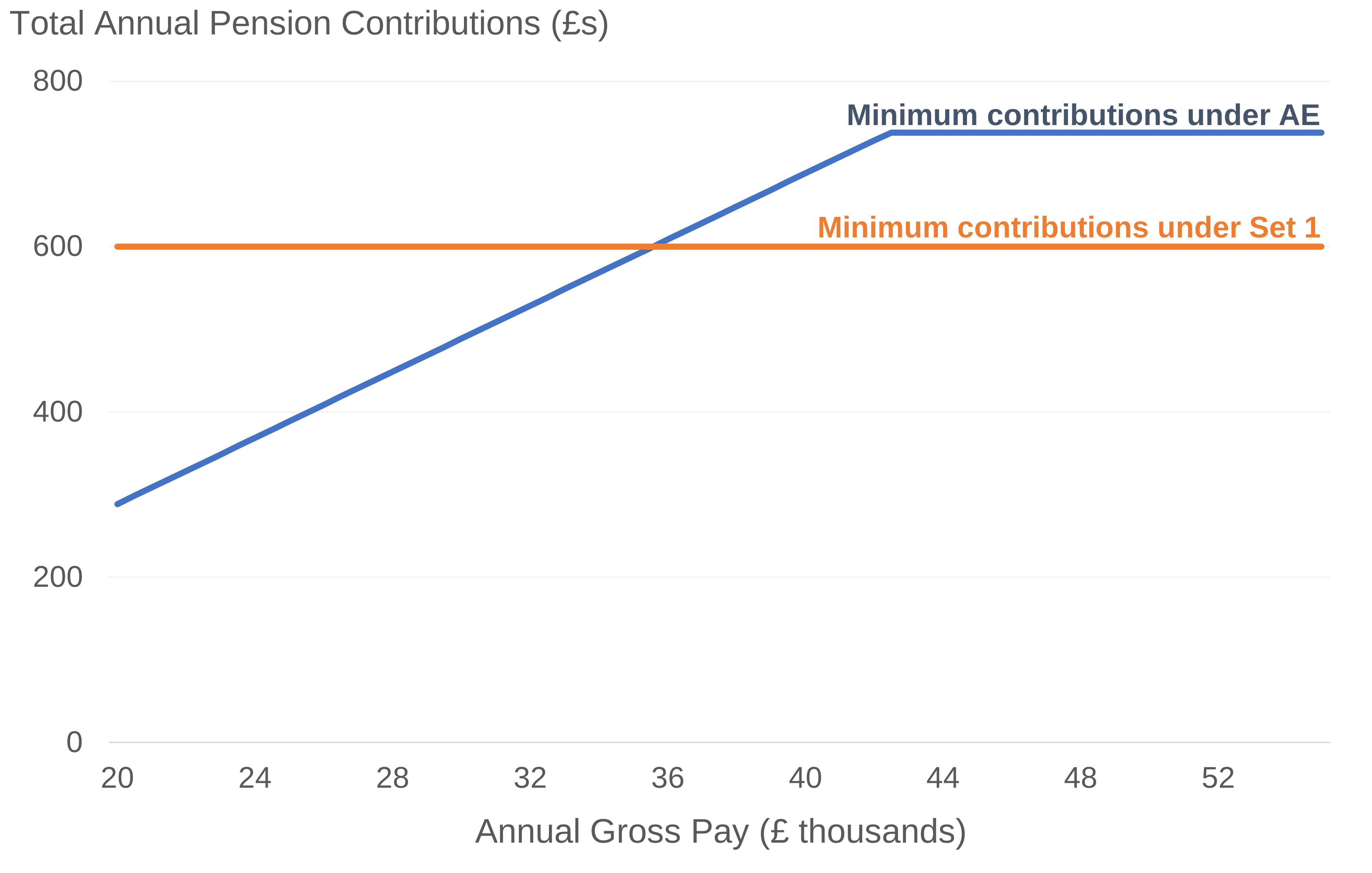
30. This alternative quality requirement for CDC schemes will operate alongside the evaluation requirements in the CDC regulations. The call for evidence included a question which allowed respondents to share their views on the CDC test.
The 2026 Reviews - Review of Alternative Quality Requirements for defined benefit and hybrid schemes (Pensions Act 2008, Section 23A)
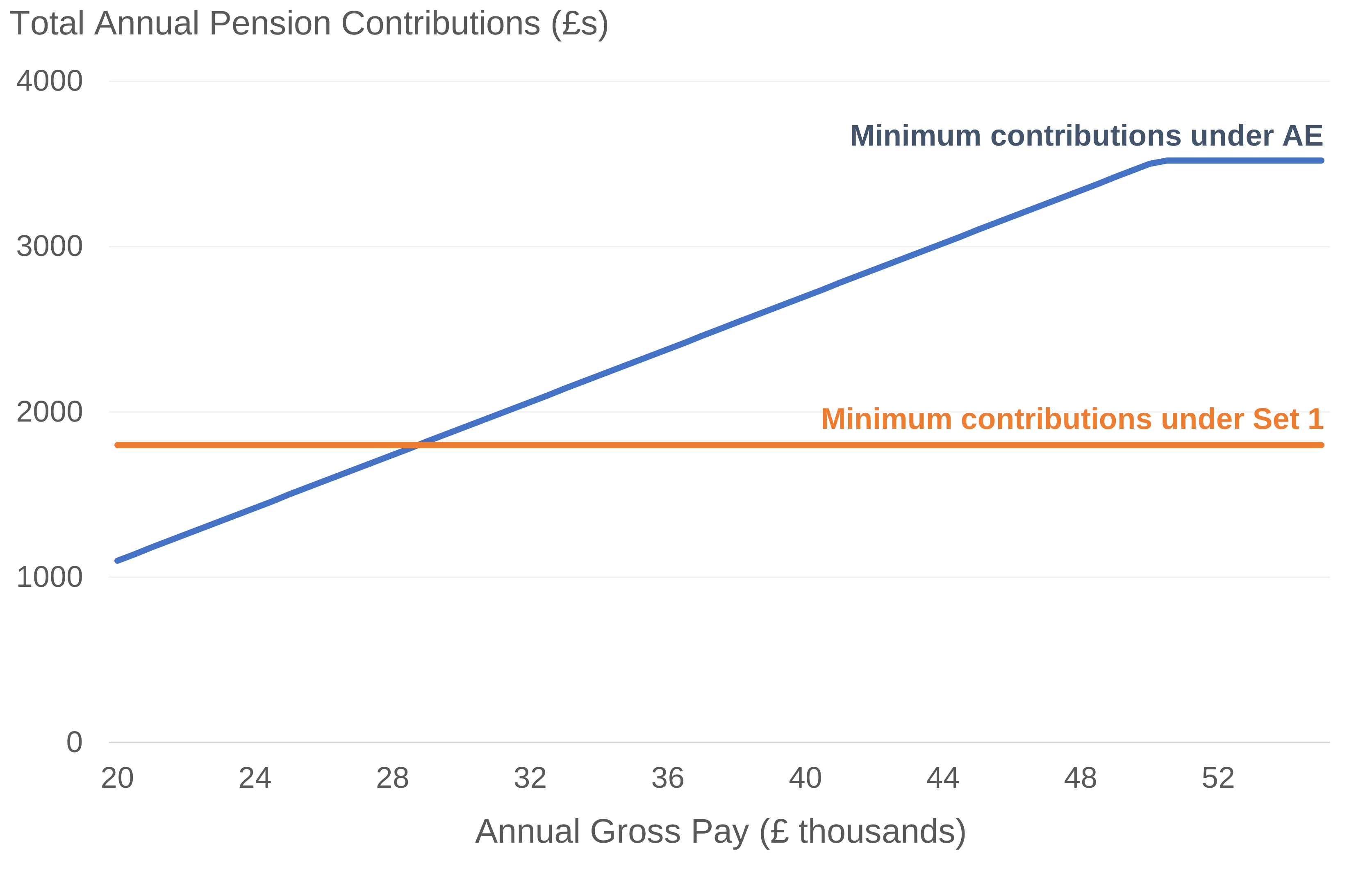
Introduction
31. The review process fulfils the requirement set out in legislation to periodically reconfirm that government policy intent continues to be achieved, to deliver broad administrative easement for the majority of pension schemes that would otherwise have to fall back on the TSS.
32. The government carried out a call for evidence from 16 June 2026 to 27 July 2026 to seek the views of interested stakeholders on the effectiveness of the alternative quality tests, and whether issues have arisen that would make this deregulatory easement ineffective for schemes that choose to make use of it.
33. Through a series of questions, the call for evidence asked whether the alternative tests were continuing to deliver, in broad terms, a simplified mechanism for demonstrating a pension scheme met the quality requirements.
34. We received responses from 7 organisations with an interest in this aspect of the automatic enrolment framework. We thank our stakeholders for their thoughtful responses.
Responses to questions set out in the call for evidence
Question 1
Do the alternative quality requirements for defined benefit (DB) and hybrid schemes still deliver simplification and flexibility for sponsoring employers and pension schemes that are unable to use the TSS?
Where possible, please provide information on the frequency of use and circumstances where schemes revert to using the TSS.
35. Overall, respondents felt that the alternative quality requirements do continue to deliver the intended simplifications to the AE testing regime, and support retaining the current requirements without changes.
Given the tests are well established and understood, we support retaining the current requirements without changes.
– Association of Consulting Actuaries
36. Respondents with relevant experience consider the tests to be well established, well understood and simpler to apply than the TSS. They are seen as effective in reducing administrative burdens for employers while providing flexibility in demonstrating compliance with AE requirements. Evidence suggests that the alternative requirements provide a simpler alternative means of demonstrating quality where either route may be available.
37. While support for the alternative quality requirements is strong amongst respondents, one respondent did mention that simplification should not come at the expense of member outcomes and that the TSS should remain available as an important safeguard where alternative tests are not appropriate. The government’s position remains that member outcomes remain a priority and that if the alternative quality tests are not appropriate then schemes should use the TSS to ensure they are meeting AE quality standards.
Question 2
In practice, who is carrying out the tests and signs off certification: the employer (for example, self-certification) or its professional advisers?
Where possible, please provide information on cost/time to certify and what governance/assurance is used.
38. While not all respondents chose to answer this question, the available evidence indicates that who carries out the alternative tests can vary on a case by case and scheme by scheme basis. Some respondents reported that certification is most commonly carried out by scheme actuaries or other professional advisers, particularly where the assessment involves complex actuarial judgements. Others noted that employers may undertake certification themselves in more straightforward cases, often supported by advice or information provided by professional advisers.
39. One respondent suggested that certification should be supported by appropriately qualified professionals to ensure transparency and independent scrutiny. However, no other respondents identified significant concerns with current certification arrangements, indicating that existing processes are generally working effectively.
40. Overall, respondents did not identify significant concerns with existing certification practices, suggesting that the current approach is operating effectively. This is consistent with evidence from previous reviews. The government therefore continues to consider it appropriate not to prescribe who must carry out the tests, allowing employers and schemes flexibility to adopt arrangements that are suitable for their circumstances.
Question 3
Are there any issues or considerations that sponsoring employers or pension schemes would like to bring to DWP’s attention regarding the operation of the alternative quality requirements?
Please describe any issues that have arisen to date, as well as any issues you anticipate may arise in the future. Where possible, indicate the frequency and scale of these issues, and set out any suggested solutions or mitigations.
41. Respondents generally emphasised that the alternative quality requirements continue to operate as intended. While some issues were raised in the call for evidence, these were raised by only a minority of respondents, with no single systemic problem or consensus reform emerging from the evidence. Nevertheless, we will touch on areas where respondents felt the alternative quality requirements could better accommodate certain scheme designs or emerging developments.
42. A small minority of respondents suggested that the current framework could more effectively accommodate members accruing benefits across more than one pension arrangement, such as both DB and DC schemes. The concern was that the different tests used to assess DB and DC benefits can make it difficult to reflect the overall value of pension provision available to members, with suggestions made around assessing schemes collectively to assess overall member benefits. The government’s view is that in such circumstances, the TSS may be the more appropriate route for demonstrating compliance.
43. One respondent sought clarification on how the proposed Authorised Member Surplus Payment regime, due to be introduced from April 2027, will interact with the alternative quality requirements. Consultation feedback received on the draft legislation for Authorised Member Surplus Payments will inform the development of legislation for Finance Bill 2026-27. Separately, the government recently consulted on wider surplus flexibilities for defined benefit pension schemes and will publish its response in due course.
44. As was touched on in the 2023 review, the Universities Superannuation Scheme (USS), together with the Universities and Colleges Employers Association (UCEA) and University and College Union (UCU), jointly raised concerns that aspects of the alternative quality requirements, such as the requirement to fund for revaluation, can be seen as a barrier to conditional indexation within the USS DB pension scheme. The government continues to engage with USS on this matter as their proposals develop.[footnote 9]
45. As in the 2023 review, one respondent sought greater clarity around arrangements that allow members to “opt down” to a lower, non-qualifying level of benefits. Under the current legislation, however, such members remain within the definition of “relevant members” [footnote 10] for the purposes of the cost of accruals test and must be re-enrolled into a qualifying arrangement as part of the cyclical re-enrolment process. The same respondent also raised concerns regarding schemes that operate final pensionable salary caps, an issue previously highlighted in the 2020 and 2023 reviews. As set out in these earlier reviews, the government’s view remains that schemes in such circumstances should look to see if the TSS will be the more appropriate test to meet their automatic enrolment obligations.
Question 4
Do the alternative quality requirements for CDC schemes remain appropriate for single and connected employers?
For new unconnected multi-employer CDC schemes, are the proposed alternative quality requirements appropriate?
46. The majority of respondents are satisfied with the quality requirements for CDC schemes. Several of the respondents state that they welcome the proposals that unconnected multi-employer CDC schemes will be able to use the alternative DC test to meet their obligations with AE legislation, in addition to the alternative CDC test. However, a minority of respondents question why the DC test is not also going to be available for single and connected employer CDC schemes.
47. As a CDC market develops, we will of course consider the impact on the CDC test to ensure CDC schemes will be able to certify their compliance with the AE quality requirements.
Conclusion of the section 23A requirement
48. On the basis of the evidence gathered, we have concluded that, in broad terms, the alternative quality tests continue to provide a simplified option and are suitable for the majority of DB and hybrid schemes who use them and have not identified a case for fundamental or immediate change. We have also concluded that the CDC test remains sufficient, and the policy objective continues to be met.
The 2026 Reviews - Analysis of the Alternative Quality Requirements for Section 28 schemes
Introduction
49. DWP has conducted analytical modelling of the section 28 test, based on the Office for National Statistics’ Annual Survey of Hours and Earnings (ASHE), which is the primary data source on employees’ earnings. Our analysis examines all jobholders, regardless of whether they are contributing into a pension. The analysis has been used to determine if total and employer contributions in these alternative schemes are exceeding minimum contributions under Automatic Enrolment. Because these tests have been satisfied for over 90% of jobholders for each of the alternative sets analysed, the alternative scheme quality requirements have been met for the 2026 review.
50. In this analysis, we present figures for the proportion of jobholders in different Sets for whom total contributions are at least as much as under minimum contributions on qualifying earnings. The minimum contributions required for the 3 Sets are outlined in table 1.
Table 1: Minimum employer and total contribution level requirement for Set 1, 2 and 3 at different staging periods[footnote 11]
| Set | Contribution levels until 5th April 2018 | Contribution levels from 6th April 2018 until 5th April 2019 | Contribution levels since 6th April 2019 |
|---|---|---|---|
| 1 | The scheme must provide for at least a 3% contribution of pensionable earnings (inclusive of at least a 2% employer contribution) for all of the relevant jobholders in the group or in the scheme. The pensionable earnings of the jobholder must be equal to, or more than the jobholder’s ‘basic pay’. | The scheme must provide for at least a 6% contribution of pensionable earnings (inclusive of at least a 3% employer contribution) for all of the relevant jobholders in the group or in the scheme. The pensionable earnings of the jobholder must be equal to, or more than the jobholder’s ‘basic pay’. | The scheme must provide for at least a 9% contribution of pensionable earnings (inclusive of at least a 4% employer contribution) for all of the relevant jobholders in the group or in the scheme. The pensionable earnings of the jobholder must be equal to, or more than the jobholder’s ‘basic pay’. |
| 2 | The scheme must provide for at least a 2% contribution of pensionable earnings (inclusive of at least a 1% employer contribution) for all relevant jobholders in the group or scheme. The pensionable earnings of the jobholder must be equal to or more than the jobholder’s basic pay. Total pensionable earnings of all relevant jobholders (taken in aggregate) to whom this set applies must constitute at least 85% of their total earnings. | The scheme must provide for at least a 5% contribution of pensionable earnings (inclusive of at least a 2% employer contribution) for all relevant jobholders in the group or scheme. The pensionable earnings of the jobholder must be equal to or more than the jobholder’s basic pay. Total pensionable earnings of all relevant jobholders (taken in aggregate) to whom this set applies must constitute at least 85% of their total earnings. | The scheme must provide for at least an 8% contribution of pensionable earnings (inclusive of at least a 3% employer contribution) for all relevant jobholders in the group or scheme. The pensionable earnings of the jobholder must be equal to or more than the jobholder’s basic pay. Total pensionable earnings of all relevant jobholders (taken in aggregate) to whom this set applies must constitute at least 85% of their total earnings. |
| 3 | Total contributions of at least 2% of the jobholder’s earnings (including an employer contribution of at least 1%) for each relevant jobholder in the group or scheme. | Total contributions of at least 5% of the jobholder’s earnings (including an employer contribution of at least 2%) for each relevant jobholder in the group or scheme. | Total contributions of at least 7% of the jobholder’s earnings (including an employer contribution of at least 3%) for each relevant jobholder in the group or scheme. |
Methodology
51. Our analysis uses the latest available data, up to 2025, from the Office for National Statistics’ Annual Survey of Hours and Earnings (ASHE), which is the primary data source on employees’ earnings. Our analysis examines all jobholders, regardless of whether they are contributing into a pension. A jobholder is defined as:
- an employee working in Great Britain (England, Scotland and Wales)
- aged 16 to 74
- earning above the lower earnings limit (currently £6,240)
52. For these jobholders, we compare their minimum notional pension contributions under the automatic enrolment framework against their notional contributions under each alternative requirement.
Results
Set 1
53. Table 2 shows that since the introduction of automatic enrolment in 2012, certification under Set 1 would have delivered at least as good an outcome for total contributions for over 90% of jobholders during all 3 staging periods.
Table 2: Proportion of jobholders for whom total contributions under Set 1 (contributions on basic pay from pound 1) are at least as much as under minimum contributions on qualifying earnings, 2012 to 2025
| Contribution basis | Period | Proportion |
|---|---|---|
| 3% basic pay from pound 1 at least as much as 2% of qualifying earnings | 2012 to 2017 | 99% |
| 6% basic pay from pound 1 at least as much as 5% of qualifying earnings | 2018 | 97% |
| 9% basic pay from pound 1 at least as much as 8% of qualifying earnings | 2019 to 2023 | 96% |
| 9% basic pay from pound 1 at least as much as 8% of qualifying earnings | 2024 to 2025 | 97% |
Source: DWP estimates derived from ONS ASHE, GB, 2012 to 2025
54. From 2018 onwards, there has been a slight decrease in the proportion of jobholders for whom Set 1 would deliver at least as good an outcome as minimum contributions on qualifying earnings. This has fallen from 99% in 2017 to 96% between 2019 and 2023 – rising to 97% in 2024 and 2025. This is attributable to the phased increases in minimum contribution rates in April 2018 and April 2019 as well as increases in the AE eligible population over time.
55. Across all years, for an individual with gross pay equal to basic pay, the test for Set 1 is automatically satisfied. This is because basic pay would be greater than qualifying earnings and therefore, a greater percentage of the larger basic pay would be greater than a smaller percentage of the lower qualifying earnings. However, for an individual with gross pay greater than basic pay, satisfying the test for Set 1 depends on the amount of additional pay the individual receives.
56. For example, consider an employee earning £20,000 gross pay per annum. The chart ‘total annual pension contributions’ shows how total annual pension contributions vary with gross pay for an employee in 2012 with a basic pay of £20,000 (and under the then minimum contribution rate of 2%). It shows that contributions under Set 1 remain constant as gross pay increases, whereas minimum contributions under automatic enrolment increase with earnings. The 2 contribution levels are equal at gross annual earnings of around £36,000.
Chart: Total annual pension contributions
57. Up to the point of intersection at a gross pay of £36,000, the minimum contribution this individual would receive under Set 1 is greater than the minimum contribution they receive under automatic enrolment. Therefore, they satisfy the test for earnings up to £36,000.
58. The chart ‘total annual pension contributions’ shows how total pension contributions vary with gross pay for an employee in 2025 with a basic pay of £20,000. It shows that contributions under Set 1 remain constant as gross pay increases, whereas minimum contributions under automatic enrolment increase with earnings up to the Upper Earnings Limit for automatic enrolment, currently £50,270. The 2 contribution levels are equal at gross annual earnings of around £29,000.
Chart: Total annual pension contributions
59. An individual in 2025, despite having the same basic pay at £20,000, would now only satisfy the test if gross pay is less than £29,000. Because there is a greater likelihood of an individual with a basic pay of £20,000 earning above £29,000 in 2025, compared to earnings above £36,000 in 2012, they are more likely to fail this test in 2025.
60. For any employee under a Set 1 arrangement whose total contributions are at least as much as minimum contributions on qualifying earnings would be, the same is automatically true of their employer contributions.
Set 2
61. An individual receives at least as good an outcome under Set 2 as under minimum contributions on qualifying earnings, for both total and employer contributions, if and only if their entire basic pay is at least as much as qualifying earnings. Table 3 shows that since the introduction of automatic enrolment in 2012, this has been the case for over 90% of jobholders. Therefore, both elements (total contributions and employer contributions) of the quality tests are met for Set 2.
| Year | Proportion of jobholders (%) |
|---|---|
| 2012 | 91% |
| 2013 | 92% |
| 2014 | 92% |
| 2015 | 92% |
| 2016 | 92% |
| 2017 | 92% |
| 2018 | 92% |
| 2019 | 93% |
| 2020 | 94% |
| 2021 | 93% |
| 2022 | 93% |
| 2023 | 93% |
| 2024 | 93% |
| 2025 | 93% |
Source: DWP estimates derived from ONS ASHE, GB, 2012 to 2025
62. Certification for a scheme under Set 2 also requires that the total pensionable earnings of all relevant jobholders (taken in aggregate) in each scheme to whom this Set applies must constitute at least 85% of their total earnings.
63. As ASHE is a survey of employee jobs, it is not possible to use it to look at total employer aggregates.
64. Therefore, for the purpose of our analysis we assume that this condition of Set 2 plays no part. However, any additional condition on a scheme can only increase necessary contributions under that scheme. Therefore, by not accounting for this, the true proportion of jobholders that would receive at least as good an outcome under Set 2 would be even greater than our estimate. Since our estimates are greater than 90% when only accounting for condition 1, by also including condition 2, these proportions would have been even greater.
Set 3
65. For all jobholders, gross earnings are greater than qualifying earnings. This automatically means the employer contributions test is met for all years, and the total contributions test is met up to 2018.
66. Table 4 also shows that since 2019, certification under Set 3 continues to deliver at least as good an outcome for total contributions for over 90% of jobholders.
Table 4: Proportion of jobholders for whom total contributions under Set 3 (contributions on gross pay from pound 1) are at least as much as under minimum contributions on qualifying earnings, 2019 to 2025
| Contribution basis | 2019 | 2020 | 2021 | 2022 | 2023 | 2024 | 2025 |
|---|---|---|---|---|---|---|---|
| 7% of gross pay from £1 at least as much as 8% of qualifying earnings | 99% | 100% | 99% | 99% | 99% | 99% | 99% |
Source: DWP estimates derived from ONS ASHE, GB, 2019 to 2025.
67. Therefore, both elements of the quality test are met for Set 3. Certification under Set 3 would have delivered at least as good an outcome for total contributions for over 99% of jobholders.
Conclusion of the section 28 requirement
68. Based on the above modelling, as the section 28 tests have been satisfied for over 90% of jobholders for each of the alternative sets analysed, the alternative scheme quality requirements for DC schemes have been met for the 2026 review.
Tests for Collective Defined Contribution schemes
69. CDC schemes have been recently introduced. It is not presently possible to perform separate analysis of the tests for these CDC schemes. Currently, Royal Mail is the only employer seeking to establish a single or connected employer CDC scheme and as their scheme exceeds the 8% minimum defined under the automatic enrolment framework, employees in this CDC scheme satisfy the requirements of the test.
Equalities Analysis
70. The following tables compare the breakdown, by age group and gender, of jobholders who would receive a sub-par outcome against the equivalent overall population in 2025. We do this by comparing the outcomes of jobholders contributing under Sets 1, 2 and 3 as opposed to minimum contributions on qualifying earnings.
71. Age and gender are the only protected characteristics in relation to the public sector equality duty that are captured in ASHE. No other data sources are readily available to analyse the impact of alternative quality requirements on other protected characteristics. The number of people negatively impacted by the alternative quality requirements is small, in comparison to the total number of jobholders. The analysis conducted for the quality tests assesses the number of jobholders who would be potentially worse off if they were in an alternative scheme compared to having minimum contributions under qualifying earnings, but many of these will be individuals who are not in fact saving under an alternative scheme arrangement[footnote 12]. Therefore, any potential positive or negative impact on protected groups is likely to be small in comparison to the total number of jobholders in each protected group.
Distribution of jobholders by gender, 2025
72. For Sets 1, 2 and 3, table 5 shows a smaller proportion of female jobholders would have worse outcomes than with minimum contributions on qualifying earnings when compared to the overall population of jobholders.
Table 5: Gender breakdown of jobholders not meeting AE requirement by Sets, 2025
| Category | % worse off | Gender: of which are male | Gender: of which are female |
|---|---|---|---|
| Jobholders who would be worse off under Set 1 than with minimum contributions on qualifying earnings | Approximately 3% | 72% | 28% |
| Jobholders who would be worse off under Set 2 than with minimum contributions on qualifying earnings | Approximately 7% | 73% | 27% |
| Jobholders who would be worse off under Set 3 than with minimum contributions on qualifying earnings | Approximately 1% | 71% | 29% |
| All jobholders | - | 56% | 44% |
Distribution of jobholders by age, 2025
73. For Sets 1, 2 and 3, table 6 shows the distribution by age of jobholders who would have worse outcomes than with minimum contribution on qualifying earnings. Overall, younger individuals aged 16 to 21 have worse outcomes when compared to their representation in the overall population of job holders.
Table 6: Age breakdown of jobholders, 2025
| Group | % worse off | 16 to 21 | 22 to 29 | 30 to 39 | 40 to 49 | 50 to 59 | 60 to 69 | 70 to 74 |
|---|---|---|---|---|---|---|---|---|
| Jobholders who would be worse off under Set 1 than with minimum contributions on qualifying earnings | Approximately 3% | 5% | 19% | 24% | 22% | 20% | 9% | 1% |
| Jobholders who would be worse off under Set 2 than with minimum contributions on qualifying earnings | Approximately 7% | 5% | 18% | 25% | 23% | 20% | 9% | 0% |
| Jobholders who would be worse off under Set 3 than with minimum contributions on qualifying earnings | Approximately 1% | 1% | 19% | 31% | 24% | 19% | 6% | 0% |
| All jobholders | - | 6% | 17% | 25% | 22% | 19% | 9% | 1% |
Source: DWP estimates derived from the ONS ASHE, GB, 2025
Note: Percentages may not sum to 100%, due to rounding.
Public Sector Equality Duty
74. The Secretary of State has paid due regard to the Public Sector Equality Duty (PSED) as set out in section 149 [footnote 13] of the Equality Act 2010 in carrying out this review. Overall, the alternative quality requirements are designed to offer schemes and their sponsoring employers, simplified tests to demonstrate scheme quality. The policy is intended to encourage employers to continue using legacy pension schemes to discharge their automatic enrolment duties. Therefore, continuing to leave the tests unchanged is likely to ensure that schemes are still available to workers covered by AE who have protected characteristics and is not expected to have any material negative impacts on protected groups.
75. The PSED is on an ongoing duty and the government is committed to continually monitor the impacts of its policies. We will use the next triennial review to make a further assessment of whether there are any unintended consequences or adverse impacts on protected groups arising from this policy. In addition, we will continue to monitor feedback from stakeholders and individuals through our normal feedback channels to assess the broader impact of the policy.
Conclusion
76. Overall, considering the evidence gathered and the analysis set out in this response, the Secretary of State has concluded that:
-
the alternative quality requirements for UK defined benefit and hybrid schemes set out in regulations made under section 23A(1) of the Pensions Act 2008 should continue to remain in place without changes at this time
-
the tests set out in section 28(2A) of the Pensions Act 2008, continue to be satisfied
77. The evidence and analysis demonstrate that the overall objectives of the alternative quality requirements to act as simplified quality tests for relevant pension schemes are being met and in broad terms continue to operate as intended.
78. The government acknowledges the suggestions for technical changes to the tests and corresponding regulations, particularly around where tests could better reflect the needs of modern scheme designs such as considerations around accrual of benefits across multiple scheme types, changes to the Authorised Member Surplus Payment regime, or of implementing Conditional Indexation in DB schemes. However, the overall evidence base, including consideration of consensus relating to any single systemic issue, does not support change at this time.
79. Finally, this 2026 review takes place while the Pensions Commission is undertaking its wider assessment of the UK’s pension system, with its final report expected in 2027. The government believes it is important to provide continued stability during this period while the Pensions Commission is underway. It is of the view that making significant changes to the AE quality requirements during this period could undermine such stability. Given that the evidence received indicates that the alternative quality requirements continue to operate broadly as intended, the government does not consider it proportionate to make changes at this time. We will continue to monitor any concerns and take account of any changes that may arise following the Pensions Commission’s final report in early 2027.
80. Ahead of making any potential changes to the alternative quality requirements in the future, the government will seek to understand where and to what extent there might be scope for changes in the tests, while maintaining the integrity of the automatic enrolment framework and continuing to deliver the simplified operation of the alternative quality tests for the benefit of DB, CDC and hybrid schemes. If future changes are made, the government will consider factoring in any transitional arrangements for the alternative quality tests where needed.
81. The next statutory reviews will take place by the end of 2029.
Glossary
Hybrid schemes
82. Hybrid schemes are defined, for the purposes of automatic enrolment only, as schemes that are neither money purchase nor defined benefits.[footnote 14] They generally have elements of both types of benefits, and depending on the type of scheme involved, they may need to satisfy a combination of the defined benefits quality requirement (including the alternative quality requirements prescribed under Pensions Act 2008 section 23A) and the money purchase quality requirement, or they may only need to satisfy either of the requirements.
Contracting out
83. Up to and including 5 April 2016, individuals were able to contract out (which is the same as opting out) of the Additional State Pension. This meant that workers and employers could pay less National Insurance (NI) contributions into the NI fund. It was not possible to contract out of the Basic State Pension. Individuals could only contract out of the Additional State Pension if they were part of a private pension – such as a workplace or personal pension scheme – that could accrue similar benefits. New State Pension was introduced by the Pensions Act 2014 for those reaching state pension age on or after 6 April 2016 and contracting out was abolished under the Act.
Defined benefit contracting out
84. Many workplace pension schemes where the pension is linked to the individual’s earnings contracted out all of their scheme members as part of their scheme rules. The new State Pension has replaced the previous Basic and Additional State Pension for those reaching state pension age on or after 6 April 2016 and ended contracting out for defined benefit pension schemes.
Terms in the ‘cost of accruals’ test
85. Under the ‘cost of accruals’ test [footnote 15], a defined benefits scheme (or defined benefits element of a hybrid scheme) satisfies the quality requirement if the cost of providing benefits accruing for or in respect of the relevant members over a relevant period would require contributions to be made of a total amount equal to at least a prescribed percentage of the member’s total relevant earnings over that period.
Relevant members
86. Relevant members for the purposes of the cost of accrual test are the active members of the scheme of which the jobholder is a member. However, where there is or was a material difference in the cost of providing the benefits accruing for different groups of relevant members over the relevant period, then (subject to the transitional arrangement) the testing is carried out separately for each sub-group (such as, benefit scale). The actuary, having considered a range of factors, will determine whether there is a material difference in cost. [footnote 16]
Relevant period
87. The relevant period is the period over which the cost of providing the accruing benefits is estimated. The period is normally to be taken from the most recent written report signed by the actuary, containing information about the cost of future benefit accrual by reference to a period which begins later than the date report takes effect. [footnote 17]
Relevant earnings
88. The relevant earnings are the earnings which the scheme uses to determine pensionable earnings, provided that they are at least equal to or more than the earnings calculated using one or more of the definitions set out in the table below, for all of the relevant members. To ensure that the cost of providing benefits, under the alternative quality requirements, is broadly equivalent to the cost of similar benefits, under the test scheme standard, the earnings definitions have a corresponding prescribed percentage (see table in section ‘Earnings definition and corresponding minimum contribution rate’) contribution rate. [footnote 18]
Earnings definition and corresponding minimum contribution rate
The table shows the prescribed minimum contribution rates that apply to different definitions of relevant earnings.[footnote 19]
| Relevant earnings must be at least equal to or more than | Prescribed percentage of relevant earnings where survivors’ pension benefits are provided by the scheme | Prescribed percentage of relevant earnings where survivors’ pension benefits are not provided by the scheme |
|---|---|---|
| Qualifying earnings | 10% | 9% |
| Basic pay | 11% | 10% |
| Basic pay and, taking all relevant members together, pensionable earnings constitute at least 85% of earnings in the relevant period | 10% | 9% |
| Earnings | 9% | 8% |
| Basic pay above the single person’s basic State Pension or the Lower Earnings Limit | 13% | 12% |
List of respondents
- Association of Consulting Actuaries (ACA)
- National Union of Rail, Maritime and Transport Workers (RMT)
- Fieldfisher
- Isio
- Universities Superannuation Scheme (USS), jointly submitted by the USS Trustee, Universities and Colleges Employers Association (UCEA) and University and College Union (UCU)
- Financial Services Consumer Panel
- Willis Towers Watson (WTW)
-
Section 23A(7); Section 28(2C) Pensions Act 2008. ↩
-
The Occupational and Personal Pension Schemes (Automatic Enrolment) Regulations 2010. ↩
-
Section 3(2). The employer must make prescribed arrangements by which the jobholder becomes an active member of an automatic enrolment scheme with effect from the automatic enrolment date. This applies to a jobholder who is aged between 22 and pensionable age, earning over £10,000. ↩
-
Sections 21 to 23 Pensions Act 2008. ↩
-
S.I. 2010/772. ↩
-
Automatic enrolment: guidance for employers on certifying defined benefits and hybrid pension schemes. ↩
-
Jobholder is defined as a worker: (a) who is working or ordinarily works in Great Britain under the worker’s contract; (b) who is aged at least 16 and under 75; and (c) to whom qualifying earnings are payable by the employer (Section 1, Pensions Act 2008). ↩
-
Pension schemes under the employer duties - automatic enrolment detailed guidance for employers. ↩
-
Used for the ‘cost of accruals’ test (Regulation 32M S.I. 2010/772). ↩
-
Occupational and Personal Pension Schemes (Automatic Enrolment) Regulations 2010, S32E. ↩
-
We do not have available data to assess the number of individuals actually saving under alternative scheme arrangements. ↩
-
Details of the duty are contained in the Equality Act 2010 (s149(1)) and (s149(7)). ↩
-
Section 99, Pensions Act 2008. ↩
-
Regulation 32M S.I. 2010/772. ↩
-
Regulation 32M S.I. 2010/772. ↩
-
Section 23A(2) Pensions Act 2008. ↩
-
Section 23A(2) Pensions Act 2008. ↩
-
Section 23A Pensions Act 2008 and Regulation 32M S.I. 2010/772. ↩