
Siting a GDF in the UK: A history (HTML)
Published 19 October 2026

© Crown copyright 2026
This publication is licensed under the terms of the Open Government Licence v3.0 except where otherwise stated. To view this licence, visit nationalarchives.gov.uk/doc/open-government-licence/version/3 or write to the Information Policy Team, The National Archives, Kew, London TW9 4DU, or email: psi@nationalarchives.gov.uk.
Where we have identified any third party copyright information you will need to obtain permission from the copyright holders concerned.
This publication is available at https://www.gov.uk/government/publications/siting-a-geological-disposal-facility-in-the-uk-a-history/siting-a-gdf-in-the-uk-a-history-html
1. Executive summary
CoRWM’s role is to provide independent expert advice to government ministers and the devolved administrations of the UK on the management of radioactive waste.
A key objective for England and Wales is to find a site for a Geological Disposal Facility (GDF) to receive the specific portions of the waste inventory for which a GDF is the only long-term solution. This requires suitable geology at depth to support a safety case for disposal in respect of very long-lived radioactive materials.
The process of finding such a site has been difficult and is yet to yield a solution. It is a process which has been going on for around 50 years and has had many false starts and failures.
So far as CoRWM is aware, to date there has been no comprehensive analysis of the chronology of these efforts, in part to seek to identify reasons for failure and learning from these previous attempts. This document on the History of Radioactive Waste Management in the UK, compiled from a wide range of publicly accessible sources, aims to rectify that omission.
This report identifies 5 phases in the chronology:
Phase 1: 1976 to 1981
In this phase the report of the Royal Commission on Environmental Pollution (the ‘Flowers Report’) made clear the moral imperative for a solution to long term radioactive waste management, if a programme of nuclear new build was to be pursued. In these years there was a process of geological screening which identified 8 short listed sites located within granite geology in Scotland and a number of sites in England.
Planning applications for exploratory boreholes were submitted by UKAEA, but only one site, at Altnabreac in Caithness, saw any boreholes drilled. This process concluded when the whole programme was discontinued by the then government in 1981, on the basis that consideration should be given to the desirability of storing high level waste at the surface in solid form for a period of at least 50 years, and possibly much longer, deferring a decision on final disposal.
Phase 2: 1982 to 1987
This phase began with the formation of the Nuclear Industry Radioactive Waste Executive (NIREX) funded by the UK nuclear industry. The period was preoccupied with a search for a site for intermediate and another for low level waste. NIREX shortlisted 2 sites, a former Central Electricity Generating Board depot at Elstow, Bedfordshire, for a near-surface site for short-lived ILW and LLW, and the disused deep anhydrite mine at Billingham, Teesside, owned by Imperial Chemical Industries (ICI) for the deep disposal of long-lived ILW. These sites quickly encountered strong local opposition and were dropped by NIREX in the face of that opposition.
NIREX also embarked on a secret shortlisting process in 1983 to seek to identify potential locations for a GDF. The technical note summarising this site evaluation and shortlisting process was only published in June 2005.
Finally, NIREX decided to pursue 4 sites for a LLW repository at Bradwell in Essex, Fulbeck Airfield in Lincolnshire, South Killingholme on Humberside and Elstow in Bedfordshire. In May 1986 a Special Development Order was granted by the Secretary of State for the Environment to permit access to all 4 sites for exploratory drilling to be undertaken. However, the local communities had been given no prior warning of this interest, and the process resulted in serious local opposition.
This phase ended when Nirex decided that it would be preferable to develop a multi-purpose deep repository to co-dispose of ILW as well as LLW. Shortly after this the government overturned its existing policy and announced the abandonment of all 4 sites for LLW. Therefore, by mid-1987 the decision had been made to refocus on a single deep disposal facility for all long-lived LLW and ILW.
Phase 3: 1987 to 1997
At the start of this phase, in November 1987, Nirex implemented a detailed public consultation process called ‘The Way Forward’, that started by considering which areas in Great Britain could potentially be used to site a GDF and invited public and stakeholder comments.
A complex, but flawed, process resulted in 2 sites, at Sellafield and Dounreay, being identified. The evaluation criteria and methodology used to assess the sites was never discussed with stakeholders and was conducted entirely in-house, in secrecy and confidentially. The results appear to have been based on the view that it would be best to begin by exploring those sites where there was some measure of local support for civil nuclear activities, trumping other siting criteria such as geology.
Planning permission was obtained for exploratory drilling, and limited investigations were carried out in both locations. Nirex concluded that the Sellafield site had advantages over the Dounreay site, significantly because an estimated 60% of the wastes destined ultimately for the repository were generated on site at Sellafield, thereby reducing transport impacts, costs and risks. In addition, the Highland Regional Council had conducted an effective campaign against the proposal at Dounreay. As a result, Nirex submitted a planning application to construct an underground rock characterisation facility at Sellafield. This resulted in a 5-month public inquiry in 1995-1996, which Nirex lost. This was severely criticised for its choice of geology and for the process it has followed; this signalled the end of this attempt to identify a suitable site.
Phase 4: 1998 to 2013
This phase saw a comprehensive rethink of policy and the creation of CoRWM as an independent advisory body charged with a review of options for managing radioactive waste. It also saw the formation of the NDA as a statutory body with responsibility for the decommissioning and clean-up of the UK’s civil nuclear sites and management of the resulting wastes.
By 2006 CoRWM had published its 15 recommendations following which the government published a response, re-confirming that geological disposal, preceded by safe and secure interim storage, should be how the UK’s higher activity radioactive waste was managed in the long-term.
In 2008 the government published a new White Paper on radioactive waste management and geological disposal. This marked the launch of a new search for an underground site for a GDF by inviting communities to express an interesting in opening ‘without commitment’ discussions with government on the possibility of hosting a GDF at some point in the future.
The only councils who responded positively were Copeland Borough Council and Allerdale Borough Council, followed by Cumbria County Council. The resulting West Cumbria Managing Radioactive Waste Safely Partnership met for 3 years, reaching a stage which required a decision about whether to move forwards into the siting process. At this point the County Council’s cabinet voted 7-3 against continuing, thereby terminating the process, once again signalling the end of this particular search process.
Phase 5: 2014 to 2025
In 2014 the government issued a new White Paper, ‘Implementing Geological Disposal’ setting out the proposed policy framework for the future implementation of geological disposal in the UK, which included the process of working with communities.
Work was also progressed on a UK wide geological screening process whilst in 2018 a new process to seek to identify sites for a GDF was launched. A number of Working Groups with interested communities were formed. In the case of one of these (Allerdale) Nuclear Waste Services (a subsidiary of the NDA) withdrew on the basis of insufficient prospects to be able to site a GDF within a suitable geological horizon and location. The 2 Working Groups on the East Coast were closed as a result of political decisions by the councils concerned. Once again, the siting process became wholly focussed on a West Cumbrian location, despite following a completely different process when compared with earlier approaches to site selection.
Conclusion
- It is clear that a number of conclusions can be drawn from this history:
- 1. A stable government policy framework is essential to provide a sound basis for delivery. A number of phases failed because of reverses in such policy.
- 2. However comprehensive and thorough a process for site selection may be, it will carry a high risk of failure if it is not carried out transparently and is seen as secretive.
- 3. A process which is dependent on a political decision by local councils carries a high risk of failure due to political change occurring over short time periods.
- 4. A process which is driven by factors other than geology and groundwater, such as the convenience of a site or perceived community support, risks failure because the geology may, on examination, prove to be unsuitable.
2. Preface
Given the extended period of time during which the UK has been working to identify a suitable long-term solution for the safe management of radioactive waste (running into many decades), this detailed history has been prepared with the aim of explaining the various events which have occurred in the UK relating to the development of an underground repository for the disposal of radioactive waste, also known as a Geological Disposal Facility (GDF), based upon a wide range of sources, including technical & scientific literature, legal policies, government consultations, committee findings, journals, NGO publications and wider media reporting.
The report has been subdivided into a series of 5 distinct phases of time, which align with the activities undertaken during that period of time, including reference to the activities of government, delivery organisations, stakeholders, the public and communities.
An initial background history has been included to illustrate how the UK produced its inventory of radioactive waste[footnote 1], together with the significant activity undertaken during the early years of the civil nuclear programme.
The clear focus of this review is relating to the geological disposal of radioactive wastes produced by the UK civil power programmes and does not consider or review arisings from defence nuclear weapons and propulsion, or the movement of wastes from and to other countries (such as under the former Thorp nuclear fuel reprocessing plant at Sellafield).
Likewise, the UK has an extensive and diverse number of legacy and operational interim storage facilities for radioactive waste, including ponds, bunkers, silos and stores, constructed since the commencement of the civil nuclear programme. This review has not attempted to identify these facilities individually.
Finally, some sections of the text are taken, with kind permission, from Stephen Tromans KC book on Nuclear Law[footnote 2].
3. Initial UK nuclear development
The UK government committed to the pursuit of atomic weapons from as early as 1940, when the MAUD committee[footnote 3] was established, which subsequently led to the Tube Alloys programme being formed in autumn 1941, in collaboration with Canada, to research and develop an atomic bomb during World War II. Subsequently the USA formed the Manhattan Project in 1942, following on from the earlier discovery of fission[footnote 4] and concerns expressed by leading physicists to the President of the USA[footnote 5] that Germany were pursuing an atomic weapons programme.
At the end of World War II, the US Atomic Energy Act of 1946 (the McMahon Act) imposed a strict ban on the sharing of nuclear technology with other states, including Britain, despite the fact that Britain had supplied personnel and know-how to the Manhattan project to produce the atom bomb, and in ignorance of the secret Quebec and Hyde Park Agreements struck by Churchill and Roosevelt during World War II as to collaboration on nuclear programmes in peacetime.[footnote 6]
With the horrors of the Blitz still fresh in mind, a British bomb was seen as the only way of deterring a future atomic bomb attack on British cities. From 1946, the UK government, under Prime Minister Clement Attlee, began to fund research into atomic energy, although provision of information to Parliament on this expenditure was restricted by being concealed within Ministry of Supply vote figures.
From 1946 to 1954, the responsibility for nuclear matters lay with the Ministry of Supply, an administrative relic of the Second World War. The Atomic Energy Act 1946 placed a general duty on the Minister of Supply ‘to promote and control the development of atomic energy’ (section 1) and he was given wide powers to do so, including compulsory acquisition. By section 10, the Minister of Supply was enabled to make orders prohibiting the use of uranium, thorium, plutonium, neptunium and any other prescribed substances, for the production or use of atomic energy, or for research into such matters. No orders were in fact ever made under the section.
During the period until 1954, the Ministry developed nuclear energy for military purposes. It oversaw the establishment of the Atomic Energy Research Establishment at Harwell, and production facilities for plutonium and uranium at Windscale and Springfields. It also commenced the Calder Hall nuclear reactor project, an installation which produced weapons-grade plutonium, with electricity being generated as a by-product. Research into the design of the bomb and its method of detonation proceeded at Fort Halstead in Kent, and later at Aldermaston in Berkshire.
By 1953 the first usable nuclear weapons - the huge ‘Blue Danube’ which were 20 feet long and 5 feet across - were in service at RAF Wittering in Rutland and moves were already afoot to authorise production of the vastly more destructive hydrogen bomb: marking what Churchill in his final speech to the House of Commons as Prime Minister, on 1 March 1955 called, ‘the hideous epoch in which we have to dwell’.
As part of the construction of the 2 Windscale reactors (Pile No 1 and Pile No 2), the first ever UK storage facility for radioactive materials - the pile fuel storage pond - was built and commissioned between 1948 and 1952 to store, cool and de-can irradiated fuel from the pile reactors. This remains the largest open-air nuclear fuel storage pond globally.
An atomic weapons programme required a reliable supply of weapons-grade enriched uranium. This was supplied by the gaseous diffusion plant at Capenhurst, which was originally the site of a Royal Ordnance factory, 25 miles from Risley in Cheshire. The construction of an enrichment plant was authorised by the government in 1946, and the Capenhurst facility made its initial start-up in February 1952. However, it was not until 1953 that it produced low enriched uranium, and 1954 before it produced highly enriched uranium. The production of highly enriched uranium increased during the 1950s to supply the hydrogen-bomb programme,[footnote 7] and continued until the end of 1961, after which the plant converted to low-enriched uranium production for civil reactor use.
The original gaseous diffusion plant was dismantled in 1982, and a new gas centrifuge plant was built, called Capenhurst A3. Since 1993 Capenhurst has been operated under IAEA safeguards as a civilian fuel enrichment plant, by Urenco UK Limited.[footnote 8]
In his presidential address to the British Association in 1950 on ‘Man’s use of energy’, Sir Harold Hartley commented that ‘the removal and disposal of the radioactive products from the reactors will be a costly and puzzling task’, whilst in the following year, Sir John Cockcroft, in the Joule Memorial Lecture said ‘The disposal of radioactive waste at one time seemed to be one of the major problems of a large scale atomic energy programme.’ These were high profile comments on the potential problems of the disposal of radioactive waste relevant to the development of a significant nuclear power programme. Such concerns helped to ensure that plans for disposal of radioactive waste were addressed at a high level, both nationally and internationally.
Following representations to government that a new entity was needed to take responsibility for nuclear energy, a committee of inquiry was set up, the outcome being the proposal to create a new body responsible for atomic energy.
3.1 Initial development: 1938 to 1953 timeline
| Date | Event |
|---|---|
| 21 December 1938 | By accident, Otto Hahn and Fritz Strassmann were able to split apart uranium atoms in Nazi Germany |
| January 1939 | Lise Meitner and her nephew Otto Frisch explained the Hann & Strassmann experiment physical phenomenon as ‘fission’ of the uranium nucleus |
| 2 August 1939 | Albert Einstein letter to F.D. Roosevelt regarding nuclear bomb development |
| 2 September 1939 | Britain and France declare war on Germany after it invaded Poland |
| 19 October 1939 | Roosevelt letter responding to Einstein, confirmed the formation of a board to progress investigations regarding the element uranium |
| June 1940 | MAUD committee formed in Britain to progress nuclear weapons research |
| July 1941 | 2 MAUD research reports finalised ‘Use of uranium for a bomb’ and ‘Use of uranium as a source of power’ |
| Autumn 1941 | Tube Alloys formed to progress research and develop an atomic bomb |
| August 1943 | Quebec Agreement was signed by Churchill and Roosevelt |
| 8 May 1945 | Germany surrenders, Victory in Europe Day |
| 16 July 1945 | Detonation of the first atomic bomb at the Trinity Test site in New Mexico, USA |
| 6 August 1945 | ‘Little Boy’ atomic bomb dropped on Hiroshima, Japan |
| 9 August 1945 | ‘Fat Man’ atomic bomb dropped on Nagasaki, Japan |
| 14 August 1945 | Japan surrenders, effectively bringing World War II to an end |
| July 1946 | Britain commits to acquire nuclear weapons |
| 1 August 1946 | USA implement the McMahon Act, removing UK access to atomic weapon research |
| 29 August 1949 | Soviet Union detonates its first atomic bomb, RDS-1, in Kazakhstan |
| October 1950 | First Windscale reactor (Pile No 1) becomes operational |
| June 1951 | Second Windscale reactor (Pile No 2) becomes operational |
| February 1952 | Gaseous diffusion plant at Capenhurst began producing enriched uranium |
| 3 October 1952 | Britain detonates its first atomic bomb at Monte Bello Islands in Western Australia |
4. Early years: 1954 to 1975
On 19 July 1954 the UK Atomic Energy Authority (UKAEA) was established when the Atomic Energy Authority Act 1954[footnote 9] received Royal Assent and gave the authority the power ‘to produce, use and dispose of atomic energy and carry out research into any matters therewith’. UKAEA was formed from the Ministry of Supply Department of Atomic Energy and inherited its facilities and most of its personnel.
When the UKAEA was formed, part of its remit was to investigate the problem of radioactive waste management, whilst it was recognised that the existing body of law under which the environment was protected against pollution was inadequate to control the radioactive wastes arising from the expanded programme of nuclear research. The UKAEA developed plans for dealing with all forms of radioactive wastes and published these in the proceedings of several international conferences in 1956 and 1960.
During this period disposal at sea of some low-level waste (LLW) had taken place at various locations around the British Isles, however by the late 1950s it was recognised by UKAEA scientists that it would be unacceptable for disposal at sea to continue long-term. There was no national strategy for the long-term management and disposal of other radioactive wastes in this period. Management, storage and disposal took place on an ad hoc and largely unregulated basis at individual nuclear sites.
The initial UKAEA studies led to a series of government initiatives on the management of radioactive wastes, particularly the UK government’s 1959 White Paper[footnote 10], Control of Radioactive Waste which led to the enactment of the Radioactive Substances Act 1960[footnote 11] which introduced a requirement that the disposal and accumulation of radioactive waste must be authorised. However, public attention to radioactive waste disposal practices remained very limited.
An appendix to a paper produced by an expert panel of the Radioactive Substances Advisory Committee (appointed under the Radioactive Substances Act 1948) included a consideration of various methods of disposal, including burial. This also identified that the disposal position was least satisfactory for solid wastes. They identified the need for a national disposal service and the possibility of a national disposal site. Deep burial was considered, and it was specifically mentioned that ‘the burial site should be carefully chosen so that there is no possibility of contamination of underground water supplies.’
The Radioactive Substance Act was discussed at length in parliament, with 1 session in the Lords[footnote 12], in November 1959, specifically debating the permanent disposal of radioactive waste. During this debate, Lord Shackleton expressed his concern regarding the serious risk of radioactivity and waste storage. He also suggested that ‘the proper place for it is somewhere in outer space’.
The Windscale Pile No 1, which had been producing plutonium for the weapons research programme since 1950, caught fire on 10 October 1957 during a regular anneal cycle (this was the ninth) which were required due to the build-up of Wigner energy within the graphite core (irradiating graphite causes an increase in potential energy due to displacement of atoms in the lattice). This fire resulted in the worst nuclear accident in the United Kingdom, and one of the most severe globally. The fire burned for 3 days and released radioactive fallout which spread across the UK and Europe. Pile No 2 was shut down shortly afterwards as it was considered too unsafe for continued use.[footnote 13] Today the 2 Piles remain in a dormant condition at Sellafield awaiting final decommissioning.
During the 1950s, the UKAEA commissioned the Institute of Geological Services (IGS) (the forerunner to the modern-day British Geological Survey (BGS)) to identify mines and other underground excavations as storage/disposal facilities for low to intermediate level radioactive wastes. For a variety of reasons, including considerations of possible contamination of groundwater resources, and local opposition to development of storage/disposal facilities, none of the sites was investigated for suitability and sea dumping continued as a major disposal method for certain wastes.
This ad hoc position continued during the 1960s and early 1970s as radioactive wastes continued to accumulate with the expansion of the nuclear power programme. Although some radioactive wastes were stored or disposed of in shallow excavations at nuclear sites, such as Harwell and Dounreay, the only site generally available in the UK for disposal of low-level solid waste was the site at Drigg.
A Royal Ordnance Factory was established at Drigg in West Cumbria during 1941 and closed at the end of the war in 1945. The site was subsequently repurposed and in 1957 was granted planning permission for the disposal of solid radioactive waste, with the storage of plutonium contaminated materials (PCM) being undertaken at Drigg between 1959 and 1967, a legacy of early military operations at Windscale (6km northwest from Drigg) and other British nuclear sites. Drigg is now the national low-level waste repository owned and operated by the Nuclear Decommissioning Authority (NDA), a non-departmental public body of the Department for Energy Security and Net Zero (DESNZ), formed by the Energy Act 2004.
In 1971 the Atomic Energy Authority Act[footnote 14] received Royal Assent. The government at the time believed that the Fuel Production Group and the Radiochemical Centre of the UKAEA would be better served if they were run as ordinary companies with powers to raise capital and enter into partnerships. As a result, the UKAEA was divided into 3 separate organisations. The third of these, British Nuclear Fuels Ltd (BNFL), took over nuclear fuel and weapons material production activities, including the Springfields manufacturing plant, Capenhurst enrichment plant, Windscale spent-fuel facility and the dual-purpose Calder Hall and Chapelcross military plutonium producing reactors.
Meanwhile, the London Dumping Convention[footnote 15] (or LC ‘72) agreement, to control pollution of the sea by dumping, entered into force on 30 August 1975. A summary relating to sea disposal of radioactive waste is included as Annex A.
By the mid-1970s, the need to plan for the eventual disposal of high level and intermediate level wastes was recognised in the UK and by the European Community generally. In 1975, as part of an international examination of the geological option, the UKAEA commissioned the IGS[footnote 16] to define the criteria required to identify geological formations which would be potentially suitable for the disposal of highly active, solidified wastes. These studies formed an input to the Sixth Report of the Royal Commission on Environmental Pollution.
4.1 Early years: 1954 to 1975 timeline
| Date | Event |
|---|---|
| 19 July 1954 | Atomic Energy Authority Act 1954 received royal assent |
| 27 August 1956 | Calder Hall, the worlds’ first commercial nuclear power station, connected to grid |
| 1957 | Drigg granted planning permission for the disposal of low-level radioactive waste |
| 10 October 1957 | Windscale Pile No 1 fire occurred |
| 24 November 1959 | First government White Paper on the control of radioactive waste |
| 2 June 1960 | Radioactive Substances Act 1960 introduced |
| 16 March 1971 | Atomic Energy Authority Act introduced |
| 30 August 1975 | London Dumping Convention implemented |
| 1975 | First studies undertaken relating to potential geological disposal in the UK |
5. Phase 1: 1976 to 1981
In September 1976 the Flowers Report[footnote 17] was published as the Sixth Report of the Royal Commission on Environmental Pollution, entitled ‘Nuclear Power and the Environment’. The commission Chairman was Sir Brian Flowers, an eminent nuclear physicist.
This report was controversial and expressed serious concerns relating to the UK nuclear programme, for example it stated in the conclusions (chapter XI, clause 533.27): ‘There should be no commitment to a large programme of nuclear fission power until it has been demonstrated beyond reasonable doubt that a method exists to ensure the safe containment of long-lived, highly radioactive waste for the indefinite future.’ In fact, this statement was expressed even more strongly in the main body text in relation to radioactive waste (chapter IV, clause 181):
There are various proposals for the permanent storage of the solidified wastes under the ocean bed or in deep geological formations where they will be virtually inaccessible.
We are confident that an acceptable solution will be found and we attach great importance to the search; for we are agreed that it would be irresponsible and morally wrong to commit future generations to the consequences of fission power on a massive scale unless it has been demonstrated beyond reasonable doubt that at least one method exists for the safe isolation of these wastes for the indefinite future (emphasis added).
It also, for the first time, identified deep geological disposal as a reasonable option and that a nuclear waste disposal corporation should be established.
With respect to the low-level solid wastes disposed of by burial at Drigg, the Royal Commission was satisfied that the practice presented no danger to the public, but were doubtful that it should be repeated around the country to deal with waste from an expanded nuclear programme; they considered that more thought needed to be given to the arrangements which might be required in the future.
When the Royal Commission considered intermediate-level solid waste, as they were unable to discover any clearly formulated policy for its future disposal, such waste was at that stage kept at nuclear sites, and the Royal Commission gained the impression that there was a lack of clarity about where responsibility lay for determining the best strategy for dealing with such wastes. The Royal Commission felt it unlikely that an expanded programme of sea dumping would be acceptable to United Kingdom authorities and internationally, and that it was therefore necessary to begin work on developing a national disposal facility.
The IGS was involved in early searches for suitable repository sites in the 1970s[footnote 18] with areas of crystalline rocks, clays and evaporite formations being considered to be potentially suitable host rocks and mapped[footnote 19]. A consolidated map of the potential areas selected during this search process is included in Annex C for reference. Application of the IGS criteria led to the identification of 16% of the land area of the UK as potentially suitable for disposal.
This geological screening process identified 127 areas which were then subsequently reduced to 24 sites via desk study assessments, and then further to 8 short-listed sites for detailed investigation. As a result, the first siting assessment was undertaken by UKAEA in 1976, during which they selected the Highlands & Islands and the Scottish Uplands as offering the most suitable granite formations for a high-level waste repository.
In addition to these regional studies for high level waste disposal, the UK Department of the Environment and the Commission of the European Communities supported IGS to study the potential of existing nuclear sites for deep disposal of low and medium level radioactive wastes.[footnote 20] These were desk studies using existing geological information. The potential for deep disposal was identified at several sites including Dounreay, Harwell, and Windscale-Drigg. (The expansion of the Windscale and Calder Hall works to form the Sellafield complex had not occurred at that time.)
For the Windscale-Drigg area, the good potential was identified at depths of over 1,000m in the basement volcanic rocks below the coastal sequence of sedimentary rocks. However, the cost of investigating a potential repository at such depths was recognised as ‘likely to be prohibitive’. Moderate potential was also recognised at the Bradwell and Sizewell sites in southeast England where basement rocks are present beneath a few hundred metres of sedimentary cover. These studies of nuclear sites contributed to a realisation that selection criteria based primarily on the nature of the near surface geological units would not cover the full potential.
The UK government responded to the Flowers Report with a White Paper in May 1977[footnote 21] and accepted the bulk of the recommendations.[footnote 22] The government accepted that an overall long-term strategy was needed for radioactive waste, and that waste management problems must be dealt with before any large additional nuclear programme, of the kind about which the Commission was concerned, was undertaken. They further accepted that departmental responsibility for nuclear waste management policy should be independent of departmental responsibility for energy policy.
Following on from the Flowers Report, the Radioactive Waste Management Advisory Committee (RWMAC) was established in 1978 to advise the UK government on civil radioactive waste management issues.
The UKAEA submitted planning applications to undertake exploratory drilling in Scotland at 2 sites in 1978.
The first was made on 27 January 1978 to Kyle and Carrick District Council to drill on Mullwharchar hill in the Carrick Forest near Loch Doon, on the border between Strathclyde and Dumfries and Galloway. On 24 October 1978 the Council rejected the application, followed by UKAEA lodging an appeal on 11 April 1979 with the Secretary of State for Scotland. A public inquiry was held between 19 February, and 19 March 1980, which witnessed strong opposition, including from various groups such as the Scottish Conservation Society, the Campaign Opposing Nuclear Dumping, Friends of the Earth and the Scottish Campaign to Resist the Atomic Menace, known as SCRAM.
A second planning application was submitted for exploratory drilling at Altnabreac on the Ulbster estate in Caithness, to Caithness District Council on 16 May 1978 and was granted permission by the Highland Regional Council on 23 June 1978. This area was supportive of the nuclear industry given the proximity to nearby Dounreay. As a result, 27 boreholes were drilled between November 1978 and May 1979.
As well as the granite sites in Scotland, planning applications were also submitted by UKAEA to undertake exploratory drilling at the following sites:
- Royal Ordnance Factory Bridgwater, at Puriton, Somerset, (Somerset Halite)
- Wymeswold Airfield in Leicestershire, (Widmerpool Gulf, Carboniferous sedimentary basin)
- Brent Knoll service area on the M5 south of Bristol, (sedimentary rocks)
- Radcliffe-on-Soar power station in Nottinghamshire (sedimentary clay), and
- Two sites in the Northumberland National Park at Chillingham and Usway forests in the Cheviot Hills (granite hard rock).
Other sites were identified in the Worcester Basin (Vale of Evesham clay) and North Wales (Gwynedd & Powys, sedimentary), although planning applications were not submitted in these locations as there was strong local opposition in both areas.
At the time of these applications there was significant public concern and widespread opposition relating to the nuclear industry and in particular nuclear weapons, and as a result the exploratory drilling proposals were also met with strong opposition. In the end, Altnabreac was the only site to gain approval and for drilling to be undertaken.
The Northumberland applications were refused by the Northumberland County Council National Park and Countryside Committee and appealed by UKAEA, with a public inquiry held in November and December 1980. The Planning Inspector in that case recommended that the planning permission should be granted for the applications in December 1981.
However, before granting the appeal, on 16 December 1981 Parliament was informed by the Secretary of State (SoS) for the Environment[footnote 23] (Tom King MP, as Minister of State responded on behalf of the SoS, Michael Heseltine MP) that, following a government review of the research programme for high-level radioactive waste, as recommended by RWMAC in its second annual report published in May 1981[footnote 24], the UKAEA programme would be reorientated to confirming the application to the UK of the findings from research in other countries, by means of desk studies, laboratory work and the use of existing data.
As a result, the exploratory drilling was considered to no longer be required for the time being, with the appeals for planning permission being dismissed and the other pending appeals and planning applications withdrawn.
A key reason was stated to be that RWMAC had recommended that serious consideration should be given to the desirability of storing high level waste at the surface in solid form for a period of 50 years, and possibly much longer. At the end of that period a decision would be needed whether to continue to store it, or to bury it deep underground, or to use one of the other methods - such as emplacement on or under the ocean bed - under investigation at that time.
An important technical paper was published in July 1981 Strategy for Radioactive Waste Disposal in Crystalline Rocks[footnote 25], which defined the concept of basement under sedimentary cover (BUSC), which was reliant upon multiple isolation barriers, such that groundwater flow characteristics would be well understood. This would become an important aspect of repository siting in the UK.
5.1 Phase 1: 1976 to 1981 timeline
| Date | Event |
|---|---|
| June 1976 | UKAEA identifies shortlisted locations for repository geological investigations |
| September 1976 | Royal Commission Flowers Report published |
| May 1977 | UK government issues a White Paper in response to the Flowers Report |
| 1978 | Radioactive Waste Management Advisory Committee created |
| January 1978 | First planning application submitted by UKAEA for exploration drilling |
| May 1978 | Planning permission secured for first boreholes in Scotland, near Dounreay |
| 1980 | Planning applications submitted by UKAEA for exploration at a further 6 sites |
| 16 December 1981 | UK government abandons the UKAEA exploration programme |
6. Phase 2: 1982 to 1987
In 1982 the Nuclear Industry Radioactive Waste Executive (known as ‘NIREX’), was formed by the UK nuclear industry and was funded by organisations which made use of its facilities for radioactive wastes (its main shareholders were BNFL (39.5%), Magnox Electric (35.0%), UKAEA (14.7%), Nuclear Electric (5.7%) and Scottish Nuclear (5.1%), whilst the SoS for Trade and Industry was a special shareholder, holding a single ‘golden’ share providing safeguard rights over aspects of the Company’s business and the right to appoint 2 Directors to the Board).
Its remit was to examine the safe, environmental and economic aspects of deep geological disposal of intermediate (ILW)) and low-level waste (LLW)), as well as being responsible for sea disposal (which had been used for several decades). RWMAC had pointed to the urgent need for suitable disposal options for ILW in its first Annual Report in 1980[footnote 26], and as a result attention switched to securing such options.
The UK government’s White Paper Radioactive Waste Management was published in July 1982[footnote 27], endorsing the 1977 response to the Flowers Report, whilst also identifying the lack of suitable disposal facilities for ILW as a major gap in waste management policy, with NIREX being given the role of identifying such facilities.
In 1983 NIREX shortlisted 2 sites, the former Central Electricity Generating Board (CEGB) depot at Elstow, Bedfordshire, for a near-surface site for short-lived ILW and LLW, and the disused deep (and very large) anhydrite mine at Billingham, Teesside, owned by Imperial Chemical Industries (ICI), for the deep disposal of long-lived ILW. To date the authors have not been able to identify technical information which supported the shortlisting process which resulted in selecting these 2 locations.
These sites quickly encountered strong local opposition, for example, in the Billingham area 83,000 people signed a letter of protest to the Prime Minister[footnote 28], prompting ICI to refuse any co-operation with NIREX, who eventually withdrew from both sites by 1985. At that time there was significant ongoing opposition to NATO nuclear weapons being based at UK sites, seeing multiple large scale national protests throughout the period of the 1980’s.
Following on from the London Dumping Convention (the UK government declared a moratorium on the practice of sea disposal of radioactive wastes in 1983, whilst a formal decision to abandon this was made in 1988), in 1983 NIREX embarked on a secret shortlisting process to seek to identify potential locations for an underground repository, also known as a geological disposal facility (GDF). A technical note summarising this site evaluation and shortlisting process was finally published by Nirex in June 2005[footnote 29].
NIREX was reconstituted as a limited company on 2 July 1985 when it was renamed to become United Kingdom Nirex Limited - known as ‘Nirex’.
In March 1986, Assessment of Best Practicable Environmental Options for Management of Low and Intermediate-Level Solid Radioactive Wastes[footnote 30] was published by the UK government. This significant study by the Department of Environment, Radioactive Waste Management (Professional) Division, concluded that the ‘best practicable environmental option’ (BPEO) for most LLW and some short-lived ILW was near-surface disposal, as soon as practicable, in appropriately designed trenches.
At this time, the House of Commons Environment Select Committee, chaired by Sir Hugh Rossi MP, had published its first report on radioactive waste.[footnote 31] The Report was deeply critical of many aspects of policy. The Committee also critically referred to the fact that public perception was at the heart of the problem in this respect and concluded that the ‘industry must radically change its present attitudes and its relationship with the public’.
In 1986 the House of Commons Environment Committee published a report on radioactive waste[footnote 32]. The UK government issued its response[footnote 33], which stated that only LLW would be placed in the Nirex near-surface facility, and which reaffirmed the policy of storing HLW for 50 years.
A significant technical paper relating to geological environments for a deep repository, jointly authored by the BGS and Nirex, was published in March 1986[footnote 34]. This paper described the hydrogeological environments required for deep disposal by placing a greater emphasis on the regional groundwater regime in the vicinity of the potential host formation. It also set out those areas in the UK where these environments occur, with a series of maps showing the potential locations of suitable geology. An example map has been included within Annex C to this report for reference.
- In early 1986 Nirex decided to pursue 3 further sites for an LLW repository in addition to the site at Elstow. The full list being:
- 1. Bradwell in Essex (300 hectares of land, part of the Bradwell nuclear power station site),
- 2. Fulbeck Airfield, Lincolnshire (270 hectares, the former RAF Fulbeck station),
- 3. South Killingholme on Humberside (330 hectares of land in 7 areas, known as the Killingholme power station site), and
- 4. Elstow, Bedfordshire (180 hectares of land known as the Elstow storage depot).
In May 1986 a Special Development Order[footnote 35] was granted by the SoS for the Environment (Kenneth Baker MP) to permit access to all 4 sites for exploratory drilling to be undertaken. However, the local communities had been given no prior warning of this interest, with the announcement being made first to the House of Commons and, because of Parliamentary convention, the list of sites was kept secret until MPs had been informed. Although drilling started in October 1986, Nirex was only able to carry out 8 months of exploration.
On 29 April 1987, the Nirex Board met to consider the progress and results from the site investigations. The Board reached the conclusion that the economic advantages of separate near-surface LLW disposal were nothing like as great as earlier thought. Consequently, the Board concluded that it would be preferable to develop a multi-purpose deep repository to co-dispose of LLW as well as ILW (ILW was its originally focus), rather than to build a separate shallow disposal site. As a result, on 30 April 1987, the Chairman of Nirex drafted a letter to the SoS setting out this revised approach.
On 1 May 1987 (less than a fortnight before the general election campaign was declared) the SoS for the environment (Nicholas Ridley MP) announced in the House of Commons[footnote 36] that he was overturning the existing government policy (on the basis of new cost calculations for a combined repository for both LLW and ILW) and as a result of this also announced the abandonment of all 4 sites.
This was a very politically driven decision and there was much criticism in the House of Commons debate, including a comment from one MP that ‘this must be about the greatest and quickest U-turn in the history of the government, seeing that the letter was despatched yesterday and the Secretary of State must have been up early this morning to send his reply.’ Another MP went further ‘As an engineer, the justification of economics in regard to shallow disposal compared to deep disposal leaves me somewhat breathless with astonishment. The only thing that I can detect is the erosion of electoral support. If there is a difference in cost to justify the statement, will NIREX and the Department publish the costings so that everyone can test the validity of the claim?’.
As a result, by mid-1987 the decision had been made to refocus on a single deep disposal facility for all long-lived LLW and ILW.
In September 1987 BNFL announced that it would initiate discussions with local authorities and community groups in the Sellafield area concerning preliminary geological investigations of the Sellafield site’s suitability for developing a deep disposal facility. The BNFL concept was to locate the disposal facility in a layer of anhydrite (the same type of rock as considered at Billingham) that was thought to be accessible, offshore but close to the coastline, through an access tunnel from the Sellafield works. Consequently, in 1988 BNFL, working in conjunction with the BGS, conducted geophysical surveys and developed plans for an exploratory borehole in support of their initiative. Subsequently, it was agreed that Nirex would take over any continued investigation at Sellafield.
6.1 Phase 2: 1982 to 1987 timeline
| Date | Event |
|---|---|
| 1982 | NIREX formed |
| July 1982 | UK government White Paper on radioactive waste management |
| 1983 | NIREX identifies 2 sites for LLW and ILW |
| 1983 | Sea dumping moratorium declared by UK government |
| July 1984 | UK government national strategy for radioactive waste management |
| 1985 | NIREX withdraws from both identified sites due to public pressure |
| July 1985 | NIREX renamed to United Kingdom Nirex Limited |
| Early 1986 | Nirex announce 3 further near surface disposal sites for exploration |
| May 1986 | Special Development Order granted by SoS for exploratory drilling at 4 sites |
| July 1986 | UK government White Paper in response to Environment Committee report |
| May 1987 | SoS announces a change in government policy to a combined deep repository |
| September 1987 | BNFL announce intentions to undertaken geological investigations at Sellafield |
7. Phase 3: 1987 to 1997
In November 1987 Nirex implemented a detailed public consultation process called ‘The Way Forward’[footnote 37], that started by considering which areas in Great Britain could potentially be used to site a GDF and invited public and stakeholder comments. Nirex published some 50,000 copies of The Way Forward and its sister Summary document throughout the UK.
Nirex’s document suggested that over 30% of the UK landmass was suitable and included a simple base map of the British Isles (see Figure C3 in Annex C).
At the same time that The Way Forward was launched, Nirex commissioned the Environmental Risk Assessment Unit of the University of East Anglia to produce a report on the comments received and discussions held at a series of briefing meetings with Nirex. In November 1997, the University published its report[footnote 38] which confirmed that 2,526 replies were received in response to the Nirex discussion document. The main findings of the report were:
- There was a clear welcome for the consultation exercise among local authorities and the majority of responding organisations,
- There was no overall unanimity of view. While there was some level of support for Nirex’s approach, there was also some support for the alternative of in-site storage of wastes,
- There appeared to be little support for the under sea-bed accessed off-shore repository,
- Safety was judged to be the paramount factor for all consultees. The safe transport of wastes was the next major area of concern,
- Views differed as to whether areas of high amenity value should be excluded from the outset, though the majority view was that they should be,
- The monitoring and recoverability of wastes was generally deemed to be important and was perceived as a key aspect of safety assurance by many,
- Detrimental local economic impact and blight due to social stigma associated with public perception of radioactive waste was a key concern, particularly in areas dependent upon tourism, agriculture and fishing,
- There was opposition from local authorities and environmental groups to the use of Special Development Orders for obtaining planning permission for investigations or subsequent development, with a strong preference for a commitment to holding a public local inquiry, and
- Further consultation would be welcomed.
The Way Forward also confirmed that Nirex intended to follow a 3-stage site selection process, as suggested by the International Atomic Energy Agency, (IAEA). The document itself reported progress with the first stage (Regional Evaluation) of that process and noted that work on the second stage (Site Identification) would commence in 1988.
The procedure that Nirex intended to follow was that recommended by the IAEA in their Guidebook[footnote 39], taking particular account of the following recommendations:
- Repository sites should be evaluated on the basis of geological and ecological information as well as societal considerations,
- Evaluation is performed in several stages, proceeding from generic to specific assessments, and
- The site selection should be undertaken in close connection with the work for the repository concept and design, and if necessary, the introduction of engineered barriers should also be taken into account.
The idealised IAEA sequence of activities within the site selection process comprises 3 stages: ‘Regional Evaluation’, ‘Site Identification’ and ‘Site Confirmation’. The first of these, Regional Evaluation, comprises a search on a national scale to select areas that have favourable characteristics for a repository and to reduce them to a few preferred areas for further study. At the second stage of Site Identification, specific candidate sites are identified for comparative evaluation and outstanding prospects are identified for physical exploration to confirm their suitability. At the third and final stage of Site Confirmation, one or more favourable sites are selected, and final site selection follows. The IAEA guidance envisaged that activities would be undertaken to characterise the sites at the Site Identification stage, and then in more detail at the Site Confirmation stage.
Following the identification of areas of search, the next step for Nirex was to identify possible, individual sites for evaluation. However, this step was strongly influenced by the non-technical, but critical consideration that Nirex had not been granted compulsory purchase powers to enable it to acquire a site for the development of a repository. Accordingly, Nirex was restricted principally to considering sites that were owned by central government or by its nuclear industry shareholders. Some privately-owned sites were also considered which in the main had been volunteered by the owners in response to the public consultation exercise.
During 1988 Nirex subsequently identified 537 sites as having been involved in the exercise, although it was noted that some other sites had been added and removed from the process before arriving at the final longlist.
- The schedule of sites was built up by Nirex from a number of contributions, as follows:
- 1. The exercise initially included all sites in the clay formations of the UK that had been considered previously for the siting of a near-surface LLW/short-lived ILW facility (approximately 200 in number). These sites had been identified from information provided in the Department of the Environment Land Register of surplus public land ownership, by the Ministry of Defence or by Nirex’s nuclear industry shareholders. These sites were not necessarily matched to the areas of search defined by the hydrogeological evaluation and the population and planning considerations.
- 2. Map-based research was carried out to determine mainland sites in public ownership, or large areas of land in single, private ownership, within the areas underlain by the other potentially suitable geological settings in addition to clay.
- 3. Small islands that on a cursory evaluation might be expected to offer the required hydrogeological environment at depth.
- 4. These main sources were supplemented by further volunteered offers of sites from private landowners and the identification by the nuclear industry of further sites in its ownership.
Nirex subsequently emphasised that they felt that the restriction to sites that were owned by central government, or the nuclear industry, was a severe constraint and led to a strategy of maximising the number of such sites for initial evaluation. The principles defining the areas of search were treated initially as guidance rather than hard and fast rules.
- At this time, Nirex also appointed a consultant to advise on planning matters (‘Pieda’) at the time of the site selection exercise. The process was as follows:
- 1. Initial screening was undertaken on the basis of establishing if there was any realistic potential for the sites identified. It was based on advice from their planning consultant (from Pieda) and a geoscientist (from the BGS). This reduced the long list of 537 down to 204 sites[footnote 40],
- 2. The second stage of screening checked ownership of the land, with the list being reduced down to 165 sites,
- 3. The third stage of screening considered the sizes of the sites in terms of adequate land-take for the surface infrastructure and underground footprint of a repository (of the order of 400 hectares), with the list being reduced down to 117 sites,
- 4. The fourth stage of screening consisted of a geological evaluation. All sites remaining under consideration were re-examined in further detail by the BGS in terms of their geological potential for development as a deep repository. The Nirex records of the site selection exercise identify a single BGS report[footnote 41] as the source of this evaluation. That report contains purely geological descriptions of the remaining sites; there is no record of a process of evaluation. A later internal document, prepared in 1995 by a consultant to Nirex[footnote 42], assisting the legal team prior to the RCF local planning inquiry, gives summary reasons for the rejection of sites on geological grounds at this stage. These reasons were traceable to factual information contained within the BGS report. The list was subsequently reduced down to 39 sites.
- 5. The fifth stage of screening was referred to as the ‘39-site stage’ and introduced the initial comparative evaluation. This was based upon 5 clearly defined hydrogeological environments:
- i. Hard rocks in low relief terrain, where the low relief gives little driving potential for groundwater flow,
- ii. Small islands, where the groundwater conditions beneath the seawater/freshwater interface were thought likely to be effectively stagnant,
- iii. Seaward dipping and offshore sediments, where groundwater movements were expected to be very slow and under the coast,
- iv. Inland basins of mixed sedimentary rocks - although considered to offer the potential of effectively stagnant groundwater, these were subsequently discarded as considered too complicated, and
- v. Low permeability basement rocks under sedimentary cover (BUSC), where regional-scale groundwater movement occurs predominantly in the sedimentary cover rocks with little connection to the underlying basement.
- These environments were allocated to the following categories for the purposes of the site selection process:
- i. Low relief hard rock,
- ii. Small islands,
- iii. Sedimentary, and
- iv. BUSC.
- The identification of the best 3 or 4 sites in each hydrogeological category led to the elimination of a further 22 sites, with this process being conducted at the CEGB staff training centre at Bricket Wood in December 1987. As a result, 17 sites were carried forwards, and
- 6. The sixth stage of screening was conducted in July 1988, again at Bricket Wood. This benefitted from the availability of much more detailed assessments, especially radiological safety assessments relating to post-closure safety. In addition, 2 broad geographical locations (east and west of the British Isles) for a generic offshore repository concept were brought into consideration. The aim of this stage was to identify the most suitable land-based sites for each geological category. These were to be carried forward to a process that would attempt to rank locations. This stage resulted in the elimination of 8 land-based sites and concluded with a shortlist of 10 sites (see table 1), plus 2 generic offshore areas.
Table 1: The 10 Nirex Shortlisted Sites for a GDF
| No | Location | Hydrogeological Setting |
|---|---|---|
| 1 | Altnabreac, Caithness, Scotland (18km south of Dounreay) | Low-relief hard rock |
| 2 | Bradwell, Essex (adjacent to the nuclear power station) | Coastal: BUSC |
| 3 | Dounreay, Caithness, Scotland | Low-relief hard rock |
| 4 | Fuday, Western Isles, Scotland (small, uninhabited island north of Barra) | Small Island (hard rock) |
| 5 | Killingholme, South Humberside | Seaward dipping sediments |
| 6 | Potton Island, Essex (MoD land 8km from Southend on Sea) | Coastal: BUSC |
| 7 | Sandray, Western Isles, Scotland (small, uninhabited island south of Barra) | Small Island (hard rock) |
| 8 | Sellafield ‘A’ site, Cumbria (Anhydrite) | Seaward dipping sediments |
| 9 | Sellafield ‘B’ site, Cumbria (Borrowdale Volcanic Group) | BUSC |
| 10 | Stanford, Norfolk (MoD training area) | Inland: BUSC |
Note: Two generic offshore sites were included for the option of a sub-sea GDF accessed from a shaft sunk vertically from a man-made island/platform. One under the North Sea (accessed from Teesport, Middlesbrough) and 1 under the North Atlantic Sea between the Inner Hebrides and Northern Ireland (accessed from the port at Hunterston, North Ayrshire, Scotland).
A fatal flaw in the Nirex process was that there was major confusion around the fact that the original Sellafield ‘A’ site (the BNFL anhydrite option) included on the long list was different to the Sellafield ‘B’ site (BUSC), which was not on the original long list, and was only introduced much later in the process (Nirex claim that occurred at the second Bricket Wood meeting in 1988).
Of particular relevance to GDF siting options in West Cumbria, Nirex report 477002 states that during the meeting held in 1988,
The records show that the participants believed the [site B] option to be much superior to the sedimentary option. There was a growing realisation of the complexity of the deep geology at the edge of the East Irish Sea Basin, underlying the coast. (emphasis added).
It also appears that there was a view at that time that to secure political support for any repository it would be strongly conditional upon its location being beneath a nuclear site. The evaluation criteria and methodology used to assess the sites was never discussed with stakeholders and was conducted entirely in-house and confidentially.
The next stage in the site identification process was to implement a highly formalised evaluation process using multi-attribute decision analysis (MADA). Dr Lawrence Phillips of the Decision Analysis Unit of the London School of Economics and Political Science, a leading exponent of MADA, was appointed to guide the process. In this case, the evaluations were carried out in a series of meetings by a group consisting of Nirex staff and specialist contractors, who agreed the methodology and the weighting and scoring of attributes.
The multiple attributes relating to the siting of a repository, and including the transport of wastes to the repository, were grouped into 4 collective branches within MADA.
These were as follows:
- Safety - which included conventional as well as radiological safety, with radiological safety covering both the operational and ‘post-closure’ periods of a repository,
- Robustness - which covered the sustainability and verifiability of performance ratings in the light of uncertainties and included consideration of geological predictability,
- Costs - which covered capital and operating costs for a repository and waste transport system, and
- Socio-economic and Environmental Impact - which covered proximity to people, nature conservation, nature resources, and environmental factors such as transport, noise and visual impact.
- The treatment of post-closure safety in MADA was also considered, as follows:
- a. Siting options were only included in this stage of site selection on the basis that they were considered to be capable of meeting the relevant radiological safety standard set by government departments, the individual dose target equivalent to a risk of one in a million per year of contracting fatal cancer,
- b. A value was ascribed to any margin of safety with respect to the target that was offered by various options, and
- c. In comparing this attribute with others, a low weight was attached to variations in calculated post-closure performance.
It was considered by the MADA group that this approach was consistent with the statements on the nature of the dose target in the relevant guidance, which were subsequently reaffirmed, with respect to a risk target, in the 1995 UK government White Paper on Radioactive Waste Management policy.
Two main factors contributed to the consistently high ranking of the Sellafield ‘B’ basement rock option. Firstly, the costs associated with the transport of wastes to a repository at Sellafield were highly favourable, since at that time it was estimated that approximately 60% of the waste requiring long-term management would be produced at the BNFL Sellafield Works and would not require transport in the public domain to a repository in that location. Secondly, the reduced requirement for transport in the public domain resulted in a benefit to the calculated radiological impact of transport that offset any greater margin of post-closure safety that might be achieved elsewhere. This suggests that the weightings and scoring were flawed or selected specifically to favour certain outcomes.
The output of the MADA was used by Nirex management as technical guidance and to produce advice for the Nirex Board on options for site investigation. Clear guidance was given on those sites that should be physically investigated and the minimum number that should be involved in such investigations. The guidance was based on a systematic analysis of the advantages and disadvantages of each site, which included consideration of the presence of a local community with knowledge and understanding of nuclear technology. This down-selection process was also undertaken confidentially and in secret.
Based on preliminary outputs from the MADA process that was underway, the October 1988 Nirex Board meeting was advised that 6 principal and 3 reserve land-based sites had been identified at that time, along with a generic offshore option in hard rock. In this advice, Sellafield was identified as a single site, although both options at Sellafield were still under consideration, and the generic offshore option was not sub-divided into the east and west geographical options. Hence there was an inconsistent identification of just 10 sites including a generic offshore option, compared with the 12 options under consideration by the MADA process. The sites were listed in an interim report[footnote 43], which was presented in a revised form at the October 1988 Board meeting.
In July 1988, the Nirex Chairman (Sir Richard Morris) had received a request from the SoS for the Environment (Nicholas Ridley MP) for a report on the work carried out by Nirex, including the technical justification for the short list of sites identified as potential locations for the repository. The request was discussed by the Nirex Board at meetings in September and October 1988. Following removal of the list of sites, and further revision in light of comments from Board members, the report[footnote 44] was finally issued to the SoS in a letter dated 15 November 1988.
The Nirex letter issued to the SoS contained a number of significant statements in relation to the identified sites, including:
- “… the emerging consensus that whatever the technical merits of the various short-listed sites… they in fact divide into 2 categories: those where there is a measure of local support for nuclear activities in the local community (Sellafield and Caithness) and those where there is not. We are doubtful whether, given the expected level of opposition, it would prove possible to pursue to a successful conclusion a site where there is no measure of support in the local community no matter how good its technical features……”.
- “… the best way forward will be to carry out site geological exploration during 1989 at both Sellafield and Caithness in parallel (covering both the sites at Caithness which are geologically different).” It was made clear that this was an expression of the Chairman’s personal judgement.
- “I do not consider it practical in public acceptability terms to pursue other sites before the suitability of Sellafield and Caithness have been explored.”
- “It would not be my intention to disclose the identity of possible other sites until the suitability of Sellafield and Caithness has been established one way or the other.”
In line with this last point, correspondence and relevant Nirex and consultants’ documents were generally marked CONFIDENTIAL or COMMERCIAL IN CONFIDENCE from around this date.
Subsequently, at a Board Meeting in December 1988, the results of the MADA process were reported by the Nirex executive. These were summarised in the conclusions of a report prepared for Nirex by the Decision Analysis Unit of the London School of Economics[footnote 45], where the modelling work of the MADA group formed the following recommendations to be put to the Board:
- Both offshore sites are overall so poor that they should be investigated only if the land-based sites prove to be unacceptable,
- Sellafield-A is significantly the worst of all land-based sites and should not be investigated,
- Sellafield-B is consistently good; it should be investigated,
- Stanford and Bradwell are relatively good, and though Stanford is marginally better than Bradwell, especially under pessimistic assumptions, one of them should be investigated. There is no need to investigate both because they are geologically similar,
- Dounreay and Altnabreac look relatively good and either, or preferably both, (because they are geologically different), should be investigated,
- Fuday is as good, overall, as Dounreay and Altnabreac, and is particularly good on robustness, but loses as more weight is given to environmental issues. It should be considered,
- It is recommended that at least 3 sites be investigated and there may be merit in investigating up to 5:
- If 3 sites: Sellafield-B; Stanford or Bradwell; Dounreay or Altnabreac,
- If 4 sites: Sellafield-B; Stanford or Bradwell, Dounreay or Altnabreac; Fuday, and
- If 5 sites: Sellafield-B; Stanford or Bradwell; Dounreay; Altnabreac; Fuday.
Thus, 5 sites were identified by the Nirex executive as offering the best prospects and a decision was sought from the Board on the number and identities of those to be pursued.
One of the sites, Fuday, the recommended small island, was considered by the Nirex executive to be sensitive on environmental and planning grounds. Apart from confirming that because of this, the focus of attention should be on the 4 remaining sites, the Board meeting came to no firm conclusion. It was agreed to return to the issue at the next meeting of the Board and that meanwhile the Chairman would speak to the SoS regarding the likely availability of the Stanford site, to be added to the 2 Caithness sites and Sellafield-B.
A protectively marked confidential reply from the SoS (in response to the letter of 15 November 1988) was received by the chairman on 31 January 1989, with a request from the Department of the Environment that it should not be circulated to Board members. To inform Board members, a letter was drafted by the Managing Director of Nirex (Michael Folger) reporting that the SoS considered the parallel investigation of the Sellafield area and the Caithness area “to raise no problems for national strategy”.
Consequently, a letter was written to seek formal agreement from Board members that only the 3 sites (Altnabreac, Dounreay and Sellafield-B) would be investigated in the first instance. This was on the basis that, if investigations at those sites did not lead to the identification of a satisfactory site for a repository, it would be necessary to turn to others amongst the shortlist of outstanding sites.
Following agreement from the Board to proceed on that basis, it was learnt that the Altnabreac site was proposed for designation as part of a Site of Special Scientific Interest. Although not presenting an absolute bar to any further interest in the site, it was dropped as a location for early investigation because the proposed designation raised questions about the availability of planning consent for investigations. Accordingly, on 21 March 1989[footnote 46], Nirex formally confirmed Dounreay and Sellafield for investigation.
Ultimately it was the direct and confidential exchanges between the Nirex Chairman and SoS which resulted in the decision to focus only on Sellafield-B and Dounreay. This process was eventually documented by Nirex in 2005 (Report 477002) and claimed to have been in-line with UK government policy to keep the information confidential, to prevent blight affecting any of the areas being considered.
The conclusion of Nirex was based on the view that it would be best to begin by exploring those sites where there was some measure of local support for civil nuclear activities. The authors have not been able to identify any documents which provide any other explanation for the reduction of sites down to Sellafield and Dounreay, nor any relating to the exclusion of the other short-listed sites from further investigation. Remarkably, this meant that the sites with the best geology, such as Stanford, were excluded, demonstrating a crucial lack of consistency.
Planning applications for exploratory drilling at both shortlisted sites were submitted by UKAEA, on behalf of Nirex, to Cumbria County Council (CCC) and the Highland Regional Council (HRC) in early 1989. Both councils voted to refuse the applications, at which point Nirex lodged appeals.
On 21 March 1989 Nicholas Ridley MP, the SoS for Environment, gave an update statement to the House of Commons[footnote 47] (sections reproduced below from the Hansard records) within which he upheld the appeal for the drilling of boreholes at Sellafield:
Nirex’s report and recommendations on the disposal of low and intermediate-level radioactive waste in a deep repository were submitted to government on 28 February. Nirex recommends that a repository should be constructed in the form of a mine under the land, and that the next steps should be to carry out detailed geological studies, including the sinking of boreholes, in the vicinity of Sellafield and Dounreay. In arriving at these recommendations Nirex has concluded that it would be best to explore first those sites where there is some measure of local support for civil nuclear activities. The further evaluation of the geology of these 2 areas will enable Nirex to decide on their suitability for construction of a repository, or whether it will be necessary to evaluate other sites.
The government, having consulted the radioactive waste management advisory committee accept the report and note that Nirex, having examined the arguments for storage rather than disposal of radioactive waste, has endorsed the government’s policy of disposal. The government agree that further exploratory work is necessary before any particular site can be decided upon, and that it is for Nirex to obtain the necessary planning permissions through the normal procedures. Only when these investigations have been undertaken will Nirex be in a position to submit proposals for a substantive development and to seek the necessary approvals.
I have today decided to accept the recommendations made to me by the inspector, that the appeal by British Nuclear Fuels plc against Cumbria County Council’s refusal of planning permission to drill an exploratory geological borehole at Sellafield should be allowed. Copies of the decision letter on the borehole drilling at Sellafield have today been placed in the Libraries of both Houses. Copies of the Nirex report will be placed in the Libraries shortly. Further copies of the report will be available from Nirex.
Nirex published a combined Preliminary Environmental and Radiological Assessment and Preliminary Safety Report (PERA)[footnote 48]; which was a foundational technical evaluation of deep geological disposal concepts and included the multi-barrier disposal concept, which had evolved from option studies carried out in the 1980s relating to the preference for steel and cement waste containers[footnote 49].
In November 1989, Caithness District Council (CDC) conducted a referendum on the proposed siting of a deep repository at Dounreay. The residents of Caithness overwhelmingly voted against the plan, with 74% against and 26% in favour.
Subsequently, Malcolm Rifkind MP, the then SoS for Scotland, upheld the appeal for Dounreay and granted planning permission on 14 May 1990[footnote 50].
In September 1990 BNFL, one of Nirex’s main shareholders, indicated that it was their intention to dispose of virtually all low-level waste, for the next 60 years, at the existing near-surface disposal site at Drigg, near Sellafield. As a result, policy had reverted to that which was abandoned only 3 years before.
Initial geological investigations were carried out at Dounreay and Sellafield between 1989 and 1991, with 2 deep boreholes, totalling 2,268m of drilling[footnote 51], being completed at Dounreay, together with a seismic survey (which also required an appeal to secure planning permission).
Nirex concluded that the Sellafield site had considerable advantages over the Dounreay site, significantly because an estimated 60% of the wastes destined ultimately for the repository were generated on site at Sellafield, thereby reducing transport impacts, costs and risks. In addition, the Highland Regional Council had conducted an effective campaign against the proposal at Dounreay. The Nirex Board therefore decided (on 18 July 1991) to concentrate future efforts on the Sellafield ‘B’ site, at Longlands Farm, while retaining Dounreay as an option should the Cumbrian site prove not to be suitable. Nirex and announced it had chosen Sellafield as its preferred site on 23 July 1991[footnote 52].
Following on from a period of further borehole exploration at Longlands Farm, near Gosforth, Nirex announced in October 1992 the intention to construct an underground rock characterisation facility (RCF), instead of moving straight to seek to permit and construct a GDF, given that its original plan was to submit a single planning application (in 1990) for both exploratory excavations and the final repository. Nirex had to rethink its strategy after CCC, and independent experts expressed concern that radioactivity could leak out through the movement of groundwater.
Nirex also submitted a planning application to CCC in 1992 to be able to drill a further 11 boreholes around the Longlands Farm area, which was approved. By 1996, at the end of the investigation works, Nirex had drilled a total of 27.5km, recovering approximately 17km of core from 29 deep boreholes. This programme of geological investigation became the largest ever carried out in Britain.
In 1993 Nirex invited the Royal Society to conduct an independent review. This it did, consulting widely and taking submissions from various environmental groups as well as the nuclear industry.
In its Directors’ Report for the year ended 31 March 1994[footnote 53], the Nirex Board confidently declared “Overall, good progress was achieved in the Site Characterisation Programme during the year. The emerging picture of the geology and hydrogeology continues to suggest that the site holds good promise as a potential repository location.”
On 19 May 1994[footnote 54] the SoS for the Environment (John Gummer MP) announced that a review of radioactive waste management policy would be undertaken. The review of radioactive waste management policy was also carried out in parallel with the UK government’s review of the future prospects for nuclear power, known as the ‘Nuclear Review’.
This review was subsequently followed by the publication of a White Paper[footnote 55] in mid-1995 which set out the conclusions of the UK government’s consultation on radioactive waste management policy, within which it confirmed its commitment to the development of both shallow and deep repositories for LLW and ILW. It also included the concept of having a risk target as an appropriate objective in the design process and that this should be a risk of 106 per year of developing either a fatal cancer or a serious hereditary defect (clause 170).
Nirex submitted a planning application[footnote 56] for the RCF to CCC on 29 July 1994, which consisted of the following works:
- The sinking of 2 vertical shafts (5m finished diameter, 50m apart, not exceeding 1020m depth), with headgears up to 30m high, at Longlands Farm,
- Tunnelling of a series of underground galleries (none exceeding 5m height & width and 975m length), to include exploratory drilling underground,
- Construction of an engineered shaft platform and associated works for the carrying out of tests of the Borrowdale Volcanic Group and overlying geological strata, including the carrying out of scientific investigations, measurements & experiments in and from the said shafts & galleries, and
- Storage of topsoil & subsoil, deposit of underground spoil, internal access road, services, service buildings, landscaping & restoration.
The RCF programme was designed to increase the understanding of the geological conditions and the ways in which water moved through the rock in the potential repository zone. It would also provide information essential to validation of models of hydrogeological behaviour and of long-term safety performance to ensure firmer assessment of the potential site’s suitability for radioactive waste disposal. Specifically, the top-level objectives of the RCF were to build confidence in evaluation of long-term safety through a process of model refinement and validation, and to provide information to assist the optimisation of repository location, design and construction methods.
In August 1994, Her Majesty’s Inspectorate of Pollution issued a consultation relating to disposal facilities for radioactive wastes[footnote 57].
The Royal Society published its study in November 1994[footnote 58], acknowledged the quality of work undertaken by the company’s scientific programme, which commanded high respect from others engaged in parallel work world-wide. The report commented favourably on the quality of Nirex’s data, but was critical on some points, particularly in relation to the short timetable laid down for the work, and some lack of openness and external peer-review.
The report also identified a number of areas where scientific understanding was not yet sufficiently advanced to support the construction of a detailed post-closure safety performance assessment, and areas which were priorities for further work. These included certain issues concerning groundwater flow, gas generation and migration, chemical containment and the modelling of future scenarios.
However, the study group did recommend the construction of the RCF, whilst noting that an important unresolved issue was that even with the most detailed geological and hydrogeological data yet available, this had failed to yield a simple relationship between the inferred pattern of fracturing in the repository host rock, the Borrowdale Volcanic Group, and the organisation of groundwater flow patterns. As a result, they regarded the RCF to be an essential component of Nirex’s programme and recommended that it should be operated for a long enough period to contribute substantially to detailed post-closure safety performance assessments.
Further, in the first of its principal recommendations, which dealt with the early stage of development of the science, it included a warning that ‘the first exposure to alternative interpretations and to the inadequacies of supporting data could come in the confrontational climate of a public inquiry. This could set back the entire programme, with serious consequences for the achievement of satisfactory solutions to the problems of radioactive waste management and disposal in the UK’. The report went on to argue the need for transparency and openness with data.
The RCF planning application was rejected by CCC on 20 December 1994. The main reasons given were:
- The location of the proposed development within open countryside,
- The proximity to the Lake District National Park,
- Failure to enhance the environment,
- That the proposed development was considered to be a major development more national than local in character,
- Not satisfied that a rational basis for focusing detailed investigations solely on Sellafield was demonstrated, and
- Not satisfied, based on the available geological, hydrogeological & safety assessment information, that the potential repository zone held sufficient promise to justify the development.
Nirex immediately submitted a planning appeal (on 28 December 1994) in response to the CCC rejection. On 27 February 1995, it was announced that a Public Inquiry would be held, and that the SoS would be responsible for determining the appeal as it related to proposals which gave rise to significant public controversy.
The UK government’s White Paper relating to nuclear power was published on 9 May 1995[footnote 59], followed by the UK government’s White Paper relating to radioactive waste management policy (referenced previously) being published on 4 July 1995.
A 5-month long planning Public Inquiry (running from the 5 September 1995 to 1 February 1996) was held in the town hall at Cleator Moor (near Whitehaven, West Cumbria).
Nirex assembled a team of 5 lawyers, led by Lionel Reade QC, together with 44 other staff, with 18 expert witnesses being called. Opposing them, also with expert witnesses, were representatives of CCC, the Gosforth and Copeland Borough Councils, Greenpeace, Friends of the Earth, local conservation groups and concerned individuals. The Irish government also sent representatives. The local Labour MP (Jack Cunningham) supported the proposal, as did the unions at the Sellafield plant. The Inquiry’s chairman (the Planning Inspector) was a solicitor (Christopher McDonald) who was assisted by another solicitor and also a mining and engineering consultant geologist (Colin Knipe) who evaluated the technical information.
The cost of the inquiry was estimated to be around half a million pounds to CCC, whereas for Nirex it was reported to be of the order of 10 million pounds.
In its 1996 Directors’ Report[footnote 60] the then Chairman of Nirex (Sir Richard Morris) stated that “The Company now looks forward to an early and favourable decision by the Secretary of State for the Environment so that work on the construction of the RCF can begin, which we hope can be early in 1997”.
Following on from the inquiry the Planning Inspector issued his report to the SoS during November 1996[footnote 61]. On 17 March 1997 (just a few months before a general election) the SoS for the Environment (John Gummer MP), accepted the Inspectors recommendation to dismiss the appeal, and thus Nirex’s appeal was rejected by the SoS, marking the end of the road for the RCF and the wider Nirex siting programme.
The SoS’s decision letter explained that he dismissed the appeal for reasons related to the RCF design and layout, arrangements for access and the adverse impact on visual amenity, a protected species and the natural beauty of the National Park caused by surface elements of the proposal. He also expressed concerns about 2 other matters, either of which in itself would have justified refusal of the appeal. The first related to what the SoS described as ‘the scientific uncertainties and technical deficiencies in the proposals’, reflecting a conclusion of the Planning Inspector that it would be ‘seriously premature’ to proceed with the RCF on the basis of present knowledge. The second related to the process of site selection undertaken in 1989 and broader issues of the scope and adequacy of the environmental statement.
It was also abundantly clear from both the SoS decision letter and the Inspector’s report that there were very serious concerns over the site selection process and technical deficiencies in the proposal.[footnote 62] It was noted that the site selection process had ‘singularly failed to impress the inspector in terms of its transparency and the rigour of its technical and scientific logic’. Moreover, the technical assessor to the inquiry (Mr Knipe), found that the proposed site was not readily characterisable – indeed its volcanic nature and significant faulting made it ‘exceptionally difficult’ to characterise accurately.
For example, the assessor’s report[footnote 63] included a series of critical conclusions, including:
- Para G.26 of the assessor’s report described the site as falling “well short of meeting what at one stage Nirex itself accepted as requisite generic features, notably very slow local and regional groundwater movements in an area of low regional hydraulic gradients, and predictable groundwater flow paths”.
- Para. G.27 described the features of the Sellafield district as being generally unfavourable for the siting of a repository, including the hilly topography and relatively steep head gradients of groundwater locally, the degree of faulting and the complexity of the volcanic rocks, and the overlying presence of 500m of water bearing-sandstones, recognised as a significant aquifer.
- Para. G.28 stated: “Taken overall, the site is not an obvious choice for its geological environment. It seems to me to have been selected because of its convenience – its proximity to Sellafield works.”
- Para. B.34 concluded “Thus the Sellafield Basement site introduced at a late stage did not comfortably meet what were earlier seen as requisite features. Nor did it comfortably fit into one of the previously adopted generic types of target geology. Nirex introduced a site that might reasonably have been expected to be difficult to investigate and characterise. If the Sellafield B site had been included in the original pool of nearly 500 potential repository locations and had passed through the same qualitative geological sieving process as the others then I would have expected it to have been excluded on comparative geological and hydrogeological grounds at a relatively early stage.”
Nirex was also found to have been guilty of ‘undue optimism’ in its modelling of possible pathways through the overlying sedimentary rocks.
Indeed, in Colin Knipe’s view[footnote 64], the selection process that led to Sellafield emerging as the preferred site was ‘by no means transparent’ and was considered to be ‘highly contrived’. Sellafield, he thought, should never have survived the selection process as it did not have a low hydraulic gradient, it was not a simple geological setting, it did not have predictable groundwater flow-paths and it was close to the Lakeland Boundary Fault and as a result was not considered to be a geo-dynamically stable location.
Whilst the application was, after all, for an underground laboratory rather than a waste repository, public opposition resulted in the planning inquiry turning into “a de facto assessment of the full safety case for a repository, essentially in the wrong place, the wrong forum, at the wrong time.”
An internal inquiry undertaken by Nirex after the decision concluded that the process for developing the Sellafield repository was “damagingly unclear” and that insufficient public justification was provided, which “implied a lack of accountability to society”.
As a result, the search for a long-term solution was once again, essentially back to square one.
The 1997 general election was held on 1 May 1997 and saw New Labour (under the leadership of Tony Blair MP) sweep to power, replacing the Conservative party with a large majority, winning 418 seats. The incoming SoS for the Environment (John Prescott MP) inherited the situation where the Nirex siting process had failed, as a result of the decision issued by John Gummer MP in March 1997, and the realisation that a completely new policy for radioactive waste management would be required.
On 20 May 1997, the new government announced that it was ‘considering the implication for radioactive waste management policy’ as a result of the RCF decision[footnote 65].
In November 1997 the Parliamentary Office of Science and Technology produced a report which found that several factors had come together to cause this outcome, ‘a trip back to square one’ after 15 years of work at a cost in excess of £500 million.[footnote 66] As that report pointed out, the fundamental importance of basing the process of site selection on considerations of public and environmental safety, rather than practical expediency, and of openness and credibility with the public, had been pointed out in the 1970’s by Lord Flowers’ Royal Commission.[footnote 67]
When the shortlisting process was finally published in 2005, a number of prominent geologists highlighted that the site at Stanford would have been a very suitable site from a geological and hydrogeological perspective. The authors have not been able to identify the reasons for its removal from the shortlist.
7.1 Phase 3: 1987 to 1997 timeline
| Date | Event |
|---|---|
| November 1987 | Nirex issued ‘The Way Forwards’ consultation |
| 1987-1988 | Nirex conduct secret site identification and selection process |
| July 1988 | Nirex shortlist of 10 sites finalised |
| December 1988 | Nirex board agree shortlist of at least 3 sites |
| January 1989 | SoS advises Nirex of 2 final sites - Sellafield and Caithness |
| February 1989 | 2 planning applications for drilling submitted |
| March 1989 | Planning appeal upheld for drilling in Cumbria |
| May 1990 | Planning appeal upheld for drilling in Caithness |
| Spring 1991 | Drilling concluded in Scotland |
| July 1991 | Nirex decides to concentrate investigations on Sellafield |
| July 1994 | Nirex submits RCF planning application |
| November 1994 | Royal Society report on radioactive waste disposal |
| December 1994 | CCC reject RCF planning application & Nirex submit planning appeal |
| July 1995 | UK government White Paper on radioactive waste policy |
| September 1995 | RCF public inquiry commenced |
| February 1996 | RCF public inquiry closed |
| March 1997 | SoS rejects Nirex appeal |
| May 1997 | UK government announces review of radioactive waste management policy |
8. Phase 4: 1998 to 2013
The Nirex Managing Director, Michael Folger, was replaced in April 1998 by the then finance director, Chris Murray, with a significant reduction in headcount being implemented following the RCF appeal rejection.
During 1998 and 1999 the concept of an internationally located high-isolation repository for radioactive waste disposal, based on superior sites chosen for geologic reasons, was being promoted by Pangea Resources (a joint venture of BNFL, Golder Associates and Nagra (the Swiss radioactive waste management organisation), with significant financial support provided by BNFL). Pangea identified a number of global zones for a remote repository, whilst their initial focus was for a location in remote central Australia[footnote 68]. However, there was significant anti-nuclear opposition in Australia which ultimately resulted in Pangea abandoning the concept by 2000.
The House of Lords Select Committee on Science and Technology carried out a substantial review[footnote 69] of the status of radioactive waste disposal and in March 1999 recommended that underground geological disposal remained the best policy, using a phased approach to develop technical and public confidence. It also recommended that to develop confidence the UK government should draw up a comprehensive radioactive waste management strategy for all wastes and consult the public on its proposed policy, as well as the alternative solutions, which should also include a proposed site selection process. The RWMAC also contributed to debate with key guiding principles for the process.
The committee also noted that with the rejection of the Nirex RCF planning application, the UK ‘was left with no practical plan for the disposal of most of its nuclear waste’ and also found that whilst there was plenty of evidence that phased disposal in a deep geological repository was feasible and desirable, the future policy would critically require public acceptance, central to which would need to be widespread public consultation before any policy was settled upon by government.
As a result, the UK government decided in October 1999[footnote 70] to undertake a more fundamental review of options for managing radioactive wastes in the long term, and to set up an independent body to advise it.
The Environment Minister (Michael Meacher MP) told the House of Commons on 20 July 2000 that the government would launch a consultation process.
Finally, after another extended period, in September 2001 the Department for the Environment, Food and Rural Affairs (DEFRA) and the devolved administrations for Scotland, Wales and Northern Ireland published a consultation paper ‘Managing Radioactive Waste Safely’ (MRWS)[footnote 71], proposing an action programme for reaching and implementing decisions on managing the UK’s waste over many thousands of years. In particular, it proposed a review of the different waste management options and a new independent body to advise the government by setting out the process for reaching a decision on the route forwards.
In its April 2002 submission to the DEFRA consultation on developing UK policy for the management of radioactive wastes, the Royal Society[footnote 72] called for the creation of a body whose independence and stature would command public confidence in developing proposals for a UK policy for the long-term management and disposal of radioactive wastes by stating:
The disposal of existing UK nuclear wastes is a serious and urgent issue that must be resolved regardless of whether a new generation of nuclear stations produces fresh volumes of waste. Its role should be to elicit values and priorities from citizens and marry these with technical and scientific issues to produce proposals that were both technically efficient and commanded broad public support.
A similar conclusion had previously been reached by the House of Lords Select Committee on Science and Technology, to which the Royal Society gave evidence in 1999.
The House of Commons Environment, Food and Rural Affairs (EFRA) Select Committee[footnote 73] and the House of Lords Science and Technology Select Committee[footnote 74] made a number of recommendations. In particular, the EFRA Committee called for progress reports by the end of each year moving forwards. Government replied to the EFRA committee and Science and Technology Committee recommendations on 24 July 2002.
0n 29 July 2002, after a 6-month consultation, the government published a summary of consultation responses and also announced to Parliament the next steps to be taken, in particular that a review would be undertaken and a new independent body would be formed to oversee this review and to recommend the best option, or combination of options, for managing radioactive waste. The new committee was entitled the Committee on Radioactive Waste Management (CoRWM) to be appointed in November 2003.
Government also commenced a review of policy on decommissioning nuclear facilities in September 2002, which followed on from a White Paper, Managing the Nuclear Legacy[footnote 75], which was published in July 2002.
In July 2003 Nirex published a technical note relating to site selection and recommended a stepwise approach be adopted for any new site search in the UK.[footnote 76]
In the Queen’s speech of November 2003, it was announced that the government intended to introduce an Energy Bill to, amongst other things, establish the NDA, which would oversee the decommissioning and clean-up of nuclear facilities.
The first CoRWM cohort, recruited during 2003[footnote 77], consisted of the Chairman (Professor Gordon MacKerron, an economist), deputy chairman (Dr Wynne Davies, a former lecturer in physics and radiation biology) and 11 committee members, with the inaugural committee meeting held on 17 & 18 November 2003[footnote 78]. The committee was constituted with a diverse membership of experts, academics and environmentalists. The committee also engaged NNC (formerly National Nuclear Corporation) as project managers - NNC were the leading UK private sector supplier of nuclear engineering, technical and safety services when they took on the CoRWM contract in 2004[footnote 79]. Subsequently, in July 2005, NNC were acquired by AMEC, a major construction company with an acknowledged interest in new-build nuclear power in the UK[footnote 80].
The CoRWM principles were set out in Document No. 5[footnote 81], with a remit defined as:
Our objective is to carry out a review of the options for managing the wastes. The review will involve members of the public and stakeholders, providing them with the opportunity to express their views.
If people are to have confidence in our work, including our recommendations, they must be actively involved in what we are doing and be able to see how we make our decisions. So our task involves listening to their concerns and suggestions and taking these into account. Drawing on this work, we will then make recommendations to government on what to do with the waste so that people and the environment are protected.
- Five core ‘Guiding Principles’ were defined by CoRWM at the start of this process, as below:
- 1. To be open and transparent,
- 2. To uphold the public interest by taking full account of public and stakeholder views in our decision making,
- 3. To achieve fairness with respect to procedures, communities and future generations,
- 4. To aim for a safe and sustainable environment both now and in the future, and
- 5. To ensure an efficient, cost-effective and conclusive process.
Over a 3-year period CoRWM carried out an extensive public and stakeholder engagement (PSE) programme, combining a technical assessment of the potential options to manage and dispose of radioactive waste, together with ethical considerations and examination of overseas experience. CoRWM indicated that the majority of stakeholders were in favour of either storage or ‘disposal’ options which provided the capability for retrieval. One committee member was dismissed in April 2005 and another resigned in May 2005, after both had expressed criticism that CoRWM had become obsessed with public consultation at the expense of expert scientific advice.
There were also a number of independent commentators and former experts[footnote 82] who had historically been involved in the nuclear industry, who considered that CoRWM was being overly steered and influenced by not only Nirex but a ‘charmed circle’ and vested interests operated via CoRWM’s programme manager (AMEC-NNC) in relation to the direction of its recommendations for deep disposal[footnote 83] and that CoRWM had been placed in a very difficult position by being expected to start the process with a ‘blank sheet of paper’ approach. Another key decision taken by CoRWM was to exclude the question of where a GDF might be sited and how any such siting process should be structured.
To place this in context, the GDF Bibliography[footnote 84], (which includes a schedule of 960 documents published between December 2007 and November 2020) contains a list of 275 documents published by Nirex and RWM between December 2000 and December 2006. This list shows that Nirex published at least 16 summary notes prepared specifically for CoRWM on a wide range of technical topics, as well as at least 20 reviews and responses to individual CoRWM documents that had been shared with Nirex.
An earlier bibliography[footnote 85] lists all of the documents published by NIREX between January 1983 and October 2006. It is an extensive document running to 1,226 pages, with an estimated 4,892 individual documents (noting that these documents are not readily accessible in the public domain).
In December 2004, the House of Lords Science and Technology Select Committee[footnote 86] reviewed CoRWM’s progress 1 year into their process and highlighted a series of concerns regarding timing, the ‘dauntingly broad blank sheet of paper approach’, scientific expertise & commissioning scientific work and disproportionate level of public & stakeholder engagement.
The NDA was formed as a non-departmental public body on the 1 April 2005 and took strategic responsibility for the decommissioning and clean-up of the UK’s civil nuclear sites, formerly the responsibility of BNFL and UKAEA, as well as operational activities including the generating Magnox stations, Sellafield and Springfield site operations, rail and sea transportation and low-level waste repository companies.
The ownership of Nirex was also transferred to the UK government on 1 April 2005, with a new holding company (Nirex CLG (a company limited by guarantee) Limited) being formed and jointly owned by DEFRA and the Department of Trade and Industry (DTI), making Nirex wholly independent from the nuclear industry for the first time, with the intention to boost transparency and accountability. The new arrangements were set out in the 2004-05 Nirex Annual Report[footnote 87], with the Directors’ report making reference to a key issue being the ongoing debate (between government and Nirex) as to whether or when to publish the list of sites previously considered.
In January 2006 the Royal Society issued a policy report[footnote 88] setting out a series of 8 recommendations to CoRWM and 5 recommendations to DEFRA. Key points included retrievability, a successor body to CoRWM and the process of selecting sites.
A single page joint note was issued by the BGS and Nirex in March 2006[footnote 89], in response to queries from CoRWM, on the suitability of UK geology for siting a GDF, which stated that
it can be concluded that rather more than the previously determined 30% proportion of the UK land mass would provide a potentially suitable geological setting for a repository.
The note also made reference to the analysis being published in a forthcoming BGS report to Nirex later in 2006, but no evidence has been found by the authors to identify that such a report was ever published.
In April 2006, Pete Wilkinson, a CoRWM committee member (formerly the first director of Greenpeace UK), circulated an internal paper in response to CoRWM internal report 1691[footnote 90], within which he considered it critical to ensure confidence in long term safety to be able to justify a recommendation for deep geological disposal. He further identified that much of the public engagement supported ‘phased’ disposal in that this was an ‘act now but keep it flexible/retrievable’ approach.
Nirex were also invited by CoRWM to provide comments on CoRWM’s draft recommendations[footnote 91], which they responded to in May 2006. This response included areas where they considered the recommendations could be strengthened further, including recognising the fundamental importance of retrievability.
CoRWM issued their Document 700[footnote 92], with 15 recommendations, in July 2006. It was at this time that the concept of disposing of High Level, or Heat Generating, Wastes (HLW), spent fuel, plutonium and uranium into a GDF, as well as ILW, was introduced. The 15 recommendations have been provided for reference in Annex B.
- In summary, CoRWM presented an integrated set of recommendations, covering 3 interdependent strands:
- 1. It recommended geological disposal as the end point for the long-term management of radioactive wastes,
- 2. Robust storage was required in the interim period, including the provision of contingency against delay or failure in reaching the end point, and
- 3. A major focus on implementation, including the need for a staged process, flexibility in decision making and partnership with communities willing to participate in the siting process.
At the same time as publishing its recommendations, CoRWM also published a separate draft report setting out proposals for the implementation of its recommendations[footnote 93].
In October 2006, the UK government published a response to CoRWM’s recommendations[footnote 94], explaining that geological disposal, preceded by safe and secure interim storage, should be the means by which the UK’s higher activity radioactive waste was managed in the long-term. This response also proposed the establishment of a reconstituted CoRWM to provide independent advice to UK government and Devolved Administration Ministers on the long-term management, including storage and disposal, of radioactive waste, and also confirmed that it was making the NDA responsible for planning and implementing geological disposal for the UK’s higher activity radioactive wastes.
On 30 November 2006, the shares in Nirex were transferred from Nirex CLG Ltd into the NDA, implementing a merger of Nirex staff and functions with those of the NDA[footnote 95].
The 2 CoRWM committee members who left in 2005 jointly published a paper in December 2006 which set out their concerns regarding the CoRWM process[footnote 96], chiefly the lack of scientific scrutiny to support the concept of geological disposal and being able to demonstrate the post closure safety case over extremely long timescales.
On the 1 April 2007 the NDA established a new dedicated Radioactive Waste Management Directorate (RWMD) with the staff and activities of Nirex being transferred into RWMD at that time.
On 25 June 2007, the UK government, in conjunction with the devolved administrations of Wales and Northern Ireland, published an MRWS consultation document[footnote 97]. The Scottish Government did not sponsor the MRWS consultation document and issued a press release[footnote 98] on the same day, confirming that it had declined to endorse plans to consult on proposals to bury radioactive waste in deep geological facilities in Scotland. A Scottish Parliamentary Question[footnote 99] was answered on the same date that confirmed the basis of Scottish Government position.
In September 2007 Pete Wilkinson further commented that there were, in his opinion, lots of caveats and other important CoRWM recommendations which the government had ignored[footnote 100].
The MRWS consultation closed in November 2007, with a summary and analysis of the responses being published in January 2008[footnote 101].
In January 2008 the UK government published a White Paper on Nuclear Power[footnote 102]. This made clear the role that new nuclear power stations should play in the UK’s energy mix. It also concluded that it would be technically possible to dispose of new higher-activity radioactive waste in a GDF and that this would be a viable solution and the right approach for managing waste from any new nuclear power stations. It also considered that it would be technically possible and desirable to dispose of both new and legacy waste in the same GDF(s) and that this should be explored through the Managing Radioactive Waste Safely programme. It considered that waste could and should be stored in safe and secure interim storage facilities until a GDF became available.
It also set out at p. 99 the so called ‘page 99 test’ which states:
… before development consents for new nuclear power stations are granted, the government will need to be satisfied that effective arrangements exist or will exist to manage and dispose of the waste they will produce.
This test was applied when considering the proposals for new nuclear power stations at Hinkley Point C and Sizewell C.
On 25 June 2008 the UK government published a new White Paper[footnote 103] on radioactive waste management and geological disposal. This marked the launch of a new search for an underground site for a GDF by inviting communities to express an interesting in opening up ‘without commitment’ discussions with government on the possibility of hosting a GDF at some point in the future.
The White Paper described 6 stages in the siting process, as below:
- Stage 1 ‘Expression of Interest’ - an open invitation for communities who wish to register interest in discussions about participation in the siting process, without commitment to host a facility,
- Stage 2 a high-level geological screening that ensures that obviously unsuitable areas are discounted at an early stage,
- Stage 3 community consideration leading to a ‘Decision to Participate’,
- Stage 4 follows a positive Decision to Participate and involves the identification and assessment of potential candidate sites for geological disposal,
- Stage 5 comprises more in-depth surface investigations on remaining potential sites, and
- Stage 6 involves underground operations including construction of the GDF.
As a result, this policy was based on voluntarism, meaning communities could express willingness to search for a site for a potential GDF, and perhaps ultimately host a facility, rather than having a facility forced upon them. However, the government also made it clear that technical issues such as geological suitability would be subject to ‘objective and consistent assessment’, so that if a site is not geologically suitable or safe for a GDF, it would not be built just because a community volunteers. The White Paper also made direct reference to the short Nirex/BGS statement regarding deep geological disposal.
The reformed RWMD commenced this new process whereby communities across the country were invited to volunteer by engaging with RWMD about potentially hosting a site. MRWS effectively implemented the majority of CoRWM’s main recommendations from Doc.700 but also went further by introducing the right of withdrawal (described as the responsibility of the local authority ‘Decision Making Body’ based on advice and recommendations from the Community Siting Partnership) up until construction was due to start. One recommendation that the government did not implement was to establish a new independent oversight body.
In July 2008 the 2 committee members who left CoRWM in 2005 acted as guest editors of an edition of the Journal ‘Energy & Environment’[footnote 104] dedicated to the topic of radioactive waste, once again raising questions regarding the original CoRWM process and outcomes.
During 2008, Copeland Borough Council & Allerdale Borough Council, followed by CCC, were the only councils throughout the UK to volunteer to discuss the possibility of a search for a site, once again focussing the potential GDF to be sited in West Cumbria.
The ‘West Cumbria Managing Radioactive Waste Safely Partnership’ was set up by the councils in March 2009 and funded by government to ensure that a wide range of community interests were involved in the discussions. A significant programme of public and stakeholder engagement was undertaken during the 3-year period of engagement.
In June 2011, the NDA published a statement in response to a specific question from the Partnership, advising what limit the NDA and the Department of Energy and Climate Change (DECC) were placing on the lateral distance between a surface facility and underground vaults for a GDF. The NDA confirmed that in its view a maximum distance of 10km could be feasible, with limits on distance being underground transportation requirements and emergency escape requirements.[footnote 105]
The partnership met regularly over the 3-year period and published 305 documents (reports, meeting minutes, letters etc.) before issuing its’ final report in August 2012[footnote 106]. The official position included a provision that no surface site associated with a GDF would be located within the Lake District National Park.
By this stage, the process had reached stage 3, which required a decision about whether to move forwards into the siting process. The 3 councils deferred a decision in October 2012 because of unease over a guaranteed right to withdraw right up until construction work started, and to look at alternative disposal methods.
As a result, at the end of January 2013, CCC voted to withdraw from the process to find a host community for a GDF, despite the 2 borough councils voting in favour of remaining in the process to seek to identify a suitable site and against the Ipsos MORI opinion survey responses, which showed both overall and individual borough level support for the process to progress to the next stage (Copeland was highest at 68% considering the search should continue, significantly higher than Allerdale (51%) and the rest of Cumbria (50%)).
CCC’s Cabinet voted 7-3 against continuing. It was subsequently believed (by local councillors in Copeland & Allerdale) that members of the Cabinet had been influenced by the then Leader of CCC. This was despite significant evidence being presented to the Cabinet, including a detailed cabinet paper which referred to the work of geologists but relied primarily on the Partnership’s Report, as the decision before Cabinet was whether or not to move to the next stage of the MRWS process.
There were impassioned campaigns by both those in favour of the GDF (coordinated by the Sellafield trade unions) and those opposed to the GDF (including independent geologists who viewed that there was no suitable geology in West Cumbria due to the fractured geological formation and high relief setting, and environmentalists who raised fears for the western Lake District, winning backing from the Lake District National Park Authority and hundreds of influential landscape groups in the UK and overseas).
As a result, this signalled the end of the RWMD siting process and once again, in 2013, the UK siting process was back to square one.
Given the withdrawal and end of the process, a public ‘Call for Evidence’ was issued by the UK government on 13 May 2013[footnote 107] seeking views on the site selection aspects of the MRWS programme, with the consultation running for 4 weeks. This call for evidence received a total of 719 responses from named stakeholders and 99 individual redacted responses.
In mid-2013 DECC asked CoRWM to consider whether it would issue a statement endorsing the committee’s commitment to geological disposal. As a result, CoRWM published a statement on geological disposal on 13 June 2013[footnote 108] which confirmed that CoRWM considered geological disposal to be the best available approach to the long-term management of all the material categorised as waste in CoRWM’s inventory when compared with the risks associated with other methods of management.
The government did not issue a formal response to the earlier call for evidence, however it did confirm that the responses received had helped shape the proposals which were subsequently set out on 12 September 2013[footnote 109] and published as a consultation, seeking views on proposals which aimed to revised and improve the site selection process for a GDF, while maintaining an approach based on voluntarism and partnership.
8.1 Phase 4: 1998 to 2013 timeline
| Date | Event |
|---|---|
| March 1999 | House of Lords Select Committee confirms geological disposal as best policy |
| October 1999 | UK government confirms fundamental review of radioactive waste policy |
| September 2001 | UK government ‘Managing Radioactive Waste Safely’ consultation paper |
| July 2002 | UK government White Paper ‘Managing the Nuclear Legacy’ |
| July 2002 | UK government confirms a review on the options for managing radioactive waste via the formation of a new independent body (CoRWM) |
| November 2003 | UK government announce intention to introduce an Energy Bill, which would establish the NDA |
| November 2003 | CoRWM committee formed and first meeting |
| April 2005 | NDA formed & ownership of Nirex transferred to UK government |
| July 2006 | CoRWM Recommendation issued in Document 700 |
| October 2006 | UK government responds to CoRWM recommendations |
| November 2006 | Nirex transferred into the NDA |
| April 2007 | NDA forms RWMD to replace Nirex |
| June 2007 | UK government consultation on MRWS initiated |
| June 2008 | UK government White Paper on MRWS issued, launching a new GDF site search |
| March 2009 | West Cumbria partnership established (as the only volunteer community) |
| June 2011 | NDA statement on separation distance limit published |
| August 2012 | West Cumbria partnership final report issued |
| January 2013 | CCC votes to withdraw from the siting process |
| September 2013 | UK government consultation seeking views on the site selection process for a GDF |
9. Phase 5: 2014 to 2025
The UK government published a summary of the responses to the review of the GDF siting process consultation responses in February 2014[footnote 110].
In April 2014 RWMD became Radioactive Waste Management Ltd (RWM) a wholly owned subsidiary of the NDA.
In July 2014 the UK government published its own response to the siting process consultation[footnote 111], noting that there were 719 responses in total. The same month also saw the UK government publish a new White Paper entitled ‘Implementing Geological Disposal‘[footnote 112]. The White Paper provided background information in relation to radioactive waste, how geological disposal became UK government policy and information on what geological disposal is. It then set out the proposed policy framework for the future implementation of geological disposal in the UK, which included:
- Establishing an upfront process of national screening, based on known geological information,
- In England, bringing GDFs, and the borehole investigations that support their development, within the statutory definition of ‘Nationally Significant Infrastructure Projects’ within the Planning Act 2008, with a generic (i.e. non-site specific) National Policy Statement to support the planning process, and
- Developing the process of working with communities.
0n 26 March 2015, a Statutory Instrument[footnote 113] was laid before Parliament to add GDFs to the list of Nationally Significant Infrastructure Projects (NSIPs) in England, via the 2008 Planning Act.
In the same month, the government set up a Community Representation Working Group (CRWG) to help develop practical processes for community representation, including how to undertake a test of public support (TOPS), and organise community investment throughout the siting process for a GDF. In July 2015 it launched a ‘Call for Evidence on Working With Communities’. This working group met 8 times, with the final meeting held on 20 April 2016. During this period, a summary report of the call for evidence was published in January 2016 by DECC[footnote 114].
In September 2015, RWM launched a consultation on its draft national geological screening guidance (NGS), called ‘Providing Information on Geology’[footnote 115].
The NGS guidance was published by RWM in April 2016[footnote 116], which set out the policy background, an overview of geological disposal, the approach to be adopted in terms of the scope for the national geological screening exercise and the form of outputs. It was within this guidance that the screening environment was extended to include areas up to 20km offshore, which was a change from the previous geological screening assessments which did not extend beyond 5km offshore.
The full suite of 57 NGS reports produced by RWM, split into 13 separate regions across England, Wales and Northern Ireland, with each region divided in sub-regions, were eventually published by RWM, via their website, in January 2018[footnote 117]. Separately, the BGS published 13 sub-region NGS reports which contain significantly more information and detail that the RWM reports.[footnote 118]
- In January 2018, the UK government also launched 2 new consultations on proposals to develop a GDF, these being:
- 1. Working with Communities: Implementing Geological Disposal[footnote 119] which set out the process being followed by forming Community Partnerships (CP) and sought views on how communities should be engaged in a siting process, and
- 2. A draft National Policy Statement (NPS) for geological disposal infrastructure[footnote 120], aiming to provide the framework for the Planning Inspectorate and the SoS to examine and make decisions on Development Consent applications for geological disposal infrastructure in England.
The government subsequently issued a summary of the 86 individual responses received on the consultation for the draft national policy statement in July 2019[footnote 121].
- The new process to seek to identify sites for a GDF was launched by RWM in England in December 2018 and in Wales in 2019, which included a series of information documents prepared by RWM:
- 1. Introduction to Geological Disposal,
- 2. Community Guidance, and
- 3. Site Evaluation - how we will evaluate sites.
The finalised NPS for Geological Disposal Infrastructure was formally designated in October 2019[footnote 122]. The NPS set out the need for NSIPs related to the geological disposal of higher activity radioactive waste in England and the government’s approach to deliver them. It also provided planning guidance for developers of NSIPs on geological disposal infrastructure. Geological disposal infrastructure was further identified to include:
- Any deep geological facility for disposing of the waste - GDF, and
- The deep borehole investigations necessary to characterise the geology at a particular site to enable assessment of the sites’ suitability for a geological disposal facility.
The first Working Group (WG) was formed in Copeland, Cumbria in November 2020. This was followed by Allerdale, Cumbria in January 2021 and Theddlethorpe, Lincolnshire in October 2021. The latter WG was specifically established on the basis of exploring whether the brownfield former gas terminal site at Theddlethorpe could be a suitable location for the surface works for an inshore GDF.
The first CP, Mid Copeland in West Cumbria, was formed in November 2021, with the South Copeland CP, also in West Cumbria, being formed in December 2021.
In January 2022 RWM was integrated into Nuclear Waste Services (NWS), which also included the Low-Level Waste Repository (LLWR) and the NDA’s Integrated Waste Management Programme.
The Allerdale CP was formed in January 2022, followed by the Theddlethorpe CP which was formed in June 2022.
In March 2023 the government launched a public consultation exercise on UK policy for managing radioactive substances and nuclear decommissioning[footnote 123], given that the last overarching policy document on the management of radioactive waste (Command 2919) was published in 1995.
The South Holderness WG was established in January 2024 but closed less than a month later, due to opposition from the local MP.
The Allerdale CP closed in March 2024 following a review of the geology and a decision by NWS that there were insufficient prospects to be able to site a GDF within a suitable geological horizon and location.
In May 2024 the UK government and devolved administrations published both a response to the consultation undertaken in 2023[footnote 124] which received 330 responses, together with a new and updated Policy Framework for Radioactive Substances and Decommissioning[footnote 125], replacing Command Paper 2919 and subsequent amendments and additions. Major amendments including a simplification of the structure of the policy, clarification of how the policy applies to radioactive liquid and gaseous waste and adding detail for near surface disposal facilities for the disposal of less hazardous ILW.
In November 2024 a 15-week consultation was published by the Environment Agency[footnote 126], setting out their proposals to update current guidance on ‘Geological disposal facilities for solid radioactive waste: staged regulation guidance’ and ‘Disposal facilities for solid radioactive waste: guidance on the requirements for authorisation (GRA)’.
On 30 January 2025 NWS announced their ‘areas of focus’, which set out the potential site locations for the GDF surface works within the search areas at each of the 3 remaining CP’s. As part of this announcement, it was confirmed that there was a major shift in focus in East Lincolnshire, with the former gas terminal no longer being under consideration (because of other competing projects seeking to utilise that site), replaced with an area located on agricultural land.
On 12 February 2025 the leader of East Lindsey District Council signalled his intention to recommend that the council withdrew from the East Lincolnshire CP, partly as a result of the change from a brownfield site to an agricultural land site. This was followed by the executive board of Lincolnshire County Council, who voted unanimously to withdraw from NWS’ CP on 3 June 2025, ending the process to site a GDF in East Lincolnshire[footnote 127]. This vote took place after the Reform Party had secured a huge majority at the election that May and thereby replaced the previous Conservative-led administration which had been working with NWS for almost 4 years.
9.1 Phase 5: 2014 to 2025 timeline
| Date | Event |
|---|---|
| April 2014 | RWMD renamed to RWM |
| July 2014 | UK government White Paper ‘Implementing Geological Disposal’ published |
| March 2015 | GDF added to the list of NSIP’s via a statutory instrument |
| September 2015 | RWM consultation on national geological screening guidance |
| April 2016 | RWM published national geological screening guidance |
| January 2018 | UK government launches 2 consultations on working with communities and a NPS for geological disposal infrastructure |
| December 2018 | New process to identify sites for a GDF launched by RWM |
| July 2019 | NPS for geological disposal issued |
| November 2020 | First WG formed in Copeland |
| January 2021 | Second WG formed in Allerdale |
| October 2021 | Third WG formed at Theddlethorpe |
| November 2021 | First CP formed in Mid-Copeland |
| December 2021 | Second CP formed in South-Copeland |
| January 2022 | Third CP formed in Allerdale |
| January 2022 | RWM integrated into NWS |
| June 2022 | Fourth CP formed in Theddlethorpe |
| March 2023 | UK government consultation on managing radioactive substances and nuclear decommissioning launched |
| January 2024 | Fourth WG formed in South Holderness |
| February 2024 | South Holderness WG closed |
| March 2024 | Allerdale CP closed |
| May 2024 | UK government publishes new UK policy on managing radioactive substances and nuclear decommissioning |
| January 2025 | NWS announces areas of focus within CP’s |
| June 2025 | Theddlethorpe CP closed |
10. Annex A - Historic dumping of LLW at sea
Between 1949 and 1982 low-level radioactive waste was disposed of at sea by a number of European countries. The majority of this took place in the deep waters of the North-East Atlantic from the 1970s up to 1982 at depths of between 3,000m and 5,000m, however some was carried out at shallower depths prior to 1970. In total more than 137,000 tonnes of radioactive waste, with a total activity of 42,321 TBq (terabecquerel) was dumped in the North-East Atlantic.
Table A1: Countries who participated in sea disposal
| Country | Tonnes | Radioactivity (TBq) | % of Radioactivity |
|---|---|---|---|
| Belgium | 23,100 | 2,120 | 5.01% |
| France | 14,300 | 354 | 0.84% |
| Germany | 185 | 0.2 | 0.0005% |
| Italy | 45 | 0.2 | 0.0005% |
| Netherlands | 19,200 | 336 | 0.79% |
| Sweden | 1,080 | 3.2 | 0.07% |
| Switzerland | 5,321 | 4,419 | 10.44% |
| United Kingdom | 74,052 | 35,088 | 82.91% |
| Total | 137,283 | 42,321 | - |
Guidelines on the type of the containers used to dispose of low-level radioactive waste ensured that waste packages reached the seafloor intact and was retained inside the containers for a number of years to allow for the decay of short-lived radionuclides. The eventual slow release and dispersal into the marine environment of the remaining waste was part of the disposal concept. This approach changed in 1983 with the adoption, under the 1972 London Convention (LC), of a voluntary moratorium on the dumping of radioactive waste at sea.
The Convention for the Protection of the Marine Environment of the North-East Atlantic (‘OSPAR Convention’) is the current legislative instrument regulating international cooperation on environmental protection in the North-East Atlantic. The OSPAR Convention was concluded at Paris on 22 September 1992, combining and updating the 1972 Oslo Convention on dumping waste at sea and the 1974 Paris Convention on land-based sources of marine pollution (the name is a combination of ‘Oslo’ and ‘Paris’). As a result, in 1992 OSPAR prohibited the dumping of low and intermediate level radioactive substances in the OSPAR maritime area (North-East Atlantic) followed by a global ban in 1993 under the LC.
The prohibitions set out in these conventions do not apply to radioactive substances in authorised discharges from land-based facilities or in wastes arising from normal operations of offshore facilities. Compared to other man-made sources of radionuclides in the North-East Atlantic, such as global fallout, the amount disposed of at sea was relatively minor and will, since 1982, have been significantly reduced by radioactive decay.
Ocean floor disposal (or sub-seabed disposal) - a more deliberate method of delivering radioactive waste to the ocean floor and depositing it into the seabed - was studied by the United Kingdom and Sweden but never implemented.
11. Annex B - CoRWM Document 700 recommendations
Recommendation 1: Within the present state of knowledge, CoRWM considers geological disposal to be the best available approach for the long-term management of all the material categorised as waste in the CoRWM inventory when compared with the risks associated with other methods of management. The aim should be to progress to disposal as soon as practicable, consistent with developing and maintaining public and stakeholder confidence.
-
Recommendation 2: A robust programme of interim storage must play an integral part in the long-term management strategy. The uncertainties surrounding the implementation of geological disposal, including social and ethical concerns, lead CoRWM to recommend a continued commitment to the safe and secure management of wastes that is robust against the risk of delay or failure in the repository programme. Due regard should be paid to:
- i. reviewing and ensuring security, particularly against terrorist attacks
- ii. ensuring the longevity of the stores themselves
- iii. prompt immobilisation of waste leading to passively safe waste forms
- iv. minimising the need for repackaging of the wastes
- v. the implications for transport of wastes.
Recommendation 3: CoRWM recommends a flexible and staged decision-making process to implement the overall strategy, which includes a set of decision points providing for a review of progress, with an opportunity for re-evaluation before proceeding to the next stage.
Recommendation 4: There should be a commitment to an intensified programme of research and development into the long-term safety of geological disposal aimed at reducing uncertainties at generic and site-specific levels, as well as into improved means for storing wastes in the longer term.
Recommendation 5: The commitment to ensuring flexibility in decision making should leave open the possibility that other long-term management options (for example, borehole disposal) could emerge as practical alternatives. Developments in alternative management options should be actively pursued through monitoring of and/or participation in national or international R&D programmes.
Recommendation 6: At the time of inviting host communities to participate in the implementation process, the inventory of material destined for disposal must be clearly defined. Any substantive increase to this inventory (for example creation of waste from a new programme of nuclear power stations, or receipt of waste from overseas) would require an additional step in the negotiation process with host communities to allow them to take a decision to accept or reject any additional waste.
Recommendation 7: If a decision is taken to manage any uranium, spent nuclear fuel and plutonium as wastes, they should be immobilised for secure storage followed by geological disposal.
Recommendation 8: In determining what reactor decommissioning wastes should be consigned for geological disposal, due regard should be paid to considering other available and publicly acceptable management options, including those that may arise from the low level waste review.
Recommendation 9: There should be continuing public and stakeholder engagement, which will be essential to build trust and confidence in the proposed long-term management approach, including siting of facilities.
Recommendation 10: Community involvement in any proposals for the siting of long- term radioactive waste facilities should be based on the principle of volunteerism, that is, an expressed willingness to participate.
Recommendation 11: Willingness to participate should be supported by the provision of community packages that are designed both to facilitate participation in the short term and to ensure that a radioactive waste facility is acceptable to the host community in the long term. Participation should be based on the expectation that the well-being of the community will be enhanced.
Recommendation 12: Community involvement should be achieved through the development of a partnership approach, based on an open and equal relationship between potential host communities and those responsible for implementation.
Recommendation 13: Communities should have the right to withdraw from this process up to a pre-defined point.
Recommendation 14: In order to ensure the legitimacy of the process, key decisions should be ratified by the appropriate democratically elected body/bodies.
Recommendation 15: An independent body should be appointed to oversee the implementation process without delay.
12. Annex C - Geological plans
Figure C1: Compilation geological map from 1979 Institute of Geological Services technical paper (Mather et al)
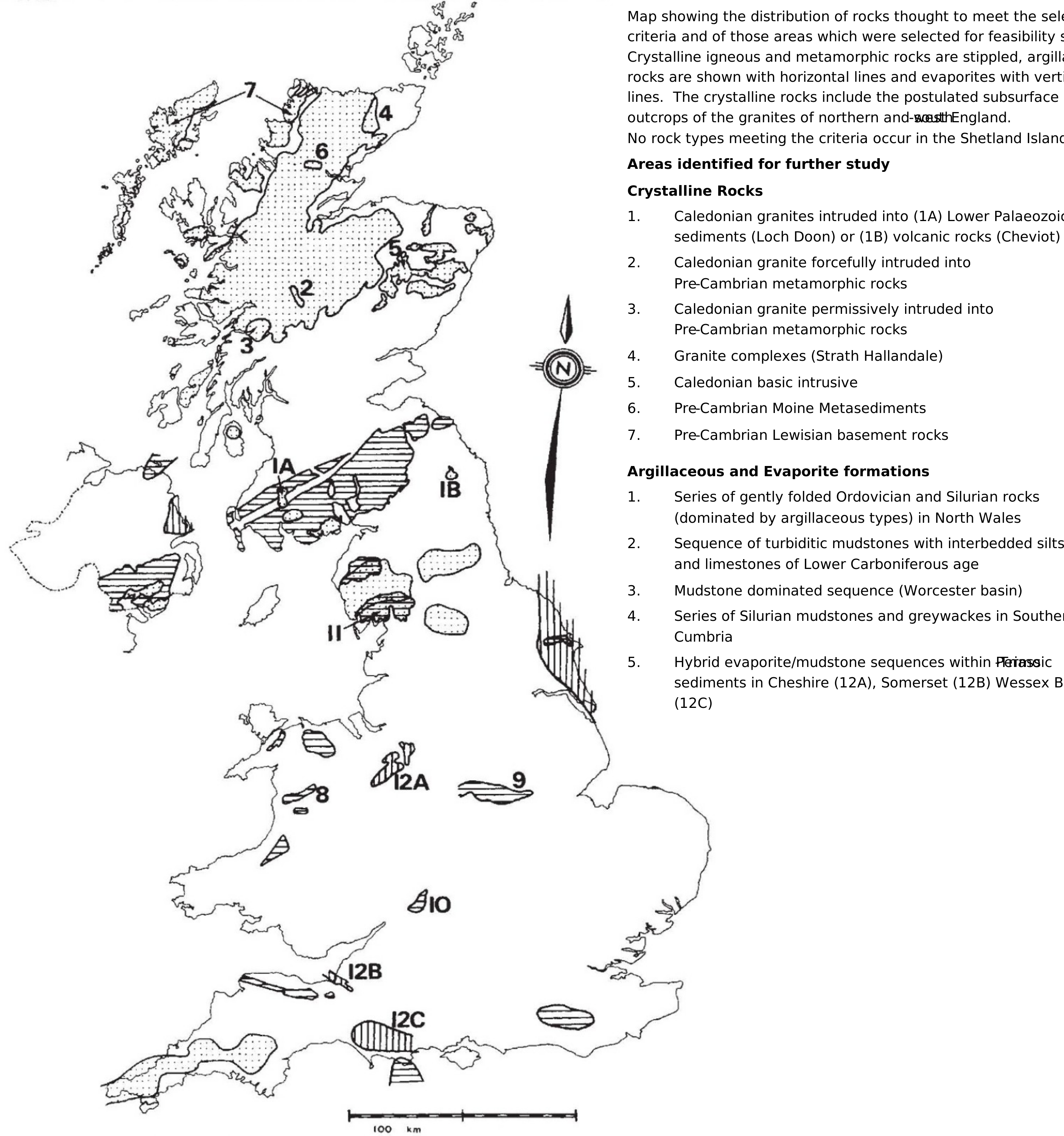
Figure C2: Compilation of areas containing all the geological environments considered suitable for deep disposal of long-lived intermediate level wastes in 1986.
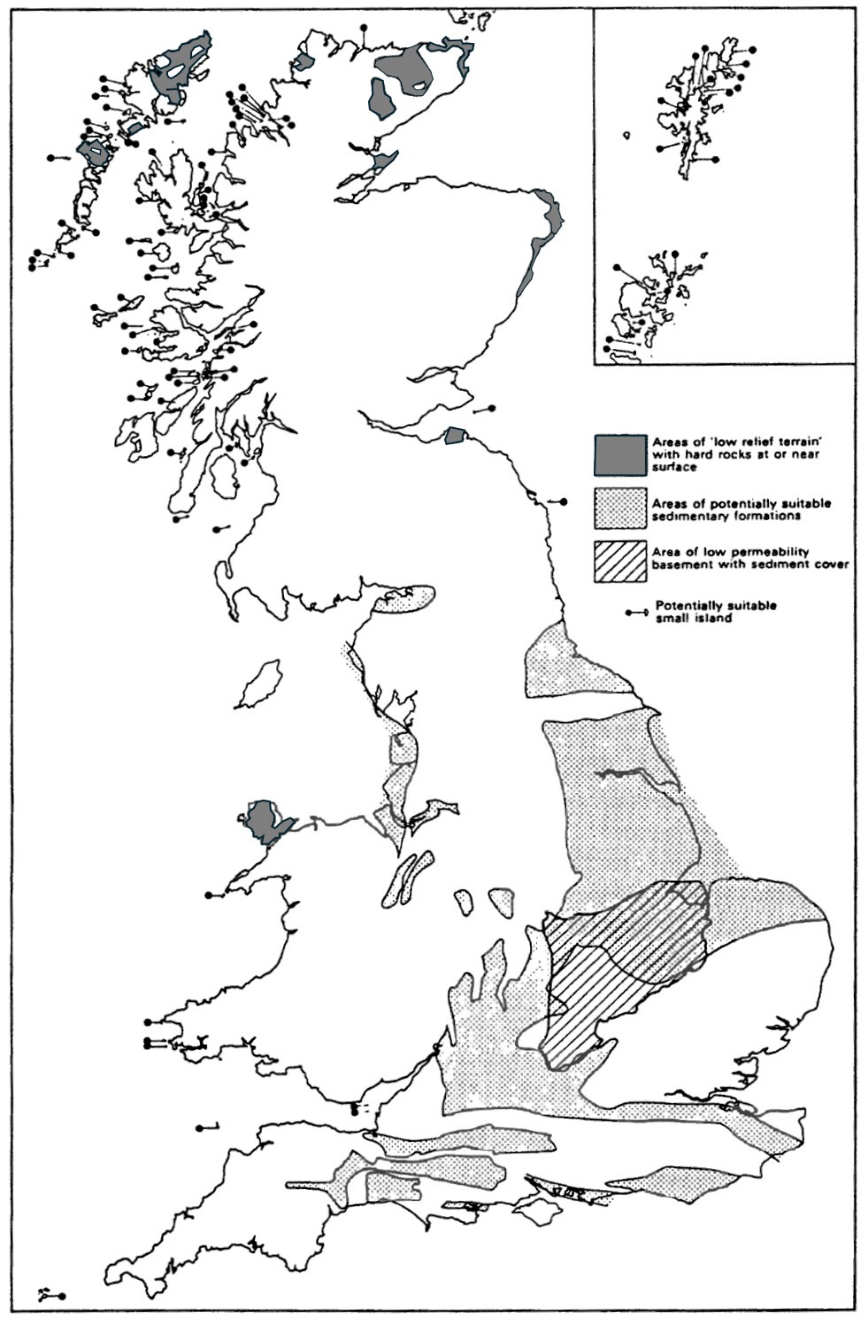
Figure C3: Areas of Geological Suitability, as published as Map 1 in ‘The Way Forward’ by Nirex in 1987
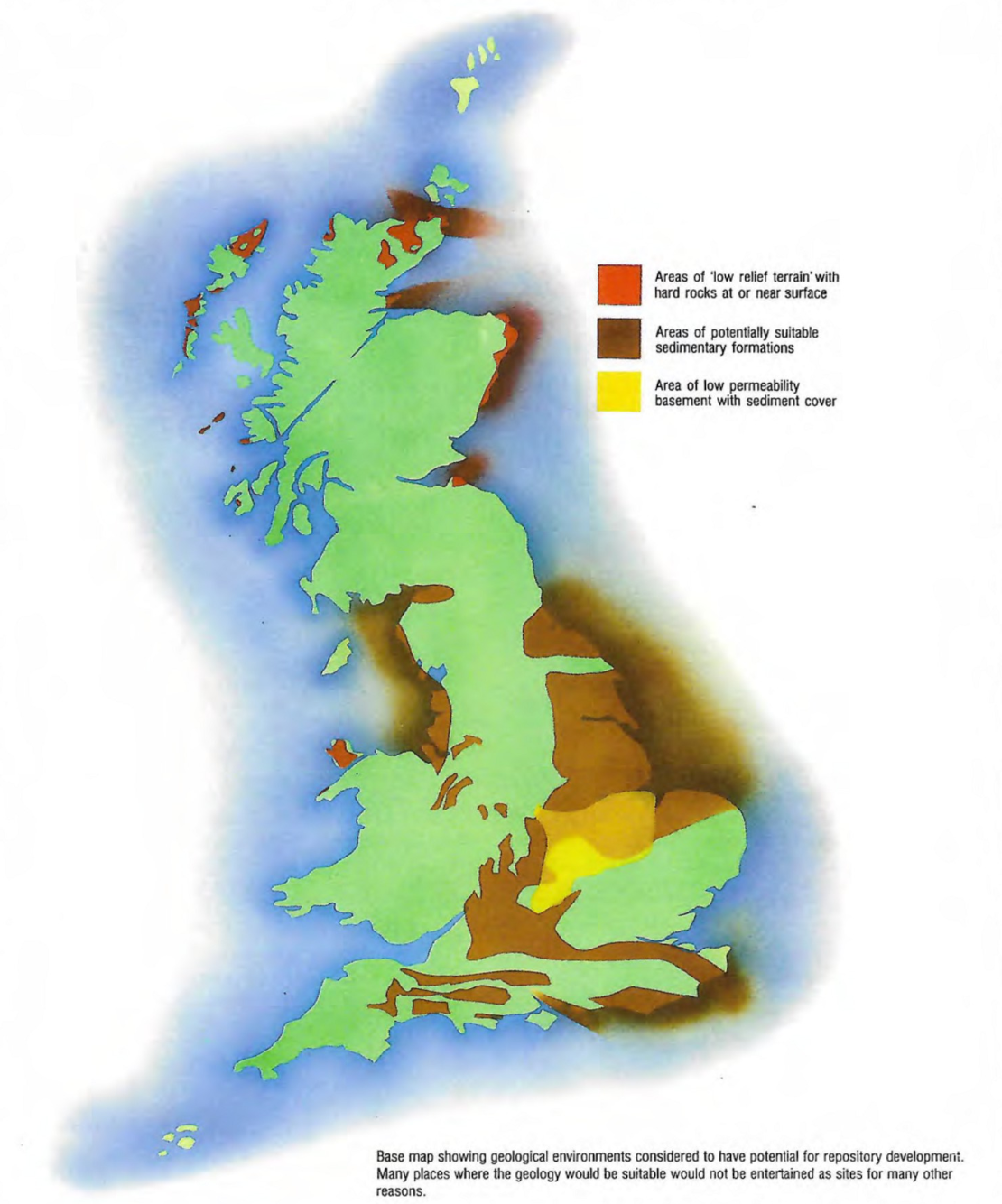
Figure C4: Geological Suitability, as published by Nirex in 1989
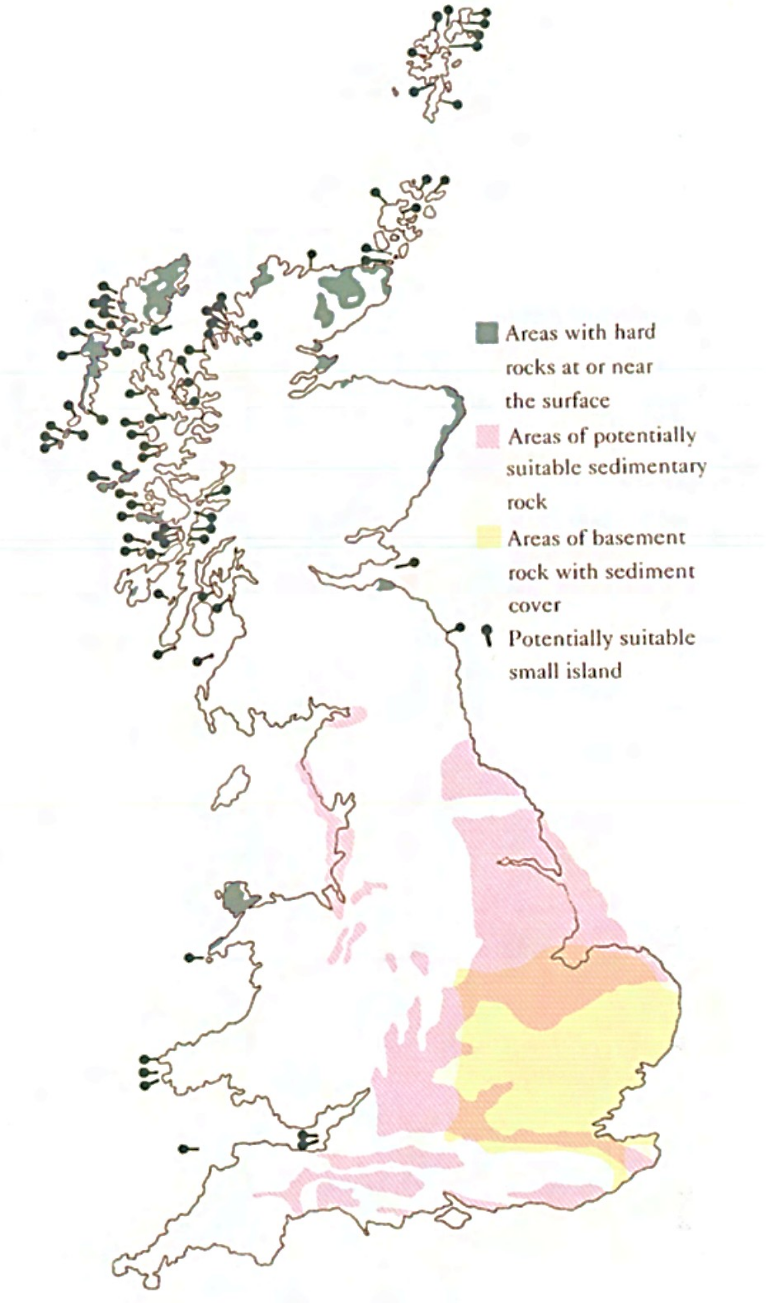
13. List of abbreviations
| Abbreviation | In full |
|---|---|
| BGS | British Geological Survey |
| BNFL | British Nuclear Fuels Ltd |
| BPEO | Best Practicable Environmental Options |
| BUSC | Basement Rocks Under Sedimentary Cover |
| CCC | Cumbria County Council |
| CDC | Caithness District Council |
| CEGB | Central Electricity Generating Board |
| CoRWM | Committee on Radioactive Waste Management |
| CP | Community Partnership |
| CRWG | Community Representation Working Group |
| DECC | Department of Energy and Climate Change |
| DEFRA | Department for Environment, Food and Rural Affairs |
| DESNZ | Department for Energy Security and Net Zero |
| DTI | Department of Trade and Industry |
| EFRA | Environment, Food and Rural Affairs |
| GDF | Geological Disposal Facility |
| GRA | Guidance on the Requirements for Authorisation |
| HLW | High Level Waste |
| HRC | Highland Regional Council |
| ICI | Imperial Chemical Industries |
| IGS | Institute of Geological Services |
| ILW | Intermediate-Level Waste |
| LC ‘72 | London Dumping Convention 1972 |
| LLW | Low-Level Waste |
| LLWR | Low Level Waste Repository |
| MADA | Multi Attribute Decision Analysis |
| NDA | Nuclear Decommissioning Authority |
| NGS | National Geological Screening |
| NIREX | Nuclear Industry Radioactive Waste Executive |
| Nirex | United Kingdom Nirex Limited |
| NPS | National Policy Statement |
| NSIPs | Nationally Significant Infrastructure Projects |
| NWS | Nuclear Waste Services |
| PCM | Plutonium Contaminated Materials |
| PERA | Preliminary Environmental and Radiological Assessment |
| PSE | Public and Stakeholder Engagement |
| RCF | Rock Characterisation Facility |
| RWM | Radioactive Waste Management Ltd |
| RWMAC | Radioactive Waste Management Advisory Committee |
| RWMD | Radioactive Waste Management Directorate |
| SoS | Secretary of State |
| ToPS | Test of Public Support |
| UKAEA | United Kingdom Atomic Energy Authority |
| WG | Working Group |
14. Additional references
Geological aspects of sub-surface high-level radioactive waste disposal. Geological aspects of Uranium in the Environment, Gray. D.A., Misc. Papers No.7, 64-73, Geol. Soc., London, 1978.
Research requirements for site selection for disposal of high-level radioactive waste. Geological aspects of Uranium in the Environment, Mather, J.D., Misc. Papers No.7, 74-80. Geol. Soc., London, 1978.
Geological Site Descriptions of Potential Sites for the Deep Disposal of Low and Intermediate Level Radioactive Wastes, McEwen, T.J., and Abbott, M.A.W., BGS Report No. WE/88/10C, 1988 (approved for issue 1989).
The geology and hydrogeology of Dounreay. Executive Summary, Nirex, Report No. 653, 1994.
The Selection of Sites at Dounreay and Sellafield to be Accorded Priority for Further Evaluation as Potential Locations for the Nirex Deep Underground Intermediate- and Low-Level Solid Radioactive Waste Repository, Baker, D.W.C., and Beale, H., Report DWCB IPTE 1458, 1995.
The geological framework of the Sellafield area and its relationship to hydrogeology, in ‘The geology and hydrogeology of the Sellafield area’, Michie, U., (ed. Chaplow, R.), Q. J. Eng. Geol., Suppl., 29, 513-527, 1996.
Role of the geosphere in deep nuclear waste disposal – An England and Wales perspective, Turner, J.P., Berry, T.W., Bowman, M.J., and Chapman, N.A., Earth Science Reviews, July 2023.
-
2022 UK Radioactive Waste Inventory, Report prepared for the Department for Business, Energy and Industrial Strategy (BEIS) and the Nuclear Decommissioning Authority (NDA) by Jacobs UK Ltd and AFRY Solutions UK Ltd. 1 February 2023. ↩
-
Nuclear Law, The Law Applying to Nuclear Installations and Radioactive Substances in its Historic Context, 2nd Edition, Tromans, S. KC, 12 March 2010. ↩
-
The MAUD Committee’s name was not an acronym or cryptic message but was adopted as a code name from a telegram sent by physicist Niels Bohr to Otto Frisch, which ended with instruction to pass his words along to “Maud Ray, Kent”. After the war, Maud Ray was identified as the Bohrs’ governess. ↩
-
Nuclear fission was discovered in December 1938 by chemists Otto Hahn and Fritz Strassmann in Germany. While bombarding uranium with neutrons, they observed that the nuclei split into smaller nuclei, such as barium, and released a large amount of energy. Physicist Lise Meitner and her nephew Otto Frisch later confirmed and named the process ‘fission’. ↩
-
Einstein sent a letter to Roosevelt in 1939, primarily drafted by physicist Leo Szilard, that warned President Roosevelt that Nazi Germany might be developing an atomic bomb. ↩
-
See Peter Hennessy, Having It So Good: Britain in the Fifties, London, Penguin Books, 2007, 144. ↩
-
Work began at Aldermaston in 1954 to develop a British thermonuclear fusion bomb, leading to the first tests in 1957-58, and ultimately to Britain being given access to US know-how and material under the 1958 Mutual Defence Agreement, whereby UK-produced plutonium was exchanged for US tritium and highly enriched uranium over the period 1960-79 under so-called ‘Barter’ arrangements. ↩
-
See www.urenco.com. URENCO was founded in 1971 following the entering into force of the Treaty of Almelo signed by the governments of Germany, the Netherlands and the UK and was incorporated as an English company in 1971. ↩
-
Atomic Energy Authority Bill, HC Deb, vol 524, cc844-967, 1 March 1954. ↩
-
The Control of Radioactive Waste, government White Paper, HMSO, 1959. ↩
-
The Radioactive Substances Act 1960, UK government, 2 June 1960. ↩
-
Radioactive Substances Bill, House of Lords Debate, 24 November 1959, vol 219 cc902-16. ↩
-
Windscale 1957: Anatomy of a Nuclear Accident, Arnold, L., Third Edition, Palgrave Macmillan, 2007. ↩
-
Atomic Energy Authority Act, UK government, 16 March 1971. ↩
-
Convention on the Prevention of Marine Pollution by Dumping of Wastes and Other Matter, International Maritime Organization treaties, 1972. ↩
-
Disposal of highly active, solid radioactive wastes into geological formations-relevant geological criteria for the United Kingdom, Gray, D. A. et al. Inst. Geol. Sciences, report 76/12, HMSO, September 1976. ↩
-
Nuclear Power and the Environment, Royal Commission on Environmental Pollution, Sixth Report, Command 6618, HMSO, London, September 1976. ↩
-
Disposal of highly active, solid radioactive wastes into geological formations - relevant geological criteria for the United Kingdom, Gray, D.A. et al., Report by the Institute for Geological Science, No. 76/12, HMSO, London, 25 June 1976. ↩
-
Burying Britain’s radioactive waste - the geological areas under investigation, Mather, J.D., Greenwood, D.A. & Greenwood, P.B., Nature Vol. 281, 4 October 1979, p332 - 334. ↩
-
The geology of some United Kingdom nuclear sites related to the disposal of low and medium level radioactive wastes, Robins, N.S., NERC Institute of Geological Sciences report ENPU 80-5, (2 parts), 1980. ↩
-
Nuclear Power and the Environment: The government’s response to the Sixth Report of the Royal Commission of Environmental Pollution, Command 6820, HMSO, London, May 1977. ↩
-
Nuclear Power and the Environment, Hansard Volume 932: debated on Friday 27 May 1977. ↩
-
Environment - Radioactive Waste Disposal, Hansard, Written Answers, House of Commons, 16 December 1981. ↩
-
RWMAC Second Annual Report, HMSO, May 1981. ↩
-
Strategy for Radioactive Waste Disposal in Crystalline Rocks, Bredehoeft, J.D. & Maini, T., Science Vol. 213, 17 July 1981. ↩
-
RWMAC First Annual Report, HMSO, May 1980. ↩
-
Radioactive Waste Management, government White Paper, Command. 8607, HMSO, July 1982. ↩
-
Nuclear Dustbin Blues, Wilkie, T., Prospect Magazine Essays, 19 May 1997. ↩
-
Review of 1987-1991 Site Selection for an ILW/LLW Repository, United Kingdom Nirex Limited, Technical Note No. 477002, June 2005. ↩
-
Radioactive Waste Management – The National Strategy, Department of the Environment, HMSO, London, July 1984. ↩
-
Session 1985-1986, HC 191-I. ↩
-
Radioactive Waste, House of Commons Environment Committee, First Report 1985-86, HC 191. ↩
-
Radioactive Waste, The government response to the House of Commons Environment Committees Report, White Paper, Command 9852, HMSO, 23 July 1986. ↩
-
Geological Environments for Deep Disposal of Intermediate Level Wastes in the United Kingdom, Chapman, N.A., McEwen, T.J. & Beale, H. British Geological Survey & United Kingdom Nirex Limited, March 1986 (published by the IAEA in the proceedings of a conference on repositories for radioactive waste, Vienna, IAEA-SM-289/37). ↩
-
The Town and Country Planning (NIREX) Special Development Order, Statutory Instruments, No. 812, 7 May 1986. ↩
-
Parliamentary Statement by the Secretary of State for the Environment, Mr. Nicholas Ridley, Hansard, Vol. 115, HC Deb., Col. 504, 1 May 1987. ↩
-
The Way Forward– A Discussion Document on the Development of a Repository for the Disposal of Low and Intermediate-Level Radioactive Waste, United Kingdom Nirex Limited, November 1987. ↩
-
Responses to The Way Forward, Environmental Risk Assessment Unit, School of Environmental Sciences, University of East Anglia, Kemp, R. & Gerrard, S., November 2008. ↩
-
Disposal of Low and Intermediate Level Solid Wastes in Rock Cavities: A Guidebook. International Atomic Energy Agency, IAEA Safety Series No. 59, Vienna, 1983. ↩
-
Deep Repository Project – Land Based Repository Site Search, Pieda, Report Ref. No. 6038/JM, 1989. ↩
-
Geological Site Descriptions of Potential Sites for the Deep Disposal of Low and Intermediate Level Radioactive Wastes, McEwen, T.J. & Abbott, M.A.W., BGS Report No. WE/88/10C, 1988. ↩
-
The Selection of Sites at Dounreay and Sellafield to be Accorded Priority for Further Evaluation as Potential Locations for the Nirex Deep Underground Intermediate and Low-Level Solid Radioactive Waste Repository, Baker, D.W.C. and Beale, H., Report DWCB IPTE 1458, 1995. ↩
-
Interim Draft ‘Description of Sites’, Nirex document NC/88/40, October 1988. ↩
-
Repository Development and Site Selection – The Present Position, Nirex document UKNL (88)45, 3 November 1988. ↩
-
Decision Analysis for Selecting Sites for Investigation for Development as a Deep Radioactive Waste Repository, L D Phillips and S Barclay, Report NX03958 by Decision Analysis Unit, London School of Economics for United Kingdom Nirex Limited, Nirex Report N/076, dated 1988 & revised 1989. ↩
-
Nirex Announces Deep Site Investigation, Press Release, United Kingdom Nirex Limited, UX/12/07, 21 March 1989. ↩
-
Written Answer from Mr Nicholas Ridley, Secretary of State for the Environment. Hansard, Vol. 149, HC Deb., WA Col. 506, 21 March 1989. ↩
-
Preliminary Environmental and Radiological Assessment/Preliminary Safety Report (PERA), Deep Repository Project, Report No 71, UK Nirex Ltd, March 1989. ↩
-
Concepts for the Geological Disposal of Intermediate-level Radioactive Waste, Hicks et al, Galson Sciences Limited for the NDA, April 2008. ↩
-
Directors Report and Accounts, United Kingdom Nirex Limited, 31 March 1990. ↩
-
Nirex Geological Archive, A report produced for United Kingdom Nirex Limited, British Geological Survey, Commissioned Report CR/01/075N, 2002. ↩
-
Directors Report and Accounts, United Kingdom Nirex Limited, 31 March 1991. ↩
-
Directors Report and Accounts, United Kingdom Nirex Limited, 31 March 1994. ↩
-
SoS for the Environment Statement on Radioactive Waste, UK Parliament, Hansard, Volume 243, Col. 534, 19 May 1994. ↩
-
Review of Radioactive Wast Management Policy, Final Conclusions, Department of the Environment, Command 2919, HMSO, July 1995. ↩
-
Rock Characterisation Facility, Planning Application, Longlands Farm, Gosforth, Cumbria, Nirex Report No. 601, July 1994. ↩
-
Disposal Facilities on Land for Low and Intermediate Level Radioactive Wastes: Guidance on Requirements for Authorisation, Her Majesty’s Inspectorate of Pollution, August 1994. ↩
-
Disposal of Radioactive Wastes in Deep Repositories: Report of a Royal Society Study Group, Royal Society, November 1994. ↩
-
The Prospects for Nuclear Power in the UK, White Paper, Department of Trade & Industry, May 1985. ↩
-
Directors Report and Accounts, United Kingdom Nirex Limited, 20 June 1996. ↩
-
Planning Inspector’s Report. Cumbria County Council; Appeal by UK Nirex Limited. McDonald, C.S., 21 November 1996. ↩
-
Radwaste Policy in tatters as Gummer blocks Nirex dump, ENDS Report 266, March 1997. ↩
-
Assessor’s Report (Appendix 1 to Inspector’s Report), Cumbria County Council; Appeal by UK Nirex Limited. Inquiry doc No. APP/H0900/A/94/247019. Knipe, C.V., 1996. ↩
-
Nirex and the great denouncement, Oldroyd, Geological Society, London, Memoirs, 2002, p.271-287. ↩
-
Radioactive Waste: Disposal, Hansard, Deb 20 May 1997 vol 580 c6WA. ↩
-
Radioactive Waste – Where Next? POST Report Summary, Parliamentary Office of Science and Technology, November 1997. ↩
-
See also Nirex Technical Note 477002 Review of 1987-1991 Site Selection for an ILW/LLW Repository (June 2005) which accepts that ‘the process used was technically sound, but it was conducted in secret and did not involve stakeholders, therefore it was not a legitimate process.’ ↩
-
High-Isolation Sites for Radioactive Waste Disposal, Waste Management 1999 Conference, Miller et al, March 1999. ↩
-
The Management of Nuclear Waste, House of Lords Select Committee on Science and Technology, HL Paper 41, The Stationery Office, 24 March 1999. ↩
-
The government’s response to the House of Lords Select Committee on Science and Technology Report on the Management of Nuclear Waste, Paper reference Dep 99/1698, 25 October 1999. ↩
-
Managing Radioactive Waste Safely, consultation paper published by Defra, Scottish Executive, The National Assembly for Wales, and Department of the Environment, September 2001. ↩
-
Developing UK policy for the management of radioactive wastes, Policy Document 12/02, Royal Society: London, UK, April 2002. ↩
-
Radioactive Waste: The government’s Consultation Process, The Environment, Food and Rural Affairs (EFRA) Committee Report, 13 February 2002. ↩
-
Managing Radioactive Waste: the government’s consultation, The House of Lords Science and Technology Select Committee report, 13 November 2001. ↩
-
Managing the Nuclear Legacy – A strategy for Action, DTI White Paper, Command 5552, July 2002. ↩
-
Site Selection and Investigations for a Deep Geological Repository: Preliminary Technical Planning in Support of the Stepwise Process, Nirex Document No 393559. Littleboy, A., & Degnan, P., July 2003. ↩
-
New team appointed to find long term solution for UK nuclear waste, Defra news release 479/03, 17 November 2003. ↩
-
Agenda for CoRWM’s 1st meeting, CoRWM Document No 6, 17 November 2003. ↩
-
While working for CoRWM, NNC was promoting its GeoMelt technology for rad-waste management, presenting it at CoRWM’s 22 February 2005 meeting. ↩
-
Sam Usher, who managed the CoRWM contract for AMEC-NNC, wrote in the in-house magazine: ‘This is a high-profile contract that puts AMEC at the leading edge of developing nuclear strategy - not only in the waste management industry, but to have an influence on new build’. ↩
-
CoRWM Principles, Document No.5, January 2004. ↩
-
Professor Gordon MacKerron: Fallout guy, The Guardian Profile article, 27 September 2005. ↩
-
Disposing of Britain’s Nuclear Waste: The CoRWM Process, Max K. Wallis, CCAB, Cardiff University, Energy & Environment, Vol. 19 No 3+4, 2008. ↩
-
GDF Bibliography (2007 to 2021), Nuclear Waste Services, September 2022. ↩
-
Bibliography (Summary 1983-2007), Radioactive Waste Management Directorate, Nuclear Decommissioning Authority, 2014. ↩
-
Radioactive Waste Management, House of Lords Select Committee on Science and Technology, Fifth Report, 9 November 2004. ↩
-
Nirex Annual Report and Financial Statements 2004-05, United Kingdom Nirex Limited, 22 June 2005. ↩
-
The long-term management of radioactive waste: the work of the Committee on Radioactive Waste Management (CoRWM), The Royal Society, Policy document 01/06, January 2006. ↩
-
A Note by the British Geological Survey and Nirex on the Suitability of UK Geology for Siting a Repository for Radioactive Waste, British Geological Survey/United Kingdom Nirex Limited, March 2006. ↩
-
Briefing Paper for CoRWM’s Holistic Assessment, Report No 1691, CoRWM, 3 April 2006. ↩
-
Nirex’s response to an invitation to comment on CoRWM’s draft recommendations, UK Nirex Ltd, Ref. 502965, May 2006. ↩
-
Managing our Radioactive Waste Safely, CoRWM’s recommendations to government, CoRWM Document 700, 31 July 2006. ↩
-
Moving Forward CoRWM’s Proposals for Implementation, CoRWM Document No 1703, July 2006. ↩
-
Response to the Report and Recommendations from the Committee on Radioactive Waste Management, UK government and the devolved administrations, PB12303, 25 October 2006. ↩
-
Nirex Annual Report and Financial Statements 2006-97, United Kingdom Nirex Limited, 11 December 2007. ↩
-
Some of the most important criticisms of the final report of CoRWM, Baverstock & Ball, 5 December 2006. ↩
-
Managing Radioactive Waste Safely: A Framework for Implementing Geological Disposal, Defra, BERR and the Welsh and Northern Ireland devolved administrations, 25 June 2007. ↩
-
Ministers Decline to Endorse Deep Storage, News Release, The Scottish Government, 25 June 2007. ↩
-
Scottish Government Question Reference:: S3W-01426, Richard Lochead, 25 June 2007 ↩
-
Burying safety issues on nuclear waste is not an option, Pete Wilkinson, The Guardian, 12 September 2007. ↩
-
Summary and Analysis of Responses to the Consultation on Managing Radioactive Waste Safely: A Framework for Implementing Geological Disposal, Defra, BERR and the Welsh and Northern Ireland devolved administrations,10 January 2008. ↩
-
Meeting the Energy Challenge, A White Paper on Nuclear Power, Command 7296, January 2008. ↩
-
Managing Radioactive Waste Safely: A Framework for Implementing Geological Disposal, DEFRA, 25 June 2007. ↩
-
Editorial, The Importance of Nuclear Waste as an Issue for E&E, Baverstock & Ball, Energy & Environment Vol. 19, No. 3+4, 2008, p379. ↩
-
NDA Statement on Separation Distance Limit between a Surface Facility and Underground Vaults, Document Nu 169, NDA/RWMD 17 June 2011. ↩
-
The Final Report of the West Cumbria Managing Radioactive Waste Safely Partnership, The West Cumbria MRWS Partnership, Copeland Borough Council, August 2012. ↩
-
Call for Evidence, Managing Radioactive Waste Safely: Review of the Siting Process for a Geological Disposal Facility, Response Form, Department of Energy & Climate Change, URN 13D/105 13 May 2013. ↩
-
CoRWM Statement on Geological Disposal, Document No. 3122, CoRWM, 13 June 2013. ↩
-
Review of the Siting Process for a Geological Disposal Facility, Consultation, Department of Energy & Climate Change, URN 13D/250, September 2013. ↩
-
Review of the Siting Process for a Geological Disposal Facility, Summary of Responses, Department of Energy & Climate Change, URN 14D/060, February 2014. ↩
-
Review of the Siting Process for a Geological Disposal Facility, government response to Consultation, Department of Energy & Climate Change, URN 14D/236, July 2014. ↩
-
Implementing Geological Disposal, A Framework for the long-term management of higher activity radioactive waste, White Paper, Department of Energy & Climate Change, URN 14D/235, July 2014. ↩
-
The Infrastructure Planning (Radioactive Waste Geological Disposal Facilities) Order, Statutory Instrument, No. 949, 2015. ↩
-
Implementing Geological Disposal, Working With Communities, Call for evidence summary report, Department of Energy & Climate Change, URN 15D/544, 26 January 2016. ↩
-
A Public Consultation, Providing Information on Geology, National Geological Screening Guidance, RWM, September 2015. ↩
-
National Geological Screening Guidance, Corporate Report, RWM, 21 April 2016. ↩
-
National Geological Screening for a GDF, Guidance, RWM, 25 January 2018. ↩
-
BGS National Geological Screening Reports, download webpage ↩
-
Implementing Geological Disposal – Working with Communities, BEIS, 2018. ↩
-
Draft National Policy Statement For Geological Disposal Infrastructure A framework document for planning decisions on nationally significant infrastructure, BEIS, 2018. ↩
-
Summary of responses to the consultation: draft national policy statement for geological disposal infrastructure, Department for Business, Energy & Industrial Strategy, July 2019. ↩
-
National Policy Statement for Geological Disposal Infrastructure: A framework document for planning decisions on nationally significant infrastructure, BEIS, July 2019. ↩
-
Consultation: Part I UK policy proposals for managing radioactive substances and nuclear decommissioning, closing date 24 May 2023, DESNZ, March 2023. ↩
-
Managing radioactive substances and nuclear decommissioning policy consultation, government response, DESNZ, May 2024. ↩
-
Managing radioactive substances and nuclear decommissioning, UK policy framework, DESNZ, May 2024. ↩
-
Consultation summary: guidance on the requirements for authorisation and staged regulation for the disposal of solid radioactive waste, Environment Agency, 12 November 2024. ↩
-
Lincolnshire County Council ‘We’re out!’: council leaves nuclear waste community partnership, 3 June 2025. ↩