
Final report
Published 17 July 2026

© Crown copyright 2026
This publication is licensed under the terms of the Open Government Licence v3.0 except where otherwise stated. To view this licence, visit nationalarchives.gov.uk/doc/open-government-licence/version/3 or write to the Information Policy Team, The National Archives, Kew, London TW9 4DU, or email: psi@nationalarchives.gov.uk.
Where we have identified any third party copyright information you will need to obtain permission from the copyright holders concerned.
This publication is available at https://www.gov.uk/government/publications/review-of-the-interaction-between-the-market-access-principles-and-englands-air-quality-domestic-solid-fuels-standards-regulations-2020/final-report
Executive summary
Our review
Following a joint referral from the four governments of the UK[footnote 1], the Office for the Internal Market (OIM) carried out a review examining the impact on the trade in solid fuels within the UK internal market of The Air Quality (Domestic Solid Fuels Standards) (England) Regulations 2020 (DSF Regulations) and associated solid fuel / air quality regulations around the UK. These regulations are intended to reduce smoke emissions to protect the environment and improve health outcomes, as particulate matter released in emissions poses a serious health concern. In 2023, domestic burning of solid fuel contributed 20.1% of total PM2.5 emissions in the UK.[footnote 2]
Air quality is a devolved competence, with the four governments each able to make their own policy in this respect. Air quality, through its connection to fuel use, is closely related to energy security, fuel affordability and other environmental objectives, such as net zero. Better air quality is a shared policy goal of all four governments.
The policy trade-offs in pursuit of this goal lie outside of the remit and competence of the OIM. Accordingly, we address the related questions of how differences in air quality regulations have affected internal market trade (including through the interaction with the Market Access Principles (MAPs) and how internal market trade might better serve the shared goal of improved air quality across the UK. The MAPs permit goods, which can lawfully be placed on the market in one nation of the UK, to be legally sold into the others.[footnote 3]
The evidence base for our review involved quantitative data from multiple sources and qualitative data from engagement with a wide range of business representative groups, manufacturer, wholesaler and retailer/merchant stakeholders, as well as public sector officials including policymakers, and environmental health and Trading Standards officers.
We have taken care to weigh all the evidence we gathered, which is largely qualitative but supported with estimated quantitative data. This is not a heavily researched sector, and our analysis and conclusions necessarily reflect an element of judgement in that we have had to balance conflicting claims, reconcile different data sets and make reasonable assumptions or inferences where evidence (particularly quantitative) is unavailable on a specific issue.
Mineral-based manufactured solid fuels (MSFs) are manufactured alternatives to traditional house coal primarily consisting of bituminous coal, petroleum coke and anthracite. Solid fuel that is manufactured and sold in England for domestic burning has to be certified as ‘Ready to Burn’ (RTB) in most circumstances; however, uncertified cheaper solid fuel manufactured in, or imported into, other parts of the UK – where RTB certification is not required – can be sold in England for domestic burning, by virtue of the application of the MAPs. Enforcement practices around the UK for solid fuel regulations vary.
The supply of MSFs comprises manufacturers, wholesalers and retailers, with it being common for businesses to operate at more than one level in the supply chain. The wholesale and retail segments have seen the most change in recent years, with the role of traditional coal merchants shrinking as new players enter the industry, including large chain bricks and mortar retailers, garage forecourts/shops, and online-only retailers.
RTB-certified MSF products carry a price premium of up to 50% over uncertified products. We heard that this price differential is of a sufficient magnitude to change consumer behaviour and competitive dynamics. The additional cost of raw materials to manufacture certified solid fuels, as well as additional RTB testing/certification costs, are the primary reasons for these price differentials.
Stakeholders reported that price is the most important factor influencing consumer behaviour. Consumers were broadly considered to prioritise affordability over other factors, particularly in the context of cost-of-living pressures. Stakeholders also told us that convenience impacts consumer behaviour. Consumers may prefer to purchase fuels through easily accessible retail channels, such as supermarkets or petrol stations, and may favour smaller, more frequent purchases rather than bulk buying. There was a consistent view that consumer knowledge and general awareness around solid fuel options is low and that consumers are not well informed about the regulatory framework, nor about the differences between certified and uncertified products. Consumer awareness of certification schemes, and specifically the Ready to Burn scheme, was limited.
There are seven large manufacturers of certified MSF operating across England, Northern Ireland (NI) and the Republic of Ireland (ROI), with both recent entry and exit. The number of coal merchants has declined considerably, partly due to overall declining demand for solid fuels and partly due to competition from newer retail distribution channels, in particular online specialists and bricks and mortar retailers who can serve customer demand for small purchases.
Many of these changes were underway before the DSF Regulations were introduced. Nevertheless, these changes have interacted with regulatory differences between UK nations and the application of the MAPs. English manufacturers – who account for the majority of sales in England – cannot sell uncertified fuels for domestic use in England (although they can supply uncertified fuel to other parts of the UK). However, manufacturers in NI can supply uncertified fuel to England, as can manufacturers outside of the UK, provided that imports into the UK do not arrive directly into England. We were told that this has created a situation where English manufacturers have become quite uncompetitive for certain customer categories.
Main findings
We estimate that 20,000 to 35,000 tonnes of uncertified solid fuel are imported into England from other UK nations and either directly or indirectly from international locations. At current wholesale prices for uncertified fuel this represents a total value of £5m to £9.6m and at current retail prices for unauthorised fuel a value of £7.9m to £15.8m. Uncertified fuel therefore represents approximately 9 to 15% of the consumption of MSFs in England, based on our estimate of 228,000 tonnes of MSF consumed in England per annum.
We estimate that at least half of all the uncertified fuel sold in England originates from manufacturers in NI. Manufacturers in NI told us that they only export certified fuels directly to England and so we infer that most of the supplies to England of uncertified fuel manufactured in NI are made through wholesalers. We were told that wholesale exports from NI rarely move directly to England. Typically, they will move first to Scotland or Wales and then on to England, with businesses in Scotland and Wales involved in breaking bulk supplies and selling on to businesses and final consumers in England. There are also some direct retail supplies into England from outside of England.
As there is not any large-scale manufacturing of MSF in Scotland or Wales, we infer that the majority of the remaining uncertified fuel sold in England is manufactured in England or imported from international locations. Most international imports are from the ROI. Businesses involved in importing from international locations indicated that much of the MSF imported into the UK from ROI is uncertified fuel originally manufactured in England. Reported sales from English manufacturers are clear that they do not directly supply the English market with uncertified fuels. It appears, therefore, that some UK-based wholesalers/traders supplying customers in England may be importing uncertified fuel from outside the UK (which may have been manufactured in England) and/or are purchasing uncertified fuel manufactured in England directly from English manufacturers. With respect to the latter scenario, we were told that some businesses in Scotland, Wales and NI purchase uncertified fuel from English manufacturers and re-export it to England.
Most of the effects of the interaction of regulatory differences and the MAPs are concentrated in England, but some coal merchants in Wales who prefer to stock certified fuels told us they have also lost sales to businesses selling uncertified fuels. NI manufacturers selling uncertified fuels into England either directly or indirectly are benefitting, as are wholesalers and retailers who are predominantly based in NI, Scotland and England. New participants have brought increased competition, but also an increased willingness to sell uncertified fuel in England and Wales.
Without an exclusion to the MAPs being put in place, it is likely there will be continuing legal competitive pressures on suppliers of certified fuels to consumers in England. The impact of these pressures would be most acute for English manufacturers and coal merchants offering certified fuels who told us it would very likely become unviable for them to continue to compete.
If an exclusion were in place, many stakeholders emphasised that strong and visible enforcement would be essential to achieving the desired impact on air quality. An exclusion would likely have differential effects on providers depending on their location and role in the supply chain:
- English manufacturers told us an exclusion would create more even competition, as they would face competition from suppliers operating under the same air quality regulations
- by contrast, manufacturers outside England generally said that an exclusion would have limited effects on their businesses. Some manufacturers in NI said this was because they already supply certified fuels into England; wholesale customers in England who could not lawfully buy uncertified fuel would buy certified fuel. Some stakeholders noted that England is not a key import destination for products manufactured in ROI / NI, including uncertified products, with Scotland representing a more significant destination
- we heard that some wholesalers and distributors based outside of England would continue to sell uncertified fuels into England if enforcement was weak. Coal merchants in England selling certified fuel might experience the clearest direct impact of an exclusion and hoped to regain some sales they consider they are currently losing to uncertified fuels
- larger retailers might also benefit from increased sales as they generally only sell certified MSF, whilst smaller retailers might consider the effectiveness of the enforcement scheme when deciding on what forms of MSF to stock
All categories of stakeholders told us that compliance with air quality rules depends both on the substance of rules, and whether those rules are clear, consistently applied and supported by product testing and enforcement.
Industry stakeholders told us of a lack of visible enforcement action, particularly against businesses operating outside formal schemes or selling through online channels. This was described as creating challenges for competition and weakening confidence in the regulatory framework. Stakeholders emphasised that they would welcome additional enforcement action.
Conclusions
Broadly, our conclusions can be summarised as follows:
- the impact of regulatory differences between nations and the MAPs has coincided with several other developments affecting the sector, for example, cost of living pressures and the emergence of online solid fuels sales as a major retail channel, which have contributed to an increase in the supply of uncertified fuels to customers in England
- many of those other developments interact with the MAPs but were in train before the MAPs started to have an effect
- the MAPs may have increased the pace of certain changes. The shift in sales from coal merchants to bricks and mortar and online retailers may have favoured uncertified fuels which we heard were more readily stocked in these newer retail channels. Similarly, by creating a legal route to supply uncertified fuels to customers in England, the MAPs have made it easier for uncertified fuels to win sales from certified fuels
- the sector will probably continue to evolve towards uncertified fuel in the absence of an exclusion from the MAPs
- an exclusion from the MAPs would likely slow down some of the observed trends, but absent other supporting measures, including improvements in enforcement, incentives to supply uncertified fuels in England will likely persist even if the effect of the MAPs is removed by an exclusion
The substantial price differential between certified and uncertified fuel has, in our view, had a significant effect on the sector. It has introduced an incentive and opportunity for consumers in England to be easily targeted by suppliers of uncertified products. The recent trend for consumers to purchase MSF either online or in smaller quantities at (non-chain) bricks and mortar stores has increasingly exposed them to uncertified products. Furthermore, there is a complex regulatory environment for the domestic burning of solid fuels in the UK, even in the absence of the MAPs. We consider this produces a regulatory landscape that is difficult for consumers, suppliers and enforcers to navigate efficiently. None of these elements arise because of the MAPs, but the MAPs add an additional layer of complexity.
The complex regulatory and business landscape interacts with limited enforcement capacity and consumer habits. With respect to enforcement capacity, we note that the regulations are difficult to enforce due to both the challenges of obtaining appropriate evidence and the range of possible legal defences due to the structure of the regulations. Limited enforcement capacity is stretched further by the need for laboratory testing of products to support any prosecution.
Consumer habits have interacted with the MAPs and with recent industry developments. While we observe a demand for premium, mostly certified products, there is clearly also a demand for cheaper uncertified fuels. We accept the view that many consumers prioritise product characteristics of heat output, low ash and price over environmental considerations. In our view, this has created conditions in which a significant proportion of consumers could choose to buy uncertified fuels. Our cautious assessment is that this process is still playing out; more consumers in England may move their purchases to cheaper uncertified fuels over time if these products remain available for purchase.
Taking the evidence in the round, we conclude that if the current regulatory status quo is maintained then customers in England will continue to purchase increasing quantities of uncertified fuels, with a consequent risk of worsening air quality in England.
A further factor driving change will be the future business models and strategic choices of merchants and manufacturers. In this context, we note that the expansion of the share of supply of uncertified fuels could become self-reinforcing. Merchants ultimately need to stock what customers wish to buy. Similarly, manufacturers in England will need to consider their strategic response. This might include, for example, considering relocating some production facilities to other parts of the UK and/or reducing the scale of their English production activities.
Notwithstanding these observations, our research leads us to conclude that any exclusion from the MAPs, if one is introduced, would both need to be carefully framed to avoid restricting competition between suppliers of certified fuels and would not achieve its full impact without appropriate enforcement of the DSF Regulations. We accept the view that there are many participants in the supply and purchase of MSF (including some consumers) who will only sell and buy certified fuels if an exclusion is in place. But we consider it possible, based upon stakeholder evidence, that non-compliance could become significant even with an exclusion, and we encountered businesses who said they would continue to supply uncertified fuels unless there was a credible threat of enforcement action.
Recommendations
We propose that a holistic approach is taken to the management of the UK internal market with respect to the impact of the DSF Regulations. Individual measures are unlikely to work fully in isolation but could form part of a coordinated package of measures. Ultimately it will be for the four governments to determine which actions to take forward in line with their policy priorities, taking into account the costs and benefits of further interventions.
Given that a root cause of the difficulties facing policymakers and market participants in this sector is the complexity of the regulatory framework as it applies across the four nations of the UK, we recommend that any action taken in response to this report is done so on the basis of dialogue between the four governments through the Air Quality Common Framework.
In this context, the Air Quality Common Framework could agree to make a joint request for an exclusion from the MAPs.[footnote 4] Based on our analysis, we consider that an exclusion of MSF from the MAPs in England would slow down the expansion of the share of supply of uncertified fuels and thereby support the UK Government’s policy aims in relation to air quality in England.
While an exclusion from the MAPs would, in our view, be a necessary condition to enable the DSF Regulations to have their desired impact, we consider that effective enforcement will be central to the successful operation of air quality regulation across the UK internal market under any scenario. We recommend further discussion within the Air Quality Common Framework of issues relating to enforcement, including how policy design affects enforcement. Enforcement of air quality regulation is likely to be most effective if both the regulation and the enforcement regime around it are designed in a manner that combines technical ease of enforcement with low costs of implementing enforcement. Both characteristics will be more easily achieved where the four governments coordinate their next steps in relation to air quality and solid fuels regulation.
Discussion within the Air Quality Common Framework might over time lead to alignment of regulations governing the composition of solid fuels for domestic burning, and perhaps other regulatory changes which might ensure easier and less costly enforcement. If harmonisation is not reached, then close management of the impact of the differences in regulation through Common Frameworks, as envisaged in the UK Government response to the UKIMA review,[footnote 5] would mitigate the effects on internal market trade and air quality.
Background and evidence
This report sets out the findings from our review into the interaction between the MAPs and England’s Air Quality (Domestic Solid Fuels Standards) Regulations 2020. This follows a joint request from the UK, Scottish and Welsh Governments and the Northern Ireland Executive.
As part of our review, we examined the cross-border sales of certified and uncertified manufactured solid fuel (MSF) and house coal. We considered the role of the MAPs and their impact on market participants across the supply chain, taking into account other regulatory and market conditions. We launched our review on 30 April 2026.
The report is laid out as follows:
- section 1 sets out relevant background
- section 2 contains our main findings
- section 3 summarises our conclusions and sets out our recommendations to the four governments
- appendix A – Glossary
- appendix B – Legal context
- appendix C – Data methodology
The policy context
Air quality is a devolved competence, with the UK, Scottish and Welsh governments and the Northern Ireland Executive each able to make their own policy in this respect. Air quality is closely related to energy policy in so far as it relates to what types of fuels are used, where they are used, and in what quantities. This connects air quality policies to energy security, fuel affordability and other environmental objectives, such as net zero.
This creates policy trade-offs that the four governments must legitimately consider and prioritise. In this respect, we note that domestic combustion of solid fuels is one of the two largest sources of pollution from PM2.5 particulate matter[footnote 6], comparable with emissions from road transport. Defra has acted to improve air quality by regulating the composition of MSF burned in England, and the governments of Scotland and Wales and the Northern Ireland Executive are also working towards improved air quality in their respective nations. Better air quality is therefore a shared policy goal of all four governments. The policy trade-offs in pursuit of this goal lie outside of the remit and competence of the OIM.
The OIM’s statutory objective is to support the effective operation of the internal market in the UK through the application of economic and other technical expertise,[footnote 7] and we have prepared our report with that objective in mind. We have taken as our starting point that Defra Ministers have chosen to pursue improved air quality through the regulation of MSF. Accordingly, we address the related questions of how differences in air quality regulations have affected internal market trade (including through the interaction with the MAPs) and how internal market trade might better serve the shared goal of improved air quality across the UK.
Legal basis for the review
The OIM’s functions include monitoring and reporting on the operation of the UK internal market[footnote 8] – in other words, markets for goods and services and the recognition of professional and other qualifications in England, NI, Scotland and Wales.[footnote 9]
The OIM has power under section 33(1) of the Act to undertake a review of any matter that it considers relevant to assessing or promoting the effective operation of the internal market in the UK. The OIM may prepare a report on the matters considered in the review and may publish it in such a manner as the OIM considers appropriate. We have prepared this review under these powers.
On 30 April 2026 the OIM accepted a request, made under s33(2) of the Act, from the four governments of the UK coordinating via the Air Quality Common Framework to undertake a review under section 33(1) of the Act. The request is the first such joint referral to the OIM. In line with the CMA’s Annual Plan commitment to deliver proportionate and timely advice to governments on regulatory differences, we have run this project as a ‘short-form review’ with a tight timescale and focus.[footnote 10]
Further information on the OIM’s functions and powers can be found in Chapter 2 of the Guidance on the Operation of the CMA’s UK Internal Market Functions.[footnote 11]
Evidence base
We drew our evidence base from a range of sources in each of the four nations of the UK and in ROI.
A key component of our evidence base is 45 interviews with industry stakeholders (including SME coal merchants, manufacturers, distributors, wholesalers and retailers), consumer bodies, Trading Standards, government officials and regulatory bodies. We spoke with approximately equal numbers of industry participants and government officials in each of the nations of the UK.
We drew on quantitative data from multiple sources, including HMRC import and export data, HMRC Climate Change Levy data, Department for Transport (DfT) Port Freight Statistics, the National Atmospheric Emissions Inventory (NAEI) database and the Heat Equipment Testing and Approvals Scheme (HETAS) database (unpublished). In addition, industry stakeholders provided quantitative data on production volumes, geographic sales markets and prices.
We have carefully weighed our evidence base, which is largely qualitative but is supported with quantitative data where available. The analysis and conclusions we set out reflect an element of judgement in that we have had to balance conflicting claims, reconcile different data sets and make reasonable assumptions or inferences where evidence (particularly quantitative) is unavailable on a specific issue.
We are grateful to all the stakeholders who helped us with our research.
The Relevant Products
The products in scope of the review include a range of naturally occurring and manufactured products (a glossary of terms is at Appendix A):
- bituminous coal, also known as traditional house coal, has a carbon content of approximately 60 to 80% and contains bitumen or asphalt
- anthracite is the rarest form of coal with the highest carbon content, between 86 to 98%
- mineral MSFs are manufactured alternatives to traditional house coal and anthracite. They are produced by blending mineral ingredients such as bituminous coal, anthracite, petroleum coke, and plant-based derivatives. Smoke emissions vary depending on the ingredients, and the fuels may be certified or uncertified
- in addition, whilst not strictly in scope of the review, we have also considered wood-based MSFs, as these are alternative solid fuel products in competition with mineral-based ones. Wood-based MSFs are biomass products made by processing and compressing woody materials into uniform fuel-efficient burning blocks.[footnote 12]
MSF can be authorised, certified or neither. Authorisation and certification are granted by the UK-wide HETAS scheme, subject to the products meeting certain requirements with respect to emissions and composition. HETAS also maintain a register of authorised and certified fuels, with each fuel allocated an authorisation / certification number.
Smoke Control Areas (SCAs) are areas where smoke cannot legally be released from a chimney. Authorised MSFs are suitable to be burnt in appliances for which they are designed, in specific SCAs,[footnote 13] with most authorisations applying to all SCAs in the UK but with some products authorised only for particular jurisdictions. Certified fuels are compliant with Defra’s Ready to Burn scheme allowing them to be sold in England for domestic burning. Certified fuels will also meet the standards of authorised fuels and can be burnt across the UK including in SCAs. Uncertified and unauthorised mineral MSF is generally higher in volatile content and sulphur, burns hotter, and emits more smoke than certified MSF.
Composition of MSF and the origin of raw materials
MSF is produced using a combination of three primary raw materials: petroleum coke (pet coke), anthracite, and bituminous coal, with binding products used to combine the materials.
Pet coke typically forms the largest component. Stakeholders reported that both high-sulphur and low‑sulphur variants of pet coke are used, with the latter generally required to meet the regulatory threshold of no more than 2% for sulphur content. Stakeholders noted that higher-grade low-sulphur pet coke is often used for industrial purposes and is therefore more expensive to source, contributing to the higher production costs of certified, low-sulphur MSF.
Anthracite is also sometimes used in the production of MSF, although it typically forms a smaller component due to its higher cost relative to both pet coke and bituminous coal. Anthracite produces very little smoke when burnt. This means that fuels with a higher proportion of anthracite are more likely to meet certification requirements under the DSF Regulations.
The final component of MSF is bituminous coal. Whilst the price of bituminous coal is significantly lower than both anthracite and pet coke, its use is limited due to the fact that it produces significant volumes of smoke when burnt. This means that it is more commonly used in greater quantities in lower-quality uncertified MSF.
Health and Environmental Impacts
The use of MSF has implications for public health. Particulate matter (PM) in the air, especially PM less than 2.5 micrometres in diameter (PM2.5), poses a serious health concern when inhaled and accumulated in the respiratory system.[footnote 14] SO₂ emissions are also of concern, as they can exacerbate asthma and are associated with respiratory mortality.[footnote 15] Exposure to PM2.5 has also been linked to respiratory and cardiovascular disease, particularly among vulnerable groups such as children, older people and those with pre-existing conditions. In 2023, domestic burning of solid fuel contributed 20.1% of total PM2.5 emissions in the UK.[footnote 16]
The environmental impacts of MSF vary based primarily on the raw materials used in the product and the efficiency of the appliance used to burn the fuel. Higher-sulphur fuels (which would be uncertified) produce higher emissions of particulate matter and sulphur dioxide.
Air quality regulations and the Market Access Principles
There is a complex set of regulations around environmental law, air quality, domestic burning of solid fuels and the MAPs, which interact and can differ by nation. This section briefly covers each of these areas and considers enforcement. More detail on the specific regulations can be found in Appendix B.
Environment
Environment policy is a devolved matter and the Environment Act 2021 requires the Secretary of State to set long term environmental targets for England. The devolved governments have each published plans and legislated to set targets for improving air quality and reducing emissions. England, Wales and Scotland have each set a target of achieving a PM2.5 concentration limit of 10µg/m3,[footnote 17] although the timeframe for doing so differs between the nations, and NI has a limit for PM2.5 of 25µg/m3.
Air quality
The Clean Air Act 1993 and Environment Act 1995 constitute the main legal framework for controlling air quality in England, Scotland and Wales. In NI, equivalent provisions are in the Clean Air (Northern Ireland) Order 1981 and the Environmental Better Regulation Act (Northern Ireland) 2016.
SCAs are used to control air quality, with local authorities in England, Wales and Scotland, and district councils in NI, having power to declare some or all of their area an SCA.[footnote 18] Each UK nation has its own list of approved fuels which may be burnt, and throughout this report we refer to fuels that appear on the approved lists as ‘authorised fuel / authorised MSFs’.
There are clear challenges with enforcement of SCAs. For example, whilst it is an offence for occupiers to emit smoke in SCAs, they can only be prosecuted on sufficient evidence of smoke having been emitted, and whilst it is an offence to supply, sell or offer unauthorised fuels, a possible defence is that the person accused of doing so believed and had reasonable grounds to believe that the fuel was to be burnt in an approved fireplace such as an exempt stove.
Manufactured Solid Fuels
The DSF Regulations control the sale (in England only) of solid fuel for domestic use. They apply across the whole of England unlike SCAs, which are local. The regulations prohibit the supply and sale of bituminous coal (house coal) and of wet wood in volumes under 2m³. MSF must be authorised as complying with limits on sulphur content of 2% and smoke emission limits of a PM2.5 concentration of less than 5µg/m3. Local authorities enforce these requirements and can issue fixed penalty notices or pursue court action.
The DSF Regulations extend the system of control of air quality across all of England, prohibit emissions of smoke and control the fuels that can be used for burning. The DSF Regulations form part of the UK Government’s strategy for securing the implementation of international agreements relating to the quality of air.
Scotland, Wales and NI do not have similar regulations in place, and outside of SCAs it is permissible for a wide range of solid fuels to be used, including bituminous coal.
Interaction between the MAPs and air quality regulations
Part 1 of the United Kingdom Internal Market Act 2020 (UKIMA) promotes the functioning of the UK internal market for goods through the MAPs of mutual recognition and non-discrimination to counter barriers to trade within the UK internal market.
The principle of mutual recognition is particularly relevant in the current context. It establishes that goods which have been produced in, or imported into, one part of the United Kingdom, and can be sold there without contravening any relevant requirements that would otherwise apply to their sale.[footnote 19]
The prohibitions in the DSF Regulations apply in England (but not in the rest of the United Kingdom) to all supplies of MSF, wood and coal irrespective of whether supply of these goods is permitted or not permitted in other parts of the UK and irrespective of whether the supply is for use inside or outside an SCA.
This raises the possibility that importers to England of solid fuel which is permitted to be supplied in other parts of the UK, but which does not comply with the DSF Regulations, may nevertheless seek to rely on the mutual recognition of goods principle. In such a case, the importer would rely on the MAPs to supply uncertified solid fuel in England free from the prohibition in the DSF Regulations which would otherwise apply.
This creates a risk that the application and benefits of the DSF Regulations in reducing PM2.5 and sulphur dioxide (SO2) emissions in England may be undermined. The extent to which this risk applies in practice and possible mitigations are one of the key issues for this review.
The enforcement landscape
Enforcement of air quality legislation is principally led by Trading Standards and environmental health teams of local authorities, although their responsibilities differ. Trading Standards teams are typically focused on metrology (weights and measures) and may not have specialist expertise in fuel composition, smoke control rules or online solid fuel sales. In England, Trading Standards officers do, however, undertake some checks for the Ready to Burn logo being present on MSF bags.
Environmental health teams may respond to smoke complaints, but we heard that their role is often framed around air quality management and providing advice rather than formal prosecution. This means that enforcement outcomes can differ across councils, even where the underlying issue is similar.
Industry trends
At the UK level the demand for coal and mineral-based MSF is in decline, with some changes in product mix. Restrictions on sales of traditional house coal for domestic burning in England were phased in between 1 May 2021 and 1 May 2023, with domestic sales of coal sharply reducing in England, and more slowly declining across the rest of the UK. UK-wide sales of coal for domestic use fell from 491,000 tonnes in 2019 to 41,000 tonnes in 2024.[footnote 20] Similarly, industry estimates are that sales of mineral MSF have fallen over the same period from approximately 400,000 tonnes in 2019 to 300,000 tonnes in 2025. By contrast, sales of wood have increased from 782 kilotonnes of oil equivalent (Ktoe) in 2019 to 1,035 Ktoe in 2024.[footnote 21] Increased use and/or installation of other heating sources have also impacted sales of coal and mineral-based MSFs across the UK, including heating oil, bottled gas and all forms of central heating.
Figure 1.1. Consumption of selected solid fuels 2019 to 2024 (2019=100)
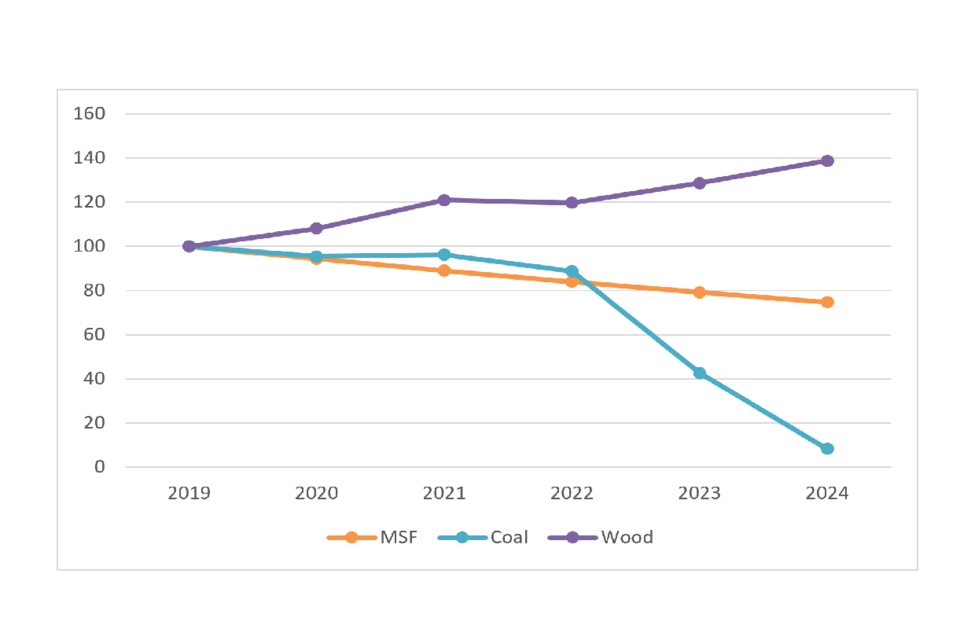
The figure shows the trends in the consumption of three solid fuels in the UK: coal, manufactured solid fuel, and wood.
Consumption is normalised to 100 in 2019.
Coal declines from 100 in 2019 to 8 in 2024.
Manufactured solid fuel declines from 100 in 2019 to 75 in 2024.
Wood increases from 100 in 2019 to 139 in 2024.
Source: Digest of UK Energy Statistics (coal, wood); OIM estimates (MSF).
Industry structure
The supply of mineral MSF for domestic use is characterised by a supply chain with manufacturers, distributors/wholesalers and retailers, with some businesses carrying out activities at more than one level of the supply chain.
While imports and exports play a role, most MSF consumed in the UK is produced within the UK, with 6% imported in 2025. Of that, the majority (92%) was imported from ROI in 2025, with the residual spread amongst a range of countries including Germany, Australia and France.
There are three large manufacturers of certified MSF that operate production facilities in England, three that operate production facilities in NI and one in ROI (plus a further ROI production facility operated by one of the three English manufacturers).[footnote 22] Collectively, the UK-based manufacturers produce at least 317,000 tonnes per annum, of which we estimate over three-quarters is produced in England.
Many wholesalers also act as retailers selling to customers directly. Wholesalers, as well as buying MSF in bulk from manufacturers and selling to retailers, may also be involved in importing, sorting and bagging coal (coal not being manufactured in the same way as MSF).
The retail segment of the supply chain comprises a diverse range of distribution channels, including traditional coal merchants, bricks and mortar retail outlets (in particular DIY stores), garden centres and petrol forecourts (as well as to a lesser extent other types of shops), specialist online retailers, and some roadside vendors, particularly in border areas where sellers look to take advantage of differing regimes.[footnote 23] Some manufacturers and wholesalers make retail sales alongside their main business.
Differences between retail distribution channels
There are three main retail distribution channels: traditional coal merchants, bricks and mortar retailers, and online specialist vendors. It is estimated there are around 400 coal merchants in the UK accounting for approximately 40 to 50% of total sales, with 25 to 35% sold through bricks and mortar retail outlets and approximately a further 25% sold through online sales.
Traditional coal merchants make direct deliveries to consumers, typically within a local area – often within a 30 to 50-mile radius of the merchant. Many coal merchants are members of a trade association which has a code of conduct and seeks to ensure merchants have the knowledge to advise their customers about solid fuels, including what makes a good fuel and how to get the best out of them. Stakeholders suggested that the closer and often long-standing nature of their relationships with their customers made coal merchants less willing to stock low quality fuels than other retail distribution channels.
Bricks and mortar retailers will typically sell only bagged products but generally will not deliver, with most sales being made in person. Consequently, sales are usually for smaller quantities, with this distribution channel being particularly popular with both occasional users and consumers on restricted budgets who may only be able to afford relatively small purchases at any point in time.
Specialist online vendors (ie retailers without a bricks and mortar presence) usually make deliveries via couriers. This typically gives them national coverage, in contrast to coal merchants and most other bricks and mortar retailers, with the exception of some of the national retail chains.
Methods of sale vary between retail distribution channels. Online options are now prevalent across most channels, although not all coal merchants have online options, and whilst some larger retailers do offer online sales, many smaller retailers such as petrol forecourts and rural convenience stores only offer in-person sales. Specialist online vendors may reach their customers via their own website or through social media platforms.
Price differentials between certified and uncertified solid fuels
We were told by stakeholders that certified solid fuels carry a substantial price premium over uncertified alternatives, with the retail price for uncertified fuel sometimes lower than the wholesale price or even the production costs for certified fuel. Stakeholders told us that this differential is large enough to shape purchasing behaviour and competitive dynamics. Certified solid fuels are more expensive to make primarily because many of the raw materials are more expensive, and the cost of gaining Ready to Burn certification, including testing, increases costs too.
Table 1 sets out estimated typical price ranges at the wholesale and retail levels for certified and uncertified fuels. The figures represent estimates for a generic certified and uncertified product based on industry data. In practice, prices vary between producers due to differences in branding and quality, and wholesale prices in particular are influenced by the volume being purchased. The figures are therefore indicative.
Indicative price ranges for certified and uncertified MSF
| Wholesale ex VAT (£) - Tonne (delivered) | Wholesale ex VAT (£) - 20kg bag | Retail ex VAT (£) - Tonne (delivered) | Retail ex VAT (£) - 20kg bag | |
|---|---|---|---|---|
| Uncertified fuel | 250 - 275 | 5 - 5.5 | 395 - 450 | 8 - 9 |
| Certified fuel | 360 - 400 | 7.2 - 8 | 575 - 600 | 11.5 - 12 |
Source: OIM estimates
This significant difference in prices, which can be as high as 50%, creates an incentive for consumers to purchase uncertified fuel, and by extension for retailers, wholesalers and – where they have a choice – manufacturers to offer the cheaper uncertified products either exclusively or as part of a range of products that includes certified fuels. Stakeholders considered this particularly acute in online and bricks and mortar sales channels, where consumers often find it easier to compare prices between rival products, compared with the more time-consuming process of telephoning coal merchants for a quote.
Shipping costs play a relatively modest role in overall pricing. The majority of MSF sold in the UK is manufactured in the British Isles and shipping costs between the island of Ireland and Great Britain (GB) are around £15 per tonne (or approximately 2.5% of the total price for a one tonne delivery of certified MSF). We consider this is unlikely to offset the wider cost advantages that uncertified fuel enjoys.
Consumer behaviour, knowledge and needs
Stakeholders reported that price is the most important factor influencing consumer behaviour. Consumers were broadly considered to prioritise affordability over other factors, particularly in the context of cost-of-living pressures. While some consumers express a preference for cleaner fuels, this is generally secondary. This characterisation of consumer preferences was considered to be especially pronounced in rural areas of Scotland, Wales and NI, where solid fuels are more likely to be the primary or only source of heating.
Alongside price, stakeholders reported that consumers place importance on the functional performance of fuels. In particular, they seek products that are easy to light, provide a strong heat output and produce relatively little ash. We noted that some products referenced being ‘smokeless’ even if they did not carry the Ready to Burn logo, which suggests that low smoke output may have some importance with consumers.
Some consumer reviews noted that the odour emitted when a product is burnt can be an important factor. However, we did not see evidence to suggest that environmental factors, such as sulphur content, emission levels or compliance with legislation play a central role in many purchasing decisions.
Stakeholders also told us that convenience impacts consumer behaviour. Consumers may prefer to purchase fuels through easily accessible retail channels, such as supermarkets or petrol stations, and may favour smaller, more frequent purchases rather than bulk buying.
Demand for solid fuels, and the installation of stoves is likely to be affected by concerns about energy security, particularly in NI where only around a third of the population have access to the gas network (compared with 85% in GB). We were told that there had been an increase in installation of stoves following Russia’s invasion of Ukraine in 2022.
Across all stakeholder groups, there was a consistent view that consumer knowledge and general awareness around solid fuels is low and that consumers are not well informed about the regulatory framework, nor about the differences between certified and uncertified products.
In particular, knowledge of certification schemes, namely the Ready to Burn scheme, was limited. This suggests that, while manufacturers and suppliers may understand the regulatory requirements when producing MSF, consumers are largely unable to identify whether a particular product meets these requirements. Stakeholders noted that this is made more difficult by the fact that fuels that do not carry the Ready to Burn logo may still be branded as ‘smokeless’ as recognised under the authorisation regime, meaning consumers need to actively search for the logo in order to discriminate between products. These factors suggest that certification may not currently inform consumer behaviour to a material extent when purchasing solid fuels.
Stakeholders told us that consumers are moving away from traditional retailers, such as coal merchants, towards other retail channels including bricks and mortar retailers and online specialist vendors. The latter includes sales made through social media platforms, such as Facebook Marketplace. The informal nature of these channels – and the absence of detailed product descriptions on them – means that there is limited visibility on whether products comply with regulatory requirements, however, this has not prevented consumers from migrating towards them.
We saw little evidence to suggest that consumers are likely to raise complaints in relation to solid fuels, except in cases where there are significant problems. We heard in our engagement that complaint volumes in this market are relatively low, which may reflect both the smaller size of the consumer base and a lack of awareness or engagement with the issues. On the small number of occasions that complaints do arise, they tend to relate to high levels of smoke emissions, odour (namely a noticeable smell of sulphur), or the fuel producing little heat.
Competitive dynamics
At the top of the mineral MSF supply chain, there are eight manufacturers operating across England, NI and ROI. Over the last five years one manufacturer in each of ROI and Wales has exited the market. There have been at least two relatively recent new entrants to the market for the supply of MSF.
At the wholesale level, larger distributors and wholesalers have opened distribution centres to maximise efficiencies in logistics by operating on a national or a UK-wide scale.
The retail sector has also been undergoing changes. The number of coal merchants has declined considerably, partly due to overall declining demand for solid fuels and partly due to competition from new retail distribution channels, notably online specialists and bricks and mortar retailers who can serve customer demand for small purchases (20kg bags). Some coal merchants in both England and Wales told us they are unwilling to sell uncertified fuels to their customers due to concerns about quality.
Transport costs within the British Isles (UK and ROI) are low enough for exports and imports between GB, NI and ROI to play an important role in the overall supply of MSF in each nation. According to overseas trade data from HMRC, exports of MSF from UK to ROI were 19,200 tonnes in 2025, with exports from ROI to UK amounting to 15,652 tonnes over the same period.[footnote 24] According to the DfT, exports of coal (including MSF) from NI to GB were 6,519 tonnes in 2024 with 43,922 tonnes exported from GB to NI.[footnote 25]
Many of these industry changes were underway before the DSF Regulations were introduced. Nevertheless, these changes have interacted with the MAPs. English manufacturers – who account for the majority of sales in England – cannot sell uncertified fuels for domestic use in England (although they can supply uncertified fuel to other parts of the UK). However, manufacturers in NI can supply uncertified fuel to England, as can manufacturers outside of the UK, provided that imports into the UK do not arrive directly into England. We were told that this has created a situation where English manufacturers cannot properly compete.
We discuss the consequences of these recent changes in the context of the interaction between regulatory differences and the MAPs in Section 2, where we set our assessment of the possible evolution of the supply and demand for MSFs under different scenarios.
Main findings
In this section, we set out our main findings with a particular focus on the likely evolution of the supply and demand for MSF in the scenarios in which MSF is excluded from the market access principles and in which it is not.
We look first at the current supply and demand conditions for different types of MSF across the UK, and the role of the MAPs in shaping those conditions, including implications for intra-UK trade. We then consider how the supply and demand for MSF might evolve under different policy scenarios, including an exclusion from the MAPs.
Current trade flows and the influence of the MAPs
Solid fuel industry trade flows within the UK are complex. Between production and consumption, MSF can move across no UK internal borders or several – there is no simple, single model for the geographic footprint of a ‘typical’ supply chain. In this sub-section we set out what we know or can infer about sales of certified and uncertified MSF and trade flows within the UK.
How much uncertified fuel is being sold in England?
There is no centrally maintained database that records how much uncertified fuel is being sold in England. We have therefore estimated the sales of uncertified fuels in England; our methodology is set out in Appendix C. The need to make certain assumptions in deriving an estimate means that we present our estimate as a range. We estimate that 20,000 to 35,000 tonnes of uncertified fuel was sold in England in 2025.
At current wholesale prices for uncertified fuel (see Table 1.1) this represents a total value of £5m to £9.6m and at current retail prices for uncertified fuel a value of £7.9m to £15.8m.
Uncertified fuel therefore represents between 9 to 15% of the consumption of MSFs in England, based on our estimate of 228,000 tonnes of MSF consumed in England per annum.
The origins and trade in uncertified solid fuel sold in England
There is similarly no central database of the location of manufacture of the uncertified fuels sold in England. Nevertheless, it is possible to make reasonable inferences about the likely locations of manufacture.
We estimate (see Appendix C for details) that at least half of all the uncertified fuel sold in England originates from manufacturers in NI. Manufacturers in NI told us that they only export certified fuels directly to England and so we infer that most of the supplies to England of uncertified fuel manufactured in NI are made through wholesalers. We heard that wholesale exports from NI rarely move directly to England. Typically, they will move first to Scotland or Wales and then on to England, with businesses in Scotland and Wales involved in breaking bulk supplies and selling on to businesses and final consumers in England. There are also some direct retail supplies into England from outside of England. These deliveries are made using couriers (pallet deliveries) and we understand in many cases will travel through either Scotland or Wales to reach England but are not handled by businesses in either of those nations (other than the courier).
As there is not any large-scale manufacturing of MSF in Scotland or Wales, we infer that the majority of the remaining uncertified fuel sold in England is manufactured in England or imported from international locations. Most international imports are from the ROI. Businesses involved in importing from international locations indicated that much of the MSF imported into the UK from ROI is uncertified fuel originally manufactured in England. Reported sales from English manufacturers are clear that they do not directly supply the English market with uncertified fuels. It appears, therefore, that some UK-based wholesalers/traders supplying customers in England may be importing uncertified fuel from outside the UK (which may have been manufactured in England) and/or are purchasing uncertified fuel manufactured in England directly from English manufacturers. With respect to the latter scenario, we were told that some businesses in Scotland, Wales and NI purchase uncertified fuel from English manufacturers and re-export it to England.[footnote 26]
National differences
It is clear that most of the effects of the interaction between regulatory differences and the MAPs are concentrated in England, where manufacturers in particular, but also some coal merchants who prefer to stock only certified fuels, have lost sales to businesses selling uncertified fuels. Manufacturers based in NI who are selling uncertified fuel into England either directly or indirectly are benefitting.
Other beneficiaries include wholesalers and retailers selling the uncertified fuels into England. These are located in NI, Scotland and England in particular.
The supply and demand for MSF in Wales is also affected. Many coal merchants in Wales have historically stocked certified fuels and supplied them to customers, even outside of SCAs. We were told that some of these sales have recently been lost to uncertified products, in part due to new participants offering these products. We note the competitive dynamic here – new participants have brought increased competition to existing suppliers but have also brought a greater willingness to sell uncertified fuels. This is not a result of the MAPs; uncertified fuels can be legally sold in Wales without the need to rely on the MAPs.
Reasons for increase in sales of uncertified fuel in England, including the role of the MAPs
Wholesale and retail prices for uncertified fuel are cheaper than fuel that complies with the DSF Regulations in England. Our understanding is that this is primarily because of differences in the cost of raw materials for certified and uncertified products. Given customer preferences for low price and observable aspects of performance, there is an incentive for suppliers to import cheaper forms of MSF into England.
The MAPs - and specifically the mutual recognition principle - reinforce these incentives, by making it lawful to import and sell uncertified MSF into England, provided that it meets regulatory requirements in another part of the UK and has been produced outside of England.
We heard that awareness of the MAPs and how they affect what forms of MSF can and cannot be lawfully sold in England has been steadily increasing amongst coal merchants supplying English customers, therefore increasing the legitimate sale of uncertified solid fuel through use of the MAPs.
The prevailing view amongst stakeholders was that as knowledge of the MAPs has increased, compliance with the DSF Regulations (which was considered to have been high at the point they were introduced) has declined. We were told that the MAPs, in combination with stricter rules in England, have made it possible for some businesses supplying in England to easily undercut MSF produced in accordance with English specification and to increase their sales. One coal merchant emphasised that this is not a result of uncertified fuels being sold below market value, (ie the issue is not ‘dumping’ of products) but rather a price difference between certified and uncertified products, driven by the respective costs of production.
A number of stakeholders we spoke to stated that importation of uncertified fuels has taken sales away from English producers. One English manufacturer reported that it estimated that sales it had lost to uncertified imports had doubled over the past two winters and indicated that this level of attrition would not be sustainable if the trend continues.
The changing face of retail distribution channels may also be having an impact. Traditional coal merchants in GB now find themselves subject to greater competition characterised by direct competition from overseas MSF suppliers, a diverse range of bricks and mortar retailers and the growing popularity of wood as solid fuel. With sales of uncertified fuels increasing, several merchants told us their prices were no longer competitive compared to new entrants selling uncertified fuels through Facebook Marketplace and other online outlets, sometimes at retail prices that would not cover the (higher) production costs of certified fuel.
Coal merchants have responded to these changes in various ways. As their awareness of the MAPs has grown, along with the understanding of the legality of selling uncertified fuel from other UK nations into England, some merchants have now also started to sell uncertified fuel as part of a product offering that will also include certified fuels - to better match competitors’ prices. However, notwithstanding the competitive pressures, some coal merchants choose not to stock uncertified fuels which they perceive to be poorer quality than certified fuels. Some merchants have diversified into other areas, such as selling wood-based MSF and some now also sell garden supplies, to enable them to sell products outside of the burning season.
Other retail distribution channels are also selling uncertified fuels. The bricks and mortar retailers we spoke to indicated that as a rule, bricks and mortar retailers that are not part of national chains are more likely to stock uncertified fuels, although data on the exact products stocked by a representative sample of retailers was not available to us. Online specialist vendors appear to predominantly stock uncertified fuels. We also identified examples of coal merchants in NI offering to supply customers in England with either uncertified or certified fuels by courier. In summary, most of the retail channels of significance carry uncertified fuels to some degree.
Potential outcomes absent an exclusion from the MAPs
We considered the potential outcomes should the policy framework remain unchanged and an exclusion from the MAPs not be introduced. This forms a counterfactual scenario against which to consider the potential impact of an exclusion.
Stakeholders tended to describe this scenario in terms of continuing pressures rather than new impacts. These pressures are likely to remain most acute for English manufacturers and coal merchants, who would continue to face competition from lower-cost, uncertified fuels. Some of the English coal merchants and all English manufacturers told us that, if an exclusion were not introduced, it would very likely become unviable to continue to compete. Although none of the manufacturers we spoke to had imminent or well-defined plans to relocate manufacturing activity out of England to take advantage of the MAPs, one manufacturer told us they could potentially carry out the last significant processing step in Scotland as relocation was the natural next step – especially if only part of the production process needed to be relocated outside of England in order to engage the MAPs. Another manufacturer pointed to the costs associated with relocation and suggested that scaling back production to maintain efficiency was the most likely response.
Stakeholders explained that the effects on wholesalers, distributors and retailers are likely to be more limited, depending on their exposure to sales in England and whether they deal in uncertified fuel, certified fuel or both.
How likely is supply and demand to continue to pivot towards uncertified fuels? A number of factors seem relevant to this question:
- price is often, but not always, determinative of consumer behaviour. The price differential between certified and uncertified fuels would continue to create an incentive on suppliers and consumers to switch towards uncertified fuels – it is not clear that this process has yet run its course
- having said this, some consumers will want a premium product which will typically be a certified fuel. This could create a ceiling on the sales of uncertified fuels
- in addition, the OIM has found in other contexts that large national chain retailers sometimes eschew using the MAPs, in situations where they are legally entitled to rely on them.[footnote 27] Sometimes this reflects ESG commitments, other times a desire to operate a single unified supply chain for all parts of the UK, and sometimes an intention not to sour its relationship with a national government by undermining its legislation. It can also reflect a desire not to relate the business’ brand to the perception of exploiting a legal ‘loophole’. The share of MSF supplies sold as bagged products via larger retailers has been growing which may mitigate the extent to which the retail channel switches to uncertified fuels
On balance, we conclude that the market is likely to continue to move towards uncertified fuels mostly through online sales, non-chain bricks and mortar retailers and, to a lesser extent, an increasing proportion of traditional coal merchants stocking uncertified fuel.
What might change if an exclusion were put in place
We have considered the potential impact should MSF regulation be excluded from the MAPs.
The direct effect of an exclusion from the mutual recognition principle would be to extend the DSF Regulation to apply to all solid fuels sold in England, regardless of where they have been manufactured or processed within the UK. We emphasise that any exclusion should be limited to the mutual recognition principle (see Appendix B paragraphs B.21 to B.25). The non-discrimination market access principle (which ensures that goods cannot be discriminated against based upon their country of origin) will remain relevant, as it will allow for supplies of certified fuels from NI to continue to be sold in England free from discrimination. This could be an important source of competition in a post-exclusion trading environment and could help keep prices down for English consumers who rely on MSF as their primary source of heating.
Beyond this effect, the impacts of an exclusion are likely to differ across the supply chain and between the four UK nations, depending on businesses’ exposure to sales in England and the extent to which enforcement is effective.
Competitive landscape if an exclusion is introduced
Stakeholder evidence suggests that an exclusion would have the most direct impact on English manufacturers and coal merchants, with more limited or indirect effects on other parts of the supply chain.
Manufacturers
The English-based manufacturers we spoke to generally said that an exclusion would make it easier for them to compete by reducing competition from lower-cost, uncertified fuels entering from other parts of the UK. One English manufacturer told us that greater regulatory certainty could support investment in cleaner and renewable fuels for sale in England.
By contrast, manufacturers outside England generally said that an exclusion would have limited effects on their businesses. Some manufacturers in NI said this was because they already supply certified fuels into England; wholesale customers in England who could not lawfully buy uncertified fuel would buy certified fuel. Some stakeholders noted that England is not a key import destination for products manufactured in ROI / NI, including uncertified products, with Scotland representing a more significant destination. Linked to this, we heard about the additional cost of supplying into England, including transport across the Irish Sea and the presence of three large manufacturers already operating in England.
Notwithstanding these observations, we asked stakeholders whether they drew a distinction between direct and indirect sales. Direct sales by manufacturers into England were – for the most part – for certified fuels. But they also sold uncertified fuels to wholesalers, specialist online vendors and coal merchants in NI and Scotland (and to a lesser extent Wales). Those businesses might then sell uncertified fuels into other nations, including England. Many of the manufacturers in NI we spoke to acknowledged that they were – in all likelihood – making indirect sales into England. Some of them observed that the same could also be true of English manufacturers in the sense that sales to coal merchants and wholesalers in Scotland and Wales might subsequently be sold at retail in England. We were unable to corroborate these claims, and, in any event, note that even if a proportion of supplies from the English manufacturers into Scotland and Wales ultimately reach final consumers in England, with an exclusion from the MAPs, these sales would likely be replaced by sales of certified fuels which English manufacturers are well placed to compete for.
Manufacturers emphasised that the overall impact of an exclusion would depend on how it operated in practice and how it would be enforced. That view was based on how they perceived wholesalers and retailers would engage with a restriction on the sale of uncertified fuels in England.
Wholesalers and distributors
For wholesalers and distributors, the effects of an exclusion are likely to arise indirectly through changes in cross-border supply.
However, wholesalers based in NI, Scotland, and Wales could continue to purchase uncertified fuels as they would be lawful in their home nations. Several stakeholders indicated that amongst wholesalers there was a subset of businesses who might continue to sell uncertified fuel into England even if an exclusion were implemented, so long as enforcement of the regulations remains weak.
Based on this logic, several wholesalers outside England said that, without consistent enforcement in England, an exclusion may have limited effect on trading patterns or on the continued sale of uncertified fuels. One wholesaler stated that they would continue to supply solid fuels if the regulations were not enforced.
Retail channel
Coal merchants
Stakeholder evidence suggests that coal merchants in England may experience the clearest direct impact from an exclusion. Several English merchants said that an exclusion could improve compliance with the certification standard in England and reduce the availability of cheaper imported uncertified fuels. Some reported having lost sales to merchants based in NI, in some cases by around 25%, and said that an exclusion could help to bring back some sales.
As noted in paragraph 1.47, coal merchants have traditionally operated within a limited geographic area around their business, reflecting transport and haulage costs. However, some non-English merchants reported that sales from elsewhere in the UK, alongside a shift towards a more online-based sales model, have enabled suppliers to serve customers beyond their traditional local areas. In this context, changes in sales practices appear to have increased the relevance of the mutual recognition principle in shaping competitive conditions.
By contrast, some coal merchants operating outside England indicated that an exclusion would have limited impact on their businesses, as they already only supply certified fuels into England.
Bricks and mortar retailers
Large chain retailers, such as major garden centres and national supermarket chains, were reported to sell predominantly certified fuels. We also consider that the discussion at paragraph 2.24 lends support to the view that large retailers are unlikely to switch to stocking uncertified fuels in the future. As a result, the direct impact of an exclusion on these larger retailers in respect of which products they stock will likely be more limited than for other parts of the supply chain. That said, we note that they may benefit if the availability of - and thereby competition from - uncertified fuel is reduced.
In contrast, stakeholders indicated that uncertified fuel is more commonly available through smaller and non-chain retailers. It was reported that some coal merchants are losing sales to smaller retailers stocking lower-cost uncertified fuel. Stakeholders were concerned that the extent to which these businesses would stop selling uncertified fuel would be strongly dependent on how robustly the DSF Regulations would be enforced. Similar considerations applied to online specialist vendors who appear to specialise in the sale of uncertified fuel.
The importance of enforcement to the impact of an exclusion
The design of enforcement matters; visibility and targeting of prosecutions may be more cost effective and build industry confidence more quickly than a widespread but less targeted and less transparent approach. We take the view that effective – but potentially limited and targeted – enforcement could act as a powerful deterrent and help to set industry expectations about conduct. We consider issues relating the enforcement of any exclusion and air quality regulations more broadly in the next sub-section.
Enforcement
The challenges of enforcement of air quality regulations
Stakeholders highlighted that compliance depends both on the substance of rules, and whether those rules are clear, consistently applied and supported by product testing and enforcement. Four core challenges were identified:
- the partial restriction on uncertified fuel in England and the differing regulatory standards across the UK
- the movement of products across more than one jurisdiction as they move through the supply chain
- capacity and focus of enforcement teams
- laboratory testing of products to support enforcement teams
We have considered each of these points in turn.
The partial restriction on uncertified fuel in England and differing regulatory standards across the UK
An additional enforcement challenge if an exclusion is introduced is that the restriction in England of uncertified fuel does not extend to hospitality and industrial premises. For example, if enforcement officers discover uncertified fuels at an MSF suppliers’ premises (eg a petrol forecourt, a coal merchant’s yard, or a manufacturer’s production plant), the supplier could say that the fuel is to be sold to a hospitality business. This makes the DSF Regulations difficult to enforce.
A similar problem applies to the differing regulatory landscape around the UK. Businesses stocking or supplying uncertified fuel could seek to claim that the supplies are for customers in Scotland, Wales or NI.
Movement of products across more than one jurisdiction
Cross-border movement of solid fuels makes enforcement more complex. Stakeholders referred to fuels moving back and forward between ROI, NI and GB for various steps in the production, processing, wholesaling and retail sale of products. A bag of fuel may cross borders multiple times before reaching the final consumer. This makes it difficult to map trade flows and determine which local authority is best placed to intervene, and therefore to enact enforcement.
Online sales were identified as a particular concern. Stakeholders said that online sales of uncertified products are difficult to monitor and that it can sometimes be difficult to identify the companies operating the websites. Our own research suggested that some online specialist vendors had taken steps to disguise the corporate entity behind the website (for example, by withholding the company name from the domain registry database or registering the website via a proxy in an overseas jurisdiction).
In terms of international examples regarding enforcement and online sales, we heard from ROI’s Environmental Protection Agency and Department for Climate, Energy and Environment, who are involved in emissions regulation matters. It was stated that local authority enforcement officers are involved in multi-agency road checkpoints and undertake enforcement checks on couriers and lorries so that solid fuel products can be sampled and tested.
Capacity and focus of enforcement teams
Industry stakeholders told us of a lack of visible enforcement action, particularly against businesses operating outside formal schemes or selling through online channels. This was described as creating challenges for competition and weakening confidence in the regulatory framework. Stakeholders stated that they would welcome additional enforcement action.
Stakeholders involved directly in enforcement framed the issues as being as much about prioritisation as capacity, and we heard from our engagement with Trading Standards personnel that the focus was on metrology (weights / measures) rather than on product content. They highlighted that the evidential challenge affects where enforcement action is directed. A local authority told us they have been reluctant to prosecute retailers for selling high sulphur content MSF because retailers may not control the composition of the product they sell or be in a position to tell if the compositional requirements have been met.
Laboratory testing
The composition of an MSF cannot be distinguished by eye. The ability to test fuels is therefore an important part of any enforcement regime. The UK’s only accredited UK laboratory has recently closed, which was described as increasing uncertainty and weakening the credibility of enforcement, at least until the laboratory is replaced. Without testing capacity, stakeholders argued that local authorities cannot reliably prove whether a fuel complies with Ready to Burn standards, trace problems through the supply chain, or create an effective deterrent.
Stakeholders raised concerns that, in the absence of product testing, some businesses might purchase uncertified fuels in bulk and bag them and label them as certified fuels. We have not been able to corroborate these concerns, although we note that any business attempting to do this would:
- be breaking consumer law on misleading claims
- would have to hold an authorisation for an MSF product from HETAS (without which they would not have an authorisation number to place on the bag)
Stakeholders’ suggestions
Stakeholders viewed enforcement as central to any future policy response and made a number of suggestions as to how it might be improved. We summarise these suggestions below.
- Trading Standards may benefit from coordinating across local areas around the UK, given that some firms have wide geographic footprints. Trading Standards teams in local authorities may benefit from a single central authority for information and education on solid fuels and smoke control areas. This could also help consumers
- Defra could consider mandating that briquettes / ovoids are visually distinguished as being either certified or uncertified fuels. This could be achieved in several ways, such as mandating differing shapes for certified / uncertified fuels or by mandating that certified briquettes / ovoids are stamped with a mark such as ’RTB’ (Ready to Burn). This would allow for improved auditing between manufacturers, wholesalers and retailers, and for easier enforcement of the regulations
- Defra could consider strengthening the sanctions for repeated or serious non-compliance with the DSF Regulations. This could include larger fines than are currently possible for MSF manufacturers found not to have complied
- Defra could consider the business case for additional funding for Trading Standards to operate a testing regime whereby manufacturers, wholesalers, and retailers would be spot-checked on an unannounced basis with fuel samples taken for laboratory analysis
- Trading Standards could consider using a proximate analysis test to measure the percentage of volatiles in a fuel sample as a guide to the likely particulate emissions when burnt, to aid enforcement. This is a widely available and much cheaper test (typically £125 to £175 per test, rather than £1,000 to £3,000 for emissions testing), which could be used to predict whether a fuel is likely to breach emissions limits. The wide availability of proximate analysis testing could allow for more than one laboratory to be accredited and, optionally, limits could be set on the maximum percentage of volatiles permitted in certified fuels
Conclusions and recommendations
In this final section we set out our conclusions as to the effect that differences in national regulations, interacting with the MAPs, have had on the UK internal market with respect to the manufacturing, wholesaling and retailing of MSF. We make a series of observations and recommendations regarding how the internal market might be managed going forward.
Conclusions
The evidence set out in this report, alongside the views and analysis in Section 2 provide a basis for assessing the overall impact of the MAPs on the internal market for MSF in the UK, and in particular on the supply of certified and uncertified fuel.
Broadly, our conclusions can be summarised as follows:
- the impact of regulatory differences between nations and the MAPs has coincided with several other developments affecting the sector which have contributed to an increase in the supply of uncertified fuels to customers in England
- many of those other developments interact with the MAPs but were in train before the MAPs started to have an effect
- the MAPs may have increased the pace of certain changes by creating a legal route to supply uncertified fuels to customers in England
- the sector will probably continue to evolve towards uncertified fuel in the absence of an exclusion from the MAPs
- an exclusion from the MAPs would likely slow down some of the observed trends, but absent other supporting measures including improvements in enforcement, incentives to supply uncertified fuels in England will likely persist even if the effect of the MAPs is removed by an exclusion
We discuss these points in more detail below.
The approximately 50% price differential between certified and uncertified fuel has, in our view, had a strong impact on the sector. It has introduced an incentive and opportunity for consumers in England to be easily targeted by suppliers of uncertified products, notwithstanding the additional shipping costs associated with supplying from outside England. In short, products manufactured in NI (or imported into NI, Wales or Scotland), whether supplied directly or indirectly into England, can legally target the demand for MSF in England. The recent trend for consumers to purchase MSF either online or in smaller quantities at bricks and mortar stores has increasingly exposed them to uncertified products which we understand, apart from large chain retailers, are commonly stocked in these retail channels.
There is a complex regulatory environment for the domestic burning of solid fuels in the UK, even in the absence of the MAPs, for example:
- different rules apply in each of the UK’s nations
- specific fuels may be authorised for sale in one nation but not in another
- regulations relating to SCAs put the emphasis on consumer compliance, which is complicated further because compliance also depends upon the type of stove on which the fuel is burned
None of these elements arise as a result of the MAPs, but the MAPs add an additional layer of complexity. This is because the interaction of the MAPs and DSF Regulations has the consequence that uncertified MSF produced in England is unlawful to sell or burn in England in most circumstances, but uncertified MSF produced outside of England is lawful to sell in England under the principle of mutual recognition. There is no way to ascertain the location of the production of an MSF ovoid or briquette from the product itself. We consider this produces a regulatory landscape that it is difficult for consumers and enforcers to navigate efficiently.
The complex regulatory and business landscape interacts with limited enforcement capacity and consumer habits. With respect to enforcement capacity, we note that the regulations are difficult to enforce due to both the challenges of obtaining appropriate evidence and the range of possible defences due to the structure of the regulations. We also observe that enforcement priorities (perhaps in response to these challenges) have tended to focus on weights and measures rather than product composition and that, in any event, enforcement capacity within Trading Standards and environmental health teams is constrained. Limited enforcement capacity is stretched further by the need for laboratory testing of products to support any prosecution. We therefore consider it likely that the level of enforcement of the regime is as much a product of the regime’s design as it is of the available resources within enforcement teams. Further discussion on enforcement regarding smokeless, cleaner solid fuel at the Common Framework level should be helpful and important for all four governments, and also the operation of the UK internal market in this sector.
Consumer habits have interacted with the MAPs and with recent industry developments. While we observe a demand for premium, mostly certified products, based upon a consumer understanding of the performance of these products, we note there is clearly also a demand for cheaper uncertified fuels. We accept the view that many consumers prioritise characteristics of price, heat output and low ash over environmental considerations, a view supported by much of the product branding we have seen. To the limited extent that environmental performance of a product is salient to consumers, it is more likely to be with respect to carbon footprint and climate change – rather than air quality. In our view, this has created conditions in which a significant proportion of consumers could choose to buy uncertified fuels. Our cautious assessment is that this process is still playing out; more consumers in England may move their purchases to cheaper uncertified fuels over time if these products remain available for purchase. In this specific respect we think that consumer willingness to switch from certified to uncertified fuel is likely to have been increased by the cost-of-living crisis with its pronounced energy-cost dimension.
Taking the evidence in the round, we conclude that if the current regulatory status quo is maintained then customers in England will continue to purchase increasing quantities of uncertified fuels. We do not attempt to put an upper bound on the proportion of sales that could be accounted for – our best estimate is that the share of uncertified fuel is still relatively low at around 9 to 15 % – but it could increase substantially and the factors driving it are to some degree unpredictable, including inflation, geopolitical tensions and winter temperatures.
A further important factor driving change will be the future business models and strategic choices of merchants and manufacturers. In this context, we note that the expansion of the share of supply of uncertified fuels could become self-reinforcing. Merchants will ultimately need to stock what customers wish to buy, even if currently there is reticence amongst some retailers to stock uncertified fuels.
Similarly, manufacturers in England will need to consider their strategic response. This might include, for example, considering relocating some production facilities to other parts of the UK. In this context, we note that the MAPs require that only the last significant processing step of an uncertified fuel is undertaken outside of England for it to be lawful in England. This could require only a relatively modest investment. Furthermore, at least one of the English manufacturers already has production facilities in the ROI. We therefore consider the possibility that one or more of these businesses will relocate some or all of their production outside of England and/or reduce the scale of their English production activities will increase the longer the MAPs promote the expanding sales of uncertified fuels.
Notwithstanding these observations, our research leads us to conclude that any exclusion from the MAPs, should one be introduced, would not achieve its full impact without appropriate enforcement of the DSF Regulations. In particular, without visible inspection, product testing and effective sanctions, the competitive process is likely to continue rewarding the sale of lower-cost uncertified products and disadvantaging suppliers that comply with the English certification regime. We accept the view that there are many participants in the supply and purchase of MSF (including consumers) who will only sell and buy certified fuels should an exclusion be in place. But we consider it possible, based upon stakeholder evidence, that non-compliance could be significant, even with an exclusion. An exclusion might encourage businesses selling uncertified products to make their activities clandestine and/or difficult to enforce against, and we encountered businesses who either said they would continue to supply uncertified fuels unless there was a credible threat of enforcement action or who were obfuscating their corporate identity (perhaps as a precaution against enforcement action).
We set out below observations and recommendations that build upon these conclusions.
Recommendations
Below we set out observations and recommendations for the four governments to consider. We recognise that any recommendations we make are likely to have implications for governments’ approaches to energy security, fuel poverty and other aspects of energy policy. With respect to the discussion at paragraphs 1.4 to 1.6, we have taken as our starting point that the four governments have considered the wider policy trade-offs which lie outside of our remit. Our recommendations are focused on supporting the operation of the internal market such that it best serves the shared goal of improved air quality across the four nations of the UK.
We recommend that a holistic approach is taken to the management of the UK internal market with respect to the impact of the DSF Regulations. Individual changes that governments make in response to this report are unlikely to work fully in isolation but could form part of a coordinated package. Ultimately it will be for the four governments to determine whether or not to take forward any or all of these proposals in line with their policy priorities.
Given the interactions between the four nations, and the complexity arising from different national standards, further discussion of air quality regulations within the Air Quality Common Framework level will be fundamental to the effective operation of the UK internal market in this sector. Discussion within the Air Quality Common Framework might over time lead to alignment of regulations governing the composition of solid fuels for domestic burning, and perhaps other regulatory changes which might ensure easier and less costly enforcement. We note that alignment on technical standards and/or the general approach to enforcement would still allow for divergence in other areas of air quality/solid fuel policy such as the geographic scope of regulations. If alignment is not achievable, then close management of the impact of the differences in regulation through Common Frameworks, as envisaged in the UK Government response to the UKIMA review[footnote 28], would mitigate the effects on internal market trade and air quality.
The Air Quality Common Framework could make a joint request for an exclusion from the MAPs (DBT’s review of UKIMA determined that it would implement exclusions that have been agreed by all governments in a Common Framework). Based on our analysis, we consider that an exclusion of MSF from the MAPs in England would slow down the expansion of the share of supply of uncertified fuels and thereby support the UK Government’s policy aims in relation to air quality in England. Any exclusion would need to preserve the scope for lawful competition from NI - ie the exclusion should be from the mutual recognition principle not from the non-discrimination principle.
While an exclusion is a necessary condition to allow the DSF regulations to achieve their desired objectives with respect to air quality, we consider that enforcement will be central to the DSF regulations having their full effect. Discussion within the Air Quality Common Framework could consider issues relating to enforcement including how policy design affects enforcement. The views of industry, discussed at paragraph 2.54, provide specific examples that could be considered collectively. Enforcement will have its greatest effects if both the regulation and the enforcement regime around it are designed in a manner that combines technical ease of enforcement with low implementation costs. We note that both characteristics will be more easily achieved where the four governments coordinate their next steps in relation to air quality generally and solid fuels regulation in particular.
Whilst we recognise that not all of these changes could be implemented quickly; we consider that they could build on one another to create an overall regime that could work more effectively in securing the four governments’ objectives in relation to air quality than the current approach. The most effective improvements would combine an exclusion with an approach to enforcement that prioritises efficiency and cost-effectiveness. Alignment of regulations across jurisdictions could reduce incentives for cross-border circumvention.
Footnotes
-
The governments of UK, Scotland and Wales and the Northern Ireland Executive. ↩
-
Environmental Audit Committee, Written evidence - AIR0131, Q4(a). ↩
-
The review of UKIMA by the Department for Business and Trade (DBT) determined that DBT would implement exclusions that have been agreed by all governments in a Common Framework. ↩
-
UK Internal Market Act 2020: review and consultation - GOV.UK. ↩
-
See: Figure 5: UK annual emissions of PM2.5 by 2024 major emission sources: 1990, 2005, 2023 and 2024 - GOV.UK. ↩
-
Section 31(2) of the Act. The OIM is not subject to the CMA’s duty to promote competition. Section 31(5)(a) of the Act. ↩
-
The ‘operation of the internal market in the United Kingdom’ includes its operation in relation to a particular description of goods or in a particular area or region of the United Kingdom. Section 45(3) of the Act. ↩
-
CMA Annual Plan 2026/7, page 18. ↩
-
Guidance on the Operation of the CMA’s UK Internal Market Functions - GOV.UK. ↩
-
Note that Defra defines MSF as ‘any solid fuel made from coal, wood, plant-derived materials, waxes or petroleum products, mixed with other ingredients.’ See: Selling manufactured solid fuels for domestic use in England - GOV.UK. ↩
-
Strictly, authorisation of a fuel for the SCAs of a particular jurisdiction permits the fuels to be burnt on non-exempt stoves. Exempt stoves do not need to burn authorised fuels. ↩
-
Short-term exposure to sulphur dioxide (SO2) and all-cause and respiratory mortality: A systematic review and meta-analysis - ScienceDirect. ↩
-
Environmental Audit Committee, Written evidence - AIR0131, Q4(a). ↩
-
PM limits are maximum allowable concentrations of microscopic solid or liquid particles suspended in the air. Regulatory bodies set these limits to protect public health and the environment. PM2.5 refers to the size of the particles being 2.5 micrometres in size or smaller. These are classed as fine particles and considered especially dangerous. A measurement of 10µg/m3 means 10 micrograms of this particulate matter being present per cubic metre of air. ↩
-
England and Wales - Clean Air Act 1993, section 19. ↩
-
United Kingdom Internal Market Act 2020, section 2(1). ↩
-
DUKES 2.2; Digest of UK Energy Statistics (DUKES): solid fuels and derived gases - GOV.UK. ↩
-
DUKES 6.1; Digest of UK Energy Statistics (DUKES): renewable sources of energy - GOV.UK. ↩
-
A further small producer of certified MSF based in England, and two ROI-based producers of certified products specialising in fire logs and wood-based MSF are also active. ↩
-
For example, the England/Scotland border where differing solid fuel legislation applies, and the ROI/NI border where there are differing tax treatments with carbon tax in ROI and VAT in NI. ↩
-
Exports and imports of HS270120 in 2025, HMRC overseas trade data. HS270120 comprises ‘Briquettes, ovoids and similar solid fuels manufactured from coal’. ↩
-
Inwards and outwards trade flows of ‘coal’ between UK ports in 2024, DfT port freight statistics. DfT defined this category as ‘coal, coke and briquettes’ up until 1999. DfT note that inward and outward trade flows do not balance in 2024. ↩
-
As we note at paragraph 3.12, whether the sale of MSF manufactured in England to customers in England is lawful under the MAPs will depend on whether the products have undergone their last significant processing step while in Wales, Scotland or NI. ↩
-
Repeatedly across our work we have seen that large businesses, especially those with strong brand values, rarely, if ever, use the MAPs. See, for example, our case studies on deposit return schemes, single use plastics and high fat salt and sugar foods: Annual report on the operation of the UK internal market 2023 to 2024 - GOV.UK. ↩
-
UK Government response to the Review of the United Kingdom Internal Market Act 2020 and Public Consultation. ↩