Report by the Government Actuary on: The draft Social Security Benefits Up-rating Order 2026; and the draft Social Security (Contributions) Regulations 2026
Published 13 January 2026

© Crown copyright 2026
This publication is licensed under the terms of the Open Government Licence v3.0 except where otherwise stated. To view this licence, visit nationalarchives.gov.uk/doc/open-government-licence/version/3 or write to the Information Policy Team, The National Archives, Kew, London TW9 4DU, or email: psi@nationalarchives.gov.uk.
Where we have identified any third party copyright information you will need to obtain permission from the copyright holders concerned.
This publication is available at https://www.gov.uk/government/publications/report-to-parliament-on-the-2026-re-rating-and-up-rating-orders/report-by-the-government-actuary-on-the-draft-social-security-benefits-up-rating-order-2026-and-the-draft-social-security-contributions-regulation
1. Executive summary
Purpose
1.1 This report sets out the Government Actuary’s opinion of the effect on the Great Britain National Insurance Fund (“the Fund”) of the:
-
proposed up-rating of contributory benefits (announced in a written ministerial statement on 26 November 2025) as set out in the draft Social Security Benefits Up-rating Order 2026 (“the draft Order”)
-
changes to the National Insurance Contributions (NICs) rates, limits and thresholds as set out in the draft Social Security (Contributions) (Rates, Limits and Thresholds Amendments, National Insurance Funds Payments and Extension of Veteran’s Relief) Regulations 2026 (“the draft Regulations”).
1.2 This report includes projections of the Fund up to and including 2030-2031.
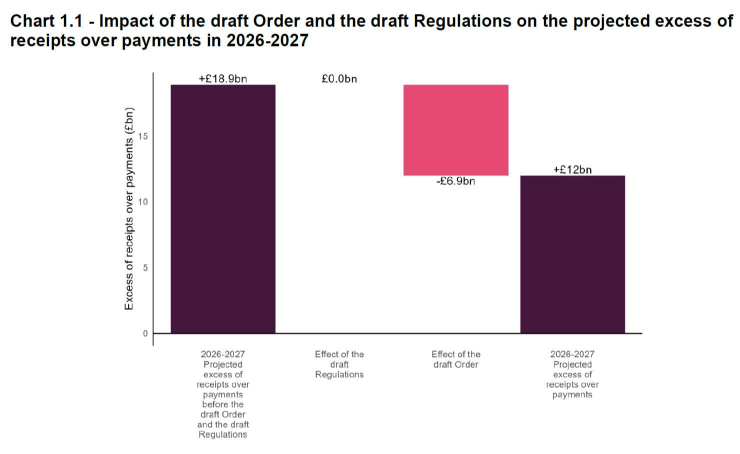
1.3 The draft Order is projected to increase annual Fund expenditure. In 2026-2027 this increase is projected to be £6.9 billion (Note 1).
1.4 The draft Regulations allow for the re-rating of certain NICs limits and rates from 2026-2027 in line with CPI, and extend the zero-rate contributions for armed forces veterans from 6 April 2026 until 5 April 2028. However, most limits and thresholds are not changing in April 2026. The impact of the draft Regulations are not projected to result in any material change in Fund income in 2026-2027 (Note 2).
1.5 This report also considers the impact of the following proposed measures, as announced in the Autumn Budget on 26 November 2025:
- the extension of the freeze in most NICs limits and thresholds from April 2028 to April 2031;
- the impact of the National Insurance Contributions (Employer Pensions Contributions) Bill 2025 which provides that, from 6 April 2029, only the first £2,000 of pension contributions made by each employee through a salary sacrifice scheme will be exempt from NICs, with employer and employee NICs charged on any excess;
- the removal of access to Class 2 voluntary NICs from abroad, and the increase in initial residency and contributions history requirements for Class 3 NICs for individuals abroad from 6 April 2026.
Note 1: Effect relative to no changes in benefit rates in 2026-2027.
Note 2: Changes to the Lower Earnings Limit and Small Profits Threshold are not projected to result in any increase in Fund income in 2026-2027. GAD have not modelled the impact of changes to the Class 2 and Class 3 rates due to the inherent difficulty in projecting voluntary contributions, and their small impact on the NIF balance.
1.6 These proposed measures have been projected to increase Fund income by £0.4bn in 2028-2029, £3.7bn in 2029-2030 and £4.3bn in 2030-2031 (Note 3).
1.7 The Fund balance is projected to increase in each year of the projection period from 2025-2026 up to and including 2030-2031. The Fund balance is also projected to remain above the recommended minimum of one-sixth of benefit expenditure throughout the projection period.
Note 3: Fund income represents around 80% of NICs, with the balance being paid to the NHS.
Impact of the draft Order and the draft Regulations on the Fund up to 2026-2027
1.8 The total Fund income in 2026-2027 is projected to be £173.6 billion and total Fund expenditure is projected to be £161.6 billion. Receipts to the Fund are expected to exceed payments from the Fund in 2026-2027 by £12.0 billion, increasing the balance of the Fund during the financial year 2026-2027. The Fund balance on 31 March 2027 is projected to be £101.6 billion.
1.9 In the absence of the measures proposed in the draft Order and the draft Regulations, the total Fund income in 2026-2027 is projected to be £173.6 billion and total Fund expenditure is projected to be £154.7 billion. In this scenario, receipts to the Fund are projected to exceed payments from the Fund in 2026-2027 by £18.9 billion, increasing the balance of the Fund during financial year 2026-2027. The Fund balance on 31 March 2027 would be projected to be £108.5 billion.
Projected financial position of the Fund to 2030-2031
Principal projections
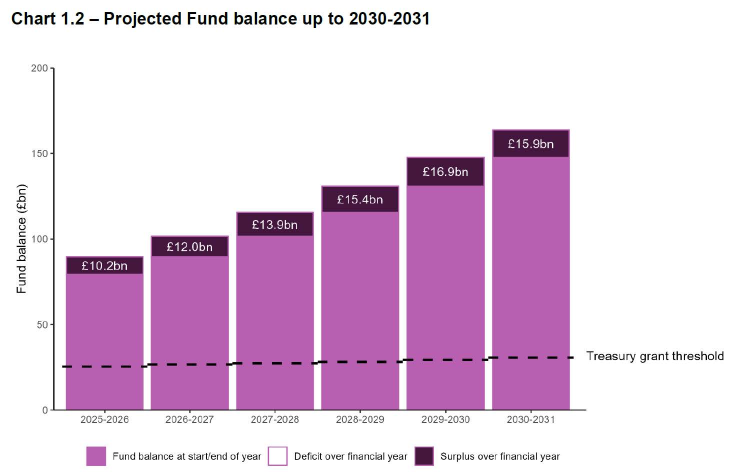
1.10 The projection to 2030-2031 is shown in Chart 1.2. Under the principal assumptions, the Fund balance is projected to increase over the projection period as contribution income is projected to exceed benefit expenditure in 2026-2027 and in every subsequent year of the projection period.
1.11 The yearly Fund balances in this projection differ from those projected in the January 2025 report. Experience (such as earnings growth and employment levels) since the previous report has differed from the assumptions previously employed. Assumptions for the future have also been updated since the previous report. In this report contributions are projected to be £4.3 billion higher in 2025-2026 than in the January 2025 report, resulting in a higher Fund balance relative to the projections shown in the January 2025 report. Appendix A contains a comparison of the projected Fund balances at 31 March 2026 from the two reports.
1.12 The projections in this report indicate that the 2026-2027 end-year Fund balance (£101.6 billion) will be around 64% of estimated benefit expenditure of £159.9 billion (including redundancy payments). This proportion is projected to remain above the recommended minimum of one-sixth of benefit expenditure. As shown in Chart 1.2, this suggests Treasury Grants will not be required in this period. A Treasury Grant was last paid in the 2015-2016 financial year.
Variant projections
1.13 The projections of receipts and payments and the Fund balance are based on various assumptions and are sensitive to some of these. Section 3 of this report shows these sensitivities through a series of variant projections. For example the Fund is sensitive to a scenario where earnings are low but inflation is high, as such a scenario would reduce contributions while increasing benefit expenditure.
Long term review
1.14 As with many countries round the world, the UK faces significant long term demographic challenges. The most recent long-term review of the Fund – the (2020) Quinquennial Review – was published on 17 March 2022 (Note 4). This provided projections of the Fund up to 2085 and showed that the Fund was projected to become exhausted within that projection period. Since that time there have been a number of changes to NICs, as well as a period of unusually high inflation. The next Quinquennial Review of the Fund (which will have an effective date of 1 April 2025) will provide an update to these longer-term projections of the Fund and illustrations of the sensitivity of the results to demographic and other factors.
1.15 Alongside my next Quinquennial Review, the third State Pension age (SPa) review, and the Pensions Commission, launched in July 2025, are both currently considering aspects of the overall pensions system in the UK (Note 5 & Note 6).
1.16 Outcomes from the SPa review may have a significant impact on future projections of the Fund balance. The effect of changes in SPa can be seen in the projection period in this report, as the increases in the number of individuals over SPa caused by increasing life expectancy and high numbers of people reaching SPa, is mitigated to some extent by the increase in SPa from 66 to 67 between 2026 and 2028.
Note 4: Quinquennial Review of the Fund (2020)
Note 5: Third State Pension Age Review
Note 6: The Pensions Commission
Professional standards and limitations
1.17 This work has been carried out in accordance with the relevant actuarial professional standards TAS 100 issued by the Financial Reporting Council (FRC). The FRC sets standards for actuarial work in the UK.
1.18 This report has been prepared for Parliament in accordance with the Social Security Administration Act 1992. It is not appropriate for any other purpose. No other person or third party is entitled to place any reliance on the contents of this report and GAD has no liability to any other person or third party for any act or omission taken, either in whole or in part, on the basis of this report.
1.19 This report does not include projections for the Northern Ireland National Insurance Fund.
2. Principal projections for receipts, payments and the Fund balance
Principal projection results
Fund balance
2.1 Table 2.1 below sets out the projections of receipts and payments of the Fund for 2025-2026 and 2026-2027 allowing for the draft Order and the draft Regulations.
Table 2.1 – Projected receipts, payments and statement of balances of the Fund
| Great Britain, £ billion | 2025-2026 (Note 1) | 2026-2027 |
|---|---|---|
| Receipts | ||
| Contributions at present rates | 160.8 | 170.2 |
| Increase due to proposed changes | 0.0 | |
| Less recoveries of statutory payments (and abatements) | 3.3 | 3.4 |
| Net contribution income | 157.4 | 166.8 |
| Treasury Grant | – | – |
| Compensation from Consolidated Fund for statutory payments recoveries | 3.4 | 3.4 |
| Income from investments | 3.4 | 3.4 |
| Total receipts (Note 2) | 164.2 | 173.6 |
| Payments | ||
| Benefits at present rates | 151.9 | 152.5 |
| Increase due to proposed changes | 6.9 | |
| Total | 151.9 | 159.4 |
| Administration costs | 0.9 | 0.9 |
| Redundancy fund payments (net) | 0.5 | 0.4 |
| Transfer to Northern Ireland | 0.6 | 0.7 |
| Other payments | 0.1 | 0.1 |
| Total payments (Note 2) | 154.0 | 161.6 |
| Statement of balances | ||
| Balance at beginning of year (Note 3) | 79.3 | 89.6 |
| Excess of receipts over payments | 10.2 | 12.0 |
| Balance at end of year | 89.6 | 101.6 |
| Balance at end of year as percentage of annual benefit payments (Note 4) | 59% | 64% |
Note 1: These projections update those in the report of January 2025, reflecting the latest accounts of the Fund and other more recent information. A breakdown and analysis of this change is provided in Appendix A.
Note 2: Figures may not sum to totals shown due to rounding.
Note 3: The balance at 31 March 2025 is taken from the published accounts of the Fund for the year 2024-2025.
Note 4: Percentages of benefit payments include net redundancy fund payments, they exclude administration costs and transfer to Northern Ireland NI Fund.
Projections for 2026-2027
Benefit expenditure
2.2 The draft Order increase the rates of social security benefits paid from the Fund from April 2026. The full rate of the basic State Pension increases from £176.45 per week to £184.90 per week and the full rate of the new State Pension increases from £230.25 per week to £241.30 per week. Appendix B sets out details of the main rates of benefits paid from the Fund before and after the draft Order.
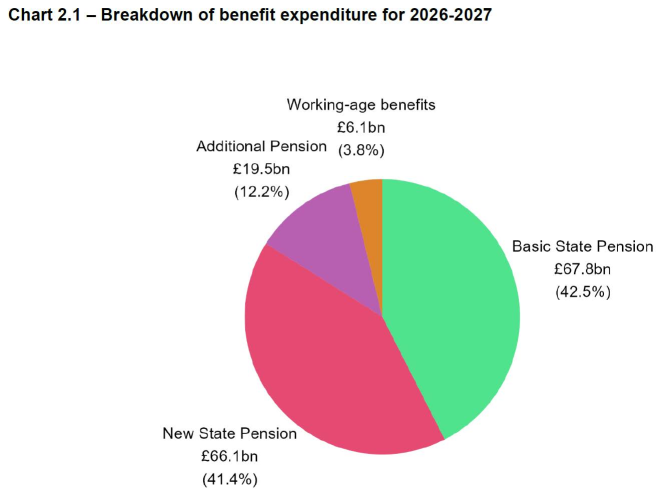
2.3 Chart 2.1 shows how Fund expenditure is split between the largest benefit categories (Note 7). Since the introduction of the new State Pension in 2016, the proportion of benefit expenditure attributable to the new State Pension has increased steadily, while the proportion of benefit expenditure attributable to the basic State Pension has declined.
Note 7: New State Pension and Basic State Pension includes Christmas bonus in this breakdown.
2.4 The projected increase in benefit expenditure in 2026-2027 as a result of the draft Order is £6.9 billion, taking projected expenditure on the benefits covered by the draft Order from £152.4 billion to £159.3 billion. Table 2.2 below shows this projection, and the effect of the draft Order, split by benefit type.
2.5 In the absence of the draft Order, projected benefit expenditure would increase from £151.7 billion to £152.4 billion. This is due to the change in pensioner population and entitlements to benefits in 2026-2027 compared to 2025-2026. This is also shown in Table 2.2.
Table 2.2 – Benefit expenditure and the effect of the proposed changes in 2026-2027
| Benefit | 2025-2026 benefit payment projections (£bn) | 2026-2027 benefit payment projections (£bn) – Before the proposed changes | 2026-2027 benefit payment projections (£bn) – Impact of the proposed changes | 2026-2027 benefit payment projections (£bn) – After the proposed changes |
|---|---|---|---|---|
| New State Pension (Note 1) | 57.2 | 63.2 | 2.9 | 66.0 |
| Basic State Pension (Note 2) | 69.0 | 64.7 | 2.9 | 67.7 |
| Additional Pension | 19.5 | 18.6 | 0.9 | 19.5 |
| Incapacity benefit | 0.0 | 0.0 | 0.0 | 0.0 |
| Widows’/bereavement benefits | 0.1 | 0.1 | 0.0 | 0.1 |
| Contributory employment and support allowance | 5.1 | 4.9 | 0.2 | 5.1 |
| Contribution-based jobseeker’s allowance | 0.3 | 0.3 | 0.0 | 0.3 |
| Maternity allowance (Note 3) | 0.4 | 0.4 | 0.0 | 0.4 |
| Bereavement support payment | 0.2 | 0.2 | – | 0.2 |
| Total of benefits covered by the draft Order (Note 4) | 151.7 | 152.4 | 6.9 | 159.3 |
| Guardian’s allowance (Note 5) | 0.0 | 0.0 | 0.0 | 0.0 |
| Christmas bonus | 0.1 | 0.1 | – | 0.1 |
| Total of benefits not covered by the draft Order (Note 4) | 0.1 | 0.1 | 0.0 | 0.1 |
| Total benefits (Note 4) | 151.9 | 152.5 | 6.9 | 159.4 |
Note 1: Includes expenditure on Protected Payments. Revaluation of Protected Payments which will come into payment during 2025-2026 is set by the State Pension Revaluation for Transitional Pensions Order 2025.
Note 2: Includes expenditure on Graduated Retirement Benefit, existing increments and deferral lump sums (in respect of deferred basic State Pension and deferred Additional Pension).
Note 3: The rate of Maternity Allowance is not covered by the draft Order but it is linked to the prescribed rate of statutory maternity pay which is covered by the draft Order.
Note 4: Figures may not sum to totals due to rounding.
Note 5: The functions of the Secretary of State under Part 10 of the Social Security Administration Act 1992 (review and alteration of benefits: Great Britain) relating to Guardian’s allowance were transferred to the Treasury by section 49(3) of the Tax Credits Act 2002. Guardian’s allowance will be up-rated by a separate Statutory Instrument made by the Treasury.
Contribution income
2.6 The contributions shown in this report are estimated based on the date they are paid, as opposed to the date they are accrued. Section 162(5) of the Social Security Administration Act 1992 sets out how NICs receipts are to be split between the Fund and the NHS. The contributions shown in this section are NICs receipts less the relevant NHS allocation. The split of NICs receipts between the Fund and the NHS is set out in Appendix F.
2.7 The draft Regulations provide for increases in the Lower Earnings Limit, the Small Profits Threshold and the Class 2 and Class 3 voluntary contribution rates in line with CPI. The draft Regulations also extend the zero-rate contributions for armed forces veterans from 6 April 2026 until 5 April 2028. However, most limits and thresholds are not changing in April 2026.
2.8 At the Autumn Budget, published on 26 November 2025, the government also announced the removal of access to Class 2 voluntary NICs and the increase in initial residency and contributions history requirements for Class 3 NICs for individuals abroad from 6 April 2026.
2.9 Appendix C sets out details of the main features of the Fund’s contribution system, including the changes made during the current financial year.
2.10 Changes to the Lower Earnings Limit and Small Profits Threshold are not projected to result in any increase in Fund income in 2026-2027.
2.11 GAD have not modelled the impact of changes to the Class 2 and Class 3 rates due to the inherent difficulty in projecting voluntary contributions, and their small impact on the Fund balance relative to other NICs classes, but these changes are not expected to have an impact on the Fund balance when rounded to the nearest £0.1bn (i.e. the impact of changes to the Class 2 and Class 3 rates is expected to be less than £0.1bn).
Table 2.3 – Contribution income in 2025-2026 and 2026-2027
| NIC class | 2025-2026 contribution projections (£bn) | 2026-2027 contribution projections (£bn) – Contribution before allowing for the draft Regulations | 2026-2027 contribution projections (£bn) – Contribution after allowing for the draft Regulations |
|---|---|---|---|
| Class 1 | 157.7 | 166.8 | 166.8 |
| Class 1A and 1B | 1.5 | 1.7 | 1.7 |
| Class 2 | – | – | – |
| Class 3 | 0.3 | 0.3 | 0.3 |
| Class 4 | 1.2 | 1.4 | 1.4 |
| Total (Note 1) | 160.8 | 170.2 | 170.2 |
Note 1: Figures may not sum to totals shown due to rounding.
2.12 The amount of NICs received by the Fund would still be expected to change from one year to the next as a result of differences in the number of employees and salary inflation. Based on the current rates, limits and thresholds, the projected size of this effect would be a £9.5 billion increase in 2026-2027 NICs compared to 2025-2026 levels.
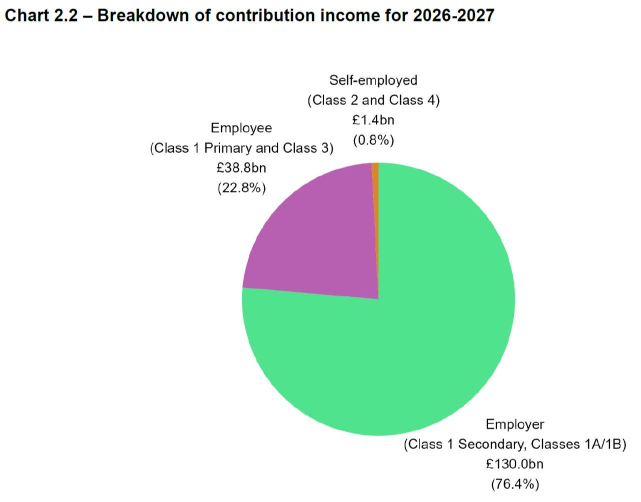
2.13 Fund contribution income in 2026-2027 is therefore projected to be £170.2 billion. A breakdown of this projection by contribution type is shown in Table 2.3, compared to 2025-2026.
Projections to 2030-2031
Measures announced at the Autumn 2025 budget
2.14 The Government announced in the Autumn Budget that it will restrict the use of salary sacrifice arrangements for pension contributions, reducing the scope for tax advantages through these schemes. From 6 April 2029, only the first £2,000 per annum of pension contributions made via salary sacrifice by each employee will be exempt from NICs, with employer and employee NICs charged on any excess.
2.15 The Government also confirmed that the freeze on most National Insurance contributions (NICs) limits and thresholds will be extended until April 2031, maintaining current levels for personal allowance and higher rate thresholds. As earnings grow over time, this measure is expected to increase NICs receipts.
2.16 The proposed measures described in the above two paragraphs have been projected to increase Fund income by £0.4bn in 2028-2029, £3.7bn in 2029-2030 and £4.3bn in 2030-2031.
Fund projections to 2030-2031
2.17 Table 2.4 below provides projections for the period to 2030-2031. The projection methodology and assumptions are described in Appendix E.
2.18 The Fund balance is projected to increase from 2026-2027 to the end of the projection period in 2030-2031.
2.19 SPa is increasing from 66 to 67 from April 2026 to March 2028. This is expected to increase the number of employees, increasing NICs receipts and reducing benefit expenditure in the latter part of the projection period.
Table 2.4 – Fund projections from 2025-2026 to 2030-2031
| Great Britain, £ billion | 2025-2026 | 2026-2027 | 2027-2028 | 2028-2029 | 2029-2030 | 2030-2031 |
|---|---|---|---|---|---|---|
| Total receipts | 164.2 | 173.6 | 179.8 | 186.1 | 195.0 | 202.1 |
| Total payments | 154.0 | 161.6 | 165.9 | 170.6 | 178.1 | 186.1 |
| Excess of receipts over payments | 10.2 | 12.0 | 13.9 | 15.4 | 16.9 | 15.9 |
| Balance in fund at end of year | 89.6 | 101.6 | 115.5 | 130.9 | 147.8 | 163.7 |
| Balance at end of year as a percentage of benefit payments (Note 1) | 59% | 64% | 71% | 78% | 84% | 89% |
Note 1: Benefit payments (from the NIF) include net redundancy fund payments, they exclude administration costs and transfers to the Northern Ireland NI Fund.
2.20 A ‘Treasury Grant’ is a payment into the Fund from money voted by Parliament as permitted under Section 2 of the Social Security Act 1993. HM Treasury may determine the size of such payments provided that they do not exceed a certain percentage (17%) of benefit payments for the financial year concerned as estimated by the Government Actuary or Deputy Government Actuary.
2.21 A payment of a Treasury Grant is usually made if the balance of the Fund is projected to fall below one sixth (16.7%) of estimated annual benefit expenditure (including redundancy receipts). At the end of 2020, this “minimum fund balance” was formally reviewed by the Government Actuary. It was recommended that the minimum fund balance should continue to be one-sixth of estimated annual benefit expenditure, subject to an interim review as part of this annual Up-rating Report process, with a more substantive review carried out as part of the next Quinquennial Review of the Great Britain NIF. This recommendation is considered to remain appropriate.
2.22 Under this principal projection, the Fund balance does not fall below the “minimum fund balance”. A Treasury Grant is therefore not expected to be required within the projection period.
3. Variant projections for receipts, payments and the Fund balance
3.1 The projections provided in this report depend on assumptions made about the future. In particular the Fund balance in the short-term is sensitive to:
- the level of earnings growth
- employment levels
3.2 This section provides projections based on variant assumptions to demonstrate how different experience could affect the Fund balance. Appendices D and E describe the principal assumptions.
3.3 The variant projections are purely illustrations of the sensitivity of the results to economic and policy assumptions. They are not intended to show extremes or potential policy changes. A material change in conditions such as, for example, a significant reduction in employment rates causing a reduction in contribution income, could result in future experience being materially different from any of the variant projections shown.
3.4 The effect of multiple variant assumptions can broadly be estimated by combining together the effects of the relevant variants.
Variant 2-year projections
3.5 Future contribution income could vary significantly in the short-term as a result of changes in employment numbers and general earnings growth. Higher earnings growth leads to higher contribution income which increases the Fund balance (and vice versa). Benefit expenditure over the same timescale tends to be more predictable compared to employment numbers and general earnings growth. This is because the number of beneficiaries is more closely linked to population numbers, which tend to be less volatile than the numbers in employment.
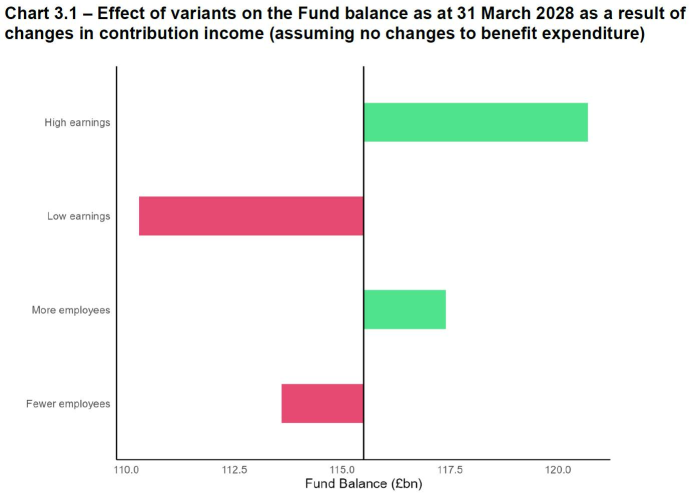
3.6 Table 3.1 shows the effect of changes in earnings growth and employment levels on contribution income for the Fund for the years 2026-2027 and 2027-2028. The change in number of employees is assumed to occur on 1 April 2026. Chart 3.1 shows the effect on the Fund balance. In these two year variants, benefit expenditure is assumed to remain constant, and in particular the Triple Lock applied on April 2027 is assumed to remain in line with the assumptions under the principal projection.
Table 3.1 – Effect on contribution income of variant assumptions (£ billion)
| Variant assumption | Effect on contribution income in 2026-2027 | Effect on contribution income in 2027-2028 | Approximate effect on the 31 March 2028 Fund balance as a result of changes in contribution income |
|---|---|---|---|
| 1 percentage point lower employee earnings growth per annum | (1.6) | (3.6) | (5.2) |
| 1 percentage point higher employee earnings growth per annum | 1.6 | 3.6 | 5.2 |
| Lower number of employees by 200,000 | (0.9) | (1.0) | (1.9) |
| Higher number of employees by 200,000 | 0.9 | 1.0 | 1.9 |
Variant 5-year projections
3.7 Variant projections for the cash flow and balance of the Fund for the 5-year projections are used to illustrate the sensitivity of the projections to economic and policy assumptions.
3.8 The economic variants considered are:
- 1 percentage point higher earnings growth – earnings growth is one percentage point higher than the principal assumption each year
- 1 percentage point lower earnings growth – earnings growth is one percentage point lower than the principal assumption each year
- 1 percentage point higher CPI together with 1 percentage point lower earnings growth – CPI is one percentage point higher and earnings growth is one percentage point lower than the principal assumption each year. This stresses the Fund as it raises benefit expenditure and reduces contribution income.
- 0.5 percentage point decrease to unemployment rate – from 2026-2027 onwards the number of GB employees is assumed to be 200,000 more than under the principal projection. This is equivalent to around a 0.5 percentage point decrease to the unemployment rate.
- 0.5 percentage point increase to unemployment rate – from 2026-2027 onwards the number of GB employees is assumed to be 200,000 fewer than under the principal projection. This is equivalent to around a 0.5 percentage point increase to the unemployment rate.
3.9 These variant projections are shown in the table and charts below. The shading shows the effect on the Fund balance relative to the principal projection.
Table 3.2 – Fund position in 2030-2031 under 6 variants
| Variant | Fund balance at end of 2030-2031 - (£bn) (Note 2) | Fund balance at end of 2030-2031 - As a percentage of benefit payments (Note 1) |
|---|---|---|
| Principal projection | £163.7 bn | 89% |
| 1 percentage point higher earnings growth | £182.6 bn | 97% |
| 1 percentage point lower earnings growth | £138.3 bn | 76% |
| 1 pp higher CPI and 1 pp lower earnings growth | £126.4 bn | 68% |
| 0.5 pp decrease to unemployment rate from 2026-2027 | £169.2 bn | 92% |
| 0.5 pp increase to unemployment rate from 2026-2027 | £158.2 bn | 86% |
Note 1: Benefit payments (from the NIF) include net redundancy fund payments, they exclude administration costs and transfer to Northern Ireland NI Fund.
Note 2: Excludes any payment of Treasury Grants.
3.10 The Fund is sensitive to earnings growth. Higher earnings growth leads to higher contribution income which acts to increase the Fund balance. In the higher earnings growth variant, the higher earnings also increase benefit expenditure as it is the highest component of Triple Lock (the operation of Triple Lock is described in the box below) and this then acts to reduce the Fund balance to some extent. The overall effect is a larger Fund balance than in the principal projection.
3.11 Lower earnings growth leads to lower contribution income and therefore a decrease in the Fund balance. In the lower earnings growth variant, the reduction in earnings only has an effect on the Triple Lock increase applied in April 2027. However, benefit increases are unchanged after April 2027 in this variant because there is no effect on Triple Lock increases in other years because these are projected to be equal to 2.5%. The overall effect is a lower Fund balance, relative to the principal projection.
3.12 The higher earnings growth and lower earnings growth variants have unequal effects on the projected Fund balance because of the different way in which the Triple Lock operates under the different economic variant assumptions used in these variant projections.


3.13 An increase in employment levels leads to an increase in contribution income. In these variants with variation to employment levels, no allowance has been made for any change in benefit expenditure over the projection period caused by the assumed variation in the employment level. In practice, an increase (or decrease) in employment levels would also be expected to increase (or decrease) working-age benefit expenditure in the short term, and pension benefit expenditure in the long term when those workers reach retirement, but this effect would be very small over the projection period. The overall effect therefore of an increase in employment levels is an increase in Fund balance. A decrease in employment levels has the opposite effect.
3.14 If the CPI value used to derive the up-ratings for April 2027 onwards was projected to be 1 percentage point higher and earnings 1 percentage point lower, the up-ratings for basic and new State Pensions in April 2028, April 2029 and April 2030 would be expected to be higher than under the principal projection. There would be a negative effect on contribution income as NICs would be levied on lower overall earnings, whilst the limits and thresholds are frozen in all but the final year of the projection period. The overall effect is a reduction in Fund balance of £37.3 billion in March 2031, relative to the principal projection.
Triple Lock
Triple Lock increases are determined as the highest of the annual growth in average May-July earnings (AWE), September prices (CPI) and 2.5%. These increases are applied to basic and new State Pension payments, excluding increases for deferral. The legislative basis for increasing the basic and new State Pensions is at least in line with average earnings. The November 2024 Autumn Budget committed to maintain the Triple Lock for the duration of this Parliament and the Autumn Budget 2025 restated this commitment. These projections assume that this policy remains in place for all future years in the principal projection, including the April 2030 up-rating which is expected to fall in the next parliament.
The Triple Lock rule has therefore been applied to the increase in earnings and CPI assumptions for each year in the principal projection. For example, under the principal projection in April 2027, AWE is 3.4% and CPI is 2.3% and so the Triple Lock assumption is 3.4% as AWE is higher than CPI and the minimum increase of 2.5%.
Table 3.3 below shows each element of the Triple Lock over the last 5 years and projected values in the 5 years ahead with the highest of the three measures used for Triple Lock up-rating highlighted. Over these 10 years, earnings is the highest in 4 of the 10 years (not including April 2022), the minimum 2.5% is highest in 4 of the 10 years and CPI is the highest in 2 of the years.
Table 3.3 – Triple Lock increases (historic and principal projection assumptions)
| Year of April up-rating | CPI | AWE | Minimum increase | Triple Lock | Value of £100 after cumulative Triple Lock increases |
|---|---|---|---|---|---|
| 2021 | 0.5% | (1.0)% | 2.5% | 2.5% | £100.00 |
| 2022 | 3.1% (Note 1) | 8.6% (Note 1) | 2.5% | 3.1% | £103.10 |
| 2023 | 10.1% | 5.5% | 2.5% | 10.1% | £113.51 |
| 2024 | 6.7% | 8.5% | 2.5% | 8.5% | £123.16 |
| 2025 | 1.7% | 4.1% | 2.5% | 4.1% | £128.21 |
| 2026 | 3.8% | 4.8% | 2.5% | 4.8% | £134.37 |
| 2027 (Note 2) | 2.3% | 3.4% | 2.5% | 3.4% | £138.93 |
| 2028 (Note 2) | 2.0% | 2.3% | 2.5% | 2.5% | £142.41 |
| 2029 (Note 2) | 2.1% | 2.1% | 2.5% | 2.5% | £145.97 |
| 2030 (Note 2) | 2.0% | 2.2% | 2.5% | 2.5% | £149.62 |
Note 1: For the April 2022 up-rating, the earnings component of Triple Lock was excluded from the calculation.
Note 2: Figures for 2027-2030 up-ratings are projections.
3.15 As Triple Lock methodology applies the highest of the three components in each year, the increase in benefit expenditure over time is expected to exceed that of any of the three components. In April 2028, April 2029 and April 2030, the highest component is the minimum increase of 2.5%. If basic and new State Pension were increased with AWE rather than Triple Lock, from April 2026 onwards, then under the assumptions in this report, the increases in the dashed boxes in Table 3.3 would apply instead of the highlighted values. This would lead to lower increases to basic and new State Pensions in April 2028, April 2029 and April 2030. There would be no changes to increases in the other years of the projection period given earnings are already expected to be the highest component of the Triple Lock. In this scenario the Fund balance at the end of the projection period would be approximately £2bn higher.
Appendix A: Revised 2025 - 2026 projections
A.1 The 2025-2026 projections shown in Table 2.1 differ from the projections for the same period included in the previous report of January 2025.
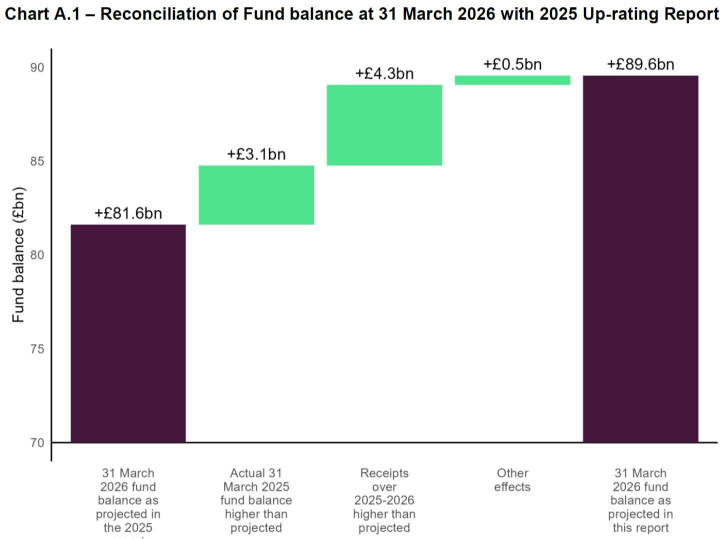
A.2 In particular the balance of the Fund as at 31 March 2026 of £89.6 billion differs from that projected in last year’s report of £81.6 billion. Chart A.1 below sets out a reconciliation between these results.
A.3 The change is primarily due to the updated projections providing for:
-
the actual Fund balance as at 31 March 2025 of £79.3 billion being £3.1 billion higher than that projected in the report last year (£76.2 billion). This was primarily due to higher than assumed growth in earnings and the number of employees.
-
Receipts for 2025-2026 are estimated to be £4.3 billion higher than previously, primarily due to higher than assumed growth in earnings and employment levels.
A.4 Table A.1 below sets out a detailed breakdown of the 2025-2026 projections in Table 2.1 of this report with those provided in Table 2.1 of last year’s report.
Table A.1 – Comparison of 2025-2026 projections from this report and last year’s report
| Great Britain £ billion | 2025-2026 projections in Table 2.1 of this report | 2025-2026 projections in Table 2.1 of last year’s report |
|---|---|---|
| Receipts | ||
| Contributions | 160.8 | 156.8 |
| Less recoveries of statutory payments (and abatements) | 3.4 | 3.3 |
| Net contribution income (Note 1) | 157.4 | 153.6 |
| Treasury Grant | – | – |
| Compensation from Consolidated Fund for statutory payments recoveries | 3.4 | 3.3 |
| Income from investments | 3.4 | 3.0 |
| Other receipts | – | – |
| Total receipts (Note 1) | 164.2 | 159.9 |
| Payments | ||
| Benefits | 151.9 | 152.5 |
| Administration costs | 0.9 | 0.5 |
| Redundancy fund payments (net) | 0.5 | 0.4 |
| Transfer to Northern Ireland | 0.6 | 0.9 |
| Other payments | 0.1 | 0.1 |
| Total payments (Note 1) | 154.4 | 154.4 |
| Excess of receipts over payments (Note 1) | 10.2 | 5.4 |
Note 1: Figures may not sum to totals due to rounding.
Appendix B: Main benefit rates
The draft Order
B.1 The draft Order proposes to up-rate the full rate of the basic State Pension and the full rate of the new State Pension from April 2026 by 4.8% in line with the May-July 2025 AWE earnings growth, subject to the appropriate rounding conventions. This increase has been derived by applying the Triple Lock methodology, Triple Lock is described in the text box under paragraph 3.14.
B.2 The draft Order also proposes increasing other components of the pre-April 2016 State Pension, including earnings-related Additional Pensions (such as SERPS and S2P) and Graduated Retirement Benefit in line with the CPI increase of 3.8%. The draft Order also proposes increasing amounts in excess of the full rate of the new State Pension (Protected Payments) and expenditure on state pension deferral (increments) in line with the CPI increase.
B.3 Full details of the rates of benefits provided from the Fund are shown in the table below.
Table B.1 – Comparison of benefits paid from the Fund before and after April 2026 up-rating
| All figures in £s | Weekly rate in 2025-2026 | Weekly rate proposed from April 2026 |
|---|---|---|
| State pension | ||
| New State Pension (full rate) (Note 1) | 230.25 | 241.30 |
| Category A or B basic State Pension (paid to individuals over SPa as at 5 April 2016 based on their own contributions or those made by a deceased spouse or civil partner) (Note 2) | 176.45 | 184.90 |
| Category BL basic State Pension (paid to an individual over SPa as at 5 April 2016 based on their spouse or civil partner’s contributions while the spouse/civil partner is alive) (Note 3) | 105.70 | 110.75 |
| Graduated Retirement Benefit (unit) | 0.1783 | 0.1851 |
| Bereavement benefits (Note 4) | ||
| Bereavement Support Payment (lump sum standard rate) | 2,500.00 | 2,500.00 |
| Bereavement Support Payment (lump sum higher rate) | 3,500.00 | 3,500.00 |
| Bereavement Support Payment (monthly payments standard rate) | 100.00 | 100.00 |
| Bereavement Support Payment (monthly payments higher rate) | 350.00 | 350.00 |
| Widowed parent’s allowance (maximum rate) | 150.90 | 156.65 |
| Employment and Support Allowance (Note 5) | ||
| Personal allowance (age 25 or over) | 92.05 | 95.55 |
| Work-related activity component | 36.55 | 37.95 |
| Support component | 48.50 | 50.35 |
| Jobseeker’s Allowance (Note 6) | ||
| Personal benefit for those aged 18 to 24 | 72.90 | 75.65 |
| Personal benefit for those aged 25 and over | 92.05 | 95.55 |
| Maternity Allowance, Statutory Maternity Pay, Statutory Paternity Pay, Statutory Adoption Pay, Statutory Shared Parental Pay, Statutory Parental Bereavement Pay, and Statutory Neonatal Care Pay (Note 7) | 187.18 | 194.32 |
| Guardian’s allowance | ||
| First child/other children (Note 8) | 22.10 | 22.95 |
| Increases for the child dependants of recipients of Industrial Injury Disablement Benefit | ||
| Standard rate | 11.35 | 11.35 |
| Rate for eldest child for whom child benefit is also paid | 8.00 | 8.00 |
| Christmas bonus | ||
| Christmas bonus to pensioners (lump sum) (Note 8) | 10.00 | 10.00 |
Note 1: Not everyone receives this rate, awards are based on an individual’s National Insurance record. A de minimis of 10 years of contributions applies in respect of the new State Pension.
Note 2: Proportionate rates are paid to those with proportionate contribution records. Pensioners in receipt of Category A or B basic State Pensions receive an increase of 25p per week on reaching age 80 (the Age Addition).
Note 3: Pensioners in receipt of Category BL basic State Pensions receive an increase of 25p per week on reaching age 80 (the Age Addition).
Note 4: Bereavement Support Payment (consisting of a lump sum and 18 monthly payments) is paid to persons of working age whose spouse or civil partner died on or after 6 April 2017. A higher rate is payable if the surviving spouse or civil partner has dependent children (linked to Child Benefit entitlement). Widowed Parent’s Allowance is paid to working age parents whose spouse or civil partner died before 6 April 2017 for as long as there is a Child Benefit entitlement. Both these benefits are also paid to cohabitees with dependent children, but only in respect of entitlement from 30 August 2018.
Note 5: Employment and Support Allowance (ESA) replaced Incapacity Benefit for new claims from 27 October 2008. The benefit contains some extra additions dependent on the circumstances of the recipients. Everyone who satisfies the Work Capability Assessment will receive a personal allowance and either the work-related activity component or the support component. However, from April 2017 the Welfare Reform and Work Act 2016 provides that new ESA claimants placed in the work–related activity group will no longer receive the work-related activity component. The process to review Incapacity Benefit claims to assess if they can be transferred to ESA is now largely complete.
Note 6: Unemployed people who are looking for work and meet certain other conditions, primarily relating to the payment of NICs in the period recently before they become unemployed, can claim Jobseeker’s Allowance. Other unemployed people who either exhaust or have no entitlement to the contributory benefit may apply for Universal Credit. Universal Credit may also be paid to recipients of Jobseeker’s Allowance if their household’s income-based benefit requirements exceed the rate of Jobseeker’s Allowance.
Note 7: The first 6 weeks of Statutory Maternity Pay and Statutory Adoption Pay are paid at 90% of the recipient’s average weekly earnings with no upper limit. Thereafter the remaining weeks (maximum 33) are paid at the standard rate or, if lower, 90% of the recipient’s average weekly earnings. Maternity Allowance is paid to employed women for up to 39 weeks at the amount shown or 90% of the woman’s average weekly earnings if this calculation results in a figure which is less. The amount of Maternity Allowance a self-employed woman may receive depends on how many weeks of Class 2 NICs they have paid in the 66 weeks immediately preceding the week their baby is due. To get the maximum amount, 13 weeks of Class 2 NICs have to be paid. Statutory Paternity Pay, Statutory Shared Parental Pay Statutory Parental Bereavement Pay and Statutory Neonatal Care Pay are paid at the standard rate or 90% of average weekly earnings if lower.
Note 8: This benefit is not increased by the draft Order.
Appendix C: Main features of the contribution system
The draft Regulations
C.1 The measures in the regulations increase the Lower Earnings Limit and the Small Profits Threshold, as well as voluntary Class 2 and Class 3 rates. The table below shows the changes in contribution rates, limits and thresholds.
Table C.1 – NIC rates, limits and thresholds
| Rate in 2025-2026 | Rate in 2026-2027 | ||
|---|---|---|---|
| Class 1 | |||
| Lower Earnings Limit (LEL) | £125 a week | £129 a week | |
| Upper Earnings Limit (UEL) | £967 a week | £967 a week | |
| Primary Threshold (PT) | £242 a week | £242 a week | |
| Secondary Threshold (ST) | £96 a week | £96 a week | |
| Upper Secondary Threshold for under age 21 group (UST) | £967 a week | £967 a week | |
| Upper Secondary Threshold for relevant apprentices (AUST) | £967 a week | £967 a week | |
| Contribution rates (NI Fund and NHS combined) | |||
| Primary (employee) | On earnings between the primary threshold and UEL | 8.00% | 8.00% |
| On earnings above the UEL | 2.00% | 2.00% | |
| NHS allocation included in above – | |||
| – percentage of earnings between the PT and UEL | 2.05% | 2.05% | |
| – percentage of earnings above the UEL | 1.00% | 1.00% | |
| Secondary (employer) | On all earnings above the ST | 15.00% | 15.00% |
| Zero-rate on earnings between the ST and UST and AUST | 0.00% | 0.00% | |
| NHS allocation included in above (percentage of all earnings on which contributions are paid for employees earning above the PT) (Note 1) | 1.90% | 1.90% | |
| Class 1A and Class 1B | |||
| Contribution rate (employer only) | 15.00% | 15.00% | |
| NHS allocation included in above | 1.90% | 1.90% | |
| Class 2 | |||
| Flat-rate contribution (Note 2) | £3.50 a week | £3.65 a week | |
| Small Profits Threshold (SPT) | £6,845.00 a year | £7,105.00 a year | |
| NHS allocation included in above (percentage of contribution) | 15.50% | 15.50% | |
| Class 3 | |||
| Flat-rate contribution | £17.75 a week | £18.40 a week | |
| NHS allocation included in above (percentage of contribution) | 15.50% | 15.50% | |
| Class 4 | |||
| Lower Profits Limit (LPL) | £12,570.00 a year | £12,570.00 a year | |
| Upper Profits Limit (UPL) | £50,270.00 a year | £50,270.00 a year | |
| Contribution rate | |||
| On profits between the LPL and UPL | 6.00% | 6.00% | |
| On profits above the UPL | 2.00% | 2.00% | |
| NHS allocation included in above | |||
| Percentage of profits between the LPL and UPL | 2.15% | 2.15% | |
| Percentage of profits above the UPL | 1.00% | 1.00% |
Note 1: The amount of the secondary Class 1 NICs apportioned to the NHS is calculated as the relevant percentage of the total earnings of those employees who earn above the primary threshold. This is in line with the interpretation of subsections (5) and (5A) of section 162 of the Social Security Administration Act 1992 provided to GAD by HMRC.
Appendix D: Key assumptions
D.1 The key assumptions used in the projections in this report are the population projections and the economic assumptions that determine future employment levels and the rate of increase in earnings and CPI. These assumptions are set out in this appendix alongside the key assumptions used for the variant projections in Section 3.
D.2 The population projections used in this report are the Office for National Statistics (ONS) National population projections: 2022 based - Office for National Statistics, published in January 2025.
D.3 The economic assumptions used in this report are consistent with the central assumptions used by the Office for Budget Responsibility (OBR) in its EFO report. The OBR exist to provide independent analysis of the UK public finances, their EFO assumptions reflect the measures in the November 2025 budget.
D.4 My understanding is that both ONS and OBR have determined these assumptions with the intention that there is no allowance for prudence or optimism. In my view, these assumptions are the most appropriate for the purposes of projecting the financial position of the Fund up to 2030–2031, evaluating the effects of proposed changes to benefit rates and National Insurance contributions limits and thresholds and assessing whether a Treasury Grant is expected to be required over the period covered in this report. I have therefore used these assumptions to determine the principal projection. Other assumptions may be more appropriate for other purposes.
D.5 This report includes variant projections to show the impact on the Fund if other assumptions were adopted.
D.6 The projections in the previous January 2025 report were based on the most recent population projections and EFO at the time. These were ONS’s 2021-based principal population projection for Great Britain (published in January 2024) and the EFO published on 30 October 2024. Those assumptions are the “UR 2025” assumptions shown in the tables in this appendix.
Population projections
D.7 The assumptions for the number of individuals at both working age and over State Pension age (SPa) are based on the ONS 2022-based population projections, published in January 2025, as shown in Table D.1.
D.8 The figures in this table and projections in this report allow for the SPa increase from 66 to 67 between April 2026 and April 2028, in line with current legislation.
D.9 In line with the notice ONS published in June 2025, the ‘migration category’ variant of the 2022 projections has been adopted instead of the ONS principal population projection.
D.10 These projections allow for 2022 Scotland census data and 2021 census data from other constituent countries. These projections do not include any individuals older than SPa who receive a State Pension while living overseas.
Table D.1 – Numbers of people older than SPa in Great Britain at the start of the financial year
| Financial year | UR 2026 (millions) | UR 2025 (millions) | Change (millions) |
|---|---|---|---|
| 2025-2026 | 12.2 | 12.2 | 0.0 |
| 2026-2027 | 12.3 | 12.3 | 0.0 |
| 2027-2028 | 12.1 | 12.1 | 0.0 |
| 2028-2029 | 12.1 | 12.2 | (0.1) |
| 2029-2030 | 12.4 | 12.4 | 0.0 |
| 2030-2031 | 12.7 | N/A | N/A |
D.11 These figures show that the number of individuals over SPa is projected to increase from 2025-2026 to 2030-2031 as a result of increasing life expectancy and high numbers of people reaching SPa. This is mitigated to some extent by the increase in SPa from 66 to 67 between 2026 and 2028.
D.12 The overall effect of these factors on the sustainability of the Fund is highlighted in the longer-term projections in the Quinquennial Review. The next Quinquennial Review of the Fund (which will have an effective date of 1 April 2025) will provide an update to these longer term projections of the Fund.
Employment levels and earnings growth
D.13 The assumptions for the number of employees in Great Britain are set out in Table D.2:
Table D.2 – Number of employees in Great Britain
| Financial year | UR 2026 (millions) | UR 2025 (millions) | Change (millions) |
|---|---|---|---|
| 2025-2026 | 29.0 | 28.4 | 0.6 |
| 2026-2027 | 29.1 | 28.5 | 0.6 |
| 2027-2028 | 29.3 | 28.6 | 0.7 |
| 2028-2029 | 29.5 | 28.7 | 0.7 |
| 2029-2030 | 29.7 | 28.9 | 0.8 |
| 2030-2031 | 29.8 | N/A | N/A |
D.14 The number of employees refers to the number of people employed rather than the number of jobs, as one person may have more than one job. Employees exclude the self-employed. The projections are relatively insensitive to the assumed number of self-employed people as this group is much smaller.
D.15 The assumptions in Table D.2 have been derived by taking the number of UK employees from Table 1.6 of the economy detailed forecast tables published alongside the November 2025 EFO and adjusting these figures to exclude Northern Ireland employees. The same process is followed for self-employed numbers.
D.16 The assumptions for the employee earnings growth used in the principal projection are set out in Table D.3 which are also derived from Table 1.6 of the November 2025 EFO:
Table D.3 – Employee earnings growth (from FY-1 to FY) (Note 1)
| Financial year (FY) | UR 2026 – Employee earnings growth (from FY-1 to FY) | UR 2025 – Employee earnings growth (from FY-1 to FY) | Change |
|---|---|---|---|
| 2025-2026 | 4.4% | 3.0% | 1.4% |
| 2026-2027 | 3.2% | 2.1% | 1.1% |
| 2027-2028 | 2.1% | 2.0% | 0.1% |
| 2028-2029 | 2.1% | 2.3% | (0.2%) |
| 2029-2030 | 2.2% | 2.6% | (0.4%) |
| 2030-2031 | 2.3% | N/A | N/A |
Note 1: The earnings growth assumptions in this table are those over the previous financial year. The earnings growth assumptions in this table are different from the definition of earnings used to determine the triple lock increase (see following paragraph).
Benefit up-rating assumptions - increase in earnings and CPI
D.17 The assumptions for increases in earnings and CPI are set out in Table D.4. These figures are the Q3 CPI assumptions (taken from tables 1.6 and 1.7 of the EFO economy detailed forecast tables). This is because up-rating each April is generally based on Q2 earnings and Q3 CPI out-turn from the previous financial year.
Table D.4 – Annual increase in earnings and CPI
| Year of April up-rating | CPI – UR 2026 | CPI – UR 2025 | CPI – Change | Increase in earnings – UR 2026 | Increase in earnings – UR 2025 | Increase in earnings – Change |
|---|---|---|---|---|---|---|
| 2025 | 1.7 (Note 1) | 1.7 (Note 1) | 0.0 | 4.1 (Note 1) | 4.1 (Note 1) | 0.0 |
| 2026 | 3.8 (Note 1) | 2.7 | 1.1 | 4.8 (Note 1) | 4.3 | 0.5 |
| 2027 | 2.3 | 2.2 | 0.1 | 3.4 | 2.1 | 1.3 |
| 2028 | 2.0 | 2.1 | (0.1) | 2.3 | 2.0 | 0.3 |
| 2029 | 2.1 | 2.1 | 0.0 | 2.1 | 2.2 | (0.1) |
| 2030 | 2.0 | N/A | N/A | 2.2 | N/A | N/A |
Note 1: The increases to be applied in April 2025 and April 2026 are now determined. Last year the April 2025 increase was determined.
Appendix E: Data, methodology and other assumptions
General
E.1 This report relies on the data sets supplied. In particular, this report relies on the general completeness and accuracy of the information supplied without independent verification. Data used in these projections is checked for reasonableness where feasible, but we have not carried out an independent audit of the data supplied and cannot confirm or guarantee the overall quality or correctness of the data. Any issues with the data could impact on the projections in this report.
Contributions modelling
NICs income
E.2 Contributions are projected separately for each class of NICs.
E.3 Projections of Class 1 NICs are made by first making a projection of workforce earnings based on:
-
assumed levels of GB employment in each year described in Appendix D, together with an assumed profile of workers by age and gender derived from OBR’s latest available cohort employment model used for its 2025 Fiscal Risks and Sustainability Report.
-
earnings distributions, by age and gender; these were derived using the 2024 Annual Survey of Hours and Earnings (ASHE) produced by ONS (Note 8)
-
assumptions on the rate of earnings growth from year to year
E.4 Class 4 contributions made by the self-employed are projected in a similar way to Class 1, but using assumptions on employment, earnings growth and earnings distributions specifically for the self-employed. These earnings distributions are derived from HMRC’s Survey of Personal Incomes.
E.5 The projection of earnings as described above is then used to project the Class 1 and 4 NICs due in each year using the respective limits and thresholds for each class.
Note 8: ONS have no responsibility for the distributions adopted beyond the data that they originally supplied to GAD.
E.6 As per current policy announced at the November 2025 Autumn Budget, the Upper Earnings Limit, Lower Profits Limit, Upper Profits Limit , Primary Threshold and Secondary Threshold are assumed to remain constant at the 2021-2022 level up to and including 2030-2031. Also in line with the November 2025 Autumn Budget, the Lower Earnings Limit has been assumed to increase in line with CPI.
E.7 Modelled projections of NICs for future years were compared with data provided by HMRC on actual NIC receipts up to and including 2024-2025 so that we can align the projections with the latest data on NICs receipts. For Class 1 NICs, the projections have been aligned with data on NICs due in respect of 2024-2025 earnings. For Class 4 NICs, projections have been aligned with the data on NICs payable in respect of income in 2023-2024.
E.8 Other classes of NICs, which generate substantially lower revenues than Class 1 and 4, are projected using simplified models:
-
Class 1A and Class 1B contributions are projected using data and projections provided by HMRC. These are UK figures and the amount attributable to Great Britain is taken as a percentage of the UK figure.
-
Class 2 voluntary and 3 contributions are a very small part of total NICs. Class 3 contributions have been estimated approximately assuming they are stable up to 2030-2031. Only limited data is currently available for the modelling of Class 2 voluntary contributions in isolation and so in the absence of sufficient data, these have not been modelled from 2025-2026 onwards. This understatement of the contribution income is not material in the context of the overall Fund.
E.9 Adjustments are also made to allow for HMRC estimates of the effect of certain measures announced in successive fiscal events that it is not possible to include directly in the calculation models.
E.10 In the October 2024 Autumn Budget, changes were announced in respect of the Employment Allowance which we have allowed for within these adjustments and represent around 2% a year of total projected NICs.
E.11 In the November 2025 Autumn Budget, it was announced that from 6 April 2029, only the first £2,000 per annum of employer pension contributions made via salary sacrifice by each employee will be exempt from NICs, with employer and employee NICs charged on any excess. The impact of this change has also been allowed for within our post budget adjustments using HMRC’s estimates and represents around 1.5% a year of total projected NICs from 2029-30.
E.12 All remaining post budget adjustments (e.g. allowances for changes in behaviour) represent less than 0.5% of total projected NICs income.
E.13 In preparing the Fund accounts, HMRC needs to split the total UK contributions between those payable to the Great Britain and Northern Ireland Funds. HMRC have informed us that the split was updated from 2025-2026 to be set at 97.8% for Great Britain and 2.2% for Northern Ireland, and it is assumed to remain at this level throughout the projection.
NICs allocation between the Fund and the NHS
E.14 The above calculations focus on making a projection of total NICs. It is then necessary to divide these NICs between those allocated to the Fund and those allocated to the NHS.
E.15 For Class 1 primary (employee) and Class 4 NICs, the modelling described in paragraphs E.2 to E.13 is used to model the NICs allocated to the Fund and NHS separately and then total NICs are calculated by adding these together.
E.16 For Class 1 secondary (employer) NICs, the modelling described in paragraphs E.2 to E.13 above provides a projection of total NICs which are then split and allocated either to the Fund or to the NHS. We take a different approach for Class 1 secondary since the way in which NICs are allocated to the NHS differs for Class 1 secondary NICs - see footnote 1 of Table C1.
E.17 When aligning our projections with the latest data, as described in paragraph E.7, historic splits of Class 1 primary and secondary NICs into NICs allocated to the Fund and NICs allocated to the NHS are observed from end of year returns from the National Insurance PAYE System (NPS) database and the Earnings Limits Scan supplied by HMRC. The latest Earnings Limits Scan provides information up to and including 2024-2025.
E.18 For Classes 1A, 1B, 2 and 3, the NHS allocations are defined in legislation as a fixed proportion of the total NICs payable, as shown in Appendix C.
E.19 The NHS allocation for Class 4 contributions is different for contributions paid on profits above and below the Upper Profits Limit. This means there is not a constant ratio between contributions allocated to the Fund and NHS for this class. The split between the Fund and the NHS shares of these contributions is therefore determined using the self-employed earnings distribution as described in paragraph E.4.
Reclaimed NICs for statutory payments
E.20 Employers can reclaim a proportion of the statutory payments made to employees from the amounts of Class 1 NICs they pay. Statutory payments include:
- Statutory Maternity Pay (SMP)
- Statutory Paternity Pay (SPP)
- Statutory Shared Parental Pay (ShPP)
- Statutory Adoption Pay (SAP)
- Statutory Parental Bereavement Pay (SPBP), and
- Statutory Neonatal Care Pay (SNCP) from April 2025
E.21 The Fund receives payments from the Consolidated Fund to offset the amounts recovered by employers (apart from the compensation element). These payments are estimated in a similar way to the amounts recovered by employers.
E.22 In broad terms, amounts reclaimed by employers are estimated by adjusting data on amounts reclaimed in the latest complete year (2024-2025) in line with changes in
numbers of employees, the numbers of births (or children, in respect of adoption), rates of benefit, and (where relevant) the average earnings of potential recipients.
Other receipts modelling
E.23 The investment income has been projected for future years by applying an assumed rate of investment return to the average balance in the Fund during each future year. The investment return on the Fund is expected to be close to the Official Bank of England Rate (Bank Rate) given that the assets of the Fund are deposited with the Commissioners for the Reduction of National Debt. The assumed rate of investment return is taken to be the projected Bank Rate contained in the EFO report published in November 2025.
Pension benefits modelling
E.24 Projected expenditure on contributory benefits are modelled separately for each of the following 5 types of benefit;
- basic State Pension
- new State Pension
- Additional Pension (SERPS and S2P)
- Graduated Retirement Benefit
- Protected Payments (paid alongside new State Pension)
E.25 The projection approaches adopted for each type of benefit are detailed in paragraphs E.32 to E.73. The projections allow for the increase in SPa from 66 to 67 during 2026- 2028.
Data
E.26 Data for current pensioners:
-
The “quarterly statistical extract” of State Pension payments (QSE) is used in the modelling of all pre-April 2016 benefits. This contains anonymised data for a sample of individuals in receipt of benefits, and the amount of benefit in payment. QSE is a 5% sample taken from DWP’s legacy system which holds records for all State Pension recipients who reached State Pension age before 2019, and a decreasing proportion of those who reached State Pension age after.
-
We also received additional summary level statistics from DWP for current recipients of new State Pension, split by DWP’s legacy system and new system. Post-April 2016 benefit modelling is also based on both the additional summary level statistics from DWP and the QSE data. More weight is placed on the information from DWP’s new system than the QSE given the lower sample rates in the QSE data.
-
The projections in this report are based on the QSE and additional summary data as at 31 March 2025. QSE data sets also include past lump sums paid where the recipient is still in receipt of a benefit.
E.27 Data was previously provided from the “lifetime labour market database 2” (L2) data set provided by DWP. This is a data set which sets out anonymised data for a 1% sample of the population showing past earnings and national insurance contribution record history - the most recent L2 data set was at 31 March 2020. Summary statistics from this data are used as a check on the assumptions for entitlements to new State Pension which are based on projected long term trends based on the current pensioner information, and to inform the assumptions for future protected payment entitlements.
E.28 Comparison against DWP figures is based on “forecast data” - this is DWP management data forecasting aggregate amounts of benefit expenditure over the current financial year, revised monthly and based on actual out-turn.
E.29 The projections use the following data sets published by ONS:
- 2022-based national population projections for Great Britain;
- 2022-based national population projections for Northern Ireland;
- 2008-based marital status projections for England and Wales.
General approach
E.30 The 5 separate benefit projections were scaled so that the projected figures in the years 2021-2022 to 2024-2025 broadly align with the benefit expenditure in those years.
E.31 The majority of the scaling factors are close to 1. There are various reasons why a factor may not equal 1. For example, the QSE data set is only a 5% sample size and is produced close to the extract date so does not allow for corrected payments made retrospectively where incorrect benefit payments have initially been made.
Basic State Pension
E.32 To project expenditure on basic State Pension, for each projection year, we have
multiplied together:
- a projected number of people over SPa
- an assumed “proportion of the population entitled” (PEnt) to any basic State Pension
- an assumed “mean proportion of the standard rate” (MPnSR) payable to those entitled to any basic State Pension
- an annual standard benefit rate
E.33 The above calculations have been carried out separately for each age and for 5 categories of people; men, single women, married women, divorced women and widows.
E.34 The number of men and women at each age over SPa is taken directly from the national population projections: 2022-based for the UK and 2022-based for Northern Ireland. The numbers for women have then been split into single, married, divorced and widowed women using ONS’s England and Wales 2008-based marital status projections, and adjusted to align with the ONS 2021 Great Britain census data.
Proportions entitled (PEnt)
E.35 For each age for each of the 5 categories of people, a PEnt assumption for the year 2025-2026 has been determined by comparing the number of people receiving basic State Pension in the QSE data with the number of people in the population projection. For married women PEnt assumptions have been set separately depending on whether
entitlement is to Category A pension, Category BL pension or both. For single and married women the proportion is age related matching recent demographic trends – for example that there were more female earners in younger generations.
E.36 Based on these observations PEnt assumptions have been set as; 100% for men, 94% for divorced women, 100% for widows and age related assumptions for single women and married women.
E.37 The same PEnt assumptions are then used in every future year of the projection but with the age related assumption applying to those aged one year older in each subsequent projection year reflecting ageing of recipients.
Mean proportion of the standard rate (MPnSR)
E.38 For each age for each of the 5 categories of people, an MPnSR assumption has been determined for the year 2025-2026. This is done by calculating the average amount of basic State Pension received by those receiving some basic State Pension in the QSE data and expressing this as a proportion of the standard benefit rate. For married women the MPnSR assumptions have been set separately depending on whether entitlement is to Category A pension, Category BL pension or both. For married women the proportion is age related matching recent demographic trends.
E.39 Based on these observations MPnSR assumptions have been set as 98% for men, 92% for single women, 94% for divorced women, 98% for widows, 37% for married women in category A lower, and age related assumptions for married women in category A higher.
E.40 The same MPnSR assumptions were then used in every future year of the projection but with the age related assumption applying to those aged one year older in each subsequent projection year reflecting ageing of recipients.
Adjustments for Category D pensions and increments
E.41 Some pensioners in receipt of basic State Pension are eligible for an increase in pension up to a specified amount on reaching age 80 (the Category D “Over 80 Pension”). This increase is not based on NICs and is not payable from the Fund but is included and not separately identified in the QSE data. The projection therefore includes an adjustment to the MPnSR assumptions described above to model the exclusion of Over 80 Pension payments from the expenditure projections for basic State Pension. These adjustments range between a 0% and 6% reduction in the MPnSR assumption depending on the category of person being projected. In general, larger reductions are made to those with lower MPnSR assumptions.
E.42 After calculating the MPnSR assumptions described above an adjustment has been made to those assumptions to reflect that some basic State Pension relates to increments paid to those who have previously deferred their basic State Pension and are now in receipt of it. These adjustments reflect the proportion of basic State Pension that is made up of increments as shown in the QSE data and the different up-rating that increments attract (CPI rather than the Triple Lock that applies to basic State Pension).
E.43 Apart from lump sums arising from deferment, described below, new awards in relation to those who have deferred their basic State Pension and are not yet in receipt of it are ignored.
E.44 Except for women with entitlement to Category BL pension (regardless of any entitlement to Category A), the standard benefit rate for projection year 2025-2026 is £184.90 per week. For women with entitlement to Category BL pension the standard benefit rate for projection year 2025-2026 is £110.75 per week. The standard benefit rates used are thereafter up-rated in line with Triple Lock up-rating implied by the economic assumptions for future projection years.
Overseas pensioners receiving basic State Pension
E.45 Pensioners residing overseas are not captured in the approach to projecting basic State Pension expenditure described above as the population projections used only cover those in Great Britain.
E.46 The QSE data set shows that the net impact of immigration and emigration over SPa is immaterial to the total level of overseas State Pension payable. Therefore, payment of basic State Pension to overseas pensioners is modelled separately as though this group are a closed population. This separate projection is then added to the basic State Pension projection described above.
E.47 Payments of basic State Pension to pensioners overseas (including increments already in payment) are projected forward by running off the existing payments shown in the QSE data set using mortality rates based on ONS’s 2022-based Great Britain population projection (i.e. assuming mortality rates for overseas pensioners are in line with those experienced domestically).
E.48 The modelling approach is the same as applied for domestic basic State Pension, except that these projections do not up-rate pensions for those living in countries where pensions are frozen.
Lump sums
E.49 People reaching SPa before 6 April 2016 can defer payment of their basic State Pension and take a lump sum when they bring their basic State Pension into payment. DWP produces projections of the amounts of lump sum payable in the future to those still deferring their basic State Pension.
E.50 Given the low and decreasing level of this benefit, figures from DWP’s management information (as described in paragraph E.28) have been used in this report.
New State Pension
E.51 To project expenditure on new State Pension, for each projection year, we have multiplied together:
- the projected number of people over SPa
- an assumed “proportion of the population entitled” (PEnt) to any new State Pension
- an assumed “mean proportion of the standard rate” (MPnSR) payable to those entitled to any new State Pension
- the annual standard benefit rate
E.52 The above calculations have been carried out separately for each age and for men and women. The number of men and women at each age over SPa was taken directly from the 2022-based population projection for Great Britain.
E.53 For each age for men and women a PEnt assumption has been determined by comparing the number of people receiving new State Pension in the QSE data with the number of people in the population projection. It is assumed that the experience of future pensioners will be broadly in line with that of those recently reaching SPa.
E.54 For each age for men and women an MPnSR assumption has been determined using the additional summary level statistics for recipients on DWP’s legacy and new system and the QSE, L2 datasets. This is done by calculating the average amount of new State Pension received by recipients in the QSE data and the additional summary data from the new system, and expressing this as a proportion of the full rate. It is assumed that the experience of future pensioners will be broadly in line with that of those recently reaching SPa. This has been compared against previous assumptions set using the L2 dataset.
E.55 The same PEnt and MPnSR assumptions were then used in every future year of the
projection but with the age-related assumption applying to those aged one year older in
each future projection year reflecting the ageing of recipients.
E.56 This leads to a PEnt assumption of 98% and an MPnSR assumption of around 96% for both future male and female recipients. For current recipients the current cohort MPnSRs are adopted.
E.57 No adjustment is made to the assumed proportion of people qualifying for any new State Pension benefit as a result of any SPa changes. Similarly no adjustment is made to the level of pension payable to those entitled to any new State Pension as a result of any SPa changes. This is because, under the current SPa a high proportion of the population are expected to qualify for the full rate of new State Pension and therefore an additional year of contributions would not affect the pension entitlements of that group.
E.58 The level of entitlement to new State Pension might be higher than assumed under the principal projection if the proportion of people working or otherwise receiving qualifying credits increases. The level of entitlement might be lower if there are policy changes that make it more difficult to qualify for full State Pension.
E.59 The standard benefit rate for projection year 2026-2027 is £241.30 per week. This is thereafter up-rated in line with Triple Lock up-rating implied by the economic assumptions for future projection years.
E.60 New State Pension projections assume 6% choose to defer receipt beyond State Pension age. Of those, 50% are assumed to defer for up to 1 year and the rest for 1-2 or 2-3 years. This assumption is derived from QSE data.
Overseas pensioners receiving new State Pension
E.61 Pensioners residing overseas are not captured in the approach to projecting new State Pension expenditure described above as the population projections used only cover those in Great Britain.
E.62 The new State Pension projections therefore include a separate projection for new State Pension payable to individuals residing overseas. This separate projection is then added to the new State Pension projection for those resident in Great Britain described above.
E.63 The modelling approach is the same as applied for domestic new State Pension, except that these projections do not up-rate pensions for those living in countries where pensions are frozen.
Additional Pension and Graduated Retirement Benefit
E.64 Additional Pension and Graduated Retirement Benefit have been projected by running off the existing payments shown in the QSE data set using mortality rates based on ONS’s 2022-based Great Britain population projection.
E.65 The QSE data set shows that people with Additional Pension exhibit lower mortality rates than in the population. Mortality rates used for modelling these benefits are therefore set lower than those implied by the population data in E.29. The adjustments vary by age and gender but, on average for those receiving Additional Pensions, are equivalent to Additional Pensions being in payment for about half a year longer (from age 65) than if standard population mortality rates were used.
E.66 These projections allow for CPI up-rating of these benefits throughout the projection period with adjustments for additional pension for contracting-out deductions and their pre 1988 and post 1988 up-rating rules.
E.67 These projections allow for the inheritance of benefits to widows, widowers and bereaved civil partners using the 2008-based marital status projections for England and Wales, adjusted to align with the ONS 2021 England and Wales census data. For Additional Pension the rate of inheritance is assumed to lie between 50% and 100%. For Graduated Retirement Benefit the rate of inheritance is assumed to be 50%.
E.68 As the QSE data set includes payment to overseas pensioners this projection approach automatically captures payments of Additional Pension and Graduated Retirement Benefit to overseas pensioners.
E.69 This modelling approach involves various simplifications which are not expected to be material. For example, this approach ignores the possibility of new awards in relation to current deferrals (new awards to current deferrers will be increasingly rare as the minimum period since State Pension age increases with the passage of time).
Protected Payments
E.70 Those reaching SPa from 6 April 2016 onwards may be entitled to Protected Payments in addition to new State Pension. A person’s Protected Payment is their entitlement at the introduction of the new State Pension based on the pre-Pensions Act 2014 system less the full rate of new State Pension. If this amount is less than zero a person has no Protected Payment.
E.71 We have identified individuals from the QSE and L2 datasets who would be affected by the new State Pension transitional arrangements and calculated Protected Payment amounts for all in this group.
E.72 We have projected these Protected Payments by running off these amounts using the same mortality rates used to project Additional Pensions and Graduated Retirement Benefit (see paragraph E.64 and E.65). These projections allow for CPI up-rating and mortality before and after coming into payment. Allowance is made for inheritance of Protected Payments using ONS’s 2008-based marital status projections for England and Wales (adjusted to align with the ONS 2021 Great Britain census data) and assuming a 50% inheritance rate.
E.73 As the L2 data set includes contribution records for those who have paid NICs and then emigrated overseas this projection approach automatically captures Protected Payments to overseas pensioners.
Working age benefits and other payments modelling
General
E.74 The estimates of benefits for widows, bereavement, incapacity, employment and support, jobseekers, maternity, and Christmas bonus are based on information provided by the DWP.
E.75 Estimates for Guardian’s Allowance are derived from recent data, adjusted in line with the projected number of children in the population and the assumed increase in the benefit rate.
Redundancy payments
E.76 The Insolvency Service has provided projections of gross and net redundancy payments to 2030-2031, which underlie recent OBR projections. These are assumed to increase in line with earnings growth thereafter.
Administration costs
E.77 The administration costs are based on those incurred in 2024-2025 as recorded in the draft Fund accounts, with future costs projected as the 2024-2025 costs (£0.9bn)
increased in line with earnings growth over each financial year.
Transfer to/from Northern Ireland
E.78 Each year transfers between the Great Britain National Insurance Fund and the Northern Ireland National Insurance Fund are made in order to keep the balance in the Northern Ireland National Insurance Fund at a certain percentage of the combined balance in the two funds (the “parity ratio”). The projections in this report allow for projected transfers between the two Funds.
E.79 The total payment made in 2025-2026 will be based on a parity ratio of 2.72% (calculated by GAD following an agreed approach). This proportion is based on analysis of the populations aged 16 and over in Great Britain and Northern Ireland as provided in the results of and the published mid-2024 population estimates for Great Britain and for Northern Ireland published in October 2025. This follows the approach that the populations should be measured using the most up to date population estimates or census data published by the Office for National Statistics agreed following the Government Actuary’s review of the parity process in 2020. Payments made after 2025 2026 are assumed to be based on the same parity ratio.
Appendix F: NICs split by NI Fund and NHS
Table F.1 – NICs split between NI Fund and NHS
| Great Britain, £ billion | 2025-2026 | 2026-2027 | |||
|---|---|---|---|---|---|
| National Insurance Fund | |||||
| Class 1 (Note 1) | Primary | 37.2 | 38.6 | ||
| Secondary | 120.5 | 128.2 | |||
| Total | 157.7 | 166.8 | |||
| Classes 1A and 1B | 1.5 | 1.7 | |||
| Class 2 | 0.0 | 0.0 | |||
| Class 3 | 0.3 | 0.3 | |||
| Class 4 | 1.2 | 1.4 | |||
| Total National Insurance Fund contributions (Note 2 & Note 3) | 160.8 | 170.2 | |||
| National Health Service | |||||
| Class 1 | Primary | 14.0 | 14.6 | ||
| Secondary | 20.9 | 21.6 | |||
| Total | 34.9 | 36.3 | |||
| Classes 1A and 1B | 0.2 | 0.3 | |||
| Class 2 | 0.0 | 0.0 | |||
| Class 3 | 0.0 | 0.0 | |||
| Class 4 | 1.0 | 0.9 | |||
| Total National Health Service contributions (Note 3) | 36.2 | 37.5 | |||
| All contributions | |||||
| Class 1 (Note 1) | Primary | 51.2 | 53.2 | ||
| Secondary | 141.4 | 149.9 | |||
| Total | 192.6 | 203.1 | |||
| Classes 1A and 1B | 1.8 | 2.0 | |||
| Class 2 | 0.0 | 0.0 | |||
| Class 3 | 0.3 | 0.3 | |||
| Class 4 | 2.2 | 2.4 | |||
| Total contributions (Note 3) | 197.0 | 207.7 |
Note 1: All figures are gross of recoveries by employers of Statutory Maternity Pay, Statutory Paternity Pay, Statutory Adoption Pay, Statutory Shared Parental Pay and Statutory Parental Bereavement Pay.
Note 2: These figures appear in Table 2.1 in the main report.
Note 3: Figures may not sum to totals shown due to rounding.