
Travel and Subsistence Guidance
Published 27 October 2026

© Crown copyright 2026
This publication is licensed under the terms of the Open Government Licence v3.0 except where otherwise stated. To view this licence, visit nationalarchives.gov.uk/doc/open-government-licence/version/3 or write to the Information Policy Team, The National Archives, Kew, London TW9 4DU, or email: psi@nationalarchives.gov.uk.
Where we have identified any third party copyright information you will need to obtain permission from the copyright holders concerned.
This publication is available at https://www.gov.uk/government/publications/policies-and-guidance-relevant-to-the-nws-supply-chain/travel-and-subsistence-guidance
1. Scope
The Travel and Subsistence policy does not form part of any employee’s contract of employment, and it may be amended at any time. Nuclear Waste Services (NWS) may also vary the procedures set out in the policy, including any time limits, as appropriate in any case.
The business travel policy requires people to consider the travel hierarchy when making their business travel plans.
NWS Non-Executive Director expenses will be paid in line with this policy.
This document will give guidance and limits on what NWS considers appropriate and allowable travel/expenses.
NWS will reimburse employees for reasonable out-of-pocket expenses incurred on NWS business.
Only expenses that are genuine, wholly necessary, and exclusively for NWS business will be reimbursed. Employees should exercise discretion and common sense in their expenditure.
Nuclear Waste Services has an obligation to manage its expenditure in line with the “Managing Public Money” and “Regularity, Propriety and Value for Money” reports. These documents are produced by Her Majesty’s Treasury and can be found at www.hm-treasury.gov.uk.
Employees should note that all travel bookings and expense claims are potentially subject to external scrutiny and as such must bear in mind the impression the expenditure would give from the taxpayer’s perspective.
All expense claims may be subject to detailed review by the following:
-
Internal Audit
-
External Audit
-
Freedom of information (FOI) Requests
-
Finance
Falsification of claims may result in disciplinary action being taken against the claimant and/or the authoriser of a claim.
Queries raised by the Accounts Payable team will in the first instance be raised with the authoriser who is responsible for ensuring expense claims are in line with policy. Disputes will be resolved by the Senior Business Support Services Lead or the Chief Financial Officer. Where decisions are required as to whether there is a business or other justification for exceptions to the Policy (for example around class of travel, or hotel nightly amount), these decisions must be made via the Senior Business Support Services Lead, or the Chief Financial Officer, unless otherwise specified in the guidance. Additional guidance may be sought from the Senior Business Support Services Lead.
NWS is under no obligation to settle any claims outside of this policy.
2. Managing Travel Bookings
The following table explains the primary route for booking travel and expense arrangements:
| Type of Expense/Travel | Travel Bookers | Employee | Payroll Expenses, claimed via HR |
|---|---|---|---|
| Air travel | International | Domestic (via NWS Travel provider) | No |
| Childcare (in limited circumstances) | No | No | Yes |
| Day Delegate Rate | Yes | No | No |
| Eye tests/contributions to eyewear (not part of this policy check your T&C’s) | No | No | Yes |
| Financial advice (in limited circumstances) | No | No | Yes |
| Food/drink | No | Yes | No |
| General road travel | No | Yes | No |
| Gratuity | No | Yes | No |
| Hire car | Yes | No | No |
| Hospitality and entertaining for other organisations including subsidiaries | Yes | Yes (With business justification | No |
| Hotel (overseas) | No | Yes (via NWS Travel provider) | No |
| Hotel (UK) | No | Yes (via NWS Travel provider) | No |
| Phone calls | No | Yes | No |
| Private car mileage | No | Yes | No |
| Rail travel | No | Yes (via NWS Travel provider) | No |
| Staying with friends/family | No | No | Yes |
| Professional Subscriptions | No | Yes | No |
| Taxi | No | Yes | No |
Every reimbursement of expenses for non-employees will be processed as follows:
| Category of Worker | Method | Settlement Process |
|---|---|---|
| Agency | Travel booker | NWS to cover expense for NWS business purposes only. |
| Interim | Travel booker | NWS to cover expense for NWS business purposes only. |
| Graduate | Travel booker | Worker to pay for NWS Business expenses, then reclaim via NWS. |
| Secondee | Travel booker | Costs to be reclaimed as per individual’s secondment agreement |
3. General
All reasonable business-related expenditure incurred while on NWS business can be claimed. The test of what is reasonable should be based upon business need. In circumstances where it is necessary to determine what is/is not reasonable, in the first instance you should speak to your Line Manager prior to incurring the expense. Areas to consider when determining reasonableness include, but are not limited to, the following:
-
Purpose.
-
Duration of trip (if applicable).
-
Destination - local customs, security, etc.
-
Incremental costs - has the claimant had to spend additional amounts as a result of business travel.
-
Personal circumstances.
-
Value for money - claimants should be considerate when arranging itineraries to ensure the most cost-effective travel arrangements are booked where possible (acknowledging a business need for flexibility may be more important than taking the cheapest option in certain circumstances).
-
Flexibility – claimants may be balancing several conflicting business priorities requiring flexibility in their schedule which may need to be taken into consideration when booking options.
-
Environment.
Health and Safety
At NWS your safety, health and wellbeing come first, and we understand that the cheapest most direct option is not always appropriate for everyone.
Managers and employees have a joint responsibility to ensure that those travelling on company business are medically fit to do so, where there is any doubt, advice should be sought from the HR Department. In addition, if travelling overseas, travellers should check the Foreign and Commonwealth Office website (http://www.fco.gov.uk/travel) for specific advice on their destination country.
Additional thought should be given when travelling internationally on long haul flights, it may be wise to arrange either an airport stay on your return before driving long distances home, or, to arrange home to airport car transfers.
Please read the travel risk assessment prior to any travel as you may not remember all the details and some aspects may have changed since your last trip.
Health conditions, disabilities, pregnancy and other personal situations may warrant exceptions to this policy, if your requirements for travel exceed policy limits, please speak to your Line Manager in the first instance.
If you are travelling alone arrange for a travel buddy - communicate time of departure, expected travel time and time of arrival, alerting them if there are significant deviations from these arrangements. Consider switching on location services on phones as an extra precaution.
Have Emergency numbers saved in your phone for the Duty Manager, Enterprise Breakdown, Click Travel helpline, emergency services or any other relevant contacts.
If during travel you become tired or unwell, please seek refuge at a nearby hotel and consider an overnight stop, reasonable expenses will always be refunded in these circumstances.
Never take risks, always proceed with caution, if you feel unsafe and cannot get yourself to a safe place, dial the emergency services immediately, they prefer to deal with a false alarm than an actual event.
Some common emergency numbers are included at the end of this document.
4. Sustainable Travel Policy
We are committed to undertaking our business in an environmentally sustainable way. We recognise our role in supporting the delivery of the NDA group’s commitment to be carbon net zero by 2050 and implementing the NDA group’s environment and carbon policies. This includes how we travel on business. We are also subject to targets set by Government under Greening Government Commitments.
Nuclear Waste Services Commits to:
-
Encouraging individuals to consider the environmental impact of all business travel.
-
Reducing our carbon emissions, including those from travel.
-
Reducing the number of flights taken.
-
Managing our transition to using electric vehicles.
We will achieve this by, implementing the following travel hierarchy:
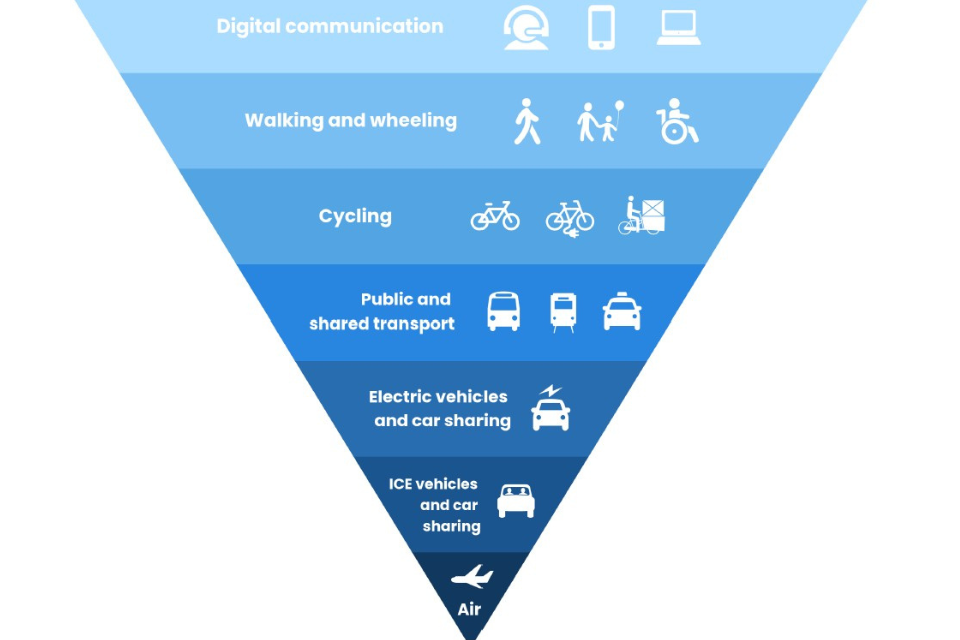
Travel Hierarchy Infographic
-
Use remote communication in preference to travel where this is not outweighed by the benefits of face-to-face interactions undertaken to support Blended Working or providing mental health benefits from exercise.
-
For short distances, consider walking or cycling.
-
Use public transport where travel is necessary unless there are clear safety, security, or business reasons (minor inconvenience or personal preference not being valid justification). Train travel remains one of the lowest impact forms of travel. If meetings are planned, ensure meetings are close to public transport hubs and allow for travel time.
-
Where travel by car cannot be avoided, consider car share. Where practicable, low emission hire cars should be used in preference to private cars.
-
Travelling by air should be undertaken by exception. Chief Executive Officer approval is required for international flights. Eurostar should be used in preference to flying for European cities on its route.
Sustainability should be considered when travel decisions are made, relating not just to the means of transport but also considering all other aspects including accommodation and food.
Additionally, carbon impact, ethical standards, modern slavery, diversity and equality should be considered when arranging travel and where necessary these factors may justify cost beyond the limits specified within this policy, in these circumstances Executive approval will be required.
5. Advance of Expenses
Employees who predict they will have to incur a large expense bill whilst away on NWS business can request an advance payment to cover the partial or full expense cost. Advances are usually only available for specific, one-off events. Upon return from the trip, an expense claim should be submitted in full as usual. The advance will be deducted from your next net salary payment which should give ample time for the claim to be paid. Speak to your Line Manager and Financial Controller in the first instance.
6. Travel Booker
Travel should be booked via the NWS Travel Provider ClarityGo. The travel provider has emergency 24 hours a day contact numbers for staff to call if they have an issue whilst travelling, please state you work at NWS.
0333 4343 909 or from outside the UK +44 333 4343 909 Travelling employees must book efficient and economical by:
-
Planning travel well in advance wherever possible, this will ensure the best and most economical prices are obtained.
-
Planning travel with as much certainty as possible, ‘anytime tickets are expensive and should be avoided unless a specific business need is identified. The use of advanced, off peak or split tickets is highly recommended, even if it is one leg of the journey that is advanced, off peak or split tickets, for example the outbound journey may be advanced, off peak or split tickets and return journey anytime.
-
Employees should take advantage of savers and special reduced fares and should have a business justification if they fail to do so.
-
Flexibility is allowed when booking travel tickets if justified by business needs. This includes booking train tickets on the same day of travel rather than in advance if a short notice business requirement to travel arises.
-
Employees must ensure that if plans change then all aspects of the booked trip are cancelled in a timely fashion so that hotels are charged and train fare can be refunded or exchanged.
-
If your train journey arrives late, please make a delay repay claim and ensure all compensation is returned to NWS.
7. Categories of Expense
a. Hotel (UK)
NWS will settle UK hotel B&B costs directly via the travel provider.
Any other charges incurred with the hotel, e.g. evening meals should be settled by the employee directly with the hotel when checking out and reclaimed through the expense claim process. Employees should ensure that the invoices are written in Nuclear Waste Services name to ensure VAT can be recovered.
Employees should ensure that they make use of the rates on the Hotel Preferred Programme by booking via the travel provider, the maximum UK hotel rates per night, inclusive of breakfast and VAT is as follows:
| Hotels London | £250 |
| UK Cities | £150 |
| Other regions | £150 |
A business justification or justification relating to health and safety (which may relate to a protected characteristic) is required for exceeding these limits.
If an employee is attending a conference or training that has been arranged externally and the nightly accommodation cost exceeds the approved rate, in certain circumstance this is permitted if the cost is less than the combined cost of a nearby hotel within limit plus transport to and from the original venue.
Compliance with these thresholds will be monitored. These limits are also embedded with the travel provider.
Employees should not book hotels within the vicinity of their home address (circa 45 miles/1 hour travel time) without prior justification and authorisation by an NWS Executive.
NWS will not reimburse pay-tv, newspapers, mini bar or other private expenses. Laundry expenses will only be reimbursed if travel exceeds 5 consecutive nights away from home.
Short telephone calls home and other business calls will be reimbursed via expense claim for employees who do not have the use of an NWS mobile telephone, a copy of an itemised phone bill/hotel invoice should be included with the claim.
b. Staying in International Locations
NWS will settle hotel and B&B costs directly via the travel provider. In the event local taxes are not billed back to the travel provider, staff should pay direct and claim back through normal expense claim process.
Any other charges incurred with the hotel, e.g. evening meals should be settled by the employee directly with the hotel when checking out and reclaimed through the expense claim process.
The following equivalents in local currency apply:
| International Locations | Cities | Regions |
|---|---|---|
| Hotel (Bed and Breakfast) | £250 | £200 |
| Overnight (Meal and reasonable drinks) | £40 | £40 |
| Breakfast (if hotel not B&B) | £15 | £15 |
| Lunch | £15 | £15 |
Approval for an out of policy booking should be sought where a reasonable standard of hotel is not available within rate.
c. Rail Travel
NWS will settle rail travel costs directly with the travel provider. In exceptional circumstances an employee may purchase rail tickets and reclaim the cost via their expenses, for example where an employee purchases train tickets on the same day of travel rather than in advance if a short notice business requirement to travel arises.
Standard Premium rail tickets with Avanti West Coast can be booked for rail journeys over 90 minutes (note the 90 minutes limit is for the rail element of the journey only and does not include ancillary travel at either end).
First Class rail tickets can be booked for rail journeys over 2 hours where standard premium is not available (note the 2 hour limit is for the rail element of the journey only and does not include ancillary travel at either end). Employees should not book First Class travel where standard premium is available.
The table below shows the class of travel to be used, depending upon the rail company:
| Duration | Avanti West Coast | Other train companies |
|---|---|---|
| Less than 90 minutes | Standard | Standard |
| Between 90 minutes and 2 hours | Standard Premium | Standard |
| Over 2 hours | Standard Premium/First class if Standard Premium not available | First Class |
Under normal circumstances, full open first class tickets should not be used. First class open tickets should be used in exceptional circumstances only. Employees should note that when booking a return journey having a fixed price outward journey and an open return journey this is significantly cheaper than an open ticker for both journeys.
Employees and travel bookers should note that on occasion 2 single tickets may be cheaper than a return.
Employees should notify the booker when there have been significant delays to their journey and should keep any incremental receipts in case a refund or partial refund can be claimed back by the company.
NWS incurs a fee for every transaction used to book tickets. Therefore, employees should endeavour to assist travel bookers in booking multiple tickets in one transaction to help reduce these.
d. Railcards
NWS will reimburse the cost of the following National Railcards if purchased for work related travel on behalf of NWS providing the savings made in the relevant tax year exceed the cost of the Railcard itself:
-
16 - 25 Railcard
-
26 - 30 Railcard
-
Senior Railcard
-
Disabled Persons Railcard
-
Veterans Railcard
-
Network Railcard
-
Two Together Railcard
The expense claim process should be followed for requesting reimbursement of the cost of the Railcard. An expense claim should only be made after journey[s] have been made and that have resulted in savings exceeding the cost of the Railcard. On the expense claim, state the date and time of the train journey[s] that the saving has been made on (e.g. 11/07/21 08:00 Penrith to London Euston).
You must inform your travel booker each time when requesting a rail booking that you hold a valid Railcard and the travel booker will retain evidence of savings made.
The employee must use the Railcard for every eligible rail journey whilst the Railcard is still valid.
Employees are responsible for carrying the Railcard on all rail journeys where the card has been used to obtain a reduced-price ticket. If the card is not carried on a journey and a fine is levied, NWS will not be liable for the cost of the fine.
e. City Travel cards e.g. Oyster cards
Payment for tube, riverboat or bus fares in London can be made by either Contactless payment or Oyster card. The cost of these journeys can be reclaimed through the expense claim process, using narrative as follows “Tube fare, start/finish tube stations, paid by Oyster/contactless card, no receipt” and claiming the standard single journey fare as per TfL website (Single fare finder - Transport for London (tfl.gov.uk).
Anytime London Travel Cards should only be purchased with appropriate business justification.
If multiple tube/riverboat/bus journeys in London are required with a business justification (for example meetings in different parts of London to the office as well as a need to be in the office on the same day), it may be cheaper use contactless or add on appropriate zone as part of the travel ticket to and from London instead of a separate one-day travel card. This option may be explored when planning the itinerary for a day.
f. Hire Cars
Hire cars are provided by NWS for business use only. Hire cars can be available or delivered the day before the journey, but you are only insured to drive it for the duration of the hire period as shown on the booking acknowledgment
As mentioned in the sustainable travel policy, if more than one person is travelling to the same venue then sharing of hire cars should be considered when practical.
If employees are in receipt of contractual car allowance, they are required to use their own car for business travel and will not normally be allowed to utilise hire cars, the only exception being if a hire car is required for the second leg of a journey following a rail journey or flight, for any other reason justification should be presented to the Head of your Directorate and their approval received before proceeding with a booking.
Vehicles hired overseas are not covered by NDA motor insurance and a local policy should be procured.
Before driving the vehicle, employees are required to check the vehicle for damage and it is recommended that photographs are taken. If damage is observed, (which is not detailed on the delivery note), this should be notified to the hire company prior to driving.
Hire cars are provided to allow travel to meet business requirements. You are only insured for business use, or travel to a restaurant close to the hotel where you are staying.
In making a request for a hire car, employees are confirming that they have a valid driving licence. Note: It is the employee’s responsibility to ensure they hold a current driving licence.
At the termination of the rental period for a hire car, it must be returned with the same amount of fuel as was in on delivery/collection, to avoid NWS incurring an expensive refuelling charge. Employees should comply with any conditions of the hire agreement (e.g. no smoking).
If costs are incurred by NWS from the travel provider following fines incurred whilst using hire vehicles, these must be met by the employee driving the vehicle at the time.
g. Private Car Mileage
If a privately owned vehicle is used for business travel, it is your responsibility to ensure that:
-
You hold a current full driving licence.
-
The appropriate insurance is in place for the vehicle, which must include business use.
-
The vehicle is roadworthy and legally compliant.
-
If the vehicle requires a MOT, a valid MOT must be in place.
It is an HMRC requirement that all drivers should keep a log of business mileage to support any claim submitted for mileage allowance rate, including:
-
The date and purpose of your trip.
-
The distance travelled.
-
The start and end address of each work-related trip (including postcodes).
If two or more NWS employees are travelling in a privately owned vehicle, NWS insurance covers the passenger(s) to drive the vehicle, but only when it is being used for business purposes and in an emergency situation. It is still essential that the driver holds a full driver’s licence. It is a requirement of this insurance, that an accurate log of who was driving at any particular time is kept.
A mileage allowance can be claimed when you use your private car for business trips. The mileage allowances as shown in the table below are in line with HMRC limits there are different for employees who are in receipt of a car allowance and those without.
| Usage in tax year | With Car Allowance | No Car Allowance |
|---|---|---|
| first 10,000 miles | 22p | 55p |
| In excess of 10,000 miles | 22p | 25p |
| NDA Group Passenger | each passenger add 5p per mile | each passenger add 5p per mile |
Business Mileage Guidlines
- Ordinary commuting and private travel are not claimable, including travel to and from your home to your contractual place of work. This includes travel from any other place an employee visits for non-work reasons, for example:
Example 1
An employee works 5 days a week at an office in central Birmingham which is their permanent workplace. From Monday to Thursday, they travel to Birmingham from home.
This journey is ordinary commuting. However, on a Thursday they always go out for the evening with friends and often stays at a friend’s house overnight from where they travel directly into work in the morning.
The journey from the friend’s house to the permanent workplace is also ordinary commuting as it’s travel to a permanent workplace from a place which is not a workplace.
Example 2
An employer sometimes needs an employee to attend their permanent workplace outside normal working hours – for example, at the weekend. This means they incurs extra costs on bus fares, the cost of meals eaten at a desk and sometimes even the cost of overnight accommodation near the workplace.
No claim is available for any of this expenditure because all journeys between home and a permanent workplace are ordinary commuting. It makes no difference that the employer needs them to make the journeys or that they’re made outside the normal working hours.
-
The maximum an employee may claim is the lesser of the mileage travelled: if office based, mileage should be claimed from wherever the starting point is less normal commute mileage, if home based then mileage can be claimed from your home address.
-
The actual miles travelled on your journey; or
-
The miles if the journey had started and finished at your normal place of work.
-
The increased mileage rate for employees without a car allowance is to provide a contribution towards the overheads of running a vehicle and is aligned with HMRC allowances.
-
Car parking, toll costs and congestion charges may be claimed.
-
Speeding and other fines will not be reimbursed.
Where an employee is reimbursed at less than 45p per mile they may be eligible to make a personal claim for additional tax relief (Mileage Allowance Relief [MAR]), subject to the current HMRC rules and regulations.
h. Taxi Journeys
A refund of the cost of a taxi will only be made if its use was clearly necessary.
As a general guide a taxi will be deemed necessary if the use of an alternate means of transport would either be more expensive or could present a risk to the personal safety or security of the traveller. Justification for the use of a taxi should be included on the travel claim for Line Manager Review and audit purposes e.g. adverse weather conditions, personal safety, security concerns, health and safety reasons etc.
When staying away from home on official company business, taxi fares will only be reimbursed for official trips, e.g. between the hotel and the temporary workplace or the station. Taxi costs will not be reimbursed for personal social activities whilst on business travel, such as a taxi between the hotel and a specific restaurant the individual wants to go to. Taxi fares for networking and dinners associated with the event will be eligible for reimbursement.
Taxis to and from home will not normally be reimbursed. However, in exceptional circumstances reimbursements such as travel to and from railway stations or airports this may be allowed for those who are not in receipt of a contractual car allowance, If you are in receipt of a contractual car allowance and the cost of the taxi would be less than the cost of business miles and car parking at the facility this may be acceptable and Line Manager approval would be required prior to travel. The reimbursement of taxi expenses to and from work may be classed as a taxable benefit.
i. Staying with Friends or Family
When staying overnight with friends or family (as opposed to a hotel), £40 per night may be claimed as an alternative to the normal meal allowances allowed when working away from home on behalf of the company. If this is claimed then a separate claim up to the £40 evening meal allowance cannot be claimed (see next section on Food and Drink). Please note that from 1st April 2025 this payment will be need to claimed via a form available from HR, this payment should not be claimed via Business World.
j. Food and Drink
Where employees are away from their normal place of work and must make their own arrangements for meals, they may make a claim supported by a receipt for the maximum amounts as follows:
| Meal | Maximum Claimable (Including VAT) | Notes (Including gratuities) |
|---|---|---|
| Breakfast | £15.00 | You must commence the business journey before 7am or your hotel is booked on a room only basis. No room service/tray charge allowed. No alcohol permitted. |
| Lunch | £10.00 | No alcohol permitted. |
| Evening Meal | £40.00 (inclusive of beverages and gratuity/services charge 10% max) | This can include up to 2 alcoholic beverages or ½ bottle of wine as part of the meal. Alcohol purchased before or after a meal is at employee’s own expense, except where drinks are not provided as part of the meal service. In these circumstances, NWS will pay for a reasonable amount of reasonably priced alcohol (equivalent to half bottle of wine per person), providing it is purchased within a reasonable time of dining, and this is evidenced on the receipts. |
Snacks, biscuits, muffins, etc. are not reimbursable individually, only meals as above.
A reasonable amount of tea/coffee/water is allowable whilst away from the office (e.g. expensing one cup in the morning and one in the afternoon, in addition to drinks taken as part of a meal.
Where an employee lives locally, they should not claim for an evening meal if dining with a non-local employee, unless this is part of a larger organised event.
Meals relating to business lunch meetings between NWS employees are not reimbursable.
k. Gratuities
When a service charge has not already been included on a bill, gratuities for meals etc, the amount paid should be recorded separately on the expense claim. Gratuities should be made at a level appropriate to local customs e.g. the guideline for UK gratuities is up to 10% and for the US is up to 15%.
l. International Travel
All overseas travel will require the prior approval of the CEO before any travel commitment is made. Employees should complete the International Travel process.
Once approval has been received the traveller should inform the vetting office of their travel plans, if any NWS IT equipment or phones are to be taken abroad, additional authorisation is required from your Line Manager, IT department and InfoSec before removing any device from the UK.
Employees travelling to Europe or Switzerland from the UK should carry a UK Global Health Insurance Card (UK GHIC) in order to obtain general cover in the event of an emergency. If they have not been issued with an UK GHIC from the Department of Health, they can contact the Customer Services Department on 020 7210 4850, or the website is http://www.dh.gov.uk
All vaccination, inoculation, medical examination expenses, work permit and visa charges which employees incur in connection with a business visit will be paid for by NWS. (These costs should be claimed via the normal expense claim process).
m. Air Travel
Employees should seek alternatives to air travel, where possible e.g. train/Eurostar. Approval from a member of the NWS Executive is required for domestic flights prior to booking with international flights requiring CEO approval prior to booking.
Economy class should be booked for flights less than 5 hours. Premium economy, if available should be booked for flights longer than 5 hours and if not available, Business Class can be booked at the cheapest available option. If cheapest option is considered unsuitable, a clear business justification is required and this must be approved by the CEO.
Note: Business class travel has a significantly higher carbon footprint than economy. These emissions form part of the One NDA’s greenhouse gas emissions which are measured and reported as part of Greening Government Commitments.
Following a long-haul flight, it would be wise to arrange either an airport stay on your return before driving long distances home, or, to arrange home to airport car transfers.
Where air miles are collected, they must be used for future business travel and not used for personal travel.
Where employees request to have a work trip extended to then have a holiday all additional costs must be met by the employee.
Any additional costs for friends and family accompanying any business trips must be met by the employee.
n. Hospitality and Entertaining
The following information must be shared when claiming for this type of expenditure
-
Names of all attendees (internal and external).
-
External attendees Company or Organisation.
-
Justification/business reason for the entertainment.
Prior written approval from an Executive Director is required and the following maximum limits apply for food and drink for an evening:
- Evening meal allowance £40 of which a maximum of £10 can be alcohol.
Hospitality and entertainment provided by other organisations including gifts should be reported on the appropriate register with the Finance Control Team, in conjunction with the appropriate Fraud and Bribery Policy.
o. Day Delegate Rates
Day Delegate rates apply for training, conferences and meetings (for example NWS Board meetings, Leadership Academy, Internal Audit Conference). This is where suitable space is not available for meetings in NWS offices, Director and Chief Financial Officer approval is required before booking any external venues, in line with Cabinet Office Controls.
Day Delegate rates:
-
London Up to £75
-
Other cities Up to £70
-
Other regions Up to £50
Where training, conferences and meetings take place over more than one day evening meal allowances of £40 including VAT and gratuities apply in addition to the day delegate rate.
Where training, conferences and meetings take place over more than one day The same maximum hotel rates apply.
Working Lunches are not permissible, it may be appropriate to provide a pack lunch for external attendees for meetings that span lunchtime.
p. Phone calls
Where the employee does not have an NWS mobile phone, business calls from hotels, public phones or private phones will be reimbursed. Hotel phones should be avoided if possible, due to the high cost incurred. You must attach an itemised bill with the business calls highlighted and noted with the person and company called.
The NWS will not reimburse a percentage of a phone bill or line rental costs for phones at home.
q. Professional Subscriptions
NWS will bear the cost of a maximum of two HMRC approved annual subscriptions to professional bodies for its staff, where it is considered that membership of that organisation will enhance the individual’s effectiveness in carrying out their duties.
r. Independent Financial Advice
All employees are eligible to claim up to a maximum of £100 for independent financial advice regarding the transfer of their pension on entering employment or at partial retirement stage. Claims should be submitted via expense claim.
s. Childcare
Staff are expected to make their own provisions for childcare when they are required to travel on NWS business. In exceptional circumstances, if this cannot be arranged, where additional childcare costs are incurred as a result of business travel outside of normal working hours, NWS will reimburse the additional cost. Proof of these costs must be provided. A registered childcare provider must be used. Payments will be made via payroll and are subject to Tax and National Insurance Contribution deductions.
8. Expense Claims Procedure
To ensure financial accountability and compliance, all expense claims should be submitted on the Business World system, within three months of the expense being incurred.
Claims submitted beyond 6 months (or beyond 3 months that are from a previous financial year) will be rejected, except in exceptional circumstances and will be subject to CFO approval.
The expense claims should be clearly described for audit/accounting/tax purposes - e.g. full description of type of expense, clear business reason for the expense (for example reference to event / visit / meeting attended), start/end points of journeys (including postcodes), etc.
Electronic expense claims should include images of the original VAT receipts relating to all expenditure being claimed, including claims for petrol and mileage (where VAT receipts for associated petrol dated before the start of the journey should be attached. UK VAT receipts must include the suppliers’ VAT registration number as NWS is unable to reclaim VAT without a VAT receipt. Credit card receipts and credit card statements are not acceptable as proof of expenditure. When no receipt is available, the circumstances should be stated; descriptions such as ‘other’ or ‘miscellaneous’ are not acceptable. Receipts are not required to accompany mileage claims for fully electric vehicles.
Receipts should be obtained for all meals and other expenses. For smaller items of expenditure, e.g. gratuities, it is recognised that there are instances where it is not always possible to obtain a receipt. Where there are un-receipted items contained within an expense claim form these must be individually recorded and sufficient information given to allow the authoriser to validate the expense.
Expense claims for expenditure incurred in a foreign currency must be converted to UK Sterling with evidence of the exchange rate used for the conversion. The evidence should be on the appropriate receipt or credit card statement. The cost of conversion of currency is reclaimable. If employees convert cash into foreign currency any loss on converting unused currency back is not claimable as an expense. The comments box should be used to record business justification for any exceptions to standard policy.
Claims are to be authorised by the employee’s line manager, and the approval route is ‘hard coded’ into the electronic expenses system. Line managers may not approve claims in excess of their authority level nor approve claims of senior colleagues or those of a similar status. The exception is the Chief Financial Officer who authorises the Chief Executive Officer’s claims.
Claimants and their line managers are responsible for checking the accuracy of expenses and ensuring that expenses conform to policies and guidelines in issue at that time. They are also responsible for ensuring that expenses are reasonable and based on a business need.
If a claim does not meet the requirements of this policy, the Accounts Payable team will contact the authoriser to discuss. This may result in the claim being paid net of the disputed item(s).
In the event of a query/dispute, please contact the Accounts Payable team (Finance) in the first instance. If it cannot be resolved, it will only be paid by agreement of the Chief Financial Officer.
NWS is under no obligation to settle any claims outside of this policy.
When a valid expense claim has been processed by Finance, payment will be made by BACS transfer to an employee’s nominated bank account. No claims will be paid by cash or cheque. Please ensure Finance hold your correct bank details.
9. Disallowable Spend
Expenses that are private, normally incurred outside work or not work related are not reimbursable unless special circumstances exist that make it reasonable to do so, this must be discussed with your Line Manager, and they must refer to Finance department.
Examples of disallowable items are listed below (but are not limited to):
-
Chewing gum, muffins, biscuits, chocolate, sweets, etc.
-
Cigars, cigarettes and vapes.
-
Personal gifts, for example employee birthday presents.
-
Hairdressing.
-
Clothes hire.
-
Traffic violation fines, including car park fines, speeding fines and clamping charges (any fines received via the car hire company are recoverable from the employee).
-
Toiletries.
-
Luggage/
-
Newspapers, magazines and books.
-
Car washing (including washing of hire cars), valeting and car related consumables.
-
Hotel videos and pay TV.
-
Minibar.
-
Passport replacements (other than recognised exceptions set out in this policy).
-
Items of personal clothing.
-
Stationery.
-
IT equipment.
-
Printers and accessories such as toner cartridges.
-
Alcohol when expensed without an associated meal.
10. Useful Information
ClarityGo Travel
Emergency 24 hours a day contact numbers for staff to call if they have an issue whilst travelling, please state that you are from NWS: +44 333 4343 909 ClarityGo
UK Global Health Insurance Card (GHIC)
If employees have not been issued with an UK Global Health Insurance card they can apply at Applying for healthcare cover abroad (GHIC and EHIC) - NHS
Other useful numbers
Enterprise Rent-A-Car Breakdown Assist: 0330 053 0405
If you are involved in an accident: FMG (NDA Insurance Claims handlers) 0344 322 1553 NWS Duty Manager Number: 01946 383 700
For any assistance from our Travel Policy Provider see details below:
CHUBB Dedicated Resource Page
The following link Travel Assistance Insurance in UK - Chubb is a dedicated resource page for Marsh clients. Included within the dedicated resource page is a link to Crisis24 whom provide information and support covering business and social customers, political situations, medical advice and overseas medical facilities, health advice, VISA and entry permit requirements, currency and banking hours, time zones and climate and other aspects such as driving restrictions. There is also a function within that allows anyone to sign-up for daily security assistance emails vetted by impartial security experts, covering a range of topics including terrorism, kidnap and cultural threats. There is also no cost to the NDA Group or any employees for using any of the above-mentioned services, the SMART app or the new Travel Assessment.