
Management of Technical Data Procedure
Published 27 October 2026

© Crown copyright 2026
This publication is licensed under the terms of the Open Government Licence v3.0 except where otherwise stated. To view this licence, visit nationalarchives.gov.uk/doc/open-government-licence/version/3 or write to the Information Policy Team, The National Archives, Kew, London TW9 4DU, or email: psi@nationalarchives.gov.uk.
Where we have identified any third party copyright information you will need to obtain permission from the copyright holders concerned.
This publication is available at https://www.gov.uk/government/publications/policies-and-guidance-relevant-to-the-nws-supply-chain/management-of-technical-data-procedure
Context
The fundamental concept underpinning this procedure is reaching and recording agreement, between the right people, about which technical data are appropriate for a particular use. The requirements set out in this procedure stem from this fundamental concept, and in this way the procedure facilitates and provides structure to the ongoing, necessary and routine interactions between those who provide data and those who use data, as part of Nuclear Waste Services (NWSs) iterative way of working:
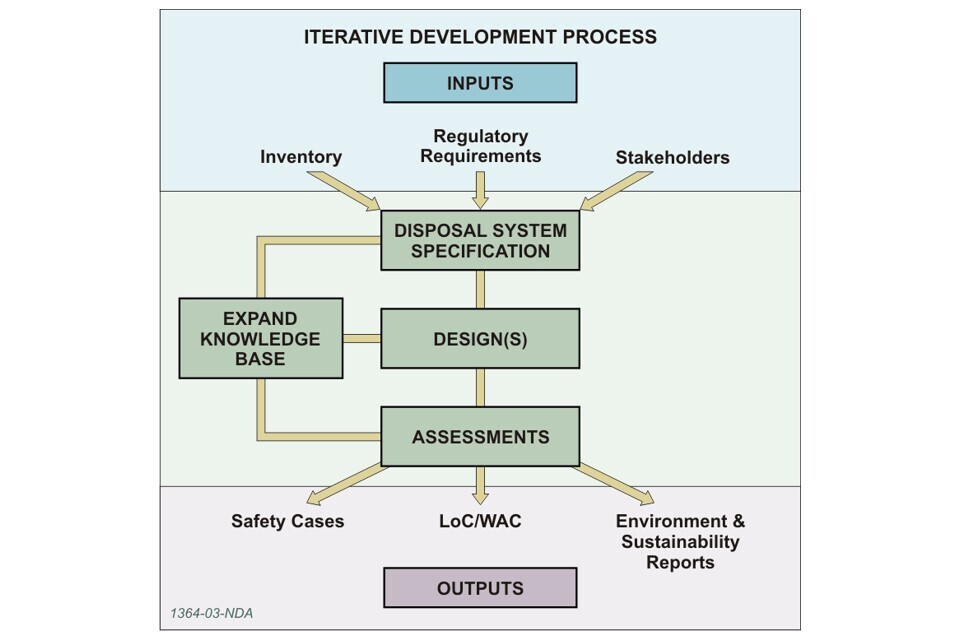
To support this fundamental concept, information about technical data and the required use of technical data needs to be known and recorded. The intention is that this recording of information is done in a pragmatic way. Those who own the data, and those who own the required data use, are charged with agreeing between them which data are appropriate for a particular use. They are also best placed to determine how much information to record about the data and the use of the data. This determination should be on the basis of recording enough information to support appropriate decision making now, and to support the future traceability of decision making. In making this determination these people must use their competence, intelligence and judgement, where necessary seeking guidance from colleagues. If available elsewhere, this information can be referenced rather than repeated.
Purpose and Scope
The purpose of this procedure is to ensure appropriate and traceable use of technical data by recording information about data quality and provenance, involving the right people in decision making about data use, and recording that decision making. This procedure applies to all stages of technical data management from the generation of new data, to its use, re-use, preservation and retirement. The procedure supports Data Management Aims and Principles (MIGSOP RWP102) and provides guidance on:
- Registration of an existing or new technical data set;
- Update of a registered data set;
- Use of a data set;
- Retirement of a registered data set;
- Maintenance of the data catalogue and review of data use;
- Management of data errors; and
-
Re-assignment of key roles. This procedure applies to technical data and related information that underpin:
- siting and site investigation;
- disposal system specification;
- disposal system design and cost estimating (financial data associated with the short term operation / planning is excluded);
- disposal system safety assessments and safety and security case production;
- disposal system sustainability and environmental assessment; and
- disposability assessment and endorsement of waste packaging proposals.
The management of data relating to the Disposability Assessment process is governed by specific arrangements detailed in NWSSOP 42.08_002. These arrangements use the concepts developed and described in this procedure and interpret and apply them using processes tailored to the review and approval requirements for disposability assessment. These particular arrangements and forms replace those detailed in this procedure for the specific case of disposability assessments.
The following are excluded from the application of this procedure:
- financial data associated with the short term operation / planning;
- large volume datasets (e.g. data for cost estimating) for which producing DDFs for individual data items would be prohibitively resource intensive; and
- non-technical data, for example personnel records and commercial transactions.
Responsibilities
Data Owners are those who provide and take ownership of data and information as assigned to them by the organisation. Data owners support data users in their responsibility for appropriate use of technical data and information, by consulting with them about use of the data they own.
Data owners are accountable for the security, integrity, quality and availability of these data, including making adequate provision for long-term care. Because the technical data are held in the data integrity system, to deliver this accountability all data owners effectively share accountability for this system.
Data owners are accountable for ensuring that this Data Management Procedure is followed.
Data owners are at Head of Function level, and so are likely to also hold other roles in relation to the data, such as being the relevant Information Asset Owner and the Competence Owner for the competence relating to the data.
A data owner is expected to delegate the day-to-day responsibility for a data set to a Data Steward, but will remain accountable for the data set. At least one of the data owner and data steward must hold the competence relevant to the data.
Where a data steward has notified NWS that they will be leaving the organisation or changing role, the data owner is accountable for identifying suitable transition arrangements. Where a data owner is leaving or changing roles the relevant director of that function head is required to identify a suitable transition plan including the appointment of an appropriate data owner(s) - see section Reassignment of Data Owner / Data Steward.
Data Users are those who use technical data and information in their work. Data users are responsible for appropriate use of technical data and information, in consultation with relevant data owners, for example by specifying their data needs, and by agreeing data and information as being of appropriate quality for their use.
Data owners, data stewards and data users are all members of NWS staff (or contractors covering permanent roles as Interims), although they may be supported by contractors in undertaking these roles.
A Review Panel is a meeting of a data user and possible data owners / stewards to determine how the specified data use should be addressed.
A Model Senior Responsible Owner (MSRO) for a model (as defined in NWSSOP 30.02.03) is a member of staff in a sufficiently senior position that they are able to understand the strategic importance to the business of what that model is being used for, and the associated business risk.
The Data Manager supports and facilitates the Data Management Procedure, in particular interactions between data owners and data users. The Data Manager is responsible for tasks such as uploading completed forms, as protection of data integrity requires limited “write” access to the data catalogue. The Data Manager is responsible for recording and maintaining appropriate sign-off of all data (see Sign-off of DDFs/DUFs in the section below).
Definitions
The Audit Commission has defined the terms data, information and knowledge [Improving information to support decision making: standards for better quality data, March 2007]. These definitions are used by NWS.
-
Data are numbers, words or images that have yet to be organised or analysed to answer a specific question. Non-numerical data are outside the scope of this procedure.
-
Information is produced through processing, manipulating and organising data to answer questions, adding to the knowledge of the receiver.
-
Knowledge is what is known by a person or persons. Knowledge involves interpreting information received, adding relevance and context to clarify the insights the information contains.
NWS defines a data set as a collection of related data, for example the half-lives of radioisotopes. The data owner must make a judgement on how data are grouped into a data set to be recorded together on a Data Definition Form. In making this judgement the data owner should consider how well the data fits together, including factors such as competence (so that each data set has a single data owner and data steward), and common features, for example data quality.
The Data Definition Form (DDF) is a form used to define, describe and record technical data, its origin (references), and attributes of data quality. This form is mandatory for data within the scope of this procedure. The DDF needs to be signed off by both the data owner and data steward. It is the responsibility of the Data Manager to ensure this sign-off happens and a unique record is maintained (see Sign-off of DDFs/DUFs below for guidance on how this may be achieved). The DDF should only be used to record data that has been accepted for use, and has therefore been checked as appropriate to support this acceptance for use. Acceptance of data for use, for example by acceptance of contractor work or by adding reports to the GDF knowledge base, is outside the scope of this procedure. In addition, before signing off the DDF the data owner should assure themselves that completion of the DDF has been appropriately checked.
The Data Use Form (DUF) is a form used to describe a required use for technical data and assumptions utilised in models, and to record decision making about the data and assumptions that will support that use. This is usually done by reference to a DDF. Where appropriate, the DUF can also store numerical data such as derived modelling parameters. In this case, details of how data (referencing the relevant DDF) have been processed for use in a model e.g. by simple computation, or expert elicitation of parameters for a particular model, should be included. It would not be appropriate to include more complex data processing on a DUF e.g. if this involves conceptualisation. Such processing would effectively be an additional model, and would need to be managed as such in compliance with NWSSOP 30.02.03. The DUF is mandatory for uses of data in models. The DUF needs to be signed off by the MSRO for the model or use in question and the data owner(s) or data steward(s) for each DDF which has been used to provide input data to the model. It is the responsibility of the Data Manager to ensure this sign-off happens and a unique record is maintained (see Sign-off of DDFs/DUFs below for guidance on how this may be achieved). Each Data Owner or Steward must be an NWS member of staff or interim who has the required technical competencies under. If the data use is in a model or toolkit that resides in the NWS Model and Software Repository, then the completed DUF(s) should also reside there.
The DIG Client is a software tool for creating, editing and viewing DDFs and DUFs.
The Data Integrity Manual provides further guidance on this procedure and especially on the use of the DIG Client.
A Data Catalogue provides a means for identifying the approved data that are available to users. The data catalogue is comprised of the collection of completed Data Definition Forms. Data Definition Forms held in this catalogue are searchable via SharePoint.
Sign-off of DDFs and DUFs. It is a requirement that DDFs and DUFs must be signed off in a way that uniquely records that the appropriate people have approved them. It is the responsibility of the Data Manager to decide how best this sign-off is achieved and demonstrated, as per the procedures described in the flow charts in Section 6. One method may be to use the DDF Quality Log (NWSF 30.02.07_002) and DUF Quality Log (NWSF 30.02.07_002) forms (which are retained for backwards compatibility with previous versions of this procedure, even though the complicated work instructions for completing these forms have now been retired). However, this is no longer mandatory, it may be more pragmatic to maintain a simple list in the Data Catalogue recording unique identifiers of the DDFs and DUFs and the appropriate signatures. It is envisaged that it may be possible to attach electronic signatures to the DDF and DUF documents in SharePoint in some way in the future to achieve this requirement in a more straightforward way.
A formal Data Glossary contains an agreed set of terms, their definitions, authorised abbreviations and relationships with other terms, to support a common vocabulary and consistent naming standard for describing data. The NWS Glossary will be used to support data management.
A set of approved units has been developed; these are available for selection from the DDF.
Data Quality
To support decision making about appropriate use, the quality of technical data will be defined on a DDF considering the following attributes:
-
Characterisation of uncertainty: The degree to which uncertainty in the data is understood and represented. Although not the same as uncertainty, variability (for example in time and space) is often managed in the same way as uncertainty, and so is also considered in this attribute. This attribute also considers the precision to which the data are represented, and the appropriateness of this precision given the uncertainty and variability in the data.
-
E.g. (bentonite solubility) “The treatment of uncertainty in these distributions differs from that used by Nirex in GPA03. The data ranges resulting from calculations in different water compositions are narrower than those produced when including a broader range of contributing uncertainties in formal elicitation. In particular, the groundwater compositions considered in the SR-Can assessment gave rise to a narrow range of solubilities for some elements, including uranium and thorium. Uncertainties identified with the specific data are detailed in «Solubility limits SR-97» (Section 11.8). It should be noted that these PDFs were not generated in the way NWS would normally expect to treat uncertainty. The PDFs were simply constructed (rather than elicited) for a log-normal distribution that was based on the best estimate and pessimistic SKB values taken arbitrarily as the arithmetic means and the 95th percentiles respectively of a log-normal distribution. The SKB values represented the best available values at the time and were used again in 2010 because research required to replace them has not yet been carried out.”
-
E.g. (volume of backfill) “The backfill volumes are the sum of the local (space in between packages) and crown (space between top of packages and the vault roof) backfill volumes only. Peripheral (space around the outside packages of the outer packages) and additional (space left due to a vault not being 100% filled) backfill volumes are not included.”
-
-
Provenance: The degree to which information about the data such as its source, assumptions, methodology and standards used, and any inconsistencies, are known and recorded.
-
E.g. (niobium solubility enhancement factor) “It has not been possible to find documentation for the derivation of the values given.”
-
E.g. (vault dimensions) “The width parameter … corresponds to the width of the vault module… The vault module width consists of the sum of the width of all the vaults of that type, plus any gaps and rock in between the vaults. The “vault widths” recorded in the 2010 PCSA are consistent with the data from the «Draft GDF design report» for vault modules. It is important to note however, that elsewhere, “vault width” usually relates to a dimension for a single vault, rather than a module of vaults.”
-
-
Limitations of applicability: The degree to which data and information address the entire scope of the domain, for example spatial or temporal.
-
E.g. (impact release fractions) “The RFs presented here are for the set of waste packages presented; bounding drop heights (8m for disposal container, 25m for UILW packages and 10m for SILW packages) onto a flat unyielding target”
-
E.g. (ILW containment time) “It can be argued that this value is pessimistic but not completely unrealistic for vented waste containers that have the potential to release inventory as soon as they become saturated. However, it may not be an appropriate assumption for DCICs unless it is considered reasonable to assume that the seals will have failed and water will be able to enter the waste package at closure.”
-
A final attribute of data quality must be considered in selection of data for a particular use, and recorded on a DUF:
- Relevance: The degree to which data and information meet the needs of a particular use.
Data and the Supply Chain
NWS is a lean-client organisation, significantly supported by the supply chain in its technical work programme. Although this procedure is focused on technical data management within NWS, NWS expectations for data in the supply chain are as follows:
-
Where NWS requires a contractor to use specific technical data, we will supply these data by providing and giving access to the relevant DDFs.
-
Where a contractor is producing technical data for NWS, we expect that data to be provided as a draft DDF, so that once accepted by NWS (Section 6.1), it will become part of NWS Data Catalogue.
-
Where a contractor uses technical data to produce a numerical output for NWS, that output should be considered as technical data and should be provided on a DDF. The DDF should provide references to all underpinning information used to derive the data, to fulfil the requirement of documenting data provenance and quality.
-
Contractors are expected to work to their own QA regime (which NWS will have agreed as acceptable during the tendering process) when handling data for NWS work. Contractors are not required to complete DDFs for all data they use in NWS work, but they are required to provide accurate and transparent references to any data used to support NWS work – this would normally be in the contractor’s report and referenced in the DDFs for the output of the work produced by the contractor.
-
Any additional requirements to be placed on a contractor or NWS regarding data management must be clearly specified in the relevant section re data and models in the Contract Technical Specification. This section should cover any requirements on NWS to supply data to contractors, any procedures for recalling out-of-date data from contractors, and any requirements for data freezes and retention of data packs or lab books or emails that form part of a data audit trail.
Procedure
The remainder of this procedure is comprised of flow charts or descriptions to follow for work within NWS for each of the activities listed in Purpose and Scope.
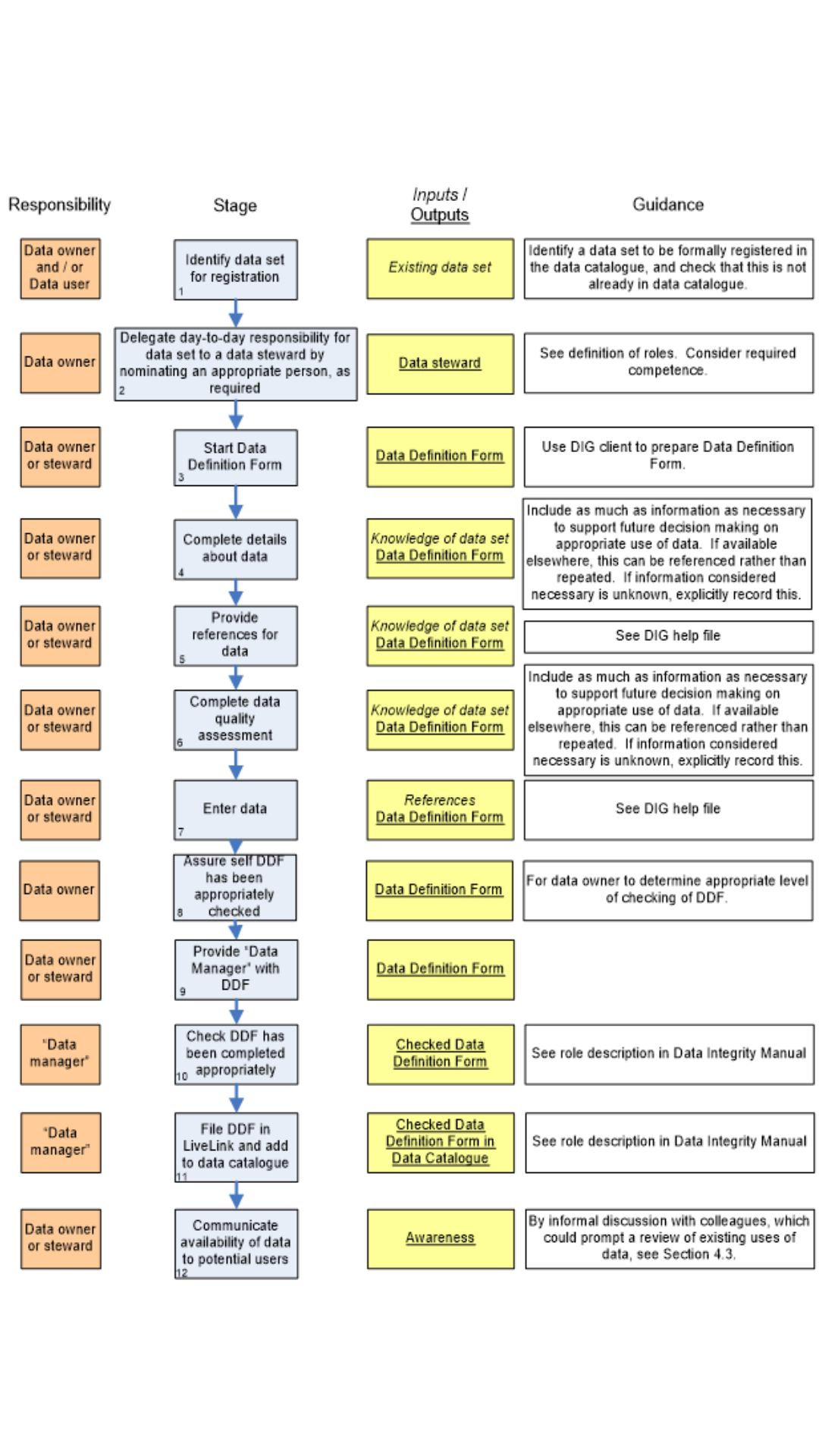
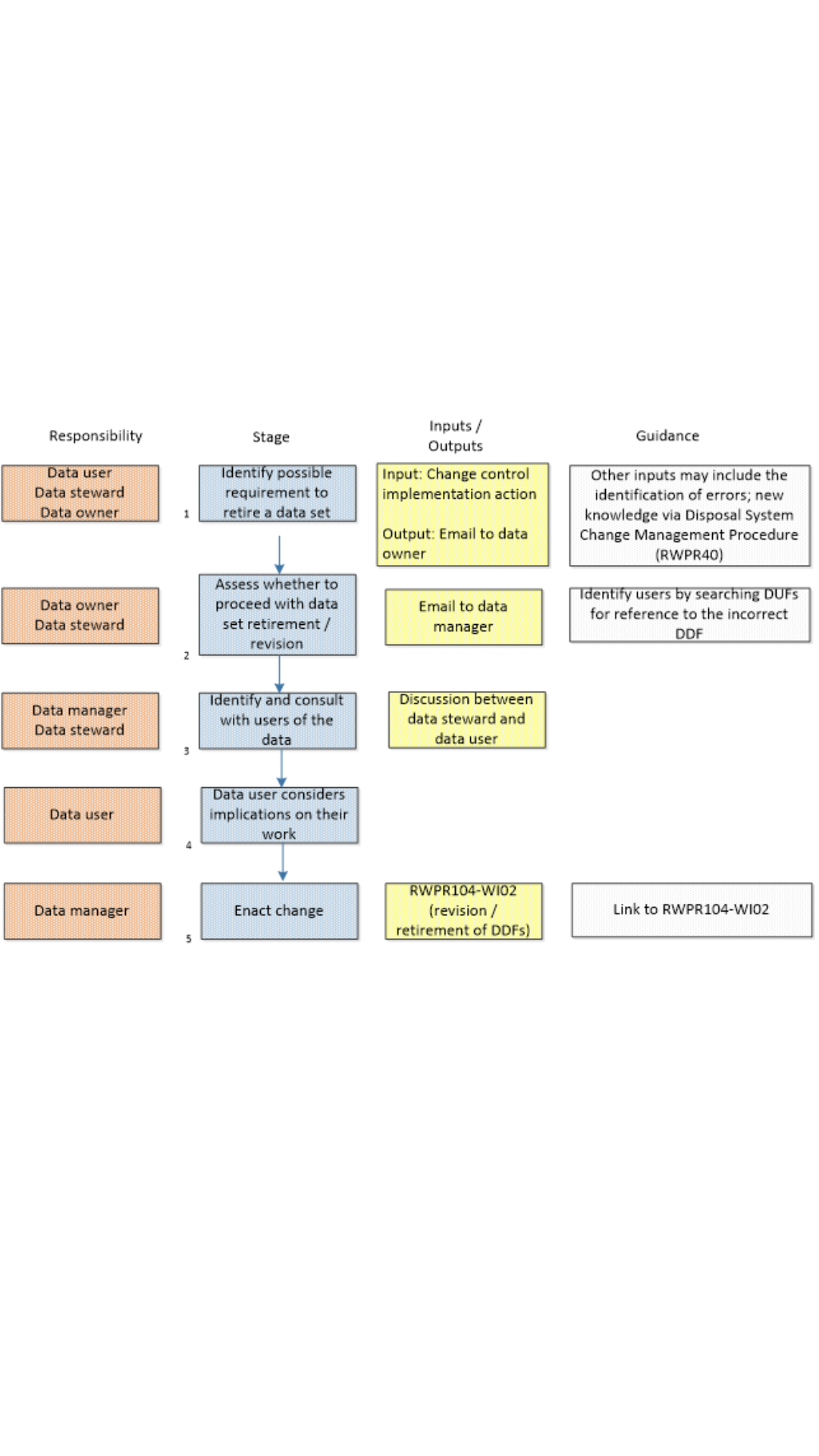
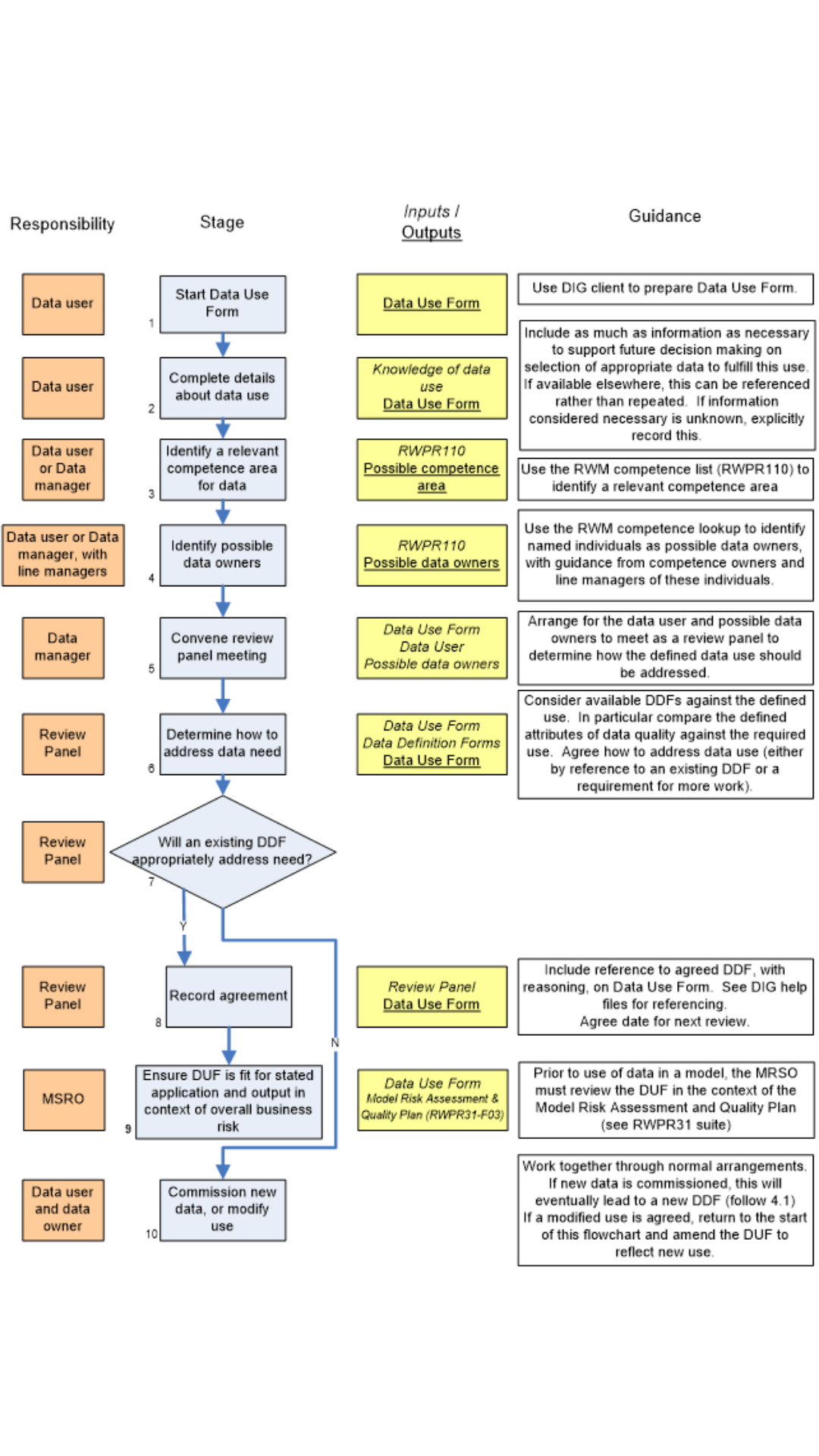
Each flow chart comprises a series of steps to be taken. Responsibility for each step is allocated to one of the roles described in Responsibilities, the inputs and outputs to each step are given, along with guidance.
It is important to include on DDFs and DUFs as much information as necessary to support future decision making on appropriate use of data. If available elsewhere, this information can be referenced rather than repeated.
It is not possible for this procedure to specify precisely the information that is necessary in every case. The over-riding principle is to record information to ensure NWS appropriate and traceable use of technical data. This will require data stewards and data users to use their discretion, and as necessary to seek guidance from the data owner and / or MSRO.
It will be necessary to identify a data owner for each data set. Arrangements for this step are not shown in the flow charts, it is expected that existing arrangements around Head of Function, competence management and Information Asset Owner will usually clearly identify who the data owner should be.
Register a Data Set
This process applies both to existing data sets that are yet to be registered in the data catalogue, and where NWS has a need to generate new data.
Update a Registered Data Set
If a data set is updated, for example as a result of a change to introduce new research findings or a revised design, a new DDF to reflect this update should be completed by following the flowchart shown in Register a Data Set.
This new Data Definition Form should take specific care to include a description of the history of the data set, changes and differences with reasons for these, and include references to existing DDFs which are potentially replaced by this (see DIG help file for referencing).
The data owner of this new DDF should identify existing DDFs which the new data set potentially replaces (via SharePoint searching and with the support of the “Data Manager”, in addition to awareness of their own and colleagues’ data sets).
For each potentially replaced DDF, the data owner should identify uses of that DDF (via SharePoint searching and with the support of the “Data Manager”) and contact the relevant data users to prompt a review of each use.
This review of use should take into account the newly available DDF. Changes to use as a result of the review should be recorded on the relevant DUF (see flowchart in Retire a Registered Data Set).
Based on this review of uses, the data owner should consider the need to retire any data sets that have been replaced and are no longer being used. To retire a data set, follow the flowchart in Periodic Maintenance of the Data Catalogue and review of data use.
Use a Data Set
This process applies when a data user utilises a data set for technical work. The main purpose of a DUF is to describe a required use for data, and to record decision making about the data (as defined in a Data Definition Form) that will support that use.
Where appropriate, the DUF can also store numerical data such as derived modelling parameters. In this case, details of how data (referencing the relevant DDF) have been processed for use in a model e.g. by simple computation, or expert elicitation of parameters for a particular model, should be included. It would not be appropriate to include more complex data processing on a DUF e.g. if this involves conceptualisation. Such processing would effectively be an additional model, and would need to be managed as such in compliance with NWSSOP 30.02.03.
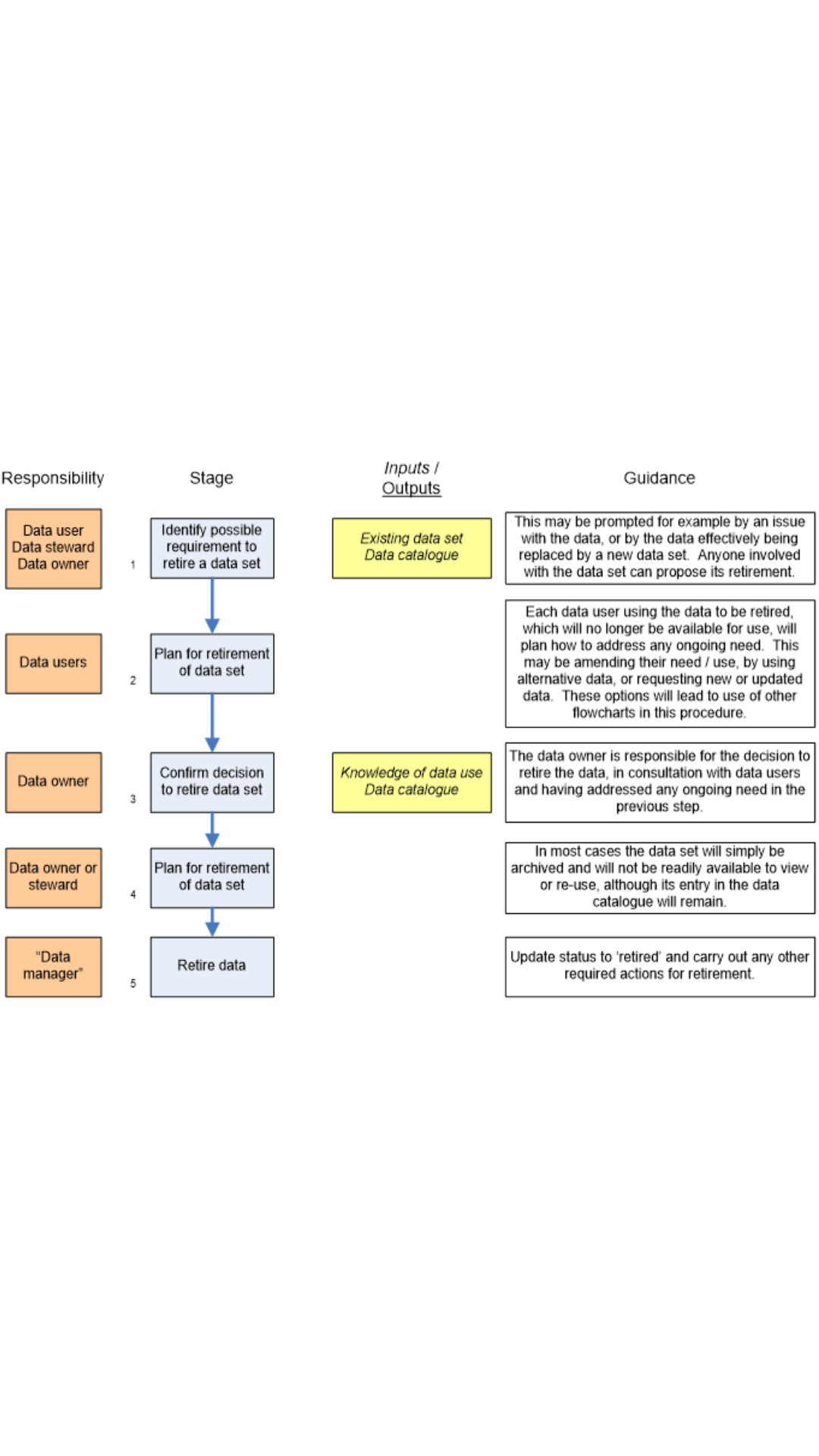
Retire a Registered Data Set
This process applies when a data set needs to be retired, for example if a completely different set of data is required as a model input, and the existing data set will no longer be used. If an existing data set is to be replaced or superseded by a similar data set, see Update a Data Set.
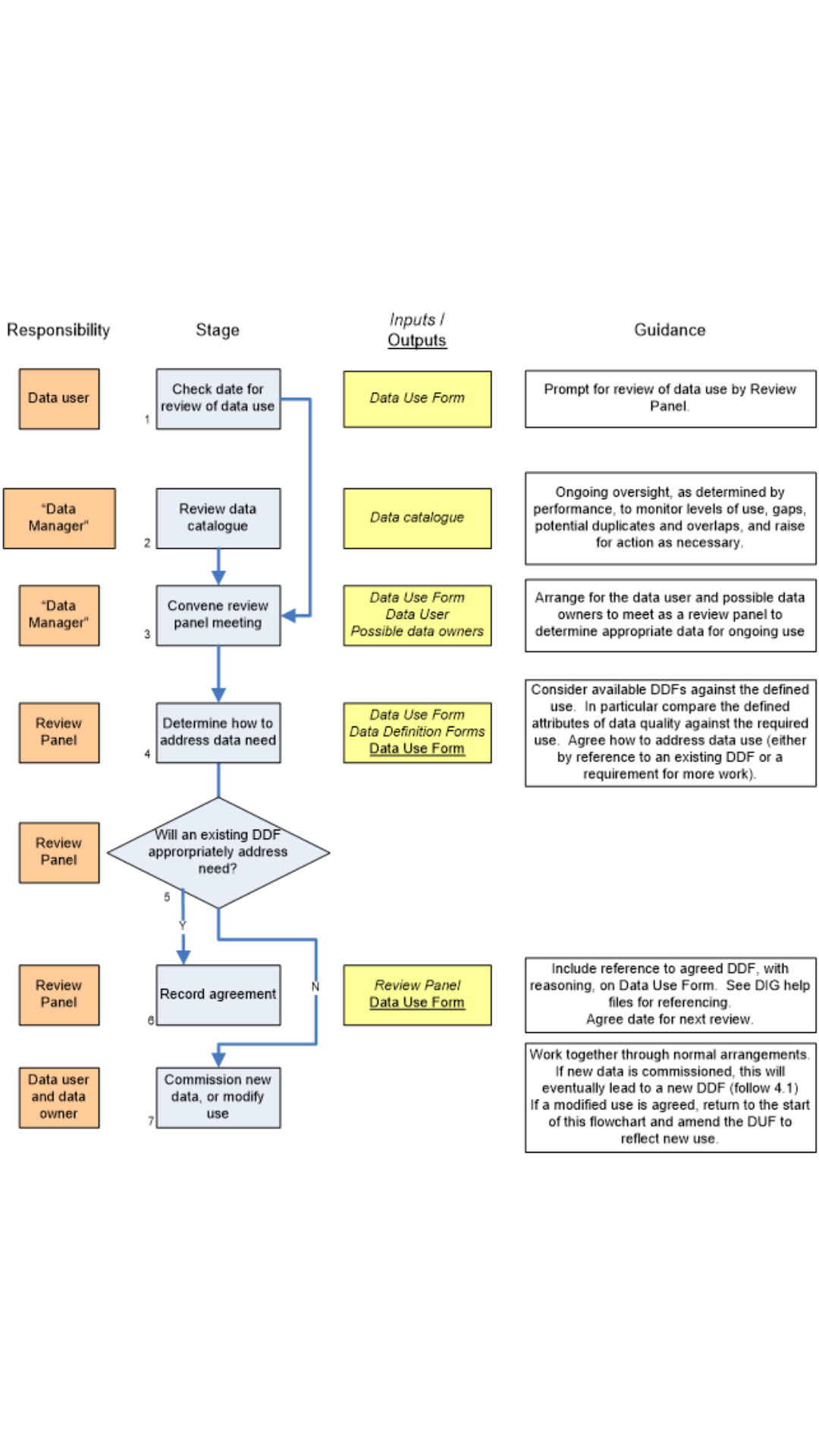
Periodic Maintenance of the Data Catalogue and review of data use
This is the process used to maintain the data catalogue.
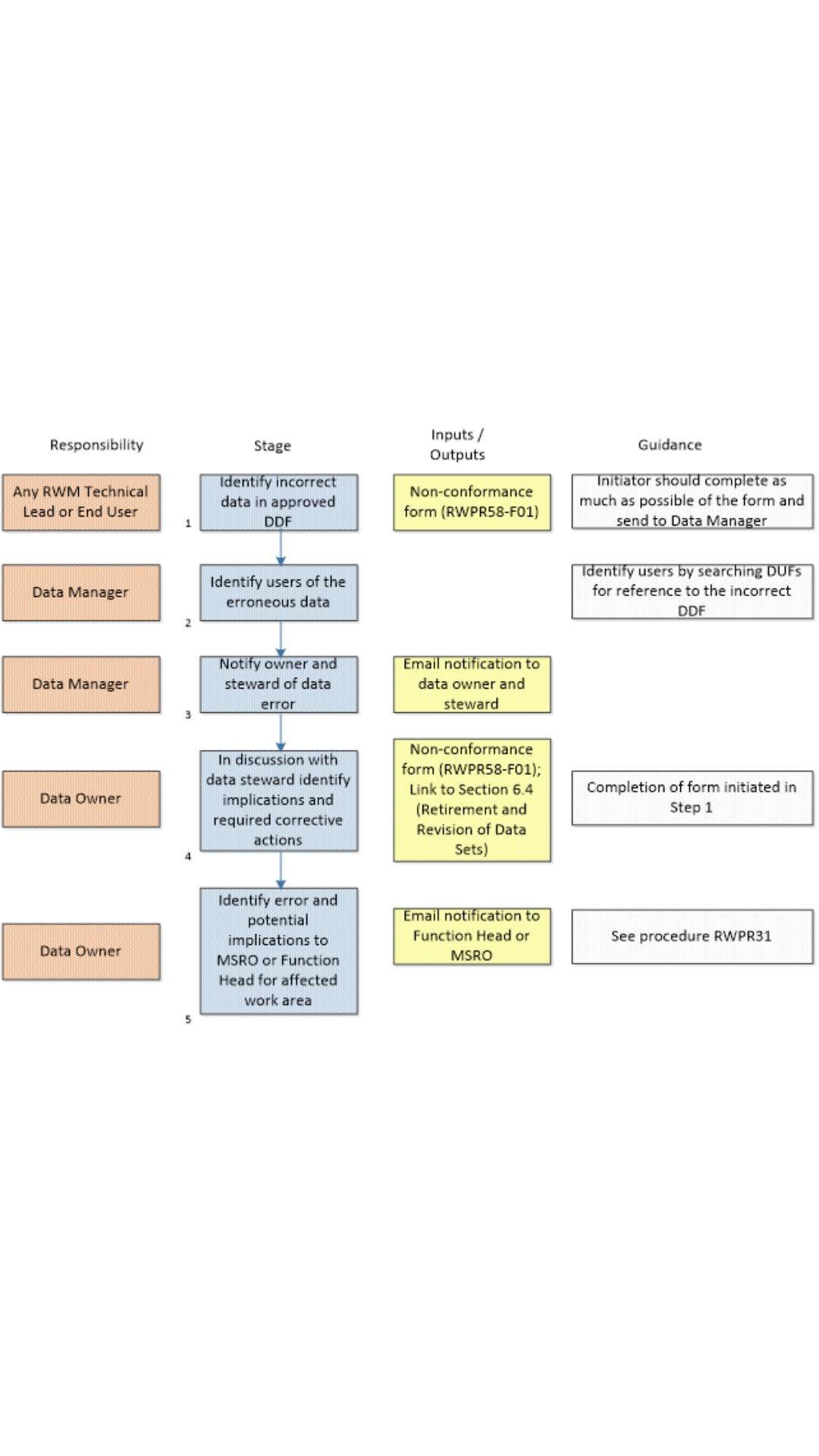
Management of Data Errors
This process applies in the event that a data error is identified.
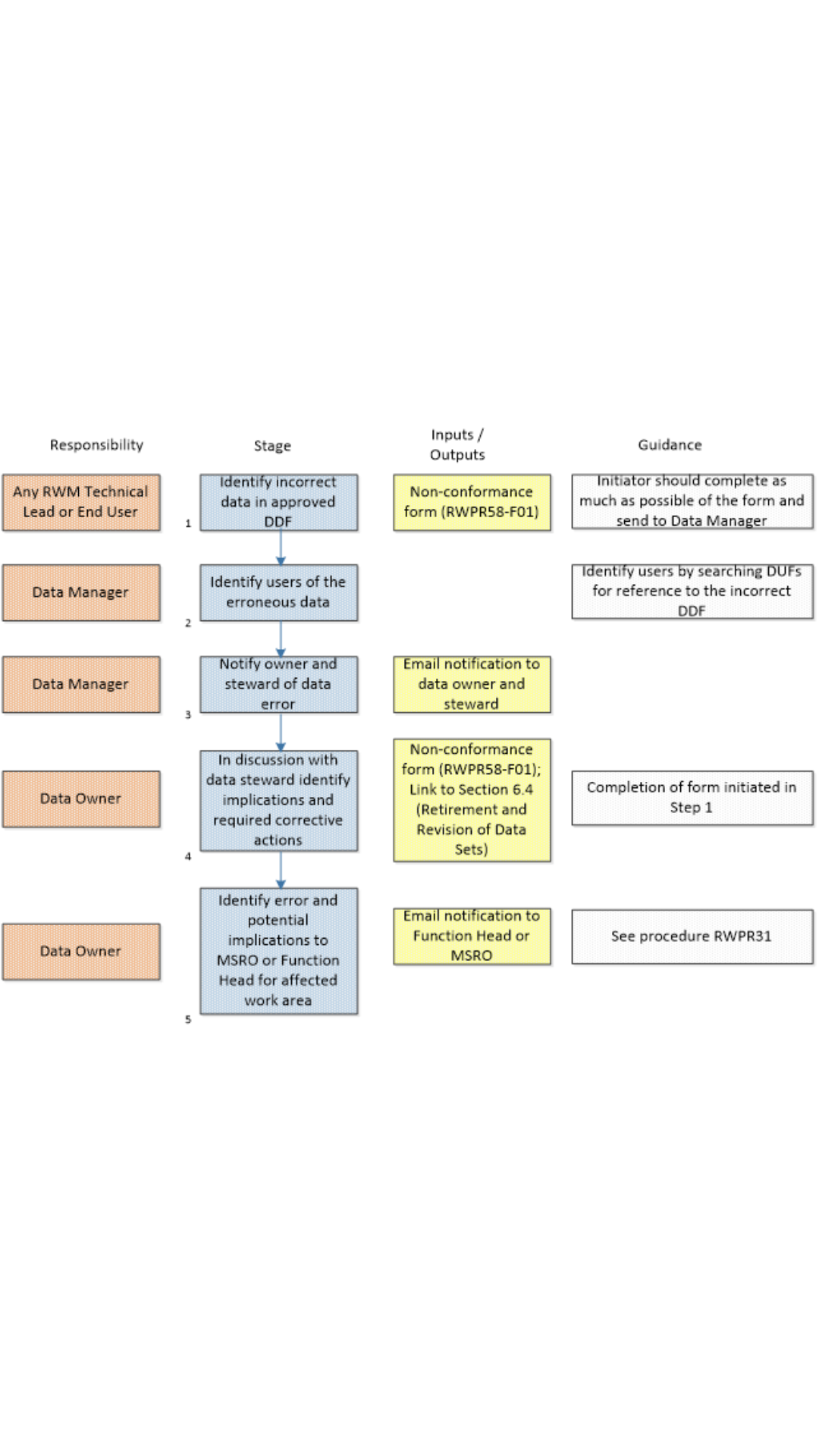
Reassignment of Data Owner / Data Steward
This process applies in the event of resignation, retirement or re-deployment of personnel in key roles. Should an MSRO leave their post their Director shall reassign their MSRO role to a suitably qualified and experienced replacement.
Documentation & Records
List of documentation and records that it is expected that the procedure will generate.
| Document/record | Responsible | Retention period |
|---|---|---|
| Data Definition Form | Data Owner or Steward | Indefinite |
| Data Use Form | Data User | Indefinite |
| Data Definition Form | Data Manager | Indefinite |