
Contract Quality Requirements
Published 27 October 2026

© Crown copyright 2026
This publication is licensed under the terms of the Open Government Licence v3.0 except where otherwise stated. To view this licence, visit nationalarchives.gov.uk/doc/open-government-licence/version/3 or write to the Information Policy Team, The National Archives, Kew, London TW9 4DU, or email: psi@nationalarchives.gov.uk.
Where we have identified any third party copyright information you will need to obtain permission from the copyright holders concerned.
This publication is available at https://www.gov.uk/government/publications/policies-and-guidance-relevant-to-the-nws-supply-chain/contract-quality-requirements
Introduction
This Nuclear Waste Services Topic Manual (NWSTM) forms part of the Quality Section of the Nuclear Waste Services Integrated Management System (IMS).
As a guiding manual it outlines the expectations and interactions between the customer and the contract in the context of the oversight of quality assurance activities, for which a detailed but not exhausted list can be found in appendix 3 - typical oversight & Assurance activities.
Nuclear Waste Services and its regulators reserve the right to undertake oversight of the contractor management system arrangements and all work being delivered within the contract scope including sub-contractor work. Oversight may by delivered means of assessment, inspection, verification, surveillance or formal audit. The contractor shall suitably inform their respective sub-contractors appropriately of this requirement as part of their flow down arrangements.
A range of documents may be referenced throughout as a guiding/more detailed principle, however the key relating NWS process to this manual is NWSSOP 08.09 (How do we deliver quality in a Project environment) which can be used intelligently applied across all work scopes to help satisfy the expectations set out within this document
For any clarification on the range of terminology used throughout this manual, a glossary has been created within appendix 1 of the document.
Aims
This document aims to ensure the safe and predictable delivery of projects, products and services through quality control, assurance, verification and validation of activities.
It extends to all tier of the supply chain via standard “flow down” arrangements. Flow-down is the dissemination of the Nuclear Waste Services quality arrangements established for the specified Assurance grading and/or Specification. These arrangements shall be adopted regardless of the Contractors operational location(s).
Purpose
Quality standards aim to support the delivery of excellence in all aspects of services, operating safely, securely, reliably and predictably. To achieve this aim, it is a requirement for the Supply Chain to deliver the quality of Projects, Products and Services safely, to schedule, to the specified requirements and to the agreed cost.
The purpose of this documents scope is to define the Contract Quality Requirements that will enable the delivery of Projects, Products and Services to the applicable Assurance grade. It is important to recognise that this document is intended to supplement an already implemented Quality Management System in line with BS EN ISO 9001:2015, however this document focuses on the NWS elements not specifically within that standard which over time have proved key to successful delivery of Projects, Products and Services to specified quality requirements.
In the event that any inconsistencies present themselves between this document and the contact between NWS and the contractor, the legally binding contract shall take precedence.
The oversight arrangements, Contract Quality Requirements and performance metrics detailed in the document reflect the key principles and activities that promote Quality control, assurance, verification and validation of projects, products and services within the Nuclear Waste Services supply chain. These oversight and assurance arrangements are designed to minimize the risk of non-conformance, defects and Counterfeit, Fraudulent and Suspect items (CFSI).
This may include but is not limited to the following;
-
Identifying and managing identified risks within the Supply chain
-
Principles for establishing risk based approach to contractor oversight
-
Qualifications of suitably qualified and experience persons (SQEP)
Projects, Products and Services
This document is designed to encompass and be intelligently applied at all phases of contract delivery by the NWS supply chain as shown below and also within Appendix 3: Typical oversight and assurance activities.
NWSSOP 08.09 (How do we deliver quality in a Project environment) details an NWS approach to structure how a PDCA (plan, do, check, act) cycle alongside useful guidance on roles, responsibilities and key tasks which contribute to successful delivery of projects, products and services.
This diagram(s) within NWSSOP 8.09 details where oversight and assurance arrangements for all projects, products and services supplied to nuclear waste services as determined by the EHSSQ assurance grade and associated product specification(s)/regulatory requirements.
Flow Down
The contractor shall comply with all the requirements as applicable to the specified Project, Product or service as defined in the contractual document and ensure the requirements are flowed to every applicable tier of the supply chain.
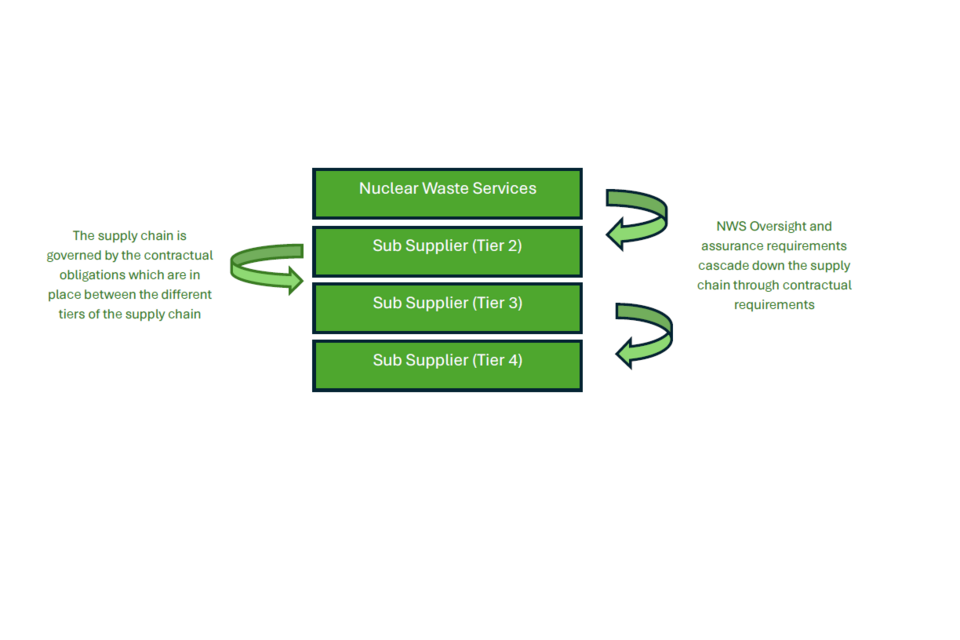
Supply Chain Tier
Designation of EHSSQ Assurance Grading
Dependant on the Assurance grade selected for a product or service, the colour coding at the heading at particular sections of this document will determine if those requirements are applicable. These are identified where deemed applicable using the key shown to the right of each heading. For example, (as below) if all of the specified grades are coloured green, this indicates that all clauses within the heading shall apply to the scope of works.
In cases where the Assurance grade is shown as pale green, then such requirements are by exception/agreement, however it is noted that such agreements shall be specifically stated as a requirement within the contractual scope document or supporting works information and shall always take precedence in any such discrepancies.
Guiding Principles/Concepts
The following principles underpin the successful application of oversight and assurance of quality management systems arrangements within Nuclear Waste Services supply chain and customers and contractors shall act in accordance with these principles at all times.
-
Nuclear Waste Services will act as the Intelligent Customer regarding application of this document
-
Contractors shall satisfy these customer requirements at all times
-
Contractors shall understand and apply effective change control management
-
Contractors shall promote industry cultures and behaviours
-
Nuclear Waste Services and it’s Supply Chain will be transparent to share information regarding industry best practice and instances of Counterfeit, Fraudulent or suspect items (CFSI)
Collaborative Working
Nuclear Waste Services are committed to working together with its Supply Chain delivering excellence in everything it does. Having the right people, with the right skills in place at the right time.
Achieving this requires a collaborative relationship to deliver to the required standards through a culture of continuous improvement. Nuclear Waste services and its supply chain shall achieve this by;
Preventing concerns escalating and resolving issues promptly through open and Honest Communication at all levels and tiers, throughout the Supply Chain – raising queries and concerns as they become known.
Checking for understanding and compliance at all levels and tiers of the Supply Chain.
Ensuring that specifications, requirements, and identified processes are flowed down, understood, and met through all levels of the supply chain.
Sharing Learning to Identify and build on best practice Utilising, Learning From Experience (LFE) to prevent issues and improve performance, Structured Problem Solving to non-conformities based on data to address true root cause.
Contractor Request for Deviation from Contract Quality Arrangements
If foreseen in the pre contract phase that the Contractor is or potentially unable to comply with any of the requirements applicable to the EHSSQ Assurance grading given throughout the duration of the contract, the Contractor shall put forward a deviation request that requires formal agreement from Nuclear Waste Services that it may be acceptable to deviate from the contracted requirements on a case by case only. If approved this shall then be retained as documented evidence within the contracts Lifetime Record file.
Nuclear Safety Culture
In the context of this document, Nuclear Safety is described as “Realising the Design intent via quality of workmanship in order to protect our people and environment.
A ‘Nuclear safety culture’ is defined as the core values and behaviours resulting from a collective commitment by leaders and individuals to emphasise safety to ensure protection of people and the environment.
There are 8 internationally accepted principles of a strong Nuclear Safety Culture:
-
Everyone is personally responsible for nuclear safety.
-
Leaders demonstrate commitment to safety.
-
Trust permeates the organisation.
-
Decision-making reflects safety first.
-
Nuclear technology is recognised as special and unique.
-
A questioning attitude is cultivated.
-
Organisational learning is embraced.
-
Nuclear safety undergoes constant examination.
NWS integrates multiple strands of NSC (nuclear safety cases) which is paramount to the safety of the site that includes quality, environment, safety and security. We ensure optimisation and integration of safety tools and processes as well as safety elements of systems engineering design.
Nuclear Waste Services place importance on these behaviours and cultures we expect to be understood and disseminated into the supply chain to ensure safe delivery of projects, products and services
Contractors shall be aware of these where required in relation to this document, particularly toward the importance of risk-based approach where nuclear safety related implications are present based on the required scope detail and may include specific design and engineering specifications that are attained to scope of a higher perceived risk.
Quality Management System arrangements – Pre Contract Phase
Where detailed within the contract shall maintain a Quality Management System that is compliant to the latest edition of BS EN ISO 9001 or equivalent, and which has been independently certified by a United Kingdom Accreditation Service (UKAS) accredited certification body, accredited Certification body or internationally accepted equivalent, as defined by the International Accreditation Forum (IAF).
To ensure best practice and continued certification, the contractor shall monitor and update their management system as necessary to demonstrate capability of delivering projects, products or services in line with the expectations within this document and those of specific contract(s) which are being undertaken for NWS.
If a contractors management system is made up of multiple certified systems (for example a joint venture partnership) then all operational management systems and interrelating arrangements relevant to the project, product or service shall be made available to Nuclear Waste Services within an agreed timescale. This shall ensure clarity over roles and responsibilities during delivery of work scopes(s) and during potential audit activities.
The Contractor shall have a nominated suitably qualified and experienced Quality Management representative independent of functions, supported by competent experienced personnel, to ensure implementation and ongoing effectiveness of the Quality Management System arrangements. These arrangements shall be documented on an organisational chart and presented for acceptance.
Upon request, the Contractor shall provide NWS with copies of their management review records relevant to the Contract work scope.
The Contractor shall notify NWS of any management review actions which have or potentially could affect compliance with contractual requirements.
Where organisational changes to the Contractors’ Quality Management System could present potential loss of certification(s) or an acceptable level of project delivery, product or services this shall be brought to the attention of Nuclear Waste Services for acceptance/approval. Acceptance/approval may be withheld if in the opinion of Nuclear Waste Services, the quality management system arrangements present a risk or do no longer comply with any specific obligations within the agreed contract(s) in place.
Contract Placement Phase
Resource Management
Modern Slavery Act (MSA) 2015
Contractors shall implement a Code of Conduct with specific focus on modern slavery issues including appropriate contractor control, oversight, and assurance mechanisms
The Contractor shall implement an induction course to include the full scope of works.
The Contractor shall ensure that all designated personnel deployed on NWS’ work scope receive an induction course prior to commencing work on the contract. The induction course shall as a minimum include:
-
Nuclear Safety Awareness
-
Conventional Safety requirements
-
Applicable Security requirements
-
Overview of the work scope
-
Mandatory procedures
-
Requirement briefs against all Standards and Specifications relevant to the work scope.
Applying effective oversight upon Project delivery, products and services utilizes SQEP (Suitably Qualified and Experienced Persons). To be considered as SQEP, individuals’ professional competence shall be demonstrated and traceable to a competency matrix linked to their role. Professional competence is deemed to be demonstrable knowledge, skills and experience as appropriate to the task or activity being undertaken and shall be supported by formal training and qualification(s) (national / international). Evidence of scheduled Periodic Reviews shall be maintained and Forward Planning to close out identified competencies or progress of working toward upskilling/training requirements.
The Contractor shall notify NWS in writing of any deficiencies identified with personnel competency that may affect the item or service provided, in a timely manner. The Contractor shall take timely corrective actions and communicate these to NWS.
The Contractor shall be able to demonstrate the qualification and independence of Personnel verifying or inspecting work from those performing the work. NWS reserves the right to interview these personnel to determine this as required.
Procurement
Graded Approach to Procurement
NWS implements a graded approach to the procurement of Projects, Products and Services within the supply chain via NWSSOP 8.05. This graded approach ensures that the appropriate levels of assurance and oversight are deployed, commensurate with the level of risk.
The contractor shall also apply a considered graded approach to procurement, deploying resources on consideration of:
-
The magnitude of potential consequences if an item fails or an activity is carried out incorrectly
-
The significance and complexity of each item or activity
-
The hazards and the magnitude of the potential impact (risks) that are associated to the safety, environmental, security, quality and economic elements of each item or activity.
NWS EHSSQ Assurance grade(s) selected as 01 and 02 will require mandatory NWS oversight and assurance activities at the Contractor’s/sub-contractor’s works or the specific location(s) where inspection or testing is taking place. This shall require submission of controlling documents such as Quality Plans, Inspection and Test plans or written method statements to the requirements stipulated within the contract specifications. Upon completion, work will require a certificate of conformity and a final inspection release certification by an NWS inspection representative. Quality Grade 01/02 items will generally require a lifetime record (LTR) pack which will also require verification and endorsement by NWS as part of the agreed handover arrangements.
NWS utilises one additional Assurance Grade that may be applicable for the direct supply of item to Nuclear Waste Services Ltd. Grade 02P (P - Proprietary) is utilised for the procurement of proprietary spares and equipment deemed high risk (i.e. typically catalogue items) but from a source of proven capability. The NWS Assurance grading risk process may identify a high risk; however, the contractor shall be compliant with Quality Grade 03 requirements but may need to supply additional supporting information dependant on the nature of the product.
Graded 03 Projects, products and Services will require goods receipt inspection by NWS as a minimum. Manufacturer’s Certificates of Conformance and supporting information depending on the nature of the product will be required as stipulated within the purchasing information. By exception, Quality Plans may be requested by NWS in some instances. Quality Plan usage at QG03 shall then require surveillances and reviews by NWS SQEP personnel as detailed within the agreed controlling document.
If the Project, Product or Service being procured can be demonstrated to carry low/no risk, then a Quality Grade 04 may be applied by NWS and therefore the requirements of this document will be intelligently applied to the relevant contractor. Assurance Grade 04 should only be used for items that, if failed on delivery or utilisation would have Low to No implications regarding Nuclear/Radiological safety, Conventional safety, Environmental impact, or Business risk.
Procurement Information
The Contractor shall ensure that the requirements of the contract, this document, the appropriate standards, and necessary requirements to deliver the Projects, Items and Services specified, are disseminated to and understood by all tiers of the Contractor’s Supply Chain.
The Contractor shall ensure that their purchasing information accurately specifies the requirements for acceptance of Projects, Items and Services, to include as applicable:
-
Reference to this document
-
The EHSSQ assurance grade given for the specific product or service.
-
Applicable Specification(s) and works information
-
Drawing(s)
-
Material Type
-
Quantity
-
Certification requirements
-
Inspection requirements (including in service and upon delivery if applicable)
-
Functional testing requirements (including in service and upon delivery if applicable)
-
Any special requirements to note such as packaging, extra testing etc.
-
Lifetime record (LTR) handover requirements
Contractor / Sub-contractor Selection
The Contractor shall have a process for sub-contractor selection through robust and auditable assessment and analysis of their competencies, facilities and equipment to ensure that they have the capability to conform to the contract requirements, delivering items and service safely, to schedule, of the correct quality and to the agreed cost.
Instruction from NWS to use a specific sub-contractor does not absolve the Contractor from completing an evaluation of the Sub-contractor’s capabilities to meet the requirements and commitments of the contract. Adverse results must be communicated to NWS for discussion.
The Contractor shall assess the sub-contractor’s capability to plan and meet the required capacities beyond existing or new contracts.
The Contractor shall ensure that any weaknesses / risks identified during tender assessment are managed post contract award by agreement at the contract opening meeting or readiness review.
Review of Contract Requirements
The Contractor shall be able to demonstrate that their contract review process includes the following:
-
Contract requirements for the scope of work are reviewed, agreed and understood, including SQEP personnel and resources.
-
Suitable Understanding of works information packages and format
-
Review of purchase order information (estimating/purchasing)
-
Identification of opening up meetings or assessment requirements with sub-contractors.
-
Measures for ongoing contract review/change management
Where the contract includes the following elements the contract review must consider them:
-
Project/Contract Management
-
Security and information management
-
Commercial
-
Health and Safety, and Environment management
-
Quality
-
Project Controls (risk management, planning, programme and costs)
-
Engineering
-
Construction
-
Commissioning
-
Operations and Maintenance
-
Provision of item samples (when requested)
-
Lifetime Records (LTRs)
Records of the ongoing reviews and the conclusion reached shall be retained and form part of the lifetime record when requested by NWS.
Sub-contractor Control
If the Contractor chooses to outsource parts of the work scope, the Contractor is responsible for controlling the sub-contractor for the scope of work in accordance with the specified requirements within the contract.
The Contractor shall ensure that the full extent of sub-contract organisations and their personnel in the supply chain have a clear understanding of the specified requirements via flow down arrangements.
When requested, Tier 2 Contractors to NWS shall produce a diagram that shows the totality (inclusive of materials, components, services, sub-assemblies, assemblies and plant items) of the supply chain delivering the contracted scope of work. The diagram shall take the form of an organisation chart, with means of visually identifying the level of assurance to be applied by the Contractor to each sub-contractor.
The diagram shall specifically include:
-
Organisational hierarchy between contracting parties
-
Names of contracting parties
-
Quality assurance arrangements (audit, surveillance, inspection and test) that shall be applied to each sub-contractor.
-
EHSSQ Assurance grade of the sub-contracted work
-
The Contractor shall submit the diagram to NWS prior to any use of identified sub-contractors within the scope of work.
-
The diagram shall be maintained with applicable changes throughout the lifetime of the contract.
NWS can provide support on format upon request for creation of the diagram.
The Contractor shall provide in writing to NWS details and justifications of any proposed increase or reduction in the control over its Sub-contractors or replacement of any Sub-contractors in their proposed schedule.
Oversight and Assurance
NWS reserves the right to undertake oversight of the Contractor’s management system arrangements and all work being delivered within the Contract scope including sub-contracted work. Oversight may be through various methods, including but not limited to; Inspection, verification, surveillance, pre assessment and formal audit. The Contractor shall ensure that its Sub-contractors are clearly informed of this requirement upon contract award(s).
Contractor Internal oversight
The Contractor shall plan and implement risk based Internal Assessment/Audit activities that focus upon the Project Quality, product and service relevant processes that are being provided to NWS. These should be selected as most suitable to the contractual agreements which as suggestions below can include but not limited to:
-
SQEP Records (competency)
-
Weld Procedures and Qualifications
-
NDE Procedures and Qualifications
-
Material management, Segregation and Workface cleanliness
-
Calibration/Measurement Traceability
-
Lifetime Record compilation and management
-
Subcontractor Management
-
Construction Planning/Control including ICL’s
-
Painting and Coating procedures
-
Applicable Special Testing Procedures
-
CSFI awareness and control
Sub-Contractor Oversight Activities
The Contractor shall document and establish Sub-contractor assurance and oversight arrangements to ensure compliance with NWS specifications, standards and Contract Quality Requirements (this document). These arrangements shall be aligned with a risk-based approach and be tailored to mitigate this. This shall be risk based and relevant to the scope of work being delivered by the contractor, evidence of this shall include:
-
Implemented assessment schedule based on EHSSQ Assurance grade risk
-
Supplier assessment reports
-
Inspection reports
-
The use of Quality Plans/ITP’s
-
Surveillance reports
Upon request, the Contractor shall report progress against their assurance programme to NWS, including highlighting any deficiencies identified affecting compliance with this document. NWS reserves the right to request and review evidence of completion via reports or associated documentation at any time.
Performance Measurement
The Contractor shall in accordance with the Contract requirements establish and agree a set of metrics (Key performance Indicators) to enable measurement and analysis of performance against individual contracted and subcontracted work scopes.
The Contractor shall ensure specific, measurable, achievable, realistic and time bound (SMART) action is taken if Sub-contractor performance is not achieving the required standard or upon the identification of a deteriorating and/or adverse trend.
Design
Control of Design
The Contractor shall ensure that all design interfaces are clearly defined and controlled.
The Contractor shall ensure that roles and responsibilities of appropriate design disciplines, for example, mechanical, electrical, process, safety and civil, are clearly understood and communicated to ensure their involvement at the appropriate stages.
The Contractor shall ensure that all designs and design changes issued to NWS are controlled by the documented management system process. Design changes shall be conducted at the same level as the original design review and verified accordingly.
The Contractor shall ensure that IT software used in analysis and computation of high-risk activities is acceptance tested, validated, has a test plan, and is not used beyond its life cycle without appropriate validation.
Design Review Requirements
When the design responsibility lies with the Contractor as defined within the contract, the Contractor shall identify and implement their proposed design reviews on a Design Quality Plan that shall be accepted by NWS prior to the commencement of work.
Third party design verification activities shall be documented and included within the Quality Plan to ensure that responsibilities and communication interfaces are clearly defined.
The Contractor shall submit all documents that are to be considered at design review, to NWS in a fully approved state at least 10 working days prior to the design review
NWS reserves the right to participate in Contractor/Sub-Contractor design reviews.
NWS reserves the right to identify any design activity which requires confirmation or third-party verification.
The Contractor shall document the results of all design reviews and transmit the results to NWS. Actions resulting from design reviews shall be completed before final NWS approval of the design.
Verification reviews of design calculations and analyses performed by alternative means shall be controlled to determine when, by what method and by whom the calculations were performed, and be traceable back to the original design.
Design Output, Review, Checking and Approval
Review, checking and approval of design outputs shall be undertaken by suitably qualified and experienced Personnel independent of those who have direct responsibility for the work being performed.
Design Output, whether in electronic or paper form, shall be considered as Lifetime Records.
Product and service realization
Quality Plans
Where Quality Arrangements for example a Quality Plan, Manufacturing plan, Inspection and Test Plan or Method statement is required by either the Contract requirements, Specification or the EHSSQ assurance grade, the Contractor shall agree the content with NWS during the opening up/Initial kick off meeting, an ‘around the table’ approach shall be applied to ensure right first time approval. From this point on in this document, these will be known as Quality Plan(s), however, the requirements apply also to Manufacture, Inspection and Test Plans and Method Statements.
The Contractor shall ensure a Quality Plan(s) are in place for the contracted scope of work. Where the work covers multiple phases, for example design, manufacture, construction, installation and commissioning, individual Quality Plans shall be prepared. In instances of multi discipline phases becoming applicable, a high level ‘overarching’ Quality Plan shall be prepared for the identified scope which references each individual sub-Quality Plan and/or Manufacture, Inspection and Test Plan. The perceived benefit of this approach allows for Quality Plans to be demonstrated as concurrent with the phase of work and allow for individual closures when those phases are completed.
The Contractor shall submit the Quality Plan(s) and Manufacture, Inspection and Test Plans to NWS for acceptance within the timeframe agreed at the opening up/initial kick off meeting.
The Contractor shall not commence work identified in the Quality Plan and Manufacture, Inspection and Test Plans prior to signed acceptance by NWS.
The Contractor shall document within Quality Plans, the controls to be applied between the Contractor and NWS, including its Sub-contractors where this may be applicable. Any change to an approved/accepted Quality Plan or Inspection and Test Plans plan shall be resubmitted under a new revision to NWS for re-approval/acceptance.
Special processes that are required to be deployed as per the specification shall be identified within the Quality Plan and Inspection and Test Plans. These written procedures will require individual approval/acceptance by NWS and shall form a mandatory hold point. Typical special processes include but are not limited to welding, pipe work bending, heat treatment, non-destructive testing, material finishes and concrete mix design.
For Projects, Items and Services, the Quality Plan and /or Inspection and Test Plans shall conform to the following criteria for identifying surveillance and inspection points:
| Action | Activity Code |
|---|---|
| 100% inspection | A1 |
| Sample inspection | A2 (#) |
| 100% witness | W1 |
| Sample witness | W2 (#) |
| 100% review | R1 |
| Sample review | R2 (#) |
| Hold point | H |
| Approval | AP |
| Surveillance | S |
Inspection and Test Plans shall be prepared listing the activities necessary to demonstrate compliance with the specified requirements. The activities shall be listed in a logical sequence and be broken down into a level of detail required to discharge the work, for example, phases associated with the contract lifecycle and different packages of work.
The Quality Plan and/or Manufacture, Inspection and/or Test Plans shall identify against activities all applicable procedures, standards and specifications, controlling arrangements, accountability for delivery and associated records. The wording and output of the activity shall be clear, concise and unambiguous.
The Quality Plan shall identify the agreed minimum records to be included in the lifetime records (NWSF 08.09.01). These records shall be reviewed, approved and accepted in accordance with the specification and contract requirements.
NWS reserves the right to identify mandatory Hold/Witness points in the Quality Plan and/or Inspection and Test Plans. An NWS representative may identify Hold points in the Quality Plan beyond which instructs that work must not proceed without NWS verification and/or permission. If work commences prior to the acceptance of the Quality Plan, or work progresses past a hold point without the required sign off on the Quality Plan, NWS shall raise a non-conformance requiring corrective and preventive action.
To monitor the work, the Quality Plan shall facilitate the signing off of all activities against the agreed Inspection Activity Codes identified in the approved Quality Plan. The selection of an activity code shall take into account the specification, novelty or difficulty of the activity and the criticality of the result. Quality Plans shall be kept up to date to reflect current status that is, signatures/dates recorded with any relevant supporting information readily available.
Whereby over the lifetime of a project the Quality Plan requires any changes, the revised plan shall require signatures again from all parties as per the original issue. There shall be an agreed method for signposting previously signed off activities and checks in place to ensure no QP steps are missed.
Where steps in a Quality Plan may become recognised as not required, there shall be an agreed formal method for striking out or removing the steps from the plan, which shall include an appropriate and traceable method of this decision being made by SQEP personnel alongside its approval.
The Quality Plan and/or Inspection and Test Plans shall consist of three main parts: cover sheet, documentation sheet and activity sheet. The cover sheet shall identify the following:
-
Company name
-
Title
-
Reference numbers (NWS Contract & Purchase order reference, EHSSQ Assurance Grade contractors reference/job number and if applicable, Sub-contractor reference or job number)
-
Plant item number or material master number (if applicable)
-
Scope of work the Quality Plan covers
-
List of Activity codes and descriptions
-
SQEP nominated roles for signing off specific Quality Plan activities/Quality Plan acceptance. This shall include names, signatures and dates
-
NWS acceptance/approval box
-
Section for final sign off when the Quality Plan is complete.
To ensure appropriate identification, prior to the activities page of the document there shall be a Signatory page (wet signed or PDF electronic signature) identifying the persons who will be signing off activities, demonstrating they are SQEP against the role identified within the activity. The table shall include Name (Clearly in Block capitals). This shall be updated concurrently in cases of additional personnel required.
The documentation sheet shall identify all standards and specifications applicable to the scope of work with their appropriate revision/version as per the contract.
The activity sheets shall identify activities and their relevant codes, controlling documents/procedures, nominated role(s) for verification and where records required to be generated to be included in the life-time records as part of that activity.
When completed the Quality Plan and Inspection and Test Plans should be able to act as a route map from the original scope of work back to the underpinning lifetime record.
Counterfeit, fraudulent and suspect items (CFSI)
The Contractor shall have processes are in place to mitigate the risk of CFSI being deployed to NWS. The processes shall include descriptive identification of the warning signs of potential CFSI and be embedded within assurance on item and service source, selection of Sub-Contractors and other suppliers and verification that purchased items or services meet the specified requirements.
In the event of CFSI being discovered the Contractor shall immediately quarantine the item and notify NWS so that any potential occurrences of the same items in use can be investigated. The contractor shall then initiate the non-conformity process as described in Deviation, Non-conforming item or process. Items confirmed as CFSI shall not be returned to the supplier to explicitly prevent their re-introduction into the supply chain. In all cases the information should be treated as Learning from Experience and disseminated to NWS for sharing as required.
The Contractor shall ensure that processes are in place to control and document the disposition of items identified as Suspect. At request, NWS shall be provided with records to demonstrate the disposition of Suspect Items.
Foreign Material Exclusion (FME)
The Contractor shall have a Foreign Materials Exclusion process to prevent the contamination or inclusion of foreign material or goods during manufacture of construction.
The process should include but is not limited to the following:
-
Identification as to whether Foreign Materials Exclusion principles apply to the scope of work and if so, when. For example, final vessel/container closures, integrated works testing, dismantling or packing and dispatch;
-
identification, segregation and management of Foreign Materials Exclusion areas.
-
identification and use of materials, equipment, processes and systems demonstrating their status. For example, 5S, shadow boards, work management, materials control including items to be removed or added such as bolts, washers, items in or items out, and management of waste arising from manufacturing processes such as swarf;
-
training and awareness information on the risks of FME including good housekeeping for personnel involved in such activities.
Product Traceability
The Contractor shall have a formal documented process for full identification and traceability of materials and products during storage, manufacturing and delivery in accordance with relevant specified requirements.
The Contractor shall, where required, ensure stockist material suppliers maintain a system that subsequently provides full product traceability in accordance with the relevant specified requirements.
Material Certification
All required material certificates provided shall comply with BS EN ISO 10204 type 3.1 as a minimum (type 3.2 may be specified in some cases) displaying the mechanical and chemical properties as required by the specification.
Where designated as required within the contract requirements, the contractor shall supply certification that the supplied goods or service meets the required specifications. This is also referred to as a Declaration of Compliance (DoC) for items that are designated to meet the Supply of Machinery (Safety) Regulations or Certificate of Conformity (C of C) for items to certify the product is in line with the specified requirement of the order.
Details required to be identified on the Certificate, as a minimum, are:
-
Contract / Purchase Order Number (Unique identifier)
-
Drawing Number (if appropriate)
-
Item identification and number of items covered under the certificate
Where a supplier is not in receipt of the TRUE VERIFIED COPY OF THE ORIGINAL CERTIFICATE, the supplier shall validate the certificate in accordance with BS EN 10204 (Name and Position) as a TRUE COPY OF THE CERTIFICATE IN OUR POSSESSION.
Validation of material certificates including stamping and signatures must be clearly legible or may be cause for rejection if all information on the certificate cannot be verified.
Where an item has been manufactured from a previously certified material the Contractor shall provide endorsed certificates of both material items produced by one manufacturer and reworked by another manufacturer, for example fittings made from pipe or plate, flanges made from a forging or plate.
The Contractor shall review and endorse the Original Material Mill Certificates or certified copies to verify conformance with the contract specification upon receipt of the material prior to the commencement of work. The Contractors authorized SQEP representative shall validate the certificate to confirm the mechanical and chemical properties comply with the specified requirements of the order.
‘Stockist’ certificates are not acceptable when original material certificates or certified copies are specified within the contract specification.
No information shall be deleted or otherwise obscured from the certificate. This includes original or other purchaser details. Any evidence to suggest alteration to a test certificate, or an illegible certificate shall be cause for rejection.
Verification and Inspection of Items and Services by NWS
Acceptance of any aspect of an item or service by NWS does not absolve the Contractor of his responsibility to ensure conformity to item and service requirements.
The Contractor shall provide NWS with the agreed notice period of a Quality Plan hold point requiring NWS attendance. The contractor shall be confident that the scope of works requested for inspection has been adequately reviewed internally and therefore prepared for client oversight to take place.
To request verification of inspection and test by an NWS representative, a notification of inspection shall be presented to include the specific scope of inspection required, to allow NWS to allocate and plan for the appropriate personnel. For example, this is to include but not limited to;
-
Controlling Quality Plan/ITP activities for verification
-
Standards/Specifications
-
Estimated hours
-
Disclipline(s) required
-
Location
On-site Contractors should establish a process for goods inward inspection. The process should ensure the following:
-
Plant and materials are received with a copy of the relevant Form 0191 (Final Certificate of Inspection) or equivalent certificate. Plant and materials should be accompanied by a manufacturer’s delivery note and should be checked for quantities and transport damage.
-
Plant, materials and associated certification are being booked into an approved storage or lay down area and allocated with a unique identification number.
-
Plant and materials that are found to be damaged or considered to be outside of specified requirements are immediately quarantined.
-
Identification of CFSI.
Control of Measurement and Test Equipment
The Contractor shall maintain a register of measurement and test equipment.
The Contractor shall provide traceability of measurement and test equipment used by means of recording such equipment used on the relevant report when inspection reports are specified as a requirement.
The Contractor shall maintain measurement and test equipment that is calibrated and traceable to national or international standards (UKAS accredited or internationally recognized IAF member as equivalent) for the duration of the contract. NWS reserves the right to request the status of such measurement and test equipment at any time.
The Contractor shall notify NWS of any item(s) that may be affected by the failure of measurement and test equipment or by the measurement and test equipment failing recalibration. The Contractor should immediately assess the impact on potential item(s) that have been used to certify or verify any aspects of the work scope. The item shall be treated as non-conforming item until demonstrated otherwise. Calibration periods set for measurement and test equipment shall be risk based dependent on the frequency of use with the requirement of this clause in mind i.e reducing potential impact.
Deviation and Non-Conforming Product or Process
The Contractor shall establish a formally documented process to identify, record, clarify and resolve technical queries and production permits for NWS prior to or during the implementation of the contracted work scope.
The Contractor shall establish a formally documented process to identify, clarify, resolve and close out non-conformances in a timely manner, throughout the life of the contract.
The Contractor shall establish a formally documented process to identify a request for deviations or a justification for the use of non-conforming product or service from NWS specified requirements (concession).
Where specified in contractual agreements or scoping document, NWS may suggest or mandate the use of procedures/forms to manage any engineering queries, deviation permits and non-conformances which are referenced by their controlling NWS processes below.
-
Technical Queries
-
NWSSOP 8.06.03 - Control of Concessions and Production Permit Applications
-
NWSSOP 8.06.01 – NWS Non-Conformance and Corrective Action
Upon identification of nonconforming item or service the Contractor shall ensure the item is clearly identified, segregated/quarantined, controlled and recorded. This shall be reported to the appropriate level of management within the organisation and then onwards to the NWS Quality Engineer/Inspector. An investigation into the cause and identification of corrective and preventative actions shall be included in the established process, NWS may request involvement in this process to be satisfied of the outcome.
The Contractor and its Sub-contractors shall not repair work or correct spoilt work after being presented for final inspection by the nominated inspection authority without the prior written approval from NWS.
Acceptance and Release
Release of Products & Records
The Contractor shall not dispatch items identified as requiring an interim release note until authorization has been obtained from NWS inspection authority.
The Contractor shall not dispatch any item unless authorization has been obtained from NWS by the issue of a signed NWS Form 0191 – “Final Certificate of Inspection”.
Lifetime Records defined in the contract and its subsets shall be indexed and formatted as agreed with NWS and accepted with a name, signature and date on the front sheet of the LTR pack by both the Contractor and NWS prior to item release.
The Contractor shall ensure that all Lifetime Records including those generated by Sub-contractors are compiled concurrently with the activity to which they relate and supplied with the goods or service provided.
Lifetime Record files that are requested for handover in a hard copy format shall be supplied to NWS not later than thirty working days after the acceptance of the final goods specified within the contract order. Electronic versions shall be uploaded using the NDA Hub/Connect.
Inspection checklists and associated contractor inspection and test plans shall be utilized to control the release and acceptance of construction works on site.
Correction Fluid such as ‘Tippex’ or similar is not to be used. Any mistakes to be corrected shall be done by a single strike through line so that the previous information can still be read. The amendment shall then be signed, stamped and dated at the side of the change(s) made.
The agreed number of sets of the Lifetime Records shall be, unless stated otherwise in the contracts, be sent to the applicable Project Quality Engineer/Lead for the contract as identified at the opening meeting.
Preservation of Items including delivery and receipt
Contractors are expected to inform NWS of specific requirements and processes that are necessary for the ongoing maintenance and preservation of item(s) before and during use. Operations and maintenance manuals may form part of the deliverables within the contractual agreements.
Contractors bringing chemicals on to NWS property are reminded that permission and a CoSHH assessment is required before the goods are brought on to site.
Contractors holding stock for NWS are reminded that this stock shall be segregated from their own incoming stores items.
Indoor spares storage areas shall be clean and dry with no potential for condensation. Storage temperatures shall be between 5°C and 25°C.
Perishable sealing items shall be stored using the principles of BS ISO 2230 Rubber products, Guidance for storage.
If no NWS or agreed contractor specification exists chemicals and paints shall be stored according to the CoSHH assessment and the Manufacturer’s recommendations.
Care shall be taken to control surface contact of incompatible materials and items, and incompatible storage of chemicals.
Cross contamination of stainless-steel items shall be prevented by appropriate segregation from other non-stainless steel, metal objects or fixings.
The Contractor should ensure the security of item and its constituent parts during internal processing and delivery to NWS.
The Contractor is responsible for establishing a specified storage area, on NWS site Contracts this will be provided by the Construction Manager. The storage area must satisfy the relevant requirements of the contractual Specifications and must be maintained to agreed standards. The specified storage area shall contain a secure and dedicated quarantine area.
Related Documentation
Methods of accessing NWS controlled documents within the Integrated management will be discussed and detailed in the contract. To ensure version control and updates to relevant NWS with regard to access and review of documentation, these can be made available by NWS at request. It is important to note that if a specific revision of a document is referenced within a contract, the revision stated shall take precedence.
Relevant Compliance
This document has been generated with consideration of relevant health and safety legislation. Where appropriate legislation has been referenced, however, the primary legislation that has influence in this document is:
-
Office for Nuclear Regulation – Licence Condition Handbook
-
Office for Nuclear Regulation – Technical Assessment Guide (TAG 077)
-
Internal Atomic Energy Agency – Safety Standards
Abbreviations
Summary of key abbreviations used in this document:
| Audit | Systematic, independent and documented process for obtaining audit evidence and evaluating it objectively to determine the extent to which audit criteria are fulfilled |
| Assessment | Process for analysing a contractor’s competencies, facilities and equipment to provide confidence in the capability to conform to the Contract requirements, delivering items and services safely, to schedule, of the correct quality and to cost |
| Assurance | A systematic approach to confirm activities are being completed as per the requirements, to the appropriate standard and to confirm that arrangements comply with required legislation, standards and NWS Repository Ltd requirements |
| Concessions | Permission to use or release of item or service that does not conform to requirements |
| Contractor/Sub-Contractor | Supplier or individual who provides items or services in accordance with NWS Contract requirements. Contractor is an all-inclusive term which may be used in place of: supplier, Contractor, Sub-Contractor or consultant |
| Counterfeit | Items intentionally manufactured or altered to imitate a legitimate item in order to pass themselves off as genuine |
| Deviation | Departures from the originally specified requirements of an item prior to realisation. Deviations can emerge at any stage of the Supply Chain, including design, manufacturing, storage and transportation. |
| Flow-down | Distribution of NWS Contract requirements as applicable to the specified Quality Grade to every tier of the Supply Chain where the risk associated with the procurement of item or services continues to be a grading of 01, 02, 03 0r 04 |
| Foreign Material Exclusion (FME) | The process of preventing the introduction of outside debris into an area or areas where that debris poses an economic risk or safety hazard. |
| Fraudulent | Fraudulent items are misrepresented with intent to deceive, including items with incorrect identification or false certifications. |
| Hold Point | Hold Point is a mandatory verification point beyond which a work cannot proceed without approval by the Engineer / Inspector. The work cannot proceed until the Engineer / Inspector is able to verify the quality of the completed work and releases the Hold by means of Inspection Request approval. |
| Inspector | The independent body or organisation that verifies that items or services have been designed, constructed, and tested in accordance with the technical Specification. |
| ITP | Inspection and Test Plan. A form of quality plan which identifies specific goods and how they will be inspected and tested. |
| Intelligent Customer | The capability of an organisation to understand where and when work is needed; specify what needs to be done; understand and set suitable standards; supervise and control the work; and review, evaluate and accept the work carried out on its behalf. |
| Learning from Experience (LFE) | The organization systematically and effectively collects, evaluates and implements lessons from relevant internal and external operating experience information in a timely manner |
| Lifetime Records (LTR) | Record(s) that provide documentary evidence of the research & development, design, build, construction, commissioning, decommissioning and demolition of/on a nuclear installation or packaging. |
| Manufacturer/Contractor/Vendor | The supplier organisation that designs, constructs and tests items or services in accordance with the NWS purchase order. This term includes the main manufacturer and any sub-contractors in the Supply Chain. It also encompasses the scenario where design, manufacture, and installation might be carried out by a number of different organisations. |
| Manufacture, Inspection and Test Plan (MITP) | Document which defines the sequential Quality Control, testing activities and associated arrangements that are applied to a specific scope of work or individual piece of plant or equipment. |
| Non-conforming or NCR (Non-conforming Report) | Non-fulfilment of a requirement. Non-conformances can emerge at any stage of the Supply Chain, including design, manufacturing, storage and transportation. |
| Nuclear Licensee | The body corporate that has been granted a Nuclear Site Licence under the Nuclear Installations Act 1965 (as amended), which permits it to carry out a defined scope of activities on a delineated site (NIA). |
| Nuclear Safety | The protection of workers, the public and the environment from undue radiation hazards by achievement of proper operating conditions, prevention of accident and the mitigation of accident consequences, In this document safety means nuclear safety unless otherwise stated. |
| NDE | Non-Destructive Examination. |
| NDT | Non-Destructive Testing. |
| NWS | Nuclear Waste Services. |
| Product | To include components, equipment (incl. free-issue / NWS issued), (goods, items etc) software, maintenance etc. |
| Production Permit or PP | Written authorisation from NWS, prior to production, to allow deviation from specified requirements |
| Project | Planned set of interrelated tasks to be executed over a fixed period and within certain cost and other limitations |
| PES | Programmable Electronic System. |
| Quality Engineer | A suitably qualified representative form NWS Quality Department or authorised inspection representative |
| EHSSQ Assurance Grade | A graded approach to the procurement and supply of items and services |
| Quality Management System | A management system to direct a unit and control an organisation with regard to quality; a combination of resources and means with which quality is realised. |
| Quality Plan | A document or set of documents setting out the specific quality practices, resources and sequence of activities relevant to realisation of a particular item or service. A quality plan is useful for formalising and co-ordinating the interactions of various organisations, through the identification of witness and hold points. |
| Root Cause Analysis | Root cause analysis (RCA) is a method of problem solving used for identifying the root causes of faults or problems. |
| Safety Culture | The assembly of characteristics and attitudes in organisations and individuals which establishes that, as an overriding priority, protection and safety issues receive the attention warranted by their significance. |
| Services | Intangible products such as consultancy, education, insurance, expertise, medical treatment, or transportation. |
| Supply Chain | The network of organisations that are involved in the different processes, and activities, that contributes to the provision of items or services to the purchaser. |
| Special Process | A process that changes the shape, form, structure or final appearance of the original product. |
| Suspect Item | Indication by inspection, testing or documentation that the Item may not conform to specified standards, specifications and/or technical requirements. Additional information or investigation is needed to determine whether the suspect item is acceptable, Non-conforming, Counterfeit or Fraudulent. |
| Technical Query or TQ | Request for clarification of technical or engineering information typically contained in drawings, specifications and contract documents. The response should provide clarification but must not in its own right change design intent. |
| Technical Specification | The Technical Specification defines the system, components and items, as applicable, in sufficient detail to provide a complete basis for the design, manufacture, testing and installation. |
| Tier 1 | The Primary Organization responsible for the procurement or project holding the Intelligent customer role – NWS |
| Tier 2 | The Contractor (either lead contractor or sole supplier) directly engaged in the supply of goods to the Primary Organization |
| Tier 3 | Sub-Suppliers or Sub-contractors to the Tier 2 Organization. This concept may extend further to tier 4, 5 or 6 etc. in the same context dependent on the complexity of the project, product or service. |
| Verification | Confirmation, through the provision of objective evidence, that the requirements have been fulfilled. |
| Validation | Confirmation, through the provision of objective evidence, that the requirements for a specific intended use or application have been fulfilled. |
Appendix 1 typical oversight and assurance activities
Pre-contract
Stakeholder Opening up meetings(s) to review tender submissions Assessment of resources and capability for delivery
Contract placement
Contract opening up/’kick off’ meetings Clarifying and testing understanding of customer/contract specified requirements Oversight and assurance plan for implementation Readiness review of controlling documentation (QP, special procedures, lifetime record plan etc.) Advising on quality assurance matters such as sub-contractor selection Clarifying technical content as necessary, for example manufacturability review
Design
Understanding and planning of Design inputs/outputs Technical document review of Design inputs/outputs Plan for the ongoing review, validation and verification of design intent Product and service realisation; Defining and management of roles and responsibilities (SQEP) Review of dissemination of information through the supply chain Defined interfaces between customer and contractor quality representatives Overview of engineering query management and data (TQ/PP/Concessions) Overview of Non-conformance management and data Assurance that products and services meet customer requirements Ongoing monitoring of contractor SQEP status Review and approval of inspection/test reports (including metric trending assessments) Review of lifetime record collation concurrent with work scope Calibration of measurement and test equipment
Acceptance and release
Final inspection(s) of products and services Concurrent review of Lifetime Records Quality plan review/verification Review of final release certification acceptance Final review and acceptance of Lifetime Records Delivery and receipt; Receipt inspection records and associated trending data