Overview of Greenfield foreign direct investment (FDI) 2003 to 2024
Published 4 December 2025

© Crown copyright 2025
This publication is licensed under the terms of the Open Government Licence v3.0 except where otherwise stated. To view this licence, visit nationalarchives.gov.uk/doc/open-government-licence/version/3 or write to the Information Policy Team, The National Archives, Kew, London TW9 4DU, or email: psi@nationalarchives.gov.uk.
Where we have identified any third party copyright information you will need to obtain permission from the copyright holders concerned.
This publication is available at https://www.gov.uk/government/publications/overview-of-greenfield-foreign-direct-investment-fdi-2003-to-2024/overview-of-greenfield-foreign-direct-investment-fdi-2003-to-2024
This analysis summarises global Greenfield foreign direct investment (FDI) trends between 2003 and 2024, with particular focus on the last 10 years, between 2015 and 2024, using data from the FDI database, fDi Markets[footnote 1].
Note that, while the figures in this analysis represent Greenfield FDI capital expenditure announced in a particular year, these investments are often realised over a number of years. The value of announced Greenfield FDI capital expenditure in a given year is different from the value of Greenfield FDI capital expenditure realised in a given year.
The methodology for this analysis and the sector mapping is outlined in the methodological note that accompanies this publication. This is an update to the February 2025 ‘Overview of Greenfield foreign direct investment (FDI) 2003 to 2023’ publication with additional data for 2024.
The figures included in this update take precedence over previous publications. These figures are estimates and differ from official statistics on FDI, such as from the Office for National Statistics (ONS) or the Department for Business and Trade’s ‘inward investment results’. More information is available in the methodological note.
Global Greenfield FDI capital expenditure trends
The UK has attracted the second highest amount of Greenfield foreign direct investment (FDI) capital expenditure globally over the last 10 years, totalling £447.3 billion over 11,141 projects[footnote 2]. The UK is only behind the United States (£872.2 billion over 18,117 projects) and is ahead of India, ranked third (£420.4 billion over 7,482 projects).
In 2024, the UK attracted the third highest amount of Greenfield FDI capital expenditure globally, totalling £67.6 billion over 1,018 projects. The UK was behind the United States (£181.3 billion over 2,257 projects) and India (£83.2 billion over 1,026 projects). In 2020 and 2021, the UK was the second highest destination for Greenfield FDI capital expenditure, only behind the United States. However, in 2022, Egypt[footnote 3] overtook the UK for one year only, and in 2023, India became the second highest destination for Greenfield FDI capital expenditure behind the United States, followed by the UK.
Greenfield FDI capital expenditure into the UK in 2024 was higher than the annual average over the previous 10 years (£41.5 billion from 2014 to 2023). The UK’s 2024 performance reflects a continued strength in the Clean Energy Industries Industrial Strategy (IS) sector, alongside a large increase in Greenfield FDI capital expenditure into the Digital and Technologies IS sector, due to high-value investments in data centres.
Over the last 10 years, £2,132.4 billion of Greenfield FDI capital expenditure was invested into the Group of 7 (G7) countries over a total of 53,413 projects. The UK (£447.3 billion) received more Greenfield FDI capital expenditure than Germany (£252.3 billion) and France (£138.6 billion) combined (£390.8 billion). However, the 2 countries combined received more projects than the UK over this period (16,897). Germany is the sixth highest country ranked by Greenfield FDI capital expenditure over this period, and France is the 16th.
Over the same period, £3,671.3 billion of Greenfield FDI capital expenditure was invested into the Organisation for Economic Co-operation and Development (OECD) countries over 95,600 projects.
Over this period, £1,317.9 billion was invested into the European Union (EU) countries over 46,702 projects, whilst £823.7 billion was invested into the Association of Southeast Asian Nations (ASEAN) countries over 12,180 projects. Finally, £291.8 billion was invested into the Gulf Cooperation Council (GCC) countries over 9,102 projects.
Figure 1: Greenfield FDI capital expenditure (£ billion) 2003 to 2024 in selected countries
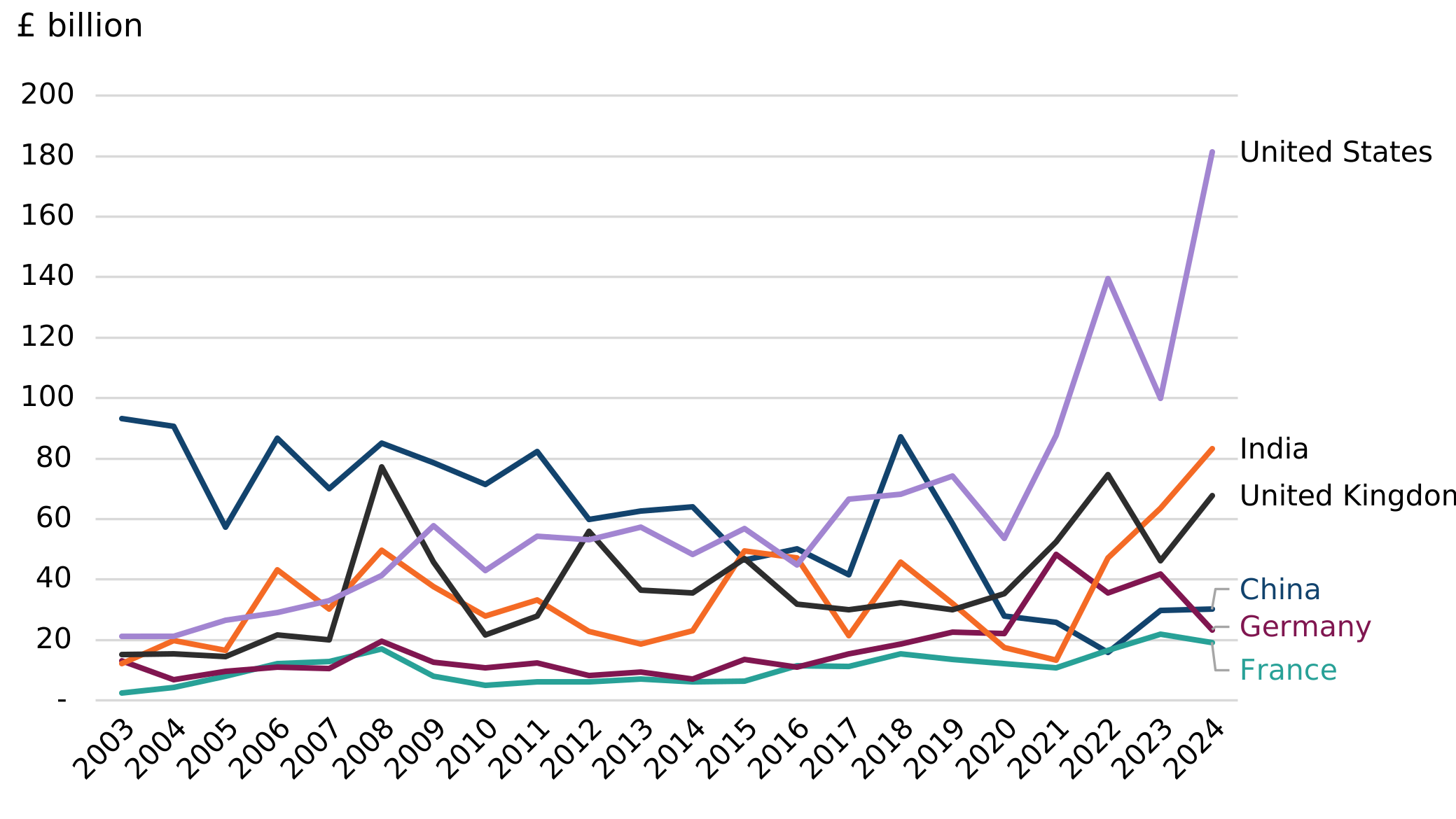
View the web accessible version of Figure 1.
Figure 2: Greenfield FDI capital expenditure (£ billion) 2003 to 2024 in selected country groups[footnote 4]
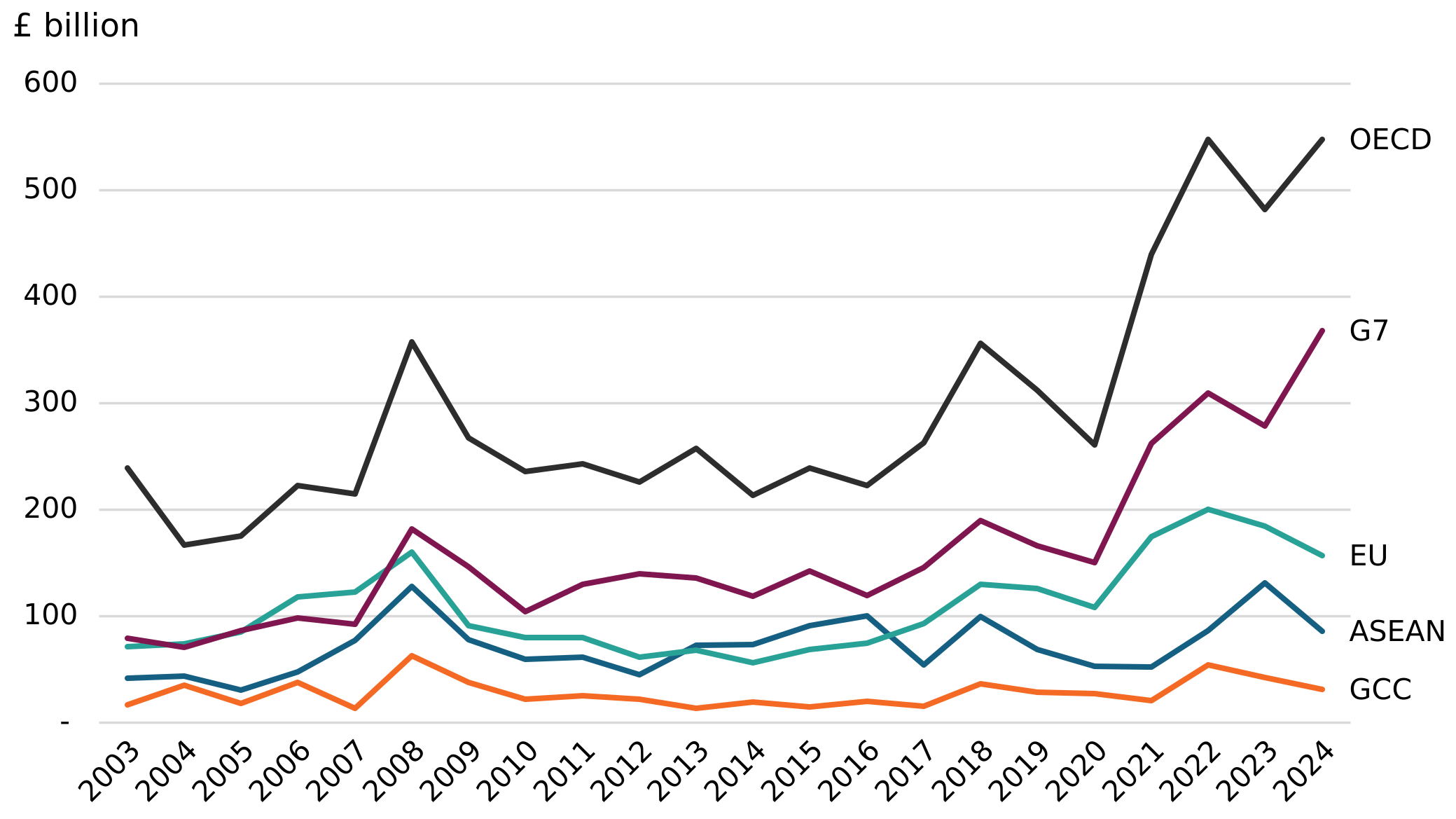
View the web accessible version of Figure 2.
Table 1: Greenfield FDI capital expenditure (£ billion) 2003 to 2024 in selected countries and 5-year compound annual growth rate (CAGR)
| Country | 2003 | 2004 | 2005 | 2006 | 2007 | 2008 | 2009 | 2010 | 2011 | 2012 | 2013 | 2014 | 2015 | 2016 | 2017 | 2018 | 2019 | 2020 | 2021 | 2022 | 2023 | 2024 | 2015 to 2024 total | 2019 to 2023 CAGR | 2020 to 2024 CAGR |
|---|---|---|---|---|---|---|---|---|---|---|---|---|---|---|---|---|---|---|---|---|---|---|---|---|---|
| China | 93.2 | 90.7 | 57.3 | 86.7 | 70.2 | 85.0 | 78.6 | 71.4 | 82.4 | 59.8 | 62.7 | 64.1 | 46.5 | 50.2 | 41.6 | 87.1 | 58.4 | 28.0 | 25.8 | 15.8 | 29.7 | 30.2 | 413.3 | -15.6% | 1.9% |
| France | 2.6 | 4.2 | 8.0 | 12.2 | 12.9 | 17.0 | 8.0 | 4.9 | 6.2 | 6.2 | 7.0 | 6.3 | 6.4 | 11.4 | 11.3 | 15.3 | 13.5 | 12.3 | 10.8 | 16.5 | 21.9 | 19.2 | 138.6 | 12.9% | 11.8% |
| Germany | 13.0 | 7.0 | 9.6 | 11.1 | 10.5 | 19.5 | 12.6 | 10.7 | 12.4 | 8.2 | 9.4 | 7.0 | 13.6 | 11.1 | 15.4 | 18.6 | 22.5 | 22.2 | 48.2 | 35.6 | 41.9 | 23.3 | 252.3 | 16.8% | 1.3% |
| India | 12.2 | 19.9 | 16.7 | 43.1 | 30.1 | 49.8 | 37.7 | 27.8 | 33.3 | 22.9 | 18.7 | 23.1 | 49.4 | 47.2 | 21.5 | 45.6 | 32.0 | 17.6 | 13.2 | 47.1 | 63.5 | 83.2 | 420.4 | 18.7% | 47.4% |
| United Kingdom | 15.1 | 15.3 | 14.5 | 21.6 | 20.0 | 77.3 | 45.8 | 21.7 | 27.9 | 56.0 | 36.5 | 35.5 | 46.8 | 31.9 | 30.0 | 32.4 | 30.0 | 35.3 | 52.4 | 74.7 | 46.3 | 67.6 | 447.3 | 11.4% | 17.7% |
| United States | 21.3 | 21.3 | 26.4 | 29.1 | 32.9 | 41.4 | 57.8 | 42.9 | 54.4 | 53.0 | 57.2 | 48.3 | 56.8 | 44.7 | 66.7 | 68.1 | 74.2 | 53.5 | 87.5 | 139.5 | 99.9 | 181.3 | 872.2 | 7.7% | 35.7% |
Table 2: Greenfield FDI capital expenditure (£ billion) 2003 to 2024 in selected country groups[footnote 5] and 5-year CAGR
| Country group | 2003 | 2004 | 2005 | 2006 | 2007 | 2008 | 2009 | 2010 | 2011 | 2012 | 2013 | 2014 | 2015 | 2016 | 2017 | 2018 | 2019 | 2020 | 2021 | 2022 | 2023 | 2024 | 2015 to 2024 total | 2019 to 2023 CAGR | 2020 to 2024 CAGR |
|---|---|---|---|---|---|---|---|---|---|---|---|---|---|---|---|---|---|---|---|---|---|---|---|---|---|
| ASEAN | 41.8 | 43.5 | 30.4 | 47.6 | 77.2 | 128.2 | 78.0 | 59.4 | 61.3 | 45.1 | 72.7 | 73.3 | 91.1 | 100.1 | 54.5 | 99.6 | 69.0 | 53.1 | 52.4 | 86.7 | 131.4 | 85.9 | 823.7 | 17.5% | 12.8% |
| EU | 71.3 | 74.1 | 85.0 | 117.7 | 122.9 | 159.8 | 91.3 | 80.1 | 80.0 | 61.2 | 68.2 | 56.0 | 69.0 | 74.9 | 93.2 | 129.8 | 125.8 | 107.9 | 174.9 | 200.6 | 184.8 | 157.0 | 1,317.9 | 10.1% | 9.8% |
| G7 | 79.2 | 70.4 | 86.8 | 98.1 | 92.4 | 181.9 | 146.5 | 104.2 | 130.0 | 139.9 | 135.8 | 118.5 | 142.5 | 119.7 | 145.8 | 189.6 | 166.2 | 150.3 | 262.3 | 309.8 | 278.3 | 368.0 | 2,132.4 | 13.8% | 25.1% |
| GCC | 16.6 | 35.3 | 17.8 | 37.5 | 13.7 | 62.7 | 38.0 | 22.1 | 25.5 | 22.2 | 13.4 | 19.4 | 14.5 | 20.3 | 15.5 | 36.6 | 28.9 | 27.2 | 20.7 | 54.3 | 42.6 | 31.2 | 291.8 | 10.2% | 3.5% |
| OECD | 239.3 | 166.5 | 175.1 | 222.5 | 214.6 | 357.7 | 267.6 | 236.0 | 242.8 | 226.0 | 257.2 | 213.2 | 238.9 | 222.7 | 262.7 | 356.3 | 312.1 | 260.9 | 439.9 | 547.9 | 482.2 | 547.8 | 3,671.3 | 11.5% | 20.4% |
When comparing the CAGR over 5 years for investment flows (to smooth out the year-to-year volatility) between 2019 to 2023 and 2020 to 2024, Table 1 shows that:
-
the UK has seen an increase in its CAGR from 11.4% to 17.7%, with higher investment flows received in 2024 compared to 2023
-
India and the United States have seen the largest increases in their CAGRs, with larger investment flows received in 2024
-
China saw relatively consistent levels of investment flows from 2020 to 2024, contributing to a positive, yet relatively low, 2020 to 2024 CAGR, at 1.9% – this compares to a negative CAGR in the 5 years to 2023, at -15.6%
-
Germany has seen a relatively large decrease in investment flows in 2024, following large investment flows between 2021 to 2023, contributing to a lower 2020 to 2024 CAGR, at 1.3%
-
the 2020 to 2024 CAGRs are likely to overstate trend rates of Greenfield FDI capital expenditure growth because the year 2020 received lower than normal investments in most countries due to COVID-19 restrictions
Over the last 10 years, the largest investors globally were the United States, investing £1,391.9 billion, China, investing £590.3 billion and Germany, investing £503.8 billion (see Table 3). The UK ranks fourth, investing £471.4 billion globally across all sectors. When compared with the largest investors into the UK over this period, the largest investors were the United States, investing £121.6 billion, Germany, investing £56.4 billion and France, investing £34.4 billion. China is ranked 15th. This suggests that there are opportunities to grow investment relationships for the UK with the largest global investors.
Table 3: Greenfield FDI capital expenditure (£ billion) 2015 to 2024 for the top 10 investor countries, globally and into the UK
| Rank | Top 10 investors globally | Capital expenditure (£ billion) |
Top 10 investors into the UK | Capital expenditure (£ billion) |
|---|---|---|---|---|
| 1 | United States | 1,391.9 | United States | 121.6 |
| 2 | China | 590.3 | Germany | 56.4 |
| 3 | Germany | 503.8 | France | 34.4 |
| 4 | United Kingdom | 471.4 | Japan | 24.7 |
| 5 | Japan | 408.9 | Spain | 18.4 |
| 6 | France | 362.5 | Norway | 17.8 |
| 7 | South Korea | 310.1 | Ireland | 16.2 |
| 8 | United Arab Emirates | 279.0 | Denmark | 14.4 |
| 9 | Singapore | 234.8 | Portugal | 14.3 |
| 10 | Taiwan | 218.8 | Italy | 13.6 |
Greenfield FDI by UK International Territorial Level 1 (ITL1) region[footnote 6]
This publication presents Greenfield FDI capital expenditure data across the UK International Territorial Level 1 (ITL1) regions. The regional analysis is based on UK ITL1 regions only[footnote 7] and projects where the UK region was specified[footnote 8]. As not all projects within the UK have a region specified, aggregating Greenfield FDI capital expenditure across UK ITL1 regions will not equal the overall UK Greenfield FDI capital expenditure figure.
Greenfield FDI capital expenditure is not distributed equally across the UK ITL1 regions. Scotland attracted the largest amount of Greenfield FDI capital expenditure over the last 10 years, with £73.3 billion (20.8% of the UK’s total Greenfield FDI capital expenditure) over 997 projects. Scotland’s performance on Greenfield FDI capital expenditure is primarily due to its attractiveness to offshore wind projects which are highly capital intensive.
London ranked second in terms of Greenfield FDI capital expenditure, with £62.6 billion (17.8%) over 4,418 projects, and is leading when measured on FDI project count. The East of England ranked third, with £30.3 billion (8.6%) over 480 projects.
Table 4: UK ITL1 region Greenfield FDI capital expenditure (£ billion) 2003 to 2024 and 5-year CAGR[footnote 9]
| UK ITL1 region | 2003 | 2004 | 2005 | 2006 | 2007 | 2008 | 2009 | 2010 | 2011 | 2012 | 2013 | 2014 | 2015 | 2016 | 2017 | 2018 | 2019 | 2020 | 2021 | 2022 | 2023 | 2024 | 2015 to 2024 total | Share of UK regions total | 2019 to 2023 CAGR | 2020 to 2024 CAGR |
|---|---|---|---|---|---|---|---|---|---|---|---|---|---|---|---|---|---|---|---|---|---|---|---|---|---|---|
| East Midlands | 0.3 | 0.6 | 0.7 | 0.9 | 1.3 | 1.8 | 0.7 | 1.0 | 1.3 | 1.6 | 0.8 | 3.4 | 2.7 | 3.6 | 1.7 | 4.5 | 1.1 | 1.5 | 3.5 | 2.1 | 4.0 | 4.4 | 29.0 | 8.2% | 37.5% | 29.9% |
| East of England | 0.4 | 0.7 | 1.5 | 2.3 | 1.2 | 2.4 | 2.3 | 2.8 | 0.8 | 18.9 | 4.5 | 1.6 | 1.2 | 2.9 | 5.5 | 2.2 | 2.4 | 2.4 | 2.7 | 2.6 | 2.8 | 5.7 | 30.3 | 8.6% | 4.1% | 24.1% |
| London | 1.5 | 2.5 | 2.0 | 6.7 | 5.5 | 6.6 | 4.6 | 4.3 | 7.9 | 14.5 | 7.2 | 8.1 | 9.0 | 5.1 | 6.2 | 9.4 | 6.1 | 3.2 | 4.5 | 6.1 | 5.7 | 7.2 | 62.6 | 17.8% | -2.0% | 22.8% |
| North East | 0.2 | 1.8 | 0.2 | 0.1 | 0.9 | 1.0 | 0.7 | 0.4 | 0.9 | 0.8 | 0.5 | 0.3 | 0.9 | 1.0 | 1.2 | 0.6 | 0.4 | 0.9 | 3.5 | 1.6 | 2.9 | 10.4 | 23.3 | 6.6% | 65.8% | 85.3% |
| North West | 0.6 | 1.0 | 0.6 | 0.3 | 1.4 | 5.2 | 3.2 | 1.5 | 2.0 | 1.8 | 1.8 | 2.2 | 3.1 | 1.2 | 1.4 | 1.8 | 2.7 | 1.0 | 2.5 | 6.0 | 1.1 | 2.1 | 22.9 | 6.5% | -20.1% | 20.9% |
| Northern Ireland | 0.4 | 0.8 | 0.6 | 0.7 | 1.1 | 0.5 | 0.8 | 0.4 | 0.4 | 0.1 | 0.3 | 1.0 | 0.3 | 1.5 | 0.2 | 0.3 | 0.8 | 0.3 | 1.1 | 1.0 | 0.4 | 0.4 | 6.1 | 1.7% | -17.2% | 6.4% |
| Scotland | 0.5 | 2.6 | 1.8 | 4.7 | 1.5 | 3.4 | 7.4 | 2.2 | 2.5 | 7.0 | 3.3 | 2.9 | 5.7 | 5.0 | 4.7 | 3.7 | 4.2 | 1.4 | 10.6 | 23.3 | 5.9 | 8.6 | 73.3 | 20.8% | 8.6% | 57.6% |
| South East | 0.4 | 0.5 | 1.0 | 0.6 | 0.9 | 2.5 | 6.8 | 1.4 | 1.6 | 2.0 | 4.3 | 4.6 | 2.1 | 2.0 | 1.6 | 4.3 | 2.5 | 2.7 | 5.1 | 2.4 | 3.1 | 4.0 | 29.8 | 8.5% | 5.1% | 10.3% |
| South West | 0.4 | 0.2 | 0.2 | 0.7 | 0.5 | 30.3 | 2.6 | 0.3 | 2.3 | 1.6 | 2.9 | 2.5 | 2.1 | 1.2 | 0.8 | 0.3 | 0.8 | 1.3 | 2.7 | 0.9 | 6.2 | 3.6 | 19.7 | 5.6% | 65.9% | 30.0% |
| Wales | 2.5 | 1.3 | 0.3 | 1.2 | 1.8 | 1.8 | 2.1 | 0.6 | 1.1 | 0.5 | 2.7 | 1.7 | 1.8 | 1.3 | 0.3 | 0.9 | 2.6 | 0.6 | 1.8 | 1.4 | 0.9 | 2.8 | 14.3 | 4.1% | -24.2% | 46.5% |
| West Midlands | 0.2 | 0.2 | 0.7 | 0.5 | 0.3 | 3.1 | 2.2 | 0.9 | 1.9 | 1.8 | 2.7 | 1.4 | 2.7 | 2.1 | 2.3 | 1.7 | 0.5 | 0.8 | 2.7 | 1.6 | 3.0 | 2.9 | 20.3 | 5.8% | 55.4% | 38.2% |
| Yorkshire and the Humber | 0.1 | 0.4 | 0.2 | 1.2 | 1.1 | 2.1 | 1.7 | 1.0 | 2.7 | 0.5 | 1.0 | 0.8 | 2.8 | 3.1 | 0.4 | 0.6 | 1.4 | 2.3 | 2.7 | 3.3 | 1.1 | 2.8 | 20.5 | 5.8% | -5.4% | 5.1% |
Table 4 shows that in 2024, the North East attracted the highest amount of Greenfield FDI capital expenditure by UK ITL1 region, followed by Scotland and London.
When comparing the CAGR over 5 years for investment flows (to smooth out the year-to-year volatility) between 2019 to 2023 and 2020 to 2024, Table 4 shows that:
-
Wales and Scotland have seen the largest increases in their CAGRs, while the South West and the West Midlands have seen the largest decreases in their CAGRs, although their CAGRs over the 2 periods remained positive
-
all regions that had negative CAGRs over the previous period (2019 to 2023) (London, the North West, Northern Ireland, Wales and Yorkshire and the Humber) saw positive CAGRs over the latest period (2020 to 2024)
Figure 3: UK ITL1 region map of Greenfield FDI capital expenditure (share of UK regions total, %) 2015 to 2024[footnote 10]
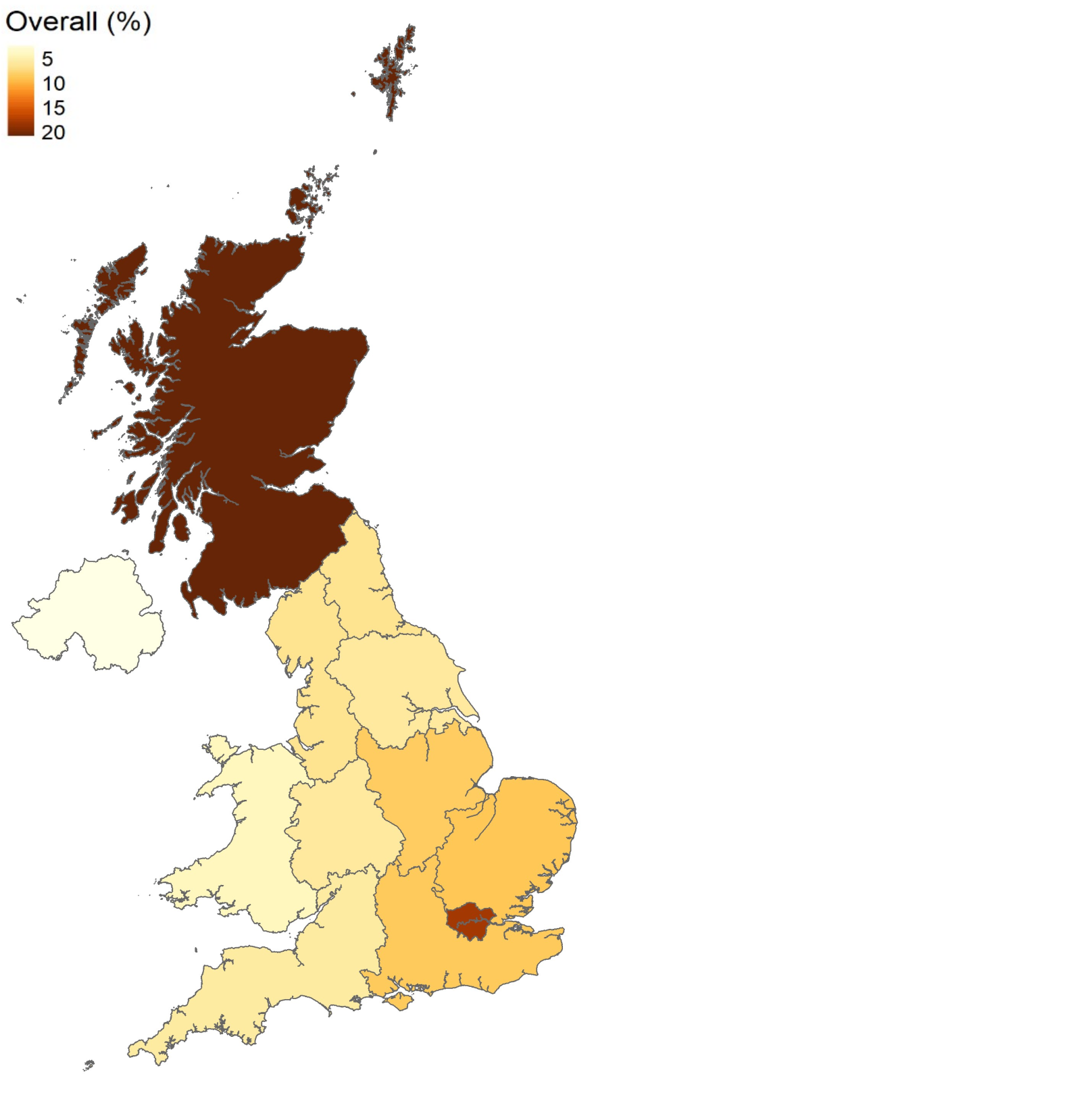
Figure 3 shows a regional heat map on the relative distribution of Greenfield FDI capital expenditure across the UK ITL1 regions over 2015 to 2024. Table 4 provides the web accessible version of the data for the share of UK regions total (%) in Figure 3.
Global Greenfield FDI jobs trends
In the UK, 701,501 Greenfield foreign direct investment (FDI) jobs have been created over the last 10 years, giving the UK a global rank of seventh. India ranked first over this period, creating 3.2 million Greenfield FDI jobs, followed by the United States, with 1.7 million jobs and China, with 1.4 million jobs.
In 2022, the UK attracted 95,845 Greenfield FDI jobs, the highest on record for the UK in any calendar year. In 2024, the UK attracted 70,525 jobs, ranking seventh globally behind India (411,327 jobs), the United States (241,318 jobs), Vietnam (159,669 jobs), Mexico (128,199 jobs), China (88,200 jobs) and Poland (70,784 jobs).
Over the last 10 years, the Organisation for Economic Co-operation and Development (OECD) countries combined attracted 9.0 million Greenfield FDI jobs. The European Countries (EU) countries attracted 4.2 million Greenfield FDI jobs. The Group of 7 (G7) countries attracted 3.9 million jobs (with the UK ranking second among the G7 countries).
Over the same period, the Association of Southeast Asian Nations (ASEAN) countries attracted 3.1 million jobs, while the Gulf Cooperation Council (GCC) countries attracted 578,847 jobs.
Within the UK International Territorial Level 1 (ITL1) regions, over the last 10 years, the highest amount of Greenfield FDI jobs was created in London, with 166,907 jobs, accounting for 23.8% of Greenfield FDI jobs created in the UK. This was followed by Scotland (56,148 jobs) and the West Midlands (55,044 jobs).
Figure 4: Greenfield FDI jobs (thousands) 2003 to 2024 in selected countries
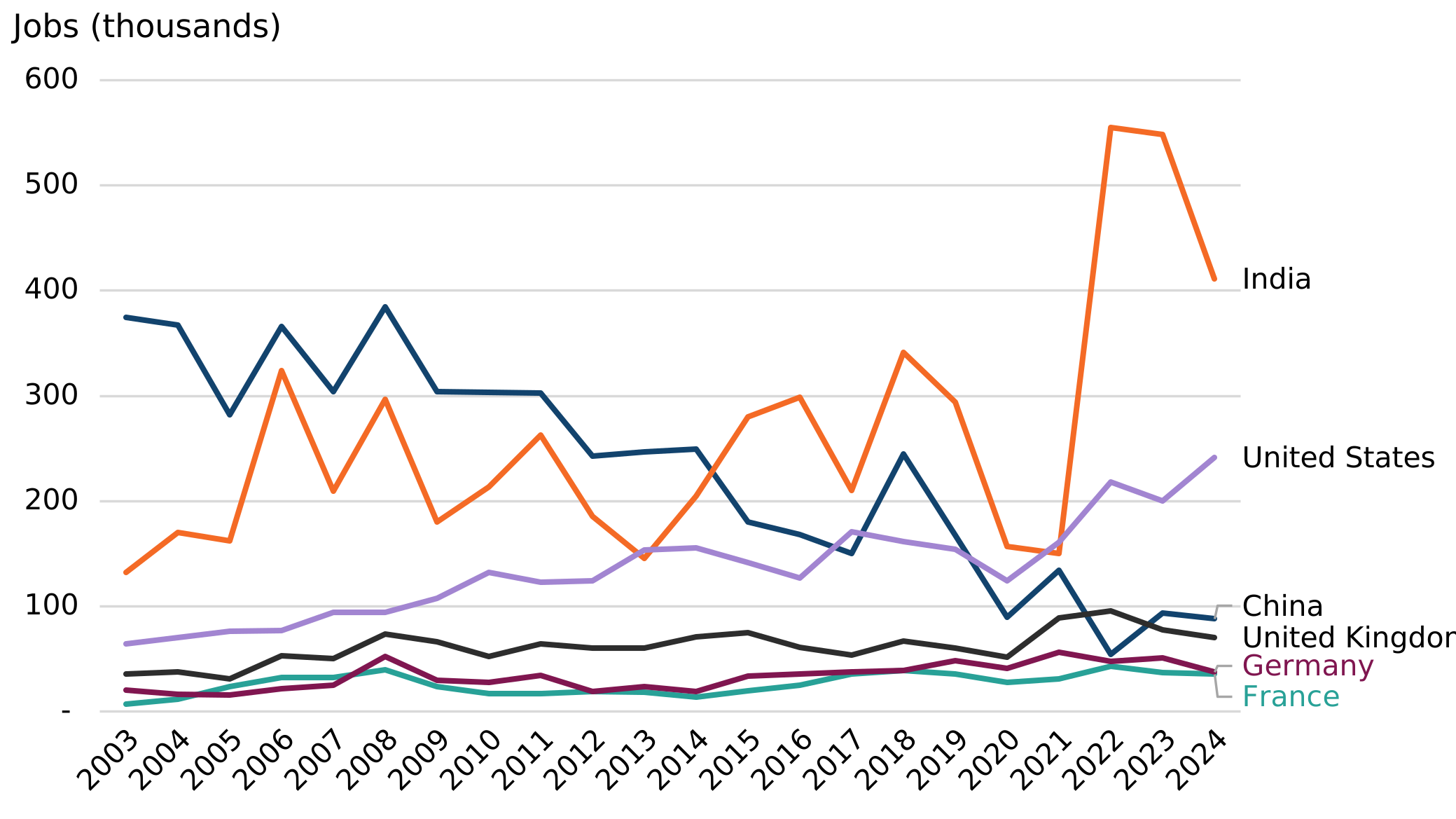
View the web accessible version of Figure 4.
Figure 5: Greenfield FDI jobs (thousands) 2003 to 2024 in selected country groups[footnote 11]
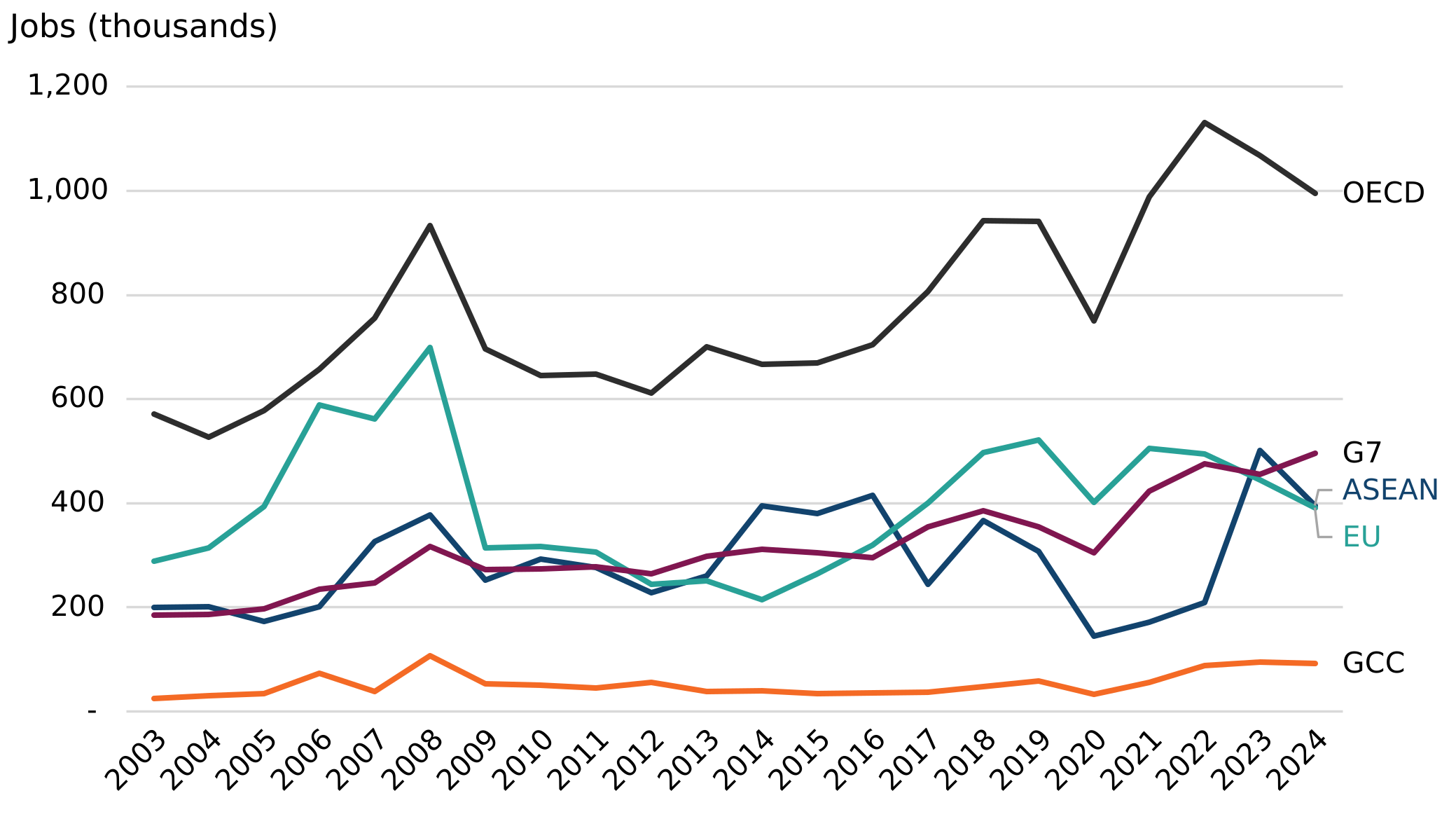
View the web accessible version of Figure 5.
Table 5: Greenfield FDI jobs (thousands) 2003 to 2024 in selected countries and 5-year CAGR
| Country | 2003 | 2004 | 2005 | 2006 | 2007 | 2008 | 2009 | 2010 | 2011 | 2012 | 2013 | 2014 | 2015 | 2016 | 2017 | 2018 | 2019 | 2020 | 2021 | 2022 | 2023 | 2024 | 2015 to 2024 total | 2019 to 2023 CAGR | 2020 to 2024 CAGR |
|---|---|---|---|---|---|---|---|---|---|---|---|---|---|---|---|---|---|---|---|---|---|---|---|---|---|
| China | 375 | 367 | 282 | 366 | 304 | 384 | 304 | 303 | 302 | 243 | 247 | 250 | 180 | 168 | 150 | 245 | 168 | 90 | 135 | 54 | 93 | 88 | 1,371 | -13.6% | -0.4% |
| France | 7 | 12 | 24 | 32 | 32 | 40 | 24 | 17 | 17 | 19 | 19 | 14 | 20 | 25 | 36 | 39 | 36 | 28 | 31 | 43 | 37 | 35 | 329 | 0.8% | 6.3% |
| Germany | 20 | 16 | 16 | 22 | 25 | 52 | 30 | 28 | 34 | 19 | 24 | 19 | 34 | 36 | 38 | 39 | 49 | 41 | 57 | 48 | 51 | 38 | 429 | 1.2% | -2.1% |
| India | 132 | 170 | 162 | 324 | 210 | 296 | 180 | 213 | 262 | 185 | 145 | 205 | 280 | 299 | 210 | 341 | 294 | 157 | 150 | 555 | 548 | 411 | 3,246 | 16.8% | 27.2% |
| United Kingdom | 36 | 38 | 31 | 53 | 50 | 74 | 66 | 52 | 64 | 60 | 60 | 71 | 75 | 61 | 54 | 67 | 60 | 52 | 89 | 96 | 77 | 71 | 702 | 6.5% | 8.1% |
| United States | 64 | 70 | 76 | 77 | 95 | 94 | 108 | 132 | 123 | 124 | 153 | 156 | 142 | 127 | 171 | 161 | 154 | 124 | 161 | 218 | 200 | 241 | 1,699 | 6.7% | 18.1% |
Table 6: Greenfield FDI jobs (thousands) 2003 to 2024 in selected country groups[footnote 12] and 5-year CAGR
| Country groups | 2003 | 2004 | 2005 | 2006 | 2007 | 2008 | 2009 | 2010 | 2011 | 2012 | 2013 | 2014 | 2015 | 2016 | 2017 | 2018 | 2019 | 2020 | 2021 | 2022 | 2023 | 2024 | 2015 to 2024 total | 2019 to 2023 CAGR | 2020 to 2024 CAGR |
|---|---|---|---|---|---|---|---|---|---|---|---|---|---|---|---|---|---|---|---|---|---|---|---|---|---|
| ASEAN | 200 | 202 | 173 | 201 | 327 | 378 | 252 | 293 | 276 | 228 | 261 | 395 | 380 | 415 | 244 | 367 | 307 | 144 | 172 | 210 | 502 | 395 | 3,136 | 13.0% | 28.6% |
| EU | 288 | 315 | 393 | 589 | 562 | 700 | 315 | 317 | 307 | 245 | 251 | 215 | 264 | 320 | 401 | 497 | 521 | 402 | 505 | 495 | 445 | 391 | 4,240 | -3.9% | -0.7% |
| G7 | 185 | 187 | 197 | 234 | 247 | 317 | 272 | 273 | 278 | 264 | 298 | 311 | 305 | 295 | 355 | 386 | 354 | 304 | 424 | 476 | 456 | 497 | 3,851 | 6.5% | 13.0% |
| GCC | 25 | 30 | 35 | 73 | 39 | 108 | 53 | 51 | 46 | 56 | 38 | 39 | 35 | 36 | 37 | 48 | 59 | 33 | 56 | 88 | 96 | 93 | 579 | 13.0% | 29.2% |
| OECD | 572 | 528 | 578 | 658 | 756 | 933 | 696 | 646 | 648 | 611 | 700 | 667 | 670 | 705 | 807 | 942 | 942 | 751 | 988 | 1,132 | 1,068 | 996 | 8,999 | 3.2% | 7.3% |
When comparing the CAGR over 5 years for Greenfield FDI jobs (to smooth out the year-to-year volatility) between 2019 to 2023 and 2020 to 2024, Table 5 shows that:
-
the United States and India saw large improvements in their CAGRs, with the United States seeing relatively more Greenfield FDI jobs created in 2024
-
although still negative, China has seen a relatively large increase in its CAGR from relatively consistent Greenfield FDI jobs created in the 5 years to 2024, at -0.4%, compared to the 5 years to 2023, at -13.6%
-
the 2020 to 2024 CAGRs are likely to overstate trend rates of Greenfield FDI job numbers because the year 2020 received lower than normal investments in most countries due to COVID-19 restrictions
Global Greenfield FDI trends by Industrial Strategy (IS) sector
The following sections outline trends in Greenfield foreign direct investment (FDI) by Industrial Strategy (IS) sector[footnote 13]. This analysis is based on an initial mapping of fDi Markets sub-sectors to IS sector definitions[footnote 14]. While most IS sectors had a direct link to fDi Markets sub-sectors, in some cases it was more difficult to map IS sectors with emerging sub-sectors as part of their sector definitions. A full explanation of the methodology and sector mapping can be found in the methodological note that accompanies this publication.
The mapping used in this publication is not an official government position, may be subject to change, or may differ from other data publications on the IS sectors. This mapping is separate to other data publications that make any reference to the sectors below. Furthermore, due to the broad nature of the IS sectors, there are several sub-sectors which feature in multiple IS sectors, such that some projects may be captured in multiple IS sectors. Therefore, while it is useful to view sectors individually, they should not be aggregated due to potential overlap.
Over the last 10 years, the IS sectors that received the most Greenfield FDI capital expenditure globally were Advanced Manufacturing, Clean Energy Industries and Digital and Technologies. These sectors also received the most Greenfield FDI capital expenditure in the UK, with Clean Energy Industries leading, followed by Digital and Technologies and Advanced Manufacturing. Growth in Greenfield FDI capital expenditure into the UK’s IS sectors over the last 10 years has been fastest in the Defence and Life Sciences sectors.
Advanced Manufacturing
Over the last 10 years, £1,736.8 billion of Greenfield FDI capital expenditure was invested into the Advanced Manufacturing sector over 33,878 projects. The largest recipients of Greenfield FDI capital expenditure in the sector were the United States, with £367.2 billion over 4,788 projects, China, with £202.9 billion over 2,196 projects, and India, with £115.7 billion over 2,015 projects. Germany ranked fourth, with £85.6 billion over 2,888 projects. The UK ranked 10th globally for receiving Greenfield FDI capital expenditure in the Advanced Manufacturing sector, with £40.1 billion over 1,853 projects. In 2024, the UK ranked 14th globally for Greenfield FDI capital expenditure received in the Advanced Manufacturing sector, with £4.0 billion over 174 projects.
Figure 6: Advanced Manufacturing Greenfield FDI capital expenditure (£ billion) 2003 to 2024 for selected countries
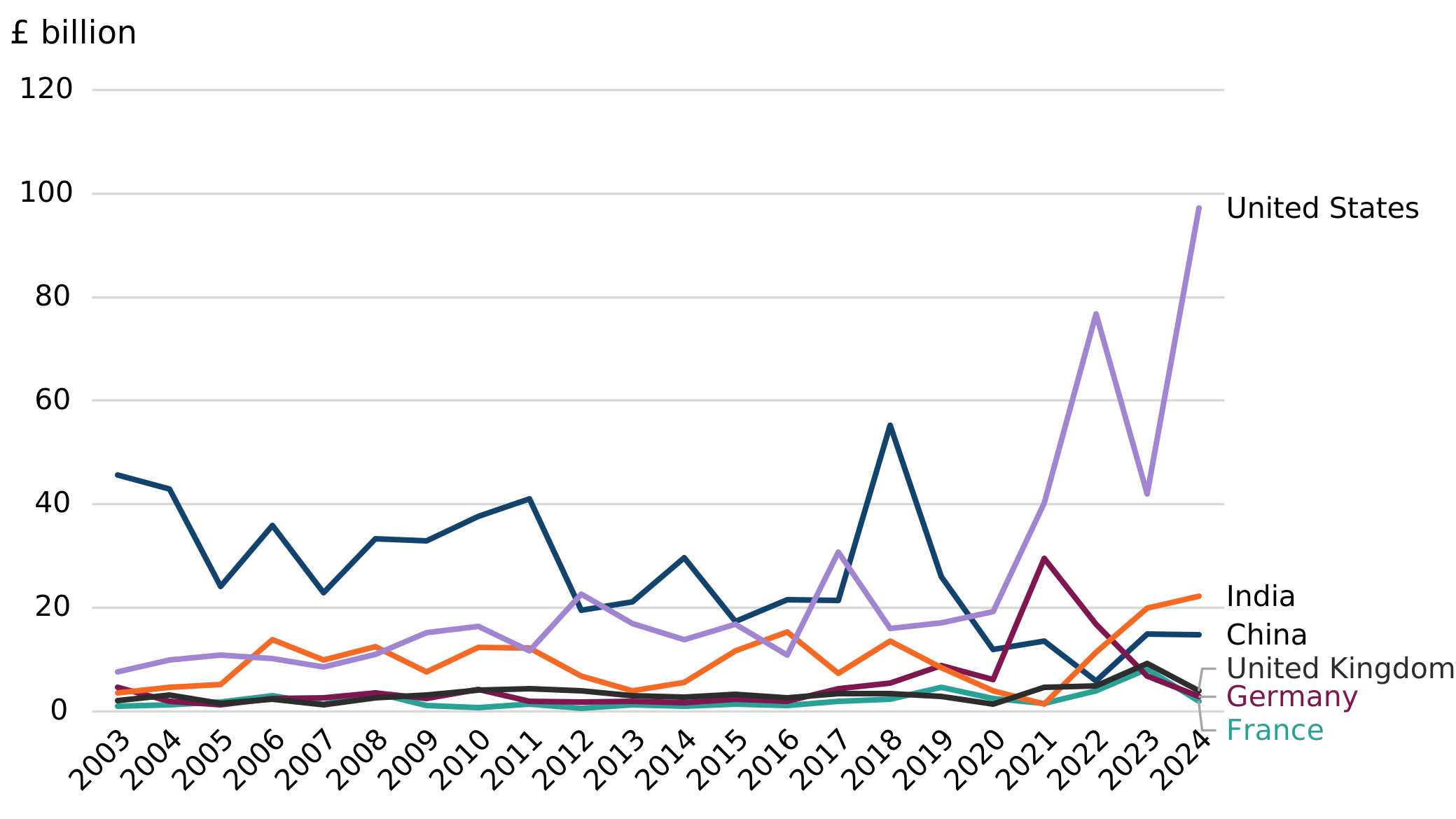
Table 7: Advanced Manufacturing Greenfield FDI capital expenditure (£ billion) 2003 to 2024 for top 10 destination and selected countries and 10-year compound annual growth rate (CAGR)
| Country | 2003 | 2004 | 2005 | 2006 | 2007 | 2008 | 2009 | 2010 | 2011 | 2012 | 2013 | 2014 | 2015 | 2016 | 2017 | 2018 | 2019 | 2020 | 2021 | 2022 | 2023 | 2024 | 2015 to 2024 total | 2014 to 2023 CAGR | 2015 to 2024 CAGR | Top 10 (2015 to 2024) |
|---|---|---|---|---|---|---|---|---|---|---|---|---|---|---|---|---|---|---|---|---|---|---|---|---|---|---|
| Canada | 3.3 | 2.7 | 5.4 | 1.9 | 1.4 | 3.7 | 3.2 | 2.2 | 2.6 | 2.6 | 5.3 | 3.2 | 1.7 | 1.4 | 2.8 | 3.3 | 1.5 | 3.0 | 10.3 | 5.7 | 9.9 | 7.6 | 47.0 | 13.3% | 18.3% | Yes |
| China | 45.7 | 42.9 | 24.2 | 35.9 | 23.0 | 33.3 | 33.0 | 37.6 | 41.1 | 19.6 | 21.2 | 29.7 | 17.3 | 21.6 | 21.4 | 55.2 | 26.1 | 12.0 | 13.6 | 5.9 | 14.9 | 14.8 | 202.9 | -7.4% | -1.7% | Yes |
| France | 1.0 | 1.2 | 1.8 | 3.1 | 1.5 | 3.6 | 1.2 | 0.7 | 1.4 | 0.7 | 1.3 | 1.0 | 1.5 | 1.1 | 2.0 | 2.4 | 4.7 | 2.5 | 1.6 | 4.0 | 8.2 | 2.0 | 30.1 | 26.5% | 3.2% | No |
| Germany | 4.7 | 2.0 | 1.3 | 2.5 | 2.7 | 3.6 | 2.5 | 4.2 | 2.0 | 1.8 | 2.0 | 1.6 | 2.4 | 2.0 | 4.4 | 5.5 | 8.9 | 6.2 | 29.6 | 16.8 | 6.8 | 2.9 | 85.6 | 17.2% | 2.2% | Yes |
| India | 3.6 | 4.7 | 5.2 | 13.9 | 9.9 | 12.5 | 7.6 | 12.4 | 12.3 | 6.9 | 4.0 | 5.6 | 11.7 | 15.4 | 7.4 | 13.6 | 8.5 | 4.0 | 1.4 | 11.5 | 20.0 | 22.2 | 115.7 | 15.1% | 7.4% | Yes |
| Indonesia | 0.8 | 1.0 | 0.4 | 1.4 | 1.3 | 1.0 | 1.0 | 1.3 | 6.3 | 2.6 | 3.7 | 2.8 | 6.3 | 1.3 | 1.7 | 4.7 | 3.9 | 11.9 | 1.0 | 11.0 | 2.8 | 6.6 | 51.4 | 0.1% | 0.5% | Yes |
| Malaysia | 2.8 | 2.0 | 1.2 | 1.8 | 2.2 | 2.4 | 1.5 | 6.9 | 3.1 | 1.7 | 1.6 | 2.3 | 2.1 | 2.5 | 1.3 | 1.1 | 2.7 | 3.9 | 15.8 | 7.5 | 14.9 | 5.0 | 56.8 | 23.1% | 10.0% | Yes |
| Mexico | 2.9 | 2.2 | 2.0 | 6.0 | 3.2 | 11.1 | 6.4 | 5.5 | 8.0 | 5.5 | 7.8 | 12.4 | 8.1 | 5.2 | 5.1 | 5.1 | 5.2 | 3.3 | 5.2 | 14.2 | 12.6 | 8.4 | 72.4 | 0.2% | 0.4% | Yes |
| United Kingdom | 2.1 | 3.2 | 1.6 | 2.4 | 1.4 | 2.6 | 3.2 | 4.1 | 4.4 | 4.0 | 3.0 | 2.8 | 3.3 | 2.6 | 3.4 | 3.4 | 2.9 | 1.5 | 4.7 | 5.0 | 9.3 | 4.0 | 40.1 | 14.1% | 2.0% | Yes |
| United States | 7.7 | 9.9 | 10.9 | 10.3 | 8.6 | 11.0 | 15.2 | 16.4 | 11.7 | 22.6 | 17.1 | 13.9 | 16.9 | 10.9 | 30.8 | 16.1 | 17.1 | 19.3 | 40.2 | 76.8 | 42.0 | 97.2 | 367.2 | 13.1% | 21.5% | Yes |
| Vietnam | 0.7 | 1.5 | 1.2 | 2.5 | 3.9 | 4.2 | 5.1 | 1.1 | 2.1 | 1.2 | 2.0 | 7.2 | 4.8 | 3.5 | 3.6 | 1.9 | 3.6 | 2.0 | 3.5 | 6.0 | 12.1 | 7.5 | 48.6 | 5.9% | 5.2% | Yes |
When comparing the CAGR over 10 years for investment flows (to smooth out the year-to-year volatility) between 2014 to 2023 and 2015 to 2024, Table 7 shows that:
-
Greenfield FDI into the UK’s Advanced Manufacturing sector grew at a slower rate annually between 2015 to 2024 (2.0%) compared to 2014 to 2023 (14.1%) – this is comparable to both France and Germany, with both countries seeing lower 2015 to 2024 CAGRs compared to 2014 to 2023, at 3.2% and 2.2%, respectively
-
the Group of 7 (G7) countries, on average, also grew at a slower rate annually between 2015 to 2024 (11.7%) compared to 2014 to 2023 (17.6%)
-
the United States had the highest CAGR over 2015 to 2024, at 21.5%, with a large improvement from its position over the 2014 to 2023 period
-
China had the lowest CAGR in both 10-year periods, with slight improvement in its 2015 to 2024 CAGR
The largest investors globally into the Advanced Manufacturing sector over the last 10 years were the United States, investing £320.7 billion, Germany, investing £188.2 billion and China, investing £183.4 billion (see Table 8). The UK is ranked as the eighth largest investor in this sector, investing £48.7 billion.
When comparing this to the largest investors into the UK’s Advanced Manufacturing sector, the largest investors were the United States (£8.7 billion), Germany (£6.9 billion) and India (£6.4 billion). Out of the top 9 investors globally into the sector (excluding for the UK), 7 were in the top 10 investors into the UK into the sector. This suggests opportunities for growing investment relationships between the UK and other top global investors into the sector.
Table 8: Greenfield FDI capital expenditure (£ billion) 2015 to 2024 for the top 10 investor countries into the Advanced Manufacturing sector, globally and into the UK
| Rank | Top 10 investors globally into Advanced Manufacturing | Capital expenditure (£ billion) |
Top 10 investors into the UK – Advanced Manufacturing | Capital expenditure (£ billion) |
|---|---|---|---|---|
| 1 | United States | 320.7 | United States | 8.7 |
| 2 | Germany | 188.2 | Germany | 6.9 |
| 3 | China | 183.4 | India | 6.4 |
| 4 | Taiwan | 183.1 | Japan | 4.8 |
| 5 | South Korea | 176.4 | China | 3.1 |
| 6 | Japan | 152.4 | Netherlands | 1.6 |
| 7 | France | 59.0 | Switzerland | 1.5 |
| 8 | United Kingdom | 48.7 | France | 1.0 |
| 9 | Switzerland | 45.6 | Saudi Arabia | 0.9 |
| 10 | Netherlands | 44.0 | Canada | 0.9 |
Over the last 10 years, the Automobiles sub-sector attracted the highest Greenfield FDI capital expenditure within the UK’s Advanced Manufacturing sector, with total investment of £10.3 billion over 92 projects.
Table 9: Greenfield FDI capital expenditure from 2015 to 2024 into the Advanced Manufacturing sector by UK ITL1 region (£ billion and share of UK regions total)[footnote 15]
| UK ITL1 region | Capital expenditure (£ billion) |
Share of UK regions total |
|---|---|---|
| East Midlands | 1.2 | 3.3% |
| East of England | 2.1 | 5.6% |
| London | 1.3 | 3.6% |
| North East | 4.9 | 13.3% |
| North West | 4.8 | 12.9% |
| Northern Ireland | 0.4 | 1.1% |
| Scotland | 2.7 | 7.2% |
| South East | 3.9 | 10.5% |
| South West | 4.9 | 13.2% |
| Wales | 1.1 | 2.8% |
| West Midlands | 5.3 | 14.1% |
| Yorkshire and the Humber | 4.6 | 12.3% |
Table 9 shows that the UK ITL1 regions that received the most Greenfield FDI capital expenditure in the Advanced Manufacturing sector over this period were the West Midlands (£5.3 billion, 14.1% of the UK’s total greenfield FDI capital expenditure in the sector), the North East (£4.9 billion, 13.3%) and the South West (£4.9 billion, 13.2%).
Figure 7: Map of Greenfield FDI capital expenditure from 2015 to 2024 into the Advanced Manufacturing sector by UK ITL1 region (share of UK regions total, %)[footnote 16]
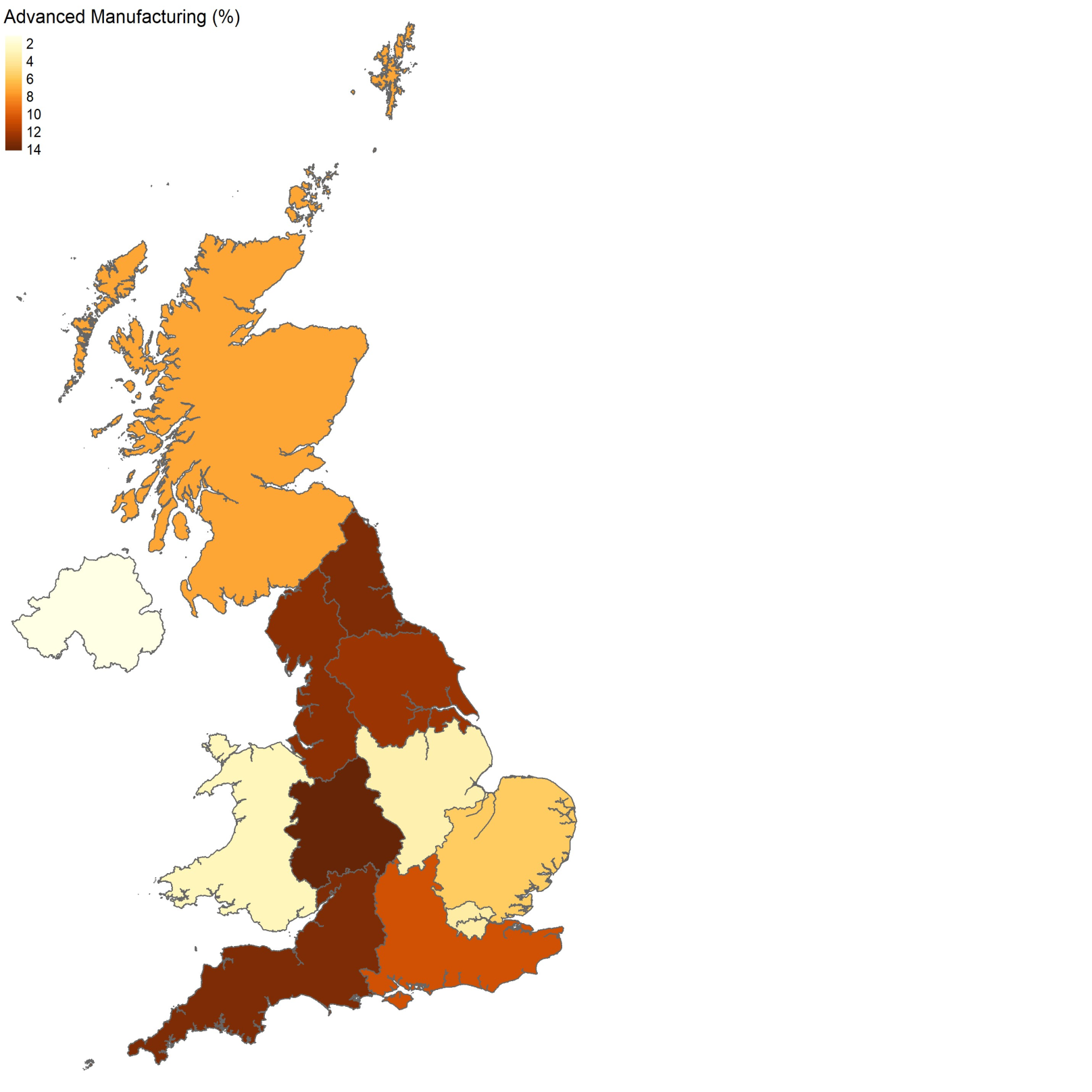
Figure 7 shows a regional heat map on the relative distribution of Greenfield FDI capital expenditure in the Advanced Manufacturing sector across the UK ITL1 regions. Table 9 provides the web accessible version of the data for the share of UK regions total (%) in Figure 7.
In terms of Greenfield FDI jobs created within the Advanced Manufacturing sector over the last 10 years, a total of 6.7 million jobs were created globally. The UK ranked 12th with 120,218 jobs. The countries that attracted the most jobs were India, with 1.0 million jobs, China, with 684,746 jobs and Mexico, with 663,788 jobs.
Clean Energy Industries
Over the last 10 years, £1,376.2 billion of Greenfield FDI capital expenditure was invested into the Clean Energy Industries sector over 5,841 projects. The UK attracted £175.9 billion over 431 projects, ranking first globally. From 2015 to 2024, foreign investors in this sector have invested more into the UK than into China (£5.5 billion), France (£11.4 billion), Germany (£48.4 billion) and India (£64.0 billion) combined (£129.3 billion). The UK is followed by Egypt, with £145.8 billion over 98 projects and Australia, with £129.8 billion over 261 projects. In 2024, the UK ranked third globally for Greenfield FDI capital expenditure received in the Clean Energy Industries sector, with £19.9 billion over 83 projects.
Figure 8: Clean Energy Industries Greenfield FDI capital expenditure (£ billion) 2003 to 2024 for selected countries
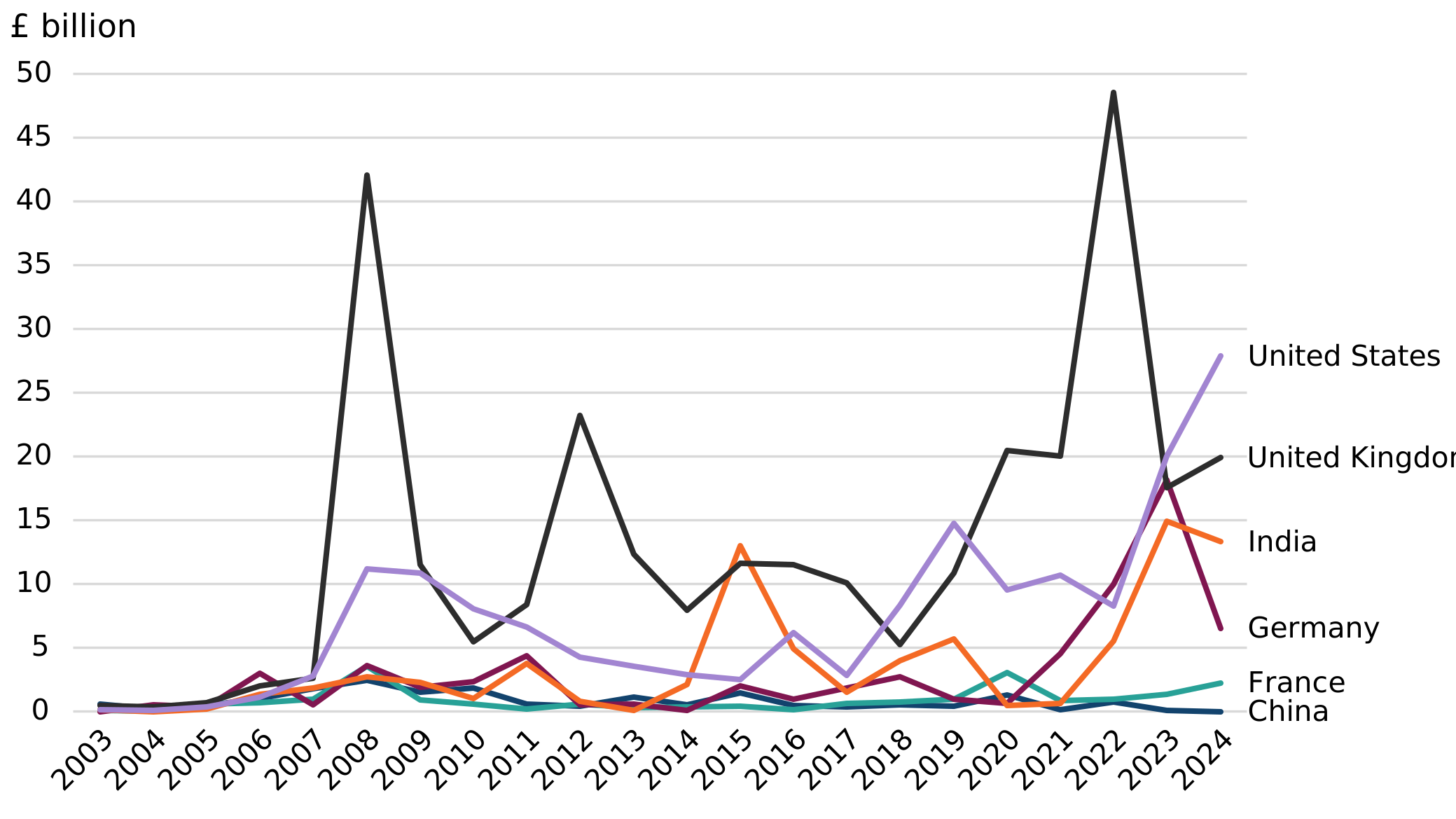
Table 10: Clean Energy Industries Greenfield FDI capital expenditure (£ billion) 2003 to 2024 for top 10 destination and selected countries and 10-year CAGR
Some shorthand is used in this table, [low] = a low figure but not a real zero, [z] = not applicable as no reported investment received in years needed for CAGR calculation.
| Country | 2003 | 2004 | 2005 | 2006 | 2007 | 2008 | 2009 | 2010 | 2011 | 2012 | 2013 | 2014 | 2015 | 2016 | 2017 | 2018 | 2019 | 2020 | 2021 | 2022 | 2023 | 2024 | 2015 to 2024 total | 2014 to 2023 CAGR | 2015 to 2024 CAGR | Top 10 (2015 to 2024) |
|---|---|---|---|---|---|---|---|---|---|---|---|---|---|---|---|---|---|---|---|---|---|---|---|---|---|---|
| Australia | 0.2 | [low] | [low] | 0.2 | 0.2 | 1.6 | 0.8 | 0.7 | 2.9 | 3.6 | 0.6 | 0.6 | 0.7 | 5.5 | 3.6 | 7.7 | 18.7 | 5.0 | 9.8 | 31.6 | 20.3 | 26.8 | 129.8 | 46.8% | 50.9% | Yes |
| Brazil | 0.6 | 0.0 | 0.1 | 1.0 | 1.5 | 1.8 | 0.4 | 3.1 | 3.0 | 0.9 | 2.6 | 1.3 | 1.2 | 1.5 | 0.8 | 2.8 | 5.6 | 5.2 | 7.7 | 3.9 | 7.1 | 14.0 | 49.8 | 20.5% | 31.6% | Yes |
| Chile | 0.1 | 0.0 | 0.5 | 0.0 | 0.1 | 1.1 | 2.6 | 1.1 | 1.4 | 2.3 | 4.5 | 1.5 | 4.5 | 2.7 | 0.8 | 2.1 | 4.5 | 3.3 | 1.8 | 1.5 | 11.5 | 2.0 | 34.6 | 25.1% | -8.5% | Yes |
| China | 0.6 | 0.2 | 0.5 | 1.0 | 1.8 | 2.5 | 1.5 | 1.8 | 0.6 | 0.4 | 1.2 | 0.5 | 1.4 | 0.5 | 0.3 | 0.5 | 0.4 | 1.3 | 0.1 | 0.8 | 0.1 | 0.0 | 5.5 | -16.1% | -100.0% | No |
| Egypt | 0.0 | 0.0 | 0.0 | 0.0 | 0.0 | 0.1 | 0.0 | 0.2 | 0.0 | 0.0 | [low] | 0.0 | 5.0 | 2.1 | 23.9 | 1.4 | 2.6 | 0.0 | 6.2 | 75.0 | 14.4 | 15.2 | 145.8 | [z] | 13.2% | Yes |
| France | 0.1 | [low] | 0.6 | 0.7 | 0.9 | 3.6 | 0.9 | 0.6 | 0.2 | 0.6 | 0.3 | 0.4 | 0.4 | 0.1 | 0.6 | 0.7 | 1.0 | 3.1 | 0.9 | 1.0 | 1.3 | 2.3 | 11.4 | 15.4% | 20.4% | No |
| Germany | 0.0 | 0.5 | 0.3 | 3.0 | 0.5 | 3.6 | 1.9 | 2.3 | 4.4 | 0.5 | 0.6 | 0.1 | 2.0 | 1.0 | 1.9 | 2.7 | 1.0 | 0.6 | 4.5 | 10.0 | 18.2 | 6.5 | 48.4 | 87.9% | 14.1% | Yes |
| India | 0.1 | 0.0 | 0.2 | 1.4 | 1.8 | 2.8 | 2.3 | 1.0 | 3.8 | 0.8 | 0.1 | 2.1 | 13.0 | 4.9 | 1.5 | 4.0 | 5.7 | 0.5 | 0.6 | 5.5 | 14.9 | 13.3 | 64.0 | 24.1% | 0.3% | Yes |
| Italy | 0.4 | [low] | 0.4 | 0.1 | 0.8 | 0.6 | 1.6 | 1.3 | 1.0 | 1.7 | 0.6 | [low] | 0.0 | [low] | 0.0 | 1.1 | 2.8 | 3.4 | 6.0 | 13.1 | 14.7 | 14.0 | 55.2 | 174.2% | [z] | Yes |
| Spain | 0.1 | 0.0 | 0.1 | 1.3 | 1.9 | 4.2 | 0.8 | 0.3 | 0.7 | 0.3 | 0.1 | 0.2 | [low] | [low] | 0.4 | 1.4 | 2.8 | 1.3 | 7.6 | 15.5 | 9.5 | 5.4 | 43.9 | 54.2% | 123.1% | Yes |
| United Kingdom | 0.5 | 0.3 | 0.7 | 2.0 | 2.6 | 42.0 | 11.5 | 5.5 | 8.4 | 23.2 | 12.3 | 8.0 | 11.6 | 11.5 | 10.1 | 5.3 | 10.9 | 20.5 | 20.0 | 48.6 | 17.6 | 19.9 | 175.9 | 9.2% | 6.2% | Yes |
| United States | 0.1 | 0.1 | 0.4 | 1.1 | 2.8 | 11.2 | 10.9 | 8.1 | 6.6 | 4.2 | 3.6 | 2.9 | 2.5 | 6.2 | 2.8 | 8.3 | 14.8 | 9.5 | 10.7 | 8.3 | 20.1 | 27.9 | 111.0 | 24.0% | 30.6% | Yes |
When comparing the CAGR over 10 years for investment flows (to smooth out the year-to-year volatility) between 2014 to 2023 and 2015 to 2024, Table 10 shows that:
-
the UK’s Clean Energy sector grew at a slower rate for 2015 to 2024 compared to 2014 to 2023, at 6.2% annually compared to 9.2% – this reflects the UK’s greater early success in attracting Clean Energy Greenfield FDI, with the UK attracting the highest Greenfield FDI capital expenditure in this sector globally over 2015 to 2024 (£175.9 billion)
-
the G7 countries, on average, (excluding Italy[footnote 17]) also grew at a slower rate annually between 2015 to 2024 (13.5%) compared to 2014 to 2023 (29.3%)
-
Spain had the highest CAGR over the 2015 to 2024 period, at 123.1%, significantly larger than the other top 10 destination and selected countries in the sector
-
Germany, India, China and Chile saw significant decreases in their CAGRs over the 2015 to 2024 period
-
China had the lowest CAGR in both 10-year periods, with no reported investment received in the sector in 2024
The largest global investors into the Clean Energy Industries sector over the last 10 years have been Germany, investing £120.3 billion, France, investing £114.6 billion and the UK, investing £97.6 billion (see Table 11).
When comparing this to the largest investors into the UK’s Clean Energy Industries sector, the largest investors were Germany (£34.5 billion), France (£23.4 billion) and Spain (£14.7 billion). Out of the top 9 investors globally into the sector (excluding for the UK), 5 were also top 10 investors into the UK into the sector. Aside from Japan, the top 10 investors into the UK’s Clean Energy Industries sector were all within Europe.
Table 11: Greenfield FDI capital expenditure (£ billion) 2015 to 2024 for the top 10 investor countries into the Clean Energy Industries sector, globally and into the UK
| Rank | Top 10 investors globally into Clean Energy Industries | Capital expenditure (£ billion) |
Top 10 investors into the UK – Clean Energy Industries | Capital expenditure (£ billion) |
|---|---|---|---|---|
| 1 | Germany | 120.3 | Germany | 34.5 |
| 2 | France | 114.6 | France | 23.4 |
| 3 | United Kingdom | 97.6 | Spain | 14.7 |
| 4 | United Arab Emirates (UAE) | 96.8 | Portugal | 14.1 |
| 5 | Spain | 89.0 | Norway | 12.9 |
| 6 | United States | 85.5 | Italy | 11.5 |
| 7 | Canada | 70.3 | Japan | 9.5 |
| 8 | Italy | 58.8 | Denmark | 8.7 |
| 9 | China | 54.4 | Ireland | 8.0 |
| 10 | Denmark | 53.7 | Sweden | 6.8 |
Over the last 10 years, the Wind Electric Power sub-sector attracted the highest Greenfield FDI capital expenditure within the UK’s Clean Energy Industries sector, with total investment of £119.6 billion over 164 projects. This accounts for 68.0% of all Greenfield FDI capital expenditure into the UK’s Clean Energy Industries sector over this period.
Table 12: Greenfield FDI capital expenditure from 2015 to 2024 into the Clean Energy Industries sector by UK ITL1 region (£ billion and share of UK regions total)[footnote 18]
| UK ITL1 region | Capital expenditure (£billion) |
Share of UK regions total |
|---|---|---|
| East Midlands | 9.4 | 7.7% |
| East of England | 12.0 | 9.8% |
| London | 0.2 | 0.2% |
| North East | 4.1 | 3.3% |
| North West | 4.3 | 3.5% |
| Northern Ireland | 3.1 | 2.5% |
| Scotland | 61.3 | 50.0% |
| South East | 3.4 | 2.7% |
| South West | 8.2 | 6.7% |
| Wales | 6.6 | 5.4% |
| West Midlands | 2.7 | 2.2% |
| Yorkshire and the Humber | 7.2 | 5.8% |
Table 12 shows that the UK ITL1 regions that received the most Greenfield FDI capital expenditure in the sector over this period were Scotland (£61.3 billion, 50.0% of the UK’s Greenfield FDI capital expenditure in the sector), the East of England (£12.0 billion, 9.8%) and the East Midlands (£9.4 billion, 7.7%).
Figure 9: Map of Greenfield FDI capital expenditure from 2015 to 2024 into the Clean Energy Industries sector by UK ITL1 region (share of UK regions total, %)[footnote 19]
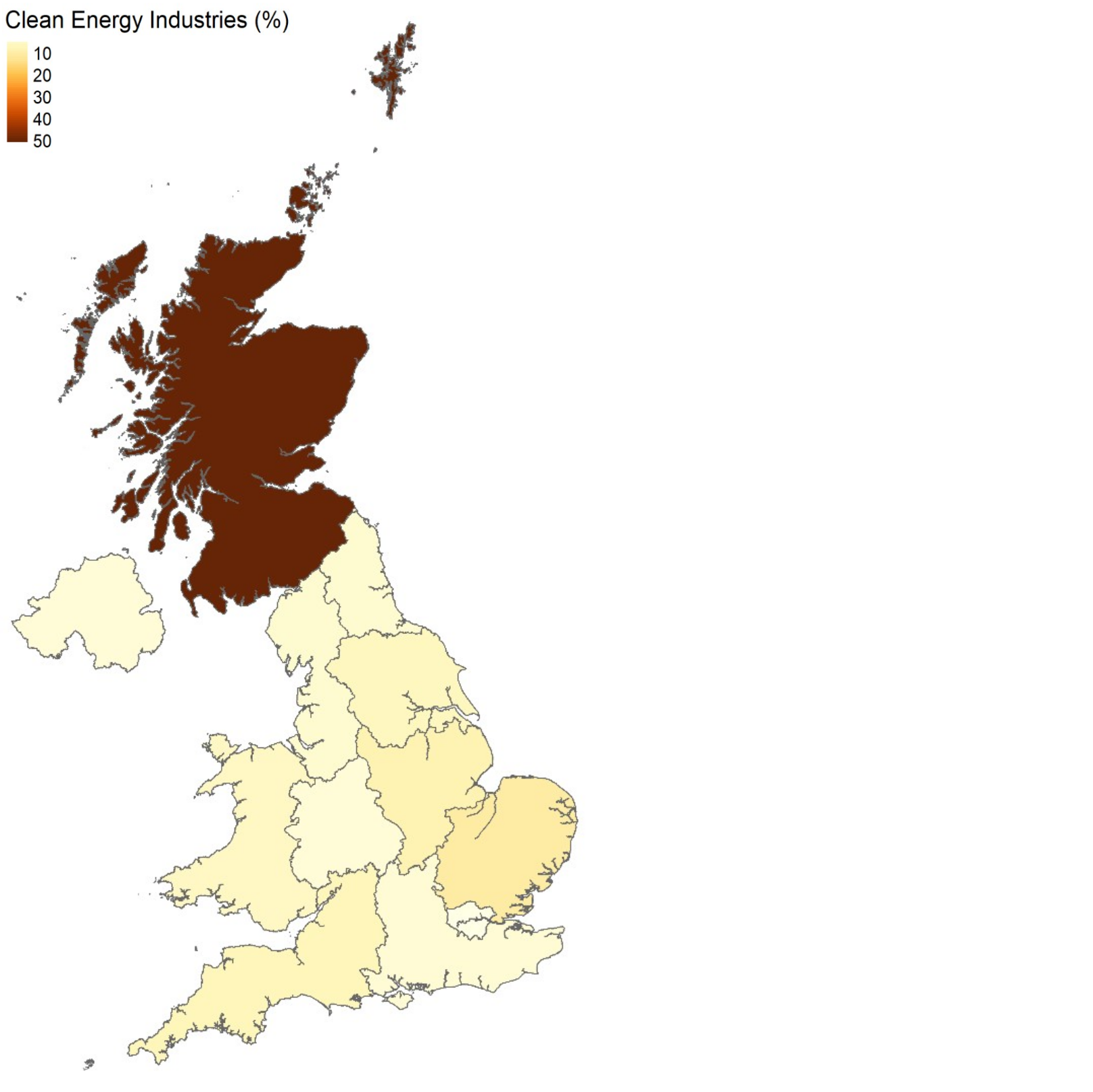
Figure 9 shows a regional heat map on the relative distribution of Greenfield FDI capital expenditure in the Clean Energy Industries sector across the UK ITL1 regions. Table 12 provides the web accessible version of the data for the share of UK regions total (%) in Figure 9.
In terms of Greenfield FDI jobs created with the Clean Energy Industries sector over the last 10 years, a total of 501,966 jobs were created globally. The UK ranked third with 36,522 jobs. The UK was behind Egypt, with 49,176 jobs and India, with 43,992 jobs.
Creative Industries
Over the last 10 years, £344.4 billion of Greenfield FDI capital expenditure was invested into the Creative Industries sector globally over 34,927 projects. The largest recipients of Greenfield FDI capital expenditure in the sector were India, with £37.9 billion over 2,071 projects, the United States, with £36.3 billion over 4,088 projects, and Canada, with £32.4 billion over 1,133 projects. The UK ranked fifth, with £19.5 billion over 3,565 projects. The UK was ahead of France, ranked seventh, with £11.9 billion over 1,628 projects. China ranked 10th with £10.0 billion over 750 projects. In 2024, the UK ranked seventh globally for Greenfield FDI capital expenditure received in the Creative Industries sector, with £1.3 billion over 269 projects.
Figure 10: Creative Industries Greenfield FDI capital expenditure (£ billion) 2003 to 2024 for selected countries
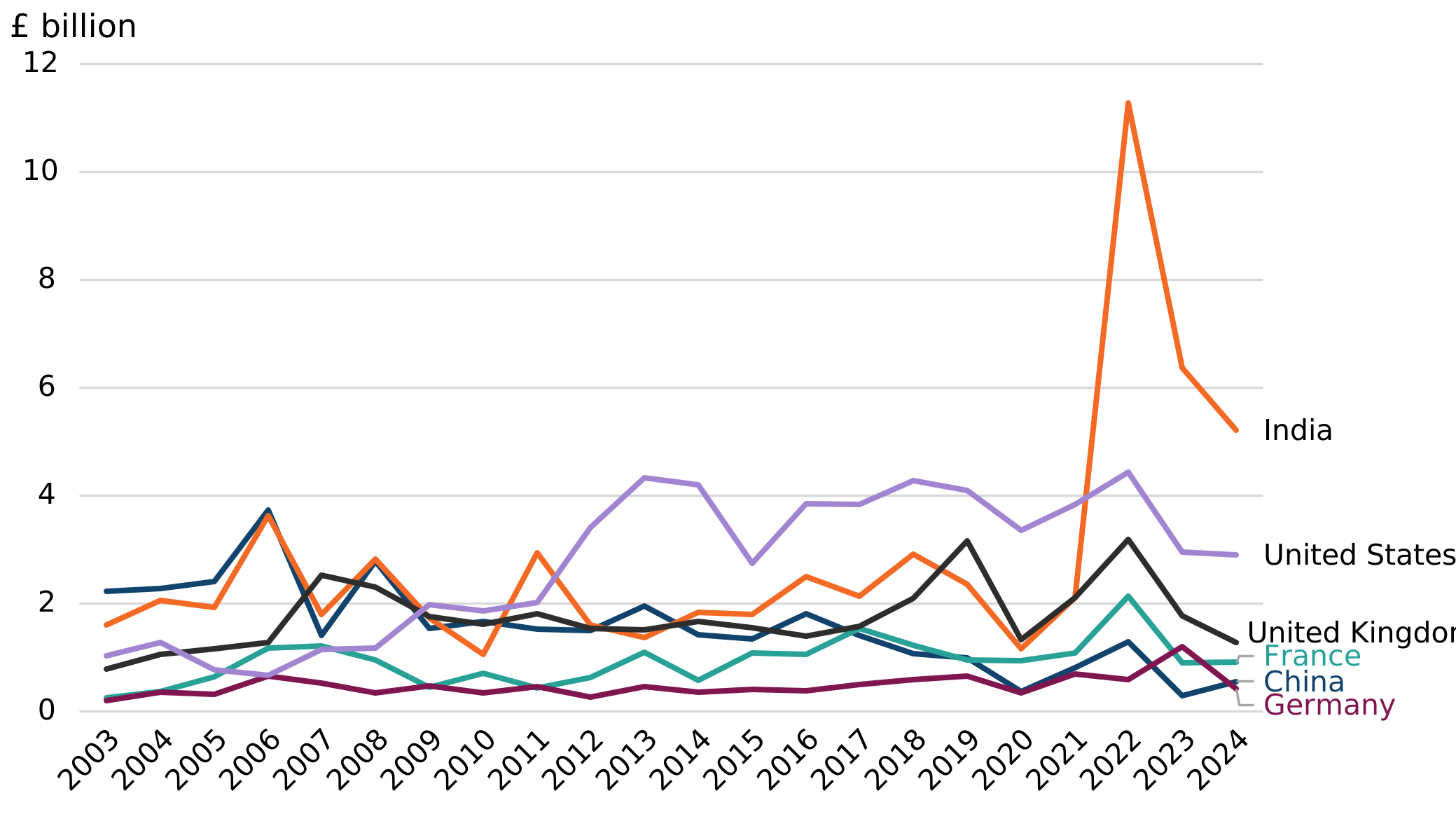
Table 13: Creative Industries Greenfield FDI capital expenditure (£ billion) 2003 to 2024 for top 10 destination and selected countries and 10-year CAGR
Some shorthand is used in this table, [low] = a low figure but not a real zero.
| Country | 2003 | 2004 | 2005 | 2006 | 2007 | 2008 | 2009 | 2010 | 2011 | 2012 | 2013 | 2014 | 2015 | 2016 | 2017 | 2018 | 2019 | 2020 | 2021 | 2022 | 2023 | 2024 | 2015 to 2024 total | 2014 to 2023 CAGR | 2015 to 2024 CAGR | Top 10 (2015 to 2024) |
|---|---|---|---|---|---|---|---|---|---|---|---|---|---|---|---|---|---|---|---|---|---|---|---|---|---|---|
| Australia | 0.5 | 0.6 | 0.7 | 0.5 | 1.0 | 0.8 | 0.8 | 1.6 | 2.0 | 2.1 | 3.1 | 3.1 | 3.7 | 2.4 | 2.2 | 2.8 | 2.1 | 2.5 | 2.8 | 1.8 | 1.2 | 1.7 | 23.2 | -9.6% | -8.4% | Yes |
| Canada | 0.3 | 0.8 | 1.8 | 0.5 | 0.9 | 0.7 | 1.3 | 0.8 | 1.5 | 2.1 | 2.4 | 2.5 | 2.4 | 2.8 | 2.8 | 3.1 | 3.2 | 4.1 | 4.1 | 4.4 | 2.4 | 3.1 | 32.4 | -0.2% | 2.9% | Yes |
| China | 2.2 | 2.3 | 2.4 | 3.7 | 1.4 | 2.8 | 1.5 | 1.7 | 1.5 | 1.5 | 2.0 | 1.4 | 1.3 | 1.8 | 1.4 | 1.1 | 1.0 | 0.4 | 0.8 | 1.3 | 0.3 | 0.6 | 10.0 | -16.3% | -9.3% | Yes |
| France | 0.3 | 0.4 | 0.6 | 1.2 | 1.2 | 1.0 | 0.4 | 0.7 | 0.4 | 0.6 | 1.1 | 0.6 | 1.1 | 1.1 | 1.5 | 1.2 | 1.0 | 0.9 | 1.1 | 2.1 | 0.9 | 0.9 | 11.9 | 5.2% | -2.0% | Yes |
| Germany | 0.2 | 0.4 | 0.3 | 0.7 | 0.5 | 0.3 | 0.5 | 0.3 | 0.5 | 0.3 | 0.5 | 0.4 | 0.4 | 0.4 | 0.5 | 0.6 | 0.7 | 0.3 | 0.7 | 0.6 | 1.2 | 0.4 | 5.8 | 14.3% | 0.2% | No |
| India | 1.6 | 2.1 | 1.9 | 3.6 | 1.8 | 2.8 | 1.7 | 1.1 | 2.9 | 1.6 | 1.4 | 1.8 | 1.8 | 2.5 | 2.1 | 2.9 | 2.4 | 1.2 | 2.1 | 11.3 | 6.4 | 5.2 | 37.9 | 14.8% | 12.6% | Yes |
| Ireland | 0.8 | 0.5 | 0.5 | 0.7 | 0.8 | 0.9 | 0.5 | 0.7 | 0.8 | 1.3 | 1.2 | 1.5 | 1.6 | 1.9 | 2.4 | 1.4 | 2.6 | 1.9 | 2.1 | 1.8 | 1.0 | 1.0 | 17.6 | -4.5% | -4.8% | Yes |
| Singapore | 0.4 | 0.2 | 0.4 | 0.2 | 0.4 | 0.7 | 0.4 | 0.6 | 2.0 | 1.0 | 0.7 | 1.5 | 1.4 | 1.4 | 0.8 | 1.8 | 1.1 | 1.0 | 1.0 | 1.3 | 0.8 | 0.8 | 11.4 | -7.2% | -5.4% | Yes |
| United Kingdom | 0.8 | 1.1 | 1.2 | 1.3 | 2.5 | 2.3 | 1.8 | 1.6 | 1.8 | 1.5 | 1.5 | 1.7 | 1.6 | 1.4 | 1.6 | 2.1 | 3.2 | 1.3 | 2.1 | 3.2 | 1.8 | 1.3 | 19.5 | 0.7% | -2.1% | Yes |
| United States | 1.0 | 1.3 | 0.8 | 0.7 | 1.2 | 1.2 | 2.0 | 1.9 | 2.0 | 3.4 | 4.3 | 4.2 | 2.7 | 3.9 | 3.8 | 4.3 | 4.1 | 3.4 | 3.8 | 4.4 | 3.0 | 2.9 | 36.3 | -3.9% | 0.6% | Yes |
| Vietnam | [low] | 0.2 | 0.4 | 0.2 | 0.3 | 0.6 | 0.2 | 0.1 | 0.1 | 0.1 | 0.1 | 0.2 | 0.1 | 0.3 | 0.2 | 0.4 | 0.5 | 0.1 | 0.3 | 3.3 | 4.0 | 0.8 | 10.0 | 42.4% | 23.9% | Yes |
When comparing the CAGR over 10 years for investment flows (to smooth out the year-to-year volatility) between 2014 to 2023 and 2015 to 2024, Table 13 shows that:
-
the UK’s Creative Industries sector has seen a small decline in Greenfield FDI flows, with a CAGR of -2.1% annually from 2015 to 2024, compared to a CAGR of 0.7% from 2014 to 2023
-
the G7 countries, on average, however, grew at a faster rate annually between 2015 to 2024 (2.7%)[footnote 20] compared to 2014 to 2023 (0.7%)
-
China had the lowest CAGR in both 10-year periods, although its 2015 to 2024 CAGR saw a slight improvement relative to 2014 to 2023
-
Vietnam had the highest CAGR in both 10-year periods, significantly larger than the other top 10 destination and selected countries in the sector.
The UK was the second largest global investor into the Creative Industries sector from 2015 to 2024, investing £30.4 billion (see Table 14). The UK is only behind the United States (£139.3 billion) and ahead of France (£19.6 billion) and Germany (£14.7 billion).
When comparing this to the largest investors into the UK’s Creative Industries sector, the largest investors were the United States (£10.1 billion), India (£1.3 billion) and France (£1.1 billion). The United States accounts for more than 50% of investment into the UK’s Creative Industries sector. Furthermore, out of the top 9 investors globally into the sector (excluding for the UK), 6 were identified as top 10 investors into the UK into the sector. This presents opportunities for growing the UK’s investment relationship with existing top investors, alongside other top global investors into the sector.
Table 14: Greenfield FDI capital expenditure (£ billion) 2015 to 2024 for the top 10 investor countries into the Creative Industries sector, globally and into the UK
| Rank | Top 10 investors globally into Creative Industries | Capital expenditure (£ billion) |
Top 10 investors into the UK – Creative Industries | Capital expenditure (£ billion) |
|---|---|---|---|---|
| 1 | United States | 139.3 | United States | 10.1 |
| 2 | United Kingdom | 30.4 | India | 1.3 |
| 3 | France | 19.6 | France | 1.1 |
| 4 | Germany | 14.7 | Australia | 0.8 |
| 5 | India | 13.9 | Germany | 0.8 |
| 6 | China | 13.1 | Ireland | 0.7 |
| 7 | Japan | 8.3 | Canada | 0.5 |
| 8 | Canada | 8.1 | Brazil | 0.3 |
| 9 | South Korea | 7.5 | Israel | 0.3 |
| 10 | Ireland | 7.4 | Netherlands | 0.3 |
Over the last 10 years, the Software Publishers, except Video Games sub-sector attracted the highest Greenfield FDI capital expenditure within the UK’s Creative Industries sector, with total investment of £8.5 billion over 1,900 projects.
Table 15: Greenfield FDI capital expenditure from 2015 to 2024 into the Creative Industries sector by UK ITL1 region (£ billion and share of UK regions total)[footnote 21]
| UK ITL1 region | Capital expenditure (£ billion) |
Share of UK regions total |
|---|---|---|
| East Midlands | 0.2 | 1.1% |
| East of England | 1.2 | 6.6% |
| London | 9.9 | 56.1% |
| North East | 0.3 | 1.7% |
| North West | 1.5 | 8.7% |
| Northern Ireland | 0.8 | 4.5% |
| Scotland | 0.9 | 5.3% |
| South East | 1.1 | 6.3% |
| South West | 0.3 | 1.7% |
| Wales | 0.3 | 1.5% |
| West Midlands | 0.6 | 3.4% |
| Yorkshire and the Humber | 0.5 | 3.1% |
Table 15 shows that the UK ITL1 region that received the most Greenfield FDI capital expenditure in the sector over the last 10 years was London (£9.9 billion, 56.1% of the UK’s Greenfield FDI capital expenditure in the sector). This region was followed by the North West (£1.5 billion, 8.7%) and the East of England (£1.2 billion, 6.6%). This presents opportunities for growth in the sector in other UK regions.
Figure 11: Map of Greenfield FDI capital expenditure from 2015 to 2024 into the Creative Industries sector by UK ITL1 region (share of UK regions total, %)[footnote 22]
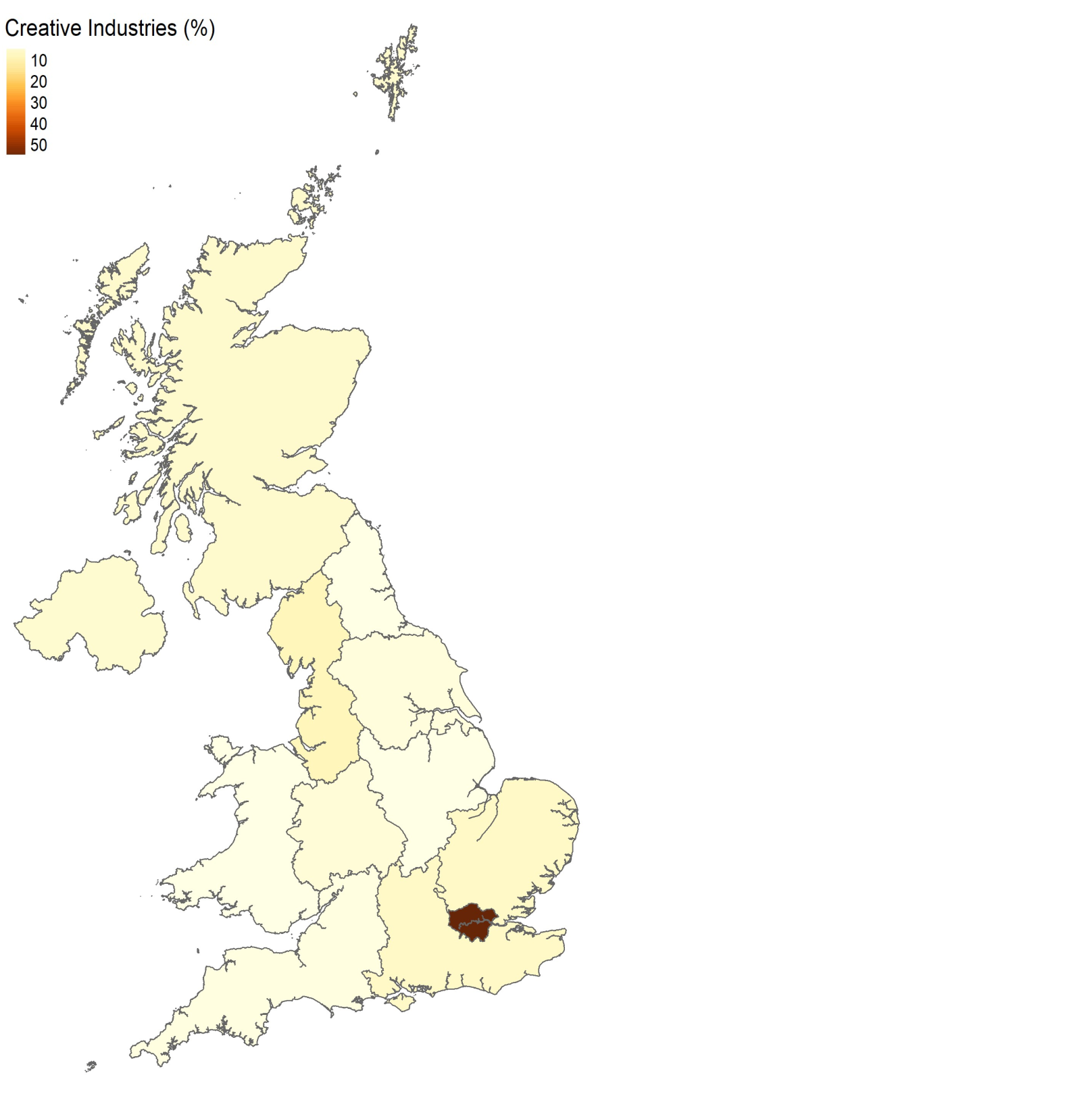
Figure 11 shows a regional heat map on the relative distribution of Greenfield FDI capital expenditure in the Creative Industries sector across the UK ITL1 regions. Table 15 provides the web accessible version of the data for the share of UK regions total (%) in Figure 11.
In terms of Greenfield FDI jobs created within the Creative Industries sector over the last 10 years, a total of 2.9 million jobs were created globally. The UK ranked third, with 140,067 jobs, behind India, with 831,641 jobs and the United States, with 277,055 jobs.
Defence[footnote 23]
Over the last 10 years, £10.4 billion of Greenfield FDI capital expenditure was invested into the Defence sector over 608 projects. The UK ranked second for Greenfield FDI capital expenditure received in the sector, with £1.4 billion over 81 projects. The United States ranked first for Greenfield FDI capital expenditure received in the sector, with £1.8 billion over 87 projects. After the UK, Djibouti and India ranked third and fourth, respectively, each attracting around £0.8 billion in Greenfield FDI capital expenditure in the sector, while France ranked fifth, with £0.7 billion. In 2024, the UK ranked second globally for Greenfield FDI capital expenditure received in the Defence sector, with £0.6 billion over 11 projects.
European countries have increased defence expenditure in recent years[footnote 24], leading to increased Defence sector FDI in both 2023 and 2024, as global businesses in the sector increased capacity to meet higher demand. The UK, as one of the leading recipients of Defence sector Greenfield FDI capital expenditure, is well positioned to benefit from this trend.
Figure 12: Defence Greenfield FDI capital expenditure (£ billion) 2003 to 2024 for selected countries
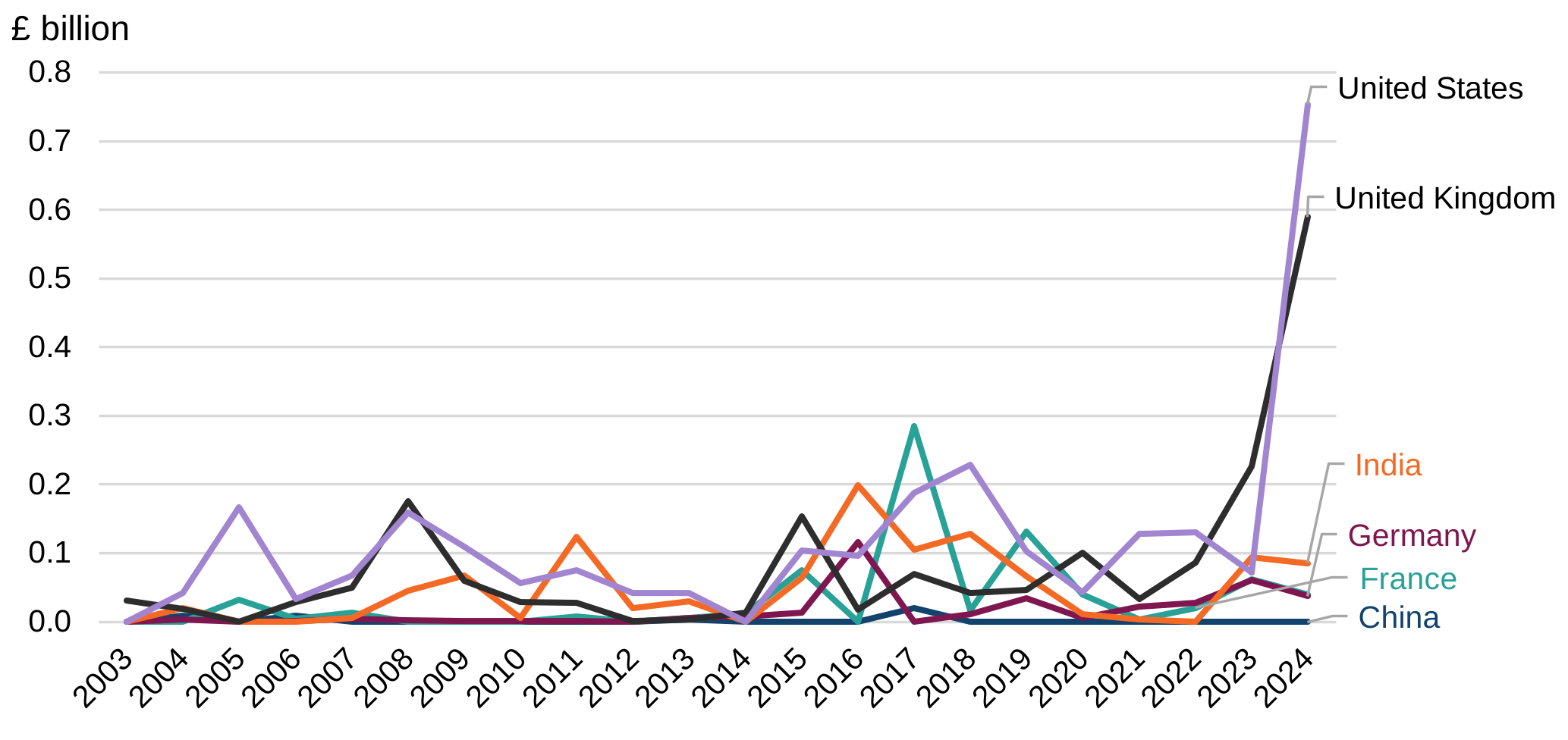
Table 16: Defence Greenfield FDI capital expenditure (£ billion) 2003 to 2024 for top 10 destination and selected countries and 10-year CAGR
Some shorthand is used in this table, [low] = a low figure but not a real zero, [z] = not applicable as no reported investment received in years needed for CAGR calculation.
| Country | 2003 | 2004 | 2005 | 2006 | 2007 | 2008 | 2009 | 2010 | 2011 | 2012 | 2013 | 2014 | 2015 | 2016 | 2017 | 2018 | 2019 | 2020 | 2021 | 2022 | 2023 | 2024 | 2015 to 2024 total | 2014 to 2023 CAGR | 2015 to 2024 CAGR | Top 10 (2015 to 2024) |
|---|---|---|---|---|---|---|---|---|---|---|---|---|---|---|---|---|---|---|---|---|---|---|---|---|---|---|
| Australia | [low] | 0.0 | 0.0 | [low] | 0.0 | [low] | [low] | [low] | [low] | [low] | [low] | 0.1 | [low] | [low] | 0.1 | 0.1 | 0.1 | [low] | 0.1 | 0.1 | 0.1 | 0.1 | 0.7 | 1.5% | 2.8% | Yes |
| Canada | 0.0 | 0.0 | 0.0 | 0.0 | 0.0 | [low] | [low] | [low] | [low] | [low] | [low] | [low] | 0.0 | [low] | 0.0 | [low] | 0.1 | [low] | 0.1 | 0.1 | [low] | [low] | 0.4 | 18.2% | [z] | Yes |
| China | 0.0 | [low] | 0.0 | [low] | 0.0 | 0.0 | 0.0 | 0.0 | 0.0 | 0.0 | [low] | 0.0 | 0.0 | 0.0 | [low] | 0.0 | 0.0 | 0.0 | 0.0 | 0.0 | 0.0 | 0.0 | [low] | [z] | [z] | No |
| Djibouti | 0.0 | 0.0 | 0.0 | 0.0 | 0.0 | 0.0 | 0.0 | 0.0 | 0.0 | 0.0 | 0.0 | 0.0 | 0.0 | 0.0 | 0.0 | 0.0 | 0.0 | 0.0 | 0.0 | 0.0 | 0.8 | 0.0 | 0.8 | [z] | [z] | Yes |
| France | 0.0 | 0.0 | [low] | [low] | [low] | 0.0 | 0.0 | 0.0 | [low] | 0.0 | [low] | [low] | 0.1 | 0.0 | 0.3 | [low] | 0.1 | [low] | [low] | [low] | 0.1 | [low] | 0.7 | 19.6% | -6.9% | Yes |
| Germany | 0.0 | [low] | 0.0 | [low] | [low] | [low] | [low] | [low] | [low] | 0.0 | [low] | [low] | [low] | 0.1 | 0.0 | [low] | [low] | [low] | [low] | [low] | 0.1 | [low] | 0.3 | 25.6% | 12.4% | No |
| India | 0.0 | [low] | 0.0 | 0.0 | [low] | [low] | 0.1 | [low] | 0.1 | [low] | [low] | 0.0 | 0.1 | 0.2 | 0.1 | 0.1 | 0.1 | [low] | [low] | 0.0 | 0.1 | 0.1 | 0.8 | [z] | 3.3% | Yes |
| Saudi Arabia | 0.0 | 0.0 | 0.0 | 0.0 | 0.0 | [low] | 0.0 | [low] | 0.0 | 0.0 | [low] | [low] | [low] | [low] | [low] | [low] | [low] | 0.0 | [low] | 0.1 | 0.0 | 0.1 | 0.3 | -100.0% | 15.4% | Yes |
| United Arab Emirates | 0.0 | 0.0 | 0.0 | [low] | 0.0 | 0.0 | 0.1 | 0.1 | 0.0 | 0.1 | [low] | 0.1 | [low] | [low] | [low] | [low] | 0.1 | [low] | [low] | [low] | 0.1 | 0.1 | 0.4 | -6.2% | 39.4% | Yes |
| Ukraine | [low] | 0.0 | 0.0 | 0.0 | 0.0 | 0.0 | 0.0 | 0.0 | 0.0 | 0.0 | 0.0 | 0.0 | 0.0 | 0.0 | [low] | [low] | 0.0 | 0.0 | 0.0 | 0.1 | 0.2 | 0.1 | 0.5 | [z] | [z] | Yes |
| United Kingdom | [low] | [low] | 0.0 | [low] | [low] | 0.2 | 0.1 | [low] | [low] | [low] | [low] | [low] | 0.2 | [low] | 0.1 | [low] | [low] | 0.1 | [low] | 0.1 | 0.2 | 0.6 | 1.4 | 37.5% | 16.1% | Yes |
| United States | 0.0 | [low] | 0.2 | [low] | 0.1 | 0.2 | 0.1 | 0.1 | 0.1 | [low] | [low] | 0.0 | 0.1 | 0.1 | 0.2 | 0.2 | 0.1 | [low] | 0.1 | 0.1 | 0.1 | 0.8 | 1.8 | [z] | 24.7% | Yes |
When comparing the CAGR over 10 years for investment flows (to smooth out the year-to-year volatility), for 2014 to 2023 and 2015 to 2024, Table 16 shows that:
-
Greenfield FDI into the UK’s Defence sector grew over 2015 to 2024, with a CAGR of 16.1%. While the rate of growth has declined compared to the previous 10-year period from 2014 to 2023, with a CAGR of 37.5%, this is a baseline effect, and the recent trend is positive with an increase from £0.2 billion in 2023 to £0.6 billion in 2024
-
the United Arab Emirates (UAE) had the highest CAGR over the 2015 to 2024 period, at 39.4%, relatively higher than other top 10 and selected countries in the sector
-
France had the lowest CAGR over the 2015 to 2024 period, at -6.9%, a significant decline from its 2014 to 2023 CAGR, at 19.6%
-
however, the absolute amounts of Defence sector Greenfield FDI capital expenditure in most countries are small and caution should therefore be exercised in drawing conclusions regarding trend growth rates based on individual country CAGRs
Over the last 10 years, the UK was the largest investor globally into the Defence sector, investing £1.54 billion (see Table 17). The UK is followed by the United States (£1.52 billion), Germany (£1.3 billion) and France (£0.8 billion).
When comparing this to the largest investors into the UK’s Defence sector, the largest investors were Germany (£0.7 billion), the US (£0.2 billion) and Israel (£0.08 billion). Out of the top 9 investors globally into the sector (excluding for the UK), 7 were also identified as top 10 investors in the UK into the sector, presenting opportunities for growing the UK’s investment relationship within the Defence sector with the largest investors globally into the sector.
Table 17: Greenfield FDI capital expenditure (£ billion) 2015 to 2024 for the top 10 investor countries into the Defence sector, globally and into the UK
Some shorthand is used in this table, [low] = a low figure but not a real zero.
| Rank | Top 10 investors globally into Defence | Capital expenditure (£ billion) |
Top 10 investors into the UK – Defence | Capital expenditure (£ billion) |
|---|---|---|---|---|
| 1 | United Kingdom | 1.5 | Germany | 0.7 |
| 2 | United States | 1.5 | United States | 0.2 |
| 3 | Germany | 1.3 | Israel | 0.1 |
| 4 | France | 0.8 | Sweden | 0.1 |
| 5 | Israel | 0.8 | France | 0.1 |
| 6 | Hong Kong | 0.8 | Italy | 0.1 |
| 7 | Sweden | 0.5 | Turkey | [low] |
| 8 | Netherlands | 0.4 | Portugal | [low] |
| 9 | Canada | 0.3 | Canada | [low] |
| 10 | Italy | 0.2 | Belgium | [low] |
Table 18: Greenfield FDI capital expenditure from 2015 to 2024 into the Defence sector by UK ITL1 region (£ billion and share of UK regions total)[footnote 25]
Some shorthand is used in this table, [low] = a low figure but not a real zero.
| UK ITL1 region | Capital expenditure (£ billion) |
Share of UK regions total |
|---|---|---|
| East Midlands | 0.01 | 1.0% |
| East of England | 0.04 | 5.1% |
| London | 0.03 | 4.7% |
| North East | 0.05 | 6.8% |
| North West | [low] | 0.6% |
| Northern Ireland | 0.00 | 0.0% |
| Scotland | 0.14 | 19.1% |
| South East | 0.12 | 16.2% |
| South West | 0.19 | 25.8% |
| Wales | 0.09 | 11.7% |
| West Midlands | 0.06 | 7.5% |
| Yorkshire and the Humber | 0.01 | 1.4% |
Table 18 shows that the 3 UK ITL1 regions that received the most Greenfield FDI capital expenditure in the sector over this period were the South West (£0.2 billion, 25.8% of the UK’s Greenfield FDI capital expenditure in the sector), Scotland (£0.1 billion, 19.1%) and the South East (£0.1 billion, 16.2%).
Figure 13: Map of Greenfield FDI capital expenditure from 2015 to 2024 into the Defence sector by UK ITL1 region (share of UK regions total, %)[footnote 26]
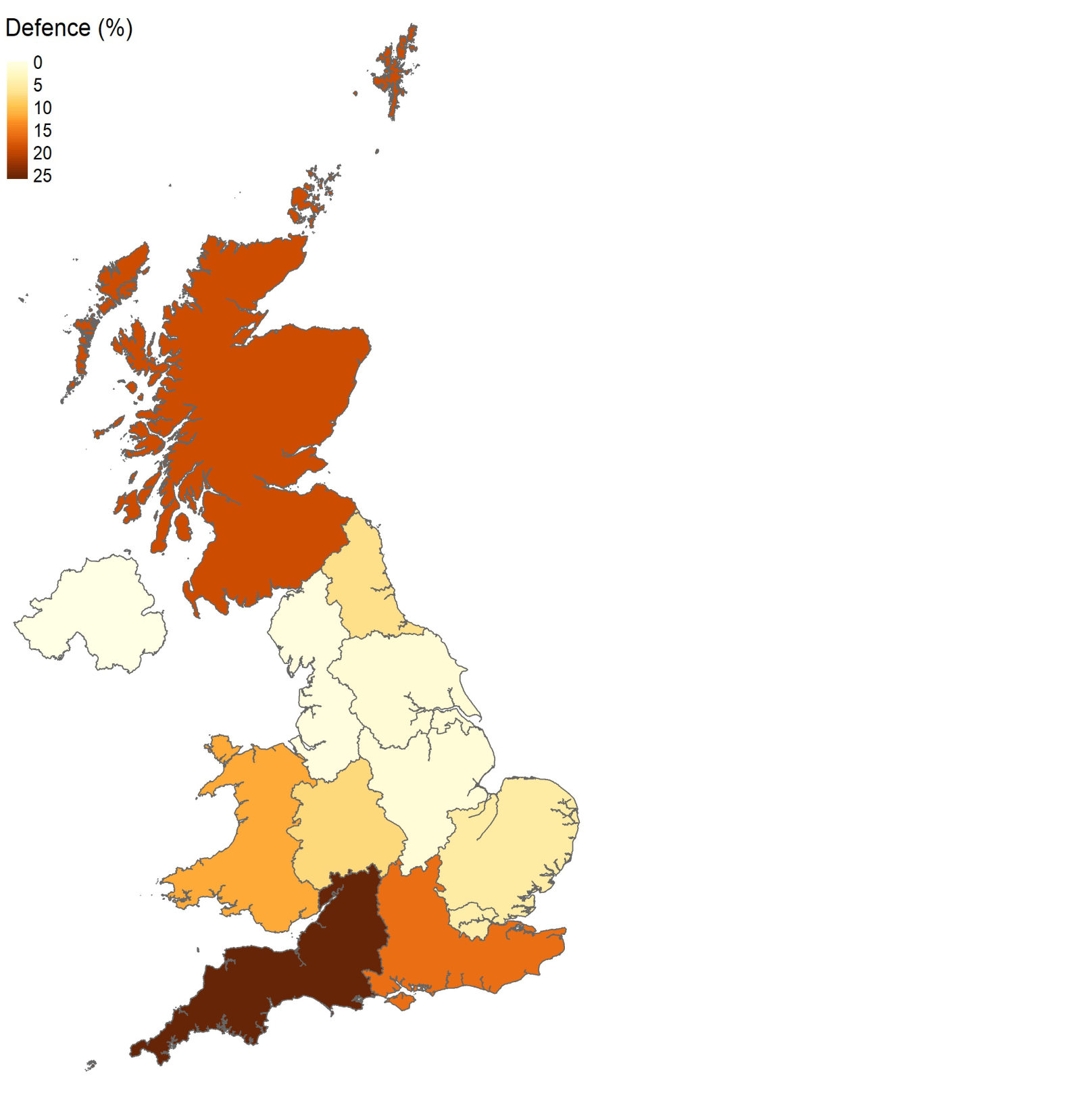
Figure 13 shows a regional heat map on the relative distribution of Greenfield FDI capital expenditure in the Defence sector across the UK ITL1 regions. Table 18 provides the web accessible version of the data for the share of UK regions total (%) in Figure 13.
In terms of Greenfield FDI jobs created within the Defence sector over the last 10 years, a total of 61,714 jobs were created globally. The UK ranked third, with 5,354 jobs, behind the United States, with 11,267 jobs and India, with 7,010 jobs.
Digital and Technologies
Over the last 10 years, £1,342.0 billion of Greenfield FDI capital expenditure was invested into the Digital and Technologies sector globally over 37,512 projects. The largest recipients of Greenfield FDI capital expenditure in the sector were the United States, with £206.3 billion over 4,000 projects, India, with £107.0 billion over 2,769 projects and Germany, with £91.6 billion over 2,584 projects. The UK ranked fourth, with £81.1 billion over 3,484 projects. The UK is ahead of China, ranked seventh, with £57.4 billion over 820 projects. In 2024, the UK ranked second globally for Greenfield FDI capital expenditure received in the Digital and Technologies sector, with £26.8 billion over 234 projects.
Figure 14: Digital and Technologies Greenfield FDI capital expenditure (£ billion) 2003 to 2024 for selected countries
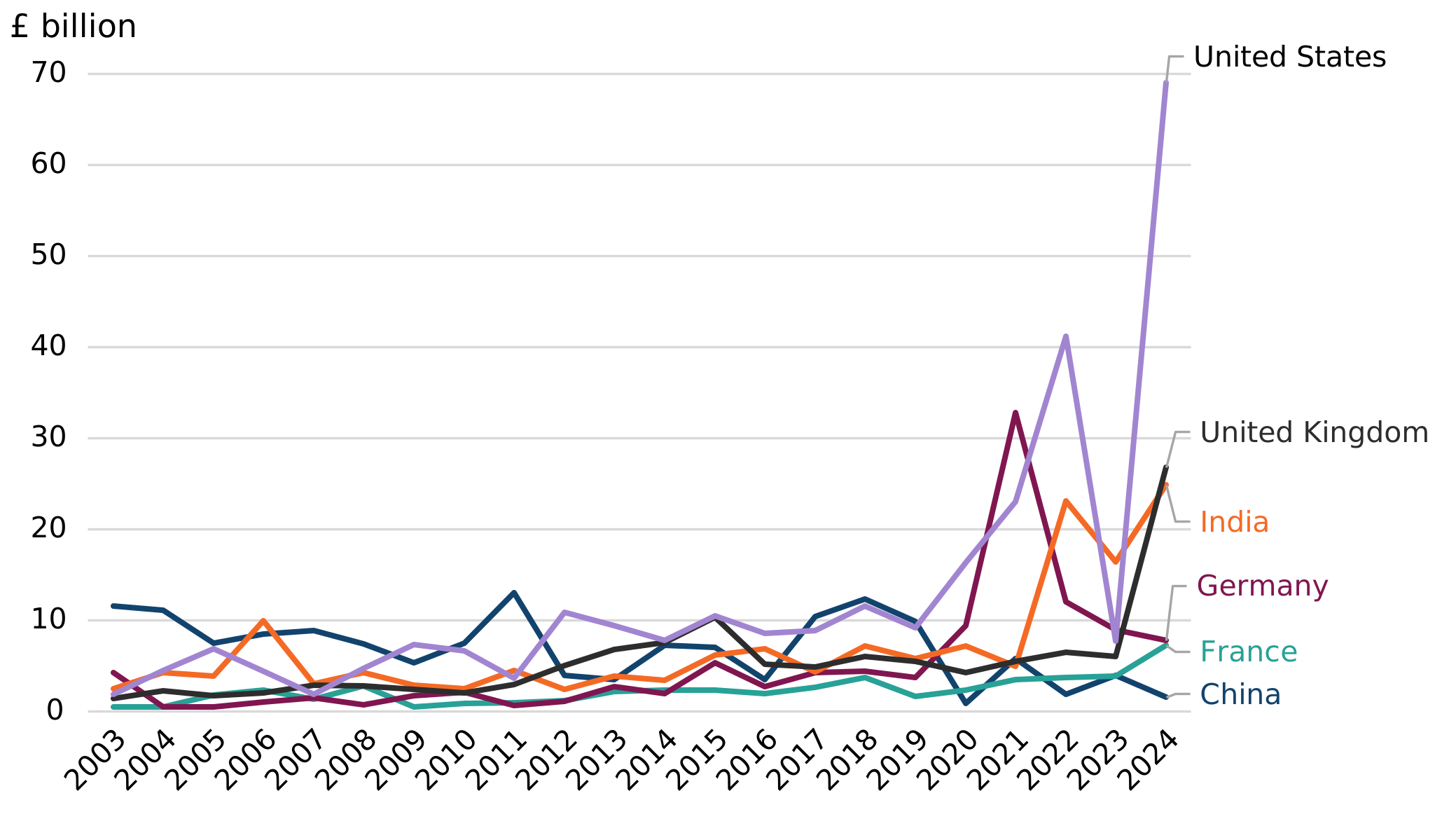
Table 19: Digital and Technologies Greenfield FDI capital expenditure (£ billion) 2003 to 2024 for top 10 destination and selected countries and 10-year CAGR
Some shorthand is used in this table, [low] = a low figure but not a real zero.
| Country | 2003 | 2004 | 2005 | 2006 | 2007 | 2008 | 2009 | 2010 | 2011 | 2012 | 2013 | 2014 | 2015 | 2016 | 2017 | 2018 | 2019 | 2020 | 2021 | 2022 | 2023 | 2024 | 2015 to 2024 total | 2014 to 2023 CAGR | 2015 to 2024 CAGR | Top 10 (2015 to 2024) |
|---|---|---|---|---|---|---|---|---|---|---|---|---|---|---|---|---|---|---|---|---|---|---|---|---|---|---|
| Canada | 1.0 | 0.9 | 1.0 | 0.8 | 0.5 | 1.2 | 0.8 | 1.2 | 1.6 | 2.6 | 6.6 | 2.7 | 3.6 | 3.3 | 3.7 | 6.1 | 3.7 | 4.9 | 6.9 | 4.3 | 2.8 | 4.2 | 43.6 | 0.5% | 1.8% | Yes |
| China | 11.6 | 11.1 | 7.5 | 8.5 | 8.9 | 7.4 | 5.4 | 7.5 | 13.0 | 4.0 | 3.5 | 7.2 | 7.0 | 3.5 | 10.5 | 12.4 | 9.9 | 0.9 | 5.8 | 1.9 | 4.0 | 1.6 | 57.4 | -6.4% | -15.4% | Yes |
| France | 0.5 | 0.5 | 1.8 | 2.4 | 1.3 | 2.8 | 0.5 | 0.9 | 0.9 | 1.2 | 2.2 | 2.3 | 2.3 | 2.0 | 2.7 | 3.8 | 1.7 | 2.4 | 3.5 | 3.7 | 3.9 | 7.2 | 33.2 | 5.9% | 13.5% | No |
| Germany | 4.3 | 0.5 | 0.5 | 1.0 | 1.5 | 0.7 | 1.7 | 2.1 | 0.7 | 1.1 | 2.8 | 2.0 | 5.3 | 2.8 | 4.3 | 4.4 | 3.7 | 9.4 | 32.8 | 12.0 | 9.0 | 7.8 | 91.6 | 18.1% | 4.3% | Yes |
| India | 2.5 | 4.2 | 3.9 | 10.0 | 3.0 | 4.3 | 2.9 | 2.5 | 4.5 | 2.4 | 3.9 | 3.4 | 6.2 | 6.9 | 4.4 | 7.2 | 5.8 | 7.2 | 4.9 | 23.1 | 16.4 | 24.9 | 107.0 | 19.1% | 16.8% | Yes |
| Ireland | 1.1 | 2.1 | 0.8 | 0.9 | 0.8 | 1.0 | 0.6 | 1.1 | 1.9 | 1.4 | 2.6 | 1.9 | 2.2 | 2.3 | 5.5 | 2.2 | 5.6 | 4.1 | 3.8 | 13.3 | 2.4 | 2.1 | 43.4 | 2.6% | -0.4% | Yes |
| Japan | 2.3 | 4.2 | 0.6 | 3.6 | 0.7 | 2.3 | 0.5 | 2.3 | 0.6 | 0.6 | 5.1 | 3.4 | 3.6 | 2.2 | 1.7 | 2.3 | 2.0 | 1.3 | 16.2 | 2.0 | 13.0 | 16.5 | 60.8 | 16.2% | 18.3% | Yes |
| Malaysia | 1.4 | 1.7 | 0.7 | 1.3 | 1.2 | 0.7 | 1.2 | 0.5 | 0.7 | 1.0 | 2.3 | 1.6 | 1.2 | 1.4 | 0.7 | 2.7 | 1.7 | 2.2 | 10.3 | 7.5 | 14.6 | 17.1 | 59.5 | 27.5% | 34.3% | Yes |
| Singapore | 2.9 | 3.5 | 1.8 | 4.9 | 3.1 | 1.3 | 1.2 | 5.1 | 2.8 | 1.8 | 1.8 | 2.4 | 2.5 | 2.6 | 3.4 | 5.2 | 1.8 | 1.5 | 5.7 | 6.3 | 2.4 | 8.1 | 39.4 | [low] | 14.0% | Yes |
| United Kingdom | 1.4 | 2.3 | 1.8 | 2.0 | 2.9 | 2.8 | 2.5 | 2.1 | 3.0 | 5.0 | 6.8 | 7.6 | 10.4 | 5.2 | 4.9 | 6.1 | 5.5 | 4.3 | 5.5 | 6.5 | 6.0 | 26.8 | 81.1 | -2.5% | 11.1% | Yes |
| United States | 1.9 | 4.5 | 6.9 | 4.4 | 1.9 | 4.7 | 7.4 | 6.7 | 3.7 | 10.9 | 9.5 | 7.8 | 10.5 | 8.6 | 8.9 | 11.6 | 9.2 | 16.3 | 23.1 | 41.2 | 7.8 | 69.1 | 206.3 | -0.1% | 23.2% | Yes |
When comparing the CAGR over 10 years for investment flows (to smooth out the year-to-year volatility) between 2014 to 2023 and 2015 to 2024, Table 19 shows that:
-
Greenfield FDI into the UK’s Digital and Technologies sector grew at a faster rate from 2015 to 2024, at 11.1% annually, compared to a decline of 2.5% from 2014 to 2023
-
the G7 countries, on average, also grew at a faster rate annually between 2015 to 2024 (16.3%) compared to 2014 to 2023 (6.3%)
-
China had the lowest CAGR in both 10-year periods among these countries, with investment flows slowing in the 2015 to 2024 period
-
Malaysia had the highest CAGR among these countries over 2015 to 2024, with investment flows into the sector growing at 34.3% annually, followed by the United States, with a CAGR of 23.2% over 2015 to 2024
Over the last 10 years, the largest global investors in the Digital and Technologies sector were the United States, investing £543.6 billion, Taiwan, investing £136.2 billion and South Korea, investing £61.7 billion (see Table 20). The UK ranked fourth, investing £60.1 billion.
When comparing this to the largest investors into the UK’s Digital and Technologies sector, the largest investors were the United States (£55.7 billion), Luxembourg (£3.1 billion) and Japan (£2.5 billion). The United States makes up nearly 70% of the Greenfield FDI capital expenditure that the UK received in the sector. Out of the top 9 investors globally into the sector (excluding for the UK), 5 were also identified as part of the top 10 investors into the UK into the sector. This presents opportunities to grow the UK’s investment relationship with other top investors globally into the sector.
Table 20: Greenfield FDI capital expenditure (£ billion) 2015 to 2024 for the top 10 investor countries into the Digital and Technologies sector, globally and into the UK
| Rank | Top 10 investors globally into Digital and Technologies | Capital expenditure (£ billion) |
Top 10 investors into the UK – Digital and Technologies | Capital expenditure (£ billion) |
|---|---|---|---|---|
| 1 | United States | 543.6 | United States | 55.7 |
| 2 | Taiwan | 136.2 | Luxembourg | 3.1 |
| 3 | South Korea | 61.7 | Japan | 2.5 |
| 4 | United Kingdom | 60.1 | France | 2.0 |
| 5 | China | 57.7 | Netherlands | 1.7 |
| 6 | Singapore | 49.7 | China | 1.7 |
| 7 | Japan | 46.2 | Ireland | 1.6 |
| 8 | Germany | 42.6 | Germany | 1.4 |
| 9 | France | 34.1 | Canada | 1.3 |
| 10 | United Arab Emirates | 26.0 | India | 1.3 |
Over the last 10 years, the Data Processing, Hosting, and Related Services sub-sector attracted the highest Greenfield FDI capital expenditure within the UK’s Digital and Technologies sector, with total investment of £51.7 billion over 151 projects, particularly influenced by a small number of high-value investments in data centres totalling £17.9 billion in 2024.
Table 21: Greenfield FDI capital expenditure from 2015 to 2024 into the Digital and Technologies sector by UK ITL1 region (£ billion and share of UK regions total)[footnote 27]
| UK ITL1 region | Capital expenditure (£ billon) |
Share of UK regions total |
|---|---|---|
| East Midlands | 0.4 | 0.6% |
| East of England | 2.9 | 4.8% |
| London | 25.1 | 41.6% |
| North East | 11.0 | 18.2% |
| North West | 2.8 | 4.7% |
| Northern Ireland | 1.0 | 1.6% |
| Scotland | 2.4 | 4.0% |
| South East | 9.0 | 14.9% |
| South West | 1.0 | 1.6% |
| Wales | 3.6 | 6.0% |
| West Midlands | 0.8 | 1.3% |
| Yorkshire and the Humber | 0.5 | 0.8% |
Table 21 shows that the 3 UK ITL1 regions that received the most Greenfield FDI capital expenditure in the sector over the last 10 years were London (£25.1 billion, 41.6% of the UK’s Greenfield FDI capital expenditure in the sector), the North East (£11.0 billion, 18.2%) and the South East (£9.0 billion, 14.9%).
Figure 15: Map of Greenfield FDI capital expenditure from 2015 to 2024 into the Digital and Technologies sector by UK ITL1 region (share of UK regions total, %)[footnote 28]
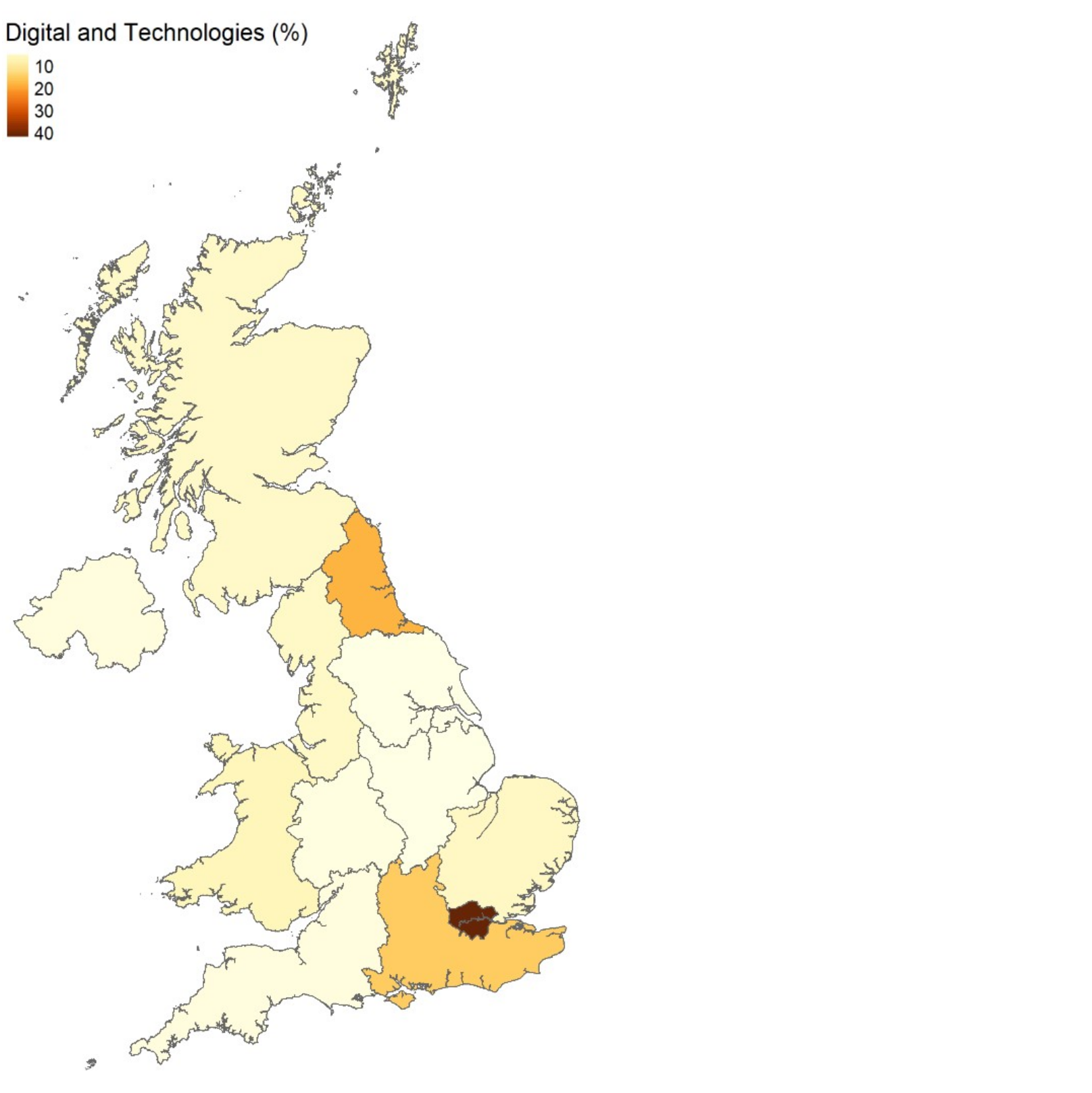
Figure 15 shows a regional heat map on the relative distribution of Greenfield FDI capital expenditure in the Digital and Technologies sector across the UK ITL1 regions. Table 21 provides the web accessible version of the data for the share of UK regions total (%) in Figure 15.
In terms of Greenfield FDI jobs created within the sector over the last 10 years, a total of 4.3 million jobs were created globally. The UK ranks fifth, with 153,450 jobs. The UK is behind India, with 1.4 million jobs, the United States, with 330,636 jobs, Vietnam, with 189,664 jobs and China, with 155,466 jobs.
Financial Services
Over the last 10 years, £163.5 billion of Greenfield FDI capital expenditure was invested into the Financial Services sector globally over 9,526 projects. The largest recipients of Greenfield FDI capital expenditure in the sector were China, with £17.1 billion over 308 projects, Brazil, with £16.2 billion over 137 projects and India, with £15.9 billion over 374 projects. The UK ranked sixth, with £6.9 billion over 776 projects. The UK is ahead of the United States, ranked seventh, with £6.6 billion over 786 projects. In 2024, the UK ranked seventh globally for Greenfield FDI capital expenditure received in the Financial Services sector, with £0.6 billion over 76 projects.
Figure 16: Financial Services Greenfield FDI capital expenditure (£ billion) 2003 to 2024 for selected countries
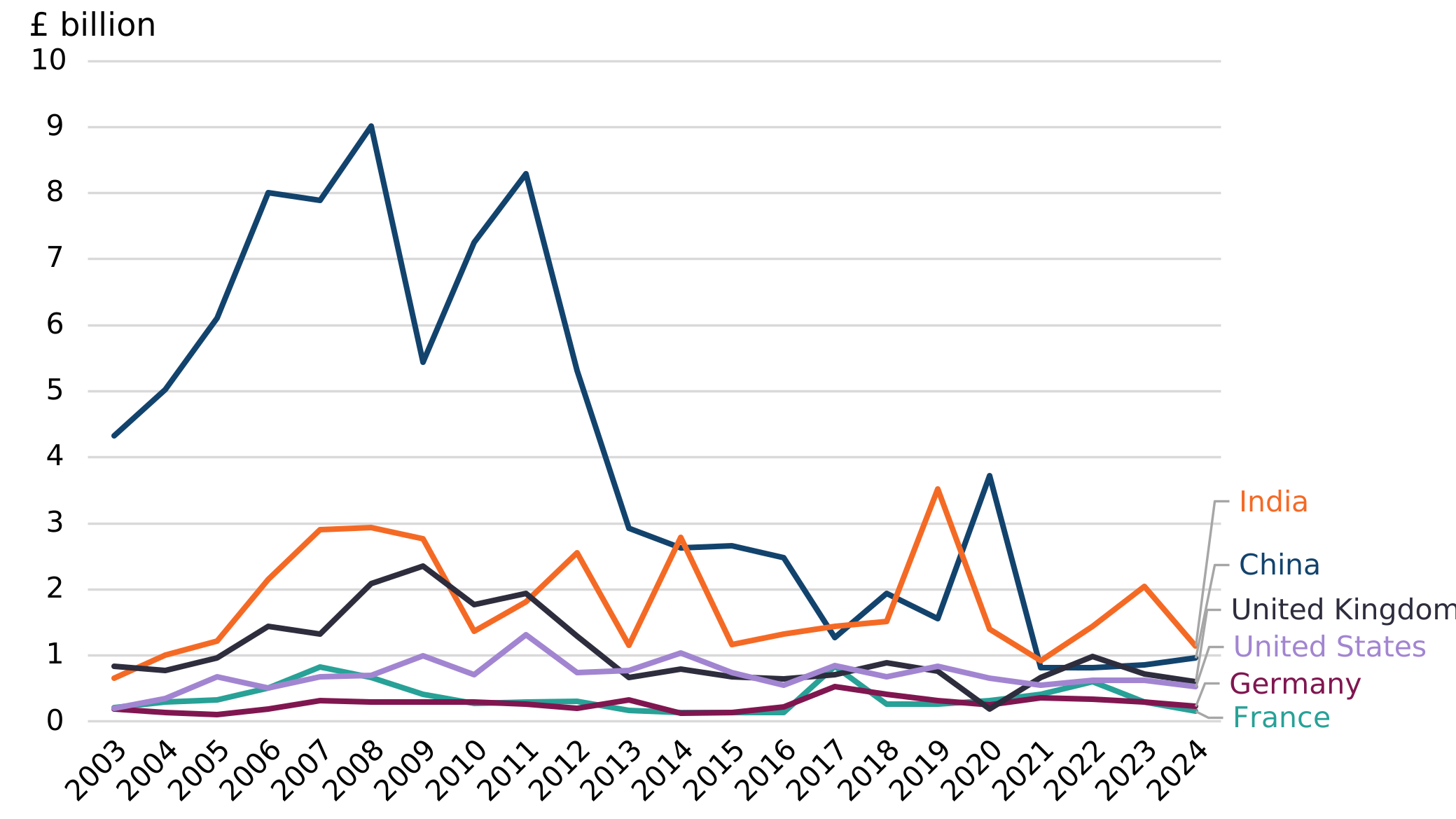
Table 22: Financial Services Greenfield FDI capital expenditure (£ billion) 2003 to 2024 for top 10 destination and selected countries and 10-year CAGR
| Country | 2003 | 2004 | 2005 | 2006 | 2007 | 2008 | 2009 | 2010 | 2011 | 2012 | 2013 | 2014 | 2015 | 2016 | 2017 | 2018 | 2019 | 2020 | 2021 | 2022 | 2023 | 2024 | 2015 to 2024 total | 2014 to 2023 CAGR | 2015 to 2024 CAGR | Top 10 (2015 to 2024) |
|---|---|---|---|---|---|---|---|---|---|---|---|---|---|---|---|---|---|---|---|---|---|---|---|---|---|---|
| Australia | 0.4 | 0.3 | 0.2 | 0.5 | 1.7 | 0.8 | 0.7 | 1.2 | 1.0 | 0.9 | 0.7 | 1.0 | 0.7 | 0.3 | 0.7 | 0.6 | 0.7 | 0.5 | 0.5 | 0.7 | 0.6 | 0.8 | 6.1 | -5.1% | 2.0% | Yes |
| Brazil | 1.5 | 0.7 | 1.1 | 0.9 | 1.5 | 4.4 | 2.0 | 2.8 | 2.5 | 3.5 | 2.4 | 1.6 | 1.8 | 0.6 | 0.8 | 1.6 | 2.0 | 1.0 | 1.4 | 2.7 | 3.4 | 0.9 | 16.2 | 8.4% | -7.4% | Yes |
| China | 4.3 | 5.0 | 6.1 | 8.0 | 7.9 | 9.0 | 5.4 | 7.3 | 8.3 | 5.3 | 2.9 | 2.6 | 2.7 | 2.5 | 1.3 | 1.9 | 1.6 | 3.7 | 0.8 | 0.8 | 0.9 | 1.0 | 17.1 | -11.7% | -10.7% | Yes |
| France | 0.2 | 0.3 | 0.3 | 0.5 | 0.8 | 0.7 | 0.4 | 0.3 | 0.3 | 0.3 | 0.2 | 0.1 | 0.1 | 0.1 | 0.8 | 0.3 | 0.3 | 0.3 | 0.4 | 0.6 | 0.3 | 0.2 | 3.4 | 8.7% | 1.4% | No |
| Germany | 0.2 | 0.1 | 0.1 | 0.2 | 0.3 | 0.3 | 0.3 | 0.3 | 0.3 | 0.2 | 0.3 | 0.1 | 0.1 | 0.2 | 0.5 | 0.4 | 0.3 | 0.3 | 0.4 | 0.3 | 0.3 | 0.2 | 3.1 | 10.2% | 6.2% | No |
| Hong Kong | 0.3 | 0.6 | 0.5 | 1.0 | 1.1 | 1.3 | 1.1 | 1.5 | 1.9 | 1.0 | 0.9 | 0.7 | 0.6 | 0.5 | 0.5 | 0.8 | 0.6 | 0.4 | 1.1 | 1.3 | 0.6 | 0.6 | 7.1 | -1.4% | -0.7% | Yes |
| India | 0.7 | 1.0 | 1.2 | 2.1 | 2.9 | 2.9 | 2.8 | 1.4 | 1.8 | 2.6 | 1.2 | 2.8 | 1.2 | 1.3 | 1.4 | 1.5 | 3.5 | 1.4 | 0.9 | 1.4 | 2.1 | 1.1 | 15.9 | -3.4% | -0.2% | Yes |
| Singapore | 0.4 | 0.4 | 0.4 | 0.9 | 1.7 | 1.4 | 1.4 | 1.8 | 1.8 | 1.0 | 0.9 | 1.0 | 0.8 | 0.8 | 1.1 | 0.9 | 1.0 | 1.1 | 0.9 | 1.5 | 1.5 | 1.3 | 10.8 | 4.1% | 5.1% | Yes |
| Spain | 0.3 | 0.3 | 0.2 | 0.4 | 0.9 | 0.9 | 0.8 | 0.5 | 0.6 | 0.6 | 0.5 | 0.3 | 0.2 | 0.6 | 0.3 | 0.6 | 0.6 | 0.3 | 0.4 | 0.6 | 0.2 | 0.3 | 4.1 | -5.8% | 2.8% | Yes |
| United Kingdom | 0.8 | 0.8 | 1.0 | 1.4 | 1.3 | 2.1 | 2.4 | 1.8 | 1.9 | 1.3 | 0.7 | 0.8 | 0.7 | 0.6 | 0.7 | 0.9 | 0.8 | 0.2 | 0.7 | 1.0 | 0.7 | 0.6 | 6.9 | -0.9% | -1.4% | Yes |
| United States | 0.2 | 0.3 | 0.7 | 0.5 | 0.7 | 0.7 | 1.0 | 0.7 | 1.3 | 0.7 | 0.8 | 1.0 | 0.7 | 0.5 | 0.8 | 0.7 | 0.8 | 0.7 | 0.6 | 0.6 | 0.6 | 0.5 | 6.6 | -5.6% | -3.8% | Yes |
| Vietnam | 0.3 | 0.4 | 0.6 | 0.7 | 0.6 | 1.0 | 1.1 | 0.5 | 0.6 | 0.7 | 0.3 | 0.9 | 0.9 | 0.5 | 0.8 | 1.0 | 0.5 | 0.2 | 0.1 | 0.3 | 0.1 | 0.3 | 4.6 | -19.6% | -12.2% | Yes |
When comparing the CAGR over 10 years for investment flows (to smooth out the year-to-year volatility) between 2014 to 2023 and 2015 to 2024, Table 22 shows that:
-
the UK’s Financial Services sector has seen a small decline in Greenfield FDI flows, with a CAGR of -1.4% annually from 2015 to 2024, compared to a CAGR of -0.9% from 2014 to 2023
-
the G7 countries, on average, remained stable, with Greenfield FDI capital expenditure in the sector growing at a slightly faster rate annually between 2015 to 2024 (2.2%) compared to 2014 to 2023 (2.1%)
-
countries including China, India and the United States have also seen declines in Greenfield FDI capital expenditure flows into the sector over 2015 to 2024, although have seen slight improvements to their CAGRs for this period
-
Germany had the highest CAGR among these countries from 2015 to 2024, at 6.2% – although in absolute terms, Germany’s Greenfield FDI capital expenditure over the period in the sector is low relative to the UK and other top 10 destination countries
Over the last 10 years, the UK ranked second globally for Greenfield FDI capital expenditure investment into the Financial Services sector, investing £25.3 billion (see Table 23). The UK is only behind the United States (£38.1 billion) and ahead of Switzerland (£8.2 billion).
When comparing this to the largest investors into the UK’s Financial Services sector, the largest investors were the United States (£2.5 billion), Spain (£0.4 billion) and Sweden (£0.3 billion). The United States accounts for over 33% of the Greenfield FDI capital expenditure that the UK received in the sector. Out of the top 9 investors globally into the sector (excluding for the UK), 7 were also identified as the top 10 investors into the UK into the sector. This suggests that there are opportunities to grow investment relationships with existing top investors and other top global investors into the sector.
Table 23: Greenfield FDI capital expenditure (£ billion) 2015 to 2024 for the top 10 investor countries into the Financial Services sector, globally and into the UK
| Rank | Top 10 investors globally into Financial Services | Capital expenditure (£ billion) |
Top 10 investors into the UK – Financial Services | Capital expenditure (£ billion) |
|---|---|---|---|---|
| 1 | United States | 38.1 | United States | 2.5 |
| 2 | United Kingdom | 25.3 | Spain | 0.4 |
| 3 | Switzerland | 8.2 | Sweden | 0.3 |
| 4 | Hong Kong | 6.4 | Switzerland | 0.3 |
| 5 | Japan | 5.7 | Hong Kong | 0.3 |
| 6 | Germany | 5.7 | Germany | 0.3 |
| 7 | Singapore | 5.6 | China | 0.2 |
| 8 | Spain | 5.0 | Canada | 0.2 |
| 9 | France | 4.8 | Netherlands | 0.2 |
| 10 | Canada | 4.5 | Singapore | 0.2 |
Over the last 10 years, the Corporate and Investment Banking sub-sector attracted the highest Greenfield FDI capital expenditure within the UK’s Financial Services sector, with total investment of £3.1 billion over 337 projects, accounting for over 40% of the UK’s Greenfield FDI capital expenditure received in the sector.
Table 24: Greenfield FDI capital expenditure from 2015 to 2024 into the Financial Services sector by UK ITL1 region (£ billion and share of UK regions total)[footnote 29]
| UK ITL1 region | Capital expenditure (£ billion) |
Share of UK regions total |
|---|---|---|
| East Midlands | 0.10 | 1.6% |
| East of England | 0.01 | 0.1% |
| London | 4.36 | 70.4% |
| North East | 0.04 | 0.7% |
| North West | 0.31 | 5.1% |
| Northern Ireland | 0.27 | 4.4% |
| Scotland | 0.27 | 4.4% |
| South East | 0.34 | 5.4% |
| South West | 0.08 | 1.2% |
| Wales | 0.09 | 1.4% |
| West Midlands | 0.20 | 3.3% |
| Yorkshire and the Humber | 0.11 | 1.8% |
Table 24 shows that the UK ITL1 region that received the most Greenfield FDI capital expenditure in the sector over the last 10 years was London (£4.4 billion, 70.4% of the UK’s Greenfield FDI capital expenditure in the sector). London was followed by the South East (£0.3 billion, 5.4%) and the North West (£0.3 billion, 5.1%).
Figure 17: Map of Greenfield FDI capital expenditure from 2015 to 2024 into the Financial Services sector by UK ITL1 region (share of UK regions total, %)[footnote 30]
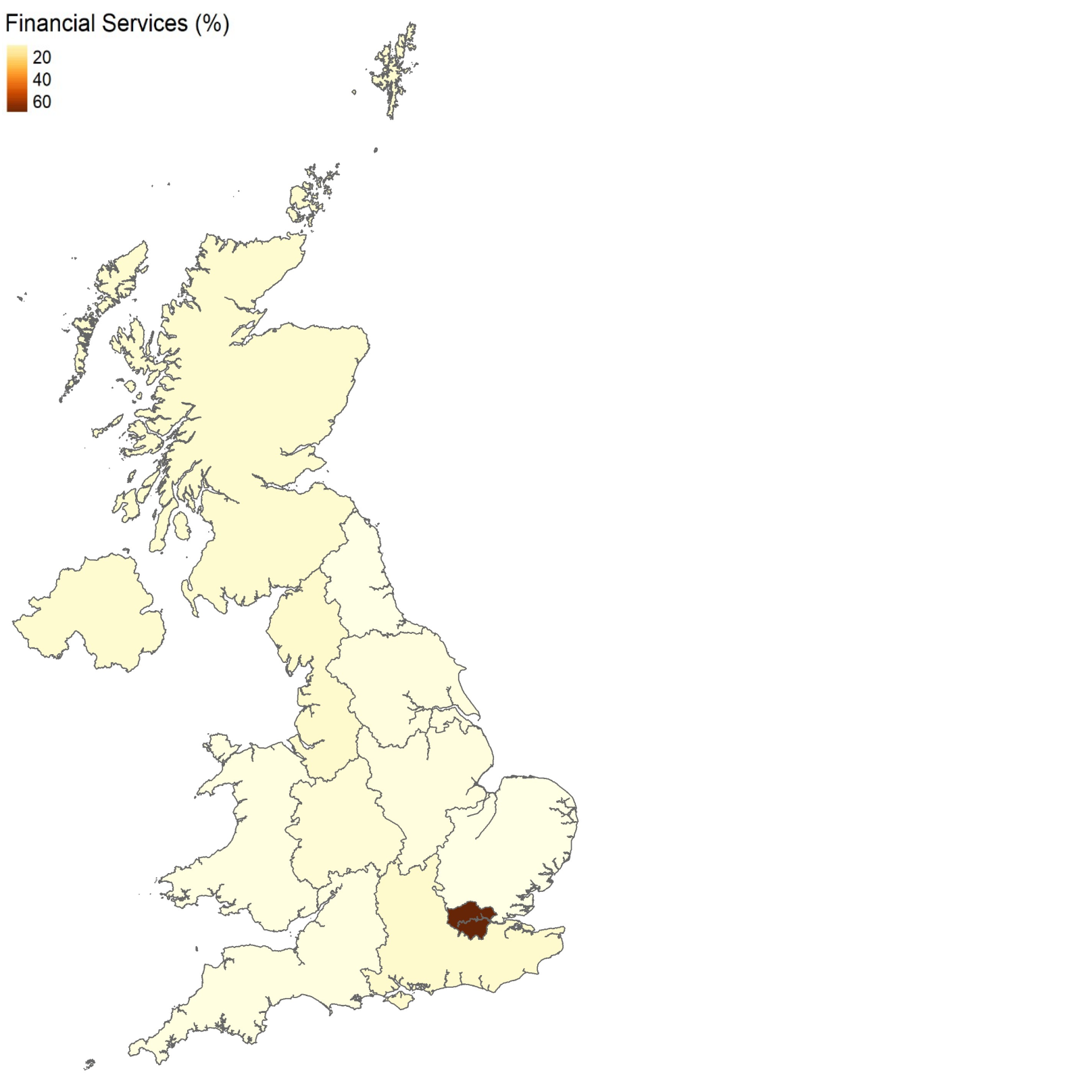
Figure 17 shows a regional heat map on the relative distribution of Greenfield FDI capital expenditure in the Financial Services sector across the UK ITL1 regions. Table 24 provides the web accessible version of the data for the share of UK regions total (%) in Figure 17.
In terms of Greenfield FDI jobs created within the sector over the last 10 years, a total of 581,471 jobs were created globally. The UK ranked fourth, with 30,591 jobs, behind India, with 108,677 jobs, the United States, with 53,142 jobs and China, with 36,764 jobs.
Life Sciences[footnote 31]
Over the last 10 years, £229.3 billion of Greenfield FDI capital expenditure was invested into the Life Sciences sector over 9,190 projects. The largest recipients of Greenfield FDI capital expenditure in the sector were the United States, with £53.5 billion over 1,609 projects, China, with £19.3 billion over 448 projects, Ireland, with £14.1 billion over 321 projects and Germany, with £13.6 billion over 797 projects. The UK ranked fifth, with £12.0 billion over 680 projects and is ahead of India, ranked sixth, with £11.3 billion over 447 projects and France, ranked seventh, with £8.8 billion over 396 projects. In 2024, the UK ranked fourth globally for greenfield FDI capital expenditure received in the Life Sciences sector, with £2.1 billion over 62 projects.
Figure 18: Life Sciences Greenfield FDI capital expenditure (£ billion) 2003 to 2024 for selected countries
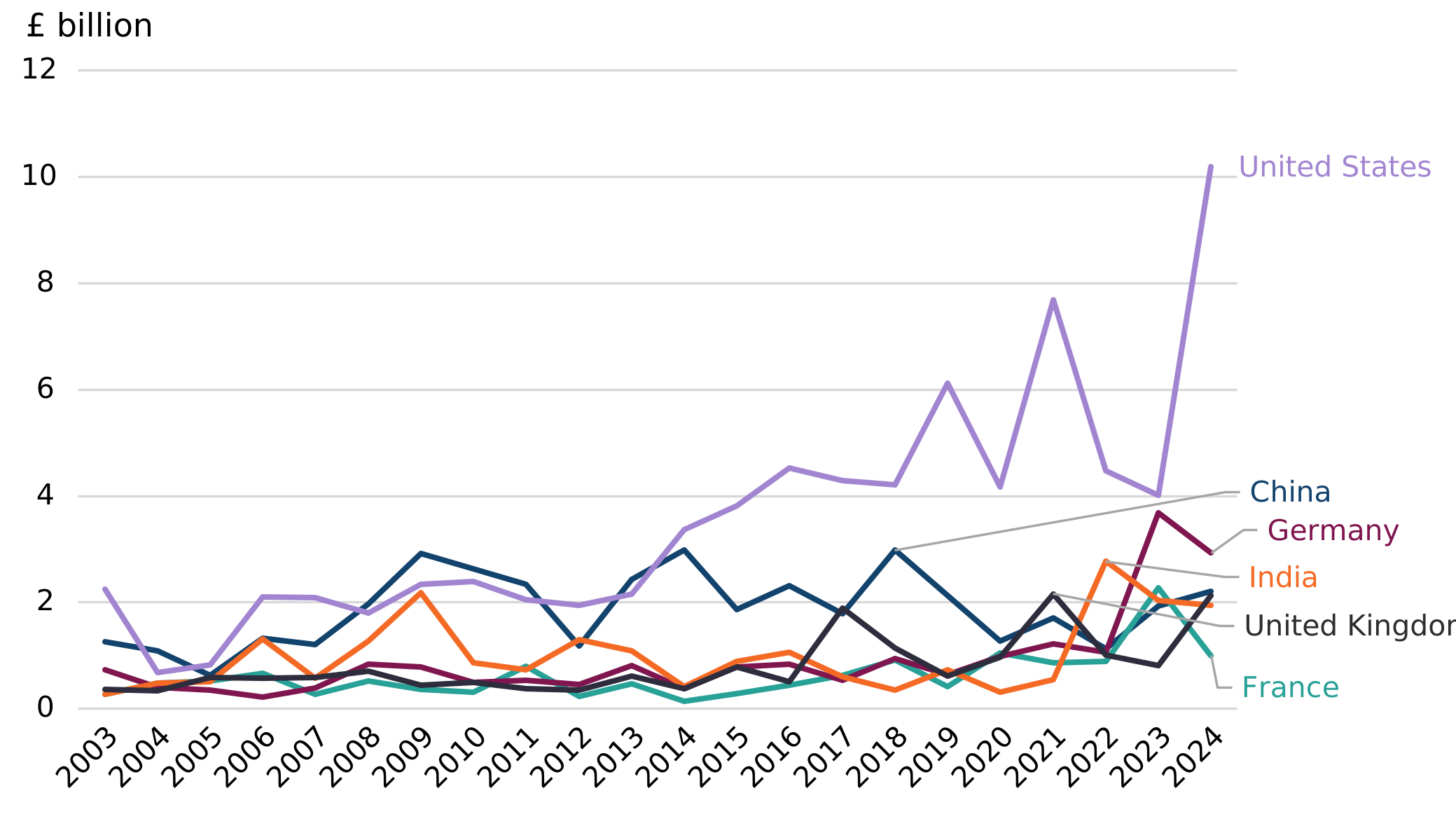
Table 25: Life Sciences Greenfield FDI capital expenditure (£ billion) 2003 to 2024 for top 10 destination and selected countries and 10-year CAGR
Some shorthand is used in this table, [low] = a low figure but not a real zero.
| Country | 2003 | 2004 | 2005 | 2006 | 2007 | 2008 | 2009 | 2010 | 2011 | 2012 | 2013 | 2014 | 2015 | 2016 | 2017 | 2018 | 2019 | 2020 | 2021 | 2022 | 2023 | 2024 | 2015 to 2024 total | 2014 to 2023 CAGR | 2015 to 2024 CAGR | Top 10 (2015 to 2024) |
|---|---|---|---|---|---|---|---|---|---|---|---|---|---|---|---|---|---|---|---|---|---|---|---|---|---|---|
| Belgium | [low] | 0.2 | 0.3 | 0.3 | 0.2 | 0.3 | 0.5 | 0.4 | 0.1 | 0.2 | 0.2 | 0.3 | 0.2 | 0.4 | 0.4 | 0.3 | 0.4 | 0.5 | 0.9 | 1.4 | 0.1 | 0.4 | 5.1 | -11.6% | 6.8% | Yes |
| China | 1.3 | 1.1 | 0.6 | 1.3 | 1.2 | 2.0 | 2.9 | 2.6 | 2.3 | 1.2 | 2.4 | 3.0 | 1.9 | 2.3 | 1.8 | 3.0 | 2.1 | 1.3 | 1.7 | 1.1 | 1.9 | 2.2 | 19.3 | -4.7% | 1.8% | Yes |
| France | 0.3 | 0.5 | 0.5 | 0.7 | 0.3 | 0.5 | 0.4 | 0.3 | 0.8 | 0.2 | 0.5 | 0.1 | 0.3 | 0.4 | 0.6 | 0.9 | 0.4 | 1.0 | 0.9 | 0.9 | 2.3 | 1.0 | 8.8 | 37.0% | 14.8% | Yes |
| Germany | 0.7 | 0.4 | 0.4 | 0.2 | 0.4 | 0.8 | 0.8 | 0.5 | 0.5 | 0.5 | 0.8 | 0.4 | 0.8 | 0.8 | 0.5 | 0.9 | 0.6 | 1.0 | 1.2 | 1.1 | 3.7 | 2.9 | 13.6 | 29.0% | 15.9% | Yes |
| India | 0.3 | 0.5 | 0.5 | 1.3 | 0.6 | 1.3 | 2.2 | 0.9 | 0.7 | 1.3 | 1.1 | 0.4 | 0.9 | 1.1 | 0.6 | 0.4 | 0.7 | 0.3 | 0.6 | 2.8 | 2.0 | 1.9 | 11.3 | 19.3% | 9.1% | Yes |
| Ireland | 0.5 | 1.9 | 0.4 | 1.0 | 1.0 | 1.1 | 0.6 | 0.3 | 1.1 | 1.1 | 0.7 | 1.7 | 0.7 | 1.0 | 1.0 | 1.6 | 0.6 | 1.5 | 1.5 | 3.6 | 1.3 | 1.4 | 14.1 | -3.2% | 7.8% | Yes |
| Singapore | 1.0 | 0.8 | 0.5 | 0.8 | 1.3 | 0.5 | 1.3 | 0.3 | 0.8 | 1.9 | 0.6 | 1.3 | 0.6 | 0.6 | 0.4 | 0.3 | 0.3 | 0.3 | 0.9 | 1.7 | 1.1 | 2.1 | 8.3 | -2.2% | 14.0% | Yes |
| Spain | 0.4 | 0.4 | 0.4 | 0.3 | 0.4 | 0.3 | 0.2 | 0.1 | 0.1 | 0.2 | 0.3 | 0.2 | 0.2 | 0.3 | 0.5 | 0.3 | 0.6 | 0.3 | 0.5 | 1.1 | 1.4 | 0.8 | 5.9 | 24.1% | 16.1% | Yes |
| United Kingdom | 0.4 | 0.3 | 0.6 | 0.6 | 0.6 | 0.7 | 0.4 | 0.5 | 0.4 | 0.3 | 0.6 | 0.4 | 0.8 | 0.5 | 1.9 | 1.1 | 0.6 | 1.0 | 2.2 | 1.0 | 0.8 | 2.1 | 12.0 | 8.9% | 11.8% | Yes |
| United States | 2.2 | 0.7 | 0.8 | 2.1 | 2.1 | 1.8 | 2.3 | 2.4 | 2.0 | 1.9 | 2.1 | 3.4 | 3.8 | 4.5 | 4.3 | 4.2 | 6.1 | 4.2 | 7.7 | 4.5 | 4.0 | 10.2 | 53.5 | 2.0% | 11.5% | Yes |
When comparing the CAGR over 10 years for investment flows (to smooth out the year-to-year volatility) between 2014 to 2023 and 2015 to 2024, Table 25 shows that:
-
Greenfield FDI into the UK’s Life Sciences sector grew at a faster rate from 2015 to 2024, at 11.8% annually, compared to 8.9% from 2014 to 2023
-
the G7 countries, on average, grew at a faster rate annually between 2015 to 2024 (13.1%) compared to 2014 to 2023 (9.7%)
-
France and Germany both grew at a slower rate from 2015 to 2024 compared to 2014 to 2023 but still grew faster than the UK from 2015 to 2024
-
the United States saw an improvement in its CAGR for 2015 to 2024, at 11.5% annually, similar to the UK’s CAGR
-
Spain had the highest CAGR among these countries from 2015 to 2024, at 16.1%, while China had the lowest, at 1.8%
Over the last 10 years, the largest global investors into the sector were the United States, investing £65.1 billion, Germany, investing £24.3 billion, and Japan, investing £18.9 billion (see Table 26). The UK ranked fourth, with £17.8 billion.
When comparing this to the largest investors into the UK, the largest investors into the UK’s Life Sciences sector were the United States (£5.6 billion), the Netherlands (£1.3 billion) and Germany (£1.0 billion). Aside from Denmark, all other top global investors into Life Sciences outside the UK are top investors into the UK’s Life Sciences sector.
Table 26: Greenfield FDI capital expenditure (£ billion) 2015 to 2024 for the top 10 investor countries into the Life Sciences sector, globally and into the UK
| Rank | Top 10 investors globally into Life Sciences | Capital expenditure (£ billion) |
Top 10 investors into the UK – Life Sciences | Capital expenditure (£ billion) |
|---|---|---|---|---|
| 1 | United States | 65.1 | United States | 5.6 |
| 2 | Germany | 24.3 | Netherlands | 1.3 |
| 3 | Japan | 18.9 | Germany | 1.0 |
| 4 | United Kingdom | 17.8 | Japan | 0.8 |
| 5 | Switzerland | 17.1 | Canada | 0.5 |
| 6 | France | 11.3 | China | 0.5 |
| 7 | Denmark | 10.3 | France | 0.3 |
| 8 | China | 9.3 | Switzerland | 0.3 |
| 9 | Canada | 6.3 | United Arab Emirates | 0.3 |
| 10 | India | 4.6 | India | 0.3 |
Over the last 10 years, the Pharmaceutical Preparations sub-sector attracted the highest Greenfield FDI capital expenditure within the UK’s Life Sciences sector, at £2.9 billion over 145 projects.
Table 27: Greenfield FDI capital expenditure from 2015 to 2024 into the Life Sciences sector by UK ITL1 region (£ billion and share of UK regions total)[footnote 32]
| UK ITL1 region | Capital expenditure (£ billion) |
Share of UK regions total |
|---|---|---|
| East Midlands | 0.3 | 2.1% |
| East of England | 1.7 | 14.5% |
| London | 3.9 | 32.9% |
| North East | 0.8 | 6.6% |
| North West | 0.9 | 7.3% |
| Northern Ireland | 0.2 | 1.3% |
| Scotland | 0.9 | 8.1% |
| South East | 1.5 | 13.0% |
| South West | 0.5 | 4.4% |
| Wales | 0.5 | 4.5% |
| West Midlands | 0.3 | 2.6% |
| Yorkshire and the Humber | 0.3 | 2.6% |
Table 27 shows that the 3 UK ITL1 regions that received the most Greenfield FDI capital expenditure in the sector over the last 10 years were London (£3.9 billion, 32.9% of the UK’s Greenfield FDI capital expenditure in the sector), the East of England (£1.7 billion, 14.5%) and the South East (£1.5 billion, 13.0%).
Figure 19: Map of Greenfield FDI capital expenditure from 2015 to 2024 into the Life Sciences sector by UK ITL1 region (share of UK regions total, %)[footnote 33]
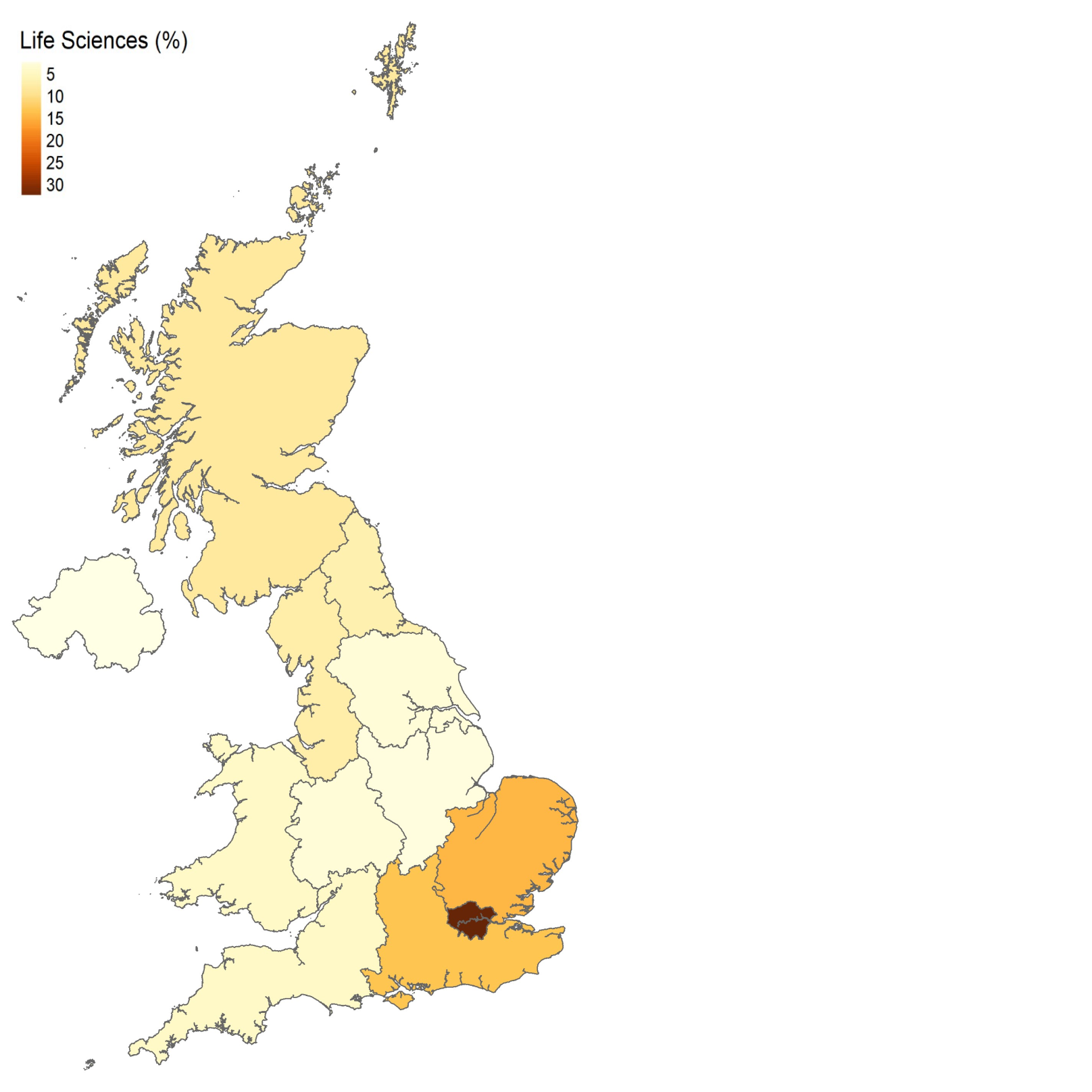
Figure 19 shows a regional heat map on the relative distribution of Greenfield FDI capital expenditure in the Life Sciences sector across the UK ITL1 regions. Table 27 provides the web accessible version of the data for the share of UK regions total (%) in Figure 19.
In terms of Greenfield FDI jobs created within the sector over the last 10 years, a total of 907,965 jobs were created globally. The countries that created the most jobs were the United States, with 131,215 jobs, India, with 128,176 jobs and China, with 86,862 jobs. The UK ranked fifth, with 35,174 jobs.
Professional and Business Services
Over the last 10 years, £114.2 billion of Greenfield FDI capital expenditure was invested into the Professional and Business Services sector over 20,913 projects globally. The largest recipients of Greenfield FDI capital expenditure in the sector were India, with £13.4 billion over 747 projects, the United States, with £10.6 billion over 2,800 projects, France, with £9.4 billion over 854 projects and China, with £9.0 billion over 679 projects. The UK ranked sixth, with £5.7 billion over 1,727 projects. In 2024, the UK ranked fourth globally for Greenfield FDI capital expenditure received in the Professional and Business Services sector, with £0.8 billion over 191 projects.
Figure 20: Professional and Business Services Greenfield FDI capital expenditure (£ billion) 2003 to 2024 for selected countries
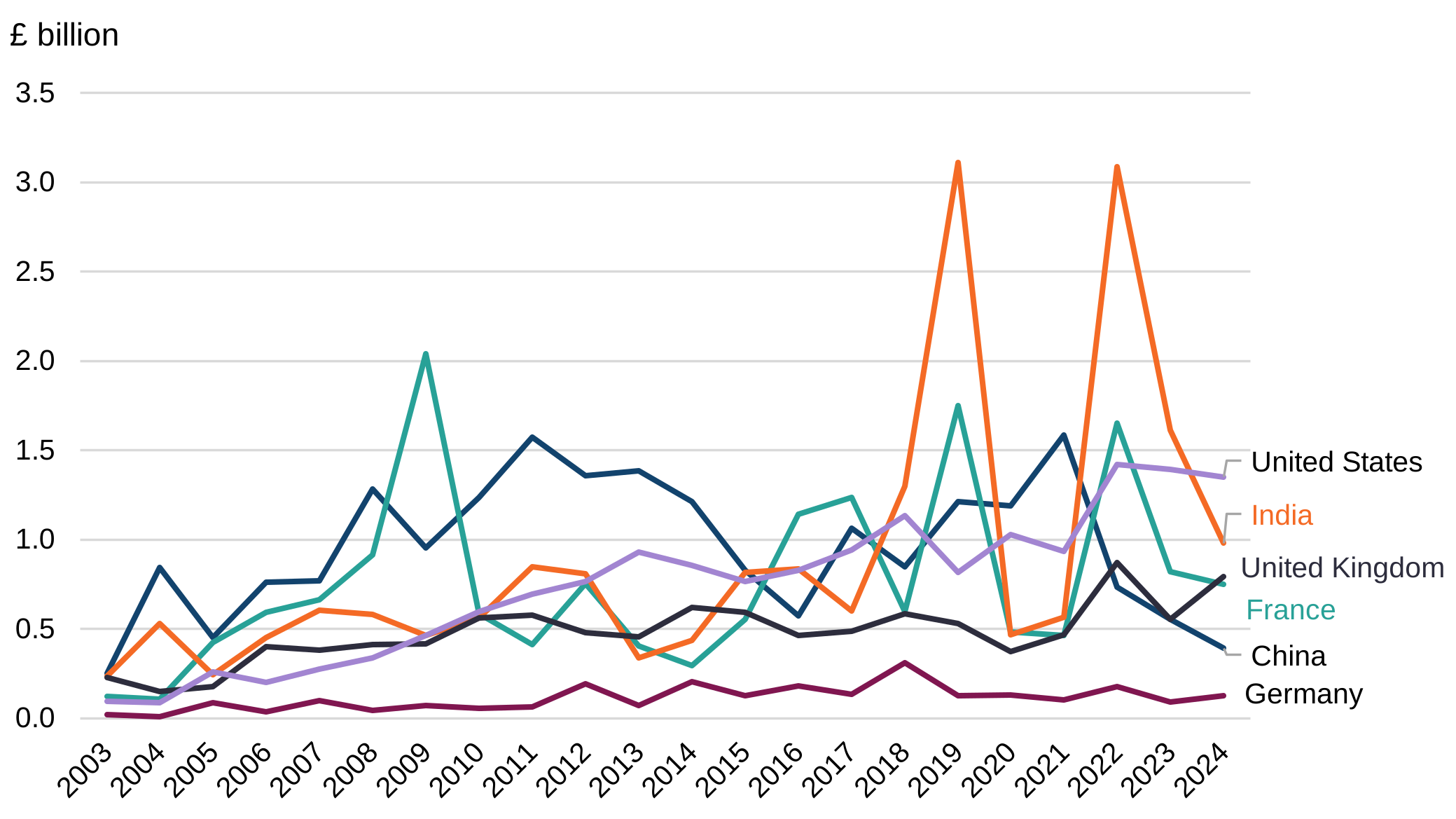
Table 28: Professional and Business Services Greenfield FDI capital expenditure (£ billion) 2003 to 2024 for top 10 destination and selected countries and 10-year CAGR
Some shorthand is used in this table, [low] = a low figure but not a real zero.
| Country | 2003 | 2004 | 2005 | 2006 | 2007 | 2008 | 2009 | 2010 | 2011 | 2012 | 2013 | 2014 | 2015 | 2016 | 2017 | 2018 | 2019 | 2020 | 2021 | 2022 | 2023 | 2024 | 2015 to 2024 total | 2014 to 2023 CAGR | 2015 to 2024 CAGR | Top 10 (2015 to 2024) |
|---|---|---|---|---|---|---|---|---|---|---|---|---|---|---|---|---|---|---|---|---|---|---|---|---|---|---|
| Australia | 0.1 | 0.1 | 0.1 | 0.2 | 0.2 | 0.1 | 0.3 | 0.6 | 0.4 | 0.6 | 0.4 | 0.4 | 0.4 | 0.3 | 0.4 | 0.5 | 0.4 | 0.5 | 0.4 | 0.7 | 0.5 | 0.7 | 4.7 | 1.5% | 6.3% | Yes |
| China | 0.3 | 0.8 | 0.5 | 0.8 | 0.8 | 1.3 | 1.0 | 1.2 | 1.6 | 1.4 | 1.4 | 1.2 | 0.8 | 0.6 | 1.1 | 0.8 | 1.2 | 1.2 | 1.6 | 0.7 | 0.6 | 0.4 | 9.0 | -8.3% | -8.0% | Yes |
| France | 0.1 | 0.1 | 0.4 | 0.6 | 0.7 | 0.9 | 2.0 | 0.6 | 0.4 | 0.8 | 0.4 | 0.3 | 0.6 | 1.1 | 1.2 | 0.6 | 1.7 | 0.5 | 0.5 | 1.7 | 0.8 | 0.7 | 9.4 | 11.9% | 3.4% | Yes |
| Germany | [low] | [low] | 0.1 | [low] | 0.1 | [low] | 0.1 | 0.1 | 0.1 | 0.2 | 0.1 | 0.2 | 0.1 | 0.2 | 0.1 | 0.3 | 0.1 | 0.1 | 0.1 | 0.2 | 0.1 | 0.1 | 1.5 | -8.7% | [low] | No |
| India | 0.2 | 0.5 | 0.2 | 0.5 | 0.6 | 0.6 | 0.5 | 0.6 | 0.8 | 0.8 | 0.3 | 0.4 | 0.8 | 0.8 | 0.6 | 1.3 | 3.1 | 0.5 | 0.6 | 3.1 | 1.6 | 1.0 | 13.4 | 15.7% | 2.0% | Yes |
| Philippines | [low] | 0.1 | 0.3 | 0.2 | 0.2 | 0.5 | 0.2 | 0.6 | 0.1 | 0.1 | 0.2 | 0.4 | 0.6 | 1.0 | 0.1 | 0.2 | 0.5 | [low] | 0.1 | 0.5 | 0.3 | 0.2 | 3.6 | -3.0% | -11.2% | Yes |
| Singapore | [low] | 0.1 | 0.1 | [low] | 0.1 | 0.2 | 0.2 | 0.4 | 0.3 | 0.3 | 0.3 | 0.3 | 0.2 | 0.1 | 0.2 | 0.3 | 0.3 | 0.2 | 0.2 | 0.3 | 0.4 | 0.3 | 2.5 | 4.8% | 0.9% | Yes |
| South Africa | [low] | [low] | [low] | [low] | 0.1 | 0.1 | 0.2 | 0.2 | 0.1 | 0.3 | 0.5 | 0.2 | 0.4 | 0.3 | 0.3 | 0.3 | 0.3 | 0.3 | 0.1 | 0.5 | 0.3 | 0.7 | 3.6 | 4.4% | 5.4% | Yes |
| Spain | [low] | [low] | [low] | 0.1 | 0.1 | 0.1 | 0.1 | 0.1 | 0.1 | 0.2 | 0.1 | 0.1 | 0.3 | 0.7 | 0.4 | 0.4 | 0.3 | 1.2 | 1.2 | 1.7 | 0.2 | 0.9 | 7.4 | 6.6% | 12.1% | Yes |
| United Kingdom | 0.2 | 0.2 | 0.2 | 0.4 | 0.4 | 0.4 | 0.4 | 0.6 | 0.6 | 0.5 | 0.5 | 0.6 | 0.6 | 0.5 | 0.5 | 0.6 | 0.5 | 0.4 | 0.5 | 0.9 | 0.6 | 0.8 | 5.7 | -1.2% | 3.3% | Yes |
| United States | 0.1 | 0.1 | 0.3 | 0.2 | 0.3 | 0.3 | 0.5 | 0.6 | 0.7 | 0.8 | 0.9 | 0.9 | 0.8 | 0.8 | 0.9 | 1.1 | 0.8 | 1.0 | 0.9 | 1.4 | 1.4 | 1.4 | 10.6 | 5.6% | 6.5% | Yes |
When comparing the CAGR over 10 years for investment flows (to smooth out the year-to-year volatility) between 2014 to 2023 and 2015 to 2024, Table 28 shows that:
-
Greenfield FDI capital expenditure into the UK’s Professional and Business Services sector grew at a faster rate from 2015 to 2024, at 3.3% annually, compared to a decline of -1.2% over 2014 to 2023, comparable to France’s annual growth over 2015 to 2024 of 3.4%
-
the G7 countries, on average, also grew at a faster rate annually between 2015 to 2024 (7.3%) compared to 2014 to 2023 (3.1%)
-
India grew at a relatively lower rate over 2015 to 2024, at 2.0%, compared to 15.7% over 2014 to 2023, the highest CAGR over 2014 to 2023
-
Spain had the highest CAGR from 2015 to 2024 among these countries, at 12.1% annually, while Philippines had the lowest, at -11.2% annually
Over the last 10 years, the UK ranked second globally for investing into the sector, investing £20.9 billion (see Table 29). The UK is only behind the United States (£32.9 billion) and ahead of France (£8.9 billion).
When comparing this to the largest investors into the UK’s Professional and Business Services sector, the largest investors were the United States (£2.1 billion), France (£0.9 billion) and India (£0.3 billion). The United States accounts for more than 33% of the Greenfield FDI capital expenditure that the UK received in the sector. Aside from Singapore, all other top global investors into the Professional and Business Services sector outside the UK are top investors into the UK’s Professional and Business Services sector.
Table 29: Greenfield FDI capital expenditure (£ billion) 2015 to 2024 for the top 10 investor countries into the Professional and Business Services sector, globally and into the UK
| Rank | Top 10 investors globally into Professional and Business Services | Capital expenditure (£ billion) |
Top 10 investors into the UK – Professional and Business Services | Capital expenditure (£ billion) |
|---|---|---|---|---|
| 1 | United States | 32.9 | United States | 2.1 |
| 2 | United Kingdom | 20.9 | France | 0.9 |
| 3 | France | 8.9 | India | 0.3 |
| 4 | Switzerland | 6.3 | Switzerland | 0.3 |
| 5 | Netherlands | 5.0 | Australia | 0.3 |
| 6 | Germany | 3.7 | Netherlands | 0.2 |
| 7 | India | 3.1 | Germany | 0.2 |
| 8 | Japan | 2.9 | Ireland | 0.2 |
| 9 | Singapore | 2.8 | Belgium | 0.1 |
| 10 | Australia | 2.4 | Japan | 0.1 |
Over the last 10 years, the Professional, Scientific and Technical Services sub-sector attracted the highest Greenfield FDI capital expenditure within the UK’s Professional and Business Services sector, with total investment of £1.1 billion over 282 projects, accounting for nearly 20% of the UK’s Greenfield FDI capital expenditure received in the sector.
Table 30: Greenfield FDI capital expenditure from 2015 to 2024 into the Professional and Business Services sector by UK ITL1 Region (£ billion and share of UK regions total)[footnote 34]
| UK ITL1 region | Capital expenditure (£ billion) |
Share of UK regions total |
|---|---|---|
| East Midlands | 0.2 | 3.1% |
| East of England | 0.1 | 2.3% |
| London | 2.3 | 43.9% |
| North East | 0.1 | 2.7% |
| North West | 0.5 | 9.9% |
| Northern Ireland | 0.3 | 5.5% |
| Scotland | 0.7 | 13.1% |
| South East | 0.3 | 5.3% |
| South West | 0.2 | 3.3% |
| Wales | 0.1 | 2.1% |
| West Midlands | 0.2 | 4.5% |
| Yorkshire and the Humber | 0.2 | 4.2% |
Table 30 shows that the 3 UK ITL1 regions that received the most Greenfield FDI capital expenditure in the sector over the last 10 years were London (£2.3 billion, 43.9% of the UK’s Greenfield FDI capital expenditure in the sector), Scotland (£0.7 billion, 13.1%) and the North West (£0.5 billion, 9.9%).
Figure 21: Map of Greenfield FDI capital expenditure from 2015 to 2024 into the Professional and Business Services sector by UK ITL1 region (share of UK regions total, %)[footnote 35]
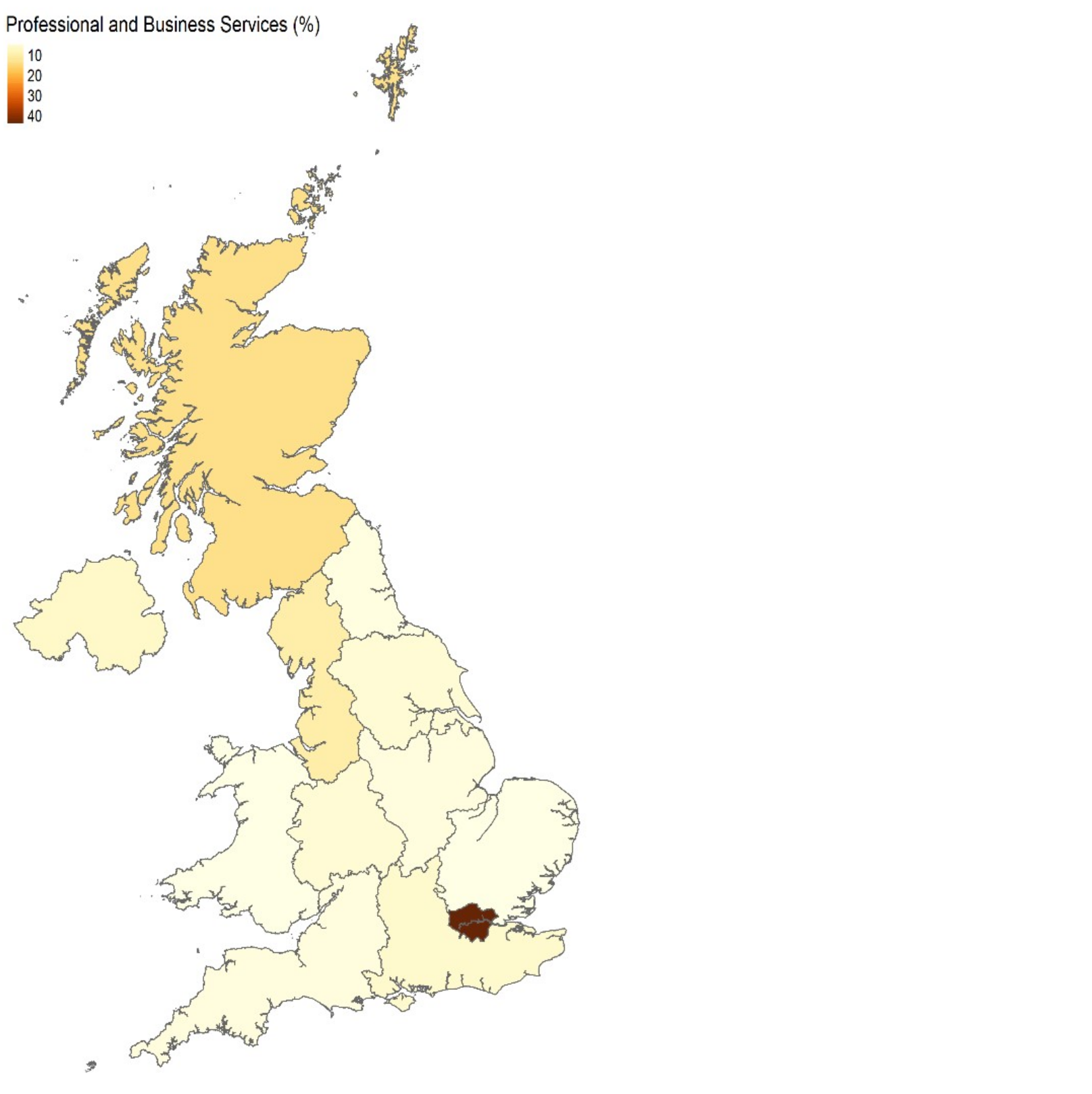
Figure 21 shows a regional heat map on the relative distribution of Greenfield FDI capital expenditure in the Professional and Business Services sector across the UK ITL1 regions. Table 30 provides the web accessible version of the data for the share of UK regions total (%) in Figure 21.
In terms of Greenfield FDI jobs created within the sector over the last 10 years, a total of 1.4 million jobs were created globally. The UK ranked fourth, with 71,361 jobs, behind India, with 354,819 jobs, the Philippines, with 124,261 jobs and the United States, with 89,083 jobs.
Global Greenfield FDI trends in the National Security and Investment (NSI) Act sectors
The following section outlines trends in Greenfield foreign direct investment (FDI) in the National Security and Investment (NSI) Act sectors[footnote 36]. This analysis is based on an initial mapping of fDi Markets sub-sectors to the NSI Act sector definitions. This analysis identified mapping to fDi Markets sub-sectors for 11 out of 17 NSI Act sectors. A full explanation of the methodology and sector mapping can be found in the methodological note that accompanies this publication.
The mapping used in this publication is not an official government position, may be subject to change, or may differ from other data publications on the NSI Act sectors. The mapping for NSI Act sectors is separate to the mapping for the Industrial Strategy sectors and other data publications that make reference to any of the sectors below.
Over the last 10 years, £3,942.9 billion of Greenfield FDI capital expenditure was invested globally into the 11 NSI Act sectors identified in the mapping for this analysis. These sectors were:
- Advanced Materials
- Communications
- Computing Hardware
- Cryptographic Authentication
- Data Infrastructure
- Defence
- Energy
- Satellite and Space Technologies
- Suppliers to the Emergency Services
- Synthetic Biology
- Transport
Investment into these 11 NSI Act sectors made up 53.0% of global Greenfield FDI capital expenditure across all sectors. Investment over these 11 NSI Act sectors was across 61,938 projects globally, which made up 40.4% of projects across all sectors.
Over the last 10 years, the UK ranked second globally in terms of receiving Greenfield FDI capital expenditure in these 11 NSI Act sectors, with £297.1 billion over 5,018 projects. The UK is only behind the United States, with £414.2 billion over 6,768 projects, and ahead of India, with £211.7 billion over 3,727 projects. Germany is ranked sixth, with £159.5 billion over 4,019 projects and China is ranked seventh, with £136.6 billion over 1,783 projects. In 2024, the UK received £49.5 billion of Greenfield FDI capital expenditure over 417 projects in these 11 NSI Act sectors, ranking second globally, behind the United States (£109.8 billion over 756 projects).
Over this period, the UK ranked second in terms of investing into these 11 NSI Act sectors, investing £261.3 billion (see Table 31). The UK is only behind the United States (£857.4 billion) and ahead of Germany (£250.3 billion).
When comparing this to the largest investors into the UK in these 11 NSI Act sectors, the largest investors were the United States (£70.9 billion), Germany (£41.7 billion) and France (£29.0 billion). Out of the top 9 investors globally into these sectors (excluding for the UK), 5 were also identified as part of the top 10 investors into the UK into these sectors. This suggests potential opportunities for the UK to grow investment relationships with other top 10 investors in these sectors.
Table 31: Greenfield FDI capital expenditure (£ billion) 2015 to 2024 for the top 10 investor countries into the NSI Act sectors, globally and into the UK
| Rank | Top 10 investors globally into the NSI Act sectors | Capital expenditure (£ billion) |
Top 10 investors into the UK – NSI Act sectors | Capital expenditure (£ billion) |
|---|---|---|---|---|
| 1 | United States | 857.4 | United States | 70.9 |
| 2 | United Kingdom | 261.3 | Germany | 41.7 |
| 3 | Germany | 250.3 | France | 29.0 |
| 4 | France | 232.9 | Norway | 16.9 |
| 5 | China | 198.5 | Spain | 15.9 |
| 6 | Japan | 149.8 | Portugal | 14.2 |
| 7 | United Arab Emirates | 149.5 | Ireland | 13.4 |
| 8 | Taiwan | 148.9 | Japan | 13.4 |
| 9 | South Korea | 134.6 | Denmark | 13.0 |
| 10 | Spain | 125.6 | Italy | 12.3 |
Table 32: Greenfield FDI Capital Expenditure (£ billion) 2003 to 2024 into the UK NSI Act Sectors and 10-year compound annual growth rate (CAGR)
Some shorthand is used in this table, [low] = a low figure but not a real zero.
| NSI Act sector | 2003 | 2004 | 2005 | 2006 | 2007 | 2008 | 2009 | 2010 | 2011 | 2012 | 2013 | 2014 | 2015 | 2016 | 2017 | 2018 | 2019 | 2020 | 2021 | 2022 | 2023 | 2024 | 2015 to 2024 Total | 2014 to 2023 CAGR | 2015 to 2024 CAGR |
|---|---|---|---|---|---|---|---|---|---|---|---|---|---|---|---|---|---|---|---|---|---|---|---|---|---|
| Advanced Materials | 0.2 | 0.4 | 0.1 | 0.3 | 0.2 | 0.2 | 0.2 | 0.1 | 0.2 | 0.2 | 0.1 | 0.2 | 0.2 | 0.1 | 0.2 | 0.4 | 0.2 | 0.1 | 0.4 | 0.2 | 0.1 | 0.2 | 2.2 | -5.4% | 0.3% |
| Communications | 0.3 | 0.8 | 0.4 | 0.6 | 1.1 | 0.5 | 1.0 | 0.4 | 1.1 | 0.7 | 2.3 | 1.1 | 4.2 | 1.1 | 1.3 | 1.7 | 1.8 | 1.1 | 1.9 | 1.4 | 1.3 | 0.2 | 15.9 | 1.6% | -29.8% |
| Computing Hardware | 0.1 | [low] | 0.2 | [low] | 0.1 | [low] | [low] | [low] | [low] | 0.1 | [low] | [low] | [low] | [low] | [low] | [low] | 0.1 | [low] | [low] | 0.1 | [low] | [low] | 0.3 | -10.8% | 1.0% |
| Cryptographic Authentication | 0.5 | 0.3 | 0.4 | 0.5 | 0.6 | 0.7 | 0.8 | 0.8 | 0.8 | 0.7 | 0.3 | 0.3 | 0.2 | 0.2 | 0.2 | 0.2 | 0.2 | [low] | 0.2 | 0.2 | 0.1 | [low] | 1.6 | -9.7% | -16.8% |
| Data Infrastructure | 0.9 | 1.2 | 1.2 | 1.1 | 1.6 | 2.3 | 1.4 | 1.7 | 1.8 | 4.2 | 4.5 | 6.4 | 5.9 | 4.2 | 3.6 | 4.3 | 3.9 | 3.0 | 2.8 | 4.8 | 5.2 | 26.4 | 64.2 | -2.1% | 18.0% |
| Defence | [low] | [low] | 0.0 | [low] | [low] | 0.2 | 0.1 | [low] | [low] | [low] | [low] | [low] | 0.2 | [low] | 0.1 | [low] | [low] | 0.1 | [low] | 0.1 | 0.2 | 0.6 | 1.4 | 37.5% | 16.1% |
| Energy | 8.6 | 5.8 | 7.1 | 4.3 | 6.6 | 54.4 | 23.2 | 7.5 | 9.5 | 30.3 | 17.7 | 11.2 | 20.2 | 11.6 | 10.6 | 7.4 | 11.1 | 20.5 | 20.7 | 49.8 | 17.9 | 20.2 | 190.0 | 5.4% | [low] |
| Satellite and Space Technologies | 0.0 | 0.0 | [low] | 0.0 | 0.0 | [low] | 0.1 | [low] | [low] | [low] | [low] | [low] | 0.3 | [low] | [low] | [low] | 0.2 | 0.1 | 0.4 | 0.2 | [low] | 0.1 | 1.3 | -8.1% | -17.0% |
| Suppliers to the Emergency Services | 0.1 | [low] | 0.2 | 0.1 | 0.1 | 0.1 | 0.1 | 0.1 | [low] | [low] | 0.1 | 0.1 | 0.1 | 0.1 | 0.2 | 0.2 | [low] | 0.2 | 0.3 | 0.1 | 0.1 | 0.1 | 1.3 | -4.2% | 0.3% |
| Synthetic Biology | 0.1 | 0.1 | 0.1 | 0.2 | 0.1 | 0.1 | 0.1 | [low] | [low] | [low] | 0.1 | [low] | 0.1 | [low] | 0.2 | 0.1 | 0.2 | 0.4 | 0.6 | 0.1 | 0.2 | 0.1 | 1.9 | 39.8% | 2.4% |
| Transport | 0.2 | 0.6 | 0.4 | 1.3 | 0.6 | 0.6 | 0.5 | 0.6 | 1.0 | 1.1 | 1.5 | 1.4 | 1.3 | 2.1 | 1.1 | 1.6 | 0.8 | 1.5 | 1.7 | 4.1 | 1.2 | 1.6 | 17.0 | -1.9% | 2.9% |
Table 32 shows that over this period, within these 11 NSI Act sectors, the UK attracted the highest amount of investment in the Energy sector, with total investment of £190.0 billion over 537 projects. In comparison, the UK received the least amount of Greenfield FDI capital expenditure in the Computing Hardware sector, with total investment of £0.3 billion over 42 projects.
When comparing the CAGR over 10 years for investment flows into the UK (to smooth out the year-to-year volatility) between 2014 to 2023 and 2015 to 2024 for these 11 NSI Act sectors, Table 32 shows that:
-
Greenfield FDI capital expenditure into the UK’s Data Infrastructure sector grew at the fastest rate over 2015 to 2024, at 18.0% annually, a significant increase compared to its CAGR over 2014 to 2023, at -2.1%, followed by the Defence sector, with a rate of 16.1% over 2015 to 2024
-
Greenfield FDI capital expenditure into the UK’s Communications sector declined from 2015 to 2024, with a CAGR of -29.8% annually, a significant decrease compared to its CAGR over 2014 to 2023, at 1.6%
In terms of Greenfield FDI jobs created within these 11 NSI Act sectors over the last 10 years, a total of 6.6 million jobs were created globally. The UK ranked third in terms of creating jobs over this period in these 11 NSI Act sectors, with 281,480 jobs. The UK is behind India, with 1.5 million jobs and the United States, with 532,258 jobs.
Global Greenfield FDI trends for other selected sectors
The following sections outline trends in Greenfield foreign direct investment (FDI) in some of the top fDi Markets sectors for Greenfield FDI capital expenditure globally from 2015 to 2024 that are not captured within the Industrial Strategy or National Security and Investment Act sectors. A full explanation of how fDi Markets gathers their data can be found in the methodological note that accompanies this publication.
Real Estate
Over the last 10 years, £616.5 billion of Greenfield FDI capital expenditure was invested into the Real Estate sector over 7,940 projects globally. This accounts for 8.3% of global Greenfield FDI capital expenditure across all sectors.
Over the last 10 years, the UK ranked second globally in terms of receiving Greenfield FDI capital expenditure in the sector, with £53.3 billion over 523 projects. The sector makes up 11.9% of UK Greenfield FDI capital expenditure received across all sectors. The UK is only behind Egypt[footnote 37], with £58.1 billion over 38 projects, and ahead of China, with £45.4 billion over 368 projects. The United States ranked fourth, with £40.4 billion over 1,048 projects. India ranked seventh, with £27.7 billion over 234 projects. In 2024, the UK ranked third globally for Greenfield FDI capital expenditure received in the Real Estate sector, with £8.1 billion over 69 projects.
Figure 22: Real Estate Greenfield FDI capital expenditure (£ billion) 2003 to 2024 for selected countries
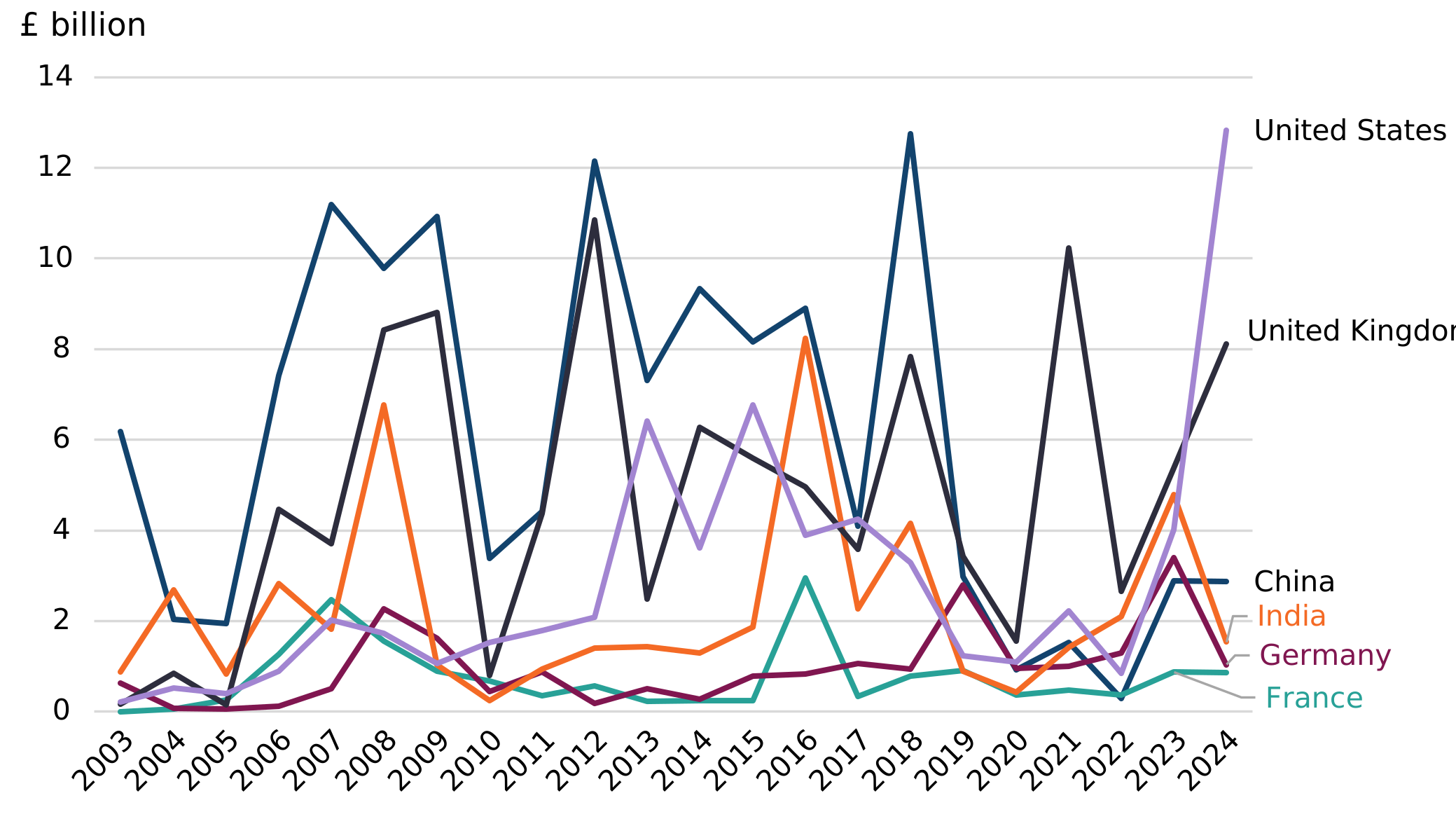
Table 33: Real Estate Greenfield FDI capital expenditure (£ billion) 2003 to 2024 for top 10 destination and selected countries and 10-year compound annual growth rate (CAGR)
Some shorthand is used in this table, [low] = a low figure but not a real zero.
| Country | 2003 | 2004 | 2005 | 2006 | 2007 | 2008 | 2009 | 2010 | 2011 | 2012 | 2013 | 2014 | 2015 | 2016 | 2017 | 2018 | 2019 | 2020 | 2021 | 2022 | 2023 | 2024 | 2015 to 2024 total | 2014 to 2023 CAGR | 2015 to 2024 CAGR | Top 10 (2015 to 2024) |
|---|---|---|---|---|---|---|---|---|---|---|---|---|---|---|---|---|---|---|---|---|---|---|---|---|---|---|
| China | 6.2 | 2.0 | 1.9 | 7.4 | 11.2 | 9.8 | 10.9 | 3.4 | 4.4 | 12.2 | 7.3 | 9.3 | 8.2 | 8.9 | 4.1 | 12.8 | 3.0 | 0.9 | 1.5 | 0.3 | 2.9 | 2.9 | 45.4 | -12.2% | -11.0% | Yes |
| Egypt | 0.1 | 0.0 | 5.0 | 4.9 | 4.2 | 3.0 | 8.1 | 1.6 | 0.4 | 1.6 | 0.1 | 1.2 | 0.3 | 24.5 | 1.9 | 1.4 | 4.1 | [low] | 2.3 | 2.3 | 2.8 | 18.3 | 58.1 | 10.5% | 56.0% | Yes |
| France | 0.0 | 0.1 | 0.3 | 1.3 | 2.5 | 1.6 | 0.9 | 0.7 | 0.4 | 0.6 | 0.2 | 0.2 | 0.3 | 3.0 | 0.3 | 0.8 | 0.9 | 0.4 | 0.5 | 0.4 | 0.9 | 0.9 | 8.2 | 15.6% | 14.8% | No |
| Germany | 0.6 | 0.1 | 0.1 | 0.1 | 0.5 | 2.3 | 1.6 | 0.4 | 0.9 | 0.2 | 0.5 | 0.3 | 0.8 | 0.8 | 1.1 | 0.9 | 2.8 | 1.0 | 1.0 | 1.3 | 3.4 | 1.0 | 14.1 | 31.9% | 3.2% | No |
| India | 0.9 | 2.7 | 0.8 | 2.8 | 1.8 | 6.8 | 1.0 | 0.3 | 0.9 | 1.4 | 1.4 | 1.3 | 1.9 | 8.2 | 2.3 | 4.2 | 0.9 | 0.4 | 1.4 | 2.1 | 4.8 | 1.5 | 27.7 | 15.6% | -2.1% | Yes |
| Japan | 0.2 | 0.3 | 0.0 | 0.0 | 0.2 | 1.2 | 0.5 | [low] | 0.2 | 1.1 | 1.3 | 2.6 | 0.6 | 2.3 | 0.3 | 2.5 | 0.6 | 1.4 | 0.3 | 2.8 | 4.0 | 2.8 | 17.7 | 4.9% | 19.7% | Yes |
| Malaysia | 0.8 | 0.0 | [low] | 0.0 | 0.7 | 1.0 | 0.9 | 1.7 | 0.5 | 0.6 | 3.0 | 4.6 | 2.8 | 8.8 | 1.0 | 2.2 | 1.6 | [low] | [low] | 7.9 | 0.3 | 1.0 | 25.5 | -26.4% | -11.0% | Yes |
| Poland | 1.0 | 1.9 | 1.6 | 2.1 | 2.4 | 6.0 | 1.8 | 1.7 | 2.4 | 2.3 | 1.2 | 1.1 | 0.9 | 1.6 | 3.6 | 4.9 | 7.6 | 6.5 | 5.1 | 2.9 | 3.0 | 2.7 | 38.8 | 11.4% | 12.3% | Yes |
| Spain | 1.0 | 0.4 | 0.4 | 0.6 | 1.8 | 2.3 | 0.7 | 0.7 | 0.5 | 0.6 | 0.4 | 0.1 | 1.1 | 0.4 | 0.6 | 2.9 | 2.7 | 2.3 | 3.0 | 2.2 | 1.6 | 1.7 | 18.5 | 33.2% | 5.3% | Yes |
| United Kingdom | 0.2 | 0.8 | 0.2 | 4.5 | 3.7 | 8.4 | 8.8 | 0.8 | 4.4 | 10.9 | 2.5 | 6.3 | 5.6 | 5.0 | 3.6 | 7.8 | 3.4 | 1.6 | 10.2 | 2.6 | 5.4 | 8.1 | 53.3 | -1.7% | 4.2% | Yes |
| United States | 0.2 | 0.5 | 0.4 | 0.9 | 2.0 | 1.7 | 1.1 | 1.5 | 1.8 | 2.1 | 6.4 | 3.6 | 6.8 | 3.9 | 4.3 | 3.3 | 1.2 | 1.1 | 2.2 | 0.8 | 4.0 | 12.8 | 40.4 | 1.1% | 7.4% | Yes |
| Vietnam | 0.6 | 0.3 | 0.6 | 0.7 | 12.3 | 9.5 | 4.1 | 2.2 | 0.1 | 0.8 | 0.5 | 1.7 | 4.2 | 13.0 | 1.6 | 5.3 | 2.2 | 0.7 | 0.9 | 0.5 | 3.5 | 1.4 | 33.2 | 8.7% | -11.5% | Yes |
When comparing the CAGR over 10 years for investment flows (to smooth out the year-to-year volatility) between 2014 to 2023 and 2015 to 2024, Table 33 shows that:
-
Greenfield FDI capital expenditure into the UK’s Real Estate sector grew at a faster rate from 2015 to 2024, at 4.2% annually, compared to a decline of -1.7% from 2014 to 2023
-
the Group of 7 (G7) countries, on average, also grew at a faster rate annually between 2015 to 2024 (13.1%) compared to 2014 to 2023 (7.9%)
-
Vietnam had the lowest CAGR over 2015 to 2024, at -11.5%, followed by Malaysia and China, both at -11.0%
-
Egypt had the highest CAGR over 2015 to 2024, with investment flows into the sector growing at 56.0% annually, reflecting relatively high investment flows in the sector in 2024
Over the last 10 years, the largest global investors into the sector were the United Arab Emirates, investing £91.8 billion, the United States, investing £71.1 billion and Singapore, investing £67.6 billion (see Table 34). The UK ranked sixth, investing £28.7 billion.
When comparing this to the largest investors into the UK’s Real Estate sector, the largest investors were the United States (£21.1 billion), Australia (£5.4 billion) and Japan (£5.2 billion). Out of the top 9 investors globally into the sector (excluding for the UK), 7 were also identified as part of the top 10 investors into the UK into the sector.
Table 34: Greenfield FDI capital expenditure (£ billion) 2015 to 2024 for the top 10 investor countries into the Real Estate sector, globally and into the UK
| Rank | Top 10 investors globally into Real Estate | Capital expenditure (£ billion) |
Top 10 investors into the UK – Real Estate | Capital expenditure (£ billion) |
|---|---|---|---|---|
| 1 | United Arab Emirates | 91.8 | United States | 21.1 |
| 2 | United States | 71.1 | Australia | 5.4 |
| 3 | Singapore | 67.6 | Japan | 5.2 |
| 4 | China | 64.3 | Singapore | 4.4 |
| 5 | Japan | 58.5 | Canada | 3.4 |
| 6 | United Kingdom | 28.7 | Germany | 2.9 |
| 7 | Hong Kong | 26.9 | China | 1.8 |
| 8 | Australia | 21.5 | India | 1.2 |
| 9 | Canada | 13.6 | Netherlands | 1.2 |
| 10 | Germany | 12.2 | France | 0.9 |
In terms of Greenfield FDI jobs created within the sector over the last 10 years, a total of 2.5 million jobs were created globally. The countries that created the most jobs in the sector were Poland, with 411,380 jobs, Romania, with 310,530 jobs and China, with 190,457 jobs. The UK ranked 17th, with 33,257 jobs.
Transport and Warehousing
Over the last 10 years, £342.0 billion of Greenfield FDI capital expenditure was invested into the Transport and Warehousing sector over 8,694 projects. This accounts for 4.6% of global Greenfield FDI capital expenditure across all sectors.
Over the last 10 years, the UK ranked second globally in terms of receiving Greenfield FDI capital expenditure in the sector, with £22.6 billion over 515 projects. This makes up 5.0% of UK Greenfield FDI capital expenditure received across all sectors. The UK is only behind China, with £32.8 billion over 347 projects and ahead of the United States, with £18.4 billion over 658 projects. India ranked fifth, with £12.9 billion over 250 projects, Germany ranked sixth, with £11.9 billion over 533 projects and France ranked ninth, with £8.4 billion over 349 projects. In 2024, the UK ranked fourth globally for Greenfield FDI capital expenditure received in the Transport and Warehousing sector, with £2.9 billion over 54 projects.
Figure 23: Transport and Warehousing Greenfield FDI capital expenditure (£ billion) 2003 to 2024 for selected countries
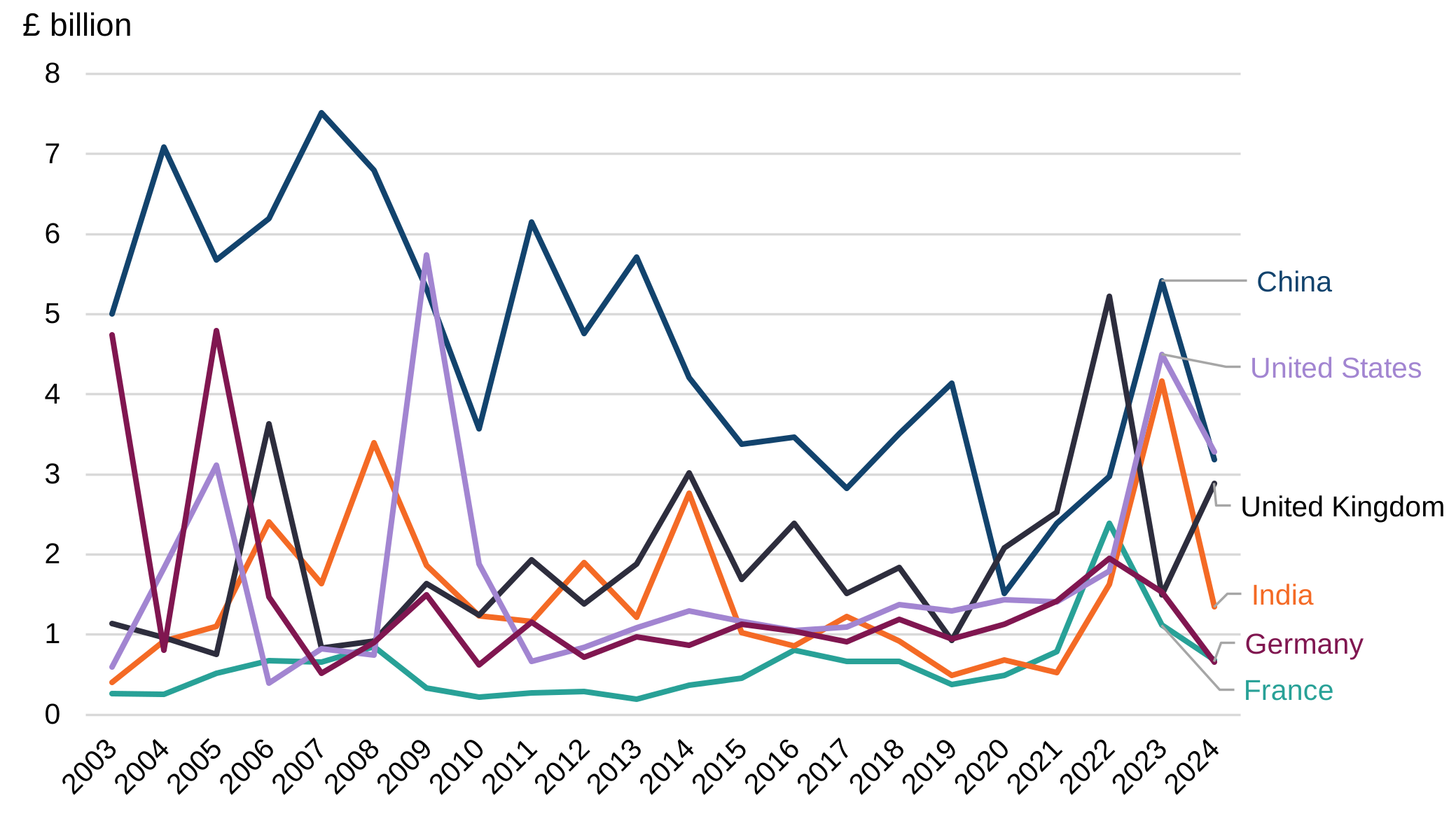
Table 35: Transport and Warehousing Greenfield FDI capital expenditure (£ billion) 2003 to 2024 for top 10 destination and selected countries and 10-year CAGR
| Country | 2003 | 2004 | 2005 | 2006 | 2007 | 2008 | 2009 | 2010 | 2011 | 2012 | 2013 | 2014 | 2015 | 2016 | 2017 | 2018 | 2019 | 2020 | 2021 | 2022 | 2023 | 2024 | 2015 to 2024 total | 2014 to 2023 CAGR | 2015 to 2024 CAGR | Top 10 (2015 to 2024) |
|---|---|---|---|---|---|---|---|---|---|---|---|---|---|---|---|---|---|---|---|---|---|---|---|---|---|---|
| China | 5.0 | 7.1 | 5.7 | 6.2 | 7.5 | 6.8 | 5.3 | 3.6 | 6.1 | 4.8 | 5.7 | 4.2 | 3.4 | 3.5 | 2.8 | 3.5 | 4.1 | 1.5 | 2.4 | 3.0 | 5.4 | 3.2 | 32.8 | 2.8% | -0.6% | Yes |
| France | 0.3 | 0.3 | 0.5 | 0.7 | 0.7 | 0.8 | 0.3 | 0.2 | 0.3 | 0.3 | 0.2 | 0.4 | 0.5 | 0.8 | 0.7 | 0.7 | 0.4 | 0.5 | 0.8 | 2.4 | 1.1 | 0.7 | 8.4 | 13.1% | 4.6% | Yes |
| Germany | 4.7 | 0.8 | 4.8 | 1.5 | 0.5 | 0.9 | 1.5 | 0.6 | 1.2 | 0.7 | 1.0 | 0.9 | 1.1 | 1.0 | 0.9 | 1.2 | 0.9 | 1.1 | 1.4 | 1.9 | 1.5 | 0.7 | 11.9 | 6.5% | -5.8% | Yes |
| India | 0.4 | 0.9 | 1.1 | 2.4 | 1.6 | 3.4 | 1.9 | 1.2 | 1.2 | 1.9 | 1.2 | 2.8 | 1.0 | 0.9 | 1.2 | 0.9 | 0.5 | 0.7 | 0.5 | 1.6 | 4.2 | 1.3 | 12.9 | 4.7% | 3.1% | Yes |
| Italy | 0.5 | 0.4 | 0.8 | 0.6 | 0.4 | 1.1 | 0.8 | 0.6 | 0.1 | 0.7 | 0.4 | 0.2 | 0.9 | 0.4 | 0.4 | 0.5 | 0.3 | 0.6 | 0.8 | 1.8 | 0.7 | 0.8 | 7.2 | 16.0% | -2.0% | Yes |
| Mexico | 0.8 | 0.5 | 0.9 | 0.4 | 0.3 | 0.8 | 1.1 | 0.4 | 0.6 | 1.3 | 5.5 | 3.7 | 1.0 | 1.5 | 1.6 | 1.6 | 1.5 | 0.8 | 0.5 | 0.8 | 1.2 | 1.2 | 11.8 | -12.1% | 2.2% | Yes |
| Poland | 0.5 | 2.1 | 0.3 | 0.8 | 0.7 | 0.7 | 0.5 | 0.8 | 0.4 | 0.6 | 0.5 | 0.7 | 0.5 | 0.7 | 1.0 | 2.1 | 2.0 | 1.7 | 2.3 | 2.6 | 2.0 | 1.8 | 16.7 | 11.8% | 15.3% | Yes |
| Spain | 0.4 | 0.6 | 0.6 | 1.9 | 1.8 | 2.9 | 1.2 | 1.6 | 0.6 | 0.3 | 0.9 | 0.8 | 0.7 | 0.6 | 0.5 | 1.9 | 1.9 | 0.8 | 1.2 | 1.1 | 1.0 | 0.8 | 10.5 | 3.0% | 1.4% | Yes |
| United Kingdom | 1.1 | 1.0 | 0.8 | 3.6 | 0.8 | 0.9 | 1.6 | 1.2 | 1.9 | 1.4 | 1.9 | 3.0 | 1.7 | 2.4 | 1.5 | 1.8 | 0.9 | 2.1 | 2.5 | 5.2 | 1.5 | 2.9 | 22.6 | -7.5% | 6.2% | Yes |
| United States | 0.6 | 1.8 | 3.1 | 0.4 | 0.8 | 0.7 | 5.7 | 1.9 | 0.7 | 0.8 | 1.1 | 1.3 | 1.2 | 1.0 | 1.1 | 1.4 | 1.3 | 1.4 | 1.4 | 1.8 | 4.5 | 3.3 | 18.4 | 14.9% | 12.2% | Yes |
When comparing the CAGR over 10 years for investment flows (to smooth out the year-to-year volatility) between 2014 to 2023 and 2015 to 2024, Table 35 shows that:
-
Greenfield FDI capital expenditure into the UK’s Transport and Warehousing sector grew at a faster rate from 2015 to 2024, at 6.2% annually, compared to a decline of -7.5% from 2014 to 2023
-
the G7 countries, on average, however, grew at a slower rate annually between 2015 to 2024 (6.8%) compared to 2014 to 2023 (8.5%)
-
Germany had the lowest CAGR among these countries from 2015 to 2024, at -5.8%, while Poland had the highest CAGR from 2015 to 2024, at 15.3%, followed by the United States, with a CAGR of 12.2% from 2015 to 2024
Over the last 10 years, the largest global investors into the sector were Germany, investing £56.8 billion, the United States, investing £41.5 billion and France, investing £24.6 billion (see Table 36). The UK ranked sixth, investing £20.4 billion. This is aligned to the largest investors into the UK in the sector: Germany (£5.5 billion), the United States (£5.0 billion) and France (£2.5 billion). All top global investors outside the UK into the sector were part of the top 10 investors into the UK in the sector, with the addition of Ireland.
Table 36: Greenfield FDI capital expenditure (£ billion) 2015 to 2024 for the top 10 investor countries into the Transport and Warehousing sector, globally and into the UK
| Rank | Top 10 investors globally into Transport and Warehousing | Capital expenditure (£ billion) |
Top 10 investors into the UK – Transport and Warehousing | Capital expenditure (£ billion) |
|---|---|---|---|---|
| 1 | Germany | 56.8 | Germany | 5.5 |
| 2 | United States | 41.5 | United States | 5.0 |
| 3 | France | 24.6 | France | 2.5 |
| 4 | China | 23.7 | United Arab Emirates | 2.0 |
| 5 | United Arab Emirates | 20.7 | Japan | 1.6 |
| 6 | United Kingdom | 20.4 | Netherlands | 1.0 |
| 7 | Denmark | 17.1 | Ireland | 1.0 |
| 8 | Japan | 15.8 | Switzerland | 0.8 |
| 9 | Switzerland | 13.4 | Denmark | 0.6 |
| 10 | Netherlands | 12.4 | China | 0.4 |
In terms of Greenfield FDI jobs created within the sector over the last 10 years, a total of 997,805 jobs were created globally. The UK ranked first for creating the most Greenfield FDI jobs within the sector, with 69,837 jobs. The UK is ahead of Poland, with 66,034 jobs and Mexico, with 65,355 jobs.
-
The fDi Markets data used in this publication was downloaded on 2 October 2025. Data was converted from the United States dollar to the UK pound on fDi Markets using the exchange rate of 0.76 = USD $1. ↩
-
Within the fDi Markets dataset, Greenfield FDI projects in the UK’s Overseas Territories of British Virgin Islands and Gibraltar, and Crown Dependencies of Guernsey, the Isle of Man and Jersey are included in the UK figures. These account for 0.1% of total Greenfield FDI capital expenditure into the UK over the 2015 to 2024 period. ↩
-
Egypt saw a growth of 157.6% in projects from 2021 to 2022, with the number of projects increasing from 59 to 152. ↩
-
These selected country groups are not mutually exclusive, and a number of countries may overlap in more than one country group. Only those countries with reported investment have been included in the country groups. ↩
-
Refer to footnote 4. ↩
-
International Territorial Levels (ITLs) is a hierarchical classification of administrative areas, used by OECD member countries for statistical purposes. Within the UK, 3 ITLs are determined. Estimates in this publication focus on ITL1 classifications covering English regions, Northern Ireland, Scotland and Wales. There are 12 UK ITL1 classifications. The ONS has further information on ITLs. ↩
-
Refer to footnote 2. ↩
-
Approximately 7.4% of Greenfield FDI projects in the UK (contributing 21.2% of the UK’s Greenfield FDI capital expenditure) did not have a specified region from 2015 to 2024. ↩
-
Includes UK regions only (refer to footnote 2) and does not include those projects which do not have a specified region (refer to footnote 8). For these reasons, aggregating Greenfield FDI capital expenditure across UK ITL1 regions will not equal the overall UK Greenfield FDI capital expenditure figure. ↩
-
Refer to footnote 9. ↩
-
Refer to footnote 4. ↩
-
Refer to footnote 4. ↩
-
The Industrial Strategy is a 10-year plan to significantly increase business investment in eight growth-driving sectors. ↩
-
Refer to footnote 9. ↩
-
Refer to footnote 9. ↩
-
Due to no reported investment received in the sector in 2015, the CAGR could not be computed for Italy for 2015 to 2024, so it has been removed from the G7 averages. ↩
-
Refer to footnote 9. More caution should be taken when interpreting the UK ITL1 regional shares for the UK’s Clean Energy Industries sector due to the higher-than-average share of Greenfield FDI capital expenditure, 30.3%, without a specified UK region in the sector over 2015 to 2024. This represents 14.7% of the UK’s Greenfield FDI projects in the Clean Energy Industries sector not having a specified region over this period. ↩
-
Refer to footnote 18. ↩
-
The G7 average for 2015 to 2024 is particularly influenced by Italy, with a CAGR of 17.1% over 2015 to 2024. ↩
-
Refer to footnote 9. ↩
-
Refer to footnote 9. ↩
-
There are no comprehensive data on Defence FDI flows. We have included data on Defence-related sub-sectors included in fDi Markets, but they are not necessarily representative of all Defence-related FDI. ↩
-
European Council. ‘EU defence in numbers’ and UK Parliament (2025). ‘UK defence spending’ ↩
-
Refer to footnote 9. More caution should be taken when interpreting the UK ITL1 regional shares for the UK’s Defence sector due to the higher-than-average share of Greenfield FDI capital expenditure, 46.2%, without a specified UK region in the sector over 2015 to 2024. This represents 16.0% of the UK’s Greenfield FDI projects in the sector not having a specified region over this period. ↩
-
Refer to footnote 25. ↩
-
Refer to footnote 9. More caution should be taken when interpreting the UK ITL1 regional shares for the UK’s Digital and Technologies sector due to the higher-than-average share of Greenfield FDI capital expenditure, 25.6%, without a specified UK region in the sector over 2015 to 2024. This represents 9.5% of the UK’s Greenfield FDI projects in the sector not having a specified region over this period. ↩
-
Refer to footnote 27. ↩
-
Refer to footnote 9. ↩
-
Refer to footnote 9. ↩
-
Greenfield FDI into the Life Sciences sector is based on the Life Sciences industry cluster in fDi Markets. This includes projects in Pharmaceuticals, Biotechnology and Medical Devices, as well as some projects in adjacent sectors such as Healthcare, Software and IT, Business Services and other industries where these projects have been tagged as Life Sciences. This follows the definition used by the Office for Life Sciences in their ‘Life sciences competitiveness indicators’ publication. ↩
-
Refer to footnote 9. ↩
-
Refer to footnote 9. ↩
-
Refer to footnote 9. ↩
-
Refer to footnote 9. ↩
-
The NSI Act legally requires anyone, including businesses and investors, to notify the government about acquisitions of certain entities in 17 sensitive areas of the economy (called ‘notifiable acquisitions’) that could harm the UK’s national security. For more details, alongside the full list of NSI Act areas (which we refer to as sectors), read this guidance on the National Security and Investment Act. ↩
-
Egypt’s number one position in the Real Estate sector can be attributed to high-value investments (totalling £33.6 billion) in 2016 and 2024. ↩