Office for National Statistics Wealth and Assets Survey - Pension Wealth Annuity Factors - Guidance Note for Waves 1 to 5 & Rounds 5 to 6
Updated 30 April 2026

© Crown copyright 2026
This publication is licensed under the terms of the Open Government Licence v3.0 except where otherwise stated. To view this licence, visit nationalarchives.gov.uk/doc/open-government-licence/version/3 or write to the Information Policy Team, The National Archives, Kew, London TW9 4DU, or email: psi@nationalarchives.gov.uk.
Where we have identified any third party copyright information you will need to obtain permission from the copyright holders concerned.
This publication is available at https://www.gov.uk/government/publications/office-for-national-statistics-wealth-and-assets-survey/office-for-national-statistics-wealth-and-assets-survey-pension-wealth-annuity-factors-guidance-note-for-waves-1-to-5-rounds-5-to-6
1. Introduction
Background
1.1 The Office for National Statistics (‘ONS’) produce and publish a biennial survey of the wealth and assets of households in Great Britain (the ‘WAS’). We understand the WAS is used widely across government to inform policy making.
1.2 Pension wealth is captured alongside property, physical assets and net financial wealth (e.g. savings). Pension wealth is split across two categories: pensions that are defined contribution (‘DC’) in nature, and pensions that are defined benefit (‘DB’) in nature.
1.3 The ONS use a model (as set out in Appendix B) to estimate pension wealth based on answers to household survey questions. This model is subject to public scrutiny.
1.4 The ONS commissioned the Government Actuary’s Department (‘GAD’) to provide annuity factors for use in the ONS’s pension wealth model for Waves 1 to 5 and Rounds 5 to 6 of the wealth and assets survey (i.e. interviews conducted before end March 2018).
1.5 The assumptions used to calculate these annuities are set out in Appendix A. The method used to derive these assumptions may differ from historic approaches. Please refer to GAD’s report on the discount rate methodology titled ‘valuing defined benefit pension wealth’ dated 5 December 2024, which includes further detail on financial assumptions.
1.6 The annuity factors GAD have calculated for Rounds and Waves that were conducted prior to Round 7 are published in the spreadsheet titled ‘ONS-WAS Annuities for Waves 1 to 5 and Rounds 5 to 6.ods’ on the 30 April 2026, which represent the 𝑎𝑅𝑖(𝑡) variable in the ONS model (see Appendix B).
1.7 GAD have split the back series annuities into three sets, that use three corresponding assumptions sets. The annuities have been produced for use with survey Waves and Rounds conducted prior to March 2018. The three annuity sets provided in the spreadsheet follow the categorisation in the below table:
| Reference set | Rounds and Waves covered |
|---|---|
| Set A | Wave 1, Wave 2 |
| Set B | Wave 3, Wave 4 |
| Set C | Wave 5, Round 5, Round 6 |
Purpose and third-party reliance
1.8 This guidance note is addressed to the Wealth and Pensions Analysis team within the ONS. This note shows how the annuity factors GAD have calculated should be used in the ONS wealth model to place an approximate value on the wealth of pension benefits.
1.9 This guidance note has been prepared for the use of the ONS for the purposes of demonstrating the application of the annuity factors for Waves 1 to 5 and Rounds 5 to 6. It includes examples of how these annuity factors should be applied in practice for different situations and types of member.
1.10 Other than the ONS, no person or third party is entitled to place any reliance on the contents of this guidance, except to any extent explicitly stated herein. GAD has no liability to any person or third party for any action taken or for any failure to act, either in whole or in part, on the basis of this guidance, whether or not GAD has agreed to the disclosure of its advice to the third party.
Limitations
1.11 This guidance should not be used for any purpose other than those set out in this guidance.
1.12 ONS should ensure they are content that the assumptions used to calculate the annuity factors are reasonable for their purposes. The ONS need to ensure that they are using the appropriate factors when performing calculations, and applying the factors as intended.
1.13 Advice provided by GAD must be taken in context and is intended to be considered in its entirety. Individual sections, if considered in isolation, may be misleading, and conclusions reached by a review of some sections on their own may be incorrect. GAD does not accept responsibility for advice that is altered or used selectively. Clarification should be sought if there is any doubt about the intention or scope of advice provided by GAD.
Compliance
1.14 Other aspects of ONS’s model review, including a review of the questionnaire used to collect data for the model, are outside the scope of this guidance note.
1.15 This guidance note and annuity factors, and the work undertaken to produce it, has been carried out in accordance with the applicable Technical Actuarial Standards: TAS 100 issued by the Financial Reporting Council (FRC). The FRC sets technical standards for actuarial work in the UK.
2. Pension wealth conversion annuity factors
2.1 The annuity factors set out in the spreadsheet titled ‘ONS-WAS Annuities for Waves 1 to 5 and Rounds 5 to 6.ods’ have been calculated using the assumptions as set out in Appendix A.
2.2 These annuity factors are intended to be used in the ONS’s current wealth model as set out in Appendix B to approximate the overall wealth of DB pensions (and DC pensions in payment) (Note 1) for Waves 1 to 5 and Rounds 5 to 6 of the ONS’s Wealth and Assets Survey.
2.3 The user will need to select the relevant factor for each individual pension from the relevant table (1-12), using the following identifiers:
(a) Wave/Round being assessed (b) Age (last birthday) (c) Sex (male/female) (d) Pensioner status (current pensioner, active or deferred member) (e) Term to assumed retirement age (complete years for active or deferred members from their last birthday) (f) Member pension or survivor’s pension (only for pensions already in payment)
2.4 The relevant factor table (1-12) to refer to in the spreadsheet are:
| Reference for Waves/Rounds | Category | Males | Females |
|---|---|---|---|
| Set A | Current pensioner | Table 1, column B. “Male pensioner” | Table 2, column B. “Female pensioner” |
| Set A | Survivor pensioner (receiving a dependant pension) | Table 1, column C. “Male survivor” | Table 2, column C. “Female survivor” |
| Set A | Active or deferred/retained (i.e. pension not in payment yet) | Table 7 | Table 8 |
| Set B | Current pensioner | Table 3, column B. “Male pensioner” | Table 4, column B. “Female pensioner” |
| Set B | Survivor pensioner (receiving a dependant pension) | Table 3, column C. “Male survivor” | Table 4, column C. “Female survivor” |
| Set B | Active or deferred/retained (i.e. pension not in payment yet) | Table 9 | Table 10 |
| Set C | Current pensioner | Table 5, column B. “Male pensioner” | Table 6, column B. “Female pensioner” |
| Set C | Survivor pensioner (receiving a dependant pension) | Table 5, column C. “Male survivor” | Table 6, column C. “Female survivor” |
| Set C | Active or deferred/retained (i.e. pension not in payment yet) | Table 11 | Table 12 |
Note 1: As per GAD recommendation 7 in Discount Rate methodology report.
2.5 The factors provided are for pensioners and non-pensioner members and survivors aged 20 to 120.
2.6 For any non-pensioners who are over their retirement age, the user should refer to tables 7 to 12 (depending on male or female, and Wave/Round) and look up the relevant annuity factors assuming zero term to retirement at the member’s age at the interview date. See example 5 in section 3 below.
3. Example calculations
This section provides examples of the calculations to estimate the pension wealth for individuals, by applying the relevant annuity factor, 𝑎𝑅𝑖(𝑡), to the annual pension using the ONS’s model (as set out in appendix B).
The discount rate to apply for each set of factors is set out in Appendix A and summarised in the following table:
| Reference set | Rounds and Waves covered | Discount rate to apply |
|---|---|---|
| Set A | Wave 1, Wave 2 | 3.50% |
| Set B | Wave 3, Wave 4 | 3.00% |
| Set C | Wave 5, Round 5, Round 6 | 2.80% |
For the below examples, factor set A is used and therefore the calculations adopt a discount rate (𝑑)=3.50%.
Example 1: Current pensioner
Male age 70 years and 2 months at interview date
Annual pension in payment of £25,000 pa at interview date (𝑌𝑖 𝑖𝑛 𝑂𝑁𝑆 𝑚𝑜𝑑𝑒𝑙)
Table 1: Male pensioner annuity factor for a 70 year old: 13.80 (𝑎𝑅𝑖(𝑡) 𝑖𝑛 𝑂𝑁𝑆 𝑚𝑜𝑑𝑒𝑙)
Current pensioner, so no discounting factor required or lump sum payment.
Estimated pension wealth at interview date: £25,000 x 13.80 = £345,000
Example 2: Partner/survivor
Female, age 85 years and 9 months at interview date
Partner’s annual pension in payment of £2,500 pa at interview date (𝑌𝑖 𝑖𝑛 𝑂𝑁𝑆 𝑚𝑜𝑑𝑒𝑙)
Table 2: Female survivor annuity factor for an 85 year old: 6.21 (𝑎𝑅𝑖(𝑡) 𝑖𝑛 𝑂𝑁𝑆 𝑚𝑜𝑑𝑒𝑙)
Current pensioner, so no discounting factor required or lump sum payment.
Estimated pension wealth at interview date: £2,500 x 6.21 = £15,525
Example 3: Active member (DB pension)
Male, age 40 years and 7 months at interview date
Estimated accrued DB pension of £15,000 pa at interview date (𝑌𝑖 𝑖𝑛 𝑂𝑁𝑆 𝑚𝑜𝑑𝑒𝑙)
Assumed retirement age in ONS model: 62
Years to assumed retirement age: 62 – 40.58 = 21.42 years
For term to retirement in the factor table, use rounded age at last birthday: 62 – 40 = 22
Table 7: Male annuity factor for a 40 year old with 22 years to retirement: 18.03 (𝑎𝑅𝑖(𝑡) 𝑖𝑛 𝑂𝑁𝑆 𝑚𝑜𝑑𝑒𝑙)
Estimated DB pension wealth at interview date: £15,000 x 18.03 / (1+3.50%)22 = £126,882
Example 4: Deferred/retained member (DB pension)
Female, age 55 years and 6 months at interview date (between July 2006 to June 2012)
Estimated accrued DB pension of £30,000 pa at interview date (𝑌𝑖 𝑖𝑛 𝑂𝑁𝑆 𝑚𝑜𝑑𝑒𝑙)
Assumed retirement age in ONS model: 65
Years to assumed retirement age: 65 – 55.5 = 9.5 years
For term to retirement in the factor table, use rounded age at last birthday: 65 – 55 = 10
Table 8: Female annuity factor for a 55 year old with 10 years to retirement: 16.84 (𝑎𝑅𝑖(𝑡) 𝑖𝑛 𝑂𝑁𝑆 𝑚𝑜𝑑𝑒𝑙)
Estimated DB pension wealth at interview date: £30,000 x 16.84 / (1+3.50%)10 = £358,146
Example 5: Deferred member over normal retirement age (DB pension)
Male, age 72 years and 6 months at interview date (between July 2006 to June 2012)
Estimated accrued DB pension of £35,000 pa at interview date (𝑌𝑖 𝑖𝑛 𝑂𝑁𝑆 𝑚𝑜𝑑𝑒𝑙)
Assumed retirement age in ONS model: 72
Years to assumed retirement age: 0 years (assume retires immediately)
Table 7: Male annuity factor for a 72 year old with 0 years to retirement: 13.07 (𝑎𝑅𝑖(𝑡) 𝑖𝑛 𝑂𝑁𝑆 𝑚𝑜𝑑𝑒𝑙)
Estimated DB pension wealth at interview date: £35,000 x 13.07 / (1+3.50%)0 = £457,450
Appendix A: assumptions underlying the back series annuity factors
A summary of the assumptions used to calculate the annuity factors is shown below:
| Assumptions | Set A |
|---|---|
| Rounds/Waves covered | Wave 1, Wave 2 |
| Net discount rate | 3.50% |
| Post-retirement mortality base tables (Note 1): | |
| Male pensioner/Male partner | S1PMA |
| Female pensioner/Female partner | S1PFA |
| Future mortality improvements | ONS 2006 population projections |
| Assumptions | Set B |
|---|---|
| Rounds/Waves covered | Wave 3, Wave 4 |
| Net discount rate | 3.00% |
| Post-retirement mortality base tables: | |
| Male pensioner/Male partner | S1PMA |
| Female pensioner/Female partner | S1PFA |
| Future mortality improvements | ONS 2010 population projections |
| Assumptions | Set C |
|---|---|
| Rounds/Waves covered | Wave 5, Round 5, Round 6 |
| Net discount rate | 2.80% |
| Post-retirement mortality base tables (Note 1): | |
| Male pensioner/Male partner | S2PMA |
| Female pensioner/Female partner | S2PFA |
| Future mortality improvements | ONS 2014 population projections |
| Assumptions | Applicable to all sets |
|---|---|
| Commutation of pension at retirement | Nil |
| Marital assumptions: | |
| Proportion married | ONS 2022 population estimates by marital status and living arrangements |
| Age difference | Males 2 years older than eligible partner (and vice versa) |
| Assumed partner pension proportion | 50% of original member’s pension |
| Gender of partner | Partners are assumed to be the opposite gender to the member |
| Guarantee period for lump payment on death of member | Current pensioners: 0 years |
| Non-pensioners: 5 years |
Note 1: As per GAD recommendation 7 in Discount Rate methodology report
The annuity factors assume no mortality before retirement age.
The factors do not include revaluation rates or assumed salary increases before retirement, as this is allowed for separately in the ONS’s model.
Appendix B: ONS model breakdown
The ONS have outlined the structure of their intended approach to modelling DB pension wealth in future Rounds in line with GAD’s advice ‘valuing defined benefit pension wealth’ paper dated 5 December 2024, summarised below:
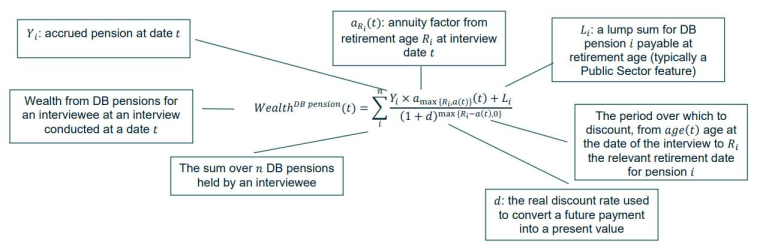
ONS apply the above model to interviews with households in their sample in each wave/round.
The above formulation of the model covers the approach taken for deferred DB pension entitlements, where the 𝑌𝑖 pension payable may be known. Where interviewees remain active participants in their DB pension scheme, we understand this accrued value is calculated as:
𝑎𝑐𝑐𝑟𝑢𝑎𝑙 𝑟𝑎𝑡𝑒 × 𝑠𝑒𝑟𝑣𝑖𝑐𝑒 × 𝑝𝑒𝑛𝑠𝑖𝑜𝑛𝑎𝑏𝑙𝑒 𝑠𝑎𝑙𝑎𝑟𝑦;
There may be some scheme specific constraints that limit the pensionable salary definition or the maximum eligible service that are ignored.
For interviewees currently in receipt of their pension, the period of discounting applied on the bottom of the equation is nil. Therefore, the wealth is derived solely from the in-payment pension 𝑌𝑖 and the relevant annuity factor.