Local Government Pension Scheme (Northern Ireland) Section 13 report as at 31 March 2022
Published 31 March 2025

© Crown copyright 2025
This publication is licensed under the terms of the Open Government Licence v3.0 except where otherwise stated. To view this licence, visit nationalarchives.gov.uk/doc/open-government-licence/version/3 or write to the Information Policy Team, The National Archives, Kew, London TW9 4DU, or email: psi@nationalarchives.gov.uk.
Where we have identified any third party copyright information you will need to obtain permission from the copyright holders concerned.
This publication is available at https://www.gov.uk/government/publications/local-government-pension-scheme-northern-ireland-section-13-report-as-at-31-march-2022/local-government-pension-scheme-northern-ireland-section-13-report-as-at-31-march-2022
1. Executive Summary
1.1 The Government Actuary has been appointed by the Department for Communities (DfC) to report under section 13 of the Public Service Pensions Act (Northern Ireland) 2014, in connection with the 2022 actuarial valuation of the Local Government Pension Scheme Northern Ireland (“LGPS NI” or “the scheme”).
1.2 The scheme is a multi-employer funded defined benefit pension scheme set up under statute. Scheme employers include local authorities, schools, colleges, housing associations, and other associated bodies.
1.3 Section 13 requires the Government Actuary to report on whether the following aims are achieved:
- Compliance
- Consistency
- Solvency
- Long-term cost efficiency
1.4 This is the third section 13 report. Section 13 was applied for the first time to the fund valuations as at 31 March 2016 and a second exercise was undertaken as at 31 March 2019.
1.5 This report is based on the actuarial valuation of the Northern Ireland Local Government Officers’ Superannuation Committee pension fund (“NILGOSC” or “the fund”), other data provided by Northern Ireland Local Government Officers’ Superannuation Committee (“NILGOSC”) and its actuary, Aon. We are grateful to these stakeholders for their assistance in preparing this report. We are committed to preparing a section 13 report that makes practical recommendations to advance the aims listed above. We will continue to work with stakeholders to advance these aims and expect that our approach to section 13 will continue to evolve to reflect changing circumstances and feedback received.
Progress since 2019
1.6 As part of the 2019 section 13 report, we concluded that the 2019 actuarial valuation of the NILGOSC pension fund and the resulting employer contribution rates achieved the aims set out in section 13 in respect of compliance, consistency, solvency and long-term cost efficiency. No recommendations were made in the 2019 section 13 report.
1.7 The 2019 report included a general risk comment, which highlighted the risk of additional spending requirements in the future, as the size of the fund increases relative to local authority budgets, and may lead to a strain on local authorities’ resources. We understand from discussions with the fund advisor and NILGOSC that they are generally mindful of the risks of a future deterioration in funding levels requiring increased pension contributions, causing this type of strain. This has been an important consideration when setting contribution rates, with the fund in surplus.
1.8 Overall, we are pleased to note that LGPS NI continues in good health.
Funding position at 2022
1.9 In aggregate, the funding position of the LGPS NI has reduced since 31 March 2019 but the scheme still appears to be in a strong financial position, specifically:
- Total assets have grown from £8.0bn in 2019 to £10.2bn in 2022.
- Total liabilities disclosed in the 2022 local valuation report amounted to £9.2bn. The local funding basis is required to incorporate prudence (i.e. there is intended to be a greater than 50:50 likelihood of actual future experience being better than the assumptions, in the opinion of the fund actuary).
- The funding level on the prudent local bases has reduced from 112% (at 2019) to 111% (at 2022).
- At the date of writing, we are aware that the economic climate has changed since the 2022 valuation, and the fund may have seen a subsequent improvement in the funding position. However, the impact of these changes will depend on the fund’s circumstances at the next valuation.
- The small reduction in local funding level is due in large part to liability increases resulting from changes in the financial assumptions - where the discount rate relative to inflation has fallen - slightly more than offsetting the strong asset returns over the 3-year period to March 2022. Investment returns averaged around 8% pa over the period.
- The aggregate funding level on the Government Actuary’s Department’s (GAD’s) best estimate basis is 116% (at 2022), this is an increase from 114% (at 2019). GAD’s best estimate basis is the set of assumptions derived by GAD without allowance for prudence. There is intended to be a 50:50 likelihood of actual future experience being better or worse than the best estimate assumptions, in our opinion. More information on this basis is set out in Appendix B.
- The continuing surplus position of the fund means there remains a focus on the treatment of surpluses. Relevant considerations include balancing intergenerational fairness with the priority given to maintaining stability of contributions. Where a surplus is attributable to an employer, the fund will consider using this to reduce that employer’s contributions. For most employers a buffer mechanism is used, so only assets in excess of 105% of the employer’s liabilities will act to reduce contributions. The fund will generally calculate the reduction assuming the surplus is spread over a period of 20 years. The exception is for employers who are expected to exit the fund, where any surplus is spread over the average expected future working period of the active members.
- Material solvency risks continue to exist. The funding level is sensitive to future experience (especially investment market conditions) and competing pressures on employers’ budgets.
1.10 We set out below our findings on each of the four aims and our recommendations.
Compliance
1.11 Our review indicated that the fund’s valuation is compliant with relevant regulations.
Consistency
1.12 As there is only one fund in the LGPS NI scheme, it is not possible to compare between different actuarial valuations of funds within the scheme.
1.13 The NILGOSC pension fund valuation includes the standard dashboard agreed by funds in England and Wales, which makes comparison between the fund and LGPS England and Wales funds easier. NILGOSC may wish to consider whether the dashboard needs to be reviewed to ensure the information remains helpful to stakeholders. In particular, information could be provided to inform the stakeholders on the different approaches to removing surpluses. We would encourage stakeholders to consider maintaining alignment of the LGPS NI dashboard with the LGPS England and Wales structure, which is expected to evolve following our recent review of that scheme.
1.14 We are grateful to DfC, NILGOSC and Aon for engaging on climate risk analysis since the previous review. We believe the analysis by Aon, in line with the climate risk analysis principles document (see LGPS England and Wales Appendices report), helped with comparison between the fund and LGPS England and Wales. We recognise the significant progress made by funds and actuarial advisors in the presentation of climate risk analysis as part of LGPS actuarial valuation processes.
1.15 We strongly promote the further development of climate risk analysis and its integration into decision-making. This remains a rapidly evolving area and we encourage DfC and NILGOSC to consider with other stakeholders what common principles should be adopted for the 2025 fund valuation. We believe there is merit in the consideration of climate risk analysis principles being prepared for the LGPS England and Wales funds. Whilst acknowledging specific Northern Ireland adjustments could be required, GAD would encourage the use of the England and Wales principles as a starting point for discussions when setting the valuation framework.
Solvency
Under solvency and long-term cost efficiency we have designed a number of metrics and raised flags against these metrics, to highlight areas where risk may be present, or further investigation is required, using a red/amber/green rating approach. Where we do not expect specific action, we have maintained the white “for information” flag approach introduced in 2019.
1.16 As currently set out in CIPFA’s Funding Strategy Statement Guidance, the employer contribution rate is appropriate to ensure solvency if:
- the rate of employer contributions is set to target a funding level for the whole fund of 100% over an appropriate time period and using appropriate actuarial assumptions.
and either:
- employers collectively have the financial capacity to increase employer contributions, should future circumstances require, in order to continue to target a funding level of 100%.
or
- there is an appropriate plan in place should there be an expectation of a future reduction in the number of fund employers, or a material reduction in the capacity of fund employers to increase contributions as might be needed.
1.17 In our view, the NILGOSC pension fund meets the conditions required to be able to demonstrate solvency, with no red or amber flags raised in relation to solvency. The fund is in a strong financial position, which reduces the immediate solvency concerns, and the funding level compares well with the LGPS England and Wales funds. However, risks remain, which NILGOSC should consider.
1.18 The proportion of non-statutory employers (e.g. Housing Associations, Universities, Colleges, Schools) has slightly reduced since the 2019 section 13 but remains high. If such employers exit the fund and it is not possible to obtain all or part of the exit payment due from them, costs fall back on the other fund employers. NILGOSC manages these risks through a variety of approaches, for example carrying out triennial assessment of covenant and changing employer contributions where necessary.
1.19 The ongoing risk of competing pressures on employer budgets and the sensitivity of funding levels to future experience (especially investment market conditions) and the potential for significant increase or decrease in contributions remains. Over the three years to 31 March 2022, the fund’s assets and liabilities have grown by around 27%. The size of the local authorities’ revenue funding has grown at a slower pace (around 10%). We note a material proportion of the active members of the fund are employed by the NI Education Authority and that the above analysis does not reflect funding for that authority. However, we don’t have reason to believe that extending the analysis to include the authority would change the relativities outlined above.
1.20 This represents a general risk for the scheme, so we have retained the general risk comment, which was included in the 2019 section 13 report.
General risk comment
Local authorities have finite resources and in recent years the size of pension funds has increased considerably more than local authority budgets. Given that pension funding levels change it is not unlikely that a period of increased pension contributions may be required at some point in the future.
If additional spending is required for pension contributions this may lead to a strain on local authority budgets.
We would expect that administering authorities and pension scheme committees are aware of this risk in relation to solvency and would monitor it over time. Administering authorities and pension scheme committees may wish to discuss the potential volatility of future contributions with employers in relation to overall affordability.
1.21 The general risk comment highlights the ongoing risk that pension funding presents to local authorities. We are not suggesting NILGOSC and their advisors are unaware of this risk.
Long-term cost efficiency
1.22 As currently set out in CIPFA’s Funding Strategy Statement Guidance, we consider that the rate of employer contributions has been set at an appropriate level to ensure long-term cost efficiency, if it is sufficient to make provision for the cost of current benefit accrual, with an appropriate adjustment to that rate for any surplus or deficit in the fund.
1.23 In our view, the NILGOSC pension fund meets the conditions required to be able to demonstrate long-term cost efficiency of the scheme. We note that it compares favourably against the majority of funds in England and Wales when we consider the SAB funding level together with the total employer contribution rate.
1.24 The return scope measure is white flagged (highlighting a general issue but one which does not require an action in isolation). This outcome reflects our discussion with the fund and its advisors which provided further details of its valuation assumption setting, and risk management, processes. The white flag is partly due to differences between NILGOSC’s long-term asset allocation strategy and current holdings.
1.25 Other measures, including the surplus retention measure (which was a white flag in 2019 section 13) were flagged green at this valuation.
1.26 On a local basis the fund is in surplus; therefore, it has a green flag on the deficit reconciliation measure. In fact, only seven fund employers were in deficit at the valuation date, with only three of these employers’ having stable, or potentially slightly reducing, contributions (in terms of percentage of pay). The maximum deficit recovery end point has been extended from 2037 to 2043. We understand that for the three employers the recovery plan was based on a flight path to closure aligned with the future expected working life of active members but has been changed to 20 years. The reason for this extension is to partially reflect that the employers are not expected to leave the fund in the short-term, but also recognises likely changes to the employers’ funding positions since the 2022 valuation.
1.27 Overall, we encourage that where at a future valuations employers remain in deficit and it was possible for the employer contributions to be reduced, we would expect that NILGOSC would again either maintain the deficit recovery end point or move it forwards, and not move it backwards unless new deficit emerges as a result of fund experience and it is appropriate to extend the recovery period.
1.28 Different approaches may be taken when determining how surplus is utilised. GAD has not flagged the fund on the utilisation of surplus at this review. The fund appears to have made decisions having considered relevant factors. We propose to use a new approach, for future section 13 reviews, to assess how the fund has utilised surpluses and not retained “large” surpluses.
1.29 The proposal is a mix of qualitative and quantitative analysis, relative to LGPS England and Wales, to reflect a range of considerations and approaches. We will expect the fund to have considered relevant factors and the trade-off between competing priorities. A particular consideration will be intergenerational fairness, as there is a need to balance the interests of current and future taxpayers.
1.30 We have illustrated the potential implications of different approaches to surplus management in our Asset Liability Modelling (ALM) for LGPS England and Wales in our recent section 13 review of that scheme. The ALM also considered the uncertainty of long-term contributions and funding and therefore the link to solvency risks.
1.31 The England and Wales SAB have published Guidance for Preparing and maintaining a Funding Strategy Statement (FSS) ahead of the 2025 valuations of that scheme. We recommend that DfC consider whether equivalent guidance should be implemented for LGPS NI. We particularly note the sections of the LGPS England and Wales guidance which relate to the utilisation of surpluses, and how deficit recovery plans should be a continuation of previous plans.
Recommendation:
We recommend that Department for Communities consider the following:
- Where LGPS NI is in surplus, whether additional guidance can be provided to support balancing different considerations.
- Where deficits exist, how can LGPS NI ensure that the deficit recovery plan can be demonstrated to be a continuation of the previous plan.
2. Introduction
2.1 This introduction provides background information on the Local Government Pension Scheme Northern Ireland (LGPS NI, or “the scheme”) and the review we have undertaken, including:
- Valuations within the LGPS NI.
- Section 13 and the statutory requirements.
- The approach that we adopt to carry out the required section 13 review.
Background information on LGPS NI
2.2 LGPS NI is a funded scheme governed by the Local Government Pension Scheme Regulations (Northern Ireland) 2014 (the ‘Regulations’). There is only one fund in the scheme which provides pensions and other benefits to employees who have worked in local government in Northern Ireland or for other scheme employers, and to their dependants. Scheme employers include local authorities, schools, colleges, housing associations, and other associated bodies.
2.3 The Northern Ireland Local Government Officers’ Superannuation Committee pension fund (“NILGOSC” or “the fund”) is managed and administered locally by the Northern Ireland Local Government Officers’ Superannuation Committee (‘NILGOSC’) established under section 1 of Schedule 3 of the Regulations.
What are LGPS NI valuations?
2.4 The scheme has its own liabilities and assets, and periodic assessments are needed to ensure the fund has sufficient assets to meet its liabilities.
2.5 The NILGOSC pension fund is required to appoint its own fund actuary, who carries out the fund’s valuation every three years. The fund actuary uses a number of assumptions to value the liabilities of the fund. Costs are split between those that relate to benefits already earned in the past (the past service cost) and those that relate to benefits being earned in the future (the future service cost). The results of the valuation may lead to changes in employer contribution rates for both future and past service costs.
2.6 In addition to the scheme valuation carried out by the fund actuary, GAD carries out a valuation to evaluate the cost of LGPS NI benefits and assesses if any changes need to be considered to meet an agreed cost control mechanism under directions set by the Department of Finance. The latest such valuation occurred as at 31 March 2020: Local Government Pension Scheme (Northern Ireland). The Government’s intention is that the cost control mechanism is only triggered by “extraordinary, unpredictable events”. As at 31 March 2020 the cost control mechanism was not breached. The next review will be as at 31 March 2024.
2.7 Scheme regulations set out member benefits to be paid and when valuations are to be carried out. We have based our assessment on current scheme regulations and benefits (with an allowance for agreement to equalise benefits under “McCloud”). See Appendix C for further information. The benefits paid to members are not dependent on the funding position of the fund.
What is section 13?
2.8 Section 13 is a requirement under the Public Service Pensions Act (Northern Ireland) 2014.
2.9 The Government Actuary has been appointed by the Department for Communities (DfC) to report under section 13 of the Public Service Pensions Act (Northern Ireland) 2014 in connection with the actuarial valuation of the NILGOSC fund.
2.10 This is the third section 13 report and sets out the Government Actuary’s findings following the fund valuation as at 31 March 2022.
Statutory requirements
2.11 This report is addressed to DfC as the responsible authority for the purposes of subsection (4) of section 13 of the Public Service Pensions Act (Northern Ireland) 2014 (“the Act”). GAD has prepared this report setting out the results of our review of the 2022 funding valuation of the NILGOSC pension fund. This report will be of relevance to NILGOSC and other employers, the actuary performing valuations for the fund, the LGPS NI Scheme Advisory Board (SAB), Department of Finance (DoF) and the Chartered Institute of Public Finance & Accountancy (CIPFA), as well as other LGPS NI stakeholders.
2.12 Subsection (4) of section 13 requires the Government Actuary, as the person appointed by DfC, to report on whether the four main aims are achieved, namely:
- Compliance: whether the fund’s valuation is in accordance with the scheme regulations.
- Consistency: As there is only one fund in the LGPS NI scheme, it is not possible to compare between different actuarial valuations of funds within the scheme.
- Solvency: whether the rate of employer contributions is set at an appropriate level to ensure the solvency of LGPS NI.
- Long-term cost efficiency: whether the rate of employer contributions is set at an appropriate level to ensure the long-term cost efficiency, so far as relating to LGPS NI.
2.13 Section 13, subsection (6) states that if any of the aims of subsection (4) are not achieved
a. the report may recommend remedial steps
b. the scheme manager must
i. take such remedial steps as the scheme manager considers appropriate, and
ii. publish details of those steps and the reasons for taking them
c. the responsible authority may -
i. require the scheme manager to report on progress in taking remedial steps
ii. direct the scheme manager to take such remedial steps as the responsible authority considers appropriate.
GAD’s approach
2.14 We have looked at a range of metrics to identify potential exceptions under the solvency and long-term cost efficiency objectives. Each fund is given a colour-coded flag under each measure:
| Colour | Interpretation |
|---|---|
| Red | A material issue that may result in the aims of section 13 not being met. In such circumstances remedial action to ensure solvency and/or long-term cost efficiency may be considered. |
| Amber | A potential issue that we would expect funds to be aware of. In isolation this would not usually contribute to a recommendation for remedial action in order to ensure solvency and/or long-term cost efficiency. |
| White | An advisory flag that highlights a general issue but one which does not require an action in isolation. It may have been an amber flag if we had broader concerns. |
| Green | There are no material issues that may contribute to a recommendation for remedial action in order to ensure solvency or long-term cost efficiency. |
2.15 The trigger points for these flags are generally based on absolute measures, except where comparisons relative to LGPS EW have been made. Where appropriate, we have maintained consistency with the approach adopted in 2019.
2.16 While they should not represent targets, these measures and flags help us determine whether a more detailed review is required. For example, we would have a concern where multiple measures are triggered amber for the fund.
2.17 These flags are intended to highlight areas where risk may be present or further investigation is required. For example, where an amber flag remains following engagement, we believe this relates to an area where some risk remains that NILGOSC and the pension board should be aware of. There is no implication that NILGOSC was previously unaware of the risk.
2.18 A green or white flag does not necessarily indicate that no risk is present and similarly the fact that we are not specifically suggesting remedial action does not mean that scheme managers should not consider actions.
2.19 We have had regard to the particular circumstances of the fund, following engagement with NILGOSC and their fund actuary, Aon. Information provided through this engagement has assisted us in deciding to award one white advisory flag. Further details of this decision are provided in the relevant section below.
2.20 The metrics shown in the tables in this report are based on publicly available information and/or information provided to GAD.
2.21 Further detail of the metrics and fund engagement can be found in the solvency and long-term cost efficiency chapters and appendices. This report may be read along with the LGPS England and Wales section 13 report (including the appendices to that report).
2.22 Within the fund, contribution rates may vary between employers. Our analysis and metrics focus on the aggregate fund position except where stated. When reading this report, it is important to note that individual employers’ contribution rates and funding situations might differ from the aggregate fund position.
2.23 Local valuation outputs depend on both the Funding Strategy Statement and the actuary’s work on the valuation. We have reported where valuation outcomes raised concerns in relation to the aims of section 13. It is not our role to express an opinion as to whether that conclusion was driven by the actions of NILGOSC or their actuary, or other stakeholders.
Standardised bases used in our approach
2.24 There are some areas of inconsistency between the LGPS England and Wales funds and the NILGOSC fund, which make meaningful comparison of local valuation results difficult. To address this, we have referred to results restated on two bases:
-
The SAB standard basis was established by the LGPS England and Wales SAB and is used by fund actuaries to calculate liabilities on a consistent basis allowing comparison of funds.
-
Where we consider the potential impact of future funding levels on solvency and long-term cost efficiency, we need to compare the value of the fund’s assets and liabilities. Therefore, we require a market consistent basis. As the SAB standard basis is not a market related basis, GAD calculates liabilities on a consistent best estimate basis, which is based on market conditions as at 31 March 2022. The exception to this is the first solvency metric described in table 6.1, which directly compares the relativity between funds, and so the SAB standard basis is adopted.
Additional information on both these bases can be found in Appendix B. Details of how we have estimated the liabilities for each basis are provided in Appendix A.
2.25 These bases facilitate comparison but are not suitable for funding purposes, as we would expect a funding basis to reflect the local characteristics of a fund. We note that:
-
The SAB standard basis is not consistent with current market conditions and is not suitable for considering possible impacts on solvency and long-term cost efficiency (other than relatively, between funds).
-
The GAD best estimate basis is based on our views of likely future returns on each broad asset class across the fund. Regulations and CIPFA guidance call for prudence to be adopted when setting a funding basis. Our best estimate basis does not include prudence and is based on the investment strategy for the fund. Future asset returns are uncertain and there are other reasonable best estimate bases which may give materially different results.
2.26 The local valuation and our calculations underlying this report are based on specific assumptions about the future. Future experience will differ from these assumptions. Some of our solvency measures are stress tests but they are not intended to indicate a worst-case scenario.
Other important information
2.27 The previous section 13 report was published on 26 April 2022 following the valuation as at 31 March 2019, details of which can be found in the Local Government Pension Scheme (Northern Ireland): review of the actuarial valuation of fund as at 31 March 2019.
2.28 NILGOSC published the fund 2022 valuation report, on 28 March 2023.
2.29 This report was prepared in accordance with the Funding Strategy Statement which is prepared, maintained and published by NILGOSC under the Regulations.
2.30 In performing this analysis, we are grateful for helpful discussions with and cooperation from:
- DfC
- NILGOSC
- Aon (NILGOSC’s actuarial advisors)
2.31 This report is GAD’s alone, and the stakeholders above are not responsible for the content.
2.32 GAD would like to acknowledge the commitment shown by the fund and their advisors, which is illustrated through their engagement with this process and the fund remaining in a strong funding position.
2.33 GAD has no liability to any person or third party other than DfC for any act or omission taken, either in whole or in part, on the basis of this report. No decisions should be taken on the basis of this report alone without having received proper advice. GAD is not responsible for any such decisions taken.
2.34 We understand and assume that there is no regulatory authority assumed by or conferred on the Government Actuary in preparing this or any future section 13 report. The appointment to report under section 13 does not give the Government Actuary any statutory power to enforce actions on scheme managers (or others).
2.35 This work has been carried out in accordance with the applicable Technical Actuarial Standard: TAS 100 issued by the Financial Reporting Council (FRC). The FRC sets technical standards for actuarial work in the UK.
Future review
2.36 We are grateful to stakeholders for their assistance in preparing this report. We are committed to preparing a section 13 report that makes practical recommendations to advance the aims in the legislation. We will continue to work with stakeholders to advance these aims ahead of the 2025 actuarial valuations and expect that our approach to section 13 will continue to evolve to reflect changing circumstances and feedback received.
Limitations
2.37 We recognise that the use of data and models has limitations. For instance, the data that we have from valuation submissions and publicly available financial information is likely to be less detailed than that available to the fund. Our risk assessment framework enables us to broadly assess scheme risks and decide on our engagement with the fund on an indicative basis. It is the responsibility of NILGOSC and their advisors to consider and manage their risks.
2.38 Because of the nature of this exercise, we have not generally allowed for experience since the fund valuations, except for any specific actions described in this report where we have engaged with the fund. For example, the discussions we have had on how the fund expects to change its asset allocation following the valuation.
3. Progress
3.1 We made a general risk comment in the 2019 section 13 report, and have reported on the progress made against:
| General risk comment | Progress |
|---|---|
| Local authorities have finite resources and in recent years, the size of pension funds has increased considerably more than local authority budgets. Given that pension funding levels change, it is not unlikely that a period of increased pension contributions may be required at some point in the future. | We understand from discussions with NILGOSC and its advisors that they are mindful of the risks of a future deterioration in funding levels requiring increased pension contributions, with this causing a strain on the local authority budget. This has been an important consideration when setting contribution rates where the fund is in surplus. Specifically, we note the focus of employers on stability when setting their contribution rates has been reflected in the fund’s investment strategy reviews, which have suggested diversification and rebalancing of assets over recent years to continue to deliver more consistency in the fund’s returns. This approach may help NILGOSC manage future increases in contributions. |
| If additional spending is required for pension contributions, this may lead to a strain on local authority budgets. | In light of the widely reported pressures on council funding impacting local authorities and other employers within the fund, it is important that the consequences of volatility and the risk of any future significant requirement to increase employer contributions continue to be monitored. |
| We would expect that administering authorities are aware of this risk in relation to solvency and would monitor it over time. Administering authorities may wish to discuss the potential volatility of future contributions with employers in relation to overall affordability. |
4. Compliance
Key Compliance findings
-
The report contained a statement of compliance.
-
The report contained confirmation of all material requirements of regulation 68 of the Local Government Pension Scheme Regulations (Northern Ireland) 2014 (as amended).
-
We concluded the aims of section 13 were achieved under the heading of Compliance, in terms of valuation reporting.
Statutory requirement and chapter content
4.1 Under section 13(4)(a) of the Act, the Government Actuary must report on whether the actuarial valuation of the fund has been completed in accordance with the scheme regulations.
4.2 In this Chapter we set out our approach to reviewing compliance and our conclusions from that review.
Review of compliance outcomes
4.3 We found that the actuarial valuation report for the fund has been completed in accordance with Regulation 68 of the Local Government Pension Scheme Regulations (Northern Ireland) 2014 (as amended) and have therefore concluded that the compliance criteria of section 13 have been achieved. We note that this is not a legal opinion.
4.4 Our review of compliance is focused on the actuarial valuation report produced under Regulation 68. We have reviewed other associated documents prepared by the fund and have not identified any areas for concern. However, we have not, for example, systematically reviewed the Funding Strategy Statement for full compliance with the relevant legislation and guidance.
4.5 We carried out the same checks for the NILGOSC pension fund as LGPS England and Wales funds. These checks are detailed in Appendix A of the appendices to the England and Wales section 13 report. Note that the Appendix in England and Wales refers to Regulation 62 of the LGPS Regulations 2013; however the relevant scheme regulation for LGPS NI from the Local Government Pension Scheme Regulations (Northern Ireland) 2014 is Regulation 68 (as amended).
4.6 The comments we make in subsequent chapters on consistency, solvency and long-term cost efficiency do not imply that we believe that the valuations are not compliant with the regulations. These comments relate to whether the valuations appear to achieve the aims of section 13.
5. Consistency
Key Consistency findings
-
As there is only one fund in the LGPS NI scheme, it is not possible to compare between different actuarial valuations of funds within the scheme.
-
The 2022 fund valuation report included the dashboard agreed for the LGPS England and Wales valuations at that date. The LGPS NI stakeholders may wish to consider whether there are any proposals in relation to that dashboard that may also be relevant to LGPS NI, as well as any recommendations made by the LGPS England and Wales Scheme Advisory Board.
-
The fund actuary’s modelling on climate change was in line with the principles paper agreed for LGPS England and Wales. We recognise the significant progress, as this aids comparisons and understanding of the risk. The LGPS NI stakeholders may wish to consider whether to adopt the 2025 LGPS England and Wales Climate change principles document for the fund’s 2025 valuation.
-
In our opinion the information provided in the 2022 valuation report is not inconsistent to that provided in the 2019 report, in relation to presentational and evidential consistency.
Statutory requirement and chapter content
5.1 Under Section 13(4)(b) of the Act, the Government Actuary must report on whether each actuarial valuation has been carried out in a way which is not inconsistent with other valuations. This requires both presentational and evidential consistency.
5.2 However, as there is only one fund in the LGPS NI scheme, it is not possible to compare between different actuarial valuations of funds within the scheme.
5.3 In this chapter, we:
-
Consider evidential and presentational consistency between the valuation reports at different dates.
-
Consider the steps taken by LGPS NI on its dashboard and climate change modelling. These aid understanding of the fund and facilitate our comparisons with LGPS England and Wales.
Types of Consistency
5.4 Presentational Consistency - Information may be presented in different ways in different reports, and sometimes information is contained in some reports but not others, so readers may have some difficulties in locating the information they wish to compare. We call this presentational inconsistency.
5.5 Evidential Consistency - When the reader has located the relevant information (e.g. funding levels), differences in the underlying methodology and assumptions mean that it is not possible to make a like for like comparison. We call this evidential inconsistency. We believe that local circumstances may merit different assumptions (e.g. financial assumptions are affected by the current and future planned investment strategy or different levels of prudence) but that wherever possible, information should be presented in a way that facilitates comparisons.
Presentational and Evidential consistency
5.6 We considered consistency among the valuation reports of the 87 local authority funds for LGPS England and Wales as at 31 March 2022. We made a recommendation to the LGPS England and Wales Scheme Advisory Board to consider steps to ensure greater consistency to better facilitate comparison. LGPS NI stakeholders may wish to consider whether there are any proposals that may be of interest for LGPS NI, once the outcome of that process is known.
5.7 GAD acknowledge that the NILGOSC pension fund has included the updated standard LGPS England and Wales dashboard, which facilitates comparison. The LGPS NI stakeholders may wish to consider whether there are any proposals in relation to that dashboard that may also be relevant to LGPS NI, as well as any recommendations made by the LGPS England and Wales Scheme Advisory Board.
5.8 GAD has also undertaken an analysis on whether the 2019 and 2022 valuation reports are presentationally and evidentially consistent.
5.9 For presentational consistency we have considered whether the information on contribution rates, surplus/deficit contributions and recovery periods are presentationally consistent in 2019 and 2022 reports (similar to the approach adopted in LGPS England and Wales across funds in 2022). In our opinion the information is not inconsistent.
5.10 For evidential consistency we have considered how one of the key assumptions, the discount rate, has been derived. The 2019 and 2022 reports explain the approach and enable rates to be compared between valuations. In our opinion the information is not inconsistent.
Emerging Issues
Climate risk
5.11 The 2019 section 13 report highlighted climate risk as an emerging issue. We are grateful to DfC, NILGOSC, and Aon for engaging on this issue and to agreeing to model climate change risks in line with the LGPS England and Wales Principles document. We recognise the significant progress made by the fund and actuarial advisor in the presentation of climate risk analysis as part of the actuarial valuation process.
5.12 LGPS England and Wales Funds which carried out climate change analysis in line with the principles document considered between three and five climate change scenarios. Whilst there were differences in the specific assumptions adopted by funds and actuarial advisors, our report outlined the general consistency in principles that were adopted across the reports.
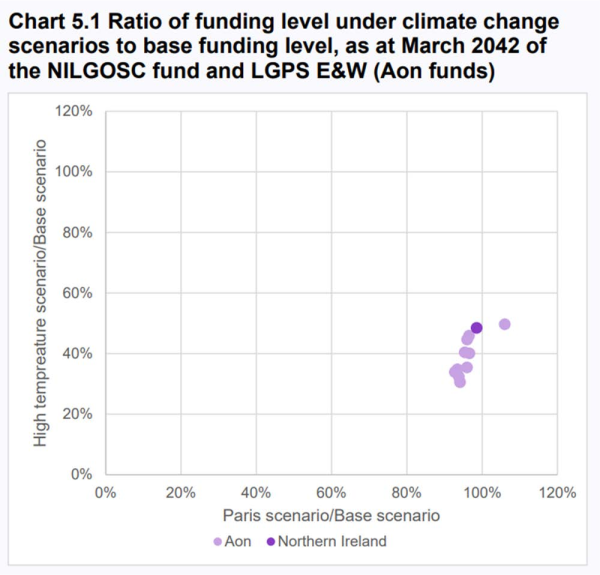
5.13 Chart 5.1 considers the impact on the calculated funding levels of the two most commonly adopted scenarios (high temperature and Paris aligned), relative to the base scenario (with position given as at 31 March 2042). Under the high temperature scenario, the fund’s funding level, as at 2042, would deteriorate, relative to the base case, by around 50%, whereas the Paris scenario is broadly unchanged relative to the base. The analysis enables a fund to start to understand funding risks relative to the uncertainties inherent in climate change. The chart also shows, given relative clustering of fund results, that NILGOSC’s analysis is similar to that for LGPS England & Wales funds advised by Aon.
5.14 The analysis has been provided for information only, as it is a high-level summary of the analysis reported. It should not be used to comment on differences in impacts across funds. This is because, under the broad principles agreed, different funds can reasonably adopt a range of assumptions within scenarios and therefore differences can arise due to assumptions as well as modelled impacts. Further, the summary presented is a snapshot at one point in time and therefore might misrepresent a more considered comparison of projected trajectories over time.
5.15 The importance of climate risk analysis, and in particular the appropriate communication of risks relative to scenarios presented, was highlighted in the recent (June 2024) Institute and Faculty of Actuaries (IFoA) risk alert on climate change scenario analysis.
5.16 We strongly promote the further development of climate risk analysis and its integration in decision-making by funds. We recommend that NILGOSC considers whether the principles of climate risk analysis that have been developed by LGPS England and Wales stakeholders, and continue to evolve following our recent review of that scheme, may also be appropriate to adopt for NILGOSC.
Other risks
5.17 There are a number of risks and issues which have the potential to affect the NILGOSC pension fund in future. In particular, if the fund remains in surplus, this has the potential to affect risks and opportunities. These issues require consideration from the fund and their advisors as they emerge. We recommend that NILGOSC considers what steps can be taken in relation to these issues and whether a consistent approach to LGPS England and Wales is appropriate.
6. Solvency
Key Solvency findings
-
The funding level has reduced slightly on the local basis since 2019, primarily due to asset outperformance being offset by change in financial assumptions. The fund remains in a strong financial position with a 111% funding level on its local funding basis. This reduces current solvency concerns, but we note future solvency risk remains an important consideration.
-
No solvency flags have been raised, however, risks clearly remain particularly in the context of competing pressures on employer budgets. The 2019 general risk comment is raised in this report as in recent years the fund has increased considerably relative to the size of the local authority budgets.
-
The proportion of non-statutory employers remains high which creates a risk to the fund, NILGOSC is actively managing the risk.
Statutory requirement and chapter content
6.1 Under section 13(4)(c) of the Act, the Government Actuary must report on whether the rate of employer contributions to the pension fund is set at an appropriate level to ensure the solvency of the pension fund.
6.2 In this chapter we outline the results of our solvency analysis and consider more broadly how the fund manages solvency risk.
Definition of Solvency
6.3 In line with the definition in CIPFA’s Funding Strategy Statement Guidance, which we adopt for the purposes of section 13, we consider that the rate of employer contributions has been set at an appropriate level, to ensure the solvency of the pension fund, if:
- the rate of employer contributions is set to target a funding level for the whole fund of 100% over an appropriate time period and using appropriate actuarial assumptions.
and either:
- employers collectively have the financial capacity to increase employer contributions, should future circumstances require, in order to continue to target a funding level of 100%
or
- there is an appropriate plan in place should there be, or there is expected in future to be, no or a limited number of fund employers and/or a material reduction in the capacity of fund employers to increase contributions as might be needed.
Background on solvency
6.4 The funding level on the valuation basis has reduced from 112% to 111% since the 2019 valuation. At the date of writing, we are aware that the fund may have seen subsequent improvement in its funding position. The slight reduction in funding still leaves the fund in a strong position. This means immediate concerns around current solvency risks relative to previous section 13 reviews remain broadly unchanged. However, the sensitivity of funding levels to future experience and competing pressures on employers’ budgets mean that solvency risks still exist.
6.5 GAD’s best estimate basis is the set of assumptions derived by GAD without allowance for prudence, hence with an intended 50:50 likelihood of actual future experience being higher or lower than the assumption adopted, in our opinion. Where the funding level on such a basis is greater than 100%, we expect there is a greater than 50% likelihood that existing assets would be sufficient to cover benefits in respect of accrued service when they fall due. On GAD’s best estimate basis, the funding level as at 31 March 2022 was 116%. This is an improvement of 2%, from a funding level of 114% as at 31 March 2019.
6.6 Solvency is dependent on employers being able to pay contributions as required, knowing that these contributions may increase or decrease significantly in future. In the case of tax-raising employers, accommodating contribution variability is a political, as well as financial, consideration. We consider it is important that NILGOSC and pension fund employers understand the potential range of future cost, so that they can understand the affordability of potential future contribution requirements.
6.7 We have assessed risk against a range of measures summarised in Table 6.1 below. There are risks of potential contribution volatility that NILGOSC and employers should be aware of. They should consider actions required to manage these risks but accepting the risk may be a valid option.
6.8 We carried out an asset liability modelling exercise as part of the England and Wales section 13 report. This might be of interest to NILGOSC to gain some insight into the potential pressures on the employer contribution rate that they may wish to manage in some way.
Solvency Measures
6.9 We have tested the following five metrics under solvency. These include tests in relation to potential emerging risks and stress tests in relation to what may happen if certain events occur. The results for the NILGOSC fund are included in the table below.
Table 6.1: 2019 Solvency Measures
| Consideration | Measure Used | Results |
|---|---|---|
| Risks already present: | ||
| The relative ability of the fund to meet its accrued liabilities | Funding level on England and Wales SAB standard basis: Comparison of the NILGOSC pension fund’s funding level with the mean funding level for the England and Wales funds, both funding levels calculated using the England and Wales SAB standard basis, as set out in Appendix B | +12.2% |
| The extent to which the fund continues to be open to new members. If a fund is closed to new members or is highly mature, we will focus on the ability to meet additional cash contributions | Open fund: Whether the fund is open to new members | Yes |
| The proportion of fund employers without tax raising powers or without statutory backing | Non-statutory members: The proportion of members within the fund who are/were employed by an employer without tax raising powers or statutory backing | 22.0% |
| Emerging risks: | ||
| The cost risks posed by changes to the value of fund assets (to the extent that these are not matched by corresponding changes to the value of fund liabilities) | Asset shock: The change in average employer contribution rate (on GAD’s best estimate basis) expressed as a percentage of payroll after a 15% fall in the value of return-seeking assets | Surplus after shock (+4.6%) |
| The impact that non-statutory employers defaulting on contributions would have on the income of sponsoring employers as a whole | Employer default: The change in average employer contribution rate (on GAD’s best estimate basis) as a percentage of payroll if all employers without tax raising powers or statutory backing default on their existing deficits | In surplus (Note 1) so no deficit will generally arise from assumed employer default |
Note 1: The employer default metric is intended to identify material risks at a fund level. Despite the fund surplus, we acknowledge that some employers remain in deficit at the valuation and so an element of risk remains. NILGOSC should continue to monitor this in accordance with its policies.
6.10 Further details on the calculations underlying the numbers are given in Appendix C of the England and Wales section 13 Appendices. There are some LGPS NI specific differences which are detailed below:
-
The data for non-statutory employees was provided by NILGOSC, and further details are included in Appendix A of this report.
-
The changes in average employer contribution rates for asset shock and employer default shock are expressed as a percentage of payroll for the NILGOSC pension fund. It was expressed in terms of core-spending power or financing data for English funds and Welsh funds respectively.
Non-statutory Members Metric
6.11 In the case of tax raising employers, accommodating contribution variability is a political, as well as financial, consideration. Different employers have different covenants. We consider taxpayer-backed employers to have a stronger covenant value than other employers. It is important, in this context, that NILGOSC and other employers understand the potential cost that may fall on taxpayers in the future if employers without statutory backing or tax raising powers are unable to meet their required contributions and those with such powers become responsible for the accrued costs.
6.12 Data for this measure was provided by NILGOSC. The measure is based on the proportion of active members who are employed by employers which do not have tax raising powers. We have assumed that broadly the following employers are tax backed:
- Council
- Education Authority
- Employers with guarantee from council
- Employers with departmental backing
And we have considered broadly the following employers to be non-tax backed following discussions with NILGOSC (although we have been made aware of certain exceptions):
- Colleges
- Housing Associations
- Northern Ireland Housing Executive
- Schools
- Translink
- Universities
- Employers from other authorities without council guarantee or departmental backing
6.13 At 22.0%, the fund has a greater proportion of non-statutory employers than most LGPS England and Wales funds. Most of these employers are public bodies which receive public funding but do not have powers to raise taxes. The proportion of non-statutory employers has decreased since the 2019 valuation, with the main driver being an increase in the proportion of active members employed by the NI Education Authority. We understand that this change has been driven by auto-enrolment exercises for its employees. The fund is below the threshold of 25% for an amber flag.
6.14 In some circumstances, an employer can elect to leave the fund, at which point any debt (or surplus) in respect of some fund members may be crystallised. After such an agreement is reached, there is no further recall on the exiting employer for additional funds if the future funding position changes.
6.15 If such employers exit the fund, they are liable to make an exit payment to cover their liabilities in the fund (net of any associated assets). However, if it is not possible to obtain all or part of the exit payment due from them, costs fall back on the other scheme employers. We noted in the 2016 and 2019 reports that unpaid exit payments amounted to £3.6 million between 2013 and 2016 and was expected to be between £2.2 to £6.9 million over the period 2016 to 2019. For the period between 2019 and 2022, NILGOSC have confirmed there are no unpaid exit amounts.
6.16 The current positive position on unpaid exit amounts may reflect the recent improvement in funding level following the 2022 valuation and the actions taken by NILGOSC. It is important that NILGOSC understands and continues to manage the implications of any employer exit payment shortfalls to ensure the ongoing solvency of the fund.
6.17 NILGOSC has recognised the risk of unpaid exit amounts in the fund’s Funding Strategy Statement. To manage this risk, NILGOSC formally assesses the covenant strength of its scheme employers on a triennial basis. This exercise is completed in advance of each actuarial valuation and is used to inform the valuation and subsequent grouping of employers for contribution rate setting purposes.
6.18 There are different funding targets, depending on each employers’ circumstances and in particular whether the employer is likely to exit the fund and what would happen to the liabilities on exit.
6.19 Government bodies, or those employers with Government guarantees, are valued as the Main Employer group. Employers that are on a flight path to closure are treated on an Ongoing Orphan basis. Employers that are not already on a flight path to closure, but who are not guaranteed by Government, are treated on the Intermediate Funding basis. At the 2022 valuation, the left-service discount rate used for the Main Employer group funding target was 4.2% p.a. whereas that for the Intermediate Funding basis and the Ongoing Orphan funding target were 3.2% p.a. and 0.8% p.a. respectively. This reflects the differing risk profile of the Ongoing Orphan and Intermediate groups, and can lead to higher contributions than stronger employers in similar circumstances in the Main Employer group.
Asset Shock Metric
6.20 Asset shock considers the scenario of a sustained reduction in the value of return seeking assets. For example, a market correction in which asset values do not immediately recover, and losses cannot be absorbed by a change in assumptions.
6.21 In this scenario we model the additional contributions that would be required to meet the emerging deficit (as opposed to the total contributions required following the shock - i.e. we are looking at where there is a risk of large changes to the contribution rate, rather than a risk of the total contribution rate exceeding some threshold).
6.22 A shock, which generates high additional contributions as a proportion of payroll, generates a flag as this may indicate that the fund may be less likely to be able to absorb substantial contribution increases without affecting core services.
6.23 Although the asset shock resulted in a reduction to the funding level of the fund on GAD’s best estimate basis, it remained in surplus post shock (the funding level was in excess of 100% after the shock). The fund is therefore green flagged on this measure. We note the reduction in the funding level following the asset shock was equivalent to a 4.6% increase in employer contributions. In practice we might not expect these pressures to feed directly into changes in employer contribution rates, because there are various ways in which such a cost pressure might be managed, at least in the short term.
6.24 The management of Investment risk is included in the funding strategy statement. For example, NILGOSC considers the asset allocation of the Fund formally by carrying out a triennial review with its Investment Advisors, Fund Managers and Fund Actuary. We understand previous reviews of the strategic funding target, and its target asset allocation, have led to reductions in the proportion of the fund invested in growth assets, and that a further review is currently being undertaken.
6.25 This indicates that the fund is aware of the impact of investment risk on contribution volatility and is actively managing it. In preparing this report we have considered only the risk management processes; we have not reviewed and do not comment on the appropriateness of the current investment strategy.
6.26 The potential for future variations in contribution rates is discussed further in our Asset Liability Modelling (ALM) section in the LGPS England and Wales report (see long-term cost efficiency chapter).
Management of Risks
Funding
6.27 Over the three years to 31 March 2022, the fund’s assets and liabilities have grown by around 27%. The size of the local authorities’ revenue funding has grown at a slower pace (around 10%). We note a material proportion of employees within the fund are employed by the education authority. We do not have detailed information on the growth of funding for NI education authority. However, we have no reason to expect that if this information were included in the comparison that it would change the general relativities shown above.
6.28 Given the sensitivity of pension funding levels to changes in market conditions and other experience, it is possible that a period of increased pension contributions will be required in the future despite the current strong funding position. If additional pension contributions are required, this may lead to a further strain on local authority and other employers’ budgets at a future date.
6.29 We have retained the general risk comment from the 2019 section 13 report to highlight the risk.
General risk comment
Local authorities have finite resources and in recent years the size of pension funds has increased considerably more than local authority budgets. Given that pension funding levels change it is not unlikely that a period of increased pension contributions may be required at some point in the future.
If additional spending is required for pension contributions this may lead to a strain on local authority budgets.
We would expect that LGPS administering authorities and pension scheme committees are aware of this risk in relation to solvency and would monitor it over time. Administering authorities and pension scheme committees may wish to discuss the potential volatility of future contributions with employers in relation to overall affordability.
6.30 We are conscious the NILGOSC are aware of this risk in relation to solvency and factor this into funding decisions. We note that the fund should continue to discuss the potential volatility of future contributions with employers in relation to overall affordability.
6.31 The risk of contribution rate increases and how stability mechanisms might influence contribution rates over time rates is discussed further in our Asset Liability Modelling (ALM) section in the LGPS England and Wales report (see long-term cost efficiency chapter).
Governance and other risks
6.32 Whilst the current positive funding position of NILGOSC reduces immediate solvency concerns, there are new challenges which could impact future solvency. The non-statutory section above considered the change in the risk profile relating to unpaid exit payments.
6.33 Pension funding is long-term in nature. We support the approach adopted by the actuarial advisor in relation to the 2022 valuation report, which noted the expected improved funding position between the valuation date and date of signature of the report but did not look to review the valuation results given the long-term nature of pension funding (with the exception of the employers mentioned in 7.18). Improvement in the funding position could lead to requests from some employers for mid-cycle reviews of employer contributions based on particular market conditions. Mid-cycle reviews of employer contributions are only appropriate in limited circumstances and both statutory and SAB guidance should be carefully considered prior to carrying out such a review.
6.34 GAD does not comment on the investment strategy that the fund should adopt or the types of investments which the fund should invest in. Nevertheless, when choosing an investment strategy, we would expect the fund to consider the timing and format of the benefits payable, the overall liability profile, and employers’ capacity to increase contributions, if required, alongside the appropriateness of the investment for the fund.
7. Long-term cost efficiency
Key long-term cost efficiency findings
-
In 2022 we raise no amber or red flags, but we do raise one white flag under our return scope measure. The white flag reflects the fund’s management of investment risk.
-
There were a small number of employers who were in deficit at the time of the 2022 valuation. For some of these employers we note that contribution rates may be decreasing (reducing the current burden on employers) at the same time as the deficit recovery is being extended further into the future (increasing the future burden on employers).
-
We acknowledge there are different approaches to the utilisation of surpluses and the fund should consider relevant factors and the trade-off between competing priorities. We set out the approach we intend to use to assess how funds have utilised surpluses at future valuations.
-
We formally recommend that DfC consider the approach to surpluses and deficits in their review of the Funding Strategy Statement (FSS) guidance, and consider whether additional guidance is appropriate.
Statutory requirement and chapter content
7.1 Under section 13(4)(c) of the Act, the Government Actuary must report on whether the rate of employer contributions to the pension fund is set at an appropriate level to ensure the long-term cost efficiency of the scheme.
7.2 This chapter sets out:
- A definition of long-term cost efficiency.
- The results of our analysis on long-term cost efficiency.
- The outcome of our engagement with the fund.
- Future considerations in respect of fund surplus.
Definition of long-term cost efficiency
7.3 In line with the definition in CIPFA’s Funding Strategy Statement Guidance, which we adopt for the purposes of section 13, we consider that the rate of employer contributions has been set at an appropriate level to ensure long-term cost efficiency if the rate of employer contributions is sufficient to make provision for the cost of current benefit accrual, with an appropriate adjustment to that rate for any surplus or deficit in the fund.
Background on long-term cost efficiency
7.4 Long-term cost efficiency relates to not deferring payments too far into the future so that they affect future generations of taxpayers disproportionately.
Long-term cost efficiency measures
7.5 We developed a series of relative and absolute considerations to help assess whether the contributions met the aims of section 13 under long-term cost efficiency. These are broadly consistent to those adopted for the England and Wales section 13 exercise.
7.6 The table below gives details of these measures along with the results for the NILGOSC pension fund. Further details are given in Appendix D of the England and Wales section 13 Appendices, with slight differences as listed below:
-
The cashflow data underlying the required return measure was obtained from the revenue accounts information provided by NILGOSC.
-
The best estimate basis used in these calculations is specific to the asset allocation for the NILGOSC fund. Further details on this are given in Appendices A and B.
Table 7.1 Long-term cost efficiency considerations and Measures
| Consideration | Measure Used | Results |
|---|---|---|
| Risks already present: | ||
| The implied deficit recovery period | Deficit Period: Implied deficit recovery period calculated on GAD’s best estimate basis. | Surplus |
| The investment return required to achieve full funding | Required Return: The required investment return rate to achieve full funding in 20 years’ time on GAD’s best estimate basis. | 3.7% pa |
| Contributions from funds not in deficit are not likely to lead to a deficit arising in the future when assessed on the best estimate basis | Surplus retention: Comparison of the average employer rate (set at the 2022 valuation for a fund) and the future service contribution rate on GAD’s best estimate basis. Where the average employer contribution rate is less than GAD’s best estimate future service contribution, we consider the implied surplus sharing period on GAD’s best estimate basis. | Green |
| The pace at which the deficit is expected to be paid off | Repayment Shortfall: The difference between: actual contributions in excess of GAD’s best estimate of future service cost and the annual deficit recovery contributions required as a percentage of payroll to pay off the deficit in 20 years, where the deficit is calculated on a standardised best estimate basis. | Surplus |
| Absolute Considerations: | ||
| The extent to which the required investment return (above) less the estimated future return being targeted by a fund’s investment strategy is above a minimum value | Return Scope: The required investment return rate, as calculated in required return above, compared with the fund’s expected best estimate future returns, assuming current asset mix is maintained (a flag will be considered where this metric is less than 0.5%). | 0.3% |
| The extent to which any deficit recovery plan can be reconciled with, and can be demonstrated to be a continuation of, the previous deficit recovery plan, after allowing for actual fund experience | Deficit Reconciliation: Confirmation that the deficit period can be demonstrated to be a continuation of the previous deficit recovery plan, after allowing for actual fund experience. | Green |
7.7 The result of our return scope metric initially raised an amber flag, as it is less than the 0.5% threshold we apply. However, through discussions with NILGOSC and its advisors we were provided with additional information about how the fund has considered investment risk, and its plans to manage it. This has resulted in us ultimately deciding that a white advisory flag is appropriate.
7.8 The metric is calculated using the actual allocation of assets held by the fund at the valuation date. We understand the fund has held a notable proportion of its assets in cash (around 8% of the fund) in recent years. However, NILGOSC have confirmed to us that this is a temporary arrangement, and these assets will be transferred into other assets, in line with the funds’ target investment allocation which is currently under review.
7.9 If we were to reflect the long-term target investment allocation in our metric then this would have meant that the fund would have exceeded the 0.5% threshold on the metric, and so would not have received an amber flag.
7.10 Aon were also able to provide us with additional details of how they had calculated the discount rate used for the fund’s valuation, and how this is linked to the target investment strategy.
7.11 Our white advisory flag recognises that the fund, and its advisors, are managing the risks associated with the return scope metric. However, we encourage them to continue to monitor the risk, and consider how it is allowed for again at future valuations of the fund.
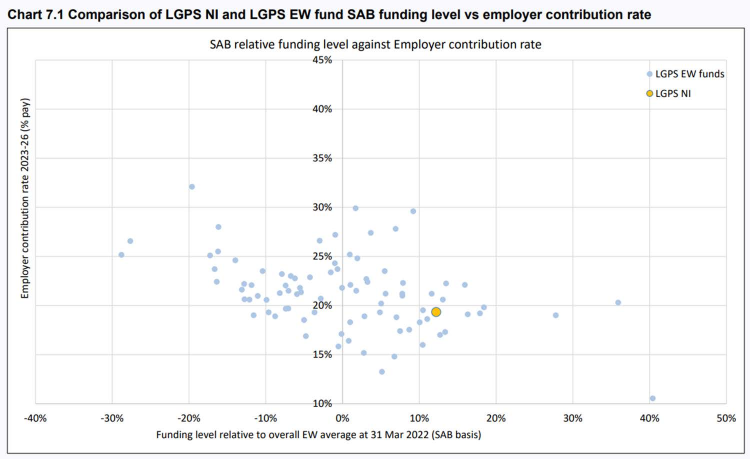
7.12 In England and Wales section 13 report, we considered the spread of the SAB funding level against employer total contributions (i.e. future contribution rate plus or minus average past service contributions over the next three years, expressed as a percentage of pensionable earnings) for each fund. We have included the NILGOSC pension fund in chart 7.1.
7.13 Other things being equal, we might expect lower contributions to be associated with higher funding levels. This pattern can be seen in the chart above. However, there is a wide range of contribution rates being paid by funds with similar fund levels. This variation could be due, to an extent, to different funding strategies, to attitudes to risk, and to payroll sizes relative to liabilities.
7.14 Overall, the chart shows that the fund is in a good position overall. It is better funded, on the SAB basis, than most LGPS England and Wales funds. The contribution rate being paid in the NILGOSC fund appears to be reflecting the strong funding position, and is not higher or lower than might be expected, relative to similarly funded England and Wales comparators.
Deficit Reconciliation
7.15 We consider that reconciliation of the deficit recovery plan is an essential component for all funds to demonstrate they meet LTCE requirements.
7.16 Generally, we would not normally expect to see employer contribution rates decreasing (reducing the burden on current taxpayers) at the same time as the deficit recovery end point being extended further into the future (increasing the burden on future taxpayers).
7.17 The maximum deficit recovery end point has been extended from 2037 to 2043. There were seven employers who were in deficit at the time of the valuation. For three of these employers, total contribution rates were broadly stable, or potentially slightly decreasing. We also understand that for these employers the recovery plan was based on a flight path to closure aligned with the future expected working life of active members but has been changed to 20 years. This reduces the current burden on the employers at the same time as the deficit recovery is being extended further into the future, increasing the future burden on the employers.
7.18 Aon confirmed that this approach had been agreed by the fund in discussions with employers. We understand that the extensions reflect that the employers are not expected to exit the fund in the short-term, and also acknowledged the likely improvements in these employers’ funding positions in light of post-valuation investment market changes. Whilst we encourage funds to not reduce contributions, and also extend end points, the approach to these small number of employers does not appear inappropriate when considering risks to the fund as a whole.
7.19 If at a future valuation the fund is in deficit NILGOSC should avoid continually extending the deficit recovery period end point at subsequent actuarial valuations as this will not meet the LTCE requirements. Over time and given stable, or better than expected market conditions, administering authorities should aim to:
- Maintain the levels of contributions and/or
- Reduce deficit recovery periods by maintaining the end point of the recovery period.
7.20 We appreciate there may be circumstances where new deficit emerges between valuations, as a result of the fund’s experience, where it may then be appropriate to extend the recovery period. For example, if a fund within the last three years of its deficit recovery period experienced a material reduction in its funding level, it would not be appropriate in the context of intergenerational fairness to repay that new deficit within three years also.
7.21 We believe it is appropriate for funds to consider their plans for the duration of the deficit recovery period, so that future contributions are recognised and these form part of employers’ budgeting process.
7.22 The dashboard includes additional information on total contributions, discount rates and reconciliation of the deficit recovery plans in. We are grateful for the disclosure of this additional information, which has aided our analysis on deficit reconciliation.
7.23 We recommend that DfC consider if additional guidance on deficits would be helpful, and in particular how the fund ensures that the deficit recovery plan can be demonstrated to be a continuation of the previous plan (see Recommendation 1).
Surplus considerations
7.24 At the 2019 and 2022 valuations, the fund was in surplus on a local basis.
7.25 There is a range of reasonable uses of fund surpluses, with strategies varying by fund to manage their specific risks and circumstances. Examples of surplus uses include (where the list below is not exhaustive):
-
Reductions in contributions, which may be managed via a surplus buffer (i.e. only surplus above an agreed funding level is utilised) or stability mechanism (with restrictions on the extent to which contribution rates can change over an agreed time period).
-
Review of investment strategy.
-
Reviewing the level of prudence within funding strategies, which changes the chance that future experience is better/worse than assumed.
7.26 The fund approach to addressing surpluses is based on the employer classifications given in section 6.19 above.
7.27 Where a surplus is attributable to an employer, the fund will consider using this to reduce that employer’s contributions. For employers in the Main Employer and Intermediate funding groups, a buffer mechanism is used. This means that only assets in excess of 105% of the employer’s liabilities will act to reduce contributions. The fund will generally calculate the reduction assuming the surplus is spread over a period of 20 years. The exception is for employers expected to exit the fund, where any surplus is spread over the average expected future working period of the active members.
7.28 Table 7.1 includes the Surplus retention metric, which considers whether the fund is utilising the surplus too quickly. The fund raised a green flag under this metric.
7.29 The counter risk to funds utilising surpluses too quickly is funds retaining “large” surpluses and not recognising the strong funding position in the fund’s contribution rates. In such a scenario the fund may be seen as being unfair to current taxpayers, with future taxpayers expecting to benefit disproportionately.
7.30 For future reviews, GAD will adopt a three-step approach:
-
identify whether the fund is exceptionally well funded (relative to funds in LGPS England and Wales).
-
Identify whether the fund is well-funded and still paying high contributions (again relative to funds in LGPS England and Wales).
-
If NILGOSC is identified to be meeting one of these two criteria, we would undertake qualitative analysis. For example, considering how contribution rates have evolved since the previous valuation and any stated rationale behind the approach adopted.
7.31 On completion of the three-step process, GAD would consider any other relevant circumstances, and engage with NILGOSC to discuss any concerns before deciding if a flag should be raised. The England and Wales report sets out the three-step approach in more detail.
7.32 We have considered surpluses utilisation in detail as part of the LGPS England and Wales Section 13 exercise, including completing an Asset Liability Model (ALM) for different strategies, in Chapter 7 of the LGPS EW Section 13 Report.
7.33 The England and Wales SAB have published Guidance for Preparing and maintaining a Funding Strategy Statement (FSS). DfC may wish to consider whether equivalent guidance should be implemented for LGPS NI, with particular consideration of use of surplus and how the deficit recovery plan is a continuation of the previous plan.
Recommendation:
We recommend that Department for Communities consider the following:
-
Where LGPS NI is in surplus, whether additional guidance can be provided to support balancing different considerations.
-
Where deficits exist, how can LGPS NI ensure that the deficit recovery plan can be demonstrated to be a continuation of the previous plan.
Appendix A: Data & Methodology
A.1 Data was received from the fund actuary for NILGOSC. This included fund documentation, and information on membership, valuation assumptions, assets, liabilities and future contributions rates, emerging issues, and details of the 50:50 scheme. This was broadly as detailed in Appendix F of LGPS England and Wales section 13 report, but there were some LGPS NI specific differences. These are detailed below:
A.2 Results on the England and Wales SAB standard basis were provided by the NILGOSC fund actuary.
A.3 Data in respect of the breakdown of members employed by employers with tax raising powers was received from NILGOSC.
A.4 There was no core spending data available for NILGOSC employers, so we did not use this information in our metrics. Instead, we based our metrics on payroll, which was provided by the NILGOSC fund actuary.
A.5 There were no ‘SF3’ financial statistics available for LGPS NI. We used information from the Northern Ireland Audit Office’s Local Government Auditor’s Report - 2024.
A.6 The primary contribution rate refers to the “common” or future service contribution rate and the secondary contribution rate refers to the past service rate in the NILGOSC pension fund valuation report.
A.7 The data underlying the position of the funds in England and Wales (which have been used for information purposes within this report) are set out in Appendix F of the Appendices to the England and Wales section 13 report.
A.8 The fund actuary provided details of liabilities at the valuation date on both local and SAB standard bases. We have used these liabilities in our metrics as appropriate. Where we have used the GAD best-estimate basis in metrics, we have estimated the liabilities on that basis through the use of ‘basis switch’ calculations which allow us to measure the impact of the relevant changes in the assumptions.
A.9 The ‘basis switch’ we have carried out has been calculated using individual membership data provided to us for our valuation of the scheme as at 31 March 2020, as outlined in our valuation data report. We have then rolled-forward the liabilities to the valuation date using cashflow data provided by the fund. This is a different approach than for our S13 valuation of the 2019 valuations, where we held membership data at the valuation date and so no roll-forward was required.
A.10 In preparing this report, GAD has relied on data and other information supplied by NILGOSC and its advisors, as described in the report. GAD has not sought independent verification around its general completeness and accuracy.
A.11 Any checks that GAD has made are limited to those described in this and associated reports, including those relating to the overall reasonableness and consistency of the data. These checks do not represent a full independent audit of the data supplied.
Appendix B: Assumptions
B.1 Each section of analysis contained in the main report is based on one of three sets of assumptions:
- The NILGOSC pension fund assumptions, as used in the fund’s 2022 actuarial valuation
- The LGPS England and Wales SAB standardised set of assumptions (E&W SAB standard basis)
- A best estimate set of assumptions
B.2 Details of the E&W SAB standard basis and the standardised best estimate basis can be found in the table below.
Table B1: SAB standard basis and best estimate basis
| Assumption | SAB standard basis | Best Estimate basis |
|---|---|---|
| Methodology | Projected Unit Methodology with 1 year control period | Projected Unit Methodology with 1 year control period |
| Rate of pension increases | 2% per annum | 2.4% per annum |
| Public sector earnings growth | 3.5% per annum | 3.9% per annum |
| Discount rate | 4.45% per annum | 4.0% per annum |
| Changes to State Pension Age (SPA) | As legislated | As legislated |
| Pensioner Baseline mortality | Set locally based on Fund experience | Set locally based on Fund experience |
| Mortality improvements | Core CMI_2021 (no allowance or 2020 and 2021 mortality data) with long-term reduction in mortality rates of 1.5% per annum | Improvements in line with those underlying the ONS 2020-based principal population projections for the UK |
| Age retirement | Set locally based on Fund experience | Set locally based on Fund experience |
| Ill health retirement rates | Set locally based on Fund experience | Set locally based on Fund experience |
| Withdrawal rates | Set locally based on Fund experience | Set locally based on Fund experience |
| Death before retirement rates | Set locally based on Fund experience | Set locally based on Fund experience |
| Promotional salary scales | None | Set locally based on Fund experience |
| Commutation | SAB future service cost assumption of 65% of the maximum allowable amount | Set locally based on Fund experience |
| Family statistics | Set locally based on Fund experience | Set locally based on Fund experience |
B.3 The financial assumptions for the best estimate basis are based on GAD’s neutral assumptions for long-term inflation measures and asset returns. The discount rate is based on the asset weight of the NILGOSC fund assets held as at 31 March 2022.
B.4 These neutral assumptions are not deliberately optimistic nor pessimistic and do not incorporate adjustments to reflect any desired outcome. We believe there is around a 50% chance of outcomes being better and a 50% chance of outcomes being worse than these assumptions imply.
B.5 We have summarised the asset split and broad asset categorisation in table B.2.
Table B.2: NILGOSC fund asset split
| Asset Class | Asset Allocation |
|---|---|
| Equity | 40.4% |
| Property | 10.7% |
| Infrastructure | 3.6% |
| Bonds (Gilts, Index-linked gilts and non-Government), | 25.7% |
| Multi asset | 12.8% |
| Cash & other defensive assets | 6.8% |
B.6 Future asset returns are uncertain and there is a wide range of reasonable views on what future asset returns will be and therefore the best estimate discount rate should be. We have presented GAD’s house view above, based on the asset split in the table, but there are other reasonable best estimate bases which may give materially different results. Local actuarial valuation funding assumptions
B.7 Full details of the local valuation assumptions adopted by Aon as at 31 March 2022 can be found in the fund’s valuation report.
B.8 The key long-term financial assumptions are shown in the table below.
Table B.3: Local valuation financial assumptions:
| General financial assumptions | |
|---|---|
| Rate of pension increases | 2.3% per annum |
| Public sector earnings growth | 3.8% per annum |
| Discount rate (Note 1) | In-service: 4.2% per annum |
| Left service: 4.2% to 0.8%, per annum |
Note 1: Different discount rates used for Main Employer, Intermediate Funding, and Ongoing Orphan, employer groups.
Appendix C: Section 13 of the Public Service Pensions Act (Northern Ireland) 2014
Employer contributions in funded schemes
(1) This section applies in relation to a scheme under section 1 which is a defined benefits scheme with a pension fund.
(2) Scheme regulations must provide for the rate of employer contributions to be set at an appropriate level to ensure—
(a) the solvency of the pension fund, and
(b) the long-term cost-efficiency of the scheme, so far as relating to the pension fund.
(3) For that purpose, scheme regulations must require actuarial valuations of the pension fund.
(4) Where an actuarial valuation under subsection (3) has taken place, a person appointed by the responsible authority is to report on whether the following aims are achieved—
(a) the valuation is in accordance with the scheme regulations;
(b) the valuation has been carried out in a way which is not inconsistent with other valuations under subsection (3);
(c) the rate of employer contributions is set as specified in subsection (2).
(5) A report under subsection (4) must be published; and a copy must be sent to the scheme manager and (if different) the responsible authority.
(6) If a report under subsection (4) states that, in the view of the person making the report, any of the aims in that subsection has not been achieved—
(a) the report may recommend remedial steps;
(b) the scheme manager must—
(i) take such remedial steps as the scheme manager considers appropriate, and
(ii) publish details of those steps and the reasons for taking them;
(c) the responsible authority may—
(i) require the scheme manager to report on progress in taking remedial steps;
(ii) direct the scheme manager to take such remedial steps as the responsible authority considers appropriate.
(7) The person appointed under subsection (4) must, in the view of the responsible authority, be appropriately qualified and must not be—
(a) an employee of the responsible authority;
(b) the scheme manager;
(c) a scheme member; or
(d) an employee of the Department of Finance and Personnel.
Appendix D: Extracts from other relevant regulations
Regulations 64 and 68 of ‘The Local Government Pension Scheme Regulations (Northern Ireland) 2014 (as amended)
Funding strategy statement
64.– (1) The Committee shall, after consultation with such persons as it considers appropriate, prepare, maintain and publish a written statement setting out its funding strategy.
(2) The statement shall be published no later than 31st March 2015.
(3) The Committee shall keep the statement under review and, after consultation with such persons as it considers appropriate, make such revisions as are appropriate following a material change in its policy set out in the statement and, if revisions are made publish the statement as revised.
(4) In preparing, maintaining and reviewing the statement, the Committee shall have regard to—
(a) the guidance set out in the document published in October 2012 by CIPFA, the Chartered Institute of Public Finance and Accountancy and called “Preparing and Maintaining a Funding Strategy Statement in the Local Government Pension Scheme 2012” ; and
(b) the statement of investment principles published by the Committee under regulation 10 (statement of investment principles) of the 2000 Regulations.
Actuarial valuations and certificates
68.– (1) The Committee shall obtain—
(a) an actuarial valuation of the assets and liabilities of the pension fund, as at 31st March 2016 and on 31st March in every third year afterwards;
(b) a report by an actuary in respect of the valuation; and
(c) a rates and adjustments certificate prepared by an actuary.
(2) Each of those documents shall be obtained before the first anniversary of the date (“the valuation date”) as at which the valuation is made or such later date as the Department may agree.
(3) A report under paragraph (1)(b) shall contain a statement of the demographic assumptions used in making the valuation and the statement shall show how the assumptions relate to the events which have actually occurred in relation to members of the Scheme since the last valuation.
(4) A rates and adjustments certificate is a certificate specifying—
(a) the common rate of employers’ contribution;
(b) any individual adjustments; and
(c) any amount calculated in accordance with paragraph (8),
for each year of the period of three years beginning with 1st April in the year following that in which the valuation date falls.
(5) The common rate of employers’ contribution is the amount, if any, which in the actuary’s opinion, should be paid to the pension fund so as to secure the fund’s solvency by all contributing bodies whose employees contribute to it expressed as a percentage of the pay of their employees who are active members, or for any other employing authority or former employing authority which does not employ active members but is liable to contribute to the fund under regulation 70(12) and (13) (special circumstances where revised actuarial valuations and certificates shall be obtained) is such amount as is payable under regulation 70(13).
(6) The actuary shall have regard to—
(a) the existing and prospective liabilities arising from circumstances common to all those bodies;
(b) the desirability of maintaining as nearly constant a common rate of employers’ contribution as possible;
(c) the current version of the Committee’s funding strategy statement mentioned in regulation 64 (funding strategy statement); and
(d) the desirability of securing long-term cost efficiency of the pension fund.
(6A) Compensation paid by the scheme to a person by virtue of section 82(1) of the PSPJOA 2022 or additional benefits payable by virtue of regulation 4Q (payment of indirect compensation) of the Transitional Regulations are liabilities for the purpose of the actuarial valuation under paragraph (1)(a).
(7) An individual adjustment is any percentage or amount by which, in the actuary’s opinion, contributions at the common rate of employer’s contribution should, in the case of—
(i) a particular contributing body;
(ii) a particular guarantor; or
(iii) both employing authority and inheriting body if agreed under regulation 71 (apportionment),
be increased or reduced by reason of any circumstances peculiar to that contributing body, guarantor or both of them and, where necessary, reflects inherited liabilities being attributable or no longer attributable.
(8) Where inherited liabilities are attributable to a guarantor or any other person which is not an employing authority, at the direction of the Committee, the actuary shall calculate such amount which in the actuary’s opinion such a guarantor or other person that is not an employing authority should pay by reason of its assumption of responsibility for these inherited liabilities.
(9) A rates and adjustments certificate shall contain a statement of the assumptions on which the certificate is given as respects—
(a) the number of members who will become entitled to payment of pensions under the provisions of the Scheme; and
(b) the amount of the liabilities arising in respect of such members,
during the period covered by the certificate.
(10) The Committee shall provide the actuary preparing a valuation or a rates and adjustments certificate with the consolidated revenue account of the pension fund and such other information as the actuary requests.