Late payment common framework
Published 19 March 2026

© Crown copyright 2026
This publication is licensed under the terms of the Open Government Licence v3.0 except where otherwise stated. To view this licence, visit nationalarchives.gov.uk/doc/open-government-licence/version/3 or write to the Information Policy Team, The National Archives, Kew, London TW9 4DU, or email: psi@nationalarchives.gov.uk.
Where we have identified any third party copyright information you will need to obtain permission from the copyright holders concerned.
This publication is available at https://www.gov.uk/government/publications/late-payment-common-framework/late-payment-common-framework
Section 1: what we are talking about
Policy area
Late payment (commercial transactions)
The Late Payment Directive (2011/7/EU) was designed to protect EU businesses against late payment in commercial transactions. The domestic legislation which implements this directive remains assimilated law, and the directive is the basis of the regime currently in effect in the UK.
Scope
The United Kingdom first implemented late payment legislation in 1998 (Late Payment of Commercial Debts (Interest) Act 1998), which introduced statutory interest for late payments.
Amended late payment legislation came into force on 16 March 2013 in relation to England and Wales and Northern Ireland under the Late Payment of Commercial Debts Regulations 2013. It came into force on 29 March 2013 in relation to Scotland under the Late Payment of Commercial Debts (Scotland) Regulations 2013 (SSI 2013/77), which implemented the recast European Directive 2011/7/EU on resolving late payment in commercial transactions. A further amendment was made to the 1998 Act in 2013 to implement Directive 2011/7/EU. This came into force in relation to Scotland on 3 May 2013 under the Late Payment of Commercial Debts (Scotland) (No. 2) Regulations 2013 (SSI 2013/131).
Directive 2011/7/EU replaced the original Late Payment Directive 2000/35/EC. Amendment Regulations were made in 2015 (SI no.1336 and SSI no. 2015/226 (the Late Payment of Commercial Debts (Scotland) Regulations 2015)) and minor amendments were made to the domestic late payment regime in 2018, under The Late Payment of Commercial Debts (Amendment) Regulations 2018 in relation to England and Wales and Northern Ireland, and under the Late Payment of Commercial Debts (Scotland) Amendment Regulations 2018 (SSI 2018/160) in relation to Scotland to ensure the Late Payment Directive was correctly implemented.
The main provisions of the domestic late payment regime, as amended by the assimilated law instruments listed, are as follows:
- public authorities must pay for the goods and services that they procure within 30 days
- enterprises must pay their invoices within 60 days, unless they expressly agree otherwise and provided it is not grossly unfair
- automatic entitlement to interest for late payment and a 40 euros minimum as compensation for recovery costs. The UK position is a fixed charge of £40, £70 or £100, depending on the size of the debt (under £1,000, under £10,000, and higher), plus additional reasonable costs incurred which were not met by the fixed sum
- statutory interest of at least 8% above the European Central Bank’s reference rate – the UK position is the Bank of England reference rate plus 8 percentage points
- EU countries may continue maintaining or bringing into force laws and regulations which are more favourable to the creditor than the provisions of the directive
Legislative competence for legislation relating to late payments is devolved in Scotland (under the Scotland Act 1998), Wales (under the Government of Wales Act 2006), and Northern Ireland (under the Northern Ireland Act 1998). The UK government has laid regulations on behalf of Northern Ireland and Wales, while the Scottish Government has laid its own legislation for Scotland.
To comply with the requirements of the EU directive, the existing legislation has been applied uniformly across the 4 nations. This has limited the ability of the parties to independently set policy in this area, as they were required to remain compliant with the standards set in the encompassing EU directive. Following the UK’s exit from the EU, the UK is no longer subject to EU law in this area, providing increased scope for potential variation in policy across the UK. As a result, this common framework will apply UK-wide.
This framework operates in accordance with the principles outlined in the encompassing intergovernmental memorandum of understanding on devolution (henceforth ‘intergovernmental MoU on devolution’) and the outcomes of the review of intergovernmental relations. It is consistent with, and complemented by, other guidance on common working arrangements, notably the principles described in the Joint Ministerial Committee (EU Negotiations) communiqué of 16 October 2017.
In October 2017, the Joint Ministerial Committee (EU Negotiations) (JMC(EN)) agreed principles to guide the work to create common frameworks.
- Common frameworks will be established where they are necessary to:
- enable the functioning of the UK internal market, while acknowledging policy divergence
- ensure compliance with international obligations
- ensure the UK can negotiate, enter into and implement new trade agreements and international treaties
- enable the management of common resources
- administer and provide access to justice in cases with a cross-border element
- safeguard the security of the UK
2․ Frameworks will respect the devolution settlements and the democratic accountability of the devolved legislatures, and will therefore:
- be based on established conventions and practices, including that the competence of the devolved institutions will not normally be adjusted without their consent
- maintain, as a minimum, equivalent flexibility for tailoring policies to the specific needs of each territory, as is afforded by current EU rules
- lead to a significant increase in decision-making powers for the devolved administrations
3․ Frameworks will ensure recognition of the economic and social linkages between Northern Ireland and Ireland, and that Northern Ireland will be the only part of the UK which shares a land frontier with the EU. They will also adhere to the Belfast Agreement.
The Late Payment Framework has been established to enable the functioning of the UK internal market, while acknowledging policy divergence.
The area of policy covered by this common framework does not fall directly within the provisions of the Trade and Cooperation Agreement (TCA), although both the common framework and that agreement will influence devolved and reserved responsibilities significantly. Agreed outcomes of the ongoing intergovernmental relations review are reflected in this common framework.
There is no conflict in these Framework proposals with the relevant provisions of the Belfast (Good Friday) Agreement, and there is no intersection between late payment policy and the Windsor Framework.
Definitions
Not applicable.
Section 2: proposed breakdown of policy area and framework
Summary of proposed approach
A business operating across different parts of the UK would be directly affected by divergent regulations. For example, each of the 4 parties could choose to implement different regulatory timescales for repayment or introduce different statutory interest rates on late payments.
As a result, there would need to be clear criteria to ascertain which regulations apply to businesses operating across different parts of the UK, and to avoid some businesses having a competitive advantage or disadvantage. To manage divergence, the parties have agreed to develop a common UK-wide approach to maintain a level playing field for business, which will help to maintain the functioning of the UK internal market.
This is a non-legislative framework, underpinned by concurrent ministerial agreement to establish the common framework. This approach will maintain existing mutual understanding and joint ways of working between the parties. It will provide a forum to consult on developments within, or between, the parties, and to manage any divergence.
While the parties have had the powers to diverge within their existing competence, a common UK approach has been maintained to date, with recognition of the importance of maintaining a level playing field across the existing body of late payment legislation, providing consistency and a uniform approach to the benefit of businesses across the UK.
Detailed overview of proposed framework: legislation (primary or secondary)
There is currently effectively a level playing field across the UK in respect of Late Payment of Commercial Debts legislation, which provides for payment periods between businesses of 60 days (or more by agreement), and 30 days for public bodies to pay businesses. The parties agree that no new legislation is considered necessary to maintain this approach or to establish the common framework.
Detailed overview of proposed framework: non-legislative arrangements
Existing joint working relationships have been satisfactory for all parties. Previous conversations between officials have highlighted a preference for maintaining the current degree of co-ordination now that the UK is outside the EU. This outline agreement sets out the common framework.
The development of the Late Payment common framework is part of the wider programme of engagement on common frameworks jointly undertaken by all parties, as agreed at the Joint Ministerial Committee in October 2017.
These key principles have been proposed on the required ways of working, consistent with what is in place now, to support the parties’ work on late payment and ensure a joined-up approach:
-
All parties agree that it is beneficial for all UK businesses that there is a common framework for late payment policy.
-
The parties will consider the impact of decisions on other parties and the UK internal market and provide time for meaningful engagement on the issue in twice-yearly meetings of the Late Payment Working Group, containing policy leads from each of the Parties. This working group will meet regularly when required, for example, for information sharing, decision-making or dispute resolution purposes. Meetings of the working group may also be convened outside the regular schedule if a substantial issue arises.
-
Any proposed legislative changes should be shared with the other parties at an official level at the earliest possible point, typically through email exchange initially. The party or parties proposing to diverge from existing arrangements will notify and consult the other parties in respect of their intended action. Should any of the other governments object to the proposed action, the parties will endeavour to identify a mutually acceptable common approach which would achieve an equivalent, or preferably identical outcome. If no mutually acceptable resolution is found, and one or more of the parties wishes to develop the proposal, the objecting party or parties may start the formal dispute resolution procedure set out in subsection 13. This framework respects the right of parties to opt to ‘agree to disagree’ or ‘agree to diverge’ in certain circumstances where parties consider this to be the preferred outcome.
-
Future collaborative meetings will be conducted at the official level and without prejudice to ministerial views. Official-level meetings will be scheduled twice-yearly to encourage regular engagement and ensure parties do not lose touch with important officials. Additional meetings will be scheduled on an ad hoc basis if any significant issues arise.
-
While it is not anticipated that any dispute will arise, any action under dispute should be paused pending resolution through the dispute resolution mechanism. This process will be guided by an agreement to resolve disputes at the lowest possible level of governance. If one party wishes to diverge, the party must first see if a common approach can be agreed that accommodates that individual party’s desired outcomes and does not disproportionately influence the functioning of the UK internal market.
-
Escalations, if necessary, should be done first at the official level via the Late Payment Working Group. If a satisfactory resolution cannot be found, the matter should be escalated to the Late Payment Programme Board, made up of senior officials. If a resolution still cannot be reached, it will be escalated to ministers to provide input or hold a multilateral discussion. Existing routes of multilateral engagement between the parties should be used for this process. If a resolution cannot be reached at this level, the matter may be referred to the Inter-Governmental Relations Secretariat for potential consideration by the Interministerial Standing Committee – although all parties will strive to resolve issues at the official or ministerial level between parties before this point is reached.
-
Terms of reference for the Late Payment Working Group and Late Payment Board can be found in Annexes A and B.
Detailed overview of areas where no further action is thought to be needed
Not applicable.
Section 3: proposed operational elements of the framework
Decision-making
Decisions will be made in accordance with the principles outlined earlier in this document under ‘Detailed overview of proposed framework: non-legislative arrangements’, in addition to the common framework principles agreed at JMC(EN). The agreed twice-yearly meetings of the Late Payment Working Group will involve all 4 governments to ensure joint working and information sharing are conducted for this policy area. All parties will have equal decision-making standing.
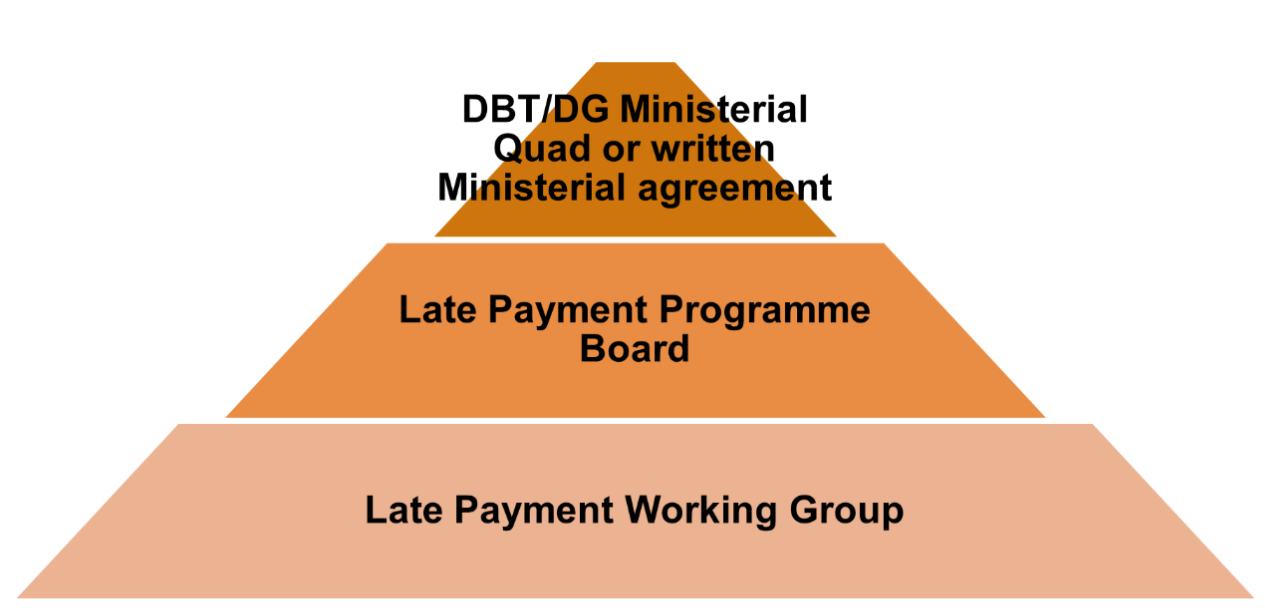
Decisions will pass through the Late Payment Working Group to the Late Payment Programme Board, made up of senior officials from all 4 governments, and then to ministers. However, not every decision will need to be escalated to the Late Payment Programme Board, nor to the ministerial level. Figure 1 outlines how decisions are expected to be made, where required. In the unlikely event that a decision cannot be made at the ministerial level, the matter will be referred to the dispute avoidance and resolution mechanism.
Figure 1: dispute avoidance and resolution mechanism
Roles and responsibilities of each party to the framework
The following sets out the role and responsibilities of officials and ministers in this common framework.
Officials
Policy officials will hold regular discussions on the policy covered by the Late Payment Common Framework and provide ministers with advice on the rationale for the approach taken within the policy area (for example, a UK or GB-wide approach), or why divergent policies may be necessary.
Officials across parties will convene to discuss policy issues as appropriate and will discuss any ramifications that policy will have across different parts of the UK. If officials do not agree when making decisions, issues discussed at the Late Payment Working Group can be escalated to senior officials in the Late Payment Programme Board, in line with the framework’s dispute avoidance and resolution mechanism.
Senior officials
Senior officials (for example, deputy directors and directors) will provide strategic direction on the policy areas governed by the Late Payment Framework and take important operational decisions.
They may review an issue as per the framework’s dispute avoidance and resolution mechanism if officials are not able to agree on an approach, or if ministers have disagreed with advice from officials in the first instance, in another attempt to reach agreement. Senior officials will convene to discuss issues as appropriate, on an ad hoc basis, through the Late Payment Programme Board.
Ministers
Ministers may receive advice from their officials either concurrently across parties as issues arise, or during business as usual for individual Parties. Ministers may accept advice, or they may reject it. If an issue is escalated to senior officials and the issue remains unresolved, the issue may be escalated to ministers.
Where ministers are considering issues as part of the framework’s dispute avoidance and resolution mechanism, this could be via various media, including inter-ministerial meetings or by correspondence.
Information sharing
As per the current MoU on devolution and the conclusions of the Intergovernmental Relations Review, each party will aim to provide each other with as full and open access as possible to policy information, including statistics and research and, where appropriate, representations from third parties.
Roles and responsibilities of existing or new bodies
There are no existing bodies that have a formal role with respect to the operation of this Framework. Terms of reference for the Late Payment Working Group and Late Payment Programme Board are set out in the annexes to this Framework Outline Agreement.
Monitoring
The Late Payment Working Group will oversee the functioning of the common framework. Any request to amend any element of the framework will be considered by this group to see whether the threshold for exceptional review and amendment is reached, or to consider it through the periodic review process.
The group will agree on what information it will need to see to provide assurance that the framework is operating effectively, and how often the information should be collected and reviewed.
Review and amendment
This Common Framework will be reviewed annually with all parties through the Late Payment Working Group. The review will look at compliance with the framework, and evaluate whether it is still suitable to ensure all parties can achieve their aims on the late payment policy. Ad hoc reviews can also be scheduled at the request of any Party if a substantial issue arises.
Review stage
-
The Late Payment Working Group will review the framework one year after final sign-off, and every 3 years thereafter, to ensure it is working effectively, or if any amendments should be made. If changes to the framework are required, senior officials and ministers will need to agree to trigger the amendment stage.
-
An exceptional review can be triggered by a significant issue:
-
to constitute a significant issue, an issue must be time-sensitive and fundamentally influence the operation or the scope of the framework
-
an example would be an issue that means the Framework no longer adheres to the common frameworks principles agreed at JMC(EN) in October 2017
Amendment stage
3․ The amendment stage can only be triggered through unanimous agreement by ministers from all parties. The existing framework will remain in place until a final amendment has been agreed upon.
4․ All amendments to the framework must be agreed by ministers from all parties, and a new non-legislative agreement signed on behalf of all parties.
Third parties can be used by any party to the common framework to provide advice at any stage in the review or amendment process. If agreement is not reached in either the review or amendment stage, parties to the framework can raise it as a dispute through the framework’s dispute avoidance and resolution process.
Dispute resolution
Disagreements could arise at:
- official level – where officials cannot agree to either recommending a common approach, or recommending that divergence is appropriate, and outlining the impact that this may have on the internal market
- ministerial level – where ministers cannot agree on the response to the recommendation put forward to them by officials, or where a dispute cannot be resolved at official level and is escalated to ministers, who also cannot reach a decision
Dispute resolution processes should only be used if resolution through normal working processes has not been possible. The Late Payment governance provides mechanisms for good communication and co-operation, which should reduce the likelihood of disputes arising. In some areas, commonality of approach will not be needed to meet the JMC(EN) Frameworks principles, and therefore an ‘agreement to diverge’ would be acceptable.
Ministerial dispute resolution
In rare instances where ministers do not reach a unanimous agreement on a joint recommendation, or where officials cannot agree an approach (and the disagreement is escalated to ministers for a decision), a ministerial dispute resolution mechanism will be required at the portfolio level (that is, there should be a process for ministers to seek to resolve disputes and reach agreement).
Where disputes do arise, they should be handled with adherence to the same principles as the officials’ dispute resolution process. In the first instance, the matter should return to officials (with a steer on areas of further work), who should review the available technical material and present further advice to ministers as appropriate. If this is not sufficient to resolve the dispute, a panel of senior officials from the 4 nations could meet to discuss possible approaches and a way forward.
Once all options outlined above have been exhausted, and if a disagreement has still not been resolved, the disagreement can be referred to the Inter-Governmental Relations Secretariat to consider whether it meets the criteria for escalation to the Inter-Ministerial Standing Committee.
Decisions will be made in accordance with the key principles earlier in this document under ‘Detailed overview of proposed framework: non-legislative arrangements’, in addition to the Common Framework principles agreed at JMC(EN) in October 2017. The Late Payment governance provides mechanisms for good communication and co-operation, which should reduce the likelihood of disputes arising.
In the unlikely event that a disagreement does arise, a resolution will be sought by following these principles:
- it does not always follow that, where disagreements emerge, they will need to be escalated or a ‘solution’ established. This framework will not prejudice the right of parties to opt to ‘agree to disagree’ or ‘agree to diverge’ in certain circumstances
- in the unlikely event that a common approach cannot be agreed upon, and divergence is not considered acceptable by one or more of the parties, the dispute resolution mechanism should be engaged. This should only happen if:
- genuine agreement cannot be made;
- one or more parties consider that the core principles or terms of reference agreed for the framework have been breached; or
- one party considers that a common framework principle has not been respected, or undue weight has been placed on one principle (or part of a principle) at the expense of another
- this process will be guided by the principle to resolve at the lowest possible level of governance. If a satisfactory resolution cannot be agreed upon at the working level, the matter will be escalated to senior officials before being escalated to ministers
- actions under dispute should be paused pending resolution through the dispute resolution mechanism
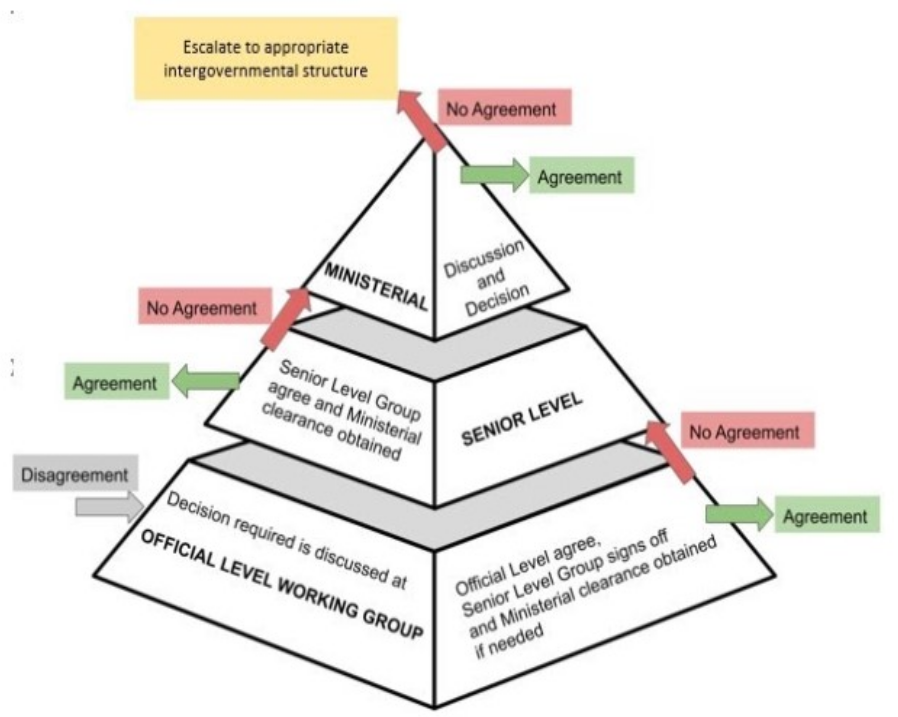
The dispute resolution mechanism is outlined in Figure 2.
Figure 2: dispute resolution mechanism
Annex A: Late Payment Working Group Terms of Reference
Purpose
The purpose of the Late Payment Working Group is to bring together the 4 parties to:
- discuss multilateral policy development
- seek to maintain a level playing field across the existing body of late payment legislation, providing consistency and a uniform approach to the benefit of businesses across the UK
- manage potential divergence in a way that respects the devolution settlements
Scope and objectives
While policy on late payment is a devolved matter, several wider policy initiatives and regulations operate on a UK-wide basis. The Late Payment Working Group will be a collegiate group which facilitates collaboration across the parties within this policy area. It will provide a forum for policy officials to engage in policy development, provide updates on progress, and raise concerns and awareness of cross-cutting issues.
Membership
Core membership:
- Department for Business and Trade (DBT)
- Scottish Government (SG)
- Welsh Government (WG)
- Department for the Economy (NI)
Rules of procedure
- DBT will chair and provide secretariat support for the group. However, this will be kept under constant review by the members
- regular meetings will be scheduled to take place, with ad-hoc meetings when required
- the meeting date, time and location will be agreed with all Parties
- the group will review its Terms of Reference against its objectives on a 12-month basis or more regularly if required to ensure it continues to add value
Annex B: Late Payment Programme Board Terms of Reference
Purpose
The purpose of the Late Payment Programme Board is to bring together the 4 parties to:
- facilitate multilateral policy development by resolving disputes relating to the Late Payment Working Group
- make decisions, by consensus of the Parties, on recommendations made by the Late Payment Working Group
- provide strategic planning decisions as identified by the Late Payment Working Group
- provide a mechanism of dispute resolution as needed and as referred by the Late Payment Working Group
- decide, by consensus of the Parties, to refer disputes of the Late Payment Working Group to ministers
- manage potential divergence in a way that respects the devolution settlements
Scope
While policy on late payment is a devolved matter, several wider policy initiatives and regulations operate on a UK-wide basis. The Late Payment Programme Board will be a collegiate group which has oversight over the Late Payment Working Group within this policy area. It will, where identified by the Late Payment Working Group, act as a crucial mechanism of the dispute resolution procedure within the Common Framework Agreement.
The Late Payment Programme Board maintains an oversight of relevant decisions of the Late Payment Working Group, and the scope of the Late Payment Programme Board is inclusive of relevant matters as identified by the Late Payment Working Group. Specifically, the Late Payment Programme Board will meet where dispute resolution is needed.
The primary objectives of the Late Payment Programme Board are to resolve disputes arising from the Late Payment Working Group. The Late Payment Programme Board may decide, by consensus of the parties, to refer matters to ministers in each party.
Membership
Core membership:
- Department for Business and Trade (DBT)
- Scottish Government (SG)
- Welsh Government (WG)
- Department for the Economy (NI)
Rules of procedure
The position of chair will rotate among members at each meeting.
DBT will provide secretariat support for the programme board. However, this will be kept under constant review by the members.
The programme board will meet where dispute resolution is needed or for financial or strategic planning decisions.
The meeting date, time and location will be agreed with all parties.
The programme board will review its terms of reference against its objectives on a 12-month basis or more regularly if required to ensure it continues to add value.