
ISAC areas of research interest
Published 24 March 2026

© Crown copyright 2026
This publication is licensed under the terms of the Open Government Licence v3.0 except where otherwise stated. To view this licence, visit nationalarchives.gov.uk/doc/open-government-licence/version/3 or write to the Information Policy Team, The National Archives, Kew, London TW9 4DU, or email: psi@nationalarchives.gov.uk.
Where we have identified any third party copyright information you will need to obtain permission from the copyright holders concerned.
This publication is available at https://www.gov.uk/government/publications/industrial-strategy-advisory-council-areas-of-research-interest/isac-areas-of-research-interest
Foreword
Dame Clare Barclay DBE, Chair of Industrial Strategy Council
The government’s Industrial Strategy sets out a clear 10‑year vision to drive economic growth across the United Kingdom. It provides a credible and long‑term plan to tackle the structural challenges that have held back productivity, investment and competitiveness, focusing on 8 sectors with the greatest potential to power national growth.
Partnership between businesses and the government sits at the heart of this strategy. The Industrial Strategy Advisory Council (ISAC) plays a central role in this collaboration. Our task is to bring together insights from businesses, academics, Trade Unions and other stakeholders, ensuring that the strategy and its implementation is informed by robust and relevant evidence.
Robust data, research and analysis are essential to this mission. They enable the ISAC to provide clear, evidence‑based advice and to support government in making the choices required to deliver the ambitions of the Industrial Strategy.
In 2025, the council helped shape the development of the strategy by providing expert perspectives from across industry. For 2026, the Chancellor of the Exchequer and the Secretary of State for Business and Trade have set us an ambitious programme of work focused on priority growth areas. Delivering this programme will require deep engagement with stakeholders and close partnership with the research community, ensuring that our recommendations are consistently underpinned by strong evidence, and that we continue to build the analytical foundations for industrial policymaking in the UK.
This publication presents ISAC’s first areas of research interest (ARIs). They highlight the most pressing questions where we are seeking the support of researchers, businesses and experts to strengthen the evidence base. The insights generated will help shape the delivery of the Industrial Strategy and support its goal of driving growth across the IS‑8 sectors and throughout the United Kingdom.
Introduction
The UK’s modern Industrial Strategy is a 10-year plan to back the United Kingdom’s strengths and realise its potential. The objective of the strategy is to drive up business investment, increase growth and create high quality jobs. The government is targeting investment at 8 growth‑driving sectors[footnote 1], the IS-8, and frontier industries. It is also focusing on the places and clusters that support them.
ISAC has a critical role to play in providing evidence-based advice to government. It works to ensure that the Industrial Strategy remains an enduring partnership between government and businesses across the UK, helping to build the longer-term evidence base for industrial policymaking. The first year mandate letter sets out an ambitious programme of work that will guide the council’s priorities in 2026.
This is the first publication of the council’s areas of research interest (ARIs). It sets out the ISAC’s view of the most pressing questions for the research community. These are areas where better data, evidence and insight can shape the UK’s Industrial Strategy and support growth in the IS‑8 sectors.
The document outlines 4 research clusters, their themes, and priority questions, signalling where new or improved evidence would most benefit the council’s work. By focusing on 4 broad clusters and their themes, the ISAC aims to deepen understanding of UK economic challenges and ground policy in cutting‑edge research. The clusters reflect our mandate letter, ensuring the ARIs inform current priorities while supporting longer‑term work to guide Industrial Strategy implementation.
How to engage with us?
The council is committed to fostering collaboration and partnerships with the research community to strengthen the role of evidence and expertise in our decision making. We are happy to receive submissions from experts, at all career stages, who are interested in sharing their research with us.
Contact us at isacevidence@businessandtrade.gov.uk if you would like to explore opportunities for collaboration, share relevant research, or discuss a specific ARI. The ISAC is currently part of the Department for Business and Trade (DBT). For details on how we will use your personal data please see the ARI privacy notice. The department has published its own ARIs and we will ensure that relevant research is shared where there is overlap.
We have developed the ARI through discussions with policy and analysis colleagues across government. This document is not an exhaustive list and we intend to update the ARI document in the future to ensure that it continues to reflect evolving priorities and evidence needs. The Government Office for Science provides further guidance on interpreting and using the ARIs.[footnote 2]
The role of the Industrial Strategy Advisory Council
To underline the government’s commitment to certainty, stability and long-termism, the government established the permanent Industrial Strategy Advisory Council (ISAC) in December 2024.
The ISAC provides independent, evidence-based advice on the implementation and evolution of the Industrial Strategy, and in doing so embeds stability to the government’s growth agenda.
The ISAC fulfils its objective through 3 core functions:
- Responding to government commissions on ministerial priority issues related to Industrial Strategy delivery.
- Undertaking projects within scope of the Industrial Strategy, informed by the annual mandate letter, with an understanding of ministerial priorities and supported by data and research programmes.
- Playing an important role in monitoring and evaluation (M&E). While it is for departments and public bodies to conduct M&E of their policies, the ISAC supports the government to drive forward effective implementation of the Industrial Strategy and helps build the capability of government to effectively monitor, evaluate and learn lessons as implementation progresses across the Industrial Strategy.
The 3 core functions are supported by external engagement with stakeholders, including across the regions and nations of the UK and secretariat-led work on data and research to build the evidence base, and complement existing work by relevant departments and public bodies.
The ISAC is supported by a secretariat, based in Manchester and London, comprising civil servants drawn from the analytical and policy professions.
Areas of research interest infographic
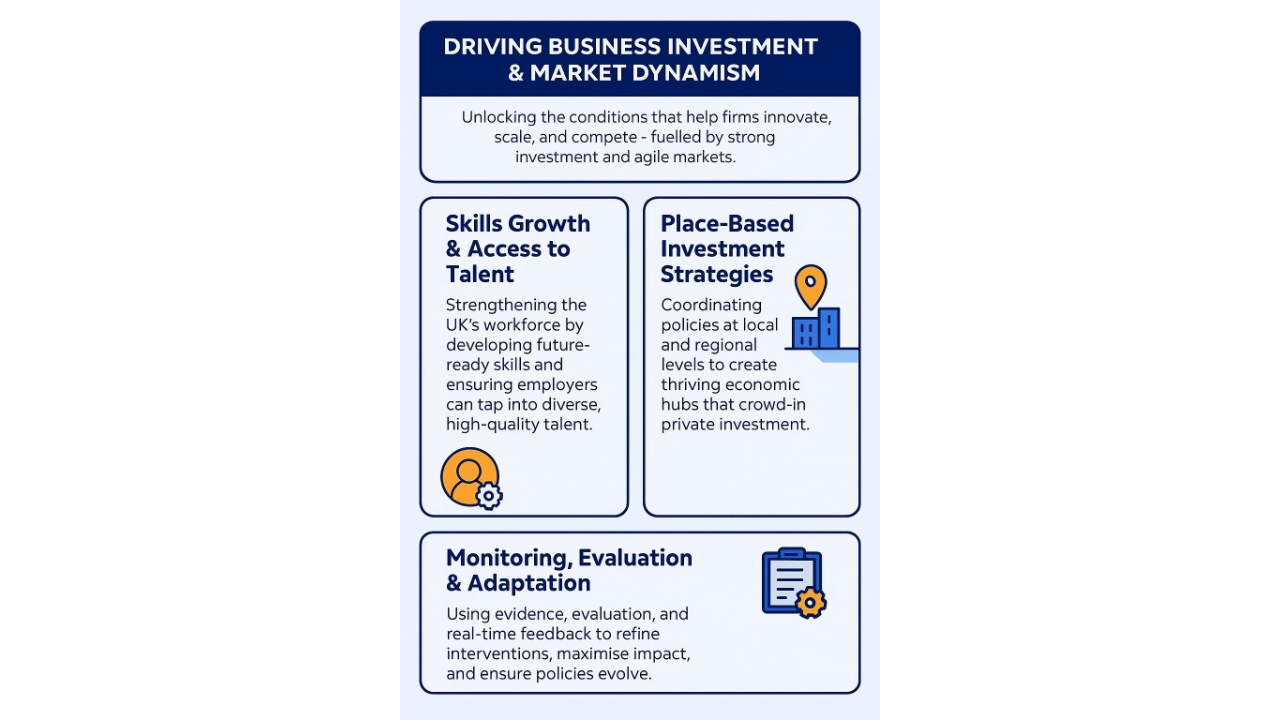
1. Increasing business investment and market dynamism in the IS-8 and frontier industries
The Industrial Strategy aims to spur national productivity growth, strengthen the UK’s economic security and resilience, and support the UK’s environmental and net zero transition. It aims to achieve this by increasing business investment in capital and innovation, attracting foreign investment, and increasing business dynamism in the IS-8 sectors.
These sectors contain the UK’s frontier industries that sit at the leading edge of innovation and have the greatest potential for future competitiveness and technological development. By prioritising these frontier industries, the strategy targets the parts of the economy most capable of driving innovation and supporting major transitions such as AI adoption and net zero.
Research themes and questions to help achieve these ambitions
1.1 Increasing business investment
How can industrial policy support increased business investment to boost stocks of physical, intangible and human capital across the IS-8? The sub‑questions we are exploring within this theme include:
- what are the historical and international lessons to increase business investment that the UK could adopt?
- what are the most important factors determining business investment decisions and sentiment across the Industrial Strategy sectors? How do these factors and challenges vary by firm type, size and sector?
- what are the interdependencies and complementarities between investments in physical, intangible and human capital? What is the relative impact of investment in these different types of capital?
- how do businesses make decisions to adopt new and emerging technologies? How does this impact growth and productivity, and what are the enablers and barriers?
- how can government support increased diffusion and successful adoption of new technologies within and across Industrial Strategy sectors?
- how can government target public investment in infrastructure to crowd-in private investment to drive growth in the Industrial Strategy sectors? How to design government support schemes to leverage the maximum possible contribution from the private sector?
- does the impact of government support on investment decisions differ between firms of different characteristics?
- what future challenges and opportunities should businesses and policymakers anticipate as the Industrial Strategy sectors adapt to a rapidly changing global, technological and economic environment?
1.2 Attracting high-quality, transformational foreign direct investment (FDI)
How can industrial policy support the attraction of high quality, transformational FDI to boost productivity in the nations and regions of the UK? The sub‑questions we are exploring within this theme include:
- what are the historical and international lessons that the UK could adopt?
- what are the most important factors determining international investment and multinational location decisions?
- what are the range of policies which should be deployed to attract FDI into the Industrial Strategy sectors? Does this differ for export‑oriented FDI?
- how can policies aimed at inward investment promotion be aligned with the wider set of policy levers, such as investment incentives, investment strategy zones, investible sites, local support for skills and innovation and transport policies to capture the agglomeration effects?
- how can the UK maximise the spillover benefits from inward FDI for domestic firms?
- how can the UK leverage FDI to strengthen its international competitiveness?
1.3 Driving innovation through private and public investment in research and development (R&D)
How can the Industrial Strategy support enhanced innovation, and growth in the number of ‘innovation active’ businesses?[footnote 3] The sub‑questions we are exploring within this theme include:
- how can data be improved to assess the distribution of public investment in R&D and understand which businesses perform R&D, where and on what?
- how can innovation funding mechanisms be designed to ensure resources are deployed efficiently and deliver measurable outcomes?
- how can R&D investment be aligned to Industrial Strategy priorities?
- how can the Industrial Strategy encourage and coordinate cross-industry collaboration through partnerships between government, business and universities?
- how can government support businesses to overcome barriers to translating R&D and fundamental research into successful enterprises?
- how can government best encourage businesses to adopt AI and other new technologies to accelerate innovation and commercialisation?
- what models of international collaboration work best and how may the UK leverage these?
1.4 Increased business dynamism
How can industrial policy support increased market and business dynamism to increase competition, innovation and productivity across the nations and regions of the UK considering the differing roles of leading, following and lagging firms?[footnote 4] The sub‑questions we are exploring within this theme include:
- what are the historical and international lessons that the UK could adopt?
- what are the most important drivers of the long-term decline in market dynamism in the UK and other advanced economies? How do UK trends compare with other advanced economies?
- what are the most important barriers and challenges to the entry, scale-up and internationalisation of businesses in the UK? What barriers are particularly acute for innovative businesses with new business models or emerging technologies? How have barriers been overcome to lead to increased dynamism?
- which aspects of business dynamism matter most for national productivity?
- what is the relative importance of entry and exit of firms in driving business dynamism?
- what is the role of primes and their supply chains in increasing business dynamism?
- how best to measure and monitor indicators of business dynamism across the IS-8 and frontier industries?
1.5 Government levers for increased innovation and dynamism
How can reforms to procurement and regulation support increased innovation and business scale-ups? What are the most important challenges facing the Industrial Strategy sectors and frontier industries? The sub‑questions we are exploring within this theme include:
- what are the historical and international lessons that the UK could adopt?
- what are the most important regulatory barriers discouraging entry and scale-up of businesses? What are the effective policy levers to scale unicorns?[footnote 5]
- how can regulatory reforms support increased innovation and business scale-ups?
- how can reporting on government procurement activities be improved to support innovation and dynamism?
- how can the administrative burdens of regulation be reduced?
2. Enhancing skills and improving access to talent in the IS-8 and frontier industries
The Industrial Strategy places skills at the heart of the UK’s growth ambitions. In an era of rapid technological change, the strength of the skills pipeline, from early education to digital literacy and leadership capability, will be pivotal. The government aims to enhance skills and increase access to talent. It is reforming the skills and employment support system to create a strong pipeline into the IS‑8 and future growth priorities, with opportunities for good jobs across the country. Building this future-ready workforce is essential for attracting globally mobile investment and enabling businesses to innovate and scale.
Research themes and questions to help achieve these ambitions
2.1 Increasing labour market dynamism
How can industrial policy support a more dynamic labour market that shifts workers into higher paying, higher productivity roles in the Industrial Strategy sectors and frontier industries? The sub‑questions we are exploring within this theme include:
- what factors have contributed to the decline in people moving between jobs in the UK and other advanced economies?
- which national and local policy levers can most effectively increase labour market dynamism within and between the Industrial Strategy sectors? How could policy be designed to bring those not in the labour market into these sectors?
- what would be the economic and social implications of a large‑scale reallocation of workers into higher‑productivity sectors, including impacts on wages, regional disparities, skills demand and potential transition costs?
2.2 Skills needs
What are the skills needed to facilitate the expansion of Industrial Strategy sectors and development of world-leading frontier industries? How do these needs vary across local labour markets? How may these evolve with technological developments, such as AI? The sub‑questions we are exploring within this theme include:
- which occupations and skills are crucial to the competitiveness and expansion of the IS-8 sectors and frontier industries at a regional and sub-sector level?
- what are the crucial skills and qualification pathways to deliver these skills? How long do they take to develop?
- what is the optimal balance between UK‑wide skills standards and classification systems, and local or regional delivery of training by devolved authorities and employers to ensure provision meets local labour market needs?
2.3 Employer investment in skills
What works in driving greater employer engagement with the skills system? What lessons can be learnt from international best practice? The sub‑questions we are exploring within this theme include:
- what factors are driving the reduction in employer investment in skills training in the UK, and what policies could help to reverse this? What lessons can we draw from differences in these trends across the Industrial Strategy sectors and among firms within them, and what additional insights emerge when comparing UK patterns with international counterparts?
- what are the productivity benefits of investment in skills? How do they occur, and how long do they last?
- to what extent do the productivity benefits of training remain with the firm versus when trained workers move on?
- what types of investment in skills generate the largest returns? In which sectors does investment in training generate the strongest productivity benefits?
- how does investment in skills facilitate organisational innovation and technological adoption within firms?
2.4 Future developments
How will technological developments, such as AI and automation, impact the labour market and what does this mean for industrial policy? The sub‑questions we are exploring within this theme include:
- what types of job transitions are likely to emerge as technologies such as artificial general intelligence reshape tasks and occupations, and how can industrial policy support workers to move smoothly into higher‑quality, higher‑productivity roles?
- which technology families are most critical for future IS‑8 growth, what are the UK’s current capabilities within these areas, and which places and ecosystems are best positioned to support their development and adoption?
- how can skills and wider polices be agile to such developments and steer towards labour augmentation rather than labour replacing technology adoption? How can the impacts of such developments on Industrial Strategy sectors be anticipated and managed? How might such developments impact the potential for Industrial Strategy sectors to generate good jobs across the country?
3. Place: supporting the best policies to increase investment in the UK’s city regions and industrial clusters
The Industrial Strategy is deliberately place-based, recognising that stronger regional growth is critical for the competitiveness of the IS-8 and the resilience of the national economy. The interventions of the Industrial Strategy aim to support growth in the city regions and clusters with the highest potential to support the IS-8 across the UK.
Research themes and questions to help achieve these ambitions
3.1 Local growth
How can industrial policy encourage increased local dynamism and productivity growth in different types of places across the UK? The sub‑questions we are exploring within this theme include:
- what are the historical and international lessons for boosting local growth that the UK could adopt?
- what factors explain regional comparative advantages and uneven rates of productivity growth across the UK?
- what drives performance and business dynamism in IS‑8 clusters and city region economies, and what barriers prevent innovation, firm growth and productivity improvements? What are the policy lessons to overcome these barriers?
- how can the UK’s second tier cities, underperforming and high-potential city regions that have industries affected by the net zero transition or are particularly exposed to labour market disruption due to AI be best supported in the transition?
- how can industrial policy address barriers to business dynamism in London, including high costs, skills shortages and spatial constraints, while sustaining its role as a global innovation hub?
- what is the role of connections between places, such as supply chains or collaborations between UK cities, in boosting local growth?
- how can local growth plans overcome coordination failures and maximise the positive spillovers from private and public investment in transport infrastructure and local R&D spending?
- how can local growth plans ensure alignment of inward investment promotion, business support, skills policies and supply chain development?
- what governance structures, funding arrangements, and accountability mechanisms are needed to give local and regional institutions the clarity, powers, and incentives required to deliver effective industrial policy?
- how best to classify and identify different places for effective targeting of industrial policy and how best to measure current and potential local comparative advantages?
- how best to define, measure and monitor relevant economic developments and performance in geographical clusters of IS-8 sectors and frontier industries?
3.2 R&D investment
How can industrial policy strengthen coordination and spillovers across government investments in infrastructure and R&D to stimulate private sector activity and support productivity growth in different types of places across the UK?
The sub‑questions we are exploring within this theme include:
- how can government investment in major R&D infrastructure most effectively encourage private investment?
- how can government investment in R&D be delivered to build upon local strengths and maximise local spillovers? What complementary policies need to be in place for this to happen?
4. Monitoring, evaluation, learning and adaptation
The Industrial Strategy is not a statement of policy at a single point in time, but a live strategy that will evolve and respond to economic, technical, and societal changes over the next decade. Effective ongoing M&E will be essential to learning the lessons from implementation and evolving the strategy in response to delivery progress and relevant developments in the UK and global economy.
Research themes and questions to help achieve these ambitions
4.1 International best practice
What lessons can be learned from international best practice in driving effective and agile implementation of industrial policy interventions?
4.2 Monitoring
How best to monitor relevant economic developments in the IS-8 and frontier industries where emerging sectors are not well defined or not well captured in conventional data sources and industrial classifications? The sub‑questions we are exploring within this theme include:
- how can IS-8 sector definitions be improved to enable better ongoing monitoring?
- what are the most important and appropriate economic outcomes to measure at the sectoral level to signal whether the Industrial Strategy and Sector Plans are on track?
- what counterfactual methods could be applied to infer causal relationships for observed trends?
4.3 Theory of change
How can the theory of change, called the impact pathway in the Industrial Strategy technical annex, be refined to support strategic decision-making, policy coordination and guide investment in longer term data requirements for monitoring and evaluation?
4.4 Culture of learning
How can a culture and practice of effective evaluation, learning and adaptation, be developed across government to drive agile policy making and ensure the effectiveness of the Industrial Strategy interventions? The sub‑questions we are exploring within this theme include:
- how can data gathering and design features be built into the design of interventions to make it easier to measure the impact of policies and adjust them if they are failing to meet their intended goals?
- how can evaluation strategies be built into policy implementation?
- how can independent institutions, such as the ISAC, promote and embed a culture of learning and adaptation in policy making? Based on historical and international experience, what are the crucial features of successful pro-growth institutions?
-
The sectors are: Advanced Manufacturing, Clean Energy Industries, Creative Industries, Defence, Digital and Technologies, Life Sciences, Financial Services, Professional and Business Services. ↩
-
Areas of research interest from all government departments are indexed and searchable via the ARI database. DBT have recently published their own ARIs. This document is separate and represents the council’s specific focus on delivering the Industrial Strategy. ↩
-
Introduced a new or improved product (goods or services), introduced new or improved business processes used to produce or supply goods or services, or engaged in innovation projects that are ongoing or abandoned. ↩
-
Market and business dynamism refer to the level of competitive activity, movement, and change within an economy, reflected in how firms enter, grow, innovate, shrink, and exit. ↩
-
A unicorn company is a privately held startup valued at over $1 billion and not listed on a share market. ↩