Attorney General's Legal Guidance - 8 Septmeber 2026
Updated 29 October 2026

© Crown copyright 2026
This publication is licensed under the terms of the Open Government Licence v3.0 except where otherwise stated. To view this licence, visit nationalarchives.gov.uk/doc/open-government-licence/version/3 or write to the Information Policy Team, The National Archives, Kew, London TW9 4DU, or email: psi@nationalarchives.gov.uk.
Where we have identified any third party copyright information you will need to obtain permission from the copyright holders concerned.
This publication is available at https://www.gov.uk/government/publications/guidance-attorney-generals-guidance-on-legal-risk--2/attorney-generals-legal-guidance-8-septmeber-2026
Introduction
1. This Guidance is for lawyers advising on lawfulness and legal risk in government in domestic or international law.
2. In that capacity, you have a key role in helping Ministers deliver their policy objectives while complying with their “overarching duty”, as set out in the Ministerial Code, “to comply with the law, including international law and treaty obligations”. The Civil Service Code recognises officials’ obligation to act with integrity, honesty, objectivity and impartiality, and lawyers owe additional duties arising from their professional obligations.
3. This Guidance aims to help you make legal advice practical, meaningful and focused on solutions within the law, and follow professional obligations as qualified lawyers in any UK jurisdiction. Designed to help you in your role, it is focused on Ministers making policy or operational decisions, but should also be used in advising other decision-makers across government.
4. As civil servants, the job of government lawyers is to advise Ministers how best to achieve their policy or operational objectives lawfully, identifying legal risks, and ways of reducing those risks. Ministers will want to understand the nature and scale of a range of risks, including legal risks, before making their final decision. Ministers will necessarily sometimes need legal advice to take decisions at a point when the legal or factual position is uncertain – for example when using powers for the first time, when formulating policy, or when the state of the relevant law is uncertain.
Meaning of legal risk and method of assessment
5. ‘Legal risk’ means the risk that a decision or act is unlawful.
6. A key factor for legal risk is the likelihood of a legal challenge being successful (if one were brought). Some legal issues will not, or are unlikely to, be tested before a court. For example, they may not be justiciable before a domestic court, no international court may have jurisdiction, or a legal challenge is unlikely. Nevertheless, for the purpose of assessing legal risk, you should always consider what a court would be likely to decide should it address the question.
7. You will need to analyse and weigh the strength of the legal arguments on both sides. This is your role as the lawyer, with policy and operational input in relation to the rationale of the policy/action and the available evidence. Well-made, carefully justified, evidence-based decisions may carry a lower risk of successful challenge, whereas a dearth of transparent justification or usable evidence may conversely increase such risk. The level of certainty in the relevant law and the novelty of proposed legal arguments will be relevant.
8. You must advise that a proposed course of action is unlawful if you assess that, if the action was legally challenged, there is no tenable legal argument that could be put to a court. A legal argument is tenable if a lawyer representing the government could properly advance that argument before a court or other tribunal in accordance with their professional obligations. If you are concerned that there is no tenable legal argument, you should consult your line manager and Legal Director before you advise. AGO and LSAG may need to be alerted at this stage.
9. Wherever there is at least a tenable legal argument, you should make clear that the decision is one that can properly and constitutionally be taken by the Minister, and advise on the degree of legal risk, including the likelihood and impact of a challenge being brought.
10. There are two other important factors which must be included in advice to Ministers on legal risk. Your advice will need to be clear on the distinction between the different factors. You must ensure that policy and operational colleagues understand, for example, that even where there is a high risk of successful challenge (if brought), a low risk of that challenge being brought is an important factor in the Minister’s decision and should also be included in their advice to Ministers. You should also proactively advise on potential mitigations, as set out below.
11. There may be variation across the UK’s separate legal jurisdictions regarding the likelihood of a legal challenge being successful, the likelihood of a challenge being brought, and the impact and consequences of legal risks. Any such variation should be suitably reflected in advice to Ministers and other decision-makers on legal risk.
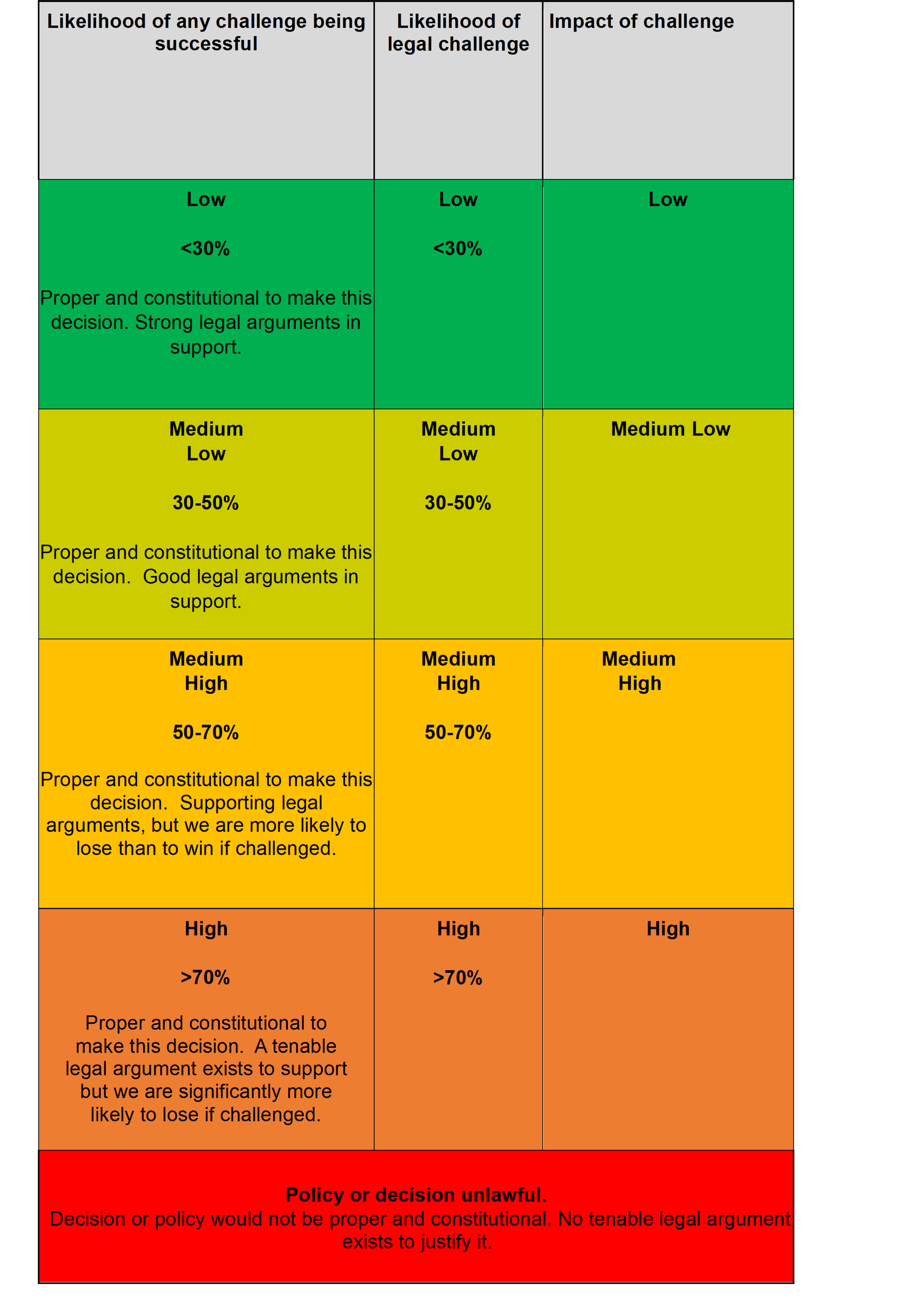
A. Likelihood of a legal challenge being brought
12. Policy or operational colleagues may be in a better position than lawyers to assess who, if anyone, might want to challenge and the likelihood of this occurring. The forum and timeframe of such a challenge, and the possibility of interim relief (on which lawyers can advise), should also be covered, as should any variation across the UK’s separate legal jurisdictions.
B. Impact and consequences of legal risks
13. Understanding the potential impact of a challenge, whether successful or not, is a core part of Ministers’ decision whether to accept the legal risk. You will need to identify and explain the potential remedies if a challenge were to succeed and work closely with policy or operational colleagues when assessing impacts and broader consequences of any legal risks you identify. A successful legal challenge may, for example, result in financial penalties, or the quashing of decisions or secondary legislation, requiring them to be remade. It may also result in reputational damage at home or overseas, delay in achieving policy aims, regulatory confusion and enforcement gaps, criticism by an oversight body and/or departmental resource implications. Some of these impacts may result from the challenge process itself irrespective of the outcome e.g. defending a judicial review can be very resource-intensive, cause delays or generate additional attention and controversy.
Mitigations: reducing legal risk
14. A mitigation strategy is important to achieving solutions which remove or reduce risk for Ministers while advancing their aims. Part of a lawyer’s role – and skillset – is to suggest and test measures designed to avoid or reduce legal risk and/or which can better achieve the intended goal. This will mean working with officials to design proposals in ways that achieve the desired outcome, by building in additional or different elements to policy design, delivery or communications to reduce the risks identified or conducting further analysis to refine the justification or improve the evidence base or other courses of action. Creativity and good communication are needed to ensure all mitigations are fully explored and put before Ministers.
15. Where one or more sources of law is a significant barrier or risk factor to a particular policy, you should be ready to advise on options for reform, even where it may appear unlikely to be pursued or face implementation challenges, such as amending long-standing primary legislation, or reform of an international obligation. In such cases, advice should cover feasibility and relevant timeframes.
16. Of course, there will be times when, having explored all mitigations, a proposed activity or policy remains high risk or unlawful.
Presenting legal risk
17. Legal risks should be fully integrated into policy analysis and the appraisal of options, and communicated accurately and accessibly to senior decision makers and to Ministers. The legal risk section of any submission should be clear and succinct (even if you attach a more detailed annex). Any subsequent changes must be checked by a lawyer so that it still properly reflects the legal advice.
18. Not all decisions involve significant legal risk, but where they do, it is important that the government should receive full merits legal advice wherever practicable. Such advice should assess the strength of the legal arguments for and against the lawfulness of the policy/decision, not just focus on whether a tenable legal argument is available. In doing so, lawyers should use this guidance to give their full and frank advice (including possible mitigations or reforms), recognising that decisions are for Ministers.
19. To achieve consistency, transparency and clarity in the assessment and presentation of legal risk, lawyers should use the framework below when giving legal advice. You should make clear whether options have a tenable (even if high risk) legal basis and would therefore be proper and constitutional to pursue, use the numerical risk percentages as a way to assist your audience to understand the advice, and draw on the brief narrative summary to describe the likelihood of the proposal being lawful.
20. It is also important to remember that your assessment can change over time as relevant facts and evidence are explored and arguments are developed, including in response to questions you ask or suggestions you make or in light of developing case law. Changes may be likely when advising at the very early stages of policy development or potential litigation. You should use your professional judgment to reassess and reconfirm or change your legal risk assessment over time.
Escalation
21. The Cabinet Manual provides that the Law Officers must be consulted in good time before the Government is committed to critical decisions involving legal considerations. You should always bring a matter to the attention of your line manager and Legal Director, who will consider consulting the Law Officers, where:
a. There are concerns about the legality or constitutional propriety of proposed legislation or administrative action.
b. Two or more departments disagree on legal questions.
c. A legal issue creates significant and sensitive policy issues.
d. Ministers wish to have advice from the Law Officers on legal questions likely to come before Cabinet.
e. The legal consequences of a policy are likely to have important implications in the foreign, EU or domestic field.
22. If it is proposed to proceed with a course of action despite advice that it would be improper to do so because it is not supported by a tenable legal argument you must bring this to the attention of your line manager and Legal Director at once, as the Law Officers must be informed.