GBE annual report and accounts 2025 to 2026 (HTML)
Published 14 September 2026

© Crown copyright 2026
This publication is licensed under the terms of the Open Government Licence v3.0 except where otherwise stated. To view this licence, visit nationalarchives.gov.uk/doc/open-government-licence/version/3 or write to the Information Policy Team, The National Archives, Kew, London TW9 4DU, or email: psi@nationalarchives.gov.uk.
Where we have identified any third party copyright information you will need to obtain permission from the copyright holders concerned.
This publication is available at https://www.gov.uk/government/publications/great-british-energy-annual-report-and-accounts-2025-to-2026/gbe-annual-report-and-accounts-2025-to-2026-html
Great British Energy Group Limited: Annual Report and Accounts for the period 10 October 2024 to 31 March 2026
Presented to Parliament pursuant to section 8 of the Great British Energy Act 2025
Ordered by the House of Commons to be printed on 14 September 2026
© Great British Energy Group Limited copyright 2026
HC 592
ISBN 978-1-5286-6758-6
Company information
Company name:
Great British Energy Group Limited
(designated by the Secretary of State for Energy and Net Zero as ‘Great British Energy’ pursuant to section 1(1) of the Great British Energy Act 2025.)
Directors:
- Beverley Gower-Jones FEI (appointed 23 September 2025)
- Chris Stark (appointed 24 June 2025)
- Dan McGrail (appointed 24 June 2025)
- Emma Floyd (appointed 10 October 2024, resigned 8 July 2026)
- Frances O’Grady (appointed 24 June 2025)
- Frank Mitchell (appointed 24 June 2025)
- Graeme Sword (appointed 23 September 2025)
- Juergen Maier CBE FRS FREng, (appointed 24 June 2025)
- Kate Gilmartin (appointed 24 June 2025, resigned 23 June 2026)
- Dr Nina Skorupska CBE FEI (appointed 24 June 2025)
- Valerie Todd CBE (appointed 24 June 2025)
Company Secretary:
Alison Presly (appointed 22 September 2025)
Registered number:
SC825539
Registered office:
AB1 Building
Crimon Place
Aberdeen
Scotland
AB10 1BJ
External Auditor:
Comptroller & Auditor General
National Audit Office
157–197 Buckingham Palace Road
London
SW1W 9SP
Introduction
Great British Energy Group Limited (GBE or the Company) is a company limited by shares, incorporated under the Companies Act 2006 under registered number SC825539 on 10 October 2024, and wholly owned by the Secretary of State for Energy Security and Net Zero. The Company operates as a publicly owned energy company and an arm’s-length body sponsored by the Department for Energy Security and Net Zero (DESNZ). This is GBE’s first Annual Report and Accounts, covering the period from incorporation to 31 March 2026.
GBE was established under the Great British Energy Act 2025 with the purpose of delivering the benefits of a cleaner, more secure energy system to the British public.
The Company was granted its operational mandate when the Great British Energy Act 2025 received Royal Assent on 15 May 2025. Activity during the period between incorporation and Royal Assent related to the setting up of GBE as an organisation. Costs during the period from incorporation (10 October 2024) to Royal Assent (15 May 2025) were retained by DESNZ and are therefore not included within the financial statements.
The Annual Report and Accounts has been prepared in accordance with:
- The Companies Act 2006 (CA 2006)
- International Financial Reporting Standards (IFRS) as adopted in the UK
- HM Treasury’s ‘Financial Reporting Manual’ (FReM), to the extent that its requirements are consistent with the Companies Act 2006 and IFRS
Where there is any inconsistency between IFRS and the FReM, IFRS has been applied. Relevant FReM disclosures and interpretations have been adopted where they do not conflict with IFRS, in order to support transparency and alignment with government reporting requirements.
Foreword from our Chair
I am delighted to present Great British Energy’s inaugural Annual Report and Accounts.
Since our inception on 10 October 2024, our goal has been clear – to become the UK’s energy champion, delivering the benefits of a cleaner, more secure energy system to the British public.
GBE was established to support that transition to a secure, affordable and low-carbon energy system by accelerating the deployment of clean energy technologies, encouraging investment, supporting well-paid jobs and bringing manufacturing back to our towns and cities by strengthening domestic supply chains.
During the time to 31 March 2026 (our first operational period), our organisation has moved from concept to early operational delivery, by focusing on three priorities.
The organisation
GBE started out by setting the standards expected of a publicly owned body managing public resources. We established governance structures, board committees, our operating framework and the safeguards necessary to function responsibly.
The strategy
GBE published its first Strategic Plan in December 2025. The Plan sets out the Company’s ambitions to deliver at least 15 GW in clean energy generation and storage, encourage £15 billion of private finance investment and support at least 10,000 jobs – through GBE spend between now and 2030.
Early delivery
Early investment and programme activity has seen GBE support the Solar Partnerships Scheme, which installs solar and complementary technologies in schools, NHS and military sites. The Company has also (via the Department of Energy Security and Net Zero) provided early-stage funding to 53 community energy projects and supported the wealth of knowledge that exists within the Local Net Zero Hubs.
None of this progress would have been possible without the commitment and professionalism of the people working across the organisation and our partners in the UK and devolved governments, industry and local communities. Their expertise and collaboration have been instrumental in enabling GBE to move from concept to an operational organisation at pace.
The Board remains committed to ensuring that GBE delivers on its mandate whilst maintaining the highest standards of governance, transparency and value for money.
I would like to thank my fellow Board members, the Executive Leadership Team and all those working across the organisation for their dedication during this formative period.
Juergen Maier CBE, FRS, FREng
Chair of Great British Energy
8 September 2026
Chief Executive Officer’s review
A significant focus during our first operating period (10 October 2024 to 31 March 2026), has been to lay the organisational foundations necessary for Great British Energy to operate effectively.
This has included building the executive leadership team and workforce, identifying our permanent headquarters in Aberdeen, implementing governance and risk management frameworks and establishing the internal financial and operational systems required for a publicly owned company that manages public resources.
We have developed policies and procedures covering financial management, procurement, risk management and responsible business conduct. We are a committed people-first organisation and have started building the culture and values that will define how we do business. These foundations are essential to ensure the Company can scale its activities while maintaining strong standards of transparency and accountability.
On 16 September, the Secretary of State set out his list of Strategic Priorities for Great British Energy. In December 2025, GBE published its first Strategic Plan, setting out our objectives and areas of focus for the coming years. The Plan highlighted the following priority areas:
- Local energy – delivering a new era of local energy projects which put communities at the heart of the energy transition, and see them benefit from schemes in their areas
- Onshore Energy – supporting the development of renewable energy generation across the UK by unlocking the potential of public land
- Offshore Energy – supporting the growth of the deep-water offshore wind sector, taking on the risks associated with new technologies to help unlock regional growth
- Supply Chains – strengthening domestic supply chains through the Energy Engineered in the UK programme, designed to support manufacturing capability, skills development and industrial growth linked to clean energy deployment.
In addition, it will move the UK away from its reliance on imported energy. GBE will plan, invest in and build the infrastructure that powers our future, and give the British people a share in it.
During this first reporting period, the Company began several early programmes designed to support the development of clean energy projects and infrastructure. This included supporting initiatives to expand renewable energy generation on the public estate, launching grant funding to support community energy projects and working with public financial institutions to mobilise investment into emerging technologies.
At a local level, GBE worked in collaboration with the Department for Energy Security and Net Zero, the Department for Education and the Department for Health and Social Care to roll out the solar scheme. In England around £80 million in funding will support around 250 schools, alongside £100 million for 260 NHS sites, covering a third of NHS trusts, to install rooftop solar panels that could power classrooms and operations, with potential to sell leftover energy back to the grid.
One example of this collaborative approach has been our investment in the Pentland Floating Offshore Wind project alongside the National Wealth Fund (NWF) and the Scottish National Investment Bank (SNIB). This investment represents an early step in supporting the development of floating offshore wind technology and strengthening the UK’s supply chain capability.
The energy transition requires collaboration – across governments, industry, investors and communities. GBE therefore works closely with a wide range of partners across the energy system.
During the reporting period, the organisation established advisory groups to ensure that our programmes are informed by expertise across the sector, including representatives from industry, trade unions, academia and community organisations.
We have also developed partnerships with other public financial institutions and public bodies to ensure that investment and programme delivery are coordinated effectively.
GBE aims to operate to high standards of responsibility and sustainability. The organisation has developed a Responsible Business Conduct Policy aligned with international standards covering human rights, labour standards, environmental protection, responsible governance and ethical supply chains. Work is underway to develop additional policies and processes covering areas such as climate change and the environment.
Our people are our strongest asset. We are committed to attracting and nurturing a diverse workforce which embodies the very best of the UK’s energy industry.
As the organisation grows, we will continue to strengthen our approach to measuring and reporting our impact. During the reporting period we began developing an Impact and Performance Framework which will provide a structured approach to assessing the outcomes of our programmes and investments.
As we look to the future, it is clear that the UK’s transition to clean energy will require sustained investment, coordinated policy and strong delivery capability.
GBE has an important role to play in supporting that transition by mobilising investment, strengthening domestic capability and enabling greater participation by communities and local partners.
Over the coming year, GBE’s focus will be on growing our delivery capability, our programmes and our investment pipeline, whilst ensuring that our governance and control frameworks continue to evolve as we do.
I would like to thank colleagues across GBE and our partners across governments, industry and local communities for their commitment and collaboration during this formative period.
Dan McGrail
Chief Executive and Accounting Officer
8 September 2026
Strategic report
Introduction
We are pleased to present the Performance Report for Great British Energy Group Limited (GBE or the Company) for the period ended 31 March 2026. This report contains an overview of activities and achievements against objectives in its first reporting period. It also summarises the landscape in which GBE operates, including its strategic direction.
GBE is a publicly owned energy company established under the Great British Energy Act 2025 and is wholly owned by the Secretary of State for Energy Security and Net Zero.
The Company was created to support the development of a secure, affordable and low-carbon energy system in the United Kingdom. Its role is to invest in and develop clean energy projects, support community and local energy initiatives, and strengthen the domestic supply chains that underpin the transition to clean energy.
Business model
GBE operates through a combination of investment activity, programme delivery and partnerships, with activities organised around several core areas, which specific interventions and funding types are targeted to:
- Local energy: GBE Local programme supports community and locally owned energy projects. GBE provides grant funding and technical support to enable the development of small-scale renewable energy projects, through to equity investments to derisk projects and provide increased opportunities for shared ownership.
- Onshore energy: GBE supports the development of renewable energy projects on land, including projects located on the public estate. GBE will both take minority equity investments in onshore projects to accelerate deployment, and, in the case of public land, act as a developer and have ownership of these assets. These initiatives aim to increase clean energy generation while supporting public sector organisations in reducing their energy costs.
- Offshore energy: GBE works with industry partners and other public financial institutions to support the development of offshore wind and related technologies. This includes investment activity to crowd in private finance and grant programmes designed to strengthen supply chains supporting offshore energy.
- Supply chains: Through the Energy Engineered in the UK programme, the Company seeks to strengthen domestic manufacturing capability across the clean energy sector. This includes investments and grants into British manufacturing companies.
Strategic objectives
The Company’s objectives were published in its first Strategic Plan in December 2025. These objectives provide the framework for the organisation’s activities over the coming years.
-
Accelerate the overall deployment of clean energy:
- Establish a portfolio that will deliver at least 15 GW (Gigawatt) through investment and ownership in clean energy generation and storage assets.
- Mobilise £15bn of private finance over time from GBE funds committed between now and 2030.
-
Increase local and community ownership of clean energy:
- Support over 1,000 local and community energy projects, boosting community ownership.
-
Support jobs and the growth of British manufacturing and clean energy technology:
- Catalyse the just transition, funding projects to directly support at least 10,000 jobs, including skills and locations historically dependent on oil and gas.
-
Invest on commercial terms, reflecting risk weighted returns relevant for the sectors we are targeting:
- Build a portfolio which is generating income by 2030 and be on a pathway to companywide profitability.
As this period represents GBE’s establishment phase, much of the Company’s activity has focused on building the governance, capability and partnerships required to deliver its mandate while beginning early programme activity. GBE’s prioritisation of this foundational activity in the period to March 2026 was in line with expectations. This will enable the expansion and acceleration of programme activity in 2026/27 and beyond, in line with GBE’s Spending Review allocation which significantly increases over this period.
Given the focus on enabling activity to date, progress against this has also been included as a fifth objective for GBE in this annual report.
Progress against strategic objectives
Since launching its Strategic Plan in December 2025, the Company has focused its efforts on four strategic outcomes:
1. Accelerating Clean Energy Generation and Overall Deployment:
GBE’s goal is to drive public ownership with purpose, giving British people a lasting stake in the UK’s clean energy future. It will achieve this by delivering a cleaner, more secure system that supports economic growth and expands electrification to all corners of the UK.
In November 2025, the Company announced its first large-scale investment in Pentland Floating Offshore Wind Farm alongside the National Wealth Fund (NWF) and the Scottish National Investment Bank (SNIB). Pentland will have capacity to generate enough electricity to power up to 70,000 homes once operational and is expected to create and support more than 1,000 jobs through its construction and operation.
By taking its first minority stake in a project, GBE has demonstrated how it can help to unlock new, innovative technologies. It allows GBE to take a leading role in deepwater wind development, signals industry confidence to invest, and supports the creation of skilled jobs and economic growth as part of the UK government’s clean energy mission.
2. Increase local and community ownership of clean energy:
Solar Schemes: GBE has invested (via DESNZ) £255m in its Solar Partnerships Scheme in the financial period ended 31 March 2026. This scheme will see solar and complementary technologies (including batteries) installed on 250 schools, 260 NHS sites and multiple military sites, delivering savings of up to £520 million in lifetime energy bills over the next 30 years.
The following additional funding has also been invested:
- £21.5 million for community and public sector energy projects in Scotland, Wales and Northern Ireland
- £5 million for new community energy projects in England – as at 31 March 2026, 53 projects were approved, from solar panels on places of worship in Leicestershire and heritage buildings in Rotherham, to a solar farm in Wiltshire
- Over £16 million for Mayoral Strategic Authorities in England to support renewable energy projects on public buildings including leisure centres and fire stations
During GBE’s first year of operation, these grant schemes were overseen by the Department for Energy Security and Net Zero (DESNZ) on behalf of GBE. As such, the costs of these are not reflected in GBE’s financial statements.
The Local Power Plan: In February 2026, GBE and DESNZ co-published the Local Power Plan, which set out a clear plan for achieving our ambitions for local energy, backed by £1 billion of funding.
The plan was launched alongside an expression of interest process, inviting local and community groups to tell GBE about their energy projects, so that funding and support services could be developed.
The plan will deliver the biggest public investment in community energy in the UK’s history. Ownership is a transformative tool to build the wealth of local areas – giving people a stake in their communities and generating pride, respect and local prosperity that cannot be dismantled.
GBE aims to support an initial 1,000 clean energy projects by 2030, improving energy security across the UK and protecting billpayers from global price fluctuations. The projects will be developed and led by local communities or government – the people who best know how to deliver for their area. Local people will also be able to buy shares in nearby larger-scale renewable projects.
3. Support jobs and the growth of British manufacturing and clean energy technology:
Energy Engineered in the UK: In December 2025, GBE announced its £1 billion supply chains programme, Energy Engineered in the UK (EEUK). The programme has a three-pillar approach, specifically designed to unlock the economic benefits of the energy transition and support 10,000 jobs.
- Pillar 1: GBE will provide Manufacturing Grants to expand domestic manufacturing of critical, constrained components.
- Pillar 2: The Company will stage Strategic Market Interventions, using a combination of grants and investments to accelerate the commercial deployment of emerging technologies. We have already announced a Deepwater Wind Commercialisation Programme, to unlock the industrial opportunity from floating foundations.
- Pillar 3: GBE will make Strategic Investments across clean energy supply chains by investing in Tier 1, Tier 2 and Tier 3 UK-based manufacturers and the ecosystems that support them.
As part of this announcement, the Company launched the GBE Supply Chain Fund: Offshore Wind and Networks. This will award up to £300 million in grant funding to build UK manufacturing capacity for critical, constrained components in offshore wind and enable electricity networks sectors. The first payments under this grant scheme are expected in the 2026/27 financial year.
GBE also confirmed the development of a Deepwater Wind Commercialisation Programme – aimed at accelerating the deployment of floating wind and other deepwater technologies, with the consideration of a competition on deepwater wind foundations and supporting serialisation as the initial areas of focus.
Trade Union Advisory Committee:
In the financial period ended 31 March 2026, GBE established its Trade Union Advisory Committee. The Committee provides a dedicated forum for discussion on issues relating to the jobs, skills and employment standards needed for the successful delivery of the energy transition.
The Committee is helping to shape GBE’s approach to workforce and skills, ensuring that – as a publicly owned company – our investment decisions and supply chains uphold high standards and contribute to high‑quality employment and fair outcomes for workers and communities across the UK.
4. Investing on commercial terms and reflecting risk:
During the financial period ended 31 March 2026, GBE focused on establishing a credible, investable pipeline aligned to its Strategic Plan. GBE’s Investment Strategy was approved by its Board, and core investment governance was put in place during the period. This included the establishment of the GBE Investment Committee, which provides independent scrutiny of and assurance on investment proposals. In the period to 31 March 2026 the Committee reviewed proposals relating to 7 projects, spanning development stage and near-term investment opportunities. It has also supported the progressive build-out of GBE’s forward investment pipeline.
Within this framework, GBE progressed a number of priority investments in the period to 31 March 2026. Its investment in Pentland reflects its ability to deploy capital on commercial terms while supporting strategically important clean energy assets. In parallel, significant preparatory work was undertaken on a number of other projects – most notably in relation to a proposed investment in ITM Power. This work involved due diligence, valuation and risk analysis, with the investment, worth £40m, concluding in early April 2026.
5. Establishing the organisation:
After the Great British Energy Act 2025 received Royal Assent, GBE began building the governance and operational frameworks required to support its activities. This work has also been included as a fifth objective for GBE in the financial period ended 31 March 2026, and has included:
- establishing the Board and its committees
- recruiting an executive leadership team, resourcing the wider organisation and establishing GBE’s values (Impactful, Bold, Entrepreneurial, Inclusive) and culture
- implementing governance and risk management frameworks
- developing financial and operational systems
- establishing the Company’s headquarters in Aberdeen
These steps were necessary to ensure the organisation could operate effectively and in accordance with public sector governance standards.
External affairs and partnerships
Collaboration sits at the heart of how GBE works. Over the past 17 months, we have engaged closely with partners across the public, private and community sectors to test our assumptions, strengthen our evidence base and shape our priorities. This engagement has directly informed our programmes, making sure they will work in the markets we operate in. It has also helped us build the constructive relationships needed to deliver on our plans and drive progress.
Aberdeen and NE Scotland:
GBE is headquartered in Aberdeen and is establishing a strong operational foundation in the city’s energy heartland. Alongside the development of our physical presence, we have prioritised early partnerships and strategic engagements that support long-term impact.
Key activities to date include:
- Establishing the GBE Aberdeen Energy Taskforce, bringing together regional partners to support the development of GBE’s programme pipeline and local impact
- Engaging with local stakeholders, including supply chain companies, community organisations and academic institutions, to inform programme design and identify regional opportunities
- Joining the North Sea Futures (NSEF) Board, contributing to strategic discussions on the future of the North Sea energy system
- Becoming a founding member of the Aberdeen Energy Campus, supporting collaboration across industry, academia and government on skills and innovation
- Selecting the Marischal Square development as the permanent headquarters of the Company, reinforcing Aberdeen’s role as our administrative and strategic base
- Participating in regional industry events to ensure visibility, strengthen relationships and ensure we’re across local priorities
Partnerships with public bodies
National Wealth Fund and Scottish National Investment Bank:
The National Wealth Fund (NWF) and GBE are key partners, working collaboratively to deliver end-to-end clean energy development and finance offers. We are already undertaking complementary roles across the sector, with GBE offering specialist developer support whilst the NWF remains a key investor.
Alongside NWF and the Scottish National Investment Bank (SNIB), GBE invested in Pentland Floating Offshore Wind Farm, a major project off the north coast of Scotland. This joint investment will support the UK’s clean energy ambitions, bolstering energy security and job creation. We have each acquired a minority stake, with an option to invest up to £50 million as the project progresses through development and construction milestones. This investment demonstrates how we can work together to support early-stage technologies in the clean energy sector, aiming to mobilise private capital in support of the UK government’s growth and clean energy missions.
The Crown Estate:
We are partnering with The Crown Estate (TCE) to accelerate and de-risk the development of offshore wind and other clean energy technologies across TCE’s land and seabed portfolio. Discussions have progressed on how GBE and TCE can co-fund projects that will create jobs, support domestic supply chains and boost clean energy delivery for the UK.
During the period, The Crown Estate advanced a significant package of investment to maximise the UK’s industrial base, setting out plans for around £400 million of additional funding.
GBE complemented this activity by opening its own £300 million Offshore Wind and Networks Supply Chain Fund. The fund is targeted at increasing the UK’s ability to produce high‑demand components and build out key areas of the offshore wind supply chain. Allocation of this fund will occur in the 2026/27 financial year.
Forestry England:
GBE and Forestry England are exploring opportunities to work in partnership to deliver rooftop solar at scale (as well as other renewable energy projects), across the public estate. This will help to generate low-carbon electricity, reduce costs and support the UK’s energy independence.
Under new statutory powers granted in February 2026, Forestry England can now encourage more new renewable electricity proposals across its Estate, which covers over 250,000 hectares.
Trydan Gwyrdd Cymru:
We are exploring a partnership with Trydan, which would support its mission to develop 1 GW of new renewable energy capacity on public land in Wales by 2040.
Mayoral Strategic Authorities:
In February 2026, GBE signed 10 Memoranda of Understanding (MoUs) with Mayoral Strategic Authorities (MSAs) and non-Mayoral Combined Authorities (CAs) across England to coincide with the launch of the Local Power Plan. These set out our shared objectives and established a framework for collaboration between GBE and English Strategic Authorities on delivering our shared ambitions to accelerate the deployment of community energy projects.
Under these MoUs, GBE is working closely with each authority to identify and jointly support one or more pilot local energy projects. Whilst some MSAs may only need project‑specific financing if they are mature and have their own energy teams, newly established authorities may require more capacity-building support. We are holding regular catch-up meetings with the MSAs and CAs to discuss opportunities and review progress.
Great British Energy Nuclear:
Great British Energy (GBE) and Great British Energy – Nuclear (GBE‑N) both support the Government’s clean energy arrangement, but with distinct remits and separate governance arrangements. GBE and GBE-N engage regularly to discuss matters of common interest.
Creating long-term, profitable, sustainable growth for the UK
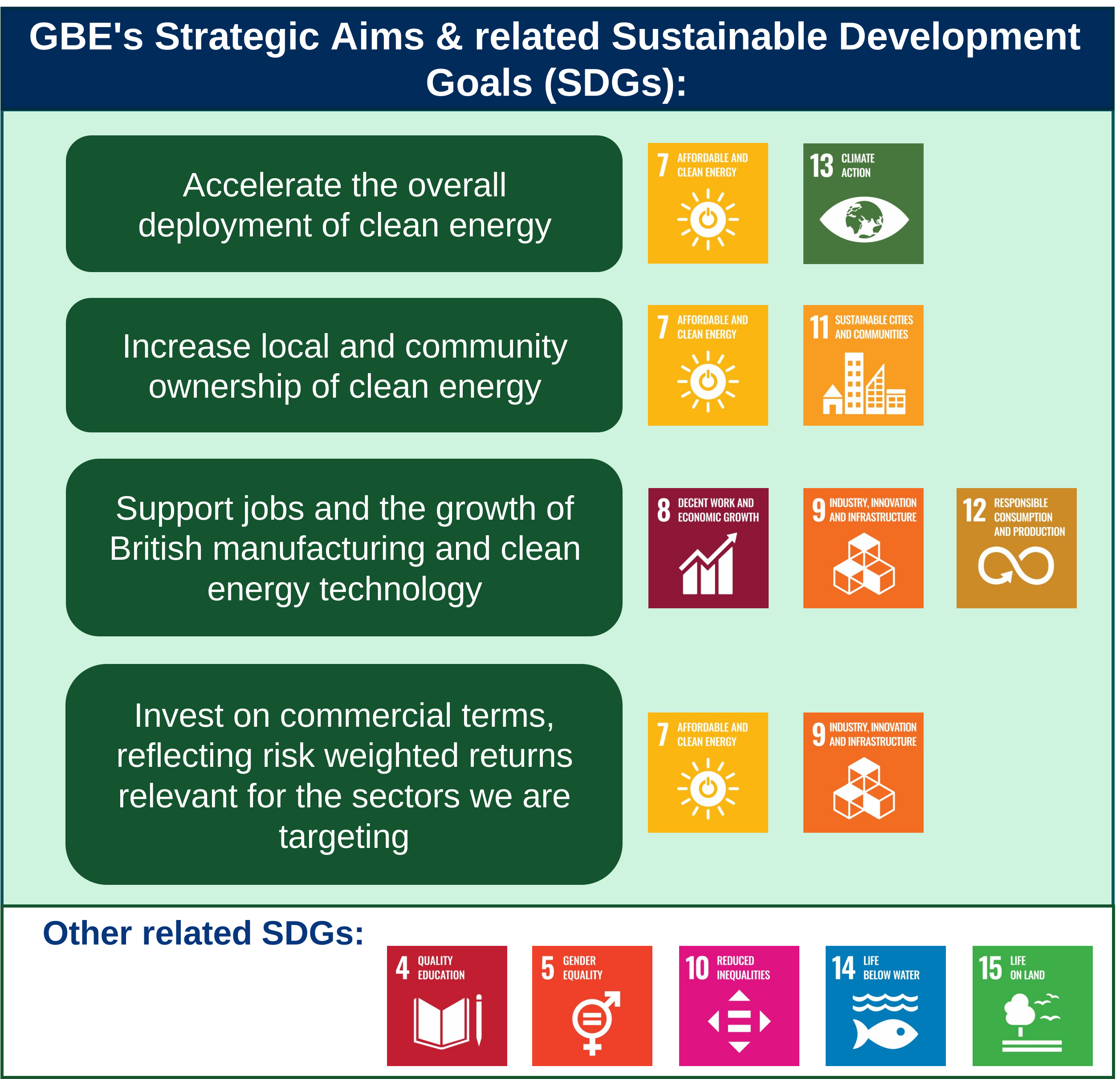
Diagram description: GBE’s strategic aims and related Sustainable Development Goals (SDGs).
Accelerate the overall deployment of clean energy:
- SDG 7 - Affordable and clean energy
- SDG 13 - Climate action
Increase local and community ownership of clean energy:
- SDG 7 - Affordable and clean energy
- SDG 11 - Sustainable cities and communities
Support jobs and the growth of British manufacturing and clean energy technology:
- SDG 8 - Decent work and economic growth
- SDG 9 - Industry, Innovation, Technology and Infrastructure
- SDG 12 - Responsible consumption and production
Invest on commercial terms, reflecting risk weighted returns relevant for the sectors we are targeting:
- SDG 7 - Affordable and clean energy
- SDG 9 - Industry, Innovation, Technology and Infrastructure
Other related SDGs:
- SDG 4 - Quality education
- SDG 5 - Gender equality
- SDG 10 - Reduced inequality
- SDG 14 - Life below water
- SDG 15 - Life on land
Our most material contribution to a more sustainable and resilient world is driving the UK’s clean energy future – providing the low-carbon energy needed to power decarbonised economies and combat climate change by removing our reliance on fossil fuels.
We are committed to doing this in the right way and, in doing so, contributing meaningfully towards the United Nations Sustainable Development Goals (SDGs).
Building on a foundation of responsible business conduct
We aim to be a force for good in the market by setting high standards and exercising stewardship, while generating real value for money that goes beyond financial returns and delivers sustainable outcomes for the UK.
GBE has engaged with energy corporations, prospective partners, and private and public investors to understand the sector’s current position and to identify where GBE can add the most value through capability building and collective action.
GBE has also collaborated across the UK’s public finance ecosystem, and with government bodies, on the issues of sustainability, impact and forced labour in UK supply chains.
This led to the development of GBE’s Responsible Business Conduct Policy, which sets the tone for how we do business and ensures alignment with key international standards, such as the UN Guiding Principles on Business and Human Rights and the OECD guidelines for responsible business conduct.
Spotlight: Ethical Supply Chains and tackling forced labour
The Great British Energy Act 2025 gave GBE a clear remit: facilitate, encourage and participate in measures to ensure that slavery and human trafficking are not occurring in our business or supply chains. This reflects the founding principle of GBE – a commitment to social purpose.
In response, GBE has established an Ethical Supply Chains Unit, which reports into our Senior Accountable Non-Executive Director, Baroness Frances O’Grady. The Unit takes a comprehensive approach that addresses the full breadth of risks and opportunities across clean energy supply chains.
GBE recognises that forced labour risks in supply chains are complex and cannot be solved in isolation. It will therefore promote collective action across the sector, recognising that meaningful progress relies on pooling knowledge, scaling effective solutions and raising standards. We will champion collaboration, engaging extensively with industry, civil society, trade unions, government departments and public finance institutions to work towards common approaches that mitigate risk and ensure due diligence.
GBE will publish a slavery and human trafficking statement in the financial year 2026/2027, setting out the steps it’s taking to ensure slavery and human trafficking are not present in its business or supply chain in alignment with section 54 of the Modern Slavery Act 2015.
As required under the Great British Energy Act 2025, GBE is committed to progressing its sustainable development activities and the reporting of its impacts, including a Sustainability and Ethical Supply Chain Strategy underpinned by double materiality. The concept of double materiality refers here to the recognition that GBE should consider the impact of its activities on society and the environment, as well as the influence these external factors have.
The double materiality assessment will also inform our approach to sustainability disclosures. Some disclosures are required by law when organisations reach a certain threshold (which GBE does not currently fall into), including an organisation’s greenhouse gas (GHG) emissions. GBE is committed to disclosing these – 2025/26 sustainability disclosures are covered as part of DESNZ’s Annual Report which includes the group as a whole, and GBE will include its own sustainability disclosures in its 2026/27 Annual Report. It will also be informed by a carbon management plan.
The safety and wellbeing of our team is also a core fundamental of the organisation. We will require explicit commitment from partners and contractors to not just comply with, but exceed, health and safety laws and industry good practice.
GBE’s impact and performance framework
Tangible benefits – or impacts – lie at the heart of GBE’s mission, so we are developing a Framework to ensure we deliver on them.
In 2026, we will publish our full Impact and Performance Framework, expanding on the principles set out in this first Annual Report. This will include further detail on our Key Performance Indicators (KPIs) and our monitoring and evaluation approach across our full range of activity.
As a publicly owned company GBE is committed to using public funds responsibly, being transparent with people about what we are achieving and being clear about the value we are delivering. Impacts – financial, social and environmental – will be considered at each stage of activity, across all activities. They will shape our strategies, inform our funding and investment decisions, and be monitored and evaluated across our portfolio. We will consider the risks associated with delivery, what outcomes we contribute to as an organisation, who or what is impacted by these, the scale of the impact and GBE’s contribution or additionality.
Our Impact and Performance Framework will set out which impacts GBE intends to achieve; how these will be factored into decision making; how we will monitor, report on and evaluate our impacts; how we will determine the extent to which our impacts are additional to what would otherwise occur; and how our impacts sit within the global ambition for responsible and sustainable business practice.
Assessing our activities against our targeted outcomes ensures decision makers make informed choices about trade-offs, whilst ensuring our portfolio continues to progress across all aims. We take a proportionate approach, with the extent of the impact’s analysis matching the scale and complexity of the activity.
The Framework will be underpinned by robust methodologies and analytical standards to ensure that the evaluation of any impact GBE has is credible and consistent. It is designed to grow and evolve with GBE.
Ensuring our impact is additional:
Additionality is the extent to which financial and nonfinancial value is created due to GBE’s activity. It is the contribution toward outcomes that would not occur in the Company’s absence.
In pursuing public ownership with purpose, GBE intends to go beyond what would be delivered by the private sector alone. The Company aims to enable new projects, mobilise private capital, enhance the quality or standards of projects, and accelerate the energy transition through its activities in a way that would not occur in its absence.
We apply a robust additionality assessment to all GBE activity to measure the extent to which GBE’s involvement is instrumental to delivering impact.
Principal risks
The principal risks facing GBE are set out in the Risk Management and Assurance section of the Corporate Governance Statement on [pages 34 to 38].
Financial review
GBE was incorporated in October 2024 and became operational following Royal Assent to the Great British Energy Act on 15 May 2025. These financial statements therefore reflect the Company’s first period of substantive activity. During the period, the Company focused on establishing the organisation, embedding its governance and operating arrangements, developing its investment capabilities and beginning to deploy capital in support of its strategic objectives.
Funding structure:
The UK Government has committed significant funding to GBE to support investment in clean energy projects and supply chains. The overall funding commitment for GBE and GBE-Nuclear is £8.3 billion over this Parliament. DESNZ is also implementing the Great British Energy Multi-Year Capitalisation Scheme, under which up to £5.3 billion is expected to be made available to the Company from financial years 2025/26 to 2029/30.
The Company’s principal source of funding is an interest-free facility made available by DESNZ under a facility agreement. Amounts drawn under the facility are repayable on demand and are available to support the Company’s working capital requirements and investment activities. The facility includes a mechanism under which outstanding amounts are intended to be capitalised into equity at the end of each reporting period.
During the period, total drawdowns and service costs capitalised to the facility amounted to £18.7 million, of which £6.6 million has been settled by share issue. The £6.6 million of shareholder funding that was issued as ordinary share capital provides permanent capital to support the Company’s activities and investment programme. At 31 March 2026, £12.2 million was outstanding under the facility.
The maximum commitment available under the facility was £68 million for the period to 31 March 2026, increasing to £510 million for the period from 1 April 2026 to 31 March 2027.
Financial performance:
For the period ended 31 March 2026, the Company reported a loss of £14.1 million, reflecting the costs incurred in establishing the organisation and developing the people, systems, governance and operating capabilities required to deliver GBE’s mandate.
The Company incurred total operating expenses of £14.2 million, funded by the DESNZ facility alongside £62,000 of other income from recovery of proportionate technical due diligence costs from the National Wealth Fund and the Scottish National Investment Bank, GBE’s co-investment partners. £7.9 million of total operating expenses related to staff costs and £3.8 million of professional services costs which included legal, advisory and other specialist support associated with set-up activity, investment work and corporate development.
Financial position:
At 31 March 2026, the Company had total assets of £9.2 million, comprising:
- an investment measured at fair value through profit or loss of £5.8 million;
- property, plant and equipment, including right-of-use assets, of £2.6 million; and
- cash and cash equivalents of £0.8 million, held through the Government Banking Service
The investment in Highland Wind Limited (HWL), the special purpose vehicle developing the Pentland Floating Offshore Wind project, represents the Company’s first strategic investment and an important initial step in building the Company’s investment portfolio. The Company did not recognise any gains or losses on the fair value of the investment during the period.
The right of use asset relates to the lease of the Head Office building in Aberdeen. This lease agreement is for a period of 12 years, and commenced in February 2026. The interest expense on the lease liabilities associated with the right-of-use asset was £10,000 for the period.
Total liabilities at 31 March 2026 were £16.8 million, comprising £12.2 million due to the Shareholder, £1.9 million of accrued expenses and £2.6 million of lease liabilities.
The net liability position of £7.6 million reflects the Company’s establishment-stage cost base and funding structure during its first period of operations and is supported by the funding arrangements with DESNZ described above.
Business developments after the reporting date:
The Company continued to deploy capital after the reporting date as it progressed its investment programme.
Since 31 March 2026, the Company has provided a further £1.3 million of funding to HWL in accordance with the funding arrangements for the Pentland Floating Offshore Wind project.
On 9 April 2026, the Company entered into an agreement to invest £40 million in ITM Power plc, a UK-based energy technology company specialising in green hydrogen solutions. The investment resulted in GBE acquiring a 10.4% equity interest in the company and forms part of GBE’s strategic objective to support the development and scaling of clean energy technologies in the UK and accelerate the deployment of low-carbon infrastructure.
In August 2026, GBE announced a £7.5 million investment in Naked Energy, a British renewable heat technology company. The funding will support Naked Energy’s plans to establish a new UK manufacturing facility for its Virtu solar thermal technology, with the potential to create up to 40 direct skilled jobs and approximately 100 indirect roles.
Together, these investments demonstrate GBE’s transition from its establishment phase into active deployment of capital in support of its strategic objectives.
The Company’s full financial performance data is contained within the financial statements and supporting notes on [pages 58 to 83].
Signed on behalf of the Board:
Dan McGrail
Chief Executive and Accounting Officer
8 September 2026
Accountability report
Directors’ report
The Board of Directors of GBE comprises a majority of Non-Executive Directors, together with the Chief Executive Officer. The Board collectively provides strategic leadership and oversight. The Directors who served during the period and their biographies are set out below. Board and Committee attendance is presented on [page 29], and their biographies appear below.
Directors’ biographies
Juergen Maier CBE, FRS, FREng, Chair
Juergen was appointed Chair of the Board of Great British Energy in June 2025. He is the former Chief Executive of Siemens UK and, prior to that held a number of senior roles in the UK and Germany, including industry sector lead for the UK and Ireland and Manufacturing Director of the Drives Factory in Congleton, Cheshire. He has also served as a non-executive board member of the Department of Business, Innovation and Skills and cofounded the social enterprise vocL. Juergen is a member of GBE’s Nominations and Remuneration Committee.
Dan McGrail, Chief Executive Officer
Dan was appointed as the permanent CEO of Great British Energy in August 2025, after holding the interim role. He took up his previous post as Chief Executive at Renewable UK in May 2021 and was previously CEO of Siemens Engines. He joined Siemens UK in 2004 and worked in a variety of roles across the energy industry, becoming a CEO in 2017. Dan is a member of GBE’s Investment Committee.
Beverley Gower-Jones OBE FEI, Non‑Executive Director
Beverley brings over 35 years of clean energy investment experience, including leadership roles at Shell Ventures and the Clean Growth Fund, and a deep knowledge of technologies like carbon capture and storage, nuclear fusion and geothermal. Beverley chairs GBE’s Investment Committee.
Chris Stark, Shareholder Non-Executive Director
Chris brings extensive climate and energy policy expertise, serving as Chief Executive of the UK Climate Change Committee from April 2018 to April 2024. Chris is currently heading Mission Control in the Department of Energy Security and Net Zero (DESNZ). He brings strategic insight that will help GBE accelerate clean power deployment and infrastructure delivery.
Emma Floyd, Shareholder Non-Executive Director
Emma is an experienced Civil Servant, having held senior roles within DESNZ and its predecessor BEIS, including Director of Clean Energy Investment and Director of Non- Domestic Energy Affordability. These roles have given her a comprehensive understanding of the UK’s energy policy landscape, investment frameworks and decarbonisation strategies. Emma is a member of GBE’s Investment Committee; Audit, Assurance and Enterprise Risk Committee and the Nominations and Remuneration Committee.
Baroness Frances O’Grady, Non-Executive Director
Frances was General Secretary for the TUC between 2013 and 2022, as well as former Deputy General Secretary from 2003. She is a member of the House of Lords and previously held positions at the Transport and General Workers Union, where she worked on successful campaigns to introduce a national minimum wage and equal pay for women. She has also served on the Resolution Foundation’s Commission on Living Standards and has been a member of the Low Pay and High Pay Commissions. Frances is a member of GBE’s Nominations and Remuneration Committee.
Frank Mitchell, Non-Executive Director
Frank is the former CEO for SP Energy Networks (2009 to 2022), Chair of Skills Development Scotland and a Non-Executive Director of Scottish Rugby Ltd, as well as a member of the Scottish Energy Advisory Board. He has worked internationally in the energy sector for 35 years, including senior roles in the UK, Europe and USA covering generation, transmission and distribution networks, and retail. Frank is a member of GBE’s Investment Committee.
Graeme Sword, Non-Executive Director
Graeme has many years of private equity experience as a co-founding Partner of Blue Water Energy, with particular expertise within worldwide oil and gas reserves, and oilfield services. Prior to joining Blue Water Energy, he was Partner and Head of Oil & Gas at 3i and a brand manager at Unilever. Graeme co-chair’s GBE’s Aberdeen Taskforce and is a member of GBE’s Investment Committee and the Audit, Assurance and Enterprise Risk Committee.
Kate Gilmartin, Non-Executive Director
Kate is the CEO of the British Hydropower Association and has a background in renewable energy and low-carbon project development. She was a founding member (and is now a director) of the trade body Community Energy England. She is also a board member for Rossendale Valley Energy (a Community Benefit Society) and a member of Greater Manchester Community Renewables. Kate is a member of GBE’s Audit, Assurance and Enterprise Risk Committee.
Dr Nina Skorupska CBE FEI, Non-Executive Director
Nina is the former Chief Executive of the Association for Renewable Energy and Clean Technology (REA). As a chemist by training, with over 40 years’ experience in the energy industry, she has worked in a range of senior executive and board roles at National Power, RWE, Npower and Essent NV. She is a former board member of Transport for London and a supervisory board member of the Dutch engineering and construction company, Royal BAM NV. Nina chairs GBE’s Audit, Assurance and Enterprise Risk Committee.
Valerie Todd CBE, Non-Executive Director
Valerie is a HR professional with extensive experience across the private, public and third sectors. She was previously Director of People and Organisation at Siemens plc, Talent and Resources Director at Crossrail and Managing Director at Transport for London. She is also a Non-Executive Director at Digital Catapult. Valerie chairs GBE’s Nominations and Remuneration Committee.
Directors’ indemnities
During the period to 31 March 2026, DESNZ granted each director an indemnity in respect of liabilities arising in connection with the actual or purported performance or exercise of duties, responsibilities or powers as a director of GBE, provided that the liability does not arise from any wilful default, bad faith or wilful breach of statutory duty. The crystallisation of any liability is dependent on the actions of the directors. GBE has not disclosed the financial effect of director indemnities because it is not practicable to do so, as there is no evidence to evaluate.
GBE employees can be called upon to act as a director of companies in which GBE has equity investments. The Company has issued indemnities to those Directors against certain personal liabilities and expenses arising out of or in connection with their position as a director of the investee.
Required information
The Directors submit the annual report, financial statements, and independent auditor’s report for the period ended 31 March 2026.
The Corporate Governance Statement in this Annual Report forms part of the Accountability report. The Companies Act 2006 requires certain information to be included in the Directors’ report, which is found in the following sections of the Annual Report:
- A description of GBE’s principal activities during the period ended 31 March 2026 is set out in the Strategic Report
- Directors’ interests, conflicts of interest and related-party interests can be found on [page 38] and in Note 14 the Financial Statements
- Information on Political Donations can be found on [page 38]
- Narrative on employee numbers and costs (s411 Companies Act 2006) can be found on [page 47] and in Note 4 to the Financial Statements
- Information on employment policies, fair pay, staff engagement, diversity and inclusion, and disability-inclusive practices can be found in the Remuneration and Staff Report
- Directors’ Indemnities can be found on [page 24]
- The Company’s risk management disclosures can be found on [pages 34 to 35]
- Information on financial instruments is given in Note 12 to the Financial Statements and significant post-balance sheet events are shown in Note 17 to the Financial Statements
Disclosure of information to the Auditor
In preparing the financial statements, each director confirms that, as far as they are aware, each director has taken all steps that they should have taken to make themselves aware of any relevant audit information and to establish that the auditors are aware of that information. This confirmation is given pursuant to section 418 of the Companies Act 2006 and should be interpreted in accordance with and subject to those provisions.
The Directors are satisfied that the Annual Report and Accounts, taken as a whole, is fair, balanced and understandable and provides the information necessary for the Shareholder to assess the Company’s performance, business model and strategy.
Auditor of Great British Energy Group Limited
The Comptroller and Auditor General (C&AG) is the auditor of GBE and the National Audit Office (NAO) supports the C&AG in delivering the audit.
Employment policies and procedures:
Prior to employing staff on its own terms and conditions in 2026/27, GBE developed a suite of employment policies, including a whistleblowing policy, to support our future workforce. These policies reflect both the requirements of employment law and the Company’s culture and values. In future reporting years, GBE as an employer will be in a position to report in accordance with gender pay gap reporting requirements.
Going concern:
The directors have completed an assessment and have concluded that the Company is a going concern. These financial statements have been prepared on a going concern basis. The Directors’ assessment and supporting disclosures are set out in Note 2.2 to the Financial Statements.
Corporate governance statement
GBE is a private company limited by shares and is wholly owned by the Secretary of State for Energy Security and Net Zero (the Shareholder). Following the Great British Energy Act 2025 (the Act) receiving Royal Assent on 15 May 2025, the Shareholder gave notice of GBE’s designation under section 1 of the Act on 19 May 2025, and the designation took effect from 21 May 2025. The designation applies governance requirements to GBE which are set out in the Act, including that GBE must ensure its articles of association contain a statement of its objects, restricted to activities associated with its role as a public energy company, and that its articles of association require it to publish and act in accordance with strategic plans, reflecting the Shareholder’s Statement of Strategic Priorities for GBE. The Shareholder passed a special resolution on 24 June 2025 to adopt and update its articles of association which meet these requirements.
GBE was incorporated to be operationally independent from its Shareholder, as outlined in its Framework Document. Two Shareholder Directors are appointed to the Company’s Board of Directors, ensuring that the Shareholder’s interests are integrated into the Company’s governance framework, contributing to strategic oversight, compliance and strategic decision making.
Dan McGrail was appointed the permanent Chief Executive Officer of the Company and its Accounting Officer in August 2025 following an interim period of service, and a fair, open and transparent recruitment campaign.
The Company is committed to upholding high standards of governance in conducting its business. GBE has adopted best practices from the Financial Reporting Council’s UK Corporate Governance Code 2024 (the Code), HM Treasury’s ‘Managing Public Money’ and the Accounting Officer’s Letter, which have been reflected in this Statement.
The Board provides strategic direction to GBE and is responsible for ensuring that effective risk-management and internal-control systems are in place, in order that GBE is able to meet its objectives. These systems have been under development during the reporting period.
DESNZ has confirmed an exemption for GBE from compliance with the Code for the reporting period, in recognition of the start-up phase to the Company’s governance during this time. GBE has however already implemented a significant number of good practices under the Code, and the Board anticipates discharging its duties under the Code over the course of the financial year ending 31 March 2027.
Shareholder oversight has been important as GBE continues to develop its governance arrangements. The Company and its Board of Directors are responsible for the governance and accountability framework as described in GBE’s Framework Document. The Company is developing policies and procedures designed to help ensure ongoing compliance with applicable laws and regulations, including (but not limited to) anti-bribery and corruption, anti-money laundering, data protection and freedom of information. Once completed, we will also embed our guidance and processes in relation to whistleblowing. In addition to complying with legal obligations, we also seek to apply good practice to all our activities.
Cognisant of the exemption from the Code in this reporting period, the Board’s assessment is that GBE has nonetheless implemented, or is in the course of implementing, sound systems and processes to ensure that it:
- complies with the principles and provisions of the Corporate Governance in Central Government Departments Code of Good Practice, to the extent appropriate
- complies with the principles and duties set out in HM Treasury’s Managing Public Money guidance
- considers HM Treasury’s Green Book guidance when appraising investment and similar opportunities
- complies with the codes of good governance and practice and guidance as set out in Appendix 1 of GBE’s Framework Document, to the extent that they are applicable to GBE
- applies appropriate processes to review the effectiveness of the system of risk management and internal control, including processes to capture and remedy any significant failings or weaknesses.
Governance structure
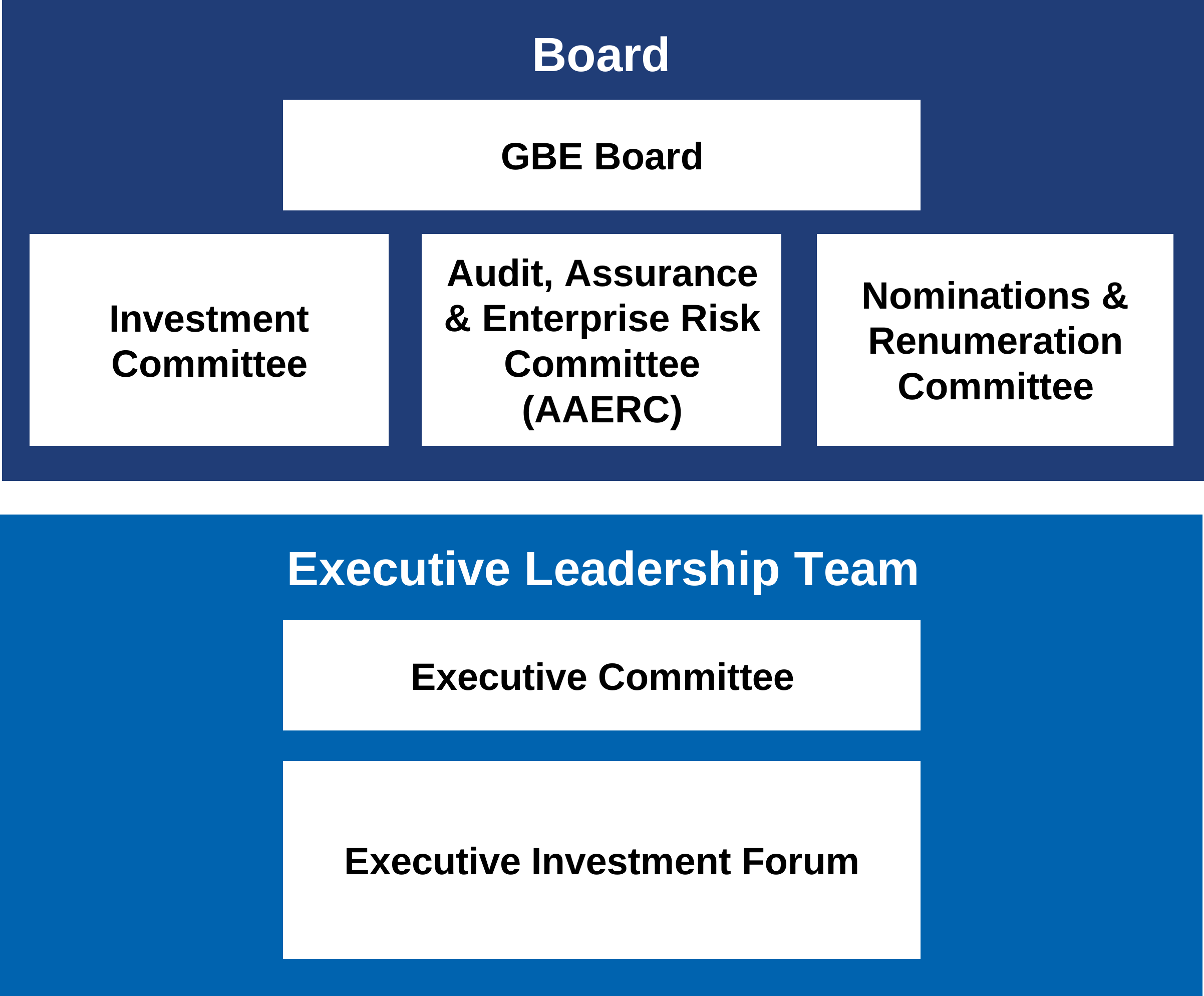
Diagram description: GBE’s governance structure, split by Board and Executive Leadership Team.
Board:
- GBE Board
- Investment Committee
- Audit, Assurance & Enterprise Risk Committee (AAERC)
- Nominations & Renumeration Committee
Executive Leadership Team:
- Executive Committee
- Executive Investment Forum
Board committees
The Board oversaw all governance arrangements during the reporting period and ensured that GBE dedicated significant resources to setting up governance systems and processes that support compliance with applicable regulatory requirements and accord with good governance practices.
During the reporting period, the Board established the following subcommittees:
- The Audit, Assurance and Enterprise Risk Committee, which oversees financial reporting and risk management
- The Nominations and Remuneration Committee, which has a number of responsibilities in respect of nominations, remuneration, evaluation and succession planning
- The Investment Committee, which provides oversight, guidance and decision making on proposed investments, divestments, loan schemes and corporate acquisitions by GBE
During the reporting period, the Board met five times (including once in shadow form in March 2025). The Audit, Assurance and Enterprise Risk Committee, which was established on 11 February 2026, met twice, whilst the Nominations and Remuneration Committee, which was established on 22 January 2026, met three times. The Investment Committee, which was established on 19 December 2025, met four times. Attendance at Board and Committee meetings is set out below.
Director attendance
Table of Directors – attendance overview
| Board** | Audit, Assurance and Enterprise Risk Committee | Nominations and Remuneration Committee | Investment Committee | Total | ||
|---|---|---|---|---|---|---|
| Juergen Maier | Board Chair | 4/4 (Chair) |
– | 3/3 | – | 7/7 |
| Nina Skorupska | Non-Executive Director | 4/4 | 2/2 (Chair) |
– | – | 6/6 |
| Valerie Todd | Non-Executive Director | 4/4 | – | 3/3 (Chair) |
- | 7/7 |
| Kate Gilmartin | Non-Executive Director | 4/4 | 2/2 | – | – | 6/6 |
| Frank Mitchell | Non-Executive Director | 4/4 | – | – | 3/4 | 7/8 |
| Graeme Sword | Non-Executive Director | 2/3* | 2/2 | – | 4/4 | 8/9 |
| Beverley Gower‑Jones | Non-Executive Director | 3/3* | – | – | 4/4 (Chair) |
7/7 |
| Frances O’Grady | Non-Executive Director | 4/4 | – | 1/3 | – | 5/7 |
| Emma Floyd | Non-Executive Director – Shareholder Representative | 4/4 | 2/2 | 3/3 | 4/4 | 13/13 |
| Chris Stark | Non-Executive Director – Shareholder Representative | 4/4 | – | – | – | 4/4 |
| Dan McGrail | Chief Executive Officer | 4/4 | – | – | 4/4 | 8/8 |
*Appointed in September 2025
**An earlier shadow board meeting took place ahead the formal appointment of the directors in June 2025 in addition to the above.
Board
GBE’s Board provides strategic leadership and establishes the organisation’s direction. It exercises oversight of management performance, ensuring compliance with public funding and statutory requirements, and upholds corporate governance standards whilst promoting the interests of GBE.
There is regular attendance at Board meetings by:
- the interim General Counsel, the interim Finance Director and other such Executive Directors and senior staff
- official-level representatives of the Shareholder or any other wider representatives from HM Government as considered necessary by the Board to support discussions relating to the subject matter of the meeting
Synopsis:
During the reporting period, the Board exercised oversight of the Company’s operational setup, strategic development and early delivery plans. Key strategic matters included:
- the development of GBE’s Strategic Plan, published in December 2025.
- the development of GBE’s supply chain programme, Energy Engineered in the UK, and launch of the £300m supply chain grant fund
- the endorsement of investment criteria and approval of GBE’s first equity investment
- joint publication with the Department for Energy Security and Net Zero (DESNZ) of the Local Power Plan in February 2026, committing to a significant investment in local and community energy in the UK
- development of GBE’s initial Business Plan and associated delivery plans
- GBE’s transition towards autonomous operations and the transition of staff and decision making from DESNZ
The Chief Executive Officer provides a report to the Board at each meeting covering operational and strategic matters including business performance, strategy milestones, recruitment, and other key management information. During the reporting period, the Board also approved core governance structures and adopted Terms of Reference for the Board and Board committees and adopted policy documents including GBE’s Risk Appetite Statement and GBE’s Responsible Business Conduct Policy.
The Board approved the appointment of Non-Executive Directors to specific roles as required under the Board’s Terms of Reference, which reflect the requirements of the Corporate Governance Code, including:
- Appointment of Valerie Todd (Nominations and Remuneration Committee Chair) as the Whistleblowing Champion
- Appointment of Nina Skorupska (AAERC Chair) as the Counter Fraud Representative Director
- Appointment of Frances O’Grady as the Workforce Engagement Representative Director
Health and safety, people priorities and organisational culture, including equality, diversity and inclusion, remain key areas of Board focus, supported by assurance from the Board’s Committees.
The Audit, Assurance and Enterprise Risk Committee (AAERC or the Committee)
The AAERC is responsible for overseeing the integrity of the Company’s financial reporting, risk management, internal controls and compliance framework, ensuring the organisation has the resources, assurance and governance needed to meet its objectives and to achieve internal assurance.
In accordance with the Committee’s Terms of Reference, the Committee Chair appointed a co-opted advisor for a 12-month period from February 2026. Following a recruitment process, Tanya Coff was appointed as the co-opted advisor to the AAERC. Tanya Coff is an experienced non-executive director and chartered accountant with over 30 years of experience as a chief financial officer working at board level in the public and private sectors.
A summary of the meetings held includes a review and discussion of the Company’s strategic risks, financial updates, internal audit and compliance. In addition to Committee members, the following also attended the AAERC meetings in this reporting year:
- The Accounting Officer (CEO)
- The interim Finance Director
- The interim General Counsel
- The Head of Risk
- The Head of Internal Audit
- the National Audit Office (External Auditor or NAO)
- Official level representatives of the Shareholder or any other wider representatives from the UK government as occasion demands
Synopsis
During the period, the Committee considered (amongst other matters):
- GBE’s Risk Management Framework and risk profile, strategic and operational risks, three lines of defence model
- the NAO’s preliminary audit planning report and fraud risk assessment
- the financial priorities and in-year position, including GBE’s Business Plan and delivery plans
- key accounting policies and judgements
- the Internal Audit plan – The Government Internal Audit Agency (GIAA), a UK executive agency sponsored by HM Treasury, provide Internal Audit services to GBE under the guidance and authority of the Committee
Nominations and Remuneration Committee
The Committee provides oversight of Board, Committee and Executive Committee succession and composition, including performance evaluations, director independence and GBE’s approach to equality, diversity and inclusion. It also sets and oversees the Company’s overarching remuneration strategy for the CEO, senior executives, non‑executive directors and the wider workforce in line with the Framework Document.
Synopsis:
The Committee met three times during the reporting period and approved a forward work plan, remuneration report, a recommendation to AAERC in relation to appointment of a co-opted advisor and a proposal from the Shareholder in relation to recruitment of Non-Executive Directors. The Committee also discussed GBE’s engagement with trade unions, an update in relation to the GBE pay case then under consideration by HM Treasury, plans for organisational design and recruitment, and the performance of the CEO. In addition to Committee members, GBE’s interim Human Resources Director and other senior staff from GBE and the Department for Energy Security and Net Zero (DESNZ) attended meetings as required.
The Investment Committee
The Investment Committee is a Board committee set up for the purpose of providing assurance and approval on proposed investments, divestments, loan schemes and corporate acquisitions by GBE. This includes the valuation of these investments. As well as the nonexecutive committee members, the Director of Business Development and Partnerships and Head of Risk are also members of the committee, and representative(s) from HM Treasury attend periodically as an observer. There is regular attendance by other members of the executive leadership team and project investment leads.
A committee member does not participate in discussions on a matter in which that member has a financial or nonfinancial interest.
Prior to the creation of the Investment Committee, the governance regarding the Company’s first investment was provided by the Interim Investment Steering Group which made recommendations to the Board and consisted of senior staff assigned to GBE and DESNZ civil servants.
Synopsis:
A summary of the meetings held includes a review and discussion of GBE’s investment strategy, consideration of investment proposals against GBE’s objectives pipeline progress, preliminary approval of various new projects as well as existing investment decisions.
During the period, discussions were held on:
- deployment of capital
- the Portfolio Returns Framework
- the Investment Valuation Policy
- investment targets across sectors and investment types
- the governance and oversight arrangements required for portfolio valuations
- supply chain and impact
Investment decisions made by GBE for the financial period ended 31 March 2026 were subject to approval by HM Treasury before execution.
Other committees
GBE also established management committees during the reporting period.
Executive Committee:
The Executive Committee is responsible for the day to day running of GBE and comprises members of the Executive Leadership Team. The Executive Committee supports the CEO in delivering GBE’s strategy, directing the day-to-day business of the organisation.
Other committees include the Executive Investment Forum, established in December 2025, which meets monthly or more frequently as necessary to scrutinise investment proposals and consider their suitability for further consideration by the Investment Committee.
Board performance:
An evaluation of Board performance was not considered appropriate during the reporting period, given the Company’s start-up status. In March 2026, the Board agreed with the Chair’s proposal for such a review to take place during 2026/27. During the reporting period the Board did however consider how best to contribute to its effectiveness including through training, external visits, recruitment plans for permanent Non-Executive Directors and the appointment of a co-opted advisor to a Board committee to complement the existing skill set of Board members.
Risk management and assurance
Risk management and internal controls:
GBE operates in a complex policy, market and technological environment, requiring a robust and comprehensive Risk Management Framework (RMF).
The RMF seeks to embed risk management throughout GBE’s strategy, investment appraisal, delivery planning and ongoing portfolio management. It is designed to allow GBE to:
- take on risk beyond typical private‑sector norms where justified by public value
- adopt a transparent and defensible approach to managing novel or emerging technology risks
- ensure investment decisions are aligned with GBE’s risk appetite, financial sustainability considerations, and public accountability requirements
The RMF has been produced with reference to current guidance from HM Treasury’s Financial Transaction Control Framework (FTCF), the UK Government’s Orange Book and Cabinet Office functional standards.
GBE has established a suite of internal controls designed to support delivery of the Company’s objectives in a compliant, effective and efficient manner, while safeguarding public funds, assets and information.
GBE’s risk management approach and internal controls are appropriate for its current stage of development: however, it is recognised that they will continue to evolve in line with the growing organisation and as new activity is undertaken.
Risk culture:
GBE aims to foster a strong, transparent and learning‑oriented risk culture grounded in:
- Accountability at all levels – every member of GBE staff takes ownership of risk-related decisions within their role and ensures that risks and opportunities are identified, assessed, and managed in line with GBE’s frameworks and delegated authorities
- Transparency and open communication – risks are discussed early, escalated promptly and communicated clearly to enable informed, timely decision making across GBE and with sponsorship from the Department for Energy Security and Net Zero (DESNZ)
- Proactive risk management – risks are anticipated and addressed at the earliest opportunity, with lessons learned integrated into strategic and operational planning
Risk appetite and tolerances:
GBE’s Risk Appetite Statement defines the risk levels and tolerances GBE is willing to accept to deliver its strategy. Risk appetites vary by category, reflecting GBE’s dual public purpose and financial sustainability mandate. Where a risk is outside the Board’s risk tolerance, there is a clearly defined route via the Audit, Assurance and Enterprise Risk Committee (AAERC) for escalation.
Risk management process:
GBE manages risks using a structured methodology:
- Risk Identification and Assessment: quarterly and ongoing horizon scanning, including emerging risks. When risks are identified, quantitative risk assessment is undertaken
- Risk Mitigation: once risks have been identified and assessed, mitigation measures are agreed, documented and implemented
- Monitoring and Review: GBE maintains a Risk Register, and strategic risks are regularly reviewed by the Executive Committee to determine if additional measures are required and how these risks will be managed within GBE’s overall portfolio
- Risk Reporting: GBE reports on its risks through its AAERC and Board, and to the Shareholder
Strategic risks:
The key risks that could impact GBE’s ability to deliver its strategic objectives are:
| Risk Category | Definition | Mitigations |
|---|---|---|
| People and Culture | GBE fails to secure sufficient human capital to deliver on its objectives | – Development of a market-facing and competitive reward strategy – Development of a high quality and efficient recruitment process along with effective communications of GBE’s mission focus and branding to attract candidates – Utilisation of multiple recruitment routes (e.g. secondments, contingent labour) |
| Strategic Delivery | GBE falls short of its ambitious objectives in the form of stimulating the Supply Chain, delivering on the Local Power Plan, and acting as a developer and investor in the clean energy sector | – Clearly defined objectives in Strategic Plan with appropriate targets and KPIs to monitor delivery – Develop robust project management, portfolio monitoring and analysis capability – Development of analysis capability to ensure sound decision making |
| Investment | External factors, geopolitical developments, market disruption and/or the prevalence of loss-making investments limit GBE’s ability to invest | – Establishment of Investment Committee alongside effective investment sourcing, portfolio management and risk management functions – Agreement with DESNZ Sponsor Team on business planning including multiyear RDEL budgets alongside Spending Review capitalisation envelope – Continuous engagement with HM Treasury and other UK government and industry institutions to identify and incorporate best practice |
| Legal and Regulatory | GBE does not comply with an applicable law, policy or regulation | – Development of appropriate legal strategies, policies and systems (including training) that embed legal compliance – Robust governance to ensure legal advice is taken, utilising independent support where needed |
| Stakeholder / Reputational | Threats to public confidence or stakeholder trust in GBE arising from the organisation’s actions or the performance of its delivery partners | – Clear communications and stakeholder management plan – Creation of appropriate groups to support stakeholder engagement – e.g. Aberdeen Task Force – Regular engagement with Shareholder and key stakeholders |
| Policy | A change in political priorities or expectations could alter or delay GBE’s mandate, investment focus or operational model | – Build strong evidence base (economic impact, value for money, public benefit) to demonstrate impact – Engagement with key stakeholders and horizon scanning on e.g. regulatory change – Maintain consistent and politically neutral communications emphasising GBE’s role in national interest |
| Environmental, Social & Safety | GBE (or one of the projects that GBE is an investor in) is subjected to a major incident – e.g. serious safety incident in the workplace or cyber incident | – Develop business continuity planning – Appropriate training to staff – Responsible Business Conduct policy and due diligence in relation to projects/funding – Use of existing government providers accredited appropriately in relation to digital |
Structures and responsibilities:
GBE’s governance model is built around the Three Lines of Defence model, in line with the government’s Orange Book. The Three Lines of Defence span the entire organisation and specialist external organisations and is illustrated below:
GBE’s Risk Management Framework – Three Lines of Defence (3LoD)
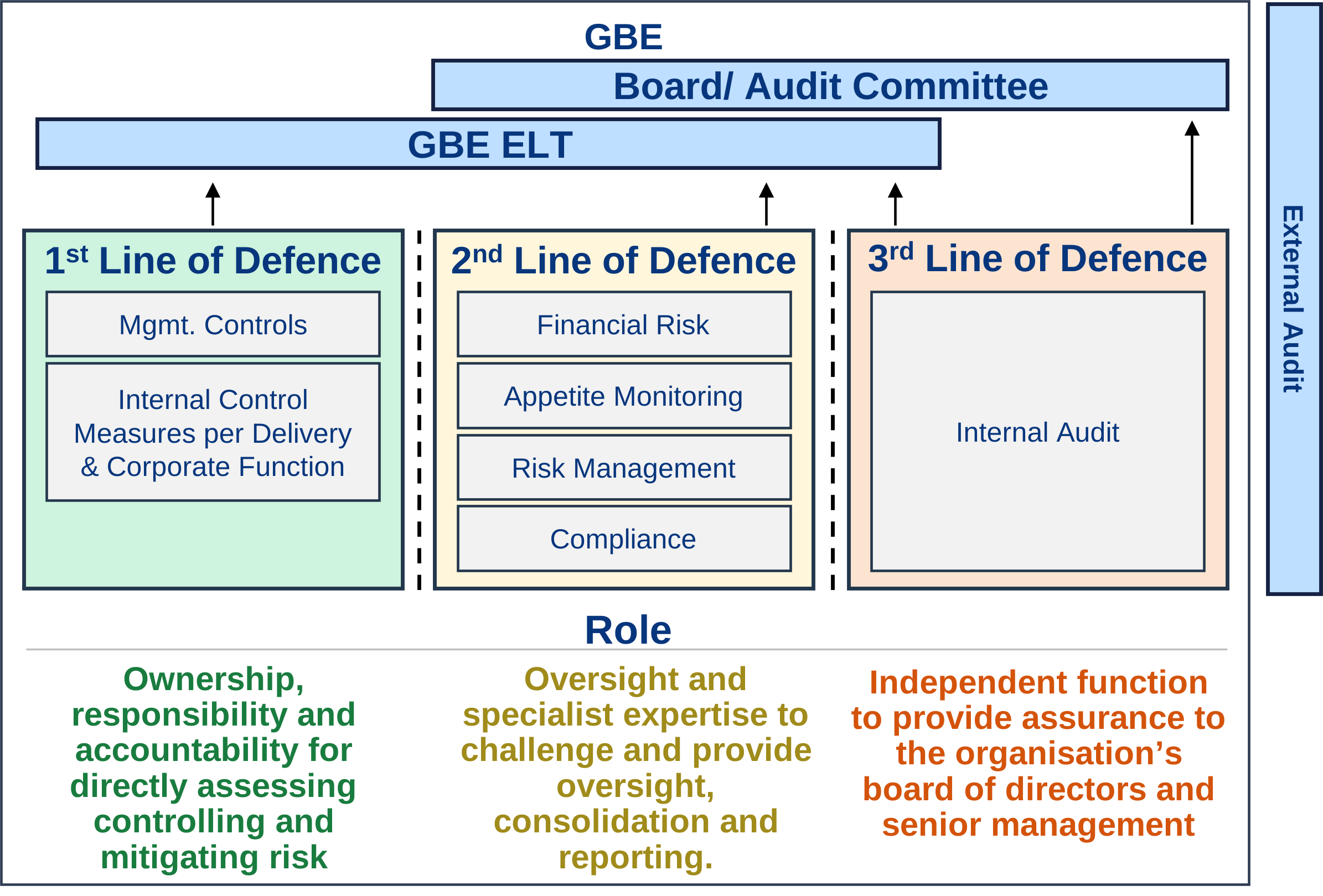
Diagram description: GBE’s Risk Management Framework – 3LoD (3 lines of defence).
1st line of defence:
- Mgmt. Controls
- Internal Control Measures per Delivery & Corporate Function
Role: Ownership, responsibility and accountability for directly assessing controlling and mitigating risk.
Reporting to: GBE ELT
2nd line of defence:
- Financial Risk
- Appetite Monitoring
- Risk Management
- Compliance
Role: Oversight and specialist expertise to challenge and provide oversight, consolidation and reporting.
Reporting to: GBE ELT
3rd line of defence:
- Internal Audit
Role: Independent function to provide assurance to the organisation’s board of directors and senior management.
Reporting to: GBE ELT & Board/Audit Committee
Conflicts of interest:
Directors have a duty under the Companies Act 2006 to avoid situations where they have, or can have, a direct or indirect interest that conflicts, or possibly may conflict, with GBE’s interests.
GBE’s Conflicts of Interest Policy sets out a formal process for the identification, assessment, management and recording of conflicts of interest, including written disclosure of all actual or potential conflicts of interest for all Directors. Directors and the Executive Team are reminded of the need to declare conflicts of interest at regular intervals throughout the period.
Register of interests:
The Executive Leadership Team and Board Directors must regularly complete a declaration of interests. There were no declarations of significant company directorships or other interests that may have conflicted with their management responsibilities during the period.
Related Party interests are disclosed in Note 14 to the financial statements.
Regularity of expenditure (Audited):
GBE is compliant against the framework of authorities against which it is audited. There have been no instances of material irregularity, impropriety or non-compliance identified during the period.
Political donations:
GBE did not make any political donations or incur any political expenditure during the period to 31 March 2026.
Cyber security and other risks:
GBE is well aware that sensitive information can be compromised or lost as a result of cyber crime (such as a ransomware attacks), eavesdropping, theft, mistakes or leaks. The company continues to strengthen its overall security and preparedness against emerging threats. This means developing its security resilience, its physical and cyber infrastructure, and the capabilities, culture and resilience of its staff to monitor and counter risks to its people and information.
GBE, working with Integrated Corporate Services[footnote 1], maintains appropriate cyber defences. The Company is also working closely with the Department for Energy Security and Net Zero (DESNZ) to realise the benefits of a more established and mature security function.
Quality assurance of analytical models:
GBE uses analytical models to inform its policy and decision making, evaluation and operations. The models are quality assured to ensure they are fit for purpose.
Compliance with the mandatory elements of the Cabinet Office Functional Standards:
GBE undertakes functional work relating to project delivery, human resources, finance, commercial, analysis, communications and grants. Given GBE’s current stage of development, formal assessments against the UK government Functional Standards in these areas have not been undertaken, but no controls breaches have been identified during this period. Where GBE is building internal functions, such as grants and digital, these capabilities are provided by experienced, central Department for Energy Security and Net Zero (DESNZ) teams.
Transparency
GBE is committed to transparency and openness and is required to comply with the Freedom of Information Act 2000 (FOIA) and the Environmental Information Regulations 2004 (EIR). To this end:
- GBE has adopted the Information Commissioner’s Office (ICO) Model Publication Scheme and will make a wide range of information readily accessible via its website
- the Company received twenty-seven FOIA/EIR requests during the reporting period. Ten were responded to within the statutory deadline, others required deadline extensions and some are still ongoing at the time of writing the report
- no Data Subject Access Requests were received by GBE during the reporting period
- there were no data breaches requiring reporting to the ICO during the reporting period
Internal Audit opinion
In compiling this governance statement, I have also been informed by the work of Internal Audit. In his annual report, the Head of Internal Audit stated the following:
In accordance with the requirements of the Global Internal Audit Standards in the UK Public Sector, I am required to provide the Accounting Officer (AO) and the Audit, Assurance and Enterprise Risk Committee (AAERC) with my annual opinion on the adequacy and effectiveness of the organisation’s risk management, control and governance arrangements. My opinion would support the AO’s Governance Statement. The AO retains personal responsibility for risk management, governance and control processes.
GBE is a relatively new organisation, receiving Royal Assent in 2025 with the audit service commencing in November of the same year. As a result, I have delivered one strategic assurance activity and had a number of conversations with the executive whilst attending two AAERCs and one Executive Committee. This means that the scope of my work has been limited, and I am not able to give an opinion covering the 2025/26 year.
However, I can deliver a statement on the progress of the developing frameworks for governance, risk management and internal control processes.
During the period from November 2025 to March 2026, ongoing conversations with senior leadership, and a review covering the development of governance structures and processes, risk management activities, and assurance mechanisms over key suppliers of corporate services highlighted that effective processes are on track to design, deliver and embed appropriate governance structures, with appropriate risk management framework to direct and control the organisation whilst ensuring the actions and decisions to be made are proportionate to the complexity of the business and its operating environment.
However, the organisation is still in its infancy and will need to continue to focus on the right developmental priorities to ensure effective embedding of processes. GBE will need to agree terms with its corporate services providers, develop a framework to monitor delivery against the strategic plan, and as GBE continues to transition from DESNZ, it works to adopt its own policies and procedures, and develop a process to monitor compliance against them.
Information governance and management
GBE’s Programme Delivery team is leading on onboarding the services provided by Integrated Corporate Services (ICS). This includes onboarding the Information Compliance services provided by the ICS Digital function, as well as Cyber Security services provided by the ICS Departmental Security Unit. This means that GBE will continue to align with ICS Information Management policies and procedures. The Company is in the process of reviewing existing ICS policies, to ensure that they are relevant to GBE’s status and function. This will result in a revised set of policies, which will be adopted by the Company.
Statement of Directors’ and Accounting Officer’s responsibilities
Under the Companies Act 2006, the Directors are responsible for preparing the Annual Report and the financial statements for each financial year. The Directors have prepared the financial statements in accordance with UK adopted International Accounting Standards (IAS).
The financial statements are prepared on an accruals basis and must provide a true and fair view of the state of affairs of GBE. The financial statements comprise the Statement of comprehensive income, the Statement of financial position, the Statement of changes in equity, the Statement of cash flows and the associated Notes to the financial statements, for the financial period.
In preparing the accounts, the Directors have:
- observed the Accounts Direction issued by HM Treasury, including the relevant accounting and disclosure requirements, insofar as these do not conflict with the Companies Act 2006 and the requirements of IAS
- applied suitable accounting policies on a consistent basis
- made judgements and estimates on a reasonable basis
- stated whether the applicable International Financial Reporting Standards (IFRS) have been followed, and disclosed and explained any material departures in the financial statements
- prepared the financial statements on a going concern basis
The Chief Executive Officer is the Accounting Officer for the Company. The responsibilities of an Accounting Officer, including responsibility for safeguarding the public funds for which they have charge; ensuring propriety, regularity, value for money and feasibility in the handling of those public funds; ensuring that proper records are kept and that the accounts are properly prepared and presented in accordance with any directions issued by the Secretary of State, are set out in HM Treasury guidance, including Managing Public Money, and reflected in the Company’s framework document.
Managing Public Money also sets out that the Accounting Officer takes personal responsibility for key accountability outputs, including personally signing the accounts, the annual report and the governance statement.
In preparing the financial statements, as the Accounting Officer and on behalf of the Board, I have taken all steps that I should have taken to make myself aware of any relevant audit information and have ensured that the Company’s auditors are aware of such relevant audit information that would have a material impact on the financial statements. I am not aware of any material information that the auditors are unaware of. I also confirm, on behalf of the Board, that the Annual Report and Financial Statements, taken as a whole, are fair, balanced and understandable and provide the information necessary for the Shareholder to assess the Company’s performance, business model and strategy.
This statement was approved by the Board of directors on 8 September 2026 and was signed on its behalf by:
Dan McGrail
Chief Executive Officer and Accounting Officer
8 September 2026
Remuneration and staff report
GBE’s organisation design activity during the period focused on the foundational capabilities required to develop and deliver its Strategic Plan. The Company did not employ any permanent employees during the period due to not having an agreed Pay & Reward Framework to enable this.
During the period, GBE’s workforce comprised Department for Energy Security and Net Zero (DESNZ) and other UK government staff, secondees and contractors.
This approach enabled the Company to build internal capability, put in place core functions and progress strategic development while maintaining flexibility during its establishment phase.
In the period, GBE developed and submitted proposals for its Pay & Reward Framework to HM Treasury. Following agreement of the Pay & Reward Framework for senior posts, seven of these posts are in recruitment as at 31 March 2026. In April 2026 the wider workforce pay case was approved by HM Treasury, following which further waves of recruitment commenced.
In addition to newly appointed individuals, in 2026/27 there will be a transfer of undertakings (TUPE) to GBE for roles of an enduring nature initially recruited on DESNZ terms and conditions.
Remuneration of Directors
The remuneration of all persons who were Directors of the Company in the period was set by DESNZ in accordance with its remuneration policies. The aggregate of Directors’ emoluments during the period was £0.7m. This includes Executive and Non-Executive Directors. No amounts were receivable by the Directors in respect of long-term incentive schemes, and no sums were paid to third parties for Directors’ services during the period.
The disclosures below have been prepared to meet FreM requirements where applicable.
Remuneration of Non-Executive Directors for the period ended 31 March 2026 – ranges of £5,000 (Audited)
| # | Name | Role title | Date appointed | Total Fees £’000 |
Annual equivalent fees £’000 |
|---|---|---|---|---|---|
| 1 | Juergen Maier | Chair | 24 June 2025 | 100-105 | 110-115 |
| 2 | Emma Floyd (note 3) |
Non-Executive Director (Shareholder Representative) |
10 October 2024 | - | - |
| 3 | Kate Gilmartin | Non-Executive Director | 24 June 2025 | 30-35 | 35-40 |
| 4 | Frank Mitchell | Non-Executive Director | 24 June 2025 | 30-35 | 35-40 |
| 5 | Beverley Gower-Jones | Non-Executive Director | 23 September 2025 | 20-25 | 35-40 |
| 6 | Frances O’Grady (note 4) |
Non-Executive Director | 24 June 2025 | - | - |
| 7 | Nina Skorupska | Non-Executive Director | 24 June 2025 | 30-35 | 35-40 |
| 8 | Chris Stark (note 3) |
Non-Executive Director (Shareholder Representative) |
24 June 2025 | - | - |
| 9 | Graeme Sword | Non-Executive Director | 23 September 2025 | 20-25 | 35-40 |
| 10 | Valerie Todd | Non-Executive Director | 24 June 2025 | 30-35 | 35-40 |
Notes to Non-Executive Remuneration:
-
The start dates disclosed above reflect the dates of appointment as recorded at Companies House. Certain Non-Executive Directors were publicly announced and commenced their duties, working as part of a ‘shadow board’ which was in operation prior to these formal registration dates.
-
Fees for Non-Executive Directors are recognised by GBE from the latter of their appointment date or 15 May 2025, being the date on which the Great British Energy Act received Royal Assent and the Company became operational.
-
The Non-Executive Directors designated as Shareholder Representatives are civil servants appointed by the Department for Energy Security and Net Zero (DESNZ). No remuneration is payable by GBE in respect of their services in these roles.
-
Frances O’Grady receives no remuneration in respect of her services in this role.
Remuneration of the Executive Director that is also a Board member for the period ended 31 March 2026 – ranges of £5,000 (Audited)
| Name | Role title | Date of taking up role | Salary (£’000) |
Pension benefits (£’000) |
Performance-related pay (£’000) (see note 1) |
Total (£’000) |
Annual equivalent salary (£’000) |
|---|---|---|---|---|---|---|---|
| Dan McGrail (see note 1) |
Chief Executive | 1 August 2025 | 230-235 | 65-70 | 85-90 | 385-390 | 350-355 |
Remuneration of the members of the Executive Leadership Team for the period ended 31 March 2026 – ranges of £5,000 (Audited)
| Name | Role title | Date of taking up role (see note 5) |
Salary (£’000) |
Pension benefits (£’000) (see note 6) |
Total (£’000) |
Annual equivalent salary/ remuneration (see note 3) (£’000) |
|---|---|---|---|---|---|---|
| Paul Addison (see note 2) |
Director of Policy and External Affairs | 15 May 2025 | 85-90 | 25-30 | 110-115 | 95-100 |
| Tim Cullen | Director of Business Development and Partnerships | 15 May 2025 | 85-90 | 25-30 | 110-115 | 100-105 |
| Jonathon Griffith | Programme Director | 30 June 2025 | 70-75 | 20-25 | 95-100 | 95-100 |
| Alison Presly | Interim General Counsel | 15 May 2025 | 80-85 | 20-25 | 105-110 | 90-95 |
| Helen Seagrave | Director of Local Energy | 15 May 2025 | 85-90 | 20-25 | 110-115 | 95-100 |
| Rob Gilbert (see note 3) |
Interim Director of Supply Chain | 15 May 2025 | - | - | 100-105 | 115-120 |
| Catherine Murphy (see note 3) |
Interim Finance Director | 25 August 2025 | - | - | 105-110 | 180-185 |
| Pamela Nichol‑Littlejohn (see note 3 and note 4) |
HR Director | 20 October 2025 | - | - | 55-60 | 120-125 |
Notes to Executive Remuneration:
-
Dan McGrail was the highest paid director for the financial period ended 31 March 2026. He was appointed as the Interim Chief Executive Officer of GBE in March 2025. He was later appointed as the permanent CEO on 1 August 2025. Total remuneration includes £83,532 paid to him whilst on secondment from Renewables UK from 15 May 2025 up to his appointment. The terms of his contract include discretionary performance-related pay allowing recognition of performance in period without raising base salary levels. The award in the period was based on an assessment of his performance against his agreed objectives by the Chair and Nominations and Remuneration committee, which includes a shareholder representative.
-
Paul Addison left his post as Director of Policy and External Affairs on 31 March 2026. No exit payments were associated with his departure.
-
Rob Gilbert, Catherine Murphy and Pamela Nichol-Littlejohn are all on secondment to GBE, with a range of costing arrangements between GBE and their home organisations. As such, only a total remuneration figure is reported, which includes elements such as employer NI contributions and pension contributions as well as salary.
-
Pamela Nichol-Littlejohn works part-time for GBE (0.5FTE).
-
Paul Addison, Tim Cullen, Alison Presly, Helen Seagrave and Rob Gilbert commenced duties relating to the set-up of GBE prior to Royal Assent on 15 May 2025. These costs are not included in the remuneration table above.
-
None of the individuals within the Remuneration Report are employed by GBE, and as such GBE does not have responsibility for the underlying pension arrangements and therefore GBE cannot disclose accrued pension benefits or liabilities. For transparency, where pension figures are known (for individuals that are employed by DESNZ or other civil service departments, relating to pension contributions only) these are disclosed.
Gender split for the Board and Executive Leadership Team
| Male | Female | |
|---|---|---|
| Chair | 1 | - |
| Non-Executive Directors | 3 | 6 |
| Executive Leadership Team | 5 | 4 |
| Total | 9 | 10 |
Staff numbers (Audited)
GBE has no direct employees. As at 31 March 2026, GBE had a workforce headcount of 121, comprised of Department for Energy Security and Net Zero (DESNZ) staff, secondees and contractors.
A breakdown of GBE’s workforce as at 31 March 2026 is set out in the table below:
| Headcount at 31 March 2026 | |
|---|---|
| Staff employed by DESNZ on behalf of GBE | 24 |
| Staff on loan from DESNZ or other civil service departments | 73 |
| Secondees | 6 |
| Contractors | 18 |
| Total | 121 |
Staff costs and the average number of employees are disclosed in Note 4 to the financial statements. No exit packages were paid by the Company during the period ended 31 March 2026.
Fair pay disclosure
We do not have a fair pay disclosure because GBE did not have an approved pay and reward framework in the period, and did not employ anyone on GBE terms and conditions in the period. GBE will include fair pay disclosures within the 2026/27 annual report.
Other pay-related disclosures
GBE does not have any directly employed staff and therefore will not report employment and occupation, health and safety data, trade union relationships and staff turnover. Data will be disclosed in 2026/27 when GBE has directly employed staff.
Cash Equivalent Transfer Value (CETV)
CETV disclosures cannot be made as GBE does not operate a pension scheme and does not have any directly employed staff, and therefore GBE does not have access to CETV data.
Staff engagement
Staff engagement has been supported through regular leadership communications, structured opportunities for feedback to ensure colleagues remain informed, supported and connected to GBE’s strategic direction, and through informal gatherings and networks.
Staff diversity and inclusion
Equality, diversity and inclusion is an integral part of GBE’s strategic workforce plan to build a sustainable organisation, with recruitment, ways of working and policy development aligned to the Public Sector Equality Duty and relevant departmental frameworks. Further, standalone policies will be developed as the organisation matures and transitions to a permanent workforce. Our ambition is to build an inclusive and diverse organisation that ensures the energy transition is shaped by, and delivers for, everyone.
Sickness absence
Information on sickness absence is managed and reported through the department’s corporate service provider ICS, with GBE monitoring themes and issues at an aggregate level where appropriate. The organisation is committed to creating an inclusive and accessible working environment and applies disability‑inclusive recruitment and workplace practices in line with public sector standards, supported by reasonable adjustments provided through the department corporate offer. GBE will report on sickness absence from 2026/27 once staff are permanently employed by GBE.
Consultancy
GBE has engaged suppliers to provide professional services during the period, which meet the definition of consultancy as per the published Public Expenditure System guidance. The value of these services is £3.8 million.
Off-payroll engagements
Off-payroll engagements are arrangements where staff are not paid via the Company’s payroll. As outlined above, GBE employed a number of contingent (interim) workers to bring in essential capacity and capability to the organisation. Details of the cost of these workers is disclosed in Note 4 to the financial statements, and further detail on the off-payroll engagements of interim workers is disclosed below. All interim contractors have been treated as inside the scope of IR35 legislation, aside from as detailed below.
Where professional services have been delivered by suppliers, their staff have not been included in the employee numbers reported in Note 4 and have been treated as outside the scope of IR35 legislation following management’s assessment of these contracts.
The relevant disclosures for off-payroll engagements relevant to the period ended 31 March 2026 are shown in the following tables.
Number of engagements for more than £245 per day as of 31 March 2026
| Engagements | |
|---|---|
| Number of existing engagements as of 31 March 2026 | 18 |
| Of which, number that existed less than 1 year | 18 |
Number of engagements for more than £245 per day at any point during the period ended 31 March 2026
| Engagements | |
|---|---|
| Number of temporary off-payroll workers engaged during the period ended 31 March 2026 | 27 |
| Of which, subject to off-payroll legislation and determined as in‑scope of IR35 | 26 |
| Of which, subject to off-payroll legislation and determined as out‑of‑scope of IR35 | 1 |
No engagements have been reassessed for compliance or assurance purposes during the period.
Number of off-payroll engagements of Board members and/or senior officials with significant financial responsibility in the period
| Engagements | |
|---|---|
| No. of off-payroll engagements of Board members, and/or senior officials with significant financial responsibility, during the period. | 19 |
| Total number of individuals on payroll and off payroll that have been deemed Board members, and/or senior officials with significant financial responsibility during the period. | 19 |
During the period, GBE was in its establishment phase and did not have a permanent executive leadership team or operational capability in place. As a result, several senior interim appointments and specialist contractors were engaged on an off-payroll basis to provide essential leadership, governance and technical expertise while the organisation was being established and permanent recruitment was undertaken.
The duration of these engagements varied according to business need. Each appointment remained in place only for the period necessary to establish organisational capability or until a permanent appointment was made or alternative internal arrangements were established. All engagements were subject to regular review to ensure they remained appropriate and represented value for money.
GBE has commenced a programme of recruitment activity which will continue throughout 2026. GBE will monitor this activity and, in conjunction with its Nominations and Remuneration Committee, assess GBE’s ability to attract whilst reviewing its remuneration offer.
Independent Auditor’s Report to the members of Great British Energy Group Limited and the Houses of Parliament
Opinion on financial statements
I have audited the financial statements of Great British Energy Group Limited for the period ended 31 March 2026.
The financial statements comprise the Great British Energy Group Limited:
- Statement of Financial Position as at 31 March 2026;
- Statement of Comprehensive Income, Statement of Cash Flows and Statement of Changes in Equity for the period then ended; and
- the related notes including the significant accounting policies
The financial reporting framework that has been applied in the preparation of the financial statements is applicable law and UK adopted International Accounting Standards.
In my opinion the financial statements:
- give a true and fair view of the state of Great British Energy Group Limited’s affairs as at 31 March 2026 and its loss for the period then ended; and
- have been properly prepared in accordance with UK adopted International Accounting Standards; and
- have been prepared in accordance with the requirements of the Companies Act 2006
Opinion on regularity
In my opinion, in all material respects, the income and expenditure recorded in the financial statements have been applied to the purposes intended by Parliament and the financial transactions recorded in the financial statements conform to the authorities which govern them.
Basis for opinions
I conducted my audit in accordance with International Standards on Auditing (UK) (ISAs (UK)), applicable law and Practice Note 10 ‘Audit of Financial Statements and Regularity of Public Sector Bodies in the United Kingdom (2024)’. My responsibilities under those standards are further described in the ‘Auditor’s responsibilities for the audit of the financial statements section of my report’.
Those standards require me and my staff to comply with the Financial Reporting Council’s ‘Revised Ethical Standard 2024’. I am independent of Great British Energy Group Limited in accordance with the ethical requirements that are relevant to my audit of the financial statements in the UK. My staff and I have fulfilled our other ethical responsibilities in accordance with these requirements.
I believe that the audit evidence I have obtained is sufficient and appropriate to provide a basis for my opinion.
Conclusions relating to going concern
In auditing the financial statements, I have concluded that Great British Energy Group Limited’s use of the going concern basis of accounting in the preparation of the financial statements is appropriate.
Based on the work I have performed, I have not identified any material uncertainties relating to events or conditions that, individually or collectively, may cast significant doubt on Great British Energy Group Limited’s ability to continue as a going concern for a period of at least 12 months from when the financial statements are authorised for issue.
My responsibilities and the responsibilities of the directors with respect to going concern are described in the relevant sections of this report.
Other information
The other information comprises the information included in the Annual Report, but does not include the financial statements and my auditor’s report thereon. The directors are responsible for the other information.
My opinion on the financial statements does not cover the other information and, except to the extent otherwise explicitly stated in my report, I do not express any form of assurance conclusion thereon.
My responsibility is to read the other information and, in doing so, consider whether the other information is materially inconsistent with the financial statements or my knowledge obtained in the audit, or otherwise appears to be materially misstated.
If I identify such material inconsistencies or apparent material misstatements, I am required to determine whether this gives rise to a material misstatement in the financial statements themselves. If, based on the work I have performed, I conclude that there is a material misstatement of this other information, I am required to report that fact.
I have nothing to report in this regard.
Opinion on other matters prescribed by the Companies Act 2006
In my opinion, based on the work undertaken in the course of the audit:
- the information given in the Strategic Report and the Directors’ Report for the financial period for which the financial statements are prepared is consistent with the financial statements; and
- the Strategic Report and the Directors’ Report have been prepared in accordance with applicable legal requirements
Other matters:
In my opinion:
- the part of the Remuneration and Staff Report to be audited has been properly prepared in accordance with HM Treasury’s Government Financial Reporting Manual; and
- the parts of the Annual Report subject to audit have been properly prepared in accordance with HM Treasury’s Government Financial Reporting Manual
Matters on which I report by exception
In the light of the knowledge and understanding of Great British Energy Group Limited and its environment obtained in the course of the audit, I have not identified material misstatements in the Strategic Report or the Directors’ Report.
I have nothing to report in respect of the following matters in relation to which the Companies Act 2006 requires me to report to you if, in my opinion:
- adequate accounting records have not been kept or returns adequate for my audit have not been received from branches not visited by my staff; or
- the financial statements and the parts of the Remuneration and Staff Report to be audited are not in agreement with the accounting records and returns; or
- certain disclosures of director’s remuneration specified by law are not made; or
- I have not received all of the information and explanations I require for my audit; or
- the Governance Statement does not reflect compliance with HM Treasury’s guidance
Responsibilities of the directors for the financial statements
As explained more fully in the Statement of Directors’ and Accounting Officer’s Responsibilities, the directors are responsible for:
- maintaining proper accounting records;
- providing the C&AG with access to all information of which management is aware that is relevant to the preparation of the financial statements such as records, documentation and other matters;
- providing the C&AG with additional information and explanations needed for his audit;
- providing the C&AG with unrestricted access to persons within Great British Energy Group Limited from whom the auditor determines it necessary to obtain audit evidence;
- ensuring such internal controls are in place as deemed necessary to enable the preparation of financial statements to be free from material misstatement, whether due to fraud or error;
- preparing financial statements, which give a true and fair view, in accordance with the Companies Act 2006;
- preparing the Annual Report in accordance with the Companies Act 2006 ;
- preparing the Remuneration and Staff Report, which is included in the Annual Report, in accordance with HM Treasury’s Government Financial Reporting Manual; and
- assessing Great British Energy Group Limited’s ability to continue as a going concern, disclosing, as applicable, matters related to going concern and using the going concern basis of accounting unless the directors either intends to liquidate the entity or to cease operations, or has no realistic alternative but to do so
Auditor’s responsibilities for the audit of the financial statements
My responsibility is to audit and report on the financial statements in accordance with applicable law and International Standards on Auditing (UK) (ISAs (UK)).
My objectives are to obtain reasonable assurance about whether the financial statements as a whole are free from material misstatement, whether due to fraud or error, and to issue a report that includes my opinion. Reasonable assurance is a high level of assurance but is not a guarantee that an audit conducted in accordance with ISAs (UK) will always detect a material misstatement when it exists. Misstatements can arise from fraud or error and are considered material if, individually or in the aggregate, they could reasonably be expected to influence the economic decisions of users taken on the basis of these financial statements.
Extent to which the audit was considered capable of detecting non-compliance with laws and regulations including fraud
I design procedures in line with my responsibilities, outlined above, to detect material misstatements in respect of non-compliance with laws and regulations, including fraud. The extent to which my procedures are capable of detecting non-compliance with laws and regulations, including fraud is detailed below.
Identifying and assessing potential risks related to non-compliance with laws and regulations, including fraud
In identifying and assessing risks of material misstatement in respect of non-compliance with laws and regulations, including fraud, I:
- considered the nature of the sector, control environment and operational performance including the design of Great British Energy Group Limited’s accounting policies, key performance indicators and performance incentives.
- inquired of management, the Government Internal Audit Agency and those charged with governance, including obtaining and reviewing supporting documentation relating to Great British Energy Group Limited ’s policies and procedures on:
- identifying, evaluating and complying with laws and regulations;
- detecting and responding to the risks of fraud; and
- the internal controls established to mitigate risks related to fraud or non-compliance with laws and regulations including Great British Energy Group Limited ’s controls relating to Great British Energy Group Limited’s compliance with the Companies Act 2006, Managing Public Money and the Great British Energy Act 2025
- inquired of management, the Government Internal Audit Agency and those charged with governance whether:
- they were aware of any instances of noncompliance with laws and regulations; and
- they had knowledge of any actual, suspected, or alleged fraud;
- discussed with the engagement team and the relevant external specialists, including financial instruments and valuation experts regarding how and where fraud might occur in the financial statements and any potential indicators of fraud
As a result of these procedures, I considered the opportunities and incentives that may exist within Great British Energy Group Limited for fraud and identified the greatest potential for fraud in the following areas: revenue recognition, posting of unusual journals, complex transactions and bias in management estimates. In common with all audits under ISAs (UK), I am required to perform specific procedures to respond to the risk of management override.
I obtained an understanding of Great British Energy Group Limited’s framework of authority and other legal and regulatory frameworks in which Great British Energy Group Limited operates. I focused on those laws and regulations that had a direct effect on material amounts and disclosures in the financial statements or that had a fundamental effect on the operations of Great British Energy Group Limited. The key laws and regulations I considered in this context included Companies Act 2006, Managing Public Money, Great British Energy Act 2025, Subsidy Control Act 2022, the Procurement Act 2023 and tax legislation.
Audit response to identified risk
To respond to the identified risks resulting from the above procedures:
- I reviewed the financial statement disclosures and testing to supporting documentation to assess compliance with provisions of relevant laws and regulations described above as having direct effect on the financial statements;
- I enquired of management, the Audit, Assurance and Enterprise Risk Committee and in-house legal counsel concerning actual and potential litigation and claims;
- I reviewed minutes of meetings of those charged with governance and the Board and internal audit reports; and
- I addressed the risk of fraud through management override of controls by testing the appropriateness of journal entries and other adjustments; assessing whether the judgements on estimates are indicative of a potential bias; and evaluating the business rationale of any significant transactions that are unusual or outside the normal course of business
I communicated relevant identified laws and regulations and potential risks of fraud to all engagement team members including external specialists and remained alert to any indications of fraud or non-compliance with laws and regulations throughout the audit.
A further description of my responsibilities for the audit of the financial statements is located on the Financial Reporting Council’s website at: www.frc.org.uk/auditorsresponsibilities. This description forms part of my report.
Other auditor’s responsibilities
I am required to obtain sufficient appropriate audit evidence to give reasonable assurance that the expenditure and income recorded in the financial statements have been applied to the purposes intended by Parliament and the financial transactions recorded in the financial statements conform to the authorities which govern them.
I communicate with those charged with governance regarding, among other matters, the planned scope and timing of the audit and significant audit findings, including any significant deficiencies in internal control I identify during my audit.
Steve Young (Senior Statutory Auditor)
9 September 2026
For and on behalf of the:
Comptroller and Auditor General (Statutory Auditor)
National Audit Office
157-197 Buckingham Palace Road
Victoria
London
SW1W 9SP
Financial statements
Statement of Comprehensive Income
(For the period ended 31 March 2026)
| Income | Note | Period ended 31 March 2026 £’000 |
|---|---|---|
| Other income | 3 | 62 |
| Total income | - | 62 |
| Operating expenses | Note | Period ended 31 March 2026 £’000 |
|---|---|---|
| Staff costs | 4 | (7,901) |
| Other operating expenses | 5 | (6,269) |
| Total operating expenses | - | (14,170) |
| Operating Loss for the period | - | (14,108) |
| Finance cost | Note | Period ended 31 March 2026 £’000 |
|---|---|---|
| Unwinding of discount on lease liabilities | - | (10) |
| Loss for the period before taxation | - | (14,118) |
| Taxation | Note | Period ended 31 March 2026 £’000 |
|---|---|---|
| Taxation | 2 | – |
| Loss for the period | - | (14,118) |
| Comprehensive income | Note | Period ended 31 March 2026 £’000 |
|---|---|---|
| Other comprehensive income for the period | - | - |
| Net comprehensive loss for the period | - | (14,118) |
All operations are continuing. Notes 1 to 17 form an integral part of these financial statements.
Statement of Changes in Equity
(At 31 March 2026)
| Share capital £’000 |
Retained earnings £’000 |
Total £’000 |
|
|---|---|---|---|
| Opening balance | - | - | - |
| Total comprehensive loss for the period | - | (14,118) | (14,118) |
| Issue of ordinary shares | 6,550 | - | 6,550 |
| Balance at 31 March 2026 | 6,550 | (14,118) | (7,568) |
Statement of Financial Position
(As at 31 March 2026)
| Assets | Note | 31 March 2026 £’000 |
|---|---|---|
| Non-current assets: Property, plant and equipment | 6 | 2,607 |
| Non-current assets: Investment | 7, 12 | 5,821 |
| Non-current assets: Total | - | 8,428 |
| Current assets: Cash and cash equivalents | 8, 12 | 778 |
| Current assets: Total | 778 | |
| Total assets | - | 9,206 |
| Liabilities | Note | 31 March 2026 £’000 |
|---|---|---|
| Current liabilities: Trade and other payables | 9, 12 | (1,944) |
| Current liabilities: Amount due to Shareholder | 10, 12 | (12,194) |
| Current liabilities: Lease liabilities | 11 | (83) |
| Current liabilities: Total | - | (14,221) |
| Non-current liabilities: Lease liabilities | 11 | (2,553) |
| Total liabilities | - | (16,774) |
| Net liabilities | - | (7,568) |
| Capital and reserves | Note | 31 March 2026 £’000 |
|---|---|---|
| Share capital | 13 | 6,550 |
| Retained earnings | - | (14,118) |
| Total equity | - | (7,568) |
These financial statements of Great British Energy (SC825539) were approved by the Board on 8 September 2026. They were signed on their behalf by:
Dan McGrail
Chief Executive and Accounting Officer
Statement of Cash Flows
(For the period ended 31 March 2026)
| Operating activities | Note | Period ended 31 March 2026 £’000 |
|---|---|---|
| Loss for the period | - | (14,118) |
| Adjustments for non-cash transactions: | ||
| Depreciation | 6 | 19 |
| Finance costs – unwinding of discount | - | 10 |
| Increase in trade and other payables | 9 | 1,944 |
| Increase in amount due to shareholder | 10 | 12,194 |
| Net cash flow from operating activities | - | 49 |
| Investing activities | Note | Period ended 31 March 2026 £’000 |
|---|---|---|
| Acquisition of investment | 7 | (5,821) |
| Net cash flow from investing activities | - | (5,821) |
| Financing activities | Note | Period ended 31 March 2026 £’000 |
|---|---|---|
| Net increase in Shareholder funding | 13 | 6,550 |
| Net cash flow from financing activities | - | 6,550 |
| Cash and cash equivalents | Note | Period ended 31 March 2026 £’000 |
|---|---|---|
| Net increase in cash and cash equivalents | - | 778 |
| Cash and cash equivalents at the beginning of the period | - | - |
| Cash and cash equivalents at end of period | 8 | 778 |
Notes 1 to 17 form an integral part of these financial statements.
Notes to the financial statements
1. General information
GBE is a private company limited by shares. The Company is registered with Companies House under company number SC825539 and the registered office is AB1 Building, Crimon Place, Aberdeen, Scotland, AB10 1BJ.
The Company is a publicly owned entity and operates as an arm’s length body sponsored by the Department for Energy Security and Net Zero (DESNZ).
The Company’s principal activity is to invest in and develop clean energy projects and related energy solutions, supporting domestic clean energy production, community energy and UK energy security in line with its strategic objectives.
The principal accounting policies adopted by the Company are set out in Note 2.
2. Accounting policies
2.1 Basis of preparation
These financial statements have been prepared in accordance with UK-adopted International Accounting Standards and International Financial Reporting Standards as issued by the International Accounting Standards Board (IASB) and applicable requirements of the Companies Act 2006. In preparing these financial statements, the Company has also applied relevant requirements of HM Treasury’s ‘Financial Reporting Manual’ (FReM), to the extent this is consistent with the Companies Act 2006 and IFRS. This application of the FReM extends to the financial statements only, except for the inclusion of the following specific FReM-derived disclosures within the Annual Report: (i) Strategic Report, (ii) Accountability Report and (iii) Remuneration and Staff Report.
The Company changed its accounting reference date from 31 October to 31 March on 24 April 2025 and, as a result, these financial statements are for the period between 10 October 2024 and 31 March 2026. The Company has changed its accounting reference period to align with that of the Company’s Shareholder.
While GBE was incorporated on 10 October 2024, it received its operational mandate following Royal Assent to the Great British Energy Act on 15 May 2025. Costs incurred by DESNZ between 10 October 2024 to 14 May 2025 for the set-up of GBE were borne by DESNZ and not recharged to GBE. They are therefore not included in the Financial Statements.
The financial statements have been prepared under the historical cost convention, except for those assets and liabilities that are required to be measured at fair value in accordance with applicable accounting standards.
The financial statements are presented in pounds sterling, which is the functional currency of the Company, and all amounts are rounded to the nearest £’000, except where otherwise indicated.
2.2 Going concern
- The financial statements have been prepared on a going concern basis. In forming their going concern conclusion, the Directors have considered:
- (i) GBE’s funding arrangements including the expected availability of funding from the Shareholder through a Facility Agreement to meet liabilities as they fall due;
- (ii) evidence of continued shareholder support including approval of GBE’s multi-year business plan; and
- (iii) the Company’s current financial position, strategic risks and wider economic conditions.
Based on this assessment, the Directors have a reasonable expectation that the Company has adequate resources to continue in operational existence for the foreseeable future and the company will have sufficient funds to meet its liabilities as they fall due for the period of at least 12 months from the date of approval of the financial statements.
The Company’s principal source of funding is an interest-free facility made available by the Department for Energy Security and Net Zero (‘DESNZ’) under a facility agreement. Amounts drawn under the facility are repayable on demand and are available to support the Company’s working capital requirements and investment activities.
The maximum commitment available under the facility was £68 million for the period to 31 March 2026, increasing to £510 million for the period from 1 April 2026 to 31 March 2027. At 31 March 2026, £12.2 million was outstanding under the facility.
The facility includes a mechanism under which outstanding amounts are intended to be capitalised into equity prior to the end of each financial year. This supports the Company’s funding model during its establishment phase and reduces the extent to which balances remain repayable in cash.
The Company has also received a letter of support from the Secretary of State for Energy Security and Net Zero stating it will provide sufficient funding to enable GBE to meet its liabilities as and when they fall due.
Funding beyond 31 March 2026 is expected to be provided through DESNZ departmental budgets and remains subject to the Government’s annual budgeting process and Parliamentary approval of supply. Having considered GBE’s role in delivering the Government’s energy policy objectives and the funding arrangements in place for financial year 2026/27, the Directors have a reasonable expectation that sufficient funding will continue to be available to support the Company’s activities.
2.3 New accounting standards and future changes
The IASB and IFRIC have issued a number of new standards and interpretations with an effective date after the date of these financial statements. GBE will adopt applicable new standards and amendments when they become effective. The Company does not expect the adoption of these standards and amendments to have a material impact on the financial statements in future periods; however, the impact will be assessed in detail as part of the implementation planning for the relevant effective dates.
The new or revised IFRSs are noted below:
| Effective for annual periods ended 31 March 2026 and thereafter: | Effective date annual periods beginning on or after |
|---|---|
| Amendments to the Classification and Measurement of Financial Instruments – Amendments to IFRS 9 Financial Instruments and IFRS 7 Financial Instruments: Disclosures | 1 January 2026 |
| Annual Improvements to IFRS Accounting Standards – Amendments to: – IFRS 7 Financial Instruments: Disclosures and its accompanying Guidance on implementing IFRS 7; – IFRS 9 Financial Instruments; and – IAS 7 Statement of Cash Flows |
1 January 2026 |
| IFRS 18 Presentation and Disclosure in Financial Statements | 1 January 2027 |
There is a further accounting standard, IFRS19 Subsidiaries without Public Accountability, effective for reporting periods starting on or after 1 January 2027. GBE does not have public accountability and therefore does not meet the criteria for implementation of this standard.
2.4 Significant judgements and estimates
The preparation of the financial statements requires management to make judgements, estimates and assumptions that affect the application of accounting policies and the reported amounts of assets, liabilities, income and expenses. Actual outcomes may differ from those estimates. Estimates and underlying assumptions are reviewed on an ongoing basis, with revisions recognised in the period in which the estimates are revised and in any future periods affected.
Significant judgements in applying accounting policies:
Investment in Highland Wind Limited – assessment of control and significant influence: Management has exercised significant judgement in assessing whether the Company controls Highland Wind Limited (HWL) under IFRS 10 and whether it has significant influence over HWL under IAS 28. GBE holds an equity interest in HWL and has certain governance rights.
In assessing control, management considered whether these rights give GBE power over the activities that most significantly affect HWL’s returns. Although GBE has consent rights over certain reserved matters, these are principally protective in nature. For the key decisions relating to progression of the project, unanimous shareholder approval is not required and the majority investor retains a casting vote. GBE therefore does not have the current ability to direct HWL’s relevant activities.
GBE is exposed to variable returns through its equity and shareholder loan interests; however, because it does not have power over HWL’s relevant activities, it does not have the ability to use that power to affect those returns. Management has therefore concluded that GBE does not control HWL.
Management has also considered whether GBE has significant influence over HWL. GBE’s rights do not provide it with the ability to participate in the financial and operating policy decisions that are relevant to HWL. Having considered the rights and governance arrangements in their entirety, management has concluded that GBE does not have significant influence over HWL.
Accordingly, HWL is neither controlled by GBE nor an associate of GBE and is not consolidated or accounted for using the equity method.
Investment in Highland Wind Limited (HWL) – classification and measurement: The Company’s investment in Highland Wind Limited (HWL) comprises ordinary shares and a shareholder loan receivable acquired together as part of the same investment transaction.
Management concluded that the equity and shareholder loan should be measured together because they were acquired contemporaneously as part of one negotiated transaction, are both exposed to the same underlying project economics and generate interdependent returns.
Fair value for combined debt/equity instruments where the Company holds both debt and equity in an investee company, and the instruments are economically linked are valued under a single unit of account. This reflects the market participant perspective that the instruments would be transacted together. In such cases, the combined investment is valued holistically, with fair value allocated across the debt and equity components, including assessment of any hybrid instruments such as convertible loan notes.
Presentation and classification of funding under the Department for Energy Security and Net Zero (DESNZ) facility agreement: The Company has funding arrangements with DESNZ under an interest-free facility agreement that is repayable on demand and includes a mechanism for the capitalisation of amounts drawn into equity.
Management has exercised judgement in determining the appropriate classification and measurement of amounts drawn under this facility.
In assessing classification, management considered whether the facility should be presented as a financial liability or as equity. As the facility is legally repayable on demand and the Company does not have an unconditional right to defer settlement for at least 12 months at the reporting date, amounts drawn and not yet capitalised have been classified as a financial liability.
In relation to measurement, management has assessed whether the fair value of the liability on initial recognition differs materially from the transaction price. Given the on-demand nature of the facility, the short, expected duration of outstanding balances prior to capitalisation, and the absence of a substantive financing component, management concluded that the transaction price represents a reasonable approximation of fair value.
Key sources of estimation uncertainty:
Fair value measurement of investment: The Company’s combined equity and debt investment in HWL is measured at fair value through profit or loss and is classified as a Level 3 financial asset within the IFRS 13 fair value hierarchy, reflecting the use of significant unobservable inputs.
Determining fair value for unquoted early-stage infrastructure investments requires management to make estimates and assumptions regarding the most appropriate valuation methodology and the significance of events occurring after acquisition.
At 31 March 2026, management determined that the most appropriate estimate of fair value was the recent transaction price, being cumulative capital invested of £5.8 million.
Changes in valuation assumptions, project performance expectations, market conditions or assessment of development risk could result in materially different fair value estimates in future reporting periods.
2.5 Property, plant and equipment:
Property, plant and equipment (PPE) is initially recognised at cost if it is intended for use on a continuing basis and its original carrying value, on an individual or asset pool basis where appropriate, exceeds the relevant capitalisation threshold of £2,500. Costs comprise the amount of cash paid to acquire the asset and includes all costs directly attributable to bringing them into working condition.
Valuation of PPE: PPE is carried at cost, less accumulated depreciation and the value of any accumulated impairments. PPE is reviewed annually for impairment. Right of use assets are valued at cost under IFRS 16 Leases.
Depreciation of PPE: Depreciation is charged so as to write off the cost of assets less their residual values over their estimated useful lives or in the event of right-of-use assets, over the shorter of the useful life of the underlying asset and the lease term, using the straight-line method, on the following basis:
Right of use assets: Limited to the period remaining on the lease.
The estimated useful lives, residual values and depreciation method are reviewed at the end of each reporting period, with the effect of any changes in estimate accounted for on a prospective basis.
Impairment of PPE: The carrying values of property, plant and equipment are reviewed for impairment if events or changes in circumstances indicate that the carrying value may not be recoverable. An impairment loss is recognised in the Statement of Comprehensive Income for the amount by which the asset’s carrying amount exceeds its recoverable amount. The recoverable amount is the higher of an asset’s fair value less costs to sell and value in use.
Derecognition of PPE: An item of property, plant and equipment is derecognised upon disposal or when no future economic benefits are expected to arise from the continued use of the asset. The gain or loss arising on the disposal or retirement of an asset is determined as the difference between the sales proceeds and the carrying amount of the asset and is recognised in the income statement.
2.6 Leases
The Company assesses whether a contract is or contains a lease, at inception of the contract. The Company recognises a right-of-use asset and a corresponding lease liability with respect to all lease arrangements in which it is the lessee, except for short-term leases (defined as leases with a lease term of 12 months or less) and leases of low value assets (such as tablets and personal computers, small items of office furniture and telephones). For these leases, the Company recognises the lease payments as an operating expense on a straight-line basis over the term of the lease unless another systematic basis is more representative of the time pattern in which economic benefits from the leased assets are consumed. The lease liability is initially measured at the present value of the lease payments that are not paid at the commencement date, discounted by using the incremental borrowing rate as advised by HM Treasury, which was 5.32% at the lease adoption date. This rate was deemed appropriate given GBE is currently ultimately funded by Government.
The lease liability is subsequently measured by increasing the carrying amount to reflect interest on the lease liability (using the effective interest method) and by reducing the carrying amount to reflect the lease payments made.
The right-of-use assets comprise the initial measurement of the corresponding lease liability, lease payments made at or before the commencement day, less any lease incentives received and any initial direct costs. They are subsequently measured at cost less accumulated depreciation and impairment losses.
2.7 Financial instruments, assets and liabilities recognition and initial measurement
A financial instrument is any contract that gives rise to a financial asset of one entity and a financial liability or equity instrument of another entity. Financial assets and liabilities are recognised in the Statement of Financial Position when the Company becomes party to the contractual provisions of the instrument in accordance with IFRS 9.
Financial assets and liabilities are accounted for at settlement date, which is when the Company becomes party to the contractual provisions of the instrument.
Financial assets and liabilities are initially measured at fair value. Fair value is the price that would be received to sell an asset or paid to transfer a liability in an orderly transaction between market participants at the measurement date, in the principal or, in its absence, the most advantageous market to which the Company has access at that date.
Where quoted market prices or other observable market data are not available, fair value is determined using an appropriate valuation technique based on the information available and assumptions that market participants would use when pricing the investment. Where recent transaction price is used as the basis for fair value, the Company assesses whether changes in circumstances since the transaction indicate that an adjustment is required. For the period ended 31 March 2026, no such adjustment was identified.
Transaction costs that are directly attributable to the acquisition or issue of financial instruments are accounted for as follows:
- Financial instruments measured at fair value through profit or loss (FVTPL) – Transaction costs are recognised immediately in the Statement of Comprehensive Income
- Financial instruments not measured at FVTPL (amortised cost, fair value through other comprehensive income (FVOCI)) – Transaction costs are reflected in the fair value of the financial asset or liability at initial recognition
Financial assets are derecognised when the contractual rights to the cash flows from the instrument expire or the asset is transferred, and the transfer qualifies for derecognition in accordance with IFRS 9 ‘Financial Instruments’.
Financial liabilities are derecognised when the Company’s obligations are discharged, cancelled or have expired.
Classification of financial instruments:
Financial assets are classified under IFRS 9 as amortised cost, fair value through other comprehensive income (FVOCI) or fair value through profit or loss (FVTPL) depending on the business model and the contractual cashflow characteristics of the instruments.
At 31 March 2026, GBE’s financial instruments comprise investment in combined equity and debt instrument, cash and cash equivalents, trade and other payables and amounts due to Shareholder.
Investments: On initial recognition, the Group classifies its investments as FVTPL. These assets at FVTPL are subsequently measured at fair value. Net gains and losses are recognised in profit or loss in ‘net unrealised gains or losses on revaluation’ in the Statement of Comprehensive Income.
Fair value is the price that would be received to sell an asset in an orderly transaction between market participants at the measurement date in the principal or, in its absence, the most advantageous market to which the Company has access at that date.
The Company’s fair value methodology has been derived using the International Private Equity and Venture Capital Valuation Guidelines (December 2022). Valuations of the investment portfolio are performed quarterly.
The Company invests in unquoted investments referencing observable market data wherever available. The fair value methodology applied to each investment is driven by the specific characteristics of the investments.
For combined debt/equity instruments where the Company holds both debt and equity in an investee company and the instruments are economically linked and share the same investment characteristics and risks, these are valued under a single unit of account. This reflects the market participant perspective that the instruments would be transacted together. The combined investment is valued holistically, with fair value allocated across the debt and equity components.
Cash and cash equivalents: Cash and cash equivalents comprise cash at bank and in hand and short-term deposits with an original maturity of 3 months or less. The carrying amount of these assets approximates to their fair value.
Trade and other payables: Trade and other payables represent liabilities for goods and services provided to GBE prior to the financial year end that are unpaid. They are measured at fair value. Trade and other payables are not interest bearing and are stated at their nominal value. Their carrying value approximates their fair value.
Accruals are recognised for expenses incurred for goods and services delivered prior to the financial year end and that have not been invoiced. GBE has a £2,500 de minimis accrued expenditure threshold; this is deemed appropriate to ensure that the accounts are materially correct, whilst keeping the workload associated with producing the accounts proportionate with the value they provide. Management is satisfied that this is appropriate in ensuring that accrued expenditure is materially correct and that the use of this de minimis value is therefore appropriate in this financial period.
Amount due to Shareholder: The Company’s principal source of funding is an interest-free facility made available by DESNZ under a facility agreement. Amounts drawn under the facility are repayable on demand and are available to support the Company’s working capital requirements and investment activities.
Cash drawdowns and agreed DESNZ costs and services added to the facility balance are recognised as a liability when received or incurred.
In accordance with IFRS 9 Financial Instruments, amounts due to DESNZ are measured at amortised cost. Given the facility is repayable on demand and interest-free, the carrying value is considered to approximate fair value, and no finance cost is recognised.
Amounts outstanding under the facility are capitalised into ordinary shares when the relevant shares are issued in accordance with the facility agreement. On capitalisation, the liability is derecognised and recognised in equity.
Any balance outstanding at the reporting date is presented as an amount due to Shareholder. As the facility is repayable on demand, uncapitalised balances are classified as current liabilities unless the Company has an unconditional right at the reporting date to defer settlement for at least 12 months.
2.8 Other income
Other income is recognised when the Company has established an enforceable right to consideration and it is probable that the economic benefits will flow to the Company. Income is measured at the fair value of the consideration received or receivable, net of any amounts collected on behalf of third parties.
2.9 Other expenses
Operating expenses are recognised when, and to the extent that, the goods or services have been received. They are measured at the fair value of the consideration payable.
2.10 Recharges
During the period, the majority of the GBE’s operating costs were incurred and paid by DESNZ on behalf of GBE, reflecting the Company’s establishment phase and the absence of fully operational internal payment and payroll systems. These costs comprised staff, supplier and service-related expenses and were subsequently recharged to GBE and recognised as operating expenses in the Statement of Comprehensive Income, with a corresponding liability recognised as amounts due to the Shareholder. GBE recognises only the cost of these services, with the associated liabilities to third parties remaining with DESNZ or the relevant employing entity.
Amounts payable to DESNZ in respect of these recharges are recognised as a financial liability until settled or capitalised into equity in accordance with the terms of the Facility Agreement.
2.11 Taxation
Current tax: GBE is subject to Corporation Tax on taxable profits. The Company is in the early stage of its development, with activities in the current period focused on establishing its operating model and investment strategy rather than generating income. As a result, GBE is expected to incur losses in its initial period of operation.
The Company has incurred accounting losses for the period ended 31 March 2026. Accordingly, no current corporation tax charge is expected for the period.
Deferred tax: Deferred tax is recognised in respect of temporary differences between the carrying amounts of assets and liabilities in the financial statements and the corresponding tax bases used in the computation of taxable profits, in accordance with IAS 12. Deferred tax liabilities are generally recognised for all taxable temporary differences and deferred tax assets are recognised to the extent that it is probable that taxable profits will be available against which deductible temporary differences can be utilised.
No deferred tax asset or liability has been recognised in the current period. This reflects both the absence of material temporary differences arising from assets and liabilities recognised on the Statement of Financial Position, and the Company’s current loss-making position during its establishment phase.
While the Company expects to generate taxable profits in future periods as its investment portfolio matures, the timing and quantum of such profits remain uncertain at this stage. Accordingly, no deferred tax asset has been recognised in respect of tax losses. This position is expected to change in future years.
VAT: The Company’s main activities are classed as nontrading for the purposes of VAT and input tax on purchases is not recoverable. Irrecoverable VAT is charged to the relevant expenses category in the Statement of Comprehensive Income.
3. Other income
Other income relates to the recovery of proportionate technical due diligence costs from the National Wealth Fund and the Scottish National Investment Bank, Great British Energy’s co-investment partners.
| Period ended 31 March 2026 £’000 |
|
|---|---|
| Funds received from National Wealth Fund | 31 |
| Funds received from Scottish National Investment Bank | 31 |
| Total | 62 |
4. Staff costs
There were no directly employed staff during the period. GBE’s workforce comprised DESNZ and other UK government staff, secondees and contractors. Total staff costs of £7.9m also includes irrecoverable VAT incurred.
Employee numbers:
GBE’s workforce is made up of a mixture of people, comprising seconded employees and individuals engaged on interim contracts to support the setup of the organisation.
The average and closing headcount of persons employed during the period was as follows:
| Average Headcount | Closing Headcount | |
|---|---|---|
| Staff employed by DESNZ on behalf of GBE | 14 | 24 |
| Staff on loan from DESNZ or other civil service departments | 42 | 73 |
| Secondees | 5 | 6 |
| Interim staff | 12 | 18 |
| Total | 73 | 121 |
5. Other operating expenses
| Period ended 31 March 2026 £’000 |
|
|---|---|
| Professional fees | 3,773 |
| Property and facilities costs | 677 |
| Shared services costs | 620 |
| Directors’ fees | 352 |
| Travel and subsistence | 229 |
| Auditor’s remuneration | 220 |
| Recruitment costs | 127 |
| IT costs | 107 |
| Learning and development costs | 71 |
| Depreciation | 19 |
| Other expenses | 74 |
| Total | 6,269 |
Auditor’s remuneration is stated inclusive of VAT and represents the total fee payable for statutory audit services provided to the Company. No non-audit services were provided by GBE’s auditor.
6. Property, plant and equipment
| Cost | Right of use assets £’000 |
Total £’000 |
|---|---|---|
| Opening balance | - | - |
| Additions | 2,626 | 2,626 |
| At 31 March 2026 | 2,626 | 2,626 |
| Depreciation | Right of use assets £’000 |
Total £’000 |
|---|---|---|
| Opening balance | - | - |
| Charge | (19) | (19) |
| At 31 March 2026 | (19) | (19) |
| Carrying amount | Right of use assets £’000 |
Total £’000 |
|---|---|---|
| At 31 March 2026 | 2,607 | 2,607 |
Right of use assets relate to the lease of the Head Office building in Aberdeen. The interest expense on the lease liabilities associated with the right-of-use asset was £0.01m for the period. The maturity analysis of the lease liabilities is presented in Note 11.
7. Investment at FVTPL
| Debt £’000 |
Equity £’000 |
Total £’000 |
|
|---|---|---|---|
| Opening balance | - | - | - |
| Additions | 2,995 | 2,826 | 5,821 |
| Closing balance | 2,995 | 2,826 | 5,821 |
In November 2025, the Company acquired a noncontrolling equity interest in Highland Wind Limited (HWL), together with a shareholder loan receivable from HWL. HWL is the special purpose vehicle developing the Pentland Floating Offshore Wind project, a 100 MW floating offshore wind development located off the coast of Scotland and led by Copenhagen Infrastructure Partners. At 31 March 2026 the Company held equity interest of £2.8 million in HWL and a shareholder loan of £3.0 million bearing interest at a fixed rate of 8%.
The equity interest and the shareholder loan are contractually and economically linked and neither instrument may be transferred or settled independently of the other. The Company has therefore valued the two instruments under a single unit of account. The judgement applied in reaching that conclusion is set out in Note 2.4.
The investment was initially recognised at transaction price, representing fair value at acquisition date, 1 November 2025. Subsequent measurement at 31 March 2026 reflects additional capital contributions and continued application of the recent transaction price methodology as the most appropriate proxy for fair value given the early development stage of the project. At 31 March 2026, the investment is carried at £5.8m, representing the total capital invested to date. No fair value gain or loss was recognised during the period. See Note 12 for details of valuation methodology.
8. Cash and cash equivalents
| 31 March 2026 £’000 |
|
|---|---|
| Cash at bank and in hand | 778 |
| Of which: Cash held at Government Banking Service (GBS) | 778 |
9. Trade and other payables
| 31 March 2026 £’000 |
|
|---|---|
| Accruals | 1,944 |
10. Amounts due to Shareholder
| 31 March 2026 £’000 |
|
|---|---|
| Opening balance | - |
| Drawdowns under DESNZ facility | 6,550 |
| DESNZ service costs capitalised to facility | 12,194 |
| Shares issued (Note 13) | (6,550) |
| As at 31 March 2026 | 12,194 |
| Analysed as: Current borrowings | 12,194 |
| Analysed as: Non-current borrowings | - |
| 12,194 |
The Company’s principal source of funding is an interest-free facility provided by the Department for Energy Security and Net Zero (DESNZ) under a facility agreement. Amounts drawn under the facility are repayable on demand and are available to support the Company’s working capital requirements and investment activities.
The facility includes a mechanism under which outstanding amounts are intended to be capitalised into equity prior to the end of each financial year. This supports the Company’s funding model during its establishment phase and reduces the extent to which balances remain repayable in cash.
During the period, total drawdowns and service costs capitalised to the facility amounted to £18.7 million, of which £6.6 million has been settled by share issue. The £6.6 million of shareholder funding that was issued as ordinary share capital provides permanent capital to support the Company’s activities and investment programme. At 31 March 2026, £12.2 million was outstanding under the facility.
The maximum commitment available under the facility was £68 million for the period to 31 March 2026, increasing to £510 million for the period from 1 April 2026 to 31 March 2027.
Funding beyond 31 March 2026 is expected to be provided through DESNZ departmental budgets and remains subject to the Government’s annual budgeting process and Parliamentary approval of supply. Having considered GBE’s role in delivering the Government’s energy policy objectives and the funding arrangements in place for 2026/27, the Directors have a reasonable expectation that sufficient funding will continue to be available to support the Company’s activities.
11. Lease liabilities
| 31 March 2026 £’000 |
|
|---|---|
| Maturity analysis: Not later than 1 year | 218 |
| Maturity analysis: Later than 1 year not later than 5 years | 1,180 |
| Maturity analysis: Later than 5 years | 2,204 |
| Total undiscounted lease liabilities | 3,602 |
| Less: unearned interest | (966) |
| Total lease liabilities included in the Statement of Financial Position | 2,636 |
| Analysed as: Current lease liabilities | 83 |
| Analysed as: Non-current lease liabilities | 2,553 |
| Total | 2,636 |
During the period, the Company did not recognise any expenses relating to short-term, low-value and variable leases. No lease payments had been made by the reporting date; accordingly, the Company did not recognise any cash outflows for leases for the period.
12. Financial instruments
Classification of financial instruments:
The following table analyses the financial assets and liabilities in the Statement of Financial Position in accordance with the categories of financial instruments in IFRS 9.
| Financial assets | Fair value through profit and loss £’000 |
Amortised cost £’000 |
Carrying value £’000 |
Fair value £’000 |
|---|---|---|---|---|
| Investments at FVTPL | 5,821 | - | 5,821 | 5,821 |
| Cash | - | 778 | 778 | 778 |
| Total | 5,821 | 778 | 6,599 | 6,599 |
| Financial liabilities | Fair value through profit and loss £’000 |
Amortised cost £’000 |
Carrying value £’000 |
Fair value £’000 |
|---|---|---|---|---|
| Trade and other payables | - | 1,944 | 1,944 | 1,944 |
| Amounts due to Shareholder | - | 12,194 | 12,194 | 12,194 |
| Total | - | 14,138 | 14,138 | 14,138 |
Fair value measurement:
For financial reporting purposes, fair value measurements are categorised into Levels 1, 2 and 3 based on the observability of the inputs used in the valuation and the significance of those inputs to the fair value measurement. The Company classifies financial instruments measured at fair value using the following hierarchy:
- Level 1: quoted prices (unadjusted) in active markets for identical assets or liabilities
- Level 2: inputs other than quoted prices included within Level 1 that are observable for the asset or liability, either directly or indirectly
- Level 3: inputs that are unobservable and reflect management judgement about the assumptions market participants would use in pricing the asset or liability
The Company’s investments are measured at fair value through profit or loss. All are classified within Level 3 of the fair value hierarchy set out in IFRS 13, as their measurement depends on inputs that are not based on observable market data.
The Company holds contractually linked debt and equity instruments in a single investee, which it measures as one unit of account. The judgement applied in reaching that conclusion is set out in Note 2.4.
The investee’s underlying asset is an unquoted earlystage development project. The project has not reached a final investment decision, does not generate revenue, and there is no active market for interests in projects at this stage. The Company has therefore applied the recent transaction price methodology as the most appropriate valuation technique, consistent with IFRS 13 and with the International Private Equity and Venture Capital Valuation (IPEV) Guidelines (December 2022) for assets at this stage of development.
The price of a recent arm’s-length transaction between market participants is generally considered an appropriate starting point for determining fair value, particularly where an investment remains at an early stage of development. At the reporting date, the Company calibrated the measurement by assessing whether development costs incurred to date continue to represent value that a market participant would recognise. That assessment considered the progress achieved against the development milestones and whether any event had occurred that would indicate the project is unlikely to proceed to a final investment decision. No such indicator was identified, and no fair value gain or loss has been recognised in the period.
The significant unobservable input is management’s adjustment to the recent transaction price for subsequent funding and changes in circumstances since the transaction. A deterioration in project prospects or other adverse developments would result in a downward adjustment to the recent transaction price. Conversely, achievement of significant value-enhancing milestones could support an upward adjustment. At 31 March 2026, no adjustment was considered necessary.
Level 3 valuations are subject to review through the Company’s investment governance framework, including oversight by the Investment Committee.
There were no transfers between fair value hierarchy levels during the period.
Financial risk management
Details of the GBE’s risk management structure, objectives and policies and processes for managing and monitoring risk are set out in the Risk Management section of the Governance Statement on [pages 34 to 38].
This note presents information about the nature and extent of risks arising from the financial instruments. The Company’s financial instruments comprise investments in UK businesses and projects in the form of equity and loans, payables arising and cash resources from DESNZ to support the Company’s objectives and missions.
Liquidity risk:
Liquidity risk is the risk that the Company is unable to meet its financial obligations in the short term as they fall due, or that its activities are constrained by insufficient or inappropriate sources of funding.
The Company manages liquidity risk through regular cash flow forecasting and monitoring to ensure that sufficient liquid resources are available to meet liabilities as they fall due. The Company operates within a budget agreed with the Department for Energy Security and Net Zero (DESNZ) and is funded by DESNZ through an interest-free facility repayable on demand. The total funding commitment available from DESNZ for the period ended 31 March 2026 was £68 million, increasing to £510 million for the financial year ending 31 March 2027. Further detail of the facility arrangement is included in Note 10. Cash balances are held within the Government Banking Service.
Given the availability of this facility and the Company’s access to Government banking arrangements, liquidity risk is not considered significant.
Liquidity risk exposure of the Company as at 31 March 2026:
| Within 1 year £’000 |
Between 1 and 5 years £’000 |
|
|---|---|---|
| Trade and other payables | 1,944 | - |
| Amount due to Shareholder | 12,194 | - |
| Lease liabilities | 83 | 2,553 |
| Total | 14,221 | 2,553 |
Credit risk:
Credit risk is the risk of financial loss arising from a counterparty to a financial instrument failing to meet its contractual obligations. It includes settlement risk, where a counterparty fails to settle its side of a transaction, and concentration risk arising from significant exposure to particular counterparties, sectors, geographies or risk categories. The Company’s credit risk exposure may also be affected by wider macroeconomic conditions.
Credit risk may arise from the Company’s financial assets, including investments, loans and cash and cash equivalents, where there is potential for counterparty default.
The credit quality of unquoted investments, which are held at fair value and include debt elements, is assessed by reference to the financial performance, creditworthiness and underlying risk characteristics of the relevant portfolio companies, funds and projects. This assessment is performed as part of the investment approval process and is monitored on an ongoing basis through the Company’s investment management processes.
Concentration risk is considered by reference to factors including credit risk rating, sector, individual counterparty and geographic exposure and is an inherent consequence of the Company’s mandate. The Company invests across a range of portfolio companies and projects, which reduces the concentration of credit risk at an individual counterparty level. However, the Company accepts a high degree of concentration risk arising from investing solely in the clean energy sector in the UK and recognises that the impact of this concentration will be greater in the early years while the portfolio is being built.
Cash balances are held through the Government Banking Service, which has an AA credit rating. Accordingly, the credit risk associated with cash and cash equivalents is considered minimal.
The Company’s maximum exposure to credit risk:
| 31 March 2026 £’000 |
|
|---|---|
| Debt investment | 2,995 |
| Cash and cash equivalents | 778 |
| As at 31 March 2026 | 3,773 |
Market risk:
Market risk is the risk that the fair value or future cash flows of a financial instrument will fluctuate because of changes in market prices. It comprises interest rate risk, valuation risk and foreign exchange risk. All of the Company’s financial instruments are denominated in sterling and the Company therefore has no exposure to currency risk.
The Company holds a debt instrument and an equity instrument in the same investee (Note 7). The instruments are contractually linked, such that returns generated through the debt and equity components are interdependent. Contractual interest payable on the debt reduces the residual cash flows available for distribution to shareholders. Moreover they cannot be transferred or settled independently. The Company has concluded that the linked instruments constitute a single unit of account for fair value measurement purposes.
Interest rate risk:
The Company has no interest-bearing borrowings. Cash balances are held to meet payments as they fall due and are not placed on deposit for extended periods; movements in market interest rates would not have a material effect on interest income for the period.
At the reporting date, the Company held a combined debt and equity investment measured at fair value, of which the debt component bears interest at a fixed rate (Note 7). Changes in market interest rates do not affect the contractual interest income receivable. Additionally, the contractual linkage between the instruments means that changes in the value attributed to the debt component are offset by corresponding changes in the residual value attributable to the equity component. Therefore, a reasonably possible change in market interest rates would not have a material effect on the fair value of the investment or on the result for the period.
The Company’s overall exposure to interest rate risk at 31 March 2026 is not considered significant. Accordingly, a quantitative interest rate sensitivity analysis has not been presented under IFRS 7 as it would not provide meaningful information about the Company’s exposure at the reporting date.
Valuation risk:
Valuation risk is the risk that the fair value attributed to the Company’s investments does not reflect the price that would be received to sell those investments in an orderly transaction between market participants at the measurement date.
The Company values its investments according to its valuation policy which has been developed in accordance with the IPEV guidelines (December 2022). Investments are measured at fair value through profit or loss.
The Company’s exposure to market risk arises from changes in the fair value of its unquoted investments (Note 7). Its investments are in unquoted clean energy assets, predominantly at the development stage, for which there is no active market and limited comparable transaction evidence. Fair value is therefore determined using unobservable inputs and is classified within Level 3 of the fair value hierarchy, with the result that the measurement is inherently dependent on judgement.
A 10% movement in either direction in the fair value of the total investment held at FVTPL would lead to a £0.6 million change in the carrying amount in the Statement of Financial Position. Greater or smaller % increases would have a proportionate increase/decrease on the valuation.
Valuation risk is mitigated through the Company’s valuation process. Valuations are prepared for each investment at each reporting date, are supported by an assessment of the investment’s progress against the assumptions underlying the most recent measurement. Valuations are subject to review through the Company’s investment governance framework, including oversight by the Investment Committee.
Capital management:
The Company’s capital structure consists of cash and cash equivalents and equity directly attributable to equity holders of the parent, comprising issued capital as disclosed in the Statement of Changes in Equity. To maintain or adjust the capital structure, the Company may request additional capital from its Shareholder, DESNZ.
The Company considers its capital to be the total equity shown in the Statement of Changes in Equity. The Company’s objectives when managing capital are:
- To safeguard the Company’s ability to continue as a going concern, so that it can continue to provide returns and benefits for stakeholders
- To maintain a strong capital base to support the development of the Company’s missions and operations
The Board regularly monitors the results of the Company and its financial position.
13. Share capital
| Number of shares | 31 March 2026 £’000 |
|
|---|---|---|
| Allotted, issued and fully paid | 6,550,150 | 6,550 |
All shares are ordinary shares with a nominal value of £1 each and are held by the Secretary of State for Energy Security and Net Zero on behalf of HM Government. The shares carry no special rights or restrictions and rank equally with respect to voting rights and distributions.
Under the terms of the facility agreement between GBE and the Secretary of State for Energy Security and Net Zero, amounts drawn under the facility may be capitalised into ordinary shares in the Company. At inception, 100 new ordinary shares representing share capital were issued to DESNZ. During the period, £6.6 million of Shareholder funding under the Department for Energy Security and Net Zero (DESNZ) facility were capitalised into ordinary shares at par value. This transaction resulted in the issue of 6,550,050 new ordinary shares to DESNZ. Further detail of the facility arrangement is included in Note 10.
14. Related party transactions
DESNZ is a Related party of GBE because it is the Company’s sole shareholder and sponsoring department. In the period, the following transactions have been undertaken between the organisations:
- DESNZ has provided funding to GBE through an interest-free facility agreement to support the delivery of its objectives. During the period, £6.6 million was drawn down under the facility and £12.2 million of recharged costs was capitalised to the facility. £6.6 million was subsequently capitalised into equity. £12.2 million remained outstanding as at 31 March 2026 and is recognised as Amounts due to the Shareholder. See Note 10 for details of the facility agreement.
- DESNZ has incurred and paid operating costs on behalf of GBE, including staff costs, supplier payments and other administrative expenses. These costs have been recharged to GBE and recognised as operating expenses in the Statement of Comprehensive Income, with a corresponding liability recognised as Amounts due to the Shareholder.
- DESNZ, through Integrated Corporate Services (ICS), has also provided corporate and support services to GBE during the period covering areas including digital, finance, HR, commercial, estates and security. These costs were agreed between the parties and recharged to GBE.
During the period, GBE paid £0.1m to Offshore Renewable Energy Catapult (OREC) for the provision of employee and consultancy services. GBE also indirectly incurred consultancy costs relating to services provided by Baringa under subcontracting arrangements with third parties. These costs are not separately identifiable. These companies are the permanent employers of two of GBE’s Executive Management team. Contractual relationships with OREC and Baringa were under normal commercial terms and individuals from those organisations seconded to GBE were not involved in the procurement process.
Remuneration of key management and personnel:
The key management personnel of the Company are deemed to be (a) the Directors and (b) the members of the Executive Leadership team. The details of the remuneration of key management personnel are disclosed in the Remuneration and Staff report on [pages 44 and 45].
Other than as disclosed in the Remuneration and Staff report, there were no other material transactions between the Directors and the Company.
15. Parent undertaking and ultimate controlling party
The Department for Energy Security and Net Zero (DESNZ) is the immediate parent undertaking of GBE and the Company is included within the publicly available group accounts for DESNZ. In the Directors’ opinion, the ultimate controlling party of the Company is HM Government. It is registered in England and Wales and operates in the United Kingdom. DESNZ’s principal place of business is 55 Whitehall, London, SW1A 2HP.
16. Capital and other financial commitments
Highland Wind Limited:
Under the shareholders’ arrangements of Highland Wind Limited (HWL), GBE has committed to provide its proportionate share of certain future funding requirements of HWL in accordance with the contractual funding arrangements.
As at 31 March 2026, GBE’s share of approved commitments comprised:
- £6.8 million of committed cash funding; and
- £1.6 million of non-cash exposure up to a cap of £3.1 million
Non-cash exposure represents GBE’s proportionate share of project costs incurred by HWL that do not require an immediate cash contribution from GBE. While not requiring immediate settlement, such exposures may crystallise into future funding requirements as the project progresses.
17. Events after reporting period
In accordance with the requirements of IAS 10 Events after the Reporting Period, events after the Statement of Financial Position are considered up to the date on which the Accounts are authorised for issue. This is interpreted as the same date as the signing date of the Independent Auditor’s Report.
Highland Wind Limited:
Since 31 March 2026, GBE has provided further funding to Highland Wind Limited (HWL) in accordance with the funding arrangements set out in the Shareholders’ Agreement for the Pentland Floating Offshore Wind project. Additional cash calls totalling £1.3 million have been funded since the reporting date.
ITM Power plc:
On 9 April 2026, GBE entered into an agreement to invest £40 million in ITM Power plc, a UK-based energy technology company specialising in green hydrogen solutions. The investment resulted in GBE acquiring an equity interest of 10.4% in the company. The investment forms part of GBE’s strategic objective to support the development and scaling of clean energy technologies in the UK and aligns with its mandate to accelerate the deployment of low-carbon infrastructure.
Naked Energy:
In August 2026, GBE announced a £7.5m investment in Naked Energy, a British renewable heat technology company. Naked Energy’s technology generates renewable heat directly at the point of use, helping businesses reduce their reliance on gas and exposure to volatile gas prices without placing additional demand on the electricity grid. GBE led the funding round with a £7.5 million investment, of which £3.5m has been paid to date, through its Energy Engineered in the UK programme, alongside further investment from Barclays Climate Ventures, an existing shareholder. The funding will support Naked Energy’s plans to establish a new UK manufacturing facility for its Virtu solar thermal technology, with the potential to create up to 40 direct skilled jobs and approximately 100 indirect roles.
Glossary
AAERC – Audit, Assurance and Enterprise Risk Committee. A Board sub-committee responsible for oversight of financial reporting, risk management and internal control arrangements.
Accounting Officer – The individual appointed with personal responsibility for the propriety and regularity of public finances, safeguarding assets and ensuring value for money, in line with HM Treasury guidance. In the Annual Report, this role is held by the Chief Executive Officer.
Board – The Board of Directors of Great British Energy, responsible for the strategic direction, governance and oversight of the Company.
CA 2006 – The Companies Act 2006, the principal legislation governing the incorporation, operation and reporting obligations of UK companies.
DESNZ – Department for Energy Security and Net Zero, the sponsoring department and sole shareholder of GBE.
EEUK – Energy Engineered in the UK, GBE’s supply chains programme, intended to support UK manufacturing capability, clean energy technologies and employment growth.
Executive Committee – The management committee responsible for the day-to-day running of GBE and supporting delivery of its strategy.
Facility Agreement – The funding arrangement under which DESNZ provides an on-demand, interest-free facility to support GBE’s working capital and investment activities.
FOIA – Freedom of Information Act 2000, which provides public access rights to information held by public authorities.
FReM – HM Treasury’s ‘Financial Reporting Manual’, which supplements accounting standards for entities operating in the UK public sector.
FVTPL – Fair value through profit or loss. A measurement basis under IFRS 9 Financial Instruments used in the financial statements for certain investments.
GBE – Great British Energy Group Limited, a publicly owned energy company designated under the Great British Energy Act 2025 which invests in and develops clean energy projects and related energy solutions.
GBE Local – A GBE programme focused on supporting community and locally owned energy projects.
GIAA – UK government’s Internal Audit Agency, which provides internal audit services to GBE.
HM Treasury – The UK government department responsible for economic and finance ministry functions, including public spending and financial reporting guidance.
IAS – International Accounting Standards, which form part of the financial reporting framework applied in the financial statements.
IASB – International Accounting Standards Board, the body responsible for issuing IFRS Accounting Standards.
ICO – Information Commissioner’s Office, the UK regulator for data protection and information rights.
ICS – Integrated Corporate Services, the UK government’s shared service provider supporting GBE in areas including corporate, digital, information compliance and cyber security services.
IFRIC – International Financial Reporting Standards Interpretations Committee, which issues interpretations and guidance on the application of IFRS Accounting Standards.
IFRS – International Financial Reporting Standards, as adopted in the UK, which form the basis of preparation for the financial statements.
IFRS 9 – The IFRS accounting standard dealing with financial instruments, including classification and measurement of investments.
IFRS 13 – The IFRS accounting standard dealing with fair value measurement.
IFRS 16 – The IFRS accounting standard dealing with leases, including recognition of right-of-use assets and lease liabilities.
Investment Committee – A Board sub-committee responsible for oversight, guidance and decision making in relation to proposed investments, divestments, loan schemes and acquisitions.
Local Power Plan – A GBE programme referenced in the Annual Report as a major initiative supporting community energy and local energy deployment.
Managing Public Money – HM Treasury guidance setting out the standards expected in the stewardship of public resources.
Nominations and Remuneration Committee – A Board sub-committee with responsibilities relating to nominations, remuneration, evaluation and succession planning.
NWF – National Wealth Fund, a public financial institution referenced in the Annual Report as a co-investment partner alongside GBE.
PPE – Property, plant and equipment. Tangible, non-current assets recognised in accordance with the Company’s accounting policies.
Responsible Business Conduct Policy – A policy framework described in the Annual Report as setting the standards and principles for how GBE intends to conduct its activities responsibly and ethically.
Risk Appetite Statement – The Board-approved statement defining the level and type of risk GBE is willing to accept in pursuit of its objectives.
RMF – Risk Management Framework, the framework designed to embed risk management across strategy, investment appraisal, delivery planning and portfolio management.
Royal Assent – The formal approval by which the Great British Energy Act 2025 became law, enabling GBE to receive its operational mandate.
Shareholder – The Secretary of State for Energy Security and Net Zero, who holds all of the shares in the Company.
SNIB – Scottish National Investment Bank, a public financial institution referenced in the Annual Report as a co-investment partner in the Pentland Floating Offshore Wind project.
Strategic Plan – GBE’s published plan setting out the Company’s objectives, priorities and intended direction of travel.
TCE – The Crown Estate, a partner organisation referenced in the Annual Report in relation to offshore wind and clean energy development opportunities.
Three Lines of Defence – a governance model under which operational management owns risks, oversight functions provide challenge and monitoring, and internal audit provides independent assurance.
VAT – Value Added Tax. The Annual Report states that VAT is currently irrecoverable and therefore charged to expenses under the relevant heading.
-
ICS is a UK Civil Service shared services initiative that combines central functions such as Digital, Finance, HR, Commercial, Estates, and Security to support government. ↩