Government Social Research Strategy 2025 - 2029
Published 27 November 2025

© Crown copyright 2025
This publication is licensed under the terms of the Open Government Licence v3.0 except where otherwise stated. To view this licence, visit nationalarchives.gov.uk/doc/open-government-licence/version/3 or write to the Information Policy Team, The National Archives, Kew, London TW9 4DU, or email: psi@nationalarchives.gov.uk.
Where we have identified any third party copyright information you will need to obtain permission from the copyright holders concerned.
This publication is available at https://www.gov.uk/government/publications/government-social-research-strategy-2025-2029/government-social-research-strategy-2025-2029
1. Foreword
The Government Social Research (GSR) Profession stands at the heart of evidence-based policy, shaping decisions that affect lives across the United Kingdom. Our reputation for rigour, integrity, and impact is built on the dedication and expertise of our members, who bring essential social science insights to the most complex and pressing challenges facing government.
2025 marks a significant milestone for GSR as we launch our new five-year strategy. This strategy draws on the voices and experiences of researchers at every stage of their careers, as well as the needs we’ve heard from our partners and users of research. We are grateful to all who contributed their time, ideas, and challenge throughout the extensive consultation process.
If you are a GSR member reading this strategy, we hope you see some of yourself in this vision, in what the profession stands for, and what it delivers. We hope that you feel inspired to work with your peers to incorporate the five ambitious goals below into your day-to-day work. Our progress towards these goals will be predicated on the work, dedication, and commitment that you have shown and continue to show.
If you are a partner reading this strategy, we hope you understand the unique insights GSR can bring to your work and objectives and you find opportunities for collaboration. This strategy is the start of a journey to put people and society centred research at the heart of government decision making and we will work closely with you so that we all benefit from improved decision making.
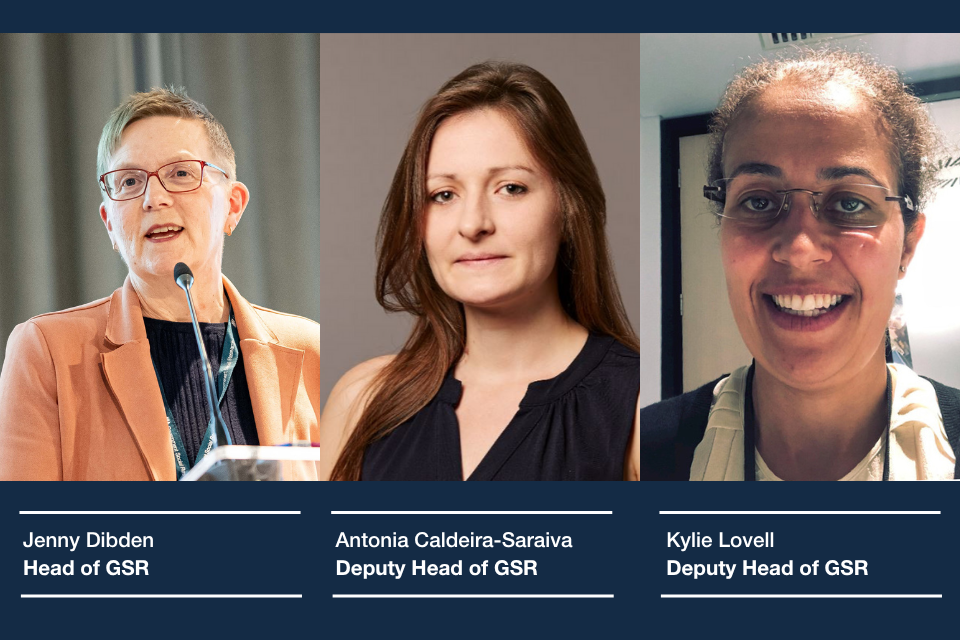
Jenny Dibden, Head of GSR
Antonia Caldeira-Saraiva, Deputy Head of GSR
Kylie Lovell, Deputy Head of GSR
2. Who we are
Government Social Research is the analytical profession within government for civil servants who generate and provide social and behavioural research and advice.
Specifically, GSR members in departments provide:
-
Analytical insight to understand systems, processes and change associated with people, groups, organisations and society.
-
Research that measures and understands what drives people’s attitudes, perceptions, values, behaviours and intentions that is used to inform and improve the quality of strategy, delivery and policy decision-making.
-
Robust evaluation that brings better understanding of the impact and value for money of government decisions, identifying what works, for whom, to what extent, and in what contexts.
-
Expert social and behavioural research advice and support to partners both in and out of government.
GSR currently has over 2,600 professionally accredited members across 60+ departments, ALBs, agencies, and devolved administrations working on range of priority challenges that impact the whole of society. GSR’s work brings people and data together at the heart of government decision-making by providing expertise in applied quantitative and qualitative research, analysis, evaluation, and behavioural science to solve complex problems. GSR members come from a wide range of professional backgrounds and disciplines. Members apply their skills in multiple policy contexts, combining research excellence with subject matter expertise to adapt their services to suit government partners in policy, delivery, communications, and other analytical professions.
3. GSR’s Vision for 2025 and beyond
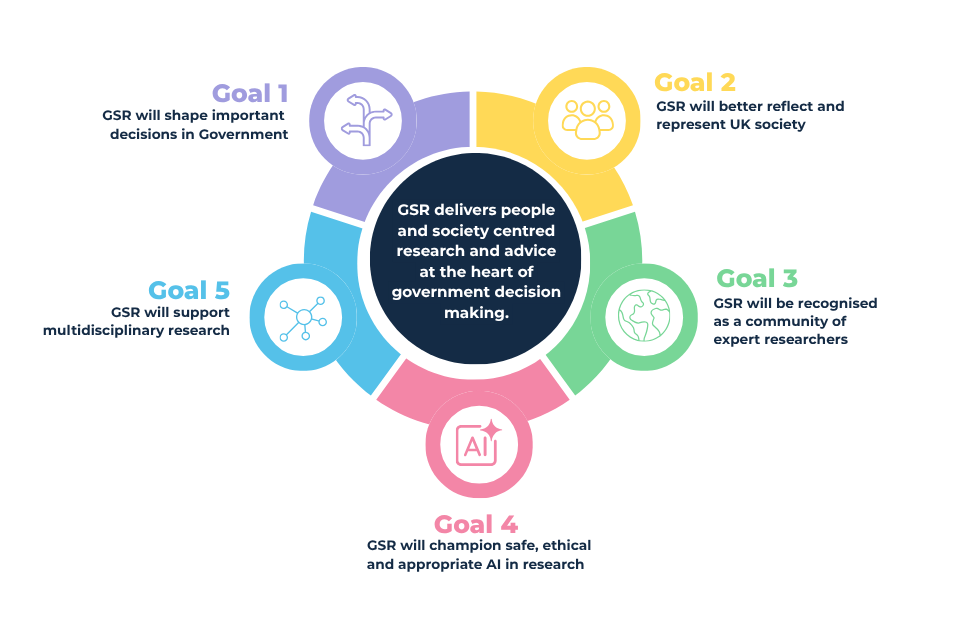
GSR delivers people and society centred research and advice at the heart of government decision making through:
-
High quality, timely, and impactful evidence that brings clarity to society’s biggest challenges.
-
Identifying what works and how to deliver value for money with robust evaluation.
-
Innovation and efficiency, including practical and ethical uses of Artificial Intelligence (AI) across the research pipeline.
-
An extensive toolkit of qualitative and quantitative skills and knowledge that adds value right across government.
-
Upholding exemplary standards to support analytical and research excellence in government.
4. Five strategic goals – where GSR will focus to achieve this vision
Under its previous strategy period (2021-2025), the GSR profession has made significant progress in building a diverse and inclusive profession, developing expert and valued members, and ensuring social research is influential in government decision making. The profession now, like many others, faces rapid change. The continued development of AI is likely to transform research methodologies, increase access to data, and provide opportunity for efficiency alongside raising new ethical challenges. Working in multidisciplinary teams and further developing specialist competencies in areas such as evaluation, behavioural science, and data science are more important than ever. This strategy sets out how GSR will lead and respond to these shifts and needs.
Goal 1: GSR will shape important decisions in Government, influencing through insight, and identifying what works.
GSR will continue to drive a more human-centred approach to policy design through providing impactful evidence and advice and actively promoting the relevance of social and behavioural science. GSR will collaborate with policy, delivery, and analytical colleagues to embed high-quality evidence and evaluation from the start and ensure robust impact assessment throughout the policy process. GSR will also be more outward looking, members will be empowered to lead purposeful engagement with internal and external partners.
This goal will be achieved by:
-
Supporting analytical leadership at all grades, with GSR leaders providing platforms and tools for members to engage peers, promote robust research and evaluation, and support career progression up to, and into the Senior Civil Service.
-
Helping ministers and senior leaders know when and how to seek GSR expertise.
-
Sharing GSR events, expertise, and learning beyond the profession, with tailored event series for policy, communications, and other partners.
-
Maintaining and expanding strategic partnerships with key organisations across the social research field, including the Economic and Social Research Council, Social Research Association, academia, and suppliers, and working with them to strengthen UK social science. The GESR team will work with departments to facilitate ongoing engagement.
What this means for you
If you are a member, GSR will support you to have professional impact, ensuring that your work is valued and understood and there are ways for you to influence important decisions across government with objective and robust evidence.
If you are a partner, GSR will deliver timely, trustworthy, and high-quality advice across a range of issues for society, policy, and government. GSR will support you to better understand how social and behavioural sciences can assist your work.
Goal 2: GSR will better reflect and represent UK society, through its people and its research
The GSR profession will better reflect society’s full diversity in both its people and its perspectives, providing diversity of thought so that analysis captures the full breadth of social experiences.
We will use robust recruitment and membership data to assess interventions which make GSR more diverse, inclusive, and representative at all stages, through recruitment, retention, and career progression. We will modernise recruitment, making it more efficient and fit for purpose for candidates, departments, assessors, and the GESR team. GSR fosters an inclusive culture where all members are supported, valued, and can thrive.
This goal will be delivered by:
-
Prioritising the Degree Apprenticeship Programme (GSR DAP) as a key entry route in the context of diversity and inclusion.
-
Supporting outreach in schools and further education to build wider and deeper enthusiasm for a career in government and in social research.
-
Incorporating best practice recruitment interventions that have been shown to improve fairness and reduce bias in other areas of government.
-
Monitoring the impact on Diversity & Inclusion (D&I) of interventions, including, but not limited to, entry routes, approaches to retention, progression, and colleague networks.
-
Launching a mentorship programme for members from underrepresented groups to support career progression and retention.
-
Building on best practice for inclusive research.
What this means for you
If you are a member, you will help build and benefit from an inclusive culture, learning from others with various perspectives and backgrounds. You will be supported to grow as people and professionals to achieve fulfilling and impactful careers in government.
If you are a partner, you will benefit from a profession that is more diverse in background and perspectives.
Goal 3: GSR will be recognised as a community of expert researchers, who have the right skills to shape, inform and underpin better decisions with robust evidence
GSR supports members to develop the research, communication and advisory skills to maximise their impact and achieve fulfilling careers.
Members invest in their own learning. Members lead methodological innovation, are equipped to be effective social scientists, as well as strong general analytical leaders, and can access opportunities across all Civil Service grades. Professional pride is strong, and partners value the expertise social researchers bring to government.
This goal will be achieved by:
-
Clarifying progression pathways and using applied case studies alongside the technical skills framework to show how skills are used in practice.
-
New resources to help members promote social research in government and gain recognition for their impact.
-
An expanded GSR Knowledge Hub on the members website and training offer mapped to the technical skills framework to support members’ professional growth.
-
Resources for non-GSR managers, helping them support members’ careers and make the best use of their teams’ skills.
What this means for you
If you are a member, you will take responsibility for investing in your own learning. You will be supported by access to a range of high-quality training materials that are tailored to support your progression and growth. You will be supported to champion the use of social and behavioural research in government and be celebrated for your expertise and impact.
If you are a partner, you will be supported to understand the value that GSR colleagues and collaborators can bring. You will benefit from working with members who have expanded skills which apply to a range of important decisions across government.
Goal 4: GSR will champion safe, ethical, and appropriate AI in research
GSR members of all grades are encouraged to use AI tools to improve the quality and responsiveness of social research, in a safe, ethical, and responsible manner.
Researchers will comply with departmental policies and practices, ensuring appropriate quality assurance and transparency, and the protection of sensitive data. Members and Heads of Profession (HoPs) are encouraged to actively share learnings, risks, and opportunities with the wider GSR community.
GSR will continue to be a leader in the use of safe and ethical AI across the research pipeline. Given the pace of change, progress against this goal will be continuously reviewed.
This goal will be achieved by:
-
Maintaining a cross-analytical community to share best practice, develop ethical and efficient AI use cases, and avoid duplication across departments.
-
New ethical guidelines and quality assurance tools that are updated to cover AI, ensuring researchers use it confidently and responsibly.
-
Clear direction to stakeholders and suppliers on standards for AI in government social research.
-
Supporting members to upskill as AI practitioners, with cross-profession development opportunities and training.
-
Senior GSR leaders and cross-government partners driving safe, robust, and ethical AI adoption.
What this means for you
If you are a member, you will be supported to use AI safely and ethically to improve the quality and efficiency of your work. Roles and responsibilities at a profession, department, and individual level will be clear. You will benefit from training to upskill yourself in the use of AI in research.
If you are a partner, you will benefit from increased efficiency in products and services offered, without compromising on quality or ethics. You will understand GSR’s approach to safe, robust, and ethical AI use in government, bringing clarity when working together.
Goal 5: GSR will support multidisciplinary research and respond to growing needs for skills in behavioural science, evaluation, and data science
GSR provides a supportive professional home for social researchers with, or who are looking to develop, skills in growing disciplines in the social sciences such as: behavioural science, evaluation, and data science.
GSR works with other analytical professions to meet this need and improve the work of multidisciplinary researchers and teams.
This goal will be achieved by:
-
Updating the GSR technical framework to incorporate optional competencies which capture and codify these growing disciplines, providing a clear route to progression for those with or looking to develop these skills.
-
Dedicated learning resources which accompany these optional competencies.
-
Reviewing recruitment and assessment process against these new optional competencies and the growing skills areas or disciplines which they capture.
-
Reviewing the ‘experience’ entry route to the profession to keep pace with methodological innovation and changes to the research talent pipeline.
What this means for you
If you are a member, you will benefit from an expanded package of optional skills that will enable you to develop a specialism that suits your personal and professional goals.
If you are a partner, GSR will support the expansion of these skills in government, meeting your increasing demands for broader techniques to meet new challenges in government decision making. You will benefit from an expanded understanding of these disciplines in government, opening new avenues to collaborate.
Annex A - How the strategy was developed
This strategy has been developed through extensive consultation with members of the GSR profession. The process of building it began in earnest in April 2024 and it has been overseen through official GSR governance processes, with final sign off from GSR leadership.
GSR has also received feedback and input on the strategy from its partners across government and externally, including input from: the Analysis Function, the ESRC, the SRA, and several key private and third sector social research agencies. We are grateful for their input.
In the interests of transparency around the use of AI, a key pillar of our ethical approach, secure generative AI tools have been used to redraft certain sections of this strategy, reduce word count, and improve clarity of communication. No factual information was provided by AI.
Annex B - Progress since the last strategy
In developing the 2025-2029 Strategy, GSR reflected on progress made as a result of the 2021-2025 strategy. This strategy was built on three pillars, some of the work of which has been carried through into this strategy. The pillars helped us build a profession that is: impactful and influential, expert and valued, and diverse and inclusive.
Some milestones from the last strategy period are:
-
Delivering a first-of-its-kind social research degree apprenticeship programme which has seen 52 apprentices join the profession to date, with more to come as the programme grows over time. The social research degree apprenticeship was recognised for excellence as one of three finalists at the Civil Service Awards in the Diversity and Inclusion category.
-
Producing annual membership statistical reports, providing detailed data about the diversity profile of GSR. This previously unavailable data brings understanding of who we are and has prompted important debate and action across the profession.
-
Launching a new members site which has vastly improved our ability to communicate with members, share resources, and access learning. This body of work also includes the launch of a Knowledge Hub for members, providing a one-stop shop for social research focussed learning and development.
-
Funding the placement of interns with disabilities under the Change 100 programme.
-
Modernising and professionalising our marketing practices, resulting in an expanded reach on social media, and has ushered in an 1105% increase in applications to the profession since 2021.
-
Delivering high-quality annual conferences and a packed events programme, which are run as hybrid events and are recorded to enable enduring learning.
-
Developing a co-ordinated outreach programme to target schools across England, including GSR ambassadors training, designing common materials, monitoring progress and building best practice
-
Delivering our first ever week-long GSR careers festival to support career progression for members.
-
Developing a bespoke knowledge test for the profession which provides a fair and engaging mechanism to assess the skills vital for success as a GSR member.
-
Establishing a thriving community of practice to tackle the challenges and opportunities introduced by the use of AI in government research and analysis.