GCA annual report and accounts 2025 to 2026: accessible version
Published 15 July 2026

© Crown copyright 2026
This publication is licensed under the terms of the Open Government Licence v3.0 except where otherwise stated. To view this licence, visit nationalarchives.gov.uk/doc/open-government-licence/version/3 or write to the Information Policy Team, The National Archives, Kew, London TW9 4DU, or email: psi@nationalarchives.gov.uk.
Where we have identified any third party copyright information you will need to obtain permission from the copyright holders concerned.
This publication is available at https://www.gov.uk/government/publications/government-commercial-agency-annual-report-and-accounts-2025-to-2026/gca-annual-report-and-accounts-2025-to-2026-accessible-version
Presented to Parliament pursuant to Section 4 (6A) (b) of the Government Trading Funds Act 1973 (as amended by the Government Trading Act 1990).
Ordered by the House of Commons to be printed on 15 July 2026.
HC 400
Welcome to the Government Commercial Agency Annual Report and Accounts 2025/26
This report is filed in respect of the accounts up to 31 March 2026 incurred by the Government Commercial Agency (GCA). On 1 April 2026 Crown Commercial Service (CCS) was combined with several commercial teams from the Cabinet Office (CO) and became GCA. This report is filed by GCA in respect of the trading fund formerly known as CCS.
Who we are
Government Commercial Agency is an executive agency and trading fund of the Cabinet Office and a key constituent of the Government Commercial Function. It was formed on 1 April 2026 bringing together Crown Commercial Service with commercial teams formerly based in the Cabinet Office that also provided commercial services.
This Annual Report describes the activity of Crown Commercial Service in 2025/26.
Our Purpose - Why we exist
GCA’s purpose is to help the UK public sector realise the best value in its commercial and procurement activity. We call this value for the nation.
Our Vision - Where we want to be
We want GCA to be a world class, central commercial and procurement organisation and the delivery centre of excellence for the Government Commercial Function (GCF), famous and trusted for:
-
being easy to engage with and use
-
our commercial, procurement, policy, category and market expertise
-
our data and decision-enhancing insight
-
making best use of our unique position and relationships with buyers and suppliers to shape markets and achieve greater value for the nation
-
enabling the digital transformation of public sector commercial activity
Our Strategic Priorities
Our aim is to deliver more value from commercial and procurement activity with and for the UK public sector. We will do this through realising our strategic priorities to:
-
establish and sustain an outstanding GCA.
-
put in place commercial deals and provide services that make public sector commercial activity simpler, faster and better for buyers and suppliers.
-
maximise impact by shaping markets and public sector buying.
-
progress and coordinate the digital transformation of the GCA and the GCF.
Our Proposition - What we offer
GCA connects the full breadth of the public and private sectors across the country.
We offer a broad and continually improving suite of services - all of which help buyers and suppliers work together efficiently and effectively.
We use our unique position to lead and enable the UK public sector to achieve the government’s priority commercial, policy and economic outcomes, establishing commercial best practice to improve productivity, coordinating demand and management of supply markets and enabling access to and usage of digital tools and data insights.
Our people are motivated by the opportunity to make a positive difference for the UK. Together, we aspire to set the standard for quality and integrity in public procurement.
Our Values - How we behave
We listen, respect, collaborate, and trust in order to deliver with confidence.
Glossary
-
ALBs: Arms Length Bodies
-
ASHP: Air Source Heat Pump
-
BMS: Building Management System
-
C&AG: Comptroller and Auditor General
-
CCS: Crown Commercial Service
-
CETV: Cash Equivalent Transfer Value
-
CO: Cabinet Office
-
CRP: Carbon Reduction Plan
-
CSAT: Customer Satisfaction
-
CTT: Complex Transactions Team
-
DCCoE: Digital Commercial Centre of Excellence
-
DSIT: Department for Science, Innovation, and Technology
-
EI: Engagement Index
-
FTE: Full Time Equivalent
-
GBS: Government Buying Standards
-
GCA: Government Commercial Agency
-
GCF: Government Commercial Function
-
GCO: Government Commercial Organisation
-
GFS: Government Functional Standards
-
GGC: Greening Government Commitments
-
GHG: Greenhouse Gas
-
GIAA: Government Internal Audit Agency
-
GPA: Government Property Agency
-
HMRC: HM Revenue and Customs
-
HVAC: Heating, Ventilation, and Air Conditioning
-
ICT: Information and Communications Technology
-
ISAs UK: International Standards on Auditing (UK)
-
KIM: Knowledge and Information Management
-
KPI / KPIs: Key Performance Indicator
-
MSS: Markets, Sourcing, and Suppliers
-
MSAT: Modern Slavery Assessment Tool
-
NAO: National Audit Office
-
NHS: National Health Service
-
NPPS: National Procurement Policy Statement
-
OMAF: Operational Management Assurance Framework
-
PA23: Procurement Act 2023
-
PCSPS: Principal Civil Service Pension Scheme
-
PPN: Procurement Policy Notice
-
PSFA: Public Sector Fraud Authority
-
RIDDOR: Reporting of Injuries, Diseases and Dangerous Occurrences Regulations 2013
-
ROCE: Return on Capital Employed
-
SDG: United Nations Sustainable Development Goals
-
SCS: Senior Civil Service / Senior Civil Servant
-
SME: Small and Medium-sized Enterprises
-
SRO: Senior Responsible Owner
-
SSRB: Senior Salaries Review Body
-
TCFD: Task Force on Climate Related Financial Disclosures
-
UK GDPR: UK General Data Protection Regulation
-
VCSE: Voluntary, Community, and Social Enterprise organisations
-
WEEE: Waste Electronic and Electrical Equipment
Performance report
Chair’s Statement
Peter George
Whilst writing my Chair’s Statement for the financial year 2025/26, I was able to reflect on the great work that we delivered during the year. Despite this being a year of significant change, Sam Ulyatt, in her role as the Chief Executive and her Executive Committee have continued to deliver value for the nation for customers and suppliers alike. This, alongside an increase in People Survey results has been a significant achievement and one that I, and the Board have been proud to have overseen.
Sam completed her first full year as Chief Executive during 2025/26. Over the last 18 months, we have witnessed the transformative impact of Sam’s leadership. Her energy and approach have been instrumental to our success, and it is evident that this influence is felt by the entire organisation. The 3 percentage point increase to People Survey engagement scores is proof of this, but more importantly, it has been incredibly motivating to see Sam’s energy and passion manifesting in all colleagues across the organisation in my interactions across the year.
In September, Claire Dartington joined the Executive Committee as Strategy Delivery Director. Through both the Delivery Committee and Board, I have been pleased to see the improvements we have made in establishing foundations to recognise and manage a portfolio in 2026/27. The work that Claire and her team are progressing will be key to ensuring that projects are run well and investments deliver the required benefits for GCA and the public sector.
The Procurement Act 2023 went live on 24 February 2025 and I’m pleased to confirm that we now have 13 live agreements that have been established under the new regulations. It’s great that Ministers recognise the value that shaping commercial activity can bring to the UK, and we are working closely with Andrew Forzani, Government Chief Commercial Officer, and his team on future iterations of procurement reform.
Throughout the year, the Board and I have maintained that we are exceptionally well placed to deliver on the government’s priorities, helping to release efficiency and productivity that is desperately needed across the whole public sector. We remain a key contributor for economic growth and stability, as demonstrated by our record high £42 billion of common goods and services spend that went through our agreements this year.
During the year, the government announced a review of Arms Length Bodies (ALBs) and this, amongst other factors, has led to CCS transitioning to become part of GCA in 2026/27. GCA brings together key commercial teams from the Cabinet Office and CCS into a single, unified organisation designed to improve how the public sector buys goods and services. Although I fully support the creation of GCA, it is somewhat bittersweet as the organisation will be supported by a new Board with Andrew Forzani becoming the non-executive Chair.
As I leave my role as Chair, I would like to thank all of the hard working civil servants that keep the organisation effective, and to close, I would like to wish Sam the best of luck in her new role as Chief Executive of GCA. I am sure her passion and leadership will ensure that it continues to build on the previous success of CCS.
Peter George
Chair
Chief Executive’s introduction

Sam Ulyatt
Publishing these accounts marks the end of my first full year as Chief Executive of the organisation. It has been a privilege to work with all of my talented colleagues both in our organisation and across the wider public sector to facilitate the buying of common goods and services and deliver value for the nation. During the year, we have worked with 18,800 customers from across the public sector and been instrumental to 4,400 suppliers securing contracts through our commercial agreements. This is something I’m immensely proud of.
Our values of listen, respect, trust, and collaboration were the ‘how’ behind everything we achieved. Throughout the past year, I made it a personal priority to model these behaviours in every interaction, holding myself accountable to these standards to empower everyone across the organisation to lead with integrity and openness. As we transition to GCA, these core principles remain unchanged; they are the values that defined our past and will continue to drive our culture and success in this new chapter.
I’ve always maintained that our biggest asset is our people. The dedicated, hardworking civil servants that keep the organisation operational are the cornerstone of all we do. When it comes to doing what’s in the best interest of our people, I am unapologetically resolute. In December 2025 when our People Survey results were released, I was thrilled to see a response rate of 93% and engagement rising 3 percentage points to 70%. This was the highest rate since the pandemic peak in 2021 and placed us above the Civil Service benchmark of 65%. All five engagement questions improved on 2024 scores. We outperformed Civil Service benchmarks across the board.
While we are proud of our progress, the Executive Committee is already looking ahead. We’ve collectively committed to a focused agenda that turns the survey feedback into tangible change. Our focus is now on maturing our leadership culture, streamlining how we manage change, and deepening engagement across all levels of the organisation. By prioritising inclusion, safe challenge, and reward, we are building a more resilient workplace. Our Executive Directors are now translating these overarching corporate commitments into specific, local actions for their respective areas.
Inclusivity is about more than just policy; it’s about the lived experience of our people. I’ve been incredibly proud to see our eight staff-led networks go from strength to strength, fostering a culture of openness. This year, we laid the groundwork for the next five years with our new Inclusion and Diversity Strategy. Whether through professional internships with Change 100 or personal connections made during a community cooking demo and cultural deep-dives, we are intentionally building a workplace where every individual belongs.
My fantastic colleagues’ impact hasn’t gone unnoticed. Being shortlisted for the GO, CIPS, Marketing Procurement, and GCF Awards is a huge testament to our collective expertise. Recognition is never just about the final result; it’s about the hard work that got us onto those stages. This was further highlighted in the well-deserved recognition of so many colleagues at CCS Live 2025.
Having started my career as an apprentice, I am incredibly passionate about initiatives that look to continually develop the workforce. I’m proud to share that in 2025/26, 5.5% of our colleagues engaged in apprenticeships, alongside 24 Fast Streamers across diverse disciplines. Building a workforce that is equipped for both today’s challenges and tomorrow’s opportunities remains a top priority for me and the Executive Committee.
Our strategy was reset last year and I was keen that the Executive Committee and I articulate how we would be a key enabler to delivering the government’s missions and priorities. The Prime Minister has made it clear that his government is focussed on establishing foundations and delivering missions and I’m pleased to confirm that we have played an enabling role in this activity. In 2025/26, we facilitated £42 billion of spend, this was a huge achievement and with appropriate intervention we can ensure that we are sustaining, shaping, and growing the UK economy. In addition to this we have actively supported key customers such as the Home Office, Department for Energy Security and Net Zero, and various NHS Trusts to support mission delivery.
Our support extended to customers across the whole public sector in a variety of ways. 18,800 individual customers used our commercial agreements and we facilitated c.97,000 commercial transactions. Our work resulted in the creation of £5 billion commercial benefits ensuring that our customers are making the most of the public sector’s aggregated spending power and that their scarce commercial resource is available to support the transactions that most need their intervention. We invested £8.2 million in developing our customers capability through some of the following projects: Contract Management Training, Local Government Contract Management Pioneer Programme, and NHS L&D Academy. Through reviewing benefits realisation and engaging with our customers and stakeholders in these sectors, it’s clear to see that these investments have provided invaluable support to the public sector.
On 24 February 2025 the Procurement Act 2023 (PA23) came into effect and a new National Procurement Policy Statement (NPPS) went live. Given that we facilitate c.10% of all public sector commercial activity we had a significant role to play in ensuring that the benefits and objectives of both PA23 and the NPPS were realised. I’m pleased to confirm that we now have 13 live commercial agreements that were established under PA23. On 20 October 2025, we published our SME Action Plan which outlines how we will help government departments and their agencies meet the government’s aspiration to level the playing field for SMEs. We will shortly publish our VCSE Action Plan. Both these plans are key levers to achieving objectives of the NPPS.
We worked closely with our Markets, Sourcing, and Suppliers colleagues and the National Audit Office (NAO) in November 2025 to produce their report titled ‘Government’s use of external consultants’. From our perspective, the report covered our role in facilitating a significant proportion of consultancy spend through our agreement, Management Consultancy Framework 3 and 4. This was followed by a Public Accounts Committee hearing in December. Our technology category commercial experts have continued to work closely with Department for Science, Innovation, and Technology (DSIT) colleagues on the ‘Digital Commercial Centre of Excellence’ (DCCoE) which was born from the NAO’s report ‘Government’s approach to technology suppliers: addressing the challenges’.
To reaffirm my commitment to delivery, we welcomed a new role to the Executive Committee in 2025/26. Following an external recruitment campaign for a Strategy Delivery Director, Claire Dartington joined the organisation. Claire brings with her a wealth of experience, more recently from HMRC but before that she spent a number of years at HM Treasury. Claire has led our Strategy Delivery Directorate, establishing our enterprise portfolio of change and overseeing delivery across our strategic priorities. Claire’s work has also supported us to professionalise our approach to project and portfolio delivery which will pay dividends in future years.
During the year, the Government announced a review of Arms Length Bodies (ALBs) and this led to CCS becoming GCA along with key commercial teams from the Cabinet Office, becoming a single, unified organisation designed to improve how the public sector buys goods and services.
It must not be underestimated the vast amount of time and effort that has gone into establishing GCA in 5 months. Becoming GCA is a pivotal point for the GCF. Not only does it allow for a more focussed, specialist, and policy driven Cabinet Office, it enables us to focus on commercial delivery for central government and the wider public sector.
Phase 1 sees the Complex Transactions team (CTT), ‘Markets, Sourcing, and Suppliers’ (MSS including the Debarment Review Service), and the GCF Communications and Engagement team join GCA. Future phases will see Government Commercial and Grants Digital and Data Services, and the Commercial and Contract Management Capability team join us.
A significant amount of work has gone into reforming the executive and Non-Executive to ensure it is fit for purpose as we become GCA. From 1 April 2026 we will be supported by a new Board of Non-Executive Directors, led by Non-Executive Chair, Andrew Forzani. Andrew will also continue as our Cabinet Office sponsor and will be appropriately supported by Cat Little, Cabinet Office Permanent Under Secretary (PuS) and Principal Accounting Officer (PAO).
I am keen to recognise all the hard work of our colleagues past and present and would like to thank you all. I am incredibly excited, optimistic, and grateful to continue as Chief Executive Officer of GCA.
Sam Ulyatt
Chief Executive and Accounting Officer
9 July 2026
Statement of purpose, scope and strategy
In 2025/26, we maintained our strategy to increase the value the public sector gains from working with us year on year, taking forward the following strategic objectives:
-
Optimise value for our customers and suppliers, with commercial products and services that make effective procurement easy.
-
Maximise impact by using our expertise and insight, as well as our scale and unique position. We coordinate and influence public sector buying, manage and shape supply markets, enable the government’s missions and achieve the best outcomes for the UK.
-
Build an effective and efficient organisation, that is a great place to work for its people, lives its values, and takes full advantage of technology.
Organisational structure
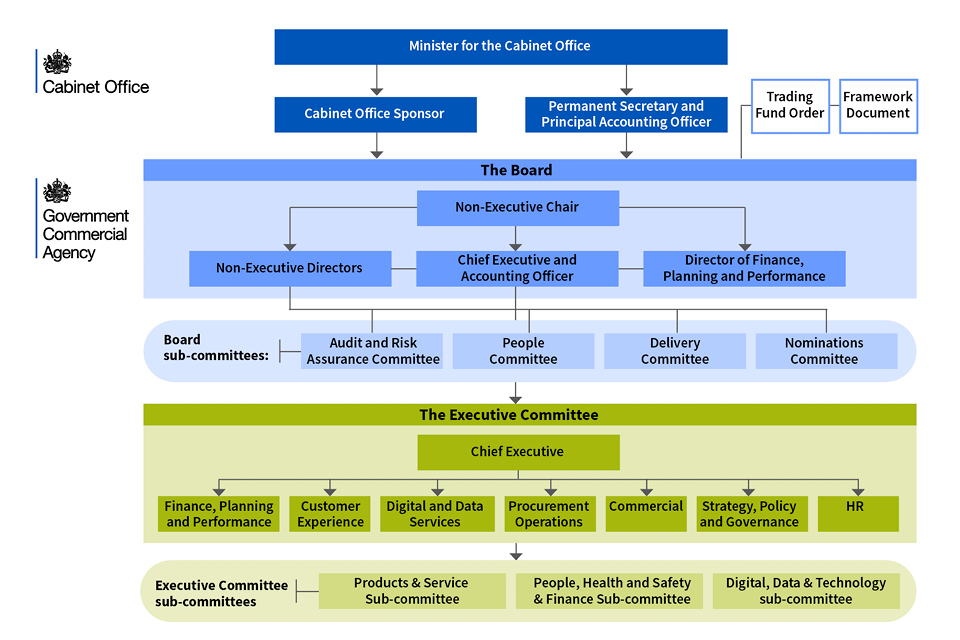
Government Commercial Agency organisational structure
Our organisational structure and governance arrangements are:
Cabinet office
-
Minister for the Cabinet Office
-
Cabinet Office Sponsor
-
Permanent Secretary and Principal Accounting Officer
-
Trading Fund Order
-
Framework Document
Government Commercial Agency (GCA)
The Board:
-
Non-Executive Chair
-
Non-Executive Directors
-
Chief Executive and Accounting Officer
-
Director of Finance, Planning and Performance
Board sub-committees:
-
Audit and Risk Assurance Committee
-
People Committee
-
Delivery Committee
-
Nominations Committee
The Executive Committee:
-
Chief Executive
-
Finance, Planning and Performance
-
Customer Experience
-
Digital and Data Services
-
Procurement Operations
-
Commercial
-
Strategy, Policy and Governance
-
HR
Executive Committee sub-committees:
-
Products & Service Sub-committee
-
People, Health and Safety & Finance Sub-committee
-
Digital, Data & Technology sub-committee
Performance overview
The purpose of this section is to provide a summary of progress made against the three strategic objectives within our organisational strategy along with an overview of our financial performance. It also sets out the key strategic risks that have been and continue to be actively managed as we move forward.
1. Optimise value for our customers and suppliers
The value we have delivered to our customers and suppliers includes:
-
customer sector-specific delivery plans were developed and implemented. Customer feedback and priorities were used to shape future products, services and investments. We actively engaged with other government departments to support Government Missions, working closely with the Home Office on police procurement in support of the Safer Streets mission and with the Department for Energy Security and Net Zero (DESNZ) on clean energy procurement
-
we undertook a review of customer journey pain points and implemented process improvements to provide a simpler, faster, better, and more consistent customer experience. This initiative is ongoing
-
we have further developed our plans for enabling public sector buyers to use digital tools supported by AI technology to procure using our portfolio of commercial agreements, progressing an investment case and scoping future phases of delivery
-
we implemented a range of improvements for suppliers through process simplification, standardisation and deepening of non-financial assurance checks across categories to create efficiencies for both suppliers and the organisation
-
we increased the percentage of small and medium sized enterprises accessible to buyers when using our commercial agreement portfolio
-
comparing prices paid using our commercial agreements with market comparators. We also enabled cost avoidance benefits of £748 million. These results show considerable progress in offering competitive pricing and delivering substantial stakeholder value
-
we demonstrated the relevance and usefulness of our commercial agreements to the public sector, increasing the proportion of public sector spending on common goods and services that is transacted through our commercial agreements to c.27%
2. Maximise impact by using our expertise and insight
The impact we have made through our commercial expertise and insight includes that we have:
-
continued to develop and make available to public sector buyers our intelligence and insights on common goods and services markets through our portfolio of market strategies
-
established mechanisms (improved data, customer and supplier engagement) that enable greater levels of aggregation of customer spend to deliver increased value and better outcomes. A pipeline of priority aggregation events has been established. The first event delivered 18% savings with significant engagement from Police Forces
-
supported the Department of Science, Innovation and Technology to develop plans to support commercial innovation through public procurement and take forward opportunities for strategic procurement of common technology products and digital services
-
refreshed our branding to better communicate our purpose and objectives as an organisation, adopting the “value for the nation” identity
-
progressed our plans to strengthen our ability to access and use data and develop insights through the Insights with Impact programme strengthening our data infrastructure and governance through the development of a Master Data Model supported by a Data Catalogue and an API service linking the data from key systems
-
also progressed the improvement of our Customer Satisfaction surveys alongside new analytical tools so that we’re in a position to use our data to inform business decision making and monitor performance combining evidence on customers’ experience with insight on the social and commercial value we help the public sector realise from their commercial and procurement activity
3. Build an effective and efficient organisation
The focus on building an efficient and effective organisation has continued with key achievements including:
-
establishment of outline requirements for a new operating model for the organisation which is digitally-led and customer centric for ongoing development and implementation, underpinned by a robust investment case. This will enable the organisation to operate flexibly at scale, maximising the value delivered to customers and suppliers
-
recruitment of additional digital expertise and capacity to improve both the capabilities of the organisation and improve product and service delivery to customers and suppliers
-
continued upskilling of our people through leadership and managing change development programmes
-
implementation of a more effective performance management approach and reward and recognition scheme for our people
-
improvements in people engagement as measured through the civil service people survey with an improved score of 70 achieved
Financial performance
We exceeded our financial targets in 2025/26. Total income was £223.4 million and expenditure was £116.6 million, delivering a surplus before other operating costs of £106.7 million (2024/25: £115.2 million). Other operating costs of £19.9 million were also incurred relating to Capability and Investment costs, Digital and Data Services and Customer Capability. After interest and dividends, the retained surplus was £35.4 million (2024/25: deficit of £65.2 million). Alongside this, we continue to expand the use of our commercial agreements with a focus on improving the value and commercial benefits arising to customers. We also continued to manage costs effectively, with headcount kept under close control.
The opening General Reserve of £102.7 million increased to £139.5 million, which included a transfer from the revaluation reserve of £1.4 million. There was no change to Public Dividend Capital (£0.35 million) meaning that the total of taxpayers’ equity increased from £104.5 million to £139.9 million. More information is contained within the notes to the accounts on pages 76-92.
The Dividend payable to the Cabinet Office was £56.0 million in 2025/26 (2024/25: £161.0 million) and was used to fund the expansion of commercial capability across government, including upskilling the commercial workforce, providing expertise on complex projects and managing relationships with strategic suppliers.
In 2025/26 we achieved a Return on Capital Employed of 60.3% (2024/25: 64.1%) which was significantly above the 5% target as set out in the Treasury Minute. The last six years of our income and costs are shown on page 94.
We continue to deliver commercial benefits and stimulate growth in customer spend through enhanced internal systems, digitised online access to our commercial agreements and focus on how we can add value through improved ways of working for both our customer users and suppliers.
We have continued our commitment to paying creditors in line with government policy on prompt payment. In 2025/26 we paid 97.9% (2024/25: 95.3%) of undisputed supplier invoices within 5 days and 100% (2024/25: 100%) of undisputed payments due within 30 days.
As a trading fund, we are expected to generate sufficient funds to meet our operating costs and prevent the need for recourse to the Cabinet Office or HM Treasury for financial support. Prudent financial management means that we ensure sufficient cash reserves are in place to mitigate against financial risk arising from any sudden reduction in customer demand, unexpected increases in expenditure or inability to collect income through systems failure. We will continue to adopt prudent cash and working capital management to ensure we are able to continue to operate as a going concern.
Key issues and risks that could affect GCA in achieving its objectives
We manage risk across all activities carried out by the business at a strategic and operational level, focusing on achievement of our Business Plan objectives. Risk management is coordinated across a network of risk management champions and business managers representing each team within the business.
Risk is appraised and managed in accordance with our risk management policy and practice. Our Strategic Risk Register is aligned to our Business Strategy and Business Plan and focuses on addressing the causes of each risk through a targeted set of mitigations.
The causes are dynamic and are continually reviewed and updated to reflect any difficulties that the business foresees or experiences, including any arising from our analysis of the global and domestic political, economic and social context in which we operate.
The Executive Committee and its sub-committees have collective ownership of the risks and Board sub-committees provide scrutiny on the effectiveness of mitigations to reduce risk in line with appetite and tolerances.
The Executive Committee and its sub-committees receive a risk insight report on a bi-monthly basis to enable a review of the effectiveness of mitigations. They also have access to the live Strategic Risk Register.
The strategic risks are underpinned by a set of dynamic causes which is the focus of mitigating action. Those causes (typically more than 30 at any one time) change over the course of the year which impacts both the residual and inherent assessment scoring of risks. There was a comprehensive review of risks and causes in late 2025/26.
Operational risks are reviewed by the Risk Assurance Group and a summary report is provided to the Executive Committee sub-committees on a bi-monthly basis.
The Audit and Risk Assurance Committee provides scrutiny of the overall system of governance, risk management and control.
The organisation’s approach to managing strategic risk was subject to an audit by the Government Internal Audit Agency (GIAA) in the year. This resulted in a ‘Moderate’ audit opinion with acknowledgement that the approach was both mature and robust. A number of recommendations were made to support continuous improvement that focused on better use of data to measure impact of mitigations, increased focus on dependency management and further embedding of organisation risk appetite. All recommendations have been addressed.
The areas of strategic risk that had the potential for preventing the business from achieving its objectives in 2025/26 (reflecting the focus of the new organisation) are set out in the following table. All of these risks along with underpinning causes which have been identified are subject to continuous review and assessment. Mitigations for the causes of each risk are documented and managed as part of the Strategic Risk Register.
| ID | Failure to | Results in |
|---|---|---|
| 1 | Establish and sustain an outstanding GCA | Loss of confidence from the Board (and other key stakeholders including customers) in the organisation and associated reputational damage |
| 2 | Put in place commercial deals and provide services that make public sector commercial activity simpler, faster and better for buyers and suppliers | Negative customer perception of our products, services and solutions and reputational damage leading to a loss of customers to competitors |
| 3 | Maximise impact by shaping markets and public sector buying | Supplier failure, an underutilised supply base and negative customer and supplier perception about the value of doing business with us |
| 4 | Progress and coordinate the digital transformation of GCA and the GCF | Inability to deliver the GCF strategy, enable GCA efficiency and digital data driven business growth along with loss of customers to competitors and damage to our reputation |
Performance analysis
How we measure performance
Organisational performance was measured on a monthly basis through a corporate performance report, which tracks progress against the 10 strategic initiatives that the organisation focused upon during the year along with a corporate performance scorecard containing 16 key performance indicators.
Business Plan objectives and the Business Strategy formed the basis of a formal monthly review at the Executive Committee and its sub-committees. The Executive Committee also performed a quarterly performance review with a focus on key risks and issues.
Organisational performance was a standing agenda item at Board meetings.
Key objectives in Business Plan
Strategic objective 1 - Optimise value for our customers and suppliers
| Strategic Initiative | Target outcome | Result |
|---|---|---|
| Customer Priorities | To implement identified customer priorities for 2025/26 as set out in our customer sector strategies via enterprise delivery plans | Fully achieved: Sector-specific delivery plans were developed and implemented. Customer feedback and priorities used to shape future products, services and investments. Activity included supporting Government Missions through police and clean energy procurement |
| Customer Journey Improvements | To implement identified customer journey improvements as part of the ‘to-be’ model to provide a simpler, faster, better, and more consistent customer experience | Partially achieved and ongoing: 8 of the 23 customer pain points in phase one have been addressed successfully. Every pain point now has a clear resolution path: either through immediate completion, handover to existing enterprise initiatives, or formal inclusion in the phase two roadmap being taken forward in 2026/27 |
| To develop an approved outline business case along with a delivery plan for a new self-serve solution for customers | ||
| Self Serve Solution | To develop an approved outline business case along with a delivery plan for a new self-serve solution for customers | Fully achieved: Outline business case complete. Discovery complete with outputs documented alongside a map of existing services to support the ‘preferred’ option. Market & customer engagement conducted |
| Supplier Management | To continue to implement supplier management aligned to the GCF Strategy through enhancing supplier assurance, fostering supplier relationships to proactively build and maintain robust relationships with key suppliers to ensure mutual innovation and value delivery | Fully achieved: Successful implementation of supplier management improvements has been achieved through process simplification, standardisation and deepening of non-financial assurance checks across categories to create efficiencies |
Strategic objective 2 - Maximise impact by using our expertise and insight
| Strategic Initiative | Target outcome | Result |
|---|---|---|
| Aggregation | To establish mechanisms (improved data, customer and supplier engagement) that enable greater levels of aggregation of customer spend to deliver increased value and better outcomes | Fully achieved: Data model requirements produced with an automated report established to support teams to identify and expand aggregation opportunities. Future approach established to meet customer needs. Pipeline of priority aggregation events established. The first event delivered 18% savings with significant engagement from Police Forces |
| Brand | To activate internally and externally the Brand Strategy and value proposition, to reach a position by September 2025 where it is actively being used in our external engagement and marketing activity | Partially achieved and ongoing: Branding actively used internally and externally. Further activity undertaken to ensure GCA branding available from April 2026 |
| Insights with impact (Data Strategy) | To deliver priorities for 2025/26 include determining and delivering the priority data requirements for directorates to improve service and product performance, along with the establishment of an agreed Master Data Model and embedding the measurement of customer and commercial value in organisational performance management | Fully achieved: Foundation for Master Data Model established to enable a “single source of truth”. Value Scorecard developed and piloted. Commercial value web tool designed to prototype stage. Data maturity assessment completed with capability development activities identified. All workstreams following an agile implementation approach |
Strategic objective 3 - Build an effective and efficient organisation
| Strategic Initiative | Target outcome | Result | |
|---|---|---|---|
| Target Operating Model | To define and commence implementation of a more efficient operating model which aligns with the services model outlined in the Customer Strategy and enables the organisation to operate flexibly at scale, maximising the value delivered to customers and suppliers | Partially achieved and ongoing: Target Operating Model design is continuing to reflect wider GCA remit with expectation of completion by Q3 FY 2026/27 | |
| Digital Transformation | To ensure the digital function is providing fit for purpose technology capabilities, change delivery, and governance to manage risk across technology services | Partially achieved and ongoing: Digital Operating Model defined and initial capability/capacity requirements recruited as part of implementing a product-led service. Demand Management and Digital Delivery Plan implemented with surge capacity arrangements in place through service delivery partnering. Work continues on technology architecture and digital product management | |
| Leadership and People Engagement | To lead on developing our leadership and engaging our people enabling delivery both within individual teams and collaboratively with an enterprise mindset | Fully achieved: Leadership programmes continue to be implemented (Executive Directors, SCS, Band 6s). New In Year Reward approach implemented. People Survey action plans in place and being implemented. New performance framework launched and monthly conversations embedded |
Strategic Key Performance Indicators
| Strategic objective | Strategy outcome | ID | Measuring | Base / target | Year end | % of target | Assessment (achieved is > 95% of target) |
|---|---|---|---|---|---|---|---|
| Optimise value for our customers and suppliers | Customers save time and money by working with us | 1 | % improvement in overall customer value (from current Customer Value Scorecard) | 2 | 7.4 | 370% | Achieved |
| 2 | Average commercial benefit rate | 10.5 (FY 2024/25 10.33) | 11.1 (FY 2024/25 10.49) | 105% (FY 2024/25 102%) | Achieved | ||
| Our commercial agreements establish and maintain a capable and diverse supply chain that supports the UK economy and society | 3 | % of suppliers on agreements who are SMEs (including G-Cloud and DOS) | 76 | 75 | 99% | Achieved | |
| 4 | % of suppliers on agreements who are SMEs (excluding G-Cloud and DOS) | 68 | 71 | 104% | Achieved | ||
| 5 | % of suppliers with up to date certifications | 85 (FY 2024/25 85) | 85 (FY 2024/25 77) | 100% (FY 2024/25 91%) | Achieved | ||
| Our products and services are designed and deployed to support customers and achieve the best value | 6 | Market share % (based on Direct & Transacted Spend) | 27 | 27 | 100% | Achieved | |
| Maximise impact by using our expertise and insight | The public sector recognises us as a key enabler of improved commercial outcomes through use of its relationships and unique position | 7 | CSAT Relationship | 7.1 | 6.9 | 97% | Achieved |
| Customers and suppliers recognise us as an authority in its markets through its expertise and scale | 8 | CSAT Journey | 7.2 | 7.4 | 103% | Achieved | |
| We provide authoritative data and decision enhancing insight for the public sector | 9 | CSAT Touchpoint | 6.4 | 7.0 | 109% | Achieved | |
| 10 | Digital functional standard | Good | Developing | N/A | Not achieved | ||
| 11 | Analysis functional standard | Good | Good | N/A | Achieved | ||
| Build an effective and efficient organisation | Our people are highly engaged and recognise our organisation as a great place to work | 12 | People Survey engagement scores | 68 | 70 | 103% | Achieved |
| 13 | 6 of the 11 (55%) Government Functional Standards rated as at least “Better” | 55% (FY 2024/25 45%) | 36% (FY 2024/25 45%) | 65% (FY 2024/25 100%) | Not achieved | ||
| We are a well-run, resilient, and financially stable organisation | 14 | Core cost (pay & non pay) as a % of income | 68% (FY 2024/2548%) | 55% (FY 2024/25 46%) | 123% (FY 2024/25 105%) | Achieved | |
| 15 | ROCE | 30 | 60 | 201% | Achieved | ||
| 16 | Overall Audit opinion | Moderate | Moderate | N/A | Achieved |
KPI without a prior year in the table above did not exist in the previous financial year
Key measures of success
Our aim is to continue to attract more business from both new and existing customers so that the public sector is able to realise value in terms of benchmarked prices, as well as quality goods and services.
The graphs illustrate over the period 2021/22 to 2025/26 the following:
-
growth in our market share
-
growth in spend directly through our agreements
-
the gross rate of return - benefits as a percentage of spend
Market share
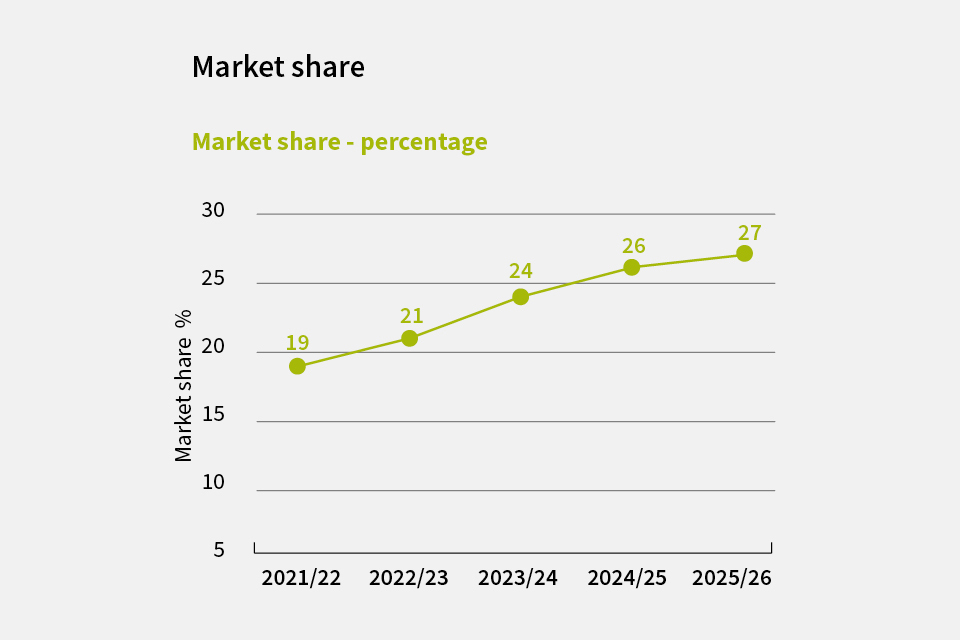
GCA market share
Market share increased from 19 percent in financial year 2021/22 to 27 percent in financial year 2025/26.
Direct spend growth
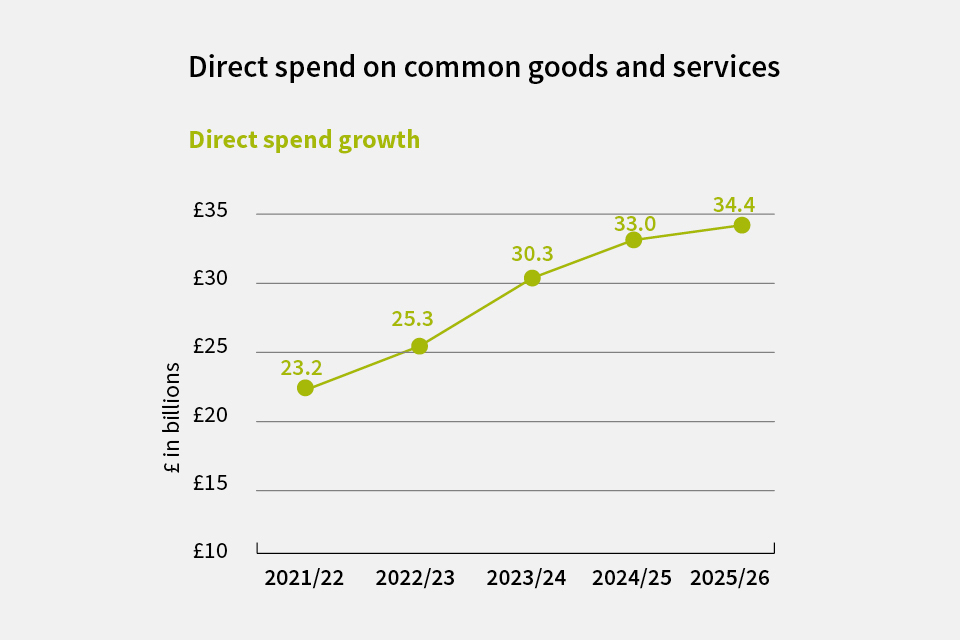
GCA direct spend on common goods and services
Direct spend on common goods and services increased from £23.2 billion in the financial year 2021/22 to £34.4 billion in the financial year 2025/26.
Gross rate of return
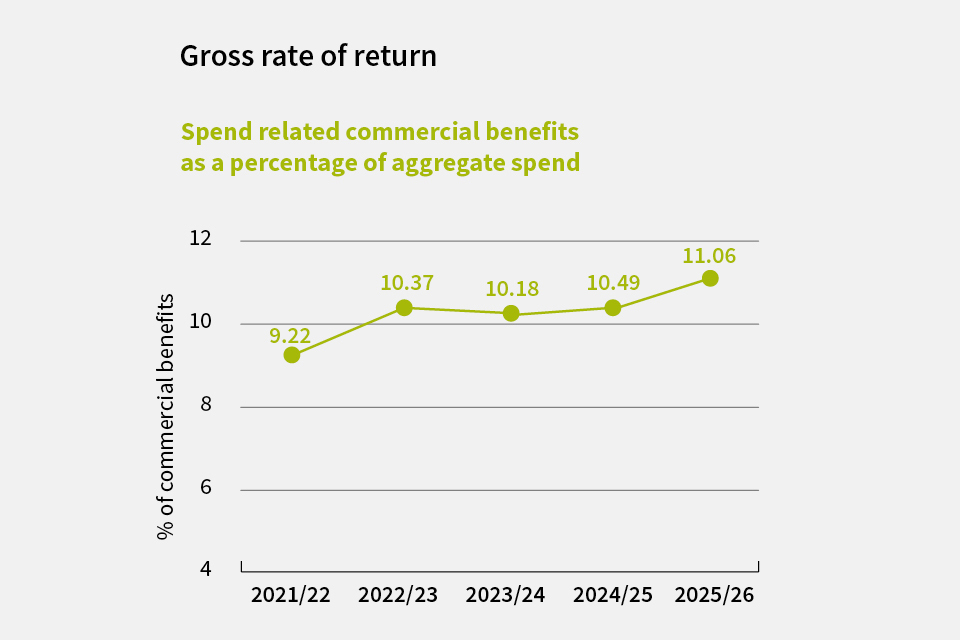
GCA gross rate of return
The spend related to commercial benefits as a percentage of aggregate spend increased from 9.22 percent in the financial year 2021/22 to 11.06 percent in the financial year 2025/26.
Sustainability Report 2025/26
We have been deeply committed to reducing our own carbon footprint and driving down emissions across the public sector supply chain through embedding Carbon Reduction Plans, Social Value, and minimum Government Buying Standards into our commercial agreements. We have worked alongside the GPA who manage our estate to minimise its environmental impact. As the strategic leader in sustainability for the government’s office portfolio, the GPA is committed to minimising environmental impact through innovative programmes such as its Net Zero and Lifecycle Replacement programme. These initiatives benefit us by creating a more sustainable working environment which reduces operational costs and improves efficiency.
We will continue to work closely with the GPA and our landlords to further reduce the environmental impact of our estate to meet our carbon reduction targets.
Greenhouse Gas Emissions
This report presents the gathered data on Scope 1-3 emissions for 2025/26 aligned to the GGC framework. To guarantee continuity in tracking progress against the government’s environmental objectives, the table below includes this year’s data which will form our new baseline and the previously reported years.
The data reported only includes those offices in scope for reporting for 2025/26 and has been extrapolated from full building data, showing figures based on space occupied. The offices reported on are:
-
Birmingham - 23 Stephenson Street - 70m2 - 64 FTE
-
London - 10 South Colonnade, Canary Wharf - 482m2 - 85 FTE
-
Norwich - Rosebery Court, St Andrews Business Park - 979m2 - 160 FTE
To avoid double counting, any current year data relating to our offices in Liverpool and Newport have been excluded from this year’s report as they are now reported by the main building occupiers. For transparency, any figures outlined below that contain an estimate as part of the total are displayed in square brackets ([ ]).
| Scope | Emission source/ activity | Detail | Amount | Expenditure (£) | 2025/26 tCO₂e | 2024/25 tCO₂e | 2023/24 tCO₂e | 2022/23 tCO₂e | % difference from 2024/25 |
|---|---|---|---|---|---|---|---|---|---|
| 1 | Natural Gas (GCA contribution) | London (kWh) | 0 | - | 0.00 | 0.28 | 0.67 | 0.50 | -100% |
| Norwich (kWh) | 280,479 | 15,138 | 51.32 | 61.79 | 52.15 | 28.00 | -17% | ||
| Liverpool (kWh) | 0 | - | 0.00 | 11.88 | 11.78 | 4.30 | -100% | ||
| Total gas | 280,479 | 15,138 | 51.32 | 73.95 | 64.60 | 32.80 | -31% | ||
| Fugitive emissions | Birmingham (kgCO2e) | - | - | - | 1.93 | - | - | - | |
| Total fugitive | 0 | - | 0.00 | 1.93 | - | 0.00 | 0.00 |
| Scope | Emission source/ activity | Detail | Amount | Expenditure (£) | 2025/26 tCO₂e | 2024/25 tCO₂e | 2023/24 tCO₂e | 2022/23 tCO₂e | % difference from 2024/25 |
|---|---|---|---|---|---|---|---|---|---|
| 2 | Electricity generated (GCA contribution) | London (kWh) | 121,924 | 107,547 | 21.58 | 28.88 | 22.66 | 20.30 | -25% |
| Birmingham (kWh) | [22,026] | [3.90] | 4.64 | 4.02 | 3.10 | -16% | |||
| Norwich (kWh) | 234,732 | 41.55 | 51.66 | 41.30 | 39.00 | -20% | |||
| Liverpool (kWh) | 0 | - | 0.00 | 115.67 | 127.20 | 122.00 | -100% | ||
| Total electricity | 378,682 | 107,547 | 67.03 | 200.85 | 195.18 | 184.40 | -67% |
| Scope | Emission source/activity | Detail | Amount | Expenditure (£) | 2025/26 tCO₂e | 2024/25 tCO₂e | 2023/24 tCO₂e | 2022/23 tCO₂e | difference from 2024/25 |
|---|---|---|---|---|---|---|---|---|---|
| 3 | Upstream transportation and distribution | Transport of event equipment (miles) | 9,914 | - | 2.92 | 1.66 | 0.85 | 1.30 | 76% |
| Business travel* | Car (hire + grey fleet, km) | 245,201 | 78,420 | 41.01 | 53.47 | 49.21 | 31.20 | -23% | |
| Coach + mini bus (km) | - | - | - | - | 0.21 | - | - | ||
| Rail travel (passenger.km) | 1,966,969 | 606,961 | 69.75 | 77.44 | 64.55 | 45.30 | -10% | ||
| Air (domestic, passenger.km) | 13,720 | 3,103 | 1.86 | 4.18 | 2.93 | 0.00 | -56% | ||
| Air (international, passenger.km) | 25,811 | 4,497 | 1.81 | 4.91 | 0.49 | 0.40 | -63% | ||
| Hotel stay | UK (room per night) | 2,015 | 210,905 | 20.96 | 23.50 | 18.53 | 13.50 | -11% | |
| UK (London) (room per night) | 564 | 81,914 | 6.49 | 7.67 | 7.43 | 5.90 | -15% | ||
| Waste disposal (GCA contribution) | Energy from waste (tonnes) | [3.89] | 3,576 | [0.02] | 0.05 | 0.14 | 0.10 | -64% | |
| Landfill (tonnes) | 0.00 | 0.00 | 0.00 | 0.00 | 0.50 | - | |||
| Food Waste (tonnes) | 0.88 | 0.01 | 0.01 | 0.01 | - | -21% | |||
| Recycling (tonnes) | 4.58 | 0.02 | 0.09 | 0.28 | 0.30 | -76% | |||
| Water (GCA contribution) | Water supply and treatment (m3) | 1,758 | 3,397 | 0.32 | 1.27 | 2.18 | 0.60 | -75% | |
| Downstream transportation and distribution | (Miles) | - | - | - | - | 0.00 | - | - | |
| Electricity transmission and distribution | Transmission & distribution loss associated with purchased electricity (kWh) | 378,682.00 | - | 6.95 | - | - | - | - | |
| Total scope 3 | 992,773 | 152.12 | 174.25 | 146.81 | 99.10 | -17% |
| 2025/26 | 2024/25 | 2023/24 | 2022/23 | % difference from 2024/25 | |
|---|---|---|---|---|---|
| Total emissions tCO₂e | 270 | 451 | 407 | 316 | -40% |
| Total expenditure (£) | 1,115,458 | 1,417,251 | 988,035 | 617,485 | - |
*Business travel does not include GCO deployed staff as their travel is booked via Cabinet Office
Scope 1 - direct emissions from owned or controlled sources
Scope 2 - indirect emissions from the purchase and use of electricity, steam, heating and cooling
Scope 3 - all other indirect emissions that occur in the upstream and downstream activities of an organisation
The Greening Government Commitments
The Greening Government Commitments (GGCs) set out the actions government departments and their partner organisations will take to reduce their impacts on the environment. These are focused on three main outcomes:
-
working towards net zero and adapting to climate change by committing to reduce direct, overall and ICT emissions, travel more sustainably and manage climate risks through assessments and adaptation plans.
-
restoring and enhancing nature, contributing to the government’s priority to ensure nature’s recovery.
-
promoting resource efficiency to move towards a more circular economy through increasing sustainable procurement, reducing waste and water consumption, increasing reuse and recycling and limiting the amount of waste sent to landfill.
1. Working towards net zero
Overall emissions reduction
Our overall greenhouse gas (GHG) emissions for the period 2025/26 are 270 tCO₂e, showing a decrease of 40% from last year. Direct GHG emissions (scope 1 gas) for this year are down to 51.32 tCO₂e, a reduction of 31% from last year. Anticipated reductions in gas emissions are now evident, as a result of the upgraded heating, ventilation, and air conditioning (HVAC) system at our Norwich office as well as the switch from gas to an Air Source Heat Pump (ASHP) at our London office. Both improvements were part of the GPA’s lifecycle replacement programme and highlight the importance of investing in new efficient technologies. The GPA have also installed a Building Management System (BMS) to monitor and control key services at our London office, further enhancing efficiency and sustainability, which should see continued reductions in emissions in the future.
Our GHG data continues to show that a significant proportion of our carbon footprint comes from scope 3 emissions, equating to 56% of our overall footprint. Business travel and hotel stays account for 53% of our overall carbon footprint at 141.9 tCO₂e, down 17% from last year. The number of flights booked in 2025/26 rose slightly but is still at minimal levels. Our travel policy mandates a ‘digital first’ approach to meetings, followed by lower carbon options for travel if it is required, with rail travel as the preferred choice. We provide a travel booking tool that displays the CO₂ emissions for each train journey, flight, or hotel stay, to help employees make sustainable travel decisions and we will continue to look at ways to improve our business travel emissions moving forward.
To encourage greener commuting, we continue to offer the ‘Cycle to Work’ scheme to all employees and currently have 22 active members, an increase of 10 on last year’s membership figure.
Reducing lifecycle emissions from ICT
All internally managed digital services have now moved to public cloud platforms. This means we benefit directly from the sustainability, carbon tracking and waste reduction initiatives carried out by those service providers. They also provide us with reporting to support and evidence these efforts.
Sustainable travel
We do not own, lease or hire any fleet cars and therefore cannot report on the decarbonisation of fleet vehicles. However, we are able to report on official business travel which has been included in the data above. In addition, a deep dive into travel data was conducted this year to support the initial development of the Sustainability Strategy. The findings from this analysis will be used to draft a travel reduction plan.
Managing climate risks
Overall, our estate remains at low risk of climate related events. Where there is an increased risk (for example, of heat island in city locations), mitigations are in place to reduce and manage this.
In 2024/25 we developed an adaptation action plan which sets out our approach to ensuring our offices remain safe working environments in a changing climate, allowing for continued business operations. This year we have begun to progress the actions outlined in the plan which will feed into a wider Sustainability Strategy, ensuring continued momentum in this space.
We will continue to work closely with the GPA who are reviewing climate related risks to the estate they manage and are leading on the reduction of carbon emissions via the Life Cycle Replacement and Net Zero programmes. As we transition to GCA, we will ensure that we continue to support any future upgrade projects undertaken by the GPA across our estate to maintain a safe working environment for our employees.
2. Restoring and enhancing nature
We do not have any significant natural capital, however our employees support the natural environment through many volunteering opportunities across the country each year. Staff participate in national initiatives such as coastal clean-ups, managing green spaces (planting, creating wildflower meadows), and parkland/woodland conservation (habitat restoration), which promotes environmental benefits, community engagement and demonstrates our commitment to sustainability.
3. Promoting resource efficiency
Sustainable procurement
We remain committed to supporting the government’s 25 Year Environment Plan and the transition to a Net Zero economy by 2050. We use relevant standards in our contract specifications, and build in contractual levers such as social value provisions and sustainability clauses, enabling users of our agreements to meet their own sustainability goals.
In particular we are committed to the following sustainable procurement priorities:
-
applying relevant and appropriate buying standards and best practice industry innovation to all our procurement activity
-
implementing and monitoring the relevant and appropriate procurement policy notices (PPNs) and legislation across our agreements and supply chain
-
reducing carbon emissions through the procurement of energy across government and the public sector
-
ensuring our agreements support the reduction of single use plastics in the supply of goods
-
ensuring our procurements and wider activities make a contribution towards the government’s Net Zero target for 2050
-
enabling the delivery of social value in public sector contracts through effective contract levers
-
helping address the risks of modern day slavery in government’s supply chains
-
supporting small and medium-sized enterprises, and voluntary, community and social enterprises through our procurements
Government Buying Standards
The Government Buying Standards (GBS) are a principal source of procurement guidance and set minimum mandatory buying standards for certain goods and services such as paper, office technology equipment, cleaning products, furniture and textiles, construction and fleet.
Where relevant and aligned with the timing of their procurement, these standards are explicitly referenced in our current commercial agreements. We also consult with policy experts in other departments, as well as relying on the considerable expertise of our category teams who will incorporate industry level best practice where relevant.
Managing waste (including ICT waste)
In 2025/26 we produced 9.35 tonnes of waste, equating to 0.05 tCO₂e.
Our waste bins are categorised and clearly labelled, enabling efficient waste management and output monitoring. All reported sites have implemented food waste streams, recycling and waste-to-energy. As a result, we can continue to report zero waste to landfill across the three offices mentioned.
We have a strong focus on recycling with 4.58 tonnes of waste being recycled, which equates to 49% of our total annual waste. Across the three offices, we sent 3.89 tonnes (42%) of waste for energy recovery and 0.88 tonnes (9%) of food waste to anaerobic digestion. We have minimal single use plastic across the organisation. All of our offices are equipped with ceramic mugs and glasses, stainless steel cutlery and ceramic plates for staff use.
Our ICT equipment is supplied by the Cabinet Office who are responsible for monitoring and reporting on the environmental impact of any digital waste. As such, we have not included any data for ICT waste in this report. The Cabinet Office is currently leading the way in managing government ICT waste, which is now reused and recycled via a third party. Furthermore, the Cabinet Office ensures that all retired ICT hardware is returned to ISO14001-certified suppliers through established take-back agreements, guaranteeing either direct reuse or recycling of the equipment.
Any in-house audio-visual equipment we have is provided by an ISO14001 accredited contractor who handles the disposal of waste electronic and electrical equipment (WEEE) through approved recycling vendors. A WEEE disposal certificate is obtained for each relevant disposal and wherever possible, recycling and responsible material recovery is prioritised using their trusted partners. This ensures waste equipment is handled in the most environmentally friendly way. Our contractor is also able to transfer ownership of any working equipment that is no longer required to charities, schools and community groups.
Reducing water consumption
The amount of water consumed across our three reported offices in 2025/26 was 1,758 cubic metres, equating to 0.32 tCO₂e. Our offices continue to benefit from the use of combined hot and cold taps which are an efficient system that only cools or heats what is required to avoid water wastage. Additionally, we benefit from the use of dual flush toilets and sensor taps in the bathrooms which also reduce the amount of water being used across our sites.
Strengthening governance
Over the past year, we have significantly strengthened the governance of our sustainability performance, ensuring greater accountability and visibility. Performance against the GGCs were presented to our People and Finance Committee six-monthly, to review our half-yearly carbon footprint and track annual progress against previous years. The findings and recommendations from this year’s review were escalated to our Executive Committee for oversight and strategic direction. A Senior Responsible Owner (SRO) has also been formally appointed to oversee our GGC performance, underscoring the organisation’s commitment to achieving its environmental targets.
To ensure sustainability is embedded across all operational and commercial activity, we established a dedicated Sustainability Working Group this year. This group comprises representatives from various business units, ensuring a holistic perspective on environmental and social performance. The working group has begun feeding into the development of a comprehensive Sustainability Strategy.
Carbon Reduction Plan
Commercial agreements are now created with sustainability built in from the start. For any contract over £5 million, PPN 006 (PPN 06/21) applies, requiring bidders to provide a Carbon Reduction Plan (CRP) to ensure that suppliers are committed to helping customers achieve Net Zero by 2050. The CRP Sustainability Lead’s involvement in our internal processes guarantees the inclusion of all relevant sustainability considerations and provisions.
To support this, we have delivered virtual training sessions on PPN 006 (PPN 06/21) to raise awareness of the policy and help suppliers create compliant CRPs. During 2025/26, we have delivered 16 virtual sessions with around 1,000 attendees. Since its inception, the CRP training has been attended by almost 6,300 people across nearly 100 events.
CRP compliance process is fully integrated into our supplier management activities to ensure all relevant suppliers maintain compliance throughout the lifetime of their agreements. All compliant CRPs are linked to supplier records on our website for public visibility. Bespoke webinars have been delivered to customers upon request and as part of cross-government collaborations, firmly establishing us as the subject matter experts.
Social value
We continue work to embed social value PPN 002 (formerly PPN 06/20) in our agreements, and follow best practice in social value. Our category strategies specifically address the opportunities to deliver social, economic and environmental sustainability in each market where we operate. Our agreements are designed to allow customers to create tangible benefits in towns and cities across the UK, including an evaluation of suppliers’ approaches during the procurement stage with a minimum 10% of total score attributed to social value.
Our internal network of social value champions continues to peer review each procurement for social value inclusion and share best practice across the organisation. Every new agreement we have launched in 2025/26 has included social value provisions, enabling customers to work towards their economic, social and environmental objectives through procurement.
Our social value working group operates cross-functionally to enable social value delivery. As part of our social value enablement role, we have successfully piloted a project to test how we could better support customers and suppliers in delivering social value through its agreements. This has involved several change workstreams, including:
-
trialling a social value measurement platform: to test how a more consistent approach to capturing social value commitments, delivery and evidence can improve visibility of the wider public benefit delivered through contracts, strengthen assurance, and generate insight to inform continuous improvement
-
local needs analysis: a tool to help customers and suppliers understand local priorities and support a place-based approach to social value delivery
-
trialling community exchange platforms: tools designed to better connect suppliers and buyers with local community projects, charities, and VCSEs
-
capturing insight from a diverse range of suppliers, including case-studies and emerging best practice as part of GCA supplier management practices
Together, these workstreams are informing how we can deliver a more joined-up future social value offer that strengthens support, insight and reporting for customers and suppliers using our agreements.
Modern slavery prevention
We are committed to tackling modern slavery in global supply chains. Our agreements are designed to address modern slavery as part of our wider supplier due diligence. We continue to implement the key activities outlined in our Modern Slavery Statement, which sets out our approach to managing labour risks in our supply chains. The statement is available to view on our website.
In line with PPN 009, we ensure that there are appropriate measures in place to mitigate the risk of modern slavery throughout the whole commercial agreement lifecycle. All new commercial agreements are assessed for modern slavery risks and include relevant measures to prevent the occurrence of forced labour abuses in the supply chain if the risk level is medium or high.
We continue to request annual Modern Slavery Assessment Tool (MSAT) reports from suppliers on higher-risk agreements, and conduct follow-up conversations with suppliers whose assessments have returned high risk scores. We have held follow-up reviews with numerous suppliers, resulting in improvements to their operations and risk management processes. We continue trialling the use of an alternative to the MSAT tool intended to support smaller businesses in identifying potential improvements to their ways of working.
We understand how important access to information is in empowering our customers to buy responsibly. Our Modern Slavery web page provides guidance and information on how we enable sustainable procurement.
Small and medium-sized enterprises
We have seen continued good progress with our efforts to enable small and medium-sized enterprises to participate in our commercial agreements. We have enabled £2.89 billion of direct spend with 2,734 SMEs. 75% of the suppliers on our commercial agreements are micros and SMEs and 63.4% of suppliers with reported spend are SMEs.
We signed off our Small and Medium-sized Enterprise Strategy 2025-2030 which outlines our aspiration for supporting the SME community. Subsequent SME Action Plans will be in line, and drawn down from the SME Strategy.
United Nations Sustainable Development Goals
A number of our commitments, policies, and programmes across the organisation are aligned with the United Nations Sustainable Development Goals (SDGs). Below are some ways in which we are contributing towards these goals.
SDG 3 - Good Health and Wellbeing: Ensure healthy lives and promote wellbeing for all
In 2025/26, we signed off our Wellbeing Strategy (2025-2027) which includes taking actions across five strategic themes: physical, mental, financial, social, and environmental. These initiatives include:
-
embedding wellbeing into monthly performance reviews
-
addressing mental, physical, and financial health through resilience training, health checks, and budgeting advice
-
providing health interventions like flu vaccinations and physical activity challenges
SDG 4 - Quality Education: Ensure inclusive and equitable quality education and promote lifelong learning opportunities for all
We are committed to promoting the Civil Service as an employer of choice by offering internships and work placements through the following programmes:
-
Civil Service Autism Exchange Internship Programme
-
Cross Government Catapult Mentoring programme
-
Change 100 Leonard Cheshire internship programme
-
Fast Stream programme
SDG 5 - Gender equality: Achieve gender equality and empower all women and girls
We are committed to gender equality. We have:
-
an established Gender Equality Network that meet regularly
-
reduced our mean gender pay gap from 6.88% to 5.91%
-
increased the number of bonuses paid to women this year
-
recognised there is more to do to increase female representation in leadership roles
SDG 7 - Affordable and Clean Energy: Ensure access to affordable, reliable, sustainable and modern energy for all
We support the public sectors energy requirements through:
-
established route to market for Power Purchase Agreements (PPAs) to support public sector access to renewables
-
delivery of commercial benefits through aggregated Energy buying model, reducing exposure to market volatility
-
support the public sector in purchasing renewable generation assets to reduce reliance on fossil fuels
SDG 8 - Decent work and economic growth: Promote sustained, inclusive and sustainable economic growth, full and productive employment and decent work for all
We are supporting this goal by:
-
signing off our SME Strategy 2025-2030 outlining our aspirations for the SME community
-
addressing modern slavery in global supply chains through supplier due diligence in agreements
-
implementing key activities from our Modern Slavery Statement to manage labour risks
SDG 10 - Reduced inequalities: Reduce inequality within and among countries
In the last 12 months, we have:
-
continued to show an upward trajectory in the diversity of our staff across ethnicity, disability, religion, sexual orientation and socio economic backgrounds
-
launched a new 5 year Inclusion and Diversity Strategy
-
nominated inclusion champions in each directorate to support local action planning
-
become an accredited disability confident leader and carer confident level 2 employer
-
continued to support the Places for Growth agenda, increasing opportunities for senior leadership roles in the regions
SDG 12 - Responsible Consumption & Production: Ensure sustainable consumption and production patterns
We continue to embed sustainability standards, social value provisions, and specific clauses into all contracts. Core priorities are:
-
applying Government Buying Standards (GBS) and best practice
-
implementing Procurement Policy Notices
-
reducing carbon emissions from energy
-
minimising single-use plastics
-
addressing modern slavery
-
supporting SMEs
SDG 13 - Climate Action: Take urgent action to combat climate change and its impacts
We continue to support the Net Zero targets to reduce the impacts of climate change through:
-
working towards GGC targets
-
the development of a sustainability strategy and action plan
-
ensuring sustainability is incorporated into our procurement frameworks
-
mandating carbon reduction plans for contracts over £5 million
We are strengthening resilience to climate change through:
-
climate related risk assessments of our estate and operations
-
developing and implementing adaptation plans
-
including climate related risks in future location strategies
Task Force on Climate Related Financial Disclosures (TCFD)
We have reported on climate-related financial disclosures consistent with HM Treasury’s TCFD-aligned disclosure application guidance, which interprets and adapts the framework for the UK public sector. We do not consider climate to be a principal risk, and have therefore complied with the TCFD recommendations and recommendations disclosures around:
-
governance - recommended disclosures (a) and (b)
-
risk management - recommended disclosures (a) to (c)
-
metrics and targets - recommended disclosures (b)
Further recommended disclosures are only mandatory (subject to comply or explain) where climate is deemed a principal risk.
Governance
a) describe the board’s oversight of climate-related issues.
Updates on work in this area, including our carbon footprint, were regularly presented to various committees. Both the climate change risk assessment and adaptation plan have been reviewed as part of an annual review process and remaining actions will be integrated into our plan under the new strategy which is set for delivery over the next four years, extending to 2030.
b) management’s role in assessing and managing climate-related issues.
We remain committed to supporting delivery of the government’s Net Zero target and ensuring the UK maximises the benefits of the transition.
We help customers generate long-term environmental benefits for their organisations, society and the economy. As part of our ambitions to maximise our value and impact, and establish a more effective and efficient organisation, our Board and committees will monitor and oversee progress against goals and targets for addressing climate-related issues moving forward.
Our current organisational structure can be found in detail on page 15 of this annual report.
Risk management
a) describe the organisation’s processes for identifying and assessing climate-related risks
We utilised the Orange Book methodology to establish a systematic approach for identifying, assessing, and mitigating climate-related risks aligned to the GGC framework. This involved integrating climate-related risk considerations into our existing risk management framework, ensuring that these risks are treated with the same rigour as other operational risks. Our assessment did not identify any significant climate-related risks to our estate and the impact of climate change on our operations is expected to be minimal. Any areas that show a slightly elevated risk score have mitigations in place, and recommendations outlined have been incorporated into an implementation action plan for sustainability moving forward.
b) describe the organisation’s processes for managing climate-related risks
Any risks identified as part of our climate change risk assessment will be mapped into short, medium and long-term risks aligned to the GGC framework as we draft our forthcoming sustainability strategy. Any identified climate-related risks will be included in our risk register along with appropriate mitigation strategies and will be reviewed at intervals as set out in the sustainability strategy once finalised
c) describe how processes for identifying, assessing, and managing climate-related risks are integrated into the organisation’s overall risk management
Using the Orange Book’s principles to guide our practice in risk evaluation, we have ensured that we employ a consistent approach to quantifying exposure to climate-related risks aligned to other operational risks in the business. Any risks identified will be included in our risk registers to enable us to implement appropriate mitigation strategies.
Metrics and targets
b) disclosure of Scope 1, 2 and, if appropriate Scope 3 greenhouse gas emissions and their related risks
We currently report on our GHG emissions quarterly via the Cabinet Office as part of the GGC requirements. Our annual sustainability report aligns with this reporting framework for scopes 1 and 2, and expands on scope 3 to include data on hotel stays. A detailed breakdown of our GHG emissions data, including disclosure across scopes 1, 2 and 3 can be found in the table on pages 24 and 25 of the sustainability report. This table includes the 2022/23 emissions data reported which forms our baseline, allowing for transparency towards achieving the cross government target of Net Zero by 2050, while 2025/26 will create the new baseline under the new GGCs.
The annual review of the climate change risk assessment for our estate and operations was completed in 2025/26. While this assessment did not identify any immediate high-risk actions, several mitigation measures have now been implemented. Moving forward, this risk assessment will capture any new locations in the expanded organisation.
(end of performance report)
Sam Ulyatt
Chief Executive and Accounting Officer
9 July 2026
Accountability report
Director’s report
This Accountability report includes the:
-
Corporate governance report
-
Remuneration and staff report
-
Parliamentary accountability and audit report
Corporate governance report
The purpose of this report is to provide an overview of our governance arrangements and the Accounting Officer’s responsibilities in managing and controlling the resources of the Trading Fund during the financial year.
As an executive agency of the Cabinet Office, we were accountable to the Chancellor of the Duchy of Lancaster and the Minister for the Cabinet Office. The holders of both roles during the financial year were:
| Role | Holder | Duration |
|---|---|---|
| Chancellor of the Duchy of Lancaster | Rt Hon Pat McFadden MP | From 5 July 2024 to 4 September 2025 |
| Chancellor of the Duchy of Lancaster | Rt Hon Darren Jones MP | From 5 September 2025 to date |
| Paymaster General and Minister for the Cabinet Office - Minister for the Constitution and European Union Relations | Rt Hon Nick Thomas-Symonds MP | From 8 July 2024 to date |
The sponsor of GCA was the Government Chief Commercial Officer:
- Andrew Forzani from 24 February 2025 to date
The management of GCA was directed by the Board comprising the Chair, Non-Executive Directors, Chief Executive and the Director of Finance, Planning and Performance. No changes were made to individuals in those roles for the reporting period.
The Board Members’ term end dates are set out in the table below:
| Role | Holder | Duration |
|---|---|---|
| Non-Executive Director | Sara Halton | Contract extended from original expiry date of 12 September 2025 to 30 September 2026 |
| Non-Executive Director | Steve Weiner | Contract expired 12 September 2025 |
| Non-Executive Director | Steve McCrystal | Contract ended 31 March 2026 due to the ceasing of CCS |
| Non-Executive Director | Dr Manuela Gazzard | Contract ended 31 March 2026 due to the ceasing of CCS |
| Non-Executive Chair | Peter George | Contract ended 31 March 2026 due to the ceasing of CCS |
The attendance list is provided on page 38 and the remuneration of all Board members during the year is shown on page 46 of the remuneration and staff report.
Managing outside interests
We implemented a clear and robust policy and process for managing and reviewing outside interests in accordance with the requirements under the Civil Service Management Code (Section 4.3). To provide the necessary and appropriate corporate governance, accountability and transparency, the policy applies to all employees and those representing us. They are required to declare any private interests which may result in a perceived or actual conflict of interest when they commence employment through an annual mandatory declaration of interests exercise. All declarations returned are reviewed to ensure that the right safeguards have been put in place to mitigate or remove any potential conflicts.
No SCS employed by GCA has declared any paid or otherwise remunerated work, employment or appointment that falls under the Civil Service declaration and management of outside interests. Read this Cabinet Office guidance on Declaration and management of outside interests in the Civil Service.
The declaration of interests is a standard item addressed at the start of all Board meetings. Additionally, Board members completed an annual declaration of interest form and were required to update this throughout the year should their situation change. The following Board members’ outside interests were declared during the reporting period, although no actual conflict of interest has arisen:
-
P George (Non-Executive Chair) - Chair of Benchmark Holdings PLC; Chair and shareholder of Oxford Quantum Circuits; President and majority shareholder at Enigma Holdings Group Ltd and XPG Ltd; Venture Partner and Advisor at Oxford Sciences Enterprises; an Advisor at Gresham House PLC; a member of Cancer Research UK
-
S Weiner (Non-Executive Director) - Non-Executive Director roles at Mediclinic International and King’s College London
-
Dr M Gazzard (Non-Executive Director) - Group Executive Director, Regulatory Services at the British Standards Institute (BSI). One of BSI’s subsidiaries, BSI Cybersecurity and Information Resilience (UK) Limited, was a supplier on the G-Cloud framework. Dr Gazzard was not involved in the day to day operations or decisions relating to that framework. Dr Gazzard was also a Parish Councillor for Dummer Parish Council
-
S Halton (Non-Executive Director) - Non-Executive Director and shareholder at Robinson PLC; Non-Executive Director at Roys (Wroxham) Ltd
-
Andrew Forzani (Non-Executive Director) - Government Chief Commercial Officer and employee of the Cabinet Office
-
S McCrystal (Non-Executive Director) - no interests to declare
-
S Ulyatt (Chief Executive) - Non-Executive Director for the Portfolio and Investment Committee, Department for Energy Security and Net Zero
-
S Golding (Director of Finance, Planning and Performance) - no interests to declare
Statement of Accounting Officer’s responsibilities
Under Section 4 (6A) (b) of the Government Trading Funds Act 1973, HM Treasury has directed GCA to prepare for each financial year a statement of accounts and on the basis set out in the Accounts Directions 2025/26. The accounts are prepared on an accruals basis and must give a true and fair view of the state of affairs of GCA and of its Income and Expenditure, Statement of Financial Position and Cash Flows for the financial year. In preparing the accounts, the Accounting Officer is required to comply with the requirements of the Government Financial Reporting Manual and in particular to:
-
observe the Accounts Direction issued by HM Treasury, including the relevant accounting and disclosure requirements, and apply suitable accounting policies on a consistent basis
-
make judgements and estimates on a reasonable basis
-
state whether applicable accounting standards as set out in the Government Financial Reporting Manual have been followed, and disclose and explain any material departures in the financial statements
-
prepare the financial statements on a going concern basis; and
-
confirm that the Annual Report and Accounts as a whole is fair, balanced and understandable and take personal responsibility for the Annual Report and Accounts and the judgements required for determining that it is fair, balanced and understandable
HM Treasury appointed Sam Ulyatt as Accounting Officer of CCS and now GCA. The responsibilities of an Accounting Officer, including responsibility for the propriety and regularity of the public finances for which the Accounting Officer is answerable, for keeping proper records and for safeguarding our assets, are set out in Managing Public Money published by HM Treasury.
Statement of the Accounting Officer Sam Ulyatt
As the Accounting Officer, I have taken all the steps that I ought to have taken to make myself aware of any relevant audit information and to establish that our auditors are aware of that information. So far as I am aware, there is no relevant audit information of which the auditors are unaware.
As Accounting Officer I confirm compliance with all the above requirements.
Governance statement
As Accounting Officer, I have responsibility for reviewing the effectiveness of our governance, risk management and systems of internal control. My review has been informed by the assurance of Operational Management Returns from each Executive Director and other sources of assurance including compliance with government functional standards. Further assurance has also been gained from internal audit reports and the annual audit opinion from the GIAA.
I am in agreement with the Internal Audit overall opinion rating of Moderate Assurance as outlined in this Governance Statement, namely that some improvements are required to enhance the adequacy and effectiveness of the framework of governance, risk management and control.
I have considered the evidence provided to support this Governance Statement and sought relevant Audit and Risk Assurance Committee assurance. Overall I conclude that a sound system of governance, risk management and internal control has been in place for the year under review and up to the date of approval of the annual report and accounts.
Corporate governance
We are an executive agency of the Cabinet Office, operating as a trading fund under the Government Trading Funds Act 1973. Our governance arrangements for 2025/26 are set out in the diagram on page 15.
As a trading fund, we are required to have a Framework Document, agreed with Cabinet Office as its sponsor department, that outlines key activities and governance. The document sets out roles and responsibilities of the trading fund and the framework within which it operates. The Framework Document is currently under review due to the transition from CCS to GCA, but currently reflects the guidance and templates published by HM Treasury in March 2022. Once finalised this will be signed off by the GCA Board and Cabinet Office.
The 2025/26 Accounting Officer System Statement for the Cabinet Office includes assurance for the accountability relationships and processes between the department and ourselves.
The role of the CCS Board
The primary responsibility of the Board was to support, advise and challenge the Chief Executive and Accounting Officer on matters of strategic importance. In addition, the Board was responsible for:
-
endorsing our vision, standards and values
-
endorsing our strategic aims, objectives and target setting
-
developing and endorsing the Strategy and annual Business Plan
-
reviewing the management of financial and human resources to deliver the Business Plan
-
monitoring the operational and financial performance and actions needed to keep performance on plan
-
monitoring strategic risks and seeking assurance on their management
-
reviewing the Annual Report and Accounts prior to approval by the Accounting Officer
-
reviewing the effectiveness of maintaining a transparent system of prudent and effective controls (including internal controls) and providing a scheme of delegated authority
-
reviewing the results of staff surveys and the results of customer satisfaction surveys, the health and safety report and major projects on a regular basis throughout the year
-
scrutinising and endorsing business cases of above £2 million prior to approval by the Accounting Officer and other central government controls
Board and Committee attendance
Meeting attendance per board member of meetings eligible to attend
| Name | Position | Board | Audit & Risk Assurance Committee | Delivery Committee | People Committee | Nominations Committee |
|---|---|---|---|---|---|---|
| Note 1 | Note 2 | |||||
| P George | Non-Executive Chair | 7/7 | N/A | N/A | 2/2 | 1/1 |
| M Gazzard | Non-Executive Director | 7/7 | 3/3 | N/A | 2/2 | 0/1 |
| S Halton | Non-Executive Director | 7/7 | 4/4 | 4/4 | N/A | 1/1 |
| S McCrystal | Non-Executive Director | 6/7 | 2/4 | 3/4 | N/A | N/A |
| S Weiner | Non-Executive Director and Chair of the Audit Committee | 3/3 | 1/1 | N/A | N/A | N/A |
| A Forzani | Non-Executive Director | 5/7 | N/A | N/A | 0/1 | 0/1 |
| S Ulyatt | Chief Executive | 7/7 | 4/4 | 4/4 | 2/2 | 1/1 |
| S Golding | Director of Finance, Planning and Performance | 7/7 | 4/4 | 4/4 | N/A | N/A |
-
Note 1: There were 6 full Board meetings during the year and 1 extraordinary meeting (to approve the Annual Report & Accounts 2024/25)
-
Note 2: Attendance by the Chief Executive and Director of Finance, Planning and Performance at the Audit & Risk Assurance Committee was in an attendee, not a member capacity
Board sub-committee reports
The Board was supported by four sub-committees: Audit and Risk Assurance Committee, Delivery Committee, People Committee and Nominations Committee. All committees met regularly throughout the year to review and provide assurance on those specific areas of responsibility.
Audit and Risk Assurance Committee
Role and responsibilities of the Committee
The Audit and Risk Assurance Committee’s role was to advise the Board and Accounting Officer on the comprehensiveness and reliability of assurances on governance, risk management, the control environment and the integrity of financial statements. This is in addition to reviewing and signing off the Annual Report and Accounts.
The Committee met 4 times during 2025/26 and core membership comprised 3 Non-Executive Directors including the Chair. Other regular attendees included the Chief Executive, Director of Finance, Planning and Performance, Head of Internal Audit and representatives from the National Audit Office and Cabinet Office. In addition, other executive directors and managers attended as appropriate at the request of the Committee. The Chair provided an update on the Committee’s work at each main Board meeting.
Focus during 2025/26
The Committee agreed and monitored progress for a programme of internal audit assurance reviews for 2025/26. The Committee monitored the implementation of actions and recommendations by the executive team.
The Committee accepted the Internal Audit overall opinion rating of Moderate assurance.
The Committee received regular updates on counter fraud, bribery and corruption measures, whistleblowing and data governance.
Delivery Committee
Role and responsibilities of the Committee
The Delivery Committee was formed as an advisory non decision-making authority. Its objective was to discuss key risks and issues relating to various change programmes and track delivery of projects to ensure they were progressing in line with agreed timescales and resourcing, allowing the opportunity to review, inform, assist, provide guidance and challenge.
The Committee met 4 times during 2025/26. Core membership comprised 2 Non-Executive Directors, the Chief Executive Officer and the Director of Finance, Planning and Performance. It was chaired by the Principle Commercial Director.Other executive directors and managers attended as appropriate at the request of the Committee.
Focus during 2025/26
The Committee’s focus during 2025/26 was to support the implementation and progress of the key deliverables set out in the Business Plan, and provide constructive challenge and support empowering SROs who lead strategic initiatives requiring significant investment, notably: Digital and Data Transformation, Target Operating Model, Insights with Impact and Customer Strategy.
People Committee
Role and responsibilities of the Committee
The People Committee was formed as an advisory committee to discuss key people issues including the People Survey, resourcing, annual objectives, office attendance, absence and wellbeing, equality diversity and inclusion, culture and values, behaviours, management and spans of control.
The Committee met 3 times during 2025/26. Membership comprised 2 Non-Executive Directors, the Chief Executive and the HR Director. Executive directors and managers from across the organisation attended at the request of the Committee. The Committee also sought engagement from the heads of function in the Governance Commercial Organisation.
Focus during 2025/26
The Committee reviewed performance against key indicators such as headcount, reward, learning and development, absence and turnover - all of which were reported through the people dashboard.
The Committee provided strategic direction on the People Strategy, workforce planning, performance management and pay. They also received updates on senior recruitment and functional standards, and discussed and reviewed health and safety policy.
Nominations Committee
Role and responsibilities of the Committee
The Nominations Committee was formed to ensure that resourcing, succession planning and developmental strategies are in place for senior leadership roles i.e. those sitting on the Executive Committee or in Senior Civil Service (SCS) posts, and for Non-Executive Director/Board Members succession. All other People and HR issues remained the responsibility of the People Committee.
The Committee met twice in 2025/26. Membership comprised 3 Non-Executive Directors and the Committee was chaired by the Chief Executive. Members of the Human Resources Senior Management Team or Executive Committee joined by invitation for selected agenda items.
The Board’s Nominations Committee was chaired by the Chief Executive Officer in 2025/26, who also serves as the Accounting Officer. In line with Corporate Governance best practice, from 1 April 2026, the Nominations Committee will be chaired by our non-executive Chair.
Focus during 2025/26
The Committee focused on senior staff and Board succession planning, GCF roles and updates on the Assessment and Development Centre (ADC) Commercial Learning Academy.
Executive Committee
The Executive Committee was led by the Chief Executive and membership included executive directors from all the key areas of the organisation. This group met formally as an Executive Committee once a month and informally on a weekly basis. Its role was to manage operational service delivery and oversee delivery against the agreed strategy and to provide leadership to the organisation.
The Executive Committee was supported by three internal sub-committees, each chaired by a different executive director and comprising members representing all directorates across the business. The 3 sub-committees were: People & Finance (Health & Safety), Products & Services, and Digital, Data & Technology. These were facilitated by the Governance team who also supported the Executive Committee, the Non-Executive Board and its sub-committees.
Code of Corporate Governance
We broadly followed best practice for corporate governance in line with the Corporate Governance in Central Departments: Code of Good Practice 2017 and its key principles (parliamentary accountability, role and composition of the Board, effectiveness and risk management). In 2025/26, the Nominations Committee remit ensured that resourcing, succession planning and developmental strategies were considered and put in place for senior leadership roles.
Internal Audit
We had a dedicated Internal Audit service provided by the GIAA which was delivered in accordance with the GIAA Charter and the Public Sector Internal Audit Standards. The Head of Internal Audit reports directly to both the Accounting Officer and the Audit and Risk Assurance Committee. Throughout the year, the Audit and Risk Assurance Committee was advised by the Internal Audit function on the effectiveness of internal controls within the organisation and on the status of outstanding actions from previous audit reviews. Internal Audit had a key role in the governance framework of the organisation through the provision of assurance to management, the Accounting Officer and the Audit and Risk Assurance Committee, along with identifying practical recommendations to reduce risk exposure across the organisation.
The Internal Audit Plan for 2025/26 was developed with reference to our corporate objectives and risks, and was reviewed, discussed and subsequently approved by the Audit and Risk Assurance Committee in March 2025.
During the year, 9 internal Audit Assurance Reports and 2 Advisory Reviews were undertaken covering business activities across the organisation:
Internal Audit Assurance Reports:
Digital Transformation, Insights with Impact, Strategic Risk Management, Effective Business Partnering - Finance, Effective Business Partnering - HR, Accounts Payable/Receivable, Supplier Management and ongoing assurance, Strategic Workforce Planning, Customer Feedback.
Advisory Reviews:
Business Resilience and Incident Management, Change Management and the effective change gateway.
In consultation with management, the Internal Audit Plan was reviewed regularly throughout the year to ensure that it remained fit for purpose and any proposed changes were presented to the Audit and Risk Assurance Committee for approval.
Annual Opinion
The Head of Internal Audit’s overall opinion on the adequacy and effectiveness of our risk management, control and governance arrangements for 2025/26 was confirmed as ‘Moderate’. The level of assurance on the effectiveness of governance, risk management, and internal control issued to the Accounting Officer was consistent with the evaluations given in previous years.
Based on the work undertaken throughout the year, recommendations were identified where improvements to the control environment would be of benefit. None of those areas identified indicate a significant control failure, however it was recommended that we should continue to prioritise work to deliver effective programme and change management.
Management assurance
The Operational Management Assurance Framework (OMAF) is a key mechanism along with audit reports (GIAA and NAO) which provides the Accounting Officer with assurance that we are a well run organisation with effective controls.
OMAF comprises four key elements:
-
a directorate-level self assessment against a set of standards (a simple playbook of what a well run directorate looks like) across 10 management practices - which provides the basis for Directors to set out how they meet those standards and more importantly what improvements are planned going forward.
-
an enterprise-wide assessment using a broader set of assurance questions (100) linked to the risk and control framework established by the Government Internal Audit Agency and HM Treasury and set out within the Orange Book.
-
our application and assessment of capability against the 11 Government Functional Standards (GFS) (currently applicable to the organisation) along with a new internal standard covering Customer. These were subject to oversight from Executive Committee sub-committees.
-
CEO and Executive Committee Directors 1-2-1s which take place on a monthly basis. The basis of discussion is structured around directorate and organisational risks and issues, progress against strategic objectives (Corporate KPIs and Strategic Initiatives) and actions against audit recommendations.
All directorates were able to demonstrate that they are being managed in line with the expected standards and Directorate-level improvements are being captured within local business plans for 2025/26.
Government Functional Standards
Executive Committee sub-committees have, over the course of the year, sought assurance from SROs of the assessments that have been made against the 11 Government Functional Standards that are currently applicable to us.
Part of this assurance was a requirement for SROs to confirm current and target levels of capability against the standards - along with articulation of improvement plans being put in place to close any gaps.
A key area of focus going forward is to establish a more strategic view of where capability levels need to be to match organisational requirements to achieve our Business Strategy along with establishing a strong functional leadership model.
This will be in addition to implementing existing improvement plans at a functional standard level.
Data governance
Improvement activity continued alongside our Data Strategy, with the agreement to establish a Data and Information Governance Council aimed at enhancing data and information management throughout the organisation. Data Governance and Data Quality Managers were appointed to engage with the business in developing a robust data governance framework that aligned with our strategic priorities for 2025/26.
Key priorities included the creation of a data and information governance forum - to serve as a strategic alliance between the Data Governance/Knowledge and Information Management team and the various directorates to improve data and information management.
Knowledge and Information Management (KIM) Activities
We continued to focus on driving compliance through the completed policy work which aligns with Cabinet Office Data and Knowledge Information Management policies and procedures.
Significant work was completed to transfer corporate records from staff personal drives to corporate libraries and the deletion of legacy leaver accounts. Priorities included developing the future KIM Strategy, maturing the Information Asset Register activities, ensuring all Information Asset Owners and Information Asset Managers understand their duties, and are implementing good Directorate information and records management across their teams in readiness for any future digital enhancements.
Security and data protection
We comply with the HMG Security Policy Framework, together with Cabinet Office’s Government Functional Standard GovS007: Security. In addition, we adhered to Cabinet Office guidance on risk management, including bulk data security guidance. The UK General Data Protection Regulation (UK GDPR) compliance standards are embedded and approved by the Cabinet Office.
Security assurance processes were put in place to provide business owners with confidence in the effectiveness of security controls, and a GovAssure assessment was performed to further support this.
Our Senior Information Risk Owner acted as the focus for information risks and was a member of the Board. All staff have agreed to an Acceptable Use Policy before accessing IT systems.
During 2025/26, there were no material breaches and no incidents reportable to the Information Commissioner’s Office. Similar to many organisations, we faced increased security risks, and ensured a proportionate level of security whilst keeping critical functions and priority work operational.
Fraud, Bribery and Whistleblowing
We adopted the Government’s Functional Standards for Fraud, Bribery and Corruption (GovS013) ensuring it remains aligned to the government’s wider agenda around a robust and coordinated approach to protecting public services and the public purse against the risk of fraud, bribery and corruption.
Our compliance with GovS013 was reported to and monitored by the Audit and Risk Assurance Committee, the Cabinet Office and also the Public Sector Fraud Authority (PSFA) on a regular basis.
The Counter Fraud, Bribery and Corruption team addressed 5 reported allegations of fraud in 2025/26, 4 of these have been progressed and fully concluded in 2025/26. 1 remains under investigation and will be carried over to 2026/27.
No whistleblowing cases were received under the terms of the Whistleblowing policy during 2025/26.
Other
Ministerial directions
There have been no ministerial directions given.
Official and Parliamentary correspondence
During 2025/26, we received 145 Freedom of Information requests and 11 Subject Access Requests under the Data Protection Act. Additionally, we answered 17 Parliamentary Questions and 23 MPs’ and Peers’ correspondence cases.
Complaints to the Parliamentary and Health Service Ombudsman
The Parliamentary and Health Service Ombudsman received no complaints about us for 2025/26.
Remuneration and Staff Report
This remuneration report sets out the policy and disclosures on directors’ remuneration as required by the Companies Act 2006 sections 420 - 422 and as interpreted in the Government Financial Reporting Manual. The Companies Act requirements include some disclosures that are not likely to be relevant (such as those on shareholdings, share options, long-term incentive schemes and excess pension benefits paid), however the report has been prepared to be compliant so far as is practicable and appropriate.
Remuneration policy
Senior Salaries Review Body
The Executive Directors are all SCS and the precise funding available to departments each year is decided by the government in response to recommendations of the independent Senior Salaries Review Body (SSRB), taking account of the government’s overall approach to public sector pay. SSRB recommendations cover the level of uplift to the SCS pay bands and progression target rates in the light of economic evidence and movements in the private and wider public sector markets for senior executives. SSRB also gives a view on performance awards for base salary and the minimum bonus payments. In reaching its recommendations, SSRB is to have regard to the following considerations:
-
the need to recruit, retain and motivate suitably able and qualified people to exercise their different responsibilities
-
regional/local variations in labour markets and their effects on the recruitment and retention of staff
-
government policies for improving public services including the requirement on departments to meet the output targets for the delivery of departmental services
-
the funds available to departments as set out in the government’s departmental expenditure limits
-
the government’s inflation target
-
evidence received about the wider economic considerations and the affordability of recommendations
Performance and reward
The SCS pay system consists of two elements, both a consolidated and non-consolidated award as applicable. Increases to the minimum salaries of SCS pay ranges 1, 2 and 3 were in line with SSRB recommendations and the government’s response.
In respect of performance assessments for those that were assessed as ‘exceeding’ and ‘high performing’ against performance objectives for 2024/25, they received a non-consolidated award. This payment was made in October 2025. Per the SSRB all eligible members of SCS received a consolidated pay increase of 3.25 per cent of their base pay from 1 April 2025. SCS pay band minimums for SCS 1, 2 and 3 were increased from 1 April 2025. There were no increases to pay band maximums.
Read the Senior Service Performance Management Framework for more information.
Service contracts
The Constitutional Reform and Governance Act 2010 requires that civil service appointments are made in accordance with the Civil Service Commission’s Recruitment Principles, which require appointments to be made on merit on the basis of fair and open competition but also includes the circumstances when appointments may otherwise be made.
Unless otherwise stated below, the directors covered by this report hold appointments that are open ended until they retire. Early termination, other than misconduct, would result in the individual receiving compensation as set out in the Civil Service Compensation Scheme.
Read about the work of the Civil Service Commission for further information.
Remuneration of Board Members FY 2025/26 (Audited)
The following sections provide details of the remuneration interests of Board Member Executive and Non-Executive Directors employed by GCA.
| To 31 March 2026 | To 31 March 2025 | |||||||||
|---|---|---|---|---|---|---|---|---|---|---|
| Salary | Bonus payments | Benefits in kind to nearest £100 | Pension benefits to nearest £1000 | Total | Salary | Bonus payments | Benefits in kind to nearest £100 | Pension benefits to nearest £1000 | Total | |
| Note 1 | Note 2 | Note 3 | Note 1 | Note 2 | Note 3 | Note 4 | ||||
| £000 | £000 | £000 | £000 | £000 | £000 | £000 | £000 | |||
| P George: Non-Executive Chair | 15-20 | - | - | - | 15-20 | 15-20 | - | - | - | 15-20 |
| M Gazzard: Non-Executive Director | 10-15 | - | - | - | 10-15 | 10-15 | - | - | - | 10-15 |
| S McCrystal: Non-Executive Director | 10-15 | - | - | - | 10-15 | 10-15 | - | - | - | 10-15 |
| S Weiner (Note 6): Non-Executive Director | 5-10 | - | - | - | 5-10 | 10-15 | - | - | - | 10-15 |
| Full Year equivalent | 10-15 | - | - | - | 10-15 | 10-15 | - | - | - | 10-15 |
| S Halton: Non-Executive Director | 10-15 | - | - | - | 10-15 | 10-15 | - | - | - | 10-15 |
| S Golding: Finance Director | 130-135 | - | - | 52 | 185-190 | 135-140 | - | - | 77 | 210-215 |
| S Ulyatt (Note 4): Chief Executive | 205-210 | 0-5 | - | - | 205-210 | 145-150 | - | - | - | 145-150 |
| Full Year equivalent | - | - | - | - | - | 195-200 | - | - | - | 195-200 |
| A Forzani (Note 5): Independent Non-Executive Director | - | - | - | - | - | - | - | - | - | - |
-
Note 1: Salary includes gross salary, overtime, recruitment and retention allowances, private office allowances and any other taxable allowances or payments
-
Note 2: No benefits in kind were provided to any members of the Board during this year
-
Note 3: The value of pension benefits accrued during the year is calculated as the real increase in pension multiplied by 20, plus the real increase in any lump sum, less contributions made by the individual. Non-Executive Board members do not receive any pension entitlements
-
Note 4: S Ulyatt participates in the partnership pension scheme. No pension benefits are available. She is employed by the Government Commercial Organisation (GCO) and the terms and conditions of her remuneration, including the approval of her salary, yearly increases and bonus are determined by the GCO
-
Note 5: No remuneration was paid to A Forzani as he is an employee of the Cabinet Office
-
Note 6: S Weiner was a Board Member until 12 September 2025
Senior management pension entitlements FY 2025/26 (Audited)
The pension entitlements of the Board Members within GCA were as follows. These figures are calculated based on the duration of their tenure on the Board.
| Accrued pension and lump sum at pension age as at 31 March 2026 | Real increase in annual pension and lump sum at pension age | CETV at 31 March 2026 | CETV at 31 March 2025 (or date of board appointment) | Real increase in CETV | |
|---|---|---|---|---|---|
| £000 | £000 | £000 | £000 | £000 | |
| S Ulyatt (Note 1): Chief Executive | - | - | - | - | - |
| S Golding: Director of Finance, Planning and Performance | 25-30 | 2.5-5 | 374 | 319 | 36 |
- Note 1: S Ulyatt participates in the partnership pension scheme. This is a defined contribution scheme, and we are only required to disclose the contribution made in the year rather than the information in the table above. The total employer contribution made for 2025/26 was £30,380.39
Civil Service Pensions
The administration of the Civil Service Pension Scheme (CSPS) is outsourced by the Cabinet Office. On 1 December 2025, the administration of the scheme transferred from MyCSP to Capita Public Services. Prior to this transfer, the Cabinet Office oversaw a phased transition period. Capita has now assumed full responsibility for administering all elements of the scheme, including member services and retirement processing.
Pension benefits are provided through the Civil Service pension arrangements. Before 1 April 2015, the only scheme was the Principal Civil Service Pension Scheme (PCSPS), which is divided into a few different sections – classic, premium, and classic plus provide benefits on a final salary basis, whilst nuvos provides benefits on a career average basis. From 1 April 2015 a new pension scheme for civil servants was introduced – the Civil Servants and Others Pension Scheme or alpha, which provides benefits on a career average basis.
All newly appointed civil servants, and the majority of those already in service, joined the new scheme. The PCSPS and alpha are unfunded statutory schemes. Employees and employers make contributions (employee contributions range between 4.6% and 8.05%, depending on salary). The balance of the cost of benefits in payment is met by monies voted by Parliament each year. Pensions in payment are increased annually in line with the Pensions Increase legislation. Instead of the defined benefit arrangements, employees may opt for a defined contribution pension with an employer contribution, the partnership pension account.
In alpha, pension builds up at a rate of 2.32% of pensionable earnings each year, and the total amount accrued is adjusted annually in line with a rate set by HM Treasury. Members may opt to give up (commute) pension for a lump sum up to the limits set by the Finance Act 2004. All members who switched to alpha from the PCSPS had their PCSPS benefits ‘banked’, with those with earlier benefits in one of the final salary sections of the PCSPS having those benefits based on their final salary when they leave alpha.
The accrued pensions shown in this report are the pension the member is entitled to receive when they reach normal pension age, or immediately on ceasing to be an active member of the scheme if they are already at or over normal pension age. Normal pension age is 60 for members of classic, premium, and classic plus, 65 for members of nuvos, and the higher of 65 or State Pension Age for members of alpha. The pension figures in this report show pension earned in PCSPS or alpha – as appropriate. Where a member has benefits in both the PCSPS and alpha, the figures show the combined value of their benefits in the two schemes but note that the constituent parts of that pension may be payable from different ages.
When the government introduced new public service pension schemes in 2015, there were transitional arrangements which treated existing scheme members differently based on their age. Older members of the PCSPS remained in that scheme, rather than moving to alpha. In 2018, the Court of Appeal found that the transitional arrangements in the public service pension schemes unlawfully discriminated against younger members.
As a result, steps are being taken to remedy those 2015 reforms, making the pension scheme provisions fair to all members. The public service pensions remedy is made up of two parts. The first part closed the PCSPS on 31 March 2022, with all active members becoming members of alpha from 1 April 2022. The second part removes the age discrimination for the remedy period, between 1 April 2015 and 31 March 2022, by moving the membership of eligible members during this period back into the PCSPS on 1 October 2023. This is known as “rollback”.
For members who are in scope of the public service pension remedy, the calculation of their benefits for the purpose of calculating their Cash Equivalent Transfer Value (CETV) and their single total figure of remuneration, as of 31 March 2025 and 31 March 2026, reflects the fact that membership between 1 April 2015 and 31 March 2022 has been rolled back into the PCSPS. Although members will in due course get an option to decide whether that period should count towards PCSPS or alpha benefits, the figures show the rolled back position i.e., PCSPS benefits for that period.
The partnership pension account is an occupational defined contribution pension arrangement which is part of the Legal & General Mastertrust. The employer makes a basic contribution of between 8% and 14.75% (depending on the age of the member). The employee does not have to contribute but, where they do make contributions, the employer will match these up to a limit of 3% of pensionable salary (in addition to the employer’s basic contribution). Employers also contribute a further 0.5% of pensionable salary to cover the cost of centrally provided risk benefit cover (death in service and ill health retirement).
Cash Equivalent Transfer Values
A CETV is the actuarially assessed capitalised value of the pension scheme benefits accrued by a member at a particular point in time. The benefits valued are the member’s accrued benefits and any contingent spouse’s pension payable from the scheme. A CETV is a payment made by a pension scheme or arrangement to secure pension benefits in another pension scheme or arrangement when the member leaves a scheme and chooses to transfer the benefits accrued in their former scheme. The pension figures shown relate to the benefits that the individual has accrued as a consequence of their total membership of the pension scheme, not just their service in a senior capacity to which disclosure applies.
The figures include the value of any pension benefit in another scheme or arrangement which the member has transferred to the Civil Service pension arrangements. They also include any additional pension benefit accrued to the member as a result of their buying additional pension benefits at their own cost.
CETVs are worked out in accordance with The Occupational Pension Schemes (Transfer Values) (Amendment) Regulations 2008 and do not take account of any actual or potential reduction to benefits resulting from Lifetime Allowance Tax which may be due when pension benefits are taken.
The real increase in the value of the CETV
This reflects the increase in CETV that is funded by the employer. It does not include the increase in accrued pension due to inflation, contributions paid by the employee (including the value of any benefits transferred from another pension scheme or arrangement) and uses common market valuation factors for the start and end of the period.
Compensation on early retirement or for loss of office (Audited)
We have not made any compensation for early retirement or loss of office payments to Executive Directors in 2025/26 nor any in the prior year.
Fair pay disclosure (Audited)
The table below illustrates the relationship between the remuneration of the highest paid director and the median remuneration of the workforce. The following information includes staff deployed from the Government Commercial Organisation (GCO). The calculation includes fixed term and agency and interim staff. For details of the remuneration of Executive Directors and Non-Executive Directors see page 46.
Total remuneration includes salary, non-consolidated performance-related payments and benefits in kind. It does not include employer pension contributions and the CETV of pensions.
| Year | 25th Percentile Pay Ratio | Median Pay Ratio | 75th Percentile Pay Ratio |
|---|---|---|---|
| 2025/26 | 5.11 | 4.07 | 2.78 |
The banded remuneration of the highest paid Board Member Executive Director in 2025/26 was £205,000 to £210,000 (2024/25: £210,000 to £215,000).
This was:
-
5.11 times (2024/25: 5.66) the 25th percentile remuneration of the workforce, which was £40,567, (2024/25: £39,291). Salary component, £39,968 (2024/25: £38,710)
-
4.07 times (2024/25: 4.51) the median remuneration of the workforce, which was £50,940 (2024/25: £49,336). Salary component £50,187 (2024/25: £48,607)
-
2.78 times (2024/25: 3.11) the 75th percentile remuneration of the workforce, which was £74,666 (2024/25: £71,444). Salary component £73,000 (2024/25: £69,851)
Total remuneration ranged from £28,082 to £209,058 (2024/25: £21,995 to £252,000). Total remuneration includes salary, non-consolidated performance-related pay and benefits in kind. It does not include severance payments, employer pension contributions and the CETV of pensions.
The median total remuneration for 2025/26 is derived from the annualised payments of all staff made in March 2026, including staff paid by the GCO, interim and fixed term appointments. Part time employees’ payments are adjusted to a full time basis.
In 2025/26, no staff member received an annualised salary in excess of the highest paid Board Member Executive Director. There was 1 of these workers during 2024/25. The average percentage changes since 2024/25 are outlined below:
-
highest paid director salary: +3%
-
highest paid director bonus: -89% (Bonus in 2024/25 was set at £24,437 but related to 2023/24 and 2024/25 performance from Home Office - where they transferred in from)
-
GCA employees salary taken as a whole: +3% (excluding highest paid director, the median pay ratio for the relevant financial year is consistent with the pay, reward and progression policies for the entity’s employees taken as a whole)
-
GCA employees bonus taken as a whole: -9% (excluding highest paid director, bonus payment consistent with the two year pay award)
Staff report
Staff numbers and composition
| Salary band | GCA SCS within band as at 31 March 2026 | GCO Deployed SCS within band as at 31 March 2026 | Total GCA and GCO Deployed SCS within band as at 31 March 2026 | Total GCA and GCO Deployed SCS within band as at 31 March 2025 | ||||
|---|---|---|---|---|---|---|---|---|
| Note 1 | Note 2 | Note 3 | Note 3 | |||||
| £000 | Number | % | Number | % | Number | % | Number | % |
| 60-70 | 0 | 0.00% | 0 | 0.00% | 0 | 0.00% | 0 | 0.00% |
| 71-80 | 2 | 7.41% | 0 | 0.00% | 2 | 3.92% | 4 | 8.33% |
| 81-90 | 10 | 34.04% | 4 | 16.67% | 14 | 27.45% | 13 | 27.08% |
| 91-100 | 1 | 3.70% | 3 | 12.50% | 4 | 7.84% | 5 | 10.42% |
| 101-110 | 5 | 18.52% | 2 | 8.33% | 7 | 13.73% | 6 | 12.50% |
| 111-120 | 7 | 25.93% | 1 | 4.17% | 8 | 15.69% | 5 | 10.42% |
| 121-130 | 0 | 0.00% | 3 | 12.50% | 3 | 5.88% | 4 | 8.33% |
| 131-140 | 2 | 7.41% | 4 | 16.67% | 6 | 11.76% | 4 | 8.33% |
| 141-150 | 0 | 0.00% | 1 | 4.17% | 1 | 1.96% | 1 | 2.08% |
| 151-160 | 0 | 0.00% | 0 | 0.00% | 0 | 0.00% | 0 | 0.00% |
| 161-170 | 0 | 0.00% | 2 | 8.33% | 2 | 3.92% | 1 | 2.08% |
| 171-180 | 0 | 0.00% | 0 | 0.00% | 0 | 0.00% | 1 | 2.08% |
| 181-190 | 0 | 0.00% | 3 | 12.50% | 3 | 5.88% | 3 | 6.25% |
| 191-209 | 0 | 0.00% | 1 | 4.17% | 1 | 1.96% | 1 | 2.08% |
| Total | 27 | 100.00% | 24 | 100.00% | 51 | 100.00% | 48 | 100.00% |
-
Note 1: The figures shown are salary band only and not total remuneration
-
Note 2: The table above includes the SCS deployed from GCO
-
Note 3: The figures shown relate to permanent payrolled employees and exclude interim SCS
SCS declaration of paid outside employment
Staff numbers and costs (Audited)
The following information also provides details of staff deployed from GCO. As of 31 March 2026 we had 10 people on internal development opportunities within GCO but these individuals are included in GCA headcount and FTE figures.
There are currently 8 people on loan to other government departments (6 to GCO and 2 to other government departments) which are on a long term basis for example, 6 months or longer.
Total staff numbers
Details of the average number of FTE employees during the period were as follows:
| 2025/26 | 2024/25 | |
|---|---|---|
| Salaried staff | 684 | 668 |
| GCO deployed staff | 149 | 157 |
| Agency and contract staff | 31 | 34 |
| Total | 864 | 859 |
Note: Figures above exclude Fast Streamers and loans out
Apprentices, internships and work experience students (not audited)
Our commitment to the development of skills is reflected in our current apprenticeship metrics. During the reporting period, 5.3% of our workforce were undertaking an Apprenticeship programme across various levels and skills areas.
Eight of these colleagues celebrated success by successfully completing their apprenticeship programmes during the reporting period.
We are committed to promoting the Civil Service as an employer of choice by offering internships and work placements. Similar to previous years, in 2025/26 we engaged in the Civil Service Autism Exchange Internship Programme, which seeks to position the Civil Service as a preferred employer for diverse young individuals. Through this programme, they are given the opportunity to experience work and develop employability and personal skills within the Civil Service. In 2025/26 we welcomed 4 interns on this programme.
In addition to this, we participated in the Change 100 Leonard Cheshire Internship Programme. This 12-week summer placement is designed for students and recent graduates with disabilities or long-term health conditions, providing them with an opportunity for personal and professional development. In 2025/26, we welcomed 5 interns through this programme.
Turnover
The rolling 12 month staff turnover rates over the last five years are:
| 2021/22 | 2022/23 | 2023/24 | 2024/25 | 2025/26 |
|---|---|---|---|---|
| 10.4% | 13.1% | 11.6% | 11.9% | 4.7% |
Note: Figures are taken as of 31 March for each of the years above and reflect the previous 12 months turnover
Our turnover reporting has captured and included those employees who have transferred to another government department. 36 leavers left voluntarily and 3 were dismissals. Of the 39 total leavers 2 were SCS grade.
Transfers to other departments represent 28% of leavers as do those citing career development as their reason for leaving. Retirees make up 20% of leavers with those with 10+ years service accounting for 30%. The lowest percentage of leavers have 1-2 years service at 10%.
| Reason for leaving | Percentage |
|---|---|
| Resignation - career development | 28% |
| Transfer to other government departments | 28% |
| Retirement | 20% |
| Resignation - other | 10% |
| Dismissal - other | 5% |
| Resignation - financial | 3% |
| Dismissal - performance | 3% |
| Resignation - unhappy in role | 3% |
In terms of the leavers in 2025/26, no business appointment rules conditions were set and there were no breaches of the rules during the financial year.
Our business appointment disclosures are published in accordance with the rules.
Total staff costs (Audited)
| 2025/26 | 2024/25 | |||
|---|---|---|---|---|
| GCA | GCO | Total | Total | |
| £000 | £000 | £000 | £000 | |
| Wages and salaries | 37,223 | - | 37,223 | 33,469 |
| Bonus | 370 | 752 | 1,122 | 1,496 |
| Social security | 4,903 | - | 4,903 | 3,710 |
| Superannuation (Note 1) | 10,113 | - | 10,113 | 9,076 |
| Apprentice levy | 168 | - | 168 | 151 |
| GCO staff costs (Note 2) | - | 16,946 | 16,946 | 16,661 |
| Agency and contract staff costs | 5,390 | - | 5,390 | 4,508 |
| Total | 58,167 | 17,698 | 75,865 | 69,071 |
-
Note 1: Superannuation costs relate to staff participation in the Principal Civil Service Pension Scheme and ‘alpha’ defined benefits schemes. Further details about the pension benefits can be found on page 47
-
Note 2: During the year, we paid the Cabinet Office for the provision of GCO staff who are filling roles in the organisation. Costs are invoiced to us quarterly by the Cabinet Office. Any uninvoiced amounts are accrued
Staff composition
| Male | Female | Total | ||||
|---|---|---|---|---|---|---|
| Board Members | 4 | 57.14% | 3 | 42.86% | 7 | 100% |
| SCS (GCA) | 13 | 50.00% | 13 | 50.00% | 26 | 100% |
| Staff (GCA) | 301 | 42.04% | 415 | 57.96% | 716 | 100% |
| SCS (GCO deployed) | 12 | 52.17% | 11 | 47.83% | 23 | 100% |
| Staff (GCO deployed) | 64 | 47.41% | 71 | 52.59% | 135 | 100% |
-
Note 1: This table shows the gender composition for each category of staffing group as at 31 March 2026. It is not a cumulative table
-
Note 2: Staffing figures shown are headcount and include staff on loan out to other government departments
-
Note 3: Staffing figures are made up of the following contract types - permanent, fixed term appointments, loan in
-
Note 4: Executive Board members have been included in the Board Members figures and not the SCS and SCS GCO deployed
Sickness absence and attendance management
| Year | GCA Average Working Days Lost | Civil Service |
|---|---|---|
| 2021/22 | 6.3 | 6.1 |
| 2022/23 | 5.8 | 7.9 |
| 2023/24 | 6.3 | 7.9 |
| 2024/25 | 8.4 | 8.1 |
| 2025/26 | 8.1 | 8.2 |
Note: These figures exclude contingent workers as we do not record their absence
Average working days lost in 2025/26 is 8.1 compared to 8.4 average days lost in 2024/25 and an average of 8.2 days lost across the Civil Service as a whole.
Recruitment
As an equal opportunities employer, we make all appointments on merit through fair and open competition, adhering to the Civil Service Commission Recruitment Principles. Following a recent audit of our recruitment practices, the Commission awarded us a rating of ‘Good’.
New recruits in 2025/26 are shown in the following table, showing gender breakdown:
| GCA - New hires | GCO - New hires | Total | ||||||
|---|---|---|---|---|---|---|---|---|
| Band | Male | Female | Total | Band | Male | Female | Total | |
| Band 1 | 3 | 6 | 9 | Band 1 | 0 | 0 | 0 | 9 |
| Band 2 | 1 | 4 | 5 | Band 2 | 0 | 0 | 0 | 5 |
| Band 3 | 5 | 10 | 15 | Band 3 | 0 | 0 | 0 | 15 |
| Band 4 | 5 | 2 | 7 | Band 4 | 0 | 0 | 0 | 7 |
| Band 5 | 7 | 5 | 12 | Band 5 | 4 | 6 | 10 | 22 |
| Band 6 | 2 | 2 | 4 | Band 6 | 1 | 0 | 1 | 5 |
| SCS 1 | 0 | 3 | 3 | SCS 1 | 0 | 0 | 0 | 3 |
| SCS 2 | 1 | 0 | 1 | SCS 2 | 0 | 0 | 0 | 1 |
| Total | 24 | 32 | 56 | Total | 5 | 6 | 11 | 67 |
Note: These figures relate to permanent hires, they exclude transfers, loans or secondments from other government departments. Figures shown are headcount
Staff policies and other employee matters
In 2025/26, a primary focus was ensuring our Fraud, Corruption, and Bribery policies were compliant and aligned with best practice, specifically incorporating National Audit Office recommendations on Conflicts of Interest and Raising a Concern (whistleblowing).
We also enhanced ‘Life Leave’ policies, covering family and special leave, to meet the Employment Rights Act 2025 requirements.
Strengthening our value proposition continued by embedding ‘in the moment’ recognition, delivered through Recognition and In-Year Schemes. This focus on quality, innovation, and product/service development directly supports business objectives.
We continued to empower staff and managers using digital tools and self-service models for efficient and effective HR practices.
Finally, we maintained a constructive relationship with Trade Unions through regular discussions involving the CEO, management, HR, and Trade Union colleagues.
Inclusion and diversity
We are committed to creating a workplace where every colleague feels included and valued, regardless of their background. We believe an inclusive and diverse workforce is good for everyone.
We have 8 staff networks and 8 subgroups offering safe spaces for employees to connect, share experiences and support one another. Run entirely by volunteers in their own time, raising awareness of important issues and providing opportunities for personal and professional development.
We produce a 6 monthly Inclusion and Diversity dashboard, monitoring representation and the diversity of starters, leavers, and promotions. We use the dashboard to track progress against key objectives like increasing diversity of our senior leadership, and equipping directorates with local level data to drive action in their areas. We voluntarily report our gender and ethnicity pay gaps, and the action we are taking to reduce these.
We are an accredited disability confident leader and carer confident level 2 employer. During 2025/26 we have also:
-
launched our new 5 year Inclusion and Diversity Strategy taking us to 2030
-
created local action plans, building organisation wide accountability to deliver on the strategy
-
nominated inclusion champions in each directorate to support local action planning
-
increased declarations of diversity characteristics, enabling us to report more widely and accurately on the outcomes for different groups - see declarations chart below
-
run our 6th cohort of reverse mentoring, matching senior leaders with diverse junior colleagues to broaden understanding of their experiences
-
added a range of Inclusion and Diversity content to our learning offer
-
refreshed our induction programme with a stronger focus on inclusion, diversity and our staff networks
Disabled Staff
The organisation is committed to equality of opportunity for all employees and job applicants. Applications for employment from disabled persons are fully and fairly considered against the requirements of the role, with reasonable adjustments made wherever possible throughout the recruitment process.
The organisation seeks to retain employees who become disabled during their employment and supports them through appropriate workplace adjustments, rehabilitation, retraining and redeployment where necessary, enabling them to continue to develop their careers.
Disabled employees have access to training, learning and development opportunities, career progression and promotion on the same basis as all other employees. The organisation is committed to creating an inclusive working environment in which all employees can realise their potential and contribute fully to organisational objectives.
Declaration and representation:
This table shows our declaration rates from December 2023 to December 2025:
| Declaration rate | |||||
|---|---|---|---|---|---|
| Characteristic | December 2023 | June 2024 | December 2024 | June 2025 | December 2025 |
| Ethnicity | 90.15% | 91.15% | 92.36% | 93.26% | 93.51% |
| Disability | 50.91% | 53.99% | 56.53% | 66.98% | 70.30% |
| Religion | 82.28% | 83.31% | 84.72% | 86.52% | 86.88% |
| Sexual orientation | 84.53% | 85.63% | 87.22% | 88.54% | 88.95% |
| Socio economic background | 24.33% | 26.85% | 29.44% | 32.48% | 34.45% |
| Carer | 28.13% | 31.64% | 36.11% | 39.35% | 43.54% |
The following tables show our representation rates for each recorded characteristic:
Ethnicity
| Ethnicity | Representation rate |
|---|---|
| White | 80.0% |
| Ethnic minority | 10.5% |
| Undeclared | 6.5% |
| Prefer not to say | 3.0% |
Disability
| Disability | Representation rate |
|---|---|
| Does not have a disability | 53.5% |
| Undeclared | 29.7% |
| Has a disability | 12.7% |
| Prefer not to say | 4.1% |
Religion
| Religion | Representation rate |
|---|---|
| No religion | 42.1% |
| Has religion | 38.1% |
| Undeclared | 13.1% |
| Prefer not to say | 6.6% |
Sexual Orientation
| Sexual Orientation | Representation rate |
|---|---|
| Heterosexual | 78.6% |
| Undeclared | 11.0% |
| LGBTQ+ | 5.9% |
| Prefer not to say | 4.4% |
Socio Economic Background
| Socio Economic Background | Representation rate |
|---|---|
| Undeclared | 65.5% |
| Not low SEB | 15.3% |
| Low SEB | 11.3% |
| Don’t know | 5.4% |
| Prefer not to say | 2.4% |
Carers
| Carers | Representation rate |
|---|---|
| Undeclared | 57.5% |
| No | 22.9% |
| Yes with carers passport | 9.0% |
| Yes without passport | 8.7% |
| Prefer not to say | 1.9% |
These tables show how our disability, ethnic minority, and LGBTQ+ representation compares to the wider civil service:
| Ethnicity representation | ||
|---|---|---|
| Civil service | GCA | |
| December 2023 | 15.40% | 8.15% |
| June 2024 | 16.60% | 8.71% |
| December 2024 | 16.60% | 9.29% |
| June 2025 | 18.00% | 9.63% |
| December 2024 | 18.00% | 10.50% |
| Disability representation | ||
|---|---|---|
| Civil service | GCA | |
| December 2023 | 15.80% | 8.54% |
| June 2024 | 16.90% | 9.60% |
| December 2024 | 16.90% | 10.00% |
| June 2025 | 17.90% | 13.00% |
| December 2024 | 17.90% | 12.70% |
| LGBTQ+ representation | ||
|---|---|---|
| Civil service | GCA | |
| December 2023 | 6.40% | 4.13% |
| June 2024 | 6.90% | 5.47% |
| December 2024 | 6.90% | 5.69% |
| June 2025 | 7.20% | 6.15% |
| December 2024 | 7.20% | 5.90% |
Pay Gap Reporting
Gender pay gap
This is the ninth Gender Pay Gap report and, as per the legislation, includes GCA employed staff only. Staff deployed from the GCO are included in the Cabinet Office report.
Whilst not legally obliged to do so, our Executive Committee is committed to producing our own overview to illustrate how we are doing specifically, affirming the steps we are taking and reiterating our commitment to achieving pay equality.
Our median gap has stayed at 0% for the second year, and our mean gap has reduced to 5.91%. We are pleased this is moving in the right direction but also recognise there is more to do as we continue to have more women at bands 1-3 and fewer at SCS.
| 2021 | 2022 | 2023 | 2024 | 2025 | |
|---|---|---|---|---|---|
| Mean Pay Gap | 3.63% | 3.87% | 4.78% | 6.88% | 5.91% |
| Median Pay Gap | 0.00% | 1.63% | 0.16% | 0.00% | 0.00% |
Gender Bonus Gap: Our median bonus gap has stayed at 0% for the 7th consecutive year, but our mean gap has jumped from 1.6% to 16.9%. Significantly more women than men received a bonus last year, 69% of women to 39% of men, and the total amount of bonus paid to women was greater. The bonus gap is a result of fewer men receiving bonus pay at bands 1-3, and fewer women at SCS. Excluding SCS the bonus gap reduces to 6.4%
Ethnicity pay gap
Gender is not the only characteristic that we are focused on. This year we published our fifth ethnicity pay gap data and the work of our Inclusion and Diversity Staff Networks continues to inform our strategy.
Our median gap grew from 0% to -4.78% and our mean gap reduced from 6.51% to -0.94%. The main driver of these changes are our overall ethnic minority representation growing from 54 to 67 people, a 24% increase which is also concentrated in bands 1-4 while representation at SCS level decreased.
| 2021 | 2022 | 2023 | 2024 | 2025 | |
|---|---|---|---|---|---|
| Median Pay Gap | +2.20% | 0% | 0% | 0% | -4.78% |
| Mean Pay Gap | +5.48% | +8.94% | +9.04% | +6.51% | -0.94% |
Note 1: A positive number denotes the pay gap is in favour of ethnic minorities
Employee engagement
People Survey - employee engagement trends
| Year | Response rate percentage |
|---|---|
| 2021 | 71 |
| 2022 | 69 |
| 2023 | 62 |
| 2024 | 67 |
| 2025 | 70 |
We take part in the Civil Service People survey to measure employee engagement, focusing on how staff feel about working in our organisation and the broader Civil Service.
We achieved a 93% response rate from staff. Our Engagement Index (EI) score stands at 70%, which is an improvement of 3 percentage points on 2024, our highest rate since the pandemic peak in 2021 of 71%. We are also above the Civil Service benchmark of 65%.
There is a positive trend in employee engagement, particularly in advocacy, pride and organisational motivation. We are also outperforming Civil Service and Cabinet Office Benchmarks across all engagement questions. This reflects a growing satisfaction and alignment with our purpose.
Our EI score positions us as the 2nd highest among organisations of a similar size and 8th highest overall among all participating organisations. We have recorded improvements in six core themes, including ‘Pay’, ‘Leadership and Change’ and ‘Objectives and Purpose’. All our core theme scores exceed the Civil Service Benchmark.
Discrimination remains at 7%, which is the same as the Civil Service benchmark. Bullying and Harassment has dropped 1 percentage point to 7%, which is less than the Civil Service benchmark of 8%.
Every focus area from last year’s People Survey Action Plan showed positive results; however we recognise ongoing challenges, particularly execution of change, pressure points in terms of wellbeing, and inconsistency of experiences across the organisation. ‘Safe to Challenge’ score has dropped since 2022 across all questions; with comfort speaking to senior colleagues about their actions and confidence that challenge will be well received requiring targeted intervention.
Health, safety and wellbeing
We continue to comply with our legal obligations by continuing to:
-
maintain working relationships with GPA, FM providers and Trade Unions
-
provide advice, guidance and support to our colleagues
-
continue to ensure all workplaces are safe and legally compliant supporting our smarter working initiative by undertaking and managing all relevant risk assessments
-
maintain and develop systems and policies to ensure staff safety and promote health and safety compliance by moving towards an employee led health and safety culture
-
collaborate with HR colleagues to promote work-based health, safety and wellbeing initiatives
-
report all health and safety matters to the relevant sub-committees each quarter
There were no incidents during 2025/26 that required reporting to the Health and Safety Executive under the Reporting of Injuries, Diseases and Dangerous Occurrences Regulations 2013 (RIDDOR).
In 2025/26, we prioritised employee wellbeing across five strategic themes: physical, mental, financial, social, and environmental. By integrating wellbeing into our refreshed performance management approach, monthly health discussions between colleagues and managers are now standard.
Key initiatives included:
-
Training: Resilience and conversation workshops based on the survey results
-
Financial: Budgeting support and saving tips shared
-
Physical: Flu vouchers, SiSu health checks, and the Active Wellbeing Challenge
These efforts sustained positive 2025/26 People Survey scores, providing a strong foundation for continued progress in 2026/27.
Expenditure on consultancy and temporary staff
| 2025/26 | 2024/25 | |
|---|---|---|
| Consultancy spend | £1,114,932 | £1,631,195 |
| Contingent labour spend | £5,390,260 | £4,508,388 |
Note: The figure for Consultancy of £1,114,932 is represented in the Financial Statements as £680,942 as per Note 5.1, and a proportion of Note 5.2 of £433,990
Consultancy costs have decreased by 32% since 2024/25 and contingent labour costs have increased by 20%. The decreased consultancy expenditure is driven by the decision to move towards third party service delivery partners and an outcome based approach. In the year there was an increased dependency on agency staff for Digital and Investment portfolio activity.
Reporting of off-payroll appointments
We continue to use contingent labour as part of our resourcing model as we recognise the need for flexibility within our workforce to respond to various circumstances for example:
-
short term absences
-
peaks in demand
-
seasonal variations
-
one-off events
-
to gain specialist skills/knowledge
Highly paid off-payroll worker engagements as at 31 March 2026, earning £245 per day or greater:
| The total number of existing engagements as of 31 March 2026 | 48 |
|---|---|
| Of which, number that existed: | |
| for less than one year | 24 |
| for between one and two years | 15 |
| for between two and three years | 3 |
| for between three and four years | 5 |
| for four or more years | 1 |
Interim personnel are currently utilised across two distinct categories to meet our strategic and operational needs:
-
Short-Term & Transition Support (Less than 1 year): provide essential capacity and capability, while permanent recruitment is underway, and offer targeted support during the GCA transition
-
Long-Term Project Continuity (More than 2 years): Where permanent recruitment for some interim roles has been unsuccessful, interims who have been with us for more than two years are currently assigned to various key, long-term projects where personnel continuity is critical to achieving successful outcomes
In line with the HM Treasury Public Expenditure System guidance (IR35 assurance) to ensure IR35 compliance of all our interim/agency staff, we undertake an assurance exercise every time a contract is renewed and confirm the outcome via a Status Determination Statement where applicable, which is passed down the supply chain.
All highly-paid off-payroll appointments engaged at any point during the year ended 31 March 2026, earning £245 per day or greater.
| Number of temporary off-payroll workers engaged during the year ended 31 March 2026 | 71 |
|---|---|
| Of which… | |
| Not subject to off-payroll legislation | 70 |
| Subject to off-payroll legislation and determined as in scope of IR35 | 0 |
| Subject to off-payroll legislation and determined as out of scope of IR35 | 1 |
| Number of engagements reassessed for compliance or assurance purposes during the year | 0 |
| Number that saw a change to IR35 status following review | 0 |
For any off-payroll engagements of board members, and/or, senior officials with significant financial responsibility, between 1 April 2025 and 31 March 2026:
| Number of off-payroll engagements of board members, and/or, senior officials with significant financial responsibility, during the financial year | 0 (Note 1) |
|---|---|
| Total number of individuals on payroll and off-payroll that have been deemed ‘board members, and/or, senior officials with significant financial responsibility’, during the financial year | 7 on payroll and 0 off-payroll |
Note 1: Excludes Sam Ulyatt, CEO and Andrew Forzani, Non-Executive Board Member as they are paid by the Cabinet Office. Andrew Forzani did not receive remuneration for his Non-Executive role
Reporting of the Civil Service and other compensation schemes - exit packages (Audited)
During 2025/26, we did not operate a voluntary exit scheme. Exit costs are accounted for at the point the organisation is demonstrably committed to making the payment. All payments are made in accordance with the provisions of the Civil Service Compensation Scheme, a statutory scheme made under the Superannuation Act 1972.
| 2025/26 | 2024/25 | 2025/26 | 2024/25 | 2025/26 | 2024/25 | |
|---|---|---|---|---|---|---|
| Exit package cost by band: | Number of compulsory redundancies | Number of other departures agreed | Total number of exit packages by cost band | |||
| <£10,000 | - | - | 2 | 2 | 2 | 2 |
| £10,000 - £25,000 | - | - | - | - | - | - |
| £25,001 - £50,000 | - | - | - | 1 | - | 1 |
| £50,001 - £100,000 | - | - | - | - | - | - |
| £100,001 - £150,000 | - | - | - | - | - | - |
| £150,001 - £200,000 | - | - | - | - | - | - |
| £200,001 - £250,000 | - | - | - | - | - | - |
| £250,000 + | - | - | - | - | - | - |
| Total number of packages by type | - | - | 2 | 3 | 2 | 3 |
| Total cost £ | 0 | 0 | 10,063 | 49,145 | 10,063 | 49,145 |
Parliamentary Accountability and Audit Report
Regularity of expenditure (Audited)
In spending public money, we operate in accordance with the principles of HM Treasury Managing Public Money. This includes the framework of HM Treasury approval of expenditure and the practice of HM Treasury delegating authority to departments to enter into commitments and expenditure within predefined limits without specific prior approval.
The key requirements are regularity, propriety, value for money, and feasibility.
We meet the requirements for regularity through compliance with relevant legislation, HM Treasury delegated authority, and through following MPM guidance.
HM Treasury spending controls continue to operate on the basis of the delegated authorities set by spending teams, with spending proposals above the Department’s delegated authority requiring HM Treasury approval.
The Cabinet Office operates a set of additional spending controls on behalf of HM Treasury, which focus on common categories of expenditure. GCA is in scope of those controls. We have been largely compliant but have identified a small number of breaches of the Learning and Development control whereby GCA should have sought Cabinet Office approval to incur expenditure over £10,000 on any one contract, and we had not done so in respect of contracts in combination totalling £223,000. This expenditure is therefore considered irregular and we reported it to both the Cabinet Office and HM Treasury.
We have focused on tightening and strengthening our internal controls through increased central contracting controls advice; specific training courses to improve awareness and understanding; and through greater retrospective sample checks.
We meet the requirements for assurance through compliance with Government Functional Standards (as set out in the Corporate Governance report).
There were no losses or special payments in the year, nor in the prior year.
Fees and charges (Audited)
As a trading fund, we manage the funded operations so that the revenue of the fund is sufficient to cover general running costs and the cost of capital, which are chargeable to the Statement of Comprehensive Income and Expenditure (SOCIE).
Levies are set to recover costs and to achieve the required rate of return on capital employed, before interest and dividends, of 5.0% a year averaged over the five year period from 01/04/2021 to 31/03/2026.
In ensuring we use surpluses generated for the benefit of the public purse, we are continuing to develop plans for investment covering:
-
Initiatives that prioritise building the public sector’s commercial and digital capabilities
-
Further development of digital tools to make it easier to conduct compliant and effective public procurement through our commercial agreements
-
Investing further in assuring the compliance and resilience of suppliers and supply chains accessed through our commercial agreements
We provide services to Government departments (including agencies in other departments), non-departmental public bodies and other bodies within central government. We also provide commercial services to National Health Service bodies and the wider public sector.
As per the segmental analysis shown in Note 2 of the Notes to the accounts on page 80, two types of charges are applied from which income is derived:
-
commercial agreements - a commission levy is applied as applicable at the appropriate rate on sales reported by suppliers or based on a specific customer measure (such as energy levy based on the number of sites)
-
other operating segments - chargeable directly to customers for services received
In setting fees and charges, we follow the principles of Chapter 6 of Managing Public Money.
Remote contingent liabilities (Audited)
We do not have any remote contingent liabilities.
(end of Accountability report)
Sam Ulyatt
Chief Executive and Accounting Office
09 July 2026
The certificate and report of the Comptroller and Auditor General to the Houses of Parliament
Opinion on financial statements
I certify that I have audited the financial statements of the Government Commercial Agency for the year ended 31 March 2026 under the Government Trading Funds Act 1973.
The financial statements comprise the Government Commercial Agency
-
Statement of Financial Position as at 31 March 2026;
-
Statement of Comprehensive Net Expenditure, Statement of Cash Flows and Statement of Changes in Taxpayers’ Equity for the year then ended; and
-
the related notes including the significant accounting policies.
The financial reporting framework that has been applied in the preparation of the financial statements is applicable law and UK adopted international accounting standards.
In my opinion, the financial statements:
-
give a true and fair view of the state of the Government Commercial Agency’s affairs as at 31 March 2026 and its retained surplus for the year then ended; and
-
have been properly prepared in accordance with the Government Trading Funds Act 1973 and HM Treasury directions issued thereunder.
Opinion on regularity
In my opinion, in all material respects, the income and expenditure recorded in the financial statements have been applied to the purposes intended by Parliament and the financial transactions recorded in the financial statements conform to the authorities which govern them.
Basis for opinions
I conducted my audit in accordance with International Standards on Auditing (UK) (ISAs UK), applicable law and Practice Note 10 Audit of Financial Statements and Regularity of Public Sector Bodies in the United Kingdom (2024). My responsibilities under those standards are further described in the Auditor’s responsibilities for the audit of the financial statements section of my certificate.
Those standards require me and my staff to comply with the Financial Reporting Council’s Revised Ethical Standard 2024. I am independent of the Government Commercial Agency in accordance with the ethical requirements that are relevant to my audit of the financial statements in the UK. My staff and I have fulfilled our other ethical responsibilities in accordance with these requirements.
I believe that the audit evidence I have obtained is sufficient and appropriate to provide a basis for my opinion.
Conclusions relating to going concern
In auditing the financial statements, I have concluded that the Government Commercial Agency’s use of the going concern basis of accounting in the preparation of the financial statements is appropriate.
Based on the work I have performed, I have not identified any material uncertainties relating to events or conditions that, individually or collectively, may cast significant doubt on the Government Commercial Agency’s ability to continue as a going concern for a period of at least twelve months from when the financial statements are authorised for issue.
My responsibilities and the responsibilities of the Accounting Officer with respect to going concern are described in the relevant sections of this certificate.
Other information
The other information comprises information included in the Annual Report, but does not include the financial statements and my auditor’s certificate and report thereon. The Accounting Officer is responsible for the other information.
My opinion on the financial statements does not cover the other information and, except to the extent otherwise explicitly stated in my certificate, I do not express any form of assurance conclusion thereon.
My responsibility is to read the other information and, in doing so, consider whether the other information is materially inconsistent with the financial statements or my knowledge obtained in the audit, or otherwise appears to be materially misstated.
If I identify such material inconsistencies or apparent material misstatements, I am required to determine whether this gives rise to a material misstatement in the financial statements themselves. If, based on the work I have performed, I conclude that there is a material misstatement of this other information, I am required to report that fact.
I have nothing to report in this regard.
Opinion on other matters
In my opinion the part of the Remuneration and Staff Report to be audited has been properly prepared in accordance with HM Treasury directions issued under the Government Trading Funds Act 1973.
In my opinion, based on the work undertaken in the course of the audit:
-
the parts of the Accountability Report subject to audit have been properly prepared in accordance with HM Treasury directions issued under the Government Trading Funds Act 1973; and
-
the information given in the Performance and Accountability Reports for the financial year for which the financial statements are prepared is consistent with the financial statements and is in accordance with the applicable legal requirements.
Matters on which I report by exception
In the light of the knowledge and understanding of the Government Commercial Agency and its environment obtained in the course of the audit, I have not identified material misstatements in the Performance and Accountability Report.
I have nothing to report in respect of the following matters which I report to you if, in my opinion:
-
adequate accounting records have not been kept by the Government Commercial Agency or returns adequate for my audit have not been received from branches not visited by my staff; or
-
I have not received all of the information and explanations I require for my audit; or
-
the financial statements and the parts of the Accountability Report subject to audit are not in agreement with the accounting records and returns; or
-
certain disclosures of remuneration specified by HM Treasury’s Government Financial Reporting Manual have not been made or parts of the Remuneration and Staff Report to be audited is not in agreement with the accounting records and returns; or
-
the Governance Statement does not reflect compliance with HM Treasury’s guidance.
Responsibilities of the Accounting Officer for the financial statements
As explained more fully in the Statement of Accounting Officer’s Responsibilities, the Accounting Officer is responsible for:
-
maintaining proper accounting records;
-
providing the C&AG with access to all information of which management is aware that is relevant to the preparation of the financial statements such as records, documentation and other matters;
-
providing the C&AG with additional information and explanations needed for his audit;
-
providing the C&AG with unrestricted access to persons within the Government Commercial Agency from whom the auditor determines it necessary to obtain audit evidence;
-
ensuring such internal controls are in place as deemed necessary to enable the preparation of financial statements to be free from material misstatement, whether due to fraud or error;
-
preparing financial statements which give a true and fair view and are in accordance with HM Treasury directions issued under the Government Trading Funds Act 1973;
-
preparing the annual report, which includes the Remuneration and Staff Report, in accordance with HM Treasury directions issued under the Government Trading Funds Act 1973; and
-
assessing the Government Commercial Agency’s ability to continue as a going concern, disclosing, as applicable, matters related to going concern and using the going concern basis of accounting unless the Accounting Officer either intends to liquidate the entity or to cease operations, or has no realistic alternative but to do so.
Auditor’s responsibilities for the audit of the financial statements
My responsibility is to audit, certify and report on the financial statements in accordance with the Government Trading Funds Act 1973.
My objectives are to obtain reasonable assurance about whether the financial statements as a whole are free from material misstatement, whether due to fraud or error, and to issue a certificate that includes my opinion. Reasonable assurance is a high level of assurance but is not a guarantee that an audit conducted in accordance with ISAs (UK) will always detect a material misstatement when it exists. Misstatements can arise from fraud or error and are considered material if, individually or in the aggregate, they could reasonably be expected to influence the economic decisions of users taken on the basis of these financial statements.
Extent to which the audit was considered capable of detecting non-compliance with laws and regulations, including fraud
I design procedures in line with my responsibilities, outlined above, to detect material misstatements in respect of non-compliance with laws and regulations, including fraud. The extent to which my procedures are capable of detecting non-compliance with laws and regulations, including fraud is detailed below.
Identifying and assessing potential risks related to non-compliance with laws and regulations, including fraud
In identifying and assessing risks of material misstatement in respect of non-compliance with laws and regulations, including fraud, I:
-
considered the nature of the sector, control environment and operational performance including the design of the Government Commercial Agency’s accounting policies;
-
inquired of management, the Government Commercial Agency and those charged with governance, including obtaining and reviewing supporting documentation relating to the Government Commercial Agency’s policies and procedures on:
-
identifying, evaluating and complying with laws and regulations;
-
detecting and responding to the risks of fraud; and
-
the internal controls established to mitigate risks related to fraud or non-compliance with laws and regulations including the Government Commercial Agency’s controls relating to the Government Commercial Agency’s compliance with the Government Trading Funds Act 1973 and Managing Public Money.
-
inquired of management, the Government Commercial Agency’s head of internal audit and those charged with governance whether:
-
they were aware of any instances of non-compliance with laws and regulations;
-
they had knowledge of any actual, suspected, or alleged fraud,
-
discussed with the engagement team regarding how and where fraud might occur in the financial statements and any potential indicators of fraud.
As a result of these procedures, I considered the opportunities and incentives that may exist within the Government Commercial Agency for fraud and identified the greatest potential for fraud in the following areas: revenue recognition, posting of unusual journals, complex transactions, and bias in management estimates. In common with all audits under ISAs (UK), I am required to perform specific procedures to respond to the risk of management override.
I obtained an understanding of the Government Commercial Agency’s framework of authority and other legal and regulatory frameworks in which the Government Commercial Agency operate. I focused on those laws and regulations that had a direct effect on material amounts and disclosures in the financial statements or that had a fundamental effect on the operations of the Government Commercial Agency. The key laws and regulations I considered in this context included the Government Trading Funds Act 1973, Managing Public Money, employment law, pensions legislation and tax legislation.
Audit response to identified risk
To respond to the identified risks resulting from the above procedures:
-
I reviewed the financial statement disclosures and testing to supporting documentation to assess compliance with provisions of relevant laws and regulations described above as having direct effect on the financial statements;
-
I enquired of management and the Audit and Risk Assurance Committee concerning actual and potential litigation and claims;
-
I reviewed minutes of meetings of those charged with governance and the Board; and internal audit reports; and
-
I addressed the risk of fraud through management override of controls by testing the appropriateness of journal entries and other adjustments; assessing whether the judgements on estimates are indicative of a potential bias; and evaluating the business rationale of any significant transactions that are unusual or outside the normal course of business; and
-
I addressed the risk of fraud in revenue recognition through testing of a sample of material revenue streams to gain assurance on the completeness and accuracy of revenue recognised. I also reviewed the detailed results of the completeness and accuracy of GCA’s Income team’s audits. This included consideration of whether the testing results indicate a systemic issue with the accurate recording by suppliers of their spend, affecting the accuracy of revenue recognised in the financial statements (completeness).
I communicated relevant identified laws and regulations and potential risks of fraud to all engagement team members and remained alert to any indications of fraud or non-compliance with laws and regulations throughout the audit.
A further description of my responsibilities for the audit of the financial statements is located on the Financial Reporting Council’s website. This description forms part of my certificate.
Other auditor’s responsibilities
I am required to obtain sufficient appropriate audit evidence to give reasonable assurance that the expenditure and income recorded in the financial statements have been applied to the purposes intended by Parliament and the financial transactions recorded in the financial statements conform to the authorities which govern them.
I communicate with those charged with governance regarding, among other matters, the planned scope and timing of the audit and significant audit findings, including any significant deficiencies in internal control I identify during my audit.
Report
I have no observations to make on these financial statements.
Gareth Davies
Comptroller and Auditor General
July 2026
National Audit Office
157-197 Buckingham Palace Road
Victoria, London, SW1W 9SP
Financial statements
Statement of comprehensive income and expenditure for the year ended 31 March 2026
| 2025/26 | 2024/25 | ||||
|---|---|---|---|---|---|
| Note | £000 | £000 | £000 | £000 | |
| Income from external sales | 2 | 223,228 | 222,557 | ||
| Other operating income | 3 | 135 | 188 | ||
| Total income | 223,363 | 222,745 | |||
| Staff costs | 4 | (75,865) | (69,071) | ||
| Depreciation of property, plant and equipment | 7 | (688) | (688) | ||
| Amortisation of intangible assets | 8 | (3,473) | (4,269) | ||
| Lease Depreciation | 9 | (795) | (799) | ||
| Lease interest | 14 | (30) | (37) | ||
| Other expenditure | 5.1 | (35,769) | (32,643) | ||
| Total expenditure | (116,620) | (107,507) | |||
| Surplus before other operating costs | 106,743 | 115,238 | |||
| Other operating costs | 5.2 | (19,906) | (27,890) | ||
| Operating surplus | 86,837 | 87,348 | |||
| Finance income | 6 | 4,584 | 8,449 | ||
| Surplus for the financial year | 91,421 | 95,797 | |||
| Dividend payable to Cabinet Office | 22 | (56,000) | (161,000) | ||
| Retained surplus/(deficit) for the financial year | 35,421 | (65,203) | |||
| Other comprehensive income | |||||
| Revaluation reserve | 19 | - | 751 | ||
| Total other comprehensive income | - | 751 | |||
| Comprehensive income/(expenditure) for the financial year | 35,421 | (64,452) |
The notes to the accounts on pages 76 to 92 form an integral part of these accounts.
Statement of financial position as at 31 March 2026
| 31 March 2026 | 31 March 2025 | ||||
|---|---|---|---|---|---|
| Note | £000 | £000 | £000 | ||
| Non-current assets | |||||
| Property, plant and equipment | 7 | 695 | 1,383 | ||
| Intangible assets | 8 | 8,746 | 12,219 | ||
| Right of use assets | 9 | 2,707 | 3,531 | ||
| 12,148 | 17,133 | ||||
| Current assets | |||||
| Trade and other receivables | 10 | 54,269 | 55,214 | ||
| Cash and cash equivalents | 11 | 116,510 | 72,232 | ||
| 170,779 | 127,446 | ||||
| Current liabilities | |||||
| Trade and other payables | 12 | (39,021) | (35,116) | ||
| Employee benefit payable | 13 | (538) | (549) | ||
| Lease liabilities due in less than one year | 14 | (601) | (776) | ||
| (40,160) | (36,441) | ||||
| Net current assets | 130,619 | 91,005 | |||
| Total assets less current liabilities | 142,767 | 108,138 | |||
| Non current liabilities | |||||
| Lease liabilities due in more than one year | 14 | (2,267) | (2,894) | ||
| Provisions | 16 | (617) | (782) | ||
| Total non current liabilities | (2,884) | (3,676) | |||
| Total assets less liabilities | 139,883 | 104,462 | |||
| Capital and reserves | |||||
| Public dividend capital | 17 | 350 | 350 | ||
| General reserve | 18 | 139,533 | 102,716 | ||
| Revaluation reserve | 19 | - | 1,396 | ||
| Total capital and reserves | 139,883 | 104,462 |
The Notes to the accounts on pages 76 to 92 form an integral part of these accounts.
Sam Ulyatt
Chief Executive and Accounting Officer
9 July 2026
Statement of cash flows for the year ended 31 March 2026
| 2025/26 | 2024/25 | ||||
|---|---|---|---|---|---|
| Note | £000 | £000 | £000 | £000 | |
| Net cash inflow from operating activities | 20 | 96,742 | 59,219 | ||
| Cash flows from investing activities | |||||
| Finance income | 4,588 | 8,387 | |||
| Purchases of property plant and equipment | - | - | |||
| Purchases of intangible assets | 8 | - | - | ||
| Assets under construction | 8 | - | - | ||
| Net cash inflow from investing activities | 4,588 | 8,387 | |||
| Net cash inflow before financing | 101,330 | 67,606 | |||
| Cash flows from financing activities | |||||
| Dividend paid | (56,000) | (161,000) | |||
| Lease rental paid | (1,052) | (906) | |||
| Net cash outflow from financing activities | (57,052) | (161,906) | |||
| Net increase / (decrease) in cash and cash equivalents | 44,278 | (94,300) | |||
| Cash and cash equivalents 1 April | 72,232 | 166,532 | |||
| Cash and cash equivalents 31 March | 116,510 | 72,232 |
See Note 20 in the Notes to the accounts, in which operating surplus (as shown in the statement of comprehensive income and expenditure) is reconciled to net cash flows from operating activities.
The notes to the accounts on pages 76 to 92 form an integral part of these accounts.
Statement of changes in taxpayers’ equity as at 31 March 2026
| Public Dividend Capital | General Reserve | Revaluation Reserve | Total | |
|---|---|---|---|---|
| £000 | £000 | £000 | £000 | |
| Balance at 1 April 2025 | 350 | 102,716 | 1,396 | 104,462 |
| Comprehensive income for the financial year | - | 35,421 | - | 35,421 |
| Revaluation reserve transfer | - | 1,396 | (1,396) | - |
| Balance at 31 March 2026 | 350 | 139,533 | - | 139,883 |
| Public Dividend Capital | General Reserve | Revaluation Reserve | Total | |
|---|---|---|---|---|
| £000 | £000 | £000 | £000 | |
| Balance at 1 April 2024 | 350 | 167,919 | 645 | 168,914 |
| Comprehensive (expenditure) / income for the financial year | (65,203) | 751 | (64,452) | |
| Revaluation disposal | - | - | - | - |
| Balance at 31 March 2025 | 350 | 102,716 | 1,396 | 104,462 |
The Notes to the accounts on pages 76 to 92 form an integral part of these accounts.
Notes to the accounts
1. Accounting policies
The accounts have been prepared in accordance with the Government Financial Reporting Manual (FReM) issued by HM Treasury. The accounting policies contained in the FReM apply International Financial Reporting Standards (IFRS) as adapted or interpreted for the public sector context. Where the FReM permits a choice of accounting policy, the accounting policy which is judged to be most appropriate to our particular circumstances for the purpose of giving a true and fair view has been selected. The particular policies adopted by us are described below. They have been applied consistently in dealing with items that are considered material to the accounts.
1.1.a. Standards in issue but not in force: IFRS 18 Presentation and Disclosure in Financial Statements was issued in April 2024 and is effective for periods beginning on or after 1 January 2027. The standard is expected to be adopted by the FReM for the 2028/29 financial year. We are currently assessing the impact; however, it is anticipated that this will primarily affect the presentation and classification of items within the Statement of Comprehensive Income or Expenditure.
1.1b. Other impending changes for subsequent periods: In February 2026, the UK Government formally endorsed UK SRS S1 (General Requirements) and UK SRS S2 (Climate-related Disclosures), which are based on the IFRS Sustainability Disclosure Standards.
For the 2025/26 reporting period, we continue to report in alignment with the Task Force on Climate-related Financial Disclosures (TCFD) framework. Transition to the full UK SRS S2 (Climate) requirements is expected for the 2026/27 financial year in line with HM Treasury guidance. We are currently conducting a gap analysis to ensure compliance with the enhanced disclosure requirements, including more granular climate scenario analysis and Scope 3 emissions reporting.
1.2 Income and segmental reporting
Income consists of the value of the goods and services net of Value Added Tax (VAT), trade discounts, and commission shares from the ordinary activities of the business. Income is recognised in line with IFRS 15 principles.
Income received in advance of services provided is recognised as deferred income.
The applicable segments are as follows:
1. Commercial agreement income
a. General income – income is recognised in the calendar month in which spend takes place, at the appropriate commissionrate on sales reported from suppliers. Where management information has been received and commercial agreement sales have been invoiced but not paid as at the year end, this is recognised as receivables and measured at supplier sales times the relevant contractual levy. Where current year management information has not been received by the year end, this is recognised as accrued income. Accrued income is initially estimated based on previous management information returns and subsequently measured at supplier sales times the relevant contractual levy where the management information is received and the sale is invoiced prior to accounts production.
b. Energy income – a monthly levy is charged based on the number of sites and meters a customer has. Income is recognised monthly based on site information as reported by our suppliers.
c. Crown Hosting income – a charge is recovered from customers based on their rental hosting charges.
d. Workforce Alliance – we have entered into an Alliance agreement with four other purchasing partners to enhance and simplify health workforce procurement services to the NHS. Commercial Agreement income received across the applicable portfolio of workforce frameworks is distributed to each of the five organisations who form the Workforce Alliance in accordance with market share and growth percentages achieved within a financial year. We only include the share of income we are entitled to as a net revenue, within the SOCIE.
Commercial agreements exist between us and each customer (suppliers to the end user) with separate call off arrangements between that customer and end user. The performance obligating event is the construction and award of the framework (i.e. the point at which control and access is handed to the customer and end user). We do not recognise the income at this point because of the uncertainty in the value of potential customer sales to the end user from which we earn a commission. Consequently, we recognise income at the point supplier sales are made. This information is disclosed within monthly management information provided to us from the customer. The Workforce Alliance (WA) has agreed income will be distributed to each of the five organisations who form the WA in accordance with market share and growth percentages achieved within a financial year as set out in the commercial model. The amounts due to each party are calculated quarterly based on cumulative cash received and distributed accordingly. Our income through the SOCIE is recognised and accrued in accordance with our applicable share of overall income.
2. Other operating segments
a. Managed services – income is recognised through invoices billed directly to customers for services received. Any uninvoiced amounts are accrued. The performance obligating event for contracts for managed services between us and specific customers continues to be the direct provision of the service to the customer. Income is recognised progressively as the performance obligations associated with these engagements are satisfied over time in proportion to contracted values. We have determined that the performance obligations are satisfied over time rather than at a point in time. This is because our performance under the agreement does not create an asset with an alternative use to us and we have an enforceable right to payment for performance completed to date. Income is invoiced after the event and accrued if not invoiced before year end. This service ended during the current year.
b. Customer Payment Initiative – we made payments back to end user qualifying customers in proportion to the amount of income their commercial agreement purchases had generated. These payments were not part of any written agreement and were non-contractual. The segmental analysis (Note 2) reflects the income and costs applicable to each segment. These payments ended during the prior year.
1.3 Property, plant and equipment
Property, plant and equipment assets are capitalised at their cost of acquisition and installation. The prescribed capitalisation level is £5,000. Where an asset costs less than this but forms an integral part of a package whose total value is greater than the capitalisation level, then it is treated as a capital asset. Indexation has not been applied to PPE as the remaining useful life is less than one year and the impact is qualitatively and quantitatively immaterial.
Depreciation
Depreciation is provided on property, plant and equipment on a straight-line basis at annual rates based on the estimated lives of the assets as follows:
-
computer equipment – 3 to 6 years
-
fixtures and fittings – 4 to 10 years
-
plant and equipment – 5 to 25 years
-
right of use assets – over the life of the associated lease
A full month’s depreciation cost is charged in the first month of acquisition. Assets which are work in progress are held within the Statement of Financial Position (SOFP) until such time that they are brought into use. Only assets that have been brought into use are depreciated.
1.4 Intangible assets
Recognition and Amortisation
Software licences and costs directly associated with the development of identifiable and unique software products controlled by us are capitalised where future economic benefits are expected and can be reliably measured. Economic benefits are assessed with reference to revenue generation and/or clear cost savings.
Third party software licences are not capitalised and are expensed within the SOCIE. Licences with a life greater than one year are prepaid.
Intangible Assets are measured on initial recognition at cost. Costs include both permanent and temporary pay costs directly attributable to bringing the asset into service. Intangible assets are assessed as having a finite life of between 3-10 years and are amortised accordingly. The amortisation period and method are reviewed at each financial year end to assess whether there has been any indication that an asset maybe impaired (in accordance with IAS 36). There have been no indications of impairments in the current year. The prescribed capitalisation level is £5,000. A full month’s amortisation cost is charged in the first month of acquisition.
In accordance with IAS 38, development expenditure is recognised as an intangible asset when we can demonstrate:
-
the feasibility of completing the asset for its intended use
-
how the asset will generate future economic benefits
-
the availability of resources to complete the asset
-
the ability to measure the expenditure reliably during development
From 1 April 2025 the FReM requires all intangible assets to be measured using the cost model. We previously used the revaluation model to measure its intangible assets. Carrying values on 1 April 2025 have been deemed to be the historic cost for future measurement. The revaluation reserve balance has been transferred to the general reserve. This change has been applied retrospectively in accordance with the FReM adaptation to IAS 38. Any research costs are not capitalised and are expensed as incurred.
Asset Under Construction (AUC)
Assets which are work in progress are held within the SOFP until such time that they are fully brought into use. Only assets that have been brought into use are amortised. The majority of AUC costs relate to time spent by both temporary and permanent resources in the build of an asset until it is ready to be brought into use. There are no AUC balances in the current year and there are no AUCs being developed.
1.5 Early retirement
The majority of our past and present employees are covered by the provisions of the Civil Service pension arrangements. The defined benefit schemes are unfunded. We recognise the expected cost of these elements on a systematic and rational basis over the period during which it benefits from employees’ services by payment to the Civil Service pension arrangements of amounts calculated on an accruing basis. Liability for payment of future benefits is a charge on the Civil Service pension arrangements. In respect of the defined contribution schemes, we recognise the contributions payable for the year.
1.6 Leases
IFRS 16 “Leases” has been implemented from 1 April 2022; this introduces a single lessee accounting model that requires a lessee to recognise a right of use asset and lease liability for all leases, except for the following:
-
intangible assets;
-
non-lease components of contracts where applicable;
-
low value assets (these are determined to be in line with capitalisation thresholds on property, plant and equipment except vehicles which have been deemed to be not of low value); and
-
leases with a term of 12 months or less (note 5.1).
At inception of a contract, we assess whether a contract is, or contains, a lease. A contract is, or contains, a lease if the contract conveys the right to control the use of an identified asset for a period. This includes assets for which there is no consideration. To assess whether a contract conveys the right to control the use of an identified asset, we assess whether:
-
the contract involves the use of an identified asset;
-
we have the right to obtain substantially all of the economic benefit from the use of the asset throughout the period of use; and
-
we have the right to direct the use of the asset.
The policy is applied to contracts entered into, or changed, on or after 1 April 2022.
At inception, or on reassessment of a contract that contains a lease component, we allocate the consideration in the contract to each lease component on the basis of the relative standalone prices.
We assess whether it is reasonably certain to exercise break options or extension options at the lease commencement date, and if there are significant events or changes in circumstances that were anticipated.
Right of use assets
We recognise a right of use asset and a lease liability at the lease commencement date. The right of use asset is initially measured at the amount equal to the lease liability, adjusted by the amount of any prepaid or accrued lease liability (present value of minimum lease payments), and subsequently at the amount less accumulated depreciation and impairment losses, and adjusted for certain re-measurements of the lease liability. Right of use assets are held at current cost in accordance with HMT IFRS 16 guidance. Depreciated historic cost is used as a proxy for current value as directed by HMT guidance on IFRS 16, including for property leases, because property leases are sufficiently short in term and are not expected to fluctuate significantly due to changes in market prices. Lease payments only include the direct cost of the leases and do not include other variables. Lease terms are determined based on advice from the GPA to align to our business needs and of the wider government property strategy.
The right of use assets are depreciated using the straight-line method from the commencement date to the earlier of, the end of the useful life of the right of use asset, or the end of the lease term. The estimated useful lives of the right of use assets are determined on the same basis of those of property, plant and equipment assets.
Lease liabilities
The lease liability is initially measured at the present value of the lease payments that are not paid at the commencement date, discounted using the interest rate implicit in the lease or where that is not readily determinable, the discount rate as provided by HM Treasury. All current leases use the HM Treasury rate as at 1 January 2022 (0.95%). There were no new lease additions in the current year.
The lease liability only includes the direct lease cost and excludes any service charges. The length of each lease is determined on signing the contractual terms following agreement with the landlord and after gaining permission from the GPA.
The lease payment is measured at amortised cost using the effective interest method. It is re-measured when there is a change in future lease payments arising from a change in the index or rate, if there is a change in our estimate of the amount expected to be payable under a residual value guarantee, or if we change our assessment of whether it will exercise a purchase, extension, or termination option.
Lease payments included in the measurement of the lease liability comprise the following:
-
fixed payments
-
variable lease payments that depend on an index or a rate, initially measured using the index rate as at the commencement date
The lease liability is subsequently increased by the interest cost on the lease liability and decreased by lease payments made.
It is re-measured when there is a change in the future lease payments arising from a change in an index or rate.
When the lease liability is re-measured, a corresponding adjustment is made to the right of use asset or recorded in the SOCIE if the carrying amount of the right of use asset is zero.
1.7 Financial instruments, cash and cash equivalents
Cash and cash equivalents comprise bank deposits together with other short-term, highly liquid investments that are readily convertible into known amounts of cash and which are subject to an insignificant risk of changes in value. Trade and other receivables are recognised at fair value and subsequently at amortised cost.
1.8 VAT
Output VAT is charged on external sales and we pay input VAT on VAT applicable costs and fixed asset additions. Income and expenditure are shown net of VAT.
1.9 Expenditure
Expenditure is recognised on an accruals basis to reflect when the service is performed/goods are received. Services performed/ goods received but not paid by year end are recognised as trade payables (if invoice received) or accruals if not. When payments above £5,000 are made for services not performed/goods not received by year end, they are recorded as prepayments.
1.10 Significant judgements and critical accounting Estimates
The preparation of the financial statements requires us to make some estimates and assumptions that affect the reported amounts of income, expenses, assets and liabilities and disclosure of lease obligations. Key assumptions are stated below:
Income accruals
Accrued income where known is based on customer invoiced data received and where not known is based on an average calculation of the previous 6 months invoiced data.
Total staff costs
On 1 August 2025, we launched a new In Year Reward bonus scheme replacing the previous non consolidated bonus payments for bands 1 to 6. SCS bonuses are estimated.
Depreciation and amortisation
The useful lives of property, plant and equipment and those of intangible assets have been estimated for the purposes of applying the accounting policies for depreciation and amortisation respectively.
Office dilapidations
Estimates for future liabilities arising at the termination of office leases have been based on information provided by GPA each year who act as the lessor. The provision is estimated on a rate per square metre of floor space for each property.
Impairment
The annual impairment review identified that there were no indications of impairment for any assets held.
Expected credit loss provision
In accordance with the requirements of IFRS 9, the calculation reflects our historic loss average and a prudent, aged profiled approach. We apply a simplified model for expected credit losses.
1.11 Going concern
At the time of approving the financial statements, the directors continue to form the judgement that we have adequate resources to continue in operational existence for the foreseeable future. Future financial plans and forecasts have been subject to sensitivity analysis on which the directors have based the going concern assessment. The assumptions made in this assessment are reasonable and appropriate in the context of the FReM and accordingly the financial statements have been prepared on the basis that we are a going concern.
2. Segmental analysis
2025/2026
| 31 March 2026 | Commercial Agreements | Other Operating Segments | Customer Payment Initiative | Total | |
|---|---|---|---|---|---|
| £000 | £000 | £000 | £000 | ||
| Statement of comprehensive income and expenditure (SOCIE) | |||||
| Gross income from external sales | 1.2 | 239,028 | - | - | 239,028 |
| Commission shares | (15,800) | - | - | (15,800) | |
| Customer payment initiative | - | - | - | - | |
| Net income from external sales in SOCIE | 223,228 | - | - | 223,228 | |
| Other operating income | - | 135 | - | 135 | |
| Total income | 223,228 | 135 | - | 223,363 | |
| Operating costs | (116,485) | (135) | - | (116,620) | |
| Surplus before other operating costs | 106,743 | - | - | 106,743 | |
| Other operating costs | (19,906) | - | - | (19,906) | |
| Operating surplus | 86,837 | - | - | 86,837 | |
| Statement of financial position | |||||
| Non-current assets | 12,148 | - | - | 12,148 | |
| Current assets | 170,779 | - | - | 170,779 | |
| Total assets | 182,927 | - | - | 182,927 |
Statement of comprehensive income and expenditure (SOCIE) 2024/2025
| 31 March 2025 | Commercial Agreements | Other Operating Segments | Customer Payment Initiative | Total | |
|---|---|---|---|---|---|
| £000 | £000 | £000 | £000 | ||
| Statement of comprehensive income and expenditure (SOCIE) | |||||
| Gross income from external sales | 1.2 | 228,716 | 245 | - | 228,961 |
| Commission shares | (9,326) | - | - | (9,326) | |
| Customer payment initiative | - | - | 2,922 | 2,922 | |
| Net income from external sales in SOCIE | 219,390 | 245 | 2,922 | 222,557 | |
| Other operating income | - | 188 | - | 188 | |
| Total income | 219,390 | 433 | 2,922 | 222,745 | |
| Operating costs | (107,319) | (188) | - | (107,507) | |
| Surplus before other operating costs | 112,071 | 245 | 2,922 | 115,238 | |
| Other operating costs | (27,890) | - | - | (27,890) | |
| Operating surplus | 84,181 | 245 | 2,922 | 87,348 | |
| Statement of financial position | |||||
| Non-current assets | 17,133 | - | - | 17,133 | |
| Current assets | 127,444 | 2 | - | 127,446 | |
| Total assets | 144,577 | 2 | - | 144,579 |
The segments reflect how income and expenditure are currently managed and reported.
2.1 IFRS 15 contract assets and liabilities
Contract balances relating to the reporting segments are as follows.
| 31 March 2026 | 31 March 2026 | 31 March 2026 | 31 March 2026 | |
|---|---|---|---|---|
| Commercial Agreements | Other Services | Customer Payment Initiative | Overall Total | |
| £000 | £000 | £000 | £000 | |
| Contract assets | ||||
| Trade receivables | 18,359 | - | - | 18,359 |
| Accrued income | 31,891 | - | - | 31,891 |
| 50,250 | - | - | 50,250 | |
| Contract liabilities | ||||
| Accrued MoU | 11,922 | - | - | 11,922 |
| Workforce Health Alliance payable | 699 | - | - | 699 |
| Trade payables | 122 | - | - | 122 |
| 12,743 | 12,743 | |||
| Non contracted liabilities | ||||
| Customer payment initiative | - | - | - | - |
Payments associated with the customer payment initiative were not part of any written agreement and were non-contractual. See also note 1.2.2b.
| 31 March 2025 | 31 March 2025 | 31 March 2025 | 31 March 2025 | |
|---|---|---|---|---|
| Commercial Agreements | Other Services | Customer Payment Initiative | Overall Total | |
| £000 | £000 | £000 | £000 | |
| Contract assets | ||||
| Trade receivables | 21,066 | 74 | - | 21,140 |
| Accrued income | 29,194 | - | - | 29,194 |
| 50,260 | 74 | - | 50,334 | |
| Contract liabilities | ||||
| Accrued MoU | 6,736 | - | - | 6,736 |
| Workforce Health Alliance payable | 1,822 | - | - | 1,822 |
| Trade payables | 492 | - | - | 492 |
| 9,050 | - | - | 9,050 | |
| Non contracted liabilities | ||||
| Customer payment initiative | - | - | 1,208 | 1,208 |
Payments associated with the customer payment initiative were not part of any written agreement and were non-contractual. See also note 1.2.2b.
3. Other operating income
| Income | 2025/26 | 2024/25 |
|---|---|---|
| £000 | £000 | |
| Support services | 135 | 188 |
| Total | 135 | 188 |
Cabinet Office provided income to recruit a number of staff with regards to support services.
4. Total staff costs
| 2025/26 | 2024/25 | |
|---|---|---|
| £000 | £000 | |
| Wages and salaries | 37,223 | 33,469 |
| Bonus | 370 | 673 |
| Social security | 4,903 | 3,710 |
| Superannuation (Note 1) | 10,113 | 9,076 |
| Apprenticeship levy | 168 | 151 |
| GCO staff costs (Note 2) | 17,698 | 17,484 |
| Agency and contract staff costs | 5,390 | 4,508 |
| SOCIE total | 75,865 | 69,071 |
| SOFP capitalised staff costs | - | - |
| Total | 75,865 | 69,071 |
-
Note 1: Superannuation costs relate to staff participation in the PCSPS and alpha defined benefits schemes. Further details about the pension benefits can be found on page 47
-
Note 2: During the year, we paid the Cabinet Office for the provision of GCO staff who are filling current roles. Costs are invoiced quarterly by the Cabinet Office. Any uninvoiced amounts are accrued
-
Note 3: Further details are provided in the remuneration and staff report on page 44
5. Operating costs
5.1 Other expenditure
| Charges include | 2025/26 | 2024/25 |
|---|---|---|
| £000 | £000 | |
| Auditor’s remuneration* | 95 | 89 |
| Accommodation - buildings and utilities | 3,910 | 1,249 |
| Accommodation - furniture and equipment | 12 | 8 |
| Travel and subsistence | 1,647 | 1,219 |
| Marketing | 1,237 | 1,413 |
| Training | 2,922 | 2,184 |
| Asset disposal (gain) / loss | - | (6) |
| Operating lease | 200 | 200 |
| Legal fees | 1,605 | 2,168 |
| Technology and mobile | 11,963 | 16,766 |
| Recruitment | 502 | 542 |
| Digital transformation and third party service or delivery | 7,630 | 2,694 |
| Consultancy | 681 | 301 |
| Seminars, conferences and room hire | 143 | 486 |
| Security clearance and information assurance | 222 | 214 |
| Publications and periodicals | 483 | 409 |
| Crown Hosting Services | 142 | 189 |
| GCO non pay costs | 796 | 800 |
| Internal audit fees | 192 | 192 |
| Partial exemption VAT costs | 26 | 25 |
| Other operating and external charges | 1,361 | 1,501 |
| Total | 35,769 | 32,643 |
*The Comptroller and Auditor General is the auditor of our accounts. The charge for the year is £95,000 (2024/25: £88,500). All of this cost is related to audit services.
5.2 Other operating costs
| 2025/26 | 2024/25 | |
|---|---|---|
| £000 | £000 | |
| Capability investment costs | 6,341 | 8,439 |
| Cabinet Office central digital platform | 5,160 | 9,660 |
| Supplier assurance delivery partner | 247 | 826 |
| Customer, commercial and contract management capability | 8,158 | 8,965 |
| Total | 19,906 | 27,890 |
Other operating costs relate to specific programmes of work which are in addition to costs relating to normal operations.
Capability Investment funds a number of Programmes to improve our products, services and digital services.
Funding was provided to the Cabinet Office to develop the Central Digital Platform to comply with new procurement legislation. Supplier Assurance delivers a number of initiatives to support the management, risk and due diligence of national and global supply chains.
Funding was provided to the Cabinet Office to deliver commercial and contract management capability training to our customers and we provided funding to other public sector bodies to support customer capability.
6. Finance income
| 2025/26 | 2024/25 | |
|---|---|---|
| £000 | £000 | |
| Interest earned on cash held with the Government Banking Service and short term investments | 4,584 | 8,449 |
| Total | 4,584 | 8,449 |
7. Property, plant and equipment
2025/26
| Cost | 31 March 2026 Fixtures and fittings | 31 March 2026 Total |
|---|---|---|
| £000 | £000 | |
| At beginning of period | 3,455 | 3,455 |
| Additions in period | - | - |
| Disposals in period | - | - |
| At end of period | 3,455 | 3,455 |
| Depreciation | ||
| At beginning of period | 2,072 | 2,072 |
| Amount provided in period charged to SOCIE | 688 | 688 |
| Disposals in period | - | - |
| At end of period | 2,760 | 2,760 |
| Net book value at March 2026 | 695 | 695 |
| Net book value at March 2025 | 1,383 | 1,383 |
2024/25
| Cost | 31 March 2025 Fixtures and fittings | 31 March 2025 Total |
|---|---|---|
| £000 | £000 | |
| At beginning of period | 3,455 | 3,455 |
| Additions in period | - | - |
| Disposals in period | - | - |
| At end of period | 3,455 | 3,455 |
| Depreciation | ||
| At beginning of period | 1,384 | 1,384 |
| Amount provided in period charged to SOCIE | 688 | 688 |
| Disposals in period | - | - |
| At end of period | 2,072 | 2,072 |
| Net book value at March 2025 | 1,383 | 1,383 |
| Net book value at March 2024 | 2,071 | 2,071 |
8. Intangible assets
2025/6
| Cost | 31 March 2026 Software licences | 31 March 2026 Total |
|---|---|---|
| £000 | £000 | |
| At beginning of period | 22,248 | 22,248 |
| Additions in period | - | - |
| Revaluation | - | - |
| Disposals in period | - | - |
| At end of period | 22,248 | 22,248 |
| Amortisation | ||
| At beginning of period | 10,029 | 10,029 |
| Amount provided in period | 3,473 | 3,473 |
| Revaluation | - | - |
| Disposals in period | - | - |
| At end of period | 13,502 | 13,502 |
| Net book value at March 2026 | 8,746 | 8,746 |
| Net book value at March 2025 | 12,219 | 12,219 |
2024/25
| Cost | 31 March 2025 Software licences | 31 March 2025 Total |
|---|---|---|
| £000 | £000 | |
| At beginning of period | 20,869 | 20,869 |
| Additions in period | - | - |
| Revaluation | 1,379 | 1,379 |
| Disposals in period | - | - |
| At end of period | 22,248 | 22,248 |
| Amortisation | ||
| At beginning of period | 5,132 | 5,132 |
| Amount provided in period | 4,269 | 4,269 |
| Revaluation | 628 | 628 |
| Disposals in period | - | - |
| At end of period | 10,029 | 10,029 |
| Net book value at March 2025 | 12,219 | 12,219 |
| Net book value at March 2024 | 15,737 | 15,737 |
9. Right of use assets
| Cost | 31 March 2026 Land and buildings | 31 March 2025 Land and buildings |
|---|---|---|
| £000 | £000 | |
| 1 April 2025 | 5,928 | 6,969 |
| Lease payment adjustment | (29) | - |
| Additions in periods | - | - |
| Disposals in period | - | (1,041) |
| At end of period | 5,899 | 5,928 |
| Depreciation | ||
| 1 April 2025 | 2,397 | 1,988 |
| Amounts provided in period | 795 | 799 |
| Disposals in period | - | (390) |
| At end of period | 3,192 | 2,397 |
| Net book value | 2,707 | 3,531 |
The lease payment adjustment occurred as a result of a differential in the rate implicit in the lease agreement.
10. Trade and other receivables
Current receivables
| 31 March 2026 | 31 March 2025 | |
|---|---|---|
| £000 | £000 | |
| Trade receivables | 18,431 | 21,205 |
| Less: bad and doubtful receivables impairment assessment | (72) | (65) |
| Net trade receivables | 18,359 | 21,140 |
| Other receivables | 461 | 456 |
| Prepayments | 3,494 | 4,170 |
| Accrued income | 32,081 | 29,539 |
| Less: bad and doubtful accrued income impairment assessment | (126) | (91) |
| Net accrued income | 31,955 | 29,448 |
| Total current receivables | 54,269 | 55,214 |
Aged debt analysis
| Within credit terms | 16,916 | 18,995 |
|---|---|---|
| Past due date but not impaired: | ||
| 1-30 days | 802 | 1,608 |
| 31-60 days | 307 | 175 |
| 61-90 days | 152 | 115 |
| Over 90 days | 182 | 247 |
| Total receivable | 18,359 | 21,140 |
Bad and doubtful receivables and accrued income impairment analysis
| Assessment at the beginning of the year | 156 | 75 |
|---|---|---|
| Increase in the assessment for the year | 42 | 81 |
| Assessment at the end of the year | 198 | 156 |
11. Cash and cash equivalents
| 31 March 2026 | 31 March 2025 | |
|---|---|---|
| £000 | £000 | |
| Government Banking Service cash balance | 116,510 | 72,232 |
| Total | 116,510 | 72,232 |
12. Trade and other payables
| 31 March 2026 | 31 March 2025 | |
|---|---|---|
| Current payables | £000 | £000 |
| VAT | 7,976 | 7,283 |
| Other taxation and social security costs | 1,216 | 1,030 |
| Trade payables | 12,743 | 9,050 |
| Other payables | 1,067 | 974 |
| Accruals | 15,985 | 15,469 |
| Deferred income | 34 | 102 |
| Customer payment initiative | - | 1,208 |
| Total | 39,021 | 35,116 |
13. Employee benefit payable
| 31 March 2026 | 31 March 2025 | |
|---|---|---|
| £000 | £000 | |
| Balance at beginning of period | 549 | 498 |
| Decrease / (increase) in the period | (11) | 51 |
| Balance at end of period | 538 | 549 |
Excess or deficit annual leave balances have been applied to the actual employee salary costs to derive a liability cost. The increase in the period is reflected within total wages and salaries (Note 4).
14. Lease liabilities under finance leases
| 31 March 2026 | 31 March 2025 | |
|---|---|---|
| £000 | £000 | |
| Obligations under leases | ||
| Not later than one year | 624 | 806 |
| later than one year and not later than five years | 2,228 | 2,515 |
| later than 5 years | 87 | 450 |
| 2,939 | 3,670 | |
| Less interest elements | (71) | (101) |
| Present value of obligations | 2,868 | 3,670 |
| Present value of obligations under leases | ||
| Not later than one year | 601 | 776 |
| later than one year and not later than five years | 2,180 | 2,446 |
| later than 5 years | 87 | 448 |
| 2,868 | 3,670 | |
| Amounts recognised in the statement of comprehensive net expenditure | ||
| Depreciation | 795 | 799 |
| Interest expense | 30 | 37 |
| 825 | 836 | |
| Amounts recognised in the statement of cash flows | ||
| Interest expense | 30 | 37 |
15. Obligations under operating leases
| 31 March 2026 Land and buildings | 31 March 2025 Land and buildings | |
|---|---|---|
| £000 | £000 | |
| Operating leases due within: | ||
| One year | 200 | 200 |
| Total | 200 | 200 |
16. Provisions
| 31 March 2026 | 31 March 2025 | |
|---|---|---|
| £000 | £000 | |
| Balance at beginning of period | 782 | 816 |
| Utilised in the period | - | - |
| Decrease in the period | (165) | (34) |
| Balance at end of period | 617 | 782 |
The provision reflects future expected dilapidation liabilities incurred upon exit of leased offices.
17. Public dividend capital (PDC)
| 31 March 2026 | 31 March 2025 | |
|---|---|---|
| £000 | £000 | |
| Issued pursuant to Government Trading Funds Act 1973 | 100 | 100 |
| Issued upon acquisition of Fuel Branch 1 July 1995 | 250 | 250 |
| Balance at end of period | 350 | 350 |
PDC is a type of public sector equity finance based on the excess of assets over liabilities at the time of establishment of the Trading Fund. A dividend is payable to the Cabinet Office annually.
18. General reserve
| Note | 31 March 2026 | 31 March 2025 | |
|---|---|---|---|
| £000 | £000 | ||
| Balance at beginning of period | 102,716 | 167,919 | |
| Transfer from revaluation reserve | 19 | 1,396 | - |
| Retained surplus/(deficit) for the period | 35,421 | (65,203) | |
| Balance at end of period | 139,533 | 102,716 |
19. Revaluation reserve
| Note | 31 March 2026 | 31 March 2025 | |
|---|---|---|---|
| £000 | £000 | ||
| Balance at beginning of period | 1,396 | 645 | |
| Transfer to general reserve | 18 | (1,396) | - |
| Increase in the period | 1.4 | - | 751 |
| Balance at end of period | - | 1,396 |
20. Notes to the statement of cash flows
| Note (i): Reconciliation of operating surplus to net cash inflow from operating activities | Note | 2025/26 | 2024/25 |
|---|---|---|---|
| £000 | £000 | ||
| Operating surplus | 86,837 | 87,348 | |
| Decrease in provisions | 16 | (165) | (34) |
| Depreciation charges | 7 | 688 | 688 |
| Amortisation of intangible assets | 8 | 3,473 | 4,269 |
| Right of use depreciation | 9 | 795 | 799 |
| Lease interest | 14 | 30 | 37 |
| Asset disposal / (gain) | 5 | - | (6) |
| Decrease / (increase) in receivables | 10 | 940 | (4,425) |
| Less movements in receivables not passing through the SOCIE | 250 | 181 | |
| Increase / (decrease) in payables and employee benefit | 12/13 | 3,894 | (29,638) |
| Net cash inflow from operating activities | 96,742 | 59,219 | |
| Note (ii): Analysis of changes in net funds | |||
| Net funds at 1 April | 72,232 | 166,532 | |
| Net funds increase / (decrease) | 44,278 | (94,300) | |
| Net funds at 31 March | 116,510 | 72,232 |
21. Capital commitments
There were no capital commitments contracted for at 31 March 2026 (31 March 2025: £Nil).
22. Dividends payable to Cabinet Office
During the year, we paid the requested dividend to the Cabinet Office.
23. Related party transactions
In accordance with IAS 24 Related Party Disclosures, as interpreted by the FReM, the following information is provided on related party transactions.
GCA is an Executive Agency within the Cabinet Office. The Cabinet Office is regarded as a related party.
During 2025/26, GCA had various material transactions with most government departments and other central government bodies, devolved administrations and Wider Public sector bodies including the NHS and many local authorities.
Dr M Gazzard is a Non-Executive Director for GCA and is a President for the Regulatory Services at the British Standards Institute (BSI). Several of the BSI’s subsidiaries, consulting and assurance, are suppliers on GCA frameworks. Dr Gazzard was not involved in the day to day operation or decisions relating to these frameworks. Dr Gazzard is also a Parish Councillor for Dummer (Basingstoke and Deane). Basingstoke and Deane Borough Council are a customer who transact through CCS frameworks. Dr Gazzard has not been involved in any of these transactions.
P George (Non-Executive Chair) is President and majority shareholder at Enigma Holdings Group Ltd and XPG Ltd; an Advisor at Gresham House PLC; and a member of Cancer Research UK.
S Halton (Non-Executive Director) is a Non-Executive Director and shareholder at Robinson PLC and is also a Non-Executive Director at Roys (Wroxham) Ltd.
S Weiner (Non-Executive Director) holds Non-Executive Director roles at Mediclinic International and King’s College London.
S McCrystal during 1 April 2025 to 31 March 2026 served as Chief & Enterprise Technology Officer at Unilever and Chief Digital Information Officer as Diageo.
D Skinner is Director of Customer Experience Directorate and his wife is employed by FCM travel; a supplier on a CCS framework. There is no conflict of interest between D Skinner and the occupation of his wife, and D Skinner has not been involved in any transactions with FCM.
Compensation due to key management personnel in year has been disclosed in the Remuneration report (page 46).
24. Financial instruments
As a trading fund, we have the authority to borrow funds, should it be required.
Financial assets and liabilities are generated by day-to-day operational activities and are not held to change the risks facing us in undertaking our activities.
Our policies for managing financial risks are set to achieve compliance with the regulatory framework. Liquidity risk is managed as part of the overall organisational risk management strategy. The objective of liquidity risk management is to ensure that the organisation can continue to trade and invest according to the corporate strategy.
Liquidity risk management activities include:
- short and long-term cashflow monitoring
- analysis of key performance indicator ratios including liquidity and working capital ratios
- monitoring and managing outstanding receivables
Information on all of these measures is included in monthly reporting.
Interest rate risk – we place funds on short-term deposit with the National Loans Fund at fixed rates of interest. Sums held in the Government Banking Service are deposited overnight on a fixed rate basis.
Foreign currency risk – we have no foreign currency income. Any foreign currency expenditure is converted and reflected in the accounts in GBP. We are not exposed to currency risk. Transactions have not been hedged.
Credit risk – we have little risk in cash and cash equivalents because these are deposited with the Government Banking Service and the National Loans Fund, within government.
We have no significant concentration of credit risk from our customers as exposure is spread over a large number of entities. In accordance with IFRS 7 and IFRS 9, the carrying values of short term assets and liabilities (at amortised cost) are not considered different to fair value.
Financial assets
| Total | Floating rate | Fixed rate | Non-interest bearing | Weighted average interest rate % | Weighted average period for which fixed years | Non-interest bearing weighted average term until maturity | |
|---|---|---|---|---|---|---|---|
| 31 March 2026 | £000 | £000 | £000 | £000 | |||
| Trade receivables | 18,359 | - | - | 18,359 | - | - | - |
| Accrued income | 31,955 | - | - | 31,955 | - | - | - |
| Cash and cash equivalents | 116,510 | - | 116,510 | - | 3.93 | - | - |
| Gross financial assets | 166,824 | - | 116,510 | 50,314 | - | - | - |
| Total | Floating rate | Fixed rate | Non-interest bearing | Weighted average interest rate % | Weighted average period for which fixed years | Non-interest bearing weighted average term until maturity | |
|---|---|---|---|---|---|---|---|
| 31 March 2025 | £000 | £000 | £000 | £000 | |||
| Trade receivables | 21,140 | - | - | 21,140 | - | - | - |
| Accrued income | 29,449 | - | - | 29,449 | - | - | - |
| Cash and cash equivalents | 72,232 | - | 72,232 | - | 4.84 | - | - |
| Gross financial assets | 122,821 | - | 72,232 | 50,589 | - | - | - |
Financial liabilities
| Total | Floating rate | Fixed rate | Non-interest bearing | Weighted average interest rate % | Weighted average period for which fixed years | Non-interest bearing weighted average term until maturity | |
|---|---|---|---|---|---|---|---|
| 31 March 2026 | £000 | £000 | £000 | £000 | |||
| Trade payables | 12,743 | - | - | 12,743 | - | - | - |
| Accruals and other payables | 17,052 | - | - | 17,052 | - | - | - |
| Customer payment initiative | - | - | - | - | - | - | - |
| Gross financial liabilities | 29,795 | - | - | 29,795 | - | - | - |
| Total | Floating rate | Fixed rate | Non-interest bearing | Weighted average interest rate % | Weighted average period for which fixed years | Non-interest bearing weighted average term until maturity | |
|---|---|---|---|---|---|---|---|
| 31 March 2025 | £000 | £000 | £000 | £000 | |||
| Trade payables | 9.050 | - | - | 9,050 | - | - | - |
| Accruals and other payables | 16,444 | - | - | 16,444 | - | - | - |
| Customer payment initiative | 1,208 | - | - | 1,208 | - | - | - |
| Gross financial liabilities | 26,702 | - | - | 26,702 | - | - | - |
25. Contingent liabilities
There were no contingent liabilities.
26. Events after the reporting period
On 1 April 2026, GCA was formalised bringing together CCS and several Cabinet Office commercial teams (operating under the GCF) under a new name for the Trading Fund.
On 1 July 2026, GCA took responsibility for Government Commercial Digital Services teams from the Cabinet Office.
No adjustments have been made to the financial statements for the year ended 31 March 2026 as these conditions did not exist as at 31 March 2026 and therefore represent a non-adjusting event for 2025/26. The incoming assets and liabilities will be recognised in the 2026/27 financial year. Based on the provisional values provided by the transferring department, the net assets to be absorbed are estimated at £10 million to £15 million.
Treasury minute dated July 2022
-
Section 4(1) of the Government Trading Funds Act 1973 provides that a Trading Fund established under the Act shall be under the control and management of the responsible Minister and in the discharge of the Minister’s functions in relation to that fund it shall be the Minister’s duty:
-
a. To manage the funded operations so that the revenue of the fund:
-
i. consists principally of receipts in respect of goods and services provided in the course of the funded operations, and
-
ii. is not less than sufficient, taking one year with another, to meet outgoings which are properly chargeable to income and expenditure account; and
-
b. To achieve such further financial objectives as the Treasury may from time to time, by Minute laid before the House of Commons, indicate as having been determined by the responsible Minister (with Treasury concurrence) to be desirable of achievement.
-
OGCbuying.solutions Trading Fund was established as the Buying Agency Trading Fund with effect from 1 April 1991. The name of the Buying Agency Trading Fund was amended to OGCbuying.solutions Trading Fund with effect from 3 April 2001 by the OGCbuying. solutions Trading Fund Order 1991 (S.I. 2001. No 922). The Buying Agency Trading Fund (Amendment) Order 2009 (S.I. 2009/647) then changed OGCbuying. solutions Trading Fund to the Buying Solutions Trading Fund from 6 April 2009, which was subsequently changed to the Government Procurement Service Trading Fund by the Buying Agency Trading Fund (Amendment) Order 2011 (S.I. 2011/2208) from 1 October 2011. The Government Procurement Service Trading Fund has since changed to the Crown Commercial Service Trading Fund by the Buying Agency Trading Fund (Amendment) Order 2014 (S.I. 2014/561) from 1 April 2014.
-
The Minister for the Cabinet Office, being the responsible Minister, has determined (with Treasury concurrence) that a further financial objective desirable of achievement by Crown Commercial Service Trading Fund for the 5 year period from 1 April 2021 to 31 March 2026 shall be to achieve a minimum return, averaged over the period as a whole, equivalent to 5 percent a year in the form of an operating surplus, i.e. before interest (both receivable and payable) and dividends payable expressed as a percentage of average capital employed. Capital employed shall equate to the capital and reserves, i.e. the Public Dividend Capital, long term loan capital (if any) and the general reserve.
-
This minute supersedes that dated 30 June 2020.
-
Let a copy of this Minute be laid before the House of Commons pursuant to section 4(1)(b) of the Government Trading Funds Act 1973.
Six year summary
| 1 April 2020 to 31 March 2026 | Year 2025/26 | Year 2024/25 | Year 2023/24 | Year 2022/23 | Year 2021/22 | Year 2020/21 |
|---|---|---|---|---|---|---|
| Statement of financial position | £000 | £000 | £000 | £000 | £000 | £000 |
| Non-current assets | 12,148 | 17,133 | 22,789 | 26,919 | 14,565 | 8,081 |
| Net current assets | 130,619 | 91,005 | 151,073 | 156,748 | 118,930 | 56,649 |
| Non-current liabilities | (2,884) | (3,676) | (4,948) | (5,707) | (903) | (713) |
| Assets employed | 139,883 | 104,462 | 168,914 | 177,960 | 132,592 | 64,017 |
| Financed by | ||||||
| Public dividend capital | 350 | 350 | 350 | 350 | 350 | 350 |
| General reserve | 139,533 | 102,716 | 167,919 | 177,460 | 132,144 | 63,630 |
| Revaluation reserve | - | 1,396 | 645 | 150 | 98 | 37 |
| Total capital and reserves | 139,883 | 104,462 | 168,914 | 177,960 | 132,592 | 64,017 |
| Comprehensive income /(net expenditure) | ||||||
| Income | 223,363 | 222,745 | 169,688 | 177,628 | 171,928 | 132,789 |
| Operating costs | (116,620) | (107,507) | (106,019) | (94,897) | (86,143) | (76,948) |
| Surplus before other operating costs | 106,743 | 115,238 | 63,669 | 82,731 | 85,785 | 55,841 |
| Other operating costs | (19,906) | (27,890) | (9,878) | (4,195) | (2,361) | (3,560) |
| Operating surplus | 86,837 | 87,348 | 53,791 | 78,536 | 83,424 | 52,281 |
| Finance income | 4,584 | 8,449 | 7,484 | 2,780 | 90 | - |
| Surplus for the year | 91,421 | 95,797 | 61,275 | 81,316 | 83,514 | 52,281 |
| Dividend payable to the Cabinet Office | (56,000) | (161,000) | (71,000) | (36,000) | (15,000) | (14,500) |
| Retained surplus / (deficit) | 35,421 | (65,203) | (9,725) | 45,316 | 68,514 | 37,781 |
| Other comprehensive income | - | 751 | 679 | 52 | 61 | 37 |
| Comprehensive income / (net expenditure) | 35,421 | (64,452) | (9,046) | 45,368 | 68,575 | 37,818 |
| Year 2025/26 £bn | Year 2024/25 £bn | Year 2023/24 £bn | Year 2022/23 £bn | Year 2021/22£bn | Year 2020/21 £bn | |
|---|---|---|---|---|---|---|
| Aggregated commercial benefits | 5.2 | 4.6 | 4.9 | 3.8 | 2.8 | 2.0 |
| Aggregated customer spend | 41.6 | 39.6 | 37.1 | 31.1 | 27.6 | 22.7 |