Evaluation of the Meat Charging Discount Regime: Proposals for Ministers on a revised discount model
Updated 15 September 2026
Applies to England, Northern Ireland and Wales

© Crown copyright 2026
This publication is licensed under the terms of the Open Government Licence v3.0 except where otherwise stated. To view this licence, visit nationalarchives.gov.uk/doc/open-government-licence/version/3 or write to the Information Policy Team, The National Archives, Kew, London TW9 4DU, or email: psi@nationalarchives.gov.uk.
Where we have identified any third party copyright information you will need to obtain permission from the copyright holders concerned.
This publication is available at https://www.gov.uk/government/publications/food-standards-agency-september-2026-board-meeting/evaluation-of-the-meat-charging-discount-regime-proposals-for-ministers-on-a-revised-discount-model
Report by James Cooper to the Food Standards Agency (FSA) September 2026 Board meeting.
1. Summary
1.1 This paper updates the Board on progress towards a revised discount model for meat official control charges. Following public consultation, we ask the Board to confirm the model’s key eligibility and support parameters, and to agree our recommendations to ministers in England, Wales and Northern Ireland.
2. Introduction
2.1 Since a Call for Evidence in autumn 2024, the FSA has evaluated the current meat official control charge discounts and developed proposals for a revised support model. This has included stakeholder engagement through FSA-hosted in-person and virtual sessions, with the Board updated and providing steers at its December 2024, June 2025 and December 2025 public meetings.
2.2 At its public meeting on 10 December 2025, the Board agreed proposals and parameters for consultation on the new meat charges discount model, summarised in annex A. The 12-week public consultation ran from 19 March to 12 June 2026, supported by stakeholder events in Belfast, Cardiff and London during the consultation period.
2.3 The consultation considered all aspects of the model as well as offering opportunities to provide general comments on the policy approach and offer alternatives. 47 written responses were received from 42 respondents to the consultation, from a range of individuals, trade bodies and businesses. The final conclusions highlighted in this paper draw from the responses to that consultation and all the input and evidence presented to the FSA throughout the process to evaluate the discount, including that provided during extensive stakeholder engagement. A summary of the responses to the consultation is being published on GOV.UK.
3. Evidence and discussion
3.1 In previous meetings the Board agreed there was a case for not having full cost recovery of our charges, and instead providing financial support where doing so met the rationale of maintaining or increasing diversity in both farming and consumer choice. This would include supporting abattoirs that for example allow farmers to sell meat and products from their own animals, butchers to source locally produced meat and rare breeds to be farmed viably. The Board also agreed that supporting smaller abattoirs would contribute to meeting this objective.
3.2 On this basis we identified that providing support to help equalise regulatory burdens, so that smaller businesses are not relatively disadvantaged by the manner in which controls are delivered, is an appropriate use of public money and that by doing so we would address one of the risks to the viability of small abattoirs.
3.3 The Board previously noted that there were no persuasive arguments or evidence for providing support to larger abattoirs except perhaps with respect to Northern Ireland where it recognised the different structure of the agricultural sector with larger abattoirs providing services to the small farms.
3.4 In line with the Board’s steers, we developed a support model which provides maximum support for smaller establishments, no automatic support for larger establishments and tapered support for establishments in between, using historic throughput as a proxy for size. This model is summarised in annex A.
3.5 Responses to the consultation and wider discussions in stakeholder engagement sessions continued to support targeted help for smaller abattoirs, with simpler, more predictable support welcomed. There was no new evidence to justify recommending the Board change its position on support for larger abattoirs. Further evidence was offered on support in Northern Ireland outlined below.
3.6 The consultation produced no new evidence to reject the proposed model and no alternative model that better met the aims. Respondents proposed changes to key parameters, particularly thresholds, and we are recommending some changes which we have outlined below. Other issues raised, and our reasons for not proposing further changes, are addressed in the consultation response.
Proposed changes to the model
3.7 In the December 2025 Board paper and consultation, we proposed using throughput as a proxy for business size to determine eligibility and support levels. Businesses with a rolling three-year average throughput at or below T1 would receive a 90% discount on all eligible hours; those above T2 would receive no discount; and those between T1 and T2 would receive a discount determined by a linear taper.
3.8 In December we proposed setting T1 at 1,000 livestock units (LSU) for red meat/large game and 150,000 birds for poultry/small game, reflecting the legislative ‘low throughput’ definition. T2 was set at five times T1 (5T1) to maintain the legislative link and parity between red meat and poultry.
3.9 Evidence indicates smaller businesses are most likely to provide the benefits, such as those identified above, that the Board aimed to support. Stakeholder engagement and consultation responses suggested T2 at 5T1 was too low and would reduce or remove support from some businesses with the characteristics that provide those benefits.
3.10 The Board had previously noted the potential diversity and benefits of the more medium-sized abattoirs, and the need to avoid barriers to smaller businesses expanding. Although limited quantitative evidence was provided in the consultation responses, we commissioned further qualitative appraisal from FSA Operations, building on previous work on typical business characteristics that stakeholders considered broadly accurate. There was no clear dividing line, but the assessment found that some businesses above the proposed 5T1 level for T2 and some near the lower end of the taper receiving small discounts, have the characteristics we seek to support. Based on this further assessment and the qualitative evidence from stakeholders we could justify a higher T2.
3.11 Many respondents proposed setting T2 at ten times T1 (10T1) for red meat (10,000 LSU) as a better fit with the rationale for support. We modelled this change. It further reduced regulatory burden differences, reduced the number of smaller businesses losing support, and did not over-subsidise businesses in a way likely to discourage growth.
3.12 The estimated direct impact of moving T2 to this level would be:
- 81 small to medium sized plants within the new taper would see an increase in support compared to the previously proposed level of T2 including 18 previously ineligible for support
- 25 plants that would have seen a reduction in support compared to this year under the original proposal now see support broadly retained or increased
- based on current cost models for 27/28 we estimate this would increase the cost of support, compared to the previously proposed level of T2, by £1.9m
3.13 While the financial support through discounts to FSA charges can contribute to the viability of these services it does not guarantee their sustainability as there are many costs involved in running an abattoir business. As such there is a balance to be reached between the extent of raising T2 and the value for money of doing so. Setting T2 at 10T1 brings more businesses into scope of support, continues to equalise regulatory burdens without creating potential disincentives to growth and more strongly delivers the rationale set out by the Board but it does increase costs for government and represent a move away from full cost recovery.
3.14 As proposed in the December paper, the position of T2 and therefore the size of the taper can be adjusted to manage budgetary constraints within spending review periods. To balance the financial risk from increasing subsidy we therefore recommend that T2 should be set at a value up to, and as close to 10T1 as is affordable within available budgets for the current spending review period and that setting T2 at 10T1 should be the working assumption for future spending review bids.
3.15 Several respondents also suggested that T1 should be increased. The effect of this would be much more marginal as levels of support just beyond T1 are still very high. Additionally increasing T2 to 10T1 has much the same effect as it significantly reduces the slope of the taper just after T1. Given the legislative basis for T1 and the marginal impact of changing it if T2 is adjusted we recommend keeping T1 at the legislative ‘low throughput’ values.
3.16 There was some discussion of the other model parameters in stakeholder engagement meetings and consultation responses, most notably the use of livestock units as a proxy for business size. As a result of this we have conducted some further analysis and addressed these concerns in the consultation response. Following this analysis we recommend all other parameters remain the same as the December Board paper (see annex 1 for a full summary of parameters).
Northern Ireland
3.17 As set out in the consultation, Northern Ireland’s (NI) agricultural and abattoir sectors differ from England and Wales. The consultation responses provided some evidence of increased regulatory burdens for NI abattoirs of all sizes, although the effect is likely small and mainly linked to lairage controls.
3.18 Further evidence highlighted low operating margins in NI abattoirs, driven by the high proportion of NI product sold outside NI, associated transport costs, and competition from Republic of Ireland abattoirs where less cost is recovered. Operators explained any charge increases would need to be passed to farmers, with potential impacts on NI’s rural communities given its high proportion of small farms. These wider non regulatory factors fall outside burdens arising from the manner in which the FSA conducts Official Controls, and will be for Northern Ireland Ministerial consideration.
3.19 Based on our analysis of the evidence presented we recommend NI Ministers adopt the same basic model as England and Wales, while inviting them to consider additional discretionary support for NI abattoirs within available budgets, reflecting the evidence identified on specific regulatory and non-regulatory burdens. Any such support could be delivered through adaptations to FSA and DAERA charging mechanisms.
3.20 The scale of any such support will be for Northern Ireland Ministers to decide and contingent upon the affordability of such support within the available FSA budget.
4. Wider work on charging
4.1 With this work on principles for a revised discount system nearing completion it is now a suitable time to start considering the charges themselves and the systems that deliver them. While there is no dispute that we can, and indeed must, charge for certain official controls, elements of what we include were successfully challenged in a recent Judicial Review. We are currently seeking to appeal the verdict and, without prejudice to this, work is ongoing to manage the repercussions while seeking to avoid disruption to businesses. While this creates some uncertainty around the exact make up of our charges which we are working to address, we do not see this as a barrier to beginning work on improving the charging systems as outlined below.
4.2 In order to maintain export markets, especially with a potential UK/EU SPS agreement, we are unable to fundamentally change the nature of the controls themselves, indeed in the event of such an agreement we will need to take action to fully align with the latest version of the EU Official Control Regulations (OCR) alongside other relevant EU law. However, within that context we will have some flexibility in how we go about charging both in terms of the practical systems and the underlying calculations.
4.3 We plan to commence a programme of work to update and improve the systems and processes by which charges are levied, with the aim of improving system efficiency, accuracy and clarity. As part of this we will also engage with industry on the scope of potential changes to charging policy that can be delivered alongside these system improvements. This work is in the planning stages, and we hope to commence stakeholder engagement later this year.
5. Conclusions
5.1 The revised discount scheme will not on its own ensure a secure future for all smaller abattoirs and indeed this was not the intention. The evidence received in the consultation and throughout the development process indicates that equalising the regulatory burden on the smaller businesses will contribute significantly to the long-term sustainability of this part of the sector and to delivery of the aims set out, when compared to the counterfactual of full cost recovery.
5.2 Equally no evidence was presented as to any such benefits from the alternative counterfactual represented by the current discount scheme with large sums of public money going to subsidise the largest businesses. This does not ignore the fact that charges are at an all-time high as a result of inflationary and other pressures, and that this is a significant burden for businesses. FSA is commencing a programme of work to improve efficiency and fairness to help address this.
5.3 Further evidence has been presented to show that our initial approach to T2 of 5T1 may have been too low and further benefits can be realised by increasing this to up to 10T1 without over-compensating for the differences in regulatory burden. Increasing T2 to this level increases the affordability risk as the discount will now be directly linked to charges rather than being based on distributing remaining budget. We recommended that the value of T2 be an upper limit within affordability constraints but should be the assumption used when making bids in future Spending Reviews.
5.4 We are seeking Board agreement to the recommendation on the size of T2.
5.5 The next step is to seek Ministerial agreement on our proposals. We are therefore seeking Board agreement that we write to Ministers in England, Wales and Northern Ireland with the recommendation that:
- they agree to adopt the revised model for meat charging discounts to equalise regulatory burdens rather than applying full cost recovery
- in England and Wales - they note we have no evidence to support maintaining a universal subsidy to address regulatory burdens, but if they wish to provide additional funds for support for wider economic reasons, the FSA’s discount mechanism remains available for its delivery
- in Northern Ireland - they note there is sufficient evidence for Ministers to consider whether they wish to provide discretionary support, within existing affordable budgets, and indicate a potential model for any such support to be delivered through existing FSA and DAERA abattoir charging mechanisms
5.6 We are also asking the Board to note our intention to commence work on improving our systems and considering reforms to the charging side of the system, within the constraints of the OCR.
Annex A
Summary of the discount model
The proposed model illustrated below provides a simple route for determining eligibility for support and the level of any support for a financial year. Annually, operators’ historical throughput would be used to determine eligibility for discount and the level of support for eligible establishments, which would be a single percentage discount applied to charges for all eligible hours of Official Veterinarian (OV) / Meat Hygiene Inspector (MHI) time deployed to support operations in a financial year.
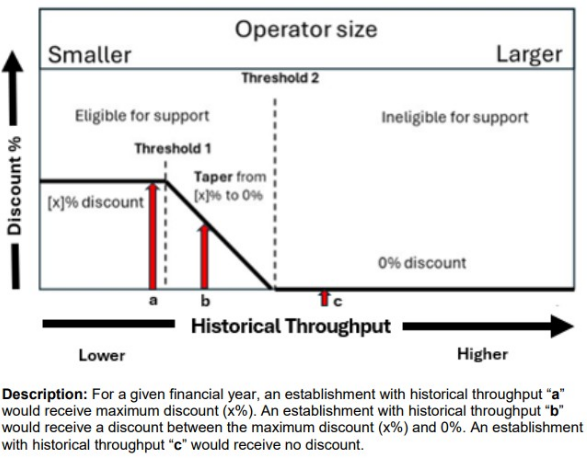
Description: For a given financial year, an establishment with historical throughput "a" would receive maximum discount (x%). An establishment with historical throughput "b" would receive a discount between the maximum discount (x%) and An establishment with historical throughput "c" would receive no discount.
Parameters
Threshold 1 (T1): 1000 livestock units (LSU) (red meat/large game) / 150,000 animals (poultry, lagomorphs, small game) as a proxy for business size (legislative definition of ‘low throughput’).
Discount up to and including Threshold 1 (“x%”): 90%
Threshold 2 (T2): A maximum of 10 times T1 equivalent to 10,000 LSU (red meat/large game), 1,500,000 animals (poultry, lagomorphs, small game) as proxy for business size.
Taper from Threshold 1 (T1) to Threshold 2 (T2): Single percentage determined according to a linear decrease from “x%” (90%) (Threshold 1) down to 0% (Threshold 2)
Throughput calculation: For the purposes of establishing eligibility for and the level of any discount, a three-year rolling average of throughput will be used with alternative approaches for establishments which lack the history for this calculation.
LSU Conversion for red meat / large game
| Species | Proposed Conversion Rate (LSUs) |
|---|---|
| Bovine animals, Equidae | 1 |
| Pigs (including piglets) | 0.2 |
| Sheep and goats (including lambs and kids) | 0.1 |
| Large game | 0.2 |
| Large wild game killed away from the game handling establishment in which it is subsequently processed | 0 |
Note: Small wild game killed away from the game handling establishment in which it is subsequently processed will not be counted towards throughput (in numbers of animals).