Annual National Food Crime Unit report to the FSA Board: December 2026
Updated 26 November 2026
Applies to England, Northern Ireland and Wales

© Crown copyright 2026
This publication is licensed under the terms of the Open Government Licence v3.0 except where otherwise stated. To view this licence, visit nationalarchives.gov.uk/doc/open-government-licence/version/3 or write to the Information Policy Team, The National Archives, Kew, London TW9 4DU, or email: psi@nationalarchives.gov.uk.
Where we have identified any third party copyright information you will need to obtain permission from the copyright holders concerned.
This publication is available at https://www.gov.uk/government/publications/food-standards-agency-december-2026-board-meeting/annual-national-food-crime-unit-report-to-the-fsa-board-december-2026
Report by Junior Johnson and Andrew Quinn
1. Summary
1.1 This report provides an overview of the National Food Crime Unit’s (NFCU’s) performance, activities and achievements between November 2025 and October 2026. This includes progress against the four priority areas set out in the previous annual review and laid out in the structure of this paper.
2. Introduction
2.1 The NFCU has enhanced our investigative capability this year through the continued use of investigatory powers, supporting our ability to disrupt food crime. We have run more simultaneous tasked investigations than ever before, which has presented resourcing challenges.
2.2 We have increased our proactive intelligence gathering to address strategic gaps in our knowledge. This included strengthening intelligence sharing relationships with law enforcement partners, both domestically and internationally.
2.3 Prevention work remains a key focus, with this year seeing record positive media coverage of operational successes and continued support from industry stakeholders.
3. Area 1: Advancing Investigations Through Effective Use of Investigatory Powers
3.1 During this reporting period, the NFCU used our PACE powers 58 times, enabling us to expedite investigation times and reduce demand on external law enforcement resources. Annex A further outlines the powers used.
3.2 These powers have supported the NFCU’s ability to operate at higher levels of demand. As of October 2026, we are managing 20 investigations, 22 intelligence developments and eight financial investigations, which exceeds any previous levels experienced by the NFCU. This follows a 9% increase in incoming intelligence this year, compared to the same period last year.
3.3 Intelligence increases are likely driven by a rising public and regulatory awareness of the role and work of NFCU, growing numbers of intelligence sharing relationships with partners and increased operationally linked intelligence gathering opportunities.
3.4 The increase in operational activity has resulted in measurable impact against food crime, with our highest number of national disruptions[footnote 1] achieved (see Annex B). 54 disruptions were recorded from one operation alone, including product seizures and the disruption of criminal supply chains.
3.5 The growing number of judicial results further demonstrates our impact and contribution to public protection. Annex C outlines results from across the year. Highlights include custodial sentences, a director disqualification and a guilty plea from a leader of an organised crime group.
3.6 Of the current live investigations, four cases are awaiting trial, four are awaiting first court appearances and two are progressing international evidence-gathering requests.
3.7 Throughout the year, our collaborative work with police has resulted in nine arrests across seven NFCU-led investigations. These arrests have contributed to the progression of complex cases, the recovery of key evidence and have protected the public from food crime threats.
4. Area 2: Developing and Enhancing Our Prevention Capabilities
4.1 During 2026, the NFCU delivered 16 face-to-face desktop exercises to 225 participants across industry and trade associations. Compared to last year, this is an increase of 7 desktop exercises to an extra 93 participants. The desktop exercises utilise custom written scenarios to test industry preparedness and to build collective food crime resilience. This work has also helped embed prevention messaging more widely, with businesses increasingly seeking NFCU support and training.
4.2 The NFCU has also conducted activities with industry to raise awareness of emerging food crime risks and encourage earlier industry action to identify and mitigate threats. This was primarily achieved by targeted industry newsletter content and industry alerts.
4.3 The NFCU expanded our media presence, publicising our work and successes for the purpose of deterring future offending. From January 2026 to October 2026, we recorded 135 items of media coverage for food fraud and food crime, with a total readership of 1.6bn. An increased media presence has also created new industry engagement opportunities. Most notably, the NFCU Prevention Team provided expert speakers for the Food Manufacturer Conference.
4.4 A particular media highlight was the Head of the NFCU’s journalist briefing on the seizure of 33 tonnes of illegal food products. The article, published in August 2026 recorded a readership of 6.2m in outlets, which included national trade magazines and newspapers.
5. Area 3: Continued Collaboration with Defra to support their efforts in mitigating risks from illegal meat imports.
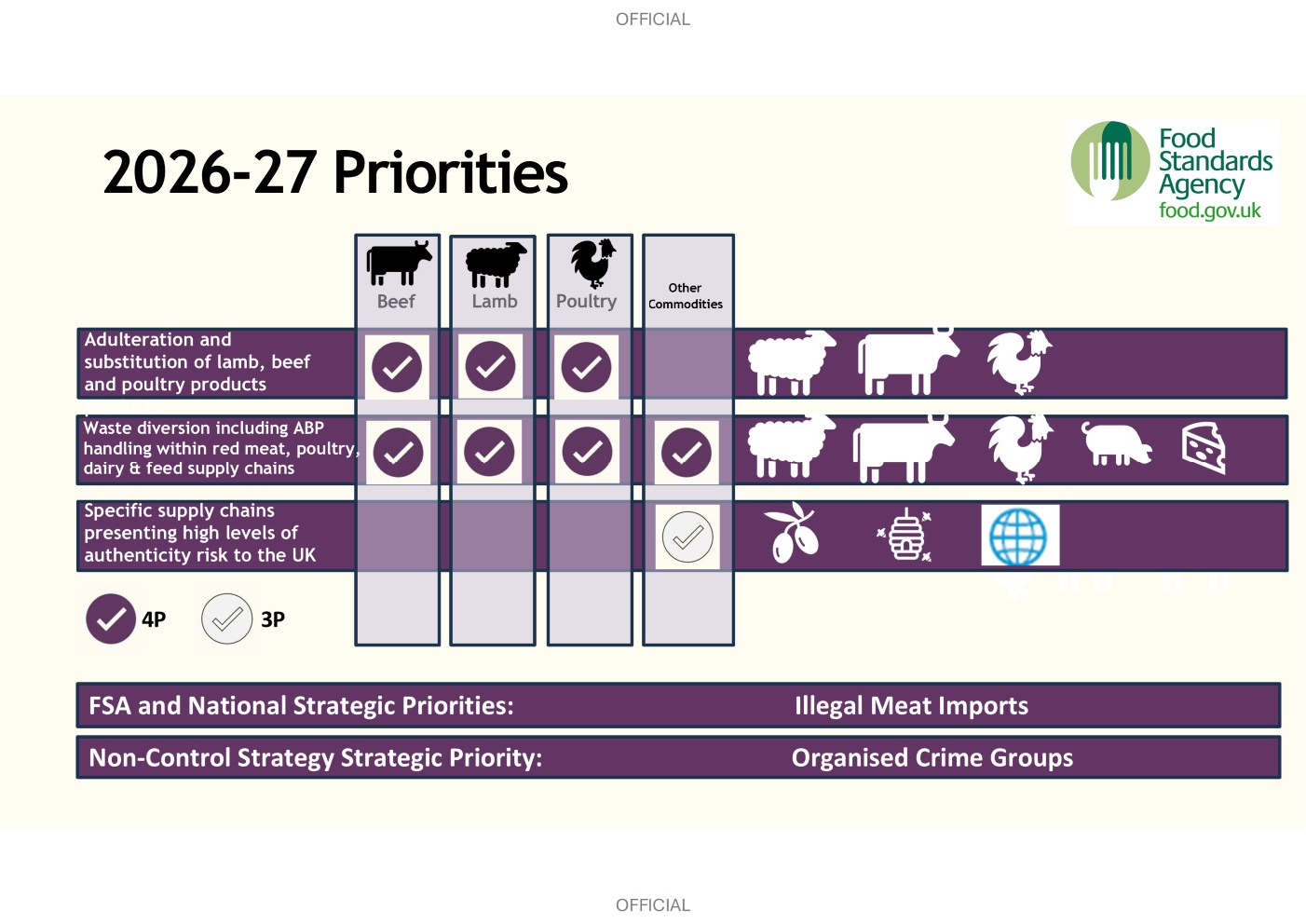
5.1 In our 2026 revised control strategy (Annex D), we stated our ongoing commitment and resourcing for the priority threat of illegal importation of products of animal origin (POAO).
5.2 We have continued to support Defra with their development of a public facing, Action Plan to address this threat. We have attended a round-table event, led by a Defra Minister, to address concerns raised by the Environment, Food and Rural Affairs (EFRA) committee.
5.3 The Action Plan includes actions on a number of key areas in relation to this threat. The NFCU’s experience of managing intelligence has been central to Defra’s proposals in this space.
5.4 Despite continuing limitations in data sharing from key ports, we sought our own opportunities in 2026 to disrupt and deter those who risk UK biosecurity and public health through illegal POAO importation.
5.5 We partnered with inland authorities to develop and share intelligence and participated in days of action to help remove a further 10 tonnes of illegally imported POAO from the food chain this year. This brings the total to 51.2 tonnes, with an estimated value exceeding £0.5 million.
5.6 Additionally, we have engaged with Welsh Government to consider the threat of illegal importation of POAO into Welsh Ports. On 1st October 2026, NFCU Food Crime Officers joined partners at Holyhead port, for a Police-led multi-agency operation. The proactive operation resulted in new intelligence sharing pathways being built, an example set of successful port engagement and the identification of new methods of concealing POAO in drivers’ cabs. 8kg of illegal uncooked pork products from Romania were also seized by the local authority on the day.
5.7 Food safety risks associated with illegal imports have also been identified as part of recent NFCU operational activity. Academic partners have identified pathogens in seized bushmeat that could lead to illness if eaten or through the handling raw meat. These identified risks have led to activities to strengthen operating procedures, protective measures and to improve partner awareness.
5.8 Whilst these activities have reduced public health risks and demonstrated the value of coordinated enforcement action in disrupting illegal supply chains, further joint operations are dependent on inland authority, borders and policing partners resources and appetite for action in this threat area.
5.9 To support UK deterrence activity, the NFCU and the Science Evidence and Research Department (SERD) developed a social science research project to better understand the demand, sales routes and distribution of illegally imported POAO. Defra agreed to jointly fund the FSA-led project in July 2026, with findings expected in 2027.
6. Area 4: Strengthening the Lines of Defence through International and Enforcement Partnerships
6.1 In 2026, the NFCU strengthened our intelligence-sharing networks, contributed to enhancing collective international resilience against food crime and prepared for re-engagement with EU systems.
6.2 Collaborating with the Scottish Food Crime & Incidents Unit (SFCIU), the NFCU worked to raise the profile of food fraud internationally through the provision of a new definition of food fraud for the Codex Alimentarius [footnote 2].
6.3 Our established partnership with the Italy’s Central Inspectorate for Quality Protection and Fraud Repression of Agri-Food Products (ICQRF) and FSS led to a significant (£500,000) seizure of bottles of counterfeit wine and prosecco. It also led to an arrest of a wanted Albanian fugitive, who remains in custody. This NFCU-coordinated work was instigated by intelligence shared through the partnership.
6.4 After this successful operational activity, further steps were taken by the NFCU to raise industry awareness of key counterfeit characteristics to look for via an industry alert. The alert was highlighted by the Prosecco Consortium at Europol’s sixteenth OPSON[footnote 3] meeting, where 28 member countries were represented, as a demonstration of decisive and effective international investigative partnerships.
6.5 The NFCU worked with wider FSA teams and partners, including FSS colleagues, to prepare for the new operational implications from the Sanitary and Phytosanitary (SPS) agreement. The NFCU is leading the FSA reintegration into the Food Fraud Network (FFN), which will enable rapid intelligence sharing and action between the NFCU and our European counterparts. Our preparatory work has stress tested proposed processes to identify risks and gaps. This work will form the foundation for scenario testing in early 2027, to ensure readiness for anticipated increases in intelligence volumes.
6.6 The UK is leading the development of a Global Alliance on Food Crime (GAFC)[footnote 4] intelligence product on a shared threat area, due to be circulated to members in January 2027. To contribute to this work, the Head of the NFCU will visit the USA in November to explore upstream opportunities for food crime disruption with the alliance nations.
6.7 Our international reputation and commitment to partnerships was further evidenced this year when the Swedish Food Authorities approached the Unit to request an inward study trip in 2027. The aim of the trip is to receive guidance and insight to assist in the development of the new Swedish Food Crime capability.
7. Preparing for the Future - Evolving our Capabilities
7.1 The NFCU has been proactively working to anticipate the FSA’s needs in the future. This work has taken two main streams, enhancing operational effectiveness and technology/innovation and data-led approaches.
Enhancing Operational Effectiveness
7.2 Our Control Strategy remains key to the NFCU’s ability to effectively prioritise emerging food crime threats and was refreshed in March 2026 (Annex D). New drivers of food crime were identified from a multidisciplinary analytical exercise and joint horizon scanning products with FSS. Further engagement has been completed with industry around these priorities, and our OPSON sampling has been tailored to help us address strategic gaps in intelligence in areas considered to be presenting the greatest food crime threats to the public.
7.3 One emerging food crime driver that dominated 2026 was the Middle East crisis. In order to understand how this may manifest in food crime and other areas of food safety, the NFCU led a cross government and five nations workshop. Output from this workshop was shared with industry to enable risk management and preparedness via the Food Industry Intelligence Network.
7.4 These insights are informing the development of our Strategic Delivery Plan and the 2027 Food Crime Strategic Assessment, helping to ensure the NFCU remains prepared, resilient and equipped to respond to emerging threats. However, with intelligence volumes continuing to increase and the Unit managing a record number of live investigations, future resources will need to be increasingly focused on the highest-risk and highest-impact activity. This may result in more cases being discontinued, transferred to other agencies or addressed with shorter term disruptions in place of prosecutions.
7.5 To ensure compliance with the new Forensic Science Regulator Code of Practice, the NFCU are working to align procedures and protocols for evidential work in CCTV and communications data with established and accepted quality frameworks and new procedures for engagement with external forensic providers. This work is critical for evidential integrity and for future management of forensic budgets, ensuring that the NFCU can recognise the tasks that can be lawfully completed in-house and those which must be outsourced at a cost.
7.6 The NFCU improved its ways of working by conducting a proactive workshop on our intelligence functions, which led to six new continuous improvement projects and 15 improvement actions. This was alongside 11 other continuous improvement projects tackling process streamlining, refining systems and developing new capabilities to address evolving food crime threats and technological advances.
Technology, Innovation and Data-Led approaches
7.7 The NFCU continued to evolve our use of new technologies to embed efficient ways of working. A staff-led Artificial Intelligence (AI) working group was established within the Unit to assist in the management and escalation of new risks, arising from AI within a sensitive law enforcement environment. The working group has led in testing new AI tools, in partnership with the FSA’s Openness, Data and Digital team (ODD), and exploring how AI could be utilised by criminal networks.
7.8 A key area of opportunity for AI is within our case management system (Clue). The NFCU is currently working with ODD and CLUE to test new AI add-ins that have the potential to reduce the burden of low value administrative tasks and improve the NFCU’s efficiencies in intelligence linking. The NFCU remains alive to the fact that AI adoption carries significant risks in law enforcement settings. Therefore, we remain aligned to both CPS and College of Policing best practice for AI adoption.
7.9 A higher number of investigations has led to increasing demands for digital forensics and the associated costs for operations. The NFCU have signed a Memorandum of Understanding with the National Crime Agency which provides access to 3 separate digital providers. Though this presents a solution to cost efficient digital services, a capability gap remains in digital storage and remote reviewing platforms for seized digital evidence. An interim solution is in place whilst a new procurement process is being finalised for tender to secure our digital capabilities for the mid-term.
7.10 In response to a request by the FSA Board last year, the NFCU is also working with SERD colleagues to explore further what impact NFCU activities have on protecting the public, UK economy and food integrity. Stage 1 was completed in 2026 and focused on the feasibility of the research. Stage 2 will begin in early 2027. The hope is that this will lead to new reporting outputs that the NFCU can utilise in conveying impact of NFCU delivery, in terms that are understandable to the public and comparable year on year.
8. Conclusions
8.1 The NFCU has delivered significant operational and strategic results, recording our highest levels of investigative activity, disruption outcomes, prevention activities and uses of investigatory powers. These results demonstrate the Unit’s growing effectiveness and value in protecting consumers, supporting legitimate businesses and safeguarding the integrity of the UK and global food systems.
8.2 However, the operating environment continues to evolve, with increasing demand, greater investigative complexity, emerging technologies and increasingly international criminal threats. To meet these challenges, the NFCU will maintain our focus on strengthening digital investigation capabilities, enhancing prevention and industry engagement, supporting cross-government action on illegal imports, expanding international intelligence partnerships, and adopting emerging technologies responsibly.
8.3 Through the following priorities, the NFCU aims to continue to deliver an intelligence-led, efficient and value-for-money response to food crime while strengthening its contribution to public protection, consumer confidence and wider food system resilience.
8.4 The NFCU proposes the following focuses for 2027:
- Enhancing prevention activity and industry engagement to create a more hostile environment for food crime and improve resilience across food supply chains.
- Supporting cross-government efforts to tackle illegal imports of Products of Animal Origin (POAO), including contributing to the development of a coordinated national intelligence response.
- Further developing international partnerships and intelligence-sharing arrangements to address increasingly transnational food crime threats and share UK expertise.
- Accelerating the responsible adoption of emerging technologies, including AI, while understanding and mitigating the risks posed by criminal exploitation of those technologies.
- Strengthening digital investigation capabilities through the procurement of a sustainable long-term digital forensics, evidence storage and review solution.
9. Recommendations
9.1 The Board is asked to:
- Note the NFCU’s performance during 2026, including our operational achievements and contribution to public protection.
- Note the NFCU’s role in strengthening international partnerships, including supporting improved intelligence exchange and the sharing of good practice.
- Note the NFCU’s continued focus on prevention activity, including increased media engagement and closer working with industry partners.
- Agree the five areas of NFCU focus for the coming year.
Annex A – Volume of PACE Powers Since Last Board Paper
| PACE power used | Description | volume |
|---|---|---|
| S18 PACE | Power to enter and search premises occupied or controlled by a person under arrest for an indictable offence, to find evidence relating to that offence or similar offences. | 21 |
| S39 PACE | Power relating to the detention of a person who has voluntarily attended a police station and is subsequently arrested when grounds exist for detention. | 17 |
| S9 PACE | Written witness statement provided under Section 9 of the Criminal Justice Act 1967, admissible as evidence if agreed by all parties. | 8 |
| Voluntary Interview | Interview conducted under caution where a person attends voluntarily and is free to leave unless arrested. | 2 |
| Voluntary Surrender | When a person attends a police station or contacts police voluntarily in response to an investigation or request. | 2 |
| S19 PACE | Power for police to seize property found during a lawful search if it is believed to be evidence of an offence or obtained through criminal conduct. | 6 |
| S22 PACE | Power to retain seized property for as long as necessary for use as evidence, forensic examination, investigation, or court proceedings. | 2 |
Annex B – Results Volumes per Calendar year
| National Disruption | NFCU Outcome | |
|---|---|---|
| 2021 | 62 | 76 |
| 2022 | 82 | 56 |
| 2023 | 90 | 82 |
| 2024 | 78 | 203 |
| 2025 | 75 | 183 |
| 2026 | 112 | 140 |
Annex C – NFCU Operational Results by Month
| Timeline | NFCU Operational Results by Month |
|---|---|
| Nov-25 | As part of ongoing operational work into ‘smokies’, an organised crime group member was sentence to 16 months imprisonment, suspended for 18 months, and ordered to complete 250 hours of unpaid work. Simba tablets were seized from another individual linked to an organised crime group. These tablets contained a prescription only drug and were being sold without a license. |
| Dec-25 | 49kg of illegal bushmeat, including endangered species, was seized and an organised crime group member was arrested as part of an NFCU-led operation. A further 100kg was seized later, further disrupting an organised crime group. |
| Jan-26 | A Proceeds Of Crime Act (POCA) confiscation order[footnote 5] was successfully obtained by the NFCU against a member of an organised crime group. The individual was ordered to pay £31,250.51 within 3 months. As part of an NFCU-led investigation into the misrepresentation of fish as premium quality, 4 individuals were charged with conspiracy to commit fraud by false representation. In an NFCU-led investigation, a man was sentenced to 30 months imprisonment and disqualified from being a company director for 7 years for his part in handling stolen poultry products, worth more than £500,000. A member of an organised crime group involved in the production and distribution of ‘smokies’ was charged with money laundering. |
| Feb-26 | £33,000 worth of prohibited pork products was seized by LA partners as part of an NFCU led operation to respond to the threat of African Swine Fever (ASF) entering the human food chain through illegal importations of prohibited pork products. |
| Mar-26 | An individual was arrested on suspicion of importing endangered species into the UK and conspiring to supply unfit meat. A further 11kg of bushmeat was seized and Simba pills. £541,780 of counterfeit wine and prosecco was removed from sale after NFCU-led operational activity with LA partners. An individual was also arrested for conspiracy to defraud as part of this activity. The head of an organised crime group plead guilty to conspiracy to place unfit meat on the market. Confiscation orders were granted against a company and its director who had conspired to place unfit meat on the market. A total of £70,967.26 had to be paid within 3 months by both the company and owner. |
| Apr-26 | The first operational activity began with partners as part of an NFCU-led investigation into fraudulently labelled food products. This operational activity has so far led to £336,403.59 worth of fraudulently labelled food products being removed from the market and an arrest of one suspect. An individual was arrested, suspected of fraud, as part of NFCU’s investigation into the falsification of documents. Arrest of a person in Wales, using custom powers for the illegal importation of POAO, led to the recovery of 70kg of illegally imported POAO and an out of court disposal by the Police for breach of customs offences. |
| May-26 | After a multi-agency operation, coordinated by NFCU, a company was convicted of two charges under the food hygiene regulations and was fined £2000. As part of NFCU’s investigation into the falsification of documents, a further individual was arrested, suspected of fraud. £8000 worth of imported dairy products were detained and disposed of as part of the NFCU’s work around illegal POAO importations. This work also led to a request for intervention being issued to the competent authority in Bulgaria by the UK Chief Veterinary Officer to conduct an investigation in relation to a Bulgarian company. |
| Jun-26 | A company was sentenced after having been found guilty of diverting animal by product into the human food chain and fined £132,000. The company and the director were also ordered to pay £150,000 each in prosecution costs, including those of the NFCU. NFCU funded sampling by a LA was used to convict a kebab company for fraud by false representation. The company were fined £500,000. |
| Jul-26 | Operational activity began, as part of an NFCU led investigation into misrepresentation and document fraud, which to date has resulted in £965 worth of fraudulently labelled food to be removed from sale and an arrest. An NFCU-led multi-agency operation at a Birmingham FBO resulted in four arrests for immigration and illegal working offences and the dismantling of an illegal cutting plant. Investigators uncovered serious hygiene breaches and evidence of Polish chicken being mislabelled as British, with use-by dates extended. Around 4.24 tonnes of food were removed from the supply chain, a Remedial Action Notice was served, and a Food Alert for Action was issued. A subsequent visit led to two further arrests on suspicion of fraud and the detention of an additional 80kg of food. |
| Aug-26 | An NFCU-led investigation into counterfeit wine resulted in an arrest. A £98,000 watch was also seized and approximately £20,000 in cash. 7 members of an organised crime group were charged with several charges under food safety and hygiene regulations, animal cruelty and conspiring to place unsafe food into the market. These charges came about from an NFCU-led investigation into ‘smokies’. An investigation by the District Council supported by NFCU Belfast, led to successful conviction relating to ‘smokies’. The defendant was given 4 charges resulting in a £4,015 fine. |
| Sep-26 | An individual was arrested as part of an NFCU investigation into ‘smokies’ resulting in the identification of an illegal cutting plant where 158kg of illegal meat was voluntarily surrendered by the individual. After the NFCU disseminated intelligence to an LA partner, closure and detention notices were served for a food business found to be selling goats heads and other illegal POAO. These products were seized and detained. |
| Oct-26 | Joint operation with North Wales Police at Holyhead in response to the illegal importation of POAO, led to the seizure of 8kg of illegally imported POAO products concealed inside the cabs of foreign registered HGV’s travelling from Europe to Ireland. |
| Nov-26 | Seven Defendants appeared at Crown Court charged with conspiracy to supply unfit meat and animal cruelty offences. Two of the defendants pleaded guilty. The trial date for the remaining defendants has been set for July 2029. |
| Key Future Dates | 04/01/2027 - second trial as part of an NFCU-led investigation into the diversion of ABP into the human food chain. 18/10/2027 - trial date for an NFCU-led investigation into ‘smokies’. |
Annex D – NFCU 2026/27 Control Strategy
-
National Disruptions are a validated law enforcement framework that measure when the NFCU has had a direct impact on serious, organised food crime relating to UK food supply chains. ↩
-
The international collection of food standards, guidelines and codes of practice developed by the Food and Agriculture Organization of the United Nations (FAO) and the World Health Organization (WHO). Codex standards aim to protect consumer health, ensure fair practices in the food trade, and serve as the global reference point for food safety standards. ↩
-
An annual international enforcement operation coordinated by Europol and INTERPOL that targets food fraud, counterfeit food and beverages, and substandard food products through joint activity involving law enforcement, customs, and food regulatory authorities. ↩
-
An international coalition of food regulatory and enforcement authorities that collaborates to prevent, detect and disrupt food crime through intelligence sharing, joint working and the development of global capability. Founding members include organisations from Australia, Canada, New Zealand, the United Kingdom and the United States. ↩
-
A confiscation order is an order made against a convicted defendant requiring them to pay, to the public purse, the amount they have financially benefited from the convicted crime. ↩