Science performance report 2025/2026: FSA Business Committee
Updated 18 September 2026
Applies to England, Northern Ireland and Wales

© Crown copyright 2026
This publication is licensed under the terms of the Open Government Licence v3.0 except where otherwise stated. To view this licence, visit nationalarchives.gov.uk/doc/open-government-licence/version/3 or write to the Information Policy Team, The National Archives, Kew, London TW9 4DU, or email: psi@nationalarchives.gov.uk.
Where we have identified any third party copyright information you will need to obtain permission from the copyright holders concerned.
This publication is available at https://www.gov.uk/government/publications/food-standards-agency-business-committee-meeting-september-2026/science-performance-report-20252026-fsa-business-committee
1. Summary
1.1 This paper is the first annual Science Performance Report. It provides a summary of metrics associated with the delivery of FSA science, the inputs and outputs and how those outputs are used.
1.2 The Business Committee is asked to:
- review the progress made
- comment on the performance metrics provided
2. Introduction
2.1 Science is a critical enabler to the FSA’s work as a regulator, and our scientific advice underpins the decisions and activities that protect public health. As well as generating new research and evidence as outlined in our areas of research interest (ARI), our science includes risk assessments, incident response and the evaluation of new food and feed products.
2.2 This report is designed to provide evidence of the value of FSA’s ongoing investment in science and how it is being delivered and used.
2.3 As the first of its kind, this report replaces the quarterly updates previously presented to the Business Committee. This reflects the reality that many science performance metrics make more sense when viewed on an annual rather than monthly/quarterly basis.
2.4 The report is designed to focus on science delivery measures, science resourcing (inputs) and scientific outputs. It specifically does not cover science impact and the outcomes that results from science delivery. This is presented in the Annual Science Update to the full FSA Board.
2.5 The report is structured as follows:
- science performance: the inputs and investment made by the FSA, demonstrating how this work is being delivered effectively and efficiently
- publications and engagement: the outputs of our science and research and how they were used
3. Science performance
3.1 The FSA continues to invest in and deliver a strong science programme, maintaining the capability, infrastructure and evidence base needed to support the work of the FSA, now and into the future. Key metrics for FY25/26 are presented below, with full details presented in the annexes.
3.2 Science budget: the science, evidence and research division (SERD) budget was £20.3M, which constitutes over 13% of FSA spend being dedicated to science (as compared to £20.4M for 24/25). Overall, the budget was delivered within tolerance (end of year out turn within 1% of first half forecast, compared with 2% in FY24/25).
3.3 Science staff: in FY25/26 the SERD headcount was 167 FTE, which represents around 10% of the FSA’s total headcount. This is largely stable compared to the previous financial year. We are also maintaining high levels of engagement within our science team. A key metric from the 2025 Civil Service People Survey showed an engagement index score of 70%, above the Civil Service average (64%).
3.4 Research budget: £4.7M was spent on external research (forecast to increase to £5.2M in FY26/27), focused on our highest-priority scientific challenges (as described in the Annual Science Update).
3.5 Research & evidence project delivery: in year, across our 4 research priorities we initiated 38 external projects. We completed 41 research projects, 30 of which started in that year and 11 that had been started in previous years. We started FY26/27 with 23 projects ongoing that were commissioned in FY25/26 or earlier and have a pipeline of new research we will initiate in year.
We have published our ongoing and planned work to increase the awareness of our portfolio of research and enable better collaboration with partners. We also maintain a pipeline of ideas which we can initiate if additional resources materialise. More detail about the distribution of spend and projects across the 4 priorities is in the annex below.
3.6 Risk assessment: in FY25/26 we completed 15 Risk Assessment Evidence Components via our Risk Analysis Process (compared to 19 in FY24/25). Each component is reviewed by the relevant policy team and scored on completeness (did it contain all of the information required for a decision to be made), timeliness (was it provided within the agreed timelines), quality assurance (was it appropriately quality assured for robustness) and fitness for purpose (how fully the evidence met the needs of the policy customer).
In FY25/26 only timeliness and fitness for purpose did not score 100% across all the risk assessment evidence components. The timeliness score for FY25/26 was 87% and was a result of 2 risk assessments being delivered outside of the originally agreed timelines, but this did not affect their usefulness. The overall fit for purpose score was 97% and was the result of one package only scoring 50% (scoring 1 out of 2), due to data gaps in the evidence base to feed into the risk assessment, rather than the quality of the assessment itself.
3.7 Science Advisory Committees (SACs): we hosted and supported 49 meetings of our SACs. We currently have 112 SAC members, and a recruitment is starting in summer 2026 to recruit 23 members to replace 41 members who will be reaching the end of their final term in 2027 and to fill expertise gaps. In the remainder of FY26/27, we will also complete an internal review of all our SACs to consider the outcomes from UK-EU SPS and help us shape how and what the SACs deliver going forward.
3.8 National infrastructure: the FSA continues to invest in the scientific skills and laboratory capabilities required to sustain UK food regulatory science into the future. This includes:
-
maintaining a network of 8 designated NRLs across 6 institutions, with an annual spend of £1.3M. Designated under 5-year contracts, the performance of the NRLs is monitored through a structured review and reporting system. In addition to annual performance reports, each NRL has quarterly performance meetings with the FSA/FSS to review delivery. They are also audited by UKAS, which fulfils our regulatory requirement to ensure NRLs are compliant with Regulation 2017/625
-
supporting the 5 Public Analyst Official Laboratories in England and Wales with grants and training totalling £0.4M. The number of both laboratories and public analysts has remained stable over recent years (no laboratories have shut since 2019). Whilst there is no room for complacency, the proactive efforts of the FSA have helped to create a more robust system to sustain these important national capabilities
3.9 Supporting two fellowships (foodborne disease and toxicology) and 5 PhD studentships (across different food safety and food system related topics).
- in 2025, the FSA also supported three summer food-related internships on the University of York’s Generation Research programme, providing placements for students from under-represented groups to deliver policy relevant research while helping develop the next generation of food scientists
3.10 Sampling: FSA funded sampling provides intelligence and evidence to support regulatory decision making, risk assessments and policy development, while continuing to support Local Authorities and Official Laboratories in England and Wales. In doing so, it also helps maintain critical national surveillance infrastructure (noted above). In FY25/26, an extensive sampling programme with a total expenditure of £5.4 million included:
- delivery of the FSA’s the Retail Surveillance Programme which sampled 845 higher risk products, and, amongst other intelligence, it identified widespread labelling non-compliance in Dubai style chocolate products and goat meat (see Annual Science Update for details)
- supporting 110 Local Authorities across three nations to undertake sampling (largely for food standards) as part of targeted surveillance and official control activities resulting in 2154 samples being taken with a total expenditure of £0.6M
- undertaking 8 research surveys to generate data for use in risk assessments and policy decisions, including on commodity specific risks relating to chemical contaminants and antimicrobial resistance. This work represented a total expenditure of £0.9M. Two surveys have been completed and published, while the remaining 6 from FY25/26 are ongoing
- fulfilling statutory food and feed safety monitoring responsibilities, including regulatory sampling of shellfish and associated waters, radiological monitoring and Trichinella monitoring
- delivery of coordinated reactive sampling and analysis in response to international food safety incidents, such as the cereulide contamination incident affecting infant formula
4. Scientific outputs and engagement
4.1 We continue to ensure that the results of our science and research are published and made accessible to the wider community, and that their usage is monitored.
4.2 To enable this, significant investment has been made over recent years. This has included the development and implementation of our FSA Research and Evidence publications web platform, the use of DOIs to allow publication tracking and the adoption of Altmetrics, as a tool for monitoring the usage of FSA publications. Combined this allows usage and engagement tracking with high granularity.
4.3 Key metrics for our publications and engagement for FY25/26 are presented below, with full details presented in the annexes.
4.4 Research reports: we published 38 research reports which were viewed over 135,000 times with almost 3,000 copies downloaded. Whilst the number of published reports went down from 54 in FY24/25 the views and downloads of those reports went up by 159% and 131%, respectively.
4.5 Risk assessments: we published 33 regulated products safety assessments and risk analysis reports, compared to 80 in FY24/25. We also published 172 rapid risk assessments linked to incidents, an increase of 25 on the previous year. The impact of this work is covered in the Annual Science Update.
4.6 Media uptake: there were 1448 online mentions of FSA research across news, social media, policy and academic sources demonstrating that people are aware of FSA science. This is a 20% decrease from FY24/25 which is indicative of a system-wide change in online and media referencing activity rather than a decline in engagement with, or relevance of, FSA-funded research specifically.
4.7 Policy usage: there have been a total of 32 citations of FSA-published reports (n=6) or FSA-funded research (n=26) in UK and international policies demonstrating that FSA research continues to inform policy discussions. This is a drop of approximately 50% from FY24/25 which, again, is indicative of a global reduction in referencing, not confined to FSA work.
4.8 International reach: 84% of the policy citations were from international sources demonstrating reach beyond the UK.
4.9 Supporting innovation: 43 patent citations were linked to FSA-funded research demonstrating that our investment is supporting wider research, innovation and development. The areas of these patents include food allergy prevention and treatment, nutritional and metabolic health, rapid diagnostic and genomic technologies, microbiology and antimicrobial resistance, cell and tissue engineering, drug development and delivery systems, and data and sequencing technologies.
4.10 FSA Science Newsletter: we continue to publish a regular FSA Science newsletter as a channel for engaging with the wider scientific and food regulatory community. This now has over 3,500 subscribers (a 75% increase on the year before) and the edition from May 2026 can be found here. To subscribe to this and other FSA newsletters, visit this page.
4.11 Science blogs: we published 23 blogs (a 10% increase from the previous year) to make our science more accessible to the public and point them to the detailed research reports if they wanted to learn more.
5. Summary
5.1 This is the first time an annual science performance report has been presented to the Business Committee. In addition to summarising the range of inputs and investments made by the FSA into science across FY25/26, metrics relating to delivery, it also provides measures relating to our scientific outputs and how those have been used.
5.2 This report specifically does not cover the outcomes and impact delivered by FSA science. That is covered in the Annual Science Update, presented to the Board, which should be considered in tandem with this report.
5.3 In presenting this report, the Business Committee is asked to review the progress made and comment on the metrics provided. Given this is the first iteration of this report, feedback on the approach taken and potential improvements for future are welcomed.
Annex 1: distribution of activity across the research priorities
The distribution of our spend in FY25/25 is shown in Figure 1 and our forecast spend for FY26/27 is shown in Figure 2. We changed the structure of our research programmes in FY26/27 hence a direct comparison across the two years is not possible.
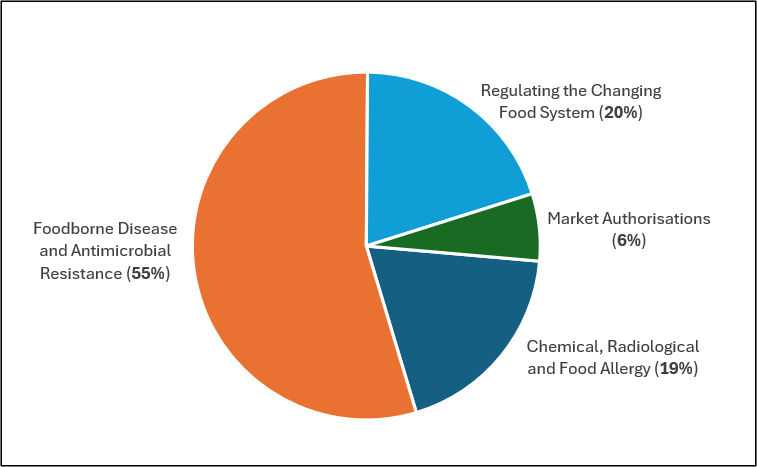
Figure 1: actual external research spend in FY25/26. NB £1.5M of the foodborne disease and antimicrobial resistance spend is on the IID3 project. Note the groupings refer to older groupings of our research priorities
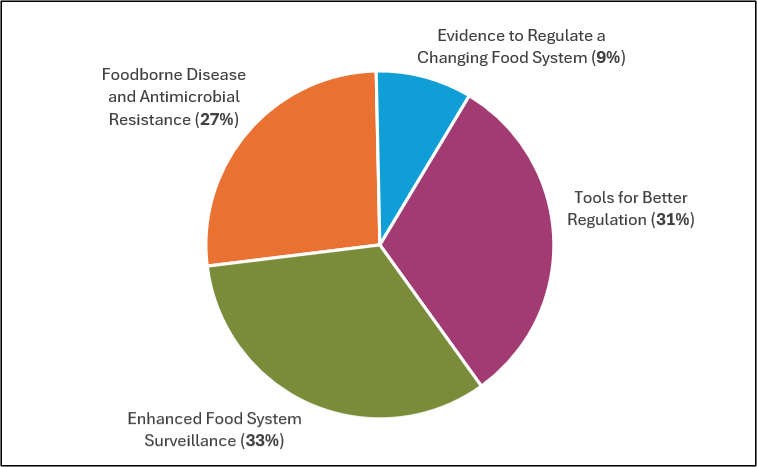
Figure 2: forecast external research spend in FY26/27. NB this refers to the current research priorities
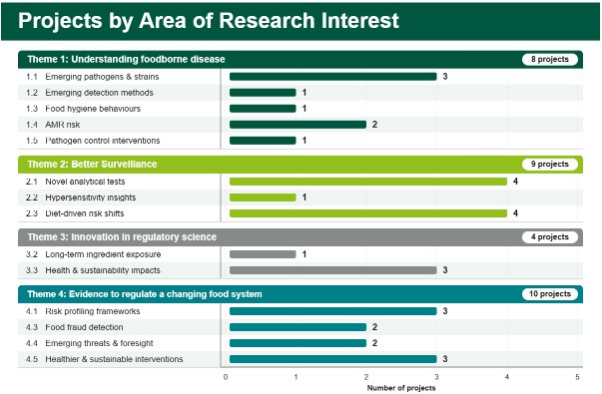
Figure 3 shows how our research portfolio aligns to our published Areas of Research Interest (ARI). Figure 3: distribution of projects across the research priorities
Annex 2: engagement metrics
In FY25/26 we had:
- 275k total views of our science pages on the FSA webpages News and communications - GOV.UK
- 137.1k total views of our research articles on https://science.food.gov.uk/
- 2.9k downloads of our research articles
The top viewed published articles were:
- Safety of Nitrates and Nitrites as Food Additives (4,350 views)
- A Survey of Microbiological and Antimicrobial Resistance (AMR) Contamination Found in Raw Dog and Cat Food on Retail Sale in the UK, published in FSA Research and Evidence (4,091 views)
- Impact of Climate Change on the UK Food System, published in FSA Research and Evidence (2,970 views)
- A Rapid Evidence Review on Consumer Responses to Precision Fermentation, published in FSA Research and Evidence (2,100 views)
The top 10 country of origin of the most viewers in FY25/26:
- Great Britain (59,154 viewers)
- United States of America (15,157 viewers)
- Japan (10,155 viewers)
- Singapore (8,630 viewers)
- Hong Kong (7,199 viewers)
- Mexico (5,728 viewers)
- China (2,565 viewers)
- India (1,996 viewers)
- Denmark (1,693 viewers)
- Brazil (1,452 viewers)
Our most viewed blogs were:
- Uncovering the hidden burden of Infectious Intestinal Disease: early insights from IID3 (469 views)
- Launch of a new survey: E. coli, Campylobacter, Salmonella and antimicrobial-resistant (AMR) bacteria in raw frozen chicken meat on retail sale in the UK (FS900593), published by FSA Research and Evidence (330 views)
- New project: comparison of AMR E. coli isolates from raw pet food at retail with those in livestock, retail meat, imported pet food and human (FS900592), published by FSA Research and Evidence (309 views)
- Launch of a new survey: AMR bacteria in whole head lettuce on sale in supermarket stores within the UK (FS900515), published by FSA Research and Evidence (256 views)
The most frequently mentioned articles (published by the FSA or made possible as a result of FSA collaboration) in the news:
- A Survey of Microbiological and Antimicrobial Resistance (AMR) Contamination Found in Raw Dog and Cat Food on Retail Sale in the UK
- Kitchen Life 2
- Cooking rice in a high water to rice ratio reduces inorganic arsenic content
- Early Predictors of Objectively Measured Physical Activity and Sedentary Behaviour in 8 to 10 Year Old Children: The Gateshead Millennium Study
The most frequently mentioned articles (published by the FSA or made possible as a result of FSA collaboration) in social media:
- A Survey of Microbiological and Antimicrobial Resistance (AMR) Contamination Found in Raw Dog and Cat Food on Retail Sale in the UK
- Management of Refractory Anaphylaxis: An Overview of Current Guidelines - Pouessel - 2024 - Clinical & Experimental Allergy - Wiley Online Library
- FS900350: A Survey of Antimicrobial Resistant E. coli and Listeria monocytogenes in Raw Salmon Fillets on Retail Sale in the UK
- Food additives and hyperactive behaviour in 3-year-old and 8/9-year-old children in the community: a randomised, double-blinded, placebo-controlled trial
Some examples of where FSA funded or supported research has been mentioned in policies (beyond the work of the FSA):
- Impact of Climate Change on the UK Food System, published in FSA Research and Evidence was referenced by the UK Climate Change Committee, the Scottish Government and the Food and Agriculture Organisation of the United Nations
- [ARCHIVED CONTENT] The Future of Animal Feed: Acknowledgements, Food Standards Agency and Trade and dietary preferences can determine micronutrient security in the United Kingdom were also referenced in documents produced by the Food and Agriculture Organisation of the United Nations
- the Scottish Government also referenced The impact of the cost of living crisis and food insecurity on food purchasing behaviours and food preparation practices in people living with obesity
- Defra cited Assessment of the frequency of Mycobacterium bovis shedding in the faeces of naturally and experimentally TB infected cattle
- Teknologirådet (advisers of the Norwegian Parliament and Government on new technology) referenced A Rapid Evidence Review on Consumer Responses to Cell-Cultivated Products, published in FSA Research and Evidence
- Who Needs Epinephrine? Anaphylaxis, Autoinjectors, and Parachutes was cited by the Office of the Federal Register (OFR) in the United States of America
FSA research also supported the REF case studies submitted by universities to demonstrate the impact of academic research. These include:
- the University of Aberdeen submitted the Test-Track-and-Tracing Campylobacter case study, citing the FSA funded IID2 final report. The case study highlights how FSA supported research improved understanding of the sources of Campylobacter infection, informing interventions to reduce foodborne illness and strengthen food safety policy
- the University of Southampton submitted the case study A systems approach to strengthening food security policy.pdf. The case study highlights how FSA investment in research strengthened the evidence base for food security policy, enabling decision makers to better understand and respond to interconnected food system risks
- St George’s University London submitted the case study Early introduction of allergenic foods and the prevention of food.pdf. The case study highlights how FSA investment in research informed evidence based guidance on infant feeding practices, contributing to improved approaches to food allergy prevention and better public health outcome
Annex 3: list of publications and views (research projects and risk assessments)
The 38 research projects published in FY25-26 (in order of the most attention they received) were: