Animal feed report: FSA Business Committee
Updated 18 September 2026
Applies to England, Northern Ireland and Wales

© Crown copyright 2026
This publication is licensed under the terms of the Open Government Licence v3.0 except where otherwise stated. To view this licence, visit nationalarchives.gov.uk/doc/open-government-licence/version/3 or write to the Information Policy Team, The National Archives, Kew, London TW9 4DU, or email: psi@nationalarchives.gov.uk.
Where we have identified any third party copyright information you will need to obtain permission from the copyright holders concerned.
This publication is available at https://www.gov.uk/government/publications/food-standards-agency-business-committee-meeting-september-2026/animal-feed-report-fsa-business-committee
1. Summary
1.1 The Business Committee is invited to note and discuss FSA performance information for animal feed policy, covering data from June 2025 to the end of June 2026.
2. Introduction
2.1 This paper provides an update on the operational delivery of animal feed policy across three core areas: market authorisations, incidents, and the delivery of official controls.
2.2 Since the previous report in 2025, the operating environment has changed. Priorities have shifted from the transition and implementation of market authorisation reforms to focusing on the smooth implementation of the UK Government’s plans for a UK-EU Sanitary and Phytosanitary (SPS) Agreement. We are responding to the uncertainty this has created for industry stakeholders.
2.3 Regulatory reforms introduced in April 2025 have been embedded, and the issues raised by industry relating to the launch of the GB Register of Feed Additives in 2025 have been resolved. However, feed trade associations continue to raise strong concerns about the time taken for new feed additives to reach the GB market, and the impact this has had, and continues to have, on the sector.
2.4 The FSA has continued to coordinate risk management responses to animal feed incidents, which have seen an increase since the 2024/25 reporting period. This increase is largely attributable to repeated issues at a single business, and to the enhanced surveillance and assurance activity from industry.
2.5 Delivery of official controls for feed remains a key priority. English and Welsh local authorities have delivered 96.1% of planned interventions, collecting 613 feed samples for analysis and undertaking 469 imported feed consignments. During 2025-26, there has also been coordinated action through the National Agriculture Panel (NAP) on risks associated with the raw pet food (RPF) sector, alongside consumer communications and research to support the reduction of food-borne disease.
3. Evidence and discussion
Service delivery: market authorisation of animal feed additives
3.1 Since the GB Market Authorisation Service was established, we have authorised 49 animal feed additives for use on the GB market. There are currently 163 applications in our service awaiting authorisation.
3.2 Market authorisations are impacted by the FSA’s work to prepare for the proposed SPS Agreement; a substantive update on the Agreement, including its implications for market authorisations, is being brought to the FSA Board this September. The FSA has been engaging with stakeholders to communicate anticipated legislative changes, to enable both industry and regulators to plan and prepare. We are committed to continuing to keep stakeholders informed as plans for an SPS Agreement take shape.
3.3 The UK and the EU have committed to negotiate an SPS Agreement that is based on dynamic alignment of relevant rules on food and feed. Whilst we do not yet know the outcome of negotiations, dynamic alignment in relation to feed additives would mean that once the Agreement comes into force, authorisations made by the FSA and Food Standards Scotland (FSS) will cease to have effect, and authorisations made by the EU will apply. Businesses would no longer apply to the FSA for authorisations and would instead need to apply under EU legislation.
3.4 Against this background, the FSA and FSS have adopted principles for prioritisation of market authorisation applications. In March 2026 we wrote to all businesses with applications in the Market Authorisation Service, and GB current authorisation holders, to inform them of the proposed SPS Agreement, the potential impact on market authorisations, and the prioritisation principles, which will be kept under review as SPS negotiations progress.
3.5 Under the current principles, applications are prioritised if there is a potential food or feed safety risk which needs to be addressed; if they are within government priority sectors for innovation and growth (cell-cultivated products, precision fermentation and precision breeding); or if they are very near the end of the process (particularly those on which we have already consulted publicly). Whilst the FSA has recently published a number of feed additive safety assessments, feed additives are not within the government priority areas for innovation and growth, and there are currently no feed additive applications at the consultation stage of risk management. The FSA is taking forward work relating to a potential safety concern associated with an authorised feed additive.
3.6 The FSA continues to review evidence relating to potential safety concerns associated with authorised feed additives and, where appropriate, take proportionate regulatory action. As a result of this work, Patent Blue V has been subject to review and, due to insufficient information to support its continued authorisation, a consultation was launched in July 2026 for its proposed removal.
3.7 We have advised all authorisation holders and applicants to start to prepare now for the SPS Agreement and to consider making an application to the EU if they have not already done so. Following the letters sent in March, we held a series of drop-in sessions for applicants. We also held roundtable discussions for trade associations with an interest in market authorisations. We will continue to update trade associations and market authorisation applicants when we are able.
3.8 The feed industry has expressed broad support for an SPS Agreement during roundtables, follow-up engagement, and correspondence sent to the FSA. They have highlighted that transition periods are important where there is divergence between GB and EU additive authorisations.
3.9 However, trade associations and some applicants have also expressed strong concerns about:
- the FSA’s current prioritisation approach to the market authorisation caseload of feed additive applications (in particular, for applications that have received a favourable safety assessment), and the impact this has on the progression of applications through to authorisation
- the uncertainty this creates for business planning and investment. The feed industry has pressed for an interim solution pending implementation of any Agreement
- the impact of secondary and implementing legislation changes and what these changes mean in practice
- the proposal for EU alignment where it could potentially slow innovation and restrict GB only products. However, the industry has also called for a mechanism for early alignment where products are already authorised by the EU to support business readiness ahead of implementation of the Agreement
3.10 These issues will be addressed in more detail in the FSA Board paper on the SPS Agreement.
Animal feed trials
3.11 Feed additives that are not authorised may be used for scientific trials, subject to an application submitted to the FSA, and ministerial approval. In Northern Ireland, the responsibility for approving animal feed trials rests with the FSA.
3.12 During this reporting period, six applications for animal feed trials were received across the UK. Five applications were received by England, and one by Northern Ireland (NI). Of the applications received by England, two have received ministerial approval. One application was withdrawn by the applicant, one is paused pending the provision of additional information, and one is currently undergoing risk assessment. The application received by NI is also currently undergoing risk assessment.
GB Register of feed additives
3.13 The GB Register of Feed Additives is now fully established as the official source of information on authorised feed additive products. The register continues to be maintained jointly by the FSA and FSS to ensure it accurately reflects ministerial decisions on authorisations.
3.14 Since the 2025 report there has been a shift from initial implementation to ongoing maintenance:
- a number of updates and corrections have been made to the register
- processes for maintaining and updating entries have been strengthened
- engagement with industry has improved transparency around changes
3.15 At the time of the previous update, a number of issues had been identified, requiring significant engagement and collaboration between the FSA and industry stakeholders to understand and address the concerns raised. The issues raised have now all been resolved, and included:
- missing or incorrect entries
- duplicate records
- invalidated applications
3.16 The use of sodium hydroxide as a feed additive (primarily used in the pet food sector), remained an outstanding issue following the September 2025 Business Committee. This renewal application was originally invalidated because a complete dossier had not been submitted. However, this issue has since been resolved, and the additive has been reinstated on the register.
3.17 We have continued to check the statuses of all additives on the register and any further issues identified (or raised by industry) have been addressed through targeted reviews and updates to the register where necessary.
3.18 We are working on the assumption that dynamic alignment with EU rules will mean that GB will revert to using the EU Register of Feed Additives as the primary source of information on authorised feed additives following implementation of the SPS Agreement. This would mean that the GB Register of Feed Additives will remain accessible for reference purposes only.
GB Register of Feed Materials
3.19 The GB Register of Feed Materials is owned and maintained by the UK Feed Chain Task Force (UKFCTF), a cross-industry group of UK feed trade associations.
3.20 Under assimilated legislation, Feed Business Operators (FeBOs) placing a feed material on the market for the first time, (where that material is not listed in the Catalogue of Feed Materials) are required to notify its use to the representatives of the feed business sectors in GB. In practice, these notifications are made through the UKFCTF who assess each entry for suitability. Whilst there is no statutory requirement to maintain the register, it is established practice to publish this information to support transparency and provide feed businesses and other stakeholders with information on feed materials placed on the market in GB. There is an equivalent register of feed materials in the EU.
3.21 FSA feed policy teams are now focusing on supporting industry to improve the accuracy and reliability of the register, recognising its importance as a source of information for businesses, enforcement bodies and other stakeholders. This work includes reviewing notifications to ensure products are correctly classified, meet the legal definition of a feed material, and do not fall within other regulatory regimes (such as feed additives). Initial reviews have begun, focusing on a first tranche of entries to test and embed the process.
3.22 Subject to the outcome of SPS negotiations, we are working on the assumption that there will be a transition towards direct notification by GB businesses to the EU Register of Feed Materials. UKFCTF is working closely with its EU counterparts (via FEFAC) to consider the practical arrangements for migrating GB-specific entries to the EU register.
Animal feed incidents
3.23 The FSA continues to play a critical role in delivering the risk management response to animal feed incidents, to protect consumer and animal health.
3.24 Ninety-seven feed incidents were reported between April 2025 and March 2026, compared with 74 incidents reported over the same period last year. This increase should be viewed in context. Thirteen of the reported incidents related to a single business and were identified through ongoing enhanced regulatory interventions, following repeated failures at border and follow-up checks. Another business was linked to three incidents. The spike in incident numbers can be attributed to these incidents across the reporting period. In addition, enhanced surveillance and assurance activity by industry and competent authorities following the FSA’s RPF survey further contributed to increased incident occurrences. This is a positive indication that the system is shifting focus to preventative approaches, enhancing supply chain assurance activity, with a view to reducing system vulnerabilities and risks over the medium to longer term.
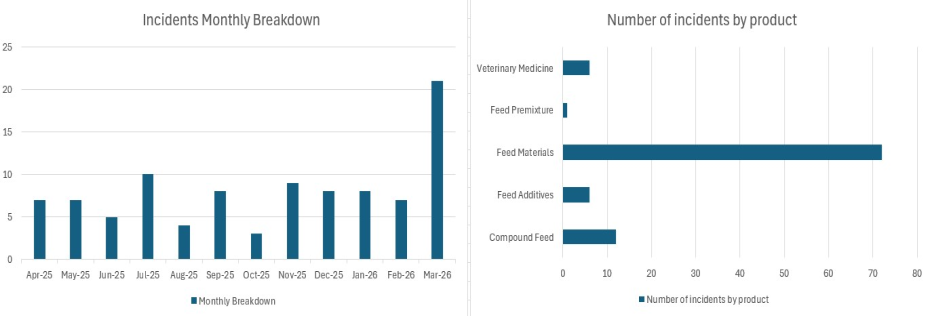
3.25 Of those incidents recorded for this reporting period, 72 related to feed materials, with a smaller number involving feed additives (6 incidents). The remaining incidents consisted of veterinary medicines notified by the Veterinary Medicines Directorate (VMD), compound feed and feed premixtures. A breakdown has been provided in Annex A.
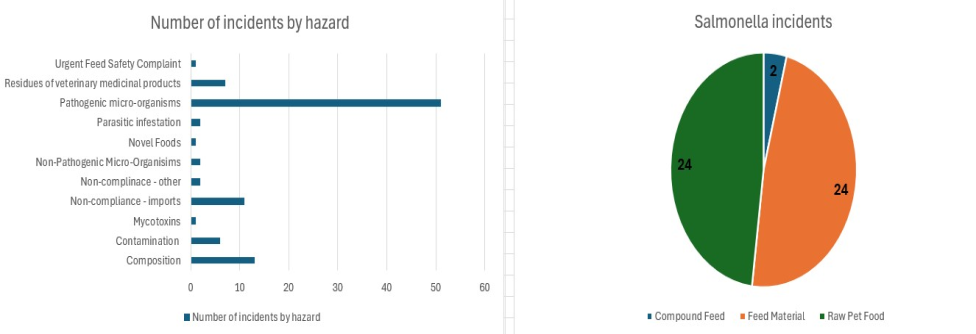
3.26 Pathogenic micro-organisms were the predominant hazard, accounting for 51 incidents (Annex B). Of these, salmonella was overwhelmingly responsible (50 incidents), representing 51% of all reported incident cases. Salmonella risks were primarily associated with RPF (25% of incidents) and feed materials (25% of incidents).
3.27 There was one non-routine feed incident within the reporting period involving waste cake dough processed into animal feed. The incident was considered significant due to the suspected presence of Clostridium botulinum toxin, which contributed to illness in cattle and resulted in the death of approximately 700 animals. The material was supplied to an animal feed business in the Midlands and subsequently distributed to dairy farms in England and Wales. Farms and feed businesses supplied with the affected feed were contacted and advised to dispose of the product through authorised routes. A lessons-learned workshop will be held with industry representatives to identify what worked well and where improvements can be made.
3.28 The FSA is working with industry and enforcement authorities to strengthen incident prevention, reporting, and root cause analysis. As a result, there may be a short-term increase in notifications as risks are more effectively identified and reported. This would be an expected outcome of targeted efforts to strengthen the feed system and reduce risks over the longer term.
Delivery of official controls
3.29 Background on the delivery of official controls was set out in the September 2025 Business Committee Report. Feed enforcement arrangements differ across the UK. In England and Wales, official feed controls are delivered by local authorities through the Feed Delivery Programme (FDP), which is funded by the FSA. This supports coordinated, risk-based delivery of inspections, sampling and imported feed checks.
3.30 Since its introduction in 2014, the FDP has strengthened engagement between the FSA and local authorities (LAs) and improved both the targeting and delivery of official controls. In 2024-25, English and Welsh local authorities fully delivered planned intervention levels and increased both feed sampling and imported feed consignment checks compared with the previous year. In NI, feed enforcement is the responsibility of DAERA, while in Scotland, responsibility sits with FSS.
3.31 The annual LA performance report, to be considered at the FSA Board meeting in September 2026, includes summary information on the delivery of feed official controls (table at Annex C).
3.32 In 2025-26, English and Welsh LAs delivered 96.1% of planned interventions. In addition to this, LAs took 613 feed samples for analysis and checked 469 consignments of imported feed.
3.33 The National Agriculture Panel (NAP) is a UK wide forum that brings together LA regional feed leads, the FSA, FSS, National Trading Standards (NTS), Animal and Plant Health Agency (APHA), VMD, and Public Analysts. It provides a single national route for coordination on agricultural and feed official controls.
3.34 Over the past year, engagement with NAP has focused on managing the concerns raised by LAs in relation to the complexity of the regulatory landscape for the enforcement of RPF, and the practical challenges this creates for local officers overseeing an expanding sector where the risk of cross-contamination is much higher.
3.35 NAP have asked the FSA and the APHA (who are responsible for inspection and approval of premises where animal by-products are produced) to look at a number of issues of concern. This includes the availability of guidance for LAs and businesses, responding to adverse sampling results and minimising the risk of microbiological contamination during the production process.
3.36 The FSA is working closely with government, industry and enforcement partners to provide greater clarity and consistency for local authorities, while enabling businesses to meet their obligations. Alongside this, the FSA continues to reiterate messaging to pet owners who use RPF to encourage safe handling practices. As discussed at the March Board meeting, evidence suggests that consumer behaviours such as poor domestic food handling and cross-contamination and the increased market for and handling of RPFs may be contributory factors to an increase in human cases of illness.
3.37 Consumer research has been commissioned to provide a more detailed understanding of consumer behaviours in the home, enabling advice and communications to be better targeted. This work will contribute to broader efforts to reduce the incidence of food-borne disease.
4. Conclusions
4.1 The Business Committee is invited to note and discuss this performance and service delivery update with particular attention to operational developments and steps taken by the FSA to address current industry concerns.
4.2 The FSA will continue to stay abreast of emerging issues monitoring market trends, and maintaining active surveillance through established networks with industry stakeholders and independent experts, including the Advisory Committee on Animal Feedingstuffs (ACAF).
Annex A: breakdown of animal feed incidents by month and product type
Annex B: breakdown of animal feed incidents by hazard and salmonella incidents
Annex C: planned and completed feed official controls in England and Wales
| England and Wales planned and completed official controls | Number of establishments 2025-26 | 2023-24 planned | 2023-24 completed | 2023-24 % | 2024-25 planned | 2024-25 completed | 2024-25 % | 2025-26 planned | 2025-26 completed | 2025-26 complete % |
|---|---|---|---|---|---|---|---|---|---|---|
| Feed manufacturer | 633 | 193 | 204 | 105.7 | 203 | 199 | 98.0 | 188 | 177 | 94.1 |
| Pet food manufacturer | 981 | 340 | 340 | 100.0 | 360 | 367 | 101.9 | 338 | 292 | 86.4 |
| Mobile mixer | 42 | 15 | 18 | 120.0 | 16 | 18 | 112.5 | 10 | 6 | 60.0 |
| Importers | 143 | 33 | 35 | 106.1 | 36 | 33 | 91.7 | 40 | 28 | 70.0 |
| Co product producer | 1,340 | 411 | 380 | 92.5 | 417 | 384 | 92.1 | 382 | 348 | 91.1 |
| Stores | 871 | 95 | 92 | 96.8 | 85 | 84 | 98.8 | 92 | 82 | 89.1 |
| Transporter | 1,676 | 155 | 158 | 101.9 | 125 | 112 | 89.6 | 136 | 138 | 101.5 |
| Supplier of feed materials / surplus food | 5,968 | 777 | 766 | 98.6 | 842 | 859 | 102.0 | 797 | 786 | 98.6 |
| On farm mixer | 10,580 | 735 | 786 | 106.9 | 633 | 632 | 99.8 | 651 | 683 | 104.9 |
| Distributor | 2,081 | 281 | 276 | 98.2 | 341 | 340 | 99.7 | 274 | 289 | 105.5 |
| Livestock farms | 105,498 | 2,163 | 2,505 | 115.8 | 2,204 | 2,265 | 102.8 | 2,346 | 2,246 | 95.7 |
| Arable farms | 11,994 | 301 | 272 | 90.4 | 250 | 245 | 98.0 | 115 | 84 | 73.0 |
| Total | 141,807 | 5,499 | 5,832 | 106.1 | 5,512 | 5,538 | 100.5 | 5,369 | 5,159 | 96.1 |