
Contamination Detection: DNA Elimination Samples (accessible)
Published 20 February 2026
Applies to England and Wales

© Crown copyright 2026
This publication is licensed under the terms of the Open Government Licence v3.0 except where otherwise stated. To view this licence, visit nationalarchives.gov.uk/doc/open-government-licence/version/3 or write to the Information Policy Team, The National Archives, Kew, London TW9 4DU, or email: psi@nationalarchives.gov.uk.
Where we have identified any third party copyright information you will need to obtain permission from the copyright holders concerned.
This publication is available at https://www.gov.uk/government/publications/contamination-detection-dna-elimination-samples-fsr-gui-0019/contamination-detection-dna-elimination-samples-accessible
Issue 1
Publication date February 2026
This document is issued by the Forensic Science Regulator in line with Section 9(1) of the Forensic Science Regulator Act 2021.
© Crown Copyright 2026
The text in this document (excluding the Forensic Science Regulator’s logo, any other logo, and material quoted from other sources) may be reproduced free of charge in any format or medium providing it is reproduced accurately and not used in a misleading context. The material must be acknowledged as Crown copyright and its title specified.
This document is not subject to the Open Government Licence.
1. Introduction
1.1.1 It is recognised that DNA contamination incidents cannot be eliminated completely, given the prevalence of human DNA within the living, and working environment. Contamination is managed through a combination of prevention, by minimising the opportunities for contamination to occur, followed by detection, in the event contamination does occur.
1.1.2 Detection of inadvertent contamination primarily involves comparison of DNA profiles generated against a database of reference DNA profiles from personnel from whom there is a significant risk of contamination, known as an elimination database. The two main elimination databases in use are the Contamination Elimination Database (CED) held and managed within the Forensic Information Databases Service (FINDS) [1] and the Staff Elimination Database (SED) held and managed locally usually by Forensic Science Providers (FSP).
1.1.3 The focus of this document is to provide guidance to forces, FSPs, Sexual Assault Referral Centres (SARCs) and manufacturers to enable them to:
a. understand the purpose, the use and operation of the CED and SEDs,
b. determine roles that pose a significant risk of DNA contamination,
c. identify the appropriate elimination database to use,
d. determine the service provision required from their local SED operator,
e. understand the recommended elimination database management for SARCs, and
f. determine the role and support of the force to the SARC for contamination investigations.
2. Risk Assessment considerations based on Activities for inclusion onto Elimination Database
2.1.1 Forensic units or facilities need to determine if identification of potential contamination by an individual should be managed using an elimination
database or by other means. It may not be proportionate or appropriate for the risk that they pose to include every individual on an elimination database.
2.1.2 To understand the best approach for managing staff, contractors, and visitors, it is recommended that forensic units and facilities utilise a risk assessment to evaluate the risk that each of them pose to the evidential chain.
2.1.3 Considerations for the risk assessment could include (but not be limited to):
a. what activity if being carried out (maintenance; casework recovery/testing; validation),
b. what equipment or facility area the activity is being carried out on/in (air flow systems/CSI equipment, etc.),
c. the frequency that the activity is carried out,
d. the proximity (direct or indirect) to the evidential material/consumables or area where evidential analysis/recovery is conducted,
e. other areas where the individual also carries out their activities (for example, do they span both custody and public/victim contact; video interview rooms, etc.), and
f. mitigations already in place (PPE; traceability; access control, etc.).
2.1.4 It is expected that units or facilities also have a process for the risk assessment of critical points of contamination for activities and this will assist with the decision and likelihood that casework may be affected and ensure that, if it is affected, it will be possible to identify the contamination via an elimination process to rule the individual out.
2.1.5 Elimination processes can include:
a. elimination databases (national or local),
b. elimination reference sample, and
c. contact details to request an elimination reference sample at the point that contamination is suspected and can be traced to that activity.
2.1.6 For example, for an individual whose role means that they frequently comes into close proximity with the recovery of evidential material, it would not be
suitable to manage just using an elimination reference sample as that sample is for a single point in time and likely to only relate to one case. This is likely to increase costs and time for completion of consent/ sample and analysis multiple times.
2.1.7 Taking contact details or a reference sample from a contractor completing infrequent maintenance on equipment used during recovery of evidential material may be more suitable provided:
a. mitigations already in place to allow traceability of that contractor within a defined period of time after the equipment was put back in use,
b. barrier PPE is used to reduce the chance of contamination whilst the maintenance activity is being carried out, and
c. the risk that the equipment later comes into direct contact with evidential material ahead of recovery is negligible and if it does, is also traceable with case notes upon investigation.
3. Standards and Guidance
3.1.1 Requirements for contamination avoidance, monitoring and detection are set out in section 23.3 of the Forensic Science Regulator Code of Practice [2].
3.1.2 Policy, responsibilities, processes and considerations for the relevant stakeholder organisations, practitioners and elimination database operators are set out in ‘DNA contamination detection The management and use of staff elimination DNA databases’ [3].
3.1.3 Reinforcement of the requirements to be included on elimination databases is set out in separate guidance for scene investigators [4], forensic healthcare practitioners) [5], [6] and laboratory staff [7].
3.1.4 FSR requirements are reflected in the responsibilities and operation of the CED set out in the ‘Forensic Information Databases Service (FINDS): Policy for the Management of the Contamination Elimination Database (CED)’ [8]. All Law Enforcement Agencies (LEAs), SARCs (non-law enforcement) and forensic Science Service Providers (FSPs) have access to this policy.
4. Purpose and Use of the CED and SEDs
4.1.1 DNA elimination databases are necessary to identify potential contamination from staff and key personnel involved in the DNA supply chain to prevent loading to the National DNA Database (NDNAD) as a crime stain, as it is not relevant data for the purposes of the NDNAD and if not detected could use valuable police investigation time.
4.1.2 SEDs are held, operated, and maintained by FSPs providing forensic DNA analysis for the CJS. The FSP SED is primarily for the FSP to identify potential contamination from their staff and avoid loading these profiles to the National DNA Database (NDNAD). This aligns with meeting the accreditation standard ISO 17025 [9] for not releasing non-conforming results, with a similar requirement for ISO 17020 [10] and ISO 15189 [11]. The FSPs have some capability to investigate certain types of mixtures and check DNA environmental monitoring sample profiles against specified staff profiles.
4.1.3 The CED as it currently operates automatically checks all newly loaded crime stains against all CED profile data held; it cannot proactively check for contamination to prevent loading, nor deal with mixtures. FINDS are able to check sample profiles obtained from environmental monitoring on request. Slightly different processes for checking environmental sample profiles from SARCs and laboratory/ examination units is detailed in FINDS-P-009 Policy for the Management of the Contamination Elimination Database (CED) [8].
4.1.4 The FSPs have different procedures for operation of the SED and investigating matches. As a result of the differing capabilities of these elimination databases, it may be necessary for staff to be on both databases, for example, a sample held on CED for checking against crime stain profiles loaded and SED for restricted environmental monitoring sample profile checks.
4.1.5 It is the responsibility of each LEA, SARC, forensic units and FSP to maintain a record of DNA samples submitted for inclusion on the SED and CED as the
donor information is anonymised for submission to the FSP for profiling and by the FSP for inclusion on the SED and/or CED. LEAs, supporting agencies, SARCs and FSPs are responsible for ensuring that all samples and data are retained according to the retention guidelines and the Data Protection Act 2018 [12] .
5. Staff Elimination Database (SED)
5.1.1 All DNA profiles including partial profiles and simple mixture profiles obtained from casework items by an FSP are checked as a minimum against their staff and manufacturer DNA profiles held on their locally managed SEDs.
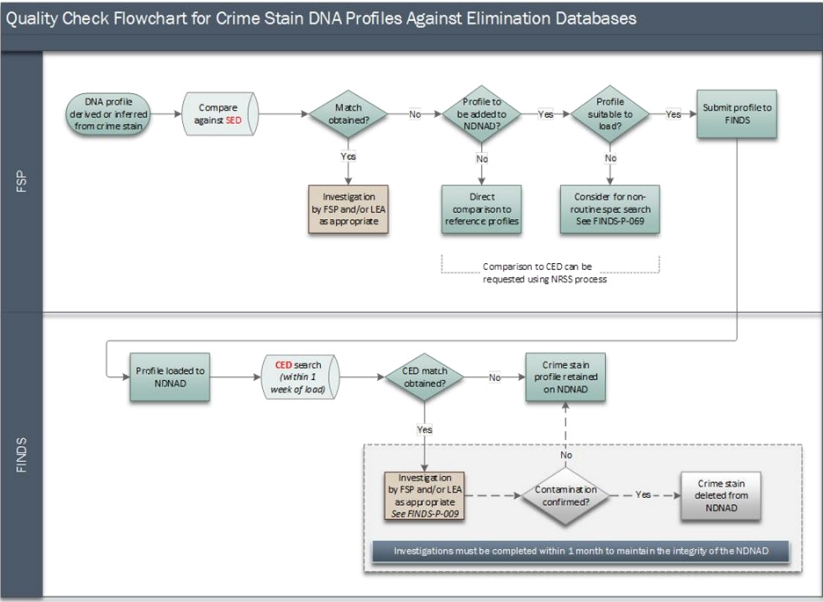
5.1.2 A casework profile search against an FSP SED is a proactive search that prevents the loading of profiles to the NDNAD that could be from possible contamination events. Those profiles that generate a match against a SED profile are suspended (embargoed) and the matches sent for investigation to determine the appropriate action and follow up.
5.1.3 DNA profiles meeting the requirements to load to the NDNAD that do not match a SED profile are automatically submitted.
5.1.4 The criteria to enable a profile to be searched against a locally held SED may be less than that permitted for searching of the CED allowing for partial profiles and profiles derived from simple mixtures (e.g. 2 person major/minor mixture to be searched. The volume of profiles held on a SED will be lower than those contained on the CED and therefore has the ability to eliminate or source partial profiles.
5.1.5 FSPs who maintain a SED on behalf of the LEA or SARC will be able to compare DNA profiles from the LEA’s casework, reference samples, batch testing and environmental monitoring against the LEA managed SED.
5.1.6 The retention and use of profiles retained on a SED should be agreed locally and overseen by the submitting organisation (e.g. LEA). If the LEA uses more than one DNA profiling organisation, then appropriate SED profiles are required by each FSP [3]]. SARC staff profiles provided for environmental
monitoring purposes only are not checked against crime stain profiles, such checks are conducted through the CED.
5.2 SED Inclusion
5.2.1 Staff that fall into the categories below, who routinely pose a significant risk of contamination throughout the end to end process, (locating, collecting, handling and analysis of DNA) should provide a DNA sample for inclusion on the SED [3], [4], [5], [7].
5.2.2 Staff should be considered using a risk-based approach for inclusion; as a minimum anyone who has direct contact with an exhibit where there is potential for DNA to be relevant to the case, the outside of those exhibit bags or access to areas where item examination is in progress should be included. Consideration should include the following:
a. laboratory staff (both DNA and non-DNA related screening/evidence recovery staff, exhibit, and storage handlers),
b. LEA staff (e.g. laboratory staff, both DNA and non-DNA related screening/evidence recovery staff and incident scene examiners, exhibit and storage handlers as appropriate),
c. Sexual Assault Referral Centre (SARC) staff (e.g. medical healthcare practitioners, crisis workers),
d. maintenance staff (e.g. cleaning staff),
e. visitors entering DNA clean areas (e.g. contractors, defence examiners,
UKAS assessors), and
f. any key personnel who will not consent to a sample for inclusion on the CED (e.g. students, work experience, vehicle recovery, fire brigade, collision investigators and couriers).
5.2.3 In addition to staff profiles held, the SED should include unsourced DNA profiles believed to originate from the consumable supply chain, this process is managed by the FSPs and FINDS
5.3 Contamination Elimination Database (CED)
5.3.1 The Contamination Elimination Database (CED) is held within FINDS and contains reference profiles primarily from individuals who work within the DNA supply chain from LEA organisations, SARCs and manufacturers of consumables.
5.3.2 All DNA profiles generated from casework items that meet the load criteria are loaded as single source profiles to the NDNAD as above. A search against the CED is currently a reactive search therefore profiles that are from possible contamination events and have not been identified through the SED may be loaded to the NDNAD, and subject of a search against all other profiles held on the NDNAD on load.
5.3.3 All newly loaded profiles are searched weekly against all the profiles held on the CED, i.e. there is currently no restriction to filter searches against individual LEAs. Any matches are reported to the CED profile owning force/organisation to investigate, which should include root cause analysis, feedback and instructions on whether to delete the profile from the NDNAD.
5.3.4 A non-routine speculative search against the CED is also possible, see section 8.5 of FINDS-P-009 [8]. A profile held on the CED may be released to an FSP for direct comparison against casework providing specific criteria is met, see section 9 of FINDS-P-009 [8],
5.3.5 Staff who have routinely posed a significant risk of contamination for a period of time prior to providing an elimination sample should be retrospectively searched against profiles held on the NDNAD (i.e. purge) to identify potential contamination in previous cases. This would need to be requested at the time of submission to FINDS-DNA.
CED Inclusion
5.3.6 Staff who should be considered for inclusion on the CED include:
a. police officers (mandatory), [13], [14],
b. police staff, laboratory and incident scene examiners (ideally inclusion on SEDs until the CED has similar search functions as SED for partial and mixture casework profile searching),
c. SARC staff, medical practitioners, pathologists, and
d. manufacturers of consumables.
5.3.7 Staff who may also be considered for inclusion on the CED (using a risk-based approach) include:
e. any key personnel or volunteer who agree to inclusion on the CED (e.g.), visitors entering DNA clean areas (e.g. contractors), maintenance staff (e.g. cleaning staff).
5.3.8 The following diagram demonstrates the process for the checks in place to identify whether a DNA profile is due to contamination from an individual involved in the DNA process chain.
6. Profile Retention
6.1.1 The minimum retention period for a profile once an individual no longer poses a contamination risk is 12 months [3]. This retention period is accepted by Police Regulations [13], [14]and Police Staff Council [15], [16] for LEA personnel. This timescale should in general allow for current cases to have been processed and checked within that time frame.
6.1.2 For SARC staff the retention period is preferred to be 24 months to coincide with the retention period for self-referral samples and the time that samples may take to enter the CJS.
6.1.3 [Note: locally held profiles on the SED relating to laboratory staff can be retained for up to 18 months provided agreement is given, as there was an anecdotal report of a staff profile appearing 18 months after they had moved on (it was suspected to originate from a keyboard they had previously used) [3].
6.1.4 For consumable manufacturers, the retention period should be based on the expiry date of the last consumable they had contact with.
6.1.5 The profile retention periods of the CED or each SED should be clearly communicated as part of informed agreement to sample donors. To comply with data protection, it is important that the organisation who is the data owner notifies the relevant parties when officers/staff transfer or leave the organisation.
6.1.6 Crime stain profiles identified in CED matches should be investigated and deleted from the national DNA database six months after the match was notified for investigation.
7. Responsibilities
7.1 General
7.1.1 FSPs, SARC legal entities and LEAs are responsible for determining the roles classed as high-risk with regards to the possible contamination in the
DNA supply chain that will require DNA sampling for inclusion on an elimination database and document these. LEAs should determine high-risk roles and, based on the donor consent obtained, determine on which elimination database (CED or SED) the profile record should be held [3], [8].
7.1.2 FINDS, FSPs, SARC legal entities and LEAs are individually responsible for compliance to the Data Protection Act (updated May 2018), with regards to the integrity and protection of the data held.
7.1.3 LEAs and FSPs must agree the terms of searching of LEA SED profiles e.g. searching restricted to the LEA crime scene DNA profiles or to include crime scene profiles from other LEAs. If searching between LEAs is required, LEAs must provide evidence of each LEA’s agreement to their FSP.
7.2 Donor Consent/Agreement
7.2.1 Other than for police officers and staff whose terms of condition require the provision of a DNA elimination sample, the appropriate donor consent to provide a DNA sample and agreement to allow retention and searching must be obtained for each elimination database (CED and SED). The consent is retained by the sampling organisation and a copy provided to the donor for their records.
7.2.2 A universal CED sampling kit can be used for sampling; the current CED DNA Kit for use on the NDNAD is provided through the national contract for kits, product code G00103-25 [17].
7.2.3 LEAs are responsible for obtaining the appropriate donor consent to allow SED searching, including searching between different LEAs. FSPs do not need to approve LEA donor consent but they must be assured that consent has been obtained. Consent should not be supplied to FSPs as the preferred approach is for anonymised samples using a unique reference number (URN) (usually the sampling kit URN) that the data owner can link to the donor information [3].
7.2.4 The LEA must ensure that donor consent allows the transfer of DNA profiles to another organisation, i.e. other FSPs where multiple FSPs are used by the LEA or contracted work is transferred to a new FSP [3].
7.3 FSP
7.3.1 FSPs are also responsible for:
a. operating the elimination database for the purpose of detecting possible DNA contamination by personnel relevant to the case DNA supply chain [3];
b. provision of information on the processing of the data and retention period(s) as part of informed consent;
c. ongoing proactive searching of LEA SED profiles in line with the criteria agreed with the LEA;
d. issuing of SED profile data to LEAs as instructed;
e. the removal of subject profiles with confirmation provided for LEA owned data;
f. supporting investigations into contamination events identified on the LEA SED; and
g. updating case files following the outcome of a SED contamination investigation.
7.4 LEA and SARCs
Employees/ Temporary staff
7.4.1 The organisation should have robust processes in place between their Human Resources (HR) and forensic units in order to manage the taking, uploading and removal of sample profiles appropriately and in accordance with this document.
7.4.2 The provision of elimination samples should be included as part of an employee’s terms and conditions for employment. For pre-existing staff sample provision on a voluntary basis should be robustly sought [3], [4], [5], [7].
7.4.3 The Force forensic department must inform the Human Resource (HR) recruitment team of the roles that are classed as high risk. The HR Unit of the Force will be responsible for ensuring all information related to newly employed staff who fall into the high-risk category is made available to the forensic department so arrangements can be made for sampling to take place.
7.4.4 Employees details provided as a minimum must include full name, DOB, staff ID/collar number and role.
7.4.5 For employees whose terms of condition require the provision of a DNA elimination sample , failure of the individual to comply with the sampling request will fall under the remit of the senior accountable individual (SAI) or nominated representative within HR to address. The SAI actions may include restricted access, increased PPE, or re-deployment to lower risk role.
7.4.6 HR or, where appropriate, the SARC legal entity will be responsible for informing the forensic department of any staff who leave force, which must include their leaving date.
Non-Employees
7.4.7 The organisation including SARCs and fire brigades should have a relevant MOU/contract in place to lay out expectations and responsibilities.
7.4.8 Inclusion to the CED or SED for non-employees or volunteers is not managed by HR so this falls to local management to organise and supervise. It will usually be determined by direct interaction with the forensic departments.
7.4.9 It is the responsibility of the:
a. relevant nominated individual or unit head to inform the forensic department of anyone requiring inclusion on the CED or SED who is a non-employee;
b. relevant unit head to inform the forensic department of any staff who leave the force/ complete a contract, which must include their leaving date;
c. forensic department to arrange the sampling of these individuals; and
d. Supervisory Unit to address failure of the individual to comply with the sampling request.
7.4.10 Non-Employees who pose a high risk of contamination and do not comply should not be allowed entry to the forensic facilities.
7.4.11 LEAs are also responsible for:
a. retaining the donor consent for the appropriate time period;
b. linking the identity of the donor to processing URN used to identify the sample;
c. informing FSPs to remove subjects’ profiles from their SED, after the appropriate; retention period – at least 12 months from cessation of employment or visit;
d. informing the FSP to load or destroy the subject’s DNA profile upon
receipt of the biometric vetting search result;
e. the retention and maintenance of their SED DNA profiles (supplied by their FSP) and the submission of retained profiles to other FSPs, and
f. collaboration and support to SARCs for contamination investigations and matches on CED.
7.4.12 SARCs are also responsible for:
a. retaining the donor agreement for the appropriate time period,
b. linking the identity of the donor to the URN used to identify the sample,
c. completing investigations into possible contamination in acceptable time periods,
d. informing the submitting force of any contamination within their casework as soon as practicably possible, and
e. working collaboratively with forces, FSPs, FINDS and other SARCs to ensure contamination is fully investigated.
7.5 FINDS
7.5.1 FINDS is also responsible for:
a. acting as the data processor on behalf of the NPCC lead as defined within the FINDS Strategy Board governance requirements;
b. operating the CED in line with the Statement of Requirements [18];
c. managing IT contracts with third parties for the CED infrastructure and maintaining security assurance of the system;
d. providing management information on the outcomes of contamination investigations;
e. management of the removal of crime stain profiles from the National DNA Database identified in CED matches 6 months after the match was notified for investigation; and
f. providing support and guidance to forces, SARCS and FSPs [7].
8. Acknowledgements
8.1.1 This guidance has been developed and produced by the Office of the Forensic Science Regulator through an expert network under the remit of the National Police Chiefs’ Council DNA Operations Group. Special thanks to Cellmark Forensic Services, East Midlands Special Operations Unit, Eurofins Forensic Services, Forensic Capability Network, Forensic Information Databases Service, Greater Manchester Police, Lancashire Police and Merseyside Police.
9. Review
9.1.1 This document is subject to review by the Forensic Science Regulator at regular intervals.
9.1.2 The Forensic Science Regulator welcomes views on this guidance. Please send any comments to the address as set out at the following web page: www.gov.uk/government/organisations/forensic-science-regulator or send them to the following email address: FSREnquiries@forensicscienceregulator.gov.uk.
10. Modification
10.1.1 This is the first issue of this document under section 9 of the Forensic Science Regulator Act 2021.
10.1.2 This is the primary version of this document.
10.1.3 The Regulator uses an identification system for all documents. In the normal
sequence of documents this identifier is of the form ‘FSR-###-####’ where
(a) (the first three ‘#’) indicate letters to describe the type of document and
(b) (the second four ‘#’) indicates a numerical code to identify the document. For example, this document is FSR-GUI-0019, and the ‘GUI’ indicates that it is a guidance document. Combined with the issue number this ensures that each document is uniquely identified.
10.1.4 If it is necessary to publish a modified version of a document (for example, a version in a different language), then the modified version will have an additional letter at the end of the unique identifier. The identifier thus becoming FSR - ### - #### - #.
10.1.5 In the event of any discrepancy between the primary version and a modified version then the text of the primary version shall prevail.
11. References
[1] Home Office, “Forensic Information Databases Service,” [Online]. Available: https://www.gov.uk/government/groups/forensic-information-databases-service. [Accessed 14 01 2026].
[2] Forensic Science Regulator, “Forensic science activities: statutory code of practice - version 2,” [Online]. Available: https://www.gov.uk/government/publications/forensic-science-activities-statutory-code-of-practice-version-2 [Accessed 07 01 2026].
[3] Forensic Science Regulator, “FSR-GUI-0028 DNA contamination detection: The management of elimination DNA databases,” [Online]. Available: www.gov.uk/government/publications/dna-contamination-detection.
[4] Forensic Science Regulator, “Contamination controls – Scene of crime (FSR-GUI-0016),” [Online]. Available: www.gov.uk/government/publications/crime-scene-dna-anti-contamination-guidance. [Accessed 14 01 2026].
[5] Forensic Science Regulator, “DNA contamination controls: forensic medical examinations (FSR-GUI-0017),” [Online]. Available: https://www.gov.uk/government/publications/dna-contamination-controls-forensic-medical-examinations. [Accessed 14 01 2026].
[6] Forensic Capability Network, “FCN-SAR-GUI-0034 SARC Elimination Database Guidance,” 30 01 2025. [Online]. Available: https://www.fcn.police.uk/docs/fcn-sarc-elimination-database-guidance-booklet-v10-1pdf/download?attachment. [Accessed 9 01 2026].
[7] Forensic Science Regulator, “DNA contamination controls: laboratory (FSR-GUI-0018),” [Online]. Available: https://www.gov.uk/government/publications/dna-contamination-controls-laboratory. [Accessed 14 01 2026].
[8] Forensic Information Databases Service, “FINDS-P-009 Policy for the Management of the Contamination Elimination Database (CED),” Home Office, [Online]. Available: Restricted document available on request to authorised organisations.
[9] British Standard, BS EN ISO/IEC 17025, General requirements for the competence of testing and calibration laboratories.
[10] British Standard, BS EN ISO/IEC 17020, General criteria for the operation of various types of bodies performing inspection.
[11] International Organization for Standardization, BS EN ISO 15189 Medical Laboratories - Requirements for quality and competence, ISO, 2022.
[12] legislation.gov.uk, “Data Protection Act 2018,” legislation.gov.uk, [Online]. Available: https://www.legislation.gov.uk/ukpga/2018/12/contents. [Accessed 13 01 2026].
[13] The Police Regulations, “The Police (Amendment) Regulations 2015 No. 455, “Explanatory Memorandum,” 2003. [Online]. Available: http://www.legislation.gov.uk/uksi/2015/455/pdfs/uksiem_20150455_en.pdf. [Accessed 14 01 2026].
[14] Legislation.co.uk, “The Special Constables (Amendment) Regulations 2015 No. 461,” [Online]. Available: www.legislation.gov.uk/uksi/2015/461/made. [Accessed 14 01 2026].
[15] The Local Government Association , “Police Staff Council Joint circular no. 96 – Contamination Elimination Database (CED) – DNA Profiling,” 30 08 2018. [Online]. Available: https://www.local.gov.uk/sites/default/files/documents/PSC%20Joint%20Circular%2096%20FINAL.pdf. [Accessed 14 01 2026].
[16] The Local Government Association, “Joint circular no. 113 – Contamination Elimination Database (CED),” 17 02 2021. [Online]. Available: www.local.gov.uk/joint-circular-no-113-contamination-elimination-database-ced. [Accessed 14 01 2026].
[17] SceneSafe, “England & Wales PACE DNA Sampling Kit - CED,” [Online]. Available: https://scenesafe.co.uk/products/england-wales-pace-dna-sampling-kit-ced. [Accessed 14 01 2026].
[18] National DNA Strategy Board, “Governance Rules for the National DNA Strategy Board,” 2014. [Online]. Available: assets.publishing.service.gov.uk/government/uploads/system/uploads/attachment_data/file/320006/9781474106412_PRINT.pdf. [Accessed 14 01 2026].
12. Glossary
Consent
Consent is the process where an individual (donor) has signed to say that they permit their DNA profile to be held and searched against an elimination database.
CED
‘CED DNA Information Sheet’ which is in the CED DNA kit, it does not require consent signature as the consent to provide a sample has to be provided in advance. The processing is covered under GDPR (on the front of the card it refers to this as ‘The lawful basis for processing a DNA record, derived from the sample provided, is for the purposes of identifying contamination (see GDPR Article 6(1), Article 6(2), and Recital 40). The processing of the DNA record is necessary to perform the task of eliminating innocent individuals, who have inadvertently contaminated a DNA sample or crime scene exhibit, from enquiries. The reason for processing is necessary for reasons of substantial public interest (see Article 9(2) of GDPR)’.
SED
Each FSP that holds a SED will have their own procedure for taking, searching, and retaining individual (donor) elimination profiles.
Contamination
The introduction of DNA, or biological material containing
DNA, to an exhibit during or after its recovery from the scene of crime or a person. Taken from [2].
Contamination Elimination Database (CED)
A database held within FINDS-DNA which contains reference profiles from individuals who work within the DNA supply chain, such as Police Officers and manufacturers of consumables.
DNA Clean Area
Area in which appropriate DNA contamination prevention
measures shall be maintained at all times.
Environmental monitoring
DNA testing on a regular basis to check that certain items and areas are DNA clean. The results determine whether the cleaning of the items/areas have been effective.
Purge
A comparison of a reference DNA profile against all crime stains on the National DNA database (NDNAD).
Staff Elimination Database (SED)
A local elimination Database held by the FSP, of staff DNA profiles, whose retention and terms of use have been agreed between staff and FSP.
DNA profiles of non FSP individuals who are at a high risk of contaminating the DNA supply chain, may also be held on a FSP’s SED; whose retention and terms of use have been agreed between the sample and profile owning organisation and the FSP.
Unsourced DNA profile
A DNA profile identified as a contaminant, i.e. following all relevant elimination database checks of which the source has not been identified. No template (negative) controls and quality control batch tests are considered as having originated from the manufacturing supply chain. Taken from [3].
Published by:
The Forensic Science Regulator
23 Stephenson Street
Birmingham
B2 4BJ
www.gov.uk/government/organisations/forensic-science-regulator