AWERB Hub Support Note: version 3, February 2026 (accessible)
Published 23 February 2026

© Crown copyright 2026
This publication is licensed under the terms of the Open Government Licence v3.0 except where otherwise stated. To view this licence, visit nationalarchives.gov.uk/doc/open-government-licence/version/3 or write to the Information Policy Team, The National Archives, Kew, London TW9 4DU, or email: psi@nationalarchives.gov.uk.
Where we have identified any third party copyright information you will need to obtain permission from the copyright holders concerned.
This publication is available at https://www.gov.uk/government/publications/animal-welfare-ethical-review-body-hub-support-note-2026/awerb-hub-support-note-version-3-february-2026-accessible
February 2026
Abbreviations
| AAALAC | Association for Assessment and Accreditation of Laboratory Animal Care |
|---|---|
| ASC | Animals in Science Committee |
| ASPA | Animals (Scientific Procedures) Act 1986 |
| ASRU | Animals in Science Regulation Unit |
| AWERB | Animal Welfare and Ethical Review Body |
| IAT | Institute of Animal Technology |
| LASA | Laboratory Animal Science Association |
| LAVA | Laboratory Animals Veterinary Association |
| NACWO | Named Animal Care and Welfare Officer |
| NC3Rs | National Centre for the Replacement, Refinement & Reduction of Animals in Research |
| NIO | Named Information Officer |
| RSPCA | Royal Society for the Prevention of Cruelty to Animals |
| UAR | Understanding Animal Research |
| UFAW | Universities Federation for Animal Welfare |
1. Foreword
One of the principal roles of the Animals in Science Committee (ASC) under the Animals (Scientific Procedures) Act 1986 (ASPA) is to advise, promote and share good practice among the Animal Welfare and Ethical Review Bodies (AWERBs) throughout the UK.
A key part of fulfilling this mandate has been to set up a national AWERB network, based around regional ‘Hub’ AWERBs. This stemmed specifically from a workshop in November 2014 at which many AWERB chairs expressed the need for improved means to communicate and share good practice among the AWERBs, and between AWERBs and the ASC.
The Hub Network went ‘live’ in mid-2017 and this Support Note was originally published to coincide with the launch, in the light of feedback and experience to date. Since then, there have been a few updates to keep this guidance relevant, with the current version being published in February 2026.
I am grateful to all the organisations that have taken a lead in this project, acting as the regional Hubs connecting the UK’s AWERBs. Membership of each region reflects the wide diversity of AWERBs and their establishments. The Hubs have enabled new links to be created between sectors (academia and industry) and establishments of different sizes and with differing areas of regulated work, experiences, and needs. Hubs are encouraged to work in different ways, appropriate to their membership and regions, to best allow the network to create opportunities to improve animal welfare, the effectiveness and rigour of ethical review, the uptake of ‘replacement, reduction and refinement’ (3Rs) methodologies, and the ‘Culture of Care’ locally, regionally, and nationally.
The ASC seeks to facilitate good practice, and to support the activities of the Hubs, without directing them. I am grateful to the ASC’s AWERB Subgroup and the Secretariat for their work in creating a Newsletter for the Hub Network, hosting biannual workshops for AWERB members, and setting up the online Knowledge Hub to enable ongoing communication between AWERBs.
This Support Note is written for guidance to the chairs of both Hub AWERBs and the AWERBs in their region. It is intended to be a living document, initiated by the ASC, but shaped and refreshed by input from the Hubs and from member AWERBs. I would like to thank you for all your efforts to date and look forward to your continued collaboration and input in this important initiative for enhancing the effectiveness of our AWERBs.
Yours sincerely,
Dr Sally Robinson
Chair of the Animals in Science Committee
2. Vision and Objectives
2.1 Vision
The ASC’s vision for the Hubs is to facilitate a network of AWERBs working together to provide mutual support, effective communications and opportunities for dynamic discussion and information sharing, to help ensure that all AWERBs add value, fulfil all their tasks and are adequately empowered and integrated into their respective organisations. While the ASC facilitated the development of the Hub network in its initial phases, we are pleased that it is gradually becoming more self-sustaining. The Committee expects to progress towards an oversight role, providing appropriate guidance and information as necessary.
2.2 Objectives
The ASC is not looking for a rigid uniformity with respect to the way in which AWERBs approach their tasks and make their decisions. We recognise that each AWERB should define, develop, and reflect its own establishment Culture of Care, applying local values and perspectives to each of its functions. Our desire is that a consistency is achieved among establishments in terms of the importance attached to central factors such as promoting a Culture of Care and the 3Rs, recognising the importance of the role of lay members and technicians. and correct non-technical project summaries.
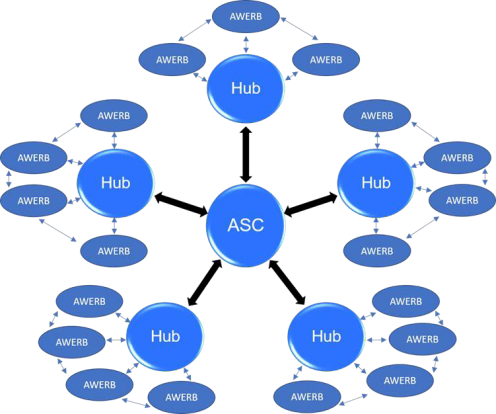
Figure 1: Schematic illustrating the interactions between AWERBs, Hubs, and ASC.
3. Current status of the AWERB Hub Network
3.1 Current regional Hubs
The ASC considered two possible ways to develop a network. One was to connect AWERBs belonging to similar organisations or pursuing similar lines of work. The other was to group within geographic regions. The regional option was chosen for two reasons. One was to make it easier to arrange meetings and minimise long distance travel. The other was because grouping different establishment types was viewed as an effective way to achieve cross-fertilisation of ideas and approaches for running AWERBs, improving the licence review process, implementing the 3Rs, and ensuring robust ethical review. For example, AWERBs operating within academia and industry can find it helpful to discuss approaches to obtaining support from senior management. Establishments using the same species in different contexts can benefit from sharing good practice. Insights and viewpoints from establishments using different species can often prompt innovative ways of thinking about refinement.
The Hub network has largely retained the original regional model, although some changes have taken place since 2017. These are reflected in Figure 1, below.
There are currently nine AWERB Hubs, most of which have been meeting once or twice per year.
Figure 2: Geographical spread of AWERB Hubs.
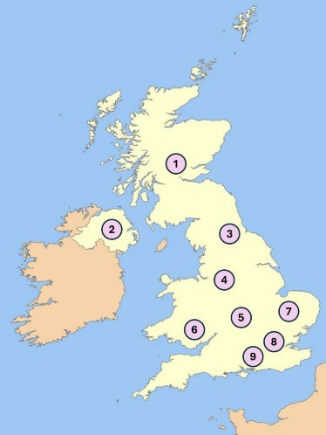
1. Scotland
2. Northern Ireland
3. Northern England
4. North-West England
5. Central England
6. Wales, West and Southwest
7. East Anglia
8. London
9. South-East
4. Sharing Good Practice
The sharing of good practice has a vital role in supporting improvement in the way AWERBs fulfil their functions, particularly in challenging circumstances such as the Covid-19 pandemic. The ASC and AWERB Hubs have worked on multiple mechanisms to share good practice in an accessible way, and these are listed in Annex A. Examples include the biannual workshops for AWERB members and Hub Chairs, regular newsletters, and the Knowledge Hub. Hubs have also organised training sessions and ‘exchanges’ between AWERBs.
Meetings are largely held online for ease of attendance and accessibility. These have the disadvantage of not meeting face-to-face but have prompted much easier participation from some of the more widely dispersed regions such as Scotland. The use of more frequent and shorter online or hybrid meetings, perhaps focused on a single topic, could be a useful working style for hubs.
4.1 Hub Tenure
The original concept was to set the tenure of the AWERB acting as host at three years, after which it could be reviewed, and a different establishment might take over as the host. It is for the AWERBs in the Hub to agree which of them is best placed to act as host and to discuss any transition processes. Some have changed host by mutual agreement. Different models have also emerged with some using rotating hosts. The Hub should inform the ASC Secretariat, which maintains a list of Hub responsibilities and membership, of the change of responsibilities. The same process should be followed if a Hub wishes to relinquish its responsibilities during its tenure. It is important that the ASC Secretariat can keep the details of the Hub network up to date so that invitations to workshops and meetings can be sent to the correct people and information can be circulated in a timely fashion.
5. Roles
5.1 Hubs’ role in the Hub Network Current
Hubs will aim to:
-
Set up and support a network for exchanging information between the partner AWERBs in their region (examples of information exchanges are given in Annex A),
-
Identify training needs for AWERB members, share induction and training materials and frameworks, facilitate peer-to-peer learning, identify opportunities for joint training and support networks,
-
Proactively share good practice with their partner AWERBs and with the ASC, recognising the different approaches of AWERBs within the Hubs. Each Hub is paired with an ASC member contact to facilitate information exchange,
-
Hold a meeting for all their partner AWERBs at least annually, inviting their nominated ASC member,
-
Convene or initiate regional, ad hoc themed workshops for their partner AWERBs, with topics relevant to all within the region, also inviting their nominated ASC member,
-
Encourage AWERBs in their region to hold joint meetings and offer reciprocal visits between members of different AWERBs in the Hub Network,
-
Encourage AWERB delegates to attend Hub workshops and other relevant events arranged by the ASC,
-
Disseminate information from Hub meetings back into local AWERBs in order to maximise the sharing of good practice,
-
Hub Chairs can take the opportunity that the Network provides to raise issues with the ASC, on matters relevant to AWERBs. They can also disseminate information and communications passed forward by the ASC and respond to questions raised by the ASC, liaising with and gathering the opinions of partner AWERBs as well as reviewing and providing suggested updates to the AWERB Hub Support Note.
6. ASC role in the Hub Network:
-
Convenes a biannual workshop for AWERB members.
-
Produces regular newsletters for onward circulation and provides an e-mail address for direct communication between the Hub chairs and ASC.
-
Created the Knowledge Hub, as an online resource for all AWERB members.
-
Brings new information to the attention of AWERB Hubs.
-
Assists the development and championing of good practice to promote:
-
the concept of a good Culture of Care for establishments, Animals in Science Regulation Unit (ASRU), ASC, and stakeholder organisations; e.g. LASA, LAVA, RSPCA, UFAW, IAT,
-
improved engagement with senior management,
-
suitable and sufficient ongoing engagement with senior stakeholders,
-
the active involvement of lay members in the work of AWERBs.
-
6.1 Relationship between the Hub Network and other organisations working in this area
The regional AWERB Hubs run in parallel with the valuable work of many other relevant organisations. These include the Laboratory Animal Science Association (LASA), Royal Society for the Prevention of Cruelty to Animals (RSPCA), Laboratory Animals Veterinary Association (LAVA), National Centre for the Replacement, Refinement & Reduction of Animals in Research (NC3Rs), Association for Assessment and Accreditation of Laboratory Animal Care (AAALAC), the Institute of Animal Technology (IAT) and Understanding Animal Research (UAR). All of these have links to stakeholders, including specific groups and specialists, that are also involved in providing advice and support in an extended Culture of Care.
The AWERB Hub network is a different entity from the AWERB-UK initiative. The latter is co-ordinated by the RSPCA, LASA, LAVA, and the IAT and brings together bodies involved in AWERB-related activities (such as providing training opportunities for members). Such activities are not within the remit of the ASC, which is tasked with ensuring the diffusion of ‘best practice’ between the AWERBs themselves.
7. Sources of further information:
7.1 The role of the AWERB under ASPA
- The roles of an AWERB are laid out in the Guidance on the Operation of ASPA (Section 10)
Guidance on the operation of the Animals (Scientific Procedures) Act 1986 (ASPA) - GOV.UK
7.2 Guiding principles on good practice for AWERBs
- Further information on the role of the AWERB in licence application review; experimental design; providing a discussion forum; retrospective assessment; and fostering a Culture of Care, as well as good chairmanship, is available in this document:
Guiding principles on good practice for Animal Welfare and Ethical Review Bodies (2026)
7.3 European Commission guidance on Animal Welfare Bodies and National Committees
- The European Commission working document on the implementation of Directive 2010/63/EU on the protection of animals used for scientific purposes is also helpful:
In addition to these sources of information, the Hub Newsletter includes links to further resources for AWERBs and highlights new resources as they are launched.
Annex A: Examples of success in sharing good practice
Organised by Hubs:
-
The London Hub organised a training workshop on key principles of experimental design and statistical analysis of the results. This was aimed particularly at AWERB members who are not normally offered formal training on these topics (e.g. lay members and NACWOs)
-
The Northern Ireland Hub organises an annual training session open to all licence-holders. This focuses on maintaining and updating awareness of regulations and severity assessment.
-
The East Midlands Hub created and shared a document: ‘Scientists and Animals Abroad’. This straddled the regulated and non-regulated contexts, setting out practical expectations for the conditions and protections that animals would experience in various countries. It also shared ways of gathering and recording information about animals being transported into and exported from the UK, and those being worked on by establishment scientists in other countries.
-
The North West Hub has organised various methods of sharing good practice, including a joint 3Rs poster event; sharing of refinements such as approaches to implementation of single needle use; approaches to openness, and approaches to managing facilities during the Covid-19 pandemic.
-
The Home counties NW & Middlesex Hub held a meeting covering the harm benefit analysis, study design, ethics, and several perspectives on the use of wild and zoo animals in research.
-
The South East Hub has held three annual meetings focusing on Culture of Care, the 3Rs, and ethics with multiple external speakers. It has also organised a facility tour for Hub members to experience the housing and care of salamanders used in research.
Organised by the ASC AWERB Subgroup:
-
AWERB Hub workshops – biannual meetings, allowing AWERB members to share their experiences, discuss areas of mutual interest, and hear from the ASC AWERB Subgroup about latest developments.
-
Knowledge Hub – an online member-only resource which acts as a repository for documents and allows for communication between AWERB members.
-
Newsletters – keeping Hub Chairs up to date on developments. These are intended for onward distribution to Hub members.
Annex B: ASC member/ Hub Pairing
Table 1: ASC Member/ Hub Pairing
It is the intention of the ASC to have an individual Member of the ASC AWERB Subgroup assigned to each Hub as a means of enhancing two-way communication and consolidating the relationship between the ASC and the AWERB Hubs.
This table provides an overview of the pairing arrangements.
| Region/Hub | ASC AWERB SG member |
|---|---|
| Scotland | Dr Dharaminder Singh |
| Northern Ireland | Mrs Wendy Jarrett |
| Northern England | Dr Lucy Whitfield |
| North-West England | Dr Lucy Whitfield |
| Central England | Mrs Caroline Chadwick (Chair) |
| Wales West and Southwest | Mrs Caroline Chadwick (Chair) |
| East Anglia | Mrs Tina O’Mahony |
| London | Mrs Wendy Jarrett |
| South | Mrs Tina O’Mahony |
ASC Member/ Hub pairings will be updated later in 2026.