UK military medics strengthen NATO medical readiness in Estonia
British military medical personnel have taken part in Exercise Vigorous Warrior 26, a multinational NATO exercise to test medical support in an operational scenario.

MOD Crown copyright
UK Defence Medical personnel have supported a major NATO medical exercise in Estonia designed to strengthen the Alliance’s ability to deliver medical care during large-scale operations.
Exercise Vigorous Warrior is a medical exercise hosted by a different NATO member biannually, this year taking place in Estonia between 8 and 20 June.
More than 2,000 personnel from 32 NATO Allied and partner nations took part, with UK Defence Medical personnel deploying as a 50-strong British Tri-service medical force alongside non-medical UK military personnel.
Brigadier Chris Wright, Head of Medical Operations and Capability, who attended the exercise, said:
Exercise Vigorous Warrior is an important opportunity for UK Defence Medical personnel to train with our NATO Allies here in Estonia and demonstrate how we contribute to collective defence.
Medical support is fundamental to operational effectiveness. By testing casualty care, patient movement and medical logistics in a realistic multinational scenario, we are strengthening our ability to support personnel on operations and improving interoperability across the Alliance.
No one nation can meet every challenge alone. Exercises like this help ensure that, when NATO needs to act together, our medical systems, people and processes are ready to work together.

MOD Crown copyright
The UK contribution included an Aeromedical Staging Unit deployed by RAF Tactical Medical Wing and Army Reserve personnel from 144 (Parachute) Medical Squadron, part of 16 Medical Regiment.
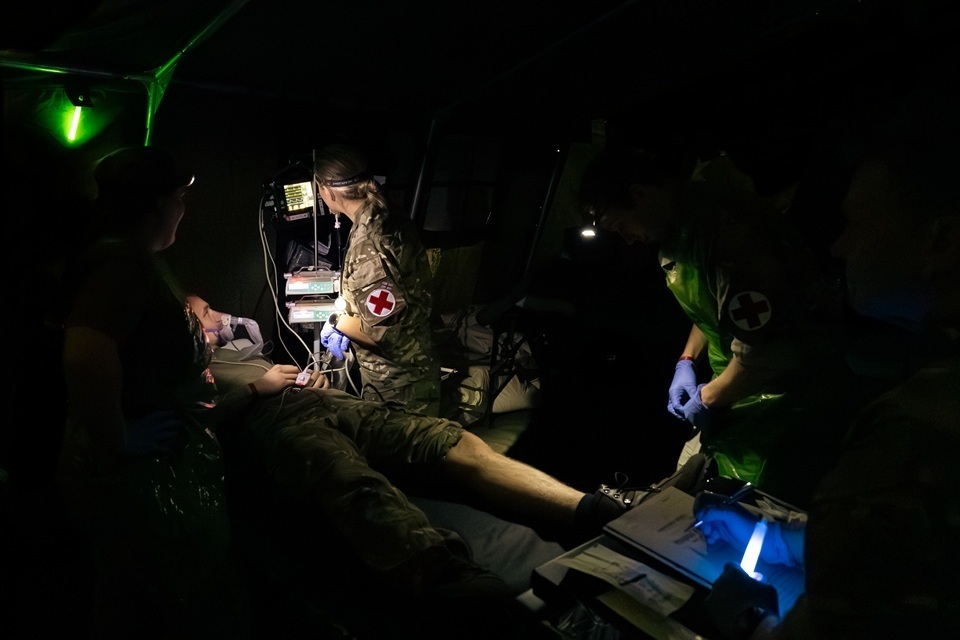
Personnel tested Role 1 medical capability, which provides immediate frontline care including lifesaving treatment, stabilisation and basic primary care, and supported wider patient care, movement and evacuation activity across the exercise.
The UK team also trialled Mercury - the UK’s frontline medical application, which enables medical records to be accessed in remote locations, even where an online connection is not possible, and observed demonstrations of unmanned ground and aerial vehicles being used to evacuate patients.
UK Medical Communications and Information Systems specialists, supported by Army Reserve medical support personnel supported use of NATO’s new Medical Management Application patient-tracking software.
UK Defence Medical personnel also worked at the Patient Evacuation Coordination Centre and provided five nurses to support a German medical facility, in addition to leading a three-day NATO Chemical, Biological, Radiological and Nuclear (CBRN) Emergency Medical Treatment course for 24 students from 15 nations, supported by personnel from Canada, the United States and the Czech Republic.
Across the exercise, NATO Allies planned, coordinated and delivered medical support across the full patient care pathway, from point of injury through stabilisation, evacuation and onward treatment. Activity included casualty handling, medical logistics, blood resupply, civil-military cooperation and aeromedical evacuation.
The training also reflected lessons from recent conflicts and placed emphasis on how military medical teams work with civilian healthcare providers during crisis situations.
For the UK Defence Medical personnel, the exercise was a valuable opportunity to train with NATO allies across the operational patient care pathway and to hone skills and capability vital in an operational environment.
MOD Crown copyright