Joint Statement of 15th Meeting of the UK-Viet Nam JETCO
The UK and Viet Nam agreed the next steps to boost trade, investment and co-operation through the 15th meeting of the JETCO.
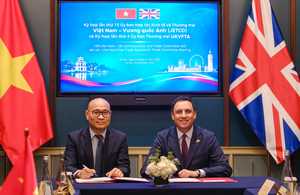
On 25th November 2026, Lord Anas Sarwar, Minister of State for Trade at the Department for Business, Innovation, Science and Trade (BIST), UK, and Mr. Luong Hoang Thai, Vice Minister of Industry and Trade (MOIT), Viet Nam, co-chaired the 15th meeting of the UK – Viet Nam Joint Economic and Trade Committee (JETCO) and the 4th meeting of the UK – Viet Nam Free Trade Agreement (UKVFTA) Trade Committee in Ha Noi.
The UK and Viet Nam celebrated the growth in our bilateral trade turnover, currently standing at £10.4 billion in the four quarters to the end of Q2 2026, an increase of 7.1% compared with the same period in 2025. Both sides acknowledged that this was the first JETCO and UKVFTA Trade Committee meeting to take place subsequent to the UK and Viet Nam’s elevation of their bilateral relationship to a Comprehensive Strategic Partnership in October 2025. The UK thanked Viet Nam for its leadership as Chair of the Comprehensive and Progressive Agreement for the Trans-Pacific Partnership (CPTPP) for 2026.
The UK and Viet Nam highlighted progress made in advancing the countries’ bilateral trade and investment relations over the past year. The UK and Viet Nam welcomed the progress made in agriculture trade, highlighting the approval of an additional 30 UK agrifood and seafood exporters to Viet Nam and the resumption of UK exports of processed animal protein powder to the Vietnamese market.
Viet Nam requested that the UK update the list fragrant-rice variety annexed to the UKVFTA, which was originally negotiated when the UK was an EU Member State and no longer reflected varieties grown by Vietnamese farmers, to ensure that Viet Nam can fully realise the substantive benefits of the Agreement. Viet Nam also requested the UK facilitate the processing of market access dossiers for Vietnamese processed poultry meat and poultry eggs. Both sides agreed to exchange information to help Vietnamese rice exporters make better use of the UKVFTA and CPTPP, while the UK agreed to provide updates on the current status of its handling of Viet Nam’s market access dossiers.
The UK and Viet Nam discussed areas of opportunity to deepen bilateral trade cooperation. In the agrifood sector, the UK expressed its interest in advancing the necessary procedures to facilitate market access for British beef, lamb and apples to Viet Nam.
Viet Nam raised concern about the UK’s new Steel Trade Measure, referred to its parallel engagement with the EU, and requested negotiations with the UK that take account the relevant commitments under the UKVFTA. While acknowledging the UK’s domestic and national-security consideration, Viet Nam emphasised the importance of reaching a mutually satisfactory solution. The UK side noted that changes to the UK’s bound tariff schedule were being negotiated through the WTO Article XXVIII process, in which Viet Nam had consultation rights, and the UK had shared its initial offer of compensation in October 2026.
Both sides continued discussions on the UK Carbon Border Adjustment Mechanism (CBAM), including through information exchange and technical cooperation. As the UK CBAM is scheduled to take effect on 1 January 2027, Viet Nam seeks further clarification on emissions calculation methodologies, verification requirements and the recognition of carbon prices paid in exporting countries. Viet Nam also welcomes continued dialogue and technical exchanges to help Vietnamese businesses in preparing for the implementation of the mechanism.
The UK welcomed Viet Nam’s removal of the Economic Needs Test for eligible foreign investors seeking to establish additional retail outlets. Both sides agreed to work together to support the timely implementation of these measures, including through clearer and more consistent nationwide guidance.
The UK and Viet Nam discussed future collaboration on healthcare to boost British exports of innovative medicines for the benefit of Viet Nam’s healthcare provision. This included further cooperation to update Viet Nam’s National Reimbursement Drug List in a timely manner and to clarify legislation related to Viet Nam’s Patient Assistance Programmes. The UK and Viet Nam agreed to a formal dialogue on intellectual property rights in the pharmaceutical sector in Viet Nam.
On financial services, the UK and Viet Nam welcomed progress on the development of the Viet Nam International Financial Centre (VIFC), highlighting the support provided by the UK to date. The UK emphasised the critical role that clear, transparent and accessible (such as translated into English and available online) regulatory and legal frameworks will play in the success of the VIFC, recommending the VIFC use English Common Law as the legal system on which the VIFC and its court operate. The UK also strongly advised the VIFC’s court and regulator be fully independent.
As part of the meeting, the UK handed over the Commodity Exchange Guidebook as a practical example of UK support for the development of Viet Nam’s financial system, in this case the development of a commodities derivatives market in Viet Nam, delivered through the UK’s Growth Gateway Programme. Both sides expressed their interest in continuing cooperation on commodity derivatives markets, including through exchanges of experience in product development and listing, exchange operations, clearing and settlement, risk management, and links with international markets. Such cooperation would support producers, processors, importers and exporters in using commodity derivatives to hedge against price volatility.
Both sides agreed to strengthen regular and substantive technical-level engagement through the relevant mechanisms established under the UKVFTA, including convening ad hoc technical meetings, where necessary, to follow up on the issues discussed at the meeting and address outstanding implementation matters. Both sides emphasised the importance of maintaining close coordination, identifying practical solutions and achieving concrete, mutually satisfactory outcomes on priority issues within the first half of 2027.
Following the plenary, both Ministers witnessed the signing of the Memorandum of Understanding on Trade Remedies (MoU). The MoU establishes a framework for both sides to share expertise and strengthen cooperation on trade remedies, thereby promoting a transparent, predictable and rules-based trading environment.