Defence Medics parachute into Tristan da Cunha to treat hantavirus patient
Fastest route to care: how Defence Medical personnel helped stabilise a critically ill patient on a remote island.

MOD Crown Copyright
When a British resident on Tristan da Cunha, one of the world’s most remote inhabited islands, became critically ill with hantavirus linked to an outbreak aboard the cruise ship MV Hondius, the challenge was immediate: how do you deliver advanced medical care when the nearest specialist unit is thousands of miles away and evacuation could take weeks?
For Wing Commander Toby Elkington, a Defence Medical anaesthetic and intensive care consultant with 16 Medical Regiment, who was on NHS placement at Peterborough City Hospital and about to anaesthetise a patient for surgery, his mission changed quickly. Within hours, alternative cover at the hospital had been found and he was en-route to the South Atlantic as part of a two-person medical team.
MOD Crown Copyright
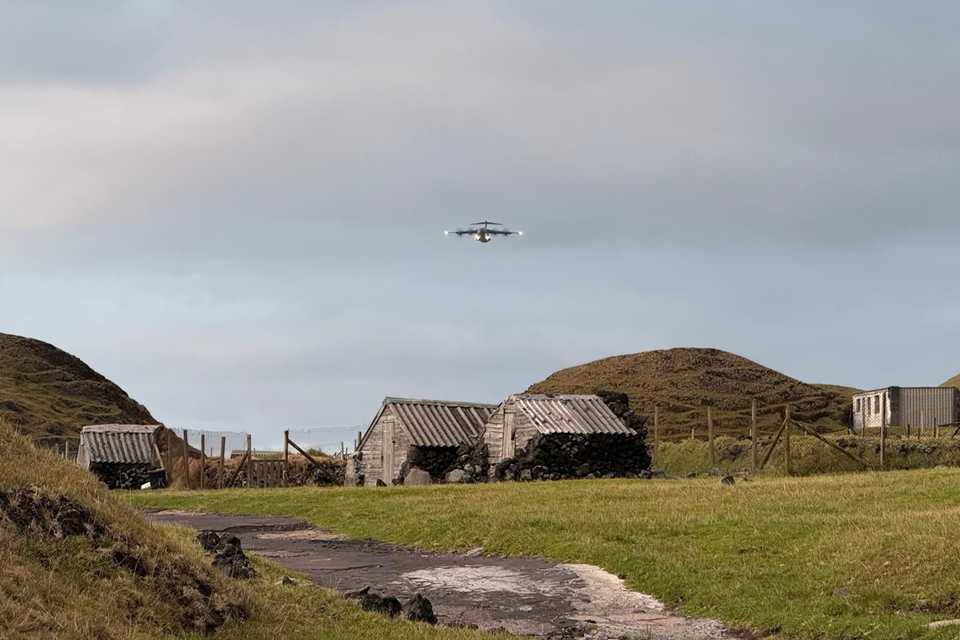
The deployment would become notable for another reason too: it involved the first known parachute insertion onto Tristan da Cunha (Toby’s first parachute jump) , and possibly the fastest ever journey from the UK to the island (approximately 27 hours instead of the usual two week trip by sea).
The two military clinicians flew with six paratroopers carrying specialist equipment, essential medicines and oxygen support on an RAF A400M, before dropping through 4,000 feet of cloud in 20-knot winds to reach the island.
Toby and his team had to plan for all eventualities before they started their journey. “We were trying to think what we might need if we had to stay there for a long time,” Elkington said. They did not know exactly what equipment was already available and whether power supplies would be reliable. In practical terms, that meant building a package capable of supporting prolonged critical care in a distant environment.
The team rapidly assembled oxygen concentrators, essential medicines and the equipment needed to provide intensive care. Every item had to justify its weight, and clinical priorities had to be balanced against the realities of air travel. “We had to make some pretty quick decisions about what was essential,” Toby said. “Oxygen provision and PPE were a must to protect staff and maintain respiratory support for the patient.”

MOD Crown Copyright.
When he arrived, Toby found an island medical team that had already done impressive work to keep the patient stable. Tristan da Cunha’s two GPs had managed a complex respiratory case under pressure and had avoided the need to intubate (a critical medical procedure where a flexible tube is inserted into the windpipe to allow a person to breathe). “They had improvised effectively and rigged up two oxygen concentrators together, which was pretty ingenious,” Toby said. One of the first tasks was to assess whether the patient could continue to be managed safely without intubation. His presence as an experienced intensive care consultant provided additional clinical oversight, targeted adjustments to sustain the patient’s recovery, and reassurance to the GPs working outside their usual comfort zone.
Toby also helped manage the wider medical and public health picture. “There were close contacts on the island who needed monitoring, local anxiety about whether the virus might spread more widely, and understandable concern in a small community unused to this kind of threat,” he said. “For the first 24 to 48 hours, it was about making sure the patient stayed stable and conducting contact tracing.”
Working with the island’s administrator and local leaders, Toby helped explain the medical plan to the community and addressed rumours that had begun to circulate. “There were rumours that people were going to be taken off the island, and we were able to say that wasn’t the case,” he said. He reassured islanders there was no plan to remove people from the island, that his team had the equipment it needed, with decisions being guided by UK Health Security Agency advice.
In the days that followed, islanders who had initially kept their distance began engaging openly with Toby and his team. “People were quite wary at first, but by the end they were coming up and chatting to us,” Toby said. He also built strong links with the island medical staff, assisting them with wider medical responsibilities wherever he could. and has remained in contact with them since returning.
The patient’s condition improved during the deployment and he was later discharged home to continue isolating. “He did well, and that was really encouraging,” Toby said. By that point, close contacts on the island also remained well, an important reassurance for the wider community. For Toby, that outcome reflected a fantastic combined effort.
Now back in the UK, Toby says one of the clearest lessons was the importance of early situational awareness: “A clearer picture of the equipment already available on the island, and the local adaptations in place, would have helped us optimise our kit further”.
It also underlined something broader about military medicine: that specialist clinical skills matter not only in treatment, but in reassurance, “A lot of it was about reassurance as much as anything else,” he said. In an isolated community, those relationship skills were as important as any piece of equipment on the pallet.
For all the attention paid to the parachute insertion, Toby remains clear about what mattered most. “The jump was a means to an end - it was about helping the patient and supporting the island,” he said. On Tristan da Cunha, that combination helped a patient recover, supported an overstretched local medical team and left behind relationships that continue after the mission’s end.

MOD Crown Copyright.