CoRWM visit to Sweden’s radioactive waste facilities
Members of CoRWM recently visited the Forsmark and Clab sites in Sweden.
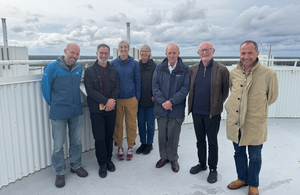
CoRWM members at the Forsmark nuclear site.
CoRWM members had been hoping to visit Sweden’s radioactive waste facilities for some time, and our visit in September was well worth the wait. Sweden is frequently discussed internationally as one of the countries that has made significant progress towards the geological disposal of both spent nuclear fuel, and low and intermediate level operational wastes. We wanted to understand more about how that progress had been achieved, and particularly what we might learn from Sweden’s experience of siting and public engagement.
Our visit began at the Forsmark nuclear site, in the municipality of Östhammar, where the repository for short-lived radioactive wastes, SFR, has been operational since 1988. In 2009 the Forsmark site was also selected to house Sweden’s deep geological spent fuel repository. Construction has been underway since 2025.
Our SKB hosts gave us an illustrated account of the history of the Swedish siting process, drawing attention to what had gone well, as well as the mistakes made in the early years. We were told that by the late 1980s it had been established that there was suitable rock everywhere, but the industry had yet to learn that however suitable the geology, “you can’t just turn up with a digger”. The SKB response to initial angry protests was to embark on a major project of public engagement that began with the posing of a basic question at a national level. They simply asked whether people would be interested to find out how a repository for spent nuclear fuel could affect their municipality? Eight municipalities from across the country expressed an interest. What followed was much more than a search for a willing community or a suitable geology. SKB invested heavily in producing detailed socio-economic surveys of each of the candidate municipalities, to see if they could identify mutual interests between industry and residents. There was a mutuality of purpose. SKB needed to understand infrastructure logistics, the supply chain, and the potential environmental impact. Residents were interested in the possibilities for investment in roads, wells, jobs, education, infrastructures and health care. The research was supported by site offices with 30 to 40 SKB personnel in each location, enabling SKB to become a more intelligent client, and providing municipalities with long-term demographic and economic forecasts that they would not otherwise have been able to afford. Siting thus went well beyond a transactional arrangement with the developer providing financial benefits in return for acceptance of a national facility. It involved building a detailed understanding of a place and asking how the project might become part of its future.
We could not go underground to visit the SFR facility as they are currently building extensions to that site. But we did drive out to the harbour – a key hub given that Sweden’s spent fuel and radioactive waste are moved almost entirely by sea, predominantly via SKB’s purpose-built vessel, the M/S Sigrid. There, we were shown a conveyor belt system built to ensure that excavated rock can also be transported by ship rather than by truck, to minimise noise and pressure on local roads. In practice, the spoil has so far not only been re-used on site – where a striking feature of the SKB programme is the way ongoing excavation material is deployed for immediate local infrastructure – but it also fetches a good price as premium aggregate. At Forsmark it is used for new roads in the region, foundations for temporary accommodation blocks, and leisure areas constructed for the workforce with an eye to further re-use by new industries who are increasingly attracted to the area. Ultimately, our guides highlighted that because of the rock’s exceptional quality, there is a highly profitable and ready market for the surplus aggregate across both sites we visited. Our tour ended high up on the observation deck of the Forsmark water tower, from where we could see the three nuclear reactors of the power station, the artificial Biotest lake built to receive the warm cooling water from the power stations, and the Baltic coast that is very popular with holiday makers in the summer months. From here we could also observe progress being made on the construction of the entrance tunnels to the spent fuel repository – and the piles of spoil, sorted and graded rock ready for use in the construction of this new facility.
In the afternoon we drove the 287 miles to the Clab interim storage facility located near Oskarshamn in the south of the country. The wastes travel this route by sea on the m/s Sigrid and are stored underground in deep water-filled pools awaiting final disposal in the facility under construction at Forsmark. There were clear resonances with the site further north, particularly in terms of the commitment to local engagement and the re-use of spoil. At Oskarshamn excavated rock from Äspö, the Swedish underground rock laboratory, had been used to create a new harbour for leisure sailing and foundations for accommodation, restaurants, etc. leading, we were told, to significant increases in tourism and associated revenues. And as with the Forsmark site, SKB engagement staff were recruited locally and there was a commitment to develop relationships with schools and community organisations. One of our SKB guides was also deeply involved in local organisations and with the municipal council. He said that local concerns focused on familiar issues of disturbance and opportunity – roads, traffic, noise, employment, education and business. But beyond that, he said that there was also strong local interest to know “how will I be part of this?”.
Another resonance was with the degree to which planning for possible futures was physically built into these facilities. At Clab, a bridge from the original storage tunnels to an adjacent plot that could accommodate future expansion, was completed decades in advance of need. Future contingency was built into the design. The orientation to re-use not just the materials but also accumulated knowledge and experience clearly played a key part in SKB’s approach to favouring proactive just-in-case engineering over reactive modelling.
Once inside the facility we were able to follow the path of the spent fuel from arrival at the port, and through the multiple stages and techniques of cooling and cleaning in preparation for interim disposal. After an initial cooling period, the transport casks are transferred into the receiving pools. From then on the whole process takes place underwater. We watched the remote removal of the lid of a cask (combining robotic arms and human operators). Once the lid is removed, the fuel assemblies are lifted out, repackaged and moved through interconnected underwater channels into storage cannisters, for longer cooling periods, and then transported in an underwater elevator into the storage pools deep in the subterranean bedrock. We were told that the radioactivity and heat will drop by 99% over the next 30 to 40 years. The final stage of the process will then be to move the spent fuel from the temporary underwater storage to an adjoining encapsulation plant (currently awaiting final building clearance) where the fuel will be dried and inserted into copper canisters for transportation, by sea, to the final repository in Forsmark for deep geological burial.
We came away from our trip to Sweden with a sense that SKB had invested in a programme in which technical planning, environmental responsibility and relationships with specific places had become closely intertwined. Nuclear waste management was repeatedly described to us as “the most important environmental protection project in Sweden”, accompanied by a strong ethical message that the generations that benefited from nuclear power should also take responsibility for dealing with its wastes. We did not get to speak with local communities or with those who are critical of the project and there will surely be other stories to be told. We also came away with a strong sense of the advantages of the Swedish context. Its geology, its relatively simple waste inventory, its political history and structures of local government all differ markedly from the UK context. Nonetheless there was a great deal to learn, particularly about what becomes possible when siting is approached as a long-term, place-based project, supported by sustained resources, shared knowledge and people who have the time and the inclination to build strong relationships in specific places.
We are especially grateful to our SKB hosts Julia Holmgren (resident of the municipality of Östhammar) Mathias Karlsson (resident of the municipality of Oskarshamn) and Ylva Stenqvist, Project Director at SKB International who stayed with us for the whole trip. Thanks to them for a fascinating visit, and particularly for engaging so generously with the siting and engagement questions that were central to our interest.