Britain’s once lost Mars lander gets its place in history with plaques at locations across the UK
Thirteen commemorative red plaques to be unveiled at locations across the UK to celebrate Beagle 2 — the first British and European spacecraft to successfully land on another planet.
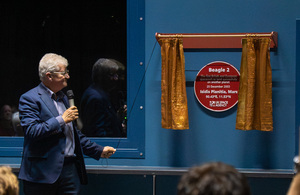
Unveiling the plaque at the National Space Centre. Credit: National Space Centre.
Beagle 2 touched down on Mars on Christmas Day 2003 but fell silent and was presumed lost for over a decade. In January 2015, NASA imagery confirmed it had landed safely and precisely on target — its silence likely caused by a single solar panel failing to fully deploy.
Host sites include the National Space Centre in Leicester, the Science Museum in London, Jodrell Bank in Cheshire, the Open University in Milton Keynes and Airbus in Stevenage, with a family celebration day at the National Space Centre on Sunday 7 June.
A series of commemorative red plaques will tell the story of Beagle 2, the pioneering British spacecraft that, against all odds, made it to the surface of Mars.
Thirteen plaques will be unveiled at organisations and companies that played an integral role in the mission or continue to champion space exploration to the public. The initiative is part of the UK Space Agency’s wider mission to celebrate the UK’s proud history in space exploration and inspire the next generation of scientists, engineers and explorers.
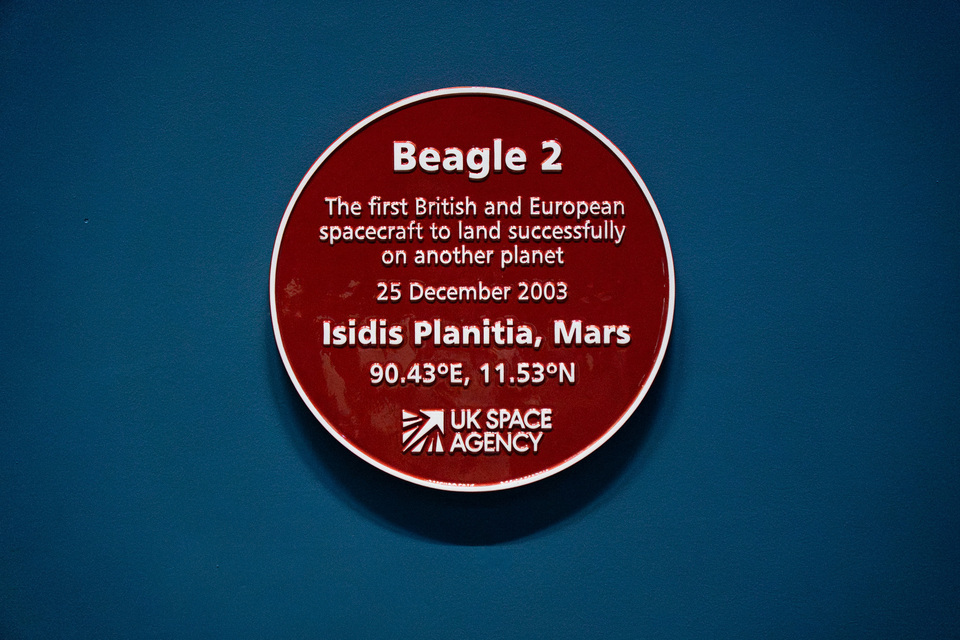
One of the plaques commemorating Beagle 2. Credit: National Space Centre.
For more than a decade the lander had been presumed lost after no signal was received following landing on Christmas Day 2003.
Then, in January 2015, it was confirmed that Beagle 2 had successfully landed precisely where it was expected to, making it the first British and European spacecraft to land on another planet.
Images from NASA’s Mars Reconnaissance Orbiter revealed the spacecraft had landed safely, with its entry and descent systems performing as designed. The cause of its silence is thought to be a single solar panel that failed to fully deploy, blocking the communications antenna.
Conceived by Professor Colin Pillinger of the Open University, in collaboration with the University of Leicester and a network of UK academics and companies, Beagle 2 was carried to Mars aboard the European Space Agency’s Mars Express mission. The spacecraft was intended to analyse Martian soil and atmosphere for evidence of past life on Mars.
Space Minister Liz Lloyd said:
Beagle 2 captured the imagination of the nation and it is one of the great stories of British science and engineering. The team who built and flew it did something extraordinary - they landed a spacecraft on Mars.
These plaques are a fitting tribute to their ingenuity and ambition, and a reminder that the technologies and expertise they developed continue to shape the UK’s place at the forefront of space exploration. I hope this initiative inspires a new generation to look up and ask what we might achieve next.
Professor Mark Sims, who was Mission Manager at the University of Leicester at the time, said:
Being part of the Beagle 2 mission was one of the most extraordinary experiences of my life. The combined industry academia team put everything into getting the spacecraft to Mars, and for over a decade we had to live with the uncertainty of not knowing what had happened and the fact that Beagle 2 may have failed to land and crashed.
When NASA’s images finally confirmed that Beagle 2 had landed safely and precisely where we intended, it was a moment of immense pride.
These plaques are a wonderful recognition of the thousands of hours of dedication from so many brilliant scientists, engineers and technicians in industry and academia across the UK who made the mission possible. The University of Leicester is immensely proud of the role it played, and I hope this initiative reminds people that Beagle 2 was not a failure — it was a remarkable achievement that continues to inspire the generations of space explorers.
The National Space Centre in Leicester marked the new initiative with a special celebration day open to families and space fans of all ages on Sunday, 7 June.
Forming a part of the Centre’s 25th birthday milestone this year, the event brought the mission’s story to life through hands-on family activities, talks and expert discussions, and an unveiling of the plaque marking the historic Lander Operation Control Centre. It provided an opportunity for audiences of all ages to increase their admiration and awareness for the legacy of this incredible mission.
The technologies, engineering expertise, and scientific innovation behind Beagle 2 have become embedded in the UK space sector over the past two decades, shaping current and future UK space exploration programmes.