Consultation on improving access to flexible working: government response (web version)
Updated 15 September 2026

© Crown copyright 2026
This publication is licensed under the terms of the Open Government Licence v3.0 except where otherwise stated. To view this licence, visit nationalarchives.gov.uk/doc/open-government-licence/version/3 or write to the Information Policy Team, The National Archives, Kew, London TW9 4DU, or email: psi@nationalarchives.gov.uk.
Where we have identified any third party copyright information you will need to obtain permission from the copyright holders concerned.
This publication is available at https://www.gov.uk/government/consultations/make-work-pay-improving-access-to-flexible-working/outcome/consultation-on-improving-access-to-flexible-working-government-response-web-version
Section 1: where we are now
Flexible working is now an established part of working life across Great Britain (England, Scotland and Wales). It can take many forms, including changes to working hours, working patterns and working locations.
It helps employees to achieve a good work-life balance and plays a valuable role for businesses in attracting and retaining talented workers. Earlier this year, government consulted on improving access to flexible working.
For many employees, flexibility can play an important role in helping people enter, stay in and progress in work. Flexibility can support wellbeing, improve work-life balance and give individuals greater control over how they manage work alongside other responsibilities, such as caring responsibilities, volunteering or education. This helps more people to participate in the labour market and contribute their skills and experience.
For employers, flexibility can support recruitment, retention and workforce participation, helping organisations attract and retain the people and skills they need to thrive and grow. Greater flexible working can therefore help businesses access a wider pool of talent.
Employees have a statutory right to request flexible working, and employers may reject requests using one of the statutory business grounds set out in legislation. In some circumstances, this is both reasonable and necessary. However, evidence gathered through engagement with employees, employers and other stakeholders has suggested that requests can sometimes be rejected without sufficient discussion, explanation or consideration of alternative arrangements. We have also heard that access to flexible working can vary considerably between organisations, sectors and workplaces, often reflecting differences in workplace culture, management capability and confidence in handling requests.
Where flexible working requests are not fully explored, opportunities can be missed to agree arrangements that would support individuals to remain in or progress in work, while continuing to meet business needs. This has consequences for individuals, businesses and the wider economy.
Through the Employment Rights Act 2025, the government committed to strengthening the flexible working framework. The act introduces a new requirement that employers must only reject requests where it is reasonable to do so and provides powers to set out a statutory process employers must follow before rejecting a request.
These changes are intended to improve transparency and accountability by ensuring employees receive a clear explanation of decisions while supporting more meaningful discussion about whether flexibility can be accommodated.
What we heard through our consultation
To help address how these reforms should be implemented in practice, the government consulted on proposals to improve access to flexible working earlier this year. The consultation sought views on a new process employers would be required to follow when considering the rejection of a statutory flexible working request, alongside wider questions about the operation of the flexible working framework and the guidance and support needed to make it work effectively in practice. The consultation received 1,016 responses from:
- individuals
- employers
- trade unions
- charities
- business representative organisations
- other stakeholders
During the consultation period, we held roundtable meetings with businesses, trade unions, charities and business representative organisations. These meetings were focused on the proposed process for consulting employees about their flexible working requests. More information about the approach to analysis is set in the annex of this document.
The consultation responses demonstrated broad support for the government’s overall objective of encouraging employers and employees to work together to find solutions that work for both parties. Most respondents agreed that employers should engage constructively with employees before rejecting a request to explore whether barriers could be overcome and whether alternative arrangements might achieve similar outcomes. Support for these principles was consistently high across the consultation, with around 88% of respondents supporting the overall objective of the proposed approach.
Responses also highlighted the importance of workplace culture, management practice and effective communication in shaping experiences of flexible working. Many respondents highlighted that successful flexible working arrangements depend not only on legal rights but also on meaningful conversations between employers and employees.
Employers generally supported the objective of improving dialogue but emphasised the importance of maintaining a framework that remains practical, proportionate and workable for businesses. Trade unions and employee representatives were supportive of stronger protections but called for sufficient safeguards to ensure requests are considered consistently and fairly.
The consultation further demonstrated strong demand for practical guidance and support. Respondents highlighted the need for clear information on the operation of the new framework, including support for line managers, examples of good practice, advice on trial periods and temporary arrangements, and greater clarity on how the new reasonableness test should operate in practice.
Next steps
Having considered the consultation responses and wider evidence, the government will now proceed with reforms enabled through the Employment Rights Act 2025. These reforms are intended to support more collaborative, transparent and constructive conversations about flexible working and to increase confidence that requests are being considered fairly and consistently.
To achieve this, the government will:
- introduce secondary legislation setting out a process that employers must follow before rejecting a statutory flexible working request
- bring the reasonableness test introduced through the Employment Rights Act 2025 into force
It is our intention that both of these changes will take effect in autumn 2027. Following publication of this paper, the Advisory, Conciliation and Arbitration Service (Acas) will publish a draft update to its code of practice on requests for flexible working for public consultation. This will set out new statutory guidance for employers and employees and will take effect at the same time as the legislative reforms. The government will also consider what other information and guidance may be needed to support implementation of these reforms.
Section 2: consultation responses – accessing flexibility now
This section brings together evidence from employees and employers on their experiences of making and handling flexible working requests, and the early impacts of recent reforms to the flexible working framework.
In April 2024, the following changes to the flexible working framework took effect:
- allowing employees to make a flexible working request from the first day of a job
- requiring employers to decide on requests within 2 months
- requiring employers to consult employees if they are considering rejecting a request
- employees being able to make 2 statutory requests in any 12-month period
- removing the requirement for employees to explain the effect their request would have on the business
The consultation sought to gather information on how these changes have affected employers and employees, with a view to improving our understanding of the current landscape of flexible working. There were 1,016 responses in total, including:
- 745 from individuals
- 117 employers
- 34 business representative organisations
- 32 charity or interest groups
- 27 trade union organisations
- 22 academics or research organisations
- 5 legal representatives
- 34 respondents who selected ‘other’
While different questions were asked of employees and employers to reflect their distinct roles and experiences, a consistent picture emerged across both groups: flexible working can support wellbeing, caring responsibilities and labour market participation, but access is often shaped by workplace culture, management practice and confidence in the statutory framework.
Responses to this consultation provide an early picture of how the flexible working framework is operating following the 2024 reforms. While the evidence suggests that employers are adapting to the changes and engaging with requests under the framework, it also highlights continuing challenges in accessing flexibility. Some employees reported that requests were rejected, while others described feeling unable to make a request because of concerns about how it would be received.
Across the findings, workplace culture, management practice and confidence in the framework emerged as key influences on whether employees feel able to seek and obtain the flexibility they need. The government will continue to monitor the impact of the reforms as they bed in.
Requests, outcomes and perceptions of recent reforms
We asked individuals whether they had considered making a statutory flexible working request in the previous 3 years. Of the 727 respondents who answered this question, 74.3% said that they had considered making a request. Of those, 61.7% went on to submit a request.
We asked respondents who had submitted a flexible working request about the outcome. A total of 330 respondents provided this information. Of these, 58.8% said that their request had been accepted, 15.2% said that they had agreed an alternative arrangement with their employer, and 26.1% said that their request had been rejected.
When asked whether overall access to flexible working had improved following the 2024 reforms, more individuals either felt that access had not improved (38.8%) or were unsure whether it had (33.5%), than that it had improved (27.7%).
Organisations representing employees, however, were generally more positive about the impact of the 2024 reforms, with some suggesting that the changes had visibly helped to improve access to flexible working in practice.
As the Union of Shop Distributive and Allied Workers (Usdaw), a trade union, said:
Our experience representing and supporting members seeking flexible working […] is that the 2024 changes did go some way to improving access to flexible working.
Employers were also more likely to report improvements. Nearly half (48.1%) of employers felt access to flexible working had improved following the 2024 changes. When asked if the number of statutory requests they had received had changed since the reforms, 38.9% of employers responding to the consultation indicated that they had received ‘about the same’ number of requests compared with the previous 12 months, while 30.1% reported that the number was ‘somewhat higher’, and 10.6% selected ‘much higher’.
Government response
The findings in this section suggest that access to flexible working remains an important issue for many employees. While a substantial proportion of individual respondents considered or made a statutory flexible working request, it is concerning that a quarter (26.1%) reported that they were unable to agree an arrangement with their employer. This reinforces the need for these reforms which aim to ensure more requests are accepted by supporting employers and employees to either address challenges with the original request or agree an alternative arrangement where possible. Additionally, perceptions of whether access to flexible working has improved differ between employers and individuals, with individuals less likely to feel access has improved.
The government welcomes these early indications that a higher number of flexible working arrangements are being agreed following recent reforms. The differing perceptions of access identified through this consultation reinforce the importance of ensuring that flexible working requests are considered fairly and transparently, and are accepted where it is reasonable to do so. The changes being introduced through the Employment Rights Act 2025 are intended to support these aims and strengthen confidence in the framework.
The impact of flexible working in practice
To understand the impacts of making, or not making, a flexible working request, individuals were asked a free text question. A total of 514 responses were received. Across these responses, a clear theme emerged that access to flexible working can have a significant positive impact on people’s lives, particularly in supporting wellbeing, managing caring responsibilities and enabling individuals to remain in employment.
Flexibility can support wellbeing and help to manage stress
Respondents consistently highlighted that access to flexible working can significantly improve wellbeing and reduce stress, while a lack of flexibility can exacerbate mental health challenges. Many respondents with flexible working arrangements in place described flexible working as central to supporting both their health and their ability to remain in work.
An individual respondent with a flexible working arrangement in place said:
It has had a positive impact on my wellbeing as I was starting to feel burnout […], having the additional flexibility has meant I’ve been able to stay in work, which I just don’t think I would have been able to otherwise.
An individual respondent whose flexible working request was not agreed described the impact this had on their wellbeing:
Flexible working request rejection has killed my work-life balance completely […], I don’t feel I have the time or energy for anything outside of work other than existing for the next working day.
Flexibility helps employees to navigate personal caring roles while remaining in work
We also heard through the consultation that certain groups rely on flexible working to balance work and other responsibilities, particularly parents and those who care for elderly or disabled relatives. Where flexible working arrangements were agreed, respondents reported being better able to manage caring responsibilities, to remain in employment, and to balance work and family life. Where flexibility was not available, respondents described significant negative consequences, including reduced time with family, reliance on informal care arrangements, or being forced to reduce hours or leave employment entirely.
An individual respondent with a flexible working arrangement in place described its impacts on their wellbeing:
It is critical for my own personal wellbeing to be able to work reduced hours 4 days a week to be able to balance the caring responsibilities of 2 young children as well as providing care for my mum who has progressive MS (multiple sclerosis) and requires full-time care.
Flexibility can support employees’ financial wellbeing
Respondents frequently reported negative financial implications where flexibility was not accessible. Respondents reported increased childcare costs, commuting expenses and, in some cases, reduced income due to needing to work fewer hours where other forms of flexibility were not agreed. Where flexible working was available, respondents highlighted reduced commuting costs and improved financial stability, particularly where arrangements enabled continued full-time employment.
This may indicate that flexibility could be increasingly important as employers think about ways to attract and support employees struggling with living costs.
An individual respondent who has a statutory flexible working arrangement in place said:
I applied for flexible working so that on 2 days a week I can finish earlier to do the school pick-up and then make up the hours later in the evening. This allows me to maintain full-time hours without a financial impact.
In contrast, an individual respondent without a flexible working arrangement described the impact of a change in on-site attendance requirements on their finances:
I have 2 children under the age of 7 and need to arrange childcare on office days. The additional day has increased my monthly expenses by around £200 in travel alone, alongside extra childcare costs.
Organisational culture and management practice both shape experiences of flexible working
Responses strongly suggest that workplace culture and management behaviour are key factors in determining how flexible working is experienced in practice. Supportive management and trust-based cultures were associated with positive outcomes, including improved morale, stronger relationships and psychological safety in making requests. In contrast, some respondents reported negative experiences where requests were dismissed, where managers were perceived as unsupportive, or where individuals felt judged or penalised for seeking flexibility.
An individual respondent without a statutory flexible working arrangement described accessing flexibility in an informal way as and when they need it:
My current organisation already operates a high-flexibility working environment […], I have not felt the need to request any specific additional flexibility. Most of the ad-hoc flexibility I may require can be easily negotiated with my direct line manager.
An individual respondent who had made a statutory request for flexible working which was not granted said:
Although the process appeared compliant on paper, I do not believe due process was meaningfully followed. I felt pressured to agree to an extension of the 2-month statutory timeline […] the consultation meeting lasted less than 11 minutes, and suggested compromises were not explored […] This has created a serious fear of retaliation and has damaged my trust in management.
Similar themes were raised during roundtable discussions with employees, many of whom stressed the important role of line managers in shaping access to flexible working in practice. This was reinforced in discussions with human resources (HR) professionals, who highlighted that there can be a disconnect between organisational policy and how flexible working is implemented by individual managers. While organisational policies and formal processes provide the framework, line managers are often responsible for interpreting, implementing and discussing flexible working arrangements with employees. As a result, their approach can have a significant influence on how workplace policies are experienced and whether employees feel supported in seeking flexibility.
Government response
The findings in this section highlight the important role that flexible working can play in supporting wellbeing, helping individuals balance caring responsibilities, and enabling people to remain in employment. They also reflect the significant difficulties employees can face when they do not have access to the flexibility they need.
Respondents also emphasised the role that workplace culture and line managers play in shaping how flexible working is experienced in practice. The government recognises these findings and is committed to improving access to flexible working.
Alongside legislative changes, we will continue to work with employers and other stakeholders to promote good practice and support positive workplace cultures that enable constructive conversations about flexible working.
Employees are facing barriers to making requests
To better understand potential barriers to using the statutory framework, we sought further information from individual respondents who had considered making a request but ultimately chose not to. 745 individuals responded to the consultation, providing insight into the factors that may discourage some people from submitting a flexible working request.
Responses indicate that decisions not to proceed were often shaped by perceptions of workplace culture and likely employer response. The most common reason given for deciding not to make a flexible working request was a belief that the request was likely to be rejected. Other frequently cited reasons included concerns it could negatively impact career development, anticipated lack of line manager support, and discouragement after seeing a colleague’s request rejected.
Figure 1: Reasons for not requesting flexible working
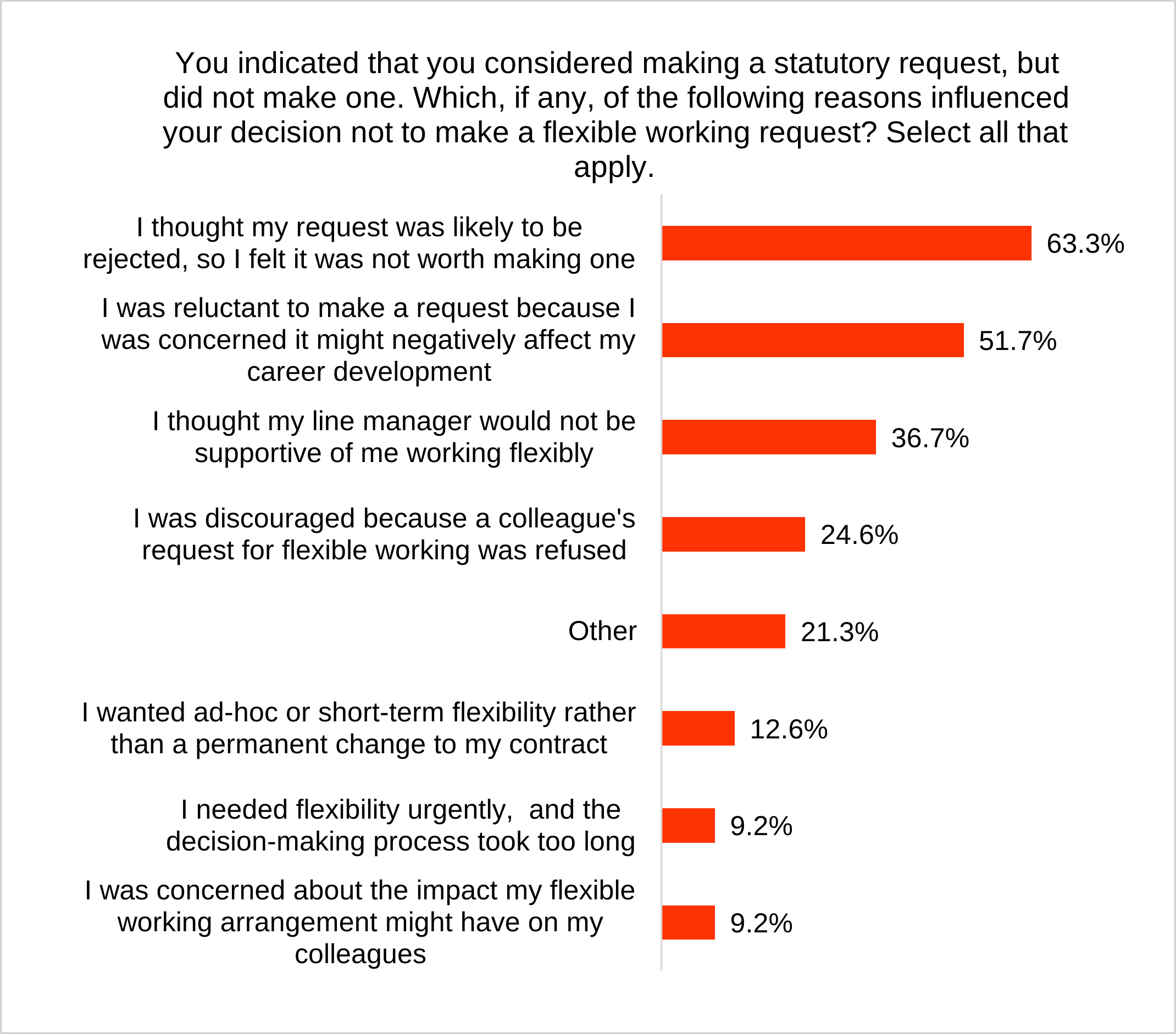
The bar chart in figure 1 shows that the most common reasons for individuals not to request flexible working were because they thought the request might be rejected, they had career development concerns, or they anticipated their line manager would not support the request.
Figure notes
- There were 207 respondents to the question: ‘Which, if any, of the following reasons influenced your decision not to make a flexible working request? Select all that apply’.
- Note this question allowed respondents to select multiple options, so percentages will not add up to 100.
Taken together, this suggests that some individuals may be deterred from using the statutory process not only because they expect their request to be refused, but because they are concerned about the potential workplace implications of asking. This indicates that employers may need to consider how they can signal to employees that they are open to talking about flexible working or challenge misperceptions about scope for flexibility within their organisations, particularly in organisations and sectors which may have had more rigid ways of working in the past.
Employers are facing challenges in handling requests
The fact that employees face barriers in accessing flexibility was mirrored in some of the feedback from employers who set out challenges in handling flexible working requests. A large proportion (59.6%) of employers who responded reported that they had rejected a statutory flexible working request since April 2024.
Employers shared a range of different reasons for rejecting requests, from operational constraints meaning some arrangements were not feasible, to concerns about future planning and perceptions of fairness.
Figure 2: Challenges when handling flexible working requests
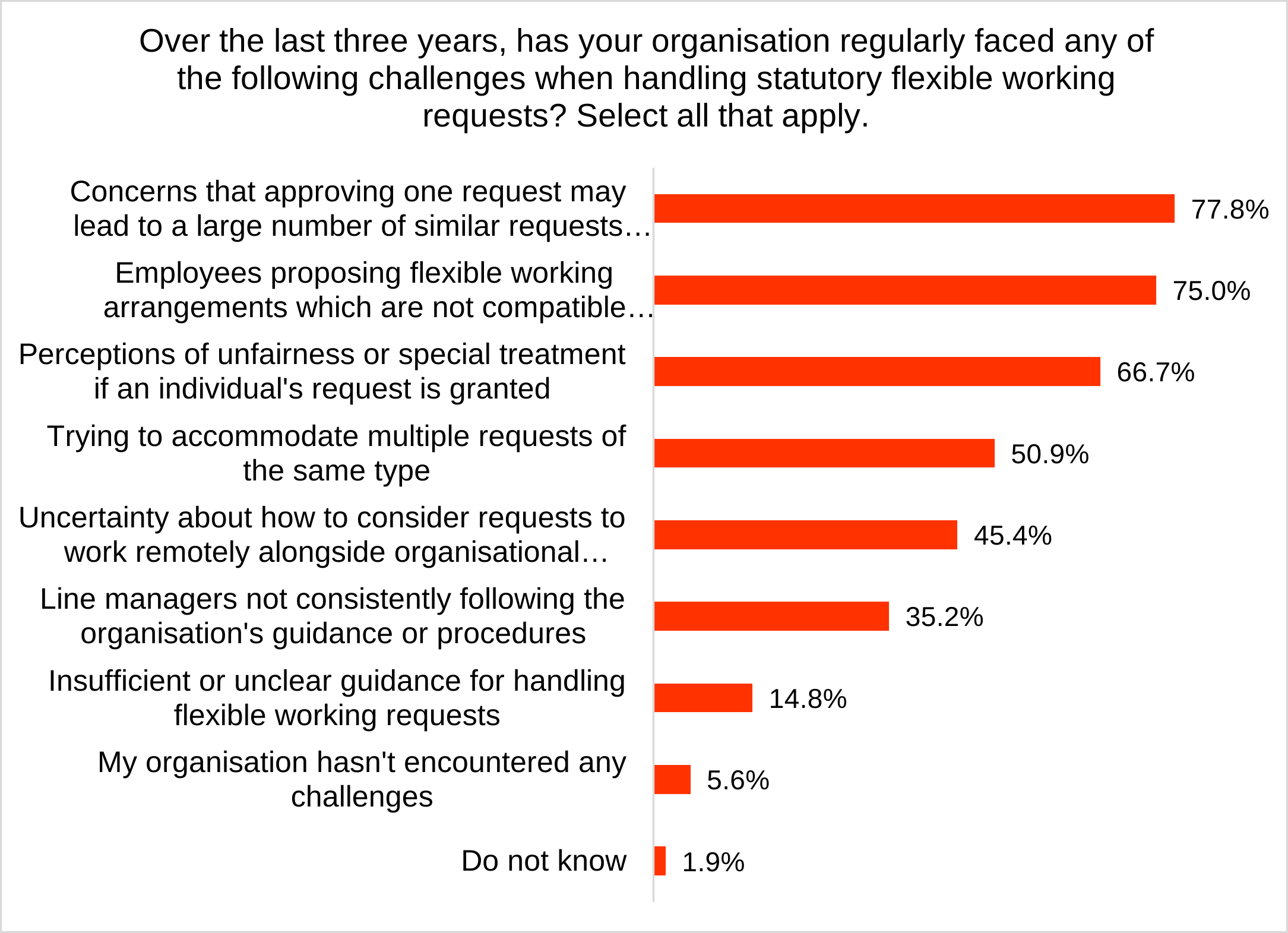
The bar chart in figure 2 shows that common challenges employers face when handling flexible working requests include concerns that approving one request would lead to a large number of similar requests, employees may propose incompatible flexible working arrangements, there may be perceptions of unfairness or special treatment, and there may be pressure to accommodate multiple requests of the same type.
Figure notes
- There were 108 respondents to the question: ‘Over the last 3 years, has your organisation regularly faced any of the following challenges when handling statutory flexible working requests? Select all that apply’.
- Only employers were invited to answer to this question in the consultation.
- Note this question allowed respondents to select multiple options, and so percentages will not add up to 100.
We asked employers what challenges they had faced in handling flexible working requests, and notably very few (5.6%) reported they faced no challenges at all. The most commonly reported challenge was concern that approving one request could lead to a larger number of similar requests from other employees (77.8%). This was also a recurring theme during employer roundtables, where businesses discussed the practical implications of managing increasing numbers of requests for similar arrangements.
Concerns about fairness were also evident across both consultation responses and roundtable discussions. Two-thirds of employers (66.7%) reported concerns about perceptions of unfairness where an individual’s request is approved, while around half (50.9%) highlighted challenges in accommodating multiple requests of the same type.
Discussions during employer roundtables suggested that these issues were often linked. Some employers described situations where they had agreed a number of similar requests and reached a point where operational constraints meant that additional requests could not be accommodated. In these circumstances, employers highlighted the challenge of explaining why a request could not be approved despite similar arrangements having previously been agreed for other employees.
At a roundtable of employers aiming to drive best practice in flexible working, attendees discussed different ways of navigating this. For example, a large public sector employer reported introducing policy to limit the number of longer shifts that could be taken consecutively. In parallel, they encouraged staff to ‘self-roster’ choosing the shifts they worked over a given time period.
This served to both increase access to flexibility, while reducing the number of requests for highly compressed hours, which had been causing resourcing problems. A large energy provider described taking a ‘framework approach’ which set parameters about the types of flexible working that employees could agree informally with their line manager.
The majority of respondents who had rejected a statutory flexible working request since April 2024 reported that they spent at least an hour handling each rejected request, with 33.3% reporting that this took more than 2 hours. Of those who reported spending more than 2 hours considering a request, the specific timeframes varied. Some estimated that the process took 4 hours or, in a small number of cases, up to 12 hours. This indicates that there is not a standard timeframe for considering requests, with timing likely to vary both with organisational approaches and the complexity of specific requests.
It may also be the case that survey respondents who reported this process is taking more than 2 hours may not be referring to a continuous period, but rather a cumulative stop-start process as multiple teams become involved in handling the request.
This is demonstrated in the following contribution from the Rail Delivery Group, a trade body:
In practice, the time taken to respond to requests will vary. For some, it can be one day, for others, it can be several days and potentially up to 2 weeks. […] responses would require input from the line manager, support from the HR team and appeal manager, the resourcing/rostering team and more. […] Requests involving train crew require extensive engagement with rostering teams being cognizant of timetable constraints.
Insights shared through written responses and employer roundtable discussions suggested that some challenges were more commonly experienced by different types of employers.
As the quote above from the Rail Delivery Group demonstrates, not only does the time taken to respond to requests vary, but so does the organisational process. Larger organisations and those with more complex operational structures often described decision-making processes involving multiple teams or stakeholders, increasing the number of factors that needed to be considered when assessing requests.
In contrast, smaller employers, particularly those without dedicated HR support or prior experience of handling statutory flexible working requests, more often expressed concerns about compliance. Some reported uncertainty about the circumstances in which a request could legitimately be refused and were concerned that this could lead them to over-compliance and feeling pressure to accommodate requests that may not be sustainable for the business.
Government response
The findings in this section suggest that confidence in the flexible working framework remains an important factor in determining whether individuals make use of their right to request flexible working. The findings suggest that workplace culture, management practice and perceptions of fairness are key factors shaping experiences of flexible working. Confidence in the statutory framework underpins these issues, but experiences are often influenced by the approach taken by individual organisations, leaders and line managers. It is right that organisations should develop an approach to handling flexible working that works for them and aligns with their wider culture and working practices.
The government recognises the concerns of employees, and the new requirement to consult and the introduction of a reasonableness test are intended to support a more transparent, collaborative and consistent approach to considering flexible working requests.
Simultaneously, these changes will continue to allow employers to take account of legitimate business considerations when making decisions, and develop policies and practices that work well for their business. We recognise that employers can face practical challenges when managing requests, particularly where multiple requests must be considered alongside operational requirements, or where organisational structures and systems add complexity to the process of assessing requests.
The findings suggest that many employers are working hard to support flexible working while balancing competing demands within their organisations and are seeking to make fair and consistent decisions on flexible working requests. The government will continue to monitor how we can work alongside employers to address gaps between organisational policy and line management practice, and further support culture change to enable flexibility, and understand what further guidance and targeted support may be needed to help employers comply with the strengthened framework and apply it consistently in practice.
Employer practice is shifting in response to recent reforms
Employers’ responses suggest that many organisations have already taken steps to adapt their policies and practices following recent reforms. Over half of employers indicated that they had introduced or updated a written policy or guidance document following the introduction of these reforms, 23.4% reported that they had made changes to their decision-making processes, and 28.8% reported that their organisation had already been managing requests in line with these changes before they took effect.
There is also widespread use of reviewing arrangements, temporary arrangements and trialling arrangements. In total, 108 employers responded to this question. Many employers use the suggested approaches: 75.0% use reviewing arrangements, 79.6% use temporary arrangements and the same number use trialling arrangements.
Government response
The government welcomes evidence that following recent reforms, many employers are already re-shaping their broader approach to flexible working, embedding it into guidance and support for managers and are going beyond minimum requirements by using approaches such as trial periods, review points and alternative working arrangements to help assess requests. These findings suggest that many employers are already adopting practices which support constructive engagement on flexible working requests.
The government considers these approaches to be an important part of a collaborative process, helping employers and employees work together to identify practical and sustainable arrangements. As further reforms are implemented, we will continue to engage with employers and other stakeholders to promote good practice and ensure organisations have access to clear and practical guidance.
Section 3: what government has decided
This section of the consultation gathered views on the proposed new process employers will follow when they are considering rejecting a statutory flexible working request. This will be set out in secondary legislation, with some good practice elements included in guidance.
The process outlined in the consultation aims to support a fuller, fairer discussion of the proposed arrangement as well as any possible alternatives, and enable more consistent handling of flexible working requests. Ultimately, these behaviour changes aim to drive increased access to flexible working.
The approach was developed following a series of discussions with businesses, trade bodies, charities and trade unions to learn about what works well now. This was reflected through consultation responses, with several employers and industry bodies responding to the consultation and participating in roundtables remarking that they already take a similar approach to the process outlined in this consultation when considering flexible working requests, or that they consider the proposal to be reflective of existing good practice.
Sysco GB, a business, said:
The shift in emphasis towards requiring employers to justify refusals is understood and broadly reflects existing good practice.
However, it will be important to ensure that the framework allows sufficient flexibility for employers to make decisions based on operational requirements, particularly in roles where flexible working may be more challenging to accommodate.
The British Retail Consortium, a business representative organisation, said:
Generally, retailers will already work to accommodate the request where they can and are already including the options outlined above in the consultation they conduct with the employee.
Following suggestions from consultation respondents, we have changed some elements of the process.
Consultation objective
The proposed process for consulting employees about their flexible working request included an objective for employers and employees to work towards. This received a high level of support with 87.6% of respondents overall reporting they felt it was appropriate.
This support was high among both employers (85.8%) and individuals (89.6%).
Pregnant then Screwed, a charity, said:
To be effective, the objective must also make clear that the purpose of the meeting is to genuinely explore how the requested arrangement can be made to work, not simply to identify barriers. It should also be explicit that any “suitable alternatives” must be mutually acceptable to both the employer and the employee.
There was a free text question which invited respondents to share their views on this aspect of the process, and these also reflected broad support.
Responses emphasised the need to ensure that the meeting is a collaborative, 2-way discussion focused on mutually beneficial solutions.
There was also broad support for the proposed requirements for setting up the meeting, with 85.7% agreeing with the proposed approach.
Challenges
Some free text responses felt the proposed objective did not place sufficient emphasis on discussing the original request and exploring ways to agree it. These respondents felt that alternative arrangements should only be considered once it has been established that the original request cannot be accommodated.
The Employment Lawyers Association, a law association, said:
It could be argued that this does not make it sufficiently clear that the first task is to discuss if the request can be accommodated in its original form or with adjustments and, only if there are genuine business reasons why not, to explore alternative arrangements. The employer may be coming to the meeting with the initial view that the request is not feasible, but it ought to be open for the employee to persuade them to rethink on this, either as is or with minor adjustments.
Some respondents suggested that the objective should include words such as ‘negotiate’, while others suggested ‘with a view to reaching an agreement’.
On the other hand, there were concerns from a small number of employers that the proposed objective would lead to an assumption that requests should be accommodated. Employers also felt that they should have the final say on any decision on the request.
The Association of General Counsel and Company Secretaries of the Financial Times Stock Exchange (FTSE) 100, official representative body for senior legal and governance officers at the UK’s largest listed companies, said:
The meeting should not proceed on the basis of any pre-determined assumption, on either side, that a request can, or should, be accommodated in every case. Instead, the objective should reflect a more balanced, 2-way discussion with a focus on flexibility from both sides.
Government response
While there is widespread support for the proposed objective, the government has taken on board suggestions to refine it further to ensure that it meets our aim of encouraging better conversations between employers and employees when discussing flexible working requests.
The government agrees that the meeting should focus on the initial request first before discussing any potential alternatives.
To ensure the objective fully reflects the constructive and collaborative spirit of these reforms, we have added the words ‘with a view to reaching an agreement’. This would not prevent employers from rejecting a request where it is reasonable to do so, and where an agreement cannot be reached. However, it clearly sets out that the purpose of the meeting is to explore whether a mutually acceptable outcome can be achieved. This could involve agreeing to the request as made, agreeing to a modified arrangement that addresses the employer’s concerns, or agreeing to trial an arrangement before a longer-term decision is made. Where the original request cannot be accommodated, employers and employees may instead agree an alternative form of flexible working.
The refined objective, set out as follows, more clearly meets these aims.
Employers must hold a meeting before rejecting a flexible working request both to:
- consider the feasibility of the requested arrangement and address challenges where possible
- explore any suitable alternative arrangements if the requested arrangement is not feasible
The meeting shall be undertaken by the employer with the view to reaching an agreement with the employee.
Setting up the meeting
There was broad support for the proposed requirements for setting up the meeting. The majority of respondents (85.7%) agreed with the proposed requirements for setting up the meeting, 9.9% respondents did not agree and 4.4% people replied ‘do not know’.
Despite broad support for the proposed requirements, the following issues were raised in response to some elements:
- the requirement to inform the employee of the context about the meeting
- providing notice before the meeting
- the requirement that a ‘decision-maker’ attends it
Informing the employee of the context of the meeting
The consultation document specified that employers should inform employees about the context of the meeting in advance. The use of the word “context” was raised in discussion by legal experts and trade bodies as a potential cause of confusion.
We have taken this on board, and regulations will reflect that employers should inform employees about the purpose of the meeting in advance.
Notice period
Respondents were asked about the appropriate amount of notice to provide before a consultation meeting.
While the most popular response was one week (44.6%), a significant number of respondents thought that the requirement should be to give fair notice, accounting for ways of working within the organisation. This was the preferred option among employers, with survey and free text responses indicating a strong preference not to have a defined time-bound requirement.
Several trade unions suggested 10 working days’ notice. These respondents felt that this would allow employees enough time to prepare, to secure a union representative to accompany them to the meeting (although there is no legal right to be accompanied) while allowing employees to manage other responsibilities.
Government response
The government believes the notice period for the meeting is best decided within organisations, and so the requirement will be for employers to give fair notice before the meeting.
This will ensure that employees are given enough advance notice without creating an inflexible requirement. An overly prescriptive approach could limit a manager and employee choosing to hold this discussion as part of a regular meeting, or could prompt disputes over minor delays.
This approach also allows employers and employees to take account of specific circumstances within the organisation or with the employee’s personal life, such as the urgency of the request.
As outlined by Acas:
In this context, ‘fair notice’ should be understood as providing enough time for both parties to prepare meaningfully for the discussion, while still arranging the meeting without unnecessary delay.
We are aiming to balance a strengthened right for employees to request a flexible working arrangement with managing business burdens. The government intends to set out further guidance to support a fair and reasonable notice period when these measures come into force.
The requirement the meeting is attended by a ‘decision-maker’
One of the proposed requirements of the meeting was that a person with the authority to make a decision about flexible working arrangements must attend the meeting. This is currently recommended as good practice in the Acas Code of Practice on requests for flexible working, and it was included in the proposed approach with the aim of supporting meaningful and constructive conversations. There are mixed views on this point, which we have taken into account.
Support for the ‘decision-maker’ requirement
There was support for the inclusion of someone with the authority to make a decision attending the consultation meeting, among individual employees and trade unions. It was felt that this would enable a meaningful discussion about challenges, solutions or potential alternatives.
Community, a trade union, said:
Community agrees that someone with authority to make a decision about flexible working arrangements must attend the meeting as this will ensure a substantive discussion and minimise delays to the process.
Challenges with the ‘decision-maker’ requirement
Some business representative organisations and larger businesses were concerned about this requirement. They reported that in their organisations, decisions about flexible working requests are usually made by a more senior member of staff rather than the employee’s line manager, and this requirement could place a heavy burden on these individuals.
Furthermore, some respondents explained that decisions in their organisations can involve several people for example the line manager, another colleague who manages rostering, and a finance colleague to approve any associated costs. They state that it would be overly burdensome to expect all decision-makers to attend a flexible working meeting.
The Confederation of British Industry (CBI), a business representative organisation, said:
Although it is noted that [the decision maker] could be a line manager, in many cases it will not be the line manager that makes a final decision on a request. In some organisations, that responsibility sits with the HR director or another member of the executive team. Having that person meet with every person making a flexible working request themselves will often be a disproportionate use of their limited time and capacity; very large businesses receive hundreds of requests each year.
Government response
Having taken on board feedback from stakeholders, the government will not include this requirement in legislation. The government believes that in most situations, a person with the authority to make a decision on a flexible working request should be present in the meeting. However, we recognise that, especially in larger organisations with many staff working on the same site or on the same area, a decision on a flexible working request may ultimately lie with a senior leader or HR director, and may involve multiple members of staff.
To manage the risk that not including this requirement could lead to a cursory approach, and to support the overall objective of these reforms to drive more constructive and collaborative conversations about flexible working, we will amend the objective of the consultation to specify that the consultation meeting must be held ‘with a view to reaching an agreement’.
As explained in the ‘objective’ section, this new wording achieves the aim of leading to a meaningful discussion of the request and any potential alternatives as well as encouraging employers and employees to agree on a solution.
During the meeting
This part of the consultation focused on what should happen in the meeting itself. These steps are outlined as follows:
- the meeting must allow for sufficient discussion of the request and any potential alternatives
- the decision-maker must clarify whether the employee would like the proposed request to be considered as a reasonable adjustment in accordance with the Equality Act 2010
Identifying challenges and problem solving
The decision-maker must clearly communicate any challenges they identify with the original request, they must explain why they feel that it would not be feasible to accommodate the request, or why the request is not reasonable, referring to the relevant business reasons.
The decision-maker must consider whether there might be ways to navigate these challenges and accommodate the request. For example, if the proposed start date of the flexible working arrangement is incompatible with business needs according to a relevant business reason, the employer must consider whether a different start date may be feasible and discuss this with the employee.
If the potential impacts of a new arrangement are unclear, an employer and employee could choose to trial it for a fixed period of time.
Exploring alternatives
If the original request cannot be feasibly accommodated, the employer and employee must consider whether there are feasible alternative arrangements, as with other requests, employers can only reject proposed alternative arrangements where a relevant business reason applies.
Employers must record the outcome of this discussion and communicate this with the employee.
Support for the meeting process
There was widespread support for elements of the suggested process:
- there was significant support (88.5%) for discussing any challenges in accommodating the original request
- 89.2% of respondents agreed meetings should consider alternative arrangements that could be accommodated
Driving best practice through enabling trial periods
82.5% of respondents agreed that discussing an option of a trial period should be included while 74% of respondents agreed with the proposal of exploring alternative start dates.
Under the current framework, employers can already trial a flexible working arrangement, set review periods or agree with the employee a defined timeframe for which the flexible working arrangement will operate. The government believes that discussing trial periods and other temporary arrangements in a meeting is constructive and can lead to better outcomes for both parties.
This will not become a requirement in legislation, but we will consider how guidance and resources can improve awareness of these options among employers and employees. This is addressed further in the following section.
Reasonable adjustments
Reasonable adjustments are changes an employer makes to remove or reduce a disadvantage relating to someone’s disability. This could involve making changes to a person’s physical working environment or providing equipment or services. Disabled employees could also be offered flexible working arrangements as a reasonable adjustment, such as a change to their working pattern or increased home working. Employers are required under the Equality Act 2010 to make reasonable adjustments for disabled employees.
The right to request flexible working is separate in law from the duty to make reasonable adjustments. Disabled people do not have to use flexible working legislation to access reasonable adjustments, if a disabled person is considering working flexibly, decisions about what is ‘reasonable’ could be different depending on the circumstances and which legislation applies.
The government has heard that there is confusion about how to handle a flexible working request from a disabled employee and whether to treat it as a reasonable adjustment instead. As a result, the proposed process for flexible working conversations included a requirement to ask the employee if they would like the request to be considered as a reasonable adjustment.
While there was strong support for this (76.8% of respondents), some respondents, from a range of organisations including legal experts, trade unions, businesses and their representative organisations have mentioned that including this requirement within the meeting process could have the unintended consequence of causing increased confusion. Employers are under an obligation to make reasonable adjustments when they are aware of a person’s disability, whereas under the flexible working framework, the onus is on the employee to make a request.
The Associated Society of Locomotive Engineers and Firemen (ASLEF), a trade union, said:
We are concerned that this could lead to what should perhaps be dealt with as a reasonable adjustment being handled as a flexible working request and could lead to confusion as to which legislation and workplace policies are being discussed.
Respondents also mentioned that including consideration of reasonable adjustments as part of this process is too late as this should happen before the meeting takes place.
GMB, a trade union, said:
GMB believes that asking if the employee would like the request to be considered as a reasonable adjustment should happen before a meeting takes place to ensure both employee and employer come to the meeting knowing what legislation and workplace policy their request is being discussed under and so they are able to prepare.
Government response
The strong level of support among respondents for discussing challenges relating to the original request in the meeting aligns with the government’s view that an important purpose of the meeting is to encourage constructive dialogue between employers and employees. This can help both parties to solve any anticipated problems with the request or to reach an alternative agreement. The responses also indicated a strong level of support for discussing trial periods as well exploring alternative start dates for the proposed arrangement during a flexible working meeting. The government believes that encouraging employers and employees to discuss this in the meeting will lead to more requests being accepted while ensuring businesses can continue to deliver and meet customer demand if circumstances change in the future.
The government recognises that there is confusion around when either the duty to make reasonable adjustments or the right to request flexible working are applicable in practice. However, asking the employee if they would like their request to be considered as a reasonable adjustment in the consultation meeting may not be appropriate.
Employees may not know whether their request should be considered a reasonable adjustment as opposed to a flexible working request. Asking employees in the meeting risks conflating 2 separate areas of law and causing increased confusion about when they should apply. It could lead to employers applying the incorrect legislation to make a decision.
The government will consider how to improve awareness of the duty to make reasonable adjustments and provide clarity on how to handle flexible working requests which should instead be considered as a reasonable adjustment. We will develop guidance to aid employers in understanding these areas of law.
Communicating the outcome of the request and meeting in writing
The consultation proposed that employers should communicate the outcome of the meeting in writing, as well as the outcome of the request. The majority of respondents (94.2%) agreed with this proposal, while 5% disagreed.
Government response
The government agrees that this requirement should be included in the process. Communicating the outcome of the meeting will provide employees with reassurances that their concerns were listened to and will allow them to better understand the reason why the request has been refused. This promotes our aim of increasing transparency around flexible working requests and encouraging better dialogue between employers and employees. To avoid duplication, where an arrangement is agreed during a meeting, the requirements to communicate the outcome of the meeting and the final decision in writing can be met through the same single communication.
Recourse to appeal decisions
Some responses suggested that government should re-introduce a statutory right to appeal a flexible working decision. It was felt that this would help employees to challenge flawed approaches to decision-making without having to escalate the matter to a grievance or tribunal.
Government response
Some respondents proactively suggested that a right to appeal a flexible working decision should be introduced as part of this process, but government takes the view this should not be a legal requirement.
The consultation meeting is an opportunity for employees to be more directly involved in decisions about their working arrangements. It already provides an opportunity for greater transparency and dialogue about flexible working than is available now. The government takes the view that this process is designed to be a collaborative and solutions-based approach, where a legal requirement for an additional layer of appeals could over-formalise discussions about flexibility.
Some employers choose to provide a route of appeal within their policies, and this is recommended within the Acas Code of Practice on requests for flexible working. Where this is not available, if an employee feels their request has not been handled reasonably, they might seek formal advice, consider making a grievance or ultimately could bring a case to tribunal. Employers may find it helpful to signpost employees whose requests are rejected to other forms of support available, such as unpaid parental leave or carers leave, or support and advice from an employee assistance programme.
Being accompanied at meetings
While this was not part of the proposed process included in the consultation, there were a number of responses that called on the government to introduce a right for employees to be accompanied to the meeting by a trade union member or another companion. It is argued that this could assist the employee when making a flexible working request as the trade union member will have access to information and training which could be valuable during the meeting.
The Trades Union Congress (TUC), a national organisation representing trade unions, said:
A union rep has access to training and guidance on flexible working that individual employees may not. Access to this can support the employee to submit a clear request, a request that is in line with the law and workplace policies and think through all the potential impacts the request may have on the employee and employer.
Government response
Non-statutory guidance on flexible working will continue to encourage employers to allow employees to be accompanied at flexible working meetings, but this will not be included in regulations. This will mean that where employers recognise a trade union, employees should be allowed to be accompanied by a union representative at flexible working meetings if they wish.
While this could be helpful in some cases, in others, it could lead to unnecessary formalisation of a conversation between an individual and their line manager. The aim of this process is to encourage better conversations between employees and their employers when discussing flexible working arrangements.
The Acas Code of Practice on requests for flexible working recommends, as good practice, that employers should allow an employee to be accompanied as it can be helpful in giving employees the confidence to make requests and can support both parties to find a mutually agreeable solution. However, the government does not feel that this should be stipulated in regulations.
Business impact
Several employers and industry bodies responding to the consultation and participating in roundtables remarked that they already take a similar approach to the process outlined in this consultation when considering flexible working requests, or that they consider the proposal to be reflective of existing good practice.
The Chartered Institute of Personnel and Development (CIPD), a professional body for HR, said:
Most of our HR roundtable respondents said this process is part of their current guidance for line managers.
Employers responding to the survey were asked to estimate how long it would take on average to follow the proposed process outlined in this consultation. A small number of employers responded to this question: 108. Over a third (34%) of respondents thought the new process would take the same amount of time as they currently spend considering flexible working requests. Just under two-thirds (63%) thought it could take more time.
Notably, in their response, the CIPD observed that most HR representatives who participated in a roundtable they held already used a similar approach, and so did not think the new requirements would lead to “a substantial increase or decrease in time requirements.”
A small number of respondents expressed concern that the new requirement amounts to a shortening of the decision-making period for considering a request.
British Chambers of Commerce, a business representative organisation, said:
In practice, the time for an employer to consider a request, make an assessment and an initial decision has been reduced from 2 months to 6 weeks. If advanced notice of a week before the meeting is given, the timeline is reduced again to 5 weeks.
It is important to note that the consultation meeting is not intended to communicate a decision, but rather as a core element of the decision-making process. While in some cases an employer may be able to reach a decision during or shortly after a meeting, in others, particularly where an alternative arrangement is discussed, the employer or indeed the employee may need additional time following the meeting to consider proposals. In addition, it remains the case that an employer can extend the decision-making period beyond 2 months with the employee’s agreement.
Planned requirements for consulting employees about their flexible working request
Objective of the meeting
Employers must hold a meeting before rejecting a flexible working request both to:
- consider the feasibility of the requested arrangement and address challenges where possible
- explore any suitable alternative arrangements if the requested arrangement is not feasible
The meeting shall be undertaken by the employer with the view to reaching an agreement with the employee.
Setting up the meeting
The meeting must take place within the 2-month period for making a decision.
The employer must give the employee fair and reasonable notice before the meeting.
The employee must be informed about the purpose of the meeting in advance.
During the meeting
The employer must clearly communicate any challenges they identify with the original request, and consider potential solutions or mitigations with the employee.
If the original request cannot be accommodated, the employer and employee must consider whether there are feasible alternative arrangements.
After the meeting
Employers will be required to provide written notification of both:
- the outcome of the meeting: a summary of conclusions or next steps agreed during the meeting, or confirmation if an arrangement has been agreed – this is not a requirement to take detailed minutes
- the outcome of the request: the final decision made by the employer about the flexible working request, stating whether the request was approved, rejected, or if an alternative arrangement was formally agreed
Government plans to set this process out in regulations that will come into force in autumn 2027.
Section 4: guidance
Consultation responses found that employers and employees alike would like to see additional guidance as new reforms take effect. Priorities include guidance on specific request types and ways of working, guidance targeted to line managers and information about the new reasonableness test. Government recognises that guidance helps ensure that legislative reforms deliver real change in practice, supporting employees’ understanding of their rights and helping employers meet their legal obligations.
Strong appetite for more guidance and support on flexible working
Consultation responses and stakeholder engagement showed that there was a high level of support for further guidance. Only a small minority of businesses and individuals thought that additional guidance was not needed.
The Law Society, a legal group, said:
Clear, practical and balanced guidance will be critical to the success of the reforms and would be welcomed by both employers and employees.
Additionally, responses indicate that further guidance and resources can help employers handle requests more effectively and support the practical implementation of flexible working arrangements.
British Insurers, a business representative organisation, said:
Members emphasised that these issues are not a lack of willingness to offer flexibility but reflect genuine operational constraints where current guidance does not provide sufficient clarity.
Additional guidance for employers
Employers, business representative organisations, charities and interest groups were asked which topics additional guidance for employers should cover, as they were considered best placed to understand employer needs.
Employers want specific guidance about types of flexibility, ways of working and sector-specific guidance
Guidance on handling specific types of requests was the most popular choice, followed by guidance on specific ways of working and guidance for specific sectors were the next most selected options. Only 10.2% employers said that no additional guidance was needed.
Improving perceptions of fairness
Fairness was a core theme among both barriers to making a request for employees, and challenges in handling requests among employers. This included a concern about how to manage several similar requests where it is not possible to accommodate them all, and being able to offer flexibility to new employees or to people whose circumstances change where longer term employees have flexible working arrangements in place.
The most effective way for employers to minimise this risk is to look at job design and scope for flexible working across a team or organisation in consultation with employees. Alongside that, where it would be particularly challenging to agree to more than one person having an arrangement at a time, or where there may be risks around agreeing an arrangement permanently, employers can choose to agree to a request for a flexible working arrangement on a time-limited basis.
Example 1
An employer facing uncertainty about long-term customer demand could agree an arrangement request for a 2 year timeframe on the basis that a contract has been agreed with a client for that period.
Example 2
Similarly, an employer and employee could agree a term-time only working pattern for a fixed number of years in order to be able to offer the same flexibility to new members of staff or other staff who become parents in future, while retaining sufficient staffing levels during school holidays.
Trialling arrangements
Under the current framework, employers can already trial a flexible working arrangement, set review periods or agree with the employee a defined timeframe for which the flexible working arrangement will operate. The government believes that discussing trial periods and other temporary arrangements in a meeting is constructive and can lead to better outcomes for both parties, and we will consider how guidance and resources can improve awareness of these options among employers and employees.
Flexible working and fire and re-hire
A small number of respondents expressed concern about the potential interaction between the right to request flexible working and new provisions limiting fire and re-hire that are being introduced through the Employment Rights Act 2025. Further information will be available on how the new fire and re-hire provisions generally apply in the revised code of practice on dismissal and re-engagement, and guidance will be provided to employers on setting timeframes for flexible working arrangements.
Reasonableness test
While the reasonableness test was not subject to the consultation, there was widespread support from stakeholders for clear and detailed guidance on what constitutes a reasonable refusal under one of the 8 statutory grounds. Respondents considered that employers would need support to interpret this new requirement, and that guidance could help ensure a consistent approach across the labour market.
British Chambers of Commerce, a business representative organisation, said:
Government needs to set out what it considers to be reasonable in this context, with guidance that makes this clear for employers.
Overall, responses suggest strong support for further employer guidance that is practical, clear and sensitive to different organisational and sectoral contexts. This indicates that further guidance could help employers make proportionate and well-evidenced decisions, while supporting more consistent implementation of the flexible working framework across the labour market.
Feedback from business roundtables indicated that employers would welcome guidance on practical ways to support and accommodate requests, including the use of trial periods, temporary arrangements, and regular check-in points to review whether an arrangement is working effectively for both parties.
Emphasising the business benefits of flexible working
Some respondents drew attention to the positive business benefits that the requirement to consult could bring.
Cranfield School of Management, a business school, said:
Obliging managers to consider alternative working arrangements and think through the implications, in order to justify their decisions to accept or reject a request, is likely also to improve understanding of how to organise and manage work more effectively.
Guidance for employees
Individuals looking to make a statutory flexible working request were more likely to look for guidance on their employer’s intranet (32.6%), the GOV.UK website (32.1%) and the Acas website (19.4%) than other sources. This highlights the importance of making sure sources of guidance meet users’ needs, and that employers have sufficient resources to share with members of their organisation.
Respondents were asked which topics additional guidance for employees should cover. The most popular response was guidance on specific types of flexible working requests (39%). Guidance on specific ways of working was also strongly supported (28%), followed by guidance for specific sectors (25%).
Cranfield School of Management, a business school, said:
Guidance on specific types of requests and guidance for specific ways of working can help the employee understand what is available to them and importantly, how the manager will analyse the specifics of their job and its responsibilities, allowing each to approach the discussion from a similar starting point.
As noted above, only a small minority of respondents (3%) agreed that no additional guidance was needed for employees.
Feedback from business roundtables indicated that additional employee guidance, especially that which sets out the parameters around the right to request framework, could be beneficial in reducing burdens on businesses.
A number of respondents (11.7%) suggested topics beyond those included in the consultation. Several respondents proposed additional guidance for employees on how the law operates, including what falls within the 8 statutory business reasons for rejecting a request, and what may constitute a reasonable request.
Another common proposal was to provide guidance for targeted groups with specific needs, such as carers, parents, and disabled people. Respondents highlighted that guidance could be used to demonstrate the benefits of flexible working in supporting these groups.
Taken together, responses suggest strong support for further employee guidance that is practical, accessible and tailored to different circumstances. Respondents wanted guidance to help employees understand both the flexible working options available to them and how requests are considered in practice. This indicates that further guidance could play an important role in supporting more informed requests.
Government response
The government acknowledges the clear demand from respondents for additional resources and recognises the importance of guidance in supporting employees and employers to navigate the flexible working framework. The government commits to developing further resources to support the needs of both employers and employees. The government will ensure that any further guidance is practical and applicable across different business models and working environments. Acas will also publish detailed guidance on the reasonableness test later this year.
Section 5: next steps
Government will draft secondary legislation to:
- set out a process for consulting employees about their request
- bring the reasonableness test introduced through the Employment Rights Act 2025 into force
It is our intention that both of these changes will take effect in autumn 2027.
Following publication of this paper, Acas will publish a draft update to its code of practice on requests for flexible working for public consultation. This will set out new statutory guidance for employers and employees on:
- the requirement to consult an employee if an employer is considering rejecting their request
- the new reasonableness test, which is a requirement that employers only reject a flexible working request where it is reasonable to do so, and that they set out the basis for their decision, referring to the relevant business reasons when they do
Acas will take account of feedback on the draft code of practice on requests for flexible working before it is laid in Parliament in early summer 2027. This means the updated will take effect at the same time as the legislative reforms.
Section 6: the intended outcome
The government believes that flexible working has an important role to play in supporting both workers and businesses in a modern labour market. Through the changes made by the Employment Rights Act 2025, and the measures set out in this response, we are seeking to create a flexible working framework that works effectively for employers and employees alike.
Flexible working supports employees to remain in work and progress in their careers by making it easier to balance work with caring responsibilities, health conditions and other personal circumstances. The evidence gathered through this consultation reinforces the positive impact that flexible working can have on people participating in the workforce as well as promoting employee wellbeing and work-life balance.
A better work-life balance can lead to happier, healthier and more productive employees. This is good for employees and good for businesses. At the same time, we recognise that not all forms of flexible working will be suitable in every role, workplace or sector and employers must be able to manage their businesses effectively. The reforms do not remove employers’ ability to refuse requests where it is reasonable to do so and where the relevant business reasons apply. Instead, they are intended to support better decision-making and encourage meaningful consideration of requests as well as avoiding adversarial employer-employee relationships.
We also want to improve confidence in the flexible working process. Consultation responses indicated that some employees are reluctant to make requests because they expect them to be refused or are concerned about the consequences of making a request. By increasing transparency around decision-making, introducing a clearer consultation process and supporting employers and employees with practical guidance, we aim to create a framework that is trusted, understood and used with confidence by all parties.
A central objective of these reforms is to encourage collaborative problem-solving when discussing flexible working requests. The government wants these conversations to focus on what may be possible, rather than on why a request cannot be accommodated.
Where challenges arise, employers and employees should be encouraged to work together to explore solutions, consider alternatives and identify arrangements that work for both parties. The consultation demonstrated strong support for this collaborative approach, which sits at the heart of the reforms.
Taken together, these measures aim to create a more inclusive, productive and dynamic labour market. By supporting greater workforce participation, enabling employers to attract and retain talent, and helping more people to balance work with other responsibilities, an effective flexible working framework benefits employees, businesses and the wider economy. Our aim is therefore to create a system that improves access to flexible working, supports good business outcomes and helps ensure that flexibility becomes a practical tool for growth, inclusion and opportunity across the labour market.
Annex: analytical approach to the consultation
This consultation ran from 5 February to 30 April 2026. It was open to responses from individuals as well as those responding on behalf of an organisation across Great Britain.
For the majority of multiple-choice questions, percentages were calculated for each option as a proportion of the respondents who answered the question, therefore the percentages for those questions may sum to greater than 100%.
Where the number of respondents to a question is less than 100, values are used rather than percentages. This applies to questions aimed towards employers in particular – there were 117 responses from organisations in total, and where questions are addressed towards employers in specific circumstances, such as those who have received a flexible working request since recent reforms took effect, the sample size does fall below 100.
For the free-text questions, in order to accurately capture the key feedback, viewpoints and issues raised across the responses, analysis of the free text questions was conducted thematically. A coding framework was developed drawing on key themes included in responses. This was iterated through analysis, with a series of parent and child themes identified for each free-text question. Each response was assigned a code (or codes) using this framework, and the coded data was then checked and verified. Prominent themes were then identified.
Some responses were submitted via email rather than through the online survey. Where these email responses addressed consultation questions, these were merged with the survey data and analysed as survey responses. Other email responses which did not respond to survey questions were analysed separately.
A series of online roundtables were also held to capture stakeholder feedback with businesses, trade unions, charities and business representative organisations.