Government response to enhanced dismissal protections for pregnant women and new mothers
Updated 22 October 2026

© Crown copyright 2026
This publication is licensed under the terms of the Open Government Licence v3.0 except where otherwise stated. To view this licence, visit nationalarchives.gov.uk/doc/open-government-licence/version/3 or write to the Information Policy Team, The National Archives, Kew, London TW9 4DU, or email: psi@nationalarchives.gov.uk.
Where we have identified any third party copyright information you will need to obtain permission from the copyright holders concerned.
This publication is available at https://www.gov.uk/government/consultations/make-work-pay-enhanced-dismissal-protections-for-pregnant-women-and-new-mothers/outcome/government-response-to-enhanced-dismissal-protections-for-pregnant-women-and-new-mothers
1. Executive summary
The government’s plan to Make Work Pay is a central part of our mission to grow the economy, raise living standards across the country and create opportunities for everyone. It will make work more secure and predictable, putting more money into working people’s pockets and strengthening the foundations that underpin a modern economy.
As part of this, the government is committed to updating Britain’s employment protections so that they are fit for a modern labour market and the future of work. The plan to Make Work Pay included commitments to strengthen dismissal protections for pregnant women and new mothers.
Consultation responses and wider evidence have highlighted that whilst existing redundancy protections can provide safeguards in certain circumstances. These responses are limited in scope and do not protect against the wider range of circumstances in which pregnant women and new mothers may face dismissal. Many women continue to experience vulnerability during pregnancy, Maternity Leave, and in the period following their return to work.
Respondents to the consultation broadly supported strengthening protections, while emphasising the importance of ensuring that any new framework is clear, fair and proportionate for both employees and employers.
Having considered the consultation evidence, the government has decided to strengthen the legal framework governing dismissal during the protected period, and to ensure that comparable protections are available to employees taking other relevant forms of leave. The main policy decisions are summarised in Table 1.
These reforms are intended to ensure that dismissal during the protected period is considered only after employers have appropriately explored reasonable alternatives. Depending on the circumstances, those alternatives may include changes to duties, additional support or training, redeployment opportunities, or other measures to help employees remain in work.
The government recognises that the steps available to employers will vary depending on the size and nature of the organisation, and expects the framework to operate proportionately in practice.
These reforms form part of the government’s wider approach to tackling pregnancy and maternity discrimination and supporting working families. They will be supported by guidance, awareness raising, and ongoing engagement with stakeholders to ensure changes are clear, workable, and deliver the intended protections in a way that is proportionate for employers.
This response summarises the evidence received during consultation, sets out the government’s decisions, and explains the rationale for the approach taken.
Table 1: Summary of main policy decisions
| Issue | Government decision and next steps |
|---|---|
| Legal test during the protected period | The government will replace the current band of reasonable responses test for unfair dismissal with a proportionality test, requiring employers to justify dismissal as a proportionate means of achieving a legitimate aim. In practice, this means employers will need to identify what business objective is being furthered by the decision to dismiss the employee, and to demonstrate that dismissal is a proportionate way of achieving that. This will ordinarily require an employer to be confident that less severe alternatives were not reasonably available in the circumstances (for example, temporary changes to a role, identifying suitable alternative roles). This is the legal test that an Employment Tribunal would apply when determining whether a dismissal was fair. Further detail on this is outlined in section 3. |
| Start of protection – entitlement | The government will make the enhanced dismissal protections a ‘day one’ right, with no qualifying period, meaning employees will qualify for protections from the first day of employment. |
| Start of protection – trigger point | The enhanced dismissal protections will apply once an employee has informed their employer that they are pregnant. |
| End of protection | The enhanced dismissal protections will apply throughout Maternity Leave and for 6 months following the end of leave. |
| End of protection – where there is no Maternity Leave entitlement | The enhanced dismissal protections will last for 2 weeks following the end of a pregnancy where there is no entitlement to Maternity Leave. |
| Other parents – Adoption Leave | The government will extend enhanced dismissal protections to Adoption Leave. Protections will apply during the period of leave and for 6 months following the end of leave. |
| Other parents – Shared Parental Leave, Neonatal Care Leave and Bereaved Partner’s Paternity Leave | The government will extend enhanced dismissal protections to Shared Parental Leave, Neonatal Care Leave and Bereaved Partner’s Paternity Leave. Protections will apply during the period of leave and for 6 months following the end of leave where 6 or more continuous weeks of leave is taken. |
| Implementation and mitigation | The government will support implementation through guidance, awareness-raising, and ongoing engagement, including working with the Advisory, Conciliation and Arbitration Service (Acas). |
2. Introduction
The government consulted on proposals to strengthen dismissal protections for pregnant women and new mothers as part of its commitment to Make Work Pay.
For the purposes of the consultation, we defined ‘new mothers’ as those who have given birth in the last 18 months. Additionally, this document will use ‘pregnant women’ or ‘new mother’ for simplicity and brevity, to refer to the person who is or was pregnant. However, we recognise that some individuals who experience pregnancy may identify as trans men or non-binary and prefer such terms as ‘pregnant person’. This policy is inclusive of all individuals who experience pregnancy.
The consultation ran between 23 October 2025 and 15 January 2026. It sought views on how enhanced dismissal protections for pregnant women, new mothers, and other parents should operate in practice. In particular, it considered the legal test that applies when deciding whether an employee was unfairly dismissed, when the protections should start and end, and how the framework should apply across different forms of parental leave. The consultation also invited views on implementation considerations, including guidance, awareness and support for employers.
2.1 Current legal framework
There are existing dismissal protections for pregnant women, new mothers and some parents taking other family-related leave. These protections are set out across different legal frameworks and apply in different circumstances, summarised as follows.
2.2 Equality Act 2010
The Equality Act provides protection from pregnancy and maternity discrimination. It is unlawful to treat a woman unfavourably because of her pregnancy, pregnancy-related illness suffered during the protected period, or because she is or has been on Maternity Leave, or has tried to exercise a right to Maternity Leave. It is also direct sex discrimination to treat her less favourably than others because she is breast-feeding.
2.3 Employment Rights Act 1996 and the regulations made under it
(a) Ordinary unfair dismissal framework
To defend itself against a claim for ‘ordinary’ unfair dismissal an employer must first establish that the decision to dismiss was taken for one of 5 potentially fair reasons:
- capability
- conduct
- redundancy
- statutory prohibition
- or some other substantial reason
Where a potentially fair reason is established, an Employment Tribunal considers whether the employer acted reasonably in treating it as sufficient grounds for dismissal in all the circumstances. The tribunal applies the ‘band of reasonable responses’ test, asking whether the decision to dismiss fell within the range of responses that a reasonable employer might have adopted in the circumstances.
Currently, employees need 2 years’ continuous service with the same employer to qualify for protection against ordinary unfair dismissal. However, under the Employment Rights Act 2025, this qualifying period will be reduced to 6 months from 1 January 2027.
(b) Automatic unfair dismissal framework
This stipulates that a dismissal for a reason connected to pregnancy, childbirth, the application of certain health and safety requirements, or the exercise of Maternity Leave rights is automatically unfair. This is a ‘day one’ right, meaning that all employees are entitled to these protections from their first day in a new job. However, pregnant women and new mothers may still be dismissed for reasons unrelated to pregnancy or maternity under the ordinary unfair dismissal framework.
(c) Enhanced redundancy protection
In addition, employees who are pregnant, on Maternity Leave, Adoption Leave, Shared Parental Leave, Neonatal Care Leave or Bereaved Partner’s Paternity Leave are entitled to enhanced redundancy protections. These protections apply during pregnancy and during the qualifying leave. For those taking Maternity Leave and Adoption Leave the protections last for 18 months after the birth or placement of a child. For those taking Shared Parental Leave, Bereaved Partner’s Paternity Leave and Neonatal Care Leave, the extended 18 months protection applies only where they have taken at least 6 continuous weeks of a single qualifying leave.
In redundancy situations, employees within the protected period may still be selected for redundancy. However, where a suitable alternative vacancy is available, the employer must offer it to them. The suitable alternative vacancy must not be less favourable than their current role in terms of pay, status or other terms and conditions.
However, these protections do not prevent redundancy in all circumstances. If there is no suitable alternative vacancy available, an employee may still be made redundant. The protections are also limited to redundancy situations and do not apply to dismissals for other potentially fair reasons.
3. Responses to consultation questions
We received 873 responses, both written and through an online survey. Responses were received from individuals with lived experiences and a range of other individuals and organisations. During the consultation period, we also held roundtable meetings with businesses, trade unions, charities and business representative organisations.
The government is very grateful to all those who took the time to respond to the consultation and to share their views and experiences. Many responses reflected personal and, in some cases, difficult workplace experiences, and the government recognises the value of this evidence in informing its approach.
Not all respondents answered every question, and respondents were able to select multiple options for some questions. As a result, the number of responses does not always equal the number of respondents, and response bases vary between questions.
This document summarises the responses received and sets out the government’s response and next steps. Evidence from the consultation is presented through a combination of quantitative and qualitative findings, followed by the government’s conclusions and decisions.
4. Section 1: about you
These questions gave us information on the type of respondents who took part in the consultation, along with characteristics such as workplace size and sector. This information provides context for the findings presented in later sections.
Not all respondents answered every question in this section. Responses from organisations have been treated as single responses and have not been weighted by the number of individuals they represent. Table 2 provides a breakdown of different respondent groups.
Table 2: Respondents by group
| Group | Count |
|---|---|
| All respondents | 873 |
| Business representative organisation | 26 |
| Charity | 11 |
| Legal representative | 11 |
| Trade union | 22 |
| Academic | 9 |
| Employer | 102 |
| Individual | 679 |
| Other | 13 |
Figure 1: Organisation size among respondents
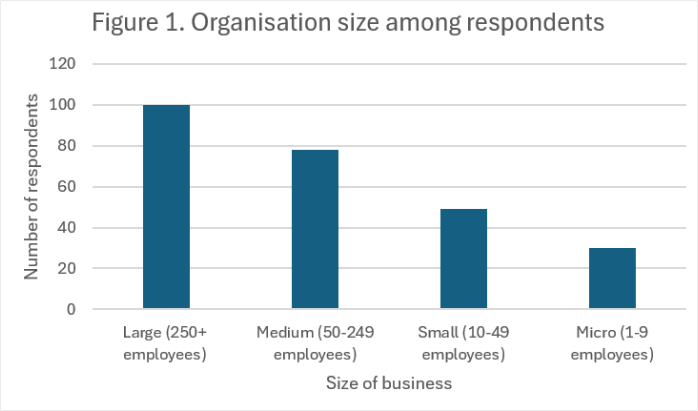
Information was provided on workplace size, including by both employers and individual respondents. Across respondents who provided information on organisation size (252), the largest proportion were from large organisations (250 or more employees) (40%), followed by medium-sized organisations (50 to 249 employees) (29%), small organisations (10 to 49 employees) (19%), and micro-organisations (1 to 9 employees) (12%). Figure 1 shows the distribution of organisation size among respondents.
Figure 2: Regional distribution of respondents
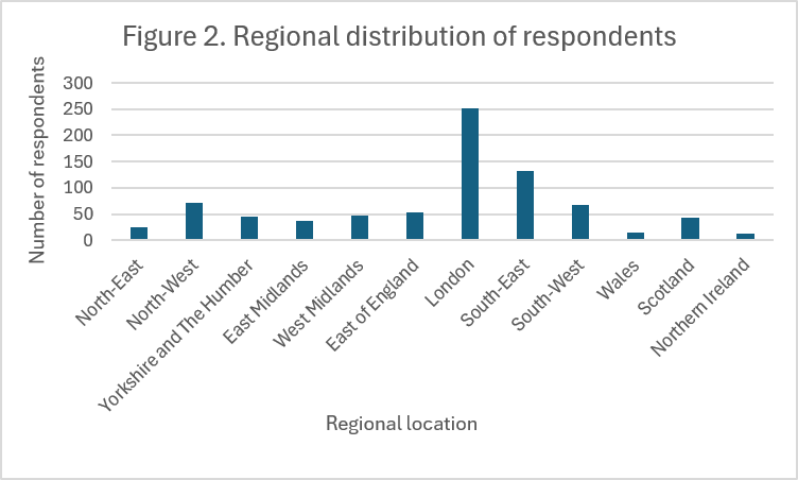
Among the 801 respondents who provided information on location, the largest proportion were based in London (31%), followed by the South-East (17%) and the North-West (9%). Similar proportions (between 5% and 8%) were reported across the South-West, East of England, Midlands, Yorkshire and the Humber, and Scotland. The lowest proportion of responses (between 1% and 3%), were from the North-East, Wales and Northern Ireland. Figure 2 shows the regional distribution of respondents.
780 respondents provided information on the sector they work in. Table 3 shows the distribution of respondents by sector.
Table 3: Breakdown of the distribution of respondents by sector (includes employers and individuals)
| Sector | Count |
|---|---|
| All respondents | 780 |
| Accommodation and food service activities | 10 |
| Activities of households as employers; undifferentiated goods and services-producing activities of households for own use | 5 |
| Administrative and support service activities | 23 |
| Arts, entertainment and recreation | 43 |
| Agriculture, forestry and fishing | 4 |
| Construction | 26 |
| Education | 81 |
| Electricity, gas, steam and air conditioning supply | 5 |
| Financial and insurance activities | 66 |
| Human health and social work activities | 67 |
| Information and communication | 93 |
| Manufacturing | 28 |
| Mining and quarrying | 0 |
| Production | 7 |
| Professional, scientific and technical activities | 101 |
| Public administration and defence; compulsory social security | 34 |
| Real estate activities | 13 |
| Services sector | 32 |
| Transportation and storage | 14 |
| Water supply; sewerage, waste management and remediation activities | 5 |
| Wholesale and retail trade; repair of motor vehicles and motorcycles | 26 |
| Other service activities | 97 |
Figure 3: Status of individual respondents
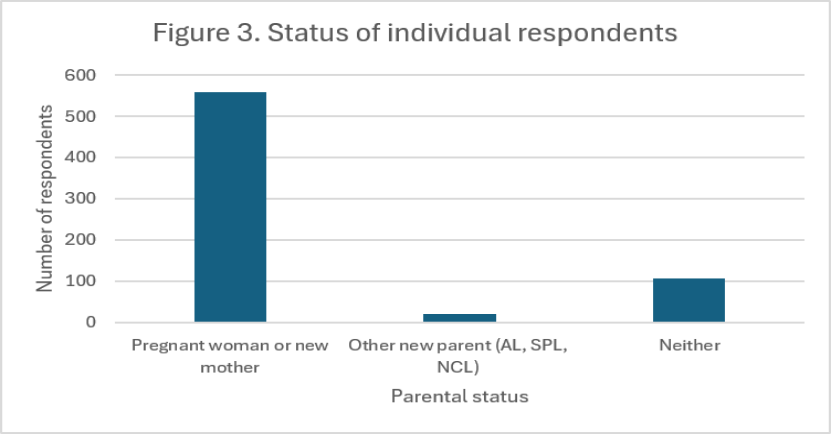
Of the 687 individual respondents who provided information on their status, the majority identified as pregnant women or new mothers (81%). A smaller proportion identified as other new parents (3%), while 16% indicated that they were neither. Figure 3 shows the status of individual respondents.
Figure 4: Age of individual respondents
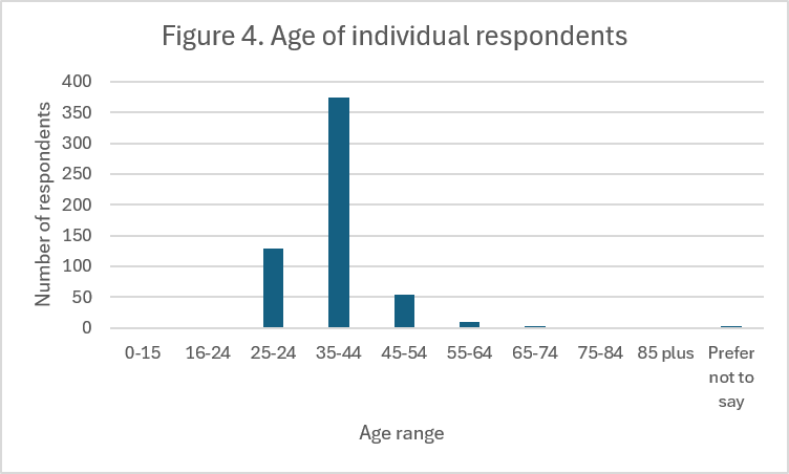
Among the 571 respondents who provided information on age, most were aged 35 to 44 (65%), followed by those aged 25 to 34 (23%) and 45 to 54 (9%), with smaller proportions in other age groups. Figure 4 shows the age of the respondents.
Figure 5. Responses by ethnic group
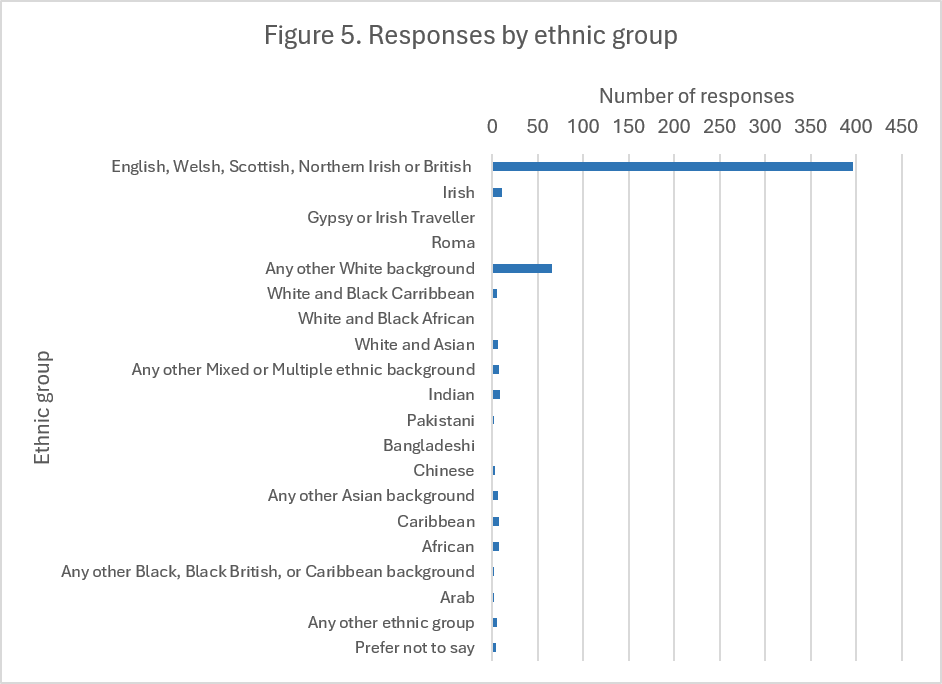
541 respondents disclosed their ethnicity. The majority identified as White (87%), including 73% who identified as English, Welsh, Scottish, Northern Irish or British. Smaller proportions identified as Asian or Asian British (approximately 4%), Mixed or Multiple ethnic groups (approximately 3%), Black, Black British, Caribbean or African (approximately 2%) or other ethnic groups (2%). Figure 5 summarises the demographic characteristics of individual respondents.
The following sections set out the findings from the consultation, drawing on both quantitative responses and the qualitative evidence provided by respondents.
5. Section 2: responses to consultation questions – evidence gathering
As part of this consultation, the government sought to build its understanding of pregnant women and new mothers’ experiences in the workplace to support the development of this policy proposal.
This section summarises the evidence gathered through the consultation on experiences of dismissal and unfair treatment, perceived risks, and the operation of existing protections. It draws on both quantitative responses and qualitative evidence provided by respondents.
Questions 1 to 6 were for pregnant women or new mothers only, based on their personal experiences. Questions 2 to 5 allowed respondents to select more than one option. Percentages are therefore calculated based on the number of respondents who selected each option, not the total number of responses for each question.
Question 1: Have you personally experienced dismissal or unfair treatment from your employer because of pregnancy or new motherhood?
A total of 511 respondents answered this question, with 70% indicating they had been subject to unfair treatment or dismissal because of pregnancy or new motherhood. 30% indicated they had not been subject to such treatment.
Question 2: If ‘yes’ to question 1, please select all of the following that apply.
355 people responded to this question, with many selecting multiple options. When asked about the types of unfair treatment experienced, the most commonly reported issue was being selected for redundancy and suspecting this was related to pregnancy or becoming a new parent (55%). This was followed by being overlooked for promotion or otherwise sidelined (31%), receiving unpleasant comments from employers or colleagues (23%), and being bullied by a line manager or supervisor (22%). Smaller proportions (ranging from 1 to 7% of respondents) related to other experiences including dismissal, pay-related impacts, disciplinary action, denial of training, and discouragement from attending antenatal appointments.
Of those who selected ‘other’, respondents described a range of experiences. Most respondents described employment loss, replacement and job insecurity, including being replaced during pregnancy or Maternity Leave and not being offered a suitable alternative role. Other respondents mentioned a detriment to role and career progression, including downgraded roles. A further theme was lack of workplace support and adjustments, including denial of flexible working, reasonable adjustments or adequate support and communication from employers.
Question 3: If ‘yes’ to question 1, at which of the following stages did you experience the dismissal or unfair treatment?
A total of 353 respondents answered this question and were able to select more than one option, so the total number of responses is greater than the total number of respondents. When asked when dismissal or unfair treatment was experienced, the most reported stage was during pregnancy (42%) and in the 6 months after returning to work (41%). This was followed by during Additional Maternity Leave (32%), Ordinary Maternity Leave (25%) and in months 7 to 12 after returning to work (16%).
A small proportion of respondents selected other (5%) and provided further detail. These responses referred to experiences occurring while expecting an additional child or pregnancy and during or following a miscarriage or stillbirth.
Respondents were able to provide further detail to support their answer. Of those who did the vast majority used this as an opportunity to provide more information about their experience of dismissal or unfair treatment.
Question 4: If you selected ‘A’ or ‘B’ to question 2, which of the following potentially fair reasons were you given for the dismissal?
A total of 43 respondents answered this question and were able to select more than one option, so the total number of responses is greater than the total number of respondents. Redundancy accounted for 88% of responses. Far smaller proportions of respondents were given reasons related to capability (5%) and some other substantial reason (5%). One individual indicated that they were subject to a statutory prohibition (2%), and another that they did not know or were not told the reason for their dismissal (2%).
Of those who provided further detail, most related to concerns about the fairness and transparency of dismissal processes. Respondents described situations where they were not made aware of performance concerns prior to dismissal or believed redundancy processes had been applied unfairly.
Question 5: What calendar year did you experience this issue or these issues described in question 2?
A total of 354 respondents answered this question and were able to select more than one option, so the total number of responses is greater than the total number of respondents. Over half of the respondents (53%) indicated that unfair treatment or dismissal was experienced after the redundancy protections were introduced in 2024. A similar proportion (51%) stated that their experiences were before the current redundancy protections were implemented (between 2010 and 2023), and only a small number of respondents (3%) referred to experiences between 1996 and 2009.
Question 6: Were you aware of where to find information about your workplace rights?
A total of 356 respondents answered this question. The majority of respondents reported being aware of where to find information about their workplace rights (65%), while 35% reported that they were not aware of where to access such information.
Among those who were aware of workplace rights, respondents most commonly mentioned accessing information through official information sources, particularly Acas and GOV.UK. The next most common source of information was through specialist pregnancy and maternity organisations, including Pregnant Then Screwed, Maternity Action and Working Families. The next most frequently cited source of information was through legal and professional advice, including legal advisers and employment specialists.
Questions 7 and 8 were for employers, business representative organisations, trade union or staff associations, academics and legal representatives.
Question 7: In your view, how common are concerns or complaints related to unfair dismissal or treatment during pregnancy?
A total of 150 respondents answered this question. The largest proportion of respondents indicated that these issues are rare (39%). This was followed by those who considered them occasional (28%) or common (18%). A smaller proportion considered such issues to be very common (11%) or non-existent (3%), while 1% selected ‘don’t know’.
Employers and business representative organisations were more likely to consider such issues to be rare (47% and 53% respectively), with a sizeable proportion describing them as occasional (32% and 27%). By contrast, trade unions and charities were more likely to consider such issues to be common (35% and 25%) or very common (35% and 75%).
Of those who provided further detail, employers and business representative organisations’ most common response was that they had a limited experience of concerns or complaints and had supportive workplace practices in place. Trade unions and charities provided further detail setting out examples of where unfair treatment or dismissal had taken place during pregnancy.
Question 8: In your view, how common are concerns or complaints related to unfair dismissal or treatment during new motherhood (that is, on Maternity Leave or when recently returned to work)?
149 respondents answered this question. The largest proportion of respondents indicated that these issues are rare (36%). This was followed by those who considered them occasional (25%) or common (23%). A smaller proportion considered such issues to be very common (13%) or non-existent (3%), while 1% selected ‘don’t know’.
Similarly to question 7, there were clear differences between respondent groups. Employers and business representative organisations were more likely to consider such concerns to be rare (both 47%), while trade unions were more likely to consider them common or very common (94% combined).
Among respondents who provided additional detail, the most common theme raised by employers and business representative organisations was limited experience of concerns or complaints and supportive workplace practices. Respondents often reported no direct experience of unfair treatment during Maternity Leave or on returning to work or considered existing legal protections and employer practices to be effective.
Respondents from trade unions and legal bodies and representatives shared further evidence of unfair treatment and dismissal during new motherhood, including examples of discrimination, redundancy, exclusion from opportunities and difficulties related to flexible working following Maternity Leave.
Questions 9 to 11 were for all respondents.
Question 9: In general, when do you think pregnant women and new mothers are at most risk of unfair treatment?
818 respondents answered this question and could select multiple options, so the total number of responses is greater than the total number of respondents.
The most commonly selected time period was soon after returning to work, that is, within 6 months of returning (78%). This was followed by during Maternity Leave (73%) and during pregnancy (61%). A smaller proportion identified sometime after returning to work (38%), while 5% selected ‘other’, suggesting that most experiences fall within the main stages captured by the question.
Of those who provided further detail, many respondents used the free-text box to elaborate on their experience of either experiencing or witnessing unfair treatment. The most common theme was that women are vulnerable to unfair treatment or dismissal throughout pregnancy, Maternity Leave and the return to work. The second most common response was that risk can arise before pregnancy, with some respondents arguing that women may face discrimination because they are perceived as likely to have children or are trying to conceive. Finally, some respondents expressed views that pregnant women and new mothers do not face a special risk of unfair treatment.
Question 10: In general, when do you think pregnant women and new mothers are most at risk of dismissal?
853 respondents answered this question and could select multiple options, so the total number of responses is greater than the total number of respondents.
Responses to this question showed a similar distribution to question 9. When asked when pregnant women and new mothers are most at risk of dismissal, the most commonly selected stage was soon after returning to work (64%). This was followed by during Maternity Leave (52%). Equal proportions identified during pregnancy and sometime after returning to work (both 34% respectively), while 5% selected ‘other’.
Similar themes arose in this question, too. Of the respondents who provided further detail, they most commonly viewed women as vulnerable to unfair dismissal throughout pregnancy, Maternity Leave and the return to work. A second theme was that risk can arise before pregnancy, particularly where women are perceived as likely to have children or are trying to conceive. Finally, some respondents maintained that pregnant women and new mothers are not at risk.
Question 11: What impact have the 2023 to 2024 extended redundancy protections for pregnant women and new mothers had on how pregnant women and new mothers are treated in the workplace?
499 respondents answered this question. Responses suggest mixed views on the impact of the 2023 to 2024 extended redundancy protections. The largest proportion of respondents indicated that the impact has been negligible (49%), while 46% reported a positive impact. A small proportion reported a negative impact (3%), and 2% selected ‘don’t know’.
Of those who provided further detail, the most prominent theme was that the protections are viewed as insufficient in practice. Respondents argued that redundancies can still occur despite the protections, with some suggesting that employers can bypass the rules, delay redundancy decisions, or rely on the lack of suitable alternative roles.
A second theme was improved job security and redundancy outcomes. Respondents reported that the protections had increased employer awareness of their responsibilities and improved protection for pregnant women and new mothers in redundancy situations. A further theme was awareness and implementation challenges. Respondents highlighted a lack of awareness of the protections among both employers and employees, which they felt limited their effectiveness.
5.1 Government response to questions 1 to 11
The government has carefully considered the evidence gathered on experiences of dismissal and unfair treatment during pregnancy, Maternity Leave, and the return-to-work period. The findings highlight continued vulnerability at each stage, as well as particular risks on returning to work.
The evidence demonstrates that the current framework does not always provide sufficient clarity or protection in practice and underscores the need for a strengthened and more consistent approach. These findings have informed the government’s decision to introduce enhanced dismissal protections, as set out in the following sections.
6. Section 3: in what circumstances should dismissals be allowed
6.1 Government response to questions 12 to 18
The next section of the consultation considered several related questions on how the enhanced dismissal protections should operate in practice, including the:
- legal test
- timing and scope of the protections
- application of protections across different parental leaves
- related implementation considerations
Unless otherwise specified, these questions were open to all respondents.
Question 12: What kind of test should be used to decide whether a pregnant woman or new mother was fairly dismissed during the protected period?
This question was answered by 764 respondents. Overall, 52% supported the introduction of a general fairness test, 33% supported the narrowing or removal of existing fair reasons for dismissal, while 14% selected ‘other’. Among respondents who selected ‘other’ a majority stated that the protections should not be strengthened.
Employers and business representative organisations (47% and 44% respectively) were significantly more supportive of introducing a new general fairness test over narrowing or removing existing fair reasons (15% and 4% respectively), whereas responses among individuals were much more evenly divided between the 2 options.
Among respondents who supported a general fairness test, the most common suggestion concerned how the test should operate, including the need for an objective test with clear criteria and definitions. A second most common response reflected the need for businesses flexibility to dismiss in appropriate circumstances. The third most common response reflected concerns about the limitations of current protections, with some respondents arguing that the existing approach is overly vague.
Among respondents who favoured narrowing the existing fair reasons, the most common view was that protections should be strengthened, with respondents frequently arguing that the current legal test is too vague. Respondents also made a range of suggestions as to how the fair reasons for dismissal could be narrowed, including the removal of capability, conduct and ‘some other substantial reason’ (SOSR), as well as clearer evidential requirements for employers. A third theme was respondents advocating for narrowing redundancy dismissals.
Question 13: If ‘A’ to question 12, what should that new test be?
This question was answered by 364 respondents. Respondents were able to select more than one option, so percentages are based on number of respondents rather than total option selections.
69% favoured a test permitting dismissal only where continued employment would pose a health and safety risk to customers, staff, or the public. A further 68% of respondents proposed a test under which dismissal would only be permissible where continuing the employment of a pregnant woman or new mother would have a significantly detrimental effect on the business. Another 49% favoured a test permitting dismissal when the continued employment of a pregnant woman or new mother would have a serious negative impact on the wellbeing of others. The remaining 12% selected ‘other’.
Among respondents who selected ‘other’, the 3 most common themes were evidential requirements and employer accountability; that the reasons should be narrowed; and lastly that employers should be able to retain their ability to dismiss in legitimate circumstances.
Of those who provided further detail, the most commonly expressed view was the need for any test to provide objectivity, clarity and legal certainty. Respondents emphasised the that the test should have clear criteria and definitions, arguing that the terms should be defined and applied consistently. A second frequently raised theme was evidential requirements and employer accountability. Respondents argued that employers should be required to provide clear evidence supporting the rationale for dismissal and demonstrate that appropriate processes had been followed. A further theme concerned business viability and employer impacts. Respondents emphasised the importance of considering the impact on businesses, including ongoing viability and the circumstances of smaller employers when assessing whether a dismissal was justified.
6.2 Government response to questions 12 and 13
The government has considered views on both the overall approach to the legal test and the design of any revised test.
The government recognises the need to strengthen the existing test while maintaining flexibility to allow dismissal in appropriate circumstances. The government therefore intends to replace the current band of reasonable responses test for unfair dismissal with the proportionality test that is a defence to a number of discrimination claims under the Equality Act 2010 (commonly referred to as the ‘objective justification’ test). Under this approach, an employer must demonstrate that dismissal is a proportionate means of achieving a legitimate business aim.
The government considers that a proportionality test is capable of capturing the consultation options and many of the approaches put forward by respondents, while applying a consistent threshold that is higher than the current band of reasonable responses test. In essence, the government expects that dismissal could still be justified where continued employment would, for example, pose a health and safety risk to customers, staff or the public; would have a significantly detrimental effect on the business; or would have a serious negative impact on the wellbeing of others. By focusing on proportionality, the test allows relevant factors to be weighed up, rather than relying on rigid or narrowly defined grounds.
In practice, applying a proportionality test would require employers not only to set out a legitimate business aim on which they rely, but also to demonstrate that the serious step of dismissing the employee is a proportionate way of achieving that aim. This will ordinarily require an employer to consider whether there are no reasonably viable, less discriminatory alternatives to dismissal. This would typically include consideration of how the employee could be supported to remain in work, for example through workplace adjustments, temporary measures, or the identification of suitable alternative roles, before dismissal is pursued.
The government does not intend specifying how the test should operate in regulations. However, guidance will set out how to approach complying with the test in practice, including the expectation that employers will consider alternatives to dismissal where appropriate.
The government considers that this approach introduces a clearer and more robust framework, striking the balance between strengthening protection against unfair or discriminatory outcomes while retaining flexibility for employers to manage genuine issues.
Question 14: Thinking about the fictional examples above, and any personal or professional experience you may have, when do you think it should be possible to dismiss a pregnant woman or new mother on grounds of conduct?
This question was answered by 364 respondents. Respondents were able to select more than one option, so percentages are based on number of respondents rather than total option selection.
The largest proportion of respondents supported narrowing dismissal during the protected period to cases of clear gross misconduct (for example, theft, violence, racism, or serious breaches of safety protocols (77%). This was followed by dismissal in situations where continued employment poses a demonstrable health and safety risk to staff, customers, or the wider public (62%).
A smaller number indicated that dismissal may also be appropriate where behaviour results in a serious negative impact on the wellbeing of others (45%) or where it causes significant harm to the business (39%).
30% stated that dismissal should be permitted for any kind of misconduct and that rules should not be narrowed. A further 7% selected ‘other’ and 4% selected ‘don’t know’. Of those who selected ‘other’ the most common theme was that a dismissal should not be related to pregnancy or maternity.
Across the different options, where respondents provided additional information, the most common consideration related to fairness, workplace equity and impacts on business. Respondents emphasised the need to balance stronger protections for pregnant women and new mothers with fair treatment of other workers and employers’ ability to address other repeated conduct issues.
A second theme focused on considering pregnancy, post-birth and caring-related circumstances, including whether conduct was connected to pregnancy or maternity and whether appropriate support or adjustments had been provided. Respondents also highlighted the need for safeguards against misuse or abuse of the rules, including clear and objective criteria to ensure that protections were applied consistently and did not prevent proportionate action in legitimate cases.
Question 15: Thinking about the fictional examples above, and any personal or professional experience you may have, when do you think it should be possible to dismiss a pregnant woman or new mother fairly on grounds of capability?
840 respondents answered this question. As respondents were able to select more than one option, so percentages are based on number of respondents rather than total option selection.
The most commonly selected option was that dismissal should be allowed where continued employment poses a health and safety risk to customers, staff or the public (56%). This was followed by dismissal where there is no suitable alternative role available or one was offered and declined (42%).
A similar proportion of respondents supported dismissal where continued employment has a serious negative impact on the wellbeing of others (39%), or where the employer can show the employee will be unable to do the job after the protected period ends (39%).
Smaller proportions supported dismissal for any capability issue and that the rules should not be narrowed (15%), while 21% said capability should not be a fair reason for dismissal during the protected period. A further 5% selected ‘other’, and 3% selected ‘don’t know’. Of those who selected ‘other’, the most common theme was the need for evidence requirements on businesses such as demonstrating that the dismissal is unrelated to pregnancy or maternity.
Across the different options, where respondents provided additional information, respondents most frequently argued that employers should provide appropriate support, make reasonable adjustments and fully explore suitable alternative roles before considering dismissal, But also that a dismissal should be considered fair providing these steps have been taken.
A second theme was that the protections should not be changed. Respondents expressing this view argued that employers should retain the ability to address genuine capability concerns under the existing framework. A further theme focused on pregnancy, post-birth and prior capability context. Respondents emphasised that capability concerns linked to pregnancy, childbirth or post-birth recovery should not justify dismissal, and that employers should distinguish these from capability issues that pre-dated pregnancy or were genuinely unrelated to it.
Question 16: Thinking about the fictional examples above, and any personal or professional experience you may have, when do you think it should be possible to dismiss a pregnant women or new mother fairly on ground of redundancy during the protected period?
This question was answered by 835 respondents. Respondents were able to select more than one option, so percentages are based on number of respondents rather than total option selection.
The most commonly selected option was that dismissal should be allowed where the business or organisation ceases to exist, and the employee has been offered any suitable alternative vacancy available (66%). This was followed by dismissal where there is no suitable alternative vacancy and where termination is necessary to address financial difficulties affecting the business (34%). A smaller proportion of respondents (21%) indicated that employers should be able to dismiss for any kind of redundancy provided a suitable alternative vacancy is offered where available. 9% respondents selected ‘other’ and the remaining 8% selected ‘don’t know’. Of those that selected ‘other’, the most commonly raised theme was that redundancies should not be allowed.
Respondents most commonly called for stronger safeguards and employer accountability, including evidence that redundancy decisions were genuine and unrelated to pregnancy or maternity, an external review of the dismissal and stricter rules against misuse. Other respondents stressed the need to balance protections with wider business impacts, including wider workplace fairness and the ability of businesses to make redundancies to ensure ongoing viability. Respondents also highlighted that any redundancy should be a genuine last resort, with employers expected to consider alternatives, such as redeployment, before dismissal.
Question 17: Thinking about the fictional examples above, and any personal or professional experience you may have, when do you think it should be possible to dismiss a pregnant women or new mother fairly on ground of statutory prohibition during the protected period?
This question was answered by a total of 834 respondents. Respondents were able to select more than one option, so percentages are based on number of respondents rather than total option selection.
The most commonly selected option was that dismissal should be allowed on statutory prohibition grounds only if there is no suitable alternative role available, or one was offered and turned down (58%). This was followed by the view that employers should be able to dismiss fairly for any kind of statutory prohibition issue without narrowing the rules (29%). This option was selected by a higher proportion of employers (72%) than individual respondents (22%). 6% of respondents selected ‘other’ and the remaining 15% selected ‘don’t know’. Of those that selected ‘other’ the most prominent theme was individuals stating that statutory prohibition should not be a reason dismiss.
Across the different options, respondents most commonly emphasised the need to balance worker protection with fairness to employers. They argued that employers should not be required to continue employment where this would breach the law.
Practical implementation and responsibilities were also prominent including suggestions that employers should alert workers when certifications need renewing. Respondents also supported the use of temporary suitable alternative roles, with a route back to the original role. Additionally, respondents called for greater support for pregnant women and new mothers, such as time to regain compliance, employer assistance to maintain qualifications, and financial support where continued employment was not possible.
Question 18: Thinking about the fictional examples above, and any personal or professional experience you may have, when do you think it should be possible to dismiss a pregnant women or new mother fairly on ground of SOSR during the protected period?
A total of 834 respondents answered this question. Respondents were able to select more than one option, so percentages are based on number of respondents rather than total option selections.
The most commonly selected option was that dismissal should be allowed where continued employment poses a health and safety risk to customers, staff or the public (46%). This was followed by dismissal where continued employment would seriously harm the business (35%), where there would be a serious negative impact on the wellbeing of others (34%) and where there is no suitable alternative role available, or one was offered and turned down (26%). A small portion of respondents selected ‘other’ (3%) and the remaining selected ‘don’t know’ (8%). Of those who selected ‘other’ very few respondents provided further detail in response to this question, so it has not been possible to identify robust themes.
Employers and business representative organisations were more likely to opt for retaining the current rules (58% of employers compared to 7% of individuals). Individual respondents were more likely to support limiting SOSR dismissals to circumstances where no suitable alternative role was available, or where continued employment would harm the business, pose a health and safety risk to staff, customers or the public, or adversely affect the wellbeing of others.
Where further detail was provided, respondents (predominantly individuals) commonly raised concerns about employer misuse of SOSR, such as the risk of using the breakdown of workplace relationships as a pretext to circumvent the protections and dismiss pregnant women or new mothers. This was followed by a second common theme of many (predominantly employers and business representative organisations) who considered additional protections unnecessary, arguing that the existing framework required little or no change. Respondents also highlighted the need for clear definitions and criteria, with calls for tighter limits on the use of SOSR as a dismissal reason, and clearer guidance or criteria which defines the main terms.
6.3 Government response to questions 14 to 18
The government has considered views on when dismissal should be permitted during the protected period across the 5 fair reasons for dismissal. A large number of respondents generally agreed that dismissal should still be possible in limited and clearly defined circumstances, while emphasising the need for appropriate safeguards.
The government recognises that maintaining the existing framework of potentially fair reasons for dismissal is important to ensure employers can continue to manage their workforce effectively. At the same time, stronger safeguards are needed to ensure dismissals during the protected period are fair and justified.
The government has therefore decided to retain all 5 of the existing fair reasons for dismissal, while strengthening the framework for assessing fairness during the protected period, as set out in the response to questions 12 and 13. This approach ensures that dismissal remains possible where justified, while providing greater protection for pregnant women, new mothers, and other parents.
7. Section 4: when the protection starts
7.1 Government response to questions 19 to 20
Question 19: When should employees be entitled to enhanced dismissal protections?
A total of 847 respondents answered this question. The largest proportion of respondents (36%) indicated that employees should be entitled to enhanced dismissal protections after an initial period of employment of between 3 and 9 months. Similar proportions supported earlier entitlement: 32% felt that protections should apply when the employment relationship begins, while 27% believed that protections should apply from the day an employee starts work.
Although framed differently, both of the latter options would in practice mean protections applying at the start of employment, rather than after a qualifying period. Taken together, these responses indicate a majority of respondents (59%) favoured a ‘day one’ entitlement. Lastly, the remaining 5% of respondents selected ‘other’. Of those that selected ‘other’, the most recurring theme was that individuals should be entitled to protections after 6 months.
There were clear differences between respondent groups. Employers and business representative organisations were more likely to support a qualifying period (62%), whereas individuals were more likely to support day one options (29% from the day they start work, 36% when the employment relationship begins).
Those who favoured a probation period argued that a qualifying or probation period could provide accountability, allow capability or conduct concerns to be addressed, and protect employers. Those who selected ‘from the day they start work’ and ‘when the employment relationship begins’, contended that individuals can be at risk of discrimination as soon as they start work, so should be protected at this point.
Question 20: At what point should the enhanced dismissal protections start for pregnant women?
A total of 846 respondents answered this question. 45% of respondents indicated that protections should begin once an employee informs her employer that she is pregnant, making this the most selected option. A further 34% of respondents favoured protections beginning when the employee becomes pregnant, while 18% selected ‘when she becomes aware of the pregnancy’. A small proportion (3%) selected ‘other’. Of those who selected ‘other’, the most frequently raised position was that there should be no changes to the current protections.
Respondents who selected ‘when an employee becomes pregnant’ and ‘when an employee becomes aware that she is pregnant’ and provided further detail commonly emphasised that women should not have to disclose a pregnancy before they were ready.
In contrast, respondents that selected ‘when an employee informs her employer that she is pregnant’ most frequently raised considerations of fairness and practical challenges if the protections start before the employer is notified. Arguing that employers should not be held responsible for decisions made before they were aware of the pregnancy.
7.2 Government response to questions 19 and 20
In responding to questions 19 and 20, the government considered views on when enhanced protections should begin, including entitlement and trigger points.
The government recognises the importance of ensuring the framework remains clear and practical to apply.
The government will legislate so that enhanced dismissal protections are a ‘day one’ right, with no qualifying period, aligning with existing automatic unfair dismissal and pregnancy or maternity discrimination protections and ensuring coverage from the start of employment.
Protections will begin when an employee informs her employer (either in writing or verbally) that she is pregnant. This provides a clear and consistent trigger point, aligned with the existing redundancy framework, and ensures that employers are able to fulfil their legal obligations once they are aware of the pregnancy.
8. Section 5: when the protection ends
8.1 Government response to questions 21 to 22
Question 21: When should the protections ‘window’ for new mothers entitled to Maternity Leave end?
A total of 843 respondents answered this question. There was strong overall support for protections lasting 18 months from the birth of the child, aligning with existing redundancy protections (77%). This was followed by a shorter period of 6 months from the return to work (19%). The remaining respondents selected ‘don’t know’ (3%).
Although a majority across most respondent groups supported the longer 18-month period, individual respondents were particularly supportive (82%), while employers were more evenly split between the 2 options (52% supporting 18 months and 44% supporting 6 months).
8.2 Government response to question 21
The government has considered views on when enhanced dismissal protections should end for new mothers entitled to Maternity Leave.
The government has decided that protections will extend throughout pregnancy and Maternity Leave and continue for 6 months following the end of leave. This reflects the continued vulnerability faced by new mothers during the return-to-work period.
While many respondents supported an 18-month protection window, aligned with existing redundancy protections, the government has taken a more proportionate approach. The government continues to support the rationale for a universal period of protection in the redundancy context, as these protections address risks that exist independently of the employee’s performance, conduct or presence in the workplace. Redundancy continues to be the most common dismissal reason for this cohort, so it is right that there continues to be redundancy-specific protections. Therefore, the existing redundancy protections, including the 18-month protected period will remain in place.
By contrast, other dismissal grounds are more closely connected to matters arising during employment, such as an employee’s performance, conduct or working relationships, and the protection against dismissal is therefore more appropriately applied during a fixed period after the employee’s return to work. Providing a fixed period of protection from birth could mean that employees who take a short period of leave remain protected long after returning to work. For example, if the protections were to end 18 months from birth it would mean that an employee who returns to work after 2 months would be protected for a further 16 months when back at work. As the new test is placing greater obligations on employers (more information in the government response to questions 12 and 13), it could make it disproportionately difficult for employers to address legitimate capability or conduct issues arising well after the employee’s return.
A 6-month post-leave protection period better reflects the evidence gathered in Section 1 of the consultation, which indicates that the risk of unfair treatment is most acute during the initial period after returning to work. It therefore provides enhanced protection during the period of greatest vulnerability while maintaining a proportionate link to the employee’s leave and return to work. This approach also helps ensure that the protections across different types of leave (more information about this can be found in the government response to Section 6) remain proportionate and evidence-based. This recognises that the strongest evidence of workplace disadvantage relates to pregnant women and new mothers.
Recent evidence from the Parental Leave and Pay Review indicates that most mothers take at least 39 weeks or more of Maternity Leave[footnote 1]. For those mothers who take the full statutory period of Maternity Leave (52 weeks), there will be no change in the overall duration of the protection, as the enhanced dismissal protections will ultimately last for 18 months from birth.
Question 22: Should women who are not entitled to Maternity Leave have protection against dismissal for 2 weeks after the end of their pregnancy?
842 respondents answered this question. 80% of respondents indicated that women who are not entitled to Maternity Leave should receive 2 weeks’ protection against dismissal following the end of their pregnancy. Smaller proportions selected ‘other’ (13%), while 4% of respondents selected ‘no’ and 4% selected ‘don’t know’.
Those who selected ‘no’ or ‘other’ were asked to explain their answer. The most common theme was that the protected period should be longer than 2 weeks, however there was no consensus on how long protections should be, with many respondents not providing an alternative. Other responses focused on the reasons for extending protection. Respondents highlighted the physical and mental impacts of pregnancy loss and the continuing risk of discrimination or detriment after a woman had shown an intention to have children.
8.3 Government response to question 22
The government has considered views on whether the protections should apply where a pregnancy ends before 24 weeks and the employee is not therefore entitled to statutory Maternity Leave.
The government has decided that enhanced dismissal protections will continue for 2 weeks following the end of the pregnancy, aligning with the existing redundancy protections, so it will be something employers are familiar with.
The government recognises that some respondents supported a longer period because of the physical and mental impacts of pregnancy loss and the ongoing risk of discrimination. However, there was no clear consensus among respondents on an appropriate alternative duration.
The government considers that a 2-week period provides a clear and consistent approach that aligns with the existing legal framework.
9. Section 6: other parents
9.1 Government response to questions 23 to 29
Questions 23 to 25 were for respondents who are taking or have taken Adoption Leave, Shared Parental Leave or Neonatal Care Leave only. Question 26 was for employers, business representative organisations, trade unions, staff associations, charities, interest groups, academics and legal representatives. Questions 27 to 29 were for all respondents.
Question 23: Have you personally experienced dismissal or unfair treatment because you have taken a long family leave entitlement (that is, Adoption Leave, Shared Parental Leave or Neonatal Care Leave)?
Among 17 respondents who answered this question, 41% reported experiencing dismissal or unfair treatment because they had taken Shared Parental Leave, while 29% indicated they had not. A further 18% reported experiencing unfair treatment after taking Adoption Leave, and another 18% selected ‘don’t know’. A smaller proportion (6%) indicated they had not experienced unfair treatment after taking Neonatal Care Leave.
All respondents who had taken Adoption Leave indicated they had experienced unfair treatment, whilst no respondents who had taken Neonatal Care Leave reported they had faced unfair treatment (Neonatal Care Leave was only introduced in April 2025).
Question 24: If ‘yes’ to question 23, which of the following applies?
There were 7 respondents who answered this question; respondents were able to select multiple options. 43% indicated they were selected for redundancy and suspected this was linked to pregnancy or becoming a new parent. The same proportion (43%) was recorded for several experiences: unpleasant comments from employer or colleagues, being overlooked for promotion or otherwise sidelined, being given unsuitable work or workloads, and being unfairly criticised or disciplined about performance.
A further 29% reported being bullied by their line manager or supervisor, being denied access to training, or being treated so poorly that they felt they had to leave. Smaller proportions (14%), related to being discouraged from attending antenatal classes during work time, dismissals, and receiving a lower pay rise or bonus than their peers.
Question 25: If ‘yes’ to question 23, at which of the following stages did you experience the dismissal or unfair treatment?
There were 7 individuals who responded to this question and were able to select multiple options. 43% indicated that unfair treatment or dismissal occurred between telling their employer they were taking Adoption Leave, Shared Parental Leave or Neonatal Care Leave and going on leave. An equal proportion (43%) reported that the unfair treatment happened during the relevant leave. A further 43% related to experiencing unfair treatment in months 7 to 12 after returning to work. A smaller proportion (29%) selected other, given the small number of respondents who provided further detail it has not been possible to identify robust themes.
Question 26: Do you think that parents who take long, family leave entitlements (that is, Adoption Leave, Shared Parental Leave or Neonatal Care Leave) are vulnerable in a dismissal situation?
Among 157 respondents who answered this question, 62% of respondents believed that parents who take long family leave entitlements such as Adoption Leave, Shared Parental Leave or Neonatal Care Leave are vulnerable in a dismissal situation. A further 24% did not consider these parents to be vulnerable, while 14% selected ‘don’t know’.
Of those who said ‘yes’, a common theme was heightened vulnerability arising from absence and reduced workplace visibility. Respondents argued that employees taking extended family-related leave could be overlooked during restructuring, consultation or redeployment, lose connections and visibility, or be viewed as more dispensable because arrangements had been made to cover their work. Of those who said ‘no’, the most frequently raised theme was that they lacked awareness of the issue.
Question 27: Do you think the enhanced dismissal protections should also cover employees taking these other types of long family leave?
A total of 798 respondents answered this question, and multiple options could be selected. A large majority of respondents indicated that other types of leave should be brought within scope of the enhanced dismissal protections. Most respondents selected multiple, and often all, of the listed leave types (83% selected all options), indicating broad support for a consistent approach across different forms of leave.
Responses were relatively evenly distributed across leave types, with 95% selecting Adoption Leave, 94% selecting Neonatal Care Leave, 91% selecting Shared Parental Leave, and 89% selecting Bereaved Partner’s Paternity Leave.
The most frequently raised theme was that comparable experiences justified comparable protections. Respondents argued that parents taking these other forms of leave could face the same risks and difficulties as those taking Maternity Leave and should therefore receive equivalent protection.
A second theme was the promotion of gender equality and shared parenting. Respondents considered that equal protection for non-birthing parents, including men, would encourage greater take-up of leave and help reduce assumptions that caring responsibilities fall primarily on women. A further theme was respondents arguing that excluding particular groups would be unfair and inconsistent.
Question 28: Thinking about your answer to question 27, should the protection against dismissal start from the first day of leave?
As these other forms of family leave are not necessarily preceded by pregnancy, there is no equivalent pregnancy-related trigger point for the start of protection. This question therefore asked whether protection should begin from the first day of leave.
814 respondents answered this question. The majority of respondents (83%) agreed that protections should begin from the first day of leave. A small proportion selected ‘no’ (4%), while 8% selected ‘other’. Of those that selected ‘other’, the recurring theme was that the protection should start when the employer is informed of the intention to take the leave.
Among respondents who selected ‘yes’ and provided further detail, the most frequent theme was clarity for all parties, including simplicity, certainty and alignment with existing protections. This was followed by equality and consistency of treatment across parents and leave types. Timing and the risk of discrimination were raised equally often, including concerns about discrimination before leave begins.
Among respondents who selected ‘no’ and provided further detail, respondents frequently raised the timing of when protection should begin. This was followed by the view that enhanced dismissal protections should not apply.
Question 29: Thinking about your answer to question 28, how long should the protection against dismissal last?
785 respondents answered this question and could select multiple options. The majority of respondents supported aligning the duration of protection with the existing approach to enhanced redundancy protections, which provides eligible groups with protections against redundancy for 18 months post-birth of the child that the leave is taken in relation to. This included 81% of respondents in relation to Adoption Leave, and 81% in relation to Shared Parental Leave, Neonatal Care Leave and Bereaved Partner’s Paternity Leave. A smaller proportion (11%) selected ‘other’.
Of those who selected ‘other’, the most common response was that the protection should last up to 18 months from the birth or adoption of the child. These respondents therefore did not propose a substantively different duration from those who selected the 18-month option.
Conversely, the next most common theme was that there should be no enhanced dismissal protections.
9.2 Government response to questions 23 to 29
In responding to questions 23 to 29, the government considered evidence on experiences of unfair treatment, perceived vulnerability, and views on extending protections to other forms of parental leave. There was broad support for extending protections with a strong emphasis on fairness and consistency across different types of leave.
The government has considered these views and intends to extend enhanced dismissal protections to parents taking Shared Parental Leave, Bereaved Partner’s Paternity Leave and Adoption Leave because these entitlements broadly align with Maternity Leave in providing a substantial protected period of leave following the arrival of a child. While Neonatal Care Leave differs in its purpose, it similarly involves a significant period away from work associated with caring responsibilities following birth. Protections will apply from the first day of leave for all eligible leave types.
For these eligible leaves, the protections will apply from the first day of leave and continue for 6 months after the leave ends, providing comparable protection to those returning from Maternity Leave. Further information on the rationale for the 6-month protection period is set out in our response to Question 21. Consistent with the existing redundancy protection framework, for those taking Shared Parental Leave, Neonatal Care Leave or Bereaved Partner’s Paternity Leave, the end of leave protections will apply where an individual has taken at least 6 weeks of continuous leave. This ensures the protections remain focused on individuals who have taken a significant period away from work and may therefore be more likely to experience discrimination or unfair treatment on their return.
The government has sought to take a balanced approach, opting for a 6-month protected period as opposed to 18 months of post-birth or post-adoption protection. While recognising the particular risk faced by pregnant women and new mothers, the government aims to ensure protections apply consistently across parents who take the qualifying leaves set out above. Clear guidance will be provided to support understanding and implementation.
10. Section 7: awareness of rights and supporting business
10.1 Government response to questions 30 to 32
Question 30: How do we ensure women, including those from minority groups, are aware of the enhanced dismissal protections for pregnant women and new mothers?
A total of 831 respondents answered this question. Respondents were able to select more than one option, so percentages are based on number of respondents rather than total option selection.
Responses were fairly evenly split between public bodies (87%), employer-led communication (86%), and intermediary organisations such as trade unions and advice services (78%). A further 17% selected ‘other’. Among those who selected ‘other’, the top 3 themes were using health services as a trusted point of information, employer responsibility to communicate workplace rights, and media campaigns.
Respondents suggested a range of channels and methods to ensure pregnant women and new mothers were aware of their rights. Respondents frequently highlighted the role of health services, such as midwifery and antenatal care, alongside employers, media campaigns, community groups, trade unions, charities and government information sources. Many argued that information should be communicated through multiple channels to help ensure it reached women at different stages of pregnancy and Maternity Leave.
The second most common theme was accessibility and clarity of information. Respondents emphasised that information should be clear, simple and easy to understand, with some calling for information to be available in multiple languages, supplemented by examples and case studies, and tailored to different audiences and ways of accessing information.
Question 31: How do we ensure employers are aware of these changes?
824 respondents answered this question. Respondents were able to select more than one option, so percentages are based on number of respondents rather than total option selection.
Respondents were asked to select from a range of approaches to improve employer awareness. The most commonly selected option was communication through government, regulatory, and public bodies (96%), and a further 75% selected intermediaries such as trade and business organisations. A smaller proportion (10%) selected ‘other’. Among respondents who selected ‘other’, the 3 most common themes were training, education and capability; a direct role for government in communicating the changes; and legal or formal requirements.
Respondents provided a range of suggestions on how awareness of the proposed protections could be raised among employers. The most common suggestion was the need to utilise employer communication and dissemination channels. This included government-led communications such as His Majesty’s Revenue and Customs (HMRC), Acas and GOV.UK.
A second theme was legal or formal requirements. Respondents suggested that employers should be required to be aware of the law and, in some cases, to provide information on the protections to employees. Some proposed formal mechanisms to demonstrate compliance, including confirmation that employers were aware of their obligations. Lastly, the third most common theme was clarity and accessibility of information around the legislation.
Question 32: How can we best support businesses, including smaller businesses, through this change and to avoid disputes escalating to the Employment Tribunal?
A total of 813 respondents answered this question. Respondents were able to select more than one option, so percentages are based on number of respondents rather than total option selection.
The most commonly selected option was clear guidance (92%). This was followed by employer training, webinars and workshops (82%), access to free advice routes (77%), practical tools such as templates, model policies and checklists (73%), awareness campaigns (70%), and more information about dispute resolution processes (64%). A small proportion (7%) selected ‘other’. Respondents who selected ‘other’ most commonly raised employer advice, guidance and education.
Where respondents provided further detail, they suggested a range of measures that could support the effective implementation of enhanced dismissal protections. The most common theme was employer advice, guidance and education. Respondents emphasised the importance of clear and accessible guidance, practical examples and case studies, targeted communications, and support for employers to understand and comply with the new protections. The second top theme was financial and practical support for businesses. Respondents highlighted the need for financial assistance to help employers manage the continued employment of women on Maternity Leave, while some suggested additional funding for organisations providing employer support and advice. A further common theme was simplicity and proportionate implementation. Respondents emphasised that the protections should be simple, clear and easy to apply in practice, with some calling for different approaches for smaller businesses to reflect the resources available to them.
10.2 Government response to questions 30 to 32
The government has considered the responses to these questions, which emphasised the importance of clear guidance and a coordinated, multi-channel approach involving government, employers, and intermediary organisations.
The government will continue to work with business, charities and trade unions to ensure individuals and businesses are fully aware of the changes. The government will also work with trade unions, employers and charities to develop and promote practical guidance for both employers and employees, including practical examples to support understanding and implementation. This will be supported by clear and accessible information from Acas.
11. Section 8: mitigating unintended consequences
11.1 Government response to questions 33 to 35
Question 33: What unintended consequences, if any, do you think could arise from the enhanced dismissal protections?
806 respondents answered this question and were able to select more than one option. The most selected unintended consequence was increased discrimination, including hesitancy in or avoidance of hiring women of childbearing age, which was selected by 81% of respondents. This was followed by employers delaying dismissal decisions until after the protection period lapses, selected by 62% of respondents.
Around 45% of respondents selected negative perceptions of workplace fairness or culture. Then followed unsustainable or unrealistic asks on small businesses, which was selected by 42%, and legal uncertainty, where employers avoid fair dismissal due to perceived risk, which was selected by 40%. Higher proportions of employers than individuals selected both of these options. Smaller proportions selected negative impacts on hiring generally (34%) and administrative burden (30%). Finally, 2% selected ‘none’. Among respondents who selected ‘other’ (5%), most put forward suggestions which reiterated the options provided.
Where respondents could provide further detail, they largely reiterated and expanded on the potential unintended consequences set out in the options. The most prominent theme was increased discrimination or disadvantage for pregnant women and new mothers. Respondents warned that employers could become more hesitant to recruit, retain or progress pregnant women and new mothers, or women perceived as likely to take family-related leave.
A second recurring theme was negative employer behaviour in response to the protections, including concerns that some employers could seek to circumvent the rules by delaying dismissals, using fixed-term contracts, reducing family-friendly provisions or otherwise avoiding the intended effect of the policy.
Other commonly expressed views included negative impacts on workplace fairness, culture and relationships. Respondents suggested that perceptions of pregnant women and new mothers receiving special treatment, alongside concerns about unfair impacts on other employees, could create resentment or workplace hostility.
Question 34: What unintended consequence, if any, do you think could arise if the policy were to exclude capability and SOSR as fair reasons to dismiss a pregnant women or new mother?
In total, 197 responses were received for this question. Respondents identified a range of potential unintended consequences that could arise if capability and SOSR were excluded as fair reasons for dismissal. The most common response was wider impacts on businesses and organisational capacity. Respondents raised concerns about operational, administrative, financial and legal burdens on businesses, with some highlighting disproportionate effects on small-medium enterprises (SMEs) and other sector-specific issues. A second recurring theme was negative impacts on workplace fairness, culture and relationships. Respondents suggested that perceptions of pregnant women and new mothers receiving special treatment, alongside concerns about other unfair impacts on colleagues, could create a sense of unfairness and contribute to workplace hostility. The third most prominent theme was increased discrimination or disadvantage for pregnant women and new mothers. In particular, respondents warned that employers could become less willing to recruit them or might subject them to greater unfair treatment.
Question 35: What action(s) could be taken to mitigate against any unintended consequences?
749 respondents answered this question. Respondents were able to select more than one option, so percentages are based on number of respondents rather than total option selection.
The most commonly selected options were clear guidance (81%) and training and support for employers (80%). A smaller proportion selected ‘other’ (19%), while very few respondents indicated that no action was required (4%).
Where respondents selected ‘other’, they provided further detail with a range of suggestions on mitigating actions. Consistent with responses to the closed question, the most common suggestion was the provision of clear guidance. Other, similar suggestions included helplines, tools such as checklists or fact sheets and other ready-to-use resources. Responses also gave further detail on potential training and support for employers, including manager and HR training. Respondents also suggested further ideas such as wider education and awareness-raising, and efforts to encourage family-friendly workplace cultures. A third theme was transparency, reporting and monitoring, including clearer success measures, evidence requirements for employers and improved reporting.
11.2 Government response to questions 33 to 35
The government recognises the risks of unintended consequences and is committed to ensuring that the approach taken is proportionate, workable and mitigates these risks as far as possible. The enhanced dismissal protections are a targeted response to evidence of heightened vulnerability for pregnant women and new mothers and are not intended to prevent fair and lawful dismissal in appropriate circumstances.
Implementation will be supported through clear and accessible guidance, alongside communications to improve employer understanding. The government will work with trade unions, employers and charities to develop and promote this guidance. Supporting information will be published on GOV.UK and complemented by guidance from Acas. Sufficient time will also be provided ahead of implementation to allow employers to prepare.
Some respondents discussed greater impacts on SMEs. The government intends that the proportionality test (outlined in the government response to questions 12 and 13) will ensure that decisions can take account of the specific context of the employer, supporting a fair and balanced approach in practice.
The government will continue to keep the impact of these protections under review to ensure they remain effective and proportionate.
12. Section 9: additional changes
12.1 Government response to questions 36 to 37
Question 36: What do you think are the main causes of pregnancy and maternity discrimination?
This question received a total of 810 responses. Respondents were asked to select one or more causes from a list of possible factors contributing to pregnancy and maternity discrimination. The most selected option was negative attitudes or bias (80%), followed by cost and operational pressures (63%) and poor communication, (46%). A further 36% selected lack of awareness as a contributing factor, while 28% cited fear of legal risk or complexity. A small proportion selected ‘other’ (9%). Among those who selected ‘other’, the most common theme was negative workplace culture, attitudes and norms.
Across the responses, the most common cause identified was negative attitudes, bias and discriminatory workplace culture. This included gender bias, structural sexism, unconscious bias and toxic workplace cultures. Cost and operational pressures on businesses were also frequently identified, with respondents suggesting that employers may view individuals on leave as more costly to accommodate. A further important theme was poor workplace support and communication during the protected period, including a lack of support from employers, limited communication during Maternity Leave and women being overlooked for work during or after Maternity Leave.
Question 37: What other changes should the government prioritise to tackle pregnancy and maternity discrimination?
A total of 289 respondents provided views on the other changes the government should prioritise to tackle pregnancy and maternity discrimination. Their responses covered a broad range of proposals.
The most frequent theme was strengthening legal protections, enforcement and oversight. Respondents called for stronger scrutiny of dismissal decisions, and better enforcement and access to justice: including tribunal reform, legal aid and financial penalties for employers. The second top theme was improving Statutory Maternity, Paternity and Shared Parental Pay and Leave. The third most commonly expressed views were around improving employer practice, workplace culture and management capability. Respondents proposed better management training on pregnancy and maternity rights, greater awareness of pregnancy and maternity rights and women’s health, and action to tackle cultural bias and improve workplace practices.
12.2 Government response to questions 36 and 37
The government recognises that pregnancy and maternity discrimination can be driven by a combination of workplace practices, cultural factors and wider structural challenges, and that legislative change alone cannot address them. Many of these issues raised fall beyond the scope of the enhanced dismissal protections but may be considered as part of wider government work, for example, all parental leave and pay entitlements are currently being considered through the ongoing Parental Leave and Pay Review.
Furthermore, the measures set out in this response form part of a broader approach to improving outcomes for pregnant women, new mothers and other parents. The government has taken steps to improve routes for resolving workplace disputes by extending the time limit for bringing Employment Tribunal claims, including discrimination claims, from 3 to 6 months. This came into force in October 2026.
Additionally, the government is working to address delays in the dispute resolution system. The Department for Business, Innovation, Science and Trade (BIST) and the Ministry of Justice have set up the Dispute Resolution System Taskforce to provide insight and feedback on longer-term system reform proposals with the aim to improve effectiveness and resilience of the dispute resolution system.
The government will continue to consider further action, including through clearer guidance and improved awareness.
13. Next steps
The government would like to thank all respondents who took the time to share their views, evidence and personal experiences through this consultation. We recognise that many contributions reflected very personal and, in some cases, difficult workplace experiences, and we are grateful to those who shared them.
The government will take forward the measures set out in this response, strengthening dismissal protections for pregnant women, new mothers and other parents. These changes will be implemented through regulations, with the government intending for measures to come into force in October 2027.
The government will continue to work closely with employers, employees, trade unions, charities and business representative organisations to ensure the new protections are clear, proportionate and effective in practice. This will include the development of guidance and supporting communications to promote understanding and compliance.
The government will continue to keep the impact of these measures under review and will consider whether further action is needed to tackle pregnancy and maternity discrimination in light of their implementation.
14. Annex A: method of analysis
14.1 Analytical approach to the main consultation
Responses were collected through an online survey and written submissions via email. The analysis draws on both quantitative data from closed questions and qualitative evidence from free-text responses. Responses from organisations were treated as single responses and were not weighted by the number of individuals or organisations they represent. Not all respondents answered every question. As a result, response bases vary across questions.
For single-choice questions, percentages were calculated as a proportion of respondents who answered the question. For questions where respondents were able to select more than one option, percentages reflect the distribution of responses rather than the proportion of respondents. In these cases, the total number of responses may exceed the number of respondents. This approach was used to show how frequently each option was selected and to identify patterns of support across options.
Free-text responses were analysed thematically to identify recurring issues, viewpoints, and examples. Responses were reviewed and coded to capture common themes and areas of divergence, with attention paid to differences between respondent groups where relevant.
The findings were used to inform policy development. The analysis summarises the principal issues and themes raised by respondents; it does not reproduce every individual comment or cover matters outside the scope of the consultation. The government’s response to each question explains how the evidence and views received informed the relevant policy decisions.
-
GOV.UK. Parental leave and pay review: summary of existing evidence Parental leave and pay review: call for evidence 2025. ↩