Clear Skies Ahead: Passive Drone Detection Lands at UK Army Base
How two innovative suppliers delivered passive drone detection systems in just six months
- UKDI, on behalf of Army Innovation, funded the first passive counter-drone detection systems deployed at a British Army base - delivered in under six months
- Initiated and driven by the British Army’s Experimentation and Trials Group (ETG), Project Halo Shield took a concept from experimentation to operational capability at pace
- Two UK suppliers, Dedrone and Quell, delivered complementary RF and optical detection technologies, giving commanders a clearer, more reliable picture of the airspace
- Project Halo Shield is already informing plans to expand passive drone detection across the wider defence estate, with ETG’s proven network integration model at its foundation
Drones are getting smaller, cheaper, and harder to detect. An unauthorised drone can loiter above a military site, gathering visual and signal intelligence, and remain hidden from sight, unless you have the right detection capability in place.
Now, that capability exists at a UK Army base. A rapid, partnering model, Initiated and led by the ETG, and funded by UK Defence Innovation (UKDI), Project Halo Shield delivered a passive C-UAS detection system at the Warminster garrison, moving from concept to operational deployment at genuine pace, delivering a UK first for Army base protection.
In the first 17 days of live monitoring, the system recorded 29 drone position alerts with detections up to 5km away - none of which presented a threat to the base. The system was also tested by Army flown drones seeking to expose any weaknesses. The impressive results are already helping inform how defence thinks about drone detection, building a clear foundation for wider adoption across UK military sites.
Two companies. One layered solution.
UKDI funding backed two suppliers to deliver a layered detection capability to give end users a clearer, more reliable picture of the airspace around the base.
That decision was built on solid groundwork. ETG had already worked alongside both suppliers through field demonstrations and C-UAS exercises, including Project Vanaheim and Project Flytrap, where the technology was tested against live drone activity. That familiarity — with the suppliers, with defence networks, and with integration standards — is what made the transition from demonstration to deployment so rapid.
One of those suppliers, Dedrone, now part of Axon, is a global leader in counter-drone technology, protecting over 1,130+ sites across 35 countries, from airports to critical national infrastructure. Their C2 software solution, which brings together multiple sensor types — including Dedrone’s own radio frequency (RF) sensors — into a single integrated operational picture, can detect the signal between a drone and its operator, identifying both the aircraft and the pilot and displaying that information in real time.
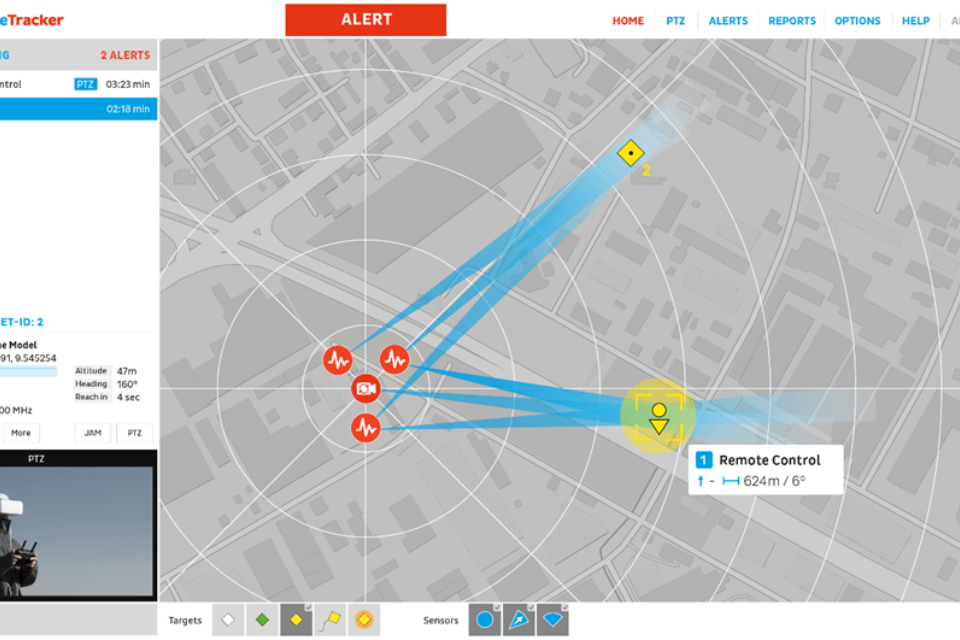
Dedrone’s system in action
For Nick McRobb, Dedrone’s UK defence lead and a former Army Colonel, the speed of the project stood out even by commercial standards. “We moved quickly. The demonstration event took place in November 2025, and we did our on-site recce in January 2026. We were installed and operational a few months later by March 2026.”
The system uses three RF sensors to triangulate the drone position across the garrison site. Meanwhile, a fourth RF sensor handles recognition and identification of both the drone and its controller. But RF detection is just one part of the capability.
This is where Quell comes in. A British company designing and building passive, AI-enabled surveillance and C-UAS systems, Quell delivered SkySpyke as the second layer of the Warminster deployment. The system operates autonomously, providing complete hemispheric sky coverage, detecting, tracking, and identifying all airborne objects. AI is also used to filter and deliver alerts and visual confirmation of objects of interest, reducing operator burden and making it easy to use.
Bobby Hamilton, Quell’s Chief Operating Officer, explains: “We’ve worked hard to build a system that is both simple and effective for the end-user. The drone threat is evolving, with a migration away from traditional RF-emitting capabilities. That’s where we can really add value. If a drone is present we will be able to see it and identify it, regardless of how it is communicating.”
Quell’s journey to Warminster can be traced back to earlier UKDI funding, which helped the company enhance the SkySpyke system, by building out their software platform, Deep Truth, improving the detection range and redesigning the hardware to deliver a modular solution. That funding didn’t just improve the product, but it also helped build the track record that got Quell through the door at Warminster.
Hamilton notes, “The UKDI funding allowed us to implement a lot of the learnings we took from the British Army’s Army Warfighting Experiment and pushed us forward into operational testing with Taskforce RAPSTONE on their C-UAS Exercises, Project Vanaheim and Project Flytrap. Having systems deployed with the UK MOD has allowed us to prove the capability in real operational environment, and demonstrate how it could perform across the wider defence estate.”
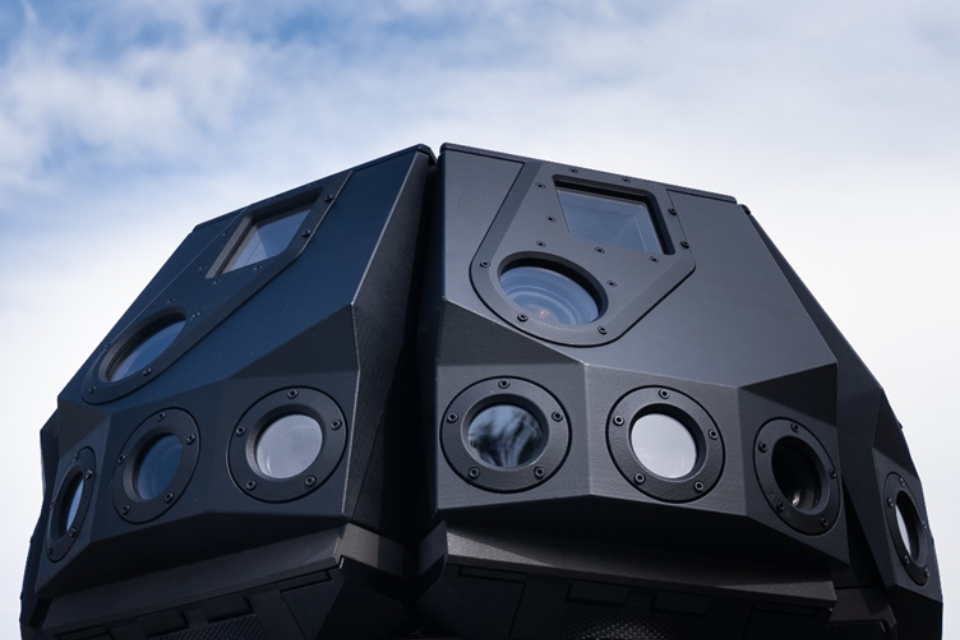
Quell’s SkySpyke system in action
What comes next
ETG’s technical input throughout Halo Shield has created a solid foundation for expansion. Future phases may see more C-UAS solutions adopted across UK garrison sites, with radar capabilities and acoustic sensors added alongside existing RF and optical sensors to create a truly layered detection architecture.
British Army’s counter-drone system takes off
Col James Howard, Experimentation & Trials Group said: “Working with UKDI and industry on this kind of dual use capability has been beneficial to all parties, making the British Army more safe from real, modern, threats while in its barracks as well as allowing the Experimentation and Trials Group to further develop the British Army’s counter drone capabilities.”
Nick McRobb notes: ”I want them to really bend it, break it, test it hard. Because only by doing that will they get the confidence to say, this is something we need more broadly across the estate. What this project proves is that sensor fusion is the answer. Each technology brings something the others don’t — and when you bring them together into a single picture, you get a level of confidence and clarity that no single system can match on its own.”
UKDI exists to get cutting-edge capability from concept to frontline at pace. Project Halo Shield is exactly that in action, a real threat, a rapid response, and two innovative companies given the space and funding to prove what’s possible.
Got a technology that could protect the UK? We want to hear from you. See current opportunities to find out how to work with us.