Budget 2026 (HTML)
Published 28 October 2026

© Crown copyright 2026
This publication is licensed under the terms of the Open Government Licence v3.0 except where otherwise stated. To view this licence, visit nationalarchives.gov.uk/doc/open-government-licence/version/3 or write to the Information Policy Team, The National Archives, Kew, London TW9 4DU, or email: psi@nationalarchives.gov.uk.
Where we have identified any third party copyright information you will need to obtain permission from the copyright holders concerned.
This publication is available at https://www.gov.uk/government/publications/budget-2026-document/budget-2026-html
1. Executive summary
The Budget comes amid global economic storms caused by the conflict in the Middle East and the illegal invasion of Ukraine, which have pushed up costs for families and businesses. In response, this Budget matches immediate action today with the big structural changes needed for the future.
The Budget meets the moment to steer Britain through this period of global pressures. It will provide breathing space for families and businesses, particularly with energy costs. At a time when households and businesses are under pressure, the Budget rejects broad-based tax rises, and is protecting most individuals and businesses from tax increases.
At the same time, this Budget commences the big changes needed to put the country on a better path. It will unlock good growth in every postcode by putting places in control of their economic future, and by backing a new wave of wealth creators. It will kickstart work on the big challenges facing the country to give people hope for the future, from bringing energy bills down for good, to building more social housing, to boosting the UK’s national security. This will build Britain’s resilience to make the country more secure and better off.
Fiscal discipline in this Budget will provide the bedrock for the economy to continue to grow and to deliver the vision that the Prime Minister and Chancellor will set out at the 10 Year Plan and the next spending review.
It is a Budget that will deliver breathing space today, and fresh hope for the future.
1.1 The economy and the public finances
Since the start of the conflict in the Middle East, all G7 countries have seen their borrowing costs rise to, or near to, highs not seen for decades. This means the UK is spending more on servicing its debt, with the Office for Budget Responsibility (OBR) forecasting the UK will pay an average of £14 billion per year in extra government debt interest compared to the Spring.
The UK economy is showing signs of resilience. Since the start of the Parliament, whole economy investment is up by 6.9%, business investment is up by 7.5%, and productivity growth exceeded 2% last year. The UK recorded the joint-fastest GDP growth in the G7 in the first half of this year, and the OBR has upgraded its growth forecast for 2026 to 1.2%. More recent GDP data has continued to exceed expectations, with growth of 0.7% in the three months to August alone.
1.2 Breathing space for Britain
Despite this resilience, the conflict in the Middle East has hit the UK’s growth outlook. Many families continue to feel their finances being squeezed. The cost of doing business – from energy bills to regulation to planning constraints – continues to weigh on investment and growth.
Fiscal discipline underwrites every promise this government makes. Reducing borrowing increases the UK’s ability to absorb global shocks, helps bear down on inflation, and creates breathing space for households and businesses. Fiscal discipline underpins economic stability, national security and sustainable growth. The government has therefore ensured that all policy at this Budget is fully funded over the forecast.
At a time when people, businesses, and the economy are under pressure and need breathing space, the Budget rejects broad-based tax rises. Instead, the government has chosen to use some of the headroom established last year to absorb the impact of higher debt-interest costs from the conflict in the Middle East.
The government continues to meet the fiscal rules with a buffer:
- The stability rule is met by £15 billion in 2029-30, before rising to £22 billion in 2030‑31. Higher debt interest costs from the conflict more than account for the reduction of headroom in 2029-30 since Spring. This is what a buffer is for – to be used when needed before being rebuilt as soon as conditions allow.
- The investment rule is met by £24 billion in 2029‑30, putting debt on a stable trajectory while continuing to deliver over £120 billion of additional investment this Parliament compared with the previous government’s plans.
The OBR’s forecast shows the government’s plans reduce borrowing over the forecast and put debt on a downward trajectory: borrowing falls to 1.8% of GDP by 2031‑32 and debt is lower at the end of the forecast (2031‑32) than it is now (2026‑27).
The IMF has forecast that the UK’s fiscal plans stand out from those of its peers. The UK has delivered the biggest reduction in borrowing in the G20 this year, and is on track to have the lowest level of borrowing in the G7 from 2029.
Energy bills
This Budget represents a shift in the government’s approach to energy. The conflict in the Middle East has put bills up for households and businesses. This Budget provides immediate relief, while offering longer-term reform to make sure the energy system works for households and businesses.
The government has made substantial progress on clean power. The focus now is to unleash cheap electricity, cutting bills to reindustrialise the country. The government must be disciplined in managing every aspect of energy costs, while building the assets needed to provide energy security to protect British businesses and households from volatile international gas prices, and to build the grid, which has not kept pace with demand. This Budget is the start of a new energy pathway on which the 10 Year Plan will build. This government will prioritise cheaper energy – to help British businesses to compete, and to provide breathing space for households. Cheaper electricity will boost electrification, increasing the UK’s energy security and helping to decarbonise the whole economy. This Budget will:
- Support households with the cost of energy – extending the VAT cut to electricity to July 2027, which is expected to take around £50 off the annual Ofgem price cap in April 2027, and launching a £2.6 billion Household Energy Payment, which will provide a £100 payment directly into bank accounts from January 2027 for households in England in council tax bands A-D, supporting up to 20 million households. Devolved governments will receive their share of this funding via the Barnett formula. To help fund this, the government is temporarily increasing the Bank Corporation Tax Surcharge from 3% to 6% for 15 months from 1 January 2027 to 31 March 2028.
- Extend the 5p fuel duty cut and freeze, while maintaining the Heavy Goods Vehicle (HGV) road tax holiday, to 1 July 2027 — keeping fuel duty as low as at any point in over 16 years and substantially lower in real terms, while the red diesel rate remains at its lowest level for over 20 years.
Alongside this immediate support, this Budget kickstarts the long-term action required to get energy costs down for good:
- Controlling energy costs – no new policy costs will be put on bills until a comprehensive Cost Control Framework is in place at the spending review in 2027, which will set budgets for components of energy costs, including policy costs.
- Prioritising a cheaper energy mix and procuring new generation only where it lowers bills, benefits the system, and can be accommodated by the grid.
- Progressing next steps in breaking the grip of gas on bills with a consultation published alongside this Budget on wholesale Contracts for Difference, fixing the price paid to some renewable projects to protect British homes and businesses from volatile gas prices.
From 2027 onward, the government will:
- Deliver the British Industrial Competitiveness Scheme, meaning 10,000 energy intensive manufacturing firms will get a 20-25% electricity discount, starting in April 2027, including a back payment for 2026-27.
- Abolish gas standing charges, coupled with targeted mitigations to ensure this is delivered fairly.
- Introduce a new Energy Debt Circuit Breaker to tackle energy debt, saving all billpayers around £30 by 2030.
- Reform electricity standing charges – with further details to be announced next year.
- Scrap the planned new tax on gas bills (the Gas Shipper Obligation), so that government rather than consumers fund the costs of hydrogen projects.
Targeted support for households
The Budget also gives households breathing space by:
- Temporarily reducing tariffs on over 100 food and drink products.
- Delivering the new Pension Tax Allowance – meeting the government’s commitment that pensioners with incomes at or under the value of the full new State Pension will not be brought into paying tax because of State Pension uprating in this Parliament.
- Supporting working people by increasing the National Living Wage and the National Minimum Wage rates by 3.9%, expanding parental pay, (including to self-employed fathers and partners for the first time), and permanently increasing the tax-free mileage rates for those who rely on their own vehicle for work.
Targeted support for businesses
Small businesses create jobs and keep communities thriving. In addition to helping businesses with the cost of energy, the Budget will address wider costs on businesses by:
- Delivering the government’s commitments on business rates by funding an extra 20% reduction for pubs, music venues and social clubs, and by increasing the Small Business Rate Relief threshold so that a further 70,000 retail, hospitality and leisure (RHL) businesses pay no business rates at all. The government is paying for this by ensuring businesses with significant sales online pay the VAT they owe, by requiring online marketplaces to collect it on their behalf.
- For all other retail, hospitality, and leisure properties, rates will be frozen for two years so that no property in those sectors faces an above inflation increase. Taken together, the decisions in this Budget mean that, from April, RHL businesses in England will see their business rates either frozen in real-terms, reduced, or cut to zero.
- Making Small Producer Relief in the Alcohol Duty system more generous by providing £10 million per year of support to over 2,000 small alcohol producers across the UK.
Public spending
The government has stabilised public services after years of underinvestment and is maintaining the highest sustained level of public spending in four decades. Departmental day-to-day spending will be £40 billion higher each year by 2028‑29 than under the previous government’s plans. Capital investment will be £120 billion more over the Parliament than under the previous government’s plans. This has enabled the government to invest in communities: building new social and affordable homes, improving infrastructure, lifting children out of poverty, strengthening the NHS, and in securing a stronger and more resilient UK through investment in defence.
The government is taking a fundamentally different approach to public services, in line with the ‘Rewiring the State’ Cabinet statement published in July. Reforms will improve outcomes and increase efficiency at every level of government by:
- Devolving decision-making by transferring resources to local leaders across England, supporting an integrated approach that gives places more power to target spending towards the biggest issues in their communities, and which more coherently joins up services, improving outcomes and efficiency.
- Streamlining central government, including through the transformation of the Civil Service which will deliver significant reductions in its size and cost.
- Harnessing transformative technologies like AI, where the Chancellor and Health Secretary have commissioned an independent review into NHS productivity and the opportunities presented by AI and technology to transform services for patients, ahead of the next spending review.
These reforms will reshape not only how government operates, but how public services are designed and delivered, shifting towards a more devolved, preventative and productive state. The next spending review will introduce a new category of ringfenced spending, preventative DEL, to deliver the government’s long-term approach.
The Budget fully funds the Defence Investment Plan through proactive management of capital pressures and reprioritisation of capital budgets. The 10 Year Plan will set out the long-term vision and priorities for the country. As the government continues to target investment into the country’s top priorities, it is not necessarily the case that all departments will see real-terms increases at the next spending review; putting the right resources into priorities is what any responsible government does.
The work to set a long-term vision for the country by transforming the state, reprioritising spending, and reforming welfare has already begun, with further details to be set out in the 10 year plan. The next spending review will act as a further enabler of this radical change and will take place in 2027.
Revenue raising
At a time when households and businesses are under pressure and need breathing space, the Budget rejects broad-based tax rises. It achieves this while ensuring that all policy at the Budget is fully funded over the forecast and raises the revenue to fund commitments on breathing space and energy in a fair, targeted and proportionate way. In doing so, it has protected most individuals and businesses from tax increases, giving them further space to breathe. The government is keeping to its commitments on tax, with no increase to the headline rates of income tax, National Insurance contributions, or VAT. The government is also maintaining the commitments in the 2024 Corporate Tax Roadmap.
The government is modernising the tax system, closing loopholes and ensuring that people and businesses pay the tax they owe. That includes modernising the taxation of company distributions, while protecting genuine commercial transactions including family successions; acting against non-compliance by online sellers, with the revenue reinvested in the high street through business rates support; ending the inconsistency in taxation between larger minicab operators; and ensuring the tax system does not allow overseas businesses to undercut UK firms.
The Budget also makes a small number of targeted choices to raise revenue fairly and help fund support for households and businesses. Banks will make a temporary additional contribution to help fund immediate household support. The government will increase tax on income from property and savings in a fair and proportionate way, while supporting tax-free saving by reversing the planned cut to the cash Individual Savings Accounts (ISA) allowance. The rate of Machine Games Duty for higher risk machines will increase to help pay for the real-terms freeze in business rates for RHL properties. Reformed capital allowances will strengthen the upfront incentive to invest while also raising revenue.
Good growth in every postcode
The government will transform the economy to deliver good growth in every postcode. The government will deliver greater public control, deliver more devolution and local leadership, back British businesses and set out a balanced approach to AI, addressing risks and pursuing opportunities. In this Budget and beyond, the government will deliver more investment, drive more innovation and help to create more jobs across every region and nation, through the following big shifts:
- Public control of the essentials – the state will provide greater strategic direction, certainty and accountability to secure the foundations for growth, including in energy, transport, water, and housing – creating the conditions for businesses to invest and grow. It will provide additional funding for the National Wealth Fund and British Business Bank to crowd in investment. The government will cut business costs and support innovation, saving businesses almost £800 million per year through further cuts to the administrative burdens of regulation, extending suspensions on tariffs, and introducing new cross-economy powers so firms can safely test new technologies faster. The government is also establishing a Better Regulation Executive which will set the direction for and drive implementation of the government’s vision for a streamlined and proportionate regulatory system.
- Growth in more places – this Budget sets out a roadmap to fiscal devolution, the biggest transfer of power and resources out of Whitehall in a generation, empowering local leaders to partner with businesses and universities to drive growth and reindustrialisation. The government will extend devolution across the country and give mayors, strategic authorities and local authorities greater powers. Mayors will receive a share of income tax and business rates, while local authorities will retain more of their business rates. Alongside these powers, the government will establish Good Growth Funds to support mayors and local leaders across England to ensure there is investment and good growth everywhere. Devolved governments will receive equivalent funding via the Barnett formula.
- Backing British Business – this Budget will support the next wave of British start-ups and scale-ups, including through a world-leading tax offer for founders and their companies. The Budget will use strategic public procurement and promotion to back British firms and develop a skilled domestic workforce. The government will also ensure talent can move to where it is needed most to help businesses thrive and provide opportunity for people to pursue their careers.
- Building the UK’s independent AI capability with British values – AI is the greatest innovation of our time, yet carries significant risks which the government must address. At this Budget, the government will strengthen AI security and resilience, including through an additional £120 million for the AI Security Institute, and £165 million for a new National AI Biosecurity Initiative. It will invest £154 million to strengthen cyber defences and £40 million to establish a National Agentic Security Unit to investigate and respond to rogue agentic incidents. It will invest an additional £140 million in the Sovereign AI Unit to back promising UK AI companies to scale and succeed here. It will also set out a new Data Centre Covenant, establishing the tests that strategic data centres are expected to meet, including the contribution they make to communities and the UK’s economic interests, matched by government action to support the capacity needed for technological sovereignty.
Fresh hope for the future
The Budget starts the big changes needed to put the country on a better path – from housing to national security – building Britain’s resilience to make the next generation better off.
Fresh hope on housing
Having a place to call home is foundational. It provides safety, stability and security. At this Budget, the government is prioritising housing investment in all its forms, supporting families across the country to thrive. The government will:
- Build more social and affordable homes by providing an additional £1.5 billion to deliver around 10,000 homes in England. This funding will be prioritised for Social Rent, especially council homes, taking total investment in the Social and Affordable Homes Programme to more than £40 billion over 10 years.
- Deliver the Prime Minister’s promise to end rough sleeping by providing further funding to ensure that people have a route off the streets, not just this year, but every year.
- Help more people find and keep a home by helping 70,000 households to get onto the housing ladder, confirming £4.7 billion for the new Your First Home equity-loan scheme for first-time-buyers and setting out its final details.
Over the next 10 years, the government will start to deliver the largest council housebuilding programme since the post-war era, and continue to drive up private sector housebuilding, helping more people benefit from a safe and secure home. Next steps will be set out in the 10 Year Plan, which will detail reforms to ensure that councils have the capacity to start building at scale again, significantly reduce the complexity and cost of the development process, and release public land for affordable housing.
Fresh hope for every generation
The government is determined to deliver a system that invests in young people’s success, rather than paying for failure. And the government will ensure elderly people can get the care they need. The government will:
- Support young people into work: The government refuses to write off the nearly one million young people not in education, employment or training. This Budget strengthens pathways into work by delivering the Jobs Guarantee for eligible 18 to 24-year-olds on Universal Credit and investing £100 million in local apprenticeship services. Early next year, the government will publish a White Paper in response to the publication of Alan Milburn’s final report and the conclusion of the Timms Review.
- Adjust the Triple Lock from the next Parliament to help fund a new settlement for older people: a state pension that rises every year, personal care free at the point of use and a high-quality National Care Service in England to give peace of mind in later life. The Prime Minister has agreed with Baroness Casey that her Independent Commission on Adult Social Care will now report in 2027.
A safer Britain
Safeguarding our national security is the first duty of any government. This government will meet this commitment to the people of Britain and its allies in the face of a new era of threat. The government’s fully funded Defence Investment Plan will deliver stronger front-line military capability, supporting jobs, businesses and economic growth across the UK.
At the spending review next year, the government will also set out the details of how it will meet its NATO commitment to spend 3.5% of GDP on defence by 2035, with a target date for 3% in 2030. This is necessary for the security of the UK. It also presents an opportunity to do things differently, working more closely with the private sector to build defence industry capacity alongside delivering new and innovative defence capability. The Budget will launch a new Innovative Defence Financing Taskforce to maximise the contribution of private and international finance to UK defence, and confirms a new commitment for the National Wealth Fund and British Business Bank to deploy up to £5 billion over the next four years into defence, dual-use and other sectors that support our national security, sovereign capability and resilience.
The government is making available over £10 billion of additional financial support to Ukraine. This is alongside its enduring commitment to £3 billion a year in military support until 2030-31 or for as long as needed, recognising that Ukraine’s security is vital to global security.
Built on the rock of fiscal discipline, this Budget provides breathing space to families and businesses in the here and now, drives good growth in every postcode and offers fresh hope for the future.
2. Economic and fiscal outlook
The UK’s economy and public finances have proven resilient despite major external shocks, with the joint fastest growth in the G7 so far this year.[footnote 1] GDP per person, real household disposable income (RHDI) per person and business investment have all grown by more in the first two years of this Parliament than they did in the five years of the last one.[footnote 2] Government borrowing is falling, by more than £15 billion in 2025‑26 compared with the year before.[footnote 3]
The conflict in the Middle East is a significant shock, affecting all economies. Ending the conflict, fully reopening the Strait of Hormuz and repairing the damage to energy infrastructure is the single biggest priority to improve the global outlook, including for the UK. However, the path of the conflict – and the resulting economic and fiscal impacts – remains highly uncertain.
The UK’s workers and firms have been resilient this year, but the government will not be complacent given the headwinds from the conflict in the Middle East. At this Budget, the government is providing households and businesses with breathing space to help them manage higher energy and other commodity prices, while continuing to deliver on its commitment to fiscal discipline. The government is meeting the fiscal rules and bringing down borrowing across the forecast, helping to bear down on inflation, mortgage rates and the cost of business.
2.1 Economic and fiscal context
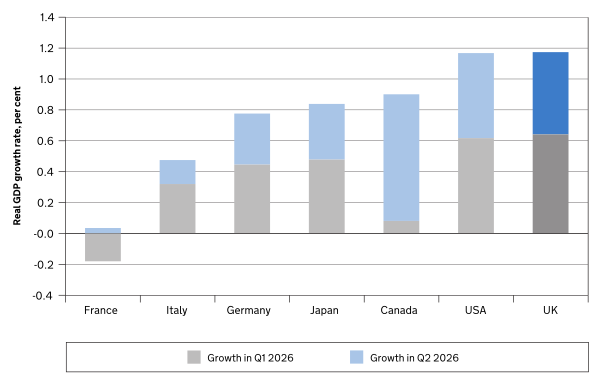
The UK had the joint-fastest growth in the G7 across the first half of 2026.[footnote 4] Real GDP grew by 0.6% in Q1 and 0.5% in Q2, and cumulative growth across the first two quarters is 0.5 percentage points higher than the Office for Budget Responsibility (OBR) expected in its March forecast.[footnote 5],[footnote 6] Stronger-than-expected outturns have led a range of forecasters, including the International Monetary Fund (IMF) and the Organisation for Economic Co-operation and Development (OECD), to upgrade expectations for 2026 compared with earlier this year.[footnote 7] In its October World Economic Outlook (WEO), the IMF forecast the UK to grow by 1.3% in 2026, 0.5 percentage points higher than its expectations in April 2026.[footnote 8] More recently, the Office for National Statistics (ONS) estimates that GDP in the three months to August 2026, which was released after the OBR closed the pre-measures forecast to new data, rose by 0.7%, continuing to exceed market expectations.[footnote 9],[footnote 10]
Chart 1.1: G7 real GDP growth in H1 2026
Source: Organisation for Economic Co-operation and Development, HM Treasury calculations.
Living standards have grown since the start of this Parliament, with GDP per person growing by 2.0% and RHDI per person rising by 1.8%.[footnote 11] Household income has been supported by growth in real wages, which have now risen consistently for three years and grown more in the first two years of this Parliament than they did over the first decade of the previous government.[footnote 12]
GDP growth in 2026 has been broad-based across all sectors of the economy (production, construction and services).[footnote 13] Despite headwinds from the conflict in the Middle East, demand has remained robust, with household consumption rising by 1.0% in the first half of the year.[footnote 14] Retail sales have grown, rising by 0.7% in Q3 2026.[footnote 15] External demand has held up, supporting UK growth, as key trading partners have remained relatively resilient, with G7 economies (excluding the UK) growing by an average of 0.4% in Q2 2026.[footnote 16] This has helped support demand for UK exports, which were 4.2% higher in Q2 2026 than the same period last year.[footnote 17]
Whole economy investment has risen by 2.7% so far this year, supported by strong business investment, which grew by 4.8% in the first half of this year.[footnote 18] In this Parliament, whole economy and business investment have both already increased by more than they did over the entirety of the previous one, rising by 6.9% and 7.5% respectively, compared with 6.4% and 4.8% in the previous Parliament.[footnote 19] Recent strong growth has helped to push whole economy investment to its highest share of GDP since 1990 and business investment to its highest share in almost a decade.[footnote 20] Strong growth in whole economy investment reflects the government’s commitment to both protecting capital investment in infrastructure and public services, and providing the stability and certainty that allows firms to invest.
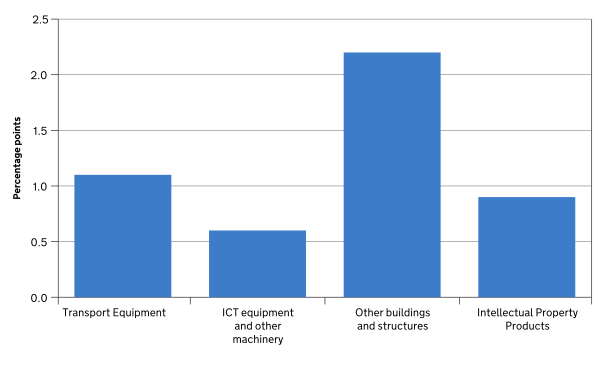
There is some evidence that AI-related investment is contributing to the strength in business investment and GDP growth. Over the first half of 2026, other buildings and structures, intellectual property products and information and communications technology (ICT) equipment and other machinery and equipment have contributed over three-quarters of the headline business investment growth of 4.8%.[footnote 21] These asset classes encompass many of the physical and intangible capital inputs needed to develop and deploy AI, including software, research and development and computing equipment. Investment activity has been particularly robust in sectors most closely associated with its adoption, for example information and communication, which has contributed over a fifth of UK GDP growth so far this year.[footnote 22]
Chart 1.2: Contributions to headline business investment growth (H1 2026)
Source: Office for National Statistics, HM Treasury calculations.
UK productivity growth strengthened over the past two years, rising for six consecutive quarters, the longest sustained run of quarterly growth in almost a decade. Over the past two years, productivity has grown at an annualised rate of 1.3%, compared with an average rate of 0.5% per year between 2015 and 2024.[footnote 23]
The labour market has remained subdued in 2026, with little change in headline indicators. Unemployment has fallen across the year to 4.7% while the number of employees has fallen slightly.[footnote 24],[footnote 25] Hiring is subdued, but employment remains close to record highs: there are only two peacetime years in the last 150 years when the employment rate was higher than it is today.[footnote 26],[footnote 27] At 75.3%, today’s employment rate is above the G7 average.[footnote 28],[footnote 29] The strength in employment masks persistent challenges for some groups, particularly young people, with almost one million young people not in employment, education or training, which rose by over 100,000 in the last five years of the previous government.[footnote 30]
Box 1.A: Measuring the UK’s productivity performance
Productivity growth (output per hour worked) is the long-run driver of economic growth, higher wages, and living standards. Headline measures of productivity growth are calculated as output divided by total hours worked. The source for hours worked in the economy is the Labour Force Survey (LFS). In recent years, falling response rates have significantly affected the quality of the LFS, making it more difficult to estimate reliably the number of workers and the hours they work. The LFS is also weighted to population projections, which could not anticipate recent changes to net migration levels.
In response to these challenges, researchers began to use alternative sources of employment information from surveys such as HM Revenue & Customs payrolled employees (known as RTI, real time information) and workforce jobs (WFJ). Since 2024, the ONS has published an alternative approach to productivity measurement using RTI data and this year recommended users focus on the RTI productivity measure.[footnote 31]
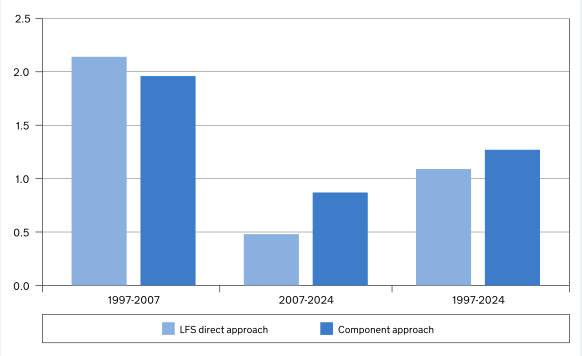
The RTI-based measure suggests that productivity growth was weak across 2022 and 2023, before rebounding strongly since late 2024.[footnote 32] RTI productivity has grown at an annualised rate of 1.3% since Q2 2024, and grew by 2.2% in 2025, compared with an average growth rate of 0.5% between 2015 and 2024.[footnote 33] These rates of productivity growth are above the OBR’s medium-term productivity forecast for annual trend productivity growth of 1.0%, which is based on the LFS measure.[footnote 34]
In September, the ONS published improved estimates of productivity growth from 1997 to 2024, updating the measurement of employment and average hours worked used in productivity calculations, bringing their methodology more closely in line with international best practice.[footnote 35] This new approach indicates that the long-run decline in average hours continued after 2010, rather than stabilising as indicated by existing LFS-based measures. The revised trajectory for average hours implies a stronger trajectory for productivity growth: average annual productivity growth between 2007 and 2024 is estimated to be 0.9%, revised up from 0.5%. The component approach suggests that productivity growth still slowed following the Global Financial Crisis, from 2.0% in 1997‑2007 to 0.9% in 2007‑2024, but this is less than previously thought and brings the UK more closely into line with international peers, although pre-existing productivity gaps remain. The new approach suggests a more positive long-run outlook for UK productivity growth.
Chart 1.3: Measures of average annual productivity growth, per cent
Source: Office for National Statistics, HM Treasury calculations.
Resilience
Decisions made since the start of this Parliament have increased the resilience of the UK economy. The government’s fiscal strategy is delivering lower borrowing and helps the Bank of England to maintain price stability, while supporting a step change in public investment of £120 billion this Parliament compared with previous plans. Last year, the government reduced the deficit to the lowest level for six years, to 4.4% of GDP. [footnote 36]
Energy prices increased sharply following the start of the conflict in the Middle East, pushing up inflation and weighing on the global economic outlook. Following the disruption to transits through the Strait of Hormuz in February, wholesale monthly average Brent crude oil prices rose by around 60% by October, while wholesale monthly average UK natural gas prices increased by nearly 200%.[footnote 37] The government wants to see an end to the conflict, the reopening of the Strait of Hormuz and restoration of the supply of energy. This would significantly improve the domestic and global outlook.
Before the onset of the conflict, inflation had been falling and was forecast to return to target this year. Inflation continued to fall until June, when it reached 2.6%, with households still protected by the Ofgem energy price cap, which was largely set before the outbreak of the conflict. Inflation has since risen to 3.5% in September, with the majority of the rise driven by motor fuel inflation caused by the conflict.[footnote 38] The OBR expects inflation to peak at 3.8% in Q1 next year, before falling again, with the outlook sensitive to wholesale oil and gas prices. The UK is not alone in seeing inflation rise as a result of these global shocks, with the IMF raising the inflation forecasts for 2026 on average across G7 countries by 0.8 percentage points in its October 2026 WEO compared with its October 2025 assessment.[footnote 39]
Although inflation is rising, the economic effect on the UK is expected to be less acute than in 2022. Growth in clean power and changes to the energy market have reduced the UK’s exposure to global energy market volatility and the international gas price, while different domestic economic conditions from 2022, underpinned by monetary and fiscal policy, mean the domestic inflationary risk of the external price shock is lower.
Box 1.B: Energy prices and inflation
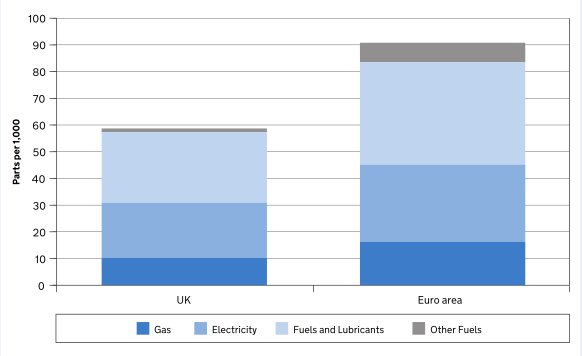
Higher global energy prices are affecting countries around the world. Liquid and motor fuel prices rose quickly following the start of the conflict in the Middle East. Petrol and diesel prices have risen by similar amounts across Europe: petrol is up 19% in Germany and 30% in France between February and October 2026, compared with 33% in the UK; diesel has risen by 31% in Germany and 42% in France, compared with 41% in the UK over the same period.[footnote 40] How such rises affect headline inflation depends on the composition of the consumer price basket in each country. At 59 parts per thousand, energy has a smaller weight in the UK CPI basket compared with the euro area where it is around 91 parts per thousand. Therefore, a similar change in energy prices will have a smaller direct effect on headline inflation in the UK. The overall energy intensity of the UK economy has fallen from 70% in 2020 to 58% in 2025, reflecting improvements in energy efficiency and changes in the composition of economic activity.[footnote 41]
Changes in the energy market since 2022 have reduced and delayed the pass-through of global energy price shocks into UK inflation. Structural changes have weakened the link between gas and electricity prices, with gas setting the wholesale electricity price around 60% of the time in 2025, down from around 90% in the early 2020s.[footnote 42] These changes include the growth in renewable generation, including a higher share of the electricity market being covered by Contracts for Differences.[footnote 43] Reflecting this, the current shock has fed through relatively more to household gas prices, with Ofgem price cap unit rates rising 8.7% from July to this October, compared with 0.8% for electricity. Removing VAT from electricity bills contributed to the smaller rise in electricity prices.[footnote 44] Pass-through to customers has been delayed by greater fixing and hedging behaviour. For businesses, in March 2026, 42% had at least half of their electricity prices fixed or hedged, and 45% had at least half of their gas prices fixed or hedged.[footnote 45]
The risk of large second-round effects – with higher headline inflation feeding into higher wages – and indirect effects pushing up non-energy prices is lower than in 2022 due to current economic conditions. The 2022 shock coincided with the pandemic recovery and a period when inflation was already rising, compounding its effects. In contrast, there is currently greater spare capacity in the economy. At a comparable point seven months after the respective shocks, core inflation was 2.8% in September 2026, compared with 6.5% in September 2022.[footnote 46]
Chart 1.4: 2026 energy weights in headline consumer price inflation
Source: Office for National Statistics, Eurostat.
Higher inflation has led to higher interest rate expectations, with households, firms and governments facing tighter financial conditions. Since the start of the conflict in the Middle East, UK gilt yields have increased broadly in line with the G7 average; all G7 countries have seen their borrowing costs rise to, or near, highs not seen for decades.[footnote 47]
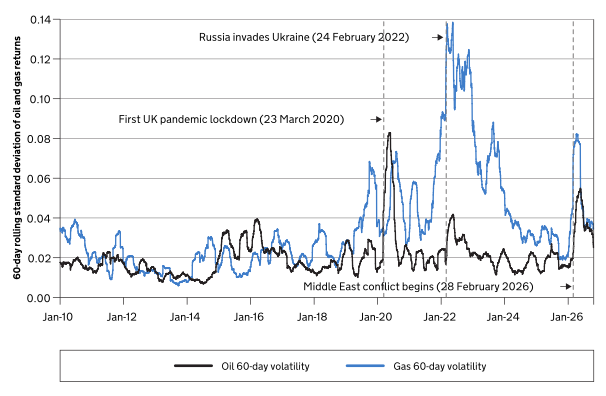
There continues to be significant uncertainty around the conflict in the Middle East and its effect on the economic and fiscal outlook. There have been periods of high volatility in wholesale energy markets since the start of the conflict. The OBR estimates that real GDP growth could be 0.5 percentage points higher in 2027 and borrowing could be £12 billion lower in 2027‑28 if energy prices follow a lower path than assumed in its central forecast.
Chart 1.5: Energy market price volatility since 2010
Source: Bloomberg, HM Treasury calculations.
2.2 Economic and fiscal strategy
Growth
The government’s economic objective is to deliver good growth and sustained improvements in living standards in every part of the UK. Greater investment, innovation and skills enable workers and businesses to become more productive, while higher employment allows more people to contribute to and benefit from growth. The government is therefore mobilising public, private and international investment, ensuring the essential infrastructure and services that underpin growth are affordable and reliable, devolving power to enable genuine local economic leadership, and backing businesses that want to grow. Together, these support rising wages, household incomes and profits while enabling high-quality public services. Good growth is growth that is resilient, broad-based and reflected in secure and productive work, affordable essentials, and greater opportunity across the country.
Stability
Growth in every postcode requires families and businesses to feel confident making long-term plans. For that, they need a stable economic environment: price stability, sustainable public finances, and strong economic and financial institutions reduce uncertainty and incentivise investment. Fiscal discipline and the stability it creates therefore provide the foundations for the investment needed to deliver good growth.
Fiscal rules
The recent rise in global borrowing costs reinforces the government’s strategy to reduce borrowing, which helps to bear down on inflation and give families more breathing space. The fiscal rules remain unchanged and mean the government will deliver this strategy while enabling the public investment needed to drive long‑term economic growth:
- The stability rule means that the current budget must be in balance or in surplus by the third year of the forecast, meaning that day-to-day spending is met with revenues, so that the government only borrows to invest.
- The investment rule is a target to ensure debt, defined as public sector net financial liabilities (PSNFL) or net financial debt, is falling as a share of the economy by the third year of the forecast.
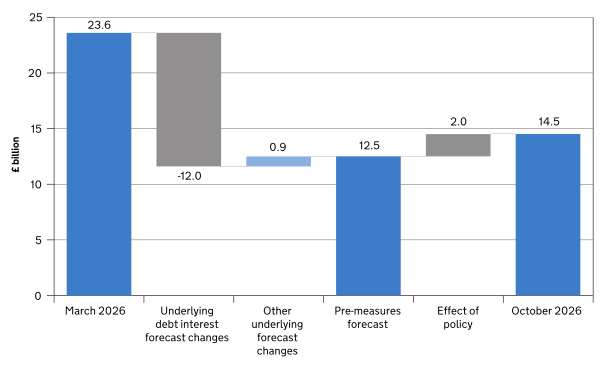
The OBR has confirmed that the government is meeting the stability and investment rules. There is a buffer of £15 billion against the stability rule and £24 billion against the investment rule. Net financial debt stabilises from 2028‑29, and is lower at the end of the forecast (2031‑32) than at the start (2026‑27).
The conflict in the Middle East has pushed up borrowing relative to the OBR’s March forecast. The OBR forecasts an average of £14 billion per year in extra government debt interest, compared with the March forecast. Higher debt interest costs more than account for the change in borrowing and the reduction of headroom against the stability rule, in 2029‑30. The government has chosen to use some of the headroom to absorb the impact of the conflict in the Middle East while the outlook is uncertain. This approach is in line with the purpose of holding headroom, which is to give the government the flexibility to weather shocks, reducing the need to make immediate changes in tax and spending plans when there are changes in the global and UK economy.
Chart 1.6: Change in stability rule headroom since March 2026 forecast
Source: Office for Budget Responsibility.
At this Budget, the government is meeting fiscal rules that bite in the third year of the forecast for the first time since 2022. The OBR notes that this should reduce fiscal risk, compared with previous fiscal rules which did not need to be met until the fifth year of the forecast. The current budget surplus of £15 billion compares with a £4 billion third-year current budget surplus forecast at Budget 2025.[footnote 48] When achieved, this would be the highest surplus since 2001‑02.[footnote 49] The OBR’s forecast shows that headroom will increase to £22 billion in 2030‑31.
In addition to the stability and investment rules, the supplementary welfare cap limits how much the government can spend on certain welfare benefits. Performance against the welfare cap will be formally assessed by the OBR at the first fiscal event of the next Parliament. The latest forecast confirms that the growth in welfare spending will have more than halved as a percentage of GDP from the levels seen in the last Parliament.[footnote 50]
Reducing borrowing
Last year (2025‑26), ONS data shows that borrowing fell by 0.7% of GDP to its lowest level in six years.[footnote 51] According to the IMF, the UK has the fastest fiscal consolidation in the G20 this year (2026).[footnote 52] The government is continuing to reduce borrowing including by ensuring that, overall, policies at this Budget do not add to borrowing over the forecast.
To enable this path of borrowing, the government has been responsible in its cost-of-living support for households and businesses, in response to pressures from the conflict in the Middle East. In line with IMF steers, the government has ensured that any intervention has been timely, targeted and temporary.
Lower borrowing helps the Bank of England to reduce inflation, reducing mortgage costs for households and borrowing costs for businesses. The independent Monetary Policy Committee (MPC) of the Bank of England is responsible for bringing inflation to target, and the MPC has the government’s full support in returning inflation to target sustainably. The government has published the remit for the MPC alongside the Budget to reaffirm that the Bank of England’s price stability objective is defined as 2% CPI inflation, which applies at all times.
Box 1.C: Fiscal stance and consolidation
The government is consolidating the public finances. Public sector net borrowing (PSNB) fell by 0.7 percentage points last year to 4.4% of GDP and continues to fall over the forecast to 1.8% in 2031‑32.[footnote 53]
Two-thirds of the reduction in PSNB will be delivered between 2024‑25 and 2028‑29, underpinned by detailed tax and departmental spending plans.[footnote 54] This demonstrates the government’s commitment to get borrowing down. Reducing borrowing is the way to reduce debt interest costs which more than account for the increase in PSNB, on average, since the OBR’s March forecast.
The government has already made progress towards its fiscal mandate to balance the current budget (day-to-day spending balanced against revenues). Last year the current budget deficit fell by 1 percentage point from 2.5% to 1.5% of GDP, the lowest current budget deficit outturn in six years.[footnote 55] The current budget is forecast to continue to improve. By 2028‑29, the government will have done 90% of the work to balance the current budget, with concrete plans that are underpinned by set departmental budgets and taxes.[footnote 56]
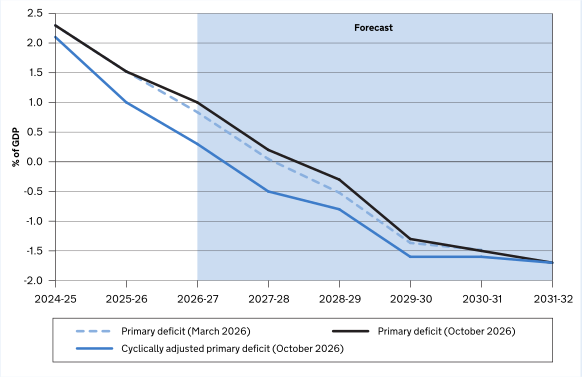
The primary deficit measures how much the government is borrowing in a way that affects the economy, by focusing on what the government controls (taxation, day-to-day spending, and investment) and excluding debt interest. Last financial year (2025‑26), the primary deficit fell by 0.8% of GDP, and next year (2027‑28) it is forecast to fall to its lowest level in 25 years.[footnote 57] The primary balance moves into surplus by 2028‑29 – which would be the first primary surplus since 2001-02 – and by 2031‑32, the OBR forecasts a 1.7% of GDP primary surplus.[footnote 58]
The cyclically adjusted primary deficit (CAPD) – which strips out changes to tax and spending related to the economic cycle – is already close to being eliminated. The OBR forecasts a surplus next year, for the first time since 2001‑02.[footnote 59]
Chart 1.7: Fiscal stance
Source: Office for National Statistics and Office for Budget Responsibility.
Box 1.D: Standing out amongst peers
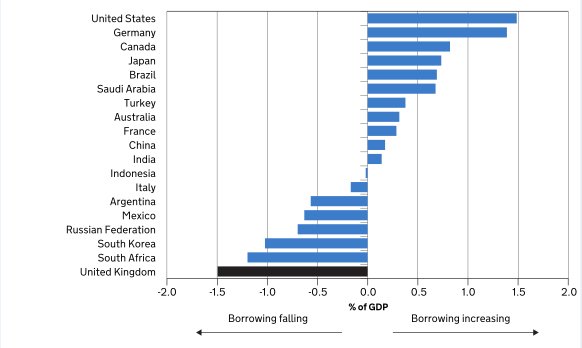
The IMF forecasts that the UK’s deficit reduction this year will be bigger than any other G20 country.[footnote 60] The UK is one of only two G7 countries to reduce the deficit this year (with Italy), and this is the first time since 2004 that the UK is borrowing less than the G7 average.
The UK is on track to reduce its deficit to the lowest in the G7 by 2029 and is an outlier in how front-loaded this borrowing reduction is. According to the IMF’s forecasts, the UK will deliver the largest near-term consolidation in the G7, reducing borrowing by 2.8% of GDP from 2025 to 2028. This early consolidation is underpinned by set departmental spending plans for the current spending review period.
The IMF also forecasts that the UK will deliver the biggest reduction in borrowing in the G20 between 2025 and 2031 and will have the second lowest government debt in the G7 by 2031.
Chart 1.8: The forecast annual change in general government borrowing in G20 countries between 2025 and 2026
Source: International Monetary Fund, October 2026.
Long-term fiscal sustainability
The government is committed to public finances that are sustainable for the long term. Sustainable public finances support economic growth, provide space for the government to protect households and businesses from future shocks, support private investment, reduce pressure on borrowing costs, and prevent unduly burdening future generations with debt.
By announcing an adjusted Triple Lock, the government is acting now to put the State Pension on a sustainable footing, while delivering a new settlement for older people: one that ensures pensioners continue to see a meaningful rise in their state pension each and every year; while building a National Care Service which will provide older people in England with personal care, free at the point of use.
Adjusting the Triple Lock will generate significant savings and materially improve the certainty of the State Pension spending trajectory. It removes the ‘ratchet’ effect, whereby the State Pension rises ever higher relative to earnings. Following the introduction of the adjusted Triple Lock, the State Pension will track earnings over time. Adjusting the Triple Lock is estimated to reduce State Pension spending by £15 billion a year by the late 2030s, and by £50 billion a year by the late 2040s.[footnote 61]
The adjusted Triple Lock builds on previous decisions to secure fiscal sustainability for the UK. This includes strengthening the tax base by introducing Electric Vehicle Excise Duty (eVED) to respond to the long-term decline in fuel duty receipts and tackling fast-growing tax reliefs, including by capping the amount of pension contributions that can be salary sacrificed. The government has also introduced a series of major, innovative reforms to balance sheet management including the Balance Sheet Framework, enacted at this Budget through the Strategic Asset Review (Chapter 2), and the Guidance on Managing Government’s Implicit Liabilities, with a second round of funding allocated for projects which reduce long-term costs to government.
The government is taking a fundamentally different approach to public services, in line with the ‘Rewiring the State’ Cabinet Statement published in July. Reforms will improve outcomes and increase efficiency at every level of government by:
- Devolving decision-making by transforming resources to local leaders across England, supporting an integrated, place-based approach that gives places more power to target spending towards the biggest issues in their communities, and which more coherently joins up services, improving outcomes and efficiency.
- Streamlining central government, including through the transformation of the Civil Service which will deliver significant reductions in its size and cost.
- Harnessing transformative technologies like AI, where the Chancellor and Health Secretary have commissioned an independent review into NHS productivity and the enormous opportunities presented by AI and technology to transform services for patients, ahead of the next spending review.
2.3 Economic and fiscal outlook
Economic outlook
The OBR has revised up its growth forecast to 1.2% in 2026, 0.1 percentage points higher than in the March forecast. The OBR forecasts growth to slow to 1.0% in 2027 as the impacts of higher energy prices feed through to consumers and businesses and higher interest rates weigh on the economy. Growth then accelerates to 1.6% in 2028, 1.8% in 2029 before moderating to 1.7% in 2030 and 1.6% in 2031. This means that despite the conflict, the level of GDP ends up broadly unchanged at the forecast horizon compared with the March forecast.
The OBR has revised up its forecast for potential output in 2026. Stronger-than-expected GDP growth and business investment in the first half of this year have raised potential output growth to 1.6%, 0.3 percentage points higher than the March forecast. Overall, the level of potential output at the forecast horizon remains broadly unchanged from the March forecast.
The OBR has not revised its assumption on underlying total factor productivity growth which reaches 0.8% in 2030. However, strong business investment – which follows a higher path across the forecast – affects trend labour productivity through greater capital deepening, leaving it 0.2% higher in 2030 than in the March forecast. The OBR has revised its forecast for real business investment and now expects it to be 0.5% above the level in its March forecast by 2030.
A higher starting level of potential output and higher growth in investment means the level of GDP per person is forecast to grow by 5.9% this Parliament and expected to be 0.7% higher at the end of the forecast compared with March.
Employment has been stronger than expected this year, with the OBR now forecasting an increase in employment of around 200,000 more than it did in the March forecast. However, labour demand is expected to remain subdued into 2027. The OBR expects unemployment to rise to 5.1% in Q2 2027 before falling to 4.1% by the end of the forecast period. The OBR expects total employment to increase from 34.4 million in 2026 to 35.4 million in 2031, rising in every year of the forecast. Nominal earnings growth is expected slow in the near term, but more gradually than in the March forecast.
The conflict in the Middle East has directly affected the inflation outlook through increased energy prices and indirectly through increased production and transportation costs. The OBR judges there to be only modest second-round effects. Inflation is forecast to peak at 3.8% in Q1 2027 before returning to the 2% target by Q3 2028.
The Budget provides breathing space for households as uncertainty and volatility from the global energy shock puts renewed pressure on living standards. RHDI per person is forecast to fall by 0.6% in 2026‑27 then average 0.6% annual growth over the rest of the forecast. Action to provide breathing space for households is expected to reduce inflation by 0.1 percentage points in 2027.
Table 1.1: Overview of the OBR’s economic forecast(1,2)
| Outturn | Forecast | ||||||
| 2025 | 2026 | 2027 | 2028 | 2029 | 2030 | 2031 | |
| Gross domestic product (GDP) | 1.3 | 1.2 | 1.0 | 1.6 | 1.8 | 1.7 | 1.6 |
| GDP per capita | 1.0 | 1.0 | 0.9 | 1.4 | 1.6 | 1.4 | 1.4 |
| Potential output growth | 1.7 | 1.6 | 1.0 | 1.3 | 1.5 | 1.5 | 1.5 |
| Main components of GDP | |||||||
| Household consumption(3) | 1.1 | 1.0 | 0.6 | 1.7 | 2.0 | 1.7 | 1.6 |
| General government consumption | 1.7 | 2.2 | 0.9 | 1.3 | 1.3 | 1.7 | 1.8 |
| Total fixed investment of which | 4.0 | 2.9 | 1.1 | 0.6 | 1.3 | 1.7 | 1.6 |
| Business investment | 4.3 | 0.0 | -0.5 | 1.0 | 1.2 | 1.2 | 1.3 |
| General government investment | 4.2 | 14.6 | 3.6 | -2.4 | -2.2 | -0.2 | 0.1 |
| Private dwellings investment(4) | 3.6 | 1.5 | 2.4 | 2.1 | 3.9 | 3.9 | 2.9 |
| Change in inventories(5) | -0.1 | 0.1 | -0.1 | 0.0 | 0.0 | 0.0 | 0.0 |
| Exports | 1.9 | 1.1 | 1.4 | 1.0 | 1.0 | 1.1 | 1.1 |
| Imports | 4.1 | 2.8 | 0.1 | 0.5 | 0.9 | 1.0 | 1.1 |
| Consumer Prices Index (CPI) inflation | 3.4 | 3.1 | 3.4 | 2.1 | 2.1 | 2.0 | 2.0 |
| Employment (millions) | 34.2 | 34.4 | 34.5 | 34.7 | 34.9 | 35.2 | 35.4 |
| Unemployment (% rate) | 4.8 | 5.0 | 5.1 | 4.9 | 4.5 | 4.3 | 4.1 |
| Productivity – output per hour | 0.1 | 0.5 | 0.9 | 1.2 | 1.3 | 1.1 | 1.1 |
| Real household disposable income (RHDI) per capita | 0.6 | -0.8 | 0.1 | 0.7 | 0.5 | 0.9 | 0.7 |
| 1 All figures in this table are rounded to one decimal place. This is not intended to convey a degree of unwarranted accuracy. Components of GDP may not sum to total due to rounding and the statistical discrepancy. |
| 2 Percentage change on a year earlier, unless otherwise stated. |
| 3 2025 outturn data are consistent with the data used in the OBR forecast and do not incorporate subsequent ONS revisions. |
| 4 Includes households and non-profit institutions serving households. |
| 5 Includes transfer costs of non-produced assets. |
| 6 Contribution to GDP growth, percentage points. |
| Source: Office for National Statistics and Office for Budget Responsibility. |
Fiscal outlook
Table 1.2: Overview of the OBR’s fiscal forecast (% GDP)
| Forecast | ||||||
| 2026-27 | 2027-28 | 2028-29 | 2029-30 | 2030-31 | 2031-32 | |
| Current budget deficit | 1.3 | 0.5 | 0.2 | -0.4 | -0.6 | -0.5 |
| Public sector net investment | 2.9 | 2.9 | 2.7 | 2.5 | 2.4 | 2.3 |
| Public sector net borrowing | 4.2 | 3.4 | 2.9 | 2.1 | 1.8 | 1.8 |
| General government net borrowing(4) | 4.5 | 3.9 | 3.5 | 2.7 | 2.4 | 2.1 |
| Primary deficit | 1.0 | 0.2 | -0.3 | -1.3 | -1.5 | -1.7 |
| Cyclically adjusted primary deficit | 0.3 | -0.5 | -0.8 | -1.6 | -1.6 | -1.7 |
| Public sector net financial liabilities(1) | 83.2 | 83.8 | 83.8 | 83.1 | 82.3 | 81.7 |
| Public sector net debt(1) | 95.5 | 96.7 | 97.3 | 96.7 | 95.9 | 95.6 |
| Public sector net debt ex Bank of England(1) | 92.4 | 93.8 | 94.7 | 94.3 | 94.2 | 94.0 |
| Public sector net worth(1,2,3) | 63.3 | 63.4 | 63.1 | 62.2 | 61.0 | 59.8 |
| General government gross debt(4) | 102.3 | 103.9 | 104.8 | 104.4 | 104.0 | 103.6 |
| 1 Stock values at end of March; GDP centred on end of March. |
| 2 IMF Government Finance Statistics Manual (GFSM) basis. |
| 3 PSNW has been inverted to facilitate comparisons with the other stock metrics |
| 4 Calendar year basis. |
| Source: Office for Budget Responsibility. |
Borrowing (PSNB) falls over the forecast, from 4.2% of GDP in 2026‑27 to 1.8% in 2031‑32 (Table 1.3). Borrowing is slightly higher compared with the OBR’s March forecast due to higher debt interest costs as a result of the conflict in the Middle East (Table 1.3). The current budget is in surplus from 2029‑30, meeting the stability rule with a buffer of £15 billion, and then increases to £22 billion in 2030‑31, which will be the target year at the next Budget.
Table 1.3: Changes in borrowing since March 2026 (£ billion)
| Forecast | ||||||
| 2026-27 | 2027-28 | 2028-29 | 2029-30 | 2030-31 | 2031-32 | |
| March 2026 forecast | 115.5 | 96.5 | 86.0 | 63.4 | 59.0 | |
| November 2026 forecast | 133.2 | 112.0 | 99.5 | 73.8 | 66.9 | 68.3 |
| Difference | 17.7 | 15.5 | 13.5 | 10.4 | 7.9 | |
| of which: | ||||||
| Underlying forecast differences | 11.4 | 8.5 | 11.4 | 13.0 | 11.4 | |
| of which: | ||||||
| Debt interest | 15.4 | 16.0 | 12.0 | 12.0 | 12.1 | |
| Other forecast changes | -4.0 | -7.5 | -0.6 | 1.0 | -0.6 | |
| Memo: Impact on the current budget deficit(2) | 0.6 | 4.5 | 8.6 | 11.1 | 11.0 | |
| Total effect of policy decisions(1) | 6.3 | 7.0 | 2.1 | -2.6 | -3.5 | -9.3 |
| of which: | ||||||
| Tax | 2.0 | 1.2 | -1.9 | -4.3 | -4.5 | -4.3 |
| Spending | 4.3 | 5.8 | 4.0 | 1.7 | 1.0 | -4.9 |
| Memo: Impact on the current budget deficit(2) | 6.1 | 8.4 | 2.5 | -2.0 | -2.4 | -7.7 |
| Note: This table uses the convention that a negative figure means a reduction in PSNB i.e. an increase in receipts or a reduction in spending will have a negative effect on PSNB. |
| Figures may not sum due to rounding. |
| 1 Differences between the direct impacts of the policy measures as set out in Table 6.1 of the Budget, and how the OBR incorporate these into their forecast are explained in the OBR’s EFO Table 3.1. |
| 2 The current budget deficit in a given year is equal to current expenditure plus depreciation minus current receipts. It can also be derived, for a given year, as PSNB minus capital spending plus depreciation. |
| Source: Office for Budget Responsibility. |
Chart 1.9: Public sector net borrowing and current budget deficit
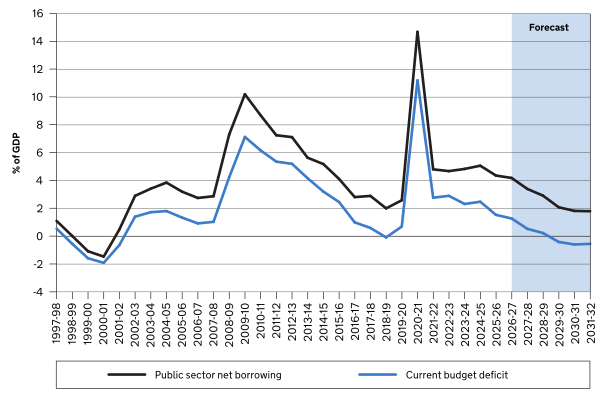
Source: Office for National Statistics and Office for Budget Responsibility.
Net financial debt is falling as a share of GDP from 2029‑30 and the government is meeting the investment rule in 2029‑30 by a margin of £24 billion. Net financial debt is lower at the end of the forecast (2031‑32) than at the start (2026‑27).
In addition to its fiscal rules, the government has committed to consider a wide range of metrics to inform a full assessment of the sustainability of the public finances, and will seek to improve sustainability over time. Public sector net debt (PSND) falls from 2029‑30, to 95.6% by the end of the forecast. Public sector net worth (PSNW) improves from 63.3% of GDP in 2026‑27 to 62.2% in 2029‑30 and 59.8% by the end of the forecast period.
Chart 1.10: Four measures of the public sector balance sheet
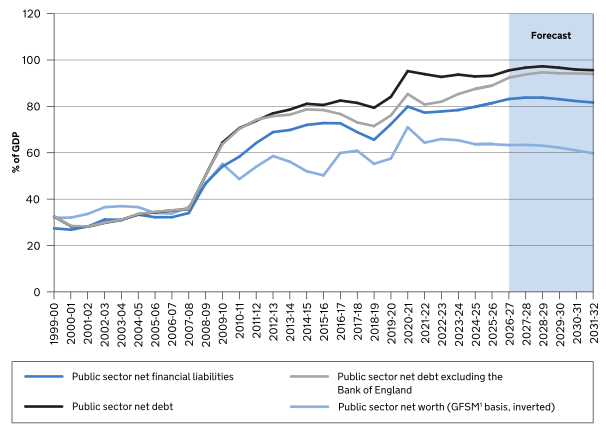
| 1 Government Finance Statistics Manual. |
| Source: Office for National Statistics and Office for Budget Responsibility. |
Net financial debt recognises the value of financial assets and growth‑enhancing investments. As set out in Chapter 4, the government is providing funding specifically for financial transactions via Good Growth Funds, to enable Mayoral Strategic Authorities to make investments in financial assets in the private sector as part of a broad tool kit to drive growth. The recapitalisation of public financial institutions with financial transactions also drives private investment and business growth. The latest forecast for financial transactions is set out in Table 1.4.
The Financial Transaction Control Framework (FTCF) sets guardrails to ensure that the government’s use of financial transactions is fiscally sustainable and does not cause debt to rise over time. An update of the FTCF is published alongside this Budget, including a commitment to engage with devolved governments, departments and Mayors on how the framework applies to devolved financial transactions.
Table 1.4: OBR forecast of financial transactions, excluding Bank of England
| £ billion (current prices) | 2026-27 | 2027-28 | 2028-29 | 2029-30 | 2030-31 | 2031-32 |
| DEL net lending(1) | 2.3 | 2.2 | 3.2 | 4.1 | 4.3 | 4.0 |
| of which: | ||||||
| Mayoral Strategic Authority borrowing facility | 0.0 | 0.0 | 0.3 | 0.3 | 0.5 | 0.5 |
| Student Loans(2) | 15.9 | 8.9 | 9.1 | 9.2 | 9.3 | 9.2 |
| National Wealth Fund (inc. Energy Wealth Fund) | 3.5 | 2.4 | 2.5 | 3.2 | 3.4 | 3.5 |
| British Business Bank | 1.2 | 1.1 | 1.1 | 0.8 | 0.6 | 0.8 |
| National Housing Bank | 0.6 | 1.4 | 1.8 | 2.0 | 1.5 | 0.6 |
| UK Export Finance | 0.6 | 0.6 | 0.4 | -0.1 | 0.0 | -0.1 |
| Other net lending | 1.9 | 1.1 | 1.6 | 1.8 | 2.2 | 3.1 |
| Total FT | 26.0 | 17.7 | 19.7 | 20.9 | 21.4 | 21.0 |
| 1 Departmental Expenditure Limit net lending. |
| 2 The 2027/28 student loans figure captures the effect of the revaluation of the loan book caused by the freezing of the Plan 2 repayment threshold. |
| Source: Office for Budget Responsibility. |
One of the key commitments of the framework is transparency about the value of the assets that financial transactions create. The government publishes alongside this Budget the Financial Investment Report, an annual UK Government Investments-led assessment of the value, risk and performance of the government’s portfolio of financial assets.
Best practice in fiscal transparency means reporting on obligations that taxpayers may have to meet in the future, due to decisions today. Contingent liabilities are not included in net financial debt because they represent potential, rather than actual, obligations, often only being recognised at the point of crystallisation. The material contingent liabilities that the government has entered into since Budget 2025 are set out in Table 1.5.
Table 1.5: Significant contingent liabilities since November 2025 (£ billion)
| Department | Reasonable worst-case | Expected loss | Expected income |
| Department for Energy Security and Net Zero | 1.2-1.7 | <0.1 | <0.1 |
| Foreign, Commonwealth and Development Office | 2.1 | 0.7 | 0 |
| Ministry of Defence | 0.7 | <0.1 | 0 |
| Total | 4-4.5 | 0.7 | 0.1 |
| Note: Expected loss represents a statistical estimate of potential losses, not a forecast of losses that will occur. |
| Source: HM Treasury contingent liabilities database. |
Financing
The Debt Management Office (DMO) net financing requirement for 2026‑27 is forecast to be £258.6 billion, an increase of £7.4 billion from the previous remit. This will be financed through £250.6 billion of gilt sales (an increase of £4.4 billion), as well as £8 billion from the sale of Treasury bills used for debt management purposes (an increase of £3 billion). The government’s financing plans for 2026‑27 are summarised in Annex A.
The central government net cash requirement (CGNCR) is £144.1 billion in 2026‑27, £6.9 billion higher relative to the OBR’s March forecast. This is lower than the increase in PSNB in 2026‑27, reflecting inflation-driven increases in debt interest which affect PSNB when inflation occurs, but impact CGNCR over a longer time horizon.
The government is committed to maintaining as diversified an investor base as possible to enhance the resilience of the government’s financing programme. In keeping with this, the government published a consultation response in May on expanding and deepening the UK Treasury bill market. Today, the government is providing further detail around the implementation of the measures announced by it earlier in the year. These details can be found in Annex A.
HM Treasury, the Bank of England and the DMO have been developing a model whereby all Asset Purchase Facility (APF) active gilt sales are made to the government and not to the market. HM Treasury would instruct the DMO via the Debt Management Account to purchase the APF gilts that the Bank Executive is selling as part of its implementation of the MPC’s multi-year plan. HM Treasury would in due course instruct the DMO to issue a corresponding amount of debt to finance such APF purchases through the annual financing remit. As set out in the Chancellor’s letter to the Governor on 17 September 2026, this model remains under review, such that, subject to a final decision to proceed, implementation could begin in a way that allows this to be incorporated into the DMO’s 2027‑28 annual financing remit, as set by HM Treasury ministers.[footnote 62]
3. Fiscal responsibility and public spending
The actions this government is taking to reduce waste, increase efficiency, and live within our means will lower borrowing to bear down on inflation and increase the UK’s resilience in the face of shocks. All policy at this Budget is fully funded over the forecast.
3.1 Public spending
The government is maintaining public investment at the highest sustained level in four decades. Day-to-day departmental spending is due to be over £40 billion higher each year by 2028‑29, and the government is increasing capital investment by £120 billion over this Parliament, both compared with plans set out by the previous government in spring 2024.[footnote 63],[footnote 64] This has enabled the government to invest in communities: building new social and affordable homes, improving infrastructure, lifting children out of poverty, strengthening the NHS, and securing a stronger and more resilient United Kingdom through investment in defence.
The Budget confirms that day-to-day departmental spending will continue to grow overall in real terms over the forecast period, but it will be more gradual, controlled and targeted. The 10 Year Plan will set out the government’s long-term vision and priorities ahead of the next spending review. The next spending review will take place in 2027. As the government continues to target investment into the country’s top priorities, it is not necessarily the case that all departments will see real terms increases at the next spending review – putting the right resources into priorities is what any responsible government does.
The Budget also reaffirms the government’s commitment to reform through devolution, prevention and the transformational use of technology. This will improve outcomes and deliver efficiencies and savings. The choices the government is making on spending means this Budget can reject broad-based tax rises and protect most individuals and businesses from tax increases.
3.2 Spending discipline
In June, the government announced £15 billion between 2026‑27 and 2029‑30 for the Defence Investment Plan. It confirmed that £10.3 billion would be funded by reprioritising public spending without taking resources away from day-to-day spending on frontline services, and committed to confirming the full funding plan at Budget.
This Budget confirms that the residual £4.7 billion will be funded through reprioritisation of capital budgets. This will be achieved by further reducing departmental capital budgets by 1% from 2027‑28 to 2029‑30 to raise £3 billion. An additional £1.7 billion over the period will be funded from unallocated contingency in the Treasury’s capital Reserve. This is fair and balanced, made possible through proactive management of capital pressures and reprioritisation.
The government has concluded its Strategic Asset Review, which has identified surplus assets for disposal as part of the Defence Investment Plan funding package. The Budget sets revised departmental budgets, reflecting individual departmental disposal targets.
The government’s approach to spending discipline is reflected across reprioritisation decisions that it has taken throughout this administration, including: reprioritising within the Ministry of Housing, Communities and Local Government’s budget to fund an offer of a route off the streets this year for rough sleepers; cancelling the Digital ID scheme; and funding the £2 bus fare cap that will be in place over 2027 from savings within the Department for Energy Security and Net Zero’s budget.
3.3 Reforming the state
The government is taking a fundamentally different approach to public services, in line with the ‘Rewiring the State’ Cabinet statement published in July and the fiscal devolution roadmap published alongside this Budget. These reforms will improve outcomes and increase efficiency at every level of government by devolving decision-making, streamlining central government, harnessing transformative technologies, and addressing the long-term drivers of spending. Rewiring the state will result in a shift towards a more devolved, preventative and productive state.
The government is taking steps at this Budget to radically shift where and how decisions are made by transferring resources to local leaders across England. This shift will enable a more integrated and place-based approach: one that gives places more power to target spending towards the biggest issues in their communities, that breaks down decision-making siloes, and that more coherently joins up services to improve outcomes and overall efficiency. As a step towards this, and alongside fiscal devolution, the government is publishing guidance on place-based business cases, a new approach to appraisal that puts local objectives at the heart of decision making. These place-based business cases can use economic potential analysis to identify the constraints holding a place back and assess what is needed to realise its potential.
The government is working with the devolved governments and local and regional stakeholders in Scotland, Wales and Northern Ireland to explore how the benefits of regional empowerment can be spread to all parts of the UK.
The Cabinet Secretary is leading the transformation of the Civil Service so that it is recognised for excellence in delivery, innovation and improved productivity. This includes a process – supported by departmental Non-Executive Directors – to deliver significant reductions in the size and cost of the Civil Service, through maximising the opportunities presented by AI adoption and digital transformation.
The government will deliver devolution, not delegation. Where powers and functions are transferred, they will not be duplicated at the centre. Through devolution and increased adoption of AI and technology, the Civil Service will become smaller, more strategic, and focused on the issues that are best addressed at the national level.
At Spending Review 2025, the government committed to reducing departmental administration budgets by 16% in real terms by 2029‑30. As a result of its plans to rewire the state, the government is going further by reducing departmental administration budgets by 20% by 2029‑30. This will realise savings from 2027‑28 and will save an additional £595 million in 2029‑30 compared with previous plans.
This streamlining of the Civil Service will be supported by £35 million to set up GovAI to provide civil servants with access to the latest frontier AI tools and capabilities, freeing up their time to improve public services, and supporting departments to build in-house AI capabilities, procure external solutions, and partner with innovative startups. GovAI will also manage a new Civil Service AI transformation fund of £50 million across 2027‑28 and 2028‑29, funded through reinvesting some of the savings realised by reducing administration budgets. The fund will turbocharge technology and AI deployment across the Civil Service to reduce unnecessary administrative burdens and improve outcomes, including by automating processes and streamlining workflows to boost productivity.
The government is ensuring its investment into the NHS is spent wisely. In 2025‑26, the NHS delivered efficiencies and savings worth over £10 billion, equivalent to 5.2% of its RDEL budget. Considerable progress has been made already to drive NHS productivity, freeing up staff time and making improvements for patients, including through new technology such as the NHS App, which is helping more than 39 million users to navigate their healthcare options and access their health records.[footnote 65] The government’s AI-supported diagnostic tools have already helped over four million patients receive faster lung cancer diagnoses or results, with the AI Diagnostic Fund supporting technologies focused on high-demand services for lung cancer, such as chest X-ray and CT diagnostics.[footnote 66]
To build on this, the Chancellor and Health and Social Care Secretary have asked Mark Bailie to lead an independent review on NHS productivity and AI, which will inform the next spending review. Reporting in early 2027, this will focus on the practical opportunities presented by AI and technology to transform services for patients and boost NHS productivity.
The government is also launching an AI Challenge Prize to incentivise UK‑based innovators and businesses to develop AI solutions to major frontline public service challenges, supported by £15 million of funding and administered by DCMS. The first competition will focus on the NHS, with a top award of up to £2.5 million for the most promising solution to a priority healthcare challenge.
Across the rest of government, progress is also underway and is continuing to unlock innovation:
- Rolling out Ask HMRC, the government’s AI tool to support customers to navigate the tax system – this handled a record 6.3 million customer interactions in 2025‑26, supporting the government’s ambition that nine in 10 customers use digital self-service.[footnote 67]
- Expanding access to Justice Transcribe, the government’s AI-enabled probation tool, to all probation officers, building on around 267,000 hours already saved and freeing up officers to spend more time supporting rehabilitation and reducing reoffending.[footnote 68]
- Making MHCLG’s PlanAssist frontier AI tool available to all councils in England by the end of 2027, subject to further testing, to halve routine planning decision times and build capacity in the planning system. The government will also mandate the digitisation and publication of key planning documents as open data by the end of 2027, removing barriers to wider AI adoption.
3.4 Prevention
The government recognises that placing greater emphasis on early intervention can yield benefits in the long term and help to address the drivers of poor outcomes and cost. The government is committed to acting to address problems before they escalate, improving people’s lives and delivering better long‑term value for taxpayers.
To support this approach, the government will introduce a new category of ringfenced spending at the spending review in 2027, preventative DEL (PDEL). PDEL will help facilitate shared resource and accountability across budget holders, and will help protect programmes that generate benefits over the longer term. This approach is demonstrated in the government’s plans to tackle rough sleeping, where the £432 million invested at this Budget will provide individual relief whilst also reducing the significant fiscal cost of each individual sleeping rough, estimated at around £14,000 per year.[footnote 69]
The government is continuing to reform the Green Book, its guidance on appraisal, including to place greater value on the long-term benefits of investment. As part of this, the government is publishing a revised Green Book, formalising the reduction in the discount rate from 3.5% to 3.0%. This will strengthen the case for transformational projects that drive growth, wherever they take place.
3.5 Continuous improvement in public spending
The government is committed to continuously improving the way it spends taxpayers’ money, delivering better outcomes and stronger public services with the same, or less, money. At Spending Review 2025, departments published Efficiency Delivery Plans with total annual efficiency gains of almost £14 billion by 2028‑29. In 2025‑26, every large department was required, for the first time, to report against the Government Efficiency Framework, which is a common reporting standard that shows efficiencies – delivering the same or more for less – as distinct from savings.
In 2025‑26, departments delivered 4.1% of efficiency and savings, equivalent to around £16 billion RDEL and exceeding their 2% target for that year.[footnote 70] Reports through the Framework show that gains are increasingly being driven by structural improvements to the way the government operates. This focus is already delivering results:
- DfE’s AI lesson-planning tool is saving teachers an average of around three hours a week, reducing administrative burdens and freeing up more time for teaching and other school responsibilities.
- The NHS has focused on reducing reliance on temporary staffing in order to reduce costs, with agency expenditure falling by £900 million (43%) in 2025‑26 compared with 2024‑25.
Spending Review 2025 set bespoke departmental efficiency targets and delivery plans targeting day-to-day spending. To ensure value across all departmental spending, the government will introduce a minimum expectation of technical efficiencies for capital budgets. This will be reported as part of the Government Efficiency Framework.
The government is tackling public sector fraud. In 2025‑26, the Public Sector Fraud Authority delivered £403.6 million in audited counter fraud benefits, achieving 119% of its target.[footnote 71] It continues to assess Initial Fraud Impact Assessments in business planning to embed fraud prevention in programme design.
As part of wider reforms to how the government plans, assesses and uses its assets across public services, departments will be required to develop long-term asset strategies to inform funding decisions at the spending review in 2027. Alongside the work of the Strategic Asset Review, a revised Strategic Asset Management Plan process will help create a more efficient and sustainable public estate, improving the condition of public assets over time by ensuring they are maintained, invested in and rationalised in a way that delivers value for taxpayers.
3.6 Keeping the government’s tax commitments
Fiscal discipline underwrites every promise this government makes. At a time when households and businesses are under pressure and need breathing space, the Budget rejects broad-based tax rises. It achieves this while ensuring that all policy at the Budget is fully funded over the forecast, and raises the revenue to fund commitments on breathing space and energy in a fair, targeted and proportionate way. In doing so, it has protected most individuals and businesses from tax increases, giving them further space to breathe.
The government is keeping to its commitments on tax, with no increase to the headline rates of income tax, National Insurance contributions or VAT. The government is further modernising the tax system, closing loopholes and ensuring that everyone pays the tax they owe.
The government recognises the importance of a stable and predictable tax system to give businesses the certainty and confidence to make long-term decisions and invest in the UK. The government is therefore maintaining the commitments in the 2024 Corporate Tax Roadmap, and is taking steps to progress the roadmap commitment to explore simplification and improve the administration of the tax system.
3.7 A modern and fair tax system
The government is committed to a modern and fair tax system that works better for individuals and businesses, including by closing the tax gap. This Budget builds on progress already made and introduces reforms that make it easier for individuals and businesses to navigate the tax system and pay the right amount of tax at the right time, reducing error and unnecessary burdens. This includes launching a targeted, evidence-led programme to simplify specific areas of Corporation Tax, working with businesses and tax experts to reduce avoidable complexity, improve certainty and make the UK a better place to invest and do business in.
This builds on HM Revenue and Customs’ (HMRC’s) Transformation Roadmap published in July 2025, which set out the government’s vision for a more modern and efficient tax administration system, including through the continued rollout of Making Tax Digital.[footnote 72]
The government will modernise the existing Payments on Account system for Income Tax Self Assessment (ITSA), following consultation with stakeholders and affected taxpayers. From April 2029, taxpayers who already make Payments on Account will make smaller, more regular contributions towards their tax bill throughout the year, bringing payment closer to when income is earned. This will help taxpayers budget and plan for their tax obligations, reducing the risk of large, unexpected tax bills and making it less likely that they fall behind on tax due and build up debt. The government will continue to work with stakeholders and affected taxpayers on implementing this change. Alongside these reforms, the government will make it easier for around 160,000 employees to claim tax relief on employment expenses by removing the need to use ITSA solely to make these claims.
This Budget supports businesses through the use of data and technology to develop a more modern and efficient tax system. The government is setting out an implementation roadmap for requiring VAT e-invoicing from April 2029, reducing administrative burdens and improving efficiency. Alongside this, a Call for Evidence on modernising Corporation Tax administration will explore how technology can simplify the system and reduce burdens on business.
Building on the increased benefits expected from existing third-party data reforms, the government will consult on expanding third-party reporting requirements for property income data, improving the information available across the tax system to support compliance while reducing unnecessary interventions and burdens for taxpayers who are meeting their obligations.
In addition to these measures, the government is modernising the rules that determine how distributions from companies to individual (non-corporate) shareholders are taxed, ensuring that similar transactions are taxed consistently through a clearer framework. This will reduce opportunities for well‑advised taxpayers to structure how profits are taken out to secure a more favourable tax treatment that is not available to other taxpayers.
The reforms are designed to protect capital treatment for genuine changes in ownership, including families passing down their business, and in some cases make the relief more generous for demergers. The government will continue to engage with stakeholders on the technical detail of the reforms and will consult on draft legislation ahead of implementation in April 2028.
As announced at Budget 2025, the government will introduce Electric Vehicle Excise Duty (eVED), a new mileage-based charge for electric and plug-in hybrid cars, from April 2028. The government has listened to feedback received through the eVED consultation and will:
- Introduce a mileage estimation tool to support motorists that will be available at launch in April 2028. The government is undertaking proof of concept work to assess how features such as benchmarking could help motorists to estimate their mileage.
- Develop an opt-in system to make use of vehicles’ in-built connectivity. ‘eVED Connect’ will allow motorists to use this connectivity so that they do not have to report their mileage manually. The technology could also support mileage estimation for the coming year.
- Develop an automated refunds model by 2030, making refunds easier and available in more circumstances, such as when a motorist overestimates their mileage or sells their car.
- Work closely with industry and motoring representative groups ahead of implementation, and make available further guidance for fleet operators later this year.
The private hire vehicle market has grown and changed rapidly in recent years, highlighting inconsistencies in tax treatment between larger operators. This Budget ends this inconsistency by making larger operators liable for VAT on their full fare, in line with other goods and services, while protecting smaller operators. The government will shortly publish a consultation on the level of annual fare turnover this measure will apply to, with £50 million as the lead option.
The government is modernising the taxation of foreign sovereign investment, putting it on a statutory footing for the first time and giving greater certainty to sovereign investors. The new regime will bring certain real estate income and gains into UK tax, while maintaining a globally competitive offer for foreign sovereign investment in the UK, including through bespoke rules to access Real Estate Investment Trusts for investments in UK real estate.
The government has published a new multi-year plan to modernise the approach to the compliance of wealthy taxpayers. The plan sets out how HMRC will make better use of data, technology and specialist expertise to improve its understanding of wealthy taxpayers, make it easier for them to get their tax right first time, and identify and address non-compliance earlier. This will enable HMRC to focus on the greatest risks.
3.8 Ensuring everyone pays what they owe
As well as making it easier for taxpayers to get their tax right first time, the government is taking targeted action to ensure everyone pays their fair share. This includes strengthening HMRC’s ability to tackle non-compliance and recover unpaid tax, with investment at this Budget in an additional 670 compliance officers, building on previous commitments to recruit 5,500 additional compliance officers, by 2029-30.
The government is also taking action to ensure foreign firms have to pay the same tax as UK businesses. The government is closing a loophole which currently allows overseas businesses to sell services to some UK businesses without accounting for UK VAT.
In 2021, reforms were introduced to ensure that overseas sellers on online marketplaces pay the tax they owe. This was a step towards protecting the high street from unfair competition from overseas businesses. The government is now going further to tackle the non-compliance by UK sellers trading on online marketplaces that undercuts businesses on the high street who pay the tax they owe. The government will do this by making the marketplaces responsible for collecting VAT on sales by UK businesses, where those businesses are making more than £90,000 of sales through the marketplace. This policy will be implemented from October 2027 and will not impact personal sales through marketplaces. The money raised from this policy will be reinvested into the high street through reductions to business rates.
This Budget also announces that, alongside existing tools used to recover high-value debt, the government will provide HMRC with a new power to enable the direct recovery of lower-value tax debts from those who can afford to pay but repeatedly fail to do so.
The government continues to take action to close the tax gap. The changes announced at this Budget to modernise the tax system and ensure everyone pays their fair share take the total due to be raised from measures to close the tax gap announced during this Parliament to over £12 billion in 2029-30.[footnote 73]
By reducing administrative burdens and improving certainty, the government is supporting investment, productivity and growth in every postcode in the UK. The government will continue to identify opportunities to simplify and modernise the tax and customs system and will make further changes including at a Tax Update in 2027.
3.9 Making fair choices on revenue raising
The government is giving families breathing space now, including by extending the cut to VAT on electricity until July 2027, and providing a further £2.6 billion of support through the Household Energy Payment, with up to 20 million households in England receiving a direct £100 payment from January 2027 delivered through the council tax system. To help fund this, the rate of the Bank Corporation Tax Surcharge will temporarily increase from 3% to 6%, from 1 January 2027 until 31 March 2028. This time-limited period will be legislated for in Finance Bill 2026-27 and will not be extended.
The rate of Machine Games Duty will increase from 20% to 25% on machine games with stakes over £1 from April 2027. This will increase the rate on higher-risk machines, which are more associated with gambling harm and commonly found in venues such as adult gaming centres. The revenue raised from this measure will help to pay for the freeze in business rates for retail, hospitality and leisure properties, so that no property in those sectors faces a real-terms increase. In order to protect pubs and seaside arcades, the government is maintaining the existing rate for lower-stake machines.
The government is keeping the rates of tax paid on earnings unchanged, while seeking an additional contribution from those with taxable income from assets. Budget 2025 increased the rates of tax on savings and property income by two percentage points across all tax bands from April 2027. The government will increase these rates by a further two percentage points from that date. This is a fair and proportionate approach, and 84% of income tax payers will be unaffected by these changes. This also raises revenue in a progressive way, so that those who earn more contribute more. Around half of the revenue raised from this change is expected to come from the top 10% of households.[footnote 74]
The government continues to support individuals to save, including through Individual Savings Accounts (ISA), the Personal Savings Allowance (PSA) and the Starting Rate of Savings (SRS). This means that basic rate taxpayers would need over £25,000 in savings in addition to any ISA savings before paying tax and those also eligible for the SRS could have up to £150,000 in savings in addition to their ISAs without paying tax.[footnote 75]
To continue providing generous support for savers, the government has decided not to reduce the cash ISA limit, so that it remains at £20,000. The government recognises the importance of making investment more accessible to savers, supporting households to build their wealth. The government launched targeted support in April to help more people access support on investment decisions and welcomed the launch of the industry-led ‘Invest for the Future’ campaign to promote the benefits of investing to the public. The government will now go further, working with the investment industry to explore a new ISA incentive for people investing in a stocks and shares ISA for the first time. The detailed design will be developed with industry.
The government is reducing the lifetime limit for capital gains eligible for Business Asset Disposal Relief (BADR) from £1 million to £500,000 from April 2027. This will ensure that three-quarters of BADR claimants will still receive relief on their entire gain, while supporting focus within the tax system for the start-up and scale‑up phases of business, when most investment decisions are taken.
The government is maintaining stability for businesses and investment through its commitment to the Corporate Tax Roadmap, capping the headline rate at 25%, currently the lowest in the G7, and maintaining the UK’s world-leading full expensing regime. At this Budget, the government has decided to raise revenue by reducing the main rate of writing down allowances by two percentage points, taking the rate to 12% from April 2027. At the same time, the government is increasing incentives for new investment by raising the main rate First Year Allowance (FYA) from 40% to 50% and maintaining stability for businesses by prioritising sticking to the Corporate Tax Roadmap. This maintains the UK’s international competitiveness, with the UK continuing to have one of the most generous capital allowance regimes in the world.
4. Breathing space
Price stability and sustainable economic growth are essential to raising living standards in the long run. The government’s commitment to fiscal discipline supports breathing space: bringing down borrowing helps bear down on inflation, mortgage rates and the cost of business. At the same time, the government is helping households and businesses manage the immediate pressures from global volatility. This Budget delivers breathing space by launching a new Household Energy Payment, freezing or cutting taxes for retail, hospitality and leisure (RHL) businesses on the high street, and protecting most individuals and businesses from tax rises – while kicking off longer‑term changes to get costs down, starting with energy costs.
The government recognises that households and businesses are feeling the effect of the conflict in the Middle East. Global energy prices have increased sharply since the start of the conflict and the effective closure of the Strait of Hormuz in February. The global shock has pushed up the price of energy imports. Inflation rose to 3.5% in September, and the Office for Budget Responsibility (OBR) expects it to peak at 3.8% in Q1 2027.[footnote 76] For a sustained period, cost of living pressures have been the most pronounced for household essentials. Overall, consumer prices today are around 33% higher than the 2020 average, while household energy has seen an increase of 73% (Charts 3.1 and 3.2). A household filling a typical 55-litre family car now spends around £24 more at the pump for petrol and £32 more for diesel than they did before the conflict started.[footnote 77] Government action at this Budget to provide breathing space for households is expected by the OBR to reduce inflation by 0.1 percentage points in 2027.
4.1 Chart 3.1: Increases in prices and earnings since 2021
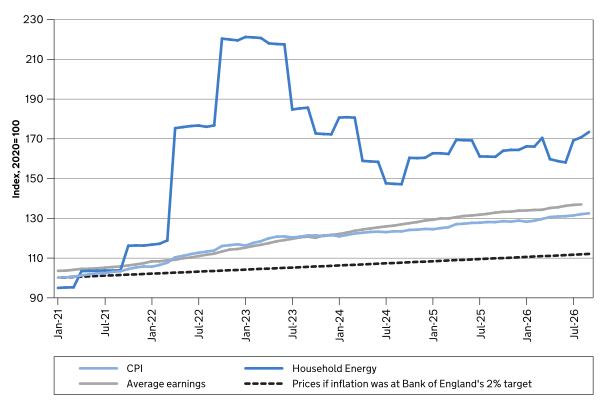
Source: ONS Consumer Price Statistics, ONS Average Weekly Earnings Statistics.
4.2 Chart 3.2: Contribution to Consumer Prices Index (CPI) inflation
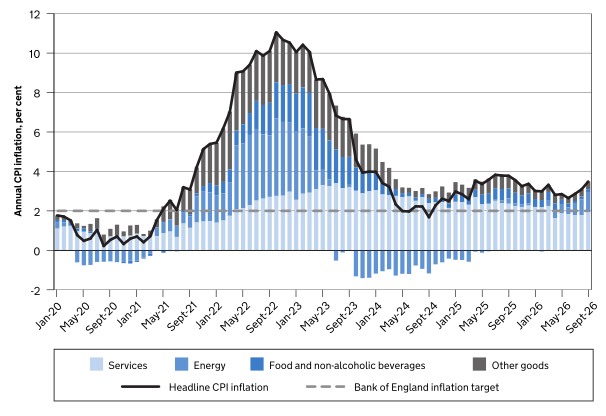
Source: Office for National Statistics.
In that context, this is a Budget to steer Britain through a period of global pressures, to grow the economy and to provide breathing space for families and businesses.
- First, this government is continuing to deliver on its commitment to fiscal discipline: the stability that fiscal discipline creates provides the foundations for the investment needed to deliver good growth, and lower borrowing supports the Bank of England to reduce inflation. The government has ensured that all policies at this Budget are fully funded over the forecast.
- Second, at a time when families and businesses are under pressure and need breathing space, this Budget rejects broad-based tax rises, protecting most individuals and businesses from tax increases. Instead, the government is choosing to use some of the headroom established last year to absorb the impact of higher debt-interest costs from the conflict in the Middle East.
- Third, this Budget takes the pressure off families and businesses now. The government has already removed VAT from domestic electricity for this winter and will cap bus fares at £2 and reduce business rates on pubs in 2027. This Budget goes further, with policies that support around 29 million households across the UK with an extended cut to VAT on electricity, 35 million individual motorists – and businesses across the UK – through extending the freeze to fuel duty, and up to 20 million households in England through the Household Energy Payment.[footnote 78],[footnote 79],[footnote 80] And for high street businesses, the decisions in this Budget mean that from April 2027, RHL businesses in England will see their business rates either frozen in real terms, reduced, or cut to zero.[footnote 81]
4.3 Supporting households and businesses with energy bills
Households are understandably worried about energy costs, given the sharp increase in global prices this year. This Budget provides universal support with energy bills by extending the temporary 0% rate of VAT on qualifying domestic electricity supplies in Great Britain for another three months, until July 2027. This extension is expected to take around £50 off the annual Ofgem price cap in April 2027.[footnote 82] To support households in Northern Ireland, the government is providing funding for the Northern Ireland Executive to provide comparable support with household electricity bills. Extended VAT relief is expected to apply in Northern Ireland from April 2027.
In addition, the government is launching a £2.6 billion Household Energy Payment to help households with the rising cost of energy. This will be directly provided to up to 20 million households via the Council Tax system, through a £100 payment for households in bands A-D in England from January 2027.[footnote 83] The devolved governments will receive their share of funding through the Barnett formula, which will enable them to provide similar support. Taken together, these decisions mean that almost all households in the UK will benefit from the extended VAT cut to electricity, which is expected to take around £50 off the annual Ofgem price cap in April 2027, and around 80% of households in England will gain further from the £100 Household Energy Payment. To help fund this, the rate of the Bank Corporation Tax Surcharge will temporarily increase from 3% to 6%, from 1 January 2027 until 31 March 2028. This time-limited period will be legislated for in the Finance Bill 2026‑27.
The government also recognises that lower-income households are the most likely to feel the squeeze when energy bills increase. In 2024‑25, households in the bottom 10% of the income distribution spent over six times more on energy than households in the top 10%, as a proportion of net income (see Chart 3.3). The government estimates the Household Energy Payment will reach 83% of fuel-stressed households in England, and 88% of households in the bottom three income deciles.[footnote 84], [footnote 85] In addition, this Budget provides £100 million additional funding for local authorities in England to provide further targeted support to households acutely impacted by rising energy bills, some of whom are in council tax bands above A-D.
Chart 3.3: Household expenditure on energy (electricity, gas and other non-motor fuels), by income decile, as a percentage of net household income
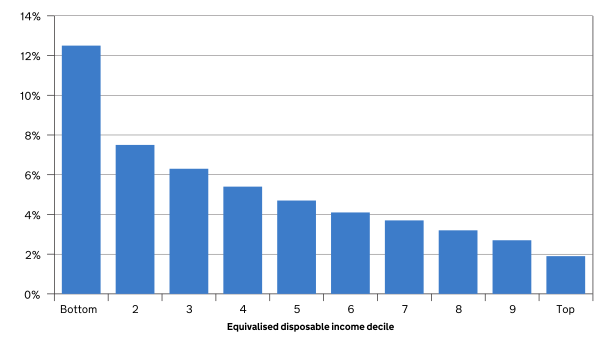
Source: Office for National Statistics, Living Costs and Food Survey, 2024-25.
This intervention builds on action taken at the last Budget, including taking £150 of costs off bills in April 2026 by scrapping the Energy Company Obligation levy and funding 75% of the Renewables Obligation from the Exchequer.[footnote 86] It also comes on top of the targeted financial support worth over £50 million for low-income households who heat their homes with oil, which the government announced in March.
The government is also offering longer-term reforms to make sure energy institutions and markets work for households and businesses. This Budget kickstarts the long-term action required to get energy costs down for good. Household energy debt has almost tripled to over £5 billion (Q2 2026) following Russia’s illegal invasion of Ukraine.[footnote 87] The government is publishing a new debt strategy to address this and act as a circuit breaker on energy debt. The strategy is expected to save a typical household almost £30 by 2030, via reforms to prevent debt building up and a one-off targeted debt relief scheme for eligible households.[footnote 88]
Gas standing charges are currently £108 a year on average for the typical billpayer.[footnote 89] They are paid by households even if they use very little gas. To give consumers more control over their bills, the government has asked Ofgem to abolish gas standing charges on domestic energy bills, aiming for delivery by the end of 2027 or as soon as possible after then. Ofgem will ensure that energy suppliers recover these costs through gas unit rates instead and work with suppliers and consumer groups to maintain a stable, fair and competitive retail market. While a significant majority will benefit from better control of their energy bills, a number of households may be less able to make the most of the reform. This change will be implemented fairly, including through the government setting out targeted mitigation. As well as abolishing gas standing charges, the government is also committing to reform electricity standing charges and will set out details next year.
Chapter 4 sets out further detail on energy bill support for businesses. This includes funding being confirmed at Budget for the British Industrial Competitiveness Scheme (BICS) to cut electricity bills by up to 25% for over 10,000 energy-intensive businesses from April 2027; the introduction of a Cost Control Framework at the spending review in 2027 to set budgets for components of energy costs, including policy costs; and reforms to the energy market which will bring down the cost of energy in the long term.[footnote 90]
The government will shortly bring forward the Energy Independence Bill to legislate for some of the measures in this Budget.
Box 3.A: Summary of energy interventions
This Budget provides breathing space for households by:
- Extending the VAT cut on domestic electricity introduced on 1 October 2026 until July 2027, expected to reduce the annual Ofgem price cap in April 2027 by around £50.[footnote 91]
- Providing a further £2.6 billion of support through the Household Energy Payment to help households with the rising cost of energy. Up to 20 million households in England will receive a direct £100 payment from January 2027. This includes funding provided to devolved governments to support households across the UK.[footnote 92]
Alongside this immediate support, this Budget kickstarts the long-term action required to get energy costs down for good:
- Controlling energy costs – no new policy costs will be put on bills until a comprehensive Cost Control Framework is in place at the spending review in 2027, which will set budgets for components of energy costs, including policy costs.
- Prioritising a cheaper energy mix and procuring new generation only where it lowers bills, benefits the system, and can be accommodated by the grid.
- Progressing next steps in breaking the grip of gas on bills with a consultation published alongside this Budget on wholesale Contracts for Difference, fixing the price paid to some renewable projects, to protect British homes and businesses from volatile gas prices.
From 2027 onward, the government will:
- Deliver the British Industrial Competitiveness Scheme, meaning 10,000 energy-intensive manufacturing firms will get a 20-25% electricity discount, starting in April 2027, including a back payment for 2026-27.[footnote 93]
- Abolish gas standing charges, coupled with targeted mitigations to ensure this is delivered fairly.
- Introduce a new Energy Debt Circuit Breaker to tackle energy debt, saving all billpayers around £30 by 2030.[footnote 94]
- Reform electricity standing charges – with further details to be announced next year.
- Scrap the planned new tax on gas bills (the Gas Shipper Obligation), so that government rather than consumers fund the costs of hydrogen projects.
4.4 Support with fuel prices and other motoring costs
The government recognises that high fuel prices from the conflict in the Middle East are continuing to impact motorists. In 2022, Russia’s illegal invasion of Ukraine led to soaring fuel prices, and the previous government introduced a temporary 12-month 5p cut in the rate of fuel duty. This has since been extended five times, including in May of this year, when the government extended it until the end of 2026 to support motorists and other fuel users in response to elevated fuel prices arising from the conflict in the Middle East.
Fuel prices remain significantly elevated, with diesel exceeding £2 per litre in October 2026.[footnote 95] To provide temporary breathing space to the 35 million motorists and businesses across the UK, the government is cancelling plans to add 5p back onto fuel duty from January 2027 and is extending the cut by a further six months to 1 July 2027.[footnote 96] The government is also deferring the planned Retail Prices Index (RPI) increase to 1 July 2027. The government will continue to monitor fuel prices over the coming months. Fuel duty is as low now as it has been at any point for over 16 years.[footnote 97] Taken together, the government’s decisions on fuel duty across this Parliament are expected to have saved the average car driver £230, the average light goods driver £472 and the average heavy goods vehicle (HGV) driver nearly £4,000, compared with plans under the previous government.[footnote 98]
As announced on 27 October, the government is also supporting employees and self-employed people across the UK who use their own vehicles for work by increasing tax-free mileage rates. In May, the government announced a temporary 55p per mile rate for the first 10,000 business miles for cars and vans. At this Budget, the government is making this permanent. This will mean around 2 million employees and 1 million self-employed people, including care workers, social workers, electricians and plumbers, will see £120 a year in additional tax savings if they drive 6,000 business miles. The government is also increasing the mileage rate above 10,000 business miles from 25p to 35p, allowing someone driving 15,000 business miles a year to receive up to £300 in additional tax savings from both upratings.[footnote 99]
The rise in fuel prices is also disproportionately affecting users of red diesel. The government is extending the 3.7p cut to duty on red diesel for a further six months to 1 July 2027, keeping the rate at its lowest level for over 20 years.[footnote 100] This will continue to provide breathing space to agriculture, rail freight and other fuel-intensive red diesel users. Additionally, in July the government introduced a 12-month holiday from vehicle excise duty (VED) for most HGVs, running to 1 July 2027, and saving £600 for a typical HGV on top of savings from cancelling the planned fuel duty increases.[footnote 101]
In addition, the government welcomes the publication alongside the Budget of Philip New’s independent review of the cost of charging electric vehicles (EVs) on the public network. The government is taking immediate steps to establish a taskforce to explore allowing drivers to use their domestic electricity tariff at local, lower-powered public charge points. This is a complex proposal that will take time to consider, so the government is also announcing £100 million over the next two years to reduce costs for local, lower-powered public chargers. Coming into effect from Spring 2027, this is expected to save the average EV driver without home charging and who charges on-street around £150 per year.[footnote 102] The Department for Transport (DfT) will set out next steps in due course.
4.5 Additional support for households
One of the biggest expenditures for families is the weekly food shop. At this Budget, the government is suspending tariffs on all UK imports of over 100 food products – from plant-based drinks and baked beans to dried fruits and chocolate – expected to reduce consumer costs by £120-185 million per annum. Combined with the package of tariff suspensions on food in June, this is expected to reduce consumer costs by £245-595 million.[footnote 103] Separately, following the impact of the conflict in the Middle East, the government is also temporarily suspending tariffs on fertiliser and kerosene heating oil. This will lower production costs for the UK’s agricultural sector and support households that rely on heating oil to heat their homes, including many people in rural areas and Northern Ireland. Food and kerosene suspensions will be in place for two years until December 2028. Fertiliser tariffs will be suspended until December 2027.
To support low-paid workers across the UK, the government is raising the National Living Wage and National Minimum Wages, which is expected to benefit around 2.3 million workers.[footnote 104] On 1 April 2027, the National Living Wage will increase by 3.9% to £13.21 per hour, equivalent to an increase of £910 in the gross annual earnings of a full-time worker on the National Living Wage.[footnote 105] The National Minimum Wage for 18- to 20-year-olds will also increase by 3.9% to £11.27 per hour. By accepting the Low Pay Commission’s recommendations in full this year, the government is ensuring workers are rewarded fairly for their work, while protecting jobs, backing businesses, and strengthening the conditions for economic growth.
The government will also introduce the Pension Tax Allowance from April 2027, which reduces the disproportionate administrative burden of paying small amounts of tax for those whose incomes only just exceed the Personal Allowance. Pensioners with incomes at or under the value of the full new State Pension will not be brought into paying tax because of State Pension uprating in this Parliament.
Looking ahead, the government is making long-term changes to improve support for families. This includes:
- Expanding parental pay to make the system fairer, including to self-employed fathers, partners and adopters: from April 2029, eligible self-employed fathers, partners and adopters in Great Britain, who are currently excluded from the system, will be able to access parental pay. This is set to benefit over 150,000 parents per year, providing breathing space to affected families who previously would be excluded from support.[footnote 106] This comes in advance of the ongoing Parental Leave and Pay Review, which will conclude in early 2027.
- Supporting children’s development from birth to school: the government is committed to increasing children’s readiness for school, with an ambition that at least 75% of children will reach a ‘good level of development’ by 2028. The government will provide up to £5 million a year for three years from 2027‑28 for organisations like Dolly Parton Imagination Library and BookTrust, increasing access to books for young children and helping improve their readiness for school.
- Giving carers in receipt of Carer’s Allowance greater flexibility to work without the fear of losing out financially: the government will reform the Weekly Earnings Limit so that carers no longer lose their entire benefit for exceeding the limit by a single penny. Instead, earnings above the limit will be subject to a taper that reduces the benefit payment as earnings increase. This measure is expected to benefit around 48,000 carers in England and Wales. The taper will be implemented during 2030‑31 following the development of a new IT system that will automatically adjust payments in line with the taper.
Box 3.B: Impact on households
The distributional analysis published alongside the Budget shows that, on average, households in the lowest income deciles in 2027‑28 will benefit most from the policy decisions taken by the government at Budget 2026 (as demonstrated in Chart 3.4). Increases in tax will be concentrated among the highest income households.
Chart 3.4: Impact of decisions from Budget 2026 on households in 2027-28, as a percentage of net income, by income decile
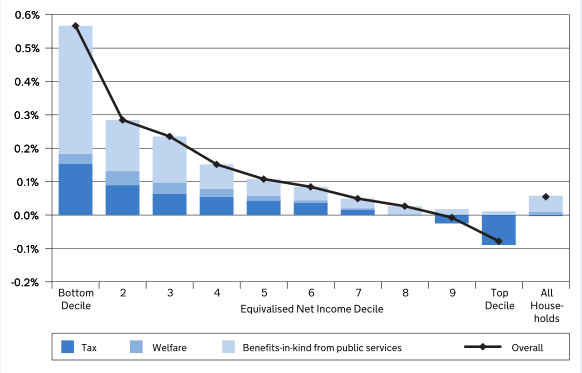
Source: HM Treasury distributional analysis model.
4.6 Supporting high streets and small businesses
High streets are at the heart of local communities. They are where many people go to work and the places that keep communities connected. The government has already started to give breathing space to those businesses that bring people together. The government is providing an extra 20% relief for pubs, social clubs and all but the very largest live music venues in England from 1 April 2027. This is in addition to the support introduced earlier this year, bringing the total relief to 35%. Taken together, this relief is a tax cut worth an average of over £3,000 per pub next year.[footnote 107]
At this Budget, the government is going further to support high streets, backing RHL businesses of all sizes, many of which had been facing significant business rates bill increases. The decisions in this Budget mean that from April 2027, RHL businesses in England will see their business rates either frozen in real terms, reduced, or cut to zero. The government will deliver this by:
- Taking around 70,000 more high street businesses out of business rates through an increase of the Small Business Rates Relief (SBRR) thresholds to £18,000 for 100% relief (from £12,000) and £21,000 for tapered relief (from £15,000) for qualifying RHL properties in England from April 2027. From next year, an additional 3,500 pubs, 3,900 restaurants, 2,200 cafés and 1,700 hairdressers and beauty salons will pay no business rates.
- Delivering a real-terms freeze of business rates bills for qualifying RHL properties in England in 2027‑28 and 2028‑29, so all RHL businesses have greater confidence to plan, invest and protect jobs. On average, over 14,000 restaurants will avoid an extra £7,500 paid over the two years and 120,000 shops will avoid an extra £3,250 paid over the two years.
- Extending transitional support by extending the 2026 Supporting Small Business (SSB) scheme in England to those who were in receipt of 2023 SSB for a further year, so that around 37,000 small and independent ratepayers will continue to receive protection next year worth an average of £3,000.
As a result of this package, half of all RHL properties in England will not pay business rates at all and around 110,000 RHL properties will see their bills falling next year.
These measures will be funded in part by increasing the rate of Machine Games Duty from 20% to 25% only for higher-stakes machine games, protecting pubs and seaside arcades. They will also be partly funded by tackling non- compliance on online marketplaces through extending the online marketplace liability rules to UK businesses. Further detail is set out in Chapter 2. To go further, the government will continue to explore how the business rates system could better target online retailers in ways that minimise any indirect impacts for wider retail businesses, to fund support for the high street. The government will extend the existing Transitional Relief Supplement in England for a further two years. This 1p supplement only affects properties that have seen smaller increases or reductions in their business rates bills and will help fund the two-year real-terms freeze for qualifying RHL properties.
This fiscal support sits at the heart of a wider package to make high streets safer and easier places in which to do business. The Ministry for Housing, Communities and Local Government (MHCLG) will launch its High Streets Strategy today, including committing to creating a ‘High Streets First’ principle for relevant public estates, Business Improvement Distinct reform, and work to clean up England’s high streets. It builds on commitments from MHCLG, with a £210 million package to revitalise derelict high street buildings, and work from the Home Office to crack down on organised crime operated through businesses on the high street. To support this, the government will also:
- Take action against business rates avoidance in England: empowering local authorities to better take on avoidance by expanding the funding provided for challenging avoidance in court; and introducing a General Anti-Avoidance Rule, giving local authorities the powers they need to take on non-compliance.
- Remove business rates reliefs for vape shops and Adult Gaming Centres, so that these reliefs are better targeted at businesses that support thriving high streets: from April 2027, vape shops and Adult Gaming Centres in England will no longer be eligible for the RHL multipliers, and vape shops will also lose eligibility for SBRR.
- Engage with businesses and local government, following the mixed responses in the ‘Business Rates and Investment: Call for Evidence’, to understand how the system can better incentivise the reoccupation of empty properties.
The government is committed to a business rates system that supports growth in every postcode, strengthens local economies and gives businesses and local government greater stability. As next steps, the government will prioritise measures that support high streets, and that improve stability and predictability within the system. As set out in the fiscal devolution roadmap, the government intends to increase the share of business rates retained locally with the intention for 100% of business rates to be retained locally. The government will also explore how greater control of business rates policy could better support fiscal devolution and good growth, while protecting business certainty and fairness between places.
Support for the RHL sector announced at this Budget sits alongside wider measures to support small businesses across the UK. Small businesses are the backbone of the British economy, supporting around 13 million jobs. Earlier this month, the government accepted recommendations from the Small Business Regulatory Taskforce, which has seen government work in partnership with business leaders to identify and reduce the bureaucracy holding firms back. For small businesses, the government will make it simpler to bid for contracts, streamline ONS business surveys to reduce the number of data requests businesses have to fill out, and implement the government’s ‘Tell us Once’ ambition. To unlock the opportunities of AI, this Budget also confirms funding to pilot local partnerships to develop locally-led approaches to AI adoption, including working across local councils to help small businesses grow. Further detail is set out in Chapter 4. The government is also committed to tackling late payments to support small business cashflow. Together, these changes represent the future partnership between government and small business.
4.7 Further support for businesses
To maintain reduced import costs for businesses across the UK, the government is extending Business Suspensions applying to 269 goods which are otherwise due to expire at the end of 2026. Tariffs will remain suspended on products such as grape juice (20% tariff), tomato paste (14%) and bicycle tyres (4%) – benefitting businesses across the food and drinks, chemicals, plastics, hydrogen and automotive sectors. The government will also open a new window for businesses to request the suspension of tariffs on further products, giving firms an opportunity to identify where removing tariffs could reduce input costs and support competitiveness. This window will be open from 11 November 2026 to 3 February 2027.
Small alcohol producers make an important contribution to the economy and local communities. To provide further help, the government will make Small Producer Relief in the Alcohol Duty system more generous, providing £10 million per year of support to over 2,000 small alcohol producers across the UK, based on the government’s Alcohol Duty Evaluation report published alongside the Budget. The government will implement a more generous discount taper for products below 3.5% ABV – strengthening incentives to produce lower-strength products – and uprate the marginal discount for products between 3.5%-8.4% ABV by RPI+10% from 1 February 2027. To further support brewers, the government intends to introduce a ‘Guest Beer’ provision in the Pubs Code, covering England and Wales. This will support brewers to continue to gain access to the market, whilst giving consumers a greater choice of beers available at the pub.
More detail on measures to cut the cost of administrative burdens on businesses, including through more proportionate regulation, is covered in Chapter 4.
This Budget is reducing pressures on households and lowering costs for businesses in a fair, responsible way: providing breathing space now, and bringing hope for the future.
5. Good growth in every postcode
Good growth is how we build a stronger, fairer country, where people can enjoy rising living standards, find good work and rely on the public services and essential infrastructure that support everyday life. Its benefits should be felt in every part of the UK.
Productivity growth has slowed since the mid-2000s, weighing on living standards. Since 2010, real household disposable income per person has grown by around 0.8 per cent a year, compared with a long-run pre-financial crisis average of around 2.5 per cent.[footnote 108]
The UK also has persistent gaps in regional productivity.[footnote 109] Economic growth and jobs have been concentrated in London and the South East.[footnote 110] Regional disparities are a symptom of the national growth challenge but also hold growth back by leaving people and productive capacity underused.
The UK’s economy has proven resilient in the face of external shocks. Real GDP grew by 1.2% in the first half of the year, the joint-fastest growth in the G7.[footnote 111] There are signs productivity growth has picked up (see Box 1.A in Chapter 1).
However, further action is needed to sustain this momentum. In recent decades the UK has not done enough to strengthen the foundations of growth: investment, innovation, and good jobs and skills.
5.1 Investment
UK investment was the lowest in the G7 in 22 of the last 30 years, leaving workers and businesses with less of the capital they need to become more productive.[footnote 112]
Public investment has averaged 2.5% of GDP over the last 30 years, compared with 3.5% across the rest of the G7, leaving the UK with the G7’s joint-lowest public capital stock.[footnote 113],[footnote 114] The government is addressing this issue by increasing capital investment by £120 billion over this Parliament, compared with plans set out in Spring 2024.[footnote 115]
Private investment, which is three times larger than government investment, is an even bigger challenge. Business investment has grown by 7.5% since the start of the Parliament.[footnote 116] However, planning constraints and inadequate infrastructure reduce the returns to investing, while high input costs make some investments uneconomic. Risk aversion and limited access to scale-up finance can slow decision making, and policy uncertainty can increase costs and risk.
Places have often lacked the powers, long-term funding and flexibility to invest in their own economic opportunities. Regional government in the UK currently receives the smallest share of its funding from taxes and is most reliant on grants from central government of any country in the G7.[footnote 117]
5.2 Innovation
UK research is globally strong, with the highest measured impact per publication in the G7.[footnote 118] But these strengths are not translating consistently through the wider economy. The Global Innovation Index ranks the UK sixth overall but 15th for knowledge diffusion.[footnote 119] There is a particular challenge with scaling companies.
A dynamic economy in which successful firms can grow and capital and workers can move towards more productive uses supports the commercialisation and diffusion of new ideas. But declining job reallocation and a shrinking share of young firms suggest this dynamism has weakened in the UK,[footnote 120] and competition, backed by a strong independent regulator, plays a key role in supporting a more dynamic economy.
The possibilities of AI show what is at stake, with the OECD estimating it could add 0.4–1.3 percentage points to annual productivity growth over the next decade,[footnote 121] depending on the rate of diffusion and adoption that occurs.
5.3 Jobs and skills
The UK labour market remains strong by historical and international standards, with the employment rate at 75.3%.[footnote 122] However, there are now almost one million young people not in education, employment or training, while around 2.7 million people are out of work because of long-term sickness.[footnote 123],[footnote 124] Growth depends on connecting people with the jobs in which they can be most productive. The UK has one of the highest rates of tertiary education attainment in the G7, but this overall strength masks weaknesses in technical and vocational skills, which can leave businesses without the capabilities they need.[footnote 125]
This Budget takes actions to address these issues by strengthening public control, driving growth in more places, backing British businesses, and seizing the opportunities of AI while managing its risks. HM Treasury and No10 North will work together to drive good growth across the country.
5.4 Public control
Public control means government stepping in to ensure that life’s essentials are run for the public good: taking an active role in delivering essential services and infrastructure on which people, businesses and places depend, by increasing investment, affordability and accountability. This may include direct provision or ownership, but also a strategic state providing leadership through setting direction, coordinating investment, reducing the cost of business, and shaping markets for public benefit.
Affordable and reliable energy, water, transport and housing are the foundations of a productive economy. On 29 September, the Prime Minister announced commitments to reform the UK energy market, a strengthened Water Bill to repeal the statutory ban on public ownership and to give Mayors stronger oversight powers over the sector, and the largest council housebuilding programme since the post-war era.
At this Budget, the government is taking steps to:
- Bring down energy costs for business and support electrification.
- Deliver infrastructure and housing faster and at lower cost.
- Provide strategic public investment, including to help mobilise private finance.
- Reduce business costs through more proportionate regulation and faster, more predictable decision making.
This Chapter also sets out the government’s approach to AI.
The government will set out further reforms to exercise greater public control as part of the 10 Year Plan.
Bringing down energy costs for business
The cost of energy is one of the biggest barriers to growth in the UK. In the second half of 2025, household electricity prices in the UK were higher than in all but three EU states.[footnote 126] Industrial energy prices for all UK business types are consistently amongst the highest in the EU.[footnote 127] The UK is exposed to volatile international fuel markets. High electricity costs also make decarbonising the whole economy more difficult.
The government will introduce a new comprehensive Cost Control Framework (CCF) at the spending review in 2027 that will set budgets for components of energy costs, including policy costs, to ensure government action drives bills down over the next 10 years. Until that CCF is in place, no further policy costs will be placed on bills unless they bring bills down or are essential for security of supply.
The Gas Shipper Obligation tax on gas bills will not be introduced as planned, providing savings for businesses and households across the country. Instead, the government will publicly fund Hydrogen Allocation Round 1 contracts and any future hydrogen contracts – for example, Hydrogen Production Plant 1 – if the government commits to them, subject to value for money.
Cheap, clean power benefits billpayers, energy security and decarbonisation. To ensure that the government’s continued commitment to clean power always means cheaper power, the government will ensure that it only procures clean power when it lowers bills overall and can connect to the grid. Allocation Round 8 will lower bills, as well as deliver a good outcome for energy security and climate.
To tackle high energy costs for businesses, the government is delivering one of the most significant interventions in business energy costs in a generation. From April 2027, the British Industrial Competitiveness Scheme will support over 10,000 eligible manufacturers in Great Britain, cutting their electricity bills by up to 25% and bringing electricity costs closer to other economies in Europe.
In addition, the main rate of the Climate Change Levy on electricity will be frozen from 1 April 2028. This will help to reduce electricity costs in real terms for businesses. This comes on top of the removal of Carbon Price Support from April 2028, as announced earlier this year. This will simplify the carbon pricing landscape and remove £18/tCO2e on fossil-fuel powered electricity generation, helping to reduce energy bills. This is worth £235 million over the next five years.
To drive down costs, the system must also deliver infrastructure cheaper and faster. As announced by the Prime Minister, Great British Grid will work alongside existing network operators to increase competition and support delivery of grid upgrades and reforms. Competition in offshore electricity networks has delivered hundreds of millions of pounds of bill savings, and building on this success, competition will shortly be introduced into onshore electricity transmission networks.[footnote 128]
The government is publishing a consultation response on strategic demand connections which will confirm the use of powers in the Planning and Infrastructure Act to prioritise grid connections for strategically important projects.
The government is delivering a golden age of nuclear power in the UK. This includes giving the green light to Sizewell C, delivering the UK’s first Small Modular Reactor programme, and a significant investment in our world-leading nuclear fusion programme. Significant progress has been made, with the Technology Partner Contract for the Gwyndod project signed with Rolls-Royce SMR in April 2026. Gwyndod represents the most significant industrial investment in North Wales for a generation: Great British Energy – Nuclear has awarded almost £900 million in supply chain contracts to date, hitting their targets for more than 70% of these going to UK registered companies.
The government has committed to deliver fully the findings of the Fingleton Nuclear Regulatory Review, the most significant reset of the UK’s nuclear regulatory system in over 20 years. This will make both deploying new civil nuclear and renewing the deterrent quicker and cheaper to build, while ensuring robust safety and environmental standards. A significant number of the recommendations have been fully implemented already or will be completed through the introduction of the Nuclear Regulation Bill early next year. All reforms should be delivered by the end of 2027.
The government will set out further detail on reforming and improving the efficiency of the electricity market in the 10 Year Plan. This will include how siting and investment decisions are made by generators, constraint management, system pricing, and balancing and settlement arrangements, building on the reformed national pricing programme set out earlier this year. These reforms will reduce system costs, make markets work better for consumers, and encourage electrification.
The government will review accountability across the energy system – setting clearer expectations for the roles, responsibilities, priorities and outcomes of the National Energy System Operator (NESO), Ofgem and the Department for Energy Security and Net Zero (DESNZ).
The consultation on wholesale Contracts for Difference has been published today to progress the government’s plans to delink electricity from volatile international gas prices. The government intends to consult on Market Arrangements for Gas, with further details to be announced in due course. Further reforms to the Contracts for Difference scheme will be delivered before the opening of Allocation Round 9.
As the UK transitions to clean power, net zero and to support the country’s energy security, the government is clear that oil and gas will remain a part of our energy mix for decades to come. Therefore, the government is continuing to take a pragmatic approach to the North Sea – providing stability, supporting jobs and ensuring the sector continues to make a significant contribution to the UK economy.
Established within the National Wealth Fund (NWF), the Energy Wealth Fund (EWF) will invest in renewable and low-carbon energy infrastructure across the UK, helping to unlock growth and supporting the low-carbon economy. To support this, £2 billion for the EWF will be provided to the NWF. The EWF will be linked to the government’s future revenues from the North Sea, ensuring investment in the energy transition.
The government is legislating for the Oil and Gas Revenue Levy in Finance Bill 2026‑27 to ensure it is ready to take effect immediately after the Energy Profits Levy ends, which will be 1 April 2030 or earlier if the price floor is triggered. This legislation will provide the oil and gas sector with the certainty and predictability it needs to keep investing in the North Sea, while ensuring it pays its fair share of tax on excess revenues in times of unusually high oil and gas prices in future.
DESNZ is reprioritising its budget to contribute towards the Defence Investment Plan. The government is prioritising delivery of mature carbon capture, usage and storage (CCUS) and hydrogen projects at the Teesside, Merseyside and North Wales clusters, maintaining grant funding for the Viking Cluster while exploring progressing projects in development through private investment and government loan or equity investments, subject to approval. This will save £200 million capital grant from CCUS and £500 million from hydrogen. The government will also save £1 billion capital grant from the Warm Homes Plan (WHP). The government remains committed to heat pump deployment and will maintain the Boiler Upgrade Scheme at current funding levels of £400 million in 2027‑28 and rising broadly in line with inflation thereafter. The government has also launched the Warm Homes Loan Scheme to support heat pump and clean technology uptake. The majority of WHP funding for low-income households and social housing, delivered by mayors and councils, is protected. After a £200‑million saving, Great British Energy (GBE) and GBE-N retain £8.3 billion across the spending review period.
The government is actively looking at how loan or equity investments can support the continued development of future CCUS and hydrogen projects this Parliament, including for the Acorn Cluster, while ensuring a return on any investment for taxpayers. Subject to value for money and affordability, up to £300 million may be available for strategically important hydrogen projects. Projects in the Second Hydrogen Allocation Round will also shortly be progressed to the Invite to Offer stage, with funding to be considered as part of the next spending review.
Delivering infrastructure faster and driving down costs
The Planning and Infrastructure Act 2025 included reforms to reduce the delay and cost associated with judicial reviews. The changes are beginning to show results, with the judicial review concerning Stonestreet Green Solar concluding in six months, compared with a previous average of 1.4 years.[footnote 129]
The government has made 60% more decisions on major infrastructure projects compared with the same time in the previous Parliament.[footnote 130] In September, the Chancellor set out a wider agenda to reduce administrative friction and get decisions made more quickly. This Budget takes that agenda forward:
- The government intends to extend the Fingleton Review’s ethos and findings more widely across other infrastructure sectors. As a first step, Rachel Skinner CBE will chair a review of rail infrastructure costs, reporting in six months’ time. Separately, building on the Review’s recommendation to indemnify nuclear developers, the government is exploring offering indemnities to developers of other critical projects.
- The government will bring forward legislation at the earliest opportunity to reduce the risk that legal challenges leave essential projects in limbo. This will let Parliament designate and authorise the country’s most critical infrastructure projects and will help ensure legal challenges are raised and resolved earlier.
- The government will seek to repeal unnecessary duties to consult, moving away from habitual, box-ticking consultation towards more participatory policymaking.
The government will publish an updated Infrastructure Pipeline before the end of the year, giving investors, industry and the supply chain greater certainty on the UK’s infrastructure programmes, projects, and funds. It will set out over £750 billion of planned investment over 10 years and an expected workforce requirement of over 650,000 people, helping industry plan.[footnote 131]
Within the business rates system, exceptional increases in rateable values can create particular challenges for strategically important infrastructure investment with long-term horizons. The government will legislate to provide further support for those most acutely affected, such as airports, once the current transitional relief package expires.
Box 4.A: Building more homes
The UK has around 4.3 million fewer homes than it would have if its housing stock per person matched its European comparators.[footnote 132] Despite significant progress on planning, the cost of building a home is at a record high, both due to underlying inflation of materials and labour costs, and increased burdens due to regulation and policy costs.
The government has already taken bold steps to boost housebuilding, including substantial pro-growth reform of the planning system, improving the performance of the Building Safety Regulator, and speeding up planning decision making. To provide further certainty for house builders, the government will not make major changes to building regulations for the remainder of this Parliament – except to continue improving building safety, including implementing the recommendations from the Grenfell Inquiry. In addition, the government will continue to consider how amendments to regulations could support development by being more proportionate. This will give industry and councils greater confidence to invest, build, and deliver homes.
The government will also introduce an exemption from Biodiversity Net Gain requirements for residential brownfield developments on sites up to 1.5 hectares, supporting its ambitions for brownfield land to be the first port of call for development. This will make it cheaper and simpler to build both council and private houses.
As set out in Chapter 5 – the government is also announcing new steps on council housebuilding and home ownership which will drive additional supply.
Mobilising private finance through strategic public investment
Over this Parliament, the government has already increased the firepower of our Public Financial Institutions (PuFIns) from £106.8 billion to £208.9 billion. The National Wealth Fund (NWF) has committed £10.9 billion to date, mobilising £21 billion of private finance and creating or supporting 83,000 jobs.[footnote 133] From inception through to the end of 2025‑26, the British Business Bank (BBB) has deployed £9 billion of public funding, mobilising an additional £23 billion of private sector capital and guaranteeing £16 billion of lending. More than 260,000 businesses have benefitted from this finance.
Building on the PuFIns’ success in delivering investment across the UK, the government is going further by recapitalising the NWF and BBB with an additional £20.4 billion – taking the overall capitalisation of our PuFIns to £229.3 billion.
The NWF will be provided with an additional £15.4 billion of capital to support growth across the UK, including £2 billion for the Energy Wealth Fund. This will take NWF’s overall capitalisation from £27.8 billion to £43.2 billion. The additional capital is expected to create or support 100,000 jobs.[footnote 134] This will enable the NWF to commit to an extra £15.4 billion of investment and lending over the scorecard period, with businesses and projects drawing down this funding over a longer timeframe.
The NWF will work with the Office for Investment (OfI) to jointly deliver the Strategic Sites Accelerator (SSA), deploying a new concessional finance offer where needed. The SSA will mobilise around £700 million between the NWF and OfI to support reindustrialisation through the development of strategic investment sites.
The BBB will be provided with an additional £5 billion of capacity, taking its total financial capacity to £30.6 billion. This will enable it to deliver the £6.5 billion expansion of the Growth Guarantee Scheme and deliver £1.4 billion in new investment commitments in commercial equity, £165 million in funding for community lenders across the UK, and £450 million to launch a new venture debt product. Together, these three measures are expected to create or support more than 40,000 jobs over their lifetime.[footnote 135]
A new UK Export Finance (UKEF) guarantee jointly delivered with the BBB will widen access to finance for Small and Medium-sized Enterprises (SMEs) that export or intend to export when launched in 2027. UKEF will also make changes to the General Export Facility – a working capital guarantee – widening eligibility to include new exporters and making it quicker for lenders to access guarantees of up to £15 million.
UKEF’s new Flexible Finance pilot will provide up to £5 billion of guarantees, covering up to 80% of eligible commercial loans to selected overseas buyers and giving them greater flexibility to procure from UK suppliers.
PuFIn Financial Transactions are governed by the Treasury’s Financial Transaction Control Framework (FTCF). It ensures the use of Financial Transactions (FTs) is fiscally sustainable and that debt, defined as Public Sector Net Financial Liabilities or net financial debt, does not rise over time. PuFIns also have investment principles to ensure their investments deliver strong value for money.
Under the FTCF, the Treasury expects PuFIns to deliver a return above gilts over time, or to be transparently subsidised through government grant funding where they target a return below gilts.
Lowering the cost of business through more proportionate regulation
The government is committed to cutting the administrative burden of regulation for business by 25% by the end of the Parliament. Achieving the target will save £5.6 billion per annum in administrative costs, freeing up 280 million working hours to spend on growth, innovation and job creation.[footnote 136] The government is on track to deliver the target, with over £2 billion of net progress secured.[footnote 137]
At this Budget, the government has identified up to an estimated £640 million per annum of new gross administrative savings for business, including:[footnote 138]
- Up to £290 million per annum from ongoing reforms to create a more proportionate company reporting framework.
- An estimated £116 million per annum through delivering the Ministry of Housing, Communities and Local Government’s (MHCLG) Home Buying and Selling Roadmap.
- An estimated £105 million per annum from the Financial Conduct Authority’s work to develop a single flexible reporting framework for UK fund managers.
The government is establishing a new Better Regulation Executive (BRE), which will set the direction and drive implementation of the government’s vision for a streamlined and proportionate regulatory system that better enables growth, investment and innovation, and frees up public sector workers to focus on the front line.
The BRE will be a joint unit between HM Treasury and the Office of the Prime Minister and Cabinet, will be overseen by a Ministerial Oversight Group including the Chancellor of the Exchequer, the First Secretary of State, and the Secretary of State for Business, Innovation, Science and Trade. A Chair will be appointed shortly. The BRE will work in close partnership with the Department for Business, Innovation, Science and Trade.
Box 4.B: Regulatory innovation
To enable growth and investment, while at the same time protecting consumers, the regulatory system needs to keep pace with innovation. The Regulation for Growth Bill will establish new cross-economy powers so businesses can safely test, refine, and scale innovative products and approaches faster.
The new powers will allow existing rules to be temporarily adapted, under strict controls and safeguards, to test new technologies and approaches. If a trial proves safe and effective, the powers will allow a route to permanence for the regulatory changes. Regional leaders will have an influential role in shaping and directing those trials and ensuring they reflect local growth priorities. The Secretary of State for Business, Innovation, Science and Trade will set out further details shortly.
The government is developing a pipeline of potential use cases, ready to deploy once the new powers are in place. In addition to those outlined in July, further potential use cases include:[footnote 139]
- Enabling innovative defence capabilities – creating simpler ways to ensure autonomous systems can be developed in the UK, working through a newly-established, Ministry of Defence-led drone regulation unit.
- Supporting high streets to thrive – ensuring the licensing system can operate more proportionately and consistently, for example by allowing councils to test making it easier for pubs, bars and restaurants to make better use of outdoor space.
- Optimising environmental regulation – exploring testing more efficient approaches to the delivery of environmental regulation and the management of rural land and natural resources to reduce administrative burdens while maintaining environmental protections and standards.
5.5 Growth in more places
In recent decades, the UK has become one of the most regionally unequal advanced economies.[footnote 140] Concentration of economic activity in London and the South East has pushed up housing costs, acting as a drag on living standards, and seen other regions underperform their potential. This has gone hand-in-hand with the centralisation of government decision making.
In most major economies, power and resources are much less centralised, with strong local institutions invested in their place and empowered to get on and deliver.[footnote 141] This Budget takes decisive steps to change this current concentration of economic activity and to back growth in every postcode.
The government will:
- Empower local leaders who are best placed to drive better decisions in their area.
- Back national and local sectoral strengths to drive reindustrialisation across the UK.
- Unlock the productivity potential of major city regions and growth corridors.
Empowering places
This Budget takes significant steps on English devolution. The Rewiring the State Delivery Plan will be published before the end of the year and will set out further details.
Local leaders need genuine control over resources, the certainty to plan beyond annual funding cycles, and the flexibility to be able to invest in their economies.
The Fiscal Devolution Roadmap outlines a new funding model for regional and local government. This includes income tax assignment for all Mayors beginning in 2028; increased business rates retention, with Mayors retaining a 20% share of locally retained business rates from next year, and with local and regional government retaining 100% of business rates income by the end of the decade; and plans to legislate for all Strategic Authorities to have the power to introduce an Overnight Visitor Levy. Fiscal devolution baselines will be set at the spending review in 2027.
The government is setting out its intention to take forward the first wave of new Mayoral Strategic Authority (MSA) Business Rates Retention Zones in Greater Manchester, East Midlands, Hull and East Yorkshire, Liverpool City Region, Tees Valley, West of England, North East, and York and North Yorkshire Strategic Authorities and the Greater London Authority, subject to Full Business Case approval and legislation. This will unlock commercial development, support the delivery of Mayors’ Local Growth Plans and projects in areas such as Stratford, Derby and Selby, and enable more tax to be spent where it is raised.
The government will continue to work with Cambridgeshire and Peterborough Combined Authority to agree a zone to support the Biomedical campus and development in Cambridgeshire from 2028. The government remains open to receiving proposals from Mayoral Strategic Authorities who did not put one forward as part of this wave.
The government intends to provide an opportunity to put forward Business Rate Retention Zone proposals to areas with Foundation Strategic Authorities and local authority areas that come forward for devolution as they work through the process of establishing Strategic Authorities. This will be subject to proposals demonstrating exceptional economic additionality. The government will set out details shortly on how this offer can be taken up.
The government will support the rollout of Good Growth Funds across England. Alongside fiscal devolution, this will enable local leaders to bring together different funding tools into a single local investment approach and align Public Financial Institutions, pension funds and private capital behind local growth priorities to invest in catalytic regeneration and development. The government is determined to help local leaders deliver good growth immediately, and today the government is confirming £285 million in 2027-28, comprising £165 million to support places with a mayor in place in 2027 to establish Good Growth Funds and £120 million of incubator capital funding for areas transitioning towards a devolution deal or strategic authority status – extending funding to areas that did not receive the City Densification Fund announced earlier in the year. Funding for MSAs will be incorporated into fiscal devolution baselines, which will be set at the next spending review alongside the transfer of responsibilities from departments, so MSAs can have certainty that the funding provided in 2027-28 will continue into future years.
To support Good Growth Funds, the government is also confirming a bespoke borrowing facility of £1.5 billion for MSAs. This facility will be operational by April 2028, allowing MSAs to build up the capability necessary to operate devolved loan funding. The government will work in partnership with MSAs to develop this borrowing facility, and this will include mechanisms to enable concessional lending to support a broad range of locally determined projects. The devolved governments will receive additional funding through the Barnett formula. Principles of the borrowing facility are set out in the devolved chapter of the FT Control Framework. To enable those MSAs with City Densification Funds to keep delivering on local growth priorities quickly, the government is working with them to finalise the funding terms for the City Investment Funds.
The true benefits of devolution cannot be felt without building strong local institutions. The government has committed to delivering a plan to support the sustainability of strategic and local authorities, recognising they are the foundation of the public services that neighbourhoods and communities rely on, and are essential to its wider ambition to rewire the state. The Budget supports these ambitions by:
- Delivering a growth package for English Local Authorities and Foundation Strategic Authorities that provides councils with greater financial flexibility and stability, increased local discretion and targeted support for investment and development. The government intends for local and regional government to retain 100% of business rates income before the end of the decade in place of grants from central government, with the share retained by local authorities increasing to at least 70%. This process will begin with MSAs receiving a 20% share of business rates from April 2027. The government will seek views from the sector on how best to achieve 100% business rates retention. These measures will strengthen local growth incentives and support councils to play a more active role in driving economic growth.
- Supporting these efforts through the High Streets Strategy. Through the new £125 million Derelict Buildings Fund, the government will support English local authorities to transform buildings into what their communities need, from health centres to civic spaces. An additional £65 million will be invested in helping communities across England rescue and revamp beloved buildings and businesses at risk of closure, like pubs and sports clubs.
- Providing an uplift to capacity and capability funding directly to Strategic Authorities, worth £150 million in 2027-28. This will support local leaders to continue building the resource and expertise required to manage greater powers, fiscal devolution and Good Growth Funds. Capacity and capability funding for Strategic Authorities will be incorporated into fiscal devolution baselines, which will be set at the spending review in 2027 alongside the transfer of responsibilities from departments so Strategic Authorities can have certainty that the funding provided in 2027-28 will continue in future years. The government will undertake a fuller assessment of Strategic Authority capacity and capability to inform funding baselines at the spending review in 2027. It has also published today an overview of how Public Financial Institutions and other investment bodies can support local places with investment capacity and capability, with a view of consolidating and simplifying this support over time.
This new model of government will be structurally embedded for the long term, and local people will be given the power to hold local leaders to account. The government is now in the final stages of agreeing 10 new devolution agreements:
- Mayoral Strategic Authorities for Devon, Plymouth and Torbay; Hertfordshire; Lancashire; Leicester, Leicestershire and Rutland; Stoke and Staffordshire; Surrey; Thames Valley (Oxfordshire, Berkshire and Swindon); and Wessex.
- A Strategic Authority for Kent and Medway which will be Mayoral if the area’s Local Government Reorganisation outcome is compatible with this and Foundation if not.
- A single Foundation Strategic Authority for Cornwall.
This will mean that over 90% of England’s population will have a devolution agreement in place. These areas will join Cheshire & Warrington, Cumbria, Sussex & Brighton, Hampshire & the Solent, Greater Essex, and Norfolk & Suffolk at the forefront of the government’s ambitious programme to expand devolution, and we will now work with the relevant councils to launch local consultations with key stakeholders, as the key next step in establishing new Strategic Authorities. We will continue working with all remaining areas – including places like Bedford, Central Bedfordshire, Luton, and Milton Keynes, where there is broad agreement but not yet local consensus – to agree a Strategic Authority as soon as possible, with the aim of achieving full devolution coverage by the end of 2028.
Through its Priority Projects Programme, No10 North will help places unlock their potential by joining up plans and agencies across government, business and academia. By partnering with local leaders, the programme puts local priorities at the heart of the government’s efforts to overcome barriers to growth. Many of the areas above are already developing strategies for growth and investment. The government will extend the Priority Projects Programme to these areas and those electing mayors for the first time in 2027 and 2028, helping them identify the projects that matter most to their economies and coordinate government support to drive delivery, including through the Prime Minister’s Situation Room. This will include support to develop strong business cases where required.
No10 North, alongside MHCLG, will also work with local leaders in places that are yet to come forward for a Strategic Authority, with a particular emphasis on supporting these places to find local consensus so that they can benefit from devolution as quickly as possible. No10 North will also help these places to develop shared growth priorities, identify joint projects, and strengthen the foundations for future devolution. Across every area, the government will encourage projects linked to local Industrial Strategy sectoral strengths and combine them with wider action on infrastructure, skills and investment needed to strengthen clusters across the UK.
The Budget will also accelerate delivery of priority projects in West Yorkshire Combined Authority, West of England Combined Authority, South Yorkshire Mayoral Combined Authority (SYMCA), subject to business cases, by funding £28 million to expand the Leeds College of Building to accommodate over 2,000 new learners; crowd in significant private investment to Bristol Temple Quarter; and match fund specialist innovation space for early stage companies in the Don Valley corridor.
The government welcomes SYMCA’s agreement with Doncaster Sheffield Airport’s leadership to bring the airport into public ownership, and stands ready to work with SYMCA as they progress plans to restart flights from the airport.
The government reiterates its support for new mass transit systems as the Mass Transit Taskforce concludes its consultation phase. Taking into account the Taskforce’s conclusions, the government will explore ways to unlock these schemes, including new powers to help mayors.
The government will continue to support local projects across the UK through a new £80‑million Local Renewal Fund to support job creation, invest in local economic regeneration, maintain heritage assets and back local initiatives that boost economic growth.
Backing local strengths to reindustrialise the UK
Box 4.C: Reindustrialisation
Reindustrialisation is central to the government’s plan to build a stronger, fairer, and more resilient economy. With the Modern Industrial Strategy at its heart, reindustrialisation will support good growth in every postcode. It will ensure the UK is the best place for workers to build a career in thriving, globally competitive industries and for businesses, including the next generation of large, innovative British firms, to invest and grow.
Reindustrialisation means more good jobs around the country. It means more towns and cities making and innovating and having a stronger role in the national economy. It means more British-owned businesses exporting goods and services. The government will co-develop our approach with local leaders, business and investors, academia and trade unions over the months and years ahead.
The UK must look forward and champion our growth-driving sectors and the places that host them, from advanced manufacturing, defence, digital and technology, and clean energy to life sciences, creative industries and financial and professional business services, and the critical foundational industries that underpin our economic resilience.
Delivering reindustrialisation will not happen overnight. This government is taking decisive steps to boost competitiveness now and for the long term:
- Devolution and a place-led approach to growth: the government will build new partnerships with local leaders, business and universities in which they are empowered to set their own priorities and identify opportunities. The government will work with them to align Local Growth Plans with our national growth strategy to prioritise where government involvement can have the greatest impact and maximise the agglomeration benefits of clusters. The government’s goal is a globally significant cluster in every nation and region.
- Prioritising lower energy costs: businesses are held back by slow grid connections and energy costs. This Budget puts the UK on a different path, enabling more businesses in more places to grow.
-
Backing British business with the power of the state by:
- Being bolder on public procurement across critical sectors, from start‑ups to steel. The government will use public procurement to build resilience and address supply chain vulnerabilities, as already shown with the decision to build three new floating docks for the Royal Navy’s submarine service in British shipyards, directing £6 billion into local economies.
- Ensuring the UK’s world-class research base can support the development of the companies of the future with £1 billion of UK Research & Innovation (UKRI) investment in innovation clusters across the UK.
- Confirming the NWF and BBB will deploy an additional £20.4 billion of capital to back UK strategic industries and places.
- Using the Regulating for Growth Bill to ensure regulation keeps pace with innovation – from new defence capabilities, to innovative medicines and medical devices – and enabling firms to test, refine and scale new technologies faster.
- Introducing reforms to make the UK’s migration system the most pro‑business in Europe for high-skilled workers.
- Protecting key supply chains like steel, via trade defence measures, and chemicals through the £350 million Critical Chemicals Resilience Fund.
The government is working with local leaders to support investment in Industrial Strategy sectors. For example, the government is already supporting Team Plymouth and Team Barrow to make the most of generational defence investments that are creating thousands of new jobs. The Plymouth place‑based business case has identified an opportunity to maximise the benefits of defence‑led growth. Team Plymouth will receive £3 million to help those not in education, employment or training (NEETS) get into the growing local defence industry while addressing skilled labour shortages faced by business.
The No10 North Priority Projects Programme will build on this, joining up agencies across government, business and academia and aligning plans with wider action on the infrastructure, skills, and investment needed to strengthen sectoral clusters across the UK.
UKRI is promoting innovation across the UK by focusing £1 billion of investment over the next four years into priority innovation clusters aligned with existing Industrial Strategy clusters, and by devolving Local Innovation Partnerships Fund settlements to Established Mayoral Authorities from 2028. UKRI is supporting university partnerships and promoting research commercialisation through its £19.75 million Collaboration for a Sustainable Future Programme and through £16 million of proof-of-concept funding. To drive regional growth, UKRI will work with organisations in regions across the UK to identify additional Research & Development- (R&D‑) intensive businesses in Industrial Strategy sectors which could act as host organisations on the endorsed funder pathway of the Global Talent visa route by spring 2027.
UKRI is investing in world-leading science and innovation clusters across the UK, including:
- £424 million to transform the John Innes Centre and the Sainsbury Laboratory at Norwich Research Park into a world-leading national hub for plant and microbial science. This will deliver 4,000 square metres of cutting-edge research and innovation infrastructure.
- Over £85 million to transform the Offshore Renewable Energy Catapult’s facilities in Blyth into a world-leading hub for testing the next generation of wind turbines, cementing the North East’s position at the vanguard of clean energy innovation.
- Over £75 million into the CoSTAR network of state-of-the-art labs anchored in Yorkshire, Dundee, Belfast, Buckinghamshire and Surrey – providing both a powerful national infrastructure for the UK Creative Industries while giving local clusters access to the world-class R&D capabilities they need to compete globally.
The government is also announcing three new public-private investments in life sciences, totalling over £1 billion and backed by almost £70 million in grant funding, delivering on the Modern Industrial Strategy and reinforcing the UK’s position as a global leader in life sciences. Convatec will invest over £500 million over the next decade in a new global R&D hub in Manchester, accelerating product evaluation and strengthening its end-to-end UK research and manufacturing capability.[footnote 142] Vertex Pharmaceuticals will invest over £300 million in a new facility in Oxford, accelerating research into creating transformative medicines for people with serious diseases. Kindeva will invest £200 million in Loughborough, strengthening manufacturing of respiratory medicines, including next‑generation low‑emission inhalers.
Aerospace is one of the UK’s greatest manufacturing success stories, with a competitive advantage across prime manufacturers and supply chains. The government is announcing a plan for a multi-decade cooperation agreement with Rolls-Royce starting with co-investment in a joint, 10-year, £2.5‑billion programme for next-generation gas turbine technologies for civil and defence aerospace. The programme will support 3,300 jobs in Rolls-Royce and its partners by the end of 2029, strengthening engineering skills and vital development and testing capabilities in the UK, including in Derby, the Midlands and Bristol.
The programme will unlock further investment from Rolls-Royce over time to advance the development of more efficient and lower-emission propulsion technologies with potential applications across a range of future aircraft. This includes the next generation of narrowbody aircraft and other defence applications, with the potential to create tens of thousands of additional jobs and billions of pounds of further investment across the UK supply chain over subsequent decades.
This is backing British technology, skills and manufacturing capability to underpin the UK’s security and long-term prosperity, and is proof of reindustrialisation in action, driving forward the industrial base that underpins the UK’s success.
The cooperation agreement provides the framework under which any future support will be provided. This has not been contracted and funding is subject to award, negotiations and relevant legal processes.
Giving firms the confidence and security to invest and grow in Britain is a priority for the government. The UK and devolved governments’ consultation on the operation of the Vehicle Emissions Trading Schemes (VETS) Order, known as the Zero Emission Vehicle Mandate, closed on 23 October. The government aims to publish a shared response to the consultation by the end of 2026, with a view to any changes taking effect from the 2027 compliance year.
The government is also supporting UK foundational sectors. The Budget confirms funding for the £350 million Critical Chemicals Resilience Fund announced in May 2026, designed to support strategically important chemicals producers and sites, strengthen critical supply chains and help support thousands of skilled jobs. The fund will be launched by the end of this year.
The government intends to expand the scope of the Carbon Border Adjustment Mechanism (CBAM) to include refined products, subject to consultation on the feasibility and impacts. This could help address carbon-leakage risks for refineries in Pembrokeshire, Cheshire, Hampshire and the Humber, giving British businesses confidence to decarbonise while retaining and renewing high‑value industrial capability.
Unlocking the potential of city regions
The government aims to realise the potential of the UK’s city regions, grow urban agglomerations, better connect surrounding areas into that growth, and build deeper connections into the rest of the country.
This is essential because in most major economies, cities and their surrounding regions are engines of growth. The UK is one of the most urbanised countries in the world – with 60% of the working age population in England living in the 20 largest functional urban areas – but our core cities have trailed the national economy and underperformed by international standards.[footnote 143]
Chart 4.1: Productivity levels in selected city regions relative to the UK average, 2023
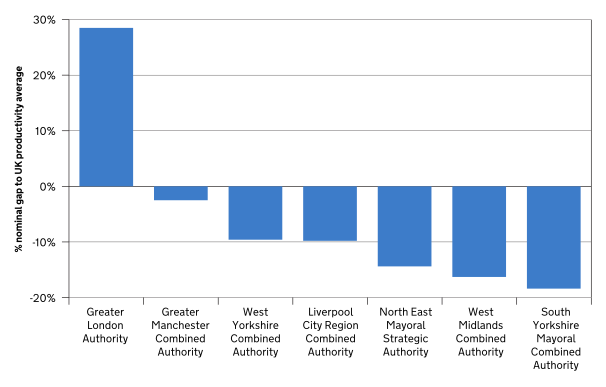
Source: Office for National Statistics.
While some of the UK’s core cities have seen strong growth in recent years, aligning the top 10 non-London cities in England with the average productivity gap between the lead city and other major cities as seen in France, Germany, and Italy would add up to £108 billion (4.4%) to England’s GDP or £3,400 per worker in England.[footnote 144]
These dividends will not only be felt in the cities themselves. The government’s approach is to improve connectivity and ensure the benefits flow to neighbouring areas so that more people can access the jobs and opportunities these cities will provide. Good Growth Funds will also ensure that towns are unlocking the benefits of regeneration and growth around improved infrastructure and connectivity.
Northern Growth Strategy – Across the North of England, our major city regions continue to demonstrate what ambitious investment, strong local leadership and long-term direction can build. Central government will help sustain that momentum, through:
- Progressing development and delivery of Northern Powerhouse Rail, including a new station in Bradford, which will be built at the Interchange site. The government is also confirming a total of over £300 million for the Leeds Existing Station Programme, set to be delivered by 2030. This will deliver a major package of upgrades to increase capacity and improve accessibility at Yorkshire’s busiest railway station.
- Giving the green light for main construction works to begin on the A66 next month, delivering a continuous 50-mile dual carriageway between the M6 and A1(M), strengthening connectivity between the North-East and Cumbria. The project will be delivered through a revised nine-year programme, with phased construction commencing in November 2026.
- Funding £7 million to conduct a feasibility study for a potential future bid to host the Olympics and Paralympics in the North of England during the 2040s. The study will report in 2029 and will also consider how this could best deliver transformational regeneration.
- Delivering on the government’s commitment to develop the Northern 500, bringing together ambitious mid-sized Northern businesses through a single growth community led by The Great North partnership of Mayors, with up to £800,000 funding for a new Council and Steering Group overseeing its development. Working alongside private sector partners including NatWest and Sage, the programme will support ambitious Northern businesses to scale and grow.
- Providing £20 million from the Growth Mission Fund to support the restoration and redevelopment of the long-derelict Littlewoods site in Liverpool into a 260,000 square foot creative campus for film, TV, gaming, immersive technology, and digital screen industries.
- Providing £10 million from the Growth Mission Fund to support local regeneration in Bury focused on the restoration and reactivation of the Indoor Market building.
Oxford to Cambridge Growth Corridor – This world-leading innovation hub across Milton Keynes, Bedford and beyond needs more residential, commercial, and lab space to reach its potential and to realise the growth benefits from East West Rail. The government will pilot a new financing model for the Greater Cambridge Development Corporation, giving it direct access to government finance for land assembly and to invest alongside private partners. This pilot is a first step that will help the government consider wider reforms to enable development corporations to access long-term, flexible government financing. The government will also launch a consultation on a development corporation in Oxford by the end of the year, and look to extend the financing pilot there.
London – The capital remains the driving force of the UK economy and one of the world’s most important cities. Its world-leading transport infrastructure is critical to its growth and productivity, and provides connectivity to the nations and regions and internationally. This Budget will build on this success through:
- Subject to a full business case developed by the Greater London Authority (GLA) and the London Borough of Camden, a Tax Increment Financing mechanism at Euston, based on a business rates retention zone, will be implemented. This will primarily fund London Underground upgrades, while the government continues to work with the Mayor of London to maximise the wider growth and development opportunity.
- Addressing capacity constraints at Stratford station and supporting the development of the surrounding area through a Business Rates Retention zone, subject to business case approval, and committing to work with the Greater London Authority to aim to enable international rail services to stop at Stratford International station.
- Welcoming the work of the bus procurement task and finish group, where a robust approach to procurement will be able to support all authorities, as well as provide certainty to manufacturers. The government will work with Strategic Authorities, including the GLA, on approaches which ensure value for money and a reliable pipeline of bus orders, and which back British manufacturing.
- Legislating to enable the Mayor of London to establish a successor to the Elizabeth Line Business Rates Supplement (BRS), which is scheduled to end by 2041. The successor BRS will have ballot requirements no more restrictive than those enacted in 2009, and, alongside the wider fiscal devolution package, will help the GLA to finance future transport infrastructure projects such as West London Orbital and the Bakerloo Line Extension.
- Exploring the extension of the legislative framework that permits Mayoral Community Infrastructure Levy revenues to support borrowing and debt repayment for strategic infrastructure projects.
- Developing, as a joint programme between the government and the GLA, a global city productivity plan to support London’s continued success as a world‑leading destination for talent, investment and tourism.
Box 4.D: Partnerships with places
Region spotlight: the Midlands
The government is working with Mayor Claire Ward to support growth and reindustrialisation in the East Midlands. The Team Derby partnership will drive regeneration and jobs in rail, aerospace and advanced manufacturing, alongside the Business Rates Retention zone at Infinity Park Derby. Alstom’s Litchurch Lane Works will build the new TransPennine Express fleet, directly supporting over 350 jobs through a £1 billion investment.[footnote 145] Rolls-Royce has also committed £140 million to new engineering and manufacturing facilities in Derby.
In the West Midlands, Mayor Richard Parker is driving regeneration through the Birmingham East Mayoral Development Corporation, which aims to deliver 50,000 jobs and 20,000 homes.[footnote 146] The West Midlands Investment Zone is supporting advanced manufacturing through sites like Green Power Park in Coventry, while making the most of the new Black Country Metro extension into Dudley and transforming Wolverhampton city centre. The Midlands Rail Hub will improve regional rail connections. Outside the metropolitan area, £10 million from the Growth Mission Fund will support the refurbishment of Stafford Market Hall and an SME business incubation hub, subject to final business case.
City region spotlight: West of England
The Mayor Helen Godwin and the Combined Authority are developing plans for 18 transport projects across the region through Transport for City Regions funding from central government. This will include developing mass transit options for Bath, Bristol, South Gloucestershire, and North Somerset.
New homes and a new train station are already being delivered in the West Innovation Arc, centred on Brabazon to the North of Bristol in its Mayoral Development Zone, alongside £45 million of funding to unlock new high-quality homes. The West Country’s world-leading AI cluster has been backed by the Sovereign AI Unit, with £500 million of funding to back new start-ups and provide access to up to 1 million GPU hours on Isambard-AI. The government is providing £10 million to unlock significant private investment in Bristol Temple Quarter, a regeneration zone which offers tens of thousands of new homes and jobs.
Growth corridor spotlight: Scottish Central Belt
73% of Scotland’s population live in the urban area spanning the Edinburgh‑Glasgow Central Belt. It is one of Europe’s most dynamic and innovative clusters for science and technology.
UK Research and Innovation (UKRI) has backed the national supercomputer located in Edinburgh with up to £750 million, and worked with Glasgow City Council to deliver £50 million of Local Innovation Partnership Funding. The £50 million Scotland Defence Growth Deal will support additional defence jobs in places like Rosyth and Helensburgh. The Lanarkshire AI Growth Zone is supporting more than 3,400 high‑quality jobs and has attracted £8.2 billion in private investment.[footnote 147]
5.6 Backing British business
The UK’s 5.7 million businesses are the drivers of wealth creation in the economy.[footnote 148] Delivering the government’s growth ambitions will require business, academia, local leaders and the public sector to work in lockstep, combining high ambition with close partnership to unlock investment, innovation and growth across the country.
Alongside other steps taken in this Budget, the government is backing British businesses by:
- Supporting entrepreneurs to start, scale and stay.
- Improving access to talent.
- Using public procurement to drive growth and innovation.
- Promoting international investment and trade.
Supporting entrepreneurs to start, scale and stay
As laid out in the ‘Entrepreneurship in the UK prospectus’, published alongside the Budget, the government’s ambition is to make the UK the best place in the world to start a business, scale it, and stay for the long term.
That is why the government is strengthening the tax environment for founders at every stage of the growth of their businesses, making it one of the most competitive in the world. The government will introduce a new Capital Gains Tax Founders’ Relief from 6 April 2027, offering a reduced 10% Capital Gains Tax rate on up to £10 million of lifetime gains, supporting the talented individuals who take risks to build and scale high-growth, innovative companies in the UK. This will further support those with a track record of creativity and resilience in building successful businesses to deliver even more UK jobs, growth and wider economic benefits in future.
The government’s plan to strengthen the tax environment also includes making R&D tax reliefs easier to access by simplifying administration and improving our venture capital schemes so that founders can raise capital with greater certainty.
The government will enhance our world-leading employee share ownership schemes by launching an expanded EMI2 (formerly CSOP). EMI2 will double the value of tax-advantaged options employees can hold from £60,000 to £120,000 from 6 April 2027, giving scaling businesses a more generous and flexible way to attract and retain talented employees as well as enabling those employees to share in the value they help their companies create.
To support entrepreneurs to take the first steps in starting a small business, the government is also tripling the generosity of the Trading Allowance from £1,000 to £3,000 from 6 April 2027.
The Budget is increasing access to finance for innovative start-ups and scale‑ups through a £5 billion uplift to the British Business Bank’s financial capacity, including £1.4 billion to invest in equity funds backing high-growth businesses and £450 million for a new venture debt product providing non-dilutive finance to innovative firms.
The Mansion House Accord should unlock around £25 billion of additional investment into UK private markets.[footnote 149] The government will work with pension providers, asset managers and the wider industry to build on existing commitments, accelerate the deployment of capital into innovative, scaling businesses, and support the UK’s scale-up ecosystem.
At Budget 2025, the government announced UK Listings Relief to incentivise firms to stay and list in the UK, and confirmed it would continue to evaluate the wider impacts of Stamp Taxes on Shares (STS). The government has heard industry feedback that cutting STS could boost UK capital market competitiveness. The government recognises the potential economic benefits of such a change and will keep this under review as part of the government’s wider focus on supporting UK capital markets, having appropriate regard to the fiscal implications of any changes.
Box 4.E: Partnering with the financial services sector to drive growth
A competitive financial services sector enables growth across the UK, financing firms to start, scale, invest and create jobs. The government is delivering an ambitious 10-year Financial Services Growth and Competitiveness Strategy as part of our Modern Industrial Strategy.
The Chancellor today set out his priorities for the Bank of England’s Financial Policy Committee in his annual remit letter. The Chancellor welcomed the Committee’s conclusions from its review of bank capital requirements to date, including proposed reforms to the leverage ratio and releasability of capital buffers, and asked for these changes to be delivered quickly. The Chancellor also set out his expectation that the next stage of the review should deliver further proposals to ensure the UK’s bank capital framework is internationally competitive, promotes competition, and supports investment in the economy.
The government is also:
- Modernising how the sector is regulated through the Financial Services and Markets Bill, including reducing the overall burden of the Senior Managers and Certification Regime by 50%.
- Working with industry and regulators to make the UK the global destination of choice for next-generation financial markets by 2030. The government will also explore the use of HM Revenue and Customs (HMRC) data in Open Finance, working with regulators and industry partners to test feasibility, while safeguarding the integrity of the tax administration system.
- Building the talent base that will underpin the UK’s future success. The government will shortly commission Progress Together to examine how career progression, socio-economic background and regional factors affect retention, to report by the Chancellor’s Mansion House speech in 2027.
Too often, a major barrier to new entrants is a lack of support with personal finances, with young entrepreneurs not always being those with the best ideas, but those with access to family support. The government will shortly pilot a Young Entrepreneurs Allowance, providing successful applicants with support towards their living costs during the first year of their business.
The government is bringing its support for high-growth, innovative businesses together through Scale UK, providing a clearer ‘no wrong door’ route to access existing programmes. This will include a new regional pilot, Scale UK – Connect, providing tailored support to 200 high-growth firms across the UK, with expert advice, investor connections and international opportunities.
Women make up just 21% of the digital workforce.[footnote 150] Led by the Women in Tech Taskforce, new voluntary Tech Forward and Inclusive Investment Standards will help to tackle the barriers women face raising capital and working in the technology sector. The government will also launch its scale-up women’s programme to support women founders across the UK. This builds on the Investing in Women Code and Invest in Women Taskforce initiatives.
The BBB has developed a pipeline of commitments to women-led funds of over £100 million, including first-time fund managers identified through Investor Pathways Capital, which tackles the barriers faced in accessing finance and investor networks.
Access to talent
Non-compete clauses in employment contracts affect millions of people, from tech employees to care workers. Workers trapped by these clauses are often held back and unpaid, missing out on opportunities and forced to spend time out of their chosen field, sometimes threatening their financial security. That also stunts innovation and inhibits the energy and dynamism our economy needs.
This Budget confirms that the government will legislate to make sure that non-compete clauses will no longer be a barrier to hiring for our most promising startups and scaling firms, and ensure that workers in the everyday economy are not prevented from moving jobs. These reforms will apply across the whole of the economy.
The government will also consult shortly to understand the wider use of restrictive practices. The government is keen to work with industry to ensure the action it takes is proportionate, evidence-based, and supports both the dynamism of the UK economy and protection of intellectual property.
The government will then set out a detailed position on all these issues in early 2027 in advance of legislating.
To ensure the immigration system supports a dynamic labour market and innovative firms, the government will deliver the most pro-business migration system in Europe for high-skill workers. The government has tightened the immigration system for low and medium-skill individuals while improving the offer to international talent. Since Budget 2025, the Global Talent visa-endorsed funder pathway has been expanded, giving more than 100 R&D-intensive businesses the ability to support the world’s best scientists and engineers to come to work in UK industry. To go further in attracting the world’s best graduates, the government will expand the High Potential Individual visa to support applicants with eligible qualifications from the top 150 of the world’s best institutions, with a proportional increase to the cap under the scheme. The government will also increase the duration of the Graduate visa to two years for graduates from high compliance universities where there are strong labour market outcomes.
The government is making the visa system work for all regions of the UK. By implementing changes to minimum salary requirements, the government will ensure that visa criteria better reflect labour market conditions across the UK, supporting employers across the entire country. The government will also work towards allowing the highest skilled workers to access a visa curtailment period of up to six months, allowing these highly skilled sponsored workers longer to find a new job. This will enable employers to locate and bring on board high-skill employees before they have to leave the country.
The government is committed to the UK being a leading destination for global talent and responding where issues emerge, which is why it has worked with the Global Talent Taskforce to identify and resolve barriers for those looking to move here. The government is taking action in this Budget to address the unavailability of double tax relief for some UK residents investing through US limited liability companies and make it easier for people with existing trusts to move to the UK. In line with that, and supported by emerging evidence next year, the government will continue to assess whether the residence-based regime is striking the right balance between international competitiveness, fairness and support for the public finances – and has shown its willingness to take action to ensure that balance is best achieved.
Using public procurement to back British businesses
The government is using public procurement to back UK industry and support local communities. A new National Procurement Policy Statement to be laid in Parliament in March 2027 will prioritise delivery of high-quality jobs, fair pay and skills opportunities, including pathways for young people.
The government will publish a new definition for a ‘UK supplier’ in public procurement by January 2027, taking action to better understand and track UK suppliers and subcontractors across public supply chains. For too long, broad definitions have allowed companies with little more than a UK post box to be classed as a UK firm. This will help ensure economic resilience in key supply chains, safeguarding UK sovereign capabilities. By maximising the UK’s domestic capabilities, alongside contracting with suppliers from our international allies, the government will ensure that procurement supports communities and that UK public services receive the best solutions on the market.
The government has published new guidance on applying social value in central government procurement. Businesses bidding for major government contracts will be judged on their commitment to creating high-quality jobs, tackling local skills shortages, and supporting young people into work.
The government will make sure that jobs and skills in local communities are at the heart of our procurement model, with a target of at least 3% for apprenticeships on large government infrastructure and construction projects.
The government is using procurement to bolster British industry by proactively shaping strategic markets, including the steel, shipbuilding, AI, and energy infrastructure sectors. For example, to improve pipeline visibility, the National Shipbuilding Office will have oversight of all future civil ship procurement. The Shipbuilding and Maritime Technology Action Plan will set out clear plans for this measure to support the UK shipbuilding industry.
Government procurement will also be used to support innovative and scaling companies. To help this, we intend to appoint an external Chair for the Department for Business, Innovation, Science and Trade (BIST)’s Commercial Innovation Hub (CIH). They will use their experience to strengthen the role of the CIH in supporting departments to procure innovative solutions along with departmental Procurement Innovation Champions.
An additional £80 million will support Sovereign AI’s R&D Procurement Scheme to create more opportunities for innovative British AI companies to work directly on some of the government’s most significant challenges across the health and care system and in AI security, assurance and safe adoption, as well as delivering innovative approaches to warfighting.
Building on a £1 billion commitment earlier this year to procure large-scale quantum computers, the government will now go further with a quantum sensing and PNT Procurement Catalyst backed by £138 million from the Department for Business, Innovation, Science and Trade (BIST) and the Ministry of Defence (MoD). Starting with £30 million from Defence, this investment will create a route for successful capabilities to enter future Defence programmes. The Procurement Catalyst will also fund public service challenges, such as new methods for detecting defects in bridges to reduce delays in the transport system. The Department for Health and Social Care (DHSC) will explore opportunities to support the acceleration of scaling and adoption of quantum technologies to cut NHS waiting lists through more effective health diagnostics.
Promoting international investment and trade
The UK has a long history as an attractive destination for global investors – with the second largest inward stock of foreign direct investment (FDI) in the G7.[footnote 151] The next International Investment Summit will take place in spring 2027 in Newcastle.
The government is supporting businesses in all regions of the UK by striking trade deals across the globe. In the past year, the UK’s landmark trade deal with India has entered into force – cutting tariffs on UK exports, including whisky, cars and medical devices and increasing UK GDP by £4.8 billion in the long run.[footnote 152] The UK has concluded agreements with the Gulf Cooperation Council and the UK’s accession to the Comprehensive and Progressive Agreement for Trans-Pacific Partnership (CPTPP) has now entered into force with all CPTPP parties. The government has also enhanced our deals with Switzerland and South Korea, which will collectively unlock over £5 billion in services exports annually.[footnote 153]
Central to the UK’s international competitiveness is its transport connectivity and access to new markets. As such, the government is working at pace to consider responses to the consultation on the Heathrow Expansion National Policy Statement. The Transport Secretary will provide an update as soon as possible to give stakeholders and communities the certainty they need.
5.7 Building the UK’s AI future
AI is an age-defining general purpose technology, transforming the economy, society and national security. The OECD estimates that AI could add between 0.4 and 1.3 percentage points to annual UK productivity growth over the next decade.[footnote 154] If realised, these productivity gains could significantly raise living standards across the UK.
AI brings risks that must be addressed, including to online safety, cyber security and jobs. The UK must build on its strengths as Europe’s leading AI economy – raising capability and leverage in areas of strategic importance, whilst reducing dependence on other countries. The UK starts from a position of strength with some of the best technology and AI talent globally and a world-leading AI Security Institute (AISI). The government will build capabilities at home and work with international partners to manage the risks of AI.
At this Budget, the government has invested over £700 million to:
- Strengthen security, resilience and sovereign capability to build public trust.
- Accelerate productive adoption in businesses, public services and communities across the UK.
- Launch a new Data Centre Covenant – setting tests for approving new strategic data centres and the contribution these projects must make to the UK, matched by a stronger offer of government support on energy connectivity for the projects that contribute the most to the UK’s objectives.
- Build British capability in AI hardware, including advanced chip design.
Strengthening security, resilience and sovereign capability
AI offers profound opportunities, but these can only be realised if it is trusted and secure. The risks increase as AI becomes more capable and widely deployed. The government will therefore invest around £500 million to build the secure foundations for an AI-enabled economy.
To strengthen the UK’s AI security, the government will:
- Strengthen AISI with an additional £120 million to ensure the UK remains at the forefront of understanding AI capabilities and advance the technical best practices for secure AI.
- Strengthen AI security expertise outside London by establishing a new AI Cyber Security Centre of Excellence in Manchester.
To deliver a step change in UK cyber defence, the government will:
- Establish a new £70 million National Exposure and Real-Time Vulnerability (NERV) Centre at the National Cyber Security Centre to strengthen the UK’s ability to understand and reduce national cyber exposure.
- Expand the public sector AI defence programme, investing an additional £24 million to systematically harden the public sector technology estate and ensure benefits are felt across local authorities, hospitals and schools.
- Invest £60 million into the first phase of a national Cyber Shield to develop agentic cyber defence capabilities, in partnership with the UK cyber security industry. This will include a £25 million AI and Cyber Security Challenge Fund to support UK innovation, alongside scoping for a regulatory deployment sandbox to help organisations deploy new technologies.
- Invest £40 million into a new National Agentic Security Unit to develop new capabilities to detect, investigate and respond to cases of rogue agentic systems. This will integrate monitoring and incident response functions with new operational capabilities.
- Building on the Law Commission’s product liability consultation, the government will consult next year on how to tackle insecure technology at source and consider where liability for cyber breaches should sit.
The government is launching a National AI Biosecurity Initiative, building on the commitments made in the UK Biological Security Strategy, demonstrating continued UK leadership. This includes:
- £100 million to establish the AI Biosecurity Lab (AIBL), a new organisation to harness AI to protect against emerging biological threats, working with UK Health Security Agency, Animal and Plant Health Agency, and Defence Science and Technology Laboratory. AIBL will be supported by up to £200 million in AI model credits from OpenAI and Anthropic, and partnerships with Google DeepMind and London-based AI life sciences pioneer Basecamp Research.
- £50.5 million towards cutting-edge bio-surveillance and a £14.5 million initial investment to support proof of concept development of novel medical countermeasures, working in partnership with the UK’s life sciences sector.
In order to strengthen national resilience and support the defence of the UK, MoD is assessing opportunities to increase the UK’s sovereign compute and data centre capacity through its secure estate, including the potential for a facility co-located with existing defence innovation, testing and technology infrastructure. In time, this could also provide scalable, secure access to compute for UK SMEs, supporting the growth of the UK’s Sovereign AI industrial base.
Unlocking the opportunities of AI
With these strong foundations in place, the UK can capture the benefits of AI for economic growth and improved public services.
The Budget therefore confirms:
- £30 million to pilot local partnerships, starting with West Yorkshire Combined Authority, South Yorkshire Mayoral Combined Authority, and York and North Yorkshire Combined Authority to develop locally led approaches to AI adoption. Building on the experience of Barnsley, the UK’s first Tech Town, these will work across local councils to help small businesses grow, equip people with the right skills, and transform local public services.
- A £60 million AI Pathfinder Fund to support practical cross-government interventions to respond to emerging barriers and opportunities from the AI transition.
- An additional £60 million for the Sovereign AI Fund from 2027‑28 to invest directly in promising UK AI companies to support them to scale, succeed and maintain a meaningful presence in the UK. This includes a new focus area: physical AI to build on the UK’s emerging strengths in areas such as robotics, autonomous systems and advanced manufacturing.
- An additional £23 million for the AI Economics Institute (AIEI), the world’s first government-backed research institution dedicated to analysing the economic impacts of AI. This will examine how AI is affecting productivity, growth, jobs and living standards, including the regional, generational and socio-economic implications.
Delivering the infrastructure needed for AI
The government will ensure the UK has the data centres, energy connections, advanced chips and digital infrastructure needed to support national resilience, and the development and adoption of AI. Building the next generation of data centre capacity in the UK will reduce reliance on infrastructure overseas and ensure British businesses and public services can access the compute they need.
The government is announcing a new deal for the development of data centres, set out in a Data Centre Covenant published today. All data centres are encouraged to meet the tests set out in the Covenant, with data centres required to meet them where they are seeking enhanced government support:
- Lower electricity bills: pay for their fair share of energy – covering any energy costs they create – so households, communities and other businesses do not pick up the bill. Their growth should help spread energy system costs across a larger base, reducing the share paid by households and businesses. They should also support grid resilience, flexibility and clean power.
- Invest in improving local communities: communities that host nationally important infrastructure should share directly in the rewards. Strategic data centres should agree a Local Benefit Plan that commits to substantial investment, developed with the local community and linked to the development’s size. This can be spent on local priorities, like transport, parks and town centres.
- Adhere to the highest environmental standards: protect nature, minimise water use and publish annual energy and water consumption reports. They should also capture the heat they produce for nearby homes, schools, hospitals or businesses wherever practical, rather than letting it go to waste.
- Create jobs, apprenticeships and drive reindustrialisation: create jobs and invest in paid apprenticeships and training places, supporting young people into the AI, digital and infrastructure jobs of the future. They should also prioritise UK suppliers and technologies and make a meaningful contribution to the development and deployment of British AI hardware.
- Strengthen Britain’s security: provide secure and reliable access to the compute the UK needs, including for the NHS and other public services. They should work with the relevant national technical authorities, including the National Cyber Security Centre, to enhance resilience against cyber and hybrid threats beyond baseline requirements.
In return, a new Ministerial Control Centre will accelerate time to power for strategic data centres. The government will:
- Reserve and reallocate connections: using new Planning and Infrastructure Act powers to prioritise strategically important demand projects, including data centres, by reserving future capacity and reallocating capacity released when other projects leave the connections queue.
- Identify additional capacity: working with NESO and network companies to identify locations where capacity may be available before 2030 and may use Planning and Infrastructure Act powers to access this capacity.
- Accelerate connections before 2030: where there is a need to go further, using new Planning and Infrastructure Act powers to facilitate the transfer of pre-2030 data centre connections contracts.
- Enable access to temporary power to bridge the gap to grid connections: by developing a tightly controlled framework to permit on-site generation until a grid connection can be secured. This will only be available for exceptionally strategic projects and only where the measures set out above cannot secure the required capacity in time, and subject to conditions such as ensuring energy security.
The government will set out further details in due course on the definition of strategic data centres and the additional criteria such projects will be expected to meet, including their contribution to local communities and impacts on the UK’s national and energy resilience.
In addition, the government is moving forward with wider reforms to support viable data centre projects to build faster and with more certainty while meeting expectations to support sustainable growth, protect communities, and conserve resources. This includes publishing a draft Data Centre National Policy Statement for consultation, which sets out the decision-making framework for data centre projects seeking development consent through the Nationally Significant Infrastructure Project regime. Further detail is set out in the published Covenant.
The government is backing UK AI hardware through an advanced market commitment to bring British chips into public compute. A further £20 million will support reindustrialisation and jobs in AI hardware, including a UK advanced Chip Design Academy led by the University of Edinburgh, linking academic chip research to commercial silicon manufacturing.
The government will work with the Public Financial Institutions and Sovereign AI to provide a stronger and more coordinated financing and funding offer for strategically important UK AI hardware companies. This will give businesses a clearer route to accessing support, which could include a combination of public finance products, alongside bespoke financing solutions where needed. A referral approach will ensure businesses can navigate to the best solution, regardless of which institution they contact first.
5.8 Growth in every Nation – Scotland, Wales and Northern Ireland
Scotland, Wales and Northern Ireland make significant contributions to growth, including through R&D investment and clean energy in Scotland, semiconductors in Wales, and Northern Ireland’s rapidly growing cyber sector. The economies of Scotland, Wales and Northern Ireland are worth £387 billion.[footnote 155]
At this Budget, the government is investing in Scotland, Wales and Northern Ireland’s dynamic industrial clusters, including announcing new investments worth over £24 million in the Edinburgh-Glasgow Central Belt; £30 million for Cardiff Parkway railway station; and £7.5 million in Belfast’s cutting-edge Cyber AI capabilities.
The government is also delivering growth across all UK nations by:
- Further capitalising the NWF and BBB with £20.4 billion, building on £4.4 billion delivered to businesses in Scotland, Wales and Northern Ireland through the NWF and BBB since the general election. This includes the NWF’s £800 million guarantee to deliver four major grid upgrades in the north of Scotland, and the NWF’s Strategic partnership with Cardiff Capital Region, supporting local leaders to build Cardiff’s investment pipeline. The BBB’s dedicated Investment Fund for Northern Ireland has already invested in over 60 new and growing businesses across Northern Ireland.
- Asking the BBB to take the next step in strengthening its regional offer across the UK by working in partnership with Mayoral Strategic Authorities and devolved governments to design the next generation of Nations and Regions Investment Funds. The BBB will also expand its support for Community Development Finance Institutions by £165 million, building on its existing support for impact lenders like Social Investment Scotland, and Finance for Enterprise and BCRS Business Loans in Wales.
- Committing to deliver new, large-scale investments through designated Public Financial Institutions, including through more flexible annually managed expenditure (AME) budgets. The government is committed to devolved governments accessing their fair share of this Financial Transaction expansion. As set out in the Statement of Funding Policy, the government funds devolved government AME programmes where they are broadly comparable to the equivalent UK government programmes. A devolved institution meeting the established criteria will be considered as the basis for demonstrating comparability. The government will work closely with the devolved governments to support them to set up and finance their own Public Financial Institutions, should they choose to, including providing access to HMT’s expertise, technical guidance and lessons learnt from establishing UK Government Public Financial Institutions. The government will also accelerate work towards designating the Scottish National Investment Bank as a Public Financial Institution ahead of the 2027‑28 financial year.
- Introducing the British Industrial Competitiveness Scheme, reducing costs for electricity intensive manufacturing industries in Industrial Strategy and foundational sectors from April 2027. Scotland and Wales’s energy intensive industries are set to benefit – from Scotland’s life sciences and energy supply chains, to semiconductors and life sciences in South Wales and auto and aerospace engineering in Wrexham and Flintshire. The Northern Ireland Executive will receive funding to deliver a comparable scheme.
- Committing to work with local leaders to identify growth-boosting projects across Scotland, Wales and Northern Ireland for the new £80-million Local Renewal Fund.
The government is supporting businesses across Scotland, Wales and Northern Ireland to export through our new trade deals. The trade agreement with India alone is estimated to boost Scotland’s economy by £190 million per year, Wales’s economy by £80 million, and Northern Ireland’s economy by £50 million.[footnote 156]
The government is going further at the Budget by also extending existing tariff suspensions for 350 goods which were otherwise due to expire this year and next, benefitting businesses in Scotland, Wales and Northern Ireland across chemicals, plastics, hydrogen, automotive, and food and drinks sectors.
Delivering growth in every postcode is a responsibility the UK Government shares with the devolved governments in Scotland, Wales and Northern Ireland, and they are well funded to deliver their devolved responsibilities. The government will work with the devolved governments and local and regional stakeholders in Scotland, Wales and Northern Ireland to explore how the benefits of regional empowerment can be spread to all parts of the country.
The collective strength and financial stability of the United Kingdom means that the government is able to provide breathing space for households and businesses and create the conditions for growth in every nation. This is only possible when fiscal discipline is maintained. The government is taking strong decisions where required to reprioritise public spending and make the public sector more efficient and productive.
As a result of decisions confirmed at Budget, the devolved governments will see an additional £1.3 billion through the application of the Barnett formula between 2026‑27 and 2029‑30. This excludes reductions following a technical change due to lower employer pensions contributions resulting from 2024 pension valuations.
This is on top of the devolved governments’ Spending Review 2025 settlements, which were the largest since devolution in 1998. All will continue to receive over 20% more per person than equivalent government spending in the rest of the UK.
Scotland
Scotland’s economy is already worth £219 billion per year, reflecting strengths across sectors such as financial services, R&D, the life sciences and creative industries.[footnote 157] At Spending Review 2025, the government announced up to £750 million for Edinburgh to host the UK’s national supercomputer. At Budget 2025, the government committed to invest up to £14.5 million to support good jobs in Grangemouth. Since then, the government has:
- Released the first £52 million of a £140 million Local Growth Funding package which will create jobs and help start-ups across Glasgow City Region, Edinburgh & South East Scotland, Tay Cities Region, Ayrshire and Forth Valley.
- Invested over £2.5 billion this year in Scotland’s Defence sector, alongside rolling out the first two Type 31 frigates at Rosyth.
- Given the green light to the Jackdaw gas field – safeguarding hundreds of jobs, harnessing Scotland’s homegrown skills and assets, and supplying millions of homes with power.
- Seen the opening of Aberdeen Energy Transition Zone’s EnergyWorks, the UK’s first dedicated low-carbon energy incubator and scale-up hub, in which the government has invested £5.7 million.
- Provided over £120 million support, as part of a joint investment with INEOS, to protect vital chemical production and 500 jobs at Grangemouth, plus hundreds more in the supply chain.
- Provided £20 million R&D funding to turbocharge the Tay Cities’ thriving creative technology sector via the Local Innovation Partnerships Fund.
- Committed over £12 million in UK Government investment for the Montrose Port Offshore Wind Project, supporting Scotland’s offshore wind supply chain cluster. This marks a major milestone in the delivery of the Tay Cities Region Deal, one of Scotland’s 12 Deals co-funded by the UK, Scottish and local governments to create thousands of jobs and drive regional growth.
At this Budget, the government is going further to deliver growth across Scotland’s major cities and industrial clusters by:
- Investing in the Edinburgh-Glasgow Central Belt via £6 million new funding to expand Glasgow’s Scottish Event Campus (subject to business case) and £18 million new funding for a UK Advanced Chip Design Academy led by the University of Edinburgh.
- Confirming £20 million of co-funding with the Scottish Government for two Defence Technical Excellence Colleges in the east and west of Scotland, creating lifelong and high-wage careers for school leavers in Scotland’s thriving defence sector. This follows the Scottish Government’s announcement of support earlier this month.
As a result of decisions at Budget 2026, the Scottish Government will receive an additional £600 million Total Departmental Expenditure (TDEL) through the application of the Barnett formula.[footnote 158] This is on top of the record Spending Review 2025 settlements and an additional £1.7 billion TDEL at Budget 2025 and Spring Forecast 2026.
Wales
Wales’s economy is already worth £100 billion per year, with strengths in multiple sectors, including advanced manufacturing and energy.[footnote 159] Last year, the government committed £500 million for steel in Port Talbot and at least £445 million to progress rail projects in Wales. This was followed by government support for a plan to transform Welsh rail with a pipeline of projects and jobs for the future, enhancing Wales’s economic connectivity and industry. At Budget 2025, the government then announced investments in South Wales’s semiconductor activity and Wales’s automotive sector, and increased the Welsh Government’s borrowing power to enable the Welsh Government to support people, businesses and public services in Wales.
Building on these commitments to Welsh industry, over the past year the government has:
- Progressed the Welsh Industrial Strategy Zones so all four are now live, unlocking up to £370 million government funding to boost local economies and create jobs in key growth sectors, including clean energy, advanced manufacturing and digital technology.
- Seen construction begin on the £28 million SWITCH Harbourside research facility, supported by £8.2 million from the UK Government-backed Tata Transition Fund.
- Agreed grant terms to enable Associated British Ports to complete the essential design and engineering work needed to build one of the UK’s first floating offshore wind ports in Port Talbot.
The government is going further by announcing at this Budget:
- £2.5 million to expand the M-SParc science park in Anglesey, North Wales, subject to business case, delivering additional space and support for SMEs.
- £20 million to support UK reindustrialisation and high-value jobs in AI hardware, building on existing strengths in semiconductor clusters including South Wales.
- £11 million to replace the Port Talbot Aberavon Bridge, identified as part of and subject to the place-based business case to unlock much needed and valuable commercial land.
- £30 million to progress delivery of Cardiff Parkway railway station, working with the Welsh Government and the private sector to enhance the growth potential of the Cardiff Parkway development.
- Its intention to expand the Carbon Border Adjustment Mechanism to include refined products, subject to consultation on the feasibility and impacts, which could help to address carbon leakage risks for Pembroke’s oil refinery.
- A £5 million bridging payment from the Wales Defence Growth Deal budget to ensure that a Wales Defence Technical Excellence College can prepare for the new entry of students. We expect the Welsh Government to follow the Scottish Government’s commitment to match fund, and thus the £5 million bridging payment will be unnecessary to draw down on.
- As a result of decisions at Budget 2026, the Welsh Government will receive an additional £450 million TDEL through the application of the Barnett formula.[footnote 160] This is on top of the record Spending Review 2025 settlements and an additional £1 billion TDEL at Budget 2025 and Spring Forecast 2026. This ensures the Welsh Government is funded above its independently assessed level of need (115%) in all years of the spending review.
Northern Ireland
The government is continuing to invest in Northern Ireland’s stability, economic potential and unique contributions to the UK. Northern Ireland’s economy is worth £68 billion per year.[footnote 161] At Budget 2025, the government announced £16.6 million to boost trade between Northern Ireland and Great Britain and confirmed advanced manufacturing as the sector focus of the Northern Ireland Enhanced Investment Support, targeting clusters in photonics and biotechnology. Since then, the government has:
- Seen Northern Ireland’s Enhanced Investment Zone move into delivery. It is expected to support around 1,000 jobs and attract around £230 million of private investment.[footnote 162] To ensure its success, the government recently announced £2 million to develop advanced manufacturing skills in the Enhanced Investment Zone, which is expected to deliver over 400 qualifications across engineering, core sciences, digital and business.
- Launched the £50 million Defence Growth Deal for Northern Ireland, helping SMEs and start-ups in Northern Ireland enter the defence supply chain, building on Northern Ireland’s significant defence industry footprint which directly supports 900 jobs.[footnote 163]
- Announced almost £7 million of funding for activity to build defence-related skills in Northern Ireland, with work ongoing with the Northern Ireland Executive’s Department for the Economy on a region-wide defence skills and apprenticeship programme.
- Signed the Full Deal Document for the Causeway Coast and Glens Growth Deal in April 2026, confirming £129 million investment comprised of £36 million from the UK Government, match funded by the Northern Ireland Executive, alongside an anticipated £57 million contribution from local delivery partners.
The government is going further this Budget by announcing:
- £7.5 million of new R&D investment for Queen’s University Belfast’s Centre for Secure Information Technologies (CSIT) Cyber AI Hub, to further grow Northern Ireland’s globally strong cybersecurity and AI sector, which employs over 2,700 people across 140 companies.[footnote 164]
- £1 million of new funding for a Northern Ireland Investment Summit, building on Northern Ireland’s economic potential and attracting foreign investment. This builds on the success of Belfast’s 2023 investment conference, will strengthen East-West trade, and will highlight Northern Ireland’s potential as the only place in the world with dual access to the UK internal market and EU market.
As a result of decisions made at Budget 2026, the Northern Ireland Executive will receive an additional £270 million TDEL through the application of the Barnett formula.[footnote 165] This is on top of the record Spending Review 2025 settlements and an additional £740 million TDEL allocated at Budget 2025 and Spring Forecast 2026.
6. Hope for the future
The government’s decisions at this Budget pave the way for the decade ahead. Fiscal responsibility underpins its promises and commitments; adhering to the fiscal rules enables the government to sustain the highest public investment in over four decades and target spending on priorities, while easing pressures on families and businesses. Strong public finances and stability create room to plan for a more hopeful decade. The government will outline its vision and next steps in its 10 Year Plan, ahead of the next spending review. The next spending review will take place in 2027.
The government is prioritising housing investment to support families to thrive with a secure place to live. It is sustaining public services and communities, with targeted investment at this Budget that gives support to individuals and families, creating opportunities and hope for the future. The government is committed to reforming the welfare system, prioritising the support people need to overcome barriers to work and participate in society, whilst putting the State Pension on a sustainable basis for decades to come. The government’s investment in defence and security protects the UK at home and abroad.
6.1 A secure place to live
Having a place to call home is foundational. It provides safety, stability and security. At this Budget, the government is prioritising housing investment, supporting families across the country to thrive.
The government is providing an additional £1.5 billion to deliver around 10,000 homes in England.[footnote 166] This funding will be prioritised for Social Rent, especially council homes. This takes total investment in the Social and Affordable Homes Programme to more than £40 billion over 10 years.[footnote 167] This funding will be allocated between 2027‑28 to 2030‑31 and will increase over the period to allow councils to build capacity. The government is also:
- Supporting local authorities to build new council homes by providing a one‑year extension to the preferential rate from the Public Works Loan Board, keeping loans at 40 basis points below the normal rates.
- Exploring options to establish a greater role for mayors in making decisions about how the public estate is used to unlock growth and deliver public services and housing in their areas. This will be supported by a revised approach to Strategic Asset Management Planning across government, as set out in Chapter 2.
- Introducing a new VAT relief on land sold to registered social housing providers to expedite the construction of social housing.
- Taken together, these measures represent progress towards the Prime Minister’s commitment to deliver the biggest boost to council house building since the post-war period, helping more people benefit from a safe and secure home and driving up private sector housebuilding. Next steps will be set out in the 10 Year Plan.
The government is also supporting people without access to the ‘bank of mum and dad’ to buy their own homes. The new £4.7 billion Your First Home scheme will help around 70,000 households in England to take their first step onto the housing ladder and support the delivery of an estimated 20,000 new homes. The scheme will provide 20% equity loans to first-time buyers who would not otherwise be in a position to purchase a residential property. Income caps will be set at £110,000 per household outside London and £140,000 inside London. Price caps will be set based on local authority median prices to ensure support is targeted at those who need it, with inner and outer London caps of £650,000 and £500,000 respectively. The deposit requirement will be set at 2.5%, with a maximum deposit of 15%. People will be able to access equity loans with a five-year interest free period, with a gradual increase after five years. That means those who use the scheme could save hundreds of pounds per month compared with a standard mortgage. Developers will be expected to make a contribution when signing up to the scheme to help cover costs, set on a sliding scale to protect smaller developments. Funding will be capped annually but government will work with developers and lenders to monitor demand.
The scheme will open for pre-registration by the end of December 2026 and full applications from February 2027 with the first loans issued from April 2027. In the near-term, the scheme will be delivered by Homes England drawing on the support, expertise and capitalisation of the National Housing Bank, which will take on responsibility for the scheme in the medium term, subject to the necessary legal and regulatory changes, with a review point next autumn to take stock on progress. To enable this, MHCLG will legislate as soon as Parliamentary time allows to provide an appropriate legislative and regulatory basis.
The £4.7 billion scheme has been funded through reprioritisation of departmental Financial Transactions. The Department for Energy Security and Net Zero will reallocate Financial Transactions, including from the Warm Homes Fund, alongside exploring the use of guarantees rather than loans. The Department for Environment, Food & Rural Affairs contribution reflects an updated delivery pathway for the Woodland Carbon Purchase Fund.
To support savers to save for a deposit for their first home, the government will introduce the new First Time Buyer ISA from April 2029. The product will retain the generosity of the Lifetime ISA, allowing contributions of up to £4,000 a year with a 25% government bonus. The bonus will be paid on the value of the account balance when funds are withdrawn for a qualifying first home purchase, up to the value of £450,000, so avoiding the need for any withdrawal charge. The new product will have no upper age restriction.
In recognition that some Lifetime ISA holders may wish to purchase a property above the £450,000 property price cap, the government will from 29 October 2026 allow Lifetime ISA funds to be withdrawn for such purchases which otherwise meet the qualifying rules, with a reduced withdrawal charge of 20%, ensuring the value of individual contributions is protected if the value of the property is above the price cap.
6.2 Public services
The government is committed to ending rough sleeping – there were 4,793 rough sleepers on a single night in autumn 2025.[footnote 168] Since July 2026, £442 million of additional funding has been provided to ensure a route off the street for rough sleepers, alongside targeted wraparound support and longer-term settled accommodation units to help rough sleepers and those with complex needs to stay off the streets long term. This includes funding to support people who are sleeping rough with a route off the streets in time for Christmas. The Budget goes further by announcing an additional £432 million across 2027‑28 and 2028‑29 to extend this off-the-streets offer, ensuring that people sleeping rough have a route off the streets, not just this year but every year.
Homelessness is not confined to rough sleeping, and the government also recognises the significant challenges associated with wider homelessness, including temporary accommodation. The government’s Value for Money Review into homelessness funding is ongoing and will conclude in 2027. Through the review, the government is considering the most effective ways to reduce homelessness, including by looking at temporary accommodation and supported housing delivery models.
The government is committed to halving violence against women and girls within a decade. To support this, the government is prioritising £55 million of funding over two years to accelerate delivery of the Violence Against Women and Girls strategy. This package includes £13 million in 2027‑28 which will strengthen law enforcement activity to improve protection for victims and to identify and disrupt harmful behaviours by perpetrators of abuse. The government is also providing £15 million to the Office for the Impact Economy to work with businesses, investors and philanthropists to mobilise additional funding to support women and girls and underpin the work of the National Taskforce for Tackling Misogyny, chaired by the Minister for Women and Equalities.
This government is supporting the NHS with record day-to-day spending and capital investment over the spending review period. The Budget provides a further £190 million in 2026‑27 for the NHS in England. This funding will support the NHS to manage the additional pressures it is facing over the winter and the rest of this year. This builds on the recent announcement of 25 new or expanded urgent care sites opening in time for winter, which are boosting NHS capacity and easing pressures on accident and emergency services.
The government will invest £100 million to accelerate the adoption of robotically assisted surgery across England. This investment will support an increase in robotic-assisted procedures from 70,000 a year today to 500,000 in 2035, enabling more patients to benefit from less invasive procedures and reducing geographical and gender inequalities. The programme will also improve NHS efficiency and productivity, supported by a world-leading national robotics registry that uses data and AI to improve outcomes and drive innovation in surgical care.
As well as supporting technological innovation, the government is supporting patient access to innovative treatments by removing VAT on medicines donated free of charge. This will help ensure early and expanded access programmes continue, supporting thousands of patients across the UK living with serious illness.[footnote 169]
6.3 Welfare reform
The government inherited a broken welfare system that has been letting too many people down and pushing costs up. The government is reforming it, prioritising the support people need to overcome barriers to work and participate in society, whilst putting the State Pension on a sustainable basis for decades to come. This is the best way to bring down the welfare bill in a sustainable and fair way.
The government has already acted:
- Rebalancing Universal Credit to tackle the incentive for people to be labelled as too sick to work.
- Increasing face-to-face assessments for health and disability benefits. The government has more than doubled face-to-face assessment rates since July 2024.[footnote 170]
- Reforming Motability, with tax breaks restricted to save over £1 billion over the next five years, and Motability Operations removing luxury vehicles from the scheme.
- Committed to stopping claims management companies from charging to help people to claim benefits, helping to reduce inaccurate claims and supporting vulnerable people.
- Doubling down on tackling welfare fraud, with new measures expected to save an additional £1.4 billion over the forecast, bringing total savings from fraud and error to over £20 billion over the forecast.
- Removing entitlement to Universal Credit, Pension Credit and Employment and Support Allowance from offenders detained in hospital that are convicted of the most serious violent and sexual offences.
- Reducing the financial cliff edge for claimants in supported housing and temporary accommodation, to ensure that work pays.
- The government is committed to further reforming the welfare system so that it proactively supports those in need, while supporting those who can work into work to bring down the welfare bill in a sustainable and fair way.
- There are nearly one million young people who are not in employment, education or training (NEETs).[footnote 171] The current welfare system is failing too many, providing cash payments but not the support needed to help young people achieve their potential. Alan Milburn is right to say in his interim report into Young People and Work that “the welfare system should be more than a safety net. It should be a springboard.”[footnote 172] An entirely new approach is needed.
- The government also takes seriously the conclusion of the interim report of the Timms Review, that Personal Independence Payment (PIP) is “no longer fit for purpose” and has failed to keep pace with how disability, health and work have changed.[footnote 173] This is not good enough when disability can affect anyone at any stage in their lives and almost one in four of the working-age population is classed as disabled.[footnote 174] Following the final report of the Timms Review, the government will bring forward changes to how it supports people with disabilities and health conditions.
- The government looks forward to the final reports of the Milburn and Timms reviews, and this Budget confirms that the government will set out its response before the end of this year. A White Paper will follow early in 2027 ahead of legislation later that year.
- This Budget confirms funding to provide new opportunities for young people, including through:
- The Youth Employment and Skills Package, which in Spring 2026 announced: the £3,000 Youth Jobs Grant for businesses hiring eligible young unemployed people, an extension of the Jobs Guarantee to those aged 22 to 24, and a £2,000 apprenticeship hiring payment for new young apprentices taken on by non-levy paying employers (typically small and medium-sized enterprises) in England.
- £100 million over two years to expand local apprenticeship services so that all current mayors are able to deliver tailored local support that helps young people access apprenticeships and supports employers to create apprenticeship opportunities.
Alongside reform of working-age welfare, the government has announced plans to put the State Pension on a sustainable footing for the decades ahead, giving people confidence that a rising State Pension will be there for them when they retire. In line with the government’s commitment to the Triple Lock throughout this Parliament, the State Pension will continue to rise by the highest of 2.5%, inflation or earnings growth each year through to April 2029. This is set to see the annual rate of the full new State Pension increase by more than £2,000 over the course of the Parliament, taking the State Pension to a record high relative to earnings. The government is committed to delivering a sustainable State Pension system that people can trust will rise every year and be available for current and future pensioners. That is why the government is making those gains permanent by adjusting the Triple Lock from April 2030 so that the State Pension rises each year by the highest of 2.5%, inflation, or the amount required to maintain its value relative to earnings as reached in April 2029.
This adjustment will generate significant savings to help build up a high-quality, preventative National Care Service in England that will provide older people with personal care free at the point of use. To help prepare for these changes in the next Parliament, the Prime Minister has agreed with Baroness Casey that her Independent Commission on Adult Social Care will now report in 2027.
This is a new settlement for older generations. A sustainable footing for the State Pension will ensure it remains a cornerstone of retirement incomes for future generations. Alongside this, the Pensions Commission’s final report will be published in February next year and recommend steps to ensure the private pensions system delivers retirement outcomes that are adequate, fair and sustainable.
Box 5.A: Triple Lock adjustment[footnote 175]
From April 2030, an adjustment to the Triple Lock will come into effect. This adjustment will put the State Pension on a sustainable footing, generate significant savings and materially improve the certainty of the State Pension spending trajectory. It removes the ‘ratchet’ effect, whereby the State Pension rises ever higher relative to earnings. Following the introduction of the adjusted Triple Lock, the State Pension will track earnings over time.
The government’s central forecast for the trajectory of the State Pension and how it differs from the Triple Lock is set out below.
Chart 5.1: This adjustment significantly improves the long-run sustainability of the State Pension
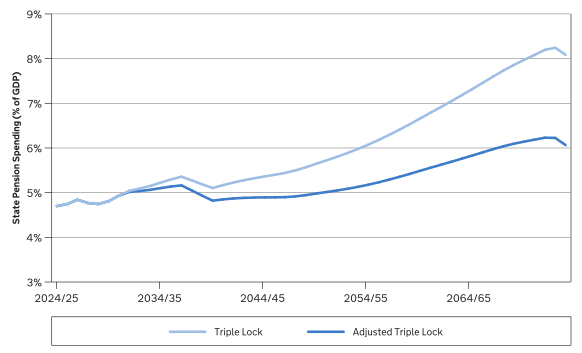
This reform addresses the uncertainty of State Pension spending as well as the level. Under the Triple Lock, the cost of the State Pension depends on which of prices, earnings or 2.5% is highest in each year, and on how those differences compound over time. That makes it inherently hard to forecast. Ensuring the State Pension broadly rises in line with earnings growth, the adjustment removes much of this uncertainty and makes future spending significantly more predictable.
Taken together, this is a comprehensive reform strategy for the UK’s social security system. It rewires the welfare state, prioritising not just cash payments but the support, care and opportunities that people need at all stages of their lives, whether struggling to get established in the world of work or living with dementia. It is through structural reforms to social security – rather than crude cuts – that the government will bring the welfare bill down.
6.4 National security
The first duty of government is to defend the nation and deter our adversaries. Russian aggression, conflict in the Middle East and rapidly changing technology demand even greater urgency in strengthening the UK’s armed forces, alliances, and defence industrial base. The government is prepared to take the strong decisions to make the UK more ready, secure and resilient.
The government has driven the highest sustained increase in defence spending since the Cold War and is fully funding the Defence Investment Plan at this Budget by reprioritising public spending. This will strengthen front-line military capability while creating skilled jobs, supporting British businesses and expanding growth and opportunity across the UK. Since the Defence Investment Plan was published, the Ministry of Defence has made significant new investments, signing around 370 new contracts worth over £2.7 billion. That includes:
- Announcing £300 million of investment in the UK’s new Collaborative Combat Air programme, StormFighter, which will operate with crewed platforms like the Typhoon. This will coincide with broader investment of £5 billion on advanced uncrewed systems over the rest of this Parliament.
- Launching the capital grant window for the Energetic Materials programme, to kickstart production at scale in UK for the first time in decades. This follows seed funding for 24 feasibility studies of new energetics factories, with initial construction nearing completion in the South West and spades in the ground in the Midlands.
- Investing £400 million to equip the Army with the latest drone technology, bolstering Britain’s defence manufacturing base in South West England, and test, evaluation, and training activity in Wales.
At the spending review next year, the government will also set out the details of how it will meet its NATO commitment of spending 3.5% of GDP on defence by 2035, with a target date for 3% in 2030. This is necessary for the security of the UK. It presents an opportunity to do things differently, working more closely with the private sector to build defence industry capacity alongside delivering new and innovative defence capability.
To support this, the government is launching a new Innovative Defence Financing Taskforce, charged with maximising the contribution of private and international finance to UK defence, and to further procurement reforms that support innovative financing. The Budget confirms immediate progress in these areas:
- The government has been developing with partners in the Netherlands, Finland and Poland the Multilateral Defence Mechanism (MDM) to aggregate demand and enable joint procurement across partners. This will reduce costs, give industry greater certainty, deliver much better value for money and improve joint NATO capabilities. The government has announced today that the MDM partners will be commencing treaty negotiations, respecting individual members’ national processes, with the aim of having the MDM up and running in 2027.
- A new commitment for the National Wealth Fund and British Business Bank to deploy up to £5 billion over the next four years into defence, dual use and other sectors that support UK national security, sovereign capability and resilience. This will support investment and lending across the defence supply chain to help strengthen the UK’s defence industrial base.
- The government will expand the UK’s defence industrial base and develop a pipeline for private finance opportunities – including public private partnerships – where they are value for money, with more detail to be set out in the forthcoming Defence Financing and Investment Strategy.
The government also recognises the nature of threats facing the UK is rapidly changing. The government is investing nearly £500 million to build the security foundations for an AI-enabled economy. The government will continue to draw on all the levers of the state to boost the UK’s military capability, including the contribution of AI, technology and cyber security spending to the NATO mission.
Alongside increased investment, the government is maximising the value of every pound spent by accelerating defence reform, focusing resources on front-line capability rather than back office costs and cutting procurement costs. That includes:
- Continuing to reform procurement under the new National Armaments Director. That means establishing defined capability portfolios, matching procurement routes to capability, and reducing the time to contract by two‑thirds for major platforms.
- Accelerating the delivery of cutting-edge innovative technology. UK Defence Innovation – the Ministry of Defence’s innovation agency – was launched last year with a ringfenced budget of £400 million per year, and the government can now confirm Tony Reeves as the new permanent Director General Innovation.
- Publishing a new Counter Fraud Strategy in November, with investment in fraud and error analytics and closer working with the Public Sector Fraud Authority set to deliver £250 million of benefits.
- Investing in over £500 million of investments to improve productivity this year alone. That means protecting investment that will modernise the way the Ministry of Defence operates, with around £30 million on new digital tools – including “digital twin capabilities”– and around £29 million on automation and AI.
The government will also make better use of the defence asset base, unlocking Ministry of Defence land for housing and growth while ensuring the estate continues to meet Defence’s needs. The Defence Housing Strategy identified capacity for over 100,000 new homes on defence land. The government is accelerating delivery through:
- Re-establishing the Defence Housing Tripartite Taskforce, with joint working between the Ministry of Defence, HM Treasury and MHCLG on housing and land release.
- Setting up the Defence Housing Service to work more closely with local and Mayoral authorities on strategic sites, such as Feltham and Chetwynd Barracks, with military housing as an anchor for the wider development where possible.
- Signing a new Strategic Partnership Agreement between the Ministry of Defence and Homes England, alongside working with the National Housing Bank to explore approaches to available funding programmes to unlock delivery.
- Reforming the “Crichel Down” Rules, which slow down release of surplus defence and public sector land and which have not undergone significant change in 20 years with updated Rules to be brought in by spring 2027.
The government will build our defence industrial base, prioritising British firms and workers, as part of a new “Back British” approach for the defence sector. The government will give industry greater certainty to invest by setting out where it will build sovereign capability, partner with allies, buy competitively, and grow the skills, technologies, capacity and supply chains required. This will ensure Britain is the best place to start, grow and sustain a defence company. The Defence Investment Plan will create approximately 60,000 new jobs by 2029‑30 compared with 2023‑24.
6.5 Ukraine
The government is steadfast in supporting Ukraine to defend itself against Putin’s illegal invasion. This is in the UK’s national interest. A secure and stable Ukraine helps protect European and NATO security, deter future aggression and reduce the wider economic pressures that conflict creates for families and businesses in the United Kingdom.
Russia’s continued attacks are placing growing pressure on Ukraine’s economy, public services and security. Following President Zelensky’s visit and the Prime Minister’s commitment to step up UK government support, the Budget will make available over £10 billion of additional financial support to Ukraine, underlining the UK’s position as a leading partner amidst illegal Russian attacks. This is on top of the UK’s enduring commitment to £3 billion a year of military support for Ukraine until 2030‑31 or for as long as needed. The funding will include:
- £7 billion of economic support over three years including up to £5.5 billion in loan guarantees through the World Bank. The government is also using the World Bank International Development Association’s crisis facility to mobilise £1.5 billion of development funding to support Ukraine’s recovery.
- £500 million in additional military support to Ukraine’s air defences this winter. Together with £750 million already committed from the UK’s Extraordinary Revenue Acceleration loan to Ukraine, this takes UK military support provided this year to Ukraine to £4.3 billion.
- A £3 billion increase in UK Export Finance (UKEF) credit capacity available to Ukraine prioritised for military support, bringing total UKEF cover to £6.5 billion.
The government has committed a further £3 million in 2027‑28 to support Ukrainian efforts to facilitate the tracing, return and reintegration of children forcibly deported by Russia, taking UK funding for this work to £7 million. The government has also confirmed a £17 million grant from Official Development Assistance to fund crucial repairs to the New Safe Confinement at the Chernobyl nuclear plant.
The government will work with international partners to consider all lawful routes to ensure Russia pays and Ukraine gets the financing it needs, building on the success of innovative initiatives like the Extraordinary Revenue Acceleration loan which used profits from sanctioned Russian sovereign assets.
7. Policy Decisions
This chapter sets out all Budget 2026 policy decisions. Unless stated otherwise, the decisions set out are ones which are announced at the Budget. Table 6.1 shows the cost or yield of all government decisions accounted for at Budget 2026 which have a direct effect on Public Sector Net Borrowing (PSNB) in the years up to 2031‑32. This includes tax measures, changes to aggregate departmental expenditure limits (DEL) and measures affecting annually managed expenditure (AME).
The government is also publishing the methodology underpinning the calculation of the fiscal impact of each policy decision made between the Spring Statement earlier this year and Budget 2026. This is included in “Budget 2026: policy costings” published alongside the Budget.
Arrangements for funding the devolved governments have been applied in the usual way as set out in the Statement of Funding Policy. This includes funding through the Barnett formula in relation to changes in funding for UK Government departments and adjustments to reflect tax and welfare devolution, as set out in their respective fiscal frameworks. As a result of decisions at Budget 2026, the devolved governments are receiving an additional £1.3 billion through the operation of the Barnett formula over the Spending Review 2026 period. The Scottish Government is receiving £600 million, the Welsh Government £450 million and the Northern Ireland Executive £270 million. These figures exclude reductions for devolved governments following a technical change due to lower employer pensions contributions resulting from 2024 pension valuations. This is on top of the largest spending review settlements in real terms since devolution in 1998 announced at the 2025 Spending Review.
7.1 Table 6.1: Budget 2026 policy decisions (£ million)(1,2)
| Head(3) | 2026-27 | 2027-28 | 2028-29 | 2029-30 | 2030-31 | 2031-32 | ||
| Breathing space for families and businesses | ||||||||
| Breathing space for families | ||||||||
| 1 | Household Energy Payment: £100 council tax rebate for bands A-D from January 2027 | Spend | -2,625m | +0m | +0m | +0m | +0m | +0m |
| 2 | Support for Energy Bills: Cut VAT on domestic electricity from 5% to 0% from 1 October 2026 to 1 July 2027 | Tax | -755m | -305m | +0m | +0m | +0m | +0m |
| 3 | Fuel Duty: Extend the temporary 5p-per-litre duty cut and defer the planned Retail Prices Index (RPI) increase to 1 July 2027 | Tax | -575m | -780m | +0m | +0m | +0m | +0m |
| 4 | Bus Fares: Cap single bus fares at £2 in England outside London for one year from 1 January 2027, funded by reprioritising DESNZ budgets | Spend | -50m | -180m | +65m | +170m | +0m | +0m |
| 5 | Mileage Rates: Increase the tax-free and tax-deductible car and van rates to 55p for the first 10,000 business miles from 6 April 2026 and the higher mileage rate to 35p from 6 April 2027 | Tax | -30m | -200m | -220m | -225m | -235m | -245m |
| 6 | Parental Pay: Establish a Parental Allowance for fathers, partners and adopters in Great Britain from April 2029 | Spend | +0m | +0m | +0m | -70m | -70m | -70m |
| 7 | Carer’s Allowance: Introduce a taper on earnings above the Weekly Earning Limit within 2030-31 | Spend | +0m | +0m | +0m | +0m | -40m | -80m |
| 8 | Universal Credit: Extend the £2,500 surplus earnings threshold for one year from 1 April 2027 | Spend | +0m | -140m | +0m | +0m | +0m | +0m |
| 9 | Early Years: Fund increased access to books for children aged 0 to 5 | Spend | -5m | -5m | -5m | +0m | +0m | +0m |
| 10 | Tariff Suspension Packages: Suspend tariffs on 135 food products from 21 June 2026 until 31 December 2028; 101 food products and kerosene for heating oil from 26 November 2026 until 31 December 2028; and fertiliser from 26 November 2026 until 31 December 2027 | Tax | -50m | -75m | -55m | +0m | +0m | +0m |
| 11 | Cash ISAs: Maintain the cash ISA limit at £20,000 from 6 April 2027 | Tax | +0m | -5m | -20m | -35m | -50m | -70m |
| Breathing space for businesses | ||||||||
| 12 | Business Rates: Increase business rates relief for pubs, social clubs and live music venues by 20ppts to 35% from 1 April 2027 | Tax | +5m | -160m | -115m | -5m | -5m | -5m |
| 13 | Business Rates: Increase valuation thresholds for Small Business Rate Relief for retail, hospitality and leisure (RHL) properties from £12,000 to £18,000 for 100% relief and from £15,000 to £21,000 for tapered relief from 1 April 2027 | Tax | +5m | -315m | -320m | +0m | -5m | -5m |
| 14 | Business Rates: Introduce a transitional support package, including a two-year real terms bills freeze for RHL businesses and a one-year extension of the 2023 Supporting Small Business support, part funded by extending the Transitional Relief Supplement for two years from 1 April 2027 | Tax | +0m | -10m | -230m | +0m | +0m | +0m |
| 15 | Trading Allowance: Increase the Income Tax Trading Allowance to £3,000 from £1,000 from 6 April 2027 | Tax | +0m | +0m | -225m | -165m | -175m | -180m |
| 16 | Business Tariff Suspensions: Suspend tariffs on 72 products from 5 August 2026 and extend suspensions for 361 products in 2027-28 | Tax | -65m | -215m | -155m | +0m | +0m | +0m |
| 17 | Climate Change Levy: Freeze electricity & liquefied petroleum gas main rates, and uprate gas and solid fuels main rates by RPI from 1 April 2028 | Tax | +0m | +0m | -25m | -25m | -25m | -25m |
| 18 | Red Diesel: Reduce duty rates by 3.7p-per-litre from 15 June 2026 to 1 July 2027 | Tax | -60m | -30m | +0m | +0m | +0m | +0m |
| 19 | Alcohol Duty: Increase the generosity of Small Producer Relief from 1 February 2027 | Tax | +0m | -10m | -10m | -10m | -10m | -10m |
| Good growth in every postcode | ||||||||
| Delivering Fiscal Devolution | ||||||||
| 20 | Good Growth Funds: Seed funding for Mayors and local leaders in England and £1.5bn finance for Mayoral Strategic Authorities with a mechanism for subsidised lending (resource impacts of subsidy) | Spend | +0m | -340m | -30m | -35m | -55m | -60m |
| 21 | Business Rates Retention: Devolve a share of business rates income and growth to Mayoral Strategic Authorities from April 2027 | Spend | +0m | -10m | -45m | -75m | -110m | -140m |
| 22 | Youth Employment and Skills: Expand local apprenticeship services to all current mayors | Spend | +0m | -50m | -70m | +0m | +0m | +0m |
| 23 | Regional Growth: Fund priority investments and local growth & regeneration projects across the UK | Spend | -20m | -85m | -45m | -30m | +0m | +0m |
| 24 | Cambridge Development Corporation: Pilot a new government financing model for land, housing and infrastructure development from April 2027 (capital grant element) | Spend | +0m | +0m | -50m | -60m | +0m | +0m |
| 25 | Strategic Authorities: Increase funding to build capacity to deliver new powers and investment responsibilities | Spend | +0m | -180m | +0m | +0m | +0m | +0m |
| Backing British business | ||||||||
| 26 | Founders’ Relief: Introduce a new CGT relief for qualifying founders of high-growth, innovative companies from 6 April 2027 | Tax | +0m | -260m | -180m | -260m | -285m | -300m |
| 27 | R&D Tax Reliefs: Remove the Claim Notification Form from 1 April 2027 and simplify the Additional Information Form from Autumn 2027 | Spend | +0m | -45m | -60m | -65m | -65m | -70m |
| 28 | Enterprise Management Incentives 2 (EMI2): Increase the individual option limit to £120,000, extending the exercise period to 15 years and remove interaction with EMI option limit from 6 April 2027 | Tax | +0m | -25m | -35m | -45m | -145m | -140m |
| 29 | Backing Innovation: Bring forward £1bn investment and increase financial capacity by £2bn for the British Business Bank to support additional investment in the UK (resource impacts of increased lending) | Spend | +0m | +5m | +0m | +5m | +10m | +25m |
| 30 | National Wealth Fund: Invest additional capital to support growth, including £2bn for the new Energy Wealth Fund (resource impacts of increased lending) | Spend | +0m | +0m | +35m | +120m | +250m | +470m |
| 31 | Artificial Intelligence: Strengthen the UK’s AI security, accelerate adoption across the economy, and support strategically important UK AI capabilities | Spend | -35m | -115m | -185m | -145m | -5m | -5m |
| 32 | EV Charging: Reduce the cost of using local, lower-powered public chargers in Great Britain | Spend | +0m | -50m | -50m | +0m | +0m | +0m |
| Hope for the future | ||||||||
| Housing | ||||||||
| 33 | Rough Sleeping: Invest in a route off the streets across the Parliament, alongside longer-term accommodation and intensive support | Spend | -175m | -515m | -580m | -85m | -90m | -95m |
| 34 | Rough Sleeping: Reprioritise existing MHCLG budgets to tackle rough sleeping | Spend | +120m | +405m | +0m | +0m | +0m | +0m |
| 35 | Social and Affordable Homes Programme: Fund delivery of around 10,000 social and affordable homes | Spend | +0m | -250m | -500m | -500m | -500m | +0m |
| 36 | Social Housing: Introduce a zero rate of VAT for land sold to registered social housing providers (relevant housing associations) from 1 April 2027 | Tax | +0m | -15m | -15m | -15m | -15m | -15m |
| 37 | Your First Home: Introduce a new equity loan scheme to support around 70,000 first-time buyers from April 2027 (net income from developer fees) | Spend | -15m | +50m | +95m | +95m | +95m | +95m |
| 38 | First Time Buyer ISA: Introduce a new ISA for first-time buyers, replacing the Lifetime ISA for new savers from 6 April 2029 | Spend | +0m | +0m | +0m | +110m | +110m | +235m |
| 39 | Lifetime ISA: Reduce the withdrawal charge from 25% to 20% for first-time buyers purchasing properties above the £450,000 price cap from 29 October 2026 | Spend | -15m | -20m | -20m | -25m | -25m | -25m |
| Investing in our national security | ||||||||
| 40 | Defence Investment Plan (DIP): Commitment to further savings made at announcement on 30 June 2026 | Spend | -1,755m | -1,090m | -1,010m | -905m | -940m | -970m |
| 41 | Defence Investment Plan: Reallocate capital spending to fully fund the Defence Investment Plan | Spend | +145m | +2,135m | +1,420m | +1,100m | +1,135m | +1,180m |
| 42 | Defence: Reinvest defence and security administration savings into frontline defence and national security | Spend | +0m | -25m | -70m | -95m | +0m | +0m |
| 43 | Ukraine: Emergency winter support for air defence | Spend | -500m | +0m | +0m | +0m | +0m | +0m |
| 44 | UK Export Finance: Increase capacity to support UK defence exports from June 2026 (increased income from additional activity) | Tax | +0m | +200m | +200m | +200m | +200m | +0m |
| Funding the Budget fairly and responsibly | ||||||||
| Modernising the tax and welfare system | ||||||||
| 45 | HMRC: Measures to close the tax gap(4) | Tax | +10m | +100m | +115m | +1,980m | +2,485m | +3,160m |
| 46 | Online Marketplace Liability: Extend to UK businesses with a minimum annual sales threshold per platform of £90,000 from 1 October 2027 | Tax | +0m | +165m | +320m | +270m | +250m | +265m |
| 47 | DWP Fraud and Error: Expand use of data and targeted controls to prevent fraud from entering the benefits system(4) | Spend | +195m | -125m | +60m | +75m | +155m | +240m |
| 48 | Welfare Reform: Remove benefit entitlements from serious offenders hospitalised in Great Britain from 6 April 2027 | Spend | +0m | +5m | +5m | +5m | +5m | +5m |
| 49 | Distributions: Modernise the distributions framework from 6 April 2028 | Tax | +0m | +0m | +55m | +800m | +775m | +785m |
| 50 | Advance Corporation Tax (ACT): Abolish Advance Corporation Tax from 1 April 2031 | Tax | +0m | +0m | +0m | +0m | +5m | +15m |
| 51 | Cross-Border Services: Restrict the reverse charge on supplies of services from overseas to VAT-registered businesses from 1 April 2027 | Tax | +0m | +70m | +75m | +75m | +75m | +75m |
| 52 | Pension Tax Allowance: Remove the income tax liability for pensioners with total income up to the value of the new State Pension from 6 April 2027 until 5 April 2030 | Tax | +0m | -45m | -90m | -150m | +50m | -15m |
| 53 | Pensions Tax: Remove the two-year rule for taxation of pension and lump sum death benefits from 28 October 2026 | Tax | -5m | -15m | -15m | -15m | -15m | -15m |
| 54 | Modernising Taxation of Foreign Sovereign Investments: Introduce a new statutory regime for the direct taxation of foreign sovereigns from 1 January 2029 | Tax | +0m | +110m | +495m | +690m | +675m | +655m |
| Making fair choices on revenue raising | ||||||||
| 55 | Bank Surcharge: Temporarily increase the Bank Corporation Tax Surcharge rate from 3% to 6%, to fund breathing space measures for households, for 15 months from 1 January 2027 | Tax | +305m | +950m | +220m | +0m | +0m | +0m |
| 56 | Machine Games Duty: Increase the rate from 20% to 25% for higher stake machines from 1 April 2027 and move duty liability to the machine supplier from 1 April 2028 | Tax | +0m | +135m | +150m | +145m | +145m | +145m |
| 57 | Business Rates: Remove reliefs for vape shops and Adult Gaming Centres from 1 April 2027 | Tax | +0m | +10m | +10m | +10m | +10m | +10m |
| 58 | Writing-down Allowances: Reduce the main rate writing-down allowance to 12% from April 2027 and increase the main rate first-year allowance to 50% from 1 January 2027 | Tax | +125m | +765m | +1,040m | +1,075m | +1,100m | +1,120m |
| 59 | Private Hire Vehicle Operators: Deem larger operators with annual fare turnover over £50 million liable for VAT on the full value of their fares from 2 January 2028 | Tax | +0m | +95m | +385m | +395m | +410m | +425m |
| 60 | Business Asset Disposal Relief (BADR): Reduce the lifetime limit to £500,000 from 6 April 2027 | Tax | +5m | +60m | +180m | +255m | +280m | +305m |
| 61 | Property Income: Increase tax rates on property income by 2ppts at the basic, higher and additional rate from 6 April 2027 | Tax | +0m | +35m | +575m | +435m | +445m | +455m |
| 62 | Savings Income: Increase tax rates on savings income by 2ppts at the basic, higher and additional rate from 6 April 2027 | Tax | +15m | +125m | +555m | +520m | +555m | +590m |
| Transforming the Civil Service | ||||||||
| 63 | Future Civil Service: Reduce administration budgets by 20% by 2029-30 compared to 16% reduction in Spending Review 2025 plans | Spend | +0m | +185m | +405m | +595m | +615m | +635m |
| 64 | Future Civil Service: Reinvest part of the administration budget savings in a new AI Fund to reduce administration burdens and improve outcomes | Spend | +0m | -25m | -25m | +0m | +0m | +0m |
| Other policy measures including pre-announced policies | ||||||||
| Pre-announced breathing space measures and associated funding | ||||||||
| 65 | Heavy Goods Vehicles: Reduce Vehicle Excise Duty to £1 for 12 months from 1 July 2026 | Tax | -135m | -50m | +0m | +0m | +0m | +0m |
| 66 | Great British Summer Savings Scheme: Reduce VAT to 5% on family days out from 25 June 2026 to 1 September 2026 | Tax | -310m | +0m | +0m | +0m | +0m | +0m |
| 67 | Bus Travel: Fund free bus travel for children aged 5 to 15 in England from 1 August 2026 until 31 August 2026 | Spend | -145m | +0m | +0m | +0m | +0m | +0m |
| 68 | Corporation Tax: Make the foreign permanent establishment exemption mandatory, preventing their losses from reducing UK corporation tax receipts for accounting periods beginning on or after 1 January 2027 | Tax | +120m | +480m | +495m | +450m | +460m | +470m |
| 69 | Electricity Generator Levy: Increase the rate from 45% to 55% until 31 March 2028 | Tax | +60m | +35m | +0m | +0m | +0m | +0m |
| Pre-announced growth measures | ||||||||
| 70 | Industrial Electricity: Fund the British Industrial Competitiveness Scheme starting from 1 April 2027, including a backdated payment for eligible businesses | Spend | +0m | -1,235m | -65m | -135m | -420m | -465m |
| 71 | Carbon Price Support (CPS): Remove the CPS rates to reduce energy bills from 1 April 2028 | Tax | +0m | +0m | -165m | -45m | -15m | -10m |
| 72 | Spring 2026 Youth Employment and Skills Package: Expand Youth Guarantee and apprenticeship support | Spend | +0m | -290m | -375m | +0m | +0m | +0m |
| 73 | Skills: Re-establish the Union Learning Fund in England | Spend | +0m | -20m | -20m | +0m | +0m | +0m |
| 74 | Investment for Growth: Support strategic technologies, local growth and key industries | Spend | -155m | -460m | -530m | -330m | -355m | -535m |
| 75 | British Business Bank: Expand the Growth Guarantee Scheme to support £6.5 billion of additional SME lending across this Parliament | Spend | -105m | -145m | -180m | -170m | -160m | -155m |
| 76 | Leeds City Fund: Establish the Leeds City Fund with 100% retention of business rates growth | Tax | +0m | +0m | -25m | -25m | -25m | -30m |
| 77 | UK-India: Bring into force the Comprehensive Economic and Trade Agreement and Double Contributions Convention from 15 July 2026 | Tax | -175m | -285m | -330m | -360m | -385m | -400m |
| 78 | Steel Tariff: Change tariff rate and quotas on imported steel from 1 July 2026 | Tax | +85m | +110m | +120m | +120m | +120m | +115m |
| 79 | Stamp Taxes on Shares: Replace Stamp Duty and Stamp Duty Reserve Tax with the Securities Transfer Tax from late 2027 | Tax | +0m | -15m | -30m | -30m | -30m | -30m |
| 80 | Business Rates: Introduce 100% relief for eligible Electric Vehicle Charging Points (EVCPs) and electric vehicle-only forecourts for ten years from 1 April 2026 | Tax | +0m | -15m | -5m | -10m | -15m | -15m |
| Priority Public Services Funding | ||||||||
| 81 | Tackling Misogyny: Invest in grassroots misogyny prevention programmes | Spend | -5m | -5m | -5m | +0m | +0m | +0m |
| 82 | Infected Blood Compensation Scheme: Implement the Inquiry’s Additional Report recommendations from 24 July 2026 | Spend | -360m | -355m | -265m | -90m | -75m | +0m |
| 83 | Student Loans: Cap interest rates for Plan 2 and Plan 3 student loans at 6% from 1 September 2026 to 31 August 2027 | Spend | -230m | -170m | -10m | -10m | -5m | -15m |
| 84 | Waste Crime: Fund Landfill Tax costs for six priority illegal waste site clearances until 31 March 2029 and a three-year pilot to fund Local Authorities’ Landfill Tax liabilities arising from illegal waste site clearances from 2027 | Spend | +0m | -5m | -5m | -5m | +0m | +0m |
| 85 | Further Priorities: Fund key priorities, including pressures facing the NHS and delivery of the Violence against Women and Girls Strategy | Spend | -355m | -175m | -140m | -5m | +0m | -15m |
| Other measures | ||||||||
| 86 | Company Car Tax: Set the Benefit-in-Kind rates (appropriate percentages) for electric vehicles, hybrids and internal combustion engine vehicles for 2030-31 | Tax | +0m | +0m | +0m | +0m | +310m | +345m |
| 87 | Supported Housing: Introduce a licensing regime to enforce national standards for supported housing from 2027‑28 | Spend | +0m | -55m | -70m | -30m | -30m | -30m |
| 88 | Donated Medicines: Introduce a zero rate of VAT for the donation of medicines under qualifying circumstances from 23 June 2026 | Tax | -15m | -20m | -20m | -25m | -25m | -25m |
| 89 | Temporary Staffing: Amend Group 7 of Schedule 9 to the VAT Act 1994 to restore the tax treatment of medical deputies to its previously intended position | Tax | +0m | +85m | +95m | +100m | +100m | +105m |
| 90 | Landfill Communities Fund: Increase the Landfill Tax credit cap from 1 April 2027 | Tax | +0m | -10m | -15m | -15m | -15m | -15m |
| 91 | Higher Education: Introduce registration requirements for franchise providers with 300 or more students from 1 September 2028, to strengthen quality and oversight of franchised provision | Spend | +30m | +70m | +200m | +220m | +200m | +225m |
| 92 | Local Authority Spending: Impact of adjustments to high needs budget on local authority spending | Spend | +105m | +140m | +0m | +0m | +0m | +0m |
| 93 | High Value Council Tax Surcharge: Confirm eligibility for deferrals, discounts and exemptions from 1 April 2028 | Tax | -5m | -5m | -45m | -45m | -50m | -50m |
| 94 | Benefits in Kind (BiKs): Delay mandatory payrolling of company cars, vans, fuel and medical benefits from 6 April 2026 to 6 April 2027, with remaining BiKs implemented from 6 April 2028 | Tax | -30m | -5m | +0m | +0m | -5m | -5m |
| 95 | Low Value Imports: Remove the £135 customs duty relief and introduce new customs arrangements from October 2028 | Tax | +0m | +0m | +215m | +0m | -10m | -15m |
| 96 | Emissions Trading Scheme (ETS): Delay the inclusion of energy from waste in the ETS | Tax | +0m | +0m | -125m | -490m | -450m | -440m |
| 97 | Corporation Tax: Spread the one-off impact of revenue recognition changes for qualifying gas distribution activities over five years for accounting periods ending on or after 31 December 2026 | Tax | -160m | +40m | +40m | +40m | +40m | +0m |
| 98 | International Investors: Relieve double taxation for UK investors in US Limited Liability Companies and similar entities from early 2028 | Tax | +0m | +0m | -5m | -10m | -5m | -5m |
| Total policy decisions | -7,595m | -2,475m | +730m | +5,190m | +6,135m | +7,350m | ||
| Total spending policy decisions | -5,950m | -3,170m | -2,135m | -355m | -360m | +380m | ||
| Total tax policy decisions | -1,645m | +695m | +2,865m | +5,550m | +6,495m | +6,970m | ||
| 1 Costings reflect the OBR’s latest economic and fiscal determinants. Totals may not sum due to rounding. |
| 2 Measures with no net increase to borrowing are not included, these are debt relief for councils in severe financial distress through the Public Works Loan Board and a landlord registration fee for the Private Rented Sector. AME and tax costings with an impact of less than +-£10 million in every year are not included. |
| 3 Many measures have both tax and spend impacts. Measures are identified as tax or spend on the basis of their largest impact. |
| 4 Full costings for the measures in this package are set out in the Budget 2026 Policy Costings document. |
7.2 Table 6.2 Budget 2026 Financial Transactions (cash impact, £ million)(1)
| 2026-27 | 2027-28 | 2028-29 | 2029-30 | 2030-31 | 2031-32 | ||
| 1 | Good Growth Funds: £1.5bn finance for Mayoral Strategic Authorities with a mechanism for subsidised lending | +0m | +0m | -300m | -355m | -535m | -595m |
| 2 | National Wealth Fund: Invest additional capital to support growth, including £2bn for the new Energy Wealth Fund | +0m | +0m | -1,000m | -2,240m | -3,060m | -3,900m |
| 3 | British Business Bank: Bring forward investment and increase financial capacity to support additional investment in the UK | -345m | -40m | -140m | -100m | -90m | -35m |
| 4 | SovAI: Additional funding for Sovereign AI to invest in and support the UK’s promising AI companies | -25m | -45m | -45m | -45m | +0m | +0m |
| 5 | Your First Home: Introduce a new equity loan scheme to support around 70,000 first-time buyers from April 2027 | +0m | -700m | -1,000m | -1,000m | -1,000m | -1,000m |
| 6 | Your First Home: Reprioritise financial transactions budgets to fund the new equity loan scheme | +165m | +100m | +635m | +1,275m | +1,395m | +1,580m |
| 7 | Investment for Growth: Support strategic technologies, local growth and key industries | -25m | -380m | -435m | -465m | -495m | +0m |
| 8 | Cambridge Development Corporation: Pilot a new government financing model for land, housing and infrastructure development from April 2027 | +0m | -95m | -10m | +0m | +0m | +0m |
| 9 | DWP Fraud and Error: Expand use of data and targeted controls to prevent fraud from entering the benefits system from April 2027 | +0m | +0m | +0m | +130m | +110m | +100m |
| Total cash impacts of financial transactions | -230m | -1,160m | -2,290m | -2,795m | -3,675m | -3,850m | |
| 1 Totals may not sum due to rounding. |
7.3 The economy and the public finances
Monetary Policy Committee (MPC) remit 2026 – The Chancellor has reaffirmed the MPC’s primary objective of maintaining price stability, defined as a 2% CPI inflation target, and its secondary objective of supporting the economic policy of the government.
Financial Policy Committee remit 2026 – The Chancellor has made recommendations to the Bank of England’s Financial Policy Committee (FPC) on responsibilities and priorities in relation to the Committee’s primary financial stability objective and secondary objective to support the government’s economic policy.
7.4 Public spending
Administration budgets – Government administration budgets will be reduced by 20% in real terms by 2029-30 compared to 2025-26 saving an additional £595 million in year 2029-30 compared to SR25 plans. £50 million of those savings will be reinvested in a new Civil Service AI transformation fund for AI deployment across the Civil Service to reduce unnecessary administrative burdens and improve outcomes.
Department of Health and Social Care (DHSC) winter pressures – The Budget provides £190 million for the NHS in England. This funding will support the NHS to manage the additional pressures it is facing over the winter and the rest of this year.
Independent review of productivity and AI in the NHS – The Chancellor and Health and Social Care Secretary have asked Mark Bailie to lead an independent review on NHS productivity and AI, which will inform the next spending review. Reporting in early 2027, it will focus on the practical opportunities presented by AI and technology to transform services for patients and boost NHS productivity.
Specifying the savings to fund the 2026 police pay award – £150 million of savings from the Afghan Resettlement Programme is being repurposed to support the costs of the 2026 police pay award in England and Wales, as part of the rigorous reprioritisation announced by the Home Office in July.
Welfare: removal of benefit entitlements from serious offenders in hospital – From 6 April 2027, individuals convicted of a number of serious offences who are detained in hospital will no longer be entitled to benefit payments in Great Britain. Overall, this is expected to save around £5 million in 2031-32.
Universal Credit: surplus earnings threshold – The government will maintain the surplus earnings threshold at £2,500 for Universal Credit claimants in Great Britain for a further year until the end of March 2028.
Parental pay: establish a parental allowance for fathers, partners and adopters – The government is extending parental pay to eligible self-employed fathers, partners and adopters in Great Britain from April 2029. Those who are recently employed or unemployed, or with a broken or irregular pattern of employment, and therefore do not qualify for statutory paternity or adoption pay will also benefit providing that they have sufficient work and earnings history.
Carer’s Allowance: introduce a taper on excess earnings – The government is replacing the cliff edge withdrawal of Carer’s Allowance at the Weekly Earnings Limit with a 100% taper on earnings in excess of the limit. The taper is planned to be introduced in 2030-31 and apply in England and Wales.
Help to Save reform – The reformed Help to Save scheme will be introduced in Spring 2028. It will move to a multi-provider model, offering Help to Save accounts from a wider range of savings providers, including some with an established high-street presence.
A change to the tax treatment of the Immigration Skills Charge and Certificate of Sponsorship fees – The government will introduce legislation in Finance Bill 2026-27 so that an employer’s payment of an Immigration Skills Charge or Certificate of Sponsorship fee is not treated as a taxable benefit in kind. The change will apply to payments made on or after 28 October 2026.
UK Asset Resolution (UKAR) pension schemes – Continuing progress towards winding down UKAR, the government expects to lay enabling secondary legislation in early 2027, with the transfer of the pension schemes for former Northern Rock and Bradford & Bingley employees to central government to occur by the end of 2027-28.
Ending surplus sharing in coal pension schemes – The government is changing the surplus sharing arrangements in the Mineworkers’ Pension Scheme and British Coal Staff Superannuation Scheme, so the members receive 100% of the surpluses generated from the schemes’ performance. The government will work with the trustees toward full transfer of the remaining Guarantor’s Fund.
Asylum accommodation – The government is providing £150 million capital investment in 2027-28 to fund additional large sites to accommodate asylum seekers and facilitate the government’s commitment to end the use of asylum hotels.
DWP fraud and error: increase preventative checks in Pension Credit – The government will provide prompts to Pension Credit claimants to redeclare the correct amount of capital they hold.
DWP fraud and error: invest in 2,000 specialist fraud staff – The government will recruit over 2,000 specialist fraud staff in DWP to prevent fraud in new and existing Universal Credit claims.
DWP fraud and error: clamping down on welfare fraud for those living abroad – The government will strengthen DWP’s ability to identify cases where customers remain abroad longer than benefit rules allow.
DWP fraud and error: Universal Credit advances – The government will restrict access to a repeat New Claimants advance to claimants where previous New Claims Advance debt remains. Appropriate exemptions will be applied to protect those in exceptional circumstances.
Official Development Assistance (ODA) update – The government remains committed to restoring ODA spending to 0.7% of Gross National Income (GNI) as soon as the fiscal circumstances allow. The OBR’s latest forecast shows that the ODA fiscal tests are not due to be met within the Parliament. The government will continue to monitor future forecasts closely and, each year, will review and confirm, in accordance with the International Development (Official Development Assistance Target) Act 2015, whether a return to spending 0.7% of GNI on ODA is possible against the latest fiscal forecast.
7.5 Energy bills
Household Energy Payment: £100 council tax rebate for households in bands A to D – The government will provide a £100 Household Energy Payment for households in bands A to D in England, alongside £100 million of further funding for local authorities to provide targeted support to households acutely impacted by rising energy bills. This will be delivered by local authorities from January 2027.
Abolish gas standing charges – The government has asked Ofgem to abolish gas standing charges on domestic energy bills in Great Britain, aiming for delivery by the end of 2027 or as soon as possible after then. The government is also committing to reform electricity standing charges and will set out details next year.
Debt relief scheme – A strategy to tackle energy debt in Great Britain will be implemented starting this year, including reforms to prevent debt building up, improve repayment and strengthen household support, and a one-off targeted debt relief scheme for eligible households to launch next year.
Gas Shipper Obligation – A new levy on gas bills in Great Britain will no longer be implemented. Instead Hydrogen Allocation Round 1 funding will be met with a £27 million uplift to DESNZ RDEL in 2027-28 and the government will publicly fund any future hydrogen contracts – for example Hydrogen Production Plant 1 – if the government commits to them and subject to value for money.
Cost Control Framework – The government will introduce a new comprehensive Cost Control Framework at the spending review in 2027 that will set budgets for components of energy costs, including policy costs.
Zero Emission Vehicle (ZEV) Mandate – The government is announcing an intention to publish the UK and devolved governments’ response to the ZEV Mandate Review consultation by the end of 2026, with a view to any changes taking effect from 2027.
Cost of living tariff suspensions package – From 26 November 2026, the government is suspending tariffs on a selection of food products and kerosene heating oil until 31 December 2028, and fertiliser until 31 December 2027.
7.6 Targeted support for businesses and the self‑employed
British Industrial Competitiveness Scheme (BICS) funding – Applications are now open for the scheme, which from 1 April 2027 will exempt eligible businesses in Great Britain from the indirect costs of the Renewables Obligation, Feed in Tariffs and Capacity Market schemes. The government is also providing an additional payment to eligible businesses in 2027 to reflect the support they would have received had the scheme been in place sooner. The Northern Ireland Executive is being funded to deliver a comparable scheme.
Review of duty suspensions due to expire and opening of new window – The government is extending tariff suspensions across chemicals, plastics, hydrogen, automotive, and food and drinks industries that were due to expire in December 2026 and June 2027, until 31 December 2028 and 31 December 2027, respectively. The new window for applications for business suspensions will be open between 11 November and 3 February.
Outcome of 2025-26 business duty suspensions window – The government suspended tariffs on a range of products applied for in 2025-2026 by businesses and other interested parties across the chemicals, plastics, fibres, metals, automotive, and food and drinks industries, from 5 August 2026 until 31 December 2028.
India Comprehensive Economic and Trade Agreement (CETA): reduce tariffs on imports from India – The UK-India CETA entered into force on 15 July 2026. This measure costs the impact of preferential tariff rates on a range of goods including clothing, footwear and food now available to traders under this agreement for imports from India.
Comprehensive and Progressive Agreement for Trans-Pacific Partnership (CPTPP): Canada and Mexico ratification of UK membership – Following ratification by Canada and Mexico, the UK’s accession to the CPTPP is now in force with all CPTPP Parties. This measure costs the impact of the preferential tariff rates now available to traders under the agreement for imports from Canada and Mexico.
Regulatory administrative savings – The government has published the detail of up to £640 million of new gross regulatory administrative savings, which contribute towards the government’s target to cut the administrative cost of regulation for businesses by 25%, or £5.6 billion, by the end of the Parliament.
Small Business Regulation Taskforce – The Department for Business, Innovation, Science and Trade (BIST) has published the government’s response to the Small Business Regulation Taskforce report, confirming the government will take forward the vast majority of its recommendations to reduce regulatory burdens on small businesses.
Regulatory innovation – The government has set out further detail on new cross-economy powers to ensure regulation keeps pace with innovation, including a pipeline of potential use cases the government is preparing to have ready to deploy once the new powers are in place.
Better Regulation Executive – The government is establishing a new Better Regulation Executive, which will set the direction and drive implementation of the government’s vision for a streamlined and proportionate regulatory system that better enables growth, investment and innovation, and frees up public sector workers to focus on the frontline.
7.7 Devolution and regional growth
Publishing the Fiscal Devolution Roadmap – The government is publishing the Fiscal Devolution Roadmap, which sets out its plans to reform the way that regional government is funded. This includes bringing Mayors into the Business Rates Retention system from 2027-28 and providing them with a share of income tax from 2028-29, as well as enabling strategic authorities to introduce visitor levies with local leaders able to set out plans for how revenues will be invested by March 2028.
Confirming progress towards new devolution agreements – The government confirms it is in the final stages of agreeing new devolution agreements with 10 areas. Final arrangements will be confirmed in due course, subject to agreement with local areas.
Increasing Business Rates Retention as part of fiscal devolution – From April 2027, mayors will receive a share of business rates income in exchange for Investment Funds, Mayoral Capacity Funding and Local Growth Funds, alongside a 20% share of growth in their areas on a permanent basis.
Business Rates Retention Zones programme for Mayoral Strategic Authorities – Subject to Full Business Case approval, the government is supporting nine Strategic Authorities by establishing new Business Rates Retention Zones. Within these zones, the relevant billing authorities can retain 100% of business rates growth above an agreed baseline for 25 years, allowing them to invest in local priorities.
Good Growth Funds – The government is supporting Mayors and local leaders in England to establish Good Growth Funds, giving local leaders greater flexibility to invest in local growth priorities with £285 million in transitional seed funding for one year in 2027-28, accompanied by a devolved borrowing facility for MSAs of £1.5 billion from April 2028 to catalyse investment into regional growth priorities. This facility will include a mechanism for subsidised lending.
City Investment Funds – The government announced funding as part of the 2026 Mais lecture, comprising grant, loan and patient capital funding for mayors in Greater London (Housing Accelerator Fund only), Greater Manchester, Liverpool City Region, the North East, South Yorkshire, West Yorkshire and the West Midlands to deliver city densification at a local level.
Capacity and capability funding uplift for strategic authorities – The government is providing an uplift to Mayoral Capacity Funding of £150 million in 2027-28. Funding allocations across strategic authorities will be set out in due course. The government will undertake a fuller assessment of MSA capacity and capability, including accounting for any new responsibilities which are confirmed in the ‘Rewiring the State Delivery Paper’ and consider the results in setting MSA baselines at the spending review in 2027.
Strategic Authority rural proofing guidance– The government is developing, for the first time, new non-statutory guidance with strategic authorities and rural stakeholders to set out expectations for rural proofing at strategic authority level in England. The guidance will be published in early 2027 and help to ensure that devolution works effectively for rural places.
Public Works Loan Board (PWLB) lending limit extension – The government is raising the statutory limit on the total amount of loans that can be issued to local authorities from the Public Works Loan Board (PWLB) from £135 billion to £155 billion, with the option to increase it to up to £175 billion in the future via statutory instrument.
Public Works Loan Board (PWLB) debt relief for councils in severe financial distress – The government is providing debt relief totalling £500 million for Woking Borough Council and £200 million for Thurrock Council for debt owed to the Public Works Loan Board (PWLB), to support the councils in their recovery from severe financial distress.
Reindustrialisation strengths – The No10 North Priority Projects Programme will support work to strengthen sectoral clusters across the UK by joining up agencies across government, business and academia and aligning plans with wider action on infrastructure, skills and investment.
Northern Growth Strategy package – The government is recommitting to boosting growth in the North through the Northern Growth Strategy with up to £7.8 million of funding to deliver on the commitment to develop the Northern 500 and backing the next stage of the North’s bid to host the Olympics and Paralympics.
Northern Olympics – The government is funding £7 million to conduct a feasibility study for a potential future bid to host the Olympics and Paralympics in the North of England during the 2040s.
Supporting regional growth priorities – Subject to business cases, the government is providing: i) £3 million for an inactivity pilot to support NEETs into Plymouth’s defence industry, ii) £11 million for the replacement of the Aberavon bridge in Port Talbot, iii) £3 million to provide match funding for specialist innovation space for early-stage companies in the Don Valley Corridor, iv) £10 million to unlock private investment in Bristol Temple Quarter, and v) £15 million to expand the Leeds College of Building campus.
Local Renewal Fund – The government will continue to support local projects across the UK through a new £80 million Local Renewal Fund to invest in local economic regeneration, support job creation, maintain heritage assets and back local initiatives that boost economic growth.
Growth Mission Fund: Stafford – £10 million from the Growth Mission Fund will support the refurbishment of Stafford Market Hall and an SME business incubation hub, subject to final business case.
Growth Mission Fund: Liverpool – £20 million from the Growth Mission Fund will support the restoration and redevelopment of the long-derelict Littlewoods site in Liverpool into a 260,000 square foot creative campus for film, TV, gaming, immersive technology and digital screen industries, subject to final business case.
Growth Mission Fund: Bury – £10 million from the Growth Mission Fund will support local regeneration in Bury focused on the restoration and reactivation of the indoor market building, subject to final business case.
Greater Cambridge Development Corporation government financing pilot – The government will provide repayable finance for infrastructure investments, with an ambition for long-term certainty and flexibility for access to government finance. The pilot could be extended to a development corporation in Oxford, subject to consultation.
Cardiff Parkway station – The government is bringing Cardiff Parkway into DfT’s Rail Enhancements Portfolio and providing £30 million to progress delivery with the Welsh Government and private sector.
Mass Transit Taskforce – The government supports the findings of the Taskforce due at the end of 2026. The government will explore ways to unlock mass transit schemes, including new powers to help mayors.
A66 project start of works – The government will deliver a continuous 50-mile dual carriageway between the M6 (Penrith) and A1(M) (Scotch Corner), starting works from November 2026 and with a revised nine-year delivery schedule.
TransPennine route upgrade – The government has awarded a £1.2 billion contract to Alstom’s Derby Litchurch Lane Works to build 29 new battery-powered trains.
Leeds Existing Station Programme – The government is confirming over £300 million for the Leeds Existing Station Programme (LSEP), set to be delivered by 2030.
London Deal – The government is confirming London transport measures including Greater London Authority’s (GLA) delivery of a Business Rates Retention Zone at Euston; exploratory work with the GLA to aim to enable international rail at Stratford International.
Collaboration for a Sustainable Future – UKRI has committed £19.75 million to support university partnerships that bring together complementary innovation strengths, building on the £4.8 million Cambridge-Manchester Innovation Partnership announced at Spending Review 2025.
Industry investment in life sciences – Convatec will invest over £500 million over the next decade, supported by government grant funding from the Life Sciences Transformational R&D Investment Fund, in a new global R&D hub in Manchester to accelerate evaluation of innovative products and its end-to-end research and manufacturing capability.
Vertex Pharmaceuticals investment – Vertex will invest over £300 million, supported by government grant funding from the Life Sciences Transformational R&D Investment Fund, in a new facility in Oxford to accelerate research into creating transformative medicines for people with serious diseases.
Kindeva investment – Kindeva will invest £200 million, supported by government grant funding from the Life Sciences Innovative Manufacturing Fund, in Loughborough to strengthen manufacturing of respiratory medicines.
Wales M-SParc expansion – The government will provide £2.5 million investment starting from 2026-27 to support expansion of the M-SParc science and innovation park in Anglesey, subject to business case. This will deliver more incubator space and support to SMEs and start-ups in North Wales.
Northern Ireland Investment Summit –The government will provide £1 million to deliver a Northern Ireland Investment Summit to promote investment, showcase opportunities in high-growth sectors, and highlight Northern Ireland’s unique dual market access.
Scotland SEC regeneration (Glasgow) – The government will provide £6 million investment from 2027-28 to fund the creation of a new outdoor events space at the SEC in Glasgow, subject to a business case.
Devolved government Financial Transactions (FT) offer and PuFIn designation – The devolved governments will access a share of the UK government’s FT expansion in AME where they have a public finance institution (PuFIn). The UK government will support the devolved governments in setting up their own PuFIns, should they choose to.
7.8 Public control and leadership
Rail infrastructure cost review – The government will launch a review chaired by Rachel Skinner CBE reporting in six months.
Procurement reform: innovation and procurement – The government intends to appoint an external chair to BIST’s Commercial Innovation Hub to accelerate efforts to drive innovation through public procurement.
Procurement reform– A new National Procurement Policy Statement will be laid in Parliament in March 2027, prioritising delivery of high-quality jobs, fair pay and skills opportunities. The government will publish a new definition for a “UK supplier” in public procurement by January 2027, to get a better understanding of UK suppliers and sub-contractors across public supply chains. The government has published new guidance on applying social value in central government procurement, and is using procurement to proactively shape strategic markets.
Green Book reform – The government is continuing to implement the actions in the Green Book Review 2025 by publishing new guidance on developing place-based business cases, new guidance on developing proportionate business cases, and the government’s response to the independent discount rate review.
Misogyny prevention funding – The government will provide £15 million to the Office for the Impact Economy to work with businesses, investors and philanthropists to mobilise additional funding to support women and girls, and underpin the work of the National Taskforce for Tackling Misogyny, chaired by the Minister for Women and Equalities.
Heathrow expansion – The government will provide an update as soon as possible on its position on a third runway at Heathrow.
Steel tariffs – On 1 July, the government introduced a steel trade measure, cutting the overall quota volume of steel that can enter the UK tariff free by 51% compared with the previous “steel safeguard” and increasing the out-of-quota tariff rate to 50%.
Co-operatives and mutuals – The government has appointed Andrew Pakes MP as Co-operatives and Mutuals Champion to act as a conduit for the co-operatives and mutuals sector within government and identify opportunities to support the sector’s growth.
Drone regulation unit– The government is launching a new Ministry of Defence-led drone regulation unit working across the government, which will take a targeted approach to cutting red tape and create clearer routes for testing uncrewed and autonomous systems.
7.9 Backing business and British Industry
British Business Bank recapitalisation – The British Business Bank’s total financial capacity will be increased by £5 billion, enabling increased commercial equity investment activity, a new venture debt product for innovative firms including defence and dual-use technology companies, and additional support for community lenders across the UK. It also delivers the Growth Guarantee expansion announced at Mansion House.
National Wealth Fund (NWF) recapitalisation – The government will provide the National Wealth Fund with an additional £15.4 billion of capital to continue investing in UK businesses and projects, which includes a £2 billion down payment for the Energy Wealth Fund.
UKRI big bets – UKRI will concentrate £1 billion of investment on “big bets,” channelling funding towards priority clusters across the country, in alignment with the Industrial Strategy sectors.
UK Export Finance ‘flexible finance’ guarantees – UK Export Finance will pilot a new guarantee product to improve the competitiveness of UK exports. Guarantees with more flexible terms will be offered to select overseas buyers who show significant potential to increase their procurement from the UK.
Rolls Royce next-generation gas-turbine technology cooperation agreement – The government is announcing a plan for a multi-decade cooperation agreement with Rolls-Royce starting with co-investment in a joint, 10-year, £2.5 billion programme for next-generation gas turbine technologies for civil and defence aerospace. The cooperation agreement provides the framework under which any future support will be provided. This has not been contracted and funding is subject to award, negotiations and relevant legal processes.
UK Advanced Chip Design – £18 million in funding will be invested to establish a UK Advanced Chip Design Academy led by the University of Edinburgh. This will support advanced semiconductor design capability and skills development in Edinburgh from October 2026 to March 2032.
Women in Tech standards – Two new voluntary industry standards developed by the Women in Tech Taskforce, ‘Tech Forward’ and ‘Inclusive Investment’, will drive more inclusive employment practices in tech and fairer access to investment for female entrepreneurs, supporting women to start and scale businesses and build careers in tech.
Widening SME access to export finance – Small and medium-sized businesses will have greater access to UK Export Finance working capital guarantees with expanded eligibility, faster approvals for larger facilities and a new SME export finance scheme launching in 2027 supporting smaller loans.
Robotic-assisted surgery – The government will invest £100 million of the £300 million NHS Transformation Fund to expand access to robotic-assisted surgery in the NHS across England.
Ceramics Industry Support Scheme – The government is introducing a £120 million Ceramics Industry Support Scheme to support energy efficiency and decarbonisation in the sector. The fund will be launched by the end of this year.
Critical Chemicals Resilience Fund – The government is confirming the £350 million Critical Chemicals Resilience Fund to support strategically important chemicals producers and sites, strengthen critical supply chains and help support thousands of skilled jobs. The fund will be launched by the end of this year.
Reform of non-compete clauses – The government will introduce legislation so that non-compete clauses in employment contracts do not prevent startups and scaling firms from hiring, or workers in the everyday economy from moving jobs. These reforms will apply across the whole economy. The government will consult shortly to understand the wider use of restrictive practices, to ensure that action it takes is proportionate, evidence-based and supportive of both dynamism and intellectual property. The government will set out a detailed position on all of these issues in early 2027, ahead of bringing legislation.
Implementing Migration Advisory Committee (MAC) recommendations on visa salary requirements – The government is implementing MAC recommendations on visa salary requirements from spring 2027. These comprise: reducing occupation-specific minimum salary thresholds from the median to the 25th percentile of wages; uprating the general threshold based on 2026 wage data; annually updating salary thresholds using the latest ONS wage inflation data (ASHE); levelling new entrant discounts into a single figure for those studying, recently graduated, or in professional training; removing the PhD discount.
Extending visa curtailment to six months – The government will allow the highest skilled workers to access a visa curtailment period of up to six months. This will give highly skilled workers longer to find a new job, with the duration varying depending on how long they have worked in their previous, highly-paid job, with implementation in 2027.
Expanding the High Potential Individual visa – The government is expanding the High Potential Individual visa route to the top 150 global institutions. There will be a proportional increase to the cap under this scheme.
Extending the graduate visa from 18 months to two years for eligible universities – The graduate visa duration will be set at two years for individuals who graduate from high-compliance universities where there are strong labour market outcomes.
Strategic Sites Accelerator – The government is announcing the formal launch of the Strategic Sites Accelerator (SSA). The SSA will mobilise around £700 million through the Office for Investment and National Wealth Fund to unlock the development of strategic commercial sites across the UK. The scheme is now open for applications from qualifying sites and is on track to invest in its first sites by the end of March 2027.
7.10 AI
Sovereign AI Fund – The £500 million Sovereign AI Fund (SovAI) will expand its direct investment activity by an additional £60 million between 2027-28 and 2029-30. This will include SovAI investing in a new focus area of Physical and Industrial AI.
AI Pathfinder fund – £60 million of funding will be provided between 2026-27 and 2029-30 on a needs-led basis to test solutions to cross-government barriers and opportunities arising from the AI transition.
Local AI partnerships – The government will provide £15 million funding for Local AI partnerships to pioneer place-based approaches to AI adoption from 2026-27 to 2029-30.
Chancellor’s AI Challenge Prize – A new Chancellor’s AI Challenge Prize will launch as an annual competition focused on a different public service priority each year with funding provided from 2026-27 to 2029-30. The first competition will focus on the NHS, with a top award of up to £2.5 million for the most promising solution to a priority healthcare challenge.
Strengthening the AI Security Institute – The AI Security Institute will receive an additional £120 million of funding over 2026-27 to 2029-30 to strengthen the UK’s frontier AI evaluation and testing capability.
Quantum Sensing procurement commitment – The government is making a new £138 million commitment from existing Budgets to catalyse quantum sensing procurement, led by BIST and including £30 million of co-investment from MoD for military-relevant innovation.
Expansion of Sovereign AI (SovAI) procurement scheme – The government is funding an additional £80 million to support SovAI’s challenge-led R&D procurement scheme. The scheme will back innovative AI companies to develop solutions to challenges including across the health and care system and in AI security, assurance and safe adoption, as well as delivering innovative approaches to warfighting, in addition to those already announced.
National Agentic Security Unit – A new £40 million National Agentic Security Unit will build world-first capabilities to detect and respond to misaligned agentic activity, increasing resilience to agentic incidents.
National Cyber Shield – A new £60 million National Cyber Shield will develop agentic capabilities to automate the UK’s cyber defences, including a £25 million AI and Cyber Security Challenge Fund to foster UK innovation.
National Biosecurity Initiative – The government is investing £100 million between 2027-28 and 2029-30 to establish a new AI Biosecurity Lab which will use advanced AI tools to understand and counter AI-enabled biosecurity threats, and a further £65 million to enhance metagenomic surveillance and partner with industry to develop medical countermeasures.
AI NERV centre – A new £70 million National Exposure and Real-Time Vulnerability (NERV) Centre will deploy AI tools to identify cyber vulnerabilities across our critical infrastructure and the wider economy.
Centre for Cyber and AI in Manchester – A new Centre for Cyber and AI Excellence in Manchester is being created to train the next generation of cyber and AI security expertise outside of London.
NI Cyber-AI Hub – The government will provide £7.5 million for Phase 2 of the Centre for Secure Information Technologies Cyber-AI Hub at Queen’s University Belfast, supporting collaboration between academia and cyber security firms to develop AI-enabled security technologies.
Progressing Data Centre Build – The government will launch a new data centre covenant for new strategic data centres and the contribution these projects must make to the UK, matched by a stronger offer of government support on energy connectivity for the projects that contribute the most to the UK’s objectives.
7.11 Housing
Your First Home Scheme – The government is introducing a new £4.7 billion equity loan scheme, supporting 70,000 first-time buyers with up to 20% government equity loans. Participants will benefit from a reduced deposit requirement and a five year interest free period, which will save the typical buyer hundreds of pounds a month.
Social and Affordable Homes Programme uplift – The government is providing further funding of £1.5 billion for the Social and Affordable Homes Programme, taking total capital investment in social and affordable housing to more than £40 billion over 10 years. This will complement the £9.6 billion allocated earlier this year and support delivery of around 10,000 additional homes.
Supported housing licensing scheme – The government is introducing a licensing regime in 2027-28 to enforce national standards for supported housing in England.
Extending council preferential access to the Public Works Loan Board for council housebuilding – The government will extend the preferential Public Works Loan Board rate for a further year, to 2027-28, at 40 basis points below the PWLB normal rate. The rate will continue to remain under review.
Supporting adoption of AI planning tools – To enable adoption of AI planning tools, the government will mandate Local Planning Authorities to digitise and publish key planning documents as open data by the end of 2027, and confirm its commitment to make MHCLG’s PlanAssist frontier AI tool available to all councils in England by the end of 2027, subject to further testing.
Housebuilding regulations – The government will not make major changes to building regulations for the remainder of this Parliament – except to continue improving building safety, including implementing the recommendations from the Grenfell Inquiry. In addition, the government will continue to consider how to amend regulations where doing so would support development, by being more proportionate.
Biodiversity Net Gain (BNG) reforms – Residential brownfield developments on sites up to 1.5 hectares in England are being exempted from BNG requirements, reducing costs and ensuring the government’s ‘brownfield-first’ ambitions directly support the delivery of more homes. The full government response to the consultation and impact assessment will be published in due course. This will also set out the timeline for implementing the new exemption. In parallel, BNG will become mandatory for Nationally Significant Infrastructure Projects from November 2026, ensuring the country’s largest developments make a strong contribution to nature recovery.
Rough sleeping – Over July and August, the Prime Minister announced £442m of funding to deliver a route off the street to rough sleepers in England before Christmas, alongside longer-term accommodation and intensive support. The government is now announcing additional funding to ensure that people sleeping rough in England have a route off the streets, not just this year, but every year, taking total additional rough sleeping funding to £874m from 2026-27 to 2028-29.
7.12 Public services
Accelerating implementation of the Violence Against Women and Girls Strategy – The government is providing a funding uplift for law enforcement activity and victim support services over the next two years in England and Wales.
Books for children – The government will provide £5 million a year for three years from 2027-28 to increase the provision of books for pre-school children, supporting organisations such as the Dolly Parton Imagination Library and BookTrust.
Higher education franchising reform – From academic year 2028/29, franchised higher education providers in England with 300 or more students will be required to register with the Office for Students for the courses they deliver to be designated for student finance.
School Physical Education (PE) & Sport funding – Funding to the Department for Education will increase by £60 million per year to contribute to the cost of new PE & Sport partnerships, due to be rolled out in England in 2027.
7.13 Young people and labour markets
Youth employment and skills: expanding local apprenticeship services to all current mayors – The government is providing £100 million of funding across 2027-28 and 2028-29 to expand Mayoral Apprenticeship Brokerage Pilots from 7 to 14 Mayoral Strategic Authorities across England. This will enable all current mayors to provide tailored support to young people and employers, particularly SMEs, to create more apprenticeship opportunities.
Young Entrepreneurs Allowance – The government will pilot a Young Entrepreneurs Allowance in England, providing successful applicants with support towards their living costs during the first year of their business.
Apprenticeships and skills: re-establish the Union Learning Fund – The government will re-establish the Union Learning Fund in England. The scheme will have a budget of £15 million per year from 2027-28 to allocate to projects put forward by unions to support learning and training among workers, supporting upskilling to the changing needs of the economy.
National Living Wage and National Minimum Wage – On 1 April 2027, the National Living Wage will increase by 3.9% to £13.21 per hour; the National Minimum Wage will increase by 3.9% to £11.27 per hour for 18 to 20-year-olds and by 3.9% to £8.31 per hour for 16 to 17-year-olds and eligible apprentices; and the accommodation offset will rise by 3.9% to £11.53 per day.
Requiring apprenticeships in large government construction and infrastructure projects – The government will require at least 3% of the workforces of all construction and infrastructure large government projects to be apprentices.
Support for women-led scale-ups – This new scale-up women’s programme will test how best to overcome barriers to fundraising and investment for women founders, which could include peer learning, investor networks and practical support on finance and governance.
Socio-economic and regional representation in financial services – HM Treasury will commission Progress Together to examine the drivers of workforce and skills attrition in financial services, focusing on how career progression, socio-economic background and regional factors affect retention, to report by the Chancellor’s Mansion House speech in 2027.
Global Talent Visa Expansion – To drive regional R&D-led growth, UKRI will work with organisations in regions across the UK to identify additional R&D-intensive businesses in Industrial Strategy sectors who could act as host organisations on the endorsed funder pathway of the Global Talent visa route by spring 2027.
Erasmus+ – The UK will participate in the Erasmus+ study scheme for 2027, from 1 January 2027. The government is accounting for the student loan impacts at this Budget, as well as providing for delivery costs.
7.14 Defence
NATO defence spending commitments – At the spending review next year, the government will set out the details of how we will meet our NATO commitment of spending 3.5% of GDP on defence by 2035, with a target date for 3% in 2030.
Innovative Defence Financing Taskforce – The government is launching a new taskforce, charged with maximising the contribution of private and international finance to UK defence, and to further procurement reforms that support innovative financing.
Multilateral Defence Mechanism (MDM) – MDM partners, including the UK, will be commencing treaty negotiations, respecting individual members’ national processes, with the aim of having the MDM up and running in 2027.
NWF and BBB defence commitment – The National Wealth Fund and British Business Bank will deploy up to £5 billion of investment and lending over the next 4 years into defence, dual use, and other sectors that support our national security, sovereign capability and resilience.
Defence private financing – The government will develop a pipeline for private finance opportunities, including public private partnerships, where they are value for money.
Expanded Public Sector Defence Programme – An additional £24 million will be invested between 2026-27 and 2029-30 in hardening our public sector AI defences and making AI-enabled cyber defence tools available across public services.
Emergency support for Ukraine’s air defences – The government is providing an additional £500 million of military support this winter to support Ukraine’s air defences.
Defence Investment Plan delivery – The government is putting the Defence Investment Plan into action through contracts with industry, supporting skilled jobs, strengthening UK supply chains and expanding the industrial capacity needed to deliver vital defence capabilities and drive economic growth.
Defence reform and efficiency – The government is maximising the value of every pound on defence to deliver stronger defence and better value for taxpayers. This includes reforming procurement under the National Armaments Director, publishing a new Counter Fraud Strategy and investing over £500 million in productivity improving investments this year.
Defence skills investment – The government is establishing new Defence Technical Excellence Colleges in Scotland and Wales, and working with the Northern Ireland Executive on a region-wide defence skills and apprenticeship programme.
Ukraine economic support – The government is making available a package of over £10 billion in future UK support for Ukraine from 2026-27 onwards, including up to £7 billion delivered through World Bank lending, £3 billion in increased capacity for UK Export Finance and £500 million of military support for this winter. The government will also provide £17 million for Chornobyl repairs and £3 million to support efforts to help return stolen children to Ukraine.
7.15 Measures to close the tax gap and modernise the tax system
E-invoicing – The government will require VAT invoices to be issued in a specified electronic format from 1 April 2029. The government has published an implementation roadmap, which sets out the key elements of the e-invoicing regime, and by April 2028 will provide full details on the policy and technical design of e-invoicing. The government has also published a consultation on potential future uses of structured invoice data generated through e-invoicing.
Reforming how taxpayers claim for employment expenses – The government will remove the £2,500 Income Tax Self-Assessment expenses threshold from 6 April 2028. This will allow more taxpayers to claim tax relief on non-reimbursed employment expenses through PAYE and ensure more claims are subject to evidence before relief is issued. The government will keep under review whether there is a case for mandating use of the PAYE route for taxpayers claiming solely employment expenses.
More timely payment for self-assessment –The government will require Income Tax Self-Assessment taxpayers who make payments on account to make more regular in-year payments towards their final tax bill from April 2029.
Requiring direct debit arrangements for VAT and PAYE return liabilities – The government will require taxpayers to set up a direct debit instruction for VAT and PAYE return liabilities from April 2029. Businesses will continue to be able to use other payment methods to pay their liability before a specified cut-off date. The direct debit instruction will be used to collect any unpaid balances.
Enhancing HMRC’s debt management capacity – The government will introduce a new power enabling HMRC to recover lower value tax debts through regular instalments directly from the bank accounts of individuals and companies who can afford to pay but repeatedly fail to do so from July 2029. The government will work with stakeholders to develop a Code of Practice setting out the safeguards and operational framework for the policy before being introduced to legislation in a future Finance Bill.
Investing in HMRC’s debt management capacity – The government will invest a further £70 million over the next five years in HMRC’s existing partnerships with private sector debt collection agencies to collect more tax debt.
Investing in additional HMRC compliance staff – The government will recruit an additional 670 HMRC compliance officers, building on previous commitments to recruit 5,500 additional compliance officers, by 2029-30.
Making Tax Digital (MTD) for income tax – Taxpayers joining MTD for income tax in April 2027 will not receive penalty points for late submission of their first four quarterly updates for the tax year 2027-28. The government is also deferring the roll-out of Making Tax Digital for Income Tax to several taxpayer groups until further notice.
Tax treatment of image rights payments – As announced at Budget 2025, the government will clarify that image rights payments related to an employment are taxable as employment income and taxed in the same way as wages. To provide affected sectors with additional time to adjust to this change, the measure will now take effect from 6 April 2028. This will be introduced through legislation in Finance Bill 2026-27.
VAT online marketplace liability (OMPL) – From October 2027, VAT OMPL rules will be extended to UK businesses. Online marketplaces will be responsible for collecting VAT on sales by UK VAT-registered businesses and any other UK business with a minimum annual sales threshold per platform of £90,000. The rules will not apply to non-business (i.e. personal) sales, second-hand goods, or business-to-business transactions.
Table 6.3: Measures to modernise the tax system and close the tax gap(1)
| 2026-27 | 2027-28 | 2028-29 | 2029-30 | 2030-31 | 2031-32 | ||
| 1 | E-invoicing: HMRC will require VAT invoices to be issued in a specified electronic format from 1 April 2029 | +0m | +10m | +55m | +140m | +160m | +150m |
| 2 | Reforming employment expenses: Remove the £2,500 Income Tax Self Assessment expenses threshold from 6 April 2028 | +0m | +0m | -85m | +70m | +25m | +25m |
| 3 | More timely payment: Require Income Tax Self Assessment taxpayers to pay more of their liabilities in-year from 2029 | +0m | +0m | +0m | +1,355m | +1,605m | +1,815m |
| 4 | VAT and PAYE: Require direct debit arrangements for VAT and PAYE return liabilities from 1 and 6 April 2029 respectively | +0m | +0m | +0m | +165m | +5m | +5m |
| 5 | Real estate: Participate in a new international agreement to automatically exchange information on real estate from 2029-30 | +0m | +0m | +0m | +20m | +65m | +55m |
| 6 | Debt management: Enable HMRC to recover lower value tax debts from the bank accounts of taxpayers who can afford to pay but repeatedly fail to do so from July 2029 | +0m | +0m | +0m | +50m | +255m | +320m |
| 7 | Debt Management: Invest in HMRC’s debt management to collect more overdue tax debts | +65m | +120m | +0m | +75m | +250m | +575m |
| 8 | Tax compliance: Expand investment in HMRC’s compliance workforce to recruit an additional 670 officers by 2029-30 | +50m | +205m | +310m | +260m | +270m | +415m |
| 9 | Making Tax Digital (MTD) for Income Tax Self Assessment: Introduce a 12 month penalty easement for taxpayers joining MTD for Income Tax from 6 April 2027 | +0m | -15m | -40m | +5m | +0m | +0m |
| 10 | Image rights: Delay the implementation of legislation to clarify the tax treatment of image rights by one year to 6 April 2028 | -5m | -30m | +0m | +0m | +0m | +0m |
| 11 | HMRC: Invest to modernise the tax system, close the tax gap, and implement budget tax measures | -100m | -190m | -135m | -160m | -150m | -205m |
| Subtotal | +10m | +100m | +115m | +1,980m | +2,485m | +3,160m | |
| Memo: Online Marketplace Liability: Extend to UK businesses with a minimum annual sales threshold per platform of £90,000 from 1 October 2027 | +0m | +165m | +320m | +270m | +250m | +265m | |
| Subtotal including memo | +10m | +260m | +435m | +2,250m | +2,735m | +3,425m | |
| 1 Totals may not sum due to rounding. |
Reforming civil tax information and inspection powers and modernising the definition of computer records – The government will modernise HMRC’s civil information and inspection powers by updating the rules for issuing information notices and revising the definition of computer records to reflect modern ways of storing and accessing information. This will ensure HMRC continues to have access to the information it needs to support its compliance work. The measure will be introduced through legislation in Finance Bill 2026-27 and will take effect from Royal Assent.
Business systems integration –The government has published a Summary of Responses to the Business Systems Integration Call for Evidence. The government will work with industry to test practical ways to encourage greater integration between the systems that businesses use.
Making better use of third-party data – The government has published a consultation on modernising how property income data from third parties is collected and used by HMRC to help customers get their tax right first time.
Improving tax intermediary markets through an intermediation roadmap –The government will publish an intermediation roadmap in spring 2027, setting out HMRC’s long-term approach to working with tax advisers, software providers and others that support taxpayers to interact with the tax and customs system. The roadmap will include measures to help taxpayers choose advisers, support advisers to help their clients get expenses right, and strengthen standards for tax software providers. The roadmap will also help HMRC identify emerging risks and tackle harmful intermediary activity, including through a clear route for reporting harmful activity to HMRC, and set out an approach to tackling tax misinformation and incorrect tax advice online.
Modernising the correction of errors in tax returns –The government will introduce new requirements for taxpayers to correct tax returns and documents where inaccuracies are identified. These will be introduced through legislation in Finance Bill 2026-27 and take effect from 1 April 2028.
HMRC’s approach to wealthy compliance – The government has published HMRC’s plan to modernise its approach to ensuring the wealthy meet their tax obligations, building on HMRC’s Transformation Roadmap.
Nicotine Approval Scheme consultation – The government has launched a 12-week consultation on the policy design of a Nicotine Approval Scheme (NAS). The NAS will introduce controls on the supply of high-strength nicotine in the UK to help tackle the illicit domestic manufacture of vaping liquid and subject to consultation will be implemented from 1 April 2028.
Excise wrongdoing penalties – The government will introduce a targeted civil penalty for deliberate conduct intended to evade UK excise duty before an excise duty point arises. The amendments will have effect from the date of Royal Assent to Finance Bill 2026-27.
Tackling the tax avoidance market –The government will shortly publish a consultation on a package of measures to tackle the promotion and use of tax avoidance.
Clamping down on till fraud – The government will introduce mandatory software standards for Electronic Point of Sale and Mobile Point of Sale systems to tackle electronic sales suppression. HMRC will engage with stakeholders and publish a technical consultation in summer 2027, setting out detailed implementation proposals.
Addressing persistent non-compliance by a small minority of larger businesses – The government will review its approach to persistent non-compliance and egregious behaviour by a small minority of larger businesses, including through the Special Measures regime. The government will engage stakeholders on any potential changes.
Reforming the publication of details of deliberate defaulters – The government will strengthen the framework for how HMRC publishes the details of deliberate tax cheats to bear down on those who default on their tax liabilities and will bring forward changes next year.
Policy maintenance package to tackle promoters of tax avoidance –The government will introduce legislation in Finance Bill 2026-27 to amend the Promoters of Tax Avoidance Schemes legislation to ensure that the regime works more effectively and will make a typographical amendment to the legal professionals legislation in Finance Act 2026.
Offshore penalties reform consultation announcement – The government will publish a consultation later this year on reform to the offshore penalties framework.
Stamp Duty Land Tax group relief – The government will amend SDLT group relief rules to ensure that relief is withdrawn as intended when a purchaser leaves a corporate group, where the vendor company has been wound up. The changes will apply to transactions of property situated in England and Northern Ireland from 29 October 2026 and will be introduced through legislation in Finance Bill 2026-27.
Preventing protected cell company avoidance and clarifying the tax treatment of termination payments – The government is making minor technical changes to the rules that apply to gains made by non-resident close companies that are attributed to UK resident individuals, trusts and companies. The government is also clarifying the legislation around the tax treatment of termination payments. The changes will be introduced through legislation in Finance Bill 2026-27 and take effect from 28 October 2026.
Close company reporting – Following consultation on company payments to participators, the government will not implement the proposed new reporting requirements at this time.
ISA manager compliance – The government will strengthen the compliance framework for Individual Savings Account (ISA) managers. From 6 April 2028 HMRC will be able to suspend non-compliant ISA managers and there will be new penalties for breaching ISA regulations, including points-based penalties for failures to submit required ISA reports and returns.
7.16 Tax administration, modernisation and simplification measures
Tax Update event – The government will announce further measures to simplify and modernise the tax and customs system at a Tax Update in 2027.
Corporate Tax simplification for business investment – The government is publishing a consultation exploring opportunities for targeted simplifications to the Corporate Tax system that could improve certainty and support investment, growth and competitiveness. The government will work with stakeholders over the next year to develop and prioritise reforms.
Modernising the administration of Corporation Tax – The government is publishing a Call for Evidence on the future administration of Corporation Tax, seeking views on how a modernised Corporation Tax administration system could better support companies to report and pay the right amount of tax first time.
Advance Corporation Tax (ACT) – The government is publishing a Summary of Responses to the Call for Evidence on the future of ACT and confirms it will repeal ACT legislation on 1 April 2031, which would extinguish existing surplus ACT balances, with legislation in a future Finance Bill.
Advance Tax Certainty Service – The government will introduce legislation in Finance Bill 2026-27 to reduce the minimum expenditure threshold for HMRC’s Advance Tax Certainty Service from £1 billion to £300 million, expanding access to the service from 4 November 2026.
Summary of Responses to tax treatment of predevelopment costs consultation – The government is publishing a summary of responses to the call for evidence on predevelopment costs. Next steps set out include exploring potential changes to guidance to clarify the tax treatment of such costs; and considering wider challenges for some infrastructure investment under the capital allowances regime.
Stamp Duty taxes on shares – modernisation – Following consultations in 2023 and 2025, and the publication of draft legislation in July, the government will introduce legislation in Finance Bill 2026-27 to introduce the Securities Transfer Tax from late 2027. The Securities Transfer Tax will replace Stamp Duty and Stamp Duty Reserve Tax.
Review of Benchmark Scale Rates and Overseas Scale Rates – The government will reform and simplify the outdated rates used by employers to reimburse employees for domestic and overseas business travel and subsistence expenses without requiring receipts to be checked. From April 2028 Benchmark Scale Rates (BSR) will be modernised to better reflect current subsistence costs for domestic business travel. Overseas Scale Rates (OSR) will be simplified, replacing the current destination-specific framework with a tiered approach that reduces administrative burdens for employers.
Modernising the distributions framework – The government will reform the tax treatment of distributions and related rules to ensure they are consistent, regardless of legal form, company residence or transaction structure. The reforms are designed to protect capital treatment for genuine changes in ownership, including families passing down their business, and in some cases make the relief more generous for demergers. The government will continue engagement with stakeholders and will publish draft legislation for technical consultation in 2027, with the changes taking effect from April 2028.
Income Tax: Pension Tax Allowance – The government will introduce the Pension Tax Allowance (PTA), ensuring that pensioners whose total income is up to the value of the full new State Pension do not have the administrative burden of paying small amounts of tax. The value of the PTA is calculated by applying the basic rate of income tax (20%) to the difference between the full new State Pension and the Personal Allowance. Individuals over State Pension age are eligible for the automatic tax deduction if their income, regardless of source, is below or at the value of the full new State Pension. For those with incomes just above the value of the full new State Pension, the allowance will be gradually withdrawn through a taper. The allowance will apply from 6 April 2027 until 5 April 2030 and will be uprated in line with the full new State Pension across this Parliament. It will be legislated for in Finance Bill 2026-27 and the government will consider arrangements beyond April 2030 in the usual way.
VAT treatment of cross-border services – From April 2027, the reverse charge on cross-border supplies of services will be restricted to VAT-registered businesses. Where overseas providers make supplies of services to non-VAT registered UK businesses, they will be required to account for VAT in the normal way. This will be introduced through legislation in Finance Bill 2026-27.
Offsetting Child Benefit overpayments – HMRC will automatically offset Child Benefit overpayments against the High Income Child Benefit Charge (HICBC), simplifying administration for affected customers by reducing unnecessary payment and repayment transactions. This will be introduced through legislation in Finance Bill 2026-27 with retrospective effect from HICBC’s introduction in January 2013.
Temporary Staffing – The government will amend Group 7 of Schedule 9 to the VAT Act 1994 to restore the tax treatment of medical deputies to its previously intended position from 1 May 2027. This will be introduced through legislation in Finance Bill 2026-27.
Exploring the use of HMRC data in Open Finance – The government will explore the use of HMRC data in Open Finance, working with regulators and industry partners to test feasibility while safeguarding the integrity of the tax administration system.
VAT zero-rate for donated medicines – The government will introduce a new zero-rate of VAT for medicines donated in qualifying circumstances, including through early and expanded access schemes. The zero-rate applies to qualifying donations made on or after 23 June 2026.
Withholding tax exemption for Scottish Government bonds – The government will introduce legislation in Finance Bill 2026-27 to provide an exemption from the duty to deduct sums representing income tax from interest paid on Scottish Government bonds, the issuance of which is subject to Treasury approval. The exemption will apply to any interest paid on or after 28 October 2026.
7.17 Business rates
Business rates: relief for pubs, social clubs and live music venues – The government is increasing the relief for pubs, social clubs and all but the very largest live music venues in England by 20ppt, from 15% to 35% from 1 April 2027. The very largest live music venues (with a rateable value of £1 million or above) will not receive this increased rate of relief, but will continue to benefit from the previously announced 15% relief in 2026-27 and real-term freeze in 2027-28 and 2028-29, as announced in January 2026. This will provide ongoing support to qualifying properties, with the level kept under review alongside the 2029 revaluation.
Business rates: Small Business Rates Relief thresholds for Retail, Hospitality and Leisure (RHL) – The government is increasing the SBRR eligibility thresholds for qualifying RHL properties in England from 1 April 2027. The threshold for 100% relief will increase to a rateable value of £18,000, and the threshold for tapered relief will increase to a rateable value of £21,000. These thresholds will provide ongoing support to qualifying properties, with their level kept under review alongside the 2029 revaluation.
Business rates: freeze bills in real terms for RHL properties for two years – The government will ensure that business rates bill increases for qualifying RHL properties in England are capped by CPI inflation in 2027-28 and 2028-29. This does not apply to increases in rateable values resulting from improvements, or losses in other reliefs such as improvement relief or hardship relief post 1 April 2026.
Business rates: Supporting Small Business (SSB) scheme – The government is extending the 2026 SSB scheme to those who were in receipt of 2023 SSB, for one year from 1 April 2027 in England.
Business rates: Transitional Relief Supplement (TRS) – The government is extending the 1p TRS for two years from 1 April 2027. This will be paid each year by those seeing bill increases otherwise below the Transitional Relief and SSB caps.
Business rates: Valuation Tribunal removal of appeal fees – The government will abolish the £150 and £300 fees charged by the Valuation Tribunal in England for non-domestic rating appeals. This will apply to the 2026 rating list and future lists and will enable fees already paid for appeals on the 2026 list to be refunded.
Business rates: removing reliefs for vape shops and Adult Gaming Centres – From April 2027, Adult Gaming Centres in England will no longer be eligible for the retail, hospitality, and leisure (RHL) multipliers, and vape shops in England will no longer be eligible for the RHL multipliers and the Small Business Rates Relief.
Business rates: General Anti-Avoidance Rule (GAAR) – The government will introduce a GAAR for business rates in England as soon as possible, following a consultation on design and delivery.
Business rates: funding local authority costs for anti-avoidance litigation – From April 2027, the government will reimburse local authorities for external legal costs incurred in unsuccessful cases that challenge business rates avoidance and test a point of law.
Summary of Responses publication: business rates and investment –The government is publishing the findings from the Business Rates and Investment: Call for Evidence, summarising views on how business rates affect investment in England and setting out the government’s response.
Business Rates: GLA Business Rates Supplement – The government will legislate to enable the Mayor of London to establish a successor to the Elizabeth Line Business Rates Supplement with ballot arrangements no more restrictive than the general ballot provisions in the Business Rates Supplements Act 2009 as originally enacted.
7.18 Transport and environmental taxation
Vehicle excise duty (VED) support for heavy goods vehicles (HGVs) – Since July, a reduced annual VED rate of £1 has been available to the majority of HGVs. The reduced rate applies to VED licences or renewals taken out between 1 July 2026 and 30 June 2027. The government is introducing legislation to ensure that, from 28 October 2026, where this reduced rate is obtained for more than 12 months, any excess benefit may be recoverable from the vehicle keeper as a civil debt.
Vehicle excise duty (VED) upratings – The government will uprate VED rates for cars, vans and motorcycles in line with the Retail Prices Index (RPI) from 1 April 2027.
Vehicle Excise Duty (VED) exemption for search and rescue vehicles – At Budget 2025, the government announced that search and rescue charities will receive an exemption from VED for eligible vehicles. The government will introduce legislation for the exemption through the Finance Bill and it will come into effect from 1 April 2027.
Annual uprating of the Van Benefit Charge for 2027-2028 –The government will increase the Van Benefit Charge and the Car and Van Fuel Benefit Charges in line with CPI from 6 April 2027.
Cost of public electric vehicle (EV) charging – The government is publishing the response to the cost of public EV charging review, and announcing (i) the tariff porting taskforce and (ii) funding to reduce the cost of local, lower powered public chargers across Great Britain.
VAT on public electric vehicle charging – The government will introduce legislation in Finance Bill 2026-27 to clarify that electricity supplied through publicly accessible, and workplace electric vehicle charging points is subject to 20% VAT and is not considered domestic use for the Climate Change Levy. The legislation will take effect from 1 November 2026.
Corporation Tax revenue recognition deferral for gas network operators – The government will introduce legislation in Finance Bill 2027–28 to introduce a Corporation Tax deferral for the one-off impact of changes to revenue recognition on qualifying gas distribution activities where this would otherwise be passed on to consumers.
Benefit in Kind Appropriate Percentage Rates for 2030-31 – The government will set Company Car Tax Appropriate Percentage rates for 2030-31. Rates will be 1 percentage point above 2029-30 rates across all vehicle bands. Appropriate Percentages for zero-emission vehicles will increase from 9% to 10%, rates for cars emitting 1 to 50g CO2/km will increase from 19% to 20%, and all other rates will increase by 1 percentage point, subject to a maximum of 40%.
Carbon Price Support – The government will end Carbon Price Support rates in Great Britain from April 2028.
Climate Change Levy rates 2028-29 – The main rates of Climate Change Levy for electricity and liquified petroleum gas will be frozen from April 2028, at 2027-28 levels. The main rates for gas and solid fuels for 2028-29 will be uprated in line with RPI.
Temporary VAT zero-rate on electricity –The temporary 0% VAT rate for domestic electricity (six months from 1 October 2026) will be extended for a further three months, to 1 July 2027. This is expected to apply UK-wide from April 2027.
Fuel duty: 2027-28 main rates – The government will extend the temporary 5p-per-litre fuel duty cut for a further six months to 1 July 2027. The government is also deferring the planned RPI inflation increase to 1 July 2027.
Red diesel rate for fuel duty 2027-28 – The government will extend the temporary 3.7p-per-litre red diesel duty cut for a further six months, along with the proportional reduction in red diesel duty resulting from the 5p cut to the main fuel duty rate. Red diesel duty will then return to its pre-March 2022 rate and be uprated in line with RPI from 1 July 2027.
Mileage rates review – As announced on 27 October, the government is permanently increasing tax-free mileage rates for employees and self-employed people who use their own car or van for work. The tax-free, per mile rate will be 55p for the first 10,000 miles and 35p per mile for mileage above 10,000 miles.
Income Tax exemption: Department for Energy Security & Net Zero (DESNZ) Electricity Bill Discount Scheme –The government will exempt payments made under the DESNZ Electricity Bill Discount Scheme from income tax, with retrospective effect from 6 April 2026. This will be introduced through Finance Bill 2026-27.
Revert to reduced rate on energy saving materials (ESMs) as planned and include heat batteries in scope – The government will add heat batteries to the list of materials that qualify for the reduced rate of VAT of 5% applying to energy saving materials from 1 April 2027, when installed in residential accommodation and charitable buildings. This will be legislated for via secondary legislation and take effect from 1 April 2027.
Electricity Generator Levy (EGL) – As previously announced, the government will extend the EGL past 2028. The EGL will remain for the lifetime of the longest Wholesale Contract for Difference (WCfD), on which DESNZ is launching a consultation. The exemptions for new investment and CfDs will remain, and CfDs will include WCfDs. A consultation on future EGL policy design will follow next year, and changes will be made in a future Finance Bill.
Carbon Border Adjustment Mechanism (CBAM) country-specific default values (CSDVs) – The government will introduce CSDVs for the UK CBAM from 2029, replacing the initial global default values used in 2027 and 2028. CSDVs will more accurately reflect emissions associated with imports from different countries, strengthening the environmental integrity of the regime.
Carbon Border Adjustment Mechanism (CBAM) sectoral scope expansion – The government intends to expand the scope of the CBAM to include refined products, subject to consultation on the feasibility and impacts of doing so.
Private hire vehicle operators – The government will deem the larger operators with annual fare turnover above a certain threshold liable for 20% VAT on the full value of their fares from 2 January 2028. The government will shortly publish a consultation to confirm the level of this threshold, with £50 million annual fare turnover as the lead option, and to support final policy design and implementation.
Plastic Packaging Tax (PPT): mechanically recycled plastic and certification consultation – Following consultation, from 1 April 2030 the government will introduce mandatory certification for mechanically recycled plastic used in plastic packaging for the purposes of PPT. The government has also published a summary of responses to the consultation.
Landfill Tax rates – The government will increase the standard rate of Landfill Tax by RPI and the lower rate by the cash amount of the increase in the standard rate in England and Northern Ireland, preventing the difference between the rates getting wider.
Landfill Communities Fund (LCF) value – The government will increase the cap of tax credit claimable by landfill operators in respect of contributions to the LCF from 5.3% to 8.3% of their Landfill Tax liability, to help sustain the LCF and support local communities.
Landfill Tax rebate for Defra-funded illegal waste sites – The government will provide funding for Defra to meet Landfill Tax liabilities arising from the planned clearance of six illegal waste sites between 2026–27 and 2028–29.
Landfill Tax rebate scheme for local authorities – The government will introduce a three-year pilot scheme, starting in 2027, to fund local authorities’ Landfill Tax liabilities arising from the clearance of illegal waste sites in their areas.
7.19 Duties and upratings
Machine Games Duty (MGD) – The Government will increase the rate of MGD from 20% to 25% for machine games with stakes over £1 or prizes over £100 from 1 April 2027. The Government will also change the liability for MGD to machine suppliers for supplier-owned machines under profit sharing arrangements from 1 April 2028 and has launched a 12 week consultation on the implementation of this reform. The consultation will close on 20 January 2027.
Alcohol duty – The government will increase alcohol duty rates in line with RPI to maintain its real terms value. The government will also increase the relative value of Small Producer Relief compared to the main rates, by moving to a more generous discount taper for products under 3.5% ABV and uprating the marginal discount for products between 3.5% and 8.4% ABV by RPI plus an additional 10%. These changes will be implemented from 1 February 2027. The government has also published an evaluation report on the impacts of the 2023 alcohol duty reforms.
Guest beer – The government intends to legislate to introduce a ‘Guest Beer’ provision to support brewers to continue to access pubs covered by the Pubs Code in England and Wales, building on existing voluntary action taken by Pub Companies in order to offer tied tenants greater flexibility on the range of beers they stock.
Gaming duty bands – The Gross Gaming Yield bandings for gaming duty will be frozen from 1 April 2027 until 31 March 2028.
Soft Drinks Industry Levy uprating – In line with the uprating strategy announced at Autumn Budget 2024, the SDIL will be uprated on 1 April 2027. The Levy will be increased in line with Consumer Price Index plus one fifth of the ‘catch-up’ increment to reflect the 27% CPI increase between 2018 and 2024.
Air Passenger Duty 2028-29 uprating – The government will increase all rates of Air Passenger Duty in line with RPI from 1 April 2028. These rates will be rounded to the nearest penny.
Married Couples Allowance (MCA) and Blind Persons Allowance (BPA) uprating – The government will uprate the Married Couple’s Allowance and the Blind Person’s Allowance by CPI. This will be legislated through a Treasury Order and take effect from 6 April 2027.
Qualifying Care Relief uprating – The government will uprate Qualifying Care Relief, the amount of income tax relief available to foster carers and shared lives carers, by CPI. This will be introduced through a Treasury Order and take effect from 6 April 2027.
7.20 Property taxation
High Value Council Tax Surcharge (HVCTS) – The government has published a Summary of Responses to consultation, confirming it will introduce a deferral scheme, a series of discounts and exemptions, and a 100% premium on properties left empty and unoccupied for 12 months or more. HVCTS applies to England only and this measure will be introduced through Finance Bill 2026-27.
Annual Tax on Enveloped Dwellings (ATED) – The annual charges will increase by 3.5%, in line with September 2026 CPI, for the 2027–28 charging period. This uprating is provided for in existing legislation and will be confirmed in a Treasury Order.
Stamp Duty Land Tax Relief for the Local Government Pension Scheme – A relief will be introduced for the pooling of Local Government Pension Scheme (LGPS) debt assets, situated in England and Northern Ireland, to support LGPS reforms, applying to transactions from 28 October 2026 and before 1 April 2032. This will be introduced through Finance Bill 2026-27.
Removing Stamp Duty Land Tax on rent under assured tenancies – The government will remove Stamp Duty Land Tax on rent paid under assured tenancies in England, effective from 1 May 2026, following the introduction of the Renters’ Rights Act 2025. This will be introduced in Finance Bill 2026-27.
Zero-rate on land sold to social housing providers –The government will implement a zero-rate of VAT for land sold to registered providers of social housing (relevant Housing Associations). This will be introduced through secondary legislation in early 2027 and take effect from 1 April 2027.
First Time Buyer (FTB) ISA – The government will introduce a new FTB ISA from April 2029. The product will replace the Lifetime ISA (LISA) for new savers and provide a 25% government bonus, paid on withdrawal, towards the purchase of a first home worth up to £450,000. The maximum value of the bonus will be capped at £20,000. Existing LISA holders will be able to continue contributing to and using their accounts under the current rules. In addition, the government will reduce the withdrawal charge for existing LISA holders who use their savings to purchase a first home above the £450,000 property price cap.
Reduce Lifetime ISA (LISA) withdrawal charge for properties above the Property Price Cap – From midnight 29 October 2026 the withdrawal charge for purchases of properties above the LISA property price cap will be reduced to 20%. The charge for unauthorised withdrawals will remain at 25%.
7.21 Personal taxation
Guided Retirement and Retirement Collective Defined Contribution pension schemes – The government will make changes to enable the consolidation of Defined Contribution schemes and the introduction of the Guided Retirement framework and Retirement-only Collective Defined Contribution (RCDC) pension schemes. This will include expanding the circumstances when a member may keep certain protections following a transfer and allowing members to transfer from an RCDC pension to a drawdown arrangement within a set timeframe. This will be introduced through Finance Bill 2027-28.
HMRC definition of terminal illness for pensions access – The government will make changes to the definition of terminal illness to make it easier for terminally ill individuals to access their pensions savings and allow for overseas registered medical practitioners to provide medical evidence. This will be introduced through Finance Bill 2026-27.
Tax treatment of lump sum death benefits –The government will remove the two-year rule so that beneficiaries will no longer be taxable solely because tax-free pension and lump sum death benefits are paid more than two years after the member’s death. This will apply to any payments made on or after 28 October 2026 and will be introduced through Finance Bill 2026-27.
Collecting tax due on excess lump sum death benefits – The government will make changes to the way tax is assessed and collected where a deceased member’s lump sum death benefit allowance has been exceeded to provide greater certainty to individual beneficiaries. This will be introduced through Finance Bill 2026-27.
Inheritance Tax: preventing unintended deductions for liabilities in trust arrangements – The government will amend the inheritance tax rules to clarify when liabilities relating to trust property may reduce the value of assets for inheritance tax purposes, align the treatment of liabilities affecting trust property with personal liabilities, and strengthen anti-avoidance provisions. This will take effect for deaths and other chargeable events occurring on or after 28 October 2026. This will be introduced through Finance Bill 2026-27.
Changes to tax on property income – The government is increasing all the rates of income tax applied to property income by 2 percentage points. From 2027 to 2028, the property basic rate will be 24%, the property higher rate will be 44%, and the property additional rate will be 49%. These rates will apply across England, Wales and Northern Ireland. This will be legislated for in Finance Bill 2026-27 and take effect from 6 April 2027.
Changes to tax on savings income – The government is increasing all the rates of income tax applied to savings income by 2 percentage points. The savings basic rate will be 24%, the savings higher rate will be 44%, and the savings additional rate will be 49%. These rates will apply across the UK. This will be legislated for in Finance Bill 2026-27 and take effect from 6 April 2027.
Maintaining the cash ISA limit at £20,000 – The government is retaining the annual cash Individual Savings Accounts (ISA) subscription limits at £20,000.
New ISA incentive – The government will work with industry to explore a new ISA incentive for people investing in a stocks and shares ISA for the first time. The detailed design will be developed with industry.
7.22 Business and enterprise taxation
Modernising taxation of foreign sovereign investments – From 1 January 2029, the government will introduce a new statutory tax regime for foreign sovereigns. This will bring certain real estate income and gains into UK tax, while providing for unique access to Real Estate Investment Trusts for investments in UK real estate.
Writing down allowances – The government will introduce legislation in Finance Bill 2026-27 to increase the main rate first-year allowance to 50% for expenditure incurred on or after 1 January 2027 and to reduce the main rate writing down allowance to 12%, with effect from 1 April 2027 for Corporation Tax and 6 April 2027 for Income Tax.
Increase in rate of the Bank Corporation Tax surcharge for a temporary period – The government will temporarily increase the surcharge rate to 6% for 15 months, from 1 January 2027 to 31 March 2028, returning to 3% from 1 April 2028. This measure will be legislated for in Finance Bill 2026–27.
Improving R&D Tax Reliefs – The government will remove the R&D tax credit Claim Notification Form from 1 April 2027, and simplify the Additional Information Form from autumn 2027. The removal of the Claim Notification Form will be introduced through Finance Bill 2026-27, and changes to the Additional Information Form made through secondary legislation.
Increase Trading Allowance – The government will increase the Trading Allowance from £1,000 to £3,000, allowing individuals to receive up to £3,000 of trading and miscellaneous income tax-free each year. This will be introduced through Finance Bill 2026-27 and will take effect from 6 April 2027.
Enterprise Management Incentives 2 – The government will increase the Company Share Option Plan (CSOP) individual option limit from £60,000 to £120,000, remove the interaction with the Enterprise Management Incentive (EMI) option limit, allowing eligible employees to receive the full amount of options available under each scheme and extend the CSOP exercise period from 10 to 15 years. To help businesses understand how the schemes fit together, CSOP will be known as EMI2, reflecting its role as an option for growing companies that have moved beyond EMI or are not eligible for EMI. The changes will apply from 6 April 2027 and be introduced through Finance Bill 2026-27.
Improving tax advantaged venture capital schemes – The government will make the Venture Capital Trust, Enterprise Investment Scheme and Seed Enterprise Investment Scheme easier to use through a small number of technical changes made in Finance Bill 2026-27. The government will also strengthen guidance and compliance activity on excessive fees, and engage with stakeholders on improving the Advance Assurance service.
Capital Gains Tax (CGT) Founders’ Relief – The government will introduce a new Founders’ Relief, providing a 10% CGT rate on up to £10 million of lifetime gains for qualifying founders of high-growth, innovative companies from 6 April 2027. Following a technical consultation on the detailed design launched at Budget, the measure will be introduced through Finance Bill 2026-27.
Employee Share Schemes: enhanced flexibility – The government will provide greater flexibility under the Enterprise Management Incentives (EMI) rules by extending the exercise window for individuals following disqualifying events from 90 to 180 days. Companies transitioning to an Employee Ownership Trust structure will retain access to EMI. Shares and share options set aside for employees will be able to be held for 15 years without triggering disguised remuneration rules. The changes will be introduced in Finance Bill 2026-27 and will take effect from 6 April 2027.
Improving Capital Gains Tax exit charge treatment for trusts affected by trustee migration –The government is making changes to capital gains legislation to provide an administrative easement to the ‘exit charge’ that otherwise applies when a trust ceases to be resident in the United Kingdom. This will make it easier for globally mobile talent to relocate to the UK more quickly. The government will introduce legislation in Finance Bill 2026-27 which will have effect in relation to exit charges on or after 28 October 2026.
Enterprise Management Incentive (EMI): Removal of the grant of options notification – The government will simplify the Enterprise Management Incentives (EMI) scheme by removing the separate notification requirement for EMI option grants. From 6 April 2027, grants will instead be reported through the existing EMI end-of-year return.
Business Assets Disposal Relief (BADR): lifetime limit – The government will reduce the lifetime limit on gains eligible for BADR (which offers a reduced 18% rate of Capital Gains Tax on qualifying disposals) from £1 million to £500,000. The new lifetime limit will apply to disposals made from 6 April 2027 and legislation will be introduced in Finance Bill 2026-27.
Investors in US Limited Liability Companies and other reverse hybrids – In response to a consultation published in June, the government will create a mechanism to provide double taxation relief for income received by investors from certain foreign entities where relief is currently unavailable. The government has published a response to the consultation which sets out more details on the mechanism and further steps for consultation ahead of legislation being included in Finance Bill 2027-28.
Tour Operators’ Margin Scheme (TOMS) – The government has published a call for evidence seeking views on how the Tour Operators’ Margin Scheme is currently working and options to change, improve and simplify the application of VAT to travel services.
Corporate Interest Restriction: interaction with creative reliefs – The government will introduce legislation in Finance Bill 2026-27 to make technical amendments to Corporate Interest Restriction (CIR). From 1 January 2027, the calculation of taxable earnings for CIR will exclude Audio-Visual Expenditure Credits and Video Games Expenditure Credits.
8. Financing
This annex sets out the government’s financing plans for 2026-27, which were previously revised on 23 April 2026.[footnote 176] Further details of the revised financing remit for 2026-27, including progress against the remit to date, can be found on the website of the UK Debt Management Office (DMO).[footnote 177] The government’s debt management framework remains as set out in the ‘Debt Management Report 2026-27’.[footnote 178]
8.1 Debt management objective
The debt management objective, as set out in the Debt Management Report 2026-27, is “to minimise, over the long term, the costs of meeting the government’s financing needs, taking into account risk, while ensuring that debt management policy is consistent with the aims of monetary policy.”
8.2 Debt management policy
The government’s decisions on the structure of the financing remit are made in accordance with the debt management objective, the debt management framework, and wider policy considerations. In determining the overall structure of the financing remit, the government assesses the costs and risks of debt issuance by maturity and type of instrument. Decisions on the composition of debt issuance are also informed by an assessment of investor demand for debt instruments by maturity and type, as well as the government’s appetite for risk. The government also takes into account the practical implications of issuance (for example, the scheduling of operations throughout the year).
Whilst decisions on debt management policy must be taken with a long-term perspective, specific decisions on funding the government’s gross financing requirement are taken annually. Those decisions are announced in advance of the forthcoming financial year and are typically updated in April (a technical adjustment to reflect outturn data from the previous financial year) and, as now, when the Office for Budget Responsibility (OBR) publishes updated fiscal projections.
HM Treasury, the Bank of England and the DMO have been developing a model whereby all Asset Purchase Facility (APF) active gilt sales are made to the government and not to the market. HM Treasury would instruct the DMO via the Debt Management Account to purchase the APF gilts that the Bank Executive is selling as part of its implementation of the Monetary Policy Committee’s (MPC’s) multi-year plan. HM Treasury would in due course instruct the DMO to issue a corresponding amount of debt to finance such APF purchases through the annual financing remit. As set out in the Chancellor’s letter to the Governor published on 17 September 2026, this model remains under review, such that, subject to a final decision to proceed, implementation could begin in a way that allows this to be incorporated into the DMO’s 2027-28 annual financing remit, as set by HM Treasury ministers.[footnote 179]
8.3 Financing arithmetic
The updated financing arithmetic for 2026-27 is set out in Table A.1.
The OBR’s October 2026 forecast for the 2026-27 central government net cash requirement (excluding NRAM Ltd, Bradford & Bingley and Network Rail), which is referred to as CGNCR (ex NRAM Ltd, B&B, and NR) is £144.1 billion. This is an upward revision of £6.9 billion to the Spring Forecast 2026. This measure is used in the financing arithmetic, as it reflects the forecast cash requirement of the Exchequer.
The DMO’s net financing requirement (NFR) for 2026-27 was revised down by £5.9 billion on 23 April 2026, from £257.1 billion to £251.2 billion. The DMO’s NFR is being revised up by £7.4 billion at Budget 2026, to £258.6 billion. The NFR comprises CGNCR (ex NRAM Ltd, B&B, and NR) plus any financing for gilt redemptions and other adjustments, less the net contribution to financing from National Savings and Investments (NS&I), and any other in-year contributions to financing.
The upward revision to the DMO’s NFR will be delivered through i) an increase in gross gilt issuance this year of £4.4 billion and ii) a £3 billion increase in financing raised through the net issuance of Treasury bills for debt management purposes.
Table A.1: Financing arithmetic 2026-27 (£ billion)(1)
| Debt Management Report 2026‑27 | April revision 2026-27 | Budget 2026‑27 | |
| CGNCR (ex NRAM Ltd, B&B, and NR)(2) | 137.2 | 137.2 | 144.1 |
| Gilt redemptions | 140.7 | 140.2 | 140.2 |
| Redemption of the sovereign Sukuk | 0.5 | 0.5 | 0.5 |
| Financing of gilt secondary market purchases in the previous financial year | 0.0 | 0.7 | 0.7 |
| Financing adjustment carried forward from previous financial years(3) | -5.0 | -10.6 | -10.6 |
| Gross financing requirement (GFR) | 273.4 | 268.0 | 274.8 |
| Less: | |||
| NS&I net financing | 15.0 | 15.0 | 15.0 |
| NS&I Green Savings Bonds | -0.2 | 0.2 | -0.4 |
| Other financing(4) | 1.5 | 1.5 | 1.7 |
| Net financing requirement (NFR) for the UK Debt Management Office (DMO) | 257.1 | 251.2 | 258.6 |
| DMO’s NFR will be financed through: | |||
| Gilt sales, through sales of: | |||
| Short conventional gilts | 97.3 | 95.0 | 107.6 |
| Medium conventional gilts(5) | 77.8 | 76.0 | 89.3 |
| Long conventional gilts | 23.0 | 22.4 | 15.5 |
| Index-linked gilts | 23.5 | 23.0 | 23.4 |
| Unallocated amount of gilts | 30.5 | 29.8 | 14.9 |
| Total gilt sales for debt financing | 252.1 | 246.2 | 250.6 |
| Total net contribution of Treasury bills for debt financing | 5.0 | 5.0 | 8.0 |
| Total financing | 257.1 | 251.2 | 258.6 |
| DMO net cash position | 2.3 | 2.3 | 2.3 |
| 1 Figures may not sum due to rounding. |
| 2 Central government net cash requirement (excluding NRAM Ltd, Bradford & Bingley, and Network Rail). |
| 3 Following the ‘Debt Management Report 2026-27’ in March 2026, the financing arithmetic was updated in April 2026 to reflect the outturn of the previous year’s CGNCR (excluding NRAM Ltd, Bradford & Bingley, and Network Rail), which changes the financing adjustment and gross financing requirement. |
| 4 This financing item typically comprises estimated income from coinage and unhedged reserves. |
| 5 Includes green gilt issuance. |
| Source: UK Debt Management Office, HM Treasury, National Savings and Investments, and Office for Budget Responsibility. |
Gilt issuance by type, maturity, and issuance method
The planned split of gilt issuance by type, maturity and issuance method was previously set out in April 2026. Total gilt sales in 2026-27 are forecast to be £250.6 billion, which is £4.4 billion more than in the April 2026 remit revision.
The revision in gilt sales, also following transfers from the unallocated portion of issuance since April 2026 (primarily from the deployment of programmatic gilt tenders), will be implemented as follows:
- An increase of £12.6 billion in short-dated conventional gilts to £107.6 billion (42.9% of total issuance in 2026-27).
- An increase of £13.3 billion in medium-dated conventional gilts (including green gilts) to £89.3 billion (35.6% of total issuance in 2026-27).
- A decrease of £6.9 billion in long-dated conventional gilts (including green gilts) to £15.5 billion (6.2% of total issuance in 2026-27).[footnote 180]
- A slight increase in planned index-linked gilts sales to £23.4 billion (9.3% of total issuance in 2026-27).
- A decrease of £14.9 billion in the unallocated portion to £14.9 billion (5.9% of total issuance in 2026-27).[footnote 181] Since April 2026, the unallocated portion had been drawn down to £12.2 billion via transfers to the short, medium, and long conventional, as well as the index-linked gilt sales programmes.
Auctions will remain the government’s primary method of gilt issuance. It is anticipated that £169.1 billion (67.5%) of total gilt sales will take place via auction in 2026-27, and £54.1 billion (21.6%) will be issued via syndication. The government will also continue to have the option to schedule gilt tenders, which may be used to assist with the delivery of the financing remit and may also be used for market management reasons.
8.4 Treasury bills
The April 2026 remit revision planned for Treasury bill issuance to make a £5‑billion net contribution to the 2026-27 NFR. Issuance of Treasury bills will now make a net contribution of £8 billion for 2026-27.
The government published in May 2026 a response to its consultation on expanding and deepening the UK Treasury bill market. Today, the government is providing further detail around the implementation of the measures it announced earlier in the year. The DMO has also confirmed several operational parameters in a press notice published today on its website.
Tenders for Treasury bills around the 12-month maturity point will begin in January 2027. The DMO will hold tenders for 12-month maturity Treasury bills initially every four weeks. The exact dates of Treasury bill tenders, including 12-month maturity tenders, taking place in Q4 2026-27 will be confirmed in the DMO’s Q4 2026-27 Treasury bill tender calendar announcement, due to be published at 11:30 am on Thursday 24 December 2026. The frequency of subsequent 12-month maturity tenders will be confirmed at future quarterly Treasury bill tender calendar announcements.
The Treasury Bill Standing Repo Facility (TBSRF) will open in January 2027 with the exact start date to be confirmed in the DMO’s Q4 2026-27 Treasury bill tender calendar announcement. The DMO is, from 28 October 2026, ready to work with Treasury Bill Primary Participants to complete the documentation required to access the TBSRF. Operational details about the TBSRF will be published in the relevant Terms and Conditions at the launch of the facility, but the DMO has announced the expected price, which will be kept under review, in a press notice published today on its website.
A collateral pool comprising £250 million (nominal) of each Treasury bill currently in issue as of 28 October 2026 has been created. Eligible DMO cash management counterparties can transact in the repo market with the DMO to borrow these securities. To maintain this collateral pool in future, the DMO will create a fixed amount of collateral for each Treasury bill at the point when it is issued for the first time at tender. The DMO does not intend to create collateral routinely at subsequent re-openings of existing Treasury bills. Collateral in the form of specific Treasury bills will be available to the market immediately following creation and will not be subject to an exclusive Delivery-by-Value holding period.[footnote 182] The fixed amount of collateral created for each Treasury bill instrument will be kept under review and will be confirmed in the DMO’s Treasury bill tender calendar announcement each quarter. These arrangements will be reflected in the Exchequer cash management remit, which will be published in the Debt Management Report 2027-28.
8.5 Green gilts and green retail savings products
The government continues to be committed to its Green Financing Programme, under which the UK issues sovereign green bonds (‘green gilts’) via the DMO, and retail Green Savings Bonds (GSB) via NS&I. As of 28 October 2026, the Green Financing Programme has raised more than £51.0 billion for expenditures that tackle climate change, rebuild natural ecosystems and support jobs in green sectors.
The government’s plans to raise £12.0 billion via issuance of green gilts in 2026‑27, subject to demand and market conditions, remain unchanged. Total green gilt proceeds in the financial year to-date are £6.3 billion (cash).
GSB were brought on sale on 22 October 2021 and have allowed UK savers to support the government’s green spending initiatives. As of October 2026, NS&I forecasts it will have raised £2.1 billion since the launch of GSB.
Financing raised through GSB is monitored throughout the year to ensure the requirements of the Green Financing Programme can be met and that funds raised remain balanced against proceeds from green gilts. For 2026-27, an inflow target of £500 million is in place, and revisions to the target are made to manage inflows into the Green Financing Portfolio and NS&I’s financing position. Based on current assumptions, NS&I forecasts £97 million of inflows against £510 million of outflows, resulting in a net funding forecast of -£413 million over 2026-27. NS&I will continue to keep the interest rate on GSBs under review.
8.6 Digital gilt instrument
At Mansion House, on 14 November 2024, the government announced the intention to launch a pilot digital gilt instrument (DIGIT) issuance. DIGIT will be an entirely new, digitally native, UK government debt instrument, issued onto a Distributed Ledger Technology (DLT) platform, and will support the government’s commitment to maintain the UK as a world-leading and global financial centre.
DLT refers to a variety of technologies characterised by their use of networks of ledgers that update and synchronise simultaneously. The DIGIT issuance will take place in the Digital Securities Sandbox (DSS) that allows UK firms to deliver DLT services within a sandbox regulatory environment. With this pilot, the government is seeking to explore how DLT can be applied across the lifecycle of the debt issuance process and catalyse the development of DLT in UK financial markets.
In October 2025, HM Treasury issued a tender notice to procure the services of a DLT supplier for the DIGIT issuance. Following a competitive process, HSBC, through its HSBC Orion platform, was announced as the government’s DLT supplier by HM Treasury on 12 February 2026. The government announced in February that Ashurst LLP are providing legal services for the DIGIT pilot. On 6 October 2026, following a competitive procurement process, Barclays, HSBC, Lloyds Bank Corporate Markets, Morgan Stanley, NatWest and RBC Capital Markets were appointed as the Joint Lead Managers for the DIGIT pilot issuance.
On 14 July 2026, the government confirmed that HSBC and London Stock Exchange Group (LSEG) have signed a memorandum of understanding to deliver a bilateral Digital Securities Depository (DSD) link. This link is the first of its kind in relation to a sovereign DLT issuance and is intended to provide connectivity between HSBC Orion DSD and LSEG’s DSD to support connectivity and investor access to the pilot issuance.
The government also confirmed that the DIGIT pilot issuance is expected to take place by the end Q1 2027.
8.7 NS&I
NS&I’s net financing target in 2026-27 is £15 billion within a range of +/- £4 billion. In meeting this target, NS&I will continue to balance the interests of its savers, the taxpayer, and the wider financial services sector. The proceeds from the sale of the GSB do not form part of NS&I’s annual net financing target, but they do contribute to the overall gross financing requirement and will be reported as part of the financing arithmetic before the financial year-end.
8.8 Illustrative gross financing requirement
Table A.2 sets out the illustrative gross financing requirement for each financial year from 2027-28 to 2031-32, using the OBR’s October 2026 forecast for CGNCR (ex NRAM Ltd, B&B, and NR) and taking into account redemptions of gilts currently outstanding.
Table A.2: Illustrative gross financing requirement (£ billion)(1)
| 2027-28 | 2028-29 | 2029-30 | 2030-31 | 2031-32 | |
| CGNCR (ex NRAM Ltd, B&B, and NR)(2) | 146.1 | 149.8 | 83.6 | 114.8 | 104.7 |
| Gilt redemptions(3) | 166.5 | 150.6 | 165.9 | 131.8 | 143.4 |
| Total illustrative gross financing requirement | 312.6 | 300.4 | 249.6 | 246.5 | 248.1 |
| 1 Figures may not sum due to rounding. |
| 2 Central government net cash requirement (excluding NRAM Ltd, Bradford & Bingley, and Network Rail). |
| 3 Projected redemptions to reflect the amount of gilts currently in issue (net of government holdings) in these financial years. To the extent that further gilt issuance takes place of gilts redeeming in these financial years, these amounts will increase. Includes nominal amounts issued at gilt operations up to 23 October 2026. |
| Source: UK Debt Management Office, HM Treasury, and Office for Budget Responsibility. |
9. Government spending
9.1 Table B.1: Resource Departmental Expenditure Limits
| Resource Departmental Expenditure Limits(1)£ billion (current prices) |
2025-26 | 2026-27 | 2027-28 | 2028-29 | ||
| Outturn | Plans | Pre-adjusted plans(2) | Plans(2) | Pre-adjusted plans(2) | Plans(2) | |
| Health and Social Care | 204.1 | 212.5 | 221.2 | 214.8 | 231.1 | 224.5 |
| Education(3) | 90.4 | 95.0 | 97.8 | 94.8 | 101.5 | 98.4 |
| Home Office | 17.9 | 20.3 | 20.5 | 19.3 | 20.6 | 19.4 |
| Justice | 11.8 | 12.7 | 13.0 | 12.8 | 13.2 | 13.0 |
| Law Officers' Departments | 0.9 | 1.1 | 1.1 | 1.1 | 1.1 | 1.1 |
| Defence(4) | 38.9 | 41.9 | 42.6 | 41.1 | 43.7 | 42.2 |
| Single Intelligence Account(4) | 3.3 | 3.5 | 3.5 | 3.5 | 3.4 | 3.4 |
| Foreign, Commonwealth and Development Office | 7.7 | 6.3 | 6.5 | 6.4 | 6.6 | 6.5 |
| MHCLG Local Government(5) | 13.8 | 20.6 | 17.9 | 17.9 | 17.8 | 17.8 |
| MHCLG Housing, Communities and Local Government(5) | 4.4 | 4.3 | 3.1 | 2.9 | 2.8 | 2.6 |
| Digital, Culture, Media and Sport(3) | 1.9 | 2.2 | 2.2 | 2.2 | 2.6 | 2.6 |
| Transport | 7.6 | 8.1 | 8.1 | 8.1 | 7.7 | 7.6 |
| Energy Security and Net Zero | 1.8 | 2.0 | 2.1 | 2.0 | 1.7 | 1.7 |
| Environment, Food and Rural Affairs | 4.8 | 4.8 | 4.8 | 4.7 | 4.7 | 4.7 |
| Business, Innovation, Science and Trade(3) | 2.3 | 2.2 | 2.0 | 2.0 | 2.0 | 1.9 |
| Work and Pensions(3) | 14.1 | 13.7 | 15.8 | 15.6 | 15.6 | 15.4 |
| HM Revenue and Customs | 5.9 | 6.8 | 6.9 | 6.7 | 6.5 | 6.3 |
| HM Treasury | 0.4 | 0.4 | 0.4 | 0.4 | 0.4 | 0.4 |
| Cabinet Office(3) | 0.8 | 1.3 | 1.7 | 1.7 | 1.5 | 1.5 |
| Scottish Government | 41.3 | 43.7 | 44.0 | 42.9 | 45.2 | 44.2 |
| Welsh Government | 18.3 | 19.2 | 19.2 | 18.6 | 19.8 | 19.2 |
| Northern Ireland Executive | 16.9 | 16.8 | 17.1 | 16.6 | 17.6 | 17.2 |
| Small and Independent Bodies | 2.9 | 3.0 | 2.6 | 2.5 | 2.5 | 2.5 |
| Reserves | – | 1.9 | 2.5 | 2.5 | 3.1 | 3.1 |
| Total Resource DEL | 512.3 | 544.4 | 556.6 | 541.2 | 572.7 | 557.1 |
| 1 Excludes Scottish Government Block Grant Adjustments. |
| 2 Technical change due to lower employer pensions contributions resulting from 2024 public service pensions valuation, with a view to ensuring that departments are no worse or better off. |
| 3 Budgets updated since Spring Forecast 2026 to reflect Machinery of Government changes. Numbers are provisional for changes announced in July 2026 and will be confirmed through the Parliamentary Estimates process as usual. |
| 4 The technical adjustment for 2024 public service pensions valuations does not alter NATO-qualifying defence spending. This is because the lower employer pension contributions are offset by higher Exchequer funding for pensions in Annually Managed Expenditure. |
| 5 Budgets reflect changes for Business Rates Retention arrangements and Local Authority Funding Simplification since Spring Forecast 2026. |
| Source: HM Treasury Public Spending Statistics for 2025-26 outturn, HM Treasury DEL plans. |
9.2 Table B.2: Capital Departmental Expenditure Limits (DEL)
| £ billion (current prices) | Outturn 2025-26 |
Plans 2026-27 |
Plans 2027-28 |
Plans 2028-29 |
Plans 2029-30 |
| Health and Social Care | 13.3 | 13.8 | 13.5 | 14.5 | 15.0 |
| Education | 6.9 | 8.1 | 7.5 | 7.5 | 7.5 |
| Home Office | 1.7 | 1.8 | 1.8 | 1.7 | 1.6 |
| Justice | 2.2 | 2.3 | 2.3 | 2.3 | 1.9 |
| Law Officers’ Departments | 0.1 | 0.1 | 0.1 | 0.2 | 0.0 |
| Defence | 23.0 | 26.4 | 31.2 | 32.7 | 34.5 |
| Single Intelligence Account | 1.7 | 2.0 | 1.7 | 2.0 | 1.6 |
| Foreign, Commonwealth and Development Office | 3.2 | 3.1 | 2.2 | 2.7 | 3.0 |
| MHCLG Housing, Communities and Local Government(1) | 8.6 | 10.3 | 9.0 | 9.1 | 8.9 |
| Digital, Culture, Media and Sport(2) | 1.5 | 1.9 | 1.9 | 1.7 | 1.6 |
| Transport | 21.3 | 22.0 | 24.2 | 22.1 | 23.5 |
| Energy Security and Net Zero | 11.5 | 8.1 | 9.0 | 10.0 | 9.0 |
| Environment, Food and Rural Affairs | 2.5 | 2.7 | 2.7 | 2.6 | 2.6 |
| Business, Innovation, Science and Trade(2,3) | 14.8 | 15.0 | 15.3 | 15.7 | 16.0 |
| Work and Pensions | 0.6 | 1.0 | 0.8 | 0.6 | 0.5 |
| HM Revenue and Customs | 0.9 | 0.9 | 0.7 | 0.5 | 0.3 |
| HM Treasury | 0.8 | 0.8 | 0.1 | 0.1 | 0.1 |
| Cabinet Office(2) | 0.5 | 0.7 | 0.5 | 0.4 | 0.3 |
| Scottish Government | 6.5 | 7.1 | 7.1 | 7.0 | 7.1 |
| Welsh Government | 3.3 | 3.6 | 3.6 | 3.5 | 3.5 |
| Northern Ireland Executive | 2.2 | 2.4 | 2.5 | 2.4 | 2.4 |
| Small and Independent Bodies | 0.4 | 0.6 | 0.4 | 0.4 | 0.4 |
| Growth Mission Fund | – | 0.0 | 0.1 | 0.1 | 0.1 |
| Reserves | – | 1.6 | 1.1 | 2.1 | 2.5 |
| Provision for intra-governmental leases | – | 0.7 | 1.2 | 1.2 | 0.9 |
| Total Capital DEL | 127.5 | 137.2 | 140.5 | 143.0 | 145.2 |
| Remove CDEL Financial Transactions | -2.4 | -2.8 | -3.6 | -5.2 | -5.7 |
| Capital DEL excl. FTs | 125.2 | 134.4 | 136.9 | 137.8 | 139.5 |
| 1 2026-27 to 2029-30 plans reflect reclassification of the National Housing Bank from Capital Departmental Expenditure Limits to Capital Annually Managed Expenditure since Spring Forecast 2026. |
| 2 Numbers are provisional for Machinery of Government changes announced in July 2026 and will be confirmed through the Parliamentary Estimates process as usual. |
| 3 2025-26 outturn adjusted to be consistent with 2026-27 to 2029-30 plans that reflect reclassification of the British Business Bank from Capital Departmental Expenditure Limits to Capital Annually Managed Expenditure. |
| Source: HM Treasury, Public Spending Statistics for 2025-26 outturn, HM Treasury DEL plans. |
9.3 Table B.3: Capital Departmental Expenditure Limits (DEL): Financial Transactions (FT)
| £ billion (current prices) | Outturn 2025-26 |
Plans 2026-27 |
Plans 2027-28 |
Plans 2028-29 |
Plans 2029-30 |
| Health and Social Care | 0.0 | – | – | – | – |
| Education | 0.0 | 0.1 | 0.1 | 0.1 | 0.1 |
| Home Office | – | 0.0 | – | – | – |
| Defence | 0.3 | 0.3 | 0.5 | 0.6 | 0.4 |
| Foreign, Commonwealth and Development Office | 0.1 | 0.2 | 0.3 | 0.3 | 0.3 |
| MHCLG Housing, Communities and Local Government(1) | 0.2 | 0.4 | 0.9 | 1.1 | 1.4 |
| Digital, Culture, Media and Sport(2) | 0.0 | – | – | – | – |
| Transport | -0.2 | – | – | – | – |
| Energy Security and Net Zero | 0.2 | 0.1 | 1.0 | 2.2 | 2.6 |
| Environment, Food and Rural Affairs | 0.0 | 0.0 | – | – | – |
| Business, Innovation, Science and Trade(2 3) | 0.6 | 0.3 | 0.2 | 0.2 | 0.2 |
| Work and Pensions | 0.1 | 0.2 | 0.0 | 0.0 | 0.0 |
| HM Treasury | 0.8 | 0.8 | 0.1 | 0.1 | 0.1 |
| Cabinet Office(2) | – | – | – | – | – |
| Scottish Government | 0.1 | 0.2 | 0.3 | 0.3 | 0.4 |
| Welsh Government | 0.1 | 0.1 | 0.2 | 0.2 | 0.2 |
| Northern Ireland Executive | 0.0 | 0.1 | 0.1 | 0.1 | 0.1 |
| Small and Independent Bodies | 0.0 | 0.0 | – | – | – |
| Total CDEL FT | 2.4 | 2.8 | 3.6 | 5.2 | 5.7 |
| 1 2026-27 to 2029-30 plans reflect reclassification of the National Housing Bank from Capital Departmental Expenditure Limits to Capital Annually Managed Expenditure since Spring Forecast 2026. |
| 2 Numbers are provisional for Machinery of Government changes announced in July 2026 and will be confirmed through the Parliamentary Estimates process as usual. |
| 3 2025-26 outturn adjusted to be consistent with 2026-27 to 2029-30 plans that reflect reclassification of the British Business Bank from Capital Departmental Expenditure Limits to Capital Annually Managed Expenditure. |
| Source: HM Treasury, Public Spending Statistics for 2025-26 outturn, HM Treasury DEL plans. |
9.4 Table B.4: Total Managed Expenditure (TME)(1,2)
| £ billion (current prices) | Outturn 2025-26 | Plans 2026-27 | Plans 2027-28 | Plans 2028-29 | Plans 2029-30 | Plans 2030-31 | Plans 2031-32 |
| Current Expenditure | |||||||
| Resource AME | 694.1 | 734.0 | 785.6 | 813.2 | 837.0 | 865.1 | 904.3 |
| Resource DEL(3,4) | 512.3 | 544.4 | 541.2 | 557.1 | 571.8 | 591.5 | 607.4 |
| Total Public Sector Current Expenditure | 1,206.4 | 1,278.4 | 1,326.8 | 1,370.3 | 1,408.8 | 1,456.7 | 1,511.7 |
| Capital Expenditure | |||||||
| Capital AME | 31.7 | 33.5 | 36.7 | 35.2 | 33.0 | 32.3 | 31.9 |
| Capital DEL | 127.5 | 137.2 | 140.5 | 143.0 | 145.2 | 149.5 | 154.0 |
| Total Public Sector Gross Investment | 159.2 | 170.7 | 177.2 | 178.2 | 178.1 | 181.7 | 186.0 |
| Total Managed Expenditure | 1,365.6 | 1,449.2 | 1,504.0 | 1,548.5 | 1,587.0 | 1,638.4 | 1,697.7 |
| Total Managed Expenditure % of GDP | 44.5% | 45.6% | 45.7% | 45.4% | 44.8% | 44.6% | 44.7% |
| 1 Resource Departmental Expenditure Limits (DEL) is the Treasury’s primary control within resource budgets and excludes Scottish Government Block Grant Adjustments. Capital DEL is the Treasury’s primary control within capital budgets. The Office for Budget Responsibility (OBR) publishes Public Sector Current Expenditure in DEL and Annually Managed Expenditure (AME), and Public Sector Gross Investment in DEL and AME. A reconciliation is published by the OBR. |
| 2 Total Public Sector Current Expenditure and Total Public Sector Gross Investment are net of the OBR and HM Treasury Allowance for Shortfall (AfS) assumptions. For Resource DEL, the HM Treasury AfS is set at £3.3 billion in 2029-30, £3.4 billion in 2030-31 and £3.5 billion in 2031-32; for Capital DEL, the HM Treasury AfS is set at £4.0 billion in 2030-31 and £4.1 billion in 2031-32. |
| 3 Depreciation and impairments have been reclassified from Resource DEL to Resource AME. |
| 4 Includes a technical pensions adjustment due to lower employer contributions arising from 2024 public service pensions valuation, with a view to ensuring that departments are no worse or better off. |
| Source: HM Treasury calculations and Office for Budget Responsibility. |
9.5 Chart B.1: Total Managed Expenditure (% GDP)
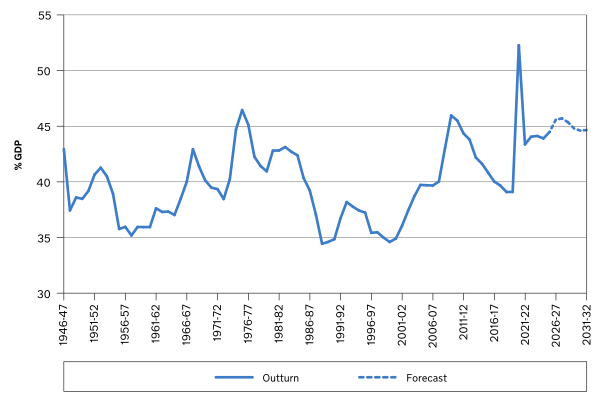
Source: Office for National Statistics outturn and Office for Budget Responsibility forecast.
9.6 Chart B.2: Total Departmental Spending (TDEL)
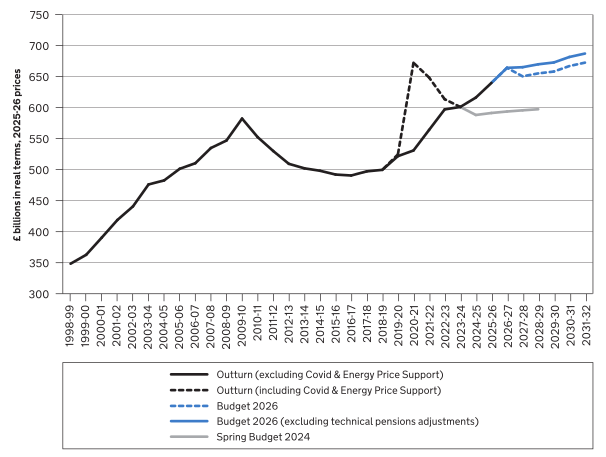
| Note: Real-terms figures for each fiscal event are calculated using the Office for Budget Responsibility’s Gross Domestic Product deflator forecast published alongside each event. Technical pensions adjustment is due to lower employer contributions arising from 2024 public service pensions valuation, with a view to ensuring that departments are no worse or better off. |
| Source: HM Treasury, Public Spending Statistics. |
10. Public sector receipts and spending
Chart C.1 shows public sector current receipts by main type. Public sector current receipts are expected to be around £1,392 billion in 2027-28.
10.1 Chart C.1: Public sector current receipts 2027-28
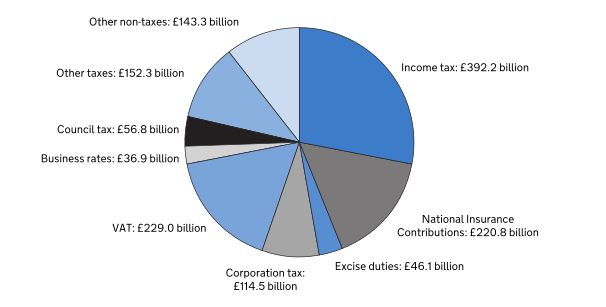
| Figures may not sum due to rounding. |
| Other taxes includes capital taxes, stamp duties, vehicle excise duties, customs duties and other smaller tax receipts. |
| Other non-taxes includes interest and dividends, gross operating surplus and other smaller non-tax receipts. |
| Source: Office for Budget Responsibility. |
Chart C.2 shows public spending by main function. Total Managed Expenditure (TME) is expected to be around £1,504 billion in 2027-28.
10.2 Chart C.2: Public sector spending 2027-28
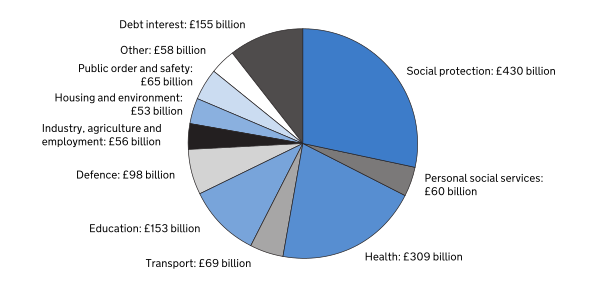
| Illustrative allocations to functions are based on HMT analysis, including capital consumption figures from the Office for National Statistics. Figures may not sum due to rounding. |
| Defence spending is presented on a COFOG basis rather than the NATO definition. |
| Source: Office for Budget Responsibility and HM Treasury calculations. |
-
HM Treasury (HMT) calculations based on ‘Quarterly GDP and components – expenditure and prices volumes’, OECD, October 2026. ↩
-
‘UK Economic Accounts’, Office for National Statistics (ONS), September 2026. ↩
-
‘Public sector finances, UK: September 2026’, ONS, October 2026. ↩
-
HM Treasury (HMT) calculations based on ‘Quarterly GDP and components, expenditure approach – volume and price indices’, OECD, October 2026. ↩
-
‘GDP quarterly national accounts, UK: April to June 2026’, ONS, September 2026. ↩
-
‘Economic and fiscal outlook detailed forecast tables – economy’, OBR, March 2026. ↩
-
‘Economic Outlook, Interim Report: Weathering Successive Shocks’, OECD, September 2026, Table 1. ↩
-
‘World Economic Outlook’, IMF, October 2026, Table 1.1.1. ‘World Economic Outlook’, IMF, April 2026, Table A2. ↩
-
‘ONS GDP monthly estimate, UK: August 2026’, ONS, October 2026. ↩
-
‘Bloomberg Economic Calendar’, Bloomberg, October 2026, accessed on 14 October 2026. ↩
-
‘UK Economic Accounts’, ONS, September 2026. ↩
-
‘Real average weekly earnings using consumer price index inflation (seasonally adjusted)’, ONS, October 2026. ↩
-
‘Monthly GDP low level industry data’, ONS, October 2026. ↩
-
‘Household final consumption expenditure’, ONS, August 2026. ↩
-
‘Retail Sales’, ONS, September 2026. ↩
-
HMT calculations based on ‘Quarterly GDP and components, expenditure approach – volume and price indices’, OECD, October 2026. ↩
-
‘UK Economic Accounts’, ONS, September 2026, Q2 2025 to Q2 2026. ↩
-
‘UK Economic Accounts’, ONS, September 2026. ↩
-
‘UK Economic Accounts’, ONS, September 2026. ↩
-
HMT analysis of ‘UK Economic Accounts’, ONS, September 2026, compares Q3 2016 to Q2 2026. ↩
-
‘Business investment by asset’, ONS, September 2026, Q4 2025 to Q2 2026. ↩
-
‘Business investment by industry and asset’, ONS, September 2026, Q4 2025 to Q2 2026. ↩
-
HMT calculations using ‘Component approach to measuring labour productivity, UK: 1997 to 2024’, ONS, September 2026. ‘Productivity flash estimate and overview, UK’, ONS, April to June 2026 and January to March 2026, ONS, August 2026. ↩
-
‘A01: Summary of labour market statistics’, ONS, October 2026, rolling three-month average (three months to August 2026). ↩
-
‘Earnings and employment from Pay As You Earn Real Time Information, seasonally adjusted’, ONS & HMRC, October 2026. ↩
-
‘Vacancies: A01: Summary of Labour market statistics’, ONS, October 2026, rolling three‑month average. ↩
-
HMT calculations using UK employment rates up to 1970: ‘Long-term trends in UK employment: 1861-2018’, ONS, April 2019; UK employment rates 1971 onwards: ‘A01: Summary of labour market statistics’, ONS, October 2026, rolling three-month average. ↩
-
UK employment rate: ‘A01: Summary of labour market statistics’, ONS, October 2026, rolling three month average (three months to August 2026). ↩
-
G7 average employment rate: ‘Infra-annual labour statistics’, OECD, October 2026 (three months to June 2026). ↩
-
‘A01: Summary of labour market statistics’, ONS, October 2026, rolling three month average. ‘Young people not in education, employment or training (NEET)’, ONS, August 2026. ↩
-
‘How the ONS measures productivity’, ONS, June 2026. ↩
-
‘Productivity flash estimate and overview, UK’, ONS, April to June 2026 and January to March 2026, ONS, August 2026. ↩
-
‘Productivity flash estimate and overview, UK’, ONS, April to June 2026 and January to March 2026, ONS, August 2026. ↩
-
‘Economic and Fiscal Outlook’, OBR, October 2026. Unless otherwise stated, references to OBR publications throughout refer to the October 2026 Economic and Fiscal Outlook. ↩
-
‘Component approach to measuring labour productivity, UK: 1997 to 2024’, ONS, September 2026. ↩
-
‘Public sector finances, UK: September 2026’, ONS, October 2026. ↩
-
HM Treasury (HMT) calculations and Bloomberg Data as of 23 October 2026. ↩
-
‘Consumer price inflation tables’, ONS, September 2026. ↩
-
HMT calculations based on ‘World Economic Outlook’, IMF, October 2026. ↩
-
HMT calculations using ‘Weekly road fuel prices,’ Department for Energy Security and Net Zero, October 2026; ‘Weekly Oil Bulletin,’ European Commission, October 2026. Calculations show the percentage change between the week commencing 23 February 2026 and the week commencing 19 October 2026. ↩
-
‘Digest of UK Energy Statistics (DUKES)’, DESNZ, July 2026. ↩
-
‘Decisive action to break influence of gas on electricity prices’, DESNZ, 21 April 2026. ↩
-
‘Contracts for Difference’, Commons Library Research Briefing, 27 July 2026. ↩
-
‘Energy Price Cap Unit Rates and Standing Charges’, Ofgem, October 2026. ↩
-
‘Energy Price Cap Press Release’, Ofgem, May 2026. One-off question from ‘Business Insights and Conditions Survey’, ONS, April 2026, Wave 154. ↩
-
‘Consumer price inflation’, ONS, October 2026. ↩
-
HMT calculations and Bloomberg. Data as of 23 October 2026. ↩
-
‘Economic and fiscal outlook November 2025’ OBR, November 2025. ↩
-
‘Public sector finances, UK: September 2026’, ONS, October 2026. ↩
-
‘Benefit expenditure and caseload tables 2026’, Department for Work and Pensions, April 2026. ↩
-
‘Public sector finances, UK: September 2026’, ONS, October 2026. ↩
-
‘World Economic Outlook October 2026’, IMF, October 2026. ↩
-
‘Public sector finances, UK: September 2026’, ONS, October 2026. ↩
-
‘Public sector finances, UK: September 2026’, ONS, October 2026 and OBR forecast. Calculated based on total reduction in PSNB between 2024-25 and 2031-32. ↩
-
‘Public sector finances, UK: September 2026’, ONS, October 2026. ↩
-
‘Public sector finances, UK: September 2026’, ONS, October 2026 and OBR forecast. Calculated based on total reduction in current budget balance since 2024-25. ↩
-
‘Public sector finances, UK: September 2026’, ONS, October 2026. ↩
-
‘Public sector finances, UK: September 2026’, ONS, October 2026. ↩
-
‘Public sector finances, UK: September 2026’, ONS, October 2026. ↩
-
All figures in this box are based on ‘World Economic Outlook October 2026’, IMF, October 2026. ↩
-
‘State Pension Uprating’, Department for Work and Pensions, October 2026. ↩
-
‘Update on the Asset Purchase Facility (APF)’, HM Treasury, September 2026. ↩
-
HMT calculations of the change in RDEL in 2028‑29 between Spring Budget 2024 and Budget 2026. ↩
-
HMT calculations of the cumulative change in nominal CDEL from 2025‑26 to 2029‑30 compared to plans set out at Spring Forecast 2024. ↩
-
‘NHS App Management Information - August 2026’, NHS England, September 2026. ↩
-
‘Chest X-ray AI - Studies Successfully Processed by NHS Trust, by month’, NHS England, July 2026. ↩
-
‘HMRC Transformation Roadmap: update 2026’, HMRC, July 2026. ↩
-
‘Justice Transcribe data: 7 October 2025 to 14 September 2026’, Ministry of Justice, September 2026. ↩
-
‘Rough sleeping questionnaire 2025: Headline findings’, MHCLG, May 2026. ↩
-
‘2025‑26 departmental efficiency and savings performance’, HMT, October 2026. ↩
-
Audited benefits achieved across the public and private sectors combined, Public Sector Fraud Authority, September 2026. ↩
-
‘HMRC’s Transformation Roadmap’, HMRC, July 2025; ‘HMRC Transformation Roadmap: update 2026’, HMRC, July 2026. ↩
-
This is made up of £6.5 billion from Autumn Budget 2024, over £1 billion from Spring Statement 2025, £2.4 billion from Budget 2025 and £2.3 billion from this Budget. ↩
-
84% of taxpayers are unaffected by these changes in 2027-28. These impacts have been derived from HMRC’s 2023-24 Survey of Personal Incomes data, projected to 2027-28 in line with economic assumptions consistent with the Office for Budget Responsibility October 2026 ‘Economic and Fiscal Outlook’, then mapped onto household income deciles using HM Treasury’s Distributional Analysis model. The figures are based on individuals’ tax liabilities, and do not represent actual tax receipts received by HMRC. ↩
-
This assumes a basic rate taxpayer with an average interest rate of 4%. ↩
-
‘Consumer price inflation, UK: September 2026’, Office for National Statistics (ONS), October 2026. Measured by Consumer Price Index (CPI) Inflation. ↩
-
‘Weekly road fuel prices’, Department for Energy Security and Net Zero (DESNZ) Accredited official statistics, October 2026. Calculations compare average UK pump prices in the weeks commencing 23 February 2026 (pre-conflict) and 19 October 2026 (latest available data), based on a 55-litre tank. ↩
-
Based on number of households in ONS Family Spending statistics: ‘Family spending workbook 1: detailed expenditure and trends’, Office for National Statistics, June 2026. ↩
-
‘Licensed vehicles at the end of the year by body type and keepership (private and company)’, DfT and DVLA Accredited official statistics, April 2026. ↩
-
‘Local Authority Council Taxbase in England 2025’, MHCLG Official Statistics, January 2026. The figures used are based on estimates of 20 million households in England residing in bands A-D, making up around 80% of total households in England. ↩
-
Based on MHCLG estimates using property level rateable value data from the Valuation Office and local authority National Non-Domestic Rates returns. ↩
-
Based on HMT analysis of the average of published external price cap forecasts from major energy suppliers. The exact level of saving will depend on how much electricity each household consumes and future electricity prices. ↩
-
‘Local Authority Council Taxbase in England 2025’, MHCLG Official Statistics, January 2026. The figures used are based on estimates of 20 million households in England residing in bands A-D, making up around 80% of total households in England. ↩
-
‘Fuel stressed’ is defined as a household spending more than 10% of their after-housing-cost income on energy. This is calculated using HMT’s Distributional Analysis model, based on ONS Living Costs and Food Survey data for 2019-20, 2022-23 and 2023-24. For more information on the model, see ‘Impact on Households’ supplementary document. ↩
-
This is calculated using HMT’s Distributional analysis model, based on DWP’s Family Resources Survey data for 2022-23, 2023-24 and 2024-25. For more information on the model, see ‘Impact on Households’ supplementary document. ↩
-
‘Budget 2025 Data Sources’, HM Treasury, November 2026. ↩
-
‘Debt and arrears indicators’, Ofgem, June 2025. ↩
-
The stock of household debt and anticipated savings to 2030 is based on the Energy Debt Circuit Breaker published alongside the Budget, which includes government analysis on expected bill savings from the measures in that strategy, compared to if they were not introduced. ↩
-
‘Energy price cap unit rates and standing charges’, Ofgem, October 2026. ↩
-
‘Government cuts electricity bill for 10,000 manufacturers in boost for UK competitiveness’, Gov.uk, April 2026. ↩
-
Based on HMT analysis of the average of published external price cap forecasts from major energy suppliers. The exact level of saving will depend on how much electricity each household consumes and future electricity prices. ↩
-
‘Local Authority Council Taxbase in England 2025’, MHCLG Official Statistics, January 2026. The figures used are based on estimates of 20 million households in England residing in bands A-D, making up around 80% of total households in England. ↩
-
‘Government cuts electricity bill for 10,000 manufacturers in boost for UK competitiveness’, Gov.uk, April 2026. ↩
-
The stock of household debt and anticipated savings to 2030 is based on the Energy Debt Circuit Breaker published alongside the Budget, which includes government analysis on expected bill savings from the measures in that strategy, compared to if they were not introduced. ↩
-
‘Weekly road fuel prices’, DESNZ Accredited official statistics, October 2026. ↩
-
‘Licensed vehicles at the end of the year by body type and keepership (private and company)’, DfT and DVLA Accredited official statistics, April 2026. ↩
-
‘Historical hydrocarbon oils duty rates’, HMRC Accredited official statics, July 2026. ↩
-
Based on HMRC internal calculations, measuring current policy for duty rates against the assumed baseline of the 5p cut being reversed in April 2025, and annual RPI uprating from April 2025 onwards. ↩
-
Based on annual income tax saving in 2027‑28 for basic rate taxpayer driving 6,000/15,000 miles claiming Mileage Allowance Relief. ↩
-
‘Historical hydrocarbon oils duty rates’, HMRC Accredited official statics, July 2026. ↩
-
HGV VED rates vary based on type, weight and number of axles. Saving based on tax band E1, which had a rate of £601 for 12 months in 2026‑27 until 30 June 2026: ‘Budget 2025 – Overview of tax legislation and rates (OOTLAR)’, HMRC, December 2025.. ↩
-
Assuming 6.4p/mile at a 0.303kWh/miles average energy consumption (‘Energy consumption of electric vehicles’, EV Database, October 2026) for an EV driver driving an average of 8,000 miles per year. ↩
-
Based on internal HMT calculations, accounting for the effects of lower tariffs and relevant administrative costs of importing on the prices of imported goods within the package of suspensions. ↩
-
The number of people benefitting from the minimum wage increase is provisional until BIST publish its Impact Assessment in early 2027. See GOV.UK press release for further information. ↩
-
The increase to the gross annual earnings of a full-time worker on the National Living Wage (£13.21) for 52 weeks. ↩
-
Population estimate from BIST analysis of the Annual Population Survey (APS) and Annual Survey of Hours and Earnings (ASHE). Adoption population estimates from ‘Children looked after in England including adoptions’, DfE, November 2026; ‘Vital Events Reference Tables 2024’, National Records of Scotland, August 2025; and ‘Children looked after by local authorities, April 2023 to March 2024’, Welsh Government, January 2025. ↩
-
All estimates for numbers of businesses affected and average savings from the business rates package are based on MHCLG estimates using property-level rateable value data from the Valuation Office and local authority National Non-Domestic Rates returns. ↩
-
‘UK Economic Accounts’, Office for National Statistics (ONS), September 2026. Long-run pre-financial crisis average defined as 1955 Q1-2008 Q1, post 2010 starts from 2010 Q1. ↩
-
HM Treasury (HMT) analysis of ‘Regional and subregional labour productivity, UK: 2023’, ONS, June 2025. ↩
-
HMT analysis of ‘Regional economic activity by gross domestic product, UK: 1998 to 2024’, ONS, September 2026; Workforce jobs by industry, UK countries and English regions’, September 2026. ↩
-
Real GDP, OECD quarterly GDP and components, expenditure approach – volume and price indices. ↩
-
‘Annual Gross Fixed Capital Formation’, Organisation for Economic Co-operation and Development (OECD). ↩
-
‘Investment and Capital Stock Dataset’, International Monetary Fund. ↩
-
HMT calculations of the cumulative change in nominal Capital Departmental Expenditure Limit (CDEL) from 2025‑26 to 2029‑30 compared with plans set out at Spring Forecast 2024. ↩
-
‘UK Economic Accounts’, ONS, September 2026. ↩
-
‘Fiscal devolution for England’, Centre for Cities, June 2026. ↩
-
‘International comparison of the UK research base’, Department for Science, Innovation and Technology, June 2025. ↩
-
‘2026 Global Innovation Index’, World Intellectual Property Organization, 2026. ↩
-
‘The State of UK Competition Report 2024’, Competition and Markets Authority, October 2024. ↩
-
‘Macroeconomic productivity gains from Artificial Intelligence in G7 economies’, OECD, June 2025. ↩
-
‘A01: Summary of labour market statistics’, ONS, October 2026, rolling three-month average. ↩
-
‘Young people not in education, employment or training (NEET)’, ONS, August 2026. ↩
-
‘A01: Summary of labour market statistics’, ONS, October 2026, rolling three-month average. ↩
-
‘Education at a Glance 2026’, OECD, September 2026. ↩
-
‘International domestic energy prices’, Department for Energy Security and Net Zero, September 2026. Price comparison for medium electricity users including all taxes and levies. ↩
-
‘International non-domestic energy prices’, Department for Energy Security and Net Zero, September 2026. Price comparison includes all taxes and levies. ↩
-
‘Evaluation of OFTO Tender Round 2 and 3 Benefits’, Ofgem, March 2016. ↩
-
Figure provided by The Ministry of Housing, Communities and Local Government. ↩
-
Based on internal Ministry of Housing, Communities and Local Government analysis of Planning Inspectorate data. ↩
-
Estimated data based on latest position and confirmed figures will be published in the next iteration of the Infrastructure Pipeline later in the autumn. ↩
-
‘The housebuilding crisis: The UK’s 4 million missing homes’, Centre for Cities, February 2023. ↩
-
‘Impact at the National Wealth Fund: Investing across the nations and regions of the UK’, National Wealth Fund, October 2026. ↩
-
‘National Wealth Fund statement on Budget and additional capitalisation’, National Wealth Fund, October 2026. ↩
-
‘British Business Bank welcomes package of Budget measures to back growth and support smaller businesses across the UK’, British Business Bank, October 2026. ↩
-
‘Technical Annex – 25% Target Methodology (Annex A)’, HM Treasury, October 2025. The target is converted into employment hours using the economy-wide average hourly wage with a non-wage uplift applied. ↩
-
‘Admin burden reduction technical annex’, Department for Business, Innovation, Science and Trade and Department for Business and Trade, July 2026. ↩
-
‘Technical Annex – Regulatory Administrative Savings Package (Budget 2026)’, HM Treasury, October 2026. ↩
-
‘Regulation Action Plan Progress Report’, Department for Business and Trade, July 2026. ↩
-
‘Tackling the UK’s regional economic inequality: Binding constraints and avenues for policy intervention’, Stansbury, Turner, and Balls, August 2023. ↩
-
‘Fiscal devolution for England’, Centre for Cities, June 2026. ↩
-
Subject to agreeing final terms and conditions. ↩
-
HMT calculations of ‘Regions, cities and local areas database’, OECD, 2024 and ONS Population data for England, 2024. ↩
-
HMT analysis of OECD functional urban area economy data for labour productivity and employment at place of work for UK, France, Germany, Italy in 2021; OECD UK GDP (US dollars, PPP converted) in 2021; ONS Regional Economic Activity by Gross Domestic Product in 2024; ONS seasonally adjusted workforce jobs in 2025. ↩
-
‘New British-built trains to transform railways and reindustrialise Britain’, Department for Transport, September 2026. ↩
-
Initial detail set out in: ‘Strategic Outline Case – Birmingham East Mayoral Development Corporation’, West Midlands Combined Authority, March 2026. ↩
-
‘More than 3,400 jobs and targeted support for local communities to help tackle the cost of living as Lanarkshire named latest AI Growth Zone’, January 2026. ↩
-
‘Business Population Estimates 2025’, Department for Business and Trade, October 2025. ↩
-
‘Pension schemes back British Growth’, HM Treasury, May 2025. ↩
-
‘Untapped Digital Talent: the £3 billion opportunity’,Cebr & City of London Corporation, 2026. ↩
-
‘Foreign direct investment: Inward and outward flows and stock, annual’, UNCTADstat, October 2026. Second in G7 based on 2025 Inward stock in US$ at current prices. ↩
-
‘UK-India Free Trade Agreement: impact assessment’, Department for Business and Trade, July 2025. ↩
-
‘UK-Switzerland enhanced Free Trade Agreement: technical note’, Department for Business and Trade, July 2026; ‘Technical note of the headline trade impacts of the upgraded UK-Republic of Korea Free Trade Agreement’, Department for Business and Trade, December 2025. ↩
-
‘Macroeconomic productivity gains from Artificial Intelligence in G7 economies’, OECD, June 2025. ↩
-
‘Regional economic activity by gross domestic product, UK: 1998 to 2024’, ONS, September 2026. ↩
-
‘UK-India Free Trade Agreement: impact assessment’, Department for Business and Trade, July 2025. ↩
-
‘Regional economic activity by gross domestic product, UK: 1998 to 2024’, ONS, September 2026. ↩
-
This excludes reductions following a technical change due to lower employer pensions contributions resulting from 2024 pensions valuations. Full details of the technical change can be found in the RDEL control totals table. ↩
-
‘Regional economic activity by gross domestic product, UK: 1998 to 2024’, ONS, September 2026. ↩
-
Figures provided by the Northern Ireland Executive Department for the Economy. ↩
-
‘Northern Ireland start-up boost with new £50 million defence growth deal’, Northern Ireland Office, April 2026. ↩
-
‘Northern Ireland Cyber Security Snapshot: Summary Report – 2025 Update’, Queen’s University Belfast & Centre for Secure Information Technologies, December 2025. ↩
-
This excludes reductions following a technical change due to lower employer pensions contributions resulting from 2024 pensions valuations. Full details of the technical change can be found in the RDEL control totals table. ↩
-
Ministry of Housing, Communities and Local Government internal estimate. ↩
-
‘UK Infrastructure: A 10 Year Strategy’, HM Treasury and National Infrastructure and Service Authority, June 2025. ↩
-
‘Rough sleeping snapshot in England: autumn 2025’, Ministry of Housing, Communities and Local Government, February 2026. ↩
-
Estimate based on available NHS England data on patients accessing medicines through the Early Access to Medicines Scheme (EAMS) and post-approval arrangements. Available data does not capture all medicines supplied free of charge. ↩
-
‘Health Assessment Statistics: Personal Independence Payment and Work Capability Assessments, January 2021 to July 2026’, Department for Work and Pensions, September 2026. ↩
-
‘Young people not in education, employment or training (NEET)’, ONS, August 2026. ↩
-
‘Young people and work: interim report’, Department for Work and Pensions, May 2026. ↩
-
‘Timms Review of Personal Independence Payment: interim report’, Department for Work and Pensions, July 2026. ↩
-
‘The employment of disabled people’, Department for Work and Pensions, November 2025. ↩
-
‘State Pension Uprating’, Department for Work and Pensions, October 2026. ↩
-
Revision to the DMO Financing Remit 2026-27, UK Debt Management Office, April 2026. ↩
-
Debt Management Report 2026-27, HM Treasury, March 2026. ↩
-
Letter from the Chancellor of the Exchequer to the Governor of the Bank of England, 17 September 2026. ↩
-
Includes green gilt issuance. More detail is provided in paragraph A.17. ↩
-
The DMO’s financing plans include an initially unallocated portion of issuance from which gilts of any maturity or type may be issued (excluding green gilts). The unallocated portion is used to respond appropriately to developments in the gilt market in-year. ↩
-
In the case of gilt collateral creation, specific gilts will typically not be available to the repo market for a period of three months following creation, during which time these new issues may be used in Delivery-by-Value transactions. Given the shorter maturity of Treasury bills relative to gilts, it would not be appropriate to impose such a restriction on these instruments. ↩