Get ECMT permits to transport goods internationally
Apply for permits to transport goods to, through or from European Conference of Ministers of Transport (ECMT) countries, and the rules you must follow.
You must have an ECMT permit (also known as an ECMT licence) to use a vehicle weighing 3.5 tonnes or more to:
- transport goods to, through or from ECMT member countries
- carry out some types of cross-trade jobs in the EU
Cross-trade is loading goods in one country and unloading them in another country, with a vehicle registered in a third, different country.
You can only use ECMT permits to travel through countries that are part of the scheme.
There are 2 types of permits you can apply for:
- short-term permits for 30 days
- annual permits valid until 31 December 2026
You can make an unlimited number of journeys within the time your permit is valid for.
ECMT countries
There are 43 ECMT member countries:
- all EU countries except Cyprus
- Albania
- Armenia
- Azerbaijan
- Belarus
- Bosnia and Herzegovina
- Croatia
- Georgia
- Liechtenstein
- North Macedonia
- Moldova
- Norway
- Russia
- Serbia
- Switzerland
- Turkey
- Ukraine
- United Kingdom
You cannot currently use ECMT permits to travel to Russia because of the Russian invasion of Ukraine.
Check if you need ECMT permits
There is a limited number of ECMT permits, so you may be able to use other permits for your journey instead.
When you must use an ECMT permit
You must use an ECMT permit to:
- transport goods to, through or from Armenia
- carry out 1 or 2 cross-trade jobs between any ECMT countries that are not in the EU
- carry out 3 cross-trade jobs between any ECMT countries
- carry out a cross-trade job between the EU and a non-EU country that is a member of ECMT
- carry out a cross-trade job in the EU after an unladen journey from the UK
Example
A journey that includes 3 cross-trade jobs:
- UK to France – outward journey
- France to Belgium – first cross-trade journey
- Belgium to Netherlands – second cross-trade journey
- Netherlands to Germany – third cross-trade journey
- Germany to UK – return journey
Returning to the UK does not count as one of the 3 cross-trade jobs.
When you can use a UK Licence for the Community instead
You should apply for a UK Licence for the Community instead of an ECMT permit if:
- you only want to carry out 1 or 2 cross-trade jobs in EU countries, Liechtenstein or Switzerland
- your journey only goes through EU countries, Liechtenstein or Switzerland
When you can use bilateral haulage permits instead
You cannot currently get bilateral permits for Belarus or Russia because of the Russian invasion of Ukraine.
You should apply for a bilateral road haulage permit instead of an ECMT permit if your journey only involves any of these countries:
- Azerbaijan
- Belarus
- Georgia
- Kazakhstan
- Morocco
- Norway
- Russia
- Tunisia
You should also use a bilateral road haulage permit if you are travelling:
- through Turkey to another country
- in Ukraine using a vehicle that meets Euro 3 or Euro 4 emissions standards
When you do not need a permit
You do not usually need a permit to transport goods to, through or from:
- Albania
- Bosnia and Herzegovina
- Moldova
- Montenegro
- North Macedonia
- Serbia
- Turkey – unless you are travelling through Turkey to another country
- Ukraine – unless you are using a vehicle that meet Euro 3 or Euro 4 emissions standards
When you can use ECMT permits
You can only use an ECMT permit in one vehicle at a time. When a vehicle returns to the UK, you can then use the permit in another vehicle. You must return to the UK after every third journey.
You cannot use ECMT permits for:
- unaccompanied trailers or semi-trailers
- vehicles with a lower Euro emissions class than the permit allows
- cabotage - loading and unloading goods within one country, with a vehicle registered in another country
Use an ECMT permit with a hire or lease vehicle
You can use ECMT permits for vehicles you hire or lease.
Your hire or lease contract must state that only your company can use the vehicles for the duration of the contract.
Only your staff from your company are allowed to drive hire or lease vehicles when using an ECMT permit.
Check if you’re eligible
To apply for ECMT permits, you must:
- have a vehicle operator licence from Great Britain (England, Scotland and Wales) or Northern Ireland
- use vehicles for your ECMT journeys that meet Euro 5 or Euro 6 emissions standards
- meet the ECMT quality charter
Restricted or standard national operator licence holders
If you have a restricted or standard national operator licence, before you apply for an ECMT permit you need to apply for a standard international operator licence or:
- employ or contract a transport manager
- give financial evidence to show you have the higher amount of money needed for a standard international licence
What it costs
You’ll pay a fee to apply for permits, as well as a fee for each permit.
Application fees
There is a fee of £10 per permit when you apply.
Short-term permit fees
Short-term permits cost £10.
They last for 30 days from the date of your first journey.
Annual permit fees
The fee depends on the time of year you apply for an annual permit.
| When you apply | Cost |
|---|---|
| January to March | £123 |
| April to June | £93 |
| July to September | £62 |
| October to December | £31 |
Apply for permits
You can apply for:
- short-term permits for 30 days
- annual permits valid until 31 December 2026
Email the Driver and Vehicle Standards Agency (DVSA) International Road Haulage Permits Office to apply.
DVSA International Road Haulage Permits Office
irhp@dvsa.gov.uk
You need to include:
- your operator licence number
- the date of your first journey
- the type of journey (third cross-trade, cross-trade from an EU country to a non-EU country, or travel to a non-EU ECMT country)
- the journey destination, including your loading and unloading points
- which countries you’ll go through to reach your destination
- how many permits you need
- the type of permits you’d prefer (annual or short-term)
- which type of vehicle you’ll use (Euro V or Euro VI)
What happens next
-
Pay the fees. DVSA will email you within 5 working days with details on how to pay.
-
Email irhp@dvsa.gov.uk to confirm you’ve paid the fees.
-
DVSA will assign you digital permits within 5 working days.
-
Apply for ECMT certificates to show your vehicle meets safety standards.
-
Add vehicle and journey information to the online permit system.
-
Access ECMT permits and share them with your drivers.
Apply for ECMT certificates
Once DVSA has granted your permits, you must apply for certificates to show that your vehicles and trailers meet safety and emissions standards. You do not need to apply again if you already have these certificates.
ECMT certificate of compliance
Contact your vehicle or trailer manufacturer to request an ECMT certificate of compliance. This confirms if the vehicle meets the correct Euro emissions standard.
The manufacturer may charge for this certificate.
ECMT certificate of roadworthiness
You can apply online for an ECMT certificate of roadworthiness for your vehicle or trailer.
There is no fee for this certificate.
You’ll need:
- the vehicle registration (number plate)
- the trailer registration number if you’re applying for a trailer
- the vehicle or trailer type and make
- the certificate of compliance number, if you have one
- vehicle identification number (VIN)
- engine type and number
Apply for an ECMT certificate of roadworthiness on the manage your vehicle operator licence service.
Add vehicle and journey information to the permit system
Before you start your journey, you must add information to the permit system on the International Transport Forum website.
When DVSA assigns ECMT permits to you, they’ll email you with either:
- information on how to sign in to the International Transport Forum website to access your permit
- confirmation that you can access your permit on the International Transport Forum website, if you already have an account
You must add the following details for each of your vehicles and trailers:
- vehicle or trailer registration (number plate)
- vehicle identification number (VIN)
- Euro emissions category – for vehicles only
- certificate of compliance
- certificate of roadworthiness
You then need to use the online logbook on the permit system to add details about your journey to your ECMT permits.
You must add the following details to the logbook:
- date you depart from the UK
- date you depart from any places you are transiting through
- date you arrive back in the UK
- places you are loading, transiting through or unloading at
- vehicle and trailer registration (number plate)
- gross weight of your vehicle and trailer
- odometer reading in km at departure
You can update the logbook later if there are any changes to your journey.
During the journey, you must update the logbook with:
- changes to the weight of your vehicle, if you have loaded or unloaded goods
- odometer reading in km at any loading or unloading points
At the end of the journey, you must update the logbook with:
- gross weight of your vehicle and trailer
- odometer reading in km at arrival
How to use ECMT permits
ECMT permits are digital. You can access them on the International Transport Forum website.
There are different ways to share the permits with your drivers:
- create accounts for your drivers on the permit system so they can sign in and view the permits
- print out a copy of the permit and give this to the driver – this must be on white paper
- save a PDF of the permit and send this to the driver
The driver can then show a paper copy of the permit or a digital copy on their phone during their journey.
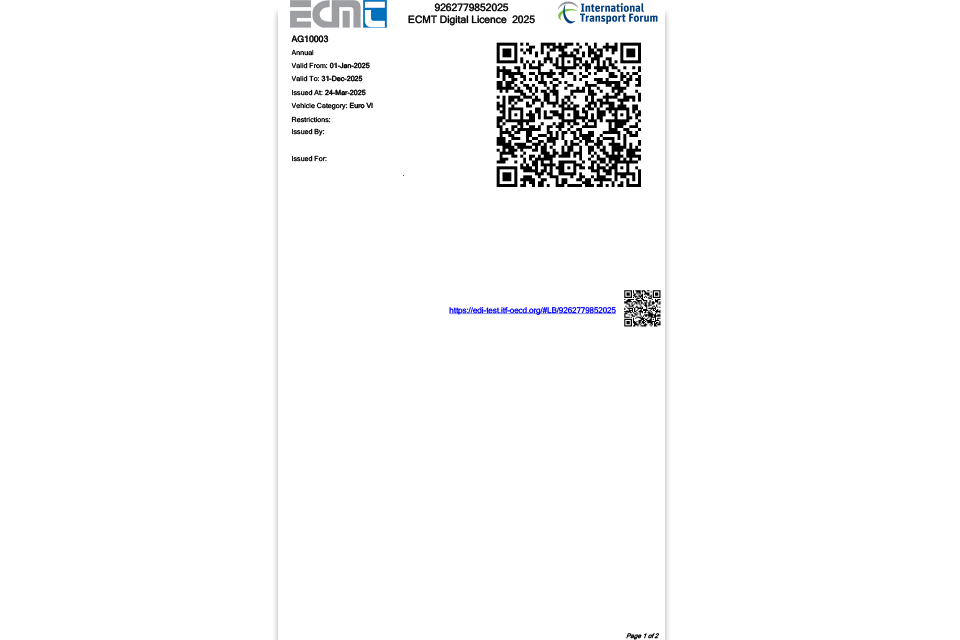
The permit includes:
- dates the permit is valid for
- who issued the permit
- QR codes that officials can scan to check your permit is valid
If you have more than one vehicle operator licence
You can use an ECMT permit for a vehicle assigned to any of your operator licences. The ECMT permit is not allocated to a specific operator licence.
You cannot transfer a permit to another business entity, for example, a sister company.
If your vehicle breaks down or is involved in an incident
If a vehicle breaks down or is involved in an incident and you replace it with a different vehicle for the rest of the journey, you must update the online logbook. You must include the:
- reason for the replacement
- location where the vehicle was replaced
- licence numbers for both vehicles
You will also need to upload proof to the permit system, such as a police report of the incident or a document showing the failure of the vehicle.
Documents the driver must carry
During the journey, the driver must have a copy of the permit. They can print it out or show it on their phone or tablet.
The driver must also carry a copy of these documents:
- ECMT certificate of compliance
- ECMT certificate of roadworthiness
- a UK Licence for the Community during journeys to, through or from EU countries
- ECMT Journey Information Document
You must not seal these certificates in foil or coat them with a protective film.
Check what other vehicle documents and driver documents the driver needs to carry on international journeys.
It’s illegal to not have the right documents for the journey. Your driver can be fined for not carrying them.
ECMT Journey Information Document
The permit system generates the ECMT Journey Information Document. It has information about the ECMT permit, including the last 10 journeys made with the permit.
The driver can show a paper copy of this document or a digital copy on their phone during their journey. You must print paper copies on white paper.
Documents to carry when using a hire or lease vehicle
If you are using a vehicle that you have hired or leased, the driver must also carry the contract of hire or lease, or a certified extract from the contract. This must include the:
- name of your company
- name of the company you are leasing the vehicle from
- date of the contract
- time you have hired the vehicle for
- vehicle identification number (VIN)
If the driver is not the person who hired the vehicle, they must carry their employment contract or a certified extract from the contract that includes the:
- name of their employer
- name of the driver
- date and duration of the contract, or a recent payslip
Find out how to certify a document if you want to use an extract from a contract.