Sweet chestnut blight: identification, reporting and control
Information about sweet chestnut blight (Cryphonectria parasitica), including how to report sightings.
Latest news and updates
Read the latest press notices:
- Forestry Commission extends sweet chestnut blight demarcated area following further outbreaks (August 2026)
- Sweet chestnut blight outbreak prompts swift action (March 2026)
Read more about the disease in Forest Research’s blog New research investigates potential biocontrol programme to manage sweet chestnut blight.
Find out how you can help by visiting the Check a Sweet Chestnut campaign.
Sweet chestnut blight is a destructive disease of sweet chestnut trees (trees in the Castanea genus) caused by the fungus ‘Cryphonectria parasitica’.
Sweet chestnut blight is a regulated quarantine pest in the UK, meaning it is under official control measures and cannot be introduced, moved, multiplied or released without prior authorisation.
It is not native to the UK, although it is now widespread in Europe. Since 2011, the disease has been found at a small number of sites in England, which are subject to statutory control measures.
Symptoms and identification
Sweet chestnut blight attacks the bark of sweet chestnut trees, entering through fissures or wounds. All symptoms on infected trees occur above ground.
The fungus spreads rapidly through infected bark causing stems or branches to become girdled. This means the flow of nutrients is eventually cut off to the tree sections above the infection. This kills the tree above ground level, and the dead bark becomes visible as a sunken canker.
Orange fruiting bodies, which produce the spores that spread sweet chestnut blight are also visible on the bark. These erupt through lenticels (raised openings) and release long, orange-yellow tendrils of spores in moist weather.
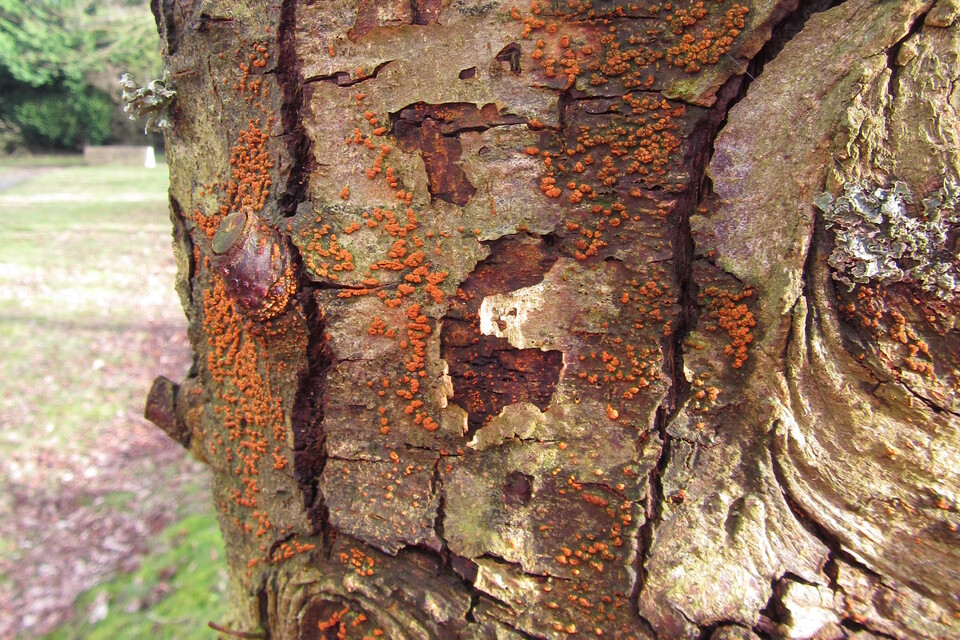
Orange fruiting bodies and fissuring of the canker on sweet chestnut. Credit: Forest Research
When the canker girdles the stem leaves wilt and turn brown but remain hanging on the tree. Below the canker, branches retain healthy foliage and new shoots are produced after a short time. It is common to find many cankers on a single tree.
Young trees may die within a year of infection. Mature trees may take several years to decline and die.
The fungus can occasionally affect some species of oak when they are growing in very close proximity to heavily infected sweet chestnut trees, especially when they are significantly stressed. The disease does not affect horse chestnut (conker) trees.
Get more details and a symptoms guide on Forest Research’s sweet chestnut blight page.
How to report sightings
Look out for signs of sweet chestnut blight. If you think you have spotted this disease report it using:
Refer to Forest Research’s maps of confirmed locations, which shows sweet chestnut blight has been found at many sites in the UK. Mostly in central and southern England.
If you trade in plants in England or Wales and suspect sweet chestnut blight on your site, contact your local Animal and Plant Health Agency (APHA) plant health and seeds inspector or email planthealth.info@apha.gov.uk.
How to manage infected trees or sites
Sweet chestnut blight is a notifiable plant disease. If you suspect it, you must report it immediately to the relevant plant health authority. Do not wait for confirmation before doing so.
Do not destroy or move any infected plants, bark or wood unless you have been instructed to do so by the Forestry Commission or APHA.
Demarcated area restrictions apply to parts of England where specific controls are in place to prevent spread. Read more and refer to the demarcated area map.
Import restrictions and regulations
Cryphonectria parasitica is a regulated pest in the UK. Import restrictions apply to sweet chestnut material from all third countries outside the UK, including plants for planting, wood and bark. These restrictions are intended to minimise the risk of further introductions of the disease.
UK legislation also requires the use of UK plant passports for the movement of all Castanea species, including sweet chestnut, with bark and isolated bark of these species.
Plant health notice (sweet chestnut blight)
The Forestry Commission has introduced a demarcated area around the Devon outbreak site under powers conferred by The Official Controls (Plant Health and Genetically Modified Organisms) (England) Regulations 2019.
Sweet chestnut blight notice no.2 was announced 19 August 2026 and came into force on 26 August 2026. The notice applies to the areas in Devon and Cornwall described in the notice. The map shows these areas and boundaries.
See this map in more detail on our map browser: in ‘Map Layers’ select Data > Constraints, select: ‘Sweet Chestnut Blight Demarcated Area’.
The notice:
- restricts the felling or killing of any trees of the genus Castanea without prior notification to the Forestry Commission
- restricts the movement of materials capable of spreading the disease both within and out of the demarcated area, including wood, chips and isolated bark
Provision is made within the notice to enable plant health inspectors to authorise movements and processing of material from the demarcated area where this can be achieved without risking the spread of sweet chestnut blight.
Landowners must provide notice of their intention to fell relevant material at least 30 days in advance of any felling in the demarcated areas. Felling may only commence once written authorisation is provided the Forestry Commission.
You can refer to the previous notice sweet chestnut blight notice no. 1 (March 2026) and previous demarcated area map (March 2026).
Contact us
Email us at sweetchestnutblight.authorisation@forestrycommission.gov.uk for all sweet chestnut blight queries.
Sign up to receive Plant Health Forestry news.
Updates to this page
-
Added a link for the Forestry Commission map browser for users who need to see the map and map borders magnified.
-
Added clarification on the date notice no.2 comes into force.
-
Added the new plant health notice 'Sweet chestnut blight notice no.2' and a new demarcated area map. Added a link to the August news item.
-
Corrected date of notice. Demarcated Area No.1 Notice comes into force 2 April 2026 and applies to the parts of Devon within the boundaries shown and described in the notice.
-
First published.