
Groundwater situation: Sussex, 30 January 2026
Updated 30 January 2026
Applies to England

© Crown copyright 2026
This publication is licensed under the terms of the Open Government Licence v3.0 except where otherwise stated. To view this licence, visit nationalarchives.gov.uk/doc/open-government-licence/version/3 or write to the Information Policy Team, The National Archives, Kew, London TW9 4DU, or email: psi@nationalarchives.gov.uk.
Where we have identified any third party copyright information you will need to obtain permission from the copyright holders concerned.
This publication is available at https://www.gov.uk/government/publications/sussex-groundwater-situation/groundwater-situation-sussex-19-january-2024
Current situation
A lot of rainfall has been recorded in January 2026. Between 1 and a half, and 2 times the long term average rainfall. On the whole, December and autumn 2025 were also a little wetter than average, with a few particularly wet periods, separated with periods of less rain.
Groundwater was at an average level at the start of January. Since 15 January 2026 groundwater has been rising steadily. Groundwater is now higher than average. In all Sussex groundwater communities groundwater is high. In Denton, groundwater is thought to be very close to the surface. In the Ems valley, Lavant valley, and Patcham, groundwater is only a short distance below the surface. Groundwater is now beginning to stabilise, following the rain of Storm Chandra on 27 January 2026.
Groundwater flood impacts are not thought to be occurring, but could occur shortly.
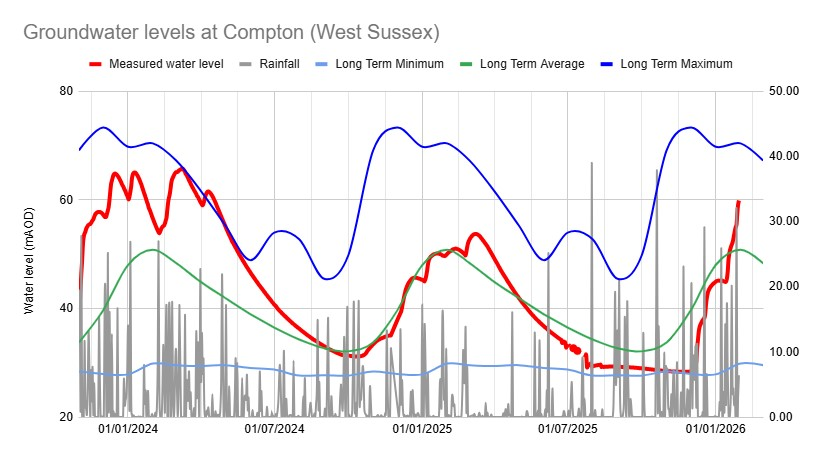
Graph showing changes in groundwater levels in Compton Borehole in West Sussex from December 2023 to January 2026. The graph shows that groundwater levels are currently average for the time of year and currently rising.
Graph showing changes in groundwater levels in Compton Borehole in West Sussex from December 2023 to January 2026. The graph shows that groundwater levels are currently average for the time of year and currently rising.
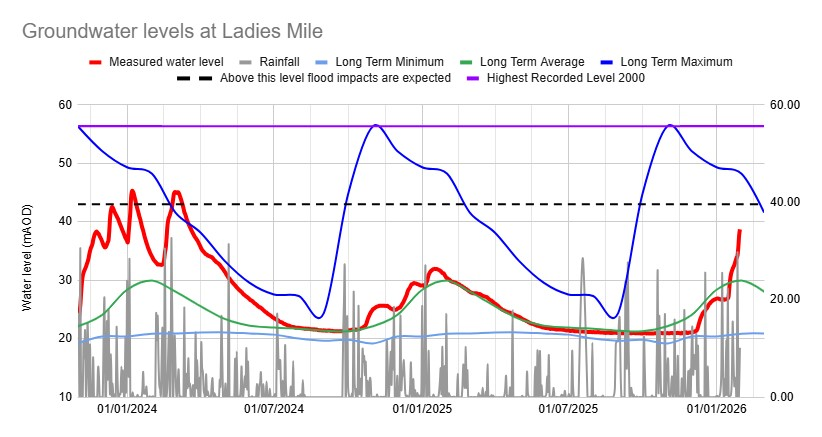
Graph showing changes in groundwater levels in Ladies Mile Borehole near Brighton from December 2023 to January 2026. The graph shows that groundwater levels are currently average for the time of year and currently rising.
Graph showing changes in groundwater levels in Ladies Mile Borehole near Brighton from December 2023 to January 2026. The graph shows that groundwater levels are currently average for the time of year and currently rising.
Weather forecast
Small amounts of rain are forecast on Friday and Saturday. On Monday 2 February 2026 another widespread area of rain is predicted. There remains uncertainty in locations and amounts, but most communities will probably receive more rain over the next 5 days.
More unsettled weather is predicted during the first week of February 2026, with showers or longer periods of rain possible. There is uncertainty in geographic location, the wettest communities could be in the south west of England. Longer term weather forecasting is very difficult, but the current suggestion is that mild and wet conditions will continue throughout the first half of February 2026, in the south of England. Unsettled weather could possibly continue through the whole of February 2026.
Forecast risk of flooding
Most boreholes are expected finish their rise from Storm Chandra around 1 February 2026. However, with more rain forecast Friday, Saturday, and Monday (2 February 2026), it is probable that groundwater will continue to rise throughout the first week of February too. If only small amounts of rain are measured, groundwater rise will be small. If a lot of rain occurs on Monday 2 February 2026, or on subsequent days, groundwater could rise more and quicker. Some boreholes, such as in East Dean near Chichester, rise for much longer after rainfall. In East Dean, groundwater levels could keep rising until at least the middle of February 2026.
Minor groundwater flood impacts are likely to occur in a few communities.
In the Ems Valley near Stoughton and Walderton, springs will appear, water will be in fields, and small amounts of water could flow down roads. By the end of the first week of February, groundwater could affect cellars in Stoughton and Walderton. More water could flow along Stoughton main road, the road from East Marden, between Cooks Lane and Barley Mow in Walderton, and the B2146 near Woodlands Lane.
In the Lavant valley near Chichester, springs will appear, water will be in fields, and small amounts of water could flood down roads near Chilgrove and East Dean. By the middle of February 2026, more water will flow along roads, and groundwater could begin to affect the ability of the sewage network to operate in East Dean, Charlton, Singleton and West Dean. Groundwater may start to appear in a small number of basements.
In Patcham, from 3 February 2026, groundwater could begin to appear on Old London Road, Patcham and Peacock Lane, Withdean. A little later, groundwater could begin to affect a small number of basements on Old London Road.
In Denton, near Newhaven small amounts of water will flow in fields, gardens, on roads, and potentially basements of isolated properties. By the end of the first week of February, more water could flow along Denton road.
In most years, most boreholes experience groundwater rise until March. Groundwater risk will continue or increase through February 2026. By the end of the month, more water could flow down roads, or affect a few more properties.
It is very difficult to accurately predict the weather weeks or months ahead, and the forecast might change. The exact groundwater response will depend on the amount, intensity and distribution of any rainfall that occurs.
If only a small amount of rain occurs in Sussex during February, then groundwater flood impacts will remain minor, and should ease before March 2026.
Next update
We will update this groundwater situation document by Friday 13 February 2026, or sooner if the risk of flooding significantly increases.
When in force, groundwater flood alerts are updated with information more frequently.
What we are doing
We continue to monitor groundwater levels and their response to rainfall.
Throughout autumn and winter, we will update this groundwater situation and our groundwater briefing notes.
We will issue and update flood alerts when there is risk of flooding affecting property.
We liaise with the local authority and other responding partners to ensure they are aware of the situation.
Our operational staff will remove blockages from main rivers, to ensure they flow freely.
Actions and advice
Think and prepare now for what you’ll do if flooding occurs where you live, don’t wait until flooding happens.
Call Floodline on 0345 988 118 or visit check for flooding to find out if you can register to receive free flood alerts for flooding from groundwater.
Look for data in your area:
There is practical advice on what to do before, during and after groundwater flooding, and further guidance about groundwater flooding, how it might affect you and what to do.
Prepare a personal flood plan or community flood plan to help you and your community decide what practical actions to take before and during a flood, which will help reduce the damage flooding could cause.
Check pumps and any other flood protection equipment you have. Ensure valuables are moved from basements and other low parts of properties.
Where safe to do so, communities may wish to check and ensure there are no blockages in local watercourses and ditches.
Further information
You can view:
- daily groundwater levels compared to average and maximum, with indicative impact thresholds
- sub daily groundwater levels on Gaugemap
- the latest flood alert information
- water situation reports
More detailed groundwater briefing notes are emailed as part of the flood alert service. See contacts section below to register your email address.
Contacts
For more information on the flood alert service and to find out what messages you are registered to receive, call Floodline on 0345 988 118.
Alternatively, you can contact the following for additional information:
- Environment Agency Customers and Engagement: ssdenquiries@environment-agency.gov.uk
- Environment Agency Incident Reporting Hotline: 0800 807060
- Environment Agency National Customer Contact Centre: 03708 506 506