Offender management statistics quarterly: April to June 2026
Published 29 October 2026
Applies to England and Wales

© Crown copyright 2026
This publication is licensed under the terms of the Open Government Licence v3.0 except where otherwise stated. To view this licence, visit nationalarchives.gov.uk/doc/open-government-licence/version/3 or write to the Information Policy Team, The National Archives, Kew, London TW9 4DU, or email: psi@nationalarchives.gov.uk.
Where we have identified any third party copyright information you will need to obtain permission from the copyright holders concerned.
This publication is available at https://www.gov.uk/government/statistics/offender-management-statistics-quarterly-april-to-june-2026/offender-management-statistics-quarterly-april-to-june-2026
Quarterly: April to June 2026
Prison population: 30 September 2026
Main Points
| 87,712 prisoners in England and Wales as at 30 September 2026 | The total prison population was virtually unchanged (less than 0.5% higher) than the same point in 2025. |
| 15,353 first receptions into prison between April and June 2026 | The number of first receptions represented a 19% decrease compared to the same period in 2025. |
| 12,278 releases from sentences between April and June 2026 | The number of releases represented an 18% decrease compared to the same period in 2025. |
| 68,273 adjudication outcomes between April and June 2026 | This was virtually unchanged (less than 0.5% decrease) compared to the same period in 2025. Additional days were awarded as punishment on 1,758 occasions. |
| 12,338 licence recalls between April and June 2026 | This was a 12% increase on the same quarter in 2025. |
| 241,119 offenders under probation supervision as at 30 June 2026 | Due to a break in the probation caseload series (explained further in the Probation Chapter), figures are not directly comparable with those published for earlier periods. |
This publication provides offender management quarterly statistics for the latest date available and provides comparisons to the previous year.
For technical detail please refer to the accompanying guide, ‘Guide to offender management statistics’.
Points to note
Contact
Users are encouraged to contact OMSQ-SiC-publications@justice.gov.uk with any comments relating to any of the below points / changes.
Standard Determinate Sentence 40% (SDS40) data
Updated transparency data on early releases under SDS40 has been published in parallel with this release:
‘https://www.gov.uk/government/collections/standard-determinate-sentence-sds40-release-data’
This includes monthly SDS40 releases from 01 April 2024 to 30 June 2026 with demographic and offence characteristics breakdowns.
Resumption of HDC recall tables
Effective from 3 June 2025, the maximum amount of time spent on HDC was expanded from 180 to 365 days. Therefore, from this date HDC recalls can occur up to four quarters after the release quarter. To enable complete reporting, the reporting period for HDC recalls now lags four quarters, rather than two quarters, behind that of other releases tables and was paused for the last 2 editions of the publication to allow for this.
In this edition of the publication, we have resumed the time series for the HDC recalls tables (3.Q.13, 3.Q.14, 3.Q.15) now that we have a full 4 quarters of recalls data for the April-June 2025 HDC releases cohort. Whilst we have resumed the publication of these tables, we are continuing exploratory work on our HDC recalls data to seek to strengthen reporting on HDC recall following the change to HDC policy.
Changes to ROTL failures table
Data for ROTL failures are drawn from the HMPPS Incident Reporting System (IRS). Following an enhancement to our data flow we have identified that a small number of ROTL failures with a sentence type of ‘Recall’ were previously incorrectly mapped to the ‘Determinate sentences’ group in table 3_Q_19, leading to a small overestimate of ROTL failures by individuals serving ‘Determinate sentences’ from 2016 to 2025 inclusive (‘Recall’ cases account for <4% of total ROTL failures between 2016 and 2025).
To rectify this, since the January to March 2026 publication (published in July 2026) we have included ‘Recalls’ in our ROTL failures by sentence type breakdown (table 3_Q_19), which has led to a small reduction in the ‘Determinate Sentences’ group compared to what has been published previously. Further work is underway to explore our enhanced data and we will inform users of any additional improvement work as it arises.
Changes to probation starts, caseload, and terminations figures
Following the transition to the new data pipeline for probation statistics, additional enhancements have been made to the data processing methodology. As a result, the published figures now provide a more complete picture of the probation caseload. These improvements have been implemented from the January to March 2026 reporting period onwards and have not been applied retrospectively. This creates a break in the time series, and users should therefore exercise caution when comparing these figures with those published for earlier periods.
Restricted Patients
This can now be found on its own page (to help users searching from the gov.uk home page). Please see the ‘Related content’ section on the OMSQ publication page, where a link to the page can be found.
Statistician’s comment
In this publication we are reporting on the prison population as at 30 September 2026, with comparisons to the same point in 2025. Whilst there has been some fluctuation in the population over this 12-month period, the prison population as at 30 September 2026 was around 250 (less than 0.5%) higher than the same point in 2025.
The prison population as at 30 Sep 2025 was 87,465, following which the prison population dropped by around 1,000 to 86,430 at the end of the following month (Oct 2025), with a further fall of around 800 by 31 Dec 2025. These month-on-month falls after September 2025 are likely to due to the implementation of Fixed-Term Recall changes from early September 2025 (more information can be found in the ‘Recall to custody’ section of the Population chapter below), on top of which the ‘as at 31 December’ population is usually lower than at other times of the year given factors such as court closures over the Christmas period.
Since December 2025, the population increased month-on-month to reach 87,342 as at the end of March 2026. From 31 March 2026, the introduction of 56-day fixed term recall changes (“FTR56”) resulted in tranches of releases of prisoners who had spent more than 56 days on recall. There was an associated drop of around 1,600 in the month-end prison population between March and April 2026. Following which, the overall month-end prison population remained fairly stable (at between 85,700 and 86,000) for April, May, and June 2026. The prison population then grew month-on-month to reach 87,712 as at 30 Sep 2026.
The first tranche of progression model releases[footnote 1] took place on 1 Oct 2026 (which is after the ‘as at 30 September 2026’ population data presented here as well as the ‘April to June 2026’ releases data), and so is not captured as part of either the total population or flows data trends reflected in this publication.
The remand population had been rising since early 2020, but there was a 10% decrease in the size of the remand population between 30 September 2025 and 30 September 2026. Over the same period there were falls in both elements of the remand prison population: a 11% decrease for the ‘untried’ remand population (those held pre-conviction) and a 9% fall in the ‘convicted unsentenced’ remand population (those held after having been convicted but awaiting their sentencing outcome). This fall in the remand population is likely linked to the increase in Magistrates’ Sentencing Powers[footnote 2] (from November 2024), as well as an increase in the number of Crown Court sitting days[footnote 3] (from December 2024), plus an increase in funding for Crown Courts from April 2026 to hear more cases.[footnote 4] Additionally, there have been recent changes to the Bail Act aimed at reducing the remand population (for more information on this please see the Receptions chapter of this document).
The prisoner flows data in this publication covers April to June 2026 with the comparison period being April to June 2025. The number of prisoner first receptions from April to June 2026 was around 15,350 (19% lower than the same period in 2025). This is likely linked to the increased use of court bail (to reduce remand first receptions & remand admissions) as well as the ‘Presumption to Suspend’ sentences of 12 months or less from March 2026[footnote 5] (to reduce sentenced first receptions & sentenced admissions).
In the latest quarter, remand and sentenced admissions decreased compared to the same quarter in 2025 (by 17% and 18% respectively). Recall admissions increased by 15% from the same period in 2025, driven by a 16% increase in determinate sentence recalls. This increase likely continues to be due to the Suitability for Fixed Term Recall Order 2024 (effective from 2 April 2024) which mandated fixed term recalls for offenders sentenced to less than 12 months in custody, subject to some exceptions, and its expansion to offenders serving determinate sentences of 4 years or less from 2 September 2025. From 31 March 2026, the introduction of 56-day fixed term recall (“FTR56”) increased the length of fixed term recalls to 56 days (from the previous 14 and 28-day fixed term recalls) for those serving determinate sentences of less than 4 years and introduced 56-day fixed term recall, rather than standard recall, for eligible offenders serving sentences of 4 years or more. Early release schemes, which have seen more prisoners released on licence earlier in their sentences, may also have impacted the volume of recall admissions.
There were around 12,300 prisoners released in the latest quarter, a decrease of 18% compared to the same period in 2025. The number of prisoners released on Home Detention Curfew (HDC) also decreased, down 32%. The observed decrease in releases is likely due to 2 main factors. Firstly, the introduction of the presumption to suspend short sentences on 22 March 2026 as part of the Sentencing Act, leading to a fall in the prison population serving these sentences and subsequently the number of these offenders released. And secondly, the high volume of HDC releases observed in April to June 2025, the comparator quarter, caused by the expansion of HDC introduced on 3 June 2025.
1. Population
The prison population was 87,712 on 30 September 2026.
The sentenced prison population stood at 71,341 (81% of the total); the remand prison population stood at 15,921 (18%) and the non-criminal prison population stood at 450 (1%).
Figure 1: Prison population, September 2016 to September 2026
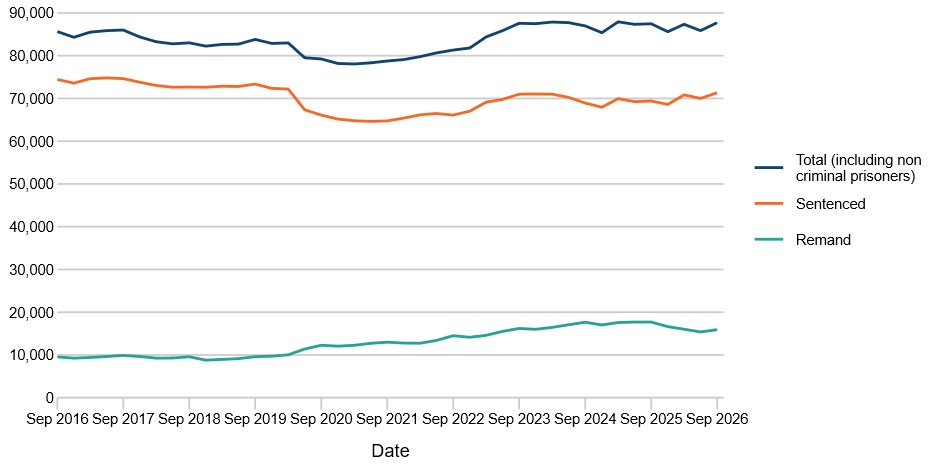
Chart description text
Line chart showing a time series (September 2016 to September 2026) of the total prison population (including non-criminal), and subsets showing the sentenced and remand populations.
The sentenced population trends quite closely with the total prison population. In September 2016 the total population was around 85,600, including around 74,400 sentenced prisoners and 9,600 prisoners on remand. Between 2016 and early 2020 the total and sentenced populations remained relatively stable overall, although both declined gradually. Following the onset of the COVID-19 pandemic, both populations fell sharply before increasing from 2022 until 2024, since when they have fluctuated but remained at similar levels overall. By September 2026, the total prison population stood at around 87,700 and the sentenced population at around 71,300.
Between 2016 and early 2020, the remand population remained broadly stable at around 9,000 to 10,000, before increasing during the pandemic to around 14,500 by September 2022. It continued to rise thereafter, peaking at around 17,900 in mid-2025, before falling back to around 15,900 in September 2026.
The data for September 2025 to September 2026 is included in table 1_Q_1 of the Quarterly Prison Population tables of this publication. The earlier data, going back to September 2016, is included in table 1_A_1 of the Annual Prison Population tables published on 30 July 2026.
Remand prison population
The 30 September 2026 remand population figure of 15,921 was 10% lower than in September 2025. This downward trend began in September 2025, reversing the sustained growth trend in the remand population that had been observed since 2020.
The untried remand population and the convicted unsentenced remand population both fell when compared with the end of September 2025, to 10,427 (down 11%) and 5,494 (down 9%), respectively. These are likely to be partly driven by increased Crown Court capacity, including more sitting days (from December 2024), and by the expansion of Magistrates’ Sentencing Powers (from November 2024), which allows more cases to be dealt with in the magistrates’ courts rather than being sent to the Crown Court. Furthermore, this financial year saw an increase in funding for Crown Courts from April 2026 to hear more cases. Recent amendments to the Bail Act also aim to reduce the remand population. See the Receptions chapter for more information.
The two largest offence groups for those held on remand were ‘violence against the person’ (47% of the untried population and 31% of the convicted unsentenced population) and ‘drug offences’ (8% and 16% respectively).
While White prisoners accounted for 73% of the sentenced population, they represented only 65% of the remand population. By contrast, all other reported ethnic groups had a higher proportional representation in the remand population than in the sentenced population.
Sentenced prison population
The sentenced population was 71,341, which is a 3% increase from the same point 12 months earlier. This was largely driven by increases in the population serving determinate sentences of two years or more.
By contrast, the populations serving the shortest sentences fell, with those serving sentences of six months or less falling by 28% and those serving more than six months but less than 12 months falling by 10%. This is likely linked to the recent Sentencing Act changes, specifically the ‘presumption to suspend’ sentences of 12 months or less. For more information on this please see the Receptions chapter of this document).
Around 2 in 3 prisoners serving an immediate custodial sentence had been convicted of either a violence against the person offence (35%), sexual offence (22%) or drug offence (11%). The population serving immediate custodial sentences for violence against the person and sexual offences increased by 4% and 3%, compared to last year, respectively. In contrast, the population serving an immediate custodial sentence for drug offences decreased by 8% over the same period. Although they represent only 8% of the total population serving immediate custodial sentences, possession of weapons, and miscellaneous crimes against society have increased markedly compared with June 2025, rising by 23% and 26%, respectively.
Extended Determinate Sentences (EDS)
EDS constitute a custodial term, the majority of which is served in prison, followed by an extended period on licence in the community. They may be imposed on offenders convicted of, or previously convicted of, specific sexual, violent, or terrorist offences. On 30 September 2026, 9,446 prisoners were serving such sentences. This represented a 2% increase since September 2025. Prisoners serving EDS accounted for 11% of the total prison population.
Indeterminate sentences
On 30 September 2026, there were 8,442 (8,085 male; 357 female) ‘unreleased’ prisoners serving indeterminate sentences (Imprisonment for Public Protection (IPP) and life sentences). This was virtually unchanged (less than 1% decrease) compared with 30 September 2025.
The number of ‘unreleased’ prisoners serving life sentences (7,610) increased by 1% compared with a year earlier, while the number of ‘unreleased’ IPP prisoners fell by 12% to 832. At point of sentencing, offenders are given a minimum time period (“tariff”) that they must serve in prison before they can apply to the Parole Board for release. Around 8 in 10 of the ‘unreleased’ IPP prisoners who had served their minimum tariff period had been held for at least ten years beyond the end of their tariff.
The number of ‘recalled’ prisoners serving life sentences increased by 4% to 956 when compared with 30 September 2025, while the number of ‘recalled’ IPP prisoners decreased by 5% to 1,403 over the same time period.
Recall to custody
The prison population of those recalled to custody (12,308 prisoners) decreased by 3% relative to the total a year earlier. There were changes to fixed-term recall from 2 September 2025[footnote 6] such that those recalled to prison from certain sentences of less than 4 years were largely mandated to receive a 28-day fixed term recall as opposed to a standard recall. Eligible prisoners who were in prison on recall (and who had been in prison on recall for more than 28 days) would have been released when the policy change was enacted. This is reflected in the corresponding month-end decreases observed between September and December 2025. A further change was made to recalls at the end of March 2026 (“FTR56”), such that most recalled offenders would serve 56 days on recall. The month-end figures from January to September 2026 have fluctuated but have remained broadly in line with those recorded towards the end of 2025.
Further information on recent trends in prison recalls can be found in the “Licence recalls” chapter.
Foreign National Offenders (FNOs)
There were 10,217 (3,381 remand, 6,439 sentenced and 397 non-criminal) foreign nationals held in custody on 30 September 2026; representing 12% of the total prison population. The number of FNOs in the prison population decreased by 5% compared with 30 September 2025. This was driven by a fall in both the FNO remand and sentenced population (down 4% and 9% respectively). It contrasts with the increase seen in British nationals population (up 1%) which is driven by an increase in sentenced population (up 9%). The most common nationalities after British Nationals in prisons were Albanian (9% of the FNO prison population), Irish (7%), Polish (6%), Romanian (6%), and Indian (4%).
2. Prison receptions and admissions
There were 15,353 first receptions into custody in the latest quarter.
10,893 were remand first receptions, 4,361 were sentenced first receptions and 99 were non-criminal first receptions.
Prisoner first receptions
The total number of first receptions between April and June 2026 was 19% lower than the same quarter in 2025.
There were 2,741 first receptions of foreign nationals between April and June 2026, which is 21% lower compared to the same quarter last year. There was an 18% decrease in first receptions for British nationals over the same period. The representation of foreign nationals amongst first receptions has consistently been around 18% to 19% since the final quarter of 2022.
The foreign nationalities with the highest numbers of first receptions in the latest quarter were: Albanian (333), Romanian (269), and Polish (197). Compared to the same quarter in 2025 this corresponds to a decrease in first receptions of Albanians, Romanians and Poles of 28%, 19% and 23% respectively. When taken together, these three nationalities accounted for 29% of first receptions of foreign nationals in this quarter, compared to 30% in the same quarter last year.
Sentenced first receptions in April to June 2026 fell by 20% compared to the same quarter in 2025. This was primarily due to a 35% decrease in receptions for sentences of less than or equal to 6 months, as compared to the same period in 2025. This fall is likely due to the introduction of the presumption to suspend short custodial sentences[footnote 7] (of 12 months or less) on 22 March 2026 as part of the Sentencing Act. Whilst courts can still impose short custodial sentences in some cases, the majority will now be suspended leading to a fall in sentenced first receptions for those serving short sentences.
Prison admissions
Compared to the same quarter in 2025, untried remand admissions decreased by 18%, while convicted unsentenced remand admissions decreased by 15%. This is in line with increasing use of bail across the court estate[footnote 8] and recent amendments to the Bail Act [footnote 9] aimed at reducing the remand population. These include amendments to the “no real prospect” test, which reduces the exemptions to bail where the court considers there is no real prospect of an immediate custodial sentence, and amending the conditions for imposing electronic monitoring requirements.
During the same period, sentenced admissions also decreased by 18% but recall admissions increased by 15%.
When considering remand admissions, violence against the person had the largest number of remand admissions overall, accounting for 38% of untried remand admissions and 30% of convicted unsentenced remand admissions. The next most common offence group among remand admissions was drug offences, accounting for 10% of untried and 14% of convicted unsentenced admissions. All offence groups saw decreases in both untried and convicted unsentenced admissions as compared to the same quarter in 2025.
For immediate custodial sentences (ICS), violence against the person offences accounted for 25% of admissions, theft offences 15%, and drug offences 15%. As with remand admissions, all offence groups saw decreases in ICS admissions as compared to the previous year, with violence against the person down by 16%, theft offences down by 23%, and drug offences down by 24%.
For ICS admissions, the most common offence groups for males, comprising just over half (54%) of all ICS male admissions, were violence against the person (25%), drug offences (15%), and theft offences (14%). For female ICS admissions the highest proportion was for theft offences (31%), followed by violence against the person (21%), and drug offences (11%). These three offence groups accounted for almost two thirds (63%) of all female ICS admissions.
Recalls
There were 11,898 ‘recall prison admissions’ (those returned to prison for breaching their release conditions) between April and June 2026, 15% higher than the same quarter in 2025. Recall admissions of individuals serving determinate sentences of 12 months or more have risen substantially, up 51% compared with the same period in 2025. These now account for 64% of all determinate sentence recall admissions, compared to 50% between April and June 2025.
The increase in recall admissions continues the trend seen since early 2022 and is likely driven by the removal of standard recalls being expanded to those serving determinate sentences of 4 years or less on 2 September 2025[footnote 6], the continued impact of early release schemes, such as SDS40, and the subsequent increase in the license population. A further change was made to recalls at the end of March 2026 (“FTR56”), such that most recalled offenders would serve 56 days on recall, likely driving the substantial increase in recall admissions for individuals serving determinate sentences of 12 months or more. For further information on recalls, please refer to the licence recalls section of this publication.
3. Releases
12,278 offenders were released from custody in the latest quarter.
There were 12,179 releases from determinate sentences and 99 from indeterminate sentences.
Prison releases from custodial sentences
The number of prisoner releases between April and June 2026 fell 18% compared to the same period in 2025.
Between April and June 2026, releases from determinate sentences decreased across almost all sentence-length bands compared with the same period in 2025. This is particularly pronounced amongst the shortest and longer sentences with a 31% decrease in sentence lengths less than or equal to 6 months, and a 34% decrease for determinate sentences 4 years or more.
This decrease in releases from shorter sentences is likely due to the presumption to suspend short sentences of 12 months or less introduced on 22 March 2026 as part of the Sentencing Act, which has led to a decline in the prison population serving sentences of this length.
The decrease observed in releases from determinate sentences of 4 years or more is likely due to the high volume of HDC releases observed in the comparator quarter (April to June 2025), caused by the expansion of HDC introduced on 3 June 2025. This expansion doubled the maximum length of time on HDC from 180 to 365 days, leading to an increase in HDC eligibility among the prison population, particularly for those serving longer determinate sentences.
Releases on Home Detention Curfew (HDC)
The number of prisoners released on HDC in the latest quarter fell to 2,534, down 32% compared with the same period last year, driven by decreases across all determinate sentence lengths. This sizeable fall, particularly for those serving sentences of 4 years or more, is likely due to the expansion of HDC[footnote 10] in the same quarter last year, leading to a high volume of HDC releases in that quarter as referenced above.
Of HDC releases between April and June 2026, 29% were of prisoners serving sentences of 4 years or more, down from 42% in the same period in 2025.
Following the suspension of updates to the HDC recalls tables (3.Q.13 – 3.Q.15) in the last 2 editions of the publication, we have resumed publication of these tables now that we have a full 4 quarters of recalls data for the April-June 2025 HDC releases cohort (see Points to Note section for further information).
Releases on Temporary Licence (ROTL)
There were 114,907 incidences of ROTL during the quarter ending June 2026, an increase of 23% compared to the same quarter in 2025. Of the ROTL incidences in the latest quarter, 68% were for ‘Work Related’ reasons.
The number of individuals receiving at least one incidence of ROTL between April to June 2026 increased, up 7% (to 4,238) compared to the same quarter in 2025.
There were 277 Temporary Release Failures (TRF) between April and June 2026, however this still indicates more than 99.5% of ROTL incidences in the latest quarter did not result in a failure.
Prisoner transfers
Between April and June 2026 there were 23,552 incidences of prisoner transfer, with 19,864 prisoners having at least one incidence of transfer. Both figures represent decreases, of 3% and 5%, respectively, since the same period of 2025.
4. Adjudications
There were 68,273 adjudication outcomes between April and June 2026.
This is virtually unchanged from the same quarter in the previous year (a 0.2% decrease). Additional days were awarded as punishment on 1,758 occasions this quarter, representing a 5% increase compared to the same time last year.
Around two-thirds (63%) of adjudications were proven.
There was a 1% increase in the number of proven adjudications, from 42,591 between April and June 2025 to 42,832 in the same quarter in 2026. This, in turn, contributed to a 1% rise in the number of punishments, reaching 128,598 between April and June 2026.
The largest offence group is ‘Unauthorised transactions’ which represents a third (33%) of all proven adjudications. The number of proven ‘Unauthorised transactions’ adjudications increased by 5% compared to the same quarter last year, reaching 14,232. Taken together, ‘Disobedience or disrespect’ (which increased by 2% to 12,655 proven adjudications) and ‘Unauthorised transactions’ accounted for 63% of all proven adjudications.
Between April and June 2026, proven adjudications resulting from ‘Wilful damage’ increased by 4% when compared to the same quarter last year, which together with a fall of 4% in the number of proven adjudications for ‘Violence’ offences brought this offence group to a similar level to ‘Violence’ (both 13% of proven adjudications). The largest percentage rise was in ‘Sexual offences’, which increased by 28% however, these represent less than 0.5% of all proven adjudications. The rise in ‘Sexual offences’ is likely partially explained by the more recent introduction of this adjudication offence type (from 31 May 2024) compared to some of the longer-standing offence types.
Between April and June 2026, additional days were awarded as punishment on 1,758 occasions. A total of 30,284 days were awarded during this period, representing an 11% increase compared to the same quarter in 2025, when 27,402 days were awarded.
Further insights into adjudication trends between 2011 and 2018 can be found in ‘The Adjudications Story’ publication.
5. Licence Recalls
The number of licence recalls between April and June 2026 was 12,338, of which 456 were recalls from Home Detention Curfew (HDC).
The total number of recalls increased by 12% compared to the same quarter in 2025.
Following substantial increases in recall numbers in recent years, largely associated with a series of policy changes (see previous recall chapters in OMSQ bulletins), the total number of recalls has fallen in each of the last two quarters. This recent decline was largely driven by decreases in the recall of offenders released from sentences of less than 12 months (ORA recalls).
The latest quarterly recall figure was 12,338, a decrease of 6% compared with the previous quarter (13,193) but 12% higher than a year earlier (11,041). ORA recalls (4,098) decreased by 25% compared with the previous quarter and by 26% compared with a year earlier. The decrease in ORA recalls in the latest quarter may be associated with the introduction of FTR-56 which, as expected, reduces opportunities for an ORA offender to be recalled multiple times within a quarter.
In contrast, non-ORA recalls of offenders serving determinate sentences increased by 7% compared with the previous quarter, to 8,059, and were 52% higher than a year earlier. Recalls of offenders serving indeterminate sentences (181) increased by 20% compared with the previous quarter but were 2% lower than a year earlier.
Around 71% of recalls between April and June 2026 were fixed-term recalls, consistent with the previous four quarters. There were no 14-day or 28-day recalls during this period, as these were replaced by 56-day recalls from 31 March 2026 (see previous recall chapters in OMSQ bulletins).
Ethnicity proportions in quarterly recalls have remained relatively stable over time, with about 8 in 10 recalls being White, 7% being Black and 5% being Asian in the latest quarter.
There usually is more than one reason for recalling an offender on licence. Of recalls between April and June 2026, around 75% involved non-compliance, 35% involved failure to keep in touch, 24% involved failure to reside, and 20% involved a charge of further offending.
Between April and June 2026, 95 IPP prisoners and 60 prisoners serving a life sentence were re-released, having previously been returned to custody for a breach of licence conditions. The combined total of 155 re-releases was 16% lower than a year earlier, with IPP re-releases decreasing by 38 offenders and life-sentence re-releases increasing by 8 offenders.
Offenders not returned to custody
Of all those released on licence and recalled to custody due to breaching the conditions of their licence between April 1999 and June 2026, there were 3,246 who had not been returned to custody by the end of September 2026.
A further 15 offenders had not been returned to custody as of June 2026 after recall between 1984 and April 1999, meaning the total number of offenders not returned to custody at the end of September 2026 was 3,261. These figures include some offenders believed to be dead or living abroad but who have not been confirmed as dead or deported.
Of the 3,261 not returned to custody by 30 September 2026, 487 had originally been serving a prison sentence for violence against the person offences and a further 89 for sexual offences.
6. Probation
Following the transition to the new data pipeline for probation statistics, additional enhancements have been made to the data processing methodology. As a result, the published figures now provide a more complete picture of the probation caseload. These improvements have been implemented from the January to March 2026 reporting period onwards and have not been applied retrospectively. This creates a break in the time series, and users should therefore exercise caution when comparing these figures with those published for earlier periods.
As at 30 June 2026, there were 241,119 offenders supervised by the Probation Service in England and Wales.
This represents a decrease of 7% compared with the end of March 2026.
Caseload
Probation caseload is a snapshot of all supervision by the Probation Service which was active on the last day of each reporting period.
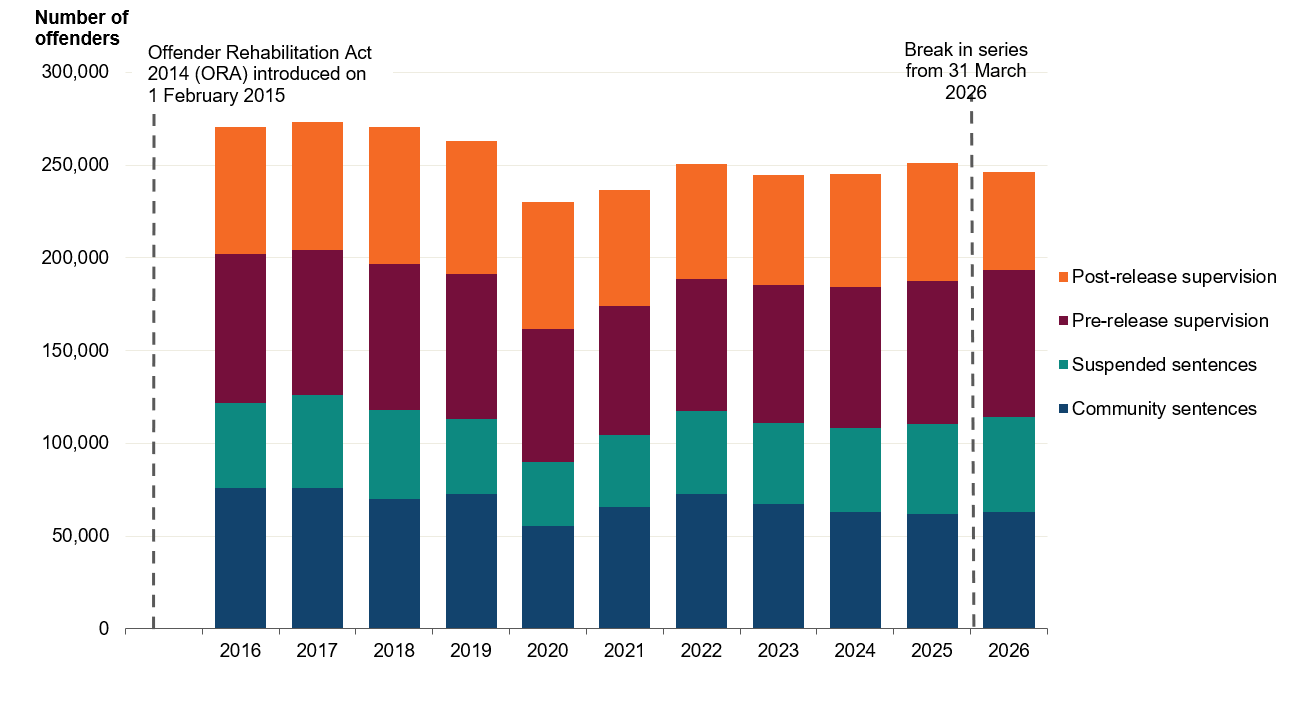
As at 30 June 2026, there were 241,119 offenders supervised by the Probation Service in England and Wales (Figure 2), a 7% decrease compared with the previous quarter. This was mainly driven by a fall in the post-release supervision caseload. Of these, 111,955 offenders were supervised under court orders, a decrease of 3% compared with the previous quarter, comprising 62,590 offenders on community orders (COs) and 50,867 offenders on suspended sentence orders (SSOs) with requirements. A total of 132,084 offenders were supervised before or after release from prison, a decrease of 11% compared with the previous quarter, including 79,237 offenders under pre-release supervision, a decrease of 2%, and 52,858 under post-release supervision, a decrease of 22%. The fall in the post-release supervision caseload is likely to partly reflect the repeal of provisions relating to supervision after the end of sentence under Section 34 of the Sentencing Act 2026, which took effect from 11 May 2026.[footnote 11]
Figure 2: Number of offenders under Probation Service supervision, 30 June 2016 to 2026 [footnote 12],[footnote 13]
Starts
Probation starts cover all court order or pre-release supervision by the Probation Service which commenced within the reporting period.
Between April and June 2026, 42,263 offenders started court order or pre-release supervision by the Probation Service, a decrease of 9% compared with the previous quarter. This comprised 25,899 offenders who started court order supervision, a decrease of 4%, and 16,377 offenders who started pre-release supervision, a decrease of 17%. Of those starting court order supervision, 15,650 offenders started COs, a decrease of 6%, and 10,184 offenders started SSOs with requirements, a decrease of less than 1%.
Terminations
Probation terminations cover all community order and suspended sentence order supervision by the Probation Service which terminated within the reporting period.
Between April and June 2026, 16,067 COs and 10,787 SSOs were terminated. Of these, 77% and 82%, respectively, were completed successfully. This means that the CO, or the supervision period of the SSO, either ran its full course or was terminated early for good progress.
Pre-sentence reports
In the quarter April to June 2026, the Probation Service prepared 25,903 pre-sentence reports (PSRs) and verification reports (VRs). In the year ending June 2026, 86% of immediate custodial sentences proposed in PSRs resulted in that sentence being given, representing the highest concordance between sentence proposed and sentence given across all sentence types. However, immediate custody accounted for 9% of all sentences proposed during this period, while community sentences, which had a concordance rate of 46%, accounted for 87%.
Further information
This publication presents quarterly data trends.
Our statisticians regularly review the content of publications. Development of new and improved statistical outputs is usually dependent on reallocating existing resources. As part of our continual review and prioritisation, we welcome user feedback on existing outputs including content, breadth, frequency, and methodology. Please send any comments you have on this publication including suggestions for further developments or reductions in content.
Please note that this release introduces a shorter Probation commentary, which will continue to be provided in the quarterly publications released in October 2026 / January 2027. The full Probation commentary will be published once a year in the April release, with the next full commentary due in April 2027. If you have any comments or questions about this approach, or any other feedback on the Probation chapter, please contact us at probation-statistics-enquiries@justice.gov.uk.
Accompanying files
As well as this bulletin, the following products are published as part of this release:
-
A ‘Guide to Offender Management Statistics’, which provides comprehensive information about data sources and quality, as well as key legislative changes.
-
A document outlining the ‘Users of Offender Management Statistics’
-
A set of data tables, covering each section of this bulletin, including a prison population data tool.
Accredited official statistics status
National Statistics are accredited official statistics. These accredited official statistics were independently reviewed by the Office for Statistics Regulation in July 2012. They comply with the highest standards of trustworthiness, quality and value in the Code of Practice for Statistics and should be labelled ‘accredited official statistics’. (Note that accredited official statistics are called National Statistics in the Statistics and Registration Service Act 2007).
Our statistical practice is regulated by the Office for Statistics Regulation (OSR). OSR sets the standards of trustworthiness, quality and value in the Code of Practice for Statistics that all producers of official statistics should adhere to. You are welcome to contact us directly with any comments about how we meet these standards. Alternatively, you can contact OSR by emailing regulation@statistics.gov.uk or via the OSR website: https://osr.statisticsauthority.gov.uk/
It is the Ministry of Justice’s responsibility to maintain compliance with the standards expected for these accredited official statistics. If we become concerned about whether these statistics are still meeting the appropriate standards, we will discuss any concerns with the OSR promptly. This accredited status can be removed at any point when the highest standards are not maintained and reinstated when standards are restored
Contact
Press enquiries should be directed to the Ministry of Justice press office: https://www.gov.uk/government/organisations/ministry-of-justice/about/media-enquiries
Non-Press enquiries about the Probation chapter of this publication should be sent to: probation-statistics-enquiries@justice.gov.uk
Non-Press enquiries about all other chapters of this publication should be sent to: OMSQ-SiC-publications@justice.gov.uk
Next update: 28 January 2027
URL: https://www.gov.uk/government/collections/offender-management-statistics-quarterly
© Crown copyright Produced by the Ministry of Justice; Alternative formats are available on request from OMSQ-SiC-publications@justice.gov.uk
-
‘https://www.gov.uk/government/news/increased-sentencing-powers-for-magistrates-to-address-prisons-crisis’ ↩
-
‘https://www.gov.uk/government/news/2000-extra-sitting-days-to-help-address-courts-crisis’ ↩
-
‘https://www.gov.uk/government/news/highest-ever-courts-funding-deal-agreed-to-deliver-faster-fairer-justice-for-victims’ ↩
-
‘https://sentencingcouncil.org.uk/latest/amendments-to-sentencing-guidelines-following-the-sentencing-act-2026/’ ↩
-
‘https://www.gov.uk/government/publications/sentencing-bill-2025/sentencing-bill-sentencing-measures-factsheet#presumption-to-suspend-short-sentences’ ↩
-
‘https://www.gov.uk/government/statistics/criminal-justice-statistics-quarterly-june-2026’ ↩
-
‘https://www.gov.uk/government/publications/sentencing-bill-2025/sentencing-bill-remand-measures-factsheet#background’ ↩
-
‘https://www.legislation.gov.uk/uksi/2024/1331/article/2/made’ ↩
-
Probation caseloads fell sharply in 2020 due to COVID-19 operational restrictions introduced on 23 March 2020. Caseloads have since recovered to pre-pandemic levels. ↩
-
The table of data that this graph is based on is labelled as ‘Table 6.6’ in the quarterly probation tables from 2023. ↩