Alcohol licensing, England and Wales, April 2025 to March 2026
Published 1 October 2026
Applies to England and Wales

© Crown copyright 2026
This publication is licensed under the terms of the Open Government Licence v3.0 except where otherwise stated. To view this licence, visit nationalarchives.gov.uk/doc/open-government-licence/version/3 or write to the Information Policy Team, The National Archives, Kew, London TW9 4DU, or email: psi@nationalarchives.gov.uk.
Where we have identified any third party copyright information you will need to obtain permission from the copyright holders concerned.
This publication is available at https://www.gov.uk/government/statistics/alcohol-licensing-england-and-wales-april-2025-to-march-2026/alcohol-licensing-england-and-wales-april-2025-to-march-2026
This release presents statistics on alcohol and late-night refreshment licensing based on information provided by licensing authorities (LAs) in England and Wales.
Businesses and organisations (such as pubs, bars, cinemas, nightclubs, late-opening cafes, village and community halls and supermarkets), and individuals, that wish to sell or supply alcohol in England and Wales must hold a licence or other authorisation issued by an LA - usually a local council. Alcohol licensing law and policy is the responsibility of the Home Office.
There are 3 types of licences and authorisation individuals and organisations can apply for:
1. Summary
As at 31 March 2026, there were an estimated:
- 968,400 personal licences
- 227,300 premises licences
- 12,500 club premises certificates
- 10,600 premises with 24-hour alcohol licences
There were:
- 184 cumulative impact areas (areas that have been identified as having a saturation of licenced premises and have special policies relating to new or variations in licences)
- 9 LAs with a late-night levy in place
In the year ending 31 March 2026:
- an estimated 600 premises licence reviews were carried out, an increase of around 30% compared with the year ending 31 March 2024
- an estimated 149,600 temporary event notices (TENs) were given, an increase of around 2% compared with the year ending 31 March 2024
- 3 premises licences had conditions imposed due to concerns over spiking, compared with 9 in the year ending 31 March 2024
To support year-on-year comparability, the headline figures include estimates for 4 LAs that were unable to provide any data for the year ending 31 March 2026, as well as estimates where LAs were unable to provide data for specific categories. Headline figures are rounded to the nearest hundred and percentage changes are based on the underlying unrounded estimates.
The user guide provides information on data coverage, a glossary of terms, the conventions used in the statistics, and relevant legislation and regulations.
The accompanying data tables contain supplementary data to support the information presented in this release.
2. Personal licences
A personal licence authorises an individual to supply or authorise the supply of alcohol under the Licensing Act 2003.
As at 31 March 2026, there were an estimated 968,400 personal licences on issue in England and Wales. A personal licence remains valid for the lifetime of the holder unless it is surrendered, revoked or suspended. As a result, the number of licences in circulation generally increases over time as new licences are issued. Therefore, an increase in personal licences does not necessarily reflect an increase in active personal licence holders over this time.
Figure 1: Personal licences, England and Wales, as at 31 March 2017 to 31 March 2026
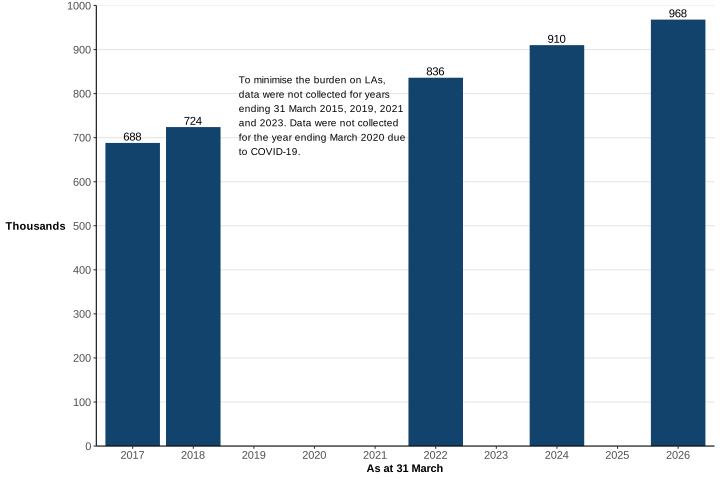
Source: Home Office, Alcohol licensing, England and Wales, April 2025 to March 2026: data tables, Table 1
Notes:
- Includes estimates for the 4 LAs that did not submit any data and the 6 LAs that were unable to provide data on personal licences.
- To minimise the burden on LAs, data was not collected for years ending 31 March 2015, 2019, 2021 and 2023. Data was not collected for the year ending March 2020 due to COVID-19.
Birmingham had the highest number of personal licences as at 31 March 2026 (14,060), and has recorded the highest number in each reporting period since 31 March 2016. North Yorkshire had the second highest number of personal licences (12,879), followed by Leeds with the third highest number (11,858).
3. Premises licences
A premises licence gives authority under the 2003 Act for a premises to:
- sell alcohol
- provide regulated entertainment
- provide late-night refreshment
As at 31 March 2026, there were an estimated 227,300 premises licences on issue in England and Wales. Premises licences may remain in force when a premises ceases trading if the licence holder does not surrender the licence. As a result, the total number of premises licences can accumulate over time. Therefore, the increase in premises licences shown in figure 2 does not necessarily reflect an increase in active premises licences over this time.
Figure 2: Premises licences, England and Wales, as at 31 March 2017 to 31 March 2026
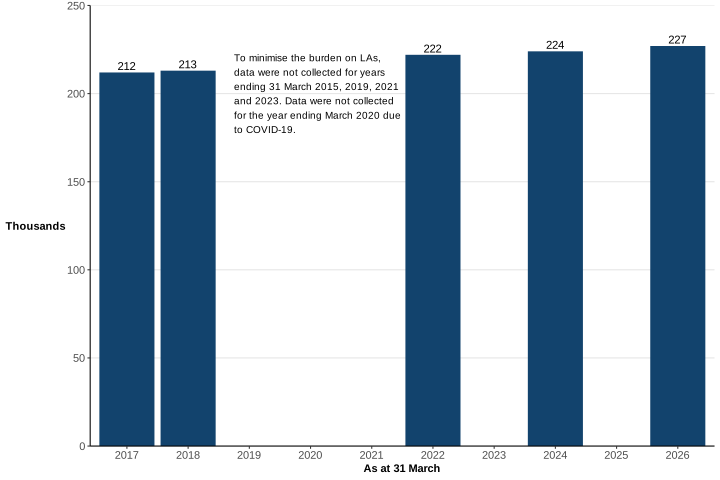
Source: Home Office, Alcohol licensing, England and Wales, April 2025 to March 2026: data tables, Table 1
Notes:
- Includes estimates for the 4 LAs that did not submit any data and the one LA that was unable to provide data on premises licences.
- To minimise the burden on LAs, data was not collected for years ending 31 March 2015, 2019, 2021 and 2023. Data was not collected for the year ending March 2020 due to COVID-19.
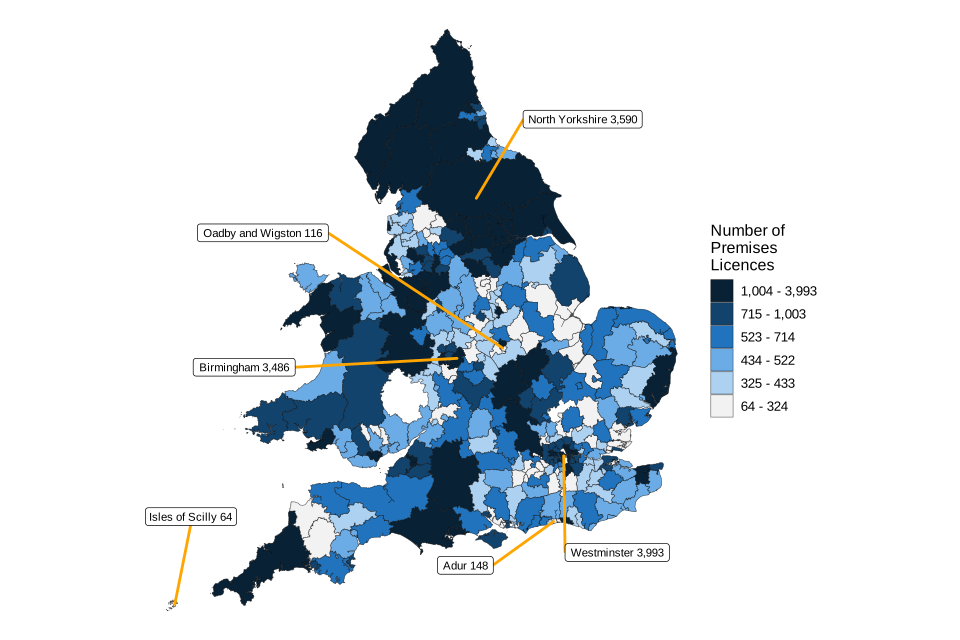
Westminster had the highest number of premises licences on issue as at 31 March 2026 (3,993), and has recorded the highest number in every reporting period since 31 March 2014. North Yorkshire had the second highest number of premises licences (3,590), followed by Birmingham with the third highest number (3,486).
At regional level, London had the highest number of premises licences on issue as at 31 March 2026 (33,769), followed by the South East (32,376). The North East region had the lowest number of premises licences on issue (10,072).
Figure 3: Premises licences by licensing authority, England and Wales, as at 31 March 2026
Source: Home Office, Alcohol licensing, England and Wales, April 2025 to March 2026: data tables, Table 2; Office for National Statistics (ONS) Local Authority Districts (December 2025) Boundaries UK BGC
Notes:
- The areas with the highest and lowest number of premises licences are labelled; Westminster 3,993 premises licences, North Yorkshire 3,590, Birmingham 3,486, Adur 148, Oadby and Wigston 116, Isles of Scilly 64.
- Does not include the 4 LAs that did not submit any data and the one LA that was unable to provide data on premises licences.
- Inner Temple and Middle Temple are excluded as the number of premises was less than 5.
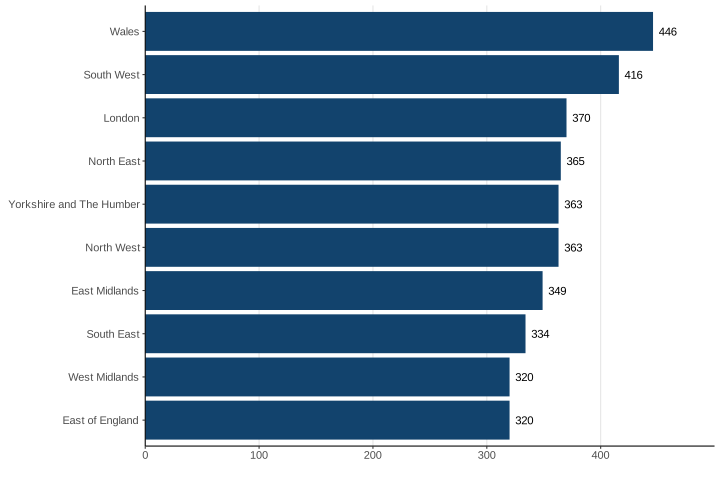
Per 100,000 population, Wales had the highest number of premises licenses (446) and the East of England region had the lowest (320), as shown in Figure 4. Although Wales had the second lowest number of premises licences overall, it had the highest number per 100,000 population, reflecting its smaller population relative to the number of licences on issue.
Figure 4: Premises licences per 100,000 people, English region areas and Wales, as at 31 March 2026
Source: Home Office, Alcohol licensing, England and Wales, April 2025 to March 2026: data tables, Table 2 and Population estimates for England and Wales: mid-2025.
Notes:
- Ranked by the highest to lowest number of premises licences, per 100,000 people.
- Does not include estimates for the 4 LAs that did not submit any data and the one LA that was unable to provide data on premises licences.
From September 2022, premises licences that permitted the sale of alcohol for consumption on-site (on-sales) only were able to take advantage of an easement in the Business and Planning Act 2020 (BPA 2020, related to COVID-19) allowing them to additionally carry out sales of alcohol off-site (off-sales; which includes delivery, takeaway and or service to customers seated in a separately licensed pavement area) without the need to amend their licence.
Following public consultations in 2023 and 2024, and wider policy and legal considerations, the temporary BPA 2020 off sales easement ended on 31 March 2025. From 1 April 2025, businesses were required to either revert to their original licence terms or apply for a minor variation to add off sales.
As at 31 March 2026, official statistics in development showed that 329 minor variations had been granted to add off-sales permissions following the expiry of the BPA 2020 off sales easement.
4. Club premises certificates
A club premises certificate is required by qualifying members’ clubs, (such as the Royal British Legion, or sports clubs) if they plan to sell or supply alcohol.
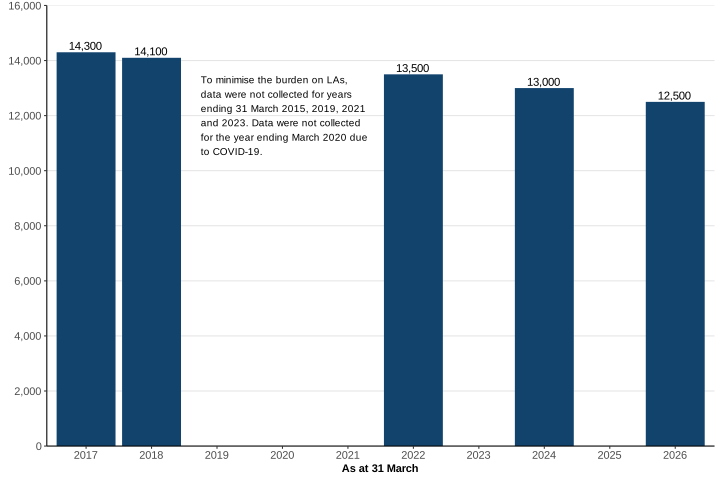
As at 31 March 2026, there were an estimated 12,500 club premises certificates in England and Wales, a decrease of around 4% compared with 31 March 2024 (13,000). As shown in Figure 5, the number of club premises certificates has gradually declined over the last decade, falling from 14,700 in 2016 to 12,500 in 2026. Durham had the highest number of club premises certificates as at 31 March 2026 with 198 certificates.
Figure 5: Club premises certificates, England and Wales, as at 31 March 2017 to 31 March 2026
Source: Home Office, Alcohol licensing, England and Wales, April 2025 to March 2026: data tables, Table 1.
Notes:
- Includes estimates for the 4 LAs that did not submit any data and the one LA that was unable to provide data on club premises certificates.
- To minimise the burden on LAs, data was not collected for years ending 31 March 2015, 2019, 2021 and 2023. Data was not collected for the year ending March 2020 due to COVID-19.
5. Cumulative impact areas
Cumulative impact areas (CIAs) are areas where an assessment by the LA has found that there is a saturation of licensed premises and has determined that the ‘cumulative impact’ of any additional licensed premises could undermine the licensing objectives (for example the prevention of crime and disorder, public safety, the prevention of public nuisance, and the protection of children from harm).
As at 31 March 2026, 71 LAs had a total of 184 CIAs in place. This compares with 76 LAs with a total of 183 CIAs in place as at 31 March 2024. Brent had the highest number of CIAs (12) as at 31 March 2026, and recorded the highest number in every reporting period since 31 March 2022. Leeds and Newcastle upon Tyne had the second highest number of CIAs (8).
6. Late-night levies
In October 2012, LAs were given discretionary powers to introduce a late-night levy through the Police Reform and Social Responsibility Act 2011. This allows LAs to collect a financial contribution from late-opening alcohol suppliers (between 12am and 6am) towards the cost of policing the night-time economy.
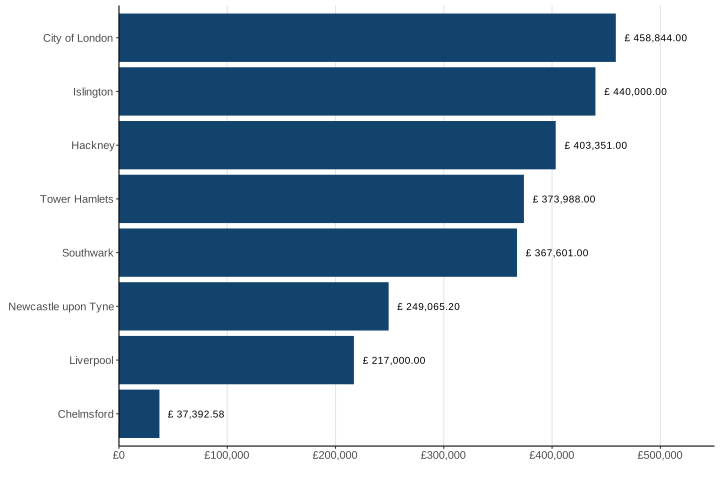
As at 31 March 2026, 9 LAs had a late-night levy in place. Together, these LAs raised more than £2.5 million (with one LA unable to provide information on the amount collected). This was broadly unchanged compared with the year ending 31 March 2024, when £2.6 million was raised.
Of the 9 LAs with a late-night levy in place, 5 were in the London region area: City of London, Hackney, Islington, Southwark and Tower Hamlets. The remaining 4 LAs were Bolton, Chelmsford, Liverpool and Newcastle upon Tyne.
Figure 6: Total amount raised by ‘late-night levies’, England and Wales, year ending 31 March 2026
Source: Home Office, Alcohol licensing, England and Wales, April 2025 to March 2026: data tables, Table 14.
Notes:
- Ranked from the highest (City of London £458,844) to lowest (Chelmsford £37,392.58) amount raised by late-night levies.
- Bolton is excluded because the LA was unable to provide data on the amount collected through its late-night levy.
7. Premises licence reviews
An LA can be asked by responsible authorities such as the police, local environmental health authority, local fire and rescue service, local public health body and others, to review a premises licence. They may do this if the licence is negatively impacting one or more of the licensing objectives (the prevention of crime and disorder, public safety, the prevention of public nuisance, and the protection of children from harm).
In the year ending 31 March 2026, an estimated 600 premises licence reviews were carried out, an increase of around 30% compared with the year ending 31 March 2024.
Excluding estimates for missing data, of the 542 licences reviewed, 46% (250) were revoked or withdrawn, 12% (64) were suspended and 7% (37) resulted in no further action being taken. For the remaining reviews (35%), licence conditions were added or modified.
More than one reason can be given for a premises licence review. Crime and disorder remained the most common reason for review (82% (442) of reviews compared with 83% (343) in the year ending 31 March 2024), followed by public safety (138; 25% of reviews), public nuisance (137; 25% of reviews) and protection of children (118; 22% of reviews).
Table 1: Completed premises licence reviews by reason, England and Wales, years ending 31 March 2026 and 31 March 2024
| Reason | Completed reviews year ending 31 March 2026 | Completed reviews year ending 31 March 2024 | Percentage change |
|---|---|---|---|
| Total | 542 | 412 | +32% |
| Crime and disorder | 442 | 343 | +29% |
| Public safety | 138 | 108 | +28% |
| Public nuisance | 137 | 119 | +15% |
| Protection of children | 118 | 130 | -9% |
Source: Home Office, Alcohol licensing, England and Wales, year ending 31 March 2026, Table 8.
Notes:
- Does not include estimates for the 4 LAs that did not submit any data and the one LAs that were unable to provide data on completed premises licence reviews.
- Note that more than one reason can be given for completing a review.
8. 24-hour alcohol licences
A 24-hour licence refers to premises that are licensed for the sale or supply of alcohol 24 hours per day (but may not operate 24 hours per day).
As at 31 March 2026, there were an estimated 10,600 premises with 24-hour alcohol licences. Premises with 24-hour alcohol licences may remain in force when a premises ceases trading if the licence holder does not surrender the licence. As a result, the total number of premises with 24-hour alcohol licences can accumulate over time.
Of the estimated 10,600 premises with 24-hour alcohol licences, 44% were for supermarkets and stores, 27% for hotel bars, 11% for pubs, bars and nightclubs, and the remaining 19% were other types of premises. This compares with 38% for supermarkets and stores, 31% for hotel bars, 9% for pubs, bars and nightclubs and 22% for other premises types in the year ending 31 March 2024.
9. Temporary event notices (TENs)
TENs are used to authorise one-off events involving licensable activities, subject to certain criteria and limits.
In the year ending 31 March 2026, an estimated 149,600 TENs were given, an increase of around 2% compared with the year ending 31 March 2024 (147,300). The number of TENs has generally increased over time, increasing from an estimated 122,100 in the year ending 31 March 2009 to an estimated 149,600 in the year ending 31 March 2026. Following a marked decrease following the COVID-19 pandemic, TENs activity has continued to increase and is now higher than pre-pandemic levels.
Excluding estimates for missing data, 146,591 TENs were issued in the year ending 31 March 2026. The South East recorded the highest number of TENs (28,661), followed by London (21,898) and the South West (21,869). These were also the 3 regions with the highest numbers of TENs in the year ending 31 March 2024.
10. Spiking concerns
To understand how local areas are utilising additional licensing guidance in relation to spiking, statistics on conditions imposed on licenses, and licenses revoked specifically related to concerns raised about spiking incidents, have been included in this publication for the second time. They are designated as official statistics in development to acknowledge that they are new and that further development of the data collection and quality assurance is needed.
In the year ending 31 March 2026, 3 premises had additional licence conditions imposed as a result of concerns relating to spiking; 2 premises in Haringey and one in Exeter. No premises licences were revoked due to concerns over spiking during the reporting period.
In the year ending 31 March 2024, 9 premises had additional licence conditions imposed as a result of concerns relating to spiking; 7 premises in Newham, one in Chelmsford and one in Sevenoaks. No premises licences were revoked due to concerns over spiking during the reporting period.
11. Forthcoming and previous statistical releases
Frequency of release: Biennially
Publications are pre-announced on the Home Office statistics release calendar.
Previous statistical releases are available on the Alcohol licensing collection page.
12. Feedback and enquiries
Home Office statistical practice is regulated by the Office for Statistics Regulation (OSR). OSR sets the standards of trustworthiness, quality and value in the Code of Practice for Statistics that all producers of official statistics should adhere to. You are welcome to contact us directly at PolicingStatistics@homeoffice.gov.uk with any comments about how we meet these standards. Alternatively, you can contact OSR by emailing regulation@statistics.gov.uk or via the OSR website.
Home Office responsible statistician: Jodie Hargreaves
We are always looking to improve the accessibility of our documents. If you find any problems or have any feedback relating to accessibility, or general questions regarding this publication, please email us at PolicingStatistics@homeoffice.gov.uk.
Press enquiries: 0300 123 3535