Young Futures Hubs Early Adopters Pilot evaluation: interim report
Published 16 September 2026
Applies to England

© Crown copyright 2026
This publication is licensed under the terms of the Open Government Licence v3.0 except where otherwise stated. To view this licence, visit nationalarchives.gov.uk/doc/open-government-licence/version/3 or write to the Information Policy Team, The National Archives, Kew, London TW9 4DU, or email: psi@nationalarchives.gov.uk.
Where we have identified any third party copyright information you will need to obtain permission from the copyright holders concerned.
This publication is available at https://www.gov.uk/government/publications/young-futures-hubs-early-adopters-pilot-evaluation-interim-report/young-futures-hubs-early-adopters-pilot-evaluation-interim-report
Summary
This interim report presents findings from the first phase of the evaluation of the Young Futures Hubs (YFH) Early Adopters. Young Futures Hubs are community-based services intended to bring universal youth work, targeted provision and specialist support together in accessible local settings. Their intention is to meet outcomes for young people relating to increased opportunities, improved mental health and wellbeing, and reduced vulnerability to crime. The early adopter phase covers eight local authority areas and is intended to test approaches to hub implementation and delivery before wider roll-out of the programme. The evaluation, commissioned by DCMS and undertaken by Ecorys, is examining how the hubs are being implemented, what early outcomes are emerging, and what can be learned about the feasibility of future impact and value for money evaluation.
The evaluation is taking a staged, mixed-methods approach. This report draws on the scoping stage, workshops with hub representatives focused on Theory of Change and impact feasibility, and the first wave of fieldwork with hubs, young people and other key stakeholders. In total, the first phase consulted 43 professionals and 12 young people. Alongside the process evaluation, the team assessed the feasibility of future impact evaluation by reviewing monitoring and outcome data, testing potential indicators with hubs, and considering what forms of impact evidence could be generated proportionately.
Hub design
The interim findings show that early adopters made a positive start in establishing locally-tailored hub models. Decisions about hub location, model and offer were generally informed by local needs assessments, service mapping, partner expertise and consultation with young people. The resulting models varied across areas, including single-site, hub-and-spoke and multi-site approaches. This variation reflects differences in geography, infrastructure, existing youth provision, local need and views on how best to maximise accessibility and reach. Across hubs, open-access activities such as sport, arts, creative sessions, cooking and social spaces were commonly used as a gateway into more targeted support, including mental health, employability and diversionary provision.
Youth engagement influenced hub design and delivery, particularly the choice of activities, opening times, physical spaces and accessibility adaptations. However, the depth and timing of youth involvement differed between areas. In some Hubs, young people shaped key aspects of the model from an early stage; in others, consultation was used more to sense-check decisions already made. The evidence suggested that future roll-out would benefit from clearer expectations about co-design while allowing sufficient time for young people to influence substantive decisions within realistic delivery constraints.
Hub implementation
Partnership working has been a central feature of the programme and a key strength of early implementation. Most hubs built on existing relationships between local authorities, Voluntary, Community and Social Enterprise (VCSE) organisations and statutory services, while also creating new links with specialist providers. Governance arrangements commonly involved multi-agency steering groups, implementation groups and links to wider strategic boards. Early evidence suggests that the programme is strengthening communication, coordination and knowledge-sharing across local youth systems. At the time of interviews, referral pathways remained at an earlier stage of development; hubs were seeking to implement ‘no wrong door’ access, warm handovers, triage processes and clearer routes into, through and beyond provision.
The process evaluation explored implementation challenges, which primarily related to the pace of mobilisation, the time required to develop meaningful partnerships and co-design processes, delays associated with buildings and capital works, and the ongoing development of referral pathways. Several stakeholders also raised concerns about the level and sustainability of funding relative to emerging need, particularly where Hubs are providing intensive one-to-one or specialist support. Key facilitators for rapid mobilisation included strong pre-existing relationships, shared commitment among partners, dedicated programme coordination capacity, evidence-led decision-making and support from delivery partner consortium Case Leads.
Early findings on change
There was strong early evidence related to improved engagement, access to support and the development of trusted relationships between young people and hub staff. Stakeholders described hubs as helping young people access support in less formal and more familiar environments, while co-location and warm handovers were reported to reduce barriers to specialist provision. Young people consulted through the evaluation described hubs as supportive spaces where they could take part in activities, build friendships, access advice and gain confidence. There are also early indications that Hubs were supporting improved connection, belonging and wellbeing, and creating routes into wider opportunities such as employability support, volunteering and participation in service design.
Assessing the feasibility of future impact evaluation
The feasibility assessment findings show that aggregate data on reach, attendance, engagement, referrals and support delivered are likely to provide the strongest common evidence base during the pilot. At the time of the research, hubs were collecting a range of output data, but the consistency and usability of data varied. Counts of attendances, sessions delivered and young people reached was found to be more feasible than linked individual-level data showing a young person’s full journey across universal, targeted and specialist support. Demographic analysis was believed to be possible where data are available, but it is unlikely to be fully complete or representative across all hub activity.
Outcome data appeared to be less consistent than output data. Soft outcomes and health and wellbeing appeared to be the most feasible areas for measurement, particularly within targeted provision where structured or semi-structured tools may already be in use in hubs. Opportunity and safer streets outcomes were found to be less likely to be measurable robustly during the evaluation of the early adopters, although activity data, referral data, qualitative evidence and targeted outcome measures may provide useful indications of progress. At present, administrative data linkage is not feasible because relevant identifiers, consent arrangements and data sharing mechanisms are not consistently in place. A future impact evaluation would therefore require stronger data infrastructure, common definitions, agreement on core indicators and early planning for data protection and consent.
Early lessons for the future
Overall, the interim findings indicate that the Early Adopter Hubs were beginning to deliver the intended core features of the YFH model: accessible youth spaces, trusted relationships, stronger local partnerships, and more joined-up routes into support. The programme appeared to be adding value by strengthening and connecting existing provision, rather than simply creating stand-alone services. However, the hubs remain at an early stage of implementation and evidence of outcomes is necessarily indicative. The remainder of the evaluation will test whether early signs of engagement, connection and improved access are sustained, and whether hubs can provide proportionate data to support stronger conclusions about reach, delivery and early outcomes. The evaluation evidence led to a number of key learnings for the wider roll out of the YFH programme:
- Future roll-out should allow sufficient mobilisation time for partnership development, co-design, commissioning, staffing, referral pathway development and capital works.
- Programme guidance should set clear expectations for meaningful youth involvement, while recognising the practical constraints within which local areas must operate.
- Hubs should build on existing local assets and relationships wherever possible, with dedicated coordination capacity to support whole-system working
- Referral routes should be designed early, kept simple, and enable young people to move discreetly and confidently between universal, targeted and specialist support.
- Monitoring requirements should remain proportionate and focus initially on a small set of clearly defined core indicators, distinguishing between attendances and unique young people, universal and targeted provision, and outputs and outcomes.
- Future impact evaluation should be planned from the outset, including data sharing agreements, consent approaches, common measures and realistic expectations about what can be evidenced through open-access youth provision.
1. Introduction
This interim report presents findings from the first phase of research for the evaluation of the Early Adopter Young Futures Hubs. Ecorys was commissioned in February 2026 to conduct the evaluation, exploring lessons learned from implementation in the eight Early Adopter sites, as well as exploring the feasibility of impact evaluation for the future roll-out of Young Futures Hubs.
1.1. About the YFH Early Adopters
In the 2025 Youth Matters: Your National Youth Strategy, the UK government announced a commitment to improve the lives of young people in England, regardless of background, by giving them the support, opportunities, and skills to thrive, ensuring that they are better able to shape their own lives and communities. The strategy signalled a renewed emphasis on local provision, collaboration between government departments and statutory and non-statutory agencies, and support for young people to engage and make decisions relating to youth policy.
As part of the Youth Matters strategy, DCMS will deliver the £70 million Young Futures Hubs and Transformation (YHT) programme to improve local youth services and establish a network of 50 Young Futures Hubs by March 2029. The Young Futures Programme is a government manifesto commitment consisting of Young Futures Panels (YFPs) and Young Futures Hubs (YFHs). YFPs aim to identify young people who are vulnerable to crime, including knife crime, and ensure they can access relevant and appropriate local support. YFHs are community-level hubs intended to bring support services (including youth workers and other professionals) together so that young people can more easily access provision in one place.
Beginning with a pilot of eight ‘YFH Early Adopters’, the government plans to gradually roll-out 50 hubs in England by 2029. The hubs are anchored in local, place-based provision and connections, designed to meet outcomes for young people relating to:
- increasing opportunities
- improving mental health and wellbeing
- reducing vulnerability to crime, including knife crime
To support achievement of these objectives, hubs will offer a blend of open access and targeted support including sports, arts and creative activities as well as detached youth work and activities such as mental health and employability-related support. At this stage in delivery, the government is keen to understand how YFHs are being implemented differently across the early adopter sites and how their impact can be measured.
The Local Youth Transformation (LYT) Fund also forms a key part of Youth Matters, designed to support system- and capacity-building of local youth services. LYT aims to help local authorities rebuild a high-quality local youth offer, strengthen their ability to meet the statutory youth services duty[footnote 1], and improve longer-term sustainability in local youth services. A Local Youth Transformation Pilot invested £8 million over 2025/26 to support 12 ‘Pathfinder’ local authorities to start to rebuild a high-quality offer for young people and transition back to local youth services leadership. As part of this LYT pilot, all eight YFH Early Adopters also receive LYT, supporting development of their local capability and ensuring Hubs are embedded in wider youth strategies at local authority level.
The National Youth Agency (NYA) and consortium partners[footnote 2] act as the Delivery Partner for the LYT and YFH pilots. Delivery Partner Case Leads have provided bespoke support to the 12 LYT pathfinder local authorities, and the eight Early Adopter YFHs. For the YFHs, this has included support to implement their LYT transformation plans and to embed youth engagement.
1.2. About the evaluation
DCMS commissioned Ecorys to evaluate the implementation and delivery of the Early Adopter YFHs. This includes process evaluation and an assessment of early impact. It also includes a feasibility study to explore options for a future impact and value for money evaluation of the wider roll-out of YFHs.
This interim report presents findings from the first phase of the evaluation and draws on evidence collected between March 2026 and July 2026. This initial research phase aimed to understand programme implementation, explore emerging outcomes, and assess the availability and quality of evidence to support the remainder of the evaluation. It also presents key findings from the feasibility study, setting out parameters for potential future evaluation design. The final report, due in Spring 2027, will build on these findings following a second wave of fieldwork analysis of monitoring data provided by hubs.
The LYT pilot programme is being evaluated by Fortia Insight. The YFH evaluation team has worked closely with both Fortia Insight and the Delivery Partner consortium to share insights and avoid duplication and research burden wherever possible.
1.3. Methodology
1.3.1. Scoping stage
The scoping stage of the evaluation provided critical data to inform the evaluation design. It comprised a review of relevant policy documents and hub implementation plans, scoping interviews with hub leads (n=8) and national stakeholders (n=5), and two stakeholder workshops (on Theory of Change (ToC) and impact evaluation feasibility respectively). Scoping interviews with hub leads in each early adopter area included:
-
details about the local area and needs of local young people
-
an overview of the hub model and how the model was designed
-
expected referral pathways
-
progress on implementation to date
-
plans for collecting data on young people and referrals
-
anticipated outcomes
Following the scoping stage, the team developed a ToC for the YFH programme, which informed the finalised evaluation plan and research tool design.
1.3.2. Intermediate process evaluation
Between May and July 2026, baseline research was conducted with all eight Early Adopter Hubs. For five hubs, this included up to four online interviews with stakeholders in each local authority area. Interviews were conducted with hub strategic staff/leads (n=9), referral partners (n=2), local hub delivery partners/staff (n=7), and Delivery Partner Consortium Case Leads (n=4).
Researchers also conducted case studies with three Early Adopter Hubs[footnote 3] to explore early implementation and delivery in greater depth. The case studies included site visits, comprising semi-structured interviews with a range of stakeholders. These included Hub leads (n=5), delivery partners (n=6), referral partners (n=1), Delivery Partner Consortium Case Leads (n=3), delivery staff (n=5), and children and young people (n=12).
In total, 43 professionals and 12 young people were consulted during this phase. Due to the early stage of mobilisation, it was not possible to speak to Hub leads from all early adopters during the baseline research, although all eight Hubs were represented in the interviewee cohort. Across the online interviews and case studies, interviews covered:
-
What support/activity types are being delivered (for example, wellbeing (mental health, family support), education, career development, and employment); how (for example, mentoring, counselling, development of trusted relationships), and with whom.
-
How effectively YFHs are addressing cross cutting themes such as young people’s needs; accessibility (diversity, physical spaces, timings, online access); new (appealing and reachable) opportunities; engagement; collaboration/partnerships (trusted grassroots organisations delivering); creating safe spaces; data collection and utility; and service quality.
During the visits, researchers also completed structured observations. The observations covered themes including the space and environment, incentives and deterrents to attending the hub, engagement in activities taking place, and interactions between staff and young people.
Data from the baseline research was then triangulated with findings from the scoping interviews, stakeholder workshops and hub documentation to identify common themes, areas of divergence, and emerging learning across the early adopter sites. This synthesis informed development of the interim findings presented in this report and helped identify implications for the remainder of the pilot and future evaluation activity.
Following this interim report, the second wave of the evaluation will see the pilot and launch of a survey with young people accessing YFH services. The qualitative fieldwork undertaken in the first wave will be repeated, and fieldwork, analysis and reporting will be supported by a panel of young evaluators. These young people will be recruited from the three case study hubs and provided with training and support, ensuring that youth engagement is embedded in the evaluation.
1.3.3. Impact feasibility assessment
Alongside the process evaluation, the evaluation team conducted an impact feasibility assessment to establish practical, proportionate and methodologically credible options for a robust future impact evaluation and value-for-money assessment of the wider Young Futures Hubs rollout. The foundational stage of the assessment tested the theoretical and technical preconditions for impact evaluation across the three YFH core outcome domains: increased opportunities, improved mental health and reduced vulnerability to crime. The assessment appraised possible impact evaluation designs, including randomised controlled trials, quasi-experimental approaches such as propensity score matching, synthetic controls and difference-in-differences, and theory-based methods, while considering how data could be collected without creating undue burden for local authorities, delivery partners or young people. The sources drawn on for the assessment are discussed further in Chapter 3 of this report.
Chapter 3 also provides key findings of the assessment, while a detailed report (updated in July 2026) has been provided to DCMS to inform internal evaluation planning.
Later in this evaluation period, assumptions developed in the feasibility assessment will be tested. Further evaluation activities including a young people’s survey and a review of monitoring data will also contribute to an intermediate assessment of impact created by the eight early adopters.
2. Establishing Young Futures Hubs
This chapter explores the process by which Early Adopter YFHs have been established. It begins by examining the decision-making behind hub models and offers, including involvement from partners and young people, before exploring governance, partnership, and referral process arrangements. Finally, the chapter reflects upon the reported challenges and facilitators for rapid set-up and mobilisation so far, and any indications of early outcomes.
Table 1 below provides an overview of the hub areas, models, and development status. There were similarities and differences in experiences and timelines for establishment and operationalisation owing to hubs’ different approach. Some of the hubs were developing or moving to new sites at the time of research, others were developing new partnership and referral arrangements, and all were in early stages of set-up and mobilisation. Those opening new sites had typically taken longer to mobilise than those using existing facilities.
Table 1: Overview of the YFH Early Adopters
| Local authority | Hub model | Site development status |
|---|---|---|
| Birmingham | Single site | New site (using Birmingham Central Library initially, then moving to a repurposed city centre shop in Summer 26) |
| Brighton and Hove | Hub and spoke | Existing youth facilities |
| Bristol | Hub and spoke | Existing youth facilities |
| Durham | Single site | New site (based in a town-centre leisure centre) |
| Leeds | Hub and spoke | Existing youth facilities |
| Manchester | Multi-site | Existing youth facilities |
| Nottingham | Hub and spoke | New site (bringing an unused youth / community centre back into use) |
| Tower Hamlets | Single site | Existing youth facility |
2.1. Understanding local need
YFHs drew upon several key inputs to inform the rationale for their model, location, and offer. Interviews indicated that early decision-making was largely evidence-led; decisions on Hub activities were commonly driven by findings from local needs assessments, inputs from young people, existing service mapping, and partnership expertise. Generally, YFHs included open-access activities to engage a broad range of young people and act as a gateway into more targeted support in their offers. This included universal offers (typically sports/fitness, cooking, and creative (arts/music/drama) sessions), alongside outreach youth work, with choices for targeted activities[footnote 4] led by evidence on local need, partner expertise, or identified gaps.
Most stakeholders from the majority of hubs emphasised that assessment of local need was an ongoing process rather than a one-off exercise, with activities expected to evolve as those running the hubs learned more about who was using services and where unmet needs remained. The majority of interviewees emphasised the importance of reaching young people impacted by inequality and disadvantage, which manifested differently based on local area. Broadly, identified population-level needs (for example, poverty, crime, unemployment, poor wellbeing) influenced the involvement of activities relating to employability support, crime reduction interventions and wellbeing services. Across hubs, this included universal to specialist support depending on the individual’s need. Identified needs of specific groups (for example, asylum seekers, SEND young people, older young people, specific cultures or ethnicities) led to the development of tailored targeted activities and outreach. Finally, identified service-access needs (young people reportedly not engaging, being referred between services, or struggling to find appropriate support) led to ‘no wrong door’ approaches, outreach, triage, and hub-and-spoke models designed to connect young people to the right support more quickly.
Overall, the evidence collected indicates that the decision-making processes relating to hub model and activities were broadly collaborative and shared between local authorities, VCSE organisations, and young people to varying extents.
2.1.1. Consultation with partners
For the most part, consultation with local partners reportedly occurred through frequent partnership meetings facilitated via boards and steering groups established to oversee the hubs, and targeted multiagency workshops or task-and-finish groups. Interviewees in most areas described facilitating ongoing partner involvement through implementation groups and regular partnership forums that continued, and will continue, to refine and adapt hub delivery (for example, to ensure progress against strategic objectives). More ad-hoc, targeted consultation tended to focus on detailed discussions about service design and operational delivery relating to specific issues/needs.
Interview data indicated that consultation with partners included efforts to assess local need, alongside identifying gaps in provision and unmet need, by mapping and reviewing existing provision, and determining the most appropriate delivery model and location. Partners also shaped the content of the offer by contributing their tacit knowledge and specialist expertise across areas such as mental health, crime prevention, employability, family support and youth work, and inputting to the design of referral pathways. Interviews revealed that consultation with partners helped to highlight the unmet needs of young people, particularly seldom heard groups such as young asylum seekers and refugees and varying demographic groups. For example, one YFH reported having used intelligence from a school and a community group to shape their offer for local Somali young people.
In one area, partnership meetings and task-and-finish groups were supplemented by consultation with 40 local partners through workshops focused on workforce development, referral pathways and service design. This collaborative process informed practical actions to develop the Hub offer. For example, Child and Adolescent Mental Health Services (CAMHS) supported the development of a consultancy offer for youth workers, Youth Justice and police partners explored referral pathways into the hub, and other partner organisations worked together to address waiting lists and gaps in local provision.
2.1.2. Consultation with young people
Across all YFHs, consultation with young people informed design decisions to varying extents. Hubs employed various methods for consultation including workshops, focus groups, and surveys. The nature of young people’s recruitment varied; whilst some young people were engaged via pre-existing panels or through other youth services (for example, youth justice or local VCSE organisations), others were recruited solely for the purpose of the YFH design (for example, in one area, young people were recruited as paid workers to design the hub logo and branding).
The extent and timing of youth involvement also varied, with some hubs engaging young people early in the decision-making and throughout the design processes, while others consulted young people primarily after key decisions, such as location selection or hub model, had already been made. For one area, decision-making involved setting initial principles (for example, targeting hub location to deprivation or where young people tend to spend time and prioritising facilities with, for example, accessible entry points or close to transport links) based on local needs assessments and building audits. Those developing the hub then conducted co-design activities with young people in order to ensure that design choices (for example, hub environment and design) were led by young people, but that their expectations were managed within funding constraints and according to the design principles cited. For another area, consultation with almost 250 young people early in the decision-making process directly contributed to the rationale for a multi-site model. Specifically, young people reportedly suggested that there was no singular central location within the area, and that ensuring reach and accessibility for young people would necessitate three, separate sites.
Across early adopters, the most consistent use of young people’s feedback was to inform the content of activities within the hubs. Several stakeholders cited examples of where views of young people had directly influenced implementation plans. This informed the content of workshops targeted towards social media or vaping, for example, when young people reported that these were issues that they wanted to learn more about. In one area, young people fed back a need for employability support at a higher prevalence than anticipated, which led to hub stakeholders altering their implementation plan to increase the offer. In some hub areas, input from young people also reportedly highlighted a demand for social spaces for over 18s and additional mental health support during stressful exam periods. In respect of physical infrastructure, for example, one Hub had installed metal detectors at the entry to the Hub at the request of young people, ensuring they could feel that the Hub was a safe space.
Consistently, information gathered suggested a need for a space for young people to call their own, catered to their needs and interests, and to relax and socialise within, with the added offer of support where needed. A number of hub stakeholders reported having continuous feedback sessions, with the process being especially iterative for those operating in temporary buildings or still setting up at the time of interviews; for example, in one case, young people had taken part in trips to choose furniture and decoration. One area was exploring the idea of young people running their own wellbeing café from the YFHs, and reviewing progress and plans with young people every 10 weeks.
It’s nice that the Hub at the moment is such a blank canvas, for the young people to kind of put their own stamp on it.
Referral partner staff
For several delivery staff and partners, the foregrounding of youth engagement in YF design and delivery was the core difference of the programme model in comparison to previous local youth service offers.
I think the biggest change for me… under Young Futures Hub, it’s more about giving them (young people) the platform to express what they want. I think for me, that’s been a real change is getting them involved more. And it’s that bottom-up approach… Just that aspect of it alone has just changed the way we’ve worked. The atmosphere, the vibe, the motivation, the energy, the passion. Young people feel that they’ve been listened to. Young people feel that they’ve been heard. It’s given them a platform for them to be able to express their opinions and express themselves.
YFH delivery staff
A small number of young people involved in coproduction were interviewed for the evaluation. For these young people, the opportunity to help shape services was viewed with excitement.
I thought of it (being involved with hub design) as a good opportunity for children to speak about what they think should happen.
Young person
However, a small number of stakeholders (including Delivery Partner Consortium Case Leads and Local Authority Hub Leads) felt that consultation with young people did not always reflect the idea of co-design to the extent anticipated; for example, it was noted that it did not necessarily lead decision making but rather acted as a sense-check. Early clarity from DCMS about what co-design should include, and adequate time to conduct this, would have reportedly better allowed for youth engagement to be the start-point and driving influence for YFH decisions. Interviewees did not suggest specific timeframes but noted that meaningful codesign necessitates time to recruit, engage, and onboard young people before taking place.
2.2. YFH models and operational approach
While the evidence and principles informing decisions were broadly similar across early adopters, the resulting models differed according to local geography, infrastructure, partnership arrangements, and views on how best to achieve accessibility and reach within each distinct context. Some YFHs concluded that a single physical hub would provide the most effective and visible point of access for young people, often because of proximity to existing facilities and practical and geographical factors (for example, accessibility, transport, or infrastructure). Others determined that a Hub-and-spoke or multi-site model was necessary to ensure adequate coverage across large or dispersed areas with varying need.
-
Single site models were based in a centralised, accessible location, targeted to reflect areas of high concentrated need (for example, deprivation, inequality, or crime) or where young people tended to spend time. These locations tended to be sited within accessible facilities close to other local services.
-
Hub and spoke models were developed to facilitate reach across large, dispersed geographies and to connect multiple, place-based organisations. Where this model was chosen, stakeholders cited that addressing inequality in access to services was a priority, with the design reflecting shared foci across sites but with distinct hyper-local need (for example, high unemployment) as key influences on the location of spokes.
-
A multi-site model, with each facility having its own governance processes and equal weight in terms of provision and focus, was chosen by one LA to facilitate consistent reach and scalability across a large geographical area where there was no distinct ‘centre’.
Across early adopter sites, hubs commonly used YFH funding to strengthen universal youth work, outreach and open-access activities, with the intention of identifying young people who might benefit from more targeted support. In this model, universal activities acted as an accessible entry point into the hub offer, while targeted provision provided a route for young people with more specific or complex needs to access specialist support. Some hubs, particularly those with multiple delivery sites, sought to ensure that common themes and needs were addressed consistently across different locations. For example, in one area employment support was identified as a cross-cutting area of need in several sites and was therefore shared across spokes, or made available through different parts of the hub model.
In some cases, the hub model enabled young people to access specialist support immediately and on site. Most hubs provided access to mental health workers, careers support and other targeted services within the same physical space as their universal provision. This was seen by stakeholders as helping to reduce barriers to access, because young people could move from informal engagement into more structured support without needing to navigate a separate referral route or attend a different setting. Interviewees highlighted their hopes that this approach would improve attendance at appointments for targeted support by eliminating the need for young people to attend a separate location with unknown agencies. Furthermore, warm handovers[footnote 5] were described as a critical mechanism for linking universal and targeted activities. This was consistent with feedback from young people during consultations, which emphasised the importance of trusted relationships and support to move between different parts of the offer. The role of warm handovers is explored further in section 2.5.
However, stakeholders also identified challenges in enabling young people to move from universal activities into targeted support in ways that felt comfortable and non-stigmatising. This was particularly relevant where young people attended universal activities with friends but did not want to disclose that they were accessing mental health or wellbeing support. Staff described the need to create environments in which young people could access targeted provision without feeling exposed or questioned by peers.
How does one navigate through (accessing targeted mental health support in the hubs while peers are present)? Does he not do that (targeted support), play with his friends, and then come on another day by himself and access the support he needs? Or can we develop an environment where he feels comfortable to say to his friends, Yeah, I am going to go see their well-being service.
YFH delivery staff
To address this, hubs and partners were commonly seeking to make targeted services more visible and familiar within universal spaces. For example, staff delivering targeted services were encouraged to spend time in areas where universal provision took place, rather than remaining in the separate space where one-to-one support would be delivered. This helped to make specialist support feel less ”other” and supported more informal introductions between young people and practitioners.
Some hubs were also adapting the framing and delivery of targeted support to improve engagement. For example, one mental health worker had begun to deliver group work with young people attending universal activities, introducing the service gradually and focusing on resilience and strengths-based work. This reflected a wider emphasis on presenting targeted provision in accessible, positive terms, while reducing stigma and helping young people build confidence to access further support where needed.
2.2.1. Use of YFH funding
Each Early Adopter LA received £100,00 funding to plan and co-design their services. To implement these plans, LAs received in the region of £300,000 in revenue funding, and around a further £125,000 for capital expenditure. Each LA also received approximately £500,000 to fund their LYT activity[footnote 6]
Across YFHs, at the time of the first wave of research, YFH programme funding was predominantly used for operational delivery. This has included commissioning partner services to deliver direct activities for young people, outreach work (including in colleges or in the surrounding hub area), staffing (for example, recruitment of youth workers or project managers to co-ordinate the complexity of delivery across multiple organisations), and physical hub improvements (for example, painting and decorating, the development of music or podcast studios, sensory rooms for young people with SEND, sports facilities, etc.). In contrast, LYT funding has reportedly typically been used for strategic infrastructure including strategy, leadership and workforce development, needs assessments, data mapping, and the development of outcomes frameworks. For the most part, where YFH funding supported direct commissioning, activity, and operationalisation, LYT supported strategic activities behind such decisions (for example, consultation, mapping exercises) and capacity-building.
Interestingly, one area had further investment from the local authority towards recruitment of youth workers. While not funded directly through the programme, stakeholders reported that YFH influenced this decision. They also highlighted a need to prioritise and maintain staffing levels as the programme develops, to ensure sustainability and help to ensure a legacy post-funding of the programme.
2.3. Governance arrangements
Whilst governance arrangements varied by Hub, they typically consisted of multi-agency steering and implementation groups, supported by existing local partnership structures and strategic boards (for example, Play and Youth Strategy Group) and linking with wider strategic partnerships (for example, Community Safety Partnerships, Early Help, or Children’s Services). Governance was reportedly designed to provide accountability for all involved partners, coordinate delivery across multiple organisations, embed youth engagement, and connect Young Futures Hubs into wider local systems.
While some hubs had programme leads and central leadership functions across all Hub activities and sites, others had structures in which individual hub sites had their own independent governance arrangements, reporting into a cross-directorate senior management group.
Interviewed stakeholders, predominantly Hub Leads, described governance arrangements in which YFH and LYT implementation structures operated alongside one another and were closely linked. Typically, however, the majority of YFHs maintained separate governance and leadership arrangements for each programme but still sought alignment through shared strategic objectives and senior oversight.
As detailed in section 2.1.2., young people were also involved in governance arrangements through advisory groups, participation forums and co-design structures, although the extent of influence varied between hubs.
2.4. Partnership working
Discussions during scoping interviews and the first wave of research indicated that, for the most part, YFH partnerships were based on pre-existing relationships and networks. However, there were several instances where additional partners or roles were onboarded as part of YFH delivery. In some cases, referral and delivery partners were not in place at the time of research. As such, the below early findings are indicative and will be explored in further detail as the pilot progresses.
2.4.1. Involved partners and roles
Each of the early adopter YFHs partnerships included a range of statutory and VCSE organisations, with the partnership structure, size, and specific roles varying depending on the local context and priorities. Most commonly, YFHs were led and co-ordinated by local authority youth service teams or large, well-established community youth organisations. While some YFHs’ partnerships were characterised by large and interconnected Hub-and-spoke networks, others emphasised local authority services more heavily and commissioned youth work providers. At the same time, while some YFHs brought together large city-wide services, others included more localised place-based VCSEs and neighbourhood partnerships. Across all areas, hubs brought together different organisations with the intention of addressing distinct local need and the foci of YFHs programme, including determinants of wellbeing, diversion from crime, or support relating to education, employment, and training.
VCSE delivery partners included youth work providers, community outreach organisations, mentoring services, sports and creativity organisations, and specialist charities with expertise in, for example, mental health and different types of therapies, diversion from crime, employability or education, sexual health, or homelessness support. Their role was reportedly to engage young people, deliver activities/outreach, provide trusted relationships, and offer specialist support. Hub Leads often reported that these were selected based on their strong local reputation, their existing relationships with young people and/or detailed understanding of local communities.
Statutory partners were more commonly involved in providing specialist services, strategic oversight (for example, on multiagency governance boards), the development of referral pathways, and system coordination. These partners included local authorities, youth justice services, CAMHS and wider mental health services, police/Community Safety Partnerships, Violence Reduction Units, education services (for example, schools, colleges), Family Hubs and Careers Services (DWP). While, at the time of interviews, structures and roles were still in the process of being embedded, it was reported that statutory partners’ remits involved providing access to statutory support, specialist expertise and safeguarding processes; identifying and referring young people with complex needs; coordinating responses across agencies; and contributing data and intelligence about local need.
Analysis of interviews indicated that, while VCSE partners tended to work directly with young people on a day-to-day basis within the YFHs, statutory partners were often responsible for ensuring the hubs connected effectively into broader support systems such as mental health pathways, family support services, education, employment support and community safety arrangements. Early findings from professional stakeholders (hub staff and partners, and Delivery Partner Consortium Case Leads) suggest that the YFH Programme was expected to facilitate stronger relationships between partners, enabling services to work more collectively around young peoples’ needs rather than operating separately.
2.4.2. Integrating with local services
Early findings indicated that YFHs were consistently making efforts to integrate with local services, either by building upon existing networks, thereby strengthening pre-existing links between services that were already operating, or bringing in new partners and pathways.
The vast majority of professional stakeholders reported that YFHs have enabled further integration of already-connected partnerships and already-operating services. Some harnessed pre-existing services by using established youth centres and networks for delivery; for example, one YFH was built on an already established network of voluntary sector organisations that were working together locally but were not previously connected as closely. Others operated from new sites via established partnerships and services, or chose their location to facilitate closer, more integrated working. As such, it emerged during interviews that YFHs aimed to position themselves within the local youth and adolescent work landscape; emphasis was placed on improving networks, collaboration, facilitating co-ordination, and filling gaps as gateways/points of access to wider services, rather than adding new services per se.
We’ve connected in a whole-system way of working… that capacity has been created from this (YFH) programme. So I don’t think we could overstate the importance of how the programme has created those connectors that bring different ideas, learning, insights, relationships together to get something that’s the product rather than the sum of the individual parts and accelerated that development.
Delivery Partner Consortium Case Lead
Without the hub model there, we’d be working together, but it’d be a lot more virtual and relational-based, based on (individual) people like rather than embedded, I think, whereas what this has is the governance structure to embed it (joint working) across teams.
YFH delivery staff
Across interviews, stakeholders reported that the YFH had increased communication, joint working and knowledge-sharing between VCSE organisations. In one case, for example, a crime reduction charity and a mental health support organisation undertook a knowledge exchange visit to improve understanding of each other’s services. Through the YFH, one of these partners was able to use the under-utilised services of a separate youth creativity charity to alleviate their long waitlists for emotional and wellbeing support. For many of the YFHs, the opportunity to co-locate or tap into each other’s resources and expertise reportedly created a more comprehensive offer than previously existed in one location.
In addition, the vast majority of YFHs also integrated new specialist services into the partnership. In one case, a YFH identified existing youth centres that needed more targeted provision to meet local need, resulting in them bringing in more specialist/targeted partners to the site. Others noted how YFH funding enabled them to integrate with smaller charities in partnership (for example, one area bringing in a small, Black-led charity enabled by the longer-term funding). Reportedly, Delivery Partner Case Leads supported hubs in looking beyond existing relationships.
There was consensus across several interviews that YFH represented a new formal and more streamlined partnership between statutory services and the VCSE youth sector. While this was still in development at the time of interviews, and stronger in some sectors (for example, reportedly stronger in health and community safety, whilst education/employment required further development), several stakeholders expected that integration would improve over the course of the programme. For example, one YFH was in discussion at the time of interviews to set up a satellite site with the local Family Hub. In addition, several stakeholders reported that the processes of designing and setting up YFHs began to create the conditions for system-wide integration, beyond individual connections.
2.5. Referral processes
Referral processes reportedly varied across each of the early adopter sites, with some YFHs developing formal triage systems and designated referral coordinators, while others relied more heavily on existing relationships with pre-established pathways (for example, between a VCSE partner, the police, and Early Help) for “warm handovers” between services, and word-of-mouth.
Analysis of early findings highlighted several emergent themes underpinning all early adopters:
- No wrong door access: the vast majority of stakeholders reported that young people were able to enter YFHs through any referral mechanisms and access wider support. Generally, universal, open-access provision within YFHs was used as an anchor for more detailed triage and referrals to other support services, with the aim of enabling young people to access a wider range of support through connected services, shared referral pathways and co-located provision.
The premise was on using the activities as almost like the hook to then get them to utilise services. We’re approaching it in a very much of a different way where it’s a one-stop shop.
YFH lead
-
Warm handovers: several stakeholders placed emphasis on helping young people to move between services directly, often when co-located within the hub or accompanying young people to services, bridging and co-working rather than expecting them to navigate services independently. An example of this may involve hub youth workers directly introducing young people to the staff at relevant targeted services, facilitating the ‘handover’ of relevant information and supporting a young person to attend sessions.
-
Multi-agency coordination: Hubs sought to connect youth work, mental health, employability, family support, education and youth justice services through shared pathways and referral systems.
-
The majority of hubs operated triage processes, including layered or ‘traffic light’ systems whereby assessment of different levels of need triggered offers for different intensity of support (for example, from universal, targeted, or specialist).
Hub sites operated as points of access to wider services in all cases, with referral and triage processes varying based on local set-up. In one area, hub delivery staff initially triaged young people by indicating their potential needs and confirming they meet criteria before passing them to a referral co-ordinator, who conducted an exploratory assessment session to determine the best pathway for the young person (for example, a specific spoke service, general exploratory sessions, or eight weeks of cognitive behavioural therapy). In this area, individual spokes maintain their own safeguarding processes, sharing information if/as young people move between spaces. Another area initially conducted a home visit or initial meeting with young people with their consent, explaining what to expect when entering the hub in a trauma-informed, child-first way. Their vision was reportedly to provide holistic support with the hub as the point of integration, to reduce instances of young people falling through the cracks when their needs are fragmented across different services. All other hubs conducted initial conversations and check-ins with young people to understand their support needs.
The majority of areas brought in providers to operate on-site, which reportedly worked well when young people attended for universal activities (for example, to play basketball or football), and access other sessions/onward referrals there and then. When first accessing hubs, for the most part, young people would not need a formal referral.;
In that conversation, they’ll find someone else in the building that deals with something else and they’ll get referred. So, it’s that multiplier effect… what’s really changed is that we’re now able to offer that wraparound here… Now they can come to one centre, one base, and receive all the help they need under one roof. And that’s been a real game changer.
YFH delivery staff
At the time of interviews, several hub staff interviewees noted gaps in current referral processes with many still being in development. One cited, for example, a need for formal referral pathways between Family Hubs and the YFH, and another highlighted a need for strengthened pathways with schools. Many were conducting developmental work, creating referral forms for schools and partners, and mapping exercises to improve and embed pathways over the course of the pilot.
2.5.1. Engagement
Early evidence suggests that YFHs were beginning to improve engagement with services at the time of the research, both by reaching young people who had not previously accessed provision and by changing how young people engaged with local support. At the time of writing in July 2026, hubs were still establishing mechanisms for recording engagement levels, and the evaluation team had not yet collated robust monitoring data on reach or attendance (see Chapter 3: monitoring and outcomes for more information). However, interviewees were able to identify perceived changes in the volume of young people engaging with services, and in the nature of their engagement.
Outreach activity appeared to be an important mechanism for increasing engagement. One hub reported that outreach work funded through the YFH programme had contributed to doubling attendance at pre-existing music sessions. This indicated that additional outreach capacity may have helped bring young people into existing provision who might otherwise not have attended.
Hubs also described using a range of promotional activities to increase visibility and understanding of their offer, including advertising, leaflets, social media and open days. In one hub, which was developed within a pre-existing and well-established youth facility, staff reported that this communication activity had been important in helping young people understand that the facility had changed and now offered a wider range of support.
I think we’ve reached a stage now where people recognise it’s the Young Futures Hub. They recognise it’s not just a normal youth club anymore. They recognise that we’ve got something special going on here and it’s different and it’s got a lot more to offer.
YFH delivery staff
The location of provision also appeared to influence engagement. Being based in places where young people were already spending time, such as libraries or other accessible community settings, helped to increase visibility and create opportunities for informal contact. This was particularly important for young people who may not have actively sought out youth provision but were willing to engage when support was available in familiar or convenient spaces. In one case, the location was chosen as it was close to an area where young people were known to congregate. The LA hoped that the hub would provide an alternative for those young people.
Interviewees also described genuine enthusiasm from young people for hub activities. Delivery staff reported examples of young people actively asking about future sessions, suggesting that some activities had become valued and anticipated parts of young people’s routines.
Before it used to be me reminding people saying, oh, don’t forget we’re doing the cooking class next week, Friday. Now it’s the opposite. They’re coming to me and saying, sir, is it cooking club on Friday? I’m like, yeah, damn right. Definitely.
YFH delivery staff
Stakeholders also suggested that targeted activities were a more effective route for engaging some older young people, particularly those aged over 16 who were less likely to attend an open-access universal session without a specific purpose. Interviewees reported that older young people, including those not in education, employment or training, were often more likely to engage where there was a clear reason to attend, such as employment support or one-to-one targeted work. In contrast, younger groups were more likely to attend with friends to take part in sport, socialise or spend time in the hub.
NEET young people who’ve been out of school, like they’ve lost that ability to go into social spaces or go into spaces with other young people. So that targeted work one-to-one actually ends up being an easier way to connect with those young people.
YFH delivery staff
Finally, across the qualitative research there were examples of adaptations to hubs to improve inclusivity and engagement for those with SEND and other disabilities. Investments had been made in quiet spaces and sensory adaptations (for example, changing lighting) to make hubs more ‘user-friendly’, with one Hub reporting anecdotally that they had seen a recent surge in registrations from young people with SEND after they had heard about the centre from others.
2.6. Delivery partner support
Delivery Partner Consortium Case Leads reported that their support to YFHs focussed upon conducting landscape reviews and needs assessments, implementation planning and quality assurance, learning exchange, and strengthening youth engagement. They reportedly held regular meetings with YFHs to discuss progress, challenges, risks, and learning, and generated recommendations. They also reportedly linked local authorities together, shared examples of good practice, and facilitated communities of practice (for example, webinars). Case leads commonly described their roles as mentor or “critical friend”; challenging assumptions, offering expertise and reflections, and supporting evidence-led decision making. Hub leads generally reported that this support helped them to better understand local need, facilitate the identification of service gaps, strengthen youth consultation, and make evidence-informed decisions about hub design and delivery. They particularly valued:
-
Long-term strategic planning and support to ensure that plans are aligned to national priorities; for example, strengthening youth consultation or grounding decisions in a better understanding of the evidence around unmet need and inequalities. Hub leads often appreciated the national strategic context that case leads could offer, including acting as a “bridge” between DCMS initiatives and priorities (for example, YFH and LYT).
-
Landscape reviews and area profiling that were seen as helping create systematic evidence about local need, which reportedly supported difficult decision making (e.g., where to locate, which unmet needs to focus activities on).
However, frontline staff often reportedly had limited direct involvement with the Delivery Partner Consortium. This is likely due to the delivery partner’s role focussing more on strategic and leadership decisions than day-to-day delivery. Furthermore, a small number of hub leads felt that the support lacked sufficient challenge or practical added value in comparison with their expectations. For example, some interviewees reported only receiving brief updates or contact with the Delivery Partner Consortium and cited a need for more practical guidance in terms of policy interpretation and how to increase the practitioner voice in communities of practice.
2.7. Early findings on set up and implementation
Analysis of implementation plans, scoping interviews, and the first wave of qualitative research produced indicative findings about the initial set-up and implementation of YFHs. This includes uses of YFH funding so far and the challenges and facilitators experienced as part of set-up and mobilisation.
2.7.1. Challenges for hub implementation
-
The main reported challenge related to tight timescales for rapid set-up and mobilisation. Stakeholders reported that the workload to design, plan, and set up hubs was substantial, especially in compressed timelines. It was reportedly challenging to get all stakeholders together for partnership meetings and to complete meaningful co-design with young people in the given time. Delays in setting up buildings and conducting capital works, and establishing/commissioning delivery partners, led to further time constraint issues.
-
Several hub stakeholders expressed concerns about the emergent level of need relative to funding, reporting that current funding levels may not be sufficient to sustain intensive support offers or meet demand. For example, one provider noted that the current cost of supporting young people through one-to-one mental health services raised concerns about long-term sustainability.
-
Related to this, uncertainty around future funding was anticipated to potentially lead to risks around staffing, programme management capacity, recruitment, and leadership transitions.
-
Coordinating referral pathways across multiple services was, for the most part, in progress at the time of interviews. Several hub leads, delivery staff, and referral partners noted improvements to be made to pathways between different organisations, citing a risk of duplication and challenging the aim of integrating hubs/workstreams to arrive at clear pathways/processes.
-
There was a minor indication that young people were tending to engage with one aspect of hubs more often, for example, low take-up or young people becoming comfortable in one space and not visiting spokes or other services as anticipated. This is reflected in hub staff concerns about moving young people between universal activities and one-to-one support offers without stigma, as discussed in section 2.2.
2.7.2.Facilitators for hub implementation
- All stakeholder types emphasised the importance of leveraging good working relationships with partners to allow for rapid set up; partners’ buy-in, commitment, and shared goals were reportedly key facilitators. Partnership meetings enabled constructive, valuable conversations and overcoming challenges in set up and early implementation:
There were a few sticking points, conversations, bits where we had to iron it out. But because we’ve got those relationships with each other where we trust each other and everybody wants the best for the young people, I feel like those things were ironed out much quicker than if we were coming in this fresh.
YFH delivery staff
- Programme and delivery lead roles were reportedly crucial for connecting the whole-system element of the offer, which operational staff may not always have sight of. The YFH programme reportedly gave capacity for hub leads to bring people together and build a common understanding of good quality youth work/partners’ roles.
2.8. Early outcomes
Largely, hubs did not have complete and robust systems in place for collecting data on outcomes at the time of the baseline research, an issue that has been complicated by the range of partners involved in delivery and the disparity between systems and processes across these partnerships (see Chapter 3: monitoring outputs and outcomes for more information). Interviewees emphasised that attempting to collect data on young people has the potential to run counter to a youth work model based on trust and open access, challenging the workers’ relationship with a young person, and interviewees – particularly delivery staff - anticipated that this would be a barrier to measuring outcomes in a quantitative way. However, interviewees were typically open to collecting and recording qualitative data, for example through journey mapping in partnership with young people, or through collecting case studies. They also widely recognised the value in collecting quantitative data in a realistic, proportionate way, with plans to do so in place in a number of hubs.
At the time of the research, it was not possible to attribute early outcomes solely to YF hubs. This was due to the early stage of implementation at which data was analysed, and for some hubs, within a context of delivery alongside pre-existing youth services. The final evaluation report will explore qualitatively the difference that the hub funding and model has made, and explore how a future evaluation might judge outcomes at scale.
Despite this, delivery staff were able to provide some insight to early outcomes.
2.8.1. System outcomes
There was early qualitative evidence that hubs were beginning to strengthen links between services and improve the way young people, and in some cases their families, accessed support. Interviewees provided examples of hubs operating a “no wrong door” approach, whereby young people could present with a range of needs and be connected to relevant support without having to navigate multiple entry points or repeat their story to different services.
Having core services either on site or the hub being involved in each of those is what adds value.
YFH lead
Stakeholders viewed the presence of core services on site, or close involvement between the Hub and those services, as an important source of added value. This was seen as helping to create more integrated support around young people’s needs, particularly where services could be accessed within the same setting or through established relationships between hub staff and partner organisations.
It’s just been a really good way to get other youth organisations talking and people have been quite committed to being a part of those conversations.
YFH delivery staff
Interviewees also anticipated that, over time, the YFH model could become a mechanism for building stronger local partnerships and provider networks. Several stakeholders reported already seeing high levels of commitment from local partners to develop collective approaches to support. In this respect, the process of establishing hubs was itself seen as contributing to improved communication and collaboration between youth organisations and wider services.
Having the capacity and the funding for two workers to really focus on those under 19 is going to hopefully turn the dial in the city of those needing those older services. or at least doing that in a managed way, you know, preventing crisis. I think it’s going to happen.
YFH delivery staff
There was also early evidence that hub models were developing processes intended to strengthen provider networks. For example, in one hub, an operational steering group had provided a forum for partners to meet, understand each other’s roles, and create better linkages across organisations. These structures were still developing, but they suggested that hubs were beginning to create the conditions for more coordinated local delivery.
Stakeholders anticipated that hubs could contribute to longer-term system outcomes by supporting earlier identification of need and enabling young people to access lower-intensity, community-based support before needs escalated. Interviewees suggested that a universal youth work model, combined with strong links to accessible targeted support, could help some young people transition away from higher-intensity services or reduce future demand on services such as CAMHS. However, at this stage, this remained an anticipated outcome rather than an evidenced change.
2.8.2 Early outcomes for young people
At this interim stage, there was limited but emerging qualitative evidence of progress towards some of the core programme outcomes set out in the ToC, which were determined as being in scope for exploration in this evaluation period. Given the early stage of hub implementation, this evidence was primarily drawn from stakeholder accounts, researcher observations and young people’s feedback. This section includes findings only for early outcomes for which we had evidence. The findings should therefore be interpreted as indicative of early change and potential contribution (see Chapter 3 for quantitative insights).
Improved connection
There was early evidence that young people were developing trusted relationships with YFH staff and, in some cases, with staff from other agencies connected to the hubs. Stakeholders described these relationships as central to the youth work model underpinning the programme, with informal engagement often creating opportunities for more substantive conversations about young people’s needs.
Delivery staff reported that young people often initially presented with one issue or engaged through light-touch conversation, before going on to disclose wider or more complex challenges. Examples included conversations that began informally but quickly revealed issues relating to sexual health, relationships, safeguarding and child protection. Staff emphasised that the timing of these disclosures varied: in some cases, trust took months to build, while in others, significant issues emerged during a first conversation.
Interviewees attributed this to the relational and open-access nature of youth work, which enabled young people to approach staff at their own pace and in a context that felt less formal than statutory or clinical services. This was seen as an important mechanism through which hubs could identify need earlier and connect young people to appropriate support.
Researcher observations during hub visits supported this finding. Observations noted examples of young people approaching staff to share details about their day, as well as staff proactively checking in with young people where they were aware of specific circumstances, such as returning to school following a long absence. These interactions suggested that, in the observed hubs, staff had established relationships that allowed them to notice changes in young people’s behaviour and respond in a personalised way.
Young people who participated in the research also described the hubs in positive terms, using words such as “calming”, “confidence”, “energy”, “friendships” and “avoiding boredom”. While these accounts were not sufficient to evidence outcomes systematically, they indicated that young people valued the hubs as supportive, relational spaces.
When I come here, they help me, they guide me.
Young person
Health and wellbeing
There was also early qualitative evidence that hubs were contributing to health and wellbeing outcomes, particularly by addressing loneliness and social isolation. Stakeholders anticipated that, over time, this could contribute to reduced anxiety and improved emotional wellbeing, although these longer-term outcomes were not yet evidenced.
Staff described conversations with young people that had led to the identification of domestic violence and opened up discussions around recent bereavements. In these cases, hub staff had signposted young people to relevant services or identified appropriate support. This suggested that the hubs were beginning to function as accessible points of early identification and referral for wider wellbeing and safeguarding needs.
Some stakeholders also described how specific services, such as sexual health provision, created routes into broader conversations about relationships, wellbeing and support needs. This illustrated how targeted or specialist inputs within hubs could create opportunities for wider preventative work.
Opportunity
Hubs were able to provide some examples of young people accessing improved opportunities through their engagement with hub services. These examples were varied and mainly illustrative, but they suggested that hubs were beginning to support progression, participation and access to new experiences.
Examples included one young person re-engaging with school, young people participating in panels to support the recruitment of new hub staff, and young people taking up volunteering opportunities, including emerging plans for young people to run a café within one hub. Stakeholders also reported multiple examples of young people taking up referrals to the DWP Hub or other employability-related support.
One young person described staff supporting them to prepare for university, including help with application forms and interview practice, which they described as calming. Although these examples were not yet sufficient to fully demonstrate or assess achievement of wider opportunity outcomes, they provided early evidence of the ways in which hubs could support young people’s aspirations and progression.
Safer streets
Safer streets and reduced vulnerability to engagement in crime were sometimes viewed by delivery staff as more challenging outcomes to achieve and evidence, particularly at this stage of delivery. One stakeholder noted that a direct focus on crime reduction was unlikely to be meaningful or attractive to young people, and that crime reduction work often needed to take place “behind the scenes”. From this perspective, the more immediate route to safer streets outcomes was through wellbeing, fun, inclusion, belonging, connection and skills-building, rather than through explicitly crime-focused messaging. The provision of positive activities and diversion was, however, reported to be starting to have an effect in one hub.
We’ve had a handful of lads that have been getting into trouble, and now their weeks are so busy – they come here, they go to the (spokes), I think they’re like actually too busy to get into any trouble now. But that’s the whole point, you know, that young people need support to access those opportunities.
YFH delivery staff
There were also examples of hubs engaging with justice and community safety services in ways intended to build trust and reduce barriers. For example, one hub had developed relationships with local PCSOs who attended the centre, talked informally with young people and played pool with them. Stakeholders reported that this gradual integration had helped make their presence feel more normal within the hub environment, and had reduced stigma linked to having positive relationships with the police.
3. Monitoring outputs and outcomes
This section summarises learning on the quantative data measuring outputs and outcomes that Early Adopter Hubs are currently collecting and assesses how far these data can be used within this evaluation period. Overall, the strongest common evidence base is likely to come from aggregate monitoring information on reach, attendance, engagement, referrals, and types of support delivered. Outcome data are also being collected by some hubs, particularly within targeted provision, but are less consistent across hubs and are likely to be more useful for descriptive learning and feasibility testing than for robust cross-hub comparison at this stage.
3.1. Learnings about hub data collection processes
Our approach to understanding hub data collection and monitoring processes involved three main linked activities. The aim was to test the approach with early adopters as a proof of concept, with learning expected to be applied to the MI/Outcomes data collection approach for the wider roll-out. First, the evaluation team used the impact feasibility workshop, held during the scoping phase, to explore the broad types of data Early Adopter Hubs were already collecting, the systems and processes being used, and the perceived feasibility of sharing monitoring and outcome data with the evaluation team. This workshop was particularly useful for identifying the main distinction between data that hubs were likely to be able to provide consistently, such as aggregate reach and attendance data, and data that would be more difficult to obtain consistently, such as linked individual-level records across the full hub journey. Some early concerns regarding practical and ethical issues around data sharing were raised by hubs as well, including GDPR, risk of identification and young people’s consent.
Second, we collated information on hub monitoring and outcome data into a structured mapping exercise. This brought together information from Hub templates, monitoring returns, workshop discussions and comments provided by hubs into a single framework organised around the main output and outcome domains in the Theory of Change. For outputs, the mapping focused on reach, engagement, and amount/type of support received. For outcomes, it reviewed what hubs appeared to be collecting against all ToC outcomes, including softer outcomes, as well as the health, opportunity and safer streets domains. This enabled us to compare both the presence of relevant data and the way similar concepts were being defined, operationalised, and recorded across hubs.
Third, we used a dedicated data workshop with early adopters to test and refine the findings from the mapping exercise. This workshop focused on what hubs could realistically collect, whether proposed indicators aligned with existing systems and local practice, and where common definitions might be possible. This approach means the findings reflect a combined assessment of whether the indicator is being collected, whether it appears to be collected in a comparable way across hubs, whether it can be reported at aggregate or individual level, and whether there are barriers to sharing it with the evaluation team. The assessment also distinguishes between data that can support analysis during this evaluation period and data that may be useful learning for the future evaluation, but is unlikely to be sufficiently complete or comparable for robust analysis now.
Several key learnings were surfaced through the aforementioned activities that shape what can feasibly be achieved during this evaluation with regards to monitoring outputs and outcomes, which are explored throughout the following sections of this chapter.
3.2. Outputs
The output data landscape is comparatively strong. Across the early adopters, hubs appear to be collecting a range of data on who is accessing provision, how often young people attend, what types of sessions or activities are delivered, and whether young people are referred into, within, or beyond the hub. However, the usability of these data varies by indicator. Measures based on aggregate counts, such as total attendances, number of sessions delivered, and number of young people reached, are likely to be the most feasible to harmonise. Measures requiring consistent individual identifiers across providers, such as unique young people across the whole hub, sustained engagement across multiple services, or full support journeys, are more challenging.
3.2.1 Reach
Reach, the number of young people accessing hubs, is the most feasible output domain for this evaluation period, but it is not entirely straightforward. Most hubs appear to collect some form of reach data, including the number of young people accessing the hub, total attendances, session-level attendance, numbers of young people attending universal provision, and, in some cases, numbers of young people accessing targeted or specialist support. Several hubs also collect demographic information, including age, gender, ethnicity, disability, Special Educational Needs (SEN) status, carer status, and ward or postcode information. This means that the evaluation should be able to generate a reasonably strong descriptive picture of the volume and profile of young people reached by hubs, particularly at aggregate level.
The most usable reach indicators are likely to be total hub attendances, total young people reached, total universal sessions delivered, young people attending universal sessions, targeted sessions delivered, young people attending targeted sessions, and demographic breakdowns (where available). These indicators are already present in several hub returns or templates and they align with what hubs appear to collect through session logs, registration processes, platforms such as Upshot or CorePlus, and partner reporting mechanisms. They are therefore likely to provide the core quantitative basis for describing the scale of hub delivery.
However, the key feasibility issue is whether ‘young people reached’ can be interpreted consistently across hubs. Some hubs can identify unique individuals through registration or electronic systems, while others appear to rely more heavily on attendance counts, partner reports, or anonymous recording for some activities. This matters because a count of attendances is not the same as a count of unique young people. In multi-provider settings, there is also a risk that the same young person is counted more than once if they engage with several partner organisations and there is no shared identifier across the hub. One hub explicitly noted that a young person could be counted multiple times if they attended more than one partner activity, because the Hub would not necessarily be able to identify that these were the same individual.
There is also variation in how far reach can be disaggregated. Some hubs appear able to provide demographic breakdowns by age, gender, ethnicity, SEN status, disability, carer status, and ward of residence. Others appear to capture demographic data only for young people engaging with in-house or more structured provision, while detached, outreach, first-contact, or brief drop-in provision may be recorded anonymously or with incomplete demographic information. This means that demographic analysis will be valuable but should be interpreted cautiously: it is unlikely to be fully representative across all hubs and may describe the profile of young people for whom data is captured, rather than the full profile of everyone who has had contact with the hub.
Overall, reach data should be usable for descriptive analysis, especially where reported at aggregate level and clearly distinguished between unique young people and attendances. The evaluation should be able describe the scale of hub activity and the broad demographic profile of young people recorded in hub data. It will be less able to make precise statements about unique reach across all provision where hubs cannot deduplicate young people across partners, sessions, and delivery routes.
3.2.2 Engagement
Data on engagement, or the extent to which young people are having meaningful contact with hubs, are also promising, but less consistent than reach data. Some hubs appear to collect information on repeat attendance, frequency of visits, number of sessions attended, ongoing participation, referral outcomes, and, in some cases, the time spent at the Hub during a visit, and thresholds for participation. Staff at others report that repeat attendance and frequency can be gathered through their core systems, or that attendance can be tracked against specific projects, activities, and thematic areas.
The most usable engagement indicators, where present, are likely to be repeat attendances, frequency of attendance, young people meeting a defined threshold for ongoing engagement (see below), and successful inward or onward referrals where hubs can record whether a young person subsequently attended or engaged with the service. These indicators are important because they move beyond basic reach and begin to show whether young people are returning to the hub, sustaining contact, and progressing through referral or support pathways. They are also more closely aligned with the causal logic of the programme, because evidencing outcomes is more plausible where young people have had repeated, meaningful contact rather than a single light-touch interaction.
The main limitation is that hubs do not yet appear to share a common language or threshold for engagement, and not all hubs capture individual-level data needed to discern between repeat attendance of one individual versus attendance of two individuals. The data workshop directly addressed this, with hubs appearing to reach some consensus around the following definition of ‘ongoing engagement’: five or more repeat visits within a 12-week period. However, this is yet to be operationalised in Hub data collection activities. Indeed, some hubs capture repeat attendance, some capture participation in specific programmes, some capture referral outcomes, and some capture broader involvement such as leadership roles or youth engagement activities. These are all valuable, but they represent different levels and types of engagement. A young person attending a one-off drop-in, a young person attending five universal sessions, a young person receiving one-to-one targeted support, and a young person taking on a leadership role are all ‘engaged’ in some sense, but the likely depth of support and expected outcomes differ substantially.
There is also a practical issue around engagement across multi-provider models. Where hubs rely on partner organisations to provide data, engagement may be visible at service or activity level but not necessarily linked across the whole hub. Partner surveys or monthly returns may show that support was provided, or that a young person attended a session, but may not allow the evaluation to track the same young person across multiple services. This reduces the feasibility of analysing full engagement journeys, particularly where hubs cannot share individual-level records or unique identifiers.
3.2.3 Support received
Data on the type and amount of support received are important, but feasibility is mixed. Several hubs appear to record the type of support delivered, including open-access youth provision, one-to-one targeted support, group programmes, mentoring, employability support, resilience and wellbeing sessions, and specialist provision. Some also record session duration, session type, number of sessions received, referral source, referral reason, onward referral destination, referral acceptance, service completion, disengagement, or withdrawal reason. This suggests that there is meaningful information available on the delivery mix within hubs and, in some cases, the intensity and duration of targeted support.
The most usable support-received indicators are likely to be aggregate counts of universal sessions, targeted sessions, young people receiving targeted support, young people receiving one-to-one targeted support, young people receiving group-based targeted support, referrals into targeted support, referrals onward to other services, and average numbers of targeted sessions received (where hubs can calculate this). These measures are already reflected in the proposed core MI structure and are likely to be feasible because they align with how hubs and partners commonly record activity.
However, support received is more difficult to analyse where the evaluation needs to understand intensity, duration, or sequencing at an individual level. Some hubs can record the duration of sessions and the type of session, but this may be recorded at project or activity level rather than directly against each young person. Others can record individual attendance, but partner data may be submitted in aggregate form through monthly surveys and may not link to individual young people. This means the evaluation can often describe what support was delivered and how much activity took place, but may not always be able to determine precisely how much support each young person received across the whole hub.
3.3 Outcomes
Outcome data are more variable than output data. Hubs are collecting a range of relevant information, particularly for targeted provision, but there is no single common outcome measurement approach across all hubs. The clearest conclusions are that: (1) Individual-level outcome data is not consistently collected or available to share. Therefore any outcome data available during this evaluation will be provided at an aggregate level, limiting analytical utility; and (2) outcome data are likely to be more usable for targeted, structured support than for universal or open-access provision. Targeted provision is more likely to involve repeated contact, relationship-building, goal-setting, and pre/post measurement. Universal provision is more likely to be suited to informal feedback, young people’s voice material, satisfaction data, staff observations, case studies, and other qualitative or semi-structured evidence. The measurement of outcomes using validated scales with these cohorts of young people is anticipated to be ‘opportunistic’ and piecemeal.
This means the evaluation should avoid treating all outcomes data as equivalent. Some outcome data may support descriptive pre/post analysis for young people receiving targeted support. Some may support qualitative evidence on perceived change. Some may only indicate that an outcome domain is being considered by the hub, rather than providing robust evidence of change. The most feasible outcome domains for this evaluation period are likely to be soft outcomes and health and wellbeing, because these are already reflected in several hub tools and are closest to the early changes expected from hub engagement. These outcomes are also well-grounded in the Theory of Change, which outlines a causal pathway worthy of testing at this early stage of the YFH (Figure 1) by combining robust aggregate output and outcome measurement.
Figure 1. Early causal pathway for the intermediate impact evaluation
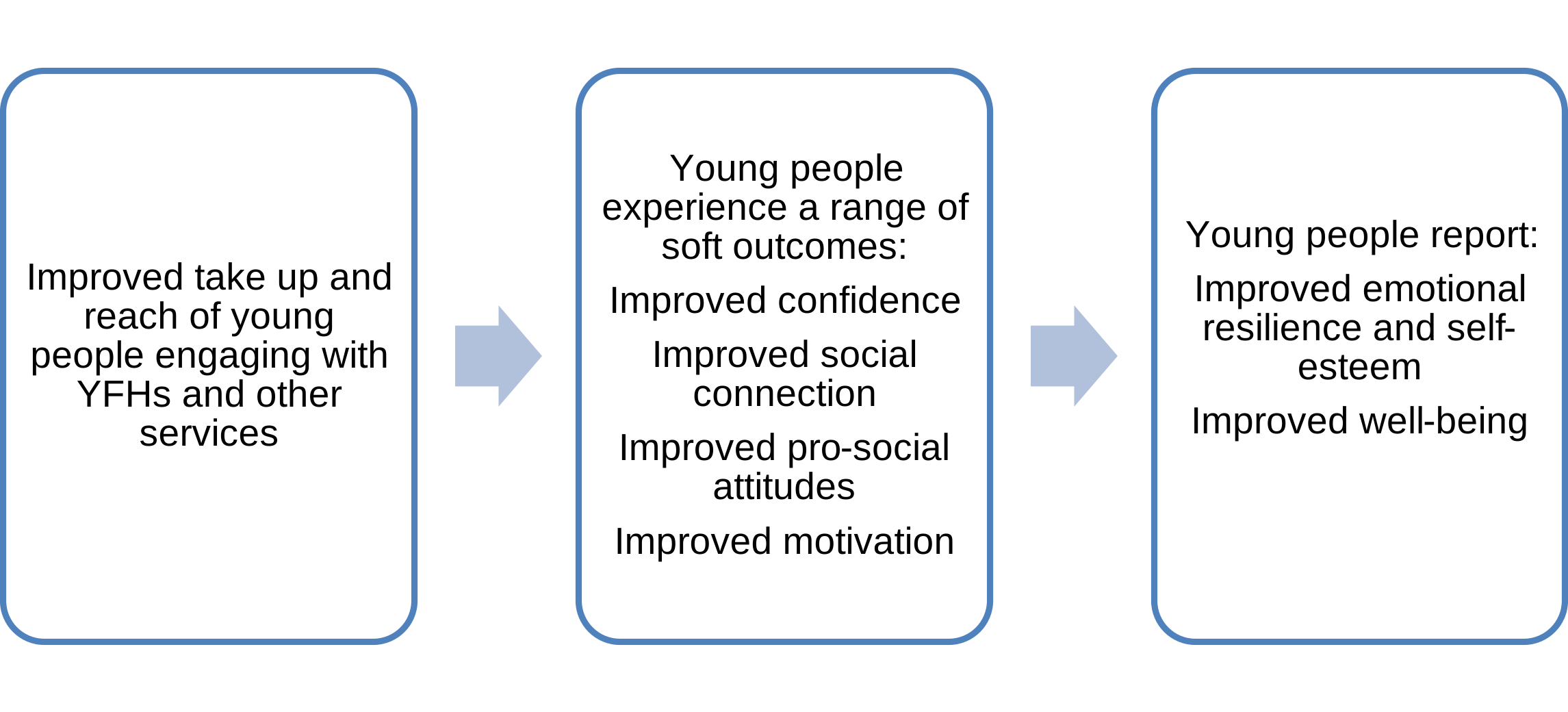
Full text description
If there is improved take up and reach of young people engaging with YFHs and other services, this leads to young people experiencing a range of soft outcomes including:
- improved confidence
- improved social connection
- improved pro-social attitudes
- improved motivation.
This leads to young people reporting:
- improved emotional resilience and self esteem
- improved well-being
Hubs were consulted as to whether outcomes data could be collected through a survey with young people, administered by the evaluation team. Hubs noted that the depth and type of questions that would be required for this would potentially be viewed as intrusive by the young people using the hubs, and therefore response rates would be impacted. There was also too little time within the evaluation period to administer a multi-phase survey to explore distance travelled with individual young people. As a result, the young people’s survey will take a light-touch approach to outcomes achieved, looking primarily at soft outcomes while giving young people space to highlight other self-reported changes.
3.3.1 Soft outcomes
Soft outcomes appear to be one of the more feasible outcome areas for measurement in this evaluation period (and in the longer term). While measurement of these outcomes is not yet harmonised, work is ongoing with the hubs to explore how harmonised indicators could be implemented. Hub representatives reported collecting, or planning to collect, information on confidence, self-esteem, social connection, belonging, motivation, pro-social identities, young people’s voice, experience of service, some of which will be pre-post or distance travelled. Some of this is captured through structured or semi-structured tools, such as goal-based outcomes, experience of service questionnaires, and outcome measures used in resilience sessions. Other evidence is more qualitative, including staff observations and feedback from children, young people, and families.
The most usable soft outcome data are likely to come from targeted provision where hubs already use goal-based measures, distance-travelled tools, or structured outcome measures. Where hubs collect start and end scores, average change scores, or goal progress, these data may support cautious descriptive analysis of change over time. This is particularly promising where hubs can identify the young people receiving the intervention, the type of support received, the timing of baseline and follow-up, and whether the same measure was used at both points.
For universal or open-access provision, the evidence is likely to be more indicative. It may show that young people report positive experiences, feel listened to, value the service, or identify areas of personal development, but it is less likely to provide robust pre/post evidence of change. This is partly because hubs noted that it may be inappropriate to ask personal or sensitive questions when a young person first attends, particularly where trust has not yet been established. As a result, outcome evidence for universal provision is likely to rely more on light-touch feedback, staff observations, young people’s voice, and qualitative accounts than on validated outcome scales.
Overall, soft outcomes are feasible to include in the evaluation, but analysis will be proportionate and caution applied where necessary. The evaluation can likely describe the types of soft outcomes hubs are seeking to capture, identify where there is overlap across hubs, and use available data to provide illustrative evidence of early change. It should not overstate comparability unless the same or sufficiently similar measures are used in the same way across hubs.
3.3.2 Health and wellbeing
Health and wellbeing is also a relatively promising outcome area, especially for targeted support. Hub representatives reported using, or planning to use, tools such as the My Mind Star, short-form wellbeing measures such as the ONS-4 or the Short Warwick-Edinburgh Mental Wellbeing Scale, and experience of service questionnaires. One representative noted that young people receiving one-to-one support would complete the pre- and post-My Mind Star and/or goal-based outcomes, while targeted group work would use similar tools or an ending evaluation depending on the activity. Another reported that universal weekly services would capture service effectiveness and distance travelled quarterly.
The most usable data are likely to come from structured resilience, wellbeing, or mental health-related provision where hubs collect baseline and follow-up measures. If start and end scores are available, the evaluation may be able to describe distance travelled for young people receiving this type of support, at an aggregate level. Where hubs use validated or semi-structured tools consistently, this could provide stronger evidence than general feedback or case study material. However, these data are likely to cover only subsets of young people, particularly those receiving targeted support, rather than all hub users.
There are also comparability challenges. Different hubs may use different tools even after harmonisation efforts, and even where tools appear similar, they may be administered at different points, with different groups, and for different types of provision. For example, one hub may use a wellbeing measure at the start and end of one-to-one support, while another may collect quarterly service effectiveness data for universal provision. These are both relevant, but they do not produce directly comparable outcome data.
Overall, health and wellbeing data should be usable for descriptive analysis, especially within targeted provision. The evaluation should be able to assess where hubs are collecting structured wellbeing data, what types of measures are being used, and whether these could support more consistent outcome tracking in future. However, it should avoid presenting health and wellbeing outcomes as a single cross-hub metric unless the underlying measures and collection points are sufficiently aligned.
3.3.3 Opportunity
Opportunity outcomes are visible in the mapping but appear less consistently developed than soft outcomes or health and wellbeing. Relevant data centre on goal-based measures, capturing distance-travelled around knowledge, experience and/or ambitions for post-16 education, employment or training (EET), with minimal tracking of longer-term EET impacts.
The most usable opportunity data in this evaluation period is therefore likely to be goal-based measures of distance-travelled and activity/participation measures rather than robust outcome measures. For example, the evaluation may be able to describe how many young people accessed employability, education, training, mentoring, or progression-related support, and whether they were referred into, accepted onto, or completed relevant provision. Where goal-based or pre/post measures are used within opportunity-focused provision, these may provide some evidence of distance travelled, but this does not yet appear to be consistent across hubs.
Longer-term opportunity outcomes, such as improved school attendance, reduced suspensions, improved attainment, or post-16 education, employment, or training destinations, are also unlikely to be measurable robustly through Hub data collection during this evaluation period. The mapping exercise revealed that this is not comprehensively measured by hubs at this point. Administrative data linkage could strengthen this domain in a future evaluation, but this would require individual identifiers, consent, data sharing arrangements, and sufficient time for outcomes to materialise.
Overall, opportunity data should be treated as largely out of scope for this pilot evaluation. The evaluation can likely describe opportunity-related provision and may be able to use some targeted outcome or goal progression data where available. However, the current data are unlikely to support consistent cross-hub analysis of opportunity outcomes, especially longer-term impacts. The most useful contribution during this period will be to identify which hubs are already collecting opportunity-related data, how this is structured, and whether it can be aligned more clearly with support type and engagement intensity.
3.3.4 Safer streets
Safer streets is the most challenging outcome domain to evidence through existing hub data. The mapping identified some relevant indicators, including measures of childhood offending violence using hub and Youth Justice Service data and survey questions targeting safety and risk behaviours asked directly to young people. However, these indicators are less consistently collected than reach, engagement, support received, soft outcomes, or wellbeing.
Following harmonisation efforts, the most usable safer streets data in this evaluation period are likely to be indirect or intermediate indicators. These include participation in positive activities, attendance at relevant sessions, referral into diversionary or specialist support, successful onward referrals, and qualitative accounts of changes in young people’s safety, belonging, decision-making, or risk-related behaviour. These data can support a contribution-based narrative about how hubs may be creating conditions associated with safer streets outcomes, but they are unlikely to provide robust evidence of reduced offending or violence during this phase.
There are also important sensitivity and appropriateness issues. Questions about risky behaviours, substance use, weapon carrying, gang involvement, exploitation, or offending are not suitable for universal administration across all young people accessing hubs. They may only be appropriate within relevant targeted provision, and even then, require careful framing, trusted relationships, appropriate consent, and a safe mode of completion. This limits the feasibility of collecting consistent safer streets outcome measures across all hubs and all young people. Administrative or justice-related data are also unlikely to be usable within this evaluation period for robust impact analysis. Measuring outcomes such as first-time entrants to the youth justice system, cautions, arrests, convictions, or proven offences would require access to appropriate administrative data, individual identifiers or linkage mechanisms, and sufficient time for outcomes to occur and appear in the data. Existing Hub MI may identify some diversionary activity or youth justice-related support, but this is not equivalent to measuring impact on offending or violence.
The evaluation can use available data to describe relevant provision, referral pathways, positive activities, and stakeholder perceptions of change. It can also identify what would be needed to measure this domain more robustly in future. However, the current evidence base is unlikely to support strong claims about reductions in risky behaviour, offending, or violence.
3.4. Implications for the pilot evaluation
Consultation with the Early Adopter Hubs clearly showed that not all hubs can reliably collect and/or share individual-level data, and this is particularly the case for young people using open-access elements of the hubs. Individual-level data collection, including baseline/follow-up data collection of outcomes, is more feasible among young people accessing targeted support. Similarly, it is more likely that hubs are able to collect outcome data for those engaging with targeted support, and before-and-after outcome measurement appears to be more feasible for this group. Access to information to allow for linkage to administrative datasets such as the NPD is not available at this stage, either because hubs do not collect this data or do but cannot share it due to data protection and consent barriers.
For the current pilot evaluation, the main implication of the data landscape above is that the intermediate impact evaluation will need to be realistic about what can be evidenced quantitatively and comparably across hubs. The strongest common evidence base is likely to come from aggregate output and outcome data, not from rich linked individual-level data. That means the pilot can say most about (in aggregate): who hubs are reaching; volumes of activity and service delivery; patterns of engagement; delivery mix (for example, universal versus targeted); and referral/connectivity across services. Coverage of outcomes, even soft outcomes and early health outcomes, are anticipated to be measurable in aggregate, at least across a reasonably large set of hubs. However, this evaluation will not be able to measure outputs and outcomes at an individual level, limiting analytical depth and nuance. While some individual level data may be provided by hubs which can collect and share this data, it is anticipated to be piecemeal. It will therefore be analysed proportionately (meaning supporting contextual insights) and utilised to support learning for the future evaluation.
These findings are largely in line with expectations for the Early Adopter Evaluation, which aimed to explore data availability and early outcomes but not include a full impact evaluation. Instead, the evaluation aims to trial harmonisation of core indicators, and use resultant findings as proof of concept to inform the wider hub roll-out.
Therefore, the final scoped approach to data collection from early adopters reflects this by making aggregate quarterly reporting the core expectation, while encouraging hubs to share additional individual-level or monthly aggregate data only where possible.
3.5 Next steps for data collection
The next step for this evaluation period is to focus on a manageable, harmonised MI and outcome return that prioritises the indicators most likely to be feasible and useful across hubs. This will centre on aggregate data covering reach, attendance, engagement, referrals, partner delivery, and support received, with demographic breakdowns where available.
For outcomes, the most realistic focus should be on the testable causal pathway covering early outcomes and health and wellbeing, particularly where hubs already collect structured data through targeted provision. Opportunity and safer streets outcomes should remain in scope but are likely to be evidenced through a combination of activity data, referral data, qualitative evidence, and any targeted outcome measures already in use, likely collected in a piecemeal way. The evaluation will not require hubs to introduce extensive new outcome tools where these would duplicate existing systems, create disproportionate burden, or ask sensitive questions in settings where they are not appropriate. Indeed, the main exercise in the next phase will be the efforts to achieve a harmonised data collection scope across the hubs. At the time of writing, the scope of this harmonised data collection is being finalised in collaboration with DCMS and other government departments (with input from hubs via the impact feasibility and data workshops). Once agreed, a clear guidance document setting out the agreed scope with clear implementation guidance for hubs will be shared.
This harmonisation process is structured across two phases:
-
Set-up and preparation (July to August 2026)
-
Data collection and submission (September to December 2026)
The set-up and preparation phase will focus on embedding the agreed indicators into Hub data collection systems and processes, alongside preparing for data sharing. This will include: reviewing and mapping the indicators; integrating them into delivery processes; agreeing local data sharing approaches (for example, data compilation, sharing formats); and establishing data sharing agreements with hubs. We will work flexibly with hubs to establish data formats and transfer mechanisms that work seamlessly with existing hubs’ processes and infrastructure.
The data collection and submission phase will centre on three indicative submission timepoints.
We do not expect data to be fully complete or standardised from the outset; the focus is on establishing a workable approach and improving data quality over time. Instead, this phased approach is intended to enable iterative improvement via hub-specific feedback between returns, rather than relying on a single final submission.
These efforts will yield learnings around data collection and sharing processes, administrative data linkage pathways, and uncover the key barriers, risks and enabling conditions associated with each. This learning is critical to informing the future roll-out evaluation, where robust impact evaluation approaches will depend on embedding the necessary data systems, governance frameworks and standardised processes from the outset, rather than attempting to retrofit them.
4. Interim conclusions
The interim findings presented above suggest that Young Futures Hubs have made a positive start in establishing locally tailored, partnership-based models of support for young people. Early adopters have used local evidence, existing youth provision, partner expertise and youth engagement to shape their hub models and offers. This has resulted in different delivery models across areas, including single-site, hub-and-spoke and multi-site approaches. This variation reflects differences in local geography, need, infrastructure and existing services.
There is early evidence that hubs are improving access to support by bringing universal youth work, targeted provision and specialist services closer together. Open-access activities appear to provide an important entry point for young people, while co-location, warm handovers and “no wrong door” approaches appear to be supporting young people to move into more targeted support where needed. These features were perceived to be particularly important for young people who may otherwise have found it difficult to navigate multiple services.
Partnership working is evidently a key strength of early implementation. Most hubs built on existing relationships between local authorities, VCSE organisations and statutory services, while also creating new opportunities for coordination. The programme appears to be strengthening communication between partners and creating the conditions for more joined-up local support. However, referral pathways, shared processes and data arrangements are still developing in many areas.
The findings also indicate that youth engagement influenced hub design and delivery, particularly the choice of activities, opening times, physical spaces and accessibility adaptations. However, the depth of youth involvement varied. In some areas, young people had shaped key decisions from an early stage; in others, consultation took place after important decisions had already been made. This suggests that clearer expectations and more time for co-design would strengthen future implementation.
At this stage, evidence of outcomes is necessarily limited and should be interpreted with caution. The strongest early evidence relates to young people’s engagement, trusted relationships, confidence, belonging, wellbeing and access to support. There are also early indications that hubs are helping to strengthen local systems and referral routes. Evidence relating to longer-term outcomes, including improved opportunities and safer streets, is less developed and will require further time and stronger data to assess.
The monitoring findings show that aggregate data on reach, attendance, engagement, referrals and support delivered are likely to provide the most feasible common evidence base during the pilot. Individual-level journey data and comparable outcome measures are less consistently available, particularly in open-access and multi-provider settings. Future evaluation will therefore need to balance ambition with proportionality and avoid placing excessive data collection burdens on youth work settings.
4.1. Lessons learned for future implementation
The evaluation evidence to date provides a number of lessons which could feed into programme design for future roll-out of the YFHs.
-
Hubs within future roll-out phases should have sufficient mobilisation time to develop partnerships, agree referral routes, commission delivery partners, complete building works, recruit staff and involve young people meaningfully in design. It is noted that the Early Adopter Hubs each launched at a different stage of readiness and were too early in their implementation journey to reflect on the ideal mobilisation period. Sufficiency of mobilisation time will be explored with hub leads during the next round of fieldwork.
-
Co-design expectations should be clear from the outset. Future guidance should explain how young people should influence decisions, while recognising practical constraints such as funding, buildings and timescales.
-
Hubs should build on existing local assets and relationships wherever possible. Implementation was strongest where the programme strengthened and connected existing youth provision rather than creating a separate or duplicated offer.
-
Dedicated coordination capacity is important. Hub leads and programme managers played a central role in bringing partners together, maintaining shared purpose and translating strategic plans into day-to-day delivery.
-
Referral pathways should be designed early and kept simple. Hubs need clear routes into, through and beyond provision, while retaining flexible and informal access points for young people.
-
Universal provision should be used as a trusted gateway into targeted support. Future hubs should plan how young people can access specialist help in ways that are discreet, non-stigmatising and based on trusted relationships.
-
Accessibility and inclusion should be embedded from the start. This includes attention to location, transport, opening times, physical accessibility, sensory needs, SEND, cultural relevance and the needs of different age groups.
-
Sustainability should be considered early. Future roll-out should take account of staffing, demand for intensive support, partner capacity and the funding needed to maintain high-quality provision over time.
-
Monitoring and outcome data requirements should be proportionate and agreed early. A small set of core indicators should, ideally, distinguish clearly between attendances and unique young people, universal and targeted provision, and outputs and outcomes.
-
Future evaluation should treat the early adopter phase as a learning platform. The pilot is generating important evidence about implementation, data collection and the conditions needed for a more robust evaluation of wider roll-out.
4.2. Next steps for this evaluation period
The next phase of the evaluation will focus on strengthening evidence on how Young Futures Hubs are being implemented in practice, how young people are engaging with the offer, and what early outcomes are emerging. This will build on the scoping and baseline findings by increasing the role of young people in the evaluation, collecting further qualitative evidence from hubs and partners, and beginning the planned collection of monitoring data.
- Increasing youth engagement: This will include piloting and rolling out a young people’s survey to understand how and why young people are using the hubs, their experiences of the support available, and any early changes they attribute to their engagement. The evaluation team will also recruit and train a young evaluator panel to support the second wave of fieldwork. This will help ensure that the evaluation reflects young people’s perspectives and that data collection is accessible and relevant..
- Wave two fieldwork: This will include qualitative interviews and site visits. These activities will assess progress since the baseline stage and explore how hub models have developed over time.
- Monitoring data collection: This will focus on the harmonised set of indicators agreed for this evaluation period, including data on reach, attendance, engagement, referrals, partner delivery and support received, along with early outcomes The purpose will be to build a clearer picture of the scale and profile of Hub delivery, while also testing what data can be collected consistently and proportionately across different local models.
At the end of the data collection period, the evaluation team will triangulate evidence . This analysis will be structured around the programme Theory of Change and will focus on the main gaps identified at the interim stage. In particular, the remainder of the evaluation will consider how different hub models are working in practice, who hubs are reaching, how young people are engaging with provision, how they move through universal, targeted and specialist support, and how effectively referral pathways between partners and services are operating.
The next phase will also explore the additionality of the hub model. This will include assessing whether hubs are adding value by improving coordination between services, strengthening local partnerships, increasing access to support, filling gaps in existing provision, or providing a more accessible gateway into targeted services. The evaluation will also continue to assess whether and what outcomes are being achieved, with a particular focus on early outcomes such as trusted relationships, confidence, belonging, wellbeing, access to support and service integration. Longer-term outcomes, including improved opportunities and safer streets, will be explored where evidence is available, but findings will be interpreted cautiously given the early stage of delivery and the limitations of available data.
The final report will bring together evidence from all strands of the evaluation and will be published in Spring 2027.
Annex 1: YFH case studies
Manchester
Overview
Manchester operates a multi-site model, delivering YFH activities equally across three hubs (north, south and central). The sites were chosen to reflect Manchester’s geography, existing youth infrastructure and stakeholder feedback.;
The local landscape review and co-design process indicated that a single central Hub would not meet need across a long, dispersed city, and providers and young people both identified the need for at least three hubs to ensure sufficient coverage. The selected sites were existing youth facilities with established quality, capacity, local reach and links to targeted services such as M-Thrive[footnote 7] and Engage [footnote 8], meaning the programme could build on and strengthen existing provision. Each hub has a universal offer, with open-access youth work and activities sitting alongside targeted provision and links to specialist services. This allows the model to respond to different levels of need.
Young Futures Hubs funding has primarily added capacity and coordination to an existing youth infrastructure, rather than creating a new standalone service. In Manchester, hub funding is being used to employ full-time youth workers across the three hub sites and to fund additional targeted provision tailored to local need. This has strengthened the universal youth offer, supported links with specialist services (such as M Thrive and Engage), and created greater capacity for hubs to provide more coordinated wraparound support.
The offer
The hubs offer a huge range of free activities for young people to enjoy, many of which they wouldn’t be able to do elsewhere in the local area, or that would otherwise have an associated cost. The hubs offer both youth worker/instructor-led sessions and free-flowing social time (with access to self-directed activities). The hubs had a preexisting range of informal social, creative and physical activities on offer. For example, in one hub the facilities include a video games area, table tennis tables, sofas and an art area, alongside two large gyms, a boxing gym, a basketball court designed with input from children and young people, a climbing wall, a music room, a canteen and cooking space, a further arts space, a large 3G football pitch, and a makers’ space with 3D printers, lino cutting and T-shirt making equipment. One hub also has access to a dedicated minibus donated by a car finance organisation, meaning staff can more easily support young people to access off-site services.
Food plays a vital role in the hubs offer, with evening meals served daily. One Hub also offered the opportunity for young people to prepare the meal. Both hubs had food pantries for young people to take food home; one offered a discreet food delivery service where parents could text staff and receive a food parcel during the school day so young people wouldn’t know the food was given by the hub.
Young people interviewed during the evaluation site visit reported being attracted to attending the hub to participate in activities and meet friends. They emphasised that they could not access (or afford to access) the kinds of activities on offer anywhere else. Young people shared that the hub fills a gap in providing financially accessible, safe spaces to meet and have fun. They reported feeling safe on site, and that the space provides them with the ability to build friendships and talk to people if there is something wrong. The young people who engaged in the research reported attending multiple times per week.
If it was up to me, I’d come every day.
Young person
Birmingham
Overview
The Birmingham YFH is an entirely new provision, funded by Young Futures Hubs funding. The Birmingham YFH currently operates from a temporary site in the Library of Birmingham on Tuesday, Thursday, and Friday afternoons, with Outreach workers operating two evenings a week (Thursday and Friday) in Birmingham City Centre.
The provision will move into its permanent home in a former city centre retail unit later in September, upon completion of renovations. The permanent site was selected as a central, accessible location in response to feedback from young people that they wanted a safe, central location to access activities and targeted support. It was designed in collaboration with partners and young people, drawing on consultation exercises around design elements and operational details such as opening times. Staff reported that evaluations will be conducted after every session to gather feedback on necessary changes regarding opening hours, services, and activities.
In its temporary location, the hub has been successful in attracting many young people during college breaks and after school. Thanks to the location, youth workers have made connections with young people living nearby, from local schools and those passing through the city centre. Youth workers based at the hub have also worked proactively to engage young people in hub activities; efforts included promoting the service to library staff and collaborating with the Department for Work and Pensions Youth Hub to encourage signposting to hub services. Being located in the library has enabled access to young people who might not usually engage with youth services, not least because it has supported engagement with older groups of young people using the library to prepare for exams and complete college work.
We’ve been having to do a lot of work with young people around exam stress and support with exams but that’s because a lot of the cohort that have been in the library have just had GCSE exams and then come to the library afterwards. So, they’ve kind of come and had a bit of a kind of chill-out space but also we’ve been able to engage them in conversations and talk to them about college and aspirations and help them do CVs.
YFH delivery staff
The offer
Youth workers interviewed believed that the Hub provided additionality to local services by offering a different type of support to a ”traditional” youth centre. While the hub may host activities, it is not designed as an activity based centre, rather, the youth workers provide intensive and structured support, often in a 1-2-1 setting. The hub can also facilitate referrals to provision in Birmingham’s wider localities.
In its current location, the hub functions as a drop-in service where youth workers build relationships while young people can access activities. Services include employment support (job searching/reintegration) in partnership with DWP, safeguarding referrals and general well-being support through referrals to external organisations. The outreach service also supports young people involved in anti-social behaviour by engaging them in positive activities.
Bristol
Overview
Bristol operates a hub and spoke model, connecting provision for young people across East Central Bristol through a ‘home base’ – Full Circle Docklands – and eight spoke locations across the area. These spokes consist of a range of voluntary sector and statutory providers, providing a mixture of universal, targeted and specialist services including Off the Record[footnote 9], Empire Fighting Chance[footnote 10] and Creative Youth Network[footnote 11]. The local landscape review and consultation process identified fragmentation and siloed working, so the Young Futures Hubs funding model was chosen to connect existing provision through a coordinated network with shared training, improved staff relationships across organisations, and pathways for young people to access a wider offer while maintaining and developing their ‘home base’. The approach was developed with a multi-agency steering group which agreed a set of principles, including locating the hub in a neighbourhood accessed by young people most impacted by inequalities and poverty. The model also aims to align with Family Hubs, Integrated Care Boards and Neighbourhood Health plans.
In terms of capital spend, Young Futures Hub funding was used to create a unified digital offer, which included a city-wide platform showing the youth offer in real time. It was also used to purchase a minibus to support young people’s access to different neighbourhoods, and to complete a refurbishment of Full Circle Docklands.
Investment in staff costs has also increased capacity and allowed the Hub and spokes to expand their existing offer for young people.
Interviewees believed that the YFH funding has led to better connectivity between services, and ultimately aims to provide seamless access between universal, targeted and specialist services. The hub and spoke model should facilitate the sharing of limited resources between partners, including collective bid writing, collaborative delivery, and consistent approaches to measuring impact and outcomes. Interviewees also believed it is strengthening the use of data to inform service offer and reach.
The offer
Through the network, young people are able to access an enhanced and better-connected offer of creative sports, arts and skills-based activities and support widening access and choice. It aims to ensure there is ‘no wrong door’ to access services, including mentoring, personal development support, emotional wellbeing services and careers guidance. The funding has also facilitated the co-location of emotional wellbeing and mental health services and EET (Employment, Education and Training) support services within the hub and spokes; detached work in hot spot areas; outreach work in schools; co-delivery with partners including the Youth Justice Service and Safer Connections (Home Outside the Home); and a digital offer.
As in Manchester, young people interviewed for the evaluation typically attended hub services at least twice a week. They had taken part in music lessons, English lessons, sports and cookery, and had also taken part in a trip to London. Young people reported that the service helped them to build their confidence, make friends, and provided somewhere to go for advice and guidance about a range of problems. They also described helping to shape service delivery by providing feedback to staff about the activities and support they would like to see at the hub and spokes, and involvement in co-design for example designing new spaces and logos.
Anytime I have a problem in my life I come here, and they always help me to solve that problem.
Young person
-
Local authorities (LAs) have a statutory duty to provide, so far as reasonably practicable, leisure-time activities and facilities for young people aged 13 to 19 and those with learning difficulties or disabilities aged 20-24. New statutory guidance for LAs was published in 2023. ↩
-
The consortium partners are UK Youth, The Network of Regional Youth Work Units, Centre for Young Lives, the Local Government Association, Young People’s Foundation Trust, Street Games, SOLVE and Youth Access. ↩
-
At the time of writing (July 2026), the site visit for one case study YFH was yet to be completed, although interviews have been conducted with the Hub lead and delivery partner case lead. The site visit is scheduled for August 2026 to align with the Hub’s implementation timescales and findings will be included in the final evaluation report. ↩
-
Specific, tailored support for those who may need more focussed help, for example, with their mental health or SEND. ↩
-
A referral process whereby professionals identify support (which they do not themselves provide) for a young person and directly introduce the young person to the provider of this support, accompanying the young person to a first meeting. With the young person’s knowledge and permission, professionals will share information on support needs and preferences. ↩
-
Funding allocations for each LA can be found here: Young Futures Hubs - Early Adopters - GOV.UK ↩
-
M-Thrive provides targeted access to mental health support for young people: Manchester, Trafford & Salford Thrive Hubs - MFT CAMHS ↩
-
Engage panels are established multi-agency panels chaired by Greater Manchester Police, which aim to identify and refer on young people at risk of becoming involved in serious violence or other crime: Appendix 1 - Manchester’s Serious Violence Strategy.pdf ↩
-
Off the Record is a mental health provision for young people: Home - OTR ↩
-
Empire Fighting Chance provides psychologically-informed non-contact boxing sessions: Empire Fighting Chance ↩
-
Creative Youth Network is a charity offering universal and targeted interventions for young people: Home - Creative Youth Network ↩