UKHSA safeguarding annual report 2025 to 2026
Published 21 October 2026

© Crown copyright 2026
This publication is licensed under the terms of the Open Government Licence v3.0 except where otherwise stated. To view this licence, visit nationalarchives.gov.uk/doc/open-government-licence/version/3 or write to the Information Policy Team, The National Archives, Kew, London TW9 4DU, or email: psi@nationalarchives.gov.uk.
Where we have identified any third party copyright information you will need to obtain permission from the copyright holders concerned.
This publication is available at https://www.gov.uk/government/publications/ukhsa-safeguarding-annual-report-2025-to-2026/ukhsa-safeguarding-annual-report-2025-to-2026
Foreword
I am pleased to introduce the UK Health Security Agency (UKHSA)’s third annual safeguarding report, which highlights the continued progress made in strengthening safeguarding practice across the organisation during financial year (FY) 2025 to 2026.
Safeguarding is fundamental to our mission of protecting health and reducing inequalities. This report demonstrates the commitment of colleagues across UKHSA to recognising concerns, taking appropriate action and supporting vulnerable people in their work.
Over the past year, we have continued to strengthen our safeguarding arrangements through improved governance, increased use of supervision, enhanced training and greater engagement across the organisation. These achievements reflect our shared commitment to ensuring safeguarding remains embedded in everything we do.
I would like to thank the Safeguarding Team, safeguarding leads and champions, and staff across UKHSA for their professionalism and dedication. Their efforts help ensure we continue to identify risks early, support those who may be vulnerable, and work effectively with partners to protect the public.
As we look ahead, we remain committed to continuous improvement and to ensuring safeguarding remains a core part of delivering safe, effective, high quality public health services.
Shona Arora
Chief Medical Advisor
Executive summary
This report provides an overview of safeguarding activity across UKHSA during financial year (FY) 2025 to 2026, and highlights progress made in strengthening safeguarding practice across the organisation. Over the past 12 months, UKHSA has continued to embed safeguarding within its public health functions through enhanced governance, workforce development, improved data oversight and stronger partnership working. The report also sets out the safeguarding priorities for FY 2026 to 2027, aligned to the UKHSA Strategic Framework and statutory safeguarding responsibilities.
UKHSA expects all staff to understand their safeguarding responsibilities and recognise when concerns about children or adults at risk should be identified, escalated and acted upon. Safeguarding remains a core component of safe, effective and high-quality public health practice, supporting UKHSA’s mission to protect health, reduce inequalities and improve outcomes for vulnerable populations.
Main points:
- mandatory Level 1 safeguarding training compliance remained consistently above 80%, providing assurance that staff continue to maintain a baseline understanding of safeguarding responsibilities, identification of concerns and reporting requirements
- continued engagement, training and awareness-raising activity have increased staff confidence in recognising and escalating safeguarding concerns, reflected in sustained reporting levels and increased use of safeguarding supervision
- safeguarding incident reporting increased by a further 10% during the year, with 148 safeguarding concerns recorded through organisational reporting systems, demonstrating continued vigilance across the workforce and early identification of concerns
- requests for safeguarding supervision increased by 25% compared to the previous year, with 110 requests received, highlighting growing awareness of safeguarding processes and the value of specialist advice and support
- neglect, self-neglect and domestic abuse remained the most commonly identified safeguarding themes, with many incidents involving individuals experiencing multiple and intersecting vulnerabilities
- improvements to data quality, compliance monitoring and incident management processes have strengthened organisational oversight and supported more effective safeguarding assurance arrangements. Incidents frequently involved individuals with multiple vulnerabilities, reinforcing the importance of safeguarding integration with wider public health and health inequalities work
- partnership working continued to develop across government, the NHS and wider public health systems, helping to strengthen UKHSA’s role as a recognised safeguarding partner and contributor to national safeguarding initiatives. Partnership working and external engagement continues to be an area of focus with the safeguarding team collaborating and presenting on a variety of workstreams including policy developments and revisions
- the safeguarding lead and champion community continued to expand, increasing local safeguarding expertise, supporting staff and further embedding a culture where safeguarding is recognised as everyone’s responsibility
- UKHSA continued to strengthen its organisational safeguarding maturity. Improved governance, sustained workforce engagement, enhanced assurance processes and increased confidence in identifying and escalating concerns provide assurance that safeguarding risks are being appropriately recognised and managed. This progress supports UKHSA’s ambition to be a high-performing agency, ensuring that safeguarding remains integral to protecting the health, wellbeing and safety of the populations and communities we serve
Figure 1. Key achievements during financial year 2025 to 2026
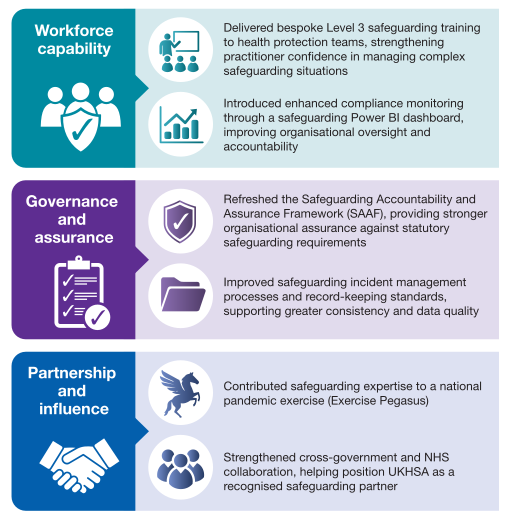
Text version of Figure 1. Key safeguarding achievements during FY 2025 to 2026
This infographic is divided into 3 sections.
- Workforce capability:
- delivered bespoke Level 3 safeguarding training to health protection teams, strengthening practitioner confidence in managing complex safeguarding situations
- introduced enhanced compliance monitoring through a safeguarding Power BI dashboard, improving organisational oversight and accountability
- Governance and assurance:
- refreshed the Safeguarding Accountability and Assurance Framework (SAAF), providing stronger organisational assurance against statutory safeguarding requirements
- improved safeguarding incident management processes and record-keeping standards, supporting greater consistency and data quality
- Partnership and influence:
- contributed safeguarding expertise to a national pandemic exercise (Exercise Pegasus)
- strengthened cross-government and NHS collaboration, helping position UKHSA as a recognised safeguarding partner
Safeguarding in UKHSA
UKHSA is an executive agency of the Department of Health and Social Care (DHSC) and, through its functions, discharges the Secretary of State for Health and Social Care’s statutory duty to protect the nation’s health and reduce health inequalities, as set out in the Framework agreement between DHSC and the UK Health Security Agency: 2026 to 2029.
The safeguarding workplan supports delivery of the UKHSA Strategic Framework 2026 to 2029 by aligning to the core pillars of Understand, Prevent and Respond. It ensures that safeguarding risks are proactively identified, mitigated and managed through effective health protection activity.
The workplan also underpins the enabling foundations of Expertise and Infrastructure, and Leadership and Collaboration by strengthening workforce capability, improving organisational consistency, and promoting effective partnership working across local and national systems.
UKHSA is committed to maintaining high safeguarding standards through clear governance, robust policies and defined operational processes.
There is a continued focus on ensuring staff are equipped with the knowledge, tools and support required to recognise, assess and respond appropriately to risks of harm and abuse.
All staff are expected to understand and discharge their safeguarding responsibilities in line with their roles. Strengthening this culture of shared accountability remains a priority to ensure safeguarding is embedded in everyday practice and decision-making across UKHSA.
UKHSA teams operate across a wide range of settings and in partnership with organisations including the police, local authorities, and primary, secondary, and social care services. It is therefore essential that staff understand UKHSA’s safeguarding arrangements and how these align with partner organisations to support consistent practice and, where appropriate, effective multi-agency responses. Safeguarding is a complex area, with abuse occurring in many forms and contexts. As such, UKHSA remains committed to promoting safeguarding across the organisation, recognising the diverse ways in which we engage with the public, including our own workforce.
Definitions
Safeguarding children: A child is defined as anyone under the age of 18 years. Safeguarding children involves protecting them from maltreatment, preventing impairment of health and development, and ensuring they grow up in circumstances consistent with the provision of safe and effective care, in line with the Children Acts 1989 and 2004.
Safeguarding adults: Safeguarding adults applies to individuals aged 18 years and over who may have care and support needs and be at risk of abuse or neglect, in accordance with the Care Act 2014. Safeguarding responses are person‑centred, proportionate and focused on promoting wellbeing.
Assurance and governance
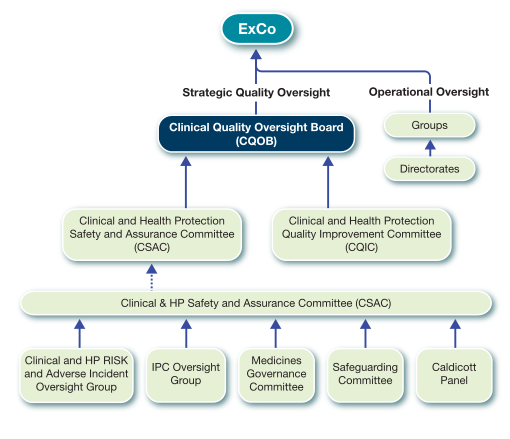
The Safeguarding Committee provides oversight of safeguarding arrangements in UKHSA and reports through established clinical governance structures, as illustrated in Figure 2. During FY 2025 to 2026, safeguarding governance continued to mature, supported by updated terms of reference, strengthened supervision arrangements and active oversight of safeguarding risks.
Figure 2. Governance structure
Safeguarding accountability and assurance framework (SAAF)
UKHSA operates a Safeguarding Accountability and Assurance Framework (SAAF) to ensure robust governance arrangements and clear lines of accountability across the organisation. The framework supports a consistent, high‑quality approach to safeguarding practice, while providing transparency and assurance to both internal and external stakeholders.
The SAAF is subject to annual review, with findings and recommendations reported to and overseen by the Safeguarding Committee. It is structured around 6 core organisational safeguarding elements:
- Leadership and organisational accountability
- Training
- Safer recruitment and human resources
- Information sharing, communication, and confidentiality
- Implementation, including the sharing and learning of good practice
- Public engagement
Building on previous assessments, the framework was refreshed and updated for FY 2025 to 2026. Widely recognised across the NHS as a robust assurance tool, the SAAF demonstrates UKHSA’s commitment to effectively discharging its safeguarding responsibilities. The latest review identified several areas of strong performance, with many elements assessed as achieved. Work is ongoing to strengthen areas requiring further development, including safer recruitment, through continued collaboration and targeted improvement activity.
Data compliance review
The safeguarding team undertook an annual review during FY 2025 to 2026 of data compliance to ensure any changes in practice had been considered. The annual review identified that safeguarding practice remained compliant with both the UK General Data Protection Regulation (GDPR) and Data Protection Act 2018. In March 2026, amendments were made to the Data Protection Impact Assessment (DPIA) to ensure future data sharing as part of the planned roll out of the Child Protection - Information Sharing (CP-IS) service was established within the governance arrangements.
Key performance indicators
Safeguarding incident data
Safeguarding incident reporting through our contact with the public has continued to increase, rising by 10% over the last financial year.
During the financial year 2024 to 2025 there were 135 safeguarding incidents reported of which 75 were for adults and 60 for children. During the financial year 2025 to 2026 this increased by a further 10%, with 148 safeguarding incidents reported of which 92 were for adults and 56 for children, as shown in Figure 3. Reporting was highest in Q3, coinciding with complex multi‑agency incidents and operational pressures.
Figure 3. Number of safeguarding incidents reported financial years 2024 to 2026
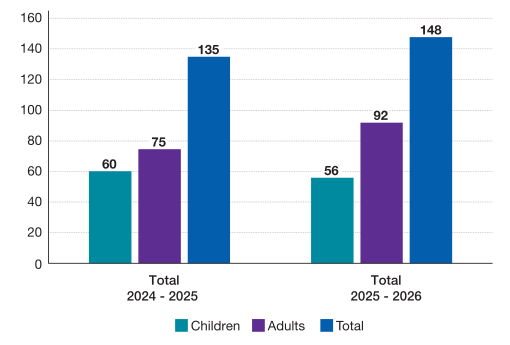
Table 1. Number of safeguarding incidents reported: financial years 2024 to 2026
This is a tabular version of Figure 3.
| 2024 to 2025 | 2025 to 2026 | |
|---|---|---|
| Children | 60 | 56 |
| Adults | 75 | 92 |
| Total | 135 | 148 |
During the financial year 2025 to 2026, incidents reported were linked to 11 different areas including neglect, physical abuse, sexual abuse and domestic abuse, as shown in Figure 4.
Figure 4. Safeguarding activity financial year 2025 to 2026
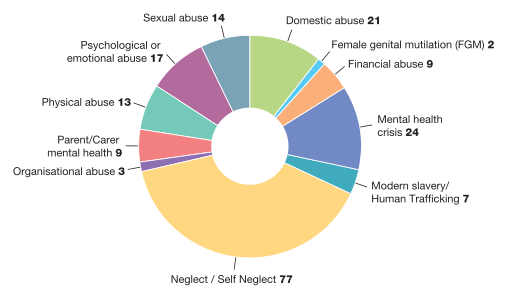
Table 2. Safeguarding activity financial year 2025 to 2026
This is a tabular version of Figure 4.
| Activity type | Incidence |
|---|---|
| Domestic abuse | 21 |
| Female genital mutilation (FGM) | 2 |
| Financial abuse | 9 |
| Mental health crisis | 24 |
| Modern slavery or human trafficking | 7 |
| Neglect or self-neglect | 77 |
| Organisational abuse | 3 |
| Parent or carer mental health | 9 |
| Physical abuse | 13 |
| Psychological or emotional abuse | 17 |
| Sexual abuse | 14 |
It is notable that most safeguarding incidents are reported by regional health protection teams; however, the safeguarding team have seen an increase in reporting of concerns from across the organisation. This could be attributed to the increased presence the team have had at various UKHSA forums, delivering awareness sessions on safeguarding.
Themes identified from FY 2025 to 2026
Review of safeguarding concerns across the year identified consistent themes:
- neglect and self-neglect
- domestic abuse
- mental health crisis
- physical and sexual abuse
- modern slavery, exploitation and safeguarding within insecure accommodation
These themes align with national data on safeguarding prevalence.
Significant incidents included safeguarding escalation linked to outbreaks in homeless accommodation, complex cases involving lead exposure in children, and safeguarding concerns identified through health protection activity.
Domestic abuse is a significant safeguarding issue, both in relation to UKHSA’s work with the public and within its own workforce. The Violence Against Women and Girls (VAWG) Strategy emphasises the responsibility of organisations to implement effective policies and processes to support individuals affected by violence and abuse. In response, the safeguarding team and the People Group jointly chair the Domestic Abuse Steering Group. The group provides oversight of the Domestic Abuse policy, promotes awareness across the organisation, and supports the development of initiatives that ensure staff affected by domestic abuse receive appropriate support.
Safeguarding supervision
Safeguarding supervision is an essential component of safeguarding practice, as it allows for critical reflection when looking to identify and protect children and adults.
Demand for safeguarding supervision remained high throughout the year, with over 100 requests for specialist advice and support received across UKHSA. Requests related to both public‑facing safeguarding concerns and staff‑related issues, including domestic abuse, mental health crises, neglect, safer recruitment queries and policy advice.
Q4 saw a notable increase in requests for support, reflecting both increasing case complexity alongside increased confidence and awareness of staff in identifying and escalating potential safeguarding concerns.
Safeguarding training
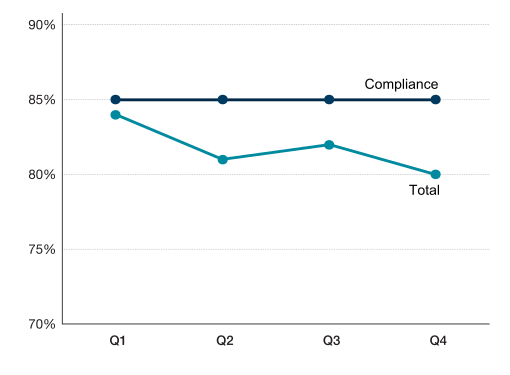
Mandatory safeguarding training compliance remained above 81% throughout FY 2025 to 2026, with expected fluctuations linked to changes in Civil Service Learning renewal cycles. A safeguarding training Power BI dashboard was implemented to improve organisational oversight and role‑based compliance monitoring.
Mandatory training Level 1
The current expected compliance rate for safeguarding training across the organisation is 85%. Over the last 12 months we have seen the data range from between 80% and 84% as seen in Figure 5. In Q3 changes were introduced to the Civil Service Learning (CSL) process for recording mandatory training. The system moved to fixed renewal dates for all staff, giving all staff a defined 3-year period in which to complete their required training. This change in data collection is likely to cause some data fluctuations, until a pattern of recording is established. As part of this change, the Safeguarding Level 1 training must be completed by all staff by 30 November 2027.
Figure 5. Safeguarding training quarterly totals financial year 2025 to 2026
Level 3 training
Following the training needs analysis conducted in 2024 the organisation has seen a year on year increase in Level 3 training compliance, supported by a strengthened approach to capturing the data. Level 3 training is required for staff in roles where:
- they are likely to have contact with patients, children, parents or carers, families, or the public
- they are likely to contribute to assessing, planning, intervening and or evaluating the needs of a child or young person and or the parenting capacity of an adult, regardless of whether there have been previously identified child protection and or safeguarding concerns or not
Training delivery is supported by UKHSA specific case studies which encourages reflective learning and an understanding of organisational processes in practice.
Evaluation of the training demonstrates consistently high levels of satisfaction and confidence among participants, alongside evidence of a positive impact on safeguarding knowledge and practice through the increased reporting of safeguarding concerns. At the end of FY 2025 to 2026 the team had trained 75% of staff requiring Level 3 training (over 500 staff).
Partnership working
During FY 2025 to 2026 the safeguarding team focused on strengthening existing partnerships while extending safeguarding influence into wider public health, health inequalities and workforce wellbeing agendas. This included supporting domestic abuse initiatives, contributing to national safeguarding networks, providing safeguarding input to strategic preparedness activities and working with partners to support future implementation of the Child Protection Information Sharing service. These activities have strengthened UKHSA’s visibility and credibility as a safeguarding partner across health and government systems.
Figure 6. Partnership working
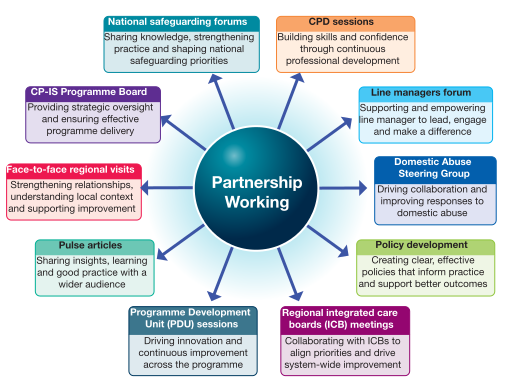
Text version of Figure 6
Figure 6 is a visual representation of types of partnership working, including:
- national safeguarding forums: sharing knowledge, strengthening practice and shaping national safeguarding priorities
- CPD sessions: building skills and confidence through continuous professional development
- CP-IS Programme Board: providing strategic oversight and ensuring effective programme delivery
- Domestic Abuse Steering Group: driving collaboration and improving responses to domestic abuse
- face-to-face regional visits: strengthening relationships, understanding local context and supporting improvement
- line managers forum: supporting and empowering line manager to lead, engage and make a difference
- Programme Development Unit (PDU) sessions: driving innovation and continuous improvement across the programme
- policy development: creating clear, effective policies that inform practice and support better outcomes
- Pulse articles: sharing insights, learning and good practice with a wider audience
- regional integrated care boards (ICB) meetings: collaborating with ICBs to align priorities and drive system-wide improvement
“UKHSA continues to make substantial progress with their statutory safeguarding assurance governance and compliance within the diverse organisation.
“They continue to facilitate professional registrants to prevent harm to children and vulnerable adults they encounter.
“UKHSA safeguarding focus to digitise and gather intelligence is gathering pace which is inspiring other cross-Government agencies to collaborate safeguarding and protect the public.”
Kenny Gibson, Deputy Director for NHS Safeguarding
UKHSA safeguarding leads and champions
The safeguarding leads and champions network continues to be a key mechanism for embedding safeguarding across UKHSA. During FY 2025 to 2026 the network expanded with 26 leads and 45 safeguarding champions, increasing local access to safeguarding advice and promoting greater awareness across directorates. The network has supported earlier identification of concerns, improved access to supervision and strengthened the organisation’s safeguarding culture through peer support, training and local leadership.
Priorities for financial year 2026 to 2027
The safeguarding team has refreshed its strategic priorities for the FY 2026 to 2027 financial year aligning with the strategic framework, building on the strong foundations and progress achieved over the past year. While many of the priorities remain consistent, reflecting the ongoing nature of this work, they have been further strengthened and refined to support continuous improvement. A clear plan of work has been developed to deliver against these objectives, all of which have been reviewed and agreed through the Safeguarding Committee.
Figure 7. Priorities for FY 2026 to 2027
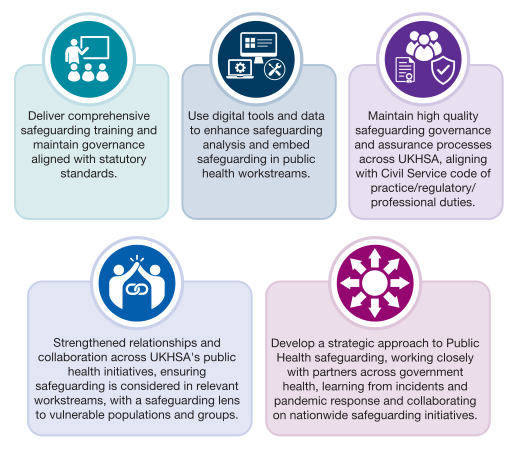
Text version of Figure 7
This infographic gives details of our 5 priorities:
- Deliver comprehensive safeguarding training and maintain governance aligned with statutory standards.
- Use digital tools and data to enhance safeguarding analysis and embed safeguarding in public health workstreams.
- Maintain high quality safeguarding governance and assurance processes across UKHSA, aligning with Civil Service code of practice / regulatory / professional duties.
- Strengthen relationships and collaboration across UKHSA’s public health initiatives, ensuring safeguarding is considered in relevant workstreams, with a safeguarding lens to vulnerable populations and groups.
- Develop a strategic approach to public health safeguarding, working closely with partners across government health, learning from incidents and pandemic response and collaborating on nationwide safeguarding initiatives.
Conclusion
Throughout FY 2025 to 2026 UKHSA has continued to strengthen its safeguarding maturity. Increased reporting, higher supervision demand, improved governance processes and sustained training compliance provide assurance that safeguarding risks are being recognised and managed appropriately. The organisation has moved beyond building safeguarding infrastructure to demonstrating its practical application, supporting safer decision-making, earlier escalation of concerns and stronger partnership working across public health systems. This progress supports UKHSA’s ambition to be a high-performing agency, ensuring that safeguarding remains integral to protecting the health, wellbeing and safety of the populations and communities we serve.