The health impacts from industrial sources of PFAS: a rapid review
Published 22 September 2026

© Crown copyright 2026
This publication is licensed under the terms of the Open Government Licence v3.0 except where otherwise stated. To view this licence, visit nationalarchives.gov.uk/doc/open-government-licence/version/3 or write to the Information Policy Team, The National Archives, Kew, London TW9 4DU, or email: psi@nationalarchives.gov.uk.
Where we have identified any third party copyright information you will need to obtain permission from the copyright holders concerned.
This publication is available at https://www.gov.uk/government/publications/the-health-impacts-from-industrial-sources-of-pfas-a-rapid-review/the-health-impacts-from-industrial-sources-of-pfas-a-rapid-review
Summary
This rapid evidence review provides a review of the available evidence regarding the potential adverse health outcomes, arising from chronic (long term) exposure to per- and polyfluoroalkyl substances (PFAS), which are often called ‘forever chemicals’. This rapid evidence review informs UK Health Security Agency’s (UKHSA’s) current opinion that there is, at present, inadequate evidence to determine if there are potential adverse effects of chronic PFAS exposure from local industrial and manufacturing sites producing and using PFAS chemicals and products, on the health of nearby communities.
This review identified evidence that suggests an association between perfluorooctane sulphonic acid (PFOS) and PFAS mixtures (where there is a combination of multiple PFAS) containing PFOS and lower birthweight on a weight-of-evidence basis. However, given that the prevalence of low and very low birthweight in England is low, it is unlikely that any measurable effect on birthweight would be detectable in local communities around affected sites in England.
The scope of this rapid evidence review was restricted to papers reporting epidemiological health outcomes related to PFAS exposure arising from industrial activities, including the use of firefighting foams containing PFAS. Consistent with the methodology, only cohort studies were included. These were prioritised because they are generally more reliable than most other study types for assessing health outcomes associated with environmental exposures. Papers reporting biomarkers relating to such health outcomes, or intermediate endpoints that may be on the pathway to the development of those outcomes, were not included.
The review was specifically designed to focus on the impact on local communities (and therefore public health) and did not consider evidence from worker only cohorts, where the exposure was due to an individuals’ occupation. Combined cohorts, including community members and workers exposed through both occupation and local residency, were considered. Included papers were subjected to critical appraisal, and confidence ratings assigned accordingly. Any methodological limitations identified in the papers were considered when determining the overall level of confidence in the evidence.
Thirty-five eligible papers that met the inclusion criteria were identified from the database searches run for papers published between 1 January 2005 to 29 April 2025. These papers investigated a range of health outcomes encompassing:
- kidney and liver conditions
- cardiovascular conditions
- musculoskeletal outcomes
- metabolic and endocrine conditions and disorders
- digestive tract conditions
- infections
- cancers
- gynaecological conditions
- pregnancy and childbirth outcomes
- behavioural and neurodevelopmental conditions
Included papers were assessed to determine the overall strength of evidence for associations between PFAS exposure and health outcomes, and the key findings are summarised in this rapid evidence review.
This rapid evidence review used p-values with a 0.05 (5%) statistical significance cut-off to identify where evidence strongly supported exposure-health links. Whilst it is recognised that there is an increasing shift away from the use of p-values as they do not measure the size or importance of the effect, this approach was employed to support the rapid assessment and review of the evidence.
The included evidence originated from studies based in 5 main areas: the Mid-Ohio Valley in the United States of America (USA), Ronneby in Sweden, Veneto in Italy, 3 communities from across Australia, and Minnesota (USA). No eligible studies based in the United Kingdom (UK), were returned from our searches.
The findings of this rapid evidence review were considered alongside those of other published evidence reviews and reports. Where statistically significant evidence to suggest or indicate an association between PFAS exposure and health outcomes were identified, these findings were generally consistent with the broader body of evidence reviewed. The current evidence base relating to the health implications of exposure to PFAS extends beyond the scope of this rapid evidence review. Amongst other outcomes, some of which were considered in this review, associations have been reported between PFAS exposure and lower birthweight, certain cancers (particularly testicular and kidney), and increased cholesterol levels. However, the evidence is not always consistent across published studies and varies due to many factors including the level and duration of exposure, and the specific PFAS studied.
A more comprehensive review using evidence from a wider range of study types would be beneficial due to the limitations of the approach used for this rapid review.
Background
Per- and polyfluoroalkyl substances (PFAS) are a large group of synthetic chemicals that have been produced and used since the 1940s. There are thousands of different PFAS with differing properties, but they are grouped together based on their core chemical structure which contains strong carbon-fluorine atom bonds (1). The presence of strong carbon-fluorine atom bonds in the core chemical structure of PFAS means that they do not break down easily (1). This property means that PFAS are used in a broad range of consumer products, manufacturing processes, and are present in some aqueous film forming foams (AFFF), which are a common type of firefighting foam (1). There are many domestic consumer products which contain PFAS including food packaging, cosmetics, outdoor clothing and shoes, textile coatings and cookware (1, 2). Because PFAS do not break down easily, they are sometimes referred to as ‘forever chemicals’.
PFAS can enter the environment in many ways, such as from industrial and manufacturing processes, the use of firefighting foams during training or emergency scenarios, and from the disposal of domestic consumer products in landfills (2). Due to their properties, PFAS can gradually build up in the environment over time. Human exposure to PFAS can occur every day from PFAS containing domestic products or through consumption of contaminated drinking water or food grown in PFAS contaminated soil (2). Following exposure, some PFAS can build up in the body and most of the global population are expected to have some level of PFAS in their blood from everyday background exposures. Individuals working in industrial settings may experience extended exposure to higher levels of PFAS if their occupation involves making or processing PFAS, or PFAS containing materials.
In addition to background and occupational exposures, some communities living near industrial manufacturing sites that produce or use PFAS chemicals and products may be exposed to higher levels of PFAS, than the general population (2). This is particularly likely where large quantities of PFAS have been emitted from the site, resulting in contamination of the surrounding environment.
There is increasing interest in PFAS research and regulation, as efforts are made to better understand the potential impacts PFAS exposure may have on public health (1). As a result, UKHSA have received an increasing number of requests to provide an opinion on potential health effects, particularly in relation to communities living in areas neighbouring industrial sites. This rapid evidence review aims to assess the available evidence on potential adverse health outcomes among communities experiencing potentially long term (chronic) exposure to PFAS as a result of living in proximity to industrial and manufacturing sites that produce or use PFAS chemicals and products.
Purpose
The purpose of the rapid evidence review is to assess the available scientific evidence on the potential health outcomes associated with chronic PFAS exposure among communities living near industrial and manufacturing sites producing or using PFAS chemicals and products where environmental contamination is attributed to an industrial source. This review focuses on public health only and does not consider evidence on occupational exposures alone, which is not within UKHSA’s remit.
UKHSA regularly receives enquiries about the impacts on public health that might occur in local communities where environmental monitoring has identified PFAS contamination, for example in water or soil, in areas close to industrial or manufacturing sites. This review, and the evidence it assesses, supports UKHSA’s remit to provide advice on the risks to public health from environmental exposure to chemicals, including PFAS, via soil, water and air. To ensure the provision of public health advice within the required timeframe, a rapid evidence review was undertaken in place of a more comprehensive and time intensive systematic review. These different types of evidence review are explained further in the ‘Materials and methods’ section, below.
The review question was: ‘What are the potential adverse health effects associated with exposure to PFAS in populations living around industrial sites or manufacturing sites producing or using PFAS chemicals and products?’
An additional review question, ‘What investigations have been conducted by public health authorities in cases of incidents associated with legacy contamination concerns associated with PFAS manufacturing and production?’ was included in early iterations of the review protocol. However, it became apparent that addressing this question would require additional evidence gathering and the use of alternative sources and methods that were beyond the scope of this rapid evidence review. Therefore, this review question was removed from the rapid evidence review protocol and is not considered further in this review.
Materials and methods
This rapid evidence review used modified systematic review methods to address the review question ‘What are the potential adverse health effects associated with exposure to PFAS in populations living around industrial sites and manufacturing sites producing or using PFAS chemicals and products?’ Using modified systematic review methods allowed for an accelerated evidence synthesis process.
Review process
Protocol
A review protocol was developed prior to commencing the literature search. The protocol specified the review objective, the review questions to be addressed, and the eligibility criteria, including the predefined inclusion and exclusion criteria used to identify relevant evidence.
Modifications made to the protocol
During the process of the review, some amendments were made to the protocol to account for time constraints.
This review considered adverse health outcomes only and excluded papers that assessed the impact of PFAS on biomarkers associated with those outcomes (biomarkers of effect). Biomarkers of effect are measurable biological characteristics that are indicators of normal biological processes and, when altered, may indicate the presence of disease processes (3). Papers examining biomarkers of effect were excluded because UKHSA is aware of ongoing research and evidence reviews that are considering these outcomes, and that duplication of this work was deemed not necessary.
In relation to study design, due to the large number of papers returned by the searches, the protocol was updated to include only cohort studies, with the understanding that cohort studies are more reliable and robust than most other study types, especially when assessing outcomes from environmental exposures (1).
Library searches
A literature search was undertaken by a UKHSA Knowledge and Evidence specialist using the Ovid platform for searches of Embase, Medline(R), and Web of Science (Preprint Citation Index) databases. Web of Science (Preprint Citation Index) was used for preprint searches prior to 2021. All database searches were run from 1 January 2005 to 29 April 2025 (search date: 29 April 2025).
Inclusion and exclusion criteria
Inclusion and exclusion criteria were determined using the Population, Exposure, Comparison, Outcome, Study design (PECOS) framework. The papers identified for inclusion were cohort studies investigating potential adverse effects of chronic PFAS exposure, resulting from local industrial or manufacturing sites producing or using PFAS chemicals and products, on the health of nearby communities. A summary of the PECOS framework, highlighting the inclusion criteria is provided below. A full list of the inclusion and exclusion criteria is detailed in Annexe A.
Population
The population scope was intentionally broad to be representative of those who may be exposed to PFAS contamination in affected communities and included all ages, sexes and genders, and ethnicities. Participants both with and without pre-existing health conditions were included as were potentially vulnerable groups such as pregnant women and children. The review focused on community only cohorts; communities in which some individuals may also have had occupational exposure to PFAS were not excluded, provided that the study population represented a community cohort rather than an occupational cohort.
Exposure
Papers investigating any type of PFAS were included.
Comparison
All included papers were required to have used an appropriate comparison group. Eligible comparators included unexposed populations, populations exposed to markedly different levels of PFAS, or populations where relevant pre and post exposure metrics were available.
Outcome
Any adverse health outcome, including adverse pregnancy outcomes, were eligible for inclusion. This included measures of both incidence and prevalence.
Study design
Cohort studies only were chosen to refine the large number of papers returned from searches, and with the understanding that cohort studies are more reliable and provide more robust evidence than most other study types, have a high level of real-world applicability, and are well suited to investigating long-term health effects within large populations over long periods of time (4).
Screening
The database search results were screened using the Rayyan online systematic review platform (5). Screening based on the title and abstract of each paper was completed by 4 paired duplicate reviewers for 10% of the records. Any disagreements were discussed amongst all 4 reviewers to come to a decision based on the inclusion and exclusion criteria for this review. The remaining studies were divided amongst 4 reviewers, and screening conducted independently. Any uncertainties were discussed and resolved between all reviewers. The same process was followed for full text screening.
Preprints were screened separately to the main search results by a single individual reviewer. Any uncertainties were discussed and checked with a second reviewer to reach a consensus. One preprint was identified for possible inclusion, however, the corresponding full published paper had already been identified and included in the main database searches and as a result this preprint was excluded to avoid duplication.
Data extraction
Data extraction was completed in paired duplicate by 4 reviewers for 10% of the studies. The remaining studies were divided amongst 4 reviewers; data was extracted by one reviewer and checked by a second.
Critical appraisal
Critical appraisal of the papers identified for inclusion was conducted in paired duplicate between 6 reviewers. The critical appraisal process was undertaken using a framework developed by the United States Environmental Protection Agency (US EPA) and used in their PFAS Integrated Risk Information System (IRIS) evidence assessment approach (6). This approach was applied in conjunction with the Committee on Toxicity of Chemicals in Food, Consumer Products and the Environment/ Committee on Carcinogenicity of Chemicals in Food, Consumer Products and the Environment (COT/COC) guidance on synthesis and integration of epidemiological and toxicological evidence (6, 7). This framework included 16 individual items across 6 domains (which were considered to have equal weighting). Individual items were rated as ‘good/included’, ‘adequate’, ‘deficient/not included’ or ‘critically deficient’.
- Good/included represents a judgment that the study was conducted appropriately in relation to the evaluation domain and that any minor deficiencies noted would not be expected to influence the study results
- Adequate indicates a judgement that there may be methodological limitations relating to the evaluation domain, but they are not likely to be severe or to have a notable impact on the results
- Deficient/not included denotes identified biases or deficiencies that are interpreted as likely to have had a notable impact on the results or that prevent interpretation of the study findings
- Critically deficient reflects a judgment that the study conduct relating to the evaluation domain question introduced a serious flaw that is interpreted to be the primary driver of any observed effects or makes the study uninterpretable
The 6 domains included a domain to assess the risk of bias, and another domain for assessing potential confounding. Within the risk of bias domain, individual items covered included, for example, the type and direction of bias, the most likely influential sources of bias, and the potential for participant selection bias. When these items were rated, consideration was given to whether these aspects had been identified and addressed by the authors. Items within the confounding domain were rated with consideration of the World Health Organization (WHO) critical potential confounders for long-term studies (8), including cohort studies. Papers which did not include these confounders as a minimum were rated lower. This list was used in the absence of sufficient time to define a unique set of confounding factors for each individual health outcome, however it is acknowledged that this list may not have encompassed all the relevant confounding factors for all the health outcomes investigated by the papers. Other domains and items included, but were not limited to, consideration of the exposure and outcome assessments, whether the population size may have resulted in the potential for chance findings, and the conclusions drawn.
Each paper was given an overall rating of either high confidence, medium confidence, low confidence or uninformative, informed by the ratings of items. This terminology (defined below) is consistent with, and taken from, US EPA IRIS (6). Many of the included papers considered multiple health outcomes; papers were rated as a whole, rather than individual confidence ratings for each health outcome.
- High confidence No notable deficiencies or concerns were identified; the potential for bias is unlikely or minimal, and the study used sensitive methodology. High confidence studies generally reflect judgments of good across all or most evaluation domains.
- Medium confidence Possible deficiencies or concerns were noted, but the limitations are unlikely to be of a notable degree. Generally, medium confidence studies include adequate or good judgments across most domains, with the impact of any identified limitation not being judged as severe.
- Low confidence Deficiencies or concerns are noted, and the potential for bias or inadequate sensitivity could have a significant impact on the study results or their interpretation. Typically, low confidence studies have a deficient evaluation for one or more domains.
- Uninformative Serious flaws make the study results unusable for hazard identification. Studies with critically deficient judgements in any evaluation domain are almost always classified as uninformative. Uninformative studies will not be considered further in the synthesis and integration of evidence.
Evidence
Summaries of the 5 main study areas represented by the 35 individual papers are provided in the Evidence identified section below. Information has been drawn directly from the papers identified for inclusion from the library searches with additional reference made, where necessary, to cited sources that provided details on the original methodologies. The evidence reviewed considered PFAS contamination only and did not consider potential effects of other environmental contaminants, where present.
Evidence synthesis
Evidence was synthesised by health outcome, in line with the National Institute for Health and Care Excellence, with reference to the Internal Classification of Disease (a global coding system from the WHO) (9, 10) where required. Evidence synthesis was conducted by 2 reviewers (with input from additional reviewers involved in the critical appraisal). All synthesised evidence was checked for consistency and accuracy.
Owing to the rapid nature of this evidence review, only primary analyses were considered initially, thereby reducing the potential limitations associated with multiple testing. Evidence from secondary and sub-analyses was assessed only when the reported results provide compelling evidence to support the findings of the primary analyses. Where statistically significant data is available, these findings have been reported, alongside the relevant measure (for example hazard ratio (HR)), in the evidence synthesis section. Where available, the associated confidence intervals and p-values are also reported. A statistical significance cutoff of p=0.05 (5% chance that the observed result is happening by chance) was applied. Where a paper did not present statistically significant findings for a health outcome, the general direction and magnitude of the effect, along with any trends, is discussed as part of the evidence synthesis. However, the specific details of not statistically significant data (for example the hazard ratio and confidence intervals) are not reported as part of the evidence synthesis.
Outcomes with case numbers (observed or expected, if relevant) less than or equal to 5 are not assessed as part of this review as it was considered that conclusions could not be drawn from population sizes this small.
Synthesised evidence was assessed in line with US EPA IRIS strength of judgement considerations and guidance (6, 7) (full criteria listed in Annexe B. Included in the listed considerations is the outcome of the critical appraisal where an evidence base of high or medium confidence studies increased the strength of the evidence. To ensure the rapid review process was completed in a timely manner, where a health outcome was considered by a single paper and the primary analysis did not identify a statistically significant association, it was considered that there is inadequate evidence, on a weight-of evidence basis, to determine whether an association existed. This applies regardless of confidence rating of the paper, magnitude of the effect reported, or consistency of results in the paper. Not all papers assessed exposure to the same primary PFAS. Therefore, in some instances results from papers investigating the same health outcomes were not directly comparable. Where there was inclusion of the same primary PFAS, either alone or as a mixture, these papers were used together to draw conclusions.
Descriptive terminology used in evidence synthesis has also been used in line with US EPA IRIS guidance (6, 7) and is broadly as follows:
- Evidence demonstrates; strong evidence of effect with little residual uncertainty
- Evidence indicates (likely); evidence of effect with some uncertainty
- Evidence suggests; evidence of effect with large amount of uncertainty
- Inadequate evidence; evidence cannot be determined for or against an effect
- Strong evidence supports no effect; compelling evidence of no effect
This review investigated the potential adverse health outcomes of chronic PFAS exposure and focused on drawing conclusions in relation to evidence that suggested or indicated the potential for increased risk, not evidence that suggested or indicated an association that was protective or not an increased risk.
Results
Search results
Figure 1. Diagram for the identification of peer-reviewed cohort study papers included in the review
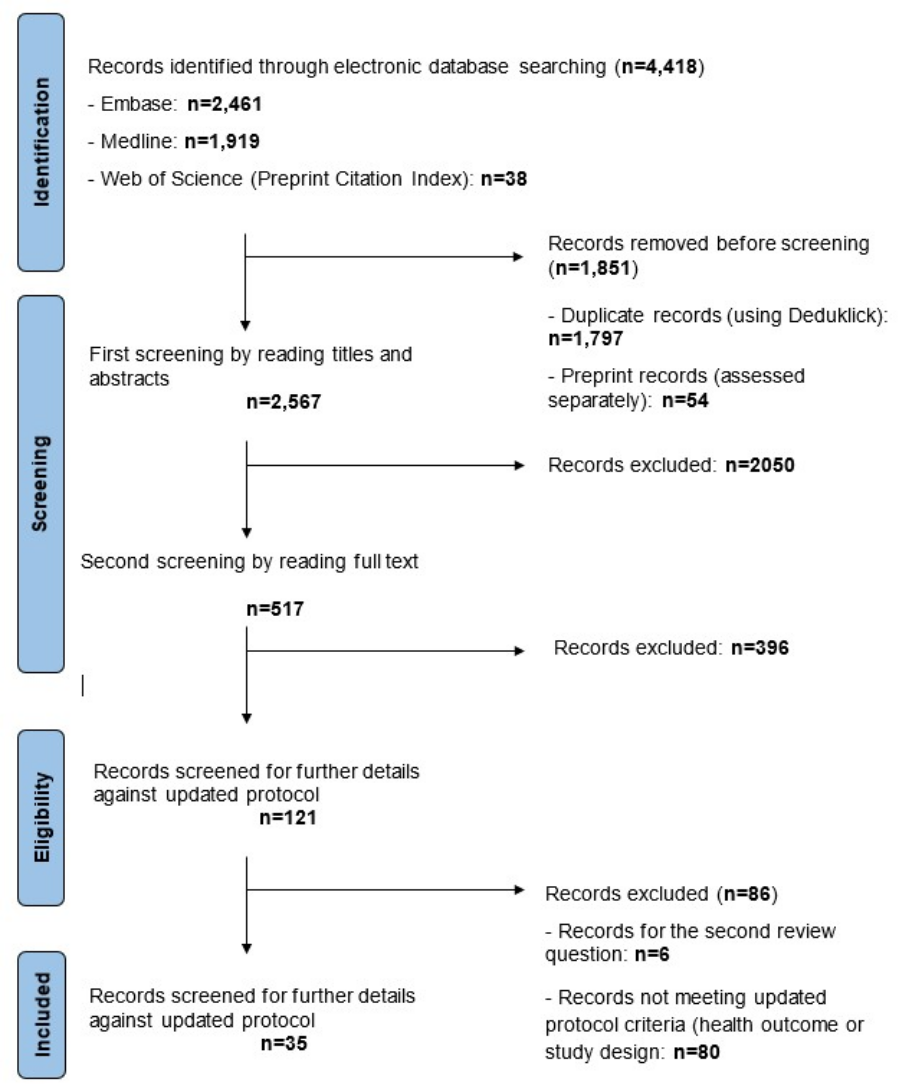
Text version of Figure 1
Flowchart showing identification of 4,418 records (2,461 from Embase, 1,919 from Medline and 38 from Web of Science (Preprint Citation Index). Figure shows that a total of 1,851 records were removed before screening (1,797 of these were duplicates identified using Deduklick, the other 54 were preprints which were assessed separately). This resulted in 2,567 records which were screened by reading titles and abstracts. 517 of these were then taken through to a second screening, where the records were screened by reading the full text. Another 396 records were excluded during this second screening, leaving 121 records which were screened for further details against the updated protocol. Of these 121 records, 80 were excluded on the basis of not meeting the updated protocol criteria (health outcome or study design) and 6 were excluded as they were relevant to the second review question only (which is not considered in this review). This yielded a final total of 35 records for inclusion in this rapid evidence review.
Evidence identified
A total of 35 papers were identified for inclusion. In line with the rapid evidence review inclusion criteria, these cohort studies investigated measured physical human health outcomes amongst communities exposed to PFAS due to local industrial and manufacturing sites producing and using PFAS chemicals and products.
The majority of the included papers were based in the Mid-Ohio Valley in the United States of America, or in Ronneby in Sweden. Papers from other geographical regions with known PFAS contamination were additionally considered as part of the evidence and make up a smaller proportion of the assessed evidence base.
Of the papers included in this review, the most predominant exposure pathway was through consumption of drinking water. The studies considered different primary PFAS, defined by the specific contamination in that location. The main PFAS assessed were perfluorooctanoic acid (PFOA), perfluorooctane sulphonic acid (PFOS) and perfluorohexane sulphonic acid (PFHxS), although many studies acknowledged, or measured, contributions to the exposure from other PFAS.
Mid-Ohio Valley, USA
A total of 17 of the 35 papers investigated PFAS contamination in the Mid-Ohio Valley which comprises of 8 counties; 7 counties in West Virginia (Calhoun, Jackson, Pleasants, Ritchie, Roane, Wirt, and Wood) and one in Ohio (Washington County) (11).
The PFAS contamination in the Mid-Ohio Valley is attributed to a chemical works (DuPont) based in Parkersburg (West Virginia) which had been using PFOA in their manufacturing processes since 1951 (12). PFOA was thought to be released from the facility into the Ohio River and into the air from the 1950s onwards, with releases increasing and peaking in the 1990s, and decreasing rapidly after 2001 (13). PFAS entered the groundwater, causing contamination of the public drinking water (14). Individuals in the affected communities were exposed to different levels of PFAS, with some water districts being more highly exposed than others (12); Darrow LA and others (2016) noted that groundwater contamination ranged from concentrations that were near background levels, up to several orders of magnitude larger, but specific concentrations were not provided (15).
C8 Health Project
The main study cohort in the Mid-Ohio Valley were recruited as part of the C8 Health Project (C8HP) which started as part of the settlement of a lawsuit filed by the community against DuPont in 2001. The project was independently created, and 3 expert epidemiologists were appointed to form what is now known as the C8 Science Panel. Data for participating individuals was collected through a health survey for demographic data upon project initiation (2005 to 2006), self-reported anthropometric measures, a blood sample, medical charts where consent was gained (used to validate self-reported outcomes), and further follow-up surveys (2008 to 2010 and 2010 to 2011) (16).
Population and eligibility Participants were required to prove consumption of water (from private or public sources) for at least 1 year between 1950 and 3 December 2004 whilst living, working or attending school in one or more of the 6 affected water districts over the 8 counties included within the Mid-Ohio Valley (16). Eligible individuals were enrolled in a baseline survey (2005 to 2006) which collected demographic and health information through blood tests and self-administered questionnaires (17). Other information such as family medical history, pregnancy history, and lifestyle and health behaviours were also collected (16). Additional study participants were recruited from a previously established cohort of DuPont workers, and the total cohort (n=69,030) (16) underwent follow-up interviews (2008 to 2011; and 2 survey rounds in 2008 to 2010 and 2010 to 2011) which gathered further information on chronic disease incidence (18).
Exposure assessments Year-by-year PFOA exposure estimates were calculated for all participants, considering estimated PFOA contamination in both air and water for each year from 1951 (or the participant’s birth year if later) to 2011 (19). The exposure estimates were further informed by information on residential history, drinking water (sources and consumption habits) and public water supply network maps. These were then converted into year-by-year PFOA serum concentration estimates using an absorption, distribution, metabolism and excretion model. For participants with workplace exposure, consideration of this was implemented through use of a job history matrix. The estimated (modelled) PFOA serum levels were compared to actual PFOA serum levels measured in 2005 amongst 45,000 participants (20). This exposure assessment is referred to in the study summaries as ‘modelled PFOA exposure’ and was used by the majority of the Mid-Ohio Valley based papers included in this review. Therefore, most of the results were reported against exposure quartiles or quintiles with the lowest quartile or quintile as the reference. For any papers which used alternative exposure assessments, details will be provided within the summary for that specific paper.
PFAS serum concentrations Serum samples from 66,899 participants were analysed for 10 PFAS. Four PFAS (PFOA, PFOS, PFHxS and perfluorononanoic acid (PFNA)) were detectable in 97% of samples with geometric means of 32.9 nanograms per millilitre (ng/mL), 19.2ng/mL, 3.3ng/mL and 1.4ng/mL respectively. PFOA was the most elevated PFAS measured when compared to PFAS serum levels recorded as part of the USA National Health and Nutrition Examination Survey (16).
Evidence from the following Mid-Ohio Valley based papers was assessed as part of this review. The study population and exposure assessment is as detailed above. Where exposure was assessed in quartiles or quintiles, the lowest (Q1) is the reference group. Any deviations from these standards will be stated.
Included papers
Barry V and others (2013) Adults aged 20 years and over (n=32,254) from the C8HP cohort. Retrospective (cumulative) PFOA exposure estimates were calculated annually between 1952 (or the participant’s birth year) and 2011. The median estimated annual PFOA serum level within the community (n=28,541) was 19.4ng/mL, with a range of 2.8ng/mL to 9,217ng/mL. The estimated median for workers (n=3,713) was 174.4ng/mL, with a range of 5.2ng/mL to 3,683ng/mL. HRs were reported for the effect of logged estimated cumulative PFOA serum concentrations for exposure with no lag, and a 10-year lag, period. For some cancer outcomes, analysis of exposure in quartiles was conducted; quartiles were defined using the estimated serum levels amongst individuals with the cancer outcomes of interest. Self-reported data on cancer incidence (bladder, brain, breast, cervical, colorectal, oesophagus, kidney, leukaemia, liver, lung, lymphoma, melanoma, oral, ovarian, pancreatic, prostate, soft tissue, stomach, testicular, thyroid and uterine) was validated through medical records or the cancer register. Results were adjusted for time-varying smoking, time-varying alcohol consumption, sex and education (14).
Darrow LA and others (2013) Infants (n=1,630) born between 2005 and 2010 to females (n=1,330) aged 19 years and over from the C8HP cohort. The exposure assessment used measured serum levels of PFOA and PFOS in mothers and odds ratios (ORs) were reported results against quintiles of exposure, per unit increase and per Interquartile range (IQR) increase. ORs were reported for preterm birth (less than 37 weeks), pregnancy induced hypertension, and low birthweight (less than 2,500 grams (g)). Difference in continuous birthweight in full-term infants was also reported. Information on the outcome was obtained from birth records. Results were adjusted for maternal age, educational level, smoking status, Body Mass Index (BMI), self-reported diabetes, and time between conception and serum measurement. For continuous birthweight, results were further adjusted for indicator variables for gestational week (21).
Darrow LA and others (2014) Females aged 20 years and over (n=1,129, with 1,438 pregnancies) from the C8HP cohort. The exposure assessment used measured maternal serum levels of PFOA and PFOS; analyses considered exposure in quintiles and as a continuous variable reported as per unit increase. ORs were reported for the effect on (self-reported) miscarriage. Results were adjusted for maternal age, educational level, smoking status, BMI, self-reported diabetes, time between conception, and serum measurement (12).
Darrow LA and others (2016) Adults aged 20 years and over (n=32,254) from the C8HP cohort. Modelled PFOA exposure was considered cumulatively in quintiles (with no lag, and 10-year lag period) and per unit increase. HRs were reported for liver disease (self-reported with subsequent medical record validation). Results were adjusted for sex, race, education level, smoking status, alcohol consumption, BMI at time of survey and birth year (15).
Dhingra R and others (2016a) Females aged 40 years and over (n=8,759) from the C8HP cohort. Modelled PFOA exposure considered cumulatively in quintiles (with no, 5-year, 10-year, and 20-year lag periods) and additionally as a continuous variable. HRs were reported for the effect on age of menopause (self-reported) from retrospective (n=8,759) and prospective (females who were premenopausal at time of the 2005/2006 C8HP survey, (n=3,334)) analyses. Results were adjusted for smoking, educational attainment, alcohol consumption, time-varying parous/nulliparous status, time-varying hypertension and time-varying high cholesterol. Additional analyses conducted with hysterectomies censored and excluded (22).
Dhingra R and others (2016b) Adults born after 1920 and aged 20 years and over (n=28,240) from the C8HP cohort. Modelled PFOA exposure was considered cumulatively (with no lag, 5-year, 10-year, and 20-year lag periods) as a continuous variable and in quintiles for primary survival analyses. HRs were reported for the effect on chronic kidney disease (self-reported, validated through medical records or end-stage renal disease registry) from retrospective (follow up from age 20, or 1951 whichever was later (cases n=397)) analysis. Results for prospective analyses are provided in the supplementary material. Results were adjusted for gender, self-reported hypertension, self-reported diabetes diagnosis, self-reported high cholesterol diagnosis, smoking, BMI, and education (18).
Karnes C and others (2014) Adults aged 20 years and over (n=32,254) from the C8HP cohort. Modelled PFOA exposure considered as a continuous variable, and also in deciles, with decile 1 (the lowest) as the reference. HRs for the outcome type 2 diabetes (T2D) from retrospective (cases diagnosed prior to 2005 to 2006, n=3,756) and prospective (cases diagnosed after 2005 to 2006, n=814) survival analyses. Self-reported data on T2D was validated through medical records. Analyses were adjusted for sex, race, education, smoking, alcohol use, BMI, and blood pressure or cholesterol lowering medication use (19).
Looker C and others (2014) Adults (n=755) from the C8HP cohort. Exposure assessment used serum measurements of PFOS and PFOA and considered exposure in quartiles and as a continuous variable. ORs were reported for self-reported ‘cold and flu’ infections, and frequency of cold infections, in the 12 months prior to undertaking the questionnaire in 2010. Results were adjusted for age and gender (23).
Savitz D and others (2012a) Females with 11,737 pregnancies between 1990 and 2006, from the C8HP cohort. Modelled PFOA exposure at the time of pregnancy considered in percentiles (less than 40th, 40th to less than 60th, 60th to less than 80th, 80th and above), per 100ng/mL increase, and per IQR increase. The lowest percentile group (less than 40th) was used as the reference. ORs were reported for self-reported outcomes of miscarriage, stillbirth, pre-eclampsia, preterm birth, term low birthweight and birth defect. Results were adjusted for exposure year, maternal age, parity, education level and smoking status (13).
Savitz D and others (2012b) Females with 4,547 births between 1990 and 2004, from the C8HP cohort. Modelled PFOA exposure considered in percentiles (less than 40th, 40th to less than 60th, 60th to less than 80th, 80th and above), per 100ng/mL increase, and per IQR increase. The lowest percentile group (less than 40th) was used as the reference. Information on outcomes (pregnancy induced hypertension (PIH), preterm birth (less than 37 weeks and less than 32 weeks), term low birthweight and small for gestational age (SGA)) obtained from birth records. Results were adjusted for maternal age, education, parity, smoking status, exposure year and state of residence. Term birthweight results were also adjusted for gestational age (24).
Simpson C and others (2013) Adults aged 20 years and over (n=32,254) from the C8HP cohort. Modelled PFOA exposure considered cumulatively in quintiles and as a continuous variable reported per unit increase. HRs were reported for the effect on stroke (including transient ischemic attack) (n=825) from retrospective survival analyses considering a no lag and 5-year lag period. Prospective survival analyses also conducted (from 2005 to 2006 to time of first stroke, n=252). Information on the outcome was self-reported and validated through medical records. Results were adjusted for time-varying hypertension, self-reported diabetes, gender, years of schooling, race, and time-varying current and former smoking and alcohol consumption (20).
Steenland K and others (2013) Adults aged 20 years and over (n = 32,254) from the C8HP cohort divided into community (n=28,541) and worker (n=3,713) sub-cohorts. Modelled PFOA exposure considered in quartiles considers with both no lag, and a 10-year lag period. Rate ratios were reported for retrospective survival analyses for the effect on incidence of autoimmune diseases. Self-reported information on the outcomes (ulcerative colitis, Crohn’s disease, rheumatoid arthritis, type 1 diabetes (including insulin-dependent diabetes), type 1 diabetes (specifically validated as such), lupus and multiple sclerosis was validated through medical records. Results were adjusted for sex and race or ethnicity and time-dependent variables for smoking, BMI, and alcohol consumption. Prospective survival analyses (follow-up 2005 to 2006 through 2008 to 2011) were conducted for some selected outcomes: ulcerative colitis and rheumatoid arthritis (25).
Stein C and others (2013) Children aged between 6 to 12 years old (n=320) from the C8HP cohort. Exposure assessment considered serum levels of PFOA obtained between 2005 to 2006 (‘measured childhood PFOA’) and estimated in utero PFOA concentration which used estimated maternal serum concentrations during pregnancy as a proxy. Exposure considered in quartiles, and per unit increase. Information on the outcomes was obtained through a series of tests conducted by 8 examiners who were blind to children’s exposure status, trained and certified to conduct the test. Tests yielded outcomes of intelligence quotient (IQ) (full scale, verbal and performance), academic skills (wording reading or pseudoword decoding) standard score and numerical operations standard score. Results for in utero exposure were adjusted for child age at the time of neuropsychological assessment, child sex, test examiner, Home Observation for Measurement of the Environment score and maternal full-scale IQ. For measured PFOA, results were also adjusted for child BMI (26).
Stein C and others (2014a) Children aged 6 to 12 years old inclusive (n=321) from the C8HP cohort. Follow up period was from 2009 to 2010. Children’s behaviour was assessed using results of surveys completed by mothers and teachers (separately). Outcomes were assessed using the Behaviour Rating Inventory of Executive Function, the Conners’ Attention-Deficit/Hyperactivity Disorder (ADHD) scale, and the Behaviour Assessment System for Children. Information on the outcomes was obtained via surveys completed by mothers and teachers. The exposure assessment used serum levels of PFOA and PFOS measured 3 to 4 years prior to behavioural assessments (therefore when the children were aged between 2 to 8 years old). Beta estimates were reported against exposure in quartiles. Results from mothers’ reports were adjusted for child age and sex, the Home Observation for Measurement of the Environment-Short Form Mother Supplement score (measuring extent and quality of stimulation in the home), maternal full-scale IQ, maternal age, and maternal employment. Results from teachers’ reports were adjusted for child age and sex (27).
Stein C and others (2014b) Females with infants (n=10,262) born between 1990 to 2006. Modelled PFOA exposure for the year on conception (as a proxy for prenatal exposure) was considered in percentiles (less than 40th, 40th to less than 70th, and 70th and above) and per IQR increase. ORs were provided per percentile. Information on the outcome (birth defects as isolated defects (gastrointestinal, kidney, brain, craniofacial, eye, limb, genitourinary and heart) and in the multiple were self-reported. Results were adjusted for year of conception. This paper was rated uninformative in the critical appraisal and therefore is not used within the evidence base considered for this review (17).
Winquist A and others (2014a) Adults age 20 years and over (n=32,254) from the C8HP cohort. Modelled PFOA exposure was considered cumulatively in quintiles, with HRs reported for hypertension (self-reported) and coronary artery disease (self-reported with subsequent medical validation using medical records). Results were adjusted for years of schooling, race, smoking, alcohol consumption, BMI and self-reported T2D (28).
Winquist A and others (2014b) Adults aged 20 years and over (n=32,254) from the C8HP cohort. Analyses started at either age 20 or the year 1952. Modelled PFOA exposure considered in quintiles (cumulative and yearly) and as log unit increase for primary retrospective survival analyses. Prospective survival analyses also conducted. HRs were reported for the effect on thyroid disease (hyperthyroidism and hypothyroidism). Information on the outcome obtained through self-reported questionnaire, answers were validated through medical records. Results were adjusted for sex, race, education, smoking, alcohol use, BMI and diabetes (29).
Ronneby, Sweden
Twelve of the 35 papers investigated PFAS contamination in Ronneby, Sweden.
In December 2013, PFAS contamination was discovered in drinking water originating from one of the 2 municipal waterworks in Ronneby (a municipality in the county of Blekinge, southern Sweden with an approximate population of 28,000) (30). This waterworks provided drinking water to approximately one-third of the households in Ronneby (30). Multiple different PFAS were detected in elevated concentrations in the waterworks, particularly PFOS and PFHxS which, in sampling taken in December 2013, were detected in concentrations of 8,000 nanograms per litre (ng/L) and 1,700ng/L respectively. The contamination was attributed to the use (and leakage) of PFAS containing firefighting foams (AFFF) at a military training range located near the aquifer (31). It is not known how long the community had been exposed for, although the Swedish Armed Forces estimated that the use of these PFAS containing firefighting foam likely began in the mid-1980s (32). The contaminated waterworks was shut down immediately following the discovery of the contamination and individuals supplied with drinking water from the alternative waterworks, which had minimal PFAS contamination (concentrations of PFOS and PFHxS in drinking water measured in this supply in December 2013 were 27ng/L and 4.7ng/L respectively (30). Sampling of uncontaminated drinking water from a neighbouring municipality revealed PFOS and PFHxS to be present in very low concentrations, less than 0.2ng/L and less than 0.3ng/L respectively (33).
The Ronneby register cohort
Individuals in the Ronneby Register Cohort were linked to different registers (for example the Swedish Prescribed Drug Register) through their unique personal identity numbers (34).
Population and eligibility
The Ronneby Register Cohort includes over 60,000 individuals who were registered as living in the municipality of Ronneby for at least one year between 1 January 1985 to 31 December 2013 (33, 35). This is an open, dynamic cohort and therefore the exact size of the population is dependent on when research was undertaken (36). Papers using this cohort obtained additional information on individuals, such as emigration status, highest achieved educational level, and registered work addresses, from Statistics Sweden (30). Educational information was available for approximately 80% of individuals in the cohort, for some of the years within the study period at least (32).
Exposure assessment Exposure was assessed by linking individuals yearly residential address to information on yearly water supply, therefore ascertaining whether individuals’ home addresses had been served by water originating from the highly contaminated water works. Home addresses were then categorised as an ‘exposed address’ or ‘unexposed address’ accordingly, homes with private wells were classified as unexposed. A time-varying exposure assessment was then conducted, based on when individuals had been exposed. Those living at an ‘unexposed address’ were classified as having ‘never-high’ exposure, and those at ‘exposed addresses’ were the ‘ever-high’ exposure group. The ‘ever-high’ exposure group was further divided into the ‘early-high’ (those at exposed addresses between 1985 to 2004) and the ‘late-high’ (those at exposed addresses between 2005 to 2013) exposure groups (35, 37). These exposure groups were validated through measured PFAS serum concentrations in a select number of individuals (37). This exposure assessment was used by the majority of the Ronneby based papers included in this review and is referred to as the ‘residential address based exposure assessment’ in the individual paper summaries below. For any papers which used alternative exposure assessments, including where different time periods were used, details will be provided within the summary for that specific paper.
PFAS serum concentrations Serum samples were taken between 2014 to 2015 from 3,084 individuals residing in Ronneby, and 226 individuals from a reference area. Serum levels of PFOS, PFHxS and PFOA were considered for the different exposure groups. For PFOS, geometric means were 40ng/mL, 199ng/mL, 48ng/mL and 239ng/mL for the ‘never-high’, ‘ever-high’, ‘early-high’ and ‘late-high’ exposure groups respectively. The geometric mean PFOS serum level for the reference group was 3.9ng/mL. The reference group consisted of subjects from Karlshamn (a neighbouring municipality) who had never resided in Ronneby between 1985 to 2013 inclusive. For PFHxS, geometric means were 30ng/mL, 176ng/mL, 43ng/mL, 210ng/mL and 0.84ng/mL for the ‘never-high’, ‘ever-high’, ‘early-high’ and ‘late-high’ exposure groups and reference group respectively. PFOA geometric means were 3.5ng/mL, 11ng/mL, 3.6ng/mL, 13ng/mL and 1.5ng/mL for the ‘never-high’, ‘ever-high’, ‘early-high’ and ‘late-high’ exposure groups and reference group respectively (33).
Included studies
Evidence from the following Ronneby based papers was assessed as part of this review. The study population and exposure assessment is as detailed above, unless otherwise stated.
Andersson EM and others (2019) All individuals from the Ronneby Register Cohort (n=63,074), who were followed until first relevant diagnosis or prescription, or censoring at death or emigration, whichever happened first. HRs were reported for hyperthyroidism and hypothyroidism assessing exposure as either ‘not exposed’ or ‘ever exposed’ or assessing exposure at different time points across 4 exposure groups; ‘not exposed’ (1980 to 1984), ‘early’ (1985 to 1994), ‘mid’ (1995 to 2004) and ‘late’ (2005 to 2013). In both cases, the exposure was defined based on residential address. In all analyses, the ‘not exposed’ exposure group was the reference. Information on the health outcomes was obtained from the National Board of Health and Welfare which drew upon information from The Swedish National Patient Register and The Swedish Prescribed Drug Register (used in analyses for prescriptions from 2006 onwards). Results were adjusted for age and in one sub-analyses for educational level and stratified by sex (32).
Ebel M and others (2023) Children (n=27,292) born between 1995 to 2013 to mothers residing in Blekinge County. Exposure was categorised based upon the mothers’ residential address history in the 5 years prior to childbirth, as a proxy prenatal exposure. Mothers residing at an address supplied with highly contaminated water for at least 1 out of the 5 years prior to childbirth were included in ‘high’ exposure groups respectively, whilst those who had resided in Ronneby, but at an address not supplied by the highly contaminated waterworks formed the ‘intermediate’ exposure group. The ‘background’ exposure group (which was used as the reference in analyses) included mothers residing in Blekinge county during the 5 years prior to childbirth, but not Ronneby. ORs were reported for gestational hypertension and pre-eclampsia (as a combined outcome) and gestational diabetes mellitus, with information on the outcome obtained from health registers, within which diagnoses resulting from Swedish antenatal care and midwife appointments were reported. Results were adjusted for maternal BMI, birth country, educational status, smoking status, age and parity (38).
Ebel M and others (2025) Children (n=17,051) born between 2003 to 2013 to mothers residing in Blekinge County for a minimum of one year during the 5 years prior to childbirth. Information on the outcome (childhood infections of the ears, eyes, respiratory tract and urinary tract) was obtained from details of registered visits to a medical doctor or nurse between 2010 to 2021. Exposure was categorised based upon the mothers’ residential address history in the 5 years prior to childbirth, as a proxy prenatal exposure. Mothers residing at an address supplied with highly contaminated water for all 5 years, and 1 to 4 years, prior to childbirth were included in the ‘very-high’ and ‘high’ exposure groups respectively. The ‘intermediate’ exposure group included mothers residing in Ronneby for at least 1 to 5 years prior to childbirth, but at an address not supplied with water from the highly contaminated waterworks. The ‘background’ exposure group (which was used as the reference in analyses) included mothers residing in Blekinge county, but not Ronneby (39).
Engström K and others (2022) Infants born in Blekinge county between 1995 and 2013 (n=30,360). Information on the outcome (differences in birthweight), and mothers’ demographics obtained through the Swedish Medical Birth Register. Maternal educational data was available from 1990 onwards from Statistics Sweden. Maternal residential history in the 5 years prior to childbirth was used as a proxy for in utero exposure for the infant. The ‘high’ exposure group included mothers residing at an address supplied with contaminated water for at least 1 year out of the 5 years prior to childbirth. The ‘low’ exposure group included mothers residing in Ronneby, but those who were not in receipt of contaminated water. The ‘background’ exposure group (which was used as the reference in analyses) included mothers residing in Blekinge county, but not in Ronneby. Results were adjusted for parity, maternal education, maternal smoking in early pregnancy, maternal age, gestational age and BMI in early pregnancy (40).
Hammarstrand S and others (2021) Females of all ages from the Ronneby Register Cohort (n=29,106) who had resided in Ronneby between 1985 to 2013. HRs were reported for polyendocrine metabolic ovarian syndrome (PMOS), uterine leiomyoma (fibroids) and endometriosis reported for exposure groups (classified by the residential address-based exposure assessment) in comparison to the ‘never-high’ exposure group. Main analyses were restricted to women aged 20 to 50 years (as these were assumed to be premenopausal) between 2002 to 2013. No upper age restriction was applied to analyses of uterine leiomyoma. Results were adjusted for high achieved educational level, information on which was available from 1990 onwards. Information on health outcomes was obtained from The Swedish National Patient Register, via The Swedish National Board of Health and Welfare (37).
Hammarstrand S and others (2024) Females (aged between 30 to 85 years) from the Ronneby Register Cohort (n=24,509) who were alive in 2006 and had not received a diagnosis of breast cancer between 1985 to 2005. Individuals were followed until 2016, and HRs were reported for hormone positive breast cancer reported for exposure groups (classified by the residential address-based exposure assessment) in comparison to the ‘never-high’ exposure group. Sensitivity analyses for educational level were conducted and analyses subsequently adjusted for this. The outcome was assessed using the presence of adjuvant endocrine therapy as a proxy for hormone positive breast cancer. Additional analyses considered hormone negative breast cancer, and all breast cancer. Information on the outcome was obtained from the Swedish Cancer Register, with hormone receptor status amongst identified breast cancer cases confirmed through the Swedish Prescribed Drug Register (34).
Li H and others (2022) Individuals aged 85 years and under from the Ronneby Register cohort (n=60,507). Time of entry into the cohort was when a person was registered as living in Ronneby between January 1985 to December 2013. Until 31 December 2016, individuals were followed until first relevant diagnosis, or censoring, whichever happened first (censoring occurred at death, emigration or upon turning 85 years old). Information on 35 cancer outcomes (overall, lip, oral, salivary gland, pharynx, oesophagus, stomach, colon, rectum, liver, gallbladder and bile duct, pancreas, nose and sinuses, larynx, trachea and lung, pleura, breast, cervix, uterus, ovarian, vulva and vagina, prostate, testicle, kidney, bladder, skin (melanoma), skin (non-melanoma), brain, thyroid, Non-Hodgkin lymphoma, Hodgkin lymphoma, myeloma, chronic lymphocytic leukaemia, chronic myelogenous leukaemia, and polycythaemia vera) obtained from the Swedish Cancer Register. Use of the residential address-based exposure assessment. Standardised incidence ratios (SIRs) were reported the ‘never-high’ and ‘ever-high’ exposure groups, using Blekinge county (excluding Ronneby) as the reference population. Results were adjusted for age and calendar year and stratified by sex. Secondary analyses report HRs from internal comparison of the exposure groups, using the ‘never-high’ exposure group as reference. Results were adjusted for age and sex (33).
Nielsen C and others (2022) Infants born between 1999 to 2009 (n=2,374) in Ronneby and a reference municipality identified from Child Health Care charts from Child Health Care centres. Exposure was defined using the mothers’ residential address history in the 5 years prior to childbirth as a proxy for childhood exposure and categorised into ‘high’, ‘low’ and ‘background’ exposure groups. The ‘high’ exposure group included those residing at an address supplied with water from the contaminated work works for at least one year. The ‘low’ exposure group included mothers who had resided in Ronneby, but at an address not supplied with water from the highly contaminated waterworks. The ‘background’ exposure group included mothers residing in Blekinge county, but not Ronneby. The ‘background’ exposure group was used as the reference. Information on breastfeeding practices (including successful initiation, duration and cessation) was obtained from Child Health Care charts, with analyses reporting relative risks and hazard ratios adjusted for time period, maternal age, parity, BMI, education level, country of birth, and tobacco use during pregnancy (31).
Stübner C and others (2023) Children (who were not born prematurely) from the Ronneby Register Cohort who had a residential address in Blekinge County for at least 1 year between birth and the age of 7 years old between 1998 to 2013. Exposure was defined using the mothers’ residential address history in the 5 years prior to childbirth, as a proxy for childhood exposure. Exposure was categorised in to ‘high’, ‘intermediate’ and ‘background’ exposure groups. The ‘high’ exposure group included children born to mothers’ residing at an address supplied with highly contaminated water for at least one year. The ‘intermediate’ exposure group included children born to mothers who had resided in Ronneby, but at an address not supplied with water from the highly contaminated waterworks, for at least one year and the ‘background’ exposure group (which was used as the reference in analyses) included children born to mothers residing in Blekinge county, but not Ronneby. HRs were reported for developmental language disorders (DLDs) where information on the outcome was obtained from the regional health care register which reported information on referrals from the Child Health Service to speech and language pathologists (SLPs) and clinical diagnoses of DLDs. Results were adjusted for parity, maternal age, maternal education, and smoking in early pregnancy. Some analyses were stratified by sex (41).
Xu Y and others (2020) Individuals from the Ronneby Register cohort aged 10 years and over (n=63,074). HRs were reported for the diagnosis of inflammatory bowel diseases (Crohn’s disease, ulcerative colitis, other or non-specified IBD, and all IBD) amongst exposure groups (classified by the residential address-based exposure assessment) using the ‘never-high’ exposure group as the reference. Included in this is ‘early’ (at least one year living at an address supplied with contaminated water between 1985 to 1994) ‘mid’ (receiving contaminated water for at least one year between 1995 to 2004) and ‘late’ (receiving contaminated water for at least one year between 2005 to 2013). Information about health outcomes obtained from The Swedish National Patient Register and the cause of death register. Sensitivity analyses were performed for males and females separately, age, and for only individuals on the in-patient registry (1980 to 2013) and after 2001 for the in and out-patient registry. Results were adjusted for highest achieved educational level (36).
Xu Y and others (2023a) Individuals from the Ronneby Register cohort (n=61,504). HRs for major osteoporotic fractures (MOFs) were reported for exposure groups (classified by the residential address-based exposure assessment) using the ‘never-high’ exposure group as the reference. Information on the health outcomes obtained from the Swedish National Patient Register. Results from primary analysis adjusted for age and sex; further results were adjusted for highest achieved education level also (30).
Xu Y and others (2023b) Individuals aged 18 years and over (n=55,032) from the Ronneby Register cohort. HRs were reported for incidence of T2D with information on the health outcomes obtained from the National Patient Register (inpatient data available from 1987 onwards, and outpatient data additionally available from 2001 onwards) and the Prescription Register (analyses based on data from 2006 onwards). Analyses reported findings for exposure groups determined by the residential address-based exposure assessment, with the ‘never-high’ exposure group as the reference. Primary analyses were adjusted for sex; further analyses were adjusted for highest achieved education level where available (35).
Veneto, Italy
Three of the 35 papers investigated PFAS contamination in the Veneto Region, Italy.
In spring 2013, following a study into PFAS contamination in major Italian river basins, PFAS contamination of surface water and groundwater was discovered in a large area of the Veneto Region in northeast Italy (42). Soil in the area was also found to be contaminated (43). The main source of contamination was a chemical plant located in the Province of Vicenza, within the Veneto Region, which had produced PFAS since the early 1960s (43). PFAS entered the environment via wastewater emissions from the plant, and water from the wastewater treatment (44). The area affected by contaminated groundwater (42) included 30 small towns across the provinces of Vicenza, Verona and Padova, with a total approximate population of 140,000 (43). The contamination affected both public waterworks and private wells. In drinking water, PFOA and PFOS were detected in concentrations up to a maximum 1,475ng/L and 117ng/L respectively (44). By August 2013, carbon-based filters had been installed to remediate drinking water (44).
The Veneto health surveillance programme
The Veneto health surveillance programme is the main cohort of individuals studied in the papers based in Veneto included is this review. The programme was established to address public concerns, and to “aid in the prevention, early diagnosis, and treatment of some the chronic disorders with epidemiological evidence of associations with PFAS exposure”(42).
Population and eligibility The health surveillance programme included residents of the Veneto Region, Italy. Residents were eligible if they resided in the so called ‘Red Area’ of Veneto (45), which comprised of 21 municipalities classified as having the highest PFAS exposure as of 31 December 2016 (42). The regional health registry was used to identify eligible individuals and, starting in January 2017 with those born in 2002, individuals were recruited sequentially from youngest to oldest (42). This marked the start of the first round of screening. The programme was extended in December 2018 to children in 2018 and again in February 2019 to include individuals from an additional 9 municipalities which had been added to the ‘Red Area’ (42). The comparison population consisted of individuals living outside of the contaminated areas (43). During the screening, demographic and health information was collected from interview questionnaires along with some biological sample collection including blood samples. Participants were additionally asked about dietary habits, including consumption of home grown produce and drinking water intake, as well as the source of this drinking water (42). As of June 2022, 53,693 individuals had completed the first round of screening (45). A second round of screening commenced in 2020 and was noted by Berti M and others (2025) to still be ongoing, at the time of their writing (45).
Exposure assessment The 3 papers from the Veneto Region use different exposure assessments which are detailed in the individual paper summaries below.
PFAS serum concentrations Non-fasting blood samples from participants were analysed for 12 different PFAS. PFOA, PFOS and PFHxS were quantifiable in at least 80% of the samples analysed from a sub-group of the population (n=18,345) who were born between 1978 to 2002. Median serum concentrations of PFOA, PFOS and PFHxS were found to be 44.4ng/mL, 3.9ng/mL and 3.9ng/mL respectively (42).
Included papers
Evidence from the following Veneto based papers was assessed as part of this review.
Berti M and others (2025) Females from the Veneto health surveillance programme aged between 39 to 60 years old (inclusive) when participating in the first round of screening (n=8,536) were included in the retrospective prospective analysis. Females who completed both rounds of screening (n=1,709) were included in the prospective analysis, assuming they met the same age eligibility. For both analyses females were excluded if they had undergone hysterectomies, had already experienced menopause at the first round of screening, or if they lacked menopausal age data. Estimations for PFOA serum concentrations in 2013 were determined using estimated excretion rates and half-lives, as well as considering background exposures. Modelled PFOA exposure was considered in quartiles (with Q1 as the reference) and reported as per log unit increase for both analyses. HRs (adjusted for country of birth, education level, smoking status, number of deliveries, categorical BMI and use of oral contraceptives or hormonal therapy) were reported for the effect on the (self-reported) age of onset of menopause (45).
Del Fiore and others (2022) Individuals (n=682), aged 15 years old and over, diagnosed and/or treated for primary melanoma at the Veneto Institute of Oncology and the University Hospital of Padua between 1998 to 2014. The exposed population (n=194) were identified in line with Veneto regional administration documentation on PFAS contaminated areas; binary exposure assessment of ‘exposed’ and ‘unexposed’. Demographic and condition related information (for example subtype of melanoma and primary site) was obtained from local database and medical appointments. Analysis of prevalence in the exposed and unexposed cohorts (adjusted for age and sex), and survival analyses considering overall survival, disease-specific survival and disease-free survival, were conducted (43).
Manea S and others (2020) Live singleton births (n=105,114) occurring between 2003 to 2018. Births included only live births, where there was one child born per delivery to mothers living in the contaminated region at time of delivery. PFAS exposure was assigned as ‘contaminated area’ or ‘control area’ based on maternal residence reported on birth certificates. Births identified from the Veneto Region Birth Registry. ORs (adjusted for maternal age, parity, nationality educational level, working status and parity) were reported for incidence of severe SGA (n=637) (44).
Australia
Two of the 35 papers investigated PFAS contaminated areas in Australia.
PFAS containing firefighting foams were used when training and responding to fire emergencies across Australian Department of Defence bases for several decades from the 1970s onwards (46). The firefighting foams used contained PFOS and PFHxS as the main active ingredients. This caused contamination of both land and water in nearby communities (47). Communities may have been exposed to PFAS through consumption or use of contaminated water, and through consumption of locally grown produce. PFAS concentrations recorded in contaminated water are not provided (48).
The PFAS health study: data linkage study
The Australian Department of Health commissioned the Australian National University (ANU) to conduct the ‘PFAS Health Study’. Part of this work included an epidemiological study of the PFAS contamination in 3 Australian communities (Katherine in the Northern Territory (NT), Oakey in Queensland (Qld) and Williamtown in New South Wales (NSW)). This review uses the territory abbreviations to reference the areas studied, mirroring the authors’ formatting. However, it should be noted that this refers to the specific community as stated above, not the entire territory. The epidemiological study included the Data Linkage Study which used routinely collected data to conduct a retrospective cohort study investigating whether adverse health outcomes were potentially association with living in the contaminated areas (49).
Population and eligibility The population was identified through the Australian Government Department of Human Services Medicare Enrolment file, with the exposed population including all individuals from this file who registered an address in Katherine (in the NT), Oakey (Qld) or Williamtown (NSW) at any point between 1984 to 2018. In relation to neonatal, infant and maternal outcomes, the population was identified using NT, Qld and NSW Perinatal Data Collections. The comparison population consisted of individuals who resided in postcodes with similar socioeconomic status and remoteness as the investigation areas, as identified by the researchers (49).
Exposure assessment Exposure was assessed as a binary outcome (exposed or not exposed). The duration of exposure was not considered (49). Katherine, Oakey and Williamtown are the exposed populations, and their respective comparison areas the unexposed populations. The authors provided analyses for the 3 study areas separately, not as combined entities.
PFAS serum concentrations Geometric means of serum PFOS and PFHxS (measurements made from 2016 to 2019) ranged from 4.9ng/L to 6.6ng/mL and 2.9ng/L to 3.7ng/mL respectively. Geometric means measured for PFOA yielded ranges that were similar to levels measured in comparison (unexposed) populations (1.3ng/L to 1.8ng/mL) (46).
Included papers
Evidence from the following Australia based papers was assessed as part of this review. The study population and exposure assessment is as detailed above, unless otherwise stated.
Law HD and others (2023a) Mothers and infants born from 1986 to 2017 for NT, from 2007 to 2018 for Qld, and from 1994 to 2018 for NSW (timeframes determined on availability of perinatal data). Relative risks of adverse perinatal outcomes and maternal conditions amongst exposed infants and their mothers (NT n=5,606, Qld n=665, and NSW n=188) were reported against the corresponding comparison population. Outcomes included gestational diabetes, PIH, postpartum haemorrhage, preterm birth and spontaneous preterm birth, SGA, large for gestational age, stillbirth, and low Apgar score at 5 minutes. The difference in means for growth measurements (birthweight, birth length and head circumference in term infants) was also investigated. Information on outcomes, address history, and demographic data were obtained from jurisdictional Perinatal Data Collections from the 3 areas. Results were adjusted for year of birth, maternal age, maternal Aboriginal and Torres Strait Islander status (except NSW), parity, marital status (except NSW), maternal country of birth, maternal BMI (Qld only), and maternal smoking status during pregnancy. Postpartum haemorrhage was also adjusted for macrosomia. Preterm birth, stillbirth, low Apgar, and growth measures were additionally adjusted for infant sex of the baby. Outcomes restricted to term infants included adjustment for gestational week (46).
Law HD and others (2023b) All individuals (n=54,343) who had resided in a contaminated area between 1983 to 2019, with a total of 24,166 cancer diagnoses between 1983 to 2017, amongst individuals aged 25 years old and over. SIRs were reported for NT, Qld and NSW populations against corresponding comparison populations. Candidate cancer outcomes (head and neck, oesophageal, stomach, colorectal, pancreatic, laryngeal, lung, breast, uterine, ovarian, prostate, testicular, kidney, bladder, thyroid, Hodgkin lymphoma, non-Hodgkin lymphoma, and leukaemia). SIRs were also provided for ‘any candidate cancer’, ‘any other cancer’ and ‘any cancer’, as well as candidate death outcomes (chronic kidney disease, coronary heart disease, stroke and liver disease). Results were adjusted for age, sex and calendar period. Deaths at any age were included. Information on cancer diagnoses and deaths was obtained from the Australian Cancer Database and the National Death Index respectively (47).
Oakdale, Minnesota, USA
One of the 35 papers investigated PFAS contamination in Oakdale, Minnesota in the USA.
Elevated levels of PFOA and PFOS were discovered in municipal water supplies providing water to individuals residing in Oakdale, Minnesota; this municipal supply served approximately 99% of Oakdale’s population (27,000). Analysis of the municipal wells revealed concentrations of PFOA and PFOS ranging from 70ng/L to 700ng/L, and non-detectable to 1,040ng/L, respectively. The contamination was attributed to industrial disposal in nearby landfills dating back to the 1950s. Water supplies to other nearby communities were also affected by PFAS contamination, but to a lesser extent. In comparison to Oakdale, the mitigating measures implemented in these communities were more limited. In Oakdale, PFAS levels (and community exposure) declined in November 2006 following the installation of granular activated charcoal filtration measures (50).
The population, eligibility, exposure assessment and PFAS serum concentrations discussed below relate to the single included paper based in Minnesota.
Population and eligibility Population of singleton births (between 2002 to 2011) that occurred in Washington country zip codes, including in Oakdale (n=3,400) and in other neighbouring affected communities (n=17,617) compared to the control area (n=28,048).
Exposure assessment Maternal residential zip code at time of infants’ birth (including birth year) used as proxy for PFAS exposure.
PFAS serum concentrations Geometric means of serum PFOA and PFOS of 15.4ng/mL and 35.9ng/mL respectively (based on volunteer samples obtained in 2008, 2 years prior to the implementation of filtration measures).
Included paper
Waterfield G and others (2020) Eligible participants were identified from birth record data collected by the Minnesota Department of Health. Information on outcomes was also obtained from birth record data. Analyses considered the impact of exposure in 2 different time frames (pre-filtration (2002 to 2006) and post-filtration (2007 to 2011)) in Oakdale (1,685 and 1,715 births respectively), and nearby communities who received less contaminated water, compared to a control community. Analysis considered continuous (birthweight and gestational age) and binary (birthweight less than 2,500g, birthweight less than 1,500g, gestational age at birth of less than 37 weeks and less than 32 weeks). All outcomes were adjusted for individual level characteristics (sex, mother’s age, educational attainment, and marital status) and zip code level characteristics (mean household income, and percentages of the population being Asian, Black, or Hispanic) (50).
Evidence synthesis (results)
The evidence assessed and discussed within this evidence review relates to that from the papers which met the inclusion criteria after screening. The evidence synthesis does not draw on data from the wider evidence base. In the first instance, only primary evidence (from populations with outcome case numbers of greater than 5) was assessed. Confidence intervals and p-values are provided where available. More information on the evidence synthesis can be found in the Materials and methods section above. For papers where statistically significant findings have been assessed as part of the evidence synthesis, concentrations for exposure categories (for example, blood concentration quintiles or quartiles) are provided in Annexe C.
Kidney and liver conditions
1) Chronic kidney disease
Dhingra R and others (2016b) examined the association between high PFOA exposure and chronic kidney disease (n=397) (18). This paper, based in the Mid-Ohio Valley, was rated medium confidence. In the retrospective analysis, the authors reported an elevated HR for some of the exposure groups but an increasing risk with increasing exposure was not observed. Results were not statistically significant. Similarly, the HRs reported for the prospective analysis, some of which were not elevated, were not statistically significant.
In a paper (rated medium confidence) considering 3 Australian communities, Law HD and others (2023b) examined the association between PFAS exposure (mainly PFOS and PFHxS) and chronic kidney disease mortality rates (47). The authors considered SIRs and reported an elevated, small magnitude SIR for Qld (10 observed deaths). The SIR reported for NT (8 observed deaths) was below the null. Neither result was statistically significant. The number of observed and/or expected cases in NSW was less than or equal to 5, and therefore this data was not assessed as part of this review.
Neither paper presented statistically significant associations for these 2 different kidney disease outcomes, nor do the papers consider the same primary PFAS. There are inconsistencies in the results within and between the papers. For this analysis, there is inadequate evidence to determine the presence, or absence, of an association between PFAS and chronic kidney disease.
2) Liver disease
Darrow LA and others (2016) (rated medium confidence) investigated the association between PFOA exposure and medically validated liver disease (n=647) in the Mid-Ohio Valley (15). HRs reported for the association between cumulative PFOA exposure and liver disease were elevated in Q2 when considering exposure both without a lag period, and with a 10-year lag period. HRs for other quintiles (for both exposure measures) were small in magnitude and varied, with some being above the null, and some being below. However, none of these results were statistically significant. HRs for the effect per unit increase in exposure were close to the null and not statistically significant for both exposure measures.
In a paper considering 3 Australian communities, Law HD and others (2023b) examined the relationship between PFAS exposure (mainly PFOS and PFHxS) and liver disease mortality rates (47). This paper was rated medium confidence. The authors considered SIRs for liver disease mortality rates and, in NT, reported a lower number of observed deaths (n=8) compared to the expected number, based on the comparison population. This result was statistically significant; SIR 0.46, 95% CI 0.20 to 0.91. SIRs reported for Qld was elevated (15 observed deaths) but not statistically significant. The number of observed and/or expected cases in NSW was less than or equal to 5, and therefore this data was not assessed as part of this review.
Although Law HD and others (2023b) reported a statistically significant reduction in liver disease mortality, this finding was observed in only one Australian community (NT) and was not consistent with other results reported in the same paper or those reported by Darrow LA and others (2016) (15). Additionally, the papers analysed different outcomes (liver disease compared to liver disease mortality) and assessed exposures to different PFAS. Therefore, these 2 papers are not directly comparable and for this analysis, there is inadequate evidence to determine whether an association exists between PFAS exposure and liver disease (including liver disease mortality).
Cardiovascular conditions
1) Coronary artery or heart disease
Winquist A and others (2014a) (rated medium confidence) investigated the association between exposure to PFOA and coronary artery disease amongst a cohort from the Mid-Ohio Valley (28). In the retrospective analysis (n=2,468), the authors reported statistically significant elevated HRs when considering cumulative PFOA exposure (in comparison to Q1) for Q2 (HR 1.26, 95% CI 1.10 to 1.45) and Q3 (HR 1.17, 95% CI 1.02 to 1.35). However, the results for Q4 and Q5 were elevated but not statistically significant, and an increasing risk was not observed with increasing cumulative exposure. Sex and age stratified retrospective analysis revealed statistically significant modestly elevated HR (exact HR and CI) not provided by authors) in males aged 20 to 39 years old in Q2. Additionally, there were elevated HRs (exact HR and CI not provided by authors) across Q3 to Q5, but these were not statistically significant and the CIs for all risk estimates were wide. The trend for cumulative exposure was not statistically significant. For females, the retrospective analysis revealed no statistically significant results and an increase in magnitude of HRs with increasing quartiles was not observed in any age category. In the prospective analysis (n=515), HRs were observed to be below the null and were statistically significant for Q2, Q3 and Q5 (exact HRs not provided by authors).
In a paper (rated medium confidence) of 3 Australian communities, Law HD and others (2023b) investigated the association between PFAS (mainly PFOS and PFHxS) exposure and coronary heart disease mortality rates (47). The reported SIRs varied between the 3 communities. For NT (40 observed deaths), the SIR was close to the null and not statistically significant. Statistically significant SIRs were reported for Qld (SIR 1.22, 95% CI 1.01 to 1.47) (114 observed deaths) and NSW (SIR 1.81, 95% CI 1.46 to 2.23) (92 observed deaths) indicating higher rates of coronary heart disease mortality than expected, compared to the unexposed population.
The 2 included papers considered different primary PFAS and examined different specific health outcomes in relation to coronary artery/heart disease. Given these differences, the findings are not directly comparable, and as both studies present statistically significant findings, separate conclusions have been drawn for each study. Winquist and others (2014a) considered incidence and prevalence of coronary artery disease (28). Multiple statistically significant results were reported across different quintiles in both the primary retrospective analysis and additional retrospective analysis, which stratifies for age and sex. However, these statistically significant results are across different quintiles in the 2 analyses, meaning a clear pattern in respect to PFOA exposure and association with the outcome cannot be seen. Additionally, the prospective analysis results are not consistent with those from the retrospective analysis. For this analysis, there is inadequate evidence to determine the presence, or absence, of an association between PFOA exposure and the incidence or prevalence of coronary artery disease.
Law HD and others (2023b) considered mortality rates attributed to coronary heart disease (47). Results across the 3 communities considered were not consistent. For this analysis, there is inadequate evidence to determine the presence, or absence, of an association between exposure to PFHxS and PFOS and coronary heart disease.
2) Myocardial infarction (heart attack)
Winquist A and others (2014a) (rated medium confidence) investigated the association between PFOA and myocardial infarction (heart attack) in the cohort from the Mid-Ohio Valley (28). The authors reported that the effect estimates from retrospective analysis were similar to those presented for coronary artery disease, although the author does not provide this dataset and the number of observed cases is also not provided.
Given that the appropriate dataset is not provided, for this analysis there is inadequate evidence to determine the presence or absence of an association between PFOA and myocardial infarction.
3) Stroke and transient ischaemic attack
Simpson C and others (2013) (rated medium confidence) investigated the association between PFOA exposure and stroke (including transient ischemic attack (TIA), ‘mini stroke’) (n=825) in a paper centred in the Mid-Ohio Valley (20). In the retrospective survival analyses, the authors reported elevated HRs considering cumulative PFOA exposure across quintiles (with Q1 as the reference); these data were statistically significant in Q2 (HR 1.39, 95% CI 1.11 to 1.76. p=0.005), Q3 (HR 1.36, 95% CI 1.08 to 1.71. p=0.010) and Q4 (HR 1.45, 95% CI 1.15 to 1.82. p=0.002). However, the HR for Q5 was smaller in magnitude than those reported for Q2 to Q4, and not statistically significant. Trend tests also did not show a statistically significant trend across quintiles. Similar results were reported when considering cumulative exposure with a 5-year lag.
Law HD and others (2023b) (rated medium confidence) considered 3 Australian communities, investigating the relationship between exposure to PFAS (mainly PFOS and PFHxS) and stroke mortality rates (47). Elevated SIRs were reported in 2 communities (NT and NSW, with 12 and 29 observed deaths respectively), and an SIR below the null reported in Qld (27 observed deaths). The results were not statistically significant.
The 2 papers investigated different outcomes and considered different primary PFAS. For the association between PFOA and prevalence of stroke (including TIA). Simpson C and others (2013) reported statistically significant results for some exposure quintiles, but not for Q5 (the highest exposure quintile) (20). For this analysis, the evidence suggests that there may be an association between exposure to PFOA and prevalence of stroke.
Law HD and others (2023b) investigated stroke mortality, rather than prevalence, with the main PFAS being PFOS and PFHxS (47). The authors did not report consistent results across all communities, and the results were not statistically significant. For this analysis, there is inadequate evidence to determine the presence, or absence, of an association between exposure to PFOS and PFHxS and stroke mortality.
4) Hypertension
In a Mid-Ohio Valley based paper, Winquist A and others (2014a) examined the association between PFOA exposure and hypertension; this paper was rated medium confidence (28). In the retrospective analysis (n=11,798), the authors reported statistically significant HRs when considering cumulative PFOA exposure (in quintiles with Q1 as the reference) for Q2 (HR 1.10, 95% CI 1.02 to 1.19) and Q3 (HR 1.10, 95% CI 1.02 to 1.18). These effect estimates were small in magnitude, and close to the null. For Q4 and Q5, the effect estimates were not statistically significant, and close to the null. Sex and age stratified analyses revealed some statistically significant elevated HRs in females (Q2 and Q3, exact HRs and 95% CI not provided by author) aged 20 to 39 years, and males (Q3 and Q4, exact HRs not provided by author) aged 40 to 59 years, although a clear trend of increasing effect estimate magnitude with increasing quintile was not observed. In the prospective analysis (n=2,226), reported HRs were close to, or below the null, and not statistically significant.
Results from Winquist A and others (2014a) were inconsistent across quintiles with no clear evidence of a trend (28). For this analysis, there is inadequate evidence to determine the presence, or absence, of an association between PFOA exposure and hypertension.
Musculoskeletal conditions
1) Osteoporotic fractures
Xu Y and others (2023a) investigated the relationship between long-term high PFAS exposure (dominated by PFOS and PFHxS) and major osteoporotic fractures (MOFs) amongst individuals from Ronneby, Sweden) (30). MOFs were defined to include any fractures located in the vertebrae, proximal humerus, distal forearm and hip. The authors provided results for MOFs as a combined outcome and also analysed individual MOF types; the primary outcomes were MOFs and hip fractures. The authors also analysed the effect on all fractures (excluding teeth). This paper was rated medium confidence and presented results in comparison to the ‘never-high’ exposure group.
The authors reported a statistically significant, elevated HR for the prevalence of MOFs in the ‘ever-high’ (n=1,079) and ‘late-high’ (n=439) exposure groups (HR 1.11, 95% CI 1.03 to 1.19. p less than 0.001 and HR 1.29, 95% CI 1.16 to 1.44. p less than 0.001 respectively). The HR for the ‘early-high’ exposure group (n=640) was close to the null, and not statistically significant. Upon adjustment for education level (population sizes not reported), similar results were observed with elevated, statistically significant HRs reported for the ‘ever-high’ and ‘late-high’ exposure groups (HR 1.09, 95% CI 1.00 to 1.18. p=0.042 and HR 1.21, 95% CI 1.08 to 1.36. p=0.001 respectively). Results from age and sex stratified analyses also yielded a statistically significant elevated HR for ‘ever-high’ (n=248) and ‘early-high’ (n=161) exposure groups, specifically for males aged over 50 years (HR 1.25, 95% CI: 1.08 to 1.45. p=0.002; HR 1.27, 95% CI: 1.07 to 1.51. p=0.008 respectively).
When considering individual fracture types in both males and females, the authors reported elevated, statistically significant HRs in the ‘ever-high’ exposure group for proximal humeral fractures (n=190) (HR 1.32, 95% CI 1.1 to 1.56. p less than 0.001), distal forearm fractures (n=473) (HR 1.17, 95% CI 1.05 to 1.30. p=0.01), hip fractures (n=439) (HR 1.12, 95% CI 1.01 to 1.24. p=0.04) and all fractures except teeth (n=2,352) (HR 1.07, 95% CI 1.02 to 1.12. p=0.01).
Similar results were also reported for these outcomes in the ‘late-high’ exposure group (proximal humeral fractures (n=90) HR 1.42, 95% CI 1.12 to 1.80. p less than 0.001; distal forearm fractures (n=227) HR 1.33, 95% CI 1.15 to 1.54. p less than 0.001; hip fractures (n=140) HR 1.22, 95% CI 1.01 to 1.47. p=0.04; all fractures except teeth (n=919) HR 1.18, 95% CI 1.10 to 1.27. p less than 0.001). When adjusted for education, the reported effects were smaller, and not all were statistically significant. Results from age and sex stratified analyses yielded elevated, but not statistically significant HRs in the ‘ever-high’ and ‘early-high’ exposure groups, for hip fractures in males and females aged 50 years and over. The result for females aged 50 years and over in the ‘late-high’ exposure group (n=96) for hip fractures was statistically significant (HR 1.30, 95% CI 1.03 to 1.64. p=0.024).
For this analysis, the evidence presented by Xu Y and others (2023a) suggests there may be an association between exposure to PFOS and PFHxS and risk of MOFs, primarily within the ‘late-high’ exposure group, although this is not observed universally across all MOF types (30).
Metabolic and endocrine conditions and disorders
1) Thyroid disorders
a) Functional thyroid disease
Winquist A and others (2014b) explored the association between PFOA exposure and functional thyroid disease, defining the outcome as “a report of Graves disease, goitre, hyperthyroidism, hypothyroidism, Hashimoto’s disease, thyroiditis not otherwise specified, or thyroid function problem of unknown type” (29). Exposure was assessed in quintiles, with Q1 as the reference. This paper was rated medium confidence. The authors used the C8HP cohort (the ‘main cohort’) but additionally provided analysis of the community members only within the secondary analysis.
From retrospective survival analyses considering cumulative exposure in the main cohort, the authors reported elevated HRs across all quintiles for both sexes combined, with statistically significant results for Q2 (HR 1.21, 95% CI 1.01 to 1.45. p=0.041), Q4 (HR 1.27, 95% CI 1.06 to 1.52. p=0.008), and Q5 (HR 1.28, 95% CI 1.06 to 1.53. p=0.010). However, a statistically significant log-linear trend was not observed. Sub-analyses stratifying by sex showed similar results for females, with elevated, statistically significant results for Q2 to Q5 (Q2 HR 1.24, 95% CI 1.02 to 1.51. p=0.031; Q3 HR 1.27, 95% CI 1.04 to 1.55. p=0.019; Q4 HR 1.36, 95% CI 1.12 to 1.66. p=0.002; Q5 HR 1.37, 95% CI 1.11 to 1.68. p=0.003). A statistically significant trend across quintiles was reported (p-trend=0.028). However, for males, results were variable with Q2 being elevated, Q4 and Q5 being elevated but close to the null, and Q3 being below the null. None of these results were statistically significant, and there was no statistically significant trend. Results from analyses considering cumulative exposure in the community only cohort were similar, with elevated statistically significant HRs were reported for both sexes combined in Q2 (HR 1.24, 95% CI 1.03 to 1.49. p=0.026), Q4 (HR 1.32, 95% CI 1.09 to 1.59. p=0.004) and Q5 (HR 1.36, 95% CI 1.11 to 1.66. p=0.003). A statistically significant trend was reported (p-trend=0.013). Results for females were similar to those from the main cohort with elevated risk estimates for Q2 to Q5 (Q2 HR 1.24, 95% CI 1.02 to 1.52. p=0.033; Q3 HR 1.27, 95% CI 1.04 to 1.56. p=0.019; Q4 HR 1.36, 95% CI 1.11 to 1.66. p=0.003; Q5 HR 1.36, 95% CI 1.10 to 1.69. p=0.005) and a statistically significant log-linear trend across quintiles (p-trend=0.033). Results for males in the community only cohort were similar to those reported for the main cohort, and none of the results were statistically significant.
When considering yearly exposure, the authors reported similar effect estimates to those from cumulative exposure for both the main cohort, and the community only cohort. For both sexes combined, HRs for Q2 to Q5 were elevated, with all but Q4 reaching statistical significance (combined cohort: Q2 HR 1.23, 95% CI 1.05 to 1.44. p=0.010; Q3 HR 1.24, 95% CI 1.06 to 1.45. p=0.007; Q5 HR 1.28, 95% CI 1.10 to 1.50. p=0.002. Community only cohort: Q2 HR 1.23, 95% CI 1.04 to 1.44. p=0.013; Q3 HR 1.25, 95% CI 1.06 to 1.46. p=0.006; Q5 HR 1.35, 95% CI 1.14 to 1.59. p=0.000). When looking at both sexes combined, there was a statistically significant trend across all quintiles (main cohort p-trend=0.037 and community only cohort p-trend=0.009). For females, the authors reported elevated effect estimates across all quintiles in both cohorts, much like the cumulative exposure results. The results were statistically significant in Q2, Q3 and Q5 (main cohort: Q2 HR 1.26, 95% CI 1.06 to 1.50. p=0.008; Q3 HR 1.28, 95% CI 1.08 to 1.52. p=0.005; Q5 HR 1.38, 95% CI 1.16 to 1.64. p=0.000 and community only cohort: Q2 HR 1.26, 95% CI 1.06 to 1.51. p=0.009; Q3 HR 1.28, 95% CI 1.08 to 1.53. p=0.005; Q5 HR 1.38, 95% CI 1.15 to 1.65. p=0.000). There was a statistically significant trend across all quintiles in both cases (main cohort p-trend=0.008 and community only cohort p-trend=0.010). In males, the effect estimates were elevated but close to the null and not statistically significant across all quintiles for the main and community only cohorts. There were no statistically significant trends across quintiles for males.
Winquist and others (2014b) presented consistent statistically significant elevated results from consideration of both cumulative and yearly exposures, in both the main cohort, and the community only cohort (29). However, stratified results yielded statistically significant results for females, but not males where the risk estimates were variable and often close to the null. For this analysis, the evidence indicates that there is likely an association between PFOA exposure and functional thyroid disease, particularly in females.
b) Hyperthyroidism
Andersson EM and others (2019) explored the association between exposure to PFAS and occurrence of hyperthyroidism (32). This paper, rated as medium confidence, was based in Ronneby, Sweden, where the authors note that very high levels of PFOS and PFHxS were discovered in the drinking water. The authors reported a HR that were below the null for both of the ‘ever-exposed’ exposure groups (male and female considered individually) compared to the ‘not-exposed’ exposure group. These results were not statistically significant for either group. Further analyses of time-varying exposure, based on year of exposure, did not yield any statistically significant results for females. In additional analyses of time-varying exposure, the authors did not report any results for males were not provided by the authors, due to there being less than 10 incidences.
In a Mid-Ohio Valley based paper, Winquist A and others (2014b) investigated the association between PFOA exposure (consider in quintiles, with Q1 as the reference) and hyperthyroidism (29). This paper was rated medium confidence. The authors used the C8HP cohort (the ‘main cohort’) but additionally provided analysis of the community members only within the secondary analysis. From retrospective survival analyses considering cumulative exposure in the combined cohort, the authors reported a HR in Q2 that was below the null and not statistically significant (for both sexes combined). For Q3 to Q5, the HRs reported were elevated but not statistically significant. Effect estimates from stratified analyses were elevated for females, but below the null for males (across all quintiles in both cases) but none were statistically significant, nor were trends.
When considering yearly exposure, the authors reported elevated HR for Q2 to Q5 for both sexes combined, although the results were not statistically significant. However, the trend was statistically significant (p-trend=0.023). For females, the authors reported elevated HRs reported across all quintiles with those for Q3 to Q5 being statistically significant (Q3 HR 1.54, 95% CI 1.02 to 2.34. p=0.040; Q4 HR 1.55, 95% CI 1.02 to 2.35. p=0.039; Q5 HR 1.72, 95% CI 1.13 to 2.61. p=0.0011). The log-linear trend was also statistically significant (p-trend=0.006). For males, results were similar to those considering the cumulative exposure metric, and not statistically significant. Results for the community cohort were similar to the main cohort findings with elevated HRs reported across all quintiles when considering both sexes combined. Of these, the result for Q5 was statistically significant (HR 1.53, 95% CI 1.04 to 2.26. p=0.031). The log-linear trend was statistically significant also (p-trend=0.014). For females only, HRs were elevated across Q2 to 5; Q3 to Q5 were statistically significance (Q3 HR 1.61, 95% CI 1.05 to 2.46. p=0.029; Q4 HR 1.65, 95% CI 1.07 to 2.52. p=0.022; Q5 HR 1.79, 95% CI 1.15 to 2.77. p=0.009). A statistically significant trend (p-trend=0.005) was also observed. For males, HRs were below the null across all quintiles and not statistically significant, and the trend was not statistically significant.
The 2 included papers considered different primary PFAS and thus are not directly comparable. The evidence presented by Andersson EM and others (2019) lacked statistically significant results and therefore there is inadequate evidence to determine the presence, or absence, of an association, between PFAS exposure (PFOS and PFHxS) and hyperthyroidism (32). For PFOA exposure, Winquist A and others (2014b) present statistically significant, elevated results for females when considering yearly exposure estimates in both the combined cohort, and the community only cohort (29). However, there was a lack of statistically significant evidence in relation to the cumulative exposure metric, and for analyses considering both sexes combined, and males individually. Therefore, for this analysis, there is inadequate evidence to determine the presence or absence of an association between PFOA exposure and hyperthyroidism.
c) Hypothyroidism
Andersson EM and others (2019) explored the association between exposure to PFAS and new prescriptions of medication for hypothyroidism in a population in Ronneby, Sweden (32). The authors noted that very high levels of PFOS and PFHxS were discovered in the drinking water in Ronneby. This paper was rated medium confidence. The authors reported a HR, using the ‘not-exposed’ exposure group as reference, for females in the ‘ever-exposed’ exposure group which was elevated but small in magnitude and not statistically significant. For males in the ‘ever-high’ exposure group, the reported effect estimate was below the null, but not statistically significant.
Winquist A and others (2014b) investigated the relationship between PFOA exposure (in quintiles, with Q1 as the reference) and hypothyroidism (29). This paper (rated medium confidence) was based in the Mid-Ohio Valley and used the C8HP cohort (the ‘main cohort’) but additionally provided analysis of the community members only within the secondary analysis. From retrospective survival analyses considering cumulative exposure in the main cohort, the authors reported elevated, statistically significant HRs across Q2 to Q5 (Q2 HR 1.31, 95% CI 1.06 to 1.63. p=0.014; Q3 HR 1.27, 95% CI 1.01 to 1.58. p=0.037; Q4 HR 1.30, 95% CI 1.04 to 1.62. p=0.019; Q5 HR 1.40, 95% CI 1.12 to 1.75. p=0.003) for both sexes combined. However, there was no statistically significant trend across quintiles. Results were similar for analyses of females only, with statistically significant elevated HRs reported for Q2 to Q5 (Q2 HR 1.32, 95% CI 1.04 to 1.67. p=0.020; Q3 HR 1.33, 95% CI 1.05 to 1.69. p=0.019; Q4 HR 1.34, 95% CI 1.06 to 1.70. p=0.016; Q5 HR 1.47, 95% CI 1.15 to 1.88. p=0.002). The trend was not statistically significant. For males, HRs were elevated for Q2 to Q5 but these results were not statistically significant, nor was the trend.
When analyses were restricted to cumulative exposure in the community only cohort, the results were similar, and the same trends observed. For both sexes combined, HRs were elevated, and statistically significant across Q2 to Q5 (Q2 HR 1.34, 95% CI 1.07 to 1.68. p=0.010; Q3 HR 1.31, 95% CI 1.04 to1.64. p=0.022; Q4 HR 1.35, 95% CI 1.07 to 1.70. p=0.011; Q5 HR 1.49, 95% CI 1.17 to 1.89. p=0.001). The trend across quintiles was statistically significant (p-trend=0.041). For females, as seen for the main cohort, the reported HRs were statistically significant and elevated for Q2 to Q5 (Q2 HR 1.31, 95% CI 1.03 to 1.66. p=0.027; Q3 HR 1.32, 95% CI 1.04 to 1.68. p=0.025; Q4 HR 1.33 95% CI 1.04 to 1.69. p=0.024; Q5 HR 1.43, 95% CI 1.10 to 1.84. p=0.006) but the trend was not statistically significant. For males, HRs were elevated across all quintiles, but not statistically significant. No statistically significant trend was reported.
The authors additionally considered the effect of yearly exposure estimates; the results observed were much like those for cumulative exposure. For the main cohort, the authors reported elevated HRs across Q2 to Q5 when considering both sexes combined, with only the result for Q4 not being statistically significant (Q2 HR 1.28, 95% CI 1.06 to 1.55. p=0.011; Q3 HR 1.27, 95% CI 1.05 to 1.54. p=0.013; Q5 HR 1.28, 95% CI 1.06 to 1.55. p=0.010). However, there was no statistically significant trend across quintiles. Similar results were observed for females with elevated HRs reported for Q2 to Q5, with only Q4 being not statistically significant (Q2 HR 1.28, 95% CI 1.04 to 1.58. p=0.019; Q3 HR 1.27, 95% CI 1.04 to 1.57. p=0.022; Q5 HR 1.35, 95% CI 1.10 to 1.66. p=0.004). The trend was not statistically significant. For males, HRs were elevated across all quintiles but not statistically significant. There was no statistically significant trend. For analyses restricted to the community only cohort, results were similar, and the same trends observed; elevated risk estimates for Q2 to Q5 for both sexes combined and females individually, with all results being statistically significance apart from Q4 (both sexes combined: Q2 HR 1.26, 95% CI 1.04 to 1.53. p=0.020; Q3 HR 1.27, 95% CI 1.05 to 1.54. p=0.014; Q5 HR 1.33, 95% CI 1.09 to 1.63. p=0.005 and for females: Q2 HR 1.28, 95% CI 1.03 to 1.57. p=0.023; Q3 HR 1.27, 95% CI 1.03 to 1.57. p=0.024; Q5 HR 1.32, 95% CI 1.06 to 1.64. p=0.012). For males, HRs were elevated but not statistically significant for any quartile. None of the reported trends for the community only cohort were statistically significant.
The 2 included papers considered different primary PFAS and thus are not directly comparable. The evidence presented by Andersson EM and others (2019) lacks statistically significant results and therefore, for this analysis, there is inadequate evidence to determine an association, or lack thereof, between PFAS exposure (PFOS and PFHxS) and hypothyroidism (32). However, for PFOA exposure, Winquist A and others (2014b) present statistically significant, elevated results for both sexes combined and females individually when considering both cumulative and yearly exposure estimates in both the combined cohort, and the community only cohort (29). Given the consistency within the results across time periods and analyses, and the magnitude of effect, for this analysis the evidence indicates that there is likely an association between PFOA exposure and hypothyroidism, particularly in females.
2) Diabetes
a) Type 1 diabetes
Steenland and others (2013) investigated the relationship between PFOA exposure and type I diabetes (T1D) (25). This paper, based in the Mid-Ohio Valley and utilising the C8HP cohort, was rated medium confidence. The authors considered medically validated cases of T1D; the analyses considered T1D labelled as ‘broad’ (T1D and insulin dependent diabetes) (n=160) and narrow’ (T1D only) (n=85). From retrospective survival analyses, the authors reported rate ratios (for exposure in quartiles, with Q1 as the reference) which were below the null for Q2 to 4 (compared to Q1 as the reference) for ‘broad’ T1D. For ‘narrow’ T1D, the reported RR for Q2 and Q4 was below the null but elevated in Q3. However, none of these results were statistically significant. There was no statistically significant trend observed for either outcome, when considering cumulative exposure. Similar findings were reported when considering a 10-year lag period between exposure and onset of T1D.
The authors did not present any significant results across either analysis. Within each analysis, the RRs are variable, and a trend is not observed. For this analysis, there is inadequate evidence to determine the presence, or absence, of an association between PFOA exposure and T1D.
b) Type 2 diabetes
In a paper (rated medium confidence) of a Mid-Ohio Valley population, Karnes C and others (2014) explored the association exposure to PFOA and medically validated T2D (n=3,756) (19). The authors did not observe increasing risk with increasing exposure; HRs for increasing deciles did not follow a linear trend, with reported risk estimates being both above and below the null, in comparison to decile one as the reference. None of the results for deciles of exposure were statistically significant and statistically significant trends were not observed.
Xu Y and others (2023b) investigated the association between PFAS exposure (using the ‘never-high’ exposure group as reference) and T2D incidence in a population from Ronneby, Sweden (35). The authors noted that, in a separate biomonitoring paper in the same area, elevated PFAS serum levels were measured for PFHxS, PFOS and PFOA; levels were 135, 35 and 4.5 times higher than those with measured background exposure only. This paper was rated low confidence. Based on the Prescription Register, the authors reported a statistically significant effect estimate (HR 1.18, 95% CI 1.03 to 1.35. p=0.02) for new cases of T2D amongst all adults in the ‘ever-high’ exposure group (n=292). Age stratified results were elevated but not statistically significant. Upon further adjustment for highest education achieved, the magnitude of the HRs decreased, and the results were not statistically significant for all adults, nor for stratified age groups. When considering data from both the National Patient Register and the Prescription Register, the authors reported a statistically significant, elevated HR (HR 1.15, 95% CI 1.05 to 1.26. p less than 0.01) for new cases amongst all adults in the ‘ever-high’ exposure group (n=606). When stratified by age, HRs were statistically significant in the ‘ever-high’ exposure group for those aged 18 to 45 years (HR 1.30, 95% CI 1.00 to 1.67. p=0.05) and those aged 45 years and over (HR 1.13, 95% CI 1.02 to 1.25. p=0.02). However, none of these results were statistically significant upon adjustment for education.
The results reported by Karnes C and others (2014) were inconsistent and not statistically significant (19). Xu Y and others (2023b) reported some statistically significant findings, but when stratifying for age and adjusting for education levels also, not all the results were statistically significant (35). Therefore, for this analysis, there is inadequate evidence to determine the presence, or absence, of an association between PFAS exposure and T2D.
3) Polyendocrine metabolic ovarian syndrome (PMOS, formerly polycystic ovary syndrome)
A single paper based in a Ronneby (Sweden) based paper, explored the relationship between PFAS exposure (dominated by PFOS and PFHxS) and PMOS in females (37). This paper was rated medium confidence. The authors reported an elevated risk estimate in the ‘ever-high’ exposure group (n=56), but also a risk estimate below the null in the ‘early-high’ exposure group; in both cases results were not statistically significant. However, the elevated HR was reported for the ‘late-high’ exposure (HR 2.18, 95% CI 1.43 to 3.34. p=0.0003) was statistically significant. All results used the ‘never-high’ exposure group as the reference.
For this analysis, evidence assessed from the singular included paper suggests that there may be an association between elevated PFOS and PFHxS exposure (specifically ‘late-high’ exposure) and PMOS in women aged 20 to 50 years.
4) Digestive tract conditions
a) Inflammatory bowel disease (IBD)
Xu Y and others (2020) investigated the association between long term high exposure to PFAS (dominated by PFOS and PFHxS) and inflammatory bowel disease (IBD) (n=1,284) in Ronneby, Sweden, using the ‘never’ exposure group as reference (36). This paper was rated high confidence. When considering those in the ‘ever’ exposure group, the authors reported a risk estimate that was close to the null and not statistically significant. In the time-varying exposure groups, a statistically significant elevated HR was reported for the ‘early’ exposure group (HR 1.26, 95% CI 1.01 to 1.57. p=0.038). However, the results for the ‘mid’ and ‘late’ exposure groups were close to the null, and not statistically significant.
There is a lack of statistically significant evidence presented by the included paper, and therefore for this analysis there is inadequate evidence to determine the presence, or absence, of an association between PFAS exposure (dominated by PFOS and PFHxS) and IBD.
b) Ulcerative colitis
Xu Y and others (2020) explored the association between long term high PFAS exposure (dominated by PFOS and PFHxS) and ulcerative colitis (n=298), using the ‘never’ exposure group as reference (36). This paper (rated high confidence) was based in Ronneby. The authors reported risk estimates that were below the null across all exposure categories, but none of the reported results were statistically significant.
Steenland K and others (2013) also explored the relationship between PFAS exposure and ulcerative colitis (n=151) (25). This paper (rated medium confidence) was based in the Mid-Ohio Valley where the PFAS exposure was predominantly PFOA. The authors considered exposure in quartiles (with Q1 as the reference) and, in the retrospective survival analyses, reported statistically significant elevated HR for Q2 to Q4. The HRs increased in magnitude with increasing exposure (Q2: HR 1.76, 95% Cl 1.04 to 2.99; Q3: HR 2.63, 95% Cl 1.56 to 4.43; Q4: HR 2.86, 95% Cl 1.65 to 4.96) and the trend was statistically significant (p-trend less than 0.0001). When considering the impact of lagged exposure (10-year lag period), the authors reported similar findings; elevated HR increasing in magnitude with increasing exposure. The results were statistically significant for Q3 (HR 2.05, 95% Cl 1.07 to 3.91) and Q4 (HR 3.05, 95% Cl 1.56 to 5.96), and the trend was also statistically significant; p-trend less than 0.0001. However, in the prospective survival analyses (which included only incident cases diagnosed after 2005 to 2006), the reported HRs (which were elevated across all quartiles) were not statistically significant. Additionally, the trend was not statistically significant.
The 2 papers assessed consider different primary PFAS and therefore cannot be directly compared. In relation to exposure to predominantly PFOS and PFHxS, there was a lack of statistically significant data reported by Xu Y and others (2020) (36). Therefore, for this analysis, there is inadequate evidence to determine the presence, or absence, of an association between exposure to dominated by PFOS and PFHxS and ulcerative colitis. However, in relation to exposure to PFOA, Steenland K and other (2013) present statistically significant data across all quartiles in the retrospective analysis for unlagged exposure (25). The findings from the prospective analysis are consistent with these (elevated across all quartiles), despite not being statistically significant. For this analysis, the evidence suggests that there may be an association between PFOA exposure and ulcerative colitis.
c) Crohn’s disease
Xu Y and others (2020) explored the relationship between long term high exposure to PFAS (dominated by PFHxS and PFOS) and the prevalence of Crohn’s disease (n=194) in an exposed population in Ronneby, Sweden in comparison to the ‘never’ exposure group (36). This paper was rated high confidence. The authors reported an elevated, small magnitude risk estimate in the “ever” exposed group which was not statistically significant. When considering time-varying sub-groups of the ‘ever’ exposure group, risk estimates were below the null for the “mid” and “late” exposure groups. However, an elevated statistically significant HR was reported for the “early” exposure group (HR 1.58, 95% CI 1.00 to 2.49. p=0.048).
Steenland K and others (2013) investigated the relationship between PFOA exposure and Crohn’s disease in a Mid-Ohio Valley population (25). This paper was rated as medium confidence. The authors considered exposure in quartiles (with Q1 as the reference) and conducted a retrospective survival analysis. The authors reported elevated risk estimates in Q2 and Q3, but these were not statistically significant. The result for Q4 was equal to null and not statistically significant. When considering the effect of (10-year) lagged exposure, the reported effect estimates were all below the null, and not statistically significant.
The 2 papers assessed considered different primary PFAS and therefore are not directly comparable. There is inconsistency in the results within each paper and a lack of statistically significant data. Therefore, for this analysis, there is inadequate evidence to determine the presence, or absence, of an association between PFAS exposure and Crohn’s disease.
d) Other or non-specified IBD
Xu Y and others (2020) examined the relationship between long term high PFAS exposure ‘other or non-specified IBD’ (n=792) in Ronneby (Sweden), where the PFAS exposure was dominated by PFOS and PFHxS (36). The authors considered the effect of exposure in comparison to the ‘never’ exposure group. This paper was rated high confidence. The authors reported an elevated HR in the ‘ever’ exposure group, but this result was not statistically significant. When considering time-varying sub-groups of the ‘ever’ exposure group, the HR for the ‘early’ exposure group was elevated and statistically significant (HR 1.38, 95% CI: 1.02 to 1.86. p=0.037). The effect estimate for ‘mid’ exposure was close to the null and not statistically significant. For the ‘late’ exposure group, the result was elevated but small in magnitude and not statistically significant.
The evidence presented includes only one statistically significant finding. However, there is inconsistency in the results presented, and a lack of further statistically significant data. For this analysis therefore, there is inadequate evidence to determine the presence, or absence, of an association between PFOS and PFHxS exposure and other or non-specified IBD.
Infections
1) Common infections in children (ears, eyes, respiratory and urinary tract)
Ebel M and others (2025) investigated the association between prenatal PFAS exposure (up to 5 years before birth) and common infections in children (aged 6 months to 7 years old). Infections of the ears, eyes, respiratory tract and urinary tract were considered as separate outcomes; the evidence presented for each of these is assessed individually below (39). This paper, based in Ronneby (Sweden) noted that the PFAS contaminated water had extremely high levels of PFOS and PFHxS. The authors considered the effect of exposure in comparison to the background population. This paper was rated high confidence.
a) Ear infections
For the occurrence of ear infections, Ebel M and others (2025) reported an elevated HR for the ‘very high’ exposure group (n=286) (HR 1.28, 95% Cl 1.03 to 1.58) which was statistically significant (39). However, effect estimates for ‘high’ and ‘intermediate’ exposure groups were below but close to the null, and not statistically significant. When the results were stratified for age, the authors reported elevated, statistically significant HR for those aged 6 months to 3 years old (HR 1.42, 95% CI 1.03 to 1.94) and aged 4 to 7 years old (HR 1.36, 95% CI 1.07 to 1.73) in the ‘very high’ exposure group. Results for ‘high’ and ‘intermediate’ exposure were not statistically significant.
b) Eye infections
When considering eye infections, the Ebel M and others (2025) reported an elevated effect estimate for the ‘very high’ exposure group, but the result was not statistically significant (39). The effect estimates reported for both ‘high’ and intermediate’ exposure groups were below the null; neither result however was statistically significant.
c) Respiratory tract infections
Ebel M and others (2025) additionally considered respiratory tract infections and reported a not statistically significant effect estimates that were close to the null (below for ‘very high’ and above for ‘high’ and ‘intermediate’) for all exposure groups (39).
d) Urinary tract infections
The authors also explored the association with urinary tract infections. Elevated HR were reported for the ‘very high’ and ‘high’ exposure groups, but these results were not statistically significant. For the ‘intermediate’ exposure group, the effect estimate was below, but close to, the null. It was also not statistically significant.
Ebel M and others (2025) did not present any statistically significant results for eye, respiratory tract, or urinary tract infections (39). Therefore, in relation to these 3 outcomes, for this analysis there is inadequate evidence to determine the presence, or absence, of an association with PFAS (PFOS and PFHxS) exposure. However, for this analysis, evidence suggests that there may be an association between ‘very high’ PFOS and PFHxS exposure and increased occurrence of ear infections in children.
2) Colds and flu
A paper (rated low confidence) based in the Mid-Ohio Valley by Looker C and others (2014) examined the relationship between self-reported respiratory infections (‘cold and flu’) and PFOS and PFOA exposure (23). There is inconsistency in the results, with reported ORs both above and below the null. None of the results reported were statistically significant for either outcome measure (occurrence and frequency of cold and flu).
Looker C and others (2014) do not present any statistically significant findings, and the results are inconsistent (23). For this analysis there is inadequate evidence to determine the presence, or absence, of an association between PFOA exposure and colds and flu.
Cancers
1) All cancer
Law HD and others (2023b) explored the association between PFAS exposure (mainly PFOS and PFHxS) and any cancers (47). This paper (rated medium confidence) was based in 3 Australian communities, and the authors reported SIRs (compared to the unexposed population) for the 3 communities separately. For NT, the authors reported a higher than expected number of cancer cases (n=358) which was statistically significant (SIR 1.18, 95% CI 1.06 to 1.30). An elevated, but smaller magnitude SIR was also reported for NSW (325 observed cases), but this result did not reach statistical significance. Finally, for Qld (656 observed cases), the SIR was equal to the null, but not statistically significant. The authors also investigated associations for any candidate cancer (any of the 20 individually assessed cancers included in the paper). SIRs were modestly elevated across all 3 communities, but none were statistically significant.
Li H and others (2022) investigated the association between PFAS exposure and ‘overall’ cancer (33). This paper (rated medium confidence) was based in Ronneby (Sweden) and the authors noted that the PFAS exposure was dominated by PFOS and PFHxS (and included PFOA but to a lesser extent). In the primary analysis, the authors reported SIRs for the ‘ever-high’ and ‘never-high’ exposure groups, in comparison to reference population which consisted of Blekinge County residents but not including those residing in Ronneby. The ‘never-high’ exposure group consisted of individuals who resided in Ronneby, but at addresses not supplied by the contaminated waterworks. The authors noted that this exposure group was likely to have had higher exposure than the reference population. For males in the ‘ever-high’ (n=725) exposure group, the authors reported an elevated SIR however this result was small in magnitude and not statistically significant. The SIR for males in the ‘never-high’ (n=2,368) exposure group equal to the null and not statistically significant. For females, the SIRs reported were below the null and statistically significant for both exposure groups (‘ever-high’ (n=600) SIR 0.89, 95% CI 0.85 to 0.93; ‘never-high’ (n=1,949) SIR 0.89, 95% CI 0.82 to 0.96).
In summary, the 2 included papers considered the same primary PFAS but the findings are inconsistent (both between papers, and within the individual papers) with statistically significant risk estimates both above and below the null being reported. For this analysis, due to these inconsistencies, there is inadequate evidence to determine the presence, or absence, of an association between PFOS and PFHxS exposure, and all cancers.
2) Brain cancer
Barry V and others (2013) used the C8HP cohort to explore the relationship between PFOA exposure and brain cancer (n=17) (14). This paper was rated high confidence. The authors reported an elevated HR when analysing the risk from cumulative PFOA exposure. The result was small in magnitude and was not statistically significant. The authors additionally considered the effect of exposure with a 10-year lag reported an elevated HR where the magnitude was smaller than that reported for the non-lagged exposure. The result was not statistically significant.
The association between PFAS exposure and brain cancer was additionally investigated by Li H and others (2022) in a paper (rated medium confidence) based in Ronneby, Sweden (33). The authors noted that the PFAS exposure was dominated PFOS and PFHxS (and included PFOA but to a lesser extent). In the primary analysis, the authors reported SIRs for the ‘ever-high’ and ‘never-high’ exposure groups, in comparison to reference population consisting of Blekinge County residents but not including those residing in Ronneby. The ‘never-high’ exposure group consisted of individuals who resided in Ronneby, but at addresses not supplied by the contaminated waterworks. The authors noted that this exposure group was likely to have had higher exposure than the reference population. An elevated not statistically significant IR was reported for males in the ‘ever-high’ exposure group (n=24). For males in the ‘never-high’ exposure group (n=56), the reported SIR was below the null, albeit by a small magnitude, and not statistically significant. For females in the ‘ever-high’ (n=18) and ‘never-high’ (n=52) exposure groups, the SIRs were below the null, but not statistically significant.
The papers considered different primary PFAS and therefore the results cannot be directly compared. The evidence assessed from the 2 papers did not include any statistically significant findings. Therefore, for this analysis, there is inadequate evidence to determine the presence, or absence, of an association between PFAS exposure and brain cancer.
3) Head and neck cancer
Law HD and others (2023b) explored the association between PFAS exposure (mainly PFOS and PFHxS) and cancer of the head and neck (47). This paper, based in 3 Australian communities, was rated medium confidence. The authors reported SIRs that were elevated, by a small magnitude and not statistically significant, for NT and NSW (22 and 12 observed cases respectively). For Qld (29 observed cases), the result was below but close to the null and not statistically significant.
Given that singular included paper did not present statistically significant results, for this analysis, there is inadequate evidence to determine the presence, or absence, of an association between PFOS and PFHxS exposure and head and neck cancer.
4) Oral cancer
Barry V and others (2013) investigated the relationship between PFOA exposure and oral cancer (n=18) (14). This paper, rated high confidence, was based in the Mid-Ohio Valley. The authors reported a HR for estimated cumulative PFOA serum concentration exposure below the null; a HR below the null was also reported when considering this exposure metric with a 10-year lag effect. Neither result was statistically significant.
Li H and others (2022) also explored the association of PFAS exposure and oral cancer (33). This paper (rated medium confidence) was based in Ronneby (Sweden) where the authors noted that the PFAS exposure noted to be dominated by PFOS and PFHxS (and include PFOA but to a lesser extent). This paper was rated medium confidence. In the primary analysis, the authors reported SIRs for males and females separately using a regional reference population (Blekinge County residents, not including those residing in Ronneby). For males in the ‘ever-high’ exposure group (n=6), the reported risk estimate was elevated but small in magnitude and not statistically significant; similar results were reported for the ‘never-high’ exposure group (n=18) (the ‘never-high’ exposure group were assumed to have higher than background exposure). For females, there were less than 5 cases in the ‘ever-high’ exposure group, and therefore this data was not assessed as part of this review. For the female ‘never-high’ exposure group (n=10), the reported SIR was below the null but not statistically significant.
Statistically significant findings were not presented by either paper. Additionally, the papers considered different primary PFAS and thus the results cannot be compared directly. For this analysis, there is inadequate evidence to determine the presence, or absence, of an association between PFAS exposure and oral cancer.
5) Pharyngeal cancer
Li H and others (2022) assessed the association between PFAS exposure and pharyngeal cancer (33). This paper, based in Ronneby (Sweden) was rated medium confidence. The authors noted that the PFAS was dominated by PFOS and PFHxS and included PFOA, but to a lesser extent. In the primary analysis, the authors reported SIRs for the ‘ever-high’ and ‘never-high’ exposure groups, in comparison to reference population consisting of Blekinge County residents but not including those residing in Ronneby. The ‘never-high’ exposure group consisted of individuals who resided in Ronneby, but at addresses not supplied by the contaminated waterworks. The authors noted that this exposure group was likely to have had higher exposure than the reference population. An elevated, but not statistically significant, SIR was reported for males in the ‘ever-high’ exposure group. For females, less than 5 cases were observed in the ‘ever-high’ exposure group and therefore this data was not assessed as part of this review. SIRs for both males and females in the ‘never-high’ group were below the null and not statistically significant.
Statistically significant results were not reported and therefore, for this analysis, there is inadequate evidence to determine the presence, or absence, of an association between exposure dominated by PFOS and PFHxS and pharyngeal cancer.
6) Thyroid cancer
Barry V and others (2013) used the C8HP cohort to explore the association between PFOA exposure and thyroid cancer (n=86) (14). In this paper (rated high confidence) the authors reported an elevated, small magnitude HR when considering the effect of estimated cumulative PFOA serum concentration. This result was not statistically significant. When considering a 10-year lag between exposure and onset of thyroid cancer, the authors reported a HR was that elevated but close to the null, and not statistically significant.
In a paper considering 3 Australian communities, Law HD and others (2023b) assessed the association between PFAS exposure (mainly PFOS and PFHxS) and thyroid cancer (47). This paper was rated medium confidence. The authors reported a higher than expected number of cases (22 observed cases) compared to the unexposed population of thyroid cancer in Qld. However, the reported SIR was not statistically significant. In NT and NSW number of observed and/or expected cases was less than or equal to 5, and therefore this data was not assessed as part of this review.
Li H and others (2022) also investigated the association between PFAS exposure and thyroid cancer (33). This paper was rated medium confidence, and the authors noted that PFAS exposure was dominated by PFOS and PFHxS and included PFOA but to lesser extent. In the primary analysis, the authors reported SIRs for the ‘ever-high’ and ‘never-high’ exposure groups, in comparison to reference population consisting of Blekinge County residents but not including those residing in Ronneby. The ‘never-high’ exposure group consisted of individuals who resided in Ronneby, but at addresses not supplied by the contaminated waterworks. The authors noted that this exposure group was likely to have had higher exposure than the reference population. The authors reported an elevated statistically significant SIR for females in the ‘ever-high’ exposure group (n=16) (SIR 2.08, 95% CI 1.19 to 3.38). Data for males in the ‘ever-high’ exposure group is not assessed as part of this review, as the number of cases was less than 5. For the ‘never-high’ exposure group, there were elevated SIRs reported both males (n=14) and females (n=32), but neither of these results were statistically significant.
Due to the authors considering different primary PFAS, the papers cannot be directly compared. Barry V and others (2013) did not present any statistically significant results in relation to PFOA exposure (14). Evidence from the 2 papers where exposure was dominated PFOS and PFHxS was inconsistent, with only some data from Li H and others (2022) being statistically significant (33). For this analysis, there is inadequate evidence to determine the presence or absence of association between exposure to PFOA, or PFOS and PFHxS, and thyroid cancer.
7) Oesophageal cancer
Barry V and others (2013) assessed the association between PFOA exposure and oesophageal cancer (n=15) in a paper based in the Mid-Ohio Valley (14). In this paper, rated high confidence, the authors reported risk estimates for estimated cumulative PFOA serum concentration that were below, but close to the null. The results were not statistically significant for both unlagged exposure, and analysis considering a 10-year lag in exposure.
A paper (rated medium confidence) by Law HD and others (2023b) investigated the relationship between PFAS exposure and oesophageal cancer (47). Based in Australia, this paper included 3 communities where PFAS exposure was mainly PFOS and PFHxS. The authors reported an elevated SIR in Qld (12 observed cases), but this result was not statistically significant. In NSW and NT, the number of observed and/or expected cases was less than or equal to 5 and therefore this data was not assessed as part of this review.
The association between PFAS exposure and oesophageal cancer was also explored by Li H and others (2022) (33). This paper, rated medium confidence, was based in Ronneby, Sweden and the authors noted that the exposure was dominated by PFOS and PFHxS, and included PFOA but to a lesser extent. In the primary analysis, the authors reported SIRs for the ‘ever-high’ and ‘never-high’ exposure groups, in comparison to reference population consisting of Blekinge County residents but not including those residing in Ronneby. The ‘never-high’ exposure group consisted of individuals who resided in Ronneby, but at addresses not supplied by the contaminated waterworks. The authors noted that this exposure group was likely to have had higher exposure than the reference population. The SIR for males in the ‘ever-high’ exposure group (n=7) was below the null and not statistically significant. The observed number of cases amongst females in the ‘ever-high’ exposure group was less than 5, and therefore this data was not assessed as part of this review. In the ‘never-high’ exposure group, an SIR that was elevated but close to the null was reported for males (n=33); for females (n=11), the SIR which was close to the null. Both results were not statistically significant.
Barry V and others (2013) considered a different primary PFAS to the other papers, meaning the 3 papers are not directly comparable (14). For the 2 papers considering the same primary PFAS (Li H and others (2022) and Law HD and others (2023b)) the results reported were inconsistent (47). Statistically significant findings were not presented by any of the 3 papers assessed in relation to oesophageal cancer. For this analysis, there is inadequate evidence to determine the presence, or absence, of an association between association between PFAS exposure and oesophageal cancer.
8) Breast cancer
Barry V and others (2013) investigated the association between PFOA exposure and breast cancer (n=559) (14). This paper, rated high confidence, was based in the Mid-Ohio Valley. When considering the effect of estimated cumulative PFOA serum concentration, the authors reported a HR that was slightly below the null, and statistically significant (HR 0.94, 95% CI 0.89 to 1.00 p = 0.05). When considering this exposure metric with a 10-year lag effect, the authors reported a statistically significant effect estimate that was below the null (HR 0.93, 95% CI 0.88 to 0.99 p = 0.03).
In a paper based in Australia, Law HD and others (2023b) investigated the association between PFAS exposure (mainly PFOS and PFHxS) and breast cancer (47). This paper was rated medium confidence. The authors considered SIRs and reported a higher number of observed cases (n=59) (compared to the expected number based on the associated unexposed population) for NT, but a lower number of observed cases in both Qld (n=88) and NSW (n=43). None of the reported SIRs were statistically significant.
Breast cancer was considered as an outcome in 2 papers (both rated medium confidence) based in Ronneby, Sweden. In these, the authors (Li H and others (2022) and Hammarstrand S and others (2024)) considered PFAS exposure that was dominated by PFOS and PFHxS (although Li H and others (2022) also noted that PFOA was present in the exposure, but to a lesser extent). Li H and others (2022) studied the cohort from 1985 to 2013, whereas Hammerstrand S and others (2024) and others had a study period of 2006 to 2016 (34).
In the primary analysis, Li H and others (2022) reported SIRs for the ‘ever-high’ and ‘never-high’ exposure groups, in comparison to reference population consisting of Blekinge County residents but not including those residing in Ronneby (33). The ‘never-high’ exposure group consisted of individuals who resided in Ronneby, but at addresses not supplied by the contaminated waterworks. The authors noted that this exposure group was likely to have had higher exposure than the reference population. The authors observed a statistically significant lower rate of breast cancer in females in the ‘ever-high’ exposure group (n=156) (SIR 0.75, 95% CI 0.64 to 0.88). A statistically significant SIR that was below the null (SIR 0.80, 95% CI 0.73 to 0.87) was reported for females in the ‘never-high’ exposure group (n=525). The number of cases for males in both exposure groups was less than 5, and therefore this data was not assessed as part of this review.
In the Ronneby based paper by Hammarstrand S and others (2024), the authors considered adjuvant endocrine therapy as a proxy for hormone receptor-positive breast cancer (n=51 in the ‘ever-high’ exposure group) as the primary outcome, reporting HRs for females in comparison to the ‘never-high’ exposure group as the reference (34). The authors also presented findings in relation to hormone negative breast cancer (using the absence of adjuvant endocrine therapy as a proxy) and all breast cancer (including hormone negative cases). This paper was rated medium confidence. The authors reported a not statistically significant HR that was below the null for females the ‘ever-high’ exposure group. Similar results which were below the null and not statistically significant, were reported for the ‘early-high’ and ‘late-high’ sub-groups of the ‘ever-high’ exposure group. Results for all breast cancer were consistent with those for the primary outcome; below the null and not statistically significant for the ‘ever-high’ exposure group, and for the ‘early-high’ and ‘late-high’ sub-groups. An elevated HR was reported for hormone negative breast cancer, which was not statistically significant.
The association between PFAS exposure and breast cancer was explored in 3 different populations by the 4 included papers. The papers considered different primary PFAS and therefore cannot be directly compared. However, whilst there were some inconsistencies, a trend of risk estimates below the null was reported across all papers. Li H and others (2022) and Hammerstrand S and others (2024) both used a population from Ronneby (Sweden) and, because the study periods overlapped, they cannot be considered as separate populations (34). For this analysis, the evidence suggests that there may not be an association between PFAS exposure (PFOA, PFHxS, and PFOS) and increasing breast cancer risk.
9) Lung cancer
Barry V and others (2013) assessed the association between PFOA exposure and lung cancer (n=108), utilising the C8HP cohort (14). This paper was rated high confidence. The authors reported a HR for the effect of cumulative PFOA serum concentration on lung cancer risk that was below the null (HR 0.88, 95% CI 0.78 to 1.00. p=0.05). When considering a 10-year lag in the analysis, the reported effect estimate was below the null, although closer to the null in comparison to the result for unlagged exposure. This result was not statistically significant.
The association between PFAS exposure and lung cancer was additionally investigated in a paper (rated medium confidence) by Law HD and others (2023b). This paper assessed the association in 3 Australian communities, where the PFAS exposure was mainly PFOS and PFHxS (47). The authors reported an elevated SIR in NSW (57 observed cases) which was statistically significant (SIR 1.83, 95% CI 1.39 to 2.38). An elevated SIR was additionally reported for Qld (61 observed cases), although the magnitude of this result was smaller and closer to the null. The result was not statistically significant. In NT (30 observed cases), the SIR was below the null and not statistically significant.
PFAS exposure in the paper (rated medium confidence) by Li H and others (2022) was also dominated by PFOS and PFHxS, although the authors additionally note that PFOA was present in the exposure, but to a lesser extent (33). In the primary analysis, the authors reported SIRs for the ‘ever-high’ and ‘never-high’ exposure groups, in comparison to reference population consisting of Blekinge County residents but not including those residing in Ronneby. The ‘never-high’ exposure group consisted of individuals who resided in Ronneby, but at addresses not supplied by the contaminated waterworks. The authors noted that this exposure group was likely to have had higher exposure than the reference population. The authors reported a higher than expected number of cases of lung and trachea cancer (as a combined outcome) in males in the ‘ever-high’ exposure category (n=64) (SIR 1.42 95% CI 1.09 to 1.81). An elevated SIR was also reported for males in the ‘never-high’ exposure group (n=177), but this result was not statistically significant. For females, the authors reported SIRs below the null in the ‘never-high’ (n=100) and ‘ever-high’ (n=29) exposure groups. These results were not statistically significant.
The evidence presented cannot be directly compared as the authors considered different primary PFAS. Barry V and others (2013) presented some evidence to suggest that there may not be an association between PFOA and an increased risk of lung cancer (14). The evidence presented in relation to exposure dominated by PFOS and PFHxS is varied, with inconsistencies between the 3 communities assessed by Law HD and others (2023b) (47). The authors also consider different outcomes, with Li H and others (2022) considering lung and trachea cancer as a combined outcome, and Law HD and others (2023b) assessing lung cancer (47). Therefore, for this analysis, there is inadequate evidence to determine the presence, or absence, of an association between PFOS and PFHxS exposure and lung cancer, or lung and trachea cancer.
10) Liver cancer
Barry V and others (2013) used the C8HP cohort to investigate the association between PFOA exposure and liver cancer (n=9) in a paper rated high confidence (14). The authors reported a HR moderately below the null when considering the effect of estimated cumulative PFOA serum concentration. A similar result was reported when including a 10-year lag period in the analysis. However, neither result was statistically significant.
Li H and others (2022) explored the association between PFAS exposure and liver cancer in a paper (rated medium confidence) based in Ronneby, Sweden (33). The authors noted that the exposure was dominated by PFOS and PFHxS and included PFOA but to a lesser extent. In the primary analysis, the authors reported SIRs for the ‘ever-high’ and ‘never-high’ exposure groups, in comparison to reference population consisting of Blekinge County residents but not including those residing in Ronneby. The ‘never-high’ exposure group consisted of individuals who resided in Ronneby, but at addresses not supplied by the contaminated waterworks. The authors noted that this exposure group was likely to have had higher exposure than the reference population. The authors reported elevated SIRs for males in the ‘ever-high’ (n=9) and ‘never-high’ (n=24) exposure groups, but both results were not statistically significant. For females in the ‘ever-high’ exposure group, the number of observed cases was less than 5, and therefore this data was not assessed as part of this review. The SIR reported for the ‘never-high’ group (n=9) was below the null but was not statistically significant.
Evidence considered from the 2 papers are not directly comparable due to differences in the primary PFAS assessed. For this analysis there is inadequate evidence to determine the presence, or absence, of an association between PFAS exposure and liver cancer.
11) Gallbladder and bile duct cancer
Li H and others (2022) assessed the association between PFAS exposure and gallbladder and bile duct cancer (as a combined outcome) (33). This paper (rated medium confidence) was based in Ronneby, Sweden and the authors noted that the PFAS exposure was dominated by PFOS and PFHxS (and included PFOA but to a lesser extent). In the primary analysis, the authors reported SIRs for the ‘ever-high’ and ‘never-high’ exposure groups, in comparison to reference population consisting of Blekinge County residents but not including those residing in Ronneby. The ‘never-high’ exposure group consisted of individuals who resided in Ronneby, but at addresses not supplied by the contaminated waterworks. The authors noted that this exposure group was likely to have had higher exposure than the reference population. The authors reported SIRs for males in the ‘ever-high’ (n=6) and females in the ‘never-high’ exposure group (n=32) that were elevated, and not statistically significant. The SIRs for females in the ‘ever-high’ (n=7) and males in the ‘never-high’ exposure group (n=11) were below the null. These results were not statistically significant.
There is a lack of statistically significant data and therefore, for this analysis, there is inadequate evidence to determine the presence, or absence of an association between PFAS exposure dominated by PFOS and PFHxS and gallbladder and bile duct cancer.
12) Stomach cancer
In a paper rated high confidence, Barry V and others (2013) explored the association between PFOA exposure and stomach cancer (n=12), utilising the C8HP cohort (14). The authors reported an effect that was below the null for estimated cumulative (modelled) PFOA serum concentration; a reduced HR was also reported when considering this exposure metric with a 10-year lag effect. Neither result was statistically significant.
Law HD and others (2023b) explored the relationship between PFAS exposure (mainly PFOS and PFHxS) and stomach cancer in 3 Australian communities (47). This paper was rated medium confidence. The authors considered SIRs, compared to the unexposed population. In Qld a lower number of observed cases (n=7) compared to the expected number was reported, but this result was not statistically significant. In NT and NSW, the number of observed and/or expected cases were less than or equal to 5, and therefore this data was not assessed as part of this review.
The association between PFAS exposure and stomach cancer was investigated by Li H and others (2022) in a paper based in Ronneby, Sweden (33). In this paper (rated medium confidence), the authors noted that the PFAS exposure was dominated by PFOS and PFHxS (and included PFOA but to a lesser extent). In the primary analysis, the authors reported SIRs for the ‘ever-high’ and ‘never-high’ exposure groups, in comparison to reference population consisting of Blekinge County residents but not including those residing in Ronneby. The ‘never-high’ exposure group consisted of individuals who resided in Ronneby, but at addresses not supplied by the contaminated waterworks. The authors noted that this exposure group was likely to have had higher exposure than the reference population. SIRs for the ‘ever-high’ exposure groups (n=13 for females, and n=24 for males) were elevated but small in magnitude with the SIR for females being close to the null. These results were not statistically significant. The SIR for females in the ‘never-high’ exposure group (n=37) was below the null, but not statistically significant. For males (n=82), the SIR was equal to the null and not statistically significant.
The evidence presented from the 3 papers is not statistically significant. Additionally, the 2 papers that consider PFOS and PFHxS as the primary PFAS (Law HD and others (2023b) and Li H and others (2022)), report differing findings (33, 47). Barry V and others (2013) consider PFOA, and these results cannot be directly compared to the other evidence (14). For this analysis, there is inadequate evidence to determine the presence, or absence, of an association between PFAS (PFOA or PFHxS and PFOS) exposure and stomach cancer.
13) Pancreatic cancer
Barry V and others (2013) explored the association between PFOA exposure and pancreatic cancer (n=24) in a paper rated high confidence (14). This paper was based in the Mid-Ohio Valley. The authors reported a not statistically significant HR equivalent to the null when analysing the effect of cumulative PFOA serum concentration. When the analysis considered a 10-year lag period, the reported risk estimate was below, but close to null. The result was not statistically significant.
Law HD and others (2023b) assessed the association between PFAS exposure (mainly PFOS and PFHxS) and pancreatic cancer in 3 Australian communities (47). This paper was rated medium confidence. The authors reported higher than expected rates of pancreatic cancer in both Qld (17 observed cases) and NSW (13 observed cases). However, these SIRs were not statistically significant. In NT, the number of observed and/or expected cases was less than or equal to 5, and therefore this data was not assessed as part of this review.
Li H and others (2022) explored the association between PFAS exposure and pancreatic cancer in a paper (rated medium confidence) based in Ronneby, Sweden (33). The authors noted that the exposure was dominated by PFOS and PFHxS and included PFOA but to a lesser extent. In the primary analysis, the authors reported SIRs for the ‘ever-high’ and ‘never-high’ exposure groups, in comparison to reference population consisting of Blekinge County residents but not including those residing in Ronneby. The ‘never-high’ exposure group consisted of individuals who resided in Ronneby, but at addresses not supplied by the contaminated waterworks. The authors noted that this exposure group was likely to have had higher exposure than the reference population. For both the ‘ever-high’ (n=6 for males, and n=10 for females) and ‘never-high’ exposure groups (n=38 and n=39 for males and females respectively), SIRs were below the null and not statistically significant.
The 3 identified papers cannot be directly compared due to consideration of different primary PFAS. Additionally, results from the papers which analysed the same primary PFAS were inconsistent. Statistically significant results were not reported in the papers’ primary analysis and therefore, for this analysis, there is inadequate evidence to determine the presence, or absence, of an association between PFAS exposure and pancreatic cancer.
14) Kidney cancer
In a Mid-Ohio Valley based paper, Barry V and others (2013) assessed the association between PFOA exposure and kidney cancer (n=105) (14). This paper was rated high confidence. In the primary analysis, the authors reported a HR (for estimated cumulative PFOA serum concentration) that was above the null but small in magnitude and not statistically significant. A similar result was reported when considering a 10-year lag period between exposure and onset of kidney cancer.
In an Australian based paper, Law HD and others (2023b) assessed the association between PFAS exposure (mainly PFOS and PFHxS) and rates of kidney cancer (47). This paper was rated medium confidence. The authors reported a higher than expected incidence rate in NSW (SIR 1.82, 95% CI 1.04 to 2.96) (16 observed cases) which was statistically significant. An elevated SIR was reported for Qld (25 observed cases), although the result was smaller in magnitude and not statistically significant. A lower than expected rate was reported in NT (6 observed cases). This result was not statistically significant.
The association between PFAS exposure and kidney cancer was investigated by Li H and others (2022) (33). This paper, based in Ronneby, Sweden was rated medium confidence and authors noted that the exposure was dominated by PFOS and PFHxS, and included PFOA but to a lesser extent. In the primary analysis, the authors reported SIRs for the ‘ever-high’ and ‘never-high’ exposure groups, in comparison to reference population consisting of Blekinge County residents but not including those residing in Ronneby. The ‘never-high’ exposure group consisted of individuals who resided in Ronneby, but at addresses not supplied by the contaminated waterworks. The authors noted that this exposure group was likely to have had higher exposure than the reference population. Lower than expected rates of kidney cancer were reported for males in the ‘ever-high’ exposure group (n=17) but the result was not statistically significant. An SIR below the null was reported for males in the ‘never-high’ exposure group (n=46); this result was statistically significant (SIR 0.67 95% CI 0.49 to 0.90). For females, the authors reported an elevated SIR for both the ‘ever-high’ (n=16) and ‘never-high’ (n=43) exposure groups. The magnitude of the effect estimate was higher for the ‘ever-high’ exposure group, but neither result was statistically significant.
The evidence from the 3 papers is not directly comparable as the authors considered different primary PFAS. The evidence presented by Barry V and others (2013) in relation to PFOA exposure did not include any statistically significant findings (14). The 2 included papers considering PFOS and PFHxS as the primary PFAS presented inconsistent findings, much of which did not reach statistical significance. For this analysis, there is inadequate evidence to determine the presence, or absence, of an association between PFAS exposure and kidney cancer.
15) Colorectal cancer
Barry V and others (2013) used the C8HP cohort in their paper, which assessed the association between PFOA exposure and colorectal cancer (n=264) (14). This paper was rated high confidence. The authors reported a HR for the effect of estimated cumulative PFOA serum concentration and additionally considered the risk estimate with a 10-year lag period between exposure and the onset of colorectal cancer. Neither result indicated a statistically significant difference from the null.
Law HD and others (2023b) also explored the association between PFAS exposure and colorectal cancer (47). In this paper, based in 3 Australian communities, the PFAS exposure was mainly PFOS and PFHxS. This paper was rated medium confidence. The authors considered standardised incidence ratios (SIRs) and reported a higher number of observed cases (compared to the expected number based on the associated unexposed population) for both NT (n=41) and Qld (n=93). However, these results were not statistically significant. In contrast, the effect estimate reported for NSW (37 observed cases) was close to, but below the null. This result was not statistically significant.
Li H and others (2022) assessed the association between PFAS exposure and colon and rectal cancers as individual outcomes (33). This paper (rated medium confidence) was based in Ronneby, Sweden, where the authors note that exposure was dominated by PFOS and PFHxS, and also included PFOA but to a lesser extent. In the primary analysis, the authors reported SIRs for the ‘ever-high’ and ‘never-high’ exposure groups, in comparison to reference population consisting of Blekinge County residents but not including those residing in Ronneby. The ‘never-high’ exposure group consisted of individuals who resided in Ronneby, but at addresses not supplied by the contaminated waterworks. The authors noted that this exposure group was likely to have had higher exposure than the reference population. For colon cancer, SIRs for the ‘ever-high’ exposure group, for both males (n=50) and females (n=45), were below the null and not statistically significant. The SIR reported for males in the ‘never-high’ exposure group (n=172) was close to the null; for females in the same exposure group (n=156), the SIR was below the null. Neither result was statistically significant. For rectal cancer, the SIRs reported for the ‘ever-high’ exposure group were elevated but neither result, for males (n=41) nor females (n=32), was not statistically significant. For the ‘never-high’ exposure group, the authors reported an SIR below the null for males (n=109), and equal to null for females (n=80). Neither result was statistically significant.
The 3 included papers do not all consider the same primary PFAS and therefore are not directly comparable. For PFOA exposure, Barry V and others (2013) do not present any statistically significant results in relation to colorectal cancer (14). Evidence from the 2 papers considering mainly PFOS and PFHxS exposure is also not directly comparable as Law HD and others (2023b) consider colorectal cancer, whereas Li H and others (2022) investigated colon and rectum cancer as individual outcomes (33, 47). Neither paper presents statistically significant findings. For this analysis, there is inadequate evidence to determine the presence, or absence of an association between PFAS exposure (PFOA, PFOS and PFHxS) and colorectal, colon and rectal cancer.
16) Bladder cancer
Barry V and others (2013) examined the association between PFOA exposure and bladder cancer (n=105), utilising the C8HP cohort (14). This paper was rated high confidence. The authors reported a HR equal to the null when considering estimated cumulative PFOA exposure; the result was not statistically significant. When considering cumulative exposure with a 10-year lag, meaning that PFOA exposure had occurred 10 years before the onset of bladder cancer, the effect estimate was below but very close to the null, and not statistically significant.
Law HD and others (2023b) conducted a paper (rated medium confidence) in 3 Australian communities investigating the association between PFAS exposure (mainly PFOS and PFHxS) and bladder cancer (47). The authors reported SIRs for the 3 regions individually; results for NSW indicated higher rates of bladder cancer than expected (compared to the unexposed population) although the result was not statistically significant (14 observed cases). The opposite effect was observed in Qld (12 observed cases), with the authors reporting an SIR that indicated lower rates than expect however this result was not statistically significant. The number of observed and/or expected cases in NT was less than or equal to 5, and therefore this data was not assessed as part of this review
Bladder cancer was investigated by Li H and others (2022) who considered the association with PFAS exposure in a paper based in Ronneby, Sweden (33). The authors noted that the exposure was dominated by PFOS and PFHxS and included PFOA, but to a lesser extent. This paper was rated medium confidence. In the primary analysis, the authors reported SIRs for the ‘ever-high’ and ‘never-high’ exposure groups, in comparison to reference population consisting of Blekinge County residents but not including those residing in Ronneby. The ‘never-high’ exposure group consisted of individuals who resided in Ronneby, but at addresses not supplied by the contaminated waterworks. The authors noted that this exposure group was likely to have had higher exposure than the reference population. For the ‘ever-high’ exposure group (for males (n=57) and females (n=17) individually) risk estimates were elevated above the null but small in magnitude and not statistically significant. A statistically significant SIR that was below the null was reported for females in the ‘never-high’ exposure group (n=35) (SIR 0.69, 95% CI 0.48 to 0.95). The result for males (n=166) was below, but close to, the null and not statistically significant.
The primary PFAS considered in the papers assessed differ, meaning that the results are not directly comparable across all 3 papers. There is a lack of statistically significant data, and therefore, for this analysis, there is inadequate evidence to determine the presence, or absence, of an association between PFAS exposure and bladder cancer.
17) Uterine cancer
Barry V and others (2013) investigated the association between PFOA exposure and uterine cancer (n=103) amongst a population from the Mid-Ohio Valley, utilising the C8HP cohort (14). The authors reported an elevated effect estimate for estimated cumulative PFOA serum concentration, however the result was small in magnitude and not statistically significant. When considering the impact of (10-year) lagged exposure, the reported HR was close to the null, and statistically significant.
The association between PFAS exposure (predominantly PFOS and PFHxS) and uterine cancer was additionally explored by Law HD and others (2023b) (47). This paper, rated medium confidence, considered 3 Australian communities. The authors reported SIRs and, in both NT and Qld, a higher than expected number of cases were observed, compared to the unexposed population (9 and 18 observed cases respectively). However, these results were not statistically significant. The number of observed and/or expected cases in NSW was less than or equal to 5, and therefore this data was not assessed as part of this review.
In a paper based in Ronneby, Sweden, Li H and others (2022) explored the relationship between PFAS exposure (dominated by PFOS and PFHxS and including PFOA but to a lesser extent) and uterine cancer (33). This paper was rated medium confidence. In the primary analysis, the authors reported SIRs for the ‘ever-high’ and ‘never-high’ exposure groups, in comparison to reference population consisting of Blekinge County residents but not including those residing in Ronneby. The ‘never-high’ exposure group consisted of individuals who resided in Ronneby, but at addresses not supplied by the contaminated waterworks. The authors noted that this exposure group was likely to have had higher exposure than the reference population. An SIR that was below the null and not statistically significant was reported for the ‘ever-high’ exposure group (n=30). The SIR for the ‘never-high’ exposure group (n=113) was similar.
The 3 papers are not all directly comparable, as the primary PFAS in the exposure differs. Evidence from the papers considering the same primary PFAS (Law HD and others (2023b) and Li and others (2022)), was not consistent (33, 47). Additionally, across all 3 papers, there is a lack of statistically significant results. For this analysis, there is inadequate evidence to determine the presence, or absence, of an association between PFAS exposure and uterine cancer.
18) Ovarian cancer
The paper (rated high confidence) by Barry V and others (2013) assessed the association between PFOA exposure and ovarian cancer (n=43), utilising the C8HP cohort (14). The authors reported a not statistically significant HR that was below the null. A similar estimated effect was reported when the analyses included a 10-year lag period between exposure and onset of ovarian cancer. This result was not statistically significant.
Law HD and others (2023b) investigated the association between PFAS exposure (mainly PFOS and PFHxS) and ovarian cancer (47). This paper, rated medium confidence, was based in 3 Australian communities. The authors reported a reduced SIR in Qld (7 observed cases), but the result was not statistically significant. In NT and NSW number of observed and/or expected cases was less than or equal to 5, and therefore this data was not assessed as part of this review.
A paper (rated medium confidence) based in Ronneby, Sweden by Li H and others (2022) explored the association between PFAS exposure and ovarian cancer (33). The authors noted that the exposure was dominated by PFOS and PFHxS and included PFOA but to a lesser extent. In the primary analysis, the authors reported SIRs for the ‘ever-high’ and ‘never-high’ exposure groups, in comparison to reference population consisting of Blekinge County residents but not including those residing in Ronneby. The ‘never-high’ exposure group consisted of individuals who resided in Ronneby, but at addresses not supplied by the contaminated waterworks. The authors noted that this exposure group was likely to have had higher exposure than the reference population. The authors reported an elevated SIR for females in the ‘ever-high’ exposure group (n=25) that was small in magnitude and not statistically significant. For SIR for the ‘never-high’ exposure group (n=68) was below the null and statistically significant.
There was a lack of statistically significant results reported across the 3 included papers. Additionally, due to the authors considering different primary PFAS, all 3 papers cannot be directly compared. For the papers which did consider the same primary PFAS, the results were inconsistent. Therefore, for this analysis, there is inadequate evidence to determine the presence, or absence, of an association between PFAS exposure and ovarian cancer.
19) Cervical cancer
Barry V and others (2013) assessed the association between PFOA exposure and cervical cancer (n=22) (14). This paper, based in the Mid-Ohio Valley, used the C8HP cohort and was rated high confidence. The authors reported a reduced effect estimate for estimated cumulative PFOA serum concentration, and when considering a 10-year lag in exposure. However, neither of the results are statistically significant.
In a paper based in Ronneby (Sweden) Li H and others (2022) explored the relationship between PFAS exposure (dominated by PFOS and PFHxS and including PFOA but to a lesser extent) and cervical cancer (33). This paper was rated medium confidence. In the primary analysis, the authors reported SIRs for the ‘ever-high’ and ‘never-high’ exposure groups, in comparison to reference population consisting of Blekinge County residents but not including those residing in Ronneby. The ‘never-high’ exposure group consisted of individuals who resided in Ronneby, but at addresses not supplied by the contaminated waterworks. The authors noted that this exposure group was likely to have had higher exposure than the reference population. SIRs below the null and not statistically significant were reported for the ‘ever-high’ (n=15) and ‘never-high’ (n=55) exposure groups.
The 2 papers assessed consistently report HRs below the null, which were not statistically significant. However, the papers are not directly comparable due to the authors considering different primary PFAS. For this analysis, there is inadequate evidence to determine the presence, or absence, of an association between PFAS exposure and cervical cancer.
20) Prostate cancer
Utilising the C8HP cohort, Barry V and others (2013) assessed the association between PFOA exposure and prostate cancer (n=446) (14). This paper was rated high confidence. The authors reported HRs for the effect of logged estimated cumulative PFOA serum concentration, considering exposure with no lag period and a 10-year lag period. For neither exposure metric was the HR statistically significant; both risk estimates were below but almost equivalent to the null.
Law HD and others (2023b) also investigated the association between PFAS exposure and prostate cancer (47). This paper (rated medium confidence) considered 3 individual Australian communities; in all communities, the PFAS exposure was mainly PFOS and PFHxS. The authors reported a statistically significant SIR (SIR 1.76, 95% CI 1.36 to 2.24) in NT (66 observed cases), compared to the expected number of cases (based on the comparison population). The SIR reported for Qld was elevated, but small in magnitude. In NSW, the reported SIR was below the null. Neither of these results (Qld and NSW) were statistically significant.
The association between PFAS exposure dominated by PFOS and PFHxS (and including PFOA but to a lesser extent) and prostate cancer was investigated by Li H and others (2022) (33). This paper, based in Ronneby, Sweden, was rated medium confidence. In the primary analysis, the authors reported SIRs for the ‘ever-high’ and ‘never-high’ exposure groups, in comparison to reference population consisting of Blekinge County residents but not including those residing in Ronneby. The ‘never-high’ exposure group consisted of individuals who resided in Ronneby, but at addresses not supplied by the contaminated waterworks. The authors noted that this exposure group was likely to have had higher exposure than the reference population. For the ‘ever-high’ exposure group (n=181), the authors reported an SIR below, but close to the null. The result was not statistically significant. An elevated, statistically significant SIR was reported the ‘never-high’ (n=712), (SIR 1.14, 95% CI 1.05 to 1.22). In additional (internal) analyses the authors reported a statistically significant HR that was below the null (HR 0.83, 95% CI 0.71 to 0.98) for the ‘ever-high’ exposure group, compared to the ‘never-high’ group as reference. Time-varying analyses yielded additional HRs that were below the null, with a statistically significant result for the late-high’ (HR 0.76, 95% CI 0.59 to 0.98) and ‘long-high’ (HR 0.72, 95% CI 0.58 to 0.91) exposure groups.
The evidence assessed cannot be directly compared, due to the authors considering different primary PFAS. When considering PFOA exposure, Barry V and others (2013) do not present any statistically significant findings and therefore there is inadequate evidence to determine whether there is an association with prostate cancer, or not (14).
For the 2 papers considering predominantly PFOS and PFHxS exposure, statistically significant results are presented by both authors (Law HD and others (2023b) and Li H and others (2022)) (33, 47). However, there is inconsistency in these results as SIRs both above and below the null were reported by both authors. For this analysis, there is inadequate evidence to determine the presence or absence of an association between PFAS exposure (PFOA, PFOS and PFHxS) and prostate cancer.
21) Testicular cancer
In a paper (rated high confidence) which used the C8HP cohort, Barry V and others (2013) assess the association between PFOA exposure and testicular cancer (n=17) (14). In the primary analysis, the authors reported a statistically significant elevated HR (HR 1.34, 95% CI 1.00 to 1.79. p=0.05) for the effect of estimated cumulative PFOA serum concentration. When considering a 10-year lag period in the analysis, the authors reported an elevated estimated effect however this result was not statistically significant. The authors additionally analysed the effect considering PFOA exposure in quartiles (with Q1 as the reference) and reported HRs of increasing magnitude with increasing exposure (both for exposure with no lag period and exposure with a 10-year lag). A statistically significant linear trend was reported for both exposure metrics (p-trend=0.04 and p-trend=0.02 for exposure with no lag and 10-year lag respectively). However, the risk estimates for individual quartiles were not statistically significant, and in some cases accompanied by wide CIs.
Law HD and others (2023b) investigated the association between PFAS exposure (mainly PFHxS and PFOS) and testicular cancer in 3 Australian communities (47). This paper was rated medium confidence. From analyses of Qld (6 observed cases), the authors reported an SIR which was below, but close to the null and not statistically significant. In NT and NSW number of observed and/or expected cases was less than or equal to 5, and therefore this data was not assessed as part of this review.
The association between PFAS exposure and testicular cancer was also explored by Li H and others (2022), whose paper (rated medium confidence) was based in Ronneby, Sweden (33). The authors noted that the exposure was dominated by PFOS and PFHxS and included PFOA but to a lesser extent. In the primary analysis, the authors reported SIRs for the ‘ever-high’ and ‘never-high’ exposure groups, in comparison to reference population consisting of Blekinge County residents but not including those residing in Ronneby. The ‘never-high’ exposure group consisted of individuals who resided in Ronneby, but at addresses not supplied by the contaminated waterworks. The authors noted that this exposure group was likely to have had higher exposure than the reference population. An elevated but not statistically significant SIR was reported in the ‘ever-high’ exposure group (n=14). For the ‘never-high’ exposure group (n=30), the SIR was below the null and not statistically significant.
In summary, Barry V and others (2013) consistently presented elevated HRs, some of which were statistically significant (14). For this analysis, the evidence suggests that there may be an association between PFOA exposure and testicular cancer. Regarding exposure to PFOS and PFHxS, there was, for this analysis, inadequate evidence to determine the presence, or absence, of an association with testicular cancer because of the small sample size analysed and inconsistency in results.
22) Skin cancers
a) Melanoma skin cancer
Barry V and others (2013) investigated the association between PFOA exposure and melanoma (n=241) (14). This paper, rated high confidence, was based in the Mid-Ohio Valley and used the C8HP cohort. The authors reported a HR that was equivalent to the null when considering the effect of estimated cumulative PFOA serum concentration. When analysing the effect of a 10-year lag period between PFOA exposure and the onset of melanoma, the authors reported a HR that was above the null, but small in magnitude. Neither reported result was statistically significant.
Li H and others (2022) additionally explored the association between PFAS exposure dominated by PFOS and PFHxS (and including PFOA but to a lesser extent) and melanoma. This paper (rated medium confidence) was based in Ronneby, Sweden (33). In the primary analysis, the authors reported SIRs for the ‘ever-high’ and ‘never-high’ exposure groups, in comparison to reference population consisting of Blekinge County residents but not including those residing in Ronneby. The ‘never-high’ exposure group consisted of individuals who resided in Ronneby, but at addresses not supplied by the contaminated waterworks. The authors noted that this exposure group was likely to have had higher exposure than the reference population. The authors reported modestly elevated SIRs for both males and females in the ‘ever-high’ exposure group (n=34 and n=43 respectively), which were not statistically significant. A slightly larger magnitude, statistically significant SIR was reported for males in the ‘never-high’ exposure group (n=115) (SIR 1.27, 95% CI: 1.05 to 1.53). An elevated SIR was reported for females in the ‘never-high’ exposure group (n=103), but this result was not statistically significant. Additional time-varying analyses, using the ‘never-high’ exposure group as reference, yielded an elevated HR (HR 1.54, 95% CI: 1.09 to 2.19) for those in the ‘late-high’ exposure group (males and females combined).
Del Fiore and others (2022) also investigated the relationship between PFAS exposure and melanoma skin cancer (43). The authors did not specify the primary PFAS contributing to the exposure, but the paper was based in the Veneto Region, Italy where it has been noted that PFAS exposure dominated by PFOS and PFHxS (and including PFOA but to a lesser extent)(33). This paper was rated low confidence. Survival analyses did not yield a statistically significant difference in survival rates between the exposed and unexposed populations.
The included papers could not be directly compared as they considered different primary PFAS. In relation to PFOA exposure, Barry V and others (2013) did not report any statistically significant results (14). Li H and others (2022) reported some statistically significant findings in relation to PFAS exposure dominated by PFOS and PFHxS, although the results are varied (33). Findings reported by Del Fiore and others (2022) were not attributed to a primary PFAS (43). There was a lack of statistically significant findings. For this analysis, there is inadequate evidence presented by either paper to determine the presence, or absence, of an association between PFAS exposure and melanoma skin cancer.
b) Non-melanoma skin cancer
Li H and others (2022) explored the association between PFAS exposure and non-melanoma skin cancer (33). This paper, based in Ronneby, Sweden was rated medium confidence. The authors noted that the exposure was dominated by PFOS and PFHxS and included PFOA but to a lesser extent. In the primary analysis, the authors reported SIRs for the ‘ever-high’ and ‘never-high’ exposure groups, in comparison to reference population consisting of Blekinge County residents but not including those residing in Ronneby. The ‘never-high’ exposure group consisted of individuals who resided in Ronneby, but at addresses not supplied by the contaminated waterworks. The authors noted that this exposure group was likely to have had higher exposure than the reference population. SIRs that were below the null were reported for both males and females in the ‘ever-high’ and ‘never-high’ exposure groups. The SIR for males in the ‘ever-high’ exposure group (n=47) was not statistically significant. SIRs were statistically significant for females in the ‘ever-high’ exposure group (n=20) (SIR 0.55, 95% CI: 0.34 to 0.85), and both sexes in the ‘never-high’ exposure group (males (n=135) SIR 0.73, 95% CI: 0.61 to 0.86; females (n=89) SIR 0.74, 95% CI: 0.60 to 0.91).
The paper reported SIRs which indicate a lower than expected number of cases of non-melanoma skin cancer. Although there is stronger evidence to support an association between exposure to PFOS and PFHxS and non-melanoma skin cancer in the ‘never-high’ group, there is a similar trend across exposure groups and sexes, albeit with the result for males in the ‘never-high’ being not statistically significant. All reported SIRs are below null by a considerable magnitude, with the statistically significant result in the female ‘ever-high’ group being of the greatest magnitude. For this analysis, the evidence suggests that there may be no association between PFAS exposure (predominantly PFOS and PFHxS) and increased risk of non-melanoma skin cancer.
23) Blood cancers
a) Leukaemia
Barry V and others (2013) explored the association between PFOA exposure and leukaemia (n=66) (14). This paper, based in the Mid-Ohio Valley, was rated high confidence. The authors reported HRs for the effect of estimated cumulative PFOA serum concentration, considering exposure with no-lag period, and additionally a lag-period of 10 years (meaning the exposure occurred 10 years prior to the onset of leukaemia). Both reported risk estimates were above, but very close to the null, and not statistically significant.
The association between PFAS exposure (mainly PFOS and PFHxS) and leukaemia was investigated by Law HD and others (2023b) (47). This paper, rated medium confidence, was based in 3 separate Australian communities. An SIR indicating a higher than expected number of cases (based on the comparison population) was reported for Qld (23 observed cases), but the result was not statistically significant. In NSW (10 observed cases), the SIR was below the null but, not statistically significant. In NT, the number of observed and/or expected cases was less than or equal to 5 and therefore this data was not assessed as part of this review.
Li H and others (2022) assessed the association between PFAS exposure and leukaemia (33). This paper, based in Ronneby, Sweden was rated medium confidence. The authors noted that the exposure was dominated by PFOS and PFHxS and included PFOA but to a lesser extent. In the primary analysis, the authors reported SIRs for the ‘ever-high’ and ‘never-high’ exposure groups, in comparison to reference population consisting of Blekinge County residents but not including those residing in Ronneby. The ‘never-high’ exposure group consisted of individuals who resided in Ronneby, but at addresses not supplied by the contaminated waterworks. The authors noted that this exposure group was likely to have had higher exposure than the reference population. The number of observed cases for chronic myelogenous leukaemia was less than or equal to 5 in males in the ‘ever-high’ exposure group, and females in both the ‘ever-high’ and ‘never-high’ exposure groups. Therefore, this data was not assessed as part of this review. The SIR for males in the ‘never-high’ exposure group (n=7) was elevated but not statistically significant. For chronic lymphocytic leukaemia, the authors reported an elevated, but not statistically significant SIR for males in the ‘ever-high’ exposure group (n=9). The number of observed cases was less than 5 for females in the same exposure group, and therefore this data was not assessed as part of this review. SIRs for males and females in the ‘never-high’ group (n=35 and n=17 respectively) were elevated but not statistically significant.
The 3 included papers cannot all be directly compared, as the authors consider different primary PFAS. There was a lack of statistically significant data reported by Barry V and others (2013) and therefore, for this analysis, there is inadequate evidence to determine the presence, or absence, of an association between PFOA exposure and leukaemia, or not (14). The evidence from the 2 papers considering the effect of exposure to PFOS and PFHxS was not statistically significant, and additionally the results are inconsistent. For this analysis, there is inadequate evidence to determine the presence, or absence, of an association between exposure dominated by PFOS and PFHxS and leukaemia, including when considering chronic lymphocytic and chronic myelogenous leukaemia as individual outcomes.
b) Myeloma
Li H and others (2022) assessed the association between PFAS exposure and myeloma (33). This paper, based in Ronneby, Sweden was rated medium confidence, and the authors noted that the exposure was dominated by PFOS and PFHxS, and included PFOA but to a lesser extent. In the primary analysis, the authors reported SIRs for the ‘ever-high’ and ‘never-high’ exposure groups, in comparison to reference population consisting of Blekinge County residents but not including those residing in Ronneby. The ‘never-high’ exposure group consisted of individuals who resided in Ronneby, but at addresses not supplied by the contaminated waterworks. The authors noted that this exposure group was likely to have had higher exposure than the reference population. SIRs for both males and females in the ‘ever-high’ exposure group (n=11 and n=9 respectively) were below but close to the null, and not statistically significant. Males in the ‘never-high’ exposure group (n=39) had an SIR that was elevated but close to the null. The SIR for females in the same exposure group (n=30) was below the null. Neither result was statistically significant.
This paper reported no statistically significant findings and for this analysis there is inadequate evidence to determine the presence, or absence of an association, between exposure dominated by PFOS and PFHxS and myeloma.
24) Lymphoma
a) All lymphoma
In a paper based in the Mid-Ohio Valley, Barry V and others (2013) used the C8HP cohort to investigate the associations between PFOA exposure and all lymphoma (n=136) (14). This paper was rated high confidence. The authors reported a HR for the effect of estimated cumulative PFOA serum concentration that was above but close to the null and not statistically significant. When considering a 10-year lagged exposure, the effect estimate was below, but close to, the null and not statistically significant.
Due to the lack of statistically significant evidence presented by the single paper considered in this review, for this analysis there is inadequate evidence to determine the presence, or absence, of an association between exposure to PFOA and all lymphoma.
b) Hodgkin lymphoma
Li H and others (2022) explored the relationship between exposure to PFAS and Hodgkin lymphoma (33). This paper, rated medium confidence, was based in Ronneby, Sweden where PFAS exposure was noted by the authors to be dominated by PFOS and PFHxS, and include PFOA but to a lesser extent. In the primary analysis, the authors reported SIRs for the ‘ever-high’ and ‘never-high’ exposure groups, in comparison to reference population consisting of Blekinge County residents but not including those residing in Ronneby. The ‘never-high’ exposure group consisted of individuals who resided in Ronneby, but at addresses not supplied by the contaminated waterworks. The authors noted that this exposure group was likely to have had higher exposure than the reference population. The number of cases for males and females in the ‘ever-high’ exposure group was less than 5, and therefore this data was not assessed as part of this review. SIRs for the ‘never-high’ exposure group were elevated but not statistically significant for both males and females (n=13 and n=10 respectively).
There is a lack of statistically significant results and for this analysis, there is inadequate evidence to determine the presence or absence of an association between exposure dominated by PFHxS and PFOS and Hodgkin lymphoma.
c) Non-Hodgkin lymphoma
Law HD and others (2023b) explored the relationship between PFAS exposure (mainly PFOS and PFHxS) and non-Hodgkin lymphoma in 3 Australian communities (47). This paper was rated medium confidence. The authors considered SIRs and reported a higher than expected number of cases of non-Hodgkin lymphoma (compared to the associated unexposed population) for both NSW and NT (16 and 12 observed cases, respectively), which were not statistically significant. The SIR reported for Qld (23 observed cases) was below but close to the null, and this result was not statistically significant.
The association between PFAS exposure and non-Hodgkin lymphoma was investigated by Li H and others (2022) in paper (rated medium confidence) based in Ronneby, Sweden (33). The exposure was noted by the authors to be dominated by PFOS and PFHxS and include PFOA but to a lesser extent. In the primary analysis, the authors reported SIRs for the ‘ever-high’ and ‘never-high’ exposure groups, in comparison to reference population consisting of Blekinge County residents but not including those residing in Ronneby. The ‘never-high’ exposure group consisted of individuals who resided in Ronneby, but at addresses not supplied by the contaminated waterworks. The authors noted that this exposure group was likely to have had higher exposure than the reference population. For the ‘ever-high’ exposure group, SIRs were below the null and not statistically significant were reported for both males (n=26) and females (n=15); the SIR for females was further below the null than that for males. In the ‘never-high’ exposure group, the SIR was (modestly) below the null for females (n=62), although not statistically significant. For males in the same exposure group (n=87), the SIR was equal to the null and not statistically significant.
Both papers considered the same primary PFAS (PFOS and PFHxS). However, there was inconsistency in the results; Law HD and others (2023) reported results which were not consistent across the 3 communities considered, and the results for both NSW and NT were inconsistent with the findings of Li H and others (2022) (47). There was a lack of statistically significant data across both papers. For this analysis, there is inadequate evidence to determine the presence, or absence, of an association between PFAS exposure and non-Hodgkin lymphoma.
25) Bone and cartilage cancer
In a paper (rated medium confidence) based in Ronneby (Sweden), Li H and others (2022) explored the association between PFAS exposure and bone and cartilage cancer (considered as a combined outcome) (33). The authors noted that the exposure was dominated by PFOS and PFHxS and included PFOA but to a lesser extent. In the primary analysis, the authors reported SIRs for the ‘ever-high’ and ‘never-high’ exposure groups, in comparison to reference population consisting of Blekinge County residents but not including those residing in Ronneby. The ‘never-high’ exposure group consisted of individuals who resided in Ronneby, but at addresses not supplied by the contaminated waterworks. The authors noted that this exposure group was likely to have had higher exposure than the reference population. The number of cases for females in the ‘ever-high’ exposure group was less than 5, and therefore this data was not assessed as part of this review. A statistically significant elevated SIR was reported for males in the ‘ever-high’ exposure group (n=11) (SIR 2.34, 95% CI: 1.17 to 4.20). The SIR for males in the ‘never-high’ exposure group (n=22) was elevated but not statistically significant. The SIR reported for females in the ‘never-high’ exposure group (n=17) was comparable to null and not statistically significant.
Li H and others (2022) reported a statistically significant result for males with ‘ever-high’ exposure, but the results for females were inconsistent with this finding (33). Therefore, for this analysis, there is inadequate evidence to determine the presence, or absence, of an association between exposure to PFOS and PFHxS and bone and cartilage cancer.
26) Soft tissue cancer
Barry V and others (2013) explored the association between PFOA exposure and soft tissue cancer (n=15) (14). This paper, based in the Mid-Ohio Valley, was rated as high confidence. The authors reported a HR for the effect of cumulative PFOA serum concentration on soft tissue cancer risk that was below the null. However, the result was not statistically significant. When considering a 10-year lag between exposure and the onset of soft tissue cancer, the authors reported a similar magnitude SIR which was below the null and not statistically significant.
Given that the evidence presented from this paper was not statistically significant, for this analysis there is inadequate evidence to determine the presence, or absence, of an association between exposure and soft tissue cancer.
27) Any other cancer
In a paper based in 3 Australian communities, Law HD and others (2023b) investigated the relationship between exposure to PFAS exposure (mainly PFOS and PFHxS) and any other cancer (any other cancer not covered by the authors’ analyses of individual cancer types) (47). This paper was rated medium confidence. The authors reported a statistically significant SIR for NT (SIR 1.29 95% CI: 1.05 to 1.57) where there were 103 observed cases. However, results for other communities were not consistent with this finding, with the SIRs reported for Qld (174 observed cases) and NSW (88 observed cases) both being below, but close to the null and not statistically significant.
Given the inconsistencies in the findings between communities, for this analysis there is inadequate evidence to determine the presence, or absence, of an association, between exposure to PFOS and PFHxS and any other cancer.
Gynaecological conditions
1) Endometriosis
Hammarstrand S and others (2021) explored the association between high levels of PFAS exposure (dominated PFOS and PFHxS) and diagnosed endometriosis (n=156) in a female population (aged 20 to 50 years) based in Ronneby, Sweden (37). This paper was rated medium confidence. The authors reported a HR that was below but close to the null for the ‘ever-high’ exposure group (n=40), in comparison to the ‘never-high’ exposure group. This result was not statistically significant.
There is a lack of statistically significant data reported in the paper and therefore, for this analysis, there is inadequate evidence to determine the presence, or absence, of an association between PFAS (PFOS and PFHxS) exposure and endometriosis.
2) Uterine leiomyoma (fibroids)
A paper based in Ronneby, Sweden by Hammarstrand S and others (2021) examined the association between high levels of PFAS exposure (dominated by PFOS and PFHxS) and uterine leiomyoma in females (37). This paper was rated medium confidence. The ‘never-high’ exposure group was used as the reference population. When considering those aged 20 years and over, the authors reported, for the ‘ever-high’ exposure group, an elevated HR which was small in magnitude and close to the null for the ‘ever-high’ exposure group (n=190). This result was not statistically significant. In analyses of females aged 20 to 50 years (assumed to be premenopausal), an elevated and not statistically significant HR was reported in the ‘ever-high’ exposure group (n=119).
There was a lack of statistically significant data and therefore, for this analysis, there is inadequate evidence to determine the presence or absence of an association between PFAS exposure dominated by PFOS and PFHxS, and uterine leiomyoma.
3) Menopause
Berti M and others (2025) (rated medium confidence) investigated the association between PFAS exposure and the onset of menopause in the Veneto Region, Italy (45). The authors note that, in this region, there were high levels of PFOA, PFOS and PFHxS. However, the authors outline that their analyses predominantly considered the effect of PFOA xposure because reconstructed PFOS and PFHxS concentrations were not much higher than background concentrations (45). In the retrospective-prospective analysis (n=8,563) of PFOA exposure, the authors reported an elevated HR in Q3 which was statistically significant (HR 1.17, 95% CI: 1.02 to 1.37), with Q1 as the reference. However, the results reported for the other quartiles were close to the null and not statistically significant. In the prospective analyses (n=1,709), HRs were below but close to the null and not statistically significant. There was no continuous trend observed when assessing increase per ng/mL from either analysis. PFOS and PFHxS were considered and included in the prospective analysis, but no associations were observed.
The Mid-Ohio Valley based paper by Dhingra R and others (2016a) (rated medium confidence) additionally investigated the association between PFOA exposure and age at menopause through retrospective and prospective analyses, reporting results separately for datasets in which hysterectomies were either censored at the age of menopause if still menstruating or excluded entirely from analyses (22). From the retrospective analysis (using modelled cumulative serum PFOA levels), the authors reported risk estimates which were above the null Q2 to Q5 (with Q1 as the reference) for both hysterectomies excluded, and hysterectomies censored. The magnitude of the effect estimate was smaller in the latter dataset, but none of these results were statistically significant.
These 2 papers both consider the effect of PFOA exposure. However, there are no statistically significant findings from either primary analysis, and the results across quartiles are inconsistent. For this analysis, there is inadequate evidence to determine presence, or absence, of an association between PFOA exposure and menopause.
Pregnancy and childbirth outcomes
1) Foetal growth indicators
a) Birthweight
Waterfield G and others (2020) explored the association between PFAS exposure and both low birthweight (less than 2,500g) and very low birthweight (less than 1,500g) (50). This paper was based in Minnesota where a water filtration facility was installed to mitigate PFAS contamination following the detection of elevated concentrations of PFOA and PFOS. The authors considered the ‘pre-filtration’ and ‘post-filtration’ populations, as well as individuals in neighbouring zip codes whose water was not filtered and thus contained some PFAS contamination, these results were compared to a control area. This paper was rated high confidence. For low birthweight, the authors reported statistically significant effect estimates (OR 1.36, p less than 0.01) for the pre-filtration population (n=96). In the post-filtration population (n=81), the effect estimate was above, but close to, the null, and not statistically significant. When considering those in the neighbouring zip codes across the entire study period (n=704), the authors reported an elevated risk estimate which was statistically significant (OR 1.16, p less than 0.05). For very low birthweight, an elevated, statistically significant effect estimate (OR 1.23, p less than 0.05) was reported for the pre-filtration population (n=17). In the post-filtration population (n=12), the OR was below the null and not statistically significant. The result reported when considering neighbouring zip codes across the entire study period (n=123) was elevated and statistically significant (OR 1.49, p less than 0.01).
The association between low birthweight (n=88) (defined as less than 2,500g) and exposure to PFOA and PFOS exposure was explored by Darrow LA and others (2013)(21). This paper, based in the Mid-Ohio Valley and utilising the C8HP cohort, was rated medium confidence. PFOA and PFOS exposure was assessed through serum concentrations, considering both continuous exposure (per unit increase), and exposure in quintiles (with Q1 as the reference), with results compared to a reference population. When considering continuous PFOA exposure, the authors reported an effect estimate that was below, but close to the null and the result was not statistically significant. When analysing exposure in quintiles, a statistically significant trend of increasing magnitude effect estimate with increasing exposure was not observed. An elevated OR was reported for Q3, but the result was not statistically significant. When analysing PFOS exposure the authors reported an elevated OR for continuous (per unit increase) exposure; the result was small in magnitude and not statistically significant. The authors reported elevated ORs across all exposure quintiles, however none of the results were statistically significant. Additionally, a statistically significant trend of increasing magnitude effect estimate with increasing exposure was not observed.
In the same paper, Darrow LA and others (2013) also investigated the association between PFOA and PFOS exposure, and continuous birthweight in full-term infants (n=1,470) (21). The authors did not report any statistically significant results when considering continuous PFOA exposure, nor for PFOA exposure quintiles (with Q1 as reference). Results for PFOS exposure per unit increase were below the null, but not statistically significant. When considering exposure in quintiles, all the results were below the null (indicating lower birthweights) with the only statistically significant result being that for Q4 (-83g, 95% CI -152g to -13g). The trend across quintiles was statistically significant (p-trend=0.045) although the magnitude of the effect was greatest in Q4, not Q5. When restricted to first prospective births (n=710), birthweight was statistically significantly lower (-49g, 95% CI: -90 to -8g) per unit increase in PFOS exposure. Similarly, across quintiles, reported results were statistically significantly lower in Q3 to 5 (Q3 -115g, 95% CI -216g to -14g; Q4 -149g, 95% CI -244g to -54g; Q5 -105g, 95% CI -196g to -13g). The trend was statistically significance (p-trend=0.006) although the highest magnitude effect was not observed in Q5.
Engström K and others (2022) examined the association between PFAS exposure (high exposure to PFOS and PFHxS) and birthweight, considering a population of infants born in Ronneby, Sweden (40). The reference population consisted of infants born to mothers from Blekinge county (but excluding Ronneby). This paper was rated medium confidence. The authors considered births before and after 2005, as the authors note that PFAS exposure was suspected to be higher in the 10 years prior to exposure being discovered 2013, and subsequently remediated. The authors reported that no significant differences in birthweight were observed for births (both male and female) before 2005. For the period of 2005 to 2013, the authors reported a statistically significant lower mean birthweight for male births in the high exposure group (n=427) (-54g, 95% CI: -97g to -11g). A statistically significant higher mean birthweight was reported for female births in the same time frame and exposure group (n=396) (47g, 95% CI: 4g to 90g). The authors reported that no differences in mean birthweight were seen when analysing the low exposure group during this timeframe (n=1,214 and n=1,238 for males and females respectively).
In a paper (rated medium confidence), the association between PFOA exposure and term low birthweight (less than 2,500g) (n=918) was explored by Savitz D and others (2012b) (24). This paper used the C8HP cohort. In the primary analysis, the authors reported an OR per 100 ng/mL increase in PFOA concentration that was equal to the null; this result was not statistically significant. When considering exposure in percentiles (with the less than 40th percentile as reference), an elevated effect estimate was reported for the 60th to less than 80th percentile, but this result was not statistically significant. Results for other percentiles were below the null and not statistically significant. The authors additionally considered the effect on continuous birthweight. From primary analysis, birthweights were reported to be lower when analysing per 100ng/mL PFOA concentration, although the result was not statistically significant. Analyses for exposure in percentiles showed lower birthweights with increasing exposure, but the results, again, did not reach statistical significance.
A paper (rated medium confidence) by the same first author, Savitz D and others (2012a) used the C8HP cohort to explore the association between PFOA exposure and occurrence of low birthweight (n=133), defined as being less than 5.5 pounds (equivalent to less than 2,500g) (13). The authors reported a not statistically significant risk estimate per 100ng/mL increase in PFOA concentration; this result was below but close to the null. When considering exposure in percentiles, elevated risk estimates were reported for the 40th to less than 60th, and 60th to less than 80th percentiles; these results were equal in magnitude but not statistically significant. For the 80th percentile and over, the reported result was below the null and not statistically significant.
Law HD and others (2023a) examined the association between PFAS exposure (mainly PFOS and PFHxS) and birthweight in 3 Australian communities (46). This paper was rated low confidence. The authors reported higher adjusted differences in means for term birthweight (babies had higher weights) in NT (n=5,125) and NSW (n=173). The magnitude of the effect was higher in NSW, but neither result was statistically significant. A lower adjusted difference in mean was reported for Qld (n=665), but again the result was not statistically significant.
The papers included cannot all be directly compared due to the authors considering difference primary PFAS, or different mixtures of PFAS. When considering PFOS and PFOS containing mixtures (PFOA and PFOS, PFHxS and PFOS), the evidence assessed includes statistically significant findings of increased odds of low and very low birthweights by Waterfield G and others (2020) (50). These results are consistent with those of Darrow LA and others (2013), who report several statistically significant results for the association between PFOS exposure and low birthweight, especially in analyses of first prospective pregnancies (21). Further evidence to support an association between PFOS (as a mixture with PFHxS) and low birthweights is reported by Engström K and others (2022), although for males only (40). Results presented by Law HD and others (2023a) for the association with PFOS and PFHxS are not consistent with those from the other included papers, but notably the results do not reach statistical significance (46). Given that consistent, statistically significant data is reported for multiple populations (from different geographical areas), for this analysis the evidence indicates that there is likely an association between PFOS and PFAS mixtures containing PFOS (PFOS and PFOA, PFOS and PFHxS) and lower birthweight.
In relation to PFOA exposure, there is a lack of statistically significant data reported by Darrow LA and others (2013), Savitz D and others (2012a) and Savitz D and others (2012b) (which also includes an overlap in study periods, and therefore a potential overlap in participants) (21, 24). Therefore, for this analysis, there is inadequate evidence to determine the presence, or absence, of an association between PFOA exposure and birthweight.
b) Small for gestational age
Savitz D and others (2012b) explored the association between PFOA exposure and infants who were small for gestational age (SGA) (n=353); SGA is typically defined as weights below the 10th percentile for their age (24). This paper was rated medium confidence. In the primary analysis, the authors reported an elevated OR per 100ng/mL increase in PFOA concentration; this was small in magnitude and not statistically significant. When considering PFOA exposure in percentiles, elevated effect estimates were reported for the 60th to less than 80th and 80th and over percentiles, however these results were not statistically significant.
Law HD and others (2023a) explored the association between PFAS exposure (mainly PFOS and PFHxS) and infants who were SGA (46). This paper considered 3 Australian communities and was rated low confidence. The authors reported effect estimates for the 3 regions separately. For NT (n=750) and NSW (n=13), the relative risks were below the null but not statistically significant. In Qld (n=30) the relative risk was above, but close to, the null and not statistically significant.
Finally, Manea S and others (2020) explored the association between PFAS exposure and the occurrence of severe SGA amongst births (n=637) in the Veneto region, Italy (44). The authors defined severe SGA as an infant with a birthweight lower than the third percentile for gestational age. This paper was rated medium confidence. The authors note that multiple PFAS contributed to the contamination in Veneto, but the paper focuses on the effect of PFOA and PFOS exposure. The authors reported a statistically significant OR (OR 1.27, 95% CI 1.16 to 1.39) for children born to mothers living in the contaminated area, in comparison to a control area.
The papers by Savitz D and others (2012b) and Manea S and others (2020) report statistically significant elevated results for the association of SGA with PFOA, and PFOA as a mixture with PFOS (44). For this analysis, this evidence suggests that there may be an association between exposure to PFOA and PFAS mixtures containing PFOA, and infants who are SGA. However, the evidence presented by Law HD and others (2023a) lacks statistical significance and therefore, for this analysis, there is inadequate evidence to determine the presence, or absence, of an association between exposure to PFOS and PFHxS and SGA (46).
c) Large for gestational age
Law HD and others (2023a) explored the association between exposure to PFAS (mainly PFOS and PFHxS) and infants who were large for gestational age, which is defined as infants with weights above the 90th percentile for their age (46). This paper considered 3 Australian communities and was rated low confidence. The authors reported effect estimates for the 3 regions separately: for all 3 (NT (n=453), Qld (n=39) and NSW (n=13)), the relative risk below the null but not statistically significant.
Given the lack of statistically significant results, for this analysis there is inadequate evidence to determine the presence, or absence, of an association between PFOS and PFHxS exposure, and infants who are large for gestational age.
d) Head circumference
Law HD and others (2023a) examined the association between PFAS exposure (mainly PFOS and PFHxS) and term head circumference in 3 Australian communities (46). This paper was rated low confidence. The authors reported adjusted differences in mean term head circumference (in centimetres (cm)). For babies born in NT (n=5,125) and Qld (n=604) the results were equal to the null and indicated no significant difference in head circumference. There was no data provided by the authors for NSW.
Given that this paper did report any statistically significant findings, for this analysis there is inadequate evidence to determine the presence, or absence, of an association between PFOS and PFHxS and head circumference.
e) Birth length
Law HD and others (2023a) explored the association between PFAS exposure (predominantly PFOS and PFHxS) and term birth length in 3 Australian communities This paper was rated low confidence (46). The authors reported statistically significant results for adjusted differences in mean term birth length for babies born in NT (n=5,125) (0.2cm, 95% CI: 0.1cm to 0.4cm) and Qld (n=604) (0.3cm 95% CI: 0.1cm to 0.5cm). There was no data provided by the authors for NSW.
This paper presented consistent statistically significant findings across the 2 communities for which data was available. For this analysis, the evidence suggests that there may be an association between exposure to PFOS and PFHxS and term birth length.
2) Labour and delivery
a) Preterm birth and gestational age
Waterfield G and others (2020) explored the association between PFAS exposure and preterm birth (less than 37 weeks gestation) and early preterm birth (less than 32 weeks gestation) (50). This paper was based in Minnesota where a water filtration facility was installed to mitigate PFAS contamination following the detection of elevated concentrations of PFOA and PFOS. The authors considered the ‘pre-filtration’ and ‘post-filtration’ populations, as well as individuals in neighbouring zip codes whose water was not filtered and thus contained some PFAS contamination; these results were compared to a control area. This paper was rated high confidence. The authors reported statistically significant elevated ORs in the pre-filtration population for both preterm (n=121) (OR 1.14, p less than 0.01) and early preterm birth (n=19) (OR 1.42, p less than 0.01). In the post-filtration population, for preterm birth (n=101), the authors reported a statistically significant effect estimate that was close to the null (OR 0.92, p less than 0.05). For early preterm (n=14), the reported result was close to the null, but not statistically significant. When considering other affected zip codes (across the entire study period) the authors reported statistically significant elevated risk estimates for both preterm (n=1,119), (OR 1.13, p less than 0.01) and early preterm (n=141) (OR 1.49, p less than 0.01) births. The authors report that the data, in terms of gestational weeks, equates to births being 0.1 weeks earlier in the pre-filtration population, and 0.09 weeks earlier in other affected areas, compared to control areas, over the entire study period.
In a paper in the Mid-Ohio Valley, Darrow LA and others (2013) investigated the association between PFOA and PFOS exposure and preterm (less than 37 weeks gestation) births (n=158) (21). This paper was rated medium confidence. For PFOA exposure per unit increase, the authors reported an OR that was elevated but small in magnitude and not statistically significant. When considering exposure in quintiles (with Q1 as reference), elevated OR were reported for some of the quintiles but none of the results were statistically significant. When considering PFOS exposure per unit increase, the authors reported an OR that was close to the null but not statistically significant. The effect estimates reported across quintiles were varied, with some being elevated and some being below the null. None of the ORs reported were statistically significant.
The occurrence of preterm births (n=1,843) was investigated in a paper (rated medium confidence) by Savitz D and others (2012a), in relation to exposure to PFOA (13). This paper, based in the Mid-Ohio Valley, used the C8HP cohort. Preterm birth was defined as a birth that occurred “3 or more weeks before the due date”. Estimated PFOA serum levels were considered as a continuous measure (100ng/mL increase), and in quartiles. The authors reported an OR that was below but close to the null when considering continuous exposure; the result was not statistically significant. The authors reported ORs that were above but close to the null when considering exposure in quintiles. These results were not statistically significant.
In another paper by the same first author, Savitz D and others (2021b) explored the association between PFOA exposure and preterm (less than 37 weeks gestation) and early preterm (less than 32 weeks gestation) births (n=405 and n=40 respectively) (24). This paper, also based in the Mid-Ohio Valley, was rated medium confidence. PFOA exposure was modelled as a continuous measure (100ng/mL increase), and as percentiles. In the primary analysis, when considering continuous exposure, the authors reported elevated ORs which were small in magnitude for both preterm and early preterm birth. Neither result was statistically significant. For exposure in percentiles, some elevated ORs were reported but these were not statistically significant.
Law HD and others (2023a) examined the association between PFAS exposure (mainly PFOS and PFHxS) and preterm birth (less than 37 weeks gestation) in 3 Australian communities (46). This paper was rated low confidence. For NT (n=455) and Qld (n=61) the reported relative risks were elevated but small in magnitude and not statistically significant. For NSW (n=15), an elevated relative risk was reported, but this was not statistically significant. The authors additionally assessed associations with spontaneous preterm birth. The authors did not provide a definition for this outcome; this review takes ‘spontaneous preterm birth’ to accounts only for preterm births where there was natural onset of labour or premature rupture of membranes and are not caused by any complications. The authors found moderately elevated but not statistically relative risks for NT (n=310) and NSW (n=7). The authors reported a relative risk below one for Qld (n=29) which was not statistically significant.
The included papers cannot all be directly compared as the authors consider different primary PFAS.
In relation to early preterm birth, Waterfield G and others (2020) reported statistically significant increased odds associated with exposure to a mixture of PFOS and PFOA (50). Savitz D and others (2021b) also considered PFOA exposure and reported elevated results, albeit small in magnitude and not statistically significant, were also elevated (24). Given the consistency of the findings from Waterfield G and others (2020), and that it is a high confidence paper, for this analysis the evidence suggests that there may be an association between exposure to PFOS and PFOA (as a mixture) and early preterm birth (50).
Waterfield G and others (2020) also reported statistically significant increased odds of preterm birth associated with exposure to a mixture of PFOS and PFOA (50). Darrow LA and others (2013) did not present any statistically significant data when considering the effect of exposure to PFOS and PFOA on preterm birth, but the findings for PFOA are consistent with those of Waterfield G and others (2020) (50). Preterm birth was also investigated by Savtiz D and others (2012a) and Savitz D and others (2012b). These papers considered PFOA exposure only, but cannot be considered as separate evidence, because the authors have used the same population and given that there is some overlap in the study periods, there is potential for overlap in the participants (13). Additionally, neither paper reported any statistically significant results. Given the consistency of the findings from Waterfield and others (2020), and that it is a high confidence paper, for this analysis the evidence suggests that there may be an association between exposure to PFOS and PFOA (as a mixture) and preterm birth (50). However, for this analysis, there is inadequate evidence to determine the presence, or absence, of an association between PFOA exposure only and preterm birth.
The paper from Law HD and others (2023a) considered the effect of exposure to PFOS and PFHxS on preterm birth and spontaneous preterm birth but did not report statistically significant results (46). For this analysis, there is inadequate evidence to determine the presence, or absence, of an association, between PFHxS and PFOS and preterm birth and spontaneous preterm birth.
b) Miscarriage
In a paper (rated medium confidence) based in the Mid-Ohio Valley, Darrow LA and others (2014) explored the association between exposure to PFOA and PFOS, and miscarriage (12). The authors conducted a prospective analysis, considering cases that occurred between enrolment (2005 to 2006) and follow up interviews (2008 to 2011). For both PFOS and PFOA, the authors reported results for continuous per unit increase and categorically across quintiles (with Q1 as the reference). For PFOA exposure, the authors reported effect estimates that were close to the null when considering exposure in quintiles, and per unit increase, however these results were not statistically significant. From analyses of PFOS exposure, the authors reported an elevated effect estimate when considering exposure per unit increase. However, the result was not statistically significant. Similarly, for exposure in quintiles, elevated but not statistically significant ORs were reported, and the magnitude of the effect did not increase with increasing exposure quintiles.
The association between PFOA exposure and miscarriage in the Mid-Ohio Valley was also investigated by Savitz D and others (2012a) (13). In this paper, the authors conducted a retrospective analysis, considering cases that occurred between 1990 and 2006. This paper was rated medium confidence. The authors defined miscarriage as a pregnancy that was less than 20 weeks gestation. The authors reported not statistically significant risk effect estimates that were below the null for all PFOA exposure metrics.
There is a lack of statistically significant data across both papers and a minor overlap of study periods and therefore, for this analysis, there is inadequate evidence to determine the presence or absence of an association between PFAS exposure and miscarriage.
c) Stillbirth
Savitz D and others (2012a) explored the association between PFOA and stillbirths (n=105) (13). This paper, based in the Mid-Ohio Valley and utilising the C8HP cohort, was rated medium confidence. Stillbirth was defined by the authors as a pregnancy that was greater or equal to 20 weeks gestation that did not result in a live birth. When considering exposure in percentiles, a trend of increasing magnitude of risk estimate with increasing exposure was not observed; the OR for the highest percentile was equal to the null. These results were not statistically significant, nor were those reported for other exposure metrics.
In a paper (rated low confidence) considering 3 Australian communities, Law HD and others (2023a) explored the association between PFAS exposure (mainly PFOS and PFHxS) and stillbirths (46). In NT (n=45) the authors reported a relative risk that was below, but close to the null, and not statistically significant For Qld (n=11), the authors reported an elevated relative risk (relative risk 2.59, 95% CI 1.25 to 5.39), accompanied by wide CIs. There were less than 5 cases in NSW, therefore this evidence is not assessed as part of this review.
The paper considering POFA exposure did not present any statistically significant results, and neither did the paper considering mainly PFOS and PFHxS exposure. Therefore, for this analysis, there is inadequate evidence to determine the presence, or absence, of an association between PFOA or PFOS and PFHXs exposure and stillbirths.
d) Postpartum haemorrhage
Law HD and others (2023a) explored the association between PFAS exposure (mainly PFOS and PFHxS) and postpartum haemorrhage in 3 Australian communities (46). This paper was rated low confidence. The authors reported an elevated, statistically significant, relative risk in NSW (n=10) (relative risk 1.94, 95% CI 1.13 to 3.33). Data was only available for NSW from 2016 onwards. In the other communities, the relative risks were close to the null (NT n=475) or below the null (Qld n=43), and not statistically significant.
The results presented are inconsistent between the 3 communities, and the one result that was statistically significant was based on a small population size. For this analysis, there is inadequate evidence to determine the presence or absence of association between PFOS and PFHxS exposure and postpartum haemorrhage.
3) Maternal conditions
a) Gestational diabetes
Ebel M and others (2023) investigated the association between PFAS exposure (high levels of PFOS and PFHxS) and the diagnosis of gestational diabetes mellitus in a population from Ronneby, Sweden (38). This paper was rated high confidence. The authors reported an elevated OR that was close to the null and not statistically significant in the ‘high’ exposure group (n=24). For the ‘intermediate’ exposure group (n=59), the OR was below the null and was not statistically significant.
Law HD and others (2023a) similarly explored the association between PFAS exposure (mainly PFOS and PFHxS) and the diagnosis of gestational diabetes mellitus (46). The paper, rated low confidence, included individuals from 3 Australian communities. Elevated relative risks were reported for NT (n=215) and NSW (n=13), but these were not statistically significant. The authors reported a relative risk that was below the null for Qld (n=361), but this was not statistically significant.
There were no statistically significant results presented by either of the papers. For this analysis, there is inadequate evidence to determine the presence or absence of an association between exposure to PFOS and PFHxS and gestational diabetes mellitus.
b) Pre-eclampsia
In a paper (rated high confidence) based in Ronneby Sweden, Ebel M and others (2023) investigated the association between PFAS exposure (high levels of PFOS and PFHxS) and pre-eclampsia (38). In the main analysis, the authors reported results for gestational hypertension and pre-eclampsia as a combined outcome. For the combined outcome, the authors reported risk estimates which were below the null and not statistically significant for both the ‘high’ (n=77) and ‘intermediate’ (n=252) exposure groups. When considering pre-eclampsia as the outcome, without gestational hypertension, the results were similar to the main analysis.
Savitz D and others (2012a) explored the association between PFOA exposure and pre-eclampsia (n=730) (13). This paper, based in the Mid-Ohio Valley and utilising the C8HP cohort, was rated medium confidence. The authors reported an elevated, statistically significant, effect estimate that was small in magnitude when assessing the continuous variable of a 100ng/mL increase in PFOA (OR 1.08, 95% CI: 1.01 to 1.15). When considering exposure percentiles, the reported effect estimates were larger in magnitude but not statistically significant.
The papers consider different primary PFAS so cannot be directly compared. Across both, there is a lack of statistically significant data. Therefore, for this analysis, there is inadequate evidence to determine the presence or absence of an association between PFOA or PFOS and PFHxS exposure and pre-eclampsia.
c) Pregnancy induced hypertension
The association between PFAS exposure (high levels of PFOS and PFHxS) and PIH was explored by Ebel M and others (2023) (38). This paper, rated high confidence, was based in Ronneby, Sweden. In the main analysis, the authors reported results for gestational hypertension and pre-eclampsia as a combined outcome. For the combined outcome, the authors reported risk estimates which were below the null and not statistically significant for both the ‘high’ (n=77) and ‘intermediate’ (n=252) exposure groups.
In a paper based in the Mid-Ohio Valley, Darrow LA and others (2013) explored the association between PFOA and PFOS exposure and pregnancy induced hypertension (PIH) (n=106) (21). This paper was rated medium confidence. The authors reported a statistically significant elevated effect estimate per unit increase in PFOA exposure (OR 1.27 95% CI 1.15 to 1.55). When considering PFOA exposure in quintiles (Q1 as reference), the authors reported a statistically significant (p-trend=0.005) trend (increasing ORs with increasing exposure quintiles). Results for all quintiles were statistically significant (Q2 OR 2.39, 95%CI: 1.05, 5.46; Q3 OR 3.43, 95% CI: 1.50 to 7,82; Q4 OR 3.12, 95% CI: 1.35 to 7.18; Q5 OR 3.16, 95% CI: 1.35 to 7.38), although the highest magnitude effect was observed in Q3. When addressing PFOS, the authors again reported a statistically significant elevated effect estimate per unit increase in exposure (OR 1.47, 95% CI 1.06 to 2.04). When considering PFOS exposure in quintiles, elevated risk estimates that were statistically significant were reported for Q3 and Q4 (OR 2.71, 95% CI 1.33 to 5.52 and OR 2.21, 95% CI 1.07 to 4.54 respectively). The ORs reported for Q2 and Q5 were elevated, but not statistically significant.
Savitz D and others (2012b) investigated the association between PFOA exposure and PIH (n=250) (24). The paper, based in the Mid-Ohio Valley, was rated medium confidence. The authors report a modestly elevated OR per in unit increase which was not statistically significant. When analysing across estimated PFOA percentiles, the ORs are equal to or modestly above null for all, but not statistically significant.
Law HD and others (2023a) explored the association PFAS exposure (mainly PFOS and PFHxS) and PIH in 3 Australian communities (46). This paper was rated low confidence. The authors reported a statistically significant elevated relative risk in NSW (n=30) (relative risk 1.88, 95% CI 1.30 to 2.73). For NT (n=294), the relative risk was elevated but not statistically significant. The result for Qld (n=17) was below but close to the null and not statistically significant.
The evidence from the included papers could not be directly compared as the authors consider different primary PFAS. The papers considering PFOA exposure used the same population and given that there is some overlap in the study periods, there is potential for overlap in the participants (21, 24). Therefore, the results cannot be considered as separate evidence. Whilst there are some inconsistencies in the evidence, statistically significant results were reported, including across all quintiles in the paper by Darrow LA and others (2013) (21). For this analysis, the evidence suggests that there may be an association between PFOA exposure and PIH.
For the papers considering PFOS and PFHxS exposure there is a lack of statistically significant data, and the only result reaching significance is inconsistent with other results from the same paper (46). Therefore, for this analysis, there is inadequate evidence to determine the presence or absence of an association between exposure to PFOS and PFHxS and PIH.
d) Birth defects
In a paper (rated medium confidence) of a population from the Mid-Ohio Valley, Savitz D and others (2012a) explored the associations between PFOA exposure and birth defects (13). When considering birth defects in aggregate, the authors reported risk estimates which were equal to or above the null (with small magnitudes) for all exposure percentiles. These results were not statistically significant. When considering PFOA exposure as a continuous measure, the OR per 100ng/mL increase was below the null but small in magnitude and not statistically significant. When considering individual defect types, the authors noted an elevated effect estimate for congenital heart defects combined in the 3rd to 5th quintiles of exposure. However, the result was not statistically significant.
The paper presented inconsistent results for birth defects in aggregate, and additionally there was a lack of statistically significant data for birth defects individually and in the aggregate. For this analysis, there is inadequate evidence to determine the presence or absence of an association between PFOA exposure and birth defects.
4) Other birth and postpartum outcomes
a) Apgar score
In a paper of 3 Australian communities Law HD and others (2023a) examined the association between PFAS exposure (mainly PFOS and PFHxS) and low Apgar score (46). This paper was rated low confidence. The authors reported elevated effect estimates in Qld and in NSW when considering term births, although neither result was statistically significant. In NT, the authors reported a reduced effect estimate, but the result was, again, not statistically significant.
The paper presents inconsistent findings between the 3 communities, and additionally the results are not statistically significant. Therefore, for this analysis, there is inadequate evidence to determine the presence, or absence, of an association between PFOS and PFHxS exposure and low Apgar score.
b) Breastfeeding
In a Ronneby based paper by Nielsen C and others (2022), the authors investigated associations between PFAS exposure and initiation and duration of breastfeeding (31). In this paper, which was rated high confidence, participating mothers had experienced exposure to higher levels of PFAS, a separate biomonitoring study found serum concentrations of PFHxS, PFOS, and PFOA which were 135, 35, and 5 times higher respectively than background levels. Exposure levels varied across the municipality. In the ‘high’ and ‘low’ exposure groups (compared to a reference municipality), the authors report elevated effect estimates for primiparous (those for whom the birth was their first delivery) and multiparous mothers individually, as well as for the combined population. However, these results were not statistically significant. The authors additionally reported an elevated effect estimate (RR 1.56, 95% CI 1.16 to 2.11) for not breastfeeding at all at 6 months amongst primiparous mothers in the ‘high’ exposure group.
Further analyses considered the cessation of breastfeeding across different timeframes before the infant was 12 months old. For all included births there were elevated HRs for the 0 and 3 month time points in the ‘high’ exposure group (HR 1.58, 95% CI: 1.12 to 2.22; HR 1.32, 95% CI: 1.06 to 1.63 respectively). For the ‘low’ exposure group, there were elevated HRs which were close to the null at the 0 and 3 month time points, and HRs below but close to null for the 6 and 10 month time points, none of these results were statistically significant. In primiparous mothers, effect estimates were highest at the earlier timepoints. For example, within the ‘high’ exposure group, authors report elevated HRs at the 0 month time point (HR 2.49, 95% CI 1.50 to 4.14), at the 3 month time point (HR 1.82, 95% CI 1.32 to 2.51), and at the 6 month time point (HR 1.33, 95% CI 1.05 to 1.69). All 3 results are statistically significant, although the CIs accompanying the results for the 0 and 3 month time points were wide, reducing the certainty in the result. For the 10 month time point, the reported effect estimate is neither elevated, nor statistically significant. When considering multiparous mothers, time-varying effect estimates were close to the null, and not statistically significant.
The paper presented statistically significant data, with elevated HRs reported particularly from analyses of primiparous mothers. For this analysis, the evidence suggests that there may be an association between exposure to higher levels of PFAS (especially PFOS and PFHxS) and initiation and cessation of breastfeeding, particularly in primiparous mothers during earlier timeframes following an infant’s birth.
Behavioural and neurodevelopmental conditions
1) Developmental language disorders
Stϋbner C and others (2023) investigated the association between PFAS exposure (primarily PFOS and PFHxS) and referrals and diagnoses of developmental language disorders (DLD) in children from Ronneby, Sweden in comparison to a background population (41). This paper was rated low confidence. For referral to speech and language pathologist (SLP), the authors reported a statistically significant elevated HR in the ‘high’ exposure group (HR 1.23, 95% CI 1.03 to 1.47). The result for the ‘intermediate’ exposure group was close to the null and not statistically significant. The results for development language disorder diagnoses were similar in that an elevated HR (small in magnitude) was seen for the ‘high’ exposure group, and that for the ‘intermediate’ exposure group was close to the null. However, neither of these results were statistically significant.
Further analyses stratified by sex yielded elevated effect estimates for referrals to an SLP for females in the ‘high’ exposure group (HR 1.36, 95% CI 1.02 to1.80) and an elevated HR for females with a confirmed DLD diagnosis in the ‘high’ exposure group (HR 1.62, 95% CI: 1.12 to 2.35). Both results were statistically significant. For males in the ‘high’ exposure group there were elevated but small magnitude HRs for both referrals to an SLP and diagnoses of DLD, but these results were not statistically significant.
The paper reported statistically significant results with respect to the ‘high’ exposure group only. For this analysis, the evidence suggests that there may be an association between ‘high’ exposure to PFOS and PFHxS and referrals to a SLP and subsequent diagnosis of DLD, particularly in females.
2) Neurophysiological and behavioural disorders
Stein C and others (2013) investigated the association between PFOA exposure (considering measured in utero and modelled early-childhood exposures) and the performance of children (aged 6 to 12 years old) (n=320) from the Mid-Ohio Valley in neuropsychological and behavioural tests (26). This paper was rated medium confidence.
The authors considered intelligence quotient (IQ) as an outcome, specifically full scale, verbal and performance IQ. No statistically significant results were reported for verbal and performance IQ, when considering in utero nor childhood exposure. Exposure was considered in quartiles, with Q1 as the reference. For full scale IQ, the authors reported a statistically significant elevated association (β 4.61, 95% CI 0.68 to 8.54) for Q4 of in utero exposure. However, a trend of increasing association with increasing exposure was not observed.
The authors investigated academic skills (word reading/pseudoword decoding standard scores and numerical operations standard scores). No statistically significant results were found for word reading/pseudoword decoding. For numerical operations, the authors report a statistically significant elevated association (β 4.75, 95% CI 0.13 to 9.36) for Q3 of in utero exposure. The largest magnitude of the association was observed in Q3, not Q4 which corresponded to the highest exposure.
In analyses of neuropsychological functioning, the authors reported no statistically significant results. The authors reported no statistically significant results for performance in attention-based tests.
Stein C and others (2014a) explored the association between PFOA exposure and behavioural outcomes of children in the Mid-Ohio Valley aged 6 to 12 years old (27). Behavioural outcomes were assessed through surveys completed reports completed by mothers and teachers separately, with consideration of executive function, ADHD-like behaviour, and behavioural problems. PFOA exposure was considered in quartiles, with Q1 as the reference. This paper was rated low confidence.
Executive function was assessed using the ‘Executive Composite’ measure from the Behaviour Rating Inventory of Executive Functions. In this assessment, lower scores are favourable. From the surveys completed by mothers (n=318), estimated betas (for male and female children combined) were below the null for all quartiles, but the results were not statistically significant. From the teacher survey (n=189), the result for Q2 was above the null, whereas results for Q3 and Q4 were below the null. The accompanying confidence intervals were wide, and the results were not statistically significant.
ADHD-like behaviour was assessed through an ADHD Index, Conner’s ADHD Diagnostic and Statistical Manual of Mental Disorders Scales (also known as the DSM-IV scale) where lower scores are favourable. Estimated betas were above the null and not statistically significant for Q2 to Q4 when considering the mother survey (n=304). The teacher survey (n=304) yielded not statistically significant estimated betas that were below the null for Q2 to Q4.
Behavioural problems were assessed using the Behavioural Symptom Index (Behaviour Assessment System for Children) in which lower scores are favourable. From the mother survey (n=313), beta estimates were above the null but not statistically significant for Q2 to Q4. Beta estimates were below the null and not statistically significant for across all quartiles when considering the teacher survey (n=138).
There was a lack of statistically significant findings reported by Stein C and others (2013) (26). Where statistically significant results were reported, these were not consistent across all quartiles, and statistically significant trends were not observed. There is also a lack of statistically significant data presented by Stein C and others (2014a) (27). For this analysis, there is inadequate evidence to determine the presence, or absence, of an association between exposure to PFOA and the investigated neuropsychological and behavioural tests.
Autoimmune conditions
This section assessed evidence relating to autoimmune conditions that have not been covered elsewhere in the review.
Steenland and others (2013) investigated the association between PFOA exposure and autoimmune conditions (25). This paper, based in the Mid-Ohio Valley and utilising the C8HP cohort, was rated medium confidence. Evidence from retrospective survival analyses conducted by the authors in relation to rheumatoid arthritis, lupus and multiple sclerosis was assessed in the following subsections (25). The authors considered medically validated cases, but also self-reported cases which had been confirmed previously during the C8HP. Exposure was considered in quartiles (with Q1 being the reference).
1) Rheumatoid arthritis
In the analysis of rheumatoid arthritis, the authors restricted cases to include only those who reported taking medication for the condition (n=346). The authors reported rate ratios which were inconsistent across the quartiles; results were elevated in Q2 and Q3, but below the null in Q4. None of these results were statistically significant. A statistically significant trend was not observed. When considering the effect of a 10-year lagged exposure, results were above the null for Q2 to Q4, although the magnitude of the effect was lowest in Q4. The result for Q3 was statistically significant (rate ratio 1.73, 95% CI 1.10 to 2.71) but a statistically significant trend for the effect of cumulative lagged exposure was not observed (25).
2) Lupus
In relation to lupus (n=72), the authors reported rate ratios that decreased in magnitude with increasing exposure; Q2 was elevated, Q3 close to the null, and Q4 below the null. The results were not statistically significant, nor was the trend. Results from analyses considering lagged exposure of a 10-year period were varied, with the reported RR for Q2 and Q4 being below the null but elevated in Q3. The results were not statistically significant, nor was the trend (25).
3) Multiple sclerosis
The authors reported rate ratios for multiple sclerosis (n=99) that were above the null in Q3 and Q4, but below the null in Q2. None of these results were statistically significant, neither was the trend. Results for 10 year lagged exposure were inconsistent with the unlagged exposure; elevated rate ratios were reported for all quartiles, with the largest magnitude effect estimated being reported in Q3. These results were not statistically significant, neither was the trend (25).
Overall, there is a lack of statistically significant data presented by the authors in relation to all 3 health outcomes (25). For rheumatoid arthritis, a singular statistically significant result is presented, but the results are variable across the lagged and unlagged exposure, and no statistically significant trends for cumulative exposure are observed. For this analysis, there is inadequate evidence to determine the presence, or absence, of an association between exposure to PFOA and rheumatoid arthritis, lupus and multiple sclerosis (considered as individual health outcomes).
Discussion
Summary of findings
The included papers investigated multiple different health outcomes.
In many cases, evidence for a health outcome was only available from a single study. Often, this single study reported few or no statistically significant findings for the investigated health outcome. Where multiple studies investigated the health outcome, often there was inconsistency between papers and the evidence reported, or the papers considered different primary PFAS which meant that the papers, and the evidence from them, were not directly comparable.
This was the case for chronic kidney disease; liver disease; coronary artery/heart disease; myocardial infarction; hypertension; hyperthyroidism; type 1 and type 2 diabetes; inflammatory bowel disease, Crohn’s disease, and other or non‑specified IBD; childhood eye, respiratory tract, and urinary tract infections; cold and flu; all cancer types; brain, head and neck, oral, pharyngeal, thyroid, oesophageal, lung, liver, gallbladder and bile duct, stomach, pancreatic, kidney, colorectal, bladder, uterine, ovarian, cervical, prostate, testicular, bone and cartilage, and soft tissue cancers; melanoma skin cancer; leukaemia; myeloma; all lymphoma; Hodgkin and non‑Hodgkin lymphoma; any other cancer; endometriosis; uterine leiomyoma; menopause; large for gestational age; head circumference; miscarriage; stillbirth; postpartum haemorrhage; gestational diabetes; pre-eclampsia; birth defects; Apgar score; neurophysiological and behavioural disorders; rheumatoid arthritis; lupus; and multiple sclerosis. Therefore, these health outcomes, it was deemed that, for this analysis, there was inadequate evidence to determine the presence or absence of an association between PFAS exposure and the investigated health outcome.
Although it has been concluded that for this analysis there is inadequate evidence in relation to the above health outcomes, it is noted that these conclusions have been drawn based on evidence from a limited number of papers, and from cohort studies only. Further research into these health outcomes, using evidence from a wider range of study types, would be beneficial.
Only health outcomes where for this analysis there was suggestive or indicative evidence to support the presence or absence of an association have been summarised further in this discussion. Further research into all of these health outcomes, using evidence from a wider range of study types, would be beneficial. Where severity of the outcome is high, the benefit of further research has been further highlighted in the discussion below.
Cardiovascular conditions
1) Stroke and transient ischaemic attack
Evidence assessed from Simpson C and others (2013) suggested that there may be an association between PFOA exposure and prevalence of strokes (including TIA) (20). Self-reported accounts of having suffered a stroke (or TIA) were validated through medical records. There was some loss of potential cases as only 75% of those who self-reported stroke consented to medical record access, and of those, approximately 76% of cases were validated. Therefore, 825 cases that met relevant criteria were included in the analysis. The authors collected information on covariates which were known risk factors for stroke but did not include high cholesterol. The authors rationalised this decision as they highlighted that there is some concern that PFOA may raise cholesterol, meaning that high cholesterol could be the link between PFOA exposure and stroke. This paper used the C8HP cohort which has the potential for selection bias; this is acknowledged by the authors and highlighted as a limitation.
When considering a 5‑year lag in exposure, the results were consistent with those of the unlagged exposure. However, as this is a single study, on a weight‑of‑evidence basis, this is not sufficient to confidently draw a conclusion about an association between PFAS and the outcome. It is recognised that in the UK stroke is a leading cause of death and disability, causing around 38,000 deaths each year (51). Therefore, further review on the effect of PFAS exposure on stroke outcomes is encouraged.
Musculoskeletal conditions
1) Osteoporotic fractures
The evidence assessed from Xu Y and others (2023) suggested that there may be an association between PFAS exposure (predominantly PFOS and PFHxS) and risk of MOFs (30). This effect was observed especially amongst those who had experienced more recent exposure at the time of the study. The study provided strong evidence although reported HRs were modest. Results were adjusted for age and sex and provided sub-analyses for highest achieved education level. Information on the highest achieved education level was not available for all participants, so these analyses were based on a smaller number of cases (for MOFs, the number of cases amongst those with the more recent exposure reduced from 439 to 381). The authors were unable to adjust for other potential risk factors such as family history of osteoporosis, physical activity level, menopause, smoking status and alcohol consumption. Interestingly when stratified by sex and age, the authors reported more statistically significant findings for males than females aged 50 and over which is notable as osteoporosis and fractures are known to be more prevalent in post-menopausal women (52). The paper showed consistency across different fracture types, however, as this is a single paper, on a weight-of-evidence basis, the evidence is not sufficient enough to confidently draw an opinion on any association between PFAS and outcome.
Metabolic and endocrine conditions or disorders
1) Thyroid disorders
The evidence assessed from Winquist A and others (2014b) indicated that there is an association between exposure to PFOA and both functional thyroid disease and hypothyroidism (explored as separate outcomes) (29). The authors reported strong evidence for both outcomes, with the effect appearing to be more pronounced in females. The analysis of functional thyroid disease (n=2,109, of which 1,725 were female) included cases of hypothyroidism (n=1,442, of which 1,190 were female) amongst other disorders. Therefore, caution is required when interpreting results separately, as it is possible that hypothyroidism is driving these results. he authors adjusted for both sex and age within their analyses both of which are risk factors for the development of thyroid disorders. The higher portion of included cases of thyroid disease in the females is not unexpected as females are known to have an increased risk of developing thyroid disorders (53). Cases were medically validated however some individual level data were not available for the entire study period. This was true of BMI which is thought to be a risk factor for developing functional thyroid disease and could also be a consequence of the disease. The authors highlight this within the paper and note it is one of the reasons why BMI was not included as a covariate.
While the study by Winquist A and others (2014b) was assessed as medium confidence and included results that were consistent across multiple sub-analyses, several uncertainties remain. This is a single paper, and although a second paper on hypothyroidism was identified, it examined a different primary PFAS and reported no statistically significant associations. On a weight-of-evidence basis, the available research is therefore not sufficient to confidently draw a conclusion about an association between PFAS and the outcome. It is noted that thyroid dysfunction is associated with an increased risk of several health problems, including cardiovascular disease, stroke, and reduced bone density (54). Further review of the evidence regarding PFAS exposure and the development of thyroid dysfunction would therefore be beneficial.
2) Polycystic metabolic ovarian syndrome
Evidence assessed from a paper by Hammarstrand S and others (2021) suggested that there may be an association between PFOS and PFHxS exposure and polycystic metabolic ovarian syndrome (PMOS) (37). This association was suggested specifically in relation to those residing in the high exposure area of the study with recent exposure. There was strong evidence which may suggest an association, however these results were from analyses based on only 161 cases of medically validated PMOS. It was noted that the authors did not include BMI as a covariate within the analyses as individual level data were not available. BMI is strongly associated with PMOS, and the relationship is thought to be bidirectional (55). The authors instead adjusted for socioeconomic status, which they highlight is linked with BMI. Even so, there could be some bias introduced by not including BMI as a covariate.
The included study was rated as medium confidence, and although it reported a highly elevated hazard ratio with a p‑value well below 0.05, the findings were based on a small number of cases and statistical significance was observed only in the highest exposure group. As this is a single paper, the available evidence is not sufficient, on a weight‑of‑evidence basis, to confidently draw a conclusion about an association between PFAS and the outcome. Despite its previous name (polycystic ovary syndrome), it is now recognised that this disorder is primarily a metabolic disorder, with cystic ovaries being only one potential characteristic. Individuals with PMOS have an elevated risk of several health conditions, including type 2 diabetes, gestational diabetes, cardiovascular disease, and infertility (56). Further review of the evidence regarding PFAS exposure and this outcome would therefore be beneficial.
Digestive tract conditions
1) Ulcerative colitis
Steenland and others (2013) reported evidence to suggest there may be an association between PFOA exposure and ulcerative colitis (25). Whilst reported risk estimates were high in magnitude and reported p-trend of less than 0.0001 when exploring across quintiles, it was noted that some confidence intervals were wide which reduces the certainty in the findings. This could be due to the small number of medically validated cases which met relevant inclusion criteria.
On a weight-of-evidence basis, although there was strong evidence reported, this comes from a single study and therefore not sufficient to confidently draw a conclusion about an association between exposure to PFOA and ulcerative colitis.
Infections
1) Common infections in children (ear infections)
Evidence assessed from Ebel M and others (2025) suggested that there may be an association between childhood ear infection and prenatal exposure to PFAS (predominantly PFOS and PFHxS, but also PFOA to a lesser extent) (39). The exposure assessment considered residency and water supply for the 5 years prior to childbirth. This association was suggested specifically where mothers had lived at an address with contaminated water for 5 years prior to childbirth. It is worth noting that there were a low number of cases (n=286) amongst children in this exposure group. The strength of the effect was modest, but greater when analysing different age groups, with younger children seeming to be more at risk. The authors did not include maternal BMI as a covariate and, given that there is existing evidence which links increasing maternal BMI with increasing infection rates in children born to these mothers there may be some risk of bias within the results (57).
The included evidence presented modest risk estimates and was based on a small number of cases, with several uncertainties noted. The evidence also comes from a single paper and therefore, on a weight‑of‑evidence basis, there is insufficient evidence to confidently draw a conclusion about an association between exposure to a mixture of PFOS and PFHxS and the outcome.
Cancers
1) Breast cancer
Evidence from 2 papers (Hammarstrand and others (2024) and Li H and others (2022)) suggested that there may be no association between exposure to PFOS and PFHxS and increased risk of breast cancer (34)). There was an overlap in the study population as both papers were based in Ronneby (Sweden) and used data from the Swedish Cancer Register, considering those who had resided in Ronneby between 1985 and 2013. Li H and others (2022) considered all malignant breast cancer and reported effects that were below the null and modest in magnitude (33). Hammarstrand S and others (2024) investigated hormone receptor positive breast cancer (34). The findings reported by the authors were not statistically significant, however they supported the findings of Li H and others (2022) (33). Neither paper consistently included covariates such as smoking, alcohol consumption and BMI, and for both papers, the analyses were based on a small number of cases. Given that the analyses were based on a small number of cases, caution should be taken when interpreting results, as there is an increased likelihood of chance findings.
Evidence assessed from Barry V and others (2013), suggested that there may be no association between PFOA exposure and increased risk of breast cancer (14. The authors reported statistically significant data below null, although the magnitude of the effect was small. Analyses were adjusted for smoking status and alcohol consumption, but the authors were unable to include BMI as a covariate.
The evidence across these papers is consistent with an effect below null, however, the focus of this rapid evidence review is to form an opinion around any increased risks of adverse health outcomes. Therefore, based on these papers, it is unlikely that there is an association between PFAS exposure and increased risk of breast cancer.
2) Lung cancer
Evidence assessed from the paper by Barry V and others (2013) suggested that there may be no association between PFOA exposure and increased risk of lung cancer (33). It should be noted that the analyses were based on a small number of cases of lung cancer (n=108). However, the authors were able to adjust their analyses for smoking, which is known to be one of the highest risk factors for lung cancer (58).
There is some uncertainty within the results because the population was small. The included evidence is from a single paper and, on a weight-of-evidence basis this does not provide sufficient evidence to confidently draw a conclusion about exposure to PFOA and development of the outcome. According to statistics from Cancer Research UK (2025) there are an estimated 32,800 deaths each year caused by lung cancer, and it is the third most common cancer in the UK; therefore, further evidence review regarding exposure to PFAS and the outcome may be beneficial (59).
3) Testicular cancer
The evidence assessed from a paper by Barry V and others (2013) suggested that there may be an association between exposure to PFOA and increased incidence of testicular cancer (14). When interpreting the results it should be noted that the observed effect, although statistically significant, was modest. Additionally, the analyses were based on a small number of cases. These factors increase the likelihood of chance findings.
Given the modest risk estimates, the small population size, and the fact that the evidence is drawn from a single paper, the available evidence is, on a weight-of-evidence basis, insufficient to confidently draw a conclusion about an association between exposure to PFOA and the outcome.
4) Non-melanoma skin cancer
The evidence presented by Li H and others (2022) suggested that there may be no association between exposure to PFOS and PFHxS (and to a lesser extent PFOA) and increased risk of non-melanoma skin cancer (14). Information on diagnoses of non-melanoma skin cancer was obtained from the Swedish Cancer Register. The largest effects were seen in females who had ever had water supplied to their home address from the highly contaminated waterworks within the study period (1985 to 2013). The analyses were based on small numbers of cases, especially for the ‘ever-high’ exposure group, which increases the likelihood of chance findings.
The evidence reported included results below the null for most exposure categories when stratified by sex. However, these findings were based on a small number of cases, which introduces uncertainties in the results. The evidence is from a single paper and, on a weight-of-evidence basis, does not provide sufficient evidence to draw a conclusion about an association between exposure to PFOS and PFHxS and the outcome. It is recognised that, in the UK, there are around 1,200 deaths each year related to non-melanoma skin cancer (60). Therefore, further evidence review regarding PFAS exposure and development of non-melanoma skin cancer may be beneficial.
Pregnancy and childbirth outcomes
1) Birthweight
The evidence assessed from 3 different papers indicated an association between lower birthweight and PFOS and PFAS mixtures containing PFOS. Waterfield G and others (2020) reported effects when investigated exposure to PFOA and PFOS that were modest, but notably smaller after filtration measures were implemented to address PFAS contamination of drinking water (50). There were a small number of cases for low (less than 2,500g or 5.5 pounds) and very low (less than 1,500g or 3.3 pounds) birthweight. The small number of cases increases the likelihood of chance findings and reduces certainty in the results. The authors’ results were not adjusted for maternal BMI or maternal smoking status, both of which are known to be important risk factors for low birthweight (61) and therefore not including these covariates could have introduced bias. However, Darrow LA and others (2013) were able to adjust for maternal smoking status and BMI and reported results similar to those from Waterfield G and others (2020), specifically modestly decreased birthweights when investigating PFOA and PFOS exposure and continuous birthweight (21). Darrow LA and others (2013) only reported statistically significant findings for PFOS exposure (21). In the primary analysis, a statistically significant result was reported for the first exposure quintile only, but in further analyses considering first prospective births, statistically significant results were reported for most quintiles. Engström K and others (2022) were also able to adjust for maternal pre-birth BMI and smoking status and reported similar findings of lower birthweights in infants born to exposed mothers when assessing exposure to PFOS and PFHxS and continuous birthweight (40). However, the reported changes in weight were small, with male infants, whose mothers had lived in a high contamination area for at least a year, being on average 54g lighter than the comparison group, and female infants being on average 47g heavier than the comparison group.
In this review, evidence from a single paper reported statistically significant associations between PFAS exposure (PFOS and PFOA) and low and very low birthweight, though the small number of cases introduces some uncertainty. The other 2 included papers assessed birthweight as a continuous measure but reported the same trend of lower birthweights following PFAS exposure. In most cases where lower mean birthweights were observed, the differences were small, and without knowing the exact birthweight values it is difficult to determine the extent to which these changes may have significance.
Low birthweight may be associated with inhibition of growth, adverse effects on cognitive development, and increased risk of infant mortality (62). Evidence also suggests that infants born with low or very low birthweight may face greater risks of adverse health outcomes in later life, including coronary heart disease and breast cancer (63). In England, data shows that 7.2% of births weighed less than 2,500g in the year 2022 (64).
Given the potential implications of birthweight related outcomes, and that small shifts in birthweight can influence the risk of related complications, further targeted evidence reviews including a wider range of study types may be beneficial. However, given that the prevalence of low and very low birthweight in England is low, it is unlikely that any measurable effect on birthweight would be detectable in local communities around affected sites in England.
2) Small for gestational age
Evidence assessed from Manea S and others (2020) suggested that there may be an association between exposure to PFOS and PFOA and infants who were SGA (44). The exposure assessment was based on residential address at single point in time using birth certificates. Therefore, movement between areas may not have been captured, resulting in some uncertainty in exposure. The reported effect estimate was moderate. Savitz D and others (2012b) assessed the association between exposure to PFOA and SGA (24). Whilst the authors did not report any statistically significant findings, elevated risk estimates were reported which supports findings by Manea S and others (2020) (44). Evidence from an additional study investigating SGA was assessed, however the authors investigated a different primary PFAS, and there were no statistically significant results.
SGA refers to infants born with a birthweight that is typically lower than the 10th centile for their gestational age (65). Therefore, despite being clinically different outcomes, there is some overlap between birthweight and SGA. In the UK, when using GROW customised charts (growth chart used in most UK maternity units) the rate of SGA was thought to be 7.2% between 2022 and 2024 (66). This value is similar to rates of low and very low birthweight in England which was 7.2% in 2022 discussed above (64). Given this overlap and similarity in reported prevalence, findings for SGA further support those of birthweight. It is also worth noting that the primary PFAS when assessing SGA was PFOS and PFOA, which aligns with findings for birthweight, where evidence indicates that there is likely an association where PFOS and PFAS mixtures containing PFOS were the primary PFAS.
For SGA, only one of the included studies reported statistically significant findings. The effect estimate was moderate, and there were some uncertainties noted. Given that statistically significant findings were only reported by a single paper, there is therefore, on a weight-of-evidence basis, insufficient evidence to confidently draw a conclusion about exposure to PFOS and PFOA and development of the outcome.
3) Birth length
The evidence from Law HD and others (2023a) suggested that there may be an association between term birth length and PFAS exposure (predominantly PFOS and PFHxS) (46). The effect was observed in 2 (Qld and NT) out of the 3 investigated communities in Australia (data was not provided by the authors for NSW) and for both showed a small increase in birth length. Whilst statistically significant, the size of the effect was small, and the authors were unable to adjust for all covariates across both communities; the analyses of NT were not adjusted for maternal BMI. There is a wider evidence base which indicates that a higher pre-pregnancy maternal weight may be linked with a longer birth length (67). However, the results for NT and Qld were consistent.
Given that the effects reported by the author were small effect sizes found by the author and that the included evidence is from a single paper, on a weight-of-evidence basis there is not sufficient evidence to confidently draw a conclusion about exposure to PFOS and PFHxS and the outcome.
4) Preterm birth and gestational age
The evidence by Waterfield G and others (2020) suggested that there may be an association between preterm birth and early preterm birth and exposure to a mixture of PFOS and PFOA (50). The authors reported statistically significant associations for both early preterm and preterm births, with a larger effect for early preterm birth. The reported effect equated to births being 0.1 weeks earlier in the population exposed to higher PFAS concentrations before drinking water treatment was undertaken, compared to the comparison population. In other areas which were affected by a smaller amount of contamination and did not receive drinking water treatment, the reported effect equated to births being 0.09 weeks earlier than the comparison population. In the highest exposed population, out of a total of 1,685 births, a relatively small number of these were preterm births (n=121), and only 19 were early preterm births. This is a small number of cases which increases the likelihood of chance findings. In contrast, a study by Darrow LA and others (2013) who also studied a population where contamination contained PFOA and PFOS, did not find any statistically significant results (21).
The evidence from Waterfield G and others (2020) is based on a small number of cases and is not consistent with other evidence from Darrow LA and others (2013) which shows risk estimates both above and below one (50). It is recognised that preterm birth is one of the leading causes of newborn death and therefore further review of evidence around exposure to PFAS and preterm and early preterm birth would be encouraged (68). Statistically significant evidence is available from one included paper only, and therefore, on a weight-of-evidence basis, there is insufficient evidence to confidently draw a conclusion between exposure to PFOS and PFOA and the outcome.
5) Pregnancy-induced hypertension
PIH was explored by 4 papers with only 2 reporting statistically significant results. The evidence assessed suggested that there may be an association between PIH and exposure to PFOA. Darrow LA and others (2013) found statistically significant evidence in relation to both PFOA and PFOS exposure, however the strength and consistency of the effect was greater in relation to PFOA exposure (21). Chance effects cannot be ruled out due because the analyses were based on a small number of cases. The authors note that, whilst information on the outcome was obtained from medical records, they were unable to distinguish between pre-eclampsia and PIH without proteinuria. Therefore, there is potential for misclassification bias of the outcome. Evidence assessed from Savtiz D and others (2012b) was not statistically significant but generally supported the findings of Darrow LA and others (2013) (21). The 2 papers were both based in the Mid-Ohio Valley and, as there was some overlap in the study periods, an overlap in the populations studied cannot be ruled out. In a different study, Law HD and others (2023a) reported a statistically significant result for NSW when investigating the association with exposure to PFOS and PFHxS, but case numbers were low and this was not consistent across all 3 investigated communities (46).
The evidence presented is modest in strength, and there are considerable uncertainties within both papers that report statistically significant results including that there were only a small number of cases in both papers. The 2 papers reported statistically significant results and consider different primary PFAS. The evidence provided by Law HD and others (2023a) was not deemed strong enough to suggest that there may be an association, due to the inconsistencies across the 3 investigated communities (46). Therefore, on a weight-of-evidence basis, there is insufficient evidence to confidently draw a conclusion about exposure to the investigated primary PFAS and the outcome.
6) Breastfeeding
Evidence assessed from Nielsen C and others (2022) suggests that there may be an association between exposure to PFAS (dominated by PFOS and PFHxS) and cessation of breastfeeding (31). Mothers (for whom the birth was their first child) who had lived at an address supplied with water from the contaminated water works for at least one year were observed to be most affected. It is worth noting that the accompanying reference population was small. Effects were seen for both initiation and duration of breastfeeding. The authors reported some evidence of strong effects however, as noted within the paper, there are many reasons why a mother may not begin or continue to breastfeed. Individual level covariate information was obtained from medical records and included health and lifestyle related factors such as weight, smoking status, and educational attainment. The authors were unable to adjust for wider factors such as mental health reasons, or negative experiences, which may have affected breastfeeding practices (69).
The evidence assessed is from a single paper and has many uncertainties around wider reasoning for non-initiation or cessation of breastfeeding. On a weight-of-evidence basis, there is not sufficient evidence to confidently draw a conclusion about exposure to PFOS and PFHxS and the outcome.
Behavioural and neurodevelopmental conditions
1) Developmental language disorders
Evidence assessed from a paper by Stϋbner C and others (2023) suggested that there may be an association between PFAS exposure (predominantly PFOS and PFHxS) and referrals and diagnoses of DLDs in children from Ronneby, Sweden (41). This was observed specifically in relation to children (particularly females) born to mothers whose residential address had been supplied with highly contaminated water for at least 1 out of 5 years prior to childbirth. There were only a small number of female children in this exposure category who were referred to a speech and language pathologist (SLP); this increases the likelihood of chance findings. The authors reported modest effects which were consistent within sub-analyses. However, whilst a number of confounding factors (such as parity and maternal smoking in early pregnancy) were considered by the authors in their analyses, the authors did not consider wider factors. For example, factors such as maternal alcohol consumption (70) or lead exposure and subsequent elevated blood lead (71), which may introduce some bias into the results. The authors used maternal exposure in the 5 years prior to childbirth as a proxy for childhood PFAS exposure, which may have inaccurately represented childhood exposure given that the analyses considered children up to 7 years old.
The included evidence comes from a single paper where case numbers are small. Additionally, there are several covariates which the authors were unable to adjust for, which introduces uncertainty in the results. On a weight-of-evidence basis this paper does not provide sufficient evidence to confidently draw a conclusion around exposure to PFOS and PFHxS and the outcome.
Strengths and limitations
Strengths of the evidence
The evidence assessed presented some consistent strengths across papers. For most papers, the authors included medical record or registry validation as part of the outcome assessment. This reduced the risk from information biases and reduced risk of selection bias as participants were not enrolling themselves into studies. Most included papers had blood serum concentration levels of PFAS, which provided validation of exposure and meant that cumulative exposure across all routes could be considered. When considering relevant covariates, most authors decided on these prior to undertaking the studies, and these were taken from the current evidence base ensuring that most relevant covariates with available data were included within analyses.
Limitations of the evidence
Alongside the common strengths identified, the evidence also had some common limitations. For example, in many cases, the evidence assessed in relation to a particular outcome came from just one paper. On a weight-of-evidence basis, single papers, even where statistically significant associations were reported, were not considered to provide sufficient evidence to confidently draw conclusions around PFAS exposure and the health outcome. Additionally, while some of the assessed outcomes were noted in multiple papers, they often examined differing primary PFAS. As a result, direct comparisons between papers were generally not possible.
For several of the included studies, information was gathered via health information surveys and questionnaires. As this data was not validated against medical records there is the potential risk of misclassification and recall biases which could influence results. Additional bias may also have arisen as many papers were unable to obtain individual level data to include for covariate testing, most commonly this was BMI. Given the wide range of health outcomes which were reviewed in this rapid evidence review, it was inevitable that some of these were going to include rarer health outcomes. As a result, some papers include very small population sizes which reduces statistical power and increases the risk of chance findings. It was also noted that many papers undertook multiple testing, and whilst this report prioritised primary analyses only, the presence of many sub-analyses further increases the risk of chance findings. Finally, there is a risk within the evidence base of publication bias as papers may have been published simply because of having some significant results, regardless of strength or consistency of the observed effects. This is a well-recognised source of bias and can mean that available studies can present an inflated impression of the potential effects.
The focus of this rapid evidence review is on communities potentially exposed to PFAS arising from industrial, manufacturing or use sites, with the aim to support UKHSA incident response around such sites. Because of this, the evidence base is relatively limited as only a relatively small number of similarly contaminated sites worldwide have been studied to date. The identified studies focus on 5 areas across the globe, which is a limited sample size from which to draw evidence and conclusions. Furthermore, many of the included papers have examined the same populations across similar study periods and as a result are not always independent of each other, meaning that caution is needed when interpreting results. It is also important to recognise that different sources of contamination vary in their PFAS composition, with sites having different PFAS mixtures and differing dominant PFAS. Therefore, not all evidence within this rapid evidence review will necessarily be applicable to all PFAS industrial, manufacturing or use sites. It is also noted that all the evidence included in this rapid review relates to chronic exposure and is not reflective of the potential health effects associated with any acute exposures.
It is noted within papers that there are generally multiple PFAS that make up the contamination. Whilst authors typically include 2 or 3 primary PFAS within their analyses, mixture effects cannot be discounted. Therefore, caution must be taken when associating a single PFAS to any health outcome, as observed effects may reflect exposure to a mixture of PFAS rather than an individual compound. Similarly, effects from other environmental contaminants cannot be discounted.
Strengths of the review process
Whilst there were amendments made to the review process due to it being a rapid evidence review; the process did benefit from several methodological strengths. During the critical appraisal, reviews were undertaken in duplicate, with the option for a third reviewer to resolve any disagreements. Results were checked in triplicate by 2 reviewers to ensure accuracy of reporting. The inclusion of cohort studies enhanced the comprehensiveness and reliability of the evidence base. Cohort studies are widely considered the most reliable observational study design and are particularly beneficial for assessing the effects of potentially harmful exposures. They allow for random sampling of the exposed population to minimise selection bias, and to study both the exposure and health outcomes over a long period of time (4, 72) .
Limitations of the review process
As a rapid evidence review, this study did not apply the same rigour typically associated with a systematic review. The library search and screening processes returned a large number of papers and in order to conduct the rapid evidence review in a timely fashion, the scope of the evidence review was restricted to cohort studies, which reduced the number of papers eligible for inclusion. Cohort studies were chosen as the most reliable study type for the purpose of this rapid evidence review, but there are limitations to this approach as cohort studies remain susceptible to issues such as loss to follow up, selection bias, and information biases (4). Additionally, by excluding other study types, such as case-control studies or cross-sectional studies the review may not have captured the full breadth of available evidence, although these also have their own limitations.
Papers were critically appraised as a whole rather than by individual health outcome, although it should be noted that within the same paper it is possible for some health outcomes to have higher quality evidence than others. Relevant covariates were not identified prior to critical appraisal, instead the WHO list of critical confounders was used due to time constraints to define a unique set of confounding factors for each health outcome (8). This list of confounders was originally developed for use in epidemiological studies investigating the heath impacts from air pollution and, therefore, may not have encompassed all relevant confounding factors for every health outcome investigated by the papers included in this review.
With respect to the population considered, the inclusion criteria for this evidence review was community cohorts with known exposure to PFAS from industrial or manufacturing sites. Community cohorts including individuals who may have additionally been exposed at work were also included. Evidence from solely occupational cohorts was not reviewed, nor were cohorts with background level exposure as these populations were not part of the focus of this review. Therefore, caution must be taken in interpreting which populations may be affected by outcomes highlighted within this review. Findings from this review cannot be directly extrapolated to occupational exposures nor to populations experiencing background level PFAS exposure.
As a rapid evidence review intended to support a timely public health response, this rapid evidence review uses p-values with a 0.05 (5%) statistical significance cut-off to identify where evidence more strongly supports exposure-health links. It is recognised that there is an increasing shift away from using p-values with a defined threshold when determining statistical significance (73). Whilst supporting the rapid nature of this review, using p-values as a statistical cut-off has some limitations. This is because, where outcomes do not meet the 5% statistical significance threshold, these results were not considered to support exposure-health links, regardless of the magnitude of the effect or severity of the health outcome. Whilst this limitation is recognised, this review did consider both the magnitude of effect and the severity of the health outcome, along with other criteria, during interpretation of the statistically significant findings, in line with US EPA IRIS guidance (6 and see Annexe B). Additionally, acknowledgement was made when trends in statistically significant findings were supported by findings that were not statistically significant. However, where an outcome was considered only in a single paper, and no statistically significant findings were reported in the primary analysis, this review deemed that there was inadequate evidence, on a weight-of-evidence basis, to determine the presence or absence of an association. A further drawback of using a defined threshold of statistical significance, is that this approach has limitations where multiple testing occurs, which is especially noted for observational environmental studies where many tests are conducted as part of the analysis (73). In this review, only primary analyses were considered in the first instance to avoid limitations from multiple testing.
Comparison with other evidence reviews
There is a growing body of evidence, including both peer reviewed literature and publications from expert bodies, which assess the potential health impacts from exposure to PFAS.
Several systematic reviews, including meta-analyses, have reported an association between exposure to PFAS and lower birthweight (68, 74, 75). These reviews identified an association with exposure to a range of PFAS, including PFOS and PFOA. Consistent with these findings, this rapid review similarly identified evidence suggesting an association between exposure to PFOS and PFAS mixtures containing PFOS and an increased risk of lower birthweight. However, unlike the above wider evidence, this review concluded that there is currently inadequate evidence to determine where an association exists between PFOA and birthweight. Similarly there were several other health outcomes, including for example SGA (Gui and others (2022)), where these other reviews drew conclusions regarding potential associations where this review did not (76). In relation to SGA, this rapid review included one paper which presented statistically significant findings. Whilst this evidence suggested that there may be an association between exposure to PFOA and PFOS and SGA, it was deemed that overall, on a weight-of-evidence basis, there was inadequate evidence to confidently draw an overall conclusion. Likewise, Kemp and others (2025) reported an association between exposure to PFAS (as a mixture) and preterm birth (77). This rapid review included one paper which suggested that there may be an association between exposure to PFOA and PFOS and preterm birth. However, on a weight-of-evidence basis there was inadequate evidence to confidently draw an overall conclusion.
Kemp and others (2025) and Tsang and others (2025) concluded that there is evidence to support an association between PFAS exposure and T2D, which differs from the findings of this review which did not find adequate evidence to determine the presence or absence of an association (75, 77). Some of the evidence included in these other reviews focused on biomarkers and intermediate endpoints; evidence of this nature was not within the scope of this rapid review, which may explain the difference in conclusions. There remains uncertainty in the association between PFAS exposure and T2D, with the Independent PFAS Scientific Advisory Panel for Jersey (PSAP) noting that, whilst some studies indicate an association, these findings are not reported universally across different study populations, and there remains inconsistency in the evidence base (78). As a result, the current evidence base remains inconsistent, and further research to clarify the nature and strength of any potential association.
It is recognised that there is a growing body of evidence which suggests potential associations between exposure to PFAS and cancer. The International Agency for Research on Cancer (IARC), part of the WHO, evaluated evidence specifically looking at cancer outcomes and exposure to PFOA and PFOS individually (79) and classified PFOA as a Group 1 carcinogen meaning it is considered carcinogenic to humans. This classification is largely based on mechanistic evidence (for example epigenetic alterations and immunosuppression) and animal studies, which used exposures that are much higher than those to which humans are exposed, even in communities such as those considered in this rapid review. Evidence for human cancers, specifically renal cell carcinoma and testicular cancer, was considered by IARC as providing limited evidence to support classification. For all other cancers in humans, it was determined that there was inadequate evidence of a link. PFOS was classified by IARC as a Group 2B carcinogen meaning that it is possibly carcinogenic to humans. Again, this classification was largely based on mechanistic evidence. There is some suggestion that these classifications could be overstating of the evidence in relation to the carcinogenicity of PFAS, and it is noted that, whilst IARC’s classification system is reflective of whether something has the potential to cause cancer, it does not quantify the level of risk (80, 81). This rapid review did not seek to scrutinise the IARC carcinogenicity classifications, and focused on a narrower range of epidemiological evidence, in relation to cancer outcomes.
In relation to the association between exposure to PFAS and specific cancers, the US EPA note that there is an increased risk of some cancers including prostate, kidney and testicular cancer (82). A systematic review conducted by Australian National University also reported a finding of increased risk of kidney and testicular cancer, and PSAP similarly concluded that the available evidence suggested a probable increase in the incidence of both kidney and testicular cancer amongst populations exposed to certain types of PFAS. In contrast to the US EPA, PSAP did not find evidence to suggest that exposure to PFAS was linked with a significant increase in risk of prostate cancer (78). This rapid review did not find adequate evidence to suggest an association regarding kidney or prostate cancer, as the evidence considered lacked consistency and / or statistical significance. This review did identity evidence from one paper with statistically significant findings that suggested that there may be an association with increased risk of testicular cancer, however, on a weight-of-evidence basis, there was not adequate evidence on which to draw an overall conclusion in relation to testicular cancer.
The current evidence base available for the potential health impacts from exposure to PFAS remains inconsistent for adverse health outcomes. Nevertheless, where this review found statistically significant evidence to suggest or indicate an association, the findings were broadly in consensus with the other evidence reviews and reports discussed. For some of the health outcomes considered, this review was, on a weight-of-evidence basis, unable to draw an overall conclusion where other reviews may have done so. This is likely explained by the broader range of evidence and studies considered in the other evidence reviews and reports. Consequently, further research incorporating evidence from a wider range of epidemiological study types would likely be beneficial in strengthening the current body of evidence of the potential health effects associated with PFAS exposure.
It is acknowledged that the current evidence base in relation to the potential impacts of PFAS exposure includes evidence on a wider range of health outcomes, as well as intermediate endpoints and biomarkers of effect, which were beyond the scope of this review. For example, the US EPA concludes that, based on evidence from current peer-reviewed scientific studies, exposure to certain levels of PFAS may lead to increased cholesterol levels and/or risk of obesity (82). PSAP similarly concluded that the evidence assessed by the panel showed a consistent association between increased cholesterol levels and exposure to some PFAS (78).
Based on current epidemiological data, the US EPA have additionally concluded that human exposure to certain levels of PFOA is likely cause effects to the liver (83). For PFOS, it was deemed that evidence indicates that exposure is likely to cause effects to the liver (84). These conclusions are supported predominantly by evidence of increased serum liver enzyme levels; enzyme levels were not included within the scope of this review. In contrast, PSAP reported that more research was needed in relation to changes in liver function, as the evidence assessed was not strong enough (78).
The US EPA also suggests that current evidence supports that certain PFAS exposure may lead to a reduced vaccine response (82). The European Food Safety Authority Panel on Contaminants in the Food Chain reported consistent findings of decreased immune response following exposure to PFAS; this conclusion was drawn from 2 studies, one of which considered exposure in humans, the other of which studied rodent exposure to PFOA and PFOS (85). PSAP similarly reported that PFAS exposure may be associated with a reduced immune response which could affect antibody response following childhood vaccinations, but that the studies to date did not show an increase in vaccine-preventable diseases (78).
In summary, the current evidence base stretches beyond the scope of this rapid evidence review. Amongst other outcomes, some of which were considered in this review, the wider literature reports associations between PFAS exposure and lower birthweight, some cancers (testicular and kidney), and increased cholesterol. However, the overall evidence base remains inconsistent and depends on many factors including the level of exposure, and specific PFAS components of the contamination.
Health equity
UKHSA considers health equity in all of the work that it undertakes. In this review, health equity is considered in line with the NHS CORE20PLUS framework (86). The framework applies to both adults and children and encourages consideration of those known to experience health inequalities and inequities, those who may be missing from health data, and those which may be known to experience inequalities or inequity based on local knowledge and context. The CORE20 refers to the most deprived 20% of the population as identified by the English Index of Multiple Deprivation. The PLUS refers to other groups who may not be part of the CORE20 but are known from current legislation or data for example, the Equality Act 2010, to experience health inequity and inequalities. From the evidence assessed, it was possible to identify that there are groups within the CORE20PLUS framework who may be disproportionately affected, although this was largely limited to groups based on sex and age. There is strong evidence included which indicates that there may be an association between exposure to PFOS and PFAS mixtures containing PFOS and birthweight. In England a higher percentage of live full-term births at a lower birthweight are in the 3 most deprived decile groups (87) and in 2019 in England and Wales, the Asian ethnic group saw the highest percentage of low birthweight infants, with infant mortality from low birthweight that year being highest in the Black ethnic group (88). This demonstrates the link between birthweight and inequity and that it may adversely affect those represented in the CORE20PLUS framework.
A limitation of the evidence assessed in this review is that it was not possible to individually consider factors such as socioeconomic status, race/ethnicity, or specific inclusion health groups. It is worth noting that environmental inequality is a widely documented issue, with those living in deprived areas being known to be more likely to live near industrial sites and subsequently be affected by industrial pollution (89, 90). Inherently, as the research question of this review focuses on communities living close to industrial sites, it is likely that those within deprived communities have been captured within the reviewed study populations.
Conclusion
This review considered the review question ‘What are the potential adverse health effects associated with exposure to PFAS in populations living around industrial sites or manufacturing sites producing or using PFAS chemicals and products?’ This review focused specifically on adverse health outcomes amongst community cohorts living near such sites, and papers investigating any type of PFAS were considered for inclusion.
To support a timely public health response, this rapid evidence review used p-values with a 0.05 (5%) statistical significance cut-off to identify where evidence strongly supported exposure-health links. For most of the health outcomes considered, this review found that there is currently inadequate evidence to determine the presence or absence of an association with chronic PFAS exposure and an increased risk of adverse health outcomes.
Where this review has only identified one paper suggesting or indicating an association with a particular outcome, it is deemed that the evidence is not strong enough to form an opinion on a weight-of-evidence basis. Further review of the wider evidence on these outcomes may be beneficial in the future.
This review identified evidence that suggests an association between perfluorooctane sulphonic acid (PFOS) and PFAS mixtures (where there is a combination of multiple PFAS) containing PFOS and lower birthweight on a weight-of-evidence basis. Wider evidence shows that lower birthweight can be linked with adverse outcomes in both infancy and adulthood. However, given that the prevalence of low and very low birthweight in England is low, it is unlikely that any measurable effect on birthweight would be detectable in local communities around affected sites in England.
Overall, based on this rapid review of the evidence base, UKHSA’s opinion is that there is currently inadequate evidence to determine if there are likely to be any adverse effects of chronic PFAS exposure on the health of communities living near local industrial and manufacturing sites producing and using PFAS chemicals and products. Further research into the potential association between PFAS exposure and adverse health outcomes, using evidence from a wider range of study types, would strengthen understanding of the potential health effects of PFAS exposure and reduce remaining uncertainties.
Acknowledgements
This rapid evidence review was prepared by the UKHSA Environmental Hazards and Emergencies Department. This rapid evidence review is published by UKHSA.
The Environmental Hazards and Emergencies Department would like to thank the Knowledge and Library Services and Toxicology Departments for their support in preparing this rapid evidence review.
Glossary
Apgar Score: a standardised clinical assessment of a newborn’s condition at 1 and 5 minutes after birth. The score (0 to 10) is based on f5 components: heart rate, respiratory effort, muscle tone, reflex response, and colour. Lower scores indicate the need for medical intervention.
Beta estimates: numerical values from regression models that quantify the size and direction of the association between an exposure (for example, PFAS) and an outcome (for example, birthweight). A positive beta indicates an increase; a negative beta indicates a decrease.
Bias: a systematic error in study design, data collection, analysis, or interpretation that leads to results that differ from the truth (for example, selection bias, recall bias).
Biomarker: in this review, biomarker is used to refer to specifically biomarker of effect: A measurable biological characteristic that are indicators of normal biological processes.
Confidence interval: a range of values that likely contains the true effect estimate, usually expressed at the 95% level. Narrow intervals suggest greater precision; wide intervals indicate more uncertainty.
Confounding factor: a variable that is associated with both the exposure and the outcome and can distort the observed relationship if not controlled for (for example, smoking confounding the relation between deprivation and birth outcomes).
Covariate: any variable included in an analysis to adjust for differences between groups, including confounders and other explanatory variables (for example, age, sex, BMI).
Critical appraisal: the systematic evaluation of research to judge its validity, relevance, and applicability, considering study design, bias, methods, and interpretation.
Data extraction: the process of systematically collecting specific information (for example sample size, outcomes, effect estimates) from studies or datasets for analysis or synthesis.
Epigenetic: changes in gene activity or gene expression, often through chemical modification. This does not involve changing or altering the deoxyribonucleic acid (DNA) sequence.
Evidence synthesis: The integration of results from multiple studies or data sources (for example, systematic reviews, meta-analyses) to draw overall conclusions about a research question.
First prospective pregnancy: a pregnancy that is both the individual’s first pregnancy and is followed forward in time from early gestation, with exposures measured before outcomes occur.
GROW customised charts: Gestation Related Optimal Weight charts used primarily in the UK to assess foetal growth. They customise expected growth based on maternal factors (for example height, weight, ethnicity, parity) and foetal sex.
Health outcome: any measurable health-related state or event, such as disease incidence, mortality, birthweight, preterm birth, or developmental outcomes.
In utero: refers to events or exposures that occur during pregnancy, while the foetus is developing in the uterus.
Lag period: the time delay between an exposure and when its effect on a health outcome becomes observable (for example, exposure during early pregnancy affecting later birth outcomes).
Magnitude: the size or strength of an effect or association (for example, how large the change in risk or outcome is).
Multiparous: describes an individual who has given birth one or more times previously to a viable pregnancy. Often contrasted with nulliparous or primiparous (one previous birth).
n=: indicates the number of observations or participants included in an analysis or subgroup.
Null (null hypothesis): the assumption that there is no association or effect between variables: Statistical testing assesses whether data provide evidence against the null.
Null (equal to or below null): refers to comparisons made relative to the null value, which represents no association or no effect (for example, beta = 0). Estimates equal to or below the null suggest no effect or a protective association, depending on context.
Nulliparous: describes an individual who has never previously given birth to a pregnancy reaching viability (typically greater than or equal to 24 weeks’ gestation in the UK).
P value: the probability of observing the study results (or more extreme) if the null hypothesis were true. Smaller values suggest stronger evidence against the null (commonly less than 0:05).
Paper screening: the process of systematically reviewing titles, abstracts, and full texts of research papers to determine eligibility for inclusion in a study or evidence synthesis, based on predefined criteria.
Percentiles: values that divide a distribution into 100 equal parts, indicating relative position (for example, the 10th percentile is below 90% of observations).
Primary analysis: the main, pre-specified analysis designed to answer the study’s principal research question. It carries the greatest interpretive weight.
Primary PFAS: the PFAS detected at the highest concentrations in either blood serum or the relevant exposure source (for example, drinking water).
Primiparous: a primiparous female is a female who has had one delivery resulting in a viable birth.
Prospective study: a type of research design which involves enrolling participants before the outcome of interest has occurred, and following participants over time to assess any associations between exposure and developments of the outcome of interest.
Quartile: one of 4 values that divide data into 4 equal groups (for example, lowest 25%, highest 25%).
Quintile: one of 5 values that divide data into 5 equal groups, often used in deprivation or exposure analyses.
Retrospective study: a type of research design which involves looking backwards in time using existing data to assess any associations between exposure and the outcome of interest which has already occurred prior to the study commencing.
Secondary analyses: additional analyses conducted beyond the primary analysis, often to explore subgroups, alternative outcomes, different exposure definitions, or sensitivity checks. These analyses are usually exploratory or hypothesis‑generating.
Spontaneous preterm birth: birth occurring before 37 completed weeks of gestation due to spontaneous onset of labour or preterm rupture of membranes, not medically induced.
Statistical significance: a finding that is unlikely to have occurred by chance alone, typically defined using a p value threshold (commonly p less than 0:05), though it does not imply clinical importance.
Survival analysis: a set of statistical methods used to analyse time-to-event data, accounting for censoring (for example, time to death, disease onset, or delivery).
Weight-of-evidence: a structured approach to assessing the overall strength and credibility of evidence by considering the full body of available research. It integrates information on study quality, consistency and magnitude of effects, plausibility, relevance, and the number of independent papers reporting an effect, rather than relying on individual study findings or statistical significance alone.
Abbreviations
ADHD: attention-deficit/hyperactivity disorder
AFFF: aqueous film forming foam
BMI: body mass index
C8HP: C8 Health Project
CI: confidence interval
cm: centimetre
COC: Committee on Carcinogenicity of Chemicals in Food, Consumer Products and the Environment
COT: Committee on Toxicity of Chemicals in Food, Consumer Products and the Environment
DLD: developmental language disorder
DWI: Drinking Water Inspectorate
EPA: [United States of America] Environmental Protection Agency
g: grams
HR: hazard ratio
IBD: inflammatory bowel disease
ICD-10 Codes: International classification of disease codes
IRIS: integrated risk information system
IQ: intelligence quotient
IQR: interquartile range
Ln-ng/mL: Natural logarithm of nanograms per millilitre
MOF: major osteoporotic fracture
n=: number equal to
NSW: New South Wales
NT: Northern Territory
ng/L: nanograms per litre
ng/mL: nanograms per millilitre
OR: odds ratio
PECOS: population, exposure, comparison, outcome, study design [Framework]
PFAS: per- and polyfluoroalkyl substances
PFHxS: perfluorohexane sulphonic acid
PFNA: perfluorononanoic acid
PFOA: perfluorooctanoic acid
PFOS: perfluorooctane sulphonic acid
PIH: pregnancy induced hypertension
PMOS: polycystic metabolic ovarian syndrome
PSAP: (The) Independent PFAS Scientific Advisory Panel for Jersey
Q: quartile or quintile
Qld: Queensland
RR: relative risk
RR: risk ratio
SGA: small for gestational age
SIR: standardised incidence ratio
SLP: speech and language pathologist
T1D: type 1 diabetes
T2D: type 2 diabetes
TIA: transient ischaemic attack
UK: United Kingdom
USA: United States of America
UKHSA: UK Health Security Agency
WHO: World Health Organization
References
1. Drinking Water Inspectorate. ‘PFAS and Forever Chemicals’ 2025 (viewed on 30 March 2026)
2. United States Environmental Protection Agency. ‘Per- and Polyfluoroalkyl Substances (PFAS)’ 2026 (viewed on 30 March 2026)
3. Committee on Toxicology (COT). ‘Glossary of terms used in COT reports beginning with B’ 2020 (viewed on 10 July 2026)
4. Critical Appraisal Skills Programme (CASP). ‘What Is a Cohort Study & Why Are They Important?’ 2023 (viewed on 30 March 2026)
5. Ouzzani M, Hammady H, Fedorowicz Z, Elmagarmid A. ‘Rayyan-a web and mobile app for systematic reviews’ Systematic Reviews 2016: volume 5, issue 1, page 210
6. United States Environmental Protection Agency. ‘Systematic Review Protocol for the PFBA, PFHxA, PFHxS, PFNA, and PFDA (anionic and acid forms) IRIS Assessments’ 2021 (viewed on 24 April 2026)
7. Committee of Toxicology and Carcinogenicity. ‘Report of the Synthesis and Integration of Epidemiological and Toxicological Evidence Subgroup (SETE)’ 2021 (viewed on 24 April 2026)
8. World Health Organization (WHO). ‘Risk of bias assessment instrument for systematic reviews informing WHO global air quality guidelines’ 2020 (Viewed on 27 April 2026)
9. National Institute for Health and Care Excellence (NICE). ‘Conditions and diseases’ 2026 (viewed on 30 March 2026)
10. World Health Organization (WHO).’ICD-11 for Mortality and Morbidity Statistics’ 2026 (viewed on 30 March 2026)
11. Chamber of Commerce of the Mid-Ohio Valley. ‘Welcome to the Mid-Ohio Valley’ 2026 (viewed on 30 March 2026)
12. Darrow LA, Howards PP, Winquist A, Steenland K. ‘PFOA and PFOS serum levels and miscarriage risk’ Epidemiology (Cambridge, Mass) 2014: volume 25, Issue 4, pages 505 to 12
13. Savitz DA, Stein CR, Bartell SM, Elston B, Gong J, Shin H-M and others. ‘Perfluorooctanoic acid exposure and pregnancy outcome in a highly exposed community’ Epidemiology 2012: volume 23, Issue 3, pages 386 to 392
14. Barry V, Winquist A, Steenland K. ‘Perfluorooctanoic acid (PFOA) exposures and incident cancers among adults living near a chemical plant’ Environmental Health Perspectives 2013: volume 121, issues 11 to 12, pages 1,313 to 1,318
15. Darrow LA, Groth AC, Winquist A, Shin H-M, Bartell SM, Steenland K. ‘Modeled Perfluorooctanoic Acid (PFOA) Exposure and Liver Function in a Mid-Ohio Valley Community’ Environmental Health Perspectives 2016: volume 12, issue 8, pages 1,227 to 1,233
16. Frisbee SJ, Brooks AP Jr, Maher A, Flensborg P, Arnold S, Fletcher T and others. ‘The C8 health project: design, methods, and participants’ Environmental Health Perspectives 2009: volume 117, issue 12, pages 1,873 to 1,882
17. Stein CR, Savitz DA, Elston B, Thorpe PG, Gilboa SM. ‘Perfluorooctanoate exposure and major birth defects’ Reproductive Toxicology 2014: volume 47, pages 15 to 20
18. Dhingra R, Lally C, Darrow LA, Klein M, Winquist A, Steenland K. ‘Perfluorooctanoic acid and chronic kidney disease: Longitudinal analysis of a Mid-Ohio Valley community’ Environmental Research 2016: volume 145, pages 85 to 92
19. Karnes C, Winquist A, Steenland K. ‘Incidence of type II diabetes in a cohort with substantial exposure to perfluorooctanoic acid’ Environmental Research 2014: volume 128, pages 78 to 83
20. Simpson C, Winquist A, Lally C, Steenland K. ‘Relation between perfluorooctanoic acid exposure and strokes in a large cohort living near a chemical plant’ Environmental Research 2013: volume 127, pages 22 to 28
21. Darrow LA, Stein CR, Steenland K. ‘Serum perfluorooctanoic acid and perfluorooctane sulfonate concentrations in relation to birth outcomes in the Mid-Ohio Valley, 2005 to 2010’ Environmental Health Perspectives 2013: volume 121, issue 10, pages 1,207 to 1,213
22. Dhingra R, Darrow LA, Klein M, Winquist A, Steenland K. ‘Perfluorooctanoic acid exposure and natural menopause: A longitudinal study in a community cohort’ Environmental Research 2016: volume 146, pages 323 to 330
23. Looker C, Luster MI, Calafat AM, Johnson VJ, Burleson GR, Burleson FG and others. ‘Influenza vaccine response in adults exposed to perfluorooctanoate and perfluorooctanesulfonate’ Toxicological Sciences: an official journal of the Society of Toxicology 2014: volume 138, issue 1, pages 76 to 88
24. Savitz DA, Stein CR, Elston B, Wellenius GA, Bartell SM, Shin H-M, and others. ‘Relationship of perfluorooctanoic acid exposure to pregnancy outcome based on birth records in the mid-Ohio Valley’ Environmental Health Perspective 2012: volume 120, issue 8, pages 1,201 to 1,207
25. Steenland K, Zhao L, Winquist A, Parks C. ‘Ulcerative colitis and perfluorooctanoic acid (PFOA) in a highly exposed population of community residents and workers in the mid-Ohio valley’ Environmental Health Perspectives 2013: volume 121, issue 8, pages 900 to 905
26. Stein CR, Savitz DA, Bellinger DC. ‘Perfluorooctanoate and neuropsychological outcomes in children’ Epidemiology 2013: volume 24, issue 4, pages 590 to 599
27. Stein CR, Savitz DA, Bellinger DC. ‘Perfluorooctanoate exposure in a highly exposed community and parent and teacher reports of behaviour in 6 to 12-year-old children’ Paediatric and Perinatal Epidemiology 2014: volume 28, issue 2, pages 146 to 156
28. Winquist A, Steenland K. ‘Modeled PFOA exposure and coronary artery disease, hypertension, and high cholesterol in community and worker cohorts’ Environmental Health Perspectives 2014: volume 122, issue 12, pages 1,299 to 1,305
29. Winquist A, Steenland K. ‘Perfluorooctanoic acid exposure and thyroid disease in community and worker cohorts’ Epidemiology 2014: volume 25, issue 2, pages 255 to 264
30. Xu Y, Hansson E, Andersson EM, Jakobsson K, Li H. ‘High exposure to perfluoroalkyl substances in drinking water is associated with increased risk of osteoporotic fractures - A cohort study from Ronneby, Sweden’ Environmental Research 2023: volume 217, page 114,796
31. Nielsen C, Li Y, Lewandowski M, Fletcher T, Jakobsson K. ‘Breastfeeding initiation and duration after high exposure to perfluoroalkyl substances through contaminated drinking water: A cohort study from Ronneby, Sweden’ Environmental Research 2022: volume 207, page 112,206
32. Andersson EM, Scott K, Xu Y, Li Y, Olsson DS, Fletcher T, and others. ‘High exposure to perfluorinated compounds in drinking water and thyroid disease. A cohort study from Ronneby, Sweden’ Environmental Research 2019: volume 176, page 108,540
33. Li H, Hammarstrand S, Midberg B, Xu Y, Li Y, Olsson DS, and others. ‘Cancer incidence in a Swedish cohort with high exposure to perfluoroalkyl substances in drinking water’ Environmental Research 2022: volume 204, issue Part C, page 112,217
34. Hammarstrand S, Andersson EM, Andersson E, Larsson K, Xu Y, Li Y, and others. ‘The impact of high exposure to perfluoroalkyl substances and risk for hormone receptor-positive breast cancer - A Swedish cohort study’ Environment International 2024: volume 193, page 109,140
35. Xu Y, Jakobsson K, Harari F, Andersson EM, Li Y. ‘Exposure to high levels of PFAS through drinking water is associated with increased risk of type 2 diabetes-findings from a register-based study in Ronneby, Sweden’ Environmental Research 2023: volume 225, page 115,525
36. Xu Y, Li Y, Scott K, Lindh CH, Jakobsson K, Fletcher T, and others. ‘Inflammatory bowel disease and biomarkers of gut inflammation and permeability in a community with high exposure to perfluoroalkyl substances through drinking water’ Environmental Research 2020: volume 181, page 108,923
37. Hammarstrand S, Jakobsson K, Andersson E, Xu Y, Li Y, Olovsson M, and others. ‘Perfluoroalkyl substances (PFAS) in drinking water and risk for polycystic ovarian syndrome, uterine leiomyoma, and endometriosis: A Swedish cohort study’ Environment International 2021: volume 157, page 106,819
38. Ebel M, Rylander L, Fletcher T, Jakobsson K, Nielsen C. ‘Gestational hypertension, preeclampsia, and gestational diabetes mellitus after high exposure to perfluoroalkyl substances from drinking water in Ronneby, Sweden’ Environmental Research 2023: volume 239, issue Part 1, page 117,316
39. Ebel M, Blomberg AJ, Bolmsjo BB, Joud AS, Jensen TK, Nielsen C. ‘Common infections in children aged 6 months to 7 years after high prenatal exposure to perfluoroalkyl substances from contaminated drinking water in Ronneby, Sweden’ Environmental Research 2025: volume 268, page 120,787
40. Engstrom K, Axmon A, Nielsen C, Rignell-Hydbom A. ‘High in Utero Exposure to Perfluoroalkyl Substances from Drinking Water and Birth Weight: A Cohort Study among Infants in Ronneby, Sweden’ International Journal of Environmental Research and Public Health 2022: volume 19, page 4
41. Stubner C, Ebel M, Jakobsson K, Gillberg C, Nielsen C, Miniscalco C. ‘Developmental language disorders in preschool children after high exposure to perfluoroalkyl substances from contaminated drinking water in Ronneby, Sweden’ Environmental Epidemiology 2023: volume 7, issue 1, page e233
42. Pitter G, Da Re F, Canova C, Barbieri G, Zare Jeddi M, Dapra F, and others. ‘Serum Levels of Perfluoroalkyl Substances (PFAS) in Adolescents and Young Adults Exposed to Contaminated Drinking Water in the Veneto Region, Italy: A Cross-Sectional Study Based on a Health Surveillance Program’ Environmental Health Perspectives 2020: volume 128, issue 2, page 27,007
43. Del Fiore P, Cavallin F, Mazza M, Benna C, Monico AD, Tadiotto G, and others. ‘Per- and polyfluoroalkyl substances (PFAS) exposure in melanoma patients: a retrospective study on prognosis and histological features’ Environmental Health 2022: volume 21, issue 1, page 126
44. Manea S, Salmaso L, Lorenzoni G, Mazzucato M, Russo F, Mantoan D, and others. ‘Exposure to PFAS and small for gestational age new-borns: A birth records study in Veneto Region (Italy)’ Environmental Research 2020: volume 184, page 109,282
45. Berti M, Cavicchio L, Rosato I, Fletcher T, Pitter G, Russo F, and others. ‘PFAS and menopause onset: Is it just a matter of reverse causation? Cross-sectional and longitudinal analyses in highly exposed women in the Veneto Region’ Environmental Research 2025: volume 264, issue Part 1, page 120,305
46. Law HD, Randall DA, Armstrong BK, D’Este C, Lazarevic N, Hosking R, and others. ‘Relative Risks of Adverse Perinatal Outcomes in Three Australian Communities Exposed to Per- and Polyfluoroalkyl Substances: Data Linkage Study’ International Journal of Environmental Research and Public Health 2023: volume 20, page 19
47. Law HD, Armstrong BK, D’Este C, Hosking R, Smurthwaite KS, Trevenar S, and others. ‘Relative rates of cancers and deaths in Australian communities with PFAS environmental contamination associated with firefighting foams: A cohort study using linked data’ Cancer Epidemiology 2023: volume 82, page 102,296
48. Australian National University. ‘PFAS Health Study Overall Summary’ 2021 (viewed on 24 April 2026)
49. Korda R LH, Armstrong B, D’Este C, Smurthwaite K, Trevenar S, Lucas R, Miller A, Kirk M. ‘The PFAS Health Study: Data Linkage Study Research Protocol’ 2019 (viewed on 24 April 2026)
50. Waterfield G, Rogers M, Grandjean P, Auffhammer M, Sunding D. ‘Reducing exposure to high levels of perfluorinated compounds in drinking water improves reproductive outcomes: evidence from an intervention in Minnesota’ Environmental Health 2020: volume 19, issue 1, page 42
51. National Institute for Health and Care Excellence. ‘What is the prevalence of stroke and TIA in the UK?’ 2025 (viewed on 30 March 2026)
52. Cawthon PM. ‘Gender differences in osteoporosis and fractures’ Clinical Orthopaedics Related Research 2011: volume 469, issue 7, pages 1,900 to 1,905
53. Mammen JSR, Cappola AR. ‘Autoimmune Thyroid Disease in Women’ JAMA 2021: volume 325, issue 23, pages 2,392 to 2,393
54. UK National Screening Committee. ‘Thyroid Disease’ 2022 (viewed on 31 March 2026)
55. Teede HJ, Tay CT. ‘Polycystic ovary syndrome: A female endocrine metabolic reproductive syndrome in the context of rising global obesity’ Global Reproductive Health 2025: volume 10, issue 4, page e0122
56. National Institute of Health and Care Excellence. ‘Polycystic ovary syndrome: What are the complications?’ 2025 (viewed on 31 March 2026)
57. Coathup V, Ashdown HF, Carson C, Santorelli G and Quigley MA. ‘Associations between maternal body mass index and childhood infections in UK primary care: findings from the Born in Bradford birth cohort study’ Archives of Disease in Childhood 2024: volume 110, issue 1, pages 59 to 66
58. NHS. ‘Lung cancer: Causes’ 2022 (viewed on 31 March 2026)
59. Cancer Research UK. ‘Lung cancer statistics’ 2025 (viewed on 31 March 2026)
60. Cancer Research UK. ‘Non-melanoma skin cancer statistics’ 2025 (viewed on 31 March 2026)
61. Bandyopadhyay A, Jones H, Parker M, Marchant E, Evans J, Todd C, and others. ‘Weighting of risk factors for low birthweight: a linked routine data cohort study in Wales, UK’ BMJ Open 2023: volume 13, issue 2, page e063836
62. World Health Organization (WHO).’ Low birthweight’ 2025 (viewed on 31 March 2026)
63. Milani L, Farina E, Armaroli P, Spadea T, Ferracin E, Onorati R, and others. ‘Association between birthweight and mortality in adulthood in a cohort from North-West Italy’ Public Health 2025: volume 248, page 105,932
64. Office of Health Improvement and Disparities. ‘Child and maternal health profiles, December 2024 update: statistical commentary’ 2024 (viewed on 24 April 2026)
65. University Hospital Wishaw Women’s Services Directorate. ‘GAP Guidance: Assessment of Fetal Growth and Management of SGA Pregnancies’ 2023 (viewed on 31 March 2026)
66. Hugh O, Butler E, Ellson H, Mytton J, Gardosi J. ‘Small-for-gestational age according to INTERGROWTH-21(st) fetal weight standard misses most pregnancies at risk of stillbirth identified by GROW’ Ultrasound Obstetrics Gynecology 2025: volume 65, issue 6, pages 798 to 799
67. Sybock K, Hartmann B, Kirchengast S. ‘Maternal Prepregnancy Obesity Affects Foetal Growth, Birth Outcome, Mode of Delivery, and Miscarriage Rate in Austrian Women’ International journal of Environmental Research and Public Health 2023: volume 20, issue 5, page 4,139
68. National Institute of Health and Care Excellence. ‘Preterm labour and birth’ 2022 (viewed on 30 March 2026)
69. Roberts D, Jackson L, Davie P, Zhao C, Harrold JA, Fallon V, and others. ‘Exploring the reasons why mothers do not breastfeed, to inform and enable better support’ Frontiers in Global Womens Health 2023: volume 4, page 1,148,719
70. Calder SD, Brennan-Jones CG, Robinson M, Whitehouse A, Hill E. ‘The prevalence of and potential risk factors for Developmental Language Disorder at 10 years in the Raine Study’ Journal of Paediatrics and Child Healt 2022: volume 58, issue 11, pages 2,044 to 2,050
71. Lewis BA, Minnes S, Min MO, Short EJ, Wu M, Lang A, and others. ‘Blood lead levels and longitudinal language outcomes in children from 4 to 12 years’ Journal of Communication Disorders 2018: volume 71, pages 85 to 96
72. National Institute of Health and Care Excellence. ‘The guidelines manual: NICE process and methods’ 2012 (viewed on 31 March 2026)
73. Rothman KJ. ‘Curbing type I and II errors’ European Journal of Epidemiology 2010: volume 25, pages 223 to 224
74. Xing WY and others. ‘Per- and polyfluoroalkyl substances and human health outcomes: An umbrella review of systematic reviews with meta-analyses of observational studies’ Journal of Hazardous Materials 2024: volume 472, page 134,556
75. Tsang J EM, Staddon C. ‘“Forever Chemicals in Our Water!”: Prevalence of PFAS inDrinking Water, Associated Health Risks, and Approachesto Regulation’ Wiley Interdiscriplinary Reviews: Water 2026: volume 13, issue 1
76. Gui and others. ‘Association Between Exposure to Per- and Polyfluoroalkyl Substances and Birth Outcomes: A Systematic Review and Meta-Analysis’ Frontiers in Public Health 2022: volume 10, page 855,348
77. Kemp MJ, Thoppe K, Jones K, Maltby M, Ball K and Barlow CA. ‘Evaluating health impacts of exposure to PFAS mixtures: a systematic review of epidemiological studies using mixture methods’ Critical Reviews in Toxicology 2025: volume 55, issue 8, pages 777 to 795
78. PFAS Scientific Advisory Panel. ‘Second Report of the Independent PFAS Scientific Advisory Panel for Jersey - An Assessment of the Impact on PFAS Exposure on Health’ 2024 (viewed on 30 July 2026)
79. International Agency for Research on Cancer. ‘IARC Monographs evaluate the carcinogenicity of perfluorooctanoic acid (PFOA) and perfluorooctanesulfonic acid (PFOS)’ 2023 (Viewed on 4 June 2026)
80. Cancer Research UK. ‘PFAS and cancer: what do we know about forever chemicals?’ 2023 (viewed on 4 June 2026)
81. Drury NL, Prueitt RL and Beck BD. ‘Commentary: Understanding IARC’s PFOA and PFOS carcinogenicity assessments’ Regulatory Toxicology and Pharmacology 2024: volume 154, page 105,726
82. United States Environmental Protection Agency (EPA). ‘Our Current Understanding of the Human Health and Environmental Risks of PFAS’ 2026 (viewed on 4 June 2026)
83. US EPA. ‘FINAL Human Health Toxicity Assessment for Perfluorooctanoic Acid (PFOA) and Related Salts’ 2024 (viewed 30 July 2026)
84. US EPA. ‘FINAL Human Health Toxicity Assessment for Perfluorooctane Sulfonic Acid (PFOS) and Related Salts’ 2024 (viewed 30 July 2026)
85. European Food Standards Agency (EFSA) Panel on Contaminants in the Food Chain. ‘Risk to human health related to the presence ofperfluoroalkyl substances in food’ EFSA Journal 2020: volume 18, issue 9, pages 1 to 391
86. NHS England. ‘Core20PLUS5 (adults) – an approach to reducing healthcare inequalities’ 2025 (viewed on 31 March 2026)
87. Public Health England. ‘Chapter 5: inequality in health’ 2017 (viewed on 31 March 2026)
88. Office of National Statistics. ‘Births and infant mortality by ethnicity in England and Wales: 2007 to 2019’ 2021 (viewed on 31 March 2026)
89. European Environment Agency. ‘Environmental inequalities’ 2026 (viewed on 31 March 2026)
90. Walker G, Mitchell G, Fairburn J, Smith G. ‘Industrial pollution and social deprivation: Evidence and complexity in evaluating and responding to environmental inequality’ The international Journal of Justice and Sustainability 2005: volume 10, issue 4, pages 361 to 377