Survey into the Radiological Impact of the Routine Transport of Radiopharmaceuticals in the UK
Published 16 September 2026

© Crown copyright 2026
This publication is licensed under the terms of the Open Government Licence v3.0 except where otherwise stated. To view this licence, visit nationalarchives.gov.uk/doc/open-government-licence/version/3 or write to the Information Policy Team, The National Archives, Kew, London TW9 4DU, or email: psi@nationalarchives.gov.uk.
Where we have identified any third party copyright information you will need to obtain permission from the copyright holders concerned.
This publication is available at https://www.gov.uk/government/publications/survey-into-the-radiological-impact-of-the-routine-transport-of-radiopharmaceuticals-in-the-uk/survey-into-the-radiological-impact-of-the-routine-transport-of-radiopharmaceuticals-in-the-uk
Introduction
Over the last 30 years United Kingdom Health Security Agency (UKHSA) and predecessor organisations have conducted studies assessing the radiological impact of the transport of radioactive material in the UK (1 to 4). Past studies have concentrated on a single mode of transport for 3 different sectors covering organisations and companies involved in the transport of radioactive materials by air, rail, road, or sea in the UK.
The survey focuses on 3 main sectors:
- the civil nuclear industry
- medical applications of radioactivity
- use of radioactive sources in general industry
Since the previous report (4) showed that 72% of packages transported by road were medical radioisotopes, and the growing use of radioisotopes in diagnostic imaging and therapeutic treatments (5), this study concentrated on the medical sector, regardless of the transport mode.
The International Atomic Energy Agency’s Regulations for the Safe Transport of Radioactive Material (6) require competent authorities to arrange for periodic assessments of radiation doses resulting from the transport of radioactive material under normal conditions. This work has been undertaken to support the responsibilities of the competent authority for the transport of Class 7 dangerous goods in Great Britain. While not formally commissioned, it contributes to the broader framework of international obligations and national oversight.
Scope and objectives of the study
This study focused on the manufacture and transport of radiopharmaceuticals and other radioactive materials used in the UK medical sector. While radiopharmaceuticals are also used in the veterinary sector, discussions with stakeholders suggested that much of the veterinary sector receives these products either directly from the manufacturers or via nearby hospitals. As a result, they are indirectly covered by this study.
The types of radionuclides, number of consignments and packages, transport patterns as well as the estimation of radiation doses to members of the public and workers, such as drivers, during the transport process were considered. The study also examined the supply of radiopharmaceuticals to the UK, as many UK hospitals rely on internationally sourced radioisotopes for nuclear diagnostic imaging and therapies.
The main objectives for the study were:
- to collect information on the number of packages and consignments and types of radionuclides transported for medical use in the UK
- to identify transportation methods and analyse any patterns in how radiopharmaceuticals are moved
- to carry out measurement surveys at different locations along the transportation route of radiopharmaceuticals and estimate the radiation doses received by workers and members of the public during transportation
The study did not focus on a single mode of transportation within the medical sector, but instead considered all current transport methods, which were found to be mainly by air and road. During the research, the use of drones was identified as an emerging transport method. Although drone delivery of radiopharmaceuticals is not in operation in the UK, they offer exciting opportunities for faster and more efficient deliveries, but concerns remain due to the absence of established regulations and protocols. Nevertheless, it holds significant potential for transforming the radiopharmaceutical supply chain in the UK. However, for the purposes of this study, only transportation methods currently in use for both importing and distributing radiopharmaceuticals within the UK were considered.
Types and sources of radiopharmaceuticals
Medical radionuclides are used in nuclear medicine for both treatments and diagnostic imaging. In some cases they are used for both diagnostic and treatment in a new method called theragnostics (7). Certain radionuclides are used more widely than others due to their physical properties that allow them to be effective for a wide range of illnesses. However, as understanding of certain illnesses improves, so does the range and application of radiopharmaceuticals. Over the past 10 years there has been a notable increase in both the volume of radiopharmaceuticals used and the diverse range of uses. For example, in developed countries, the production and use of radiopharmaceuticals in diagnosis is growing at a rate of over 10% per year (8).
Diagnostic and therapeutic procedures
In the UK approximately 90% of procedures involving radioactive material are for diagnostic purposes (9). Technetium-99m (99mTc), which is imported from Europe, is the most commonly used radiopharmaceutical, accounting for about 80% of all nuclear medicine procedures and 85% of diagnostic scans in nuclear medicine worldwide (10).
In England, imaging methods using other radiopharmaceuticals have seen significant growth, for example Positron Emission Tomography with concurrent Computed Tomography (PET-CT) scans increased by 6.7% in 2022/23. Similarly, Single Positron Emission Computed Tomography (SPECT) scans have risen by 5%, from 2012/13 to 2022/23 (11). This reflects a growing demand for scans, requiring the UK to transport more products to meet this need and develop transport methods to move radiopharmaceuticals from multiple locations.
Radiopharmaceutical production
Medical radioisotopes can be produced through 2 main methods: research reactors and cyclotrons (a particle accelerator) (12). The choice of production method depends on the physical properties of the target isotope. Products created in a reactor, such as iodine-131 (131I) and iodine-125 (125I), can be used for therapeutic and diagnostic procedures and others, such as lutetium-177 (177Lu), molybdenum-99 (99Mo) and selenium-75 (75Se) are mainly used for diagnosis. Non-radioactive lutetium-176 (176Lu) can be converted to radioactive 177Lu when exposed to neutrons in a reactor (12). There are a few products where dual production is possible like copper-64 (64Cu), phosphorus-32 (32P) and chromium-151 (51Cr), which gives flexibility for the supply and use.
Technetium-99m (99mTc) comes from the radioactive decay of 99Mo, which has a half-life of 66 hours. In the UK, radiopharmacies receive 99Mo generators on a weekly or biweekly basis. These generators can be eluted daily (13) and then 99mTc is labelled using reconstituting kit vials. The shelf-life of these radiopharmaceuticals are generally between 6 to 8 hours post-labelling, so can be produced in a batch for the day, although some require immediate use for reasons of chemical stability.
Cyclotron products such as flourine-18 (18F) and iodine-123 (123I) are generally used for diagnostic procedures. Charged particles are accelerated to high speeds in cyclotrons using magnetic and electric fields, and when non-radioactive oxygen-18 (18O) collides with these, it is converted to fluorine-18 (18F) (11). The UK no longer has the same level of manufacturing capability as noted in the previous report (4), although it still maintains several cyclotron facilities across the country. These facilities help meet the demand for commonly used radiopharmaceuticals, such as 18F. One manufacturing company alone operates 5 cyclotron sites dedicated to 18F production. This local availability is crucial, as radiopharmaceuticals like 18F have a short half-life (18F has a half-life of 110 minutes) and must be transported quickly over short distances to remain effective.
Supply of radiopharmaceuticals
Currently the UK largely relies upon imported products, and as the demand for radiopharmaceutical diagnostics and therapies increase, there are challenges regarding the importation and, due to the relatively short half-lives of the radiopharmaceuticals, time-sensitive nature of the packages.
Not only can the UK supply be disrupted by reactor shutdowns for maintenance and refuelling, but also shortages due to problems restarting reactors, such as in 2022 when due to a problem restarting the BR2 reactor in Belgium 99Mo availability was reduced (12). Delays can also occur during importation, this can either be by vehicles crossing the English Channel and being held in queues at customs, through airports rejecting packages from airplanes, due to Brexit and the COVID-19 pandemic.
Similarly, cyclotrons may be shut down for maintenance, requiring supply to be redirected from other locations. This adds another layer of complexity to the transport of radiopharmaceuticals, as some may lose their radioactivity if transported over longer distances. As a result, end users such as hospitals may need to delay scans until local cyclotrons or nearby production facilities are back in operation.
Methodology used in the study
Information on the movement of packages, package types, as well as transport patterns and working practices were collected directly from companies involved in the transport of radiopharmaceuticals. Research companies and private hospitals have been excluded from this study, due to challenges identifying and contacting them.
As research facilities and private hospitals may employ a wider range of radiopharmaceuticals due to the use of novel techniques or recently developed methods, some of these materials may appear in the data collected by air couriers (Table 2). Therefore, these omissions are not expected to affect the overall thoroughness of this study. Similarly sealed sources used in the medical sector are not included in this study, as they are typically only transported once every few years and this study is collecting data for the transport of radiopharmaceuticals made in a typical year. In previous studies, such as the transport of radioactive material by air (3), questionnaires were sent out but received limited responses. For the most recent study (4) it was decided to make direct contact with as many companies and organisations as possible requesting data. In the current study a combined approach of direct contact and sending out links to a survey was used.
Visits were undertaken at 2 sites to carry out measurement surveys: one at a hospital during the delivery of a package containing 18F; and another at a UK airport where packages imported into the UK were received. The main purpose of these visits was to take measurements of dose rates in and around packages, observe working patterns and then use these measurements to estimate doses to workers and members of the public. These visits offered the opportunity to observe the procedures adopted when loading and unloading packages, including taking note of the duration of tasks and to obtain further information from the company. This data could then be used to estimate doses to workers and members of the public. Doses to workers should be considered broadly representative of their exposure to radiation, rather than accurate doses received by individual workers, which can only be made from their dose record. Typically, the dose records of these workers showed no measurable occupational exposure.
Data collection
Data was supplied by companies and organisations within the medical industry; from 5 major manufacturers and one-third of the hospitals in the UK that use radiopharmaceuticals. From the data collected, it is estimated that this study includes approximately 70% of the total number of transported radiopharmaceuticals in a year. The hospitals were contacted using a forum of hospitals’ nuclear medicine departments in the UK.
The UK imports a large majority of radioactive materials used in the medical sector from overseas. Locations of radiopharmacies, PET scanner sites and nuclear medicine locations were mapped and are shown in Figure 1.
Figure 1. Locations of the UK’s radiopharmacies, PET scanner sites and nuclear medicine locations.
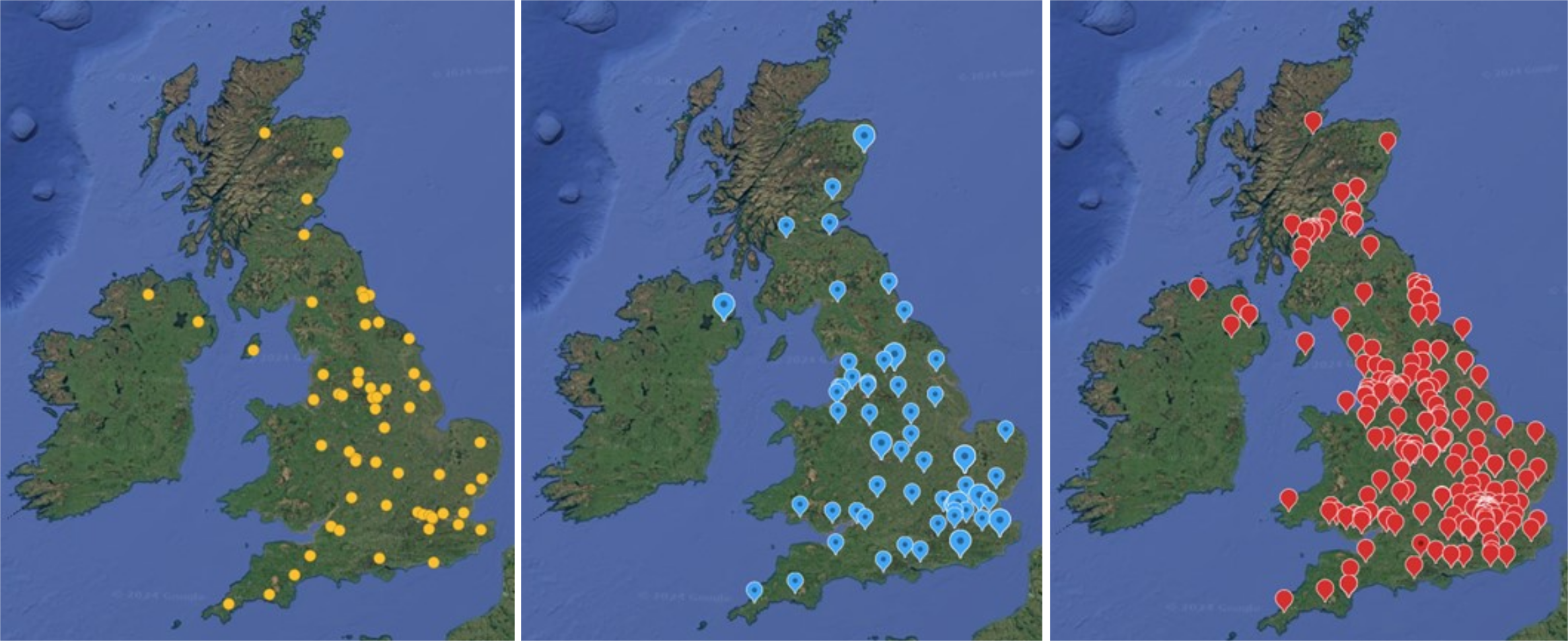
Yellow dots are for radiopharmacy locations, blue dots are for PET scanner locations and red dots are for nuclear medicine locations.
Some larger hospitals receive a bulk supply, which have been called a ‘hub’. These hospitals then prepare the radiopharmaceuticals in their radiopharmacy, package them and distribute by road to nearby smaller hospitals ready to administer to patients.
During the transport of radioactive materials, a transport index will be given and displayed on the package. It is a safety measure to help carriers and handlers know how much radiation is present and help to decide if any precautions are needed to be taken during transportation. The Transport Index (TI) is defined by the International Atomic Energy Agency (IAEA) as the number derived by multiplying the maximum radiation level (in micro sieverts per hour) at 1 metre from the external surface of the package by 100 (6).
Movement of packages by manufacturers
The IAEA Regulations for the Safe Transport of Radioactive Materials (6) recommends that radioactive materials are transported in specially designed packages. These provide shielding for the protection of workers, the public and the environment.
Package types are classified according to the activity and physical form of the radioactivity in the following order of increasing integrity:
- Excepted
- Industrial
- Type A
- Type B
- Type C
These regulations are effected by Regulations in Great Britain for different modes of transport (14). Radiopharmaceuticals are mostly transported in either Excepted or Type A packages: Excepted packages contained very low levels of radioactive material; Type A packages are designed to safely contain limited quantities (6). In addition, IAEA regulations require that packages are assigned categories I-White, II-Yellow and III-Yellow according to the surface dose rate of the packages. Most packages containing radiopharmaceuticals are labelled as I-White, indicating very low external radiation levels and minimal transport risk.
Data provided by 5 major manufacturers showed that approximately 135,000 packages were transported into and around the UK in 2023, as shown in Table 1. While this data does not represent the full picture due to incomplete data collection, it includes a substantial portion of the major manufacturers. Based on this, it is estimated that more than 200,000 packages are being transported across the entire industry. Each package varies due to the differences in radionuclides, such as half-lives, storage, dosage per individual patient, which means the supply is constantly changing.
Table 1. Summary of shipments of radiopharmaceuticals into and around the UK by 5 radiopharmaceutical manufacturers
| Radionuclide | Production | Purpose | Package type | Packages | Total TI |
|---|---|---|---|---|---|
| 18F | Cyclotron | Diagnostic, PET | Type A | 80,000 to 90,000 | 127,500 |
| 67Ga | Cyclotron | Diagnostic, PET | Type A | 70 | 214 |
| 68Ga | Cyclotron or reactor | Diagnostic, PET, Theranostics | Type A | 23 (1 generator each) | 7 |
| 123I | Cyclotron | Diagnostic, SPECT | Type A | 25,089 | 4,600 |
| 125I | Reactor | Therapy | Type A | 7 | 2 |
| 131I | Reactor | Therapy/ Theranostics | Type A | 8,093 | 5,800 |
| 111In | Cyclotron | Diagnostic, Theranostics | Type A | 781 | 275 |
| 192Ir | Reactor | Therapy | Type A | Unknown | Unknown |
| 177Lu | Reactor | Therapy/ Theranostics | Type A | Unknown | Unknown |
| 99Mo | Research reactor | Diagnostic, SPECT | Type A | 4,307 | 4,500 |
| 223Ra | Reactor | Therapy/ Theranostics | Type A | Unknown | Unknown |
| 81Rb/Kr | Cyclotron | Diagnostic | Type A | 458 | 160 |
| 186Re | Reactor | Therapy | Type A | 15 | 5 |
| 75Se | Reactor | Diagnostic | Excepted | 5,968 | 0 |
| 153Sm | Reactor | Pain management | Type A | Unknown | Unknown |
| 90Y | Reactor | Therapy/ Theranostics | Type A | 28 | 10 |
Most packages transported in the UK contained 18F, making it the most common radionuclide, 123 I was the second most prevalent. This contrasts with the previous report where most packages consisted of technetium generators. However, the earlier report included very limited data, as it relied on information from only one manufacturer in the medical sector, whereas the current study obtained data from five major manufacturers, although possible missing data reported from other smaller manufacturers means the data is incomplete. Based on the available data, this study shows technetium accounts for less than 0.05% of the radioisotopes supplied.
All packages, apart from 75Se, were transported in Type A packages; 75Se is transported as an Exempted package. For a package to be exempt during transport, it must meet specific packaging and documentation criteria, including a surface dose rate not exceeding 5 uSv h-1 and be under the activity concentration limits. For 75Se the activity concentration limit is 1 102 Bq g-1. If these limits are exceeded, stricter packaging and regulatory measures would be required (6).
Compared to the previous study, several radionuclides are no longer reported to be supplied by the 5 major manufacturers contacted. Although the data collected is incomplete, it still implies that the radionuclide market has changed quite significantly over the past decade.
Fluorine-18 has seen a substantial increase in clinical use in the last decade. In the previous study, a single manufacturer supplied data that 151 Type A packages containing 18F were transported, whereas in this study, that number has increased to 90,000 packages. Similarly, the use of 123I and 131I have increased over the last decade.
In contrast, the number of technetium generators delivered in the UK has dropped sharply from just under 40,000 packages in 2014 to fewer than 4,500 packages in 2024, representing almost a 90% decrease. It is worth noting that during the COVID-19 pandemic, the use of 99mTc was significantly disrupted, whereas the use of 18F remained largely unaffected. Since then, there have been several Europe-wide shortages of 99mTc. One shortage, which may have impacted this study, occurred in 2024 (14) when all three of the nuclear reactors used by a manufacturer to source 99mTc were offline for a combination of technical issues and essential planned maintenance works.
Although the UK has more than one 99mTc supplier, manufacturers not affected by these reactor outages because they sourced material from a different reactor were unable to increase production. As shown in Figure 2, 99mTc remains widely used, but ongoing supply shortages mean that demand is not always fully met.
The UK now imports most of its radiopharmaceuticals from other countries. In the previous study conducted in 2017, around 450 packages were reported as imported. By 2024 that number is estimated to have risen to over 150,000 packages. Although the earlier report relied on data from just one manufacturer, it indicates that, a decade ago, the UK was capable of exporting over 53,000 packages and transporting 24,000 domestically. This indicates that the UK was far less dependent on international supply at that time
Movement of packages by hospitals
Data was collected from hospitals through an online survey, which was completed by one third of the hospitals across the UK identified in Figure 1.
The survey aimed to capture information on:
- what radionuclides were used in hospitals
- how they were produced
- the supplier
- how the packages were transported
- the type of vehicle used in the transport
- where the packages were transport from and to
- the package types
- typical activity and TI
- frequency of movement of packages
- information on any onward transport
- the mode of this transport
- destination facilities
Figure 2 shows all hospitals within the UK that responded to the survey indicated they use 99mTc.
Figure 2. Hospital usage of radioactive material in the medical industry.
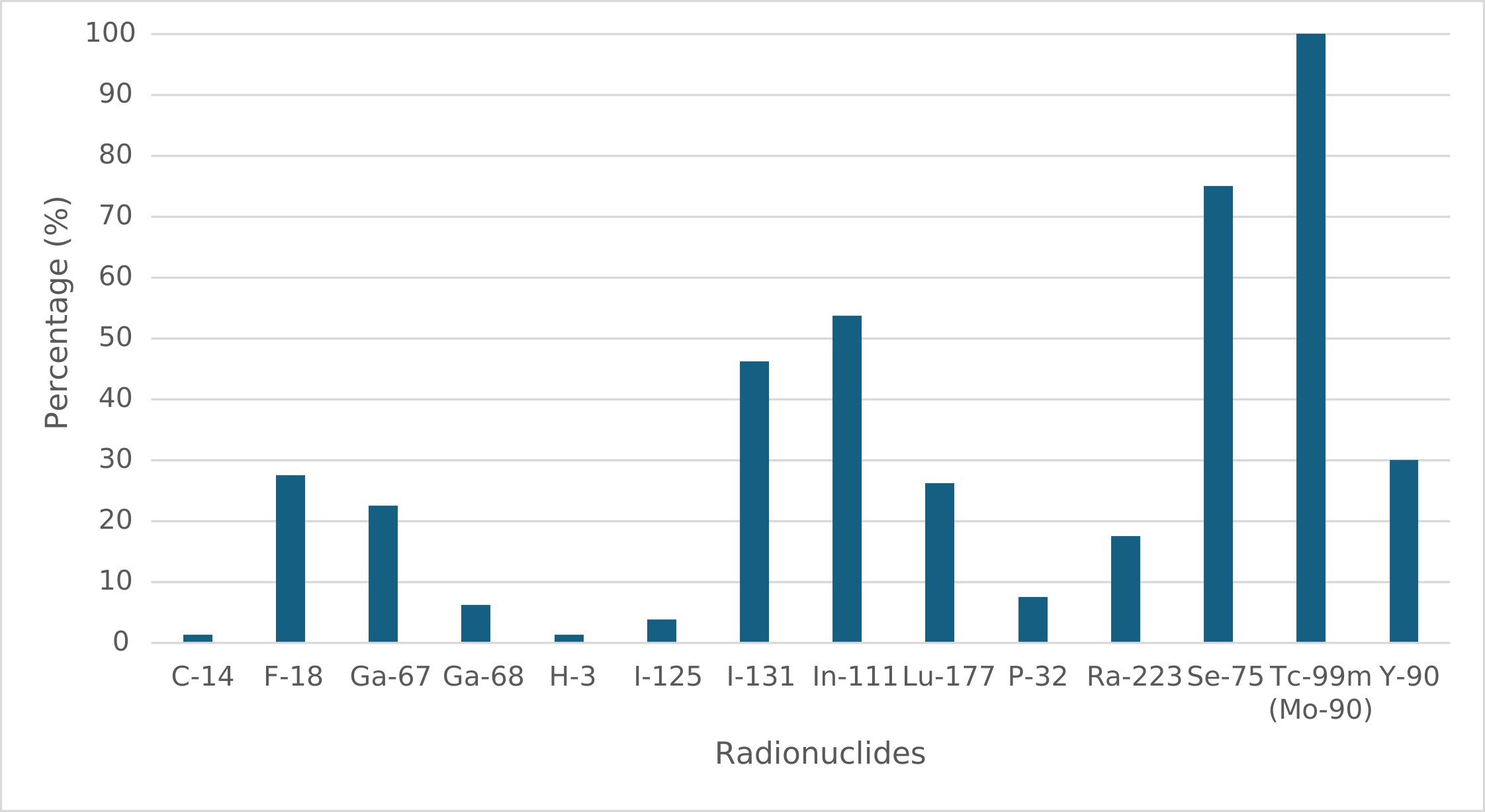
Percentage of hospitals that indicated the radionuclides used in their responses to the survey.
Although 99mTc (supplied as 99Mo generators) was the fifth most transported isotope to the UK in Table 1, this does not necessarily reflect its usage in hospitals. Fluorine-18 was indicated to have the most packages transported into the UK. However, only 28% of hospitals reported using it. In Figure 1 there are noticeably fewer PET scanner sites and radiopharmacies compared to nuclear medicines sites. Since 18F is commonly used in PET scanners and has a short half-life of under 1.5 hours. This implies that although many 18F packages are transported in the UK, UK hospitals must be properly equipped to handle and use it. Moreover, in the hospitals where 18F is used, it tends to be administered in substantial quantities. Figure 2 also indicates that 131I is the most used radionuclide for therapeutic procedures among the hospitals that participated in the survey, with just under half reporting its use.
Transport of packages by air
Data on the transportation of medical packages by air was collected from a courier operating at a UK airport. Most of these packages arrived in the UK, as shown in Table 2 and were then distributed to domestic locations via road couriers. However, some packages continued their journey by air to international destinations, as illustrated in Table 3.
Table 2 shows a summary of the radiopharmaceuticals arriving in the UK by air over a 6-month period. This data was collected at the same airport where a measurement survey was conducted. The information provided shows a wider variety of radionuclides being used in the UK compared to the data obtained from manufacturers and hospitals. However, as noted earlier, the data is incomplete and certain sectors such as private hospitals and research facilities were not included. The import of radioactive sources and radionuclides used for other purposes may also be included and these are indicated in Table 2.
Table 2. Summary of radionuclides used in the medical sector arriving by air at a UK airport over 6 months.
| Radionuclide | Number of Packages | Activity (Bq) | Total TI |
|---|---|---|---|
| 225Ac | 4 | 3.90 107 | 0 |
| 14C | 13 | 1.58 1011 | 0.8 |
| 60Co | 7 | 3.94 1010 | 2.8 |
| 51Cr | 12 | 1.37 109 | 1.2 |
| 137Cs | 6 | 1.20 1011 | 11.4 |
| 55Fe [note 1] | 2 | 2.91 1010 | 1 |
| 68Ga | 7 | 9.95 1010 | 1.8 |
| 68Ge [note 1] | 3 | 2.55 109 | 0.9 |
| 166Ho | 14 | 6.50 1010 | 13.5 |
| 121I | 15 | 5.89 1010 | 6.1 |
| 123I | 1,277 | 5.47 1012 | 197.6 |
| 125I | 50 | 6.87 1010 | 1.5 |
| 131I | 1,072 | 3.05 1012 | 448 |
| 111In | 63 | 2.01 1010 | 19.2 |
| 192Ir | 10 | 2.70 1013 | 3.1 |
| LSA-I1 [note 1] | 7 | 0 | 0.7 |
| 177Lu | 1,045 | 8.58 1012 | 0 |
| 99Mo | 213 | 3.18 1013 | 468.9 |
| 63Ni [note 1] | 3 | 8.32 1010 | 0.3 |
| 32P | 42 | 1.80 109 | 2.6 |
| 223Ra | 85 | 1.94 1010 | 0 |
| 35S [note 1] | 1 | 6.31 108 | 0 |
| 75Se | 175 | 2.64 1013 | 0.1 |
| 82Sr | 3 | 1.36 1010 | 1.8 |
| 85Sr [note 1] | 2 | 1.24 1010 | 0 |
| 182Ta [note 1] | 2 | 2.91 1010 | 1 |
| 181W [note 1] | 2 | 2.91 1010 | 1 |
| 185W [note 1] | 2 | 2.91 1010 | 1 |
| 90Y | 78 | 8.56 1011 | 38 |
| 169Yb | 5 | 1.67 1012 | 1.7 |
| 89Zr | 36 | 1.01 1010 | 22.4 |
| Excepted packages | 1,191 | 0 | 0.6 |
| Total | 5,441 | 4.14 1013 | 1,244.6 |
Note 1: These radionuclides are not administered to patients and may be used for other purposes (5, 13)
1 Low Specific Activity (LSA) material. LSA-I, one of the categories of LSA material defined in regulations for the transport of radioactive material. LSA refers to a radionuclide within a naturally occurring ore that is classified as low specific activity for transport purposes.
The isotope quantities in this dataset closely align with those reported by manufacturers, suggesting consistency with expected production or usage patterns: 131I, 123I and 75Se are some of the most in-demand radioisotopes being delivered to the airport; 99Mo is the fourth most transported radioisotope at the airport and annual projections suggest that nearly 10% of the manufacturer’s packages are delivered to this airport. Table 1 does not specify the number of packages of 177Lu, but available data in Table 2 indicates that 177Lu was the third most frequently received radioisotope at the airport. This suggests that 177Lu is a popular and widely used radioisotope in the UK. Radioisotopes with high delivery volumes delivered to the airport likely reflect significant use in medical diagnostics and treatment.
The distribution of the package deliveries across the radioisotopes is positively skewed: a few radioisotopes accounting for a very high number of packages while the majority have relatively low delivery volumes.
Table 3 shows a summary of packages that continued their journey by air to other destinations but arrived in the UK from a different international destination. Observations during the measurement survey conducted at this airport showed these were stored in a bunker until the plane was ready to take the packages to another airport. While most package will be sent to other UK airports, some are transported to other counties such as Poland and Sweden outside the UK.
Table 3. Summary of radiopharmaceuticals shipped from UK to other airports
| Radionuclide | End Destination | Number of packages | Sum of Activity (Bq) | Total TI |
|---|---|---|---|---|
| 60Co | Stockholm (ARN) | 6 | 3.49 1010 | 2.6 |
| 137Cs | Stockholm (ARN) | 6 | 1.20 1011 | 11.4 |
| Excepted | Belfast (BFS) | 8 | 0 | 0 |
| Excepted | Dublin (DUB) | 3 | 0 | 0 |
| Excepted | Keflavik (KEF) | 1 | 0 | 0 |
| Excepted | Warsaw (WAW) | 6 | 0 | 0 |
| 123I | Belfast (BFS) | 863 | 4.92 1012 | 108.8 |
| 125I | Belfast (BFS) | 1 | 7.49 106 | 0.1 |
| 131I | Belfast (BFS) | 130 | 4.47 1011 | 90 |
| 111In | Belfast (BFS) | 63 | 2.01 1010 | 19.2 |
| 192Ir | Warsaw (WAW) | 1 | 1.78 1011 | 0.1 |
| 1LSA | Warsaw (WAW) | 7 | Unknown | 0.7 |
| 177Lu | Belfast (BFS) | 3 | 2.58 1010 | 0 |
| 99Mo | Belfast (BFS) | 175 | 2.89 1013 | 395.4 |
| 99Mo | Guernsey (GCI) | 15 | 7.8 1011 | 19.7 |
| 32P | Belfast (BFS) | 1 | 3.31 108 | 0.3 |
| 223Ra | Belfast (BFS) | 96 | 1.95 1010 | 0 |
| 223Ra | Seville (SVQ) | 1 | 1.38 107 | 0 |
| 90Y | Belfast (BFS) | 1 | 1.64 109 | 0.2 |
For the packages that are transported from an English airport to a Northern Irish airport, the most common radioisotope is 123I, followed by 99Mo, 131I and radium-223 (223Ra). It is unknown how much 223Ra is brought into the UK per year. It is used to treat advanced prostate cancer so if there is an increase in patient cases, the demand for this radionuclide may increase supply in the future. Just over 15% of the hospitals indicate they use 223Ra which could imply its supply is limited to specific hospitals set up to use this radionuclide. Fluorine-18 (18F) is not transported from this UK airport but could be supplied from others and transported directly into Northern Ireland due to its short half-life.
In the last report, over 53,000 packages were recorded as being exported from the UK. While data from Table 3 indicates that some packages are transported internationally, many no longer originate from the UK. In certain cases, UK airports serve as transit points where packages temporarily stop before continuing to their final destinations.
Transport of packages by road
During the study, 2 couriers provided information on the transport of radiopharmaceuticals by road within the UK. Table 4 details the data supplied by one UK road courier on their transport of radiopharmaceuticals in the UK by van.
Table 4. Summary of radiopharmaceuticals being transported from one UK courier by road
| Radionuclide | Number of Packages | Package Type | Max activity per Transport (GBq) | Total TI |
|---|---|---|---|---|
| 99Mo/99mTc | 55 | Type A | 545 | 5.9 |
| 137Cs | 5 | Type A | 392 | 12.5 |
| 241Am | 2 | Type A | 470 | 0.4 |
| 137Cs | 20 | Type A | 59.2 | 36 |
| 60Co | 1 | Type B | 1.90 105 | 0.8 |
| 177Lu | 1 | Type A | 64 | 0 |
A second road courier described how they carry out their deliveries by road. The company typically collects from airports early in the morning and then drives to rented premises where the packages can be split up between multiple drivers for onward delivery. This courier reported that 40 to 50% of packages are delivered to sites in London, with others sent to Manchester, Liverpool, Sheffield, Newcastle, Glasgow, Birmingham, Guildford, Kent, Sutton in Surrey, Bristol, Plymouth and Oxford.
This courier transported 1,052 Excepted packages and 2,913 Type A packages in a year. The Excepted packages were transported domestically, usually containing standard testing sources with a frequency of 1 package per month for one client and for another client less than 5 packages per month. The Type A packages consisted of 2,700 medical radioisotopes. Of these, 2,500 arrive via a UK airport and were mostly classified as White category I packages. The remaining 200 were collected from another UK airport. The company has 25 drivers on rotation. The company has recently started delivering 18F to hospitals. It was estimated that there would be around 1,000 packages per year delivered at a distance of up to 2 hours’ drive.
Assessment of doses to workers involved in the transport of radiopharmaceuticals
Annual effective doses were estimated for workers involved in the transport operations (loading and unloading) and to drivers of the vehicles carrying the radioactive material. Doses were also calculated for members of the public who may be exposed during the transport of radioactive material. These are people who may be present at the premises during loading and unloading but are not directly involved in the operations or live along the transport route. The estimates of doses to the transport workers were based on observations of each of the tasks during site visits. These calculations took account of the time spent on each task, the number of shipments, the Transport Index (TI) of the packages in each shipment and the total annual TI of all packages handled.
Tables 5 (a to c). Estimated radiation doses to multiple warehouse operatives and van drivers due to the transport of radiopharmaceuticals in the UK
(a) Radionuclide 90Y
| Person/task | Doses per task (µSv) | Collective annual dose in 2025 (µSv/y) |
|---|---|---|
| Warehouse operatives | 70 | 3.5 103 |
| Warehouse operative + forklift drivers | 80 | 4.0 103 |
| Dolly drivers | 120 | 6.0 103 |
| Van drivers | 35 | 2.0 103 |
(b) Radionuclide: 111In
| Person/task | Doses per task (µSv) | Collective annual dose in 2025 (µSv/y) |
|---|---|---|
| Warehouse operatives | 215 | 1.0 104 |
| Warehouse operative + forklift drivers | 220 | 1.0 104 |
| Dolly drivers | 5 | 3.0 102 |
| Van drivers | 110 | 6.0 103 |
(c) Radionuclide: 177Lu
| Person/task | Doses per task (µSv) | Collective annual dose in 2025 (µSv/y) |
|---|---|---|
| Warehouse operatives | 0.5 | 3.0 101 |
| Warehouse operative + forklift drivers | 1 | 3.5 101 |
| Dolly drivers | 0.5 | 1.5 101 |
| Van drivers | 0.05 | 3.0 100 |
The estimated radiation doses presented in Tables 5 (a to c) represent the total collective doses to multiple warehouse operatives and van drivers over the course of a year. These values do not indicate that a single individual would receive the entire dose.
During the measurement survey, radiation doses recorded at the driver’s seat were negligible due to effective shielding placed between the driver and the packages within the van. As a result, the driver’s primary exposure occurs only during the loading of the packages. In some cases, the forklift driver was also the same individual as the warehouse operative, so for one of the dose assessments, these roles were combined. Even with this consolidation, the radiation dose received by workers remained minimal.
The highest recorded doses were associated with the transport of 111In. Over a six-month period, 72 packages of 111In were transported, projecting to approximately 140 packages annually. To estimate annual exposure, it was assumed that a single worker would handle one 111In package per week. However, these tasks are typically shared across multiple workers on rotating shifts, meaning individual doses are further reduced.
Table 6. Estimated doses to van drivers and members of the public exposed during the transport of 18F
| Exposed person | Position of measurement | Dose per journey (μSv) | Transport Index |
|---|---|---|---|
| Driver | Driver’s seat | 0.5 | 1.3 |
| - | Handling side of package during unloading | 1.3 | 1.3 |
| - | Total | 1.8 | 1.3 |
| Member of the public | Rear of the van | 0.4 | 1.3 |
The estimated dose to the driver was calculated using dose rate measurements taken during a delivery of 18F to a hospital, involving one Type A package with a Transport Index of 1.3. To calculate the dose received by the driver, the journey time was used along with dose rate measurements taken at the driver’s seat and the side of the package. The side was chosen instead of the top because it had a higher dose rate. The time taken for the driver to unload the package and transport it to the hospital using a trolley was also included and estimated to be 1 minute.
The estimated dose to the public was calculated assuming that the member of the public was 1m behind the van, representing a scenario such as waiting in traffic lights or in a traffic jam. An exposure duration of 1 minute was also used for this assessment.
Transport of radiopharmaceutical waste
As most radiopharmaceuticals have a relatively short half-life, for example 99mTc (around 6 hours) and 18F (under 1.5 hours), hospitals typically store radioactive waste in designated rooms to allow for decay. Once the radioactivity has decayed to safe levels the materials are disposed of as conventional waste.
One of the primary pathways for radiopharmaceutical waste is through the patient. After administration, the radionuclide remains in the patient’s body for a period of time before being excreted. Consequently, waste from this pathway typically enters the sewage system, with hospitals being the main source of such waste.
Another identified waste stream involves the use of generators, such as those for 99mTc or 68Ga. Once depleted, the generators are collected by a courier company and returned to the manufacturers for reuse. At this stage, the residual radioactivity is low, and the generators do not require Type A packages for transport.
Unlike the previous report, which estimated doses due to the transport of low-level radioactive waste for recycling, storage and disposal, this study did not calculate doses from medical waste transport. This is due to the very low levels of residual radioactivity following decay, which renders the waste comparable to standard non-radioactive waste. As a result, any associated radiation doses would be extremely low and difficult to measure reliably.
Conclusions
The transport of packages reviewed in this report provides a snapshot of radiopharmaceuticals currently shipped and used in the UK in 2023. The list of radioisotopes, such as 18F and emerging therapies like 177Lu, closely mirror the quantities reported by manufacturers and reflects both established and growing trends in nuclear medicine.
A critical aspect underpinning the availability of these radiopharmaceuticals is the transport infrastructure. Given the short half-lives of many isotopes, particularly those used in diagnostic imaging, reliable and timely transport is essential. The UK sometimes operates a hub-and-spoke model, where larger hospitals act as hubs by receiving shipments and then redistributing to nearby hospitals that are smaller or have little or no radiopharmaceutical facilities. These deliveries often occur multiple times per day, requiring coordination with specialist couriers, radiation shielding, and strict compliance to transport regulations, and secure handover and storage arrangements at the receiving site.
Transport methods differ based on the radioisotope’s origin: reactor-produced isotopes such as 99Mo generators are imported and distributed domestically once received and cyclotron or accelerator produced isotopes (like 18F) are delivered from nearby production sites due to their short half-life.
The majority of radiopharmaceuticals used in the UK are imported from manufacturers based in various countries, making the UK highly dependent on international supply chains. These imports primarily enter the country via air or through the Channel Tunnel. Manufacturers have not indicated the use of alternative transport routes.
Within the UK, most radiopharmaceuticals are distributed via road transport, typically by specialist couriers using vans equipped to handle radioactive materials. For cross-border movement within the UK, for example from England to Northern Ireland air transport is again used due to the requirement for speed of delivery. There are several courier companies operating within the UK nuclear medicine sector, however, not all of them handle the full range of radiopharmaceuticals.
Recent challenges such as COVID-19, when supply chains were disrupted and the logistical complications following Brexit, have underlined the fragility of these systems. Despite this, transport networks have remained resilient, though they will require continued investment and contingency planning. In the lead-up to Brexit, concerns over customs delays and border disruption led to a shift toward air transport, as it offered more reliability compared to rail. This trend has continued post-Brexit, with air remaining the dominant mode of entry, although a significant portion still arrives via the Channel Tunnel.
As medical technology advances, new tools and imaging equipment are emerging. During a site visit prior to the measurement survey, a new type of PET scanner was being trialled within hospital theatres highlighting how technological innovation could drive demand for new or more diverse radiopharmaceuticals in the near future.
Despite this innovation, the stability of radiopharmaceutical supply in the UK remains a challenge. The country’s reliance on foreign reactors, international transport logistics, and tight delivery schedules creates vulnerability in the supply chain. Any disruption, be it logistical, political, or technical can have a direct impact on patient services and nuclear medicine operations.
The radiation dose received by the public and drivers during the transport of radiopharmaceuticals is generally very low and well within safety limits, thanks to effective shielding, packaging standards, and regulatory supervision. However, as new modes of transport are introduced and the UK supply chain expands or evolves, it is important that regular monitoring and safety assessments continue. This will help to ensure that exposure levels remain minimal and that any changes in logistics do not unintentionally increase risks to workers or the public.
Currently, there is limited publicly available information about the radiopharmaceutical supply chain and market in the UK. This lack of transparency can make it difficult to assess infrastructure strengths, identify vulnerabilities, or plan for future demand. Establishing a clear and centralised overview of the UK’s radiopharmaceutical infrastructure could be highly beneficial. It would support better coordination, facilitate more effective contingency planning, and help prevent disruption or systemic failures by identifying and addressing gaps in the supply network.
The UK radiopharmaceutical market is currently operated by several independent companies, with no centralised government supervision or control. While regulatory bodies require appropriate documentation for the transport of radioactive packages, there is no obligation to specify the intended use, such as whether the material is for medical purposes. In contrast, countries like Belgium have implemented more comprehensive systems. For example, in a recent presentation of their 2022 data, it was reported that 94% of radioactive packages transported by road were for medical and research use (15). Without a similarly structured system in the UK, identifying issues and collecting meaningful detailed data remains challenging.
This study revealed that a significant number of packages containing radioactive material for medical use are transported into and around the UK each year. While issues were identified within the supply structure, including a lack of accessible information, the data collected provided a valuable overall picture of the annual activity. The majority of movements within the UK occur by road, a mode considered safe for both the public and workers due to the low levels of radioactivity involved and safety measures such as vehicle shielding. Although handling the packages represents the primary pathway for radiation exposure, the low activity of the materials and the rotation of staff ensure that individual annual doses remain low. While road transport dominates within the UK, air transport was found to be the primary mode for packages imported from abroad.
Acknowledgments
We would like to extend our sincere gratitude to Lisa Rowley, Head of the Nuclear Medicine Department at University Hospital Coventry and Warwickshire NHS Trust, whose invaluable support and guidance greatly contributed to the success of this study. We also thank the hospitals that participated in the study, as well as the manufacturers and road couriers who generously provided us with data essential for our analysis. Our thanks go to the hospital that kindly allowed us to conduct a measurement survey on their premises, and to the airport courier who not only supplied data but also facilitated a measurement survey at their site.
We are grateful to the drone company for their assistance in answering our questions and helping us establish important contacts. We also appreciate Kings College London for providing us with an insightful tour of the CARL facilities, and Radionuclides for Health UK for sharing valuable information that supported our work.
References
- Hughes, J. S. and M. P. Harvey, A Survey into the Radiological Impact of the Normal Transport of Radioactive Material by Sea, in HPA-RPD Series. 2009, Health Protection Agency: Chilton (UK).
- Harvey, M. P. and J. S. Hughes, Survey into radiological impact of normal transport of radioactive material by sea. Packaging, Transport, Storage and Security of Radioactive Material, 2011. 22(1): p. 35 to 40.
- Harvey, M. P., and others, Survey into the radiological impact of the normal transport of radioactive material by air. 2014, Public Health England: Chilton (UK).
- Jones, A.L. and T. Cabianca, Survey into the Radiological Impact of the Normal Transport of Radioactive Material in the UK by Road and Rail, in PHE CRCE Series. 2017, Public Health England: Chilton (UK).
- UKHSA. Ionising Radiation and You. Ionising radiation exposure of the UK population. 2025. Cited 2025 3 July 2025.
- IAEA, Regulations for the Safe Transport of Radioactive Material. 2025 Edition, in IAEA Safety Standards Series. 2025, International Atomic Energy Agency,: Vienna (Austria).
- Zoi, V., and others. Nuclear Medicine and Cancer Theragnostics: Basic Concepts. Diagnostics (Basel), 2023. 13(19).
- N. Smith, A.A.-B., and R. Nutbrown, Assessing Radionuclide Usage for Diagnostics and Therapies in the NHS: A Cross-Nation Data Investigation. 2024, Department for energy security and net zero.
- World Nuclear Association. Radioisotopes in Medicine. 2025 cited 2025 June.
- NEA, The supply of Medical Radioisotopes, in An Economic Diagnosis and Possible Solutions. 2019: Paris.
- NHS England, Diagnostic Imaging Dataset Annual Statistical Release 2022/23. 2023: NHS England.
- Netherlands, N., Medical isotopes Global importance and opportunities for the Netherlands in a European context. 2017.
- European Commission. European study on medical, industrial and research applications of nuclear and radiation technology. 2019: European Union, Luxembourg.
- UK Parliament, The Radioactive Material (Road Transport) (Amendment) Regulations 2003, in London. 2003, UK Parliament.
- Bande, T. Transport of radioactive material in Belgium. IN TRANSCC 48, 2024, Vienna.