Project Gigabit progress update: September 2026
Published 22 September 2026

© Crown copyright 2026
This publication is licensed under the terms of the Open Government Licence v3.0 except where otherwise stated. To view this licence, visit nationalarchives.gov.uk/doc/open-government-licence/version/3 or write to the Information Policy Team, The National Archives, Kew, London TW9 4DU, or email: psi@nationalarchives.gov.uk.
Where we have identified any third party copyright information you will need to obtain permission from the copyright holders concerned.
This publication is available at https://www.gov.uk/government/publications/project-gigabit-progress-update-september-2026/project-gigabit-progress-update-september-2026
Reaching 99% gigabit-capable coverage
The government has committed to making gigabit-capable broadband available to 99% of homes and businesses by 2032. Faster, more reliable networks can improve how people work, learn, access public services and run businesses, while supporting economic growth in communities across the UK.
The UK has already made significant progress towards this target. According to Ofcom, gigabit-capable broadband is now available to more than 88% of homes and businesses, with approximately 4 million premises remaining without coverage.
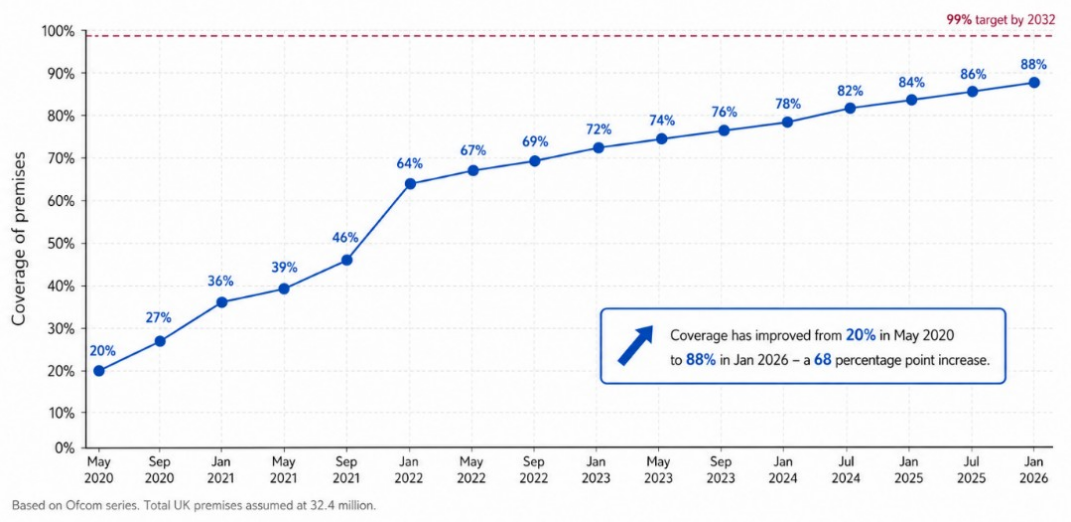
Figure 1: progress towards nationwide gigabit-capable broadband coverage
The graph shows broadband coverage of UK premises between May 2020 and January 2026. Coverage has improved from 20% in May 2020 to 88% in January 2026. This is a 68 percentage point increase.
Government action has helped extend broadband coverage across the UK by promoting competition, encouraging investment in networks and removing barriers to deployment. While much of this progress has been delivered through private sector investment, some homes and businesses remain too costly or complex for the market to reach without targeted public funding.
Project Gigabit is the government programme to bring gigabit-capable broadband to homes and businesses unlikely to be reached through commercial, privately-funded rollout alone. In July 2026, Building Digital UK (BDUK), which delivers Project Gigabit, transferred to the Department for Digital, Culture, Media and Sport. This change does not affect the government’s commitment to Project Gigabit or its delivery plans.
As of March 2026, the programme had helped bring gigabit-capable broadband to 1.4 million homes and businesses, with delivery focused first on harder-to-reach areas. More than £2 billion has already been committed through signed Project Gigabit contracts, supporting further rollout across the UK.
The path to nationwide coverage
Project Gigabit has so far focused on homes and businesses where there is clear evidence that broadband providers will not deliver gigabit-capable broadband as part of their commercial plans. This has helped bring gigabit-capable connections to many rural communities across the UK, including villages, hamlets and remote areas.
Some rural gaps remain, but premises without gigabit-capable broadband are increasingly concentrated in towns, cities and other built-up areas. These are often in locations that are more complex or less commercially attractive for broadband providers to serve.
It is not yet possible to say exactly how many of the remaining 4 million premises will need public support for the UK to reach 99% coverage. Broadband providers continue to expand their networks and revise their plans. As those plans change, some premises may become eligible for government support while others may no longer need it.
For this reason, BDUK currently reviews providers’ plans every four months to identify which premises are still expected to receive commercial coverage. This helps ensure that public funding is used only where there is no credible commercial plan for gigabit-capable broadband. If a provider changes or withdraws its plan, BDUK can consider the affected premises for future Project Gigabit support.
Some premises face practical barriers to delivery, such as difficulties securing access to land, buildings or other infrastructure needed to build networks. The government is working with industry and other stakeholders to resolve these barriers and support further roll out.
The next phase of Project Gigabit delivery
For homes and businesses that need public support, BDUK works with broadband providers to identify the most suitable way to deliver gigabit-capable broadband.
Where premises are close to a Project Gigabit contract in delivery, BDUK may add them to build plans if this is practical and offers good value for money. Between January and July 2026, for example, BDUK added premises to existing contracts covering parts of Essex, Herefordshire and Shropshire.
Where an existing contract cannot be utilised, BDUK may run a new local procurement to reach smaller clusters of homes and businesses. It will use this approach only where it can deliver coverage quickly and cost effectively.
For areas where these delivery routes are not credible, BDUK will use its existing cross-regional framework agreement. This is designed to reach premises where there is not enough market appetite or capacity to support another type of intervention. BDUK intends to complete the awards under the framework by the end of 2027.
Together, these contracts will help secure the remaining delivery needed to support the path towards 99% gigabit-capable coverage by 2032. We will continue to engage with broadband providers as plans for the remaining premises develop and publish information on future delivery activity through government commercial communication channels and Find a Tender Service.
In cases where a contract cannot be completed, BDUK will seek to secure another broadband provider to deliver gigabit-capable coverage to the affected premises as quickly as possible. For example, a Project Gigabit contract covering parts of the Peak District ended by mutual agreement in 2025. Less than a year later, the affected premises were included in another Project Gigabit contract through the cross-regional framework.
Delivery in the devolved nations
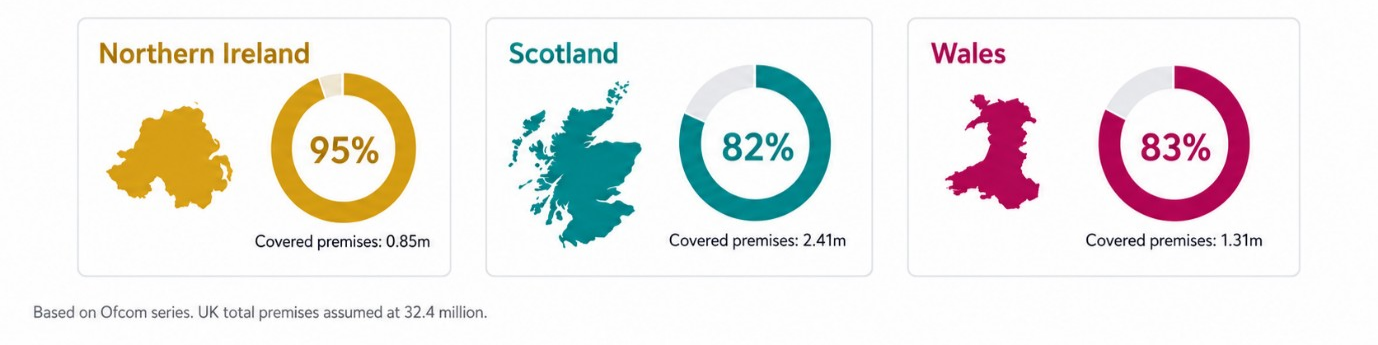
Figure 2: Gigabit-capable broadband coverage across the devolved nations
The graphic shows gigabit-capable broadband coverage across the devolved nations. Northern Ireland has 95% coverage, with 0.85 million premises covered. Scotland has 82% coverage, with 2.41 million premises covered. Wales has 83% coverage, with 1.31 million premises covered. This is based on Ofcom data of a UK total premises assumed at 32.4 million.
In Northern Ireland, a Project Gigabit contract with Fibrus will extend gigabit-capable coverage to a further 9,000 premises. Over 2,400 premises have already been given coverage following the first phase of delivery.
In Scotland, Project Gigabit contracts with GoFibre and Openreach are supporting delivery across areas including the Borders, East Lothian, Central, Northern and Western Scotland, Dumfries and Galloway, and the North East of Scotland. More than 5,600 premises have already been reached through these contracts. Further procurements are also being considered across other parts of Scotland.
In Wales, around 60,000 premises are expected to benefit through Project Gigabit contracts with Openreach, with more than 7,000 premises already reached. To date, over 28,000 premises have also received a gigabit-capable connection through voucher-funded delivery, while the previous Superfast Broadband Programme provided around 100,000 premises with gigabit-capable coverage.
Government action to remove other barriers to coverage
Public funding will not resolve every barrier to coverage. Some premises face practical issues such as securing permission to cross private land, known as wayleaves, local planning constraints, or access to blocks of flats and other multi-dwelling buildings.
BDUK is tracking specific groups of premises where the delivery challenge is different from standard network build. For example, multi-dwelling buildings, where fibre may already be close to the building, but further work is needed to secure access, permissions or in-building deployment.
We will use a range of approaches to address these issues, including engagement with broadband providers and wider work to remove access and planning barriers. This includes the government’s recent Call for Evidence on Planning Reform, as well as proposed legislative changes to give leaseholders the right to request gigabit-capable broadband connections, supporting faster rollout and helping to remove barriers to deployment.
The government has already taken action to support gigabit connectivity in new homes through additions to building regulations. New homes in England are generally required to be built with gigabit-ready infrastructure and gigabit-capable broadband connections. As a result, new-build premises are not generally included within the scope of Project Gigabit.
Alternative technologies for the very hardest-to-reach premises
A small proportion of premises are expected to remain exceptionally difficult or too costly to connect through Project Gigabit. These premises are not included in the scope of the programme.
The government will continue to assess these premises separately. It is also monitoring and supporting the development of alternative technologies, such as fixed wireless access and satellite broadband, so that Very Hard to Reach premises can access good quality broadband.
Ultrafast broadband, with download speeds of at least 100Mbps, is already widely available across the UK through fixed wireless access and satellite broadband and many remote and rural premises already use those services. Additional satellite options are expected to come to market in 2026 to 2027.
Keeping up to date on Project Gigabit
-
Use the GOV.UK address checker to find out whether gigabit-capable broadband is available at your address, planned for your address, or not currently included in any known plans.
-
Visit the Project Gigabit contract pages to see which contracts have been awarded, which broadband provider is delivering them, how many premises are expected to benefit and where contracts have changed.
-
Read BDUK’s monthly contract-level data and quarterly delivery updates to see how many premises are included in contracts and how many have been reached.
-
View BDUK’s Open Market Review data, which shows its latest understanding of current gigabit coverage, future commercial rollout plans and premises included in BDUK interventions. You can use thinkbroadband’s coverage maps to explore the data further.
-
Visit the BDUK Research Portal, which brings together evaluations, research reports and analysis relating to the programme’s design, delivery and impact.